ChatGPT's Temporary Chat feature gets upgrade to retain personalization without saving history


3 Sources
3 Sources
[1]
ChatGPT's Version of Incognito Mode May Soon Remember Who You Are
With over a decade of experience reporting on consumer technology, James covers mobile phones, apps, operating systems, wearables, AI, and more. Temporary Chat on ChatGPT may soon be easier to use than ever before. The feature works similarly to Incognito Mode in Google Chrome or private browsing features in Edge, Firefox, or Safari, creating a session that won't record your history or affect future recommendations. ChatGPT's current version starts afresh, without any of your personalization changes or search history influencing its responses. A new toggle, spotted by AI engineer Tibor Blaho and shared on X, lets you enable the Personalize replies feature in a Temporary Chat. Blaho's post was first reported by Bleeping Computer. The feature doesn't appear to be available to everyone, with PCMag unable to access it at the time of writing. Blaho refers to it as a "currently hidden option," but it's unclear whether Blaho has access as part of a test or whether it was activated through other means. If you turn the feature's toggle on, it uses ChatGPT features such as memories, history, and your style and tone preferences in the private results. This lets you get similar responses from ChatGPT without it recording what you're searching for, which is helpful when you want to prevent your search from affecting its history. The way the feature currently works means you revert to a basic version of the chatbot in a Temporary Chat, which lacks the personal touch you may have spent years building with OpenAI's tools. The brand says it will retain messages for up to 30 days. However, OpenAI says this data isn't used for training, and it also warns that third-party GPT tools may also keep data for longer. OpenAI says, "If the GPT has actions, data sent to third parties through those actions is subject to the recipient's privacy policy. That means the recipient may keep that data for longer than 30 days and may use it for other purposes." Disclosure: Ziff Davis, PCMag's parent company, filed a lawsuit against OpenAI in April 2025, alleging it infringed Ziff Davis copyrights in training and operating its AI systems.
[2]
ChatGPT Temporary chat feature is getting a much-needed upgrade
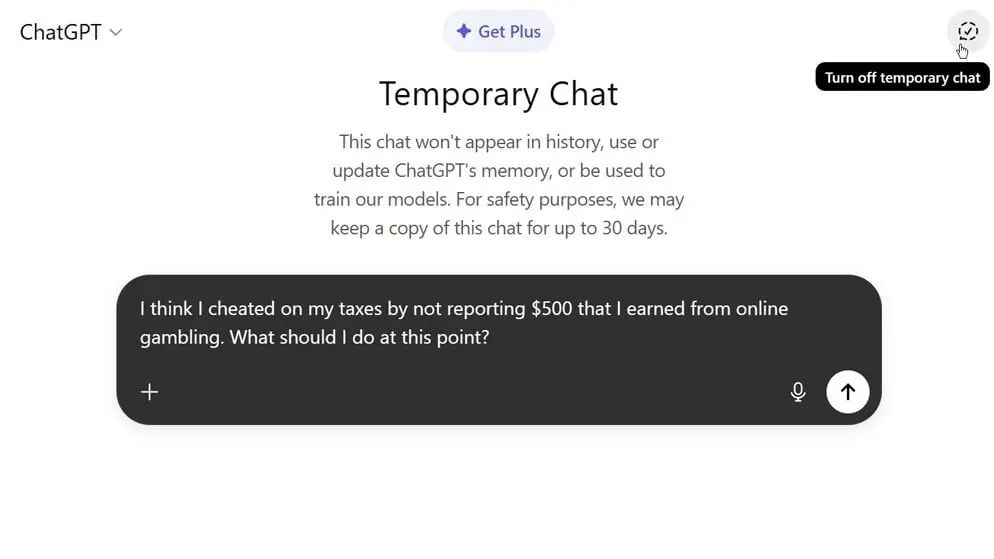
OpenAI is testing a big upgrade for ChatGPT's temporary chat feature. The update will allow you to retain personalization in temporary chat, and still block temporary chat from influencing your account. For those unaware, Temporary Chat in ChatGPT is a mode where you start with a fresh slate. In this chat, ChatGPT won't use or reference your past conversations or any saved memories, even if you normally have memory turned on. It will still follow your Custom Instructions if those are enabled, but the conversation itself is treated as "don't remember this." Temporary Chats also won't show up in your chat history, and they won't be used to improve the models. As spotted on X, after a new update, ChatGPT's temporary chat now retains personalization (memory, chat history, style, and tone preferences). The chat remains temporary, but it will now have access to your personalization, and it can be turned off. For safety reasons, OpenAI may still keep a copy of the chat for up to 30 days. To start one, open a new chat and click the pill-shaped "Temporary" button in the top-right corner. More recently, OpenAI rolled out the ChatGPT Age prediction model to identify a user's age based on their chat pattern, conversation behaviour, among other factors. OpenAI warns that its AI model is not perfect, so it may detect that some adult users are teenagers and restrict their accounts. At the same time, it might be tricked by teenagers with adult behavior. Restricted accounts can still learn, create, and ask questions, but you won't be able to interact on topics like violence, gore, viral challenges on TikTok-like platforms, etc. If incorrectly restricted, adult users can verify their age to unlock the full GPT experience.
[3]
ChatGPT has a new hidden Temporary Chats setting
AI engineer Tibor Blaho discovered the optional feature, though OpenAI may still store chat copies for up to 30 days for security purposes. OpenAI is testing an update to ChatGPT's "Temporary Chat" feature. Temporary Chat allows you to "have a conversation with a blank slate" where "ChatGPT won't be aware of previous conversations or access memories." It's a lot like Incognito Mode in Chrome, which you can use to "privately" browse the web -- except here, it's chatting. The update to Temporary Chat will sort of tweak this, allowing ChatGPT to retain your personal customizations without the conversation itself being saved or affecting your overall account. This change was first discovered by AI engineer Tibor Blaho on social media, who found an undisclosed setting for it in the AI chatbot. He describes it as "a new, currently hidden option that lets you still use personalization (memory, chat history, style and tone preferences) even though the chat is only temporary." The new Temporary Chat setting will be optional (for now?) and can be disabled. It isn't yet available to all users. However, for security reasons, OpenAI may store copies of your chats for up to 30 days.
Share
Share
Copy Link
OpenAI is testing a significant upgrade to ChatGPT's Temporary Chat feature that allows users to maintain personalized preferences while keeping conversations private. The hidden setting, discovered by AI engineer Tibor Blaho, enables memory, chat history, and style preferences in temporary sessions without affecting your account or being saved permanently.
ChatGPT Temporary Chat Feature Upgrade Bridges Privacy and Personalization
OpenAI is testing a significant update to ChatGPT's Temporary Chat feature that addresses a long-standing limitation in the AI chatbot's privacy mode. The temporary chat feature upgrade introduces a new toggle that allows users to retain personalization settings while keeping their conversations private and unsaved
1
. AI engineer Tibor Blaho discovered the hidden Temporary Chats setting, describing it as "a new, currently hidden option that lets you still use personalization (memory, chat history, style and tone preferences) even though the chat is only temporary"3
. The feature works similarly to ChatGPT Incognito Mode, comparable to private browsing in Chrome, Edge, Firefox, or Safari, creating sessions that don't record your history or affect future recommendations.How the New Personalize Replies Feature Works
The current version of Temporary Chat on ChatGPT starts with a blank slate, reverting users to a basic version of the chatbot without any personalization changes or search history influencing responses. This approach meant losing the personal touch users may have spent years building with OpenAI's tools
1
. The new toggle for the Personalize replies feature changes this dynamic entirely. When enabled, it uses ChatGPT features such as memories, history, and your style and tone preferences in private results, allowing users to get similar responses without recording what they're searching for1
. The chat remains temporary and conversations not saved to chat history, but the AI chatbot now has access to your personalization, and the feature can be turned off2
.Privacy Considerations and Data Retention Policies
While the update enhances user experience by maintaining personalized preferences, privacy remains a consideration. OpenAI will retain messages for up to 30 days for security purposes, though this data isn't used for data training
1
3
. Temporary Chats won't show up in your chat history and won't be used to improve the models2
. However, OpenAI warns that third-party GPT tools with actions may keep data for longer. The company states, "If the GPT has actions, data sent to third parties through those actions is subject to the recipient's privacy policy. That means the recipient may keep that data for longer than 30 days and may use it for other purposes"1
.Related Stories

Availability and Recent OpenAI Developments
The feature doesn't appear to be available to everyone yet, with multiple sources unable to access it at the time of reporting. Tibor Blaho refers to it as a "currently hidden option," though it's unclear whether access is part of a controlled test or activated through other means
1
. To start a Temporary Chat, users can open a new conversation and click the pill-shaped "Temporary" button in the top-right corner2
. More recently, OpenAI rolled out the ChatGPT age prediction model to identify a user's age based on their chat pattern and conversation behavior, among other factors, though the company warns the model isn't perfect and may restrict some adult accounts incorrectly2
. This update to Temporary Chat represents OpenAI's effort to balance privacy with the sophisticated memory feature and Custom Instructions that users have come to rely on for tailored interactions.References
Summarized by

Navi
[2]
Related Stories
ChatGPT Extends Memory Feature to Free Users: Enhancing Personalization and Continuity
04 Jun 2025•Technology

ChatGPT Memory Feature Suffers Widespread Data Loss, Affecting User Personalization
10 Nov 2025•Technology
ChatGPT's Memory Upgrade: Enhancing Personalization and Long-Term Interactions
11 Apr 2025•Technology

Recent Highlights
1
Google Maps unveils Ask Maps with Gemini AI and 3D Immersive Navigation in biggest update
Technology
2
AI chatbots help plan violent attacks as safety guardrails fail, new investigation reveals
Technology

3
OpenAI secures $110 billion funding round as questions swirl around AI bubble and profitability
Business and Economy

Recent Highlights
Today's Top Stories











Your Daily Dose of Curated AI News
Don’t drown in AI news. We cut through the noise - filtering, ranking and summarizing the most important AI news, breakthroughs and research daily. Spend less time searching for the latest in AI and get straight to action.

