China Dominates Humanoid Robots Shipments, Outpacing Tesla and US Rivals in 2025


4 Sources
4 Sources
[1]
Chinese Firms Dominated Global Humanoid Robot Shipments in 2025
Chinese vendors are setting benchmarks in large-scale production, with Chinese humanoid robots being cheaper than Western-made models, and the integration of artificial intelligence increasing adoption in areas like manufacturing and healthcare. Humanoid robot makers in China accounted for the vast majority of the roughly 13,000 units shipped globally last year, far outstripping US companies like Tesla Inc. and Figure AI in sheer volume, according to research firm Omdia. The Chinese startup Shanghai AgiBot Innovation Technology Co. shipped an estimated 5,168 robots last year, topping the list of humanoid producers, followed by Unitree Robotics and UBTech Robotics Corp. The industry's global sales more than quintupled from 2024, according to Omdia's figures. These are early days in the humanoid competition, but the market is expected to soar in the decades ahead. China's leadership now may help the country as the number of robots is projected to surge to 648 million in 2050, according to research from Citigroup Inc. "Chinese vendors are setting benchmarks in large-scale production," Omdia said. The integration of artificial intelligence, which enabled robots to perform complex tasks, increased adoption of such machines in areas from manufacturing and logistics to healthcare and customer service, according to the report, saying robot firms are heavily investing in cutting-edge AI models. Chinese humanoid robots are cheaper than Western-made models, with Unitree offering an entry-level model for just $6,000 and AgiBot asking about $14,000 for a scaled-down version. By comparison, Tesla's Chief Executive Officer Elon Musk has previously given a price range of $20,000 to $30,000 for the company's Optimus humanoid robots, which haven't yet reached full-scale production. AgiBot's global profile rose after the company was name-checked by Nvidia Corp. CEO Jensen Huang during his keynote address at this week's CES trade show in Las Vegas. Get the Tech Newsletter bundle. Get the Tech Newsletter bundle. Get the Tech Newsletter bundle. Bloomberg's subscriber-only tech newsletters, and full access to all the articles they feature. Bloomberg's subscriber-only tech newsletters, and full access to all the articles they feature. Bloomberg's subscriber-only tech newsletters, and full access to all the articles they feature. Bloomberg may send me offers and promotions. Plus Signed UpPlus Sign UpPlus Sign Up By submitting my information, I agree to the Privacy Policy and Terms of Service. Last year, Unitree's dancing droids charmed a nationwide audience during the country's Spring Festival Gala, setting off an explosion in humanoid robot development and investment. China's favorable policies and infrastructure support like training centers have helped boost production, according to Omdia. The number of such firms in China has exceeded 150, even promoting warning of bubble risks from policymakers. READ: Boxing, Backflipping Robots Rule at China's Biggest AI Summit Omdia expects global humanoid robot shipments growing to 2.6 million units in 2035 as factors including AI models, dexterous hands and self-reinforcement learning have made the robots viable for industrial, service and eventual household roles. The research firm's report covers two-legged humanoid robots as well as wheeled-based products with a human-like upper torso.
[2]
China's Humanoid Bots Were Everywhere at America's Top Tech Show
One of Elon Musk's worries was on full display at CES in Las Vegas this week. Chinese-made human-like robots were everywhere across the exhibition floor, playing table tennis, sweeping floors and practicing kung fu. China's latest robotics innovations were delivered to the heart of America's technology showcase, serving a constant reminder of the technological race between the world's two biggest economies. While Santa Clara, California-based Nvidia Corp. and Advanced Micro Devices Inc. hosted keynotes touting ever faster artificial intelligence chips, a legion of budding Chinese robot creators occupied much humbler booths with machines giving life to the notion of physical AI. Fourier Intelligence Co. unveiled its latest GR-3 humanoid; Booster Robotics deployed over 30 robots in synchronized choreography; X-Humanoid demonstrated the sprinting speed of its Tiangong Ultra, winner of last year's Beijing humanoid half-marathon; and Unitree showcased acrobatic routines performed by a dozen machines. Booths operated by Galbot, AgiBot and EngineAI showed off multitasking capabilities and industry-ready systems to prospective buyers, signaling ambitions to expand overseas and translate technical prowess into global sales. "China's humanoid robotics market is innovating at an extraordinary pace," said Nadav Orbach, founder and chief executive officer of Cupertino, California-based RealSense Inc. The country spawned more than 40 humanoid startups in 2025 alone, according to Orbach, whose company supplies visual perception systems to 60% of humanoid robot makers globally. Humanoid robot makers in China accounted for the vast majority of the roughly 13,000 units shipped globally last year, far outstripping US companies like Tesla Inc. and Figure AI in sheer volume, research firm Omdia said in a report released Thursday. Advances in AI and declining hardware costs are heating up the global competition in this field, with US tech leaders like Musk concerned about the pace of progress in China. Musk still expects Tesla's Optimus to be the eventual winner, he's said, but the rest of the top 10 might be all Chinese. Still, a wide gap remains between choreographed demonstrations and large-scale, real-world deployment. "As Jensen Huang of Nvidia says, we await the ChatGPT moment of robotics," said Lei Yu, chief business officer of Galaxea Dynamics. "Chinese humanoid makers are preparing for the value of physical AI that's still to come." The two-year-old Beijing-based startup designs AI systems for the humanoids industry as well as building human-like bots and hardware, which it showcased at CES. It raised $100 million last year and counts Stanford University among its customers. Globally, the focus is shifting to refining the reasoning and vision language models that humanoids need to enter real life and carry out seemingly simple tasks, said Orbach. "We want humanoids to respond to commands like 'get me a cold soda' and not an exhausting, 200-line set of instructions before fetching a drink. This is, to put it bluntly, very hard."
[3]
China's humanoids were everywhere at America's top tech show
One of Tesla CEO Elon Musk's worries was on full display at technology show CES in Las Vegas this week. Chinese-made human-like robots were everywhere across the exhibition floor, playing table tennis, sweeping floors and practicing kung fu. China's latest robotics innovations were delivered to the heart of America's technology showcase, serving a constant reminder of the technological race between the world's two biggest economies. While Santa Clara, California-based Nvidia and Advanced Micro Devices hosted keynotes touting ever faster artificial intelligence chips, a legion of budding Chinese robot creators occupied much humbler booths with machines giving life to the notion of physical AI. Fourier Intelligence unveiled its latest GR-3 humanoid; Booster Robotics deployed over 30 robots in synchronized choreography; X-Humanoid demonstrated the sprinting speed of its Tiangong Ultra, winner of last year's Beijing humanoid half-marathon; and Unitree showcased acrobatic routines performed by a dozen machines. Booths operated by Galbot, AgiBot and EngineAI showed off multitasking capabilities and industry-ready systems to prospective buyers, signaling ambitions to expand overseas and translate technical prowess into global sales.
[4]
China dominates global humanoid robot shipments in 2025, outpacing U.S. rivals - VnExpress International
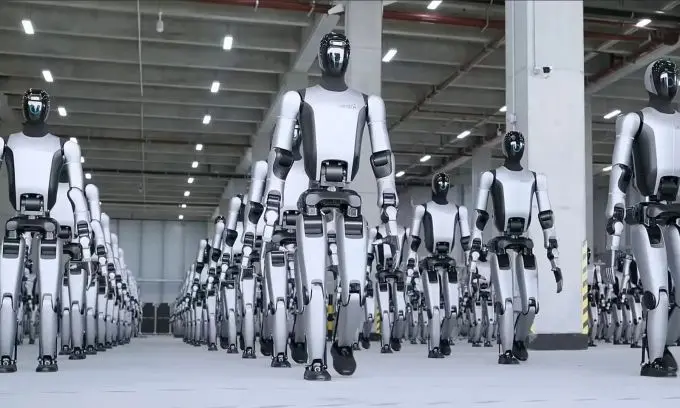
Chinese humanoid robot makers shipped most of the roughly 13,000 units delivered worldwide in 2025, far surpassing U.S. rivals such as Tesla and Figure AI, according to research firm Omdia. China-based startup Shanghai AgiBot Innovation Technology shipped an estimated 5,168 humanoid robots last year, the highest globally, followed by Unitree Robotics and UBTECH Robotics, Omdia data showed. "China could be the most important market for humanoids," RBC Capital Markets said in a note this month. The bank projects a global total addressable market of US$9 trillion by 2050, with China accounting for more than 60% of that figure, CNBC reported. Price competitiveness has been a major advantage for Chinese manufacturers. Chinese startup Noetix Robotics unveiled Bumi, a 94-cm humanoid robot priced at 9,998 yuan ($1,380), slightly less than Apple's iPhone 17 Pro Max, which starts at 9,999 yuan in China, in October 2025. Unitree offers an entry-level humanoid robot priced at about $6,000, while AgiBot charges roughly $14,000 for a scaled-down model. By comparison, Tesla chief executive officer Elon Musk has previously said the company's Optimus humanoid robots could cost between $20,000 and $30,000, although the product has yet to enter full-scale production, according to Bloomberg. "China currently leads the United States in the early commercialization of humanoid robots," Andreas Brauchle, a partner at consultancy Horváth, told CNBC. "While both countries are expected to build similarly large markets over time, China is scaling more rapidly in this initial phase." In November 2025, Shenzhen-based UBTECH Robotics released a video showing hundreds of its Walker S2 humanoid robots standing in formation and walking in unison into shipping containers. The footage drew skepticism from Brett Adcock, founder and CEO of U.S. robotics firm Figure, who described it as "fake." The company's chief brand officer, Tan Min, said the reaction reflected "a lack of understanding" of China's manufacturing strength and its advanced robotics ecosystem. "Critics should come to China and see for themselves the vibrant growth in the humanoid robotics sector and engage directly with the industry chain," Tan said. Humanoid robots are designed to resemble human form and movement, combining artificial intelligence algorithms with complex hardware such as advanced semiconductors. Last year, Unitree's dancing humanoid robots gained nationwide attention during China's Spring Festival Gala, helping fuel a surge in development and investment. China now has more than 150 humanoid robot manufacturers, according to the South China Morning Post. Omdia expects global humanoid robot shipments to reach 2.6 million units by 2035, driven by advances in AI models, dexterous robotic hands, and self-reinforcement learning that are making humanoids viable for industrial, service, and eventual household use.
Share
Share
Copy Link
Chinese humanoid robots accounted for the vast majority of 13,000 units shipped globally in 2025, far exceeding US competitors like Tesla and Figure AI. Shanghai AgiBot led with 5,168 units shipped, while Chinese manufacturers leveraged price competitiveness—offering models from $6,000 compared to Tesla's projected $20,000-$30,000 Optimus—to establish early market dominance in this emerging sector.
China Commands Early Lead in Global Humanoid Robot Shipments
Chinese manufacturers dominated global humanoid robot shipments in 2025, accounting for the vast majority of roughly 13,000 units delivered worldwide, according to research firm Omdia
1
. This figure represents more than a fivefold increase from 2024, signaling rapid acceleration in an industry still in its infancy1
. Shanghai AgiBot Innovation Technology Co. topped the list with an estimated 5,168 robots shipped last year, followed by Unitree Robotics and UBTech Robotics Corp.1
. Meanwhile, Western competitors including Tesla and Figure AI trailed significantly in sheer volume, despite high-profile development efforts2
.
Source: VnExpress
Chinese Humanoid Robots Showcase Dominance at CES
The technological race between the world's two largest economies played out visibly at CES in Las Vegas this week, where Chinese-made humanoid robots occupied exhibition floors with demonstrations of physical AI capabilities
2
. Fourier Intelligence unveiled its latest GR-3 humanoid, while Booster Robotics deployed over 30 robots in synchronized choreography3
. X-Humanoid demonstrated the sprinting speed of its Tiangong Ultra, winner of last year's Beijing humanoid half-marathon, and Unitree showcased acrobatic routines performed by a dozen machines2
. Booths operated by Galbot, AgiBot and EngineAI displayed multitasking capabilities and industry-ready systems, signaling ambitions to expand overseas and translate technical prowess into global sales. AgiBot's global profile received a boost after Nvidia CEO Jensen Huang name-checked the company during his keynote address at the trade show1
.
Source: Japan Times
Price Competitiveness Fuels China's Market Advantage
Chinese humanoid robots offer substantial price advantages over Western-made models, creating a significant competitive edge in early market development. Unitree offers an entry-level model for just $6,000, while AgiBot asks about $14,000 for a scaled-down version
1
. By comparison, Tesla CEO Elon Musk has previously given a price range of $20,000 to $30,000 for the company's Optimus humanoid robots, which haven't yet reached full-scale production4
. Chinese startup Noetix Robotics pushed pricing even lower, unveiling Bumi, a 94-cm humanoid robot priced at 9,998 yuan ($1,380)—slightly less than Apple's iPhone 17 Pro Max in China4
.
Source: Bloomberg
Artificial Intelligence Integration Drives Adoption Across Sectors
The integration of artificial intelligence has enabled humanoid robots to perform complex tasks, increasing adoption across manufacturing, logistics, healthcare and customer service sectors
1
. Robot firms are investing heavily in cutting-edge AI models, with advancements in AI algorithms allowing machines to handle increasingly sophisticated operations4
. "Chinese vendors are setting benchmarks in large-scale production," Omdia stated in its report1
. China's favorable policies and infrastructure support, including training centers, have helped boost production, with the number of humanoid robot firms in China exceeding 1501
.Related Stories

US-China Tech Competition Intensifies in Robotics Innovations
"China's humanoid robotics market is innovating at an extraordinary pace," said Nadav Orbach, founder and CEO of Cupertino, California-based RealSense Inc.
2
. The country spawned more than 40 humanoid startups in 2025 alone, according to Orbach, whose company supplies visual perception systems to 60% of humanoid robot makers globally2
. Elon Musk has expressed concern about China's pace of progress, though he still expects Tesla's Optimus to be the eventual winner—while acknowledging the rest of the top 10 might be all Chinese2
. Andreas Brauchle, a partner at consultancy Horváth, told CNBC that "China currently leads the United States in the early commercialization of humanoid robots," adding that while both countries are expected to build similarly large markets over time, China is scaling more rapidly in this initial phase4
.Market Projections Signal Massive Growth Potential
Omdia expects global humanoid robot shipments to reach 2.6 million units by 2035, driven by factors including AI models, dexterous hands and self-reinforcement learning that have made the robots viable for industrial, service and eventual household roles
1
. Looking further ahead, research from Citigroup Inc. projects the number of robots could surge to 648 million by 20501
. RBC Capital Markets projects a global total addressable market of $9 trillion by 2050, with China accounting for more than 60% of that figure4
. However, a wide gap remains between choreographed demonstrations and large-scale, real-world deployment. "As Jensen Huang of Nvidia says, we await the ChatGPT moment of robotics," said Lei Yu, chief business officer of Galaxea Dynamics2
.References
Summarized by

Navi
[3]
Related Stories
China's humanoid robot industry dominates supply chain as U.S. scrambles for alternatives
01 Mar 2026•Technology

Humanoid robots take center stage at China's Lunar New Year gala as Beijing pushes AI dominance
09 Feb 2026•Entertainment and Society
China's Robot Makers Race to Develop Humanoid Workers, Challenging Tesla
23 Aug 2024

Recent Highlights
1
Google Maps unveils Ask Maps with Gemini AI and 3D Immersive Navigation in biggest update
Technology

2
AI chatbots help plan violent attacks as safety guardrails fail, new investigation reveals
Technology

3
OpenAI secures $110 billion funding round as questions swirl around AI bubble and profitability
Business and Economy

Recent Highlights
Today's Top Stories






Your Daily Dose of Curated AI News
Don’t drown in AI news. We cut through the noise - filtering, ranking and summarizing the most important AI news, breakthroughs and research daily. Spend less time searching for the latest in AI and get straight to action.

