China dominates humanoid robots race as robot coworkers move from labs to factory floors


2 Sources
[1]
Your First Humanoid Robot Coworker Will Probably Be Chinese
Explosive acceleration, limited dexterity, eyes in the back of its head. What could possibly go wrong? The 4-foot-tall humanoid robot that's in front of me seems, quite honestly, a bit drunk. It leaps from one leg to the other, waving its arms. After 30 seconds or so it abruptly stops, then
[2]
Robot coworkers are closer than expected as labour shortages hit hard
China leads robot production while Europe anchors the precision supply chain A rise in recent deployments across manufacturing environments shows humanoid robots are no longer confined to experimental settings, and evidence now points to a shift toward real-world use, new research has claimed. A
Share
Copy Link
China leads the global race to deploy humanoid robots in workplaces, with over 200 companies developing robot coworkers compared to just 16 in the US. Unitree's robots perform backflips and cost a tenth of American counterparts, while labor shortages and AI advancements push these machines from experimental labs into real manufacturing environments. Morgan Stanley predicts 302.3 million humanoid robots in China by 2050.
China Establishes Dominance in Humanoid Robot Development
China has positioned itself as the undisputed leader in humanoid robot development, with more than 200 companies actively building these machines compared to approximately 16 prominent firms in the US
1
. At the World Artificial Intelligence Conference in Shanghai, the scale of China's ambition became visible as humanoid robots danced, carried boxes, and even sparred in boxing rings across the convention center floor1
. Hangzhou-based Unitree has emerged as the national champion, with robots performing sprints, kung-fu kicks, and acrobatic backflips while Elon Musk's Optimus still staggers through demonstrations. Unitree's machines cost tens of thousands of dollars, roughly a tenth of what typical humanoid robots in the US cost, and the company is reportedly targeting a $7 billion IPO listing in Shanghai1
.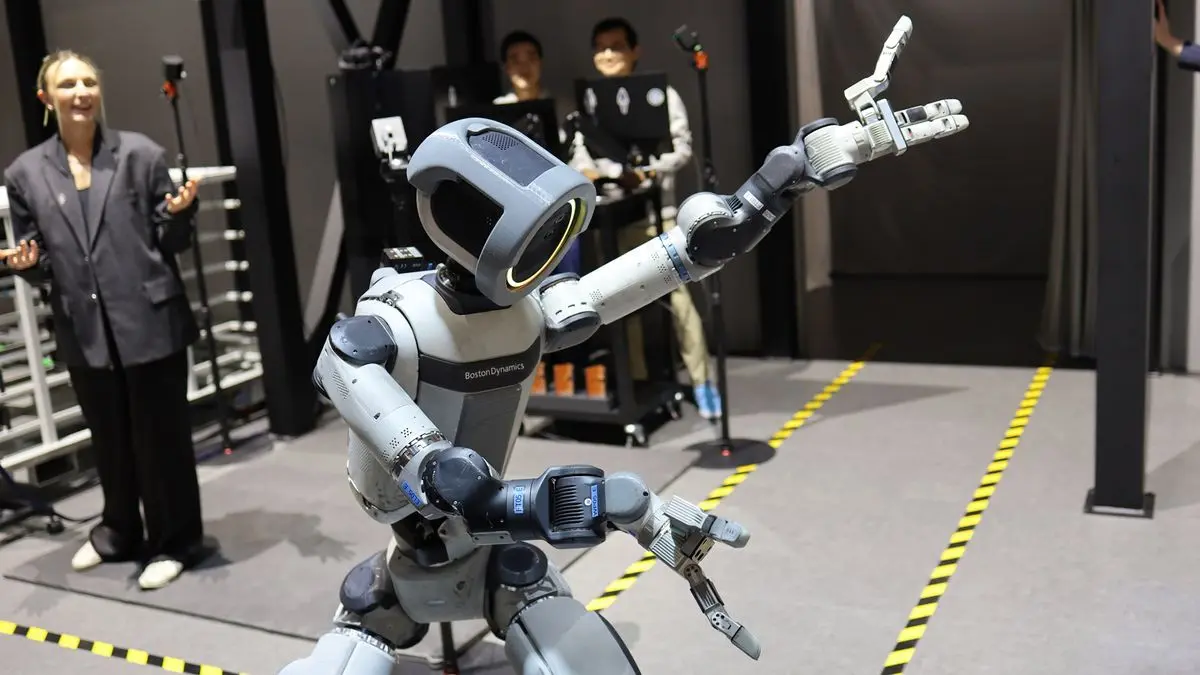
Source: TechRadar
Labor Shortages Drive Push to Integrate Humanoid Robots Into Workforce
Labor shortages across manufacturing, agriculture, logistics, and healthcare sectors are accelerating the shift toward deploying a robot coworker in real-world settings
2
. Aging populations, urban migration, and changing job preferences continue to reduce the supply of workers willing to perform physically demanding or repetitive work, creating gaps that traditional automation systems cannot fully address2
. Amazon is already testing humanoid robots from American startup Agility and, according to leaked memos, expects to replace a significant number of workers with robots in the next few years1
. A new Barclays report confirms that humanoid robots are no longer confined to experimental settings, with recent deployments across manufacturing environments showing a shift toward real-world use on production lines, in warehouses, and in other workplaces designed around human movement2
.
Source: Wired
Advancements in Artificial Intelligence Enable Operation in Human Environments
Advancements in artificial intelligence and mechanical engineering now allow humanoid robots to operate in human environments rather than requiring redesigned spaces
2
. These machines include legs, arms, and sensors that enable them to move through narrow spaces, climb stairs, and switch between tasks without major redesigns2
. Recent advances in perception and motion control software have reduced earlier failures that limited practical use, particularly errors tied to object recognition and spatial judgment, while AI tools allow these systems to respond to unstructured settings2
. However, current limitations persist. Many humanoid robots at the Shanghai conference don't have fingers, with arms ending in stumps that allow them to hold and lift boxes but not grasp objects1
. Operators still provide high-level instructions through game controllers, while the robots control their balance and execute short routines1
.Related Stories

Production Costs Plummet as Manufacturing Scales in China
Production costs have dropped dramatically from millions of dollars a decade ago to roughly $100,000 today, a reduction developers attribute to progress in computing hardware, batteries, and especially actuators that translate digital commands into movement
2
. Like electric cars, manufacturers already build humanoid robots at scale in China, though Europe continues to supply many high-precision mechanical components that allow these machines to function reliably within the supply chain2
. The sheer number of Chinese companies pursuing humanoid robot development has prompted the Chinese government to warn of overcapacity and unnecessary replication1
.Forecasts Point to China Dominating Global Workforce Automation
Morgan Stanley forecasts that by 2050, a billion humanoid robots will be in use globally, with almost a third—302.3 million—operating in China compared to 77.7 million in the US
1
. Bank of America analysts predict that by 2035, robot makers will ship 10 million humanoid robots annually1
. These projections suggest the widespread adoption of robots will transform the workforce and economy, though Barclays acknowledges large-scale adoption is neither guaranteed nor imminent2
. Energy efficiency still lags behind human performance, deployment costs remain high, and reliance on critical minerals introduces supply risks2
. Experts expect humanoid robots to take on tasks that many people already avoid in manufacturing and other sectors, though questions around reliability, regulation, and whether these machines will spread widely across industries remain open2
.References
Summarized by

Navi
Related Stories
China Ships 97% of Global Humanoid Robots as US Struggles to Compete in Physical AI Race
11 Aug 2026•Technology

China dominates humanoid robots market with 85% of global output, but finding buyers proves harder
03 Jun 2026•Business and Economy
China's Humanoid Robots Claim 97% of Global Market as Embodied AI Shifts from Spectacle to Scale
19 Aug 2026•Technology

Recent Highlights
1
Microsoft and Nvidia Launch Surface Laptop Ultra: A $2,599 AI-Ready PC With RTX Spark Chip
Technology

2
Google Unveils Gemini 4 Argon AI Model, Restricts Access to Trusted Cyber Defenders
Technology

3
Trump Consulted Grok AI Before Ordering Venezuela Invasion and Capture of Nicolás Maduro
Policy and Regulation

Recent Highlights
Today's Top Stories






Don’t drown in AI news. We cut through the noise - filtering, ranking and summarizing the most important AI news, breakthroughs and research daily. Follow topics that matter to you and stay ahead.


