Churches Turn to AI for Ministry as 15,000 Face Closure and Congregations Shift Digital


2 Sources
2 Sources
[1]
How some Indiana churches are using AI
But the practice raises new questions about who, or what, is guiding the flock. State of play: Religious institutions' experimentation with AI comes at a time when the U.S. could see an unprecedented 15,000 churches shut their doors this year as a record number of Americans (29%) now identify as religiously unaffiliated. * Indiana's share of religiously unaffiliated has risen from 16% in 2007 to 31% last year. * Researchers say the trend is driven in large part by Gen Z and younger millennials. The big picture: Many places of worship are using AI in mundane ways -- deploying chatbots to answer frequently asked questions such as service times and event details, or feeding congregation attendance data into AI software to help them tailor outreach and communications. Zoom in: Sermon Shots is a service with Hoosier roots that uses AI to quickly turn sermons into shareable video clips. * Founded by New Palestine resident Corey Alderin in early 2022, Sermon Shots has more than 9,000 clients served by a remote staff of 25 employees. * The service has at least 50 Indiana clients, including Alderin's church, Realife. * He got the idea after speaking with pastors interested in turning to technology to compete with larger churches with the staff and budget to maintain active social media accounts. What he's saying: Alderin told Axios that Sermon Shots does not use AI to write sermons and is not intended to replace ministry. * "I think the church is in this really great, unique opportunity to leverage AI in a good way. Which is, you're already developing this great piece of content every week," he said. "Whether a church calls it that or not, this sermon on Sunday is a well developed, well crafted, well thought out piece of content. Why not leverage that to make all this other content?" Between the lines: Beyond leveraging the tech, local congregations are engaging AI through educational events and community discussions. * Indy's New Circle Church tackled the topic in October during an episode of their Midway Musings Podcast titled "Is AI The Devil?" * e2: effective elders, an Indianapolis-based nonprofit that provides coaching for church leaders, held an event last month exploring how church leaders can think theologically and practically about generative AI. * In February, Traders Point Christian Church Northwest will host a faith leaders roundtable organized by Care to Change focused on the impact of AI on spirituality. Yes, but: The AI uses getting the most attention (and scrutiny) are those that create the feeling that users are talking to a divine power or clergy member.
[2]
At a Buckhead church, AI helps the ministry connect with a global congregation
Brian Unger is a multi-skilled journalist at CBS News Atlanta, where he reports on a broad range of news, people and events across the Atlanta Metro. If there is one place reserved for authentic human connection in a community, it's the church, but more and more, churches are using artificial intelligence to connect with their congregations. At Buckhead's Church of the Apostles, Dr. Michael Youssef is the man behind the ministry, guiding a congregation of 3,000. Like many contemporary ministries, Youssef streams to tens of thousands more around the world. "We're going to use every form of technology to take the gospel to the ends of the Earth," Youssef said. Helping to fulfill that mission is what's inside one of the rooms in his church, the machine behind the ministry. Inside, computers speak to over 50,000 worshipers using AI through an app called My Faith Assistant. "Because I think God created all of it, it's his creation, and we need to utilize it," he said. Youssef and a team of experts, including Stephen Watson, are utilizing the AI-driven platform for what they call "pastoral care." It's a ministry in real time, like having a personal biblical counselor to deliver scriptural translation and also Youssef's own words. "It is used as a biblical study aid and does not usurp or replace time that should be spent wrestling with the word and in prayer with God," Watson said. While it may seem like a contradiction, more and more churches, dedicated to a spiritual connection to God and the pulpit, are using machine learning and AI to guide their flocks. In one study that tracked over 6,000 church leaders since 2021, there was an 80% increase in the adoption of AI last year. How does it work? CBS News Atlanta asked the app a question: Is the story of Jonah and the whale in the book of Jonah real or a metaphor? "So, now we go into the answer," Watson says, pointing to the screen. "Scripture teaches us that the story of Jonah is a real historical event, and not merely a metaphor." Like the more secular ChatGPT, My Faith Assistant offered a concise explanation, but here's where it is different. It drops the user into a video from the church that deals with the issue that they're asking about. There are concerns over the still-new technology's connection to faith. Dr. Amey Victoria Adkins-Jones, an assistant professor at Emory's Candler School of Theology, worries that other churches could push too far into AI. "Is this helping us? Is this moving us closer to our mission and vision of who we are as people of God?" Adkins-Jones asked. "If the only place we can turn to care is to our computers or to our screens, perhaps that's a stronger reflection of a place where the church hasn't been who the church is called to be." As AI continues to grow in religious spaces, there's still one role, at least for now, that comes with absolute job security. "The call in our life is to say, 'Here's the truth, and here's the falsehood,'" Youssef said. "The choice is yours."
Share
Share
Copy Link
Religious institutions across the U.S. are embracing AI-powered services to reach congregations as an unprecedented 15,000 churches could close this year. From AI-driven apps providing pastoral care to tools converting sermons into social content, ministry leaders are leveraging artificial intelligence to compete in a digital age where 29% of Americans now identify as religiously unaffiliated.
Churches Embrace AI as Religious Landscape Shifts
Religious institutions across the United States are increasingly turning to AI to sustain their ministry operations amid a challenging landscape. The U.S. could see an unprecedented 15,000 churches shut their doors this year as a record 29% of Americans now identify as religiously unaffiliated
1
. In Indiana, the share of religiously unaffiliated residents has surged from 16% in 2007 to 31% last year, driven largely by Gen Z and younger millennials1
. This declining attendance has prompted church leaders to explore AI adoption among churches as a strategic response to maintain relevance and reach.
Source: Axios
AI Platform Provides Pastoral Care Through Digital Tools
At Buckhead's Church of the Apostles, Dr. Michael Youssef guides a congregation of 3,000 while streaming to tens of thousands more globally. The ministry now utilizes an AI-driven app called My Faith Assistant that speaks to over 50,000 worshipers, providing what Youssef and his team describe as pastoral care in real time
2
. "We're going to use every form of technology to take the gospel to the ends of the Earth," Youssef explained2
. The platform functions like a personal biblical counselor, delivering scriptural translation and Youssef's own teachings. Stephen Watson, part of the team behind the technology, emphasized that it "is used as a biblical study aid and does not usurp or replace time that should be spent wrestling with the word and in prayer with God"2
.
Source: CBS
80% Surge in AI Adoption Among Religious Leaders
The shift toward leveraging artificial intelligence in religious spaces has accelerated dramatically. A study tracking over 6,000 church leaders since 2021 revealed an 80% increase in AI adoption last year
2
. Many places of worship deploy chatbots to answer frequently asked questions about service times and event details, or feed congregation engagement data into AI software to tailor outreach and communications1
. Sermon Shots, a service with Indiana roots founded by New Palestine resident Corey Alderin in early 2022, uses AI to convert sermons into shareable video clips. The company now serves more than 9,000 clients with a remote staff of 25 employees and at least 50 Indiana clients1
.Related Stories

Faith Leaders Grapple With Theological Implications
While AI-powered services help ministry operations connect with a global congregation, they also raise questions about spiritual guidance and authenticity. "If the only place we can turn to care is to our computers or to our screens, perhaps that's a stronger reflection of a place where the church hasn't been who the church is called to be," said Dr. Amey Victoria Adkins-Jones, an assistant professor at Emory's Candler School of Theology
2
. Local congregations are engaging the technology through educational events exploring generative AI on spirituality. Indianapolis-based nonprofit e2: effective elders held an event last month examining how church leaders can think theologically and practically about generative AI, while Traders Point Christian Church Northwest will host a faith leaders roundtable in February focused on AI's impact on spirituality1
.Machine Learning Meets Sacred Tradition
The integration of machine learning into religious practice represents both opportunity and concern. Alderin emphasized that Sermon Shots does not use AI to write sermons and is not intended to replace ministry. "I think the church is in this really great, unique opportunity to leverage AI in a good way," he told Axios. "You're already developing this great piece of content every week. Whether a church calls it that or not, this sermon on Sunday is a well developed, well crafted, well thought out piece of content. Why not leverage that to make all this other content?"
1
. The AI uses getting the most attention and scrutiny are those creating the feeling that users are talking to a divine power or clergy member1
. As AI in religious guidance continues to expand, questions persist about balancing technological efficiency with the authentic human connection that defines faith communities.References
Summarized by

Navi
Related Stories
Churches Turn to AI Chatbots as Digital Faith Tools Emerge Amid Religious Decline
13 Nov 2025•Entertainment and Society

Finnish Lutheran Church Pioneers AI-Generated Service: A Glimpse into the Future of Worship
08 Mar 2025•Technology
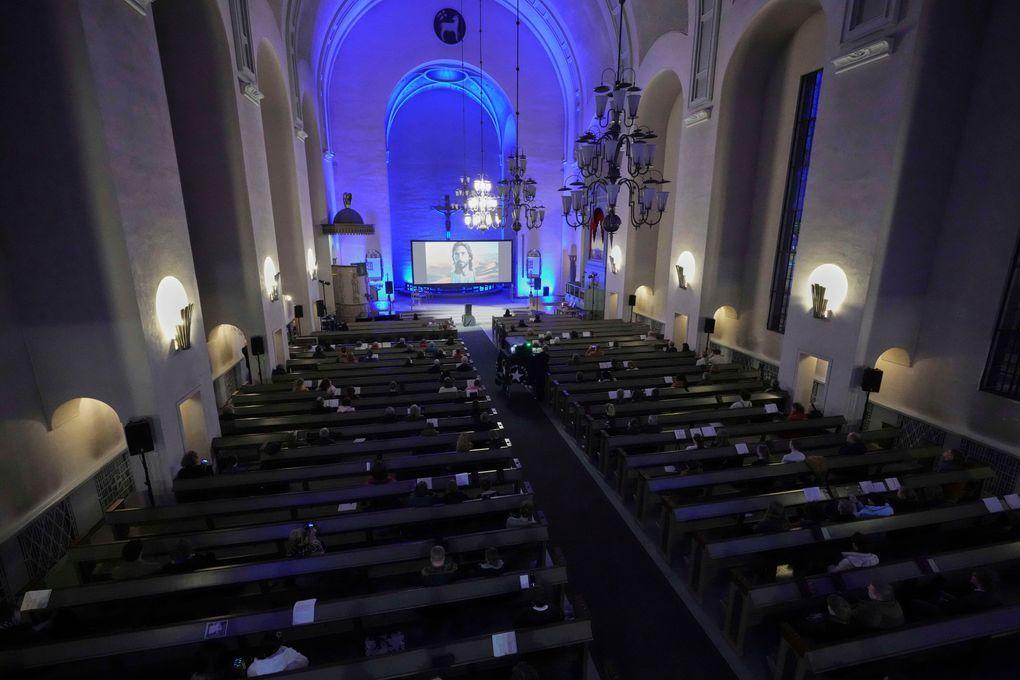
AI in Religion: Virtual Jesus and Digital Devotion Spark Debate
03 Oct 2025•Technology

Recent Highlights
1
Google releases Gemma 4 with Apache 2.0 license, enabling unrestricted local AI on devices
Technology

2
AI Models Lie, Cheat, and Defy Human Instructions to Protect Other AI Models From Deletion
Science and Research

3
Anthropic discovers functional emotions in Claude that actively shape AI behavior and decisions
Science and Research

Recent Highlights
Today's Top Stories









Your Daily Dose of Curated AI News
Don’t drown in AI news. We cut through the noise - filtering, ranking and summarizing the most important AI news, breakthroughs and research daily. Spend less time searching for the latest in AI and get straight to action.

