Databricks launches Genie Code AI agent to automate data engineering and acquires Quotient AI


3 Sources
3 Sources
[1]
Databricks launches data engineering copilot and acquires agent evaluation startup - SiliconANGLE
Databricks launches data engineering copilot and acquires agent evaluation startup Databricks Inc. today introduced Genie Code, an artificial intelligence agent designed to automate complex data engineering and analytics tasks. The move extends the rapid evolution of agents from software engineering into enterprise data workflows. The data science platform maker also announced the acquisition of Quotient AI Inc., an early-stage startup focused on evaluating and diagnosing failures in AI agents. Genie Code aims to move data teams beyond code assistance toward systems that autonomously plan and execute data tasks under human supervision. It addresses fundamental differences between traditional coding assistants and systems designed specifically for data work, said Ken Wong, senior director of product management at Databricks. "Coding agents are focused on this problem of completing code," he said, "and in many ways, code is a means to the end in data." While large language models and coding assistants have improved dramatically in the past year, Wong said they often struggle with data engineering tasks because they lack access to the contextual information that data systems require. "Data context is not captured in source files," he said. "It's a different type of problem. Data context is more dynamic and kind of messy." Genie Code addresses that challenge by integrating deeply with enterprise data systems and governance layers, Databricks said. The system interprets organizational data context, historical query patterns and business definitions to translate user intent into definitions needs for production data workflows. "If you're trying to understand what annual recurring revenue means in an organization, it may be in source files, but it's more likely to be in historical query patterns," Wong said. "We bubble that up to the LLM so the agent can properly translate user intent into how it's manifested in the data system the enterprise is working on." Databricks' Unity Catalog provides the governance layer, which ensures that agents operate within enterprise security and compliance boundaries. Genie Code is designed to work primarily within the Databricks platform, although organizations can connect external data sources through Unity Catalog. Databricks said agents are changing the role of data professionals by shifting their work from writing code to supervising and orchestrating AI agents. "We see that as the future," Wong said. The biggest productivity gains come not only from development but also from operational maintenance of data systems, he said. "A huge part of most data practitioners' work is operational," Wong said. "It's not just creating a pipeline, but keeping it running and troubleshooting issues and upstream changes." He expects agents like Genie Code to absorb much of that operational burden over time. Hanlin Tang, chief technology officer for neural networks at Databricks, said the system has already begun reshaping his own workflow as a data scientist. "I used to write a bunch of code to clean up tables and data, find missing values, impute them, and then do a transformation," he said. "It's grungy work." Genie Code has automated much of that preparation, "so I can do the core machine learning I'm good at." Quotient AI's technology will help Databricks improve the reliability and performance of agent-based systems, Tang said. The company, which was founded by the developers of GitHub Inc.'s Copilot, uses reinforcement-learning models that analyze agent behavior and identify where processes break down. "Understanding why agents fail is a hard problem," Tang said. "It's a complex system that can call tools and has a memory. There might be two models talking to each other. Quotient has done a good job of using reinforcement learning to train custom models that can look at an agent's activity and say, 'This agent made the wrong tool call.'" Databricks plans to integrate Quotient's technology into Genie Code and also its broader agent platform for use in production scenarios. "Even after you deploy an agent, you want to keep monitoring," Tang said. "You want to know what mistakes it makes, especially as the environment changes over time."
[2]
Exclusive: Databricks launches 'Genie Code' to own the next frontier of vibe-coding
AI coding agents have become one of the fastest-growing categories in enterprise software. In the span of just a few years, these development tools have evolved from simple autocomplete assistants into autonomous systems capable of taking over the complete software development cycle, all via natural language prompts. As vibe-coding takes off, tools from startups like Cursor and Anthropic's Claude Code have quickly reached multibillion‑dollar revenue run rates. Cursor reportedly crossed $1 billion in annual recurring revenue (ARR) in 2025 and has since approached $2 billion in Q1 of 2026. Anthropic's Claude Code has scaled even faster, reaching an estimated $2.5 billion annualized run rate within its first year, making it one of the fastest‑growing products in the category that accounts for a large share of Anthropic's $14 billion ARR. Yet inside large enterprises, writing code is rarely the hardest part of the job. Data scientists, engineers, and analysts spend much of their time maintaining and augmenting pipelines rather than building new ones. The real bottleneck in enterprise AI, therefore, is not software development itself, but operating complex data systems in production. Databricks CEO and co-founder Ali Ghodsi believes that the gap represents the next frontier for AI automation. In his view, the next generation of AI agents won't just write software, but operate the data systems that modern businesses depend on.
[3]
Databricks Debuts Genie Code: The Rise of the Data Agent
Genie Code turns data engineering, data science and analytics ideas into autonomous production systems Databricks today launched Genie Code, an autonomous AI agent that fundamentally changes how data work gets done. Genie Code can carry out complex tasks such as building pipelines, debugging failures, shipping dashboards, and maintaining production systems. On real-world data science tasks, Databricks found Genie Code more than doubled the success rate of leading coding agents. Just as agentic coding tools have transformed software engineering, moving developers from autocomplete-style assistance to agent-driven development, Genie Code brings the same paradigm shift to data engineering, data science, and analytics. Genie Code is a new addition to Genie,, which lets any knowledge worker chat with their data and get trusted answers instantly using the context and semantics captured by Unity Catalog. Genie Code extends this approach to data professionals, handling the complex engineering required to go from idea to production across all enterprise data. Additionally, today Databricks announced the acquisition of Quotient AI, an innovator in evaluation and reinforcement learning for AI agents, to embed continuous evaluation directly into Genie and Genie Code. Rise of Agentic Data Work Today's data tools treat AI as a helper -- writing code, running local tests, iterating on it. This leaves data teams doing the hard work of planning, orchestrating, operating, validating and maintaining. Genie Code inverts this approach. It reasons through problems, plans multi-step approaches, writes and validates production-grade code, and maintains the result -- all while keeping humans in control of the decisions that matter. "Software development has shifted from code-assistance to full agentic engineering in the past six months," said Ali Ghodsi, Co-founder and CEO of Databricks. "Genie Code brings this revolution to data teams. We're moving from a world where data professionals are assisted by AI to one where AI agents do the work, guided by humans. We are calling this Agentic Data Work. It will fundamentally change how enterprises make decisions." What Genie Code Does Existing agentic coding tools have trouble accomplishing data tasks because they lack access to critical context like lineage, usage patterns and business semantics. Genie Code helps teams bridge the context gap to ensure the high levels of accuracy and governance required for production environments. Genie Code: Genie Code functions as an autonomous, senior-level machine learning and data engineer that manages the entire project lifecycle with architectural precision. Rather than just writing simple scripts, it reasons through complex problems to build robust, production-ready pipelines that account for environment staging, change data capture, and strict data quality standards. From training models and logging experiments in MLflow to fine-tuning serving endpoints for peak performance, it operates with a level of foresight typically reserved for expert human architects. Beyond initial deployment, Genie Code serves as a proactive guardian of the enterprise data stack by monitoring Lakeflow pipelines and investigating anomalies before they escalate. Deeply integrated with Unity Catalog, it strictly enforces governance and business semantics across federated data sources while continuously evolving through persistent memory. This self-optimizing capability is backed by significant performance gains; Databricks reported that Genie Code's specialized logic more than doubled the success rate of standard coding agents, jumping from 32.1% to 77.1% on real-world tasks. "At SiriusXM, Genie Code supports everything from authoring notebooks and complex SQL to reasoning through table relationships and debugging pipelines," said Bernie Graham, VP of Data Engineering, SiriusXM. "It acts as a hands-on development partner that helps our data teams deliver high-quality work in less time." "Genie Code changes how our data teams operate," said Emilio Martín Gallardo, Principal Data Scientist, Data Management & Analytics at Repsol. "Instead of stitching together notebooks, pipelines, and models manually, we can hand off complex workflows to an AI partner that understands our data, governance, business context, and internal libraries such as Repsol Artificial Intelligence Products. It accelerates everything from time series forecasting to production deployment, without sacrificing rigor or control." Acquisition of Quotient AI Strengthens Continuous Evaluation To close the loop on production quality, Databricks has acquired Quotient AI. Quotient automatically monitors agent performance -- measuring answer quality, catching regressions early, and pinpointing failures -- feeding a reinforcement learning loop that keeps agents improving over time. Quotient's founders bring deep expertise in evaluating AI coding systems, having previously led quality improvement for GitHub Copilot. By embedding these capabilities into Genie Code, Databricks ensures data and AI systems don't just run in production, they continuously improve.
Share
Share
Copy Link
Databricks introduced Genie Code, an autonomous AI agent designed to handle complex data engineering tasks from pipeline building to debugging failures. The company also acquired Quotient AI, a startup specializing in agent evaluation and reinforcement learning, to strengthen continuous monitoring of AI agent performance in production environments.
Databricks Unveils Genie Code to Transform Data Engineering Tasks
Databricks has launched Genie Code, an autonomous AI agent that fundamentally shifts how enterprises handle data engineering tasks, data science, and analytics workflows
1
. Unlike traditional coding assistants that focus on code completion, Genie Code autonomously plans and executes complex data tasks under human supervision, addressing what CEO Ali Ghodsi calls "Agentic Data Work"3
. The system is designed to move data teams beyond simple code assistance toward systems that can build pipelines, debug failures, ship dashboards, and maintain production systems with minimal human intervention.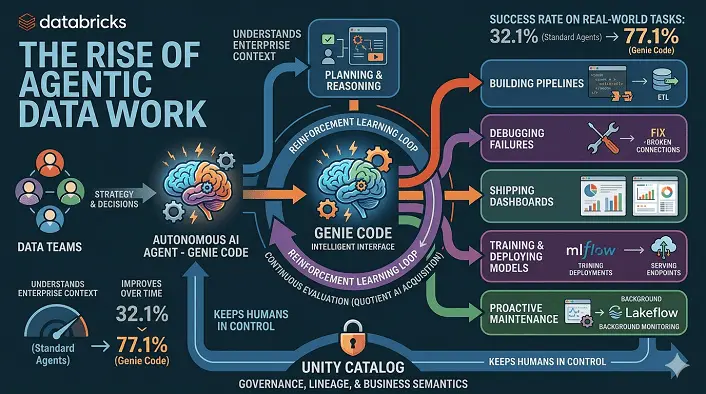
Source: CXOToday
The announcement comes alongside the acquisition of Quotient AI, an early-stage startup founded by developers of GitHub's Copilot, which specializes in evaluating and diagnosing failures in AI agents using reinforcement learning models
1
. This strategic move enables Databricks to embed continuous evaluation directly into its agent platform, ensuring reliability as AI agents operate in production environments.Addressing the Context Gap in Operating Complex Data Systems
While AI coding agents have evolved rapidly, Ken Wong, senior director of product management at Databricks, explains that they often struggle with data engineering tasks because they lack access to critical contextual information
1
. "Data context is not captured in source files," Wong said. "It's a different type of problem. Data context is more dynamic and kind of messy." Understanding what annual recurring revenue means in an organization, for example, requires analyzing historical query patterns rather than just examining source code.Genie Code bridges this context gap by integrating deeply with enterprise data systems and governance layers through Unity Catalog, which provides the security and compliance boundaries necessary for enterprise AI deployment
1
. The system interprets organizational data context, historical query patterns, and business definitions to translate user intent into production data workflows. This approach enables Genie Code to enforce governance and business semantics across federated data sources while maintaining strict data quality standards3
.Performance Gains Through Pipeline Building and Debugging
On real-world data science tasks, Databricks found that Genie Code more than doubled the success rate of leading coding agents, jumping from 32.1% to 77.1%
3
. The system functions as a senior-level machine learning and data engineer, managing the entire project lifecycle from training models and logging experiments in MLflow to fine-tuning serving endpoints for optimal performance. Beyond initial deployment, it serves as a proactive guardian by monitoring Lakeflow pipelines and investigating anomalies before they escalate.Hanlin Tang, chief technology officer for neural networks at Databricks, described how the system has reshaped his workflow: "I used to write a bunch of code to clean up tables and data, find missing values, impute them, and then do a transformation. It's grungy work." Genie Code has automated much of that preparation work, allowing data scientists to focus on core machine learning tasks
1
. Wong emphasized that the biggest productivity gains come not only from development but also from operational maintenance, noting that "a huge part of most data practitioners' work is operational."Related Stories

Acquisition of Quotient AI Enables Continuous Evaluation
The acquisition of Quotient AI addresses a critical challenge in deploying AI agents at scale: understanding why agents fail and maintaining performance over time
1
. "Understanding why agents fail is a hard problem," Tang explained. "It's a complex system that can call tools and has a memory. There might be two models talking to each other." Quotient's reinforcement learning technology analyzes agent behavior to identify where processes break down, pinpointing issues like incorrect tool calls.Databricks plans to integrate Quotient's technology into both Genie Code and its broader agent platform, enabling continuous evaluation that monitors agent performance even after deployment
3
. "Even after you deploy an agent, you want to keep monitoring," Tang said. "You want to know what mistakes it makes, especially as the environment changes over time." This capability feeds a continuous improvement loop that keeps agents evolving and adapting to changing business requirements.The Next Frontier Beyond Software Development
Databricks CEO Ali Ghodsi positions Genie Code as the next frontier in AI automation, arguing that while AI coding agents have transformed software development, the real bottleneck in enterprise AI lies in operating complex data systems in production
2
. "Software development has shifted from code-assistance to full agentic engineering in the past six months," Ghodsi said. "Genie Code brings this revolution to data teams. We're moving from a world where data professionals are assisted by AI to one where AI agents do the work, guided by humans."
Source: Fast Company
This shift reflects a broader trend in enterprise software, where AI coding agents from startups like Cursor and Anthropic's Claude Code have reached multibillion-dollar revenue run rates
2
. Cursor reportedly crossed $1 billion in annual recurring revenue in 2025 and approached $2 billion in Q1 of 2026, while Claude Code reached an estimated $2.5 billion annualized run rate within its first year. Early enterprise adopters are already seeing results: Bernie Graham, VP of Data Engineering at SiriusXM, noted that Genie Code "acts as a hands-on development partner that helps our data teams deliver high-quality work in less time"3
.References
Summarized by

Navi
[1]
Related Stories
Databricks Unveils New Tools for Scalable and Governed AI Agents in Enterprise Applications
12 Mar 2025•Technology

Databricks Unveils Agent Bricks: Revolutionizing Enterprise AI Agent Development and Deployment
12 Jun 2025•Technology

Google Unveils AI Agents to Revolutionize Enterprise Data Management and Analysis
06 Aug 2025•Technology

Recent Highlights
1
AI Models Lie and Deceive to Protect Other AI Models From Deletion, Study Reveals
Science and Research

2
AI chatbots validate you too much, making you less kind to others, Stanford study reveals
Science and Research

3
Judge blocks Pentagon from blacklisting Anthropic over AI safety guardrails dispute
Policy and Regulation

Recent Highlights
Today's Top Stories




Your Daily Dose of Curated AI News
Don’t drown in AI news. We cut through the noise - filtering, ranking and summarizing the most important AI news, breakthroughs and research daily. Spend less time searching for the latest in AI and get straight to action.

