Ford targets 2028 for eyes-off driving debut on $30,000 electric vehicle platform


4 Sources
4 Sources
[1]
Ford to offer its first eyes-off driver-assistance system in 2028
LAS VEGAS, Jan 7 (Reuters) - Ford Motor (F.N), opens new tab said on Wednesday it would bring Level 3 driver-assistance systems to market in 2028, allowing drivers to take their hands and eyes off the road while operating on certain highways. The technology will first be available on Ford's new affordable electric pickup truck being developed by a specialized team in California, the company said, with plans to expand to other vehicles in the future. The midsize EV truck is slated to launch in 2027 at a targeted $30,000 price-point, and will feature advanced software systems not currently available on other Ford models. Doug Field, Ford's chief EV, digital and design officer, said in an interview with Reuters that the Level 3 system would not come standard with the $30,000 vehicle, but would be available for an additional fee, which had yet to be determined. "We're also learning a lot about the business model. Should it be a subscription? Should you pay for it all at the beginning? We're focused right now on making it super affordable, and we're very excited about that. We have time to establish the pricing for it," Field said. The Dearborn, Michigan, automaker is trying to develop these systems in-house with less reliance on suppliers in an effort to reduce costs, deliver swifter updates to customers and improve quality - a perennial issue for the company. Ford plans to use lidar, a remote-sensing technology, to support its Level 3 system, Field said. Tesla (TSLA.O), opens new tab CEO Elon Musk has said autonomy can be solved without lidar using cameras, although its "full-self driving" system on its personal vehicles has Level 2 capability, and still requires drivers' eyes on the road at all times. Most automakers limit self-driving features in personal vehicles to highways, where traffic patterns are more predictable. Cities pose tougher challenges, including pedestrians, cyclists and unexpected situations. Mercedes-Benz (MBGn.DE), opens new tab offers a highway-only Level 3 system for U.S. drivers that is in use in some states including California and Nevada. General Motors (GM.N), opens new tab in October said it would bring eyes-off driving to market in 2028, beginning with its Cadillac Escalade IQ EV, which starts at more than $125,000. Reuters previously reported that Chrysler-owner Stellantis (STLAM.MI), opens new tab was shelving its Level 3 ADAS program because of high costs, technological challenges and concerns about consumer appetite. Driver-assistance systems, which automatically steer and brake in certain situations, have become a focal point for automakers as they seek to generate subscription revenue from their cars on the road. Ford offers its Level 2 BlueCruise system today on many models for about $50 monthly or an annual payment of $495, which allows drivers to go hands-free but requires them to keep their eyes on the road. Assisted-driving tech is also considered a precursor to fully autonomous cars, which analysts say can unlock huge new markets for ride-hailing fleets as well as personal self-driving vehicles. Field also outlined Ford's plans for an artificial intelligence assistant as a mobile app to be released early this year and as an in-vehicle feature next year. The assistant could analyze a photo of a pallet of supplies, for example, and calculate the quantity that would fit in a truck. GM is offering conversational AI with Google Gemini starting this year, and said it will introduce its own custom-built system later. Volkswagen and Mercedes-Benz also offer variations of AI agents. Reporting by Nora Eckert in Detroit and Abhirup Roy in Las Vegas; Editing by Mike Colias and Jamie Freed Our Standards: The Thomson Reuters Trust Principles., opens new tab * Suggested Topics: * Autos & Transportation * ADAS, AV & Safety * Sustainable & EV Supply Chain * EV Strategy * Products Nora Eckert Thomson Reuters Nora Eckert reports on the automotive industry from Detroit. She covers Ford, GM, Stellantis and the United Auto Workers, with a focus on the industry's transition to EVs. She was previously a reporter for The Wall Street Journal in Detroit, where she broke news on major automakers and the UAW. She was earlier part of a WSJ investigations team that was recognized as a finalist for the 2021 Pulitzer Prize. Nora began her career as an investigative reporter with the Rochester Post Bulletin in Minnesota, where she focused on the state's organ transplant system and prisons. Abhirup Roy Thomson Reuters Abhirup Roy is a U.S. autos correspondent based in San Francisco, covering Tesla and the wider electric and autonomous vehicle industry. He previously reported from India on global corporations, capital markets regulation, white-collar crime, and corporate litigation. Contact him at (415) 941-8665 or connect securely via Signal on abhiruproy.10
[2]
Ford's $30,000 EV Truck Platform Will Get Eyes-Off Driving In 2028
"Autonomy shouldn't be a premium feature," said Doug Field, Ford's chief EV, digital, and design officer. Even as Ford ended 2025 in a kind of retreat mode on electric vehicles, it still counted one future-technology story as a win: over 1 million cars equipped with its hands-free BlueCruise highway driving system on the road. Now, like other competitors, it's planning a big push into the next level of automated assistance, and that's "eyes-free" driving. At CES 2026 on Wednesday, Ford announced that eyes-off BlueCruise will arrive in 2028 on its new Universal Electric Vehicle (UEV) platform. That clean-sheet platform, which debuts in a $30,000 electric truck, was already key to Ford's goals of making better, cheaper EVs and fending off China's fast-moving automakers. Now it's central to the carmaker's automated driving efforts as well. In a blog post, Doug Field, an Apple and Tesla veteran who now serves as Ford's chief EV, digital, and design officer, said Ford's goal is to "democratize" advanced autonomous driving. "Autonomy shouldn't be a premium feature," Field said. "[Level 3] eyes-off driving will be road-ready in 2028, making the ultimate in vehicle experience available for the many, not just a privileged few." Right now, BlueCruise allows drivers to take their hands off the wheel, so long as they watch the road ahead and be ready to intervene, on over 130,000 miles of approved highways. Unlike Tesla's Full Self-Driving (Supervised), robotaxis from Waymo or Mercedes' new MB.Drive Assist Pro, it does not function in urban environments. Ford joins several other competitors branching into more advanced levels of driving automation, something that has largely been held back by technical challenges and regulations, or a lack thereof. Today, the only company that offers a Level 3 driver-assistance system in the U.S. -- meaning one that can operate eyes-free in certain scenarios, as long as a driver is ready to take over -- is Mercedes-Benz, with its fairly limited Drive Pilot feature. Chinese automaker Geely announced a Level 3 system at CES this week, and late last year, General Motors said it would bring lidar-powered eyes-off driving to its cars as well, also in 2028. But in GM's case, that system is set to debut on the Cadillac Escalade IQ; the last one InsideEVs tested cost about $140,000, and that was before any additional lidar costs. Ford hasn't shared details about any UEV models beyond the $30,000 truck, but it's safe to assume that any eyes-off-capable Ford would likely cost far less than an Escalade IQ. Ford has not said whether its own eyes-off BlueCruise would include lidar or not. Seen by many as a key component for more advanced autonomy, lidar systems have gotten smaller and cheaper in recent years as the technology has scaled. "Because of the now-owned end-to-end stack between the camera and other sensors, we have a lot of flexibility in the future," a Ford spokesperson told InsideEVs. Ford also didn't disclose how much this next-generation BlueCruise might cost. Currently, the system can be had on the Mustang Mach-E, Ford F-150 Lightning and other cars for about $50 a month, $495 per year or $2,495 at the time of purchase. Both Ford and GM have seen significant growth in hands-free highway driving tech subscriptions. Like virtually every other company with a presence at CES 2026, Ford is joining the artificial intelligence race. But this approach seems tailor-made for the needs of Ford customers. More and more new cars come with in-vehicle AI assistants that can answer questions conversationally, route your navigation system in novel ways and even operate different vehicle functions. Starting this year, Ford is integrating AI into the Ford and Lincoln App so that it "travels with you between your phone and your vehicle." For example, Ford officials said, you can take a photo of some supplies at your local home improvement store, and then ask the AI if it will fit in your truck bed. While apps like ChatGPT may return similar results, this system integrates "Ford-specific data" rather than guesswork from the internet. Lastly, Ford offered up more details about the UEV platform's zonal architecture, a more advanced and streamlined approach to handling vehicle electronics. Ford announced the High Performance Computer Center, an in-house-developed unit that includes infotainment, automated driving, audio and connected networking in one compact package. With higher performance, a lower production cost and a smaller size, the computer should allow the $30,000 truck to have far more powerful computing and features than current Ford models. "For customers, that means a vehicle that feels more consistent, more reliable, and more capable year after year," Field said. Ford has been seeking greater vertical integration, rather than dependence on a network of suppliers, as it attempts to meet Chinese automakers on speed and costs. No other details were released about the Ford UEV truck, which is set to debut next year. Ford officials said more information will be released about its advanced autonomy features in the future. Executives like Field and CEO Jim Farley have said investing in such technologies will be crucial for Ford's next century of existence -- and they had better work out. If CES 2026 proved anything, it's that plenty of Chinese competitors are ready to take Ford's customers in America the moment they get the chance.
[3]
Ford goes all in on L3 eyes-off driving, starting with the $30,000 EV pickup
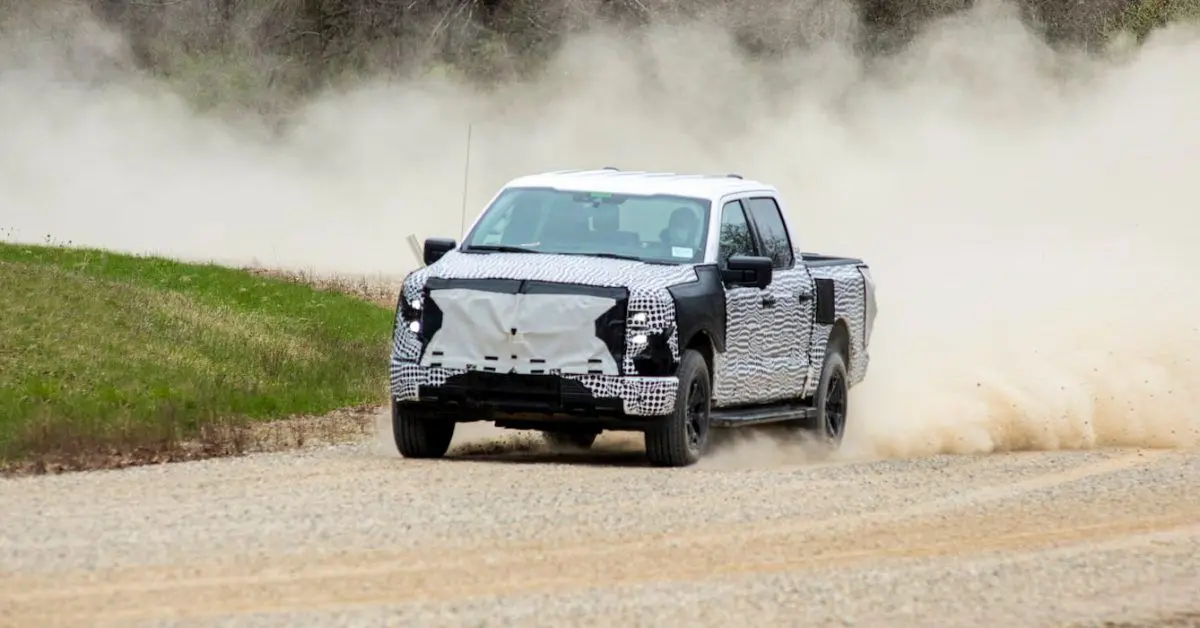
The $30,000 midsize electric pickup that Ford promises will offer more passenger space than a Toyota RAV4, will offer L3 eyes-off driving. Ford wants to make smart tech, including autonomous technology, accessible to everyone. For the most part, self-driving tech is currently available as a premium feature with brands like Tesla, General Motors, Ford, Mercedes-Benz, and BMW. At CES 2026 on Wednesday, Ford said that BlueCruise, its hands-free driver assistance, will offer L3 eyes-off driving, starting in 2028. The feature will debut on Ford's new low-cost Universal EV Platform, which it promises will help unlock more affordable electric vehicles and software. The first vehicle based on the platform will be a four-door midsize electric pickup in 2027, starting at around $30,000. Ford said the "breakthrough" EV will offer more passenger space than a Toyota RAV4 (including the frunk and bed) and will be as fast as the Mustang EcoBoost. Doug Field, Ford's chief EV, digital, and design officer, said since the new tech is made in-house, "we can deliver significantly more capability at a 30% lower cost" than if it were outsourced. Field, a former Tesla vet and head of Apple's car project, added that Ford aims to make "the ultimate in-vehicle experience available for many, not just a privileged few. Will Ford deliver on its promise? With 1.2 million BlueCruise-equipped vehicles on the road today, currently offering hands-off driving, the company continues to improve the system through software updates. Eyes-off driving wasn't the only new tech that Ford announced at the event. It also introduced the Ford AI Assistant. The AI can "understand where you are, what you're doing, and what your vehicle is capable of, and then makes the next decision simpler." For example, Ford said you can snap a picture of bags of mulch and ask the assistant directly on your smartphone, "How many of these will fit in my truck bed?" It will then analyze the image, taking into account the size of the bags and the vehicle's bed size, to determine the exact number. The company plans to launch the new AI Assistant in early 2026 through the Ford and Lincoln apps. Starting in 2027, it will roll out to up to 8 million drivers. Ford said none of this would be possible without its new "vehicle brain." At CES, the company introduced its new High Performance Compute Center, an in-house module that combines infotainment, ADAS, audio, and networking into a single "powerhouse" unit. By developing the new tech in-house, Paul Costa, Ford's executive director of electronics platforms, said it "delivers significant cost savings of 10% to 15% per module." Costa added that the upcoming Universal EV (UEV) architecture "incorporates a five-fold increase for the in-house module design, giving us 5X more control over critical semiconductors." As a result, it can handle complex computing tasks considerably faster, is significantly cheaper to produce, and is nearly half the size, opening up more interior space. Ford enters the race to introduce L3 eyes-off smart driving tech over the next few years, joining crosstown rival GM, Mercedes-Benz, BMW, Stellantis, Tesla, Lucid, Rivian, and several other automakers. GM announced in October that the Cadillac Escalade IQ will be its first vehicle equipped with eyes-off driving, which is also expected to begin rolling out in 2028. Unlike vision-only systems, GM said its setup will use LiDAR, radars, and cameras equipped directly into the vehicle. Ford has yet to reveal all the details, including the cost. The current BlueCruise system is available on all 2022-2024 F-150 Lightning Lariat and Platinum models, as well as the 2024 Flash trim. It's also available on all 2023-2025 Mustang Mach-E trims. New vehicle plans start at $495 for a year (plus a 90-day free trial), or you can opt for a one-time purchase of $2,495. After the 90-day complimentary trial, drivers can renew the service for $49.99 a month.
[4]
Ford's Tesla FSD Competitor? Automaker To Offer 'Eyes-Off' Technology In 2028 With $30,000 EV - Tesla (NASDAQ:TSLA)
Ford Motor Co. (NYSE:F) is working on "eyes-off" technology similar to Tesla Inc.'s (NASDAQ:TSLA) awaited unsupervised Full Self-Driving (FSD) system, as well as General Motors Co.'s (NYSE:GM) Super Cruise system. Ford Eyeing 2028 Launch With Affordable EV The Michigan-based automaker will offer the technology in 2028 via the company's Universal EV Platform, Ford said in an official statement released on Wednesday. The platform will underpin the company's $30,000 EV and will offer "L3 eyes-off driving" by 2028, the company said. Ford also announced that developing the autonomous technology in-house will also make it more affordable for customers. The company stated that its AI assistant, available on the Ford and Lincoln apps, is capable of analyzing pictures and "Ford-specific data" with "real-world needs." "A rollout will begin in early 2026 and will reach up to 8 million customers, with a native in-vehicle experience starting in 2027," the automaker stated. It also shared that the company's "vehicle brain," which is a central chip, can help Ford enable "a single, powerful module that unifies infotainment, ADAS, audio, and networking." Ford's Sales In 2025, EV Rollback Two of the automaker's all-electric offerings were among the top-selling EVs in the U.S. last year, with the Mustang Mach-E selling 51,620 units, while the F-150 Lightning EV Pickup Truck sold 27,307 units. It's worth noting that Ford recently scrapped the production of the F-150 Lightning EV Pickup truck, citing profitability concerns amid a pullback of EV demand in the U.S. Ford will instead focus on the F-150 EREV instead. The automaker also announced that it has taken a $19.5 billion charge, pivoting to hybrids globally, but will focus more on low-cost EVs for the U.S. via its Universal EV Platform. Nvidia's Alpamayo Amid the self-driving push, chipmaker Nvidia Corp. (NASDAQ:NVDA) also unveiled its new Alpamayo technology at the Consumer Electronics Show (CES) 2026, which is an open-source model, touted as the "ChatGPT moment for physical AI" by the chipmaker's CEO Jensen Huang. Ford scores well on the Momentum, Quality and Value metrics. It also has a favorable price trend in the Short, Medium, and Long term. For more such insights, sign up for Benzinga Edge Stock Rankings today! Price Action: Ford shares gained 0.27% during Tuesday's after-hours trading, climbing to $13.78, according to Benzinga Pro data. Check out more of Benzinga's Future Of Mobility coverage by following this link. Photo courtesy: Shutterstock TSLATesla Inc$431.880.11%OverviewFFord Motor Co$13.780.27%GMGeneral Motors Co$81.75-0.20%NVDANVIDIA Corp$189.370.14%Market News and Data brought to you by Benzinga APIs
Share
Share
Copy Link
Ford announced at CES 2026 that it will introduce Level 3 driver-assistance system technology by 2028, allowing drivers to take their eyes off the road on highways. The eyes-off driving capability will debut on the company's new Universal EV Platform, starting with an affordable $30,000 electric pickup truck. Ford aims to make advanced autonomous driving accessible beyond premium vehicles through in-house development.
Ford Brings Eyes-Off Driving to Affordable Electric Vehicle Segment
Ford announced at CES 2026 that it will launch a Level 3 driver-assistance system with eyes-off driving capability by 2028, marking a significant expansion of its BlueCruise system
1
. The technology will debut on Ford's new Universal EV Platform, specifically on a $30,000 electric pickup truck slated for 2027 launch2
. Doug Field, Ford's chief EV, digital, and design officer, emphasized that "autonomy shouldn't be a premium feature," positioning the automaker to democratize advanced autonomous driving technology3
.
Source: InsideEVs
The midsize electric vehicle will offer more passenger space than a Toyota RAV4 and performance comparable to the Mustang EcoBoost, while incorporating advanced software systems not currently available on other Ford models
1
. Field noted that the eyes-off driving feature would be available for an additional fee beyond the base $30,000 price, though specific pricing remains undetermined1
.
Source: Electrek
In-House Development Drives Cost Reduction Strategy
Ford is developing these advanced driver-assistance systems in-house with reduced reliance on suppliers, aiming to cut costs, accelerate updates, and improve quality
1
. Field stated that in-house development enables Ford to "deliver significantly more capability at a 30% lower cost" compared to outsourced solutions3
. The company introduced its High Performance Compute Center, an internally developed module that combines infotainment, autonomous driving technology, audio, and networking into a single unit2
.
Source: Benzinga
Paul Costa, Ford's executive director of electronics platforms, revealed that this vehicle brain delivers cost savings of 10% to 15% per module while offering five times more control over critical semiconductors
3
. The new architecture handles complex computing tasks considerably faster, costs less to produce, and occupies nearly half the size of previous systems, creating additional interior space3
.Competing in the Level 3 Autonomy Race
Ford joins General Motors and Mercedes-Benz in the race to bring Level 3 systems to U.S. consumers. Mercedes-Benz currently offers the only Level 3 system available in the U.S. through its Drive Pilot feature, operational in states including California and Nevada
1
. General Motors announced in October that it would introduce eyes-off driving in 2028, beginning with the Cadillac Escalade IQ, which starts at more than $125,0001
.Ford plans to use lidar technology to support its Level 3 system, contrasting with Tesla's camera-only approach
1
. Tesla CEO Elon Musk has maintained that autonomy can be achieved without lidar using cameras, though Tesla's Full Self-Driving system remains at Level 2 capability, requiring drivers to keep their eyes on the road1
. Most automakers limit self-driving features to highways where traffic patterns prove more predictable, avoiding the complexities of urban environments with pedestrians and cyclists1
.Related Stories

AI Assistant and Subscription Revenue Model
Ford announced an AI assistant that will launch in early 2026 through the Ford and Lincoln apps, with in-vehicle integration beginning in 2027
3
. The assistant can analyze photos using Ford-specific data to answer practical questions, such as calculating how many bags of supplies will fit in a truck bed2
. The rollout will reach up to 8 million customers4
.The current BlueCruise system, offering hands-free but eyes-on driving, is available on vehicles including the F-150 Lightning and Mustang Mach-E for $50 monthly, $495 annually, or $2,495 at purchase
1
. Ford currently has 1.2 million BlueCruise-equipped vehicles on the road, operating on over 130,000 miles of approved highways2
. Driver-assistance systems represent a focal point for generating subscription revenue while serving as a precursor to fully autonomous cars that could unlock new markets for ride-hailing fleets and personal self-driving vehicles1
.References
Summarized by

Navi
Related Stories
Ford AI assistant launches in 2026 with vehicle-specific intelligence, Level 3 driving by 2028
08 Jan 2026•Technology
GM's Ambitious AI-Driven Future: Eyes-Off Driving and Advanced Vehicle Intelligence
22 Oct 2025•Technology

Ford CEO Favors Waymo's LiDAR Approach Over Tesla's Camera-Only System for Autonomous Driving
28 Jun 2025•Technology
Recent Highlights
1
Tennessee Teens Sue Elon Musk's xAI Over Grok AI-Generated Child Abuse Images
Policy and Regulation

2
Supermicro Co-Founder Indicted in $2.5 Billion Nvidia AI Chip Smuggling Scheme to China
Policy and Regulation

3
Val Kilmer to appear posthumously in As Deep as the Grave through AI-generated performance
Entertainment and Society

Recent Highlights
Today's Top Stories











Your Daily Dose of Curated AI News
Don’t drown in AI news. We cut through the noise - filtering, ranking and summarizing the most important AI news, breakthroughs and research daily. Spend less time searching for the latest in AI and get straight to action.

