Ford AI assistant launches in 2026 with vehicle-specific intelligence, Level 3 driving by 2028


4 Sources
[1]
Ford is getting ready to put AI assistants in its cars
The annual Consumer Electronics Show is currently raging in Las Vegas, and as has become traditional over the past decade, automakers and their suppliers now use the conference to announce their technology plans. Tonight it was Ford's turn, and it is very on-trend for 2026. If you guessed that
[2]
Ford's AI voice assistant is coming later this year, L3 driving in 2028
Ford's new AI-powered voice assistant will be rolling out to customers later this year, the company's top software executive said at CES today. And in 2028, the automaker will introduce a hands-free, eyes-off Level 3 autonomous driving feature as part of its more affordable (and hopefully more
[3]
Ford is building an AI assistant that knows your vehicle inside out
It will let you do more than just control the AC or open the sunroof. CES 2026 Read and watch our complete CES coverage here Updated less than 22 minutes ago Ford is working on a new AI assistant for its vehicles that goes beyond basic tasks like adjusting the air conditioning or opening the
[4]
CES 2026: Ford Is Launching Its Own AI Assistant
Listen up, Ford drivers: You're getting a new AI assistant this year. During a decidedly low-key CES keynote, the company announced Ford AI Assistant, a new AI-powered bot coming to Ford customers in the early half of 2026. While the company has plans to integrate the assistant into Ford vehicles
Share
Copy Link
Ford announced its AI assistant will debut in mobile apps early 2026, with in-car integration starting 2027. The assistant uses vehicle-specific data to answer questions generic AI can't, like calculating cargo capacity from photos. Ford also plans Level 3 autonomous driving by 2028, developed in-house at 30 percent lower cost than current systems.
Ford Announces AI Assistant Rollout Starting 2026
Ford revealed its strategy to integrate AI into the driving experience at CES, with Doug Field, the company's chief EV, design, and digital officer, outlining a vision for personalized in-car experiences that extend beyond generic intelligence
1
. The Ford AI assistant will first arrive in the Ford and Lincoln mobile apps during the first half of 2026, before expanding to native in-vehicle integration starting in 2027 with new or refreshed models2
3
. This phased approach allows Ford to test and refine the technology before embedding it directly into vehicle systems.
Source: Lifehacker
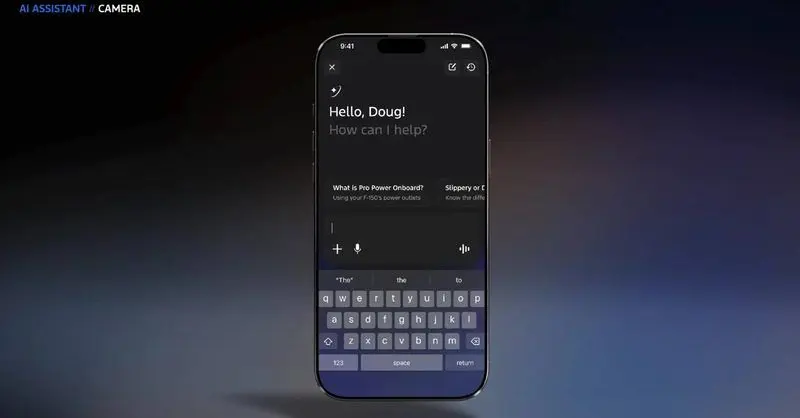
The AI voice assistant distinguishes itself by leveraging vehicle-specific data that generic chatbots cannot access. Field emphasized that customers need "intelligence that understands where you are, what you're doing, and what your vehicle is capable of"
1
. A practical example involves photographing bags of mulch at a hardware store and asking the assistant how many will fit in the truck bed—the system can provide accurate answers because it knows the exact bed dimensions and current cargo status of that specific vehicle2
.
Source: Digital Trends
In-House Development Strategy Reduces Costs
Ford is pursuing in-house development for critical components while relying on established large language models (LLMs) from partners. The assistant is hosted by Google Cloud and uses off-the-shelf LLMs, but Ford designs the integration layer that connects these models to vehicle systems
4
. Sammy Omari, Ford's head of ADAS and infotainment, explained that the key differentiator is giving the LLM "access to all the relevant Ford systems so that LLM then knows about what specific vehicle you're using"2
. The chatbot-agnostic design means Ford can work with various AI models, including Gemini, which CFO Sherry House confirmed would be integrated into vehicles2
.
Source: The Verge
This strategy extends to hardware, where Ford developed its "High Performance Compute Center" in-house. The new computer consolidates infotainment, driver-assist systems, audio, and networking functions while occupying half the volume of previous solutions at significantly lower cost
1
. Paul Costa, executive director of electronics platforms at Ford, noted that the Universal Electric Vehicle (UEV) architecture incorporates a fivefold increase for in-house module design, giving Ford 5X more control over critical semiconductors1
.Software-Defined Vehicles Enable Advanced Features
The transition to software-defined vehicles represents a fundamental shift in automotive architecture, replacing dozens of discrete electronic control units with a handful of powerful multitasking computers
1
. This unified "brain" processes multiple functions simultaneously, from infotainment to voice commands to advanced driver assistance2
. The architecture change enables Ford to deliver more sophisticated features without the cost penalties that have plagued premium autonomous systems.Field emphasized that this approach makes "advanced hands-free driving into the vehicles people actually buy, not just vehicles with unattainable price points"
2
. The strategy reflects lessons learned from Ford's pivot away from fully autonomous robotaxis after shutting down Argo AI in 2022, with the company now focusing on Level 2 and Level 3 conditional autonomous driver assist features instead2
.Related Stories
Level 3 Autonomous Driving Planned for 2028
Ford plans to introduce Level 3 autonomous driving capabilities in 2028, where drivers can take their eyes off the road completely under certain circumstances like heavy highway traffic
1
. Before that milestone, a new generation of BlueCruise will debut in 2027 with "significantly more capability at a 30 percent lower cost"1
. Omari explained that rigorous scrutiny of every sensor, software component, and compute unit achieved this cost reduction while delivering enhanced functionality2
.The enhanced BlueCruise system will offer point-to-point hands-free capability that recognizes traffic lights and navigates intersections, expanding beyond the current highway-only operation
2
. However, some experts have raised concerns about Level 3 systems requiring drivers to stay attentive despite the vehicle performing most driving tasks, creating potential safety challenges during transition periods2
.Privacy Concerns and Practical Applications
The AI assistant's deep integration with vehicle sensors raises privacy concerns, as it can access tire pressure, odometer readings, passenger count, and virtually every data point generated by the car
4
. While this comprehensive access enables genuinely useful features—like checking tire pressure before entering the vehicle or receiving maintenance alerts based on actual usage patterns—it also means the system maintains constant awareness of vehicle status and potentially driver behavior4
.Ford positions the assistant as "an intelligent thread woven seamlessly through every aspect" of ownership rather than occasional software interaction
3
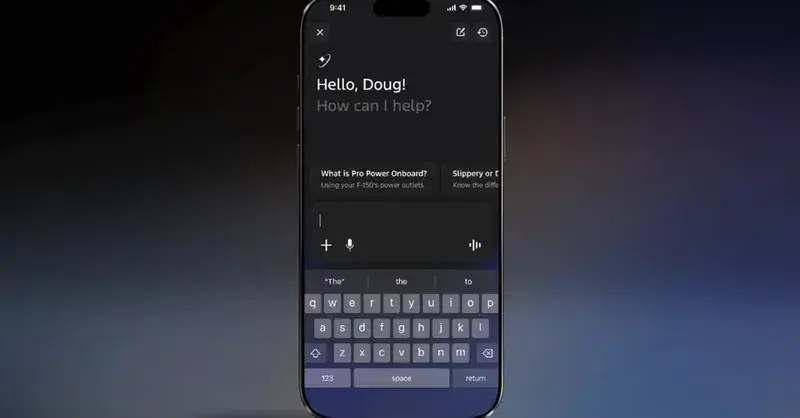
. The chat interface resembles ChatGPT or Gemini, supporting both text and voice input, with an attachment menu for capturing or uploading images3
. Sample prompts shown at CES included vehicle-specific queries like "What is Pro Power Onboard?" demonstrating the system's ability to explain model-specific features3
. Ford hasn't yet detailed all capabilities or fully outlined the in-car experience, with more information expected closer to the 2026 app rollout3
.References
Summarized by

Navi
[1]
[3]
[4]
Related Stories
Ford AI Assistant Launches in Mobile Apps, Reaching 8 Million Owners Before In-Car Integration
10 Aug 2026•Technology
Ford Pro AI assistant launches free for commercial fleets to track seatbelts and fuel costs
11 Mar 2026•Technology

Ford targets 2028 for eyes-off driving debut on $30,000 electric vehicle platform
08 Jan 2026•Technology
Recent Highlights



Recent Highlights
Today's Top Stories



Don’t drown in AI news. We cut through the noise - filtering, ranking and summarizing the most important AI news, breakthroughs and research daily. Follow topics that matter to you and stay ahead.


