Google DeepMind partners with UK government to open automated research lab in 2026


6 Sources
6 Sources
[1]
Google's AI unit DeepMind announces its first 'automated research lab' in the U.K.
The country has been racing to build out its AI capabilities following the release of its national strategy for the technology in January. Google DeepMind, the tech giant's AI unit, unveiled plans for its first "automated research lab" in the U.K. as it signs a partnership that could lead to the company deploying its latest models in the country. The AI company will open the lab, which will use AI and robotics to run experiments, in the U.K. next year. It will focus on developing new superconductor materials, which can be used to develop medical imaging tech, alongside new materials for semiconductors. British scientists will gain "priority access" to some of the world's most advanced AI tools under the partnership, the U.K. government said in its announcement. Founded in London in 2010 by Nobel prize winner Demis Hassabis, DeepMind was acquired by Google in 2014, but has retained a large operational base in the U.K. The company has made several breakthroughs considered crucial to advancing AI technology. The partnership could also lead to DeepMind working with the government on AI research in areas like nuclear fusion and deploying its Gemini models across government and education in the U.K, the government said. "DeepMind serves as the perfect example of what UK-US tech collaboration can deliver - a firm with roots on both sides of the Atlantic backing British innovators to shape the curve of technological progress," said U.K. Technology Secretary Liz Kendall in a statement. "This agreement could help to unlock cleaner energy, smarter public services, and new opportunities which will benefit communities up and down the country," she said.
[2]
Google DeepMind partners with the UK government for 'science breakthroughs, cleaner energy'
Google is also committed to modernizing outdated government IT Under a new deal with the UK Government, Google DeepMind will open its first automated, AI-driven research lab in the UK next year, with a key focus on AI and robotics. Google's lab will be key to creating new superconductor materials and next-generation semiconductor materials, helping the UK, Google, and the world progress in areas like medical imaging, chip efficiency, clean energy, transport, and more. For the UK, it means British scientists will gain priority access to DeepMind tools, making it a win-win for both parties. The Government explained in a press release that the lab would be built from the ground up to support Gemini throughout. But it's not Google's first big investment into the UK. Just weeks ago, Google announced a £5 billion plan to help modernize the UK government's outdated IT. The Government sees this partnership with Google helping across multiple sectors. For example, civil servants will be able to use automation tools to take over repetitive administrative tasks, freeing them up to do more meaningful work. AI will also play a role in education, both in terms of training for children and workload support for teachers. "This partnership will make sure we harness developments in AI for public good so that everyone feels the benefits," Prime Minister Keir Starmer commented. Technology Secretary Liz Kendall acknowledged the powerful transatlantic tech collaboration deal: "Science and technology are at the heart of our mission to drive a new era of national renewal - and partnerships like this will help us go further, faster." Besides upgrading public services, the UK Government also sees this as an opportunity to climb to the top and become a global AI science leader. For now, Kendall will continue on her journey to the US to explore how AI is having a positive impact on teachers and students.
[3]
Our partnership with the UK government
AI presents an opportunity to build a more prosperous and secure world. The UK has already laid a strong foundation to seize this moment and is uniquely positioned to translate AI innovation into public benefit. That's why we are excited to deepen our collaboration with the UK government to accelerate this work and offer a blueprint for other countries. Together we will focus on using AI to speed up progress in science and education, modernize public services and advance national security and resilience. Our partnership will center on providing access to frontier AI in two areas foundational to the UK's long-term success: scientific discovery and education. The UK has a rich history of applying new technologies to drive scientific progress, from Hooke's microscope to Faraday's electrical experiments. We aim to build on this heritage, and empower the next generation of scientists with AI tools that can unlock breakthroughs, transform the economy, and solve some of the major challenges facing humanity. We will provide priority access to our "AI for Science" models to UK scientists, including: Like the microscope or telescope, these AI tools are designed to enhance scientific capacity, enabling researchers to tackle problems of unprecedented complexity and scale. For example, AlphaFold - our AI system for predicting protein structures - has already enabled almost 190,000 researchers in the UK alone to deepen their understanding of areas such as crop resilience, antimicrobial resistance and other critical biological challenges. To help turbocharge scientific discovery, we will establish Google DeepMind's first automated laboratory in the UK in 2026, specifically focused on materials science research. A multidisciplinary team of researchers will oversee research in the lab, which will be built from the ground up to be fully integrated with Gemini. By directing world-class robotics to synthesize and characterize hundreds of materials per day, the team intends to significantly shorten the timeline for identifying transformative new materials. Discovering new materials is one of the most important pursuits in science, offering the potential to reduce costs and enable entirely new technologies. For example, superconductors that operate at ambient temperature and pressure could allow for low cost medical imaging and reduce power loss in electrical grids. Other novel materials could help us tackle critical energy challenges by unlocking advanced batteries, next-generation solar cells and more efficient computer chips.
[4]
Google DeepMind agrees to sweeping research collaboration with the U.K. government | Fortune
As part of the partnership, Google DeepMind said it would open its first automated research laboratory in the U.K. in 2026. That lab will focus on discovering advanced materials including superconductors that can carry electricity with zero resistance. The facility will be fully integrated with Google's Gemini AI models. Gemini will serve as a kind of scientific brain for the lab, which will also use robotics to synthesize and characterize hundreds of materials per day, significantly accelerating the timeline for transformative discoveries. The company will also work with the U.K. government and other U.K.-based scientists on trying to make breakthroughs in nuclear fusion, potentially paving the way for cheaper, cleaner energy. Fusion reactions should produce abundant power while producing little to no nuclear waste, but such reactions have proved to be very difficult to sustain or scale up. Additionally, Google DeepMind is expanding its research alliance with the government-run U.K. AI Security Institute to explore methods for discovering how large language models and other complex neural network-based AI models arrive at decisions. The partnership will also involve joint research into the societal impacts of AI, such as the effect AI deployment is likely to have on the labor market and the impact increased use of AI chatbots may have on mental health. British Prime Minister Keir Starmer said in a statement that the partnership would "make sure we harness developments in AI for public good so that everyone feels the benefits." "That means using AI to tackle everyday challenges like cutting energy bills thanks to cheaper, greener energy and making our public services more efficient so that taxpayers' money is spent on what matters most to people," Starmer said. Google DeepMind cofounder and CEO Demis Hassabis said in a statement that AI has "incredible potential to drive a new era of scientific discovery and improve everyday life." As part of the partnership, British scientists will receive priority access to Google DeepMind's advanced AI tools, including AlphaGenome for DNA sequencing; AlphaEvolve for designing algorithms; DeepMind's WeatherNext weather forecasting models; and its new AI co-scientist, a multi-agent system that acts as a virtual research collaborator. DeepMind was founded in London in 2010 and is still headquartered there; it was acquired by Google in 2014. The collaboration also includes potential development of AI systems for education and government services. Google DeepMind will explore creating a version of Gemini tailored to England's national curriculum to help teachers reduce administrative workloads. A pilot program in Northern Ireland showed that Gemini helped save teachers an average of 10 hours per week, according to the U.K. government. For public services, the U.K. government's AI Incubator team is trialing Extract, a Gemini-powered tool that converts old planning documents into digital data in 40 seconds, compared to the current two-hour process. The expanded research partnership with the U.K. AI Security Institute will focus on three areas, the government and DeepMind said: developing techniques to monitor AI systems' so-called "chain of thought" -- the reasoning steps an AI model takes to arrive at an answer; studying the social and emotional impacts of AI systems; and exploring how AI will affect employment. U.K. AISI currently tests the safety of frontier AI models, including those from Google DeepMind and a number of other AI labs, under voluntary agreements. But the new research collaboration could potentially raise concerns about whether the U.K. AISI will remain objective in its testing of its now-partner's models. In response to a question on this from Fortune, William Isaac, principal scientist and director of responsibility at Google DeepMind, did not directly address the issue of how the partnership might affect the U.K. AISI's objectivity. But he said the new research agreement puts in place "a separate kind of relationship from other points of interaction." He also said the new partnership was focused on "question on the horizon" rather than present models, and that the researchers would publish the results of their work for anyone to review. Isaac said there is no financial or commercial exchange as part of the research partnership, with both sides contributing people and research resources. "We're excited to announce that we're going to be deepening our partnership with the U.K. AISI to really focus on exploring, really the frontier research questions that we believe are going to be important for ensuring that we have safe and responsible development," he said. He said the partnership will produce publicly accessible research focused on foundational questions -- such as how AI impacts jobs or how talking to chatbots effects mental health -- rather than policy-specific recommendations, though the findings could influence how businesses and policymakers think about AI and how to regulate it. "We want the research to be meaningful and provide insights," Isaac said. Isaac described the U.K. AISI as "the crown jewel of all of the safety institutes" globally and said deepening the partnership "sends a really strong signal" about the importance of engaging responsibly as AI systems become more widely adopted. The partnership also includes expanded collaboration on AI-enhanced approaches to cybersecurity. This will include the U.K. government exploring the sue of tools like Big Sleep, an AI agent developed by Google that autonomously hunts for previously unknown "Zero Day" cybersecurity exploits, and CodeMender, another AI agent that can search for and then automatically patch security vulnerabilities in open source software. British Technology Secretary Liz Kendall is visiting San Francisco this week to further the U.K.-U.S. Tech Prosperity Deal, which was agreed to during U.S. President Trump's state visit to the U.K. in September. In November alone, the British government said the pact helped secure more than $32.4 billion of private investment committed to the U.K tech sector. The Google-U.K. partnership builds on a £5 billion ($6.7 billion) investment commitment from Google made earlier this year to support U.K. AI infrastructure and research, and to help modernize government IT systems. The British government also said collaboration supports its AI Opportunities Action Plan and its £137 million AI for Science Strategy, which aims to position the UK as a global leader in AI-driven research.
[5]

Google DeepMind to open UK research lab for discovery of new materials
The facility will aim to discover new materials similar to those used in batteries and semiconductors as part of a commitment to applying AI to additional scientific fields. Google DeepMind, which is an artificial intelligence (AI) research platform that spearhead's Google's AI endeavours, has announced that it will be opening its inaugural research lab for the purpose of material discovery, which will be located in the UK. Set to open in 2026, the project is in partnership with the British government and will aim to innovate AI-powered scientific breakthroughs in order to create smarter public services. The laboratory will be DeepMind's first automated facility and will use robotics and AI to carry out a range of scientific experiments and tasks, focusing particularly on developing new cutting-edge superconductor materials that can carry electricity with zero resistance. Through the partnership, scientists will have access to Google DeepMind's advanced technologies, for example the Gemini AI model and AlphaGenome, to support research, generate new theories, conduct tests and potentially discover new materials similar to those used in batteries, semiconductors, medical imagery, solar technology and more. The partnership will also extend to sharing proprietary models and data with the UK AI Security Institute, which was developed in 2023 as a means of rigorously testing and evaluating AI systems. Currently no details around staffing or finances have been disclosed. Commenting on the announcement, British prime minister Keir Starmer said, "This partnership will make sure we harness developments in AI for public good so that everyone feels the benefits. "That means using AI to tackle everyday challenges like cutting energy bills thanks to cheaper, greener energy and making our public services more efficient so that taxpayers' money is spent on what matters most to people. This is national renewal in action - driving innovation to make our country stronger and fairer for everyone." Demis Hassabis, Google DeepMind's co-founder and its CEO added, "AI has incredible potential to drive a new era of scientific discovery and improve everyday life. We're excited to deepen our collaboration with the UK government and build on the country's rich heritage of innovation to advance science, strengthen security, and deliver tangible improvements for citizens." In September of this year, Google DeepMind announced it would be adding agentic AI models to its robots, in a "foundational step toward building robots that can navigate the complexities of the physical world with intelligence and dexterity". Don't miss out on the knowledge you need to succeed. Sign up for the Daily Brief, Silicon Republic's digest of need-to-know sci-tech news.
[6]

DeepMind to open first AI science lab in UK 2026
Google DeepMind announced plans to open its first automated science laboratory in the United Kingdom in 2026. The facility will use artificial intelligence to identify new materials for superconductors, semiconductors, and solar cells. This initiative forms the core of a partnership with the British government to advance scientific research and enhance public services through robotics and AI integration. The laboratory will integrate fully with DeepMind's Gemini AI platform, enabling robotics to perform experiments autonomously. A multidisciplinary team of researchers will oversee these systems, directing them to synthesize and characterize hundreds of materials each day. This process aims to shorten the time required for material discovery by automating repetitive tasks traditionally done manually in research settings. Pushmeet Kohli, DeepMind's vice president for science and strategic initiatives, explained the technology's role, stating, "We believe that AI systems are now equipped to connect the digital realm with the actual discovery of new materials." This statement highlights how AI bridges computational modeling with physical experimentation, allowing for rapid iteration in material science. The partnership includes a memorandum of understanding signed by Technology Secretary Liz Kendall and DeepMind CEO Demis Hassabis. This agreement provides UK scientists with priority access to DeepMind's advanced AI tools. Among these tools are AlphaGenome, designed for DNA sequencing tasks, and AlphaFold, which predicts protein structures to aid biological research. The collaboration extends to the UK AI Security Institute, focusing on AI safety research. Efforts will include developing methods to monitor AI reasoning processes and examining the technology's societal impacts. These activities seek to ensure responsible deployment of AI in various sectors. Prime Minister Keir Starmer commented on the initiative, saying the partnership would "make sure we harness developments in AI for public good so that everyone feels the benefits." Specific applications involve using AI to lower energy costs and increase efficiency in public services, such as optimizing resource allocation in government operations. The agreement also covers educational uses of AI. Plans involve creating a customized version of the Gemini AI platform aligned with England's national curriculum. This tool will assist teachers by handling administrative tasks, freeing them to focus on instruction and student engagement. This development follows Google's £5 billion investment commitment in September, directed toward bolstering UK AI infrastructure and supporting research initiatives across universities and institutions. Critics express concerns over the British government's increasing reliance on American technology companies. Imogen Parker, associate director at the Ada Lovelace Institute, cautioned that "without independent regulation or oversight, we are vulnerable to the commercial interests of technology companies taking precedence over public needs." This perspective underscores the need for balanced governance in tech partnerships.
Share
Share
Copy Link
Google DeepMind will establish its first automated research lab in the UK next year, focusing on materials science and superconductor development. The UK government partnership grants British scientists priority access to advanced AI tools including Gemini models, AlphaFold, and AlphaGenome. The collaboration aims to accelerate scientific breakthroughs in clean energy, nuclear fusion, and public services modernization.
Google DeepMind announces UK government partnership for automated research lab
Google DeepMind has unveiled plans to open its first automated research lab in the UK in 2026, marking a significant expansion of its UK government partnership
1
. The facility will leverage AI and robotics to conduct experiments focused on the discovery of new materials, particularly superconductors and semiconductors that could transform medical imaging, chip efficiency, and clean energy technologies2
. This collaboration positions the UK to become a global leader in AI research while providing British scientists with priority access to AI tools that have already enabled breakthroughs across multiple scientific domains.
Source: Silicon Republic
Automated lab to accelerate material discovery through AI for Science
The automated research lab will be built from the ground up to integrate fully with Gemini AI models, which will serve as the scientific brain directing world-class robotics to synthesize and characterize hundreds of materials per day
3
. This approach aims to significantly shorten the timeline for identifying transformative new materials. The facility will focus specifically on materials science research, with a multidisciplinary team of researchers overseeing operations4
. Discovering superconductors that operate at ambient temperature and pressure could enable low-cost medical imaging and reduce power loss in electrical grids, while other novel materials could unlock advanced batteries and next-generation solar cells3
.
Source: DeepMind
British scientists gain priority access to advanced AI tools
Under the partnership, British scientists will receive priority access to Google DeepMind's suite of advanced AI tools, including AlphaGenome for DNA sequencing, AlphaEvolve for designing algorithms, WeatherNext weather forecasting models, and a new AI co-scientist multi-agent system that acts as a virtual research collaborator
4
. AlphaFold, DeepMind's AI system for predicting protein structures, has already enabled almost 190,000 researchers in the UK alone to advance understanding in areas such as crop resilience and antimicrobial resistance3
. The collaboration will also extend to nuclear fusion research, potentially paving the way for cheaper, cleaner energy solutions4
.Partnership extends to modernize public services and education
Beyond scientific breakthroughs, the UK government partnership includes deploying Gemini AI models across government and education sectors to modernize public services
1
. Civil servants will gain access to automation tools that handle repetitive administrative tasks, freeing them for more meaningful work2
. Google DeepMind is exploring a version of Gemini tailored to England's national curriculum to help teachers reduce workloads—a pilot program in Northern Ireland showed teachers saved an average of 10 hours per week4
. The UK government's AI Incubator team is trialing Extract, a Gemini-powered tool that converts old planning documents into digital data in 40 seconds compared to the current two-hour process4
.Related Stories

Expanded collaboration with AI Security Institute raises questions
Google DeepMind is expanding its research alliance with the government-run AI Security Institute to explore how large language models arrive at decisions, focusing on developing techniques to monitor AI systems' chain of thought reasoning
4
. The partnership will also involve joint research into labor market impacts and the effects of AI chatbots on mental health4
. While the AI Security Institute currently tests frontier AI models under voluntary agreements, the deepened partnership could raise questions about maintaining objectivity when evaluating its partner's models. William Isaac, principal scientist at Google DeepMind, emphasized there is no financial or commercial exchange, with both sides contributing people and research resources, and noted the research will be publicly accessible4
.Transatlantic collaboration builds on DeepMind's UK roots
Founded in London in 2010 by Nobel prize winner Demis Hassabis, DeepMind was acquired by Google in 2014 but has retained a large operational base in the UK
1
. Technology Secretary Liz Kendall described DeepMind as "the perfect example of what UK-US tech collaboration can deliver—a firm with roots on both sides of the Atlantic backing British innovators to shape the curve of technological progress"1
. Demis Hassabis stated that AI has "incredible potential to drive a new era of scientific discovery and improve everyday life," emphasizing the collaboration will build on the UK's rich heritage of innovation to advance science, strengthen national security, and deliver tangible improvements for citizens5
. This partnership follows Google's recent £5 billion commitment to help modernize the UK government's outdated IT infrastructure2
.
Source: Fortune
References
Summarized by

Navi
[2]
[3]
[4]
[5]
Related Stories
DeepMind Founder Urges UK to Lead in Global AI Development and Regulation
18 Mar 2025•Technology

UK Government Signs Strategic Partnership with OpenAI, Sparking Debate on AI's Role in Public Services
22 Jul 2025•Policy and Regulation

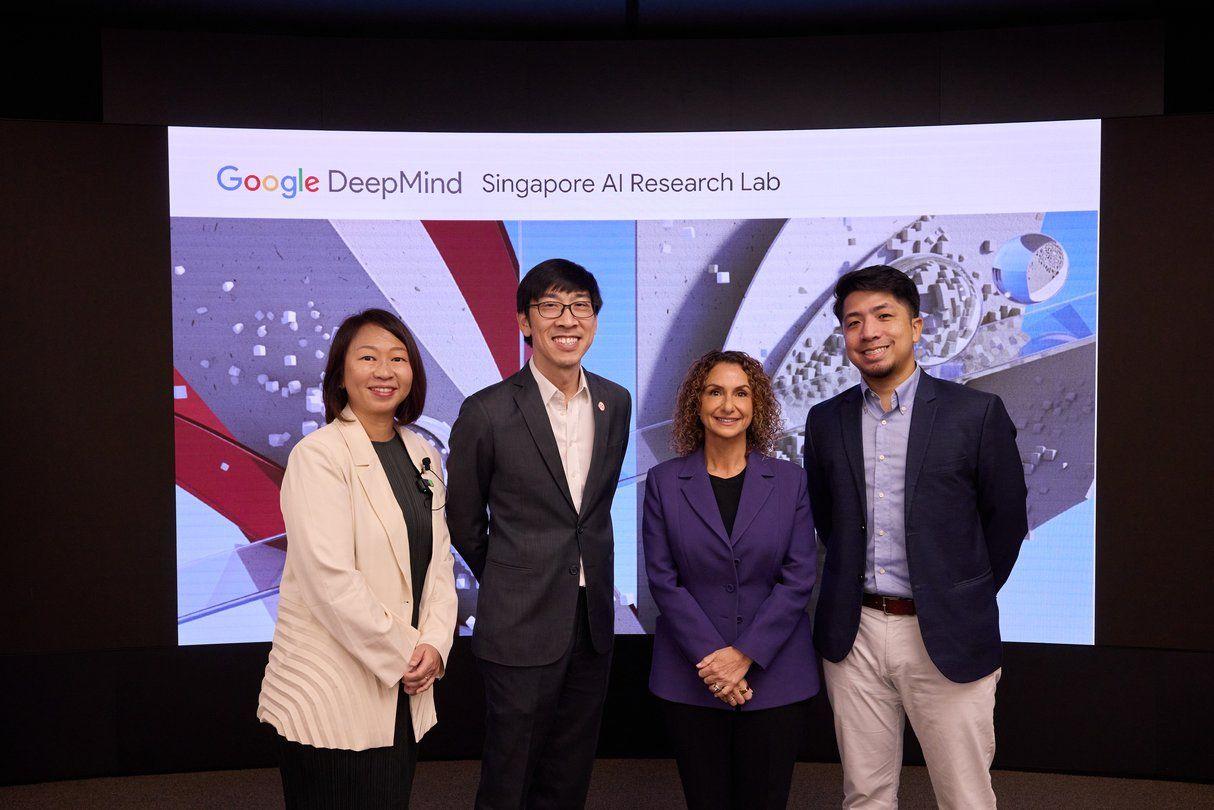
Google DeepMind Opens New AI Research Lab in Singapore to Advance AI Across Asia-Pacific
19 Nov 2025•Technology
Recent Highlights
1
Google releases Gemma 4 with Apache 2.0 license, enabling unrestricted local AI on devices
Technology

2
AI Models Lie and Deceive to Protect Other AI Models From Deletion, Study Reveals
Science and Research

3
OpenAI closes $122 billion funding round amid fierce AI competition and profitability questions
Startups

Recent Highlights
Today's Top Stories







Your Daily Dose of Curated AI News
Don’t drown in AI news. We cut through the noise - filtering, ranking and summarizing the most important AI news, breakthroughs and research daily. Spend less time searching for the latest in AI and get straight to action.

