19 Sources
19 Sources
[1]
OpenAI's $122B in funding comes at a perilous moment
War, oil shocks, and market nerves could yet knock the AI boom off course Opinion OpenAI has secured an additional $122 billion in capital from a diverse group of investors and reached a nominal $852 billion valuation, the highest of any pre-IPO tech company. The poster child of the LLM era argues it needs the money to help the world "just build things," it said in an online missive. Backers include its regular partners Amazon, Nvidia, SoftBank, and Microsoft, as well as an all-star cast of venture capitalists. Curiously for a company that is yet to go public, it is also getting public money. Through "bank channels," it is raising more than $3 billion from individual investors and will be included in "several exchange-traded funds managed by ARK Invest, further broadening ownership and giving more people the opportunity to share in the upside economics of OpenAI and the AI era." OpenAI's revolving credit has grown to around $4.7 billion supported by a global syndicate including some of the biggest names in the banking sector. OpenAI has hit 900 million weekly active users and over 50 million subscribers among consumers, but OpenAI thinks half of its revenue will come from enterprise offerings by the end of the year. Business users will be expected to pull their weight to help these ravenous investors get their handsome gains. OpenAI's business APIs process more than 15 billion tokens per minute while its Codex developer tool now serves over 2 million weekly users, up five times in the past three months, the company said. To meet that demand for its software and LLMs, OpenAI is working with an "infrastructure portfolio across multiple cloud partners and multiple chip platforms." OpenAI's infrastructure partners include Microsoft, Oracle, AWS, CoreWeave, and Google Cloud, while its chip suppliers include Nvidia, AMD, AWS again with Trainium, Cerebras, and Broadcom. Its datacenter partners are Oracle, SBE, and SoftBank. Commentators have been quick to point out that the list has significant crossover with its investors. OpenAI will build datacenters with Nvidia's chips, but Nvidia is also an investor in OpenAI. Microsoft invests in OpenAI, but OpenAI also spends heavily on Azure. Other linked companies are borrowing heavily. Oracle has increased its borrowing by $50 billion to help build datacenters for OpenAI in a $300 billion cloud deal. How will all this debt and investment be paid back? "A unified AI superapp" is part of the answer. "Users do not want disconnected tools," OpenAI said. "They want a single system that can understand intent, take action, and operate across applications, data, and workflows. Our superapp will bring together ChatGPT, Codex, browsing, and our broader agentic capabilities into one agent-first experience." Perhaps OpenAI is hoping its superapp also has superpowers, because it might need them. As things stand, some observers predict OpenAI will not make a profit until 2030. While the latest funding round is a statement of investor confidence, it's worth considering whether the AI boom belongs in the first half of the decade. A lot might happen in the next few years. The second half of the decade, as determined by the US president, seems more characterized by the Iran conflict and the oil price. Whatever the messy conclusion and whenever it comes, the aftermath will be with us for a while. S&P Global is already predicting a hit to the AI boom. Tech giants have so far not shown any signs of reducing the staggering capital investments - possibly $1.6 trillion on datacenters to largely meet AI demand by 2030, according to Omdia - but they might. If the Iran conflict creates a more permanently high oil price, it could see those companies cut spending in the next two quarters as energy costs rise, producing a "really meaningful correction in all equity markets," Melissa Otto, head of research at S&P Global Visible Alpha, told Reuters. Before the conflict, jitters already abounded. Despite announcing surging profits, Microsoft saw its share price drop 6 percent as investors voiced concerns about the rampant capex growth it needs to support AI demand. The world doesn't just want to build things. It demonstrably also wants to blow them up. OpenAI's long list of investors and cloud providers might now wonder if they are standing in the blast zone. ®
[2]
Artificial Intelligencer: OpenAI's $852 billion problem: finding focus
April 1 (Reuters) - OpenAI has just raised $122 billion in what is likely the largest-ever fundraising round in Silicon Valley history. That kind of cash should show you that the richest, most sophisticated investors in the world have ample faith in the ChatGPT maker, now worth $852 billion. What's actually happening: OpenAI is scrambling to make up for lost time. In the past six months, the company has twice redrawn its product roadmap because of threats posed by rivals, first by Google and now Anthropic. Some industry watchers now predict, opens new tab that Anthropic's pace of revenue growth will eclipse that of OpenAI within a couple of months. That prospect has sent OpenAI running to redirect resources to its own coding product, Codex, as well as to teams building tools for businesses - so far two of the most obvious opportunities for OpenAI to generate revenue and justify its valuation. That inevitably means killing off some of OpenAI's most high-profile projects. Case in point: Sora. The news to shut down the AI video app came as a shock to many people involved in Sora - including Disney, which inked a $1 billion deal tied to Sora in December. In fact, Disney and OpenAI employees were working side-by-side on a Sora-related project until 7:30 pm or so the night before Sora was canceled, my colleague Dawn Chmielewski and I reported last week. From one angle, these are the moves of a startup moving on to more promising new bets. But the Disney episode also shows how messy OpenAI's latest pivot could be. Read on to learn more about OpenAI's new strategy. OUR LATEST REPORTING IN TECH AND AI 'DOUBLE DOWN AND AVOID DISTRACTIONS' For a long time, ChatGPT was the undisputed leader of the AI pack. And as OpenAI's star rose, so did its coffers and opportunities. Then, in late 2025, OpenAI declared a "code red" after Google released its latest Gemini model to great fanfare. Then, Anthropic managed to catch OpenAI off-guard with Claude Code, a popular coding product that sent OpenAI scrambling to pour resources into its own coding tool, Codex. The back-to-back crises have forced OpenAI to reckon with what had become a sprawling empire of loosely correlated projects that often competed for talent, computational power and other resources. "Companies go through phases of exploration and phases of refocus; both are critical," said, opens new tab Fidji Simo, one of OpenAI's senior executives. "But when new bets start to work, like we're seeing now with Codex, it's very important to double down on them and avoid distractions. Really glad we're seizing this moment." The embrace of focus is a far cry from the OpenAI of just six months ago. At that point, OpenAI was working on everything: AI-generated video, consumer devices, shopping and ads for ChatGPT. It struck a deal with Mattel to hook Barbie up with ChatGPT, opens new tab. Executives negotiated more than $1 trillion worth of AI infrastructure deals and the finance team started exploring the possibility of going public to the tune of a trillion dollars. "OpenAI is attempting to excel simultaneously at every level of the stack and across every customer segment," Leonis Capital, a fund founded by a former OpenAI researcher, wrote in a report, opens new tab last year. "But the breadth also raises a core risk: loss of focus." Altman argued that what looked like a disparate slew of projects was actually all part of one effort to build artificial general intelligence, or AGI - the holy grail. It was important to embrace a variety of bets, he said, because moments like this don't come along very often. OpenAI is now reversing course. After announcing its epic fundraising round on March 31, the company flicked at this newfound approach. It confirmed that it was now building a superapp that would bundle ChatGPT with the company's other tools, including Codex. "Users do not want disconnected tools," the company wrote. "They want a single system that can understand intent, take action, and operate across applications, data, and workflows." The company statement also reiterated that this was a rare moment in history and an important opportunity for OpenAI itself. "Moments like this do not come often." CHART OF THE WEEK The prevailing fear among investors is that technology firms will spend hundreds of billions - or even trillions of dollars - on building AI infrastructure only to see demand flop. But there's another, more immediate issue: physics. Four companies - Amazon, Microsoft, Alphabet and Meta - are projected to spend about $630 billion in 2026, Morgan Stanley estimates. That equates to roughly 2.2% of U.S. GDP. The bulk of that money will be spent on servers and graphics processing units i.e. chips designed by Nvidia. Land accounts for 6% of the cost, depending on the location. But the rest? It's buildings, networking equipment, security - and most importantly, power. And these aren't trivial details, my colleague at Breakingviews, Karen Kwok, says. Let's examine power. Securing a connection to the public grid in major hubs like London can now take up to a decade. You can turn to more remote areas like Abilene, Texas - which I visited last fall - but in those areas, skilled labor is often scarce. A third option is for data centers to generate their own power. Suitable gas turbines are more or less sold out until 2029. Reporting by Deepa Seetharaman, Editing by Rosalba O'Brien Our Standards: The Thomson Reuters Trust Principles., opens new tab
[3]
OpenAI Adds Another $12 Billion to Latest Funding Round
The start-up has raised a total of $122 billion in a funding round that values the company at $730 billion. OpenAI said on Tuesday that it had raised an additional $12 billion as part of its latest funding round, bringing the total of this new investment round to an eye-popping $122 billion. The round values OpenAI at $730 billion, the same as when the company announced the deal in February. With the deal, OpenAI cemented its place as one of the most valuable private companies in the world alongside SpaceX, the rocket company founded by Elon Musk, and ByteDance, the maker of TikTok. "The fastest way to widen the benefits of A.I. is to put useful intelligence in people's hands early and let that access compound globally," the company said in a blog post. It added, "This funding gives us the resources to continue to lead at the scale this moment demands." The Japanese conglomerate SoftBank led the round along with the venture firms Andreessen Horowitz and D.E. Shaw Ventures, the United Arab Emirates investment firm MGX, and other investors. SoftBank and the chip maker Nvidia, which had both previously invested in OpenAI, each contributed $30 billion. Amazon, a new investor in OpenAI, pumped $50 billion into the artificial intelligence start-up. OpenAI faces growing competition from A.I. start-ups like Anthropic and tech giants like Google, as both businesses and consumers adopt A.I. tools in increasingly large numbers. OpenAI says its chatbot, ChatGPT, is now used by over 900 million people each week. On Tuesday, the company said it was pulling in over $2 billion a month in revenues. But OpenAI is still unprofitable and needs enormous amounts of money to pay for computing power, A.I. talent and other needs. The company pulled in revenue totaling more than $13 billion in 2025, but expects to spend $115 billion over the next four years. The start-up, based in San Francisco, hopes to make an initial public offering as soon as the end of this year, but it must first work to balance its books so that it is more attractive to Wall Street investors. The $12 billion added to the company's latest funding round came from a wide range of investors from across the globe. The company said that for the first time, it had extended participation in a funding round through banks, raising over $3 billion from individual investors. (The New York Times sued OpenAI and Microsoft in 2023 for copyright infringement of news content related to A.I. systems. The two companies have denied those claims.)
[4]
OpenAI closes $122 billion funding round, biggest ever in Silicon Valley
OpenAI closed a $122 billion funding round at a post-money valuation of $852 billion, the largest funding round in Silicon Valley history, the company said. The round was anchored by strategic partners Amazon $AMZN, Nvidia $NVDA, and SoftBank, with continued participation from Microsoft $MSFT. SoftBank co-led the round alongside Andreessen Horowitz, D. E. Shaw Ventures, MGX, TPG, and accounts advised by T. Rowe Price $TROW Associates. A broader group of institutional investors also participated, including BlackRock $BLK, Blackstone, Sequoia Capital, Thrive Capital, and Temasek, among others. The round grew from $110 billion in commitments that OpenAI announced in February. The additional $12 billion came from a wider pool of investors, including more than $3 billion raised from individual investors through bank channels -- the first time OpenAI has extended participation that way. OpenAI also said it will be included in several exchange-traded funds managed by ARK Invest. OpenAI said it is generating $2 billion in revenue per month. The company reported $13.1 billion in revenue last year and remains unprofitable, according to CNBC. ChatGPT has more than 900 million weekly active users and more than 50 million subscribers, OpenAI said. Enterprise customers now account for more than 40% of revenue and are on track to reach parity with consumer revenue by the end of 2026. The company also expanded its revolving credit facility to approximately $4.7 billion, supported by a syndicate that includes JPMorgan $JPM Chase, Citi, Goldman Sachs $GS, Morgan Stanley $MS, and Wells Fargo $WFC, among others. The facility remains undrawn. The funding round comes as OpenAI faces intensifying competition. The company recently narrowed its product focus toward coding tools and enterprise customers after rival Anthropic built a dominant position among developers and business customers, driven by its Claude Code offering. OpenAI shut down its standalone Sora video app and plans to fold video capabilities into ChatGPT directly. Its refreshed Codex coding agent now serves more than 2 million weekly users, up fivefold over the past three months. OpenAI also said it recently launched GPT-5.4, described as its most capable model, and that its APIs process more than 15 billion tokens per minute. The company said it is building a unified AI application that would bring together ChatGPT, Codex, browsing, and other capabilities into a single interface. The Wall Street Journal reported that an IPO is expected by the end of the year.
[5]
OpenAI raises $122 billion in boosted funding round
San Francisco (United States) (AFP) - OpenAI on Tuesday said that the startup was valued at $852 billion in a freshly closed funding round that raised $122 billion. The eye-watering level of funding came in higher than originally projected, reflecting the surging costs of computing power and arriving amid lingering questions about whether OpenAI and other AI companies can generate sufficient revenue to cover expenses. "The capital being deployed today is helping build the infrastructure layer for intelligence itself," OpenAI said in a blog post. "Over time, that value will flow back into the economy, to companies, to communities, and increasingly to individuals." The ChatGPT-maker said that its revenue rate of $2 billion monthly is quickly growing. The funding round included a diverse set of partners including Amazon, Microsoft, Nvidia, and Softbank, according to OpenAI. In an unusual move, some $3 billion was reportedly raised from individual investors. ChatGPT claims the top position in consumer AI, with more than 900 million weekly active users and some 50 million subscribers. Use of ChatGPT's online search engine has tripled over the course of a year, according to OpenAI. "These are not just growth milestones -- they show that frontier AI is becoming part of everyday life for people around the world," the San Francisco-based startup said in the post. The company in February began rolling out advertising for its non-premium users in a bid to bring in more revenue. OpenAI also announced that it is building a "superapp" that will combine ChatGPT, internet browsing, a Codex coding tool, and agentic capabilities that allow digital assistants to independently tend to tasks. The massive funding round comes with anticipation that OpenAI is planning to become a publicly traded company this year as competition intesifies in the AI sector. Arch-rival Anthropic, founded by former OpenAI employees, continues to gain ground and grab headlines for its well-regarded Claude AI models. Anthropic earlier this year secured a $30 billion funding round. Google's AI model Gemini has emerged as another potent competitor, with Elon Musk's xAI also attracting investment and users.
[6]
OpenAI closes larger than expected funding round of $122bn
The 'record-breaking' funding round gives OpenAI a post-money valuation of $852bn. Artificial intelligence company OpenAI has announced the closure of a recent funding round that exceeded its projected figure of $110bn, standing instead at $122bn. The round was backed by strategic partners Amazon, NVIDIA and SoftBank, with continued participation from OpenAI's long-term partner, Microsoft. SoftBank co-led the round alongside a16z, D.E Shaw Ventures, MGX, TPG and accounts advised by T. Rowe Price Associates. There was also participation from several global institutions. For the first time, OpenAI extended participation to investors through banking channels, raising more than $3bn from individual investors. According to the organisations, the 'record-breaking' funding round gives OpenAI a post-money valuation of $852bn. In a post about the announcement, OpenAI said, "This is commercial scale and it is mission scale. The fastest way to widen the benefits of AI is to put useful intelligence in people's hands early and let that access compound globally. "AI is driving productivity gains, accelerating scientific discovery and expanding what people and organisations can build. This funding gives us the resources to continue to lead at the scale this moment demands." The announcement comes at a time when OpenAI is calling a halt to specific features and products, as it aims to better manage costs and reprioritise resources. For example plans for an erotic ChatGPT were reportedly put on hold indefinitely, as OpenAI elected to carry out additional research and to address concerns from staff and investors. Additionally, in late March, the platform revealed plans to shut down controversial AI video generator Sora just a few months after announcing a multi-year licensing deal with Disney. OpenAI explained that in ending the feature, the organisation can redirect its focus onto other projects. OpenAI is facing significant challenges from rivals in the AI space and recently news surfaced indicating the company's plans to combine its AI chatbot, coding tool and web browser into a desktop 'superapp'. Sources noted that the move is intended to counter harsh competition from the AI giant's rivals, such as Anthropic. Don't miss out on the knowledge you need to succeed. Sign up for the Daily Brief, Silicon Republic's digest of need-to-know sci-tech news.
[7]
OpenAI just closed on a record-breaking $122B funding round that brings its value to $852B - SiliconANGLE
OpenAI just closed on a record-breaking $122B funding round that brings its value to $852B OpenAI Group PBC showed that it's still the darling of artificial intelligence investors today, announcing it has raised $122 billion at an $852 billion valuation, the largest funding round in Silicon Valley's history. The round, which comes at a time when the company is believed to be gearing up for an initial public offering, will enable it to continue spending enormous amounts of money on AI chips and data center infrastructure and hiring the industry's top talent. SoftBank Group Corp. led the round together with Andreessen Horowitz, D.E. Shaw Ventures, MGX, TPG and T. Rowe Price Associates, OpenAI said. Others, including previous backers such as Amazon.com Inc., Nvidia Corp. and Microsoft Corp., participated in the round too. Almost $3 billion came from individual investors through bank channels, the company said. In addition, OpenAI will now be included in a number of exchange-traded funds operated by ARK Investment Management LLC, which will enable more private investors to gain exposure to its stock ahead of the IPO. OpenAI will gain access to further funds from a number of global banks too, after expanding its revolving credit facility to around $4.7 billion, it said. That facility has not yet been tapped into, and is likely there to increase the company's financial flexibility as it ramps up its spending on infrastructure. Following this round, Chief Executive Sam Altman (pictured) will find himself under more pressure than ever to justify the company's enormous valuation, and he appears to be trying to do that already with some of the language used in today's announcement. The press release provided updates on the company's latest financials, saying that it's now generating in excess of $2 billion in sales per month. "At this stage, we are growing revenue four-times faster than the companies who defined the internet and mobile eras, including Alphabet and Meta," the company said. OpenAI also provided an update on users. It said it now counts more than 900 million weekly active users of its consumer-based applications. It added that usage of ChatGPT's search functionality has tripled in the last year, making inroads into Google LLC's territory. Moreover, its subscriber base has grown beyond 50 million, and its new ad business is generating over $100 million in annual recurring revenue, despite only launching six weeks ago. That's especially encouraging, as ads enable the company to generate revenue from its large, non-paying user base, and is the same model that generates billions of dollars per quarter for the likes of Google, Amazon, Meta Platforms Inc. and other technology titans. The company claimed to be seeing strong momentum on the enterprise side of its business. It said sales to businesses now account for 40% of its total revenue, up from just 30% a year ago. It's on track to "reach parity with consumer by the end of 2026," the company added. That's an important detail, because OpenAI has made a lot of noise about switching up its strategy to target enterprise customers, similar to what its rival Anthropic PBC is doing. The company recently announced plans to create a new kind of "superapp" that's focused on developers and business users, which will incorporate ChatGPT and its agentic offerings. It has also decided to shut down the much-hyped but consumer-focused Sora video generation application, so it can focus its investments on tools that enable workers to increase their productivity, especially coding agents. "AI is driving productivity gains, accelerating scientific discovery and expanding what people and organizations can build," the company said. "This funding gives us the resources to continue to lead at the scale this moment demands."
[8]
OpenAI lands $122 billion funding round ahead of expected IPO
OpenAI has closed a deal to raise $122 billion at an $852 billion valuation, marking its largest funding round to date. This funding aims to bolster OpenAI's expenditures on artificial intelligence chips, data center expansion, and recruitment of talent. Industry experts view this funding round as a strategic move by OpenAI to solidify its narrative ahead of an anticipated initial public offering (IPO). The company seeks to broaden its shareholder base by including its stock in several exchange-traded funds (ETFs) managed by ARK Invest, which enhances accessibility for potential investors. SoftBank co-led the funding round, joined by Andreessen Horowitz, D.E. Shaw Ventures, MGX, TPG, and T. Rowe Price Associates. Additional participation came from notable tech giants, including Amazon, Nvidia, and Microsoft. Approximately $3 billion was derived from individual investors through bank channels. OpenAI also announced an expansion of its revolving credit facility to roughly $4.7 billion, supported by leading global banks. The facility remains undrawn, enabling the company to strengthen its financial position while ramping up infrastructure investment. The company shared significant revenue and user metrics in a release that closely resembled an S-1 filing. OpenAI claims it generates $2 billion in monthly revenue and reports growth at four times the rate of competeors such as Alphabet and Meta. OpenAI has over 900 million weekly active users and more than 50 million subscribers, with search usage increasing nearly threefold in the past year. OpenAI's advertising pilot has reportedly produced over $100 million in annual recurring revenue in under six weeks, indicating a promising new revenue stream. Business revenue now comprises 40% of total revenue, up from around 30% last year. The company anticipates reaching parity between business and consumer revenue by the end of 2026, driven by growth in its latest model, GPT-5.4. OpenAI characterizes itself as an "AI superapp," aiming to be the primary platform for AI utilization. The overall emphasis of the funding round reflects OpenAI's intention to shape its public market narrative and prepare for its upcoming IPO.
[9]
OpenAI Just Raised a Record-Breaking $122 Billion to Build an 'AI Superapp.' Here's What That Means.
The numbers are staggering, even by Silicon Valley standards. OpenAI just closed a $122 billion funding round at an $852 billion valuation. The AI company now generates $2 billion in revenue per month, up from $1 billion per quarter at the end of 2024 and $1 billion annually just a year after launching ChatGPT. The round was anchored by Amazon, NVIDIAand SoftBank, with continued participation from Microsoft. The company says ChatGPT now has 900 million weekly active users and is growing revenue four times faster than Google or Meta ever did at comparable stages. OpenAI says it will use the resoures to build an "AI superapp" that unifies ChatGPT, its coding tool Codex, browsing, and agentic capabilities into one system. The goal is to create a single platform that can understand intent, take action and operate across applications and workflows -- replacing disconnected AI tools with one unified agent.
[10]
OpenAI Raises $122 Billion, Says Building Unified AI Superapp
OpenAI has expanded its revolving credit facility to $4.7 billion OpenAI, on Tuesday, announced the completion of its latest funding round. The San Francisco-based artificial intelligence (AI) giant raised $122 billion (roughly Rs. 11.37 lakh crore) in this funding round. Additionally, for the first time, the company opened participation to retail investors, raising $3 billion (roughly Rs. 28,000 crore) through bank channels. While the AI firm did not mention where it plans to spend the funds, it did reveal that a unified AI superapp is on the way. Interestingly, OpenAI claimed that it is growing its revenue four times faster than Google and Meta. OpenAI Raises $122 Billion In a post, the AI giant announced the closing of its latest funding round, where it raised $122 billion (roughly Rs. 11.37 lakh crore) backed by existing investors, including Amazon, Microsoft, Nvidia, and SoftBank. Out of this, more than $3 billion (roughly Rs. 28,000 crore) came from individual investors, a first for the company. Closing the round, OpenAI said that it was the fastest tech platform to reach 10 million users and 100 million users milestones. It also expects to become the fastest to one billion weekly active users. The AI giant also claimed that it was generating $1 billion (roughly Rs. 9,335 crore) per quarter by the end of 2024, and is currently generating $2 billion (roughly Rs. 18,670 crore) in revenue per month. "At this stage, we are growing revenue four times faster than the companies that defined the Internet and mobile eras, including Alphabet and Meta," the post added. In the post, the company also confirmed that it is building a unified AI superapp, which will bring together ChatGPT, Codex, browsing via Atlas, and agentic capabilities into a singular interface. OpenAI also said that this superapp will be agent-first. Explaining the reason behind developing the superapp, the company said users do not want disconnected tools as the limiting factor shifts from intelligence to usability. "A single product surface allows us to improve faster, ship more coherently, and capture more of the value created by agentic workflows," OpenAI added. The company is also hoping that scaling its consumer side will also influence adoption at work, ultimately leading to higher enterprise usage.
[11]
OpenAI raises $122 billion in boosted funding round - The Economic Times
The funding round included a diverse set of partners, including Amazon, Microsoft, Nvidia, and Softbank, according to OpenAI. In an unusual move, some $3 billion was reportedly raised from individual investors. The company in February, began rolling out advertising for its non-premium users in a bid to bring in more revenue.OpenAI on Tuesday said that the startup was valued at $852 billion in a freshly closed funding round that raised $122 billion. The eye-watering level of funding came in higher than originally projected, reflecting the surging costs of computing power and arriving amid lingering questions about whether OpenAI and other AI companies can generate sufficient revenue to cover expenses. "The capital being deployed today is helping build the infrastructure layer for intelligence itself," OpenAI said in a blog post. "Over time, that value will flow back into the economy, to companies, to communities, and increasingly to individuals." The ChatGPT-maker said that its revenue rate of $2 billion monthly is quickly growing. The funding round included a diverse set of partners, including Amazon, Microsoft, Nvidia, and Softbank, according to OpenAI. In an unusual move, some $3 billion was reportedly raised from individual investors. ChatGPT claims the top position in consumer AI, with more than 900 million weekly active users and some 50 million subscribers. Use of ChatGPT's online search engine has tripled over the course of a year, according to OpenAI. "These are not just growth milestones -- they show that frontier AI is becoming part of everyday life for people around the world," the San Francisco-based startup said in the post. The company in February began rolling out advertising for its non-premium users in a bid to bring in more revenue. OpenAI also announced that it is building a "superapp" that will combine ChatGPT, internet browsing, a Codex coding tool, and agentic capabilities that allow digital assistants to independently tend to tasks. The massive funding round comes with anticipation that OpenAI is planning to become a publicly traded company this year as competition intensifies in the AI sector. Arch-rival Anthropic, founded by former OpenAI employees, continues to gain ground and grab headlines for its well-regarded Claude AI models. Anthropic earlier this year secured a $30 billion funding round. Google's AI model Gemini has emerged as another potent competitor, with Elon Musk's xAI also attracting investment and users.
[12]
OpenAI Valued at $852 Billion in Latest Funding Round | PYMNTS.com
By completing this form, you agree to receive marketing communications from PYMNTS and to the sharing of your information with our sponsor, if applicable, in accordance with our Privacy Policy and Terms and Conditions. The company also announced in the release that it is developing a "unified AI superapp" and that its enterprise business will be as large as its consumer business by the end of the year. The Wall Street Journal reported Tuesday that this is the largest funding round in Silicon Valley history. Bloomberg reported that OpenAI Chief Financial Officer Sarah Friar said the financing "blows out of the water even the largest IPO that's ever been done." OpenAI said in its press release that the funding round was anchored by Amazon, Nvidia and SoftBank, and that there was continued participation from its long-term partner Microsoft. The firm added that it raised over $3 billion from individual investors, having extended participation to them through bank channels for the first time, and that it will be included in several exchange-traded funds (ETFs) managed by ARK Invest. In addition, OpenAI expanded its existing revolving credit facility to $4.7 billion. The facility is supported by a global syndicate and at close, remains undrawn, according to the release. OpenAI is now generating $2 billion in revenue per month, up from $1 billion per quarter at the end of 2024, per the release. "At this stage, we are growing revenue four times faster than the companies who defined the Internet and mobile eras, including Alphabet and Meta," the company said in the release. On the consumer side of its business, ChatGPT has 900 million weekly active users, has 50 million subscribers, and saw its ads pilot reach $100 million in annual recurring revenue (ARR) within six weeks. "These are not just growth milestones -- they show that frontier AI is becoming part of everyday life for people around the world," OpenAI said in the release. On the enterprise side, OpenAI's application programming interfaces (APIs) now process more than 15 billion tokens per minute, and Codex serves 2 million weekly users. The company said its enterprise business now makes up 40% of its revenue and is set to reach parity with its consumer business by the end of the year. OpenAI also said in the release that it is building a "unified AI superapp" that will bring together ChatGPT, Codex, browsing and agentic capabilities. "Users do not want disconnected tools," the company said in the release. "They want a single system that can understand intent, take action, and operate across applications, data and workflows."
[13]
OpenAI secures $122 billion funding to scale AI infrastructure and products
OpenAI announced the closure of a funding round with $122 billion in committed capital, reaching a post-money valuation of $852 billion. The company stated that the capital will support scaling of AI systems, expansion of infrastructure, continued model development, and growth across consumer and enterprise products. The funding round includes participation from major global investors and technology companies such as Amazon, NVIDIA, SoftBank, and continued involvement from Microsoft. SoftBank co-led the round alongside additional institutional investors and venture firms. The round also saw participation from a broad set of global financial institutions, asset managers, and investment groups. OpenAI further extended participation through bank channels, raising over $3 billion from individual investors. The company also confirmed expanded exposure through exchange-traded funds managed by ARK Invest. OpenAI reported significant platform growth across its services: Revenue milestones include: Enterprise usage accounts for more than 40% of revenue and is expected to reach parity with consumer revenue by the end of 2026. OpenAI continues to expand its product offerings across consumer, developer, and enterprise segments. Key areas include: Codex usage has reached over 2 million weekly users, with rapid growth in adoption rates. Compute is positioned as a central element of OpenAI's strategy. The company describes a cycle where improved compute enables better models, which in turn drive stronger products and increased adoption. OpenAI is expanding its infrastructure partnerships across multiple providers, including cloud platforms such as Azure, Oracle Cloud, AWS, CoreWeave, and Google Cloud. On the hardware side, OpenAI continues to work closely with NVIDIA while also engaging with additional chip ecosystems, including AMD, AWS Trainium, Cerebras, and custom silicon development in collaboration with Broadcom. OpenAI describes its operating model as a reinforcing flywheel consisting of: This system is designed to improve model capability, reduce delivery costs per unit of intelligence, and increase adoption across use cases. OpenAI is developing a unified AI superapp that integrates multiple capabilities into a single interface. This includes: The objective is to provide a single system capable of understanding user intent, executing tasks, and operating across applications and workflows. The approach is intended to align product experience with increasing model capability while simplifying user interaction. Enterprise adoption continues to expand and now represents a significant portion of revenue. OpenAI reports increased usage across: API usage and developer engagement continue to grow alongside enterprise demand. OpenAI's latest funding round highlights its continued expansion across infrastructure, enterprise adoption, and product development, supported by a broad base of global investors. The company is now focused on scaling compute and integrating its AI systems into a unified platform.
[14]
OpenAI Raises $122 Bn at $852 Bn Valuation; But There's a Catch
A good chunk of the monies would reach the OpenAI bank only after the company fulfils their part of the bargain OpenAI has done it again. They've closed their largest ever funding round, raising $122 billion at a valuation of $852 billion in what appears to be the prep before going public this year. Led by SoftBank, the latest round saw participation from Amazon, Nvidia and Microsoft alongside some other big names that suggests a return to Happy Days for Sam Altman and his team. However, there is a catch. Most of the funds are not necessarily cash in the bank. They're commitments that are unlikely to get wired into OpenAI's bank accounts for some time yet. For example, $15 billion out of Amazon's $50 billion commitment gets credited now. Similarly, SoftBank's $30 billion is spread over three payments, from now to October. So, the chirpy blog post announcing the $122 billion deal "to accelerate the next phase of AI" only the quantum of investment finds mention. Not a single word about pre-conditions that OpenAI will have to meet before the money actually lands in their accounts. Of course, we aren't surprised, given that Sam Altman's PR team is the most hardworking division in the company. The manner in which the blog was crafted left us in no doubt about its purpose. Having stated the quantum of investments in the first paragraph, it went straight to some achievements, which ironically OpenAI has been shouting from the rooftops for months now. That they got to 10 million users, that they're the fastest to 100 million users and would soon be the fastest to a billion weekly active users - sounded more like a cricketer chasing records in India and his fans lapping up every word! The key numbers related to hitting a billion dollars in annual revenues with the launch of ChatGPT, going up to $1 billion a quarter by end-2024 and now generating $2 billion per month. "At this stage, we are growing revenue four times faster than the companies who defined the Internet and mobile eras, including Alphabet and Meta," the blog says. Compare apples with oranges anyone? What we missed in this entire diatribe about how good they've been is the complete absence of any mention of profits. Maybe, Sam Altman's brand of AI hasn't learned that word it. Time to bring in former mate Dario Amodei for a validation? Coming to the fundraise itself, OpenAI says its war chest would be used to build AI chips, datacentres and hire top talent. And we thought they had all the talent they needed to accomplish the above tasks. Maybe, this time the investors that also include, Andreessen Horowitz, D.E. Shaw Ventures, MGX, TPG, and T. Rowe Price Associates, will seek more details. What's unique about this round is that $3 billion has come from individual investors via some bank channels. OpenAI would soon become part of several ETFs managed by ARK Invest, thus providing more individual investors access to a private company's stock. Moreover, it would help the company expand its shareholder base even before the upcoming IPO. Another bit of information the company shared via the blog is the expansion of its revolving credit facility to about $4.7 billion through several major banks. Of course, there has been no amount drawn from this facility till date, which indicates that OpenAI is bolstering its fiscal flexibility while pushing the frontiers over compute and infrastructure development. In recent times, OpenAI has been cutting down its exposure on several side stories such as Sora or the egregious adult stuff that it had planned to deliver thorough a specific chatbot experience. Given that close competitors like Gemini and Anthropic have gone after enterprise business, Altman and team is definitely on 'code red' now to achieve some goals on this front. The company claimed in the post that its business side of the venture now makes up 40% of total revenues, up from around 30% last year. OpenAI said it was "on track to reach parity with consumer by the end of 2026." Its growth across agentic workflows, the company said, is driven by its newest model GPT-5.4. And finally, the post also spoke about OpenAI's ambition of becoming an AI Super App. "As models become more capable, the limiting factor shifts from intelligence to usability. Users do not want disconnected tools. They want a single system that can understand intent, take action, and operate across applications, data, and workflows," says the post. Our Super App will bring together ChatGPT, Codex, browsing, and our broader agentic capabilities into one agent-first experience. This is not just product simplification. It is a distribution and deployment strategy. By unifying our surfaces, we can translate advances in model capability directly into user adoption and engagement, the company says while noting that OpenAI is building its narrative in real time, and this round is about anchoring IPO expectations and spending the funds wisely. "The capital being deployed today is helping build the infrastructure layer for intelligence itself. Over time, that value will flow back into the economy, to companies, to communities, and increasingly to individuals," the blog post says. Makes us want to believe that whatever is good for OpenAI would be good for the World.
[15]
OpenAI raises $122 bn at $852 bn valuation as AI costs surge
OpenAI has secured $122 billion in new funding, marking one of the largest capital infusions in the technology sector, as it moves to scale AI systems amid rising demand and escalating infrastructure costs. While earlier in 2025, it had suggested a valuation near or above $1 trillion, the final deal closed at $852 billion, which still marked a significant increase over its 2024-2025 valuations. Major global investors such as SoftBank, Amazon, Nvidia, Microsoft, Andreessen Horowitz, TPG, T. Rowe Price, MGX, and D. E. Shaw & Co. participated in the round. Individual investors contributed over $3 billion through bank distribution channels. This funding arrives as OpenAI experiences rapid adoption of its tools, alongside increasing costs for compute, deployment, and scaling advanced models. These factors indicate a strategic shift from building AI products to operating core digital infrastructure. The company says the funds will be used for: This round is widely viewed as OpenAI's final major private fundraising before a potential IPO in late 2026, indicating a shift toward public markets. OpenAI reportedly generates about $2 billion in monthly revenue and has approximately 900 million weekly active users, demonstrating rapid growth and broad adoption. While CEO Sam Altman previously outlined a $1.4 trillion vision for AI computing, reports from February 2026 indicate a revised but still significant infrastructure target of $600 billion by 2030. Sora's pullback reflects compute and scaling constraints: OpenAI's decision to limit the rollout of its video generation model, Sora, reflects the same constraints shaping its overall strategy. Video generation models require significantly more computing resources than text or image systems. As a result, OpenAI is prioritising high-demand, revenue-generating products such as ChatGPT and enterprise APIs. This approach highlights a key trade-off: frontier models offer technical advances, but high deployment costs limit scalability. Strong revenue growth underpins funding push: OpenAI's recent funding round coincides with a surge in revenue, fuelled by broad uptake of AI tools among enterprises and individual users. The company has reached a projected $20 billion annualised revenue run rate, supported by business integration, API consumption, and paid subscriptions. Nevertheless, scaling computational infrastructure remains critical for both accelerating revenue and increasing costs. Despite robust growth, OpenAI faces significant financial demands, as AI advancement is resource-intensive, particularly in terms of computational hardware. Profitability appears distant, and continuous infrastructure funding is essential for sustained expansion. This underscores OpenAI's requirement for significant capital, as persistent demand necessitates substantial investment.
[16]
Abishai Financial Asia Tracks OpenAI IPO After Record Raise
Record $122 billion financing pushes OpenAI towards a possible public listing, with strategic backers locking in cloud and silicon supply; attention shifts to revenue conversion, margin pressure, and governance disclosure before markets open. At the opening of the second quarter, OpenAI is finalising a $122 billion financing at a $852 billion post-money valuation, bringing a potential stock market debut into sharper focus and setting a reference point that public investors will inevitably test. Daniel Coventry, Director of Private Equity at Abishai Financial Asia Pte. Ltd., characterises the raise as "a transaction that starts to feel like pre-listing price discovery, because the backers are underwriting access and accountability as much as they are underwriting equity". The round draws $116.4 billion of committed capital against a $105 billion target, with headline cheques led by technology groups seeking influence over compute and product roadmaps. Amazon's $47.7 billion allocation includes a $33.4 billion tranche tied to defined milestones under the financing terms, while Nvidia and SoftBank each commit $28.6 billion as the deal links funding to silicon supply, infrastructure capacity and go-to-market relationships. Coventry's view is that "capital concentration is not only a financial signal, it is a strategic claim on the next generation of platforms". The focus for public market readiness sits on the capacity to turn usage into predictable cash generation. Abishai Financial Asia analysis puts annualised revenue at about $22.1 billion over the latest reporting year, up 233% from about $6.6 billion over the prior year, with a current monthly revenue run-rate of about $2 billion. The platform now supports more than 900 million weekly active users and more than 50 million subscribers, while paying business users currently stand above 9 million. With fewer than 10% of users on paid plans, Coventry argues that "the runway is visible, but investors will demand proof that monetisation expands faster than the cost of serving intelligence at scale". Infrastructure defines that cost. OpenAI is projecting compute expenditure of about $664.1 billion through the end of the decade, including planned investment of about $553.4 billion under the Stargate programme to support 10 gigawatts of capacity. Disclosed long-term commitments for data centre capacity include about $276.7 billion with Microsoft and about $42.1 billion with Amazon, putting obligations at more than 14 times the latest annualised revenue run-rate. Coventry frames the scrutiny ahead as "a test of utilisation discipline, because public investors tolerate heavy investment only when the payback is measurable and repeatable". Operating metrics already show pressure points. Over the latest fiscal year, inference costs rise about fourfold even as efficiency work targets lower per-token costs, and gross margin tightens from 40% to 33% as operating expenses outpace sales. Over that same reporting year, revenue of about $14.4 billion runs against expenditure of about $8.9 billion, keeping cash flow positive while funding expansion. Coventry describes this as "the moment where the narrative shifts from growth alone to the economics of growth, because the market will ask what happens when the easy capacity gains are gone". Governance is the second test. Bank engagement begins earlier in the year, and the company is weighing a listing window running from the final quarter of the year into the opening stretch of the next, depending on market conditions and internal controls. The public benefit corporation structure remains central, with a nonprofit parent holding 26% of equity valued at about $143.9 billion in the current framework, alongside Microsoft at 27%, employee holdings at 26% and other investors at 21%. Secondary market pricing points to valuations approaching $1.1 trillion, implying about 65 times the latest annualised revenue, while projections indicate losses of about $15.5 billion over the coming reporting year and additional funding needs of about $229.1 billion through the end of the decade under one banking model. Coventry's assessment is that "valuation is not the hard part, governance is, because disclosure and control structures are what determine whether a premium survives in public markets". Regulatory and legal exposures also matter. Compliance under the EU AI Act adds operational rigour to model development and deployment, while litigation from co-founder Elon Musk, seeking about $148.3 billion in damages in the current claim, reinforces the need for clarity on accountability and oversight. Abishai Financial Asia continues to track the balance between revenue momentum, infrastructure commitments and governance readiness as OpenAI moves closer to a public market test.
[17]
OpenAI's $122B Funding Sparks Debate, Raises Questions on AI Sustainability
OpenAI's $122 billion funding round was meant to project dominance in the artificial intelligence race. Amid the competition, a viral claim suggesting the company has only 18 months of runway has now gained traction. However, the underlying assumptions appear far less stable than the headline suggests. Instead, it has triggered questions around sustainability. has not issued any official runway guidance, and the figure does not appear in any formal disclosure. The widely shared estimate divides $122 billion over 18 months, which means a burn rate of $6.8 billion per month. What the company has confirmed is completely different. It reported $122 billion in 'committed capital' at a valuation of $852 billion, alongside roughly $2 billion in monthly revenue. The term 'committed capital' carries complexity. It can include phased investments, conditional funding, and non-cash contributions rather than immediate liquidity.
[18]
OpenAI's $122 Billion Raise Sets Stage for Mega IPO Battle
OpenAI Raises $122 Billion, Eyes IPO as Valuation Hits $852 Billion Milestone OpenAI raised $122 billion in fresh capital, setting a new record for private funding in Silicon Valley. The deal values the company at about $852 billion. The scale shows how strongly investors back artificial intelligence and its long-term potential. The move also places OpenAI among the , ahead of several established tech giants. The timing adds significance. The company prepares for a potential IPO later this year, and this fundraising strengthens its position before entering public markets. It also signals that AI has moved from experimentation to a capital-intensive industry where scale matters.
[19]
OpenAI confirms it is building an AI superapp, raises 122 billion USD funding
Funding will largely support expanding compute infrastructure as demand for advanced AI systems continues to surge. OpenAI has confirmed that it has got a whopping $122 billion in fresh funding at a valuation of around $852 billion. The investment round was backed from major players including SoftBank, NVIDIA, Amazon and continued support from Microsoft along with several global institutional investors. Taking to the blog post, the company now aims to make a unified AI super app, a single platform which will be a combined conversational AI, coding tools, browsing and enterprise workflows at a single place. By doing this, the business wants to unify its ecosystem into a single, agent-driven interface. The company wants to combine services like ChatGPT and its coding assistant Codex into a single system that can understand user needs and carry out complicated tasks across apps and workflows, rather than providing separate tools. "As models become more capable, the limiting factor shifts from intelligence to usability. Users do not want disconnected tools. They want a single system that can understand intent, take action, and operate across applications, data, and workflows. Our superapp will bring together ChatGPT, Codex, browsing, and our broader agentic capabilities into one agent-first experience," the company wrote in a blog post. Also read: What happens if Iran hits Apple, Google, Meta and other tech companies? From outages to cyberattacks, here's what to expect This comes after OpenAI's products are seeing growth. Recently ChatGPT has crossed 900 million weekly active users, with enterprise adoption contributing to the company's revenue. The company said that this convergence of consumer usage, enterprise demand, developer adoption, and computing power is creating a self-reinforcing cycle that accelerates both product development and business growth. The new capital, as per the blog post, will be directed towards expanding compute infrastructure, a critical requirement as AI models become more advanced and resource-intensive. The company is currently diversifying its infrastructure stack across multiple cloud providers and chip makers, while continuing to rely heavily on NVIDIA GPUs for training and deployment.
Share
Share
Copy Link
OpenAI secured $122 billion in the largest Silicon Valley funding round ever, reaching an $852 billion valuation. But the ChatGPT maker faces mounting pressure from rivals like Anthropic and Google while racing toward profitability. The company is pivoting to enterprise revenue and coding tools while planning a unified AI superapp and potential IPO by year-end.
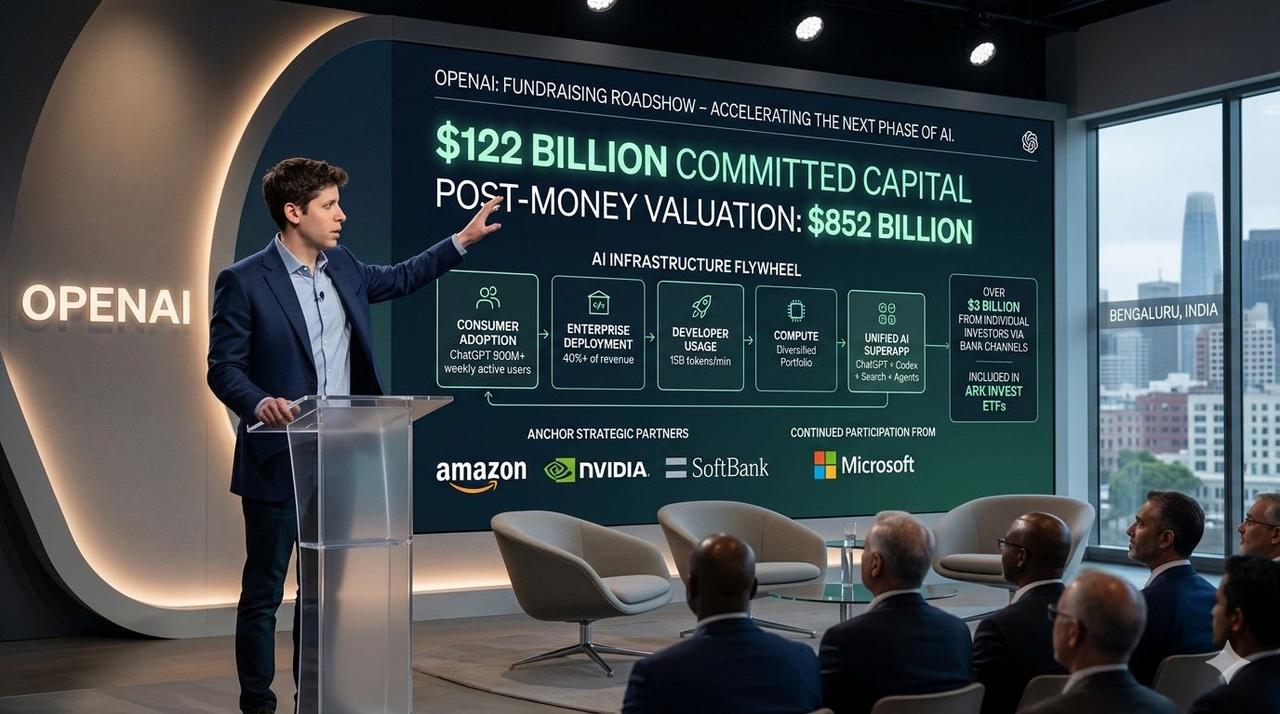
OpenAI has closed a $122 billion funding round at an $852 billion valuation, marking the largest fundraising event in Silicon Valley history
1
4
. The round grew from $110 billion in commitments announced in February, with the additional $12 billion coming from a wider pool of investors3
. Strategic partners Amazon, Nvidia, and SoftBank anchored the investment, with continued participation from Microsoft4
. SoftBank and Nvidia each contributed $30 billion, while Amazon pumped $50 billion into the artificial intelligence startup3
.
Source: CXOToday
In an unprecedented move for a pre-IPO company, OpenAI raised more than $3 billion from individual investors through bank channels and will be included in several exchange-traded funds managed by ARK Invest
1
4
. The company also expanded its revolving credit facility to approximately $4.7 billion, supported by a global syndicate including JPMorgan Chase, Citi, Goldman Sachs, Morgan Stanley, and Wells Fargo4
.The massive capital injection comes as OpenAI scrambles to address threats from AI sector competition. In the past six months, the company has twice redrawn its product roadmap, first due to Google's Gemini release and now because of Anthropic's Claude Code
2
. Some industry watchers predict that Anthropic's pace of revenue growth will eclipse that of OpenAI within a couple of months2
.This competitive threat has forced OpenAI to redirect resources to coding tools and enterprise customers—two of the most obvious opportunities to generate revenue and justify its valuation
2
. The company recently shut down its standalone Sora video app, a decision that shocked many involved, including Disney, which had inked a $1 billion deal tied to Sora in December2
.ChatGPT has reached 900 million weekly active users and over 50 million subscribers among consumers
1
5
. However, OpenAI expects enterprise customers to drive half of its revenue by the end of 2026, with business users currently accounting for more than 40% of revenue4
. The company's refreshed Codex coding agent now serves over 2 million weekly users, up fivefold in the past three months1
4
.
Source: Gadgets 360
OpenAI's business APIs process more than 15 billion tokens per minute, demonstrating the scale of demand for its services
1
. The company is generating $2 billion in revenue per month, though it reported $13.1 billion in revenue last year and remains unprofitable4
5
.OpenAI announced plans to build a unified AI superapp that will combine ChatGPT, Codex, browsing, and agentic capabilities into one agent-first experience
1
5
. "Users do not want disconnected tools," the company stated. "They want a single system that can understand intent, take action, and operate across applications, data, and workflows"1
.This represents a significant shift from OpenAI's approach just six months ago, when it was working on everything from AI-generated video to consumer devices, shopping features, and even a deal with Mattel to integrate ChatGPT with Barbie
2
. Fidji Simo, one of OpenAI's senior executives, explained: "Companies go through phases of exploration and phases of refocus; both are critical. But when new bets start to work, like we're seeing now with Codex, it's very important to double down on them and avoid distractions"2
.To meet demand, OpenAI is working with an AI infrastructure portfolio across multiple cloud partners including Microsoft, Oracle, AWS, CoreWeave, and Google Cloud
1
. Its chip suppliers include Nvidia, AMD, AWS with Trainium, Cerebras, and Broadcom1
. Notably, many of these infrastructure partners are also investors, creating a circular flow of capital. Oracle has increased its borrowing by $50 billion to help build datacenters for OpenAI in a $300 billion cloud deal1
.
Source: Reuters
Some observers predict OpenAI will not achieve profitability until 2030
1
. The company expects to spend $115 billion over the next four years3
. Tech giants are projected to spend about $630 billion in 2026 on AI infrastructure, equating to roughly 2.2% of U.S. GDP, according to Morgan Stanley estimates2
.Related Stories
S&P Global is predicting a potential hit to the AI boom due to geopolitical factors. If the Iran conflict creates a permanently high oil price, companies might cut spending in the next two quarters as energy costs rise, producing a "really meaningful correction in all equity markets," according to Melissa Otto, head of research at S&P Global Visible Alpha
1
. Microsoft already saw its share price drop 6 percent despite announcing surging profits, as investors voiced concerns about rampant capital expenditure growth needed to support AI demand1
.OpenAI is planning an Initial Public Offering as soon as the end of this year, but must first balance its books to be more attractive to Wall Street investors
3
4
. The IPO anticipation comes as competition intensifies from rivals including Anthropic, which secured a $30 billion funding round earlier this year, as well as Google's Gemini and Elon Musk's xAI5
. With the funding round complete and strategic focus narrowed, OpenAI must now demonstrate it can convert massive user engagement and investor confidence into sustainable business results that justify its historic valuation.Summarized by
Navi
[1]
[5]
24 Mar 2026•Business and Economy

12 Sept 2024

17 Dec 2025•Business and Economy

1
Policy and Regulation

2
Technology

3
Technology