Google launches Universal Commerce Protocol to power AI agents across retail ecosystem


21 Sources
21 Sources
[1]
Google announces a new protocol to facilitate commerce using AI agents | TechCrunch
Google today announced a new open standard, called the Universal Commerce Protocol (UCP) for AI agent-based shopping, at the National Retail Federation (NRF) conference. The standard, developed with companies like Shopify, Etsy, Wayfair, Target, and Walmart, lets agents work across different parts of customer buying processes, including discovery and post-purchase support. The core idea is that the standard could facilitate these various parts of the process instead of requiring connections with different agents. Google said that it also works with other agentic protocols, such as Agent Payments Protocol (A2P) -- which Google announced last year -- Agent2Agent (A2A), and Model Context Protocol (MCP). The company specified that Agents and Businesses can pick and choose specific extensions of the protocol that suits their needs. The company said that it will soon use UCP for eligible Google product listings in AI mode in search and the Gemini apps to let shoppers check out directly from U.S.-based retailers while researching a product. Users will be able to pay using Google Pay and pass on the shipping information saved in the Google Wallet. Google said that it will soon support PayPal as a payment option. "This is one of the really exciting parts about agentic," said Shopify CEO and founder Tobi Lutke. "It's really good at finding people who have specific interests and finding the product that is just perfect for them. Like, I would have never searched for this product, but somehow it found me right on the other side. This kind of serendipity is where the best of commerce happens." Notably, Shopify also unveiled a similar integration with Microsoft Copilot for shopping today to let customers check out easily within the conversational flow. In another consumer-facing change, Google said it will now allow brands to offer a special discount to users while they are looking for a product recommendation when using the AI mode. For instance, if you are searching for a rug using a query like "I'm looking for a modern, stylish rug for a high-traffic dining room. I host a lot of dinner parties, so I want something that is easy to clean," brands can set up their campaign in a way to offer you a discount at that moment. The company is also giving users new data attributes within the Merchant Center to have sellers feature their items better within AI search surfaces. Companies like PayPal and OpenAI are also working on having sellers be more discoverable in AI chatbot results. Startups like the prompting company are also working with merchants to have their products surface within AI answers. Google is now also allowing merchants to integrate an AI-powered Business Agent within their websites to answer customer questions. The company noted that merchants like Lowe's, Michael's, Poshmark, and Reebok are already using this product. Competitors like Meta and Shopify have been exploring AI-powered tools for businesses for customer support and outreach. The search giant also announced Gemini Enterprise for Customer Experience (CX), a suite to handle shopping and customer service for retailers and restaurants. Companies like Google, Amazon, Walmart, and OpenAI have been releasing new standards and products to infuse AI into every bit of shopping, both on the consumer and merchant side. Earlier in the month, Adobe noted that traffic driven to seller sites by generative AI grew by 693.4% during the holiday season, though the report didn't specify how much of this traffic translated into sales.
[2]
Google Moves to Simplify AI-Driven Shopping as Retailers Show Support
Macy has been working for CNET for coming on 2 years. Prior to CNET, Macy received a North Carolina College Media Association award in sports writing. Google has introduced a new open standard designed to help AI tools work seamlessly across the online shopping journey, connecting retailers with shoppers who are ready to make a purchase. The announcement was made Sunday, Jan. 11, at the National Retail Federation's annual conference in New York. The protocol, known as the Universal Commerce Protocol (UCP), is designed to enable different AI agents to communicate with retailers and payment systems using a shared system, rather than establishing custom technical connections for each platform. It covers product discovery, purchasing and post-purchase support, according to Google. Google said it co-developed the standard with a group of major e-commerce platforms and retailers, including Shopify, Etsy, Wayfair, Target and Walmart. More than 20 additional brands and payment companies, such as Visa, Mastercard and Stripe have also endorsed the protocol. Read also: My Jaw Dropped When Google Told Me How Its New AI Shopping Feature Handles Privacy Don't miss any of our unbiased tech content and lab-based reviews. Add CNET as a preferred Google source. The UCP is designed to serve as a common language for various aspects of the shopping experience. Instead of requiring separate integrations for each AI system and retailer, UCP provides a baseline set of rules and formats that everyone can adopt and use. It's built to be compatible with other emerging standards for AI agents and payments. Google plans to use the standard to support a new checkout feature in AI Mode in Search and its Gemini app, enabling shoppers to complete purchases directly with participating merchants through these AI interfaces. Eligible US retailers can offer checkout using payment details saved in Google Wallet and Google Pay, with support for PayPal coming later. Retailers remain the merchant of record and can customize how they use the protocol. In addition to the open standard itself, Google said it is introducing tools aimed at helping retailers interact with high-intent shoppers using AI. For instance, a Business Agent feature that allows brands to host conversational experiences in search results, answering customer questions in the brand's own voice, is now live. The branded agent is available in the Merchant Center to help products surface more easily in conversational and agentic shopping experiences. Google is also piloting a feature called Direct Offers, which lets retailers push exclusive discounts to shoppers at moments when they appear likely to make a purchase. These initiatives are part of a broader effort to incorporate more retail-specific capabilities into Google's AI and commerce tools. At this stage, the announcement is focused on technical standards and tools for businesses and developers. Google said the protocol will start powering direct checkout from eligible retailers in the US soon and will expand globally, adding more capabilities in the months ahead. There is no immediate change for most consumers at launch, and the broader impact will depend on how quickly retailers and AI platforms adopt the standard.
[3]
Google rolls out agentic commerce in Search and Gemini
Google is aiming to turn Gemini into a one-stop personal shopper with what it hopes will become a global standard for agentic AI commerce, and it's already persuaded major retailers to let Google handle transactions without sending users to their websites. Google announced a new Universal Commerce Protocol (UCP) on Sunday, alongside some other agentic AI shopping features, that it said is designed to act as "a common language for agents and systems to operate together across consumer surfaces, businesses and payment providers." What that essentially means, Google explained, is that agents won't need unique connectors in order to facilitate digital transactions, so Gemini's end-user shopping agents should communicate with other agentic AI more easily. It's yet another agentic AI protocol from Google, and the company says it's compatible with its other AI protocols, including Agent2Agent, the Agent Payments Protocol, and the Model Context Protocol. In practice, that means online shoppers buying through retailers that opt to support UCP will soon be able to use a forthcoming checkout feature in AI Mode in Search and the standalone Gemini app, "allowing shoppers to check out from eligible U.S. retailers right as they're researching on Google," the Chocolate Factory explained. Speaking to the US National Retail Federation over the weekend, Google CEO Sundar Pichai made it clear what the game is all about: Google is tired of just being the highway on which most of the internet travels to ecommerce outlets and it wants in. "Looking at retailers alone, we were processing 8.3 trillion tokens on our API in December 2024. A year later, we were processing over 90 trillion tokens," Pichai said. The natural evolution of that increase, he continued, is a highway one never has to leave in order to make purchases. "Our goal is to build a future of retail where the opportunity space expands for everyone," the Google boss said before getting to the heart of the matter. "One where customers can use Google products they love as part of a seamless shopping experience." Surprisingly enough, and in contrast to other websites that have suffered as Google has gobbled up their content to keep visitors inside its ecosystem, major retailers are at least willing to let Big G handle more of the shopping experience through Google's own surfaces, rather than insisting every click end at their virtual storefronts. According to the company, UCP was developed with input from major retailers including Shopify, Target, Walmart, and Wayfair, and is supported by major payment networks such as Mastercard, American Express, and Visa, with PayPal checkout slated to arrive "soon." Google has even somehow managed to convince customers like hardware chain Lowe's, craft store Michaels, Reebok, and others to begin using its AI Business Agent, also announced on Sunday, which allows users to "chat with brands, right on Search." More advanced features - including training the agent on a retailer's own data - won't arrive until "the coming months," according to the company. As Google is "continuing to test ads in AI Mode," it's also working with retailers to embed user-specific discounts, dubbed "Direct Offers," into its never-leave-Google AI shopping ecosystem, delivering sales to "shoppers who are ready to buy" to help them close sales. Whether or not the rest of the retail world will be thrilled with another Google strategy to keep users away from their websites is anything but certain. If retailers react in a similar manner to publishers, they're likely to be unhappy, though reducing website overhead by offloading shopping to a Google AI may be beneficial, provided they're willing to agree to Google's terms. Of course, Google is also likely making the move to better compete with companies like OpenAI and Perplexity, both of whom have made inroads into AI-based online shopping - can't lose that slice of the pie, after all. We reached out to Google to learn more about its new AI agent ecommerce strategy, including whether it'd be charging companies whose sales are processed via Gemini, but didn't hear back. ®
[4]
Google's new commerce framework cranks up the heat on 'agentic shopping'
To further push the limits of consumerism, Google has launched a new open standard for agentic commerce that's called Universal Commerce Protocol (UCP). In brief, it's a framework that combines the power of AI agents and online shopping platforms to help customers buy more things. Thanks to the introduction of UCP, Google is offering three new online shopping features. To start, Google's AI mode will have a new checkout feature that allows customers to buy eligible products from certain US retailers within Google Search. Currently, this feature works with Google Pay, but it will soon add PayPal compatibility and incorporate more capabilities, like related product discovery and using loyalty points. On the merchant side, the UCP also established the Business Agent feature, which Google said will be "a virtual sales associate that can answer product questions in a brand's voice." The Business Agent will launch tomorrow with early adopters including Lowe's, Michaels, Poshmark, Reebok and more. Also for retailers, the UCP is responsible for the new Direct Offers feature, which lets companies advertising with Google to "present exclusive offers for shoppers who are ready to buy, directly in AI Mode." The Direct Offers feature will work in tandem with the ads in AI Mode that Google is testing. With UCP, Google Search, retailers and payment processors are joining forces to make online shopping even easier, whether it's figuring out what product to buy, completing the purchase or offering "post-purchase support." According to Google, UCP is compatible with existing industry protocols, like Agent2Agent, Agent Payment Protocols and Model Context Protocol. UCP was even co-developed with industry giants like Shopify, Etsy and Walmart, and was endorsed by even more companies in the commerce ecosystem, including Macy's, Stripe, Visa and more.
[5]

Google bolsters bet on AI-powered commerce with new platform for shopping agents
The Google logo displayed on a smartphone alongside a shopping cart. As retailers increasingly turn to artificial intelligence tools to lure shoppers and run key parts of their business, Google wants to make sure it's in the center of the action. At the kickoff of the National Retail Federation's annual show on Sunday, Google announced the launch of what it's calling the Universal Commerce Protocol. The company wants UCP to become an industry standard that retailers use for their AI agents and systems across tasks like discovery, buying and "post-purchase-support." Google says the open-source protocol creates a unified system spanning the shopping experience, from searching to payment, so that retailers don't have to build their own tools and connect the various functions. "It's very important to have a standardized way so we can scale these things and everyone can be prepared for all the various steps to happen," Vidhya Srinivasan, vice president of Google ads and commerce, said in an interview. "Businesses can pick and choose what they want so there's flexibility for them." E-commerce has emerged as one of the major battlegrounds in the booming generative AI market, with Google facing off against OpenAI, Perplexity and Amazon, as they all try and get consumers to use their various apps and services to begin their shopping journey. In September, OpenAI announced Instant Checkout, which allows users to buy some products through ChatGPT, taking a fee from transactions it helps orchestrate. OpenAI's Agentic Commerce Protocol developed in partnership with Stripe, is open source and could compete with UCP. Perplexity in May said it's partnering with PayPal to let users buy products, book travel and secure concert tickets directly in its chat without leaving the platform, and in November said it will roll out a free agentic shopping product for U.S. users ahead of the holiday season. And earlier last year, Amazon launched "Shop Direct," a feature that lets consumers browse items from other brands' sites on Amazon. Some of those items include a button labeled "Buy for Me," an AI agent that can purchase products from other websites on a shopper's behalf. By 2030, the retail market could represent a $3 trillion to $5 trillion opportunity globally due to AI-powered tools and agentic commerce, according to a report in October from McKinsey. Google said UCP was co-developed with companies including Shopify, Etsy, Wayfair and Target. The protocol will soon power a new checkout feature allowing users to buy direct from Google's AI Mode or Gemini App. They can pay via Google Wallet, but Srinivasan said the company plans to include other payment methods like PayPal in the future. Srinivasan said UCP will be compatible with other existing protocols. As part of Sunday's announcements, Google also introduced a feature called Business Agent, allowing shoppers to chat with brands. "This is to address the newer consumer behavior which is shifted toward more conversational commerce," Srinivasan said. "We want retailers to be able to connect to users on our surfaces but using their own voice." Then there's Google's core market: advertising. Google said it's testing "Direct Offers," which will let retailers promote unique discounts, such as 20% off of a product, if a user of the AI Mode chatbot expresses intent to buy something. "Our role in the ecosystem is that of a matchmaker and one way is with ads," Srinivasan said. "It's a really big focus for us to innovate in the space that adds value to both retailers and buyers."
[6]

Google makes a big move into agentic commerce, raising questions about Amazon's retail dominance
Google is making a key push into AI-powered shopping with the unveiling of Universal Commerce Protocol (UCP), a new open technical standard aimed at letting shoppers buy products directly through AI chatbots and search interfaces. The protocol has backing from major retailers and payment players including Walmart, Target, Shopify, and Etsy. Notably, there was one e-commerce giant not included in Sunday's announcement: Amazon. The Seattle-based company has long controlled the infrastructure of online shopping. But UCP offers an alternative pathway that could bypass Amazon, potentially steering shoppers to competitors at the critical moment of product discovery. Announced over the weekend at the National Retail Federation conference in New York City, Google pitched UCP as a foundation for "agentic commerce," a fast-emerging concept in which AI agents help shoppers carry out multi-step tasks on their behalf. "AI agents will be a big part of how we shop in the not-so-distant future," Google CEO Sundar Pichai said on X. As AI chatbots increasingly influence shopping decisions, retailers face pressure to build custom integrations for each AI platform. UCP aims to eliminate that complexity by creating a shared "language" that lets AI agents securely access product catalogs, pricing, availability, promotions, loyalty programs, and checkout flows. We spoke to industry analysts about UCP and the potential impact to Amazon's grip on online retail. UCP might not threaten Amazon's logistics empire. But it could challenge the idea that shopping must begin inside Amazon's app or website, said Maju Kuruvilla, CEO and founder of Seattle-based agentic commerce startup Spangle. "This doesn't change Amazon's core advantage -- price, selection, and convenience," Kuruvilla said. "This is more of an additional discovery channel." Data suggests AI is already influencing online shopping behavior. A new report from Adobe Digital Insights found that AI-driven traffic to retail sites surged 693% year-over-year during the 2025 holiday season, with AI-referred visitors converting at higher rates and spending more time on sites than non-AI traffic. But analysts caution that traffic growth and checkout partnerships do not equal behavior change. Juozas Kaziukenas, an independent e-commerce analyst, said many forecasts around agentic commerce assume unrealistically fast adoption. He pointed to OpenAI research showing that only 37% of products returned by ChatGPT's regular shopping results are relevant, calling that "shockingly low." "Product discovery, curation, personalization, and recommendations are still barebones on most AI tools," he said. Some argue that even if agentic commerce does take off, Amazon is unlikely to be displaced. "It's proven that consumers are drawn to general merchandise retailers that offer value, selection, and convenience," said Scott Devitt, an analyst at Wedbush. "AI will have implications for retail, but those tenets won't change. I think Amazon and Walmart will continue to do well." Ironically, an agentic commerce boom could actually give Amazon more leverage, said Sucharita Kodali, a retail industry analyst with Forrester. "If, big if, there does appear to be a winner -- and that would be years away -- the winner will likely pay Amazon billions for its feed and cooperation, like Google pays Apple," she said. Kaziukenas said the growing wave of partnerships reflects a familiar dynamic: an anti-Amazon alliance. "Everyone is forming partnerships with everyone else -- everyone except Amazon," he said, adding that the trend reflects Amazon's position in the market. "They can ignore this for now. But it also shows how eager everyone else is to be part of something new to challenge Amazon." Amazon has been experimenting with its own AI-powered shopping features, including its Rufus assistant and the "Buy for Me" initiative. The company has not publicly announced support for open agentic commerce standards like UCP. Amazon CEO Andy Jassy acknowledged on a recent earnings call that agentic commerce "has a chance to be really good for e-commerce" and said that he expects the company to partner with third-party agents over time. But he also said agents "aren't very good" at personalization and often display incorrect pricing and delivery estimates. "So we've got to find a way to make the customer experience better and have the right exchange value," Jassy said. In November, Amazon sued Perplexity to stop the startup from using its AI browser agent to make purchases on its marketplace. We reached out to Amazon for comment on UCP, and we'll update this story if we hear back. Google said that starting soon, shoppers using Google's AI Mode in Search or the Gemini app will see buy buttons on eligible products from participating U.S. retailers. They can check out using payment details already saved in Google Wallet, with PayPal support coming later. Google says retailers remain "the seller of record" and maintain control over customer relationships. Google's announcement follows similar moves by other large tech companies. Last week, Microsoft debuted Copilot Checkout, allowing users to complete purchases directly inside its AI assistant. OpenAI, working with Stripe, has developed the Agentic Commerce Protocol (ACP) for completing transactions within ChatGPT. Emily Pfeiffer, a principal analyst at Forrester, said she's encouraged to see companies pushing for standards -- but stressed that it's "still very early, the experiences are pretty poor, and adoption is very low." "We won't say that forever, but behavior change takes time and it won't happen if the shopping experiences don't improve," she said.
[7]

Google's new checkout protocol lets you buy products without leaving your search results
The new "Business Agents" also let brands answer shopper questions in conversational results using their own product knowledge. Imagine asking your phone for new running shoes, and instead of just getting links, an AI finds and buys them for you, so you don't have to switch between tabs. That future is now much closer. Google has unveiled a new open-standard framework that aims to make autonomous, AI-led shopping a real part of how we buy things online. At the center of this change is a protocol called Universal Commerce Protocol (UCP). It serves as a common language, enabling AI agents to connect with retailers, payment systems, and shopping platforms without requiring custom connections. Google says the protocol was developed with input from major companies like Shopify, Walmart, Target, Etsy, and Wayfair. Over 20 partners have joined so far, showing that this is not just a small test. Google sees it as the foundation for the next phase of online shopping. For shoppers, the biggest change will appear in AI-powered tools like Search's AI Mode and the Gemini app. If an AI suggests a product from a participating retailer, you won't just see a link. You can check out right within the AI, using payment and shipping details from Google Pay and your Google Wallet. PayPal support is coming soon, too. Additionally, Google is launching Business Agents, which let retailers answer customer questions directly in conversational search results, using their own voice and product knowledge. Instead of a basic AI summary, shoppers can get real-time answers that feel more like talking to a helpful store associate. Google is also trying out ways for merchants to show exclusive deals and offers right in AI conversations, so discounts appear just as a user is about to make a purchase. All of this is part of Google's move toward more conversational, intent-based search. For example, asking for "comfortable trail running shoes under $120" already works well in AI Mode. UCP takes it further by letting users go from discovery to purchase without having to return to traditional online shopping steps.
[8]

You might soon be able to buy from stores without leaving Google Search
Mark has almost a decade of experience reporting on mobile technology, working previously with Digital Trends. Taking a less-than-direct route to technology writing, Mark began his Android journey while studying for a BA in Ancient & Medieval History at university. But since then, he's cast his eyes firmly on the future, with a deep love for anything that bleeps or bloops. Outside of Android tech of all types, Mark loves to hike, play video games, build small plastic men that cost far too much, and spend time with his two daughters. Buying products from stores by actually going to their websites may soon become a thing of the past, if Google's dreams come to fruition. Google has been working on using everyone's least favorite buzzword of the moment, AI, to streamline the purchasing experience. Its new protocol, Universal Commerce Protocol, would use agentic AI to buy items for you, without you ever having to leave Google Search (via Android Authority). Faster, more efficient buying This might sound like a pipe-dream for Google, but it seems this technology isn't just coming, the framework for it is already here. This is one of the first real applications for the so-called " agentic AI". In basic terms, it's when an AI is able to act as an agent for someone else. In this case, it would be able to go to the shop in your stead, put an item into your basket, and buy it, all without you having to be involved. Instead, you'd be sat on your Google Search page, having tapped an "add to basket" button and paid for it using your Google Wallet details or (eventually) your PayPal account. Google's Universal Commerce Protocol can do this because it's been designed to work with as many shopping platforms as possible, and Google boasts that more than 20 partners have joined the program, including big names like Shopify, Walmart, and Etsy. This may seem like a bad thing for the stores in question, but if it reduces barriers between a storefront and customer, then it's a benefit for the stores in question. The fewer steps there are between a prospective buyer and a sale, the better, and Google's agentic AI would end up doing more of the hard work for you, including dodging making yet another account. At the moment, using this feature will be limited only to people using Google Search's AI mode, so the rest of us can mark ourselves as safe from this. However, Google's not going to keep it there forever, and you're likely going to see this expanded to the regular search eventually -- if only because AI mode will eventually get folded into the regular search process. Yet more power for Google Of course, it's not hard to view this with a cynical eye. Subscribe for deeper newsletter coverage of AI commerce Get the newsletter for focused analysis of Google's move to enable in-search purchases. Expect clear, contextual coverage that helps you track shifts in platform power and shopping technology. Subscribe By subscribing, you agree to receive newsletter and marketing emails, and accept Valnet's Terms of Use and Privacy Policy. You can unsubscribe anytime. As the gatekeeper of the internet, Google has had an incredibly strong position for the last two decades. But at least once you were on a website, you were free of them, lessening its power somewhat. But with the introduction of AI, Google has been able to claw more and more of that power back. First, AI summaries made it so you didn't even need to leave Google Search to get answers to even fairly complex answers, and now, this agentic AI would make it so you don't leave Google to buy something. There's a word for an app like this, and it's an "everything app". Google is getting closer and closer to becoming one of those, and we should consider what it means when a company that already has so much power manages to get even more.
[9]

Gemini app and AI Mode adding product checkout, Google Search getting 'Business Agents'
Google is embracing "agentic shopping" wherein users can easily make purchases through the Gemini app and AI Mode. UCP establishes a common language for agents and systems to operate together across consumer surfaces, businesses, and payment providers. So instead of requiring unique connections for every individual agent, UCP enables all agents to interact easily. Google today launched the Universal Commerce Protocol (UCP) as an "open standard for agentic commerce." It covers product discovery, purchasing, and support. UCP was co-developed with industry leaders including Shopify, Etsy, Wayfair, and Target, and endorsed by more than 20 others across the ecosystem like Adyen, American Express, Best Buy, Flipkart, Macy's, Mastercard, Stripe, The Home Depot, Visa, and Zalando. Google will use UCP in the Gemini app and AI Mode for a new checkout feature. If the response features an eligible Google product listing (from a US retailer), tapping "Buy" starts the process. This might include creating an account with the store and then being taken to Checkout. The final Review your order page will be pre-filled with payment methods (Google Pay) and shipping info (Google Wallet). Purchasing with PayPal is coming soon. Retailers remain the seller of record, with the ability to customize the integration to their specific needs, all while helping to capture sales and avoid abandoned carts. This will expand globally "in the coming months" with more features like "discovering related products, applying loyalty rewards, and powering custom shopping experiences on Google." In AI Mode, Google is continuing to test ads and is introducing a Direct Offers feature that "allows advertisers to present exclusive offers for shoppers who are ready to buy." In the product listing, Direct Offers will appear as a "Sponsored deal." Imagine you search "I'm looking for a modern, stylish rug for a high-traffic dining room. I host a lot of dinner parties, so I want something that is easy to clean." Google already elevates the most relevant products to meet your search criteria. But often, you are only ready to buy if you're getting a great deal. Now relevant retailers have an opportunity to also feature a special discount. This helps you get better value and helps the retailer close the sale. The final announcement today adds Business Agents to Google Search. Appearing as a "Chat" button if you search for a partnering retailer, this "virtual sales associate... can answer product questions in a brand's voice." This is launching from tomorrow onwards "with retailers like Lowe's, Michaels, Poshmark, Reebok, and others."
[10]

Google is going all-out on "agentic shopping" with new AI ecommerce tools
Businesses can target customers with ads designed for AI shoppers Google has announced plans to take the stress out of online shopping with a new agentic AI ecommerce suite that'll take care of product research, purchasing, and even post-purchase support. Company VP and GM of Ads & Commerce Vidhya Srinivasan explained in a blog post that the new tools build on 2025's Agent Payments Protocol (AP2), designed to offer secure payments within the confines of agentic AI. The system relies on the Universal Commerce Protocol (UCP), co-developed by Google and a number of major retail partners like Shopify, Etsy, and Wayfair, so that agents and systems can interact in one "common language." Designed to work across multiple industries and platforms, it's also backed by payment companies like Adyen, Amex, Mastercard, Visa, and Stripe - however, from launch we're told it will only be available to eligible US retailers. The front-end experience revolves around the Gemini app or AI Mode within Google Search. Being that the AI retains information, Google's new shopping assistant will pre-fill the checkout page, and then store the shipping information within Google Wallet. Along with a later global expansion, the company is also working on a fuller shopping experience such as loyalty reward integration. At the same time, Google is launching a separate Business Agent that companies can use as their own virtual sales assistants to answer questions about their products. With this tool activated and customized from within the Merchant Center, companies can train the agent on their data, access customer insights and promote related products. A new Google Ads pilot, Direct Offers, will also target shoppers with exclusive offers that might only be available to shoppers using AI Mode. However, Google isn't without its competition. OpenAI has already launched similar agentic shopping experiences within ChatGPT, and Microsoft launched a buying experience within Copilot chats with select retailers just days before Google's announcement.
[11]

Google's new tech will let you buy stuff directly from an AI chatbot
As if we're not already spending too much on online purchases, Google just announced new tech that will make shopping even easier. At the core of the announcement is the just-launched Universal Commerce Protocol (UCP), a "new open standard for agentic commerce." Developed with major online retailers including Shopify, Etsy, Wayfair, Target, and Walmart, it will enable new ways to purchase things online, such as from within a conversation with an AI agent. For example, you could ask an AI to help you find a new carry-on suitcase, to which it may offer some options. You'll soon be able to click on the product right there within that convo and buy it without ever leaving that screen. Google says more than 20 partners have endorsed the system, including heavyweights like American Express, Best Buy, Macy's, Mastercard, Stripe, Home Depot, and Visa. For payments, you'll be able to use Google Pay, with shipping info coming from your Google Wallet; PayPal is joining as a partner "soon." Google is also launching a tool called Business Agent, a "virtual sales associate that can answer product questions in a brand's voice." So if you're searching for Reebok sneakers on Google, the branded agent might pop up as an option and help you find the right ones; once again, you'll be able to complete the purchase and check out directly in that conversation. Google says Business Agent is live starting today, with partners including Lowe's, Michael's, Poshmark, and Reebok. Finally, Google is introducing a new type of ads called Direct Offers, allowing advertisers to give exclusive offers to shoppers who are searching for products in AI mode. In other words, you might get a discount from the AI agent you're chatting with, which should push shoppers towards using this type of experience more often.
[12]

Google Introduces Universal Commerce Protocol, AI Tools to Power Agentic Shopping | AIM
Google also introduced Direct Offers, a new Google Ads pilot that allows retailers to show targeted discounts. Google has announced a new open standard and a set of AI-powered tools to help retailers sell products in an emerging "agentic shopping" environment, where AI systems act on behalf of consumers. The company introduced the Universal Commerce Protocol (UCP), an open standard that allows AI agents, retailers, and payment systems to work together across the shopping journey, from product discovery to checkout and post-purchase support. Google said the protocol is intended to reduce the need for separate integrations for each AI agent or platform. "We believe in an agentic commerce future that is open, collaborative and built for everyone to succeed," said Vidhya Srinivasan, vice president and general manager for ads and commerce at Google, in a statement. UCP has been co-developed with retailers and platforms, including Shopify, Etsy, Wayfair, Target, and Walmart. It is also endorsed by companies such as Flipkart, Visa, Mastercard, and Stripe. According to Google, UCP is compatible with existing standards, including Agent2Agent (A2A), the Agent Payments Protocol (AP2), and the Model Context Protocol (MCP). The company said the goal is to create a common language that allows AI agents to interact with retailers and payment providers without friction. As part of the rollout, UCP will soon power a new checkout feature on eligible Google product listings shown in AI Mode in Search and in the Gemini app. Shoppers in the US will be able to complete purchases during product research using Google Pay, with payment methods and shipping details stored in Google Wallet. Support for PayPal is expected to follow. Google said retailers will remain the seller of record and will be able to customise the integration. The company added that the system is designed to reduce cart abandonment by enabling purchases earlier in the shopping process. In addition, Google launched Business Agent, a branded AI agent that allows shoppers to chat directly with retailers on Search. The agent can answer product questions in a brand's voice and guide users toward a purchase. Business Agent will go live with retailers including Lowe's, Michaels, Poshmark, and Reebok. Eligible US retailers can activate the feature through Merchant Centre. In the coming months, Google said retailers will be able to train these agents using their own data, access customer insights, provide product offers, and enable direct purchases within the chat experience. To support discovery in conversational shopping, Google also announced new data attributes in Merchant Centre. These are designed to help AI systems understand product details beyond keywords, such as common questions, compatible accessories, and alternatives. Finally, Google also introduced Direct Offers, a new Google Ads pilot that allows retailers to show targeted discounts directly within AI Mode. The system uses AI to determine when an offer is relevant to a shopper who shows strong buying intent. "With Direct Offers, advertisers can present exclusive deals to shoppers who are ready to buy," Google said. The pilot initially focuses on discounts, with plans to expand to bundles and free shipping. The Big Tech company said it is working with brands including Petco, e.l.f. Cosmetics and Samsonite to test the feature.
[13]

Google debuts Universal Commerce Protocol to streamline agentic shopping automation - SiliconANGLE
Google debuts Universal Commerce Protocol to streamline agentic shopping automation Google LLC has unveiled a new open commerce standard that's designed to enable artificial intelligence agents to automate the entire shopping journey, from product discovery to payment to post-sale support. The company debuted the new Universal Commerce Protocol or UCP at the National Retail Federation's annual show on Sunday. Developed in partnership with retailers such as Shopify Inc., Target Corp., Walmart Inc. and Etsy Inc., UCP enables AI agents to collaborate on different aspects of the customer buying process, with the goal being to automate each step. Google said UCP is designed to work with existing agentic protocols such as the Agent Payments Protocol or AP2 and the Model Context Protocol, which enable AI agents to process payments on behalf of users and leverage third-party software tools, respectively. The company plans to start using UCP for eligible product listings surfaced by AI mode in Search and in the Gemini application, so shoppers will be able to purchase them more easily. The process will involve agents using Google Pay, and later PayPal, to pay for the products and then passing on the customer's shipping details that are stored in Google Wallet. In addition, Google is giving retail partners access to a new, branded Business Agent that will pop-up in Google Search results to answer questions about products on the behalf of the companies selling them. Merchants including Lowe's Companies Inc., Michaels Stores Inc. and Reebok International Ltd. are among the early adopters.. Google Vice President of Ads and Commerce Vidhya Srinivasan told CNBC that the Business Agent is meant to address the fact that consumer behavior is shifting towards more conversational commerce experiences. "We want retailers to be able to connect to users on our surfaces, but using their own voice," he explained. Google said it's also testing a new "Direct Offers" tool that will enable retailers to offer special discounts to users who purchase their products while using AI mode in Search. For instance, if someone tells Gemini "I'm looking for a modern, stylish rug for a high-traffic dining room. I host a lot of dinner parties, so I want something that is easy to clean," brands will be able to set up campaigns to surface discounted products that match with the user's description. "Our role in the ecosystem is that of a matchmaker and one way is with ads," Srinivasan said. "It's a really big focus for us to innovate in the space that adds value to both retailers and buyers." Meanwhile, Google is also giving users new "data attributes" within its Merchant Seller tool, so brands can optimize their product listings for AI search. Finally, it announced a new Gemini Enterprise for Customer Experience suite to handle shopping and customer service for retailers and restaurants. Shopify founder and Chief Executive Tobi Lutke told TechCrunch that one of the most exciting things about AI agents is that they're really good at finding products perfect for people with specific interests. "Like, I would never have searched for this product, but somehow it found me right on the other side," he said. "This kind of serendipity is where the best of commerce happens." Google's updates underscore how retail and e-commerce is fast becoming a major battleground for AI agents, with rivals such as OpenAI Group PBC, Perplexity AI Inc. and Amazon.com Inc. all pushing to automate consumer's shopping journeys. OpenAI has made a number of moves in this direction, launching its Instant Checkout feature in September that lets users buy certain products directly through ChatGPT in return for a share of the transaction fee. It has also developed an Agentic Commerce Protocol in partnership with Stripe Inc., which could rival Google's UCP due to its open-source nature. Back in May, Perplexity revealed a partnership with PayPal Holdings Inc. that lets users purchase products, book flights and pay for concert tickets directly through its AI chat portal, without leaving the platform. Then in November, it followed up with a free agentic shopping tool for U.S. consumers. Meanwhile, Amazon has launched its Shop Direct feature, which allows customers to browse products from third-party brands that don't list their products on its online store. Some of those products are labeled with a "Buy for Me" button that activates an AI agent to complete purchases using the customer's payment information held in Amazon. However, Amazon's initiative has proven somewhat controversial, with a number of smaller brands complaining about seeing their products listed on Amazon. It's easy to see why retailers and AI giants are pushing so hard though, for McKinsey Co. said in a September report that agentic commerce could grow to become a $3 trillion opportunity by 2030.
[14]

Google launches Universal Commerce Protocol to let AI shop for you
Google is intensifying its focus on the future of retail with the launch of the Universal Commerce Protocol (UCP), a new open standard designed to accelerate "agentic commerce." This framework aims to seamlessly integrate artificial intelligence agents with online shopping platforms, reducing friction for consumers and creating new avenues for transactions. By acting as a bridge between shoppers and merchants, the protocol is intended to streamline the entire purchasing journey, from product discovery to final payment. For consumers, the immediate impact of UCP is a new checkout capability integrated directly into Google Search's AI mode. This feature allows users to buy eligible products from select U.S. retailers without leaving the search interface. While the initial launch supports transactions via Google Pay, Google plans to expand the service to include PayPal and integrate features for related product discovery and loyalty point usage, further centralizing the shopping experience. Video: Google On the merchant side, the protocol introduces the "Business Agent," a virtual sales associate capable of answering product-related questions in a brand's specific voice. Early adopters of this technology include major retailers such as Lowe's, Michaels, Poshmark, and Reebok. Additionally, a new "Direct Offers" feature will allow advertisers to target high-intent shoppers with exclusive deals directly within AI Mode, working in tandem with the advertisements Google is currently testing in that space. The launch represents a significant industry collaboration, with UCP co-developed alongside e-commerce giants like Shopify, Etsy, and Walmart. The initiative has also garnered endorsements from major financial players, including Visa, Stripe, and Macy's. Google notes that the protocol is compatible with existing standards like Agent2Agent and the Model Context Protocol, ensuring it can support the full spectrum of commerce, including post-purchase support and customer service.
[15]

Google Adds AI-Powered 'Business Agent' Feature to Search for Shoppers
Google upgrades Merchant Centre for AI driven product discovery Google has announced a new set of tools and standards designed to broaden the use of AI in online shopping, including an open commerce protocol, a retailer chat agent, and new advertising formats for AI-driven search. The updates focus on how shoppers discover products, interact with brands, and complete purchases across Google services. They also aim to give retailers more ways to connect with customers and manage transactions as AI plays a larger role in online retail. Several of these features will begin rolling out in the US first. Google Unveils New AI Tools to Change How People Shop Online The company said in a blog post that its Business Agent is a new feature that lets shoppers chat with retailers directly within Google Search. The tool functions as a branded virtual assistant that can respond to product questions in a retailer's own voice. Business Agent is set to go live on January 12 for some US retailers, including Lowe's, Michael's, Poshmark, and Reebok. Additional features, such as training the agent using retailer data and enabling direct purchases through chat, are expected in the future. The Mountain View-based tech giant is also introducing new data attributes in Merchant Centre to help retailers appear in AI-powered shopping results. These additions include common questions, compatible accessories, and alternative products. The company said these tools will first be made available to a small group of retailers before being rolled out more widely. In advertising, Google revealed a new pilot called Direct Offers for AI Mode in Search. This feature allows retailers to display special deals, such as 20 percent discounts, when Google's AI identifies shoppers who are likely ready to buy. The company said it will start with discounts and later add other types of offers, including bundles and free shipping. Google added that brands such as Petco, e.l.f. Cosmetics, Samsonite, Rugs USA, and Shopify merchants are taking part in early trials of Direct Offers. The search giant also launched its Universal Commerce Protocol, or UCP, which is meant to allow AI agents, retailers, and payment platforms to work together across the entire shopping journey, from product discovery to checkout, as well as post-purchase support. UCP was developed in collaboration with companies such as Shopify, Etsy, Wayfair, Target, and Walmart. More than 20 other firms, including Flipkart, Visa, Mastercard, American Express, Stripe, and The Home Depot, have also backed the standard, the company said. It is intended to serve as a shared technical framework, so different systems can connect without needing separate integrations for each service.
[16]

How Google's New UCP Lets AI Do Product Discovery, Carts & Checkout Across the Web
Imagine a world where your AI assistant not only finds the perfect product for you but also handles the entire checkout process seamlessly, no tedious forms, no endless searches, just a few clicks and done. Below, Sam Witteveen takes you through how Google's new Universal Commerce Protocol (UCP) is making this vision a reality. Co-developed with retail giants like Shopify, Walmart, and Etsy, UCP is more than just a technical upgrade; it's a bold step toward transforming how AI agents interact with e-commerce platforms. By addressing long-standing pain points like fragmented integrations and clunky payment systems, UCP promises to redefine online shopping for businesses and consumers alike. And yet, with Amazon notably absent from the collaboration, one can't help but wonder: will this protocol truly achieve universal adoption? In this guide, we'll explore the new features that make UCP a potential fantastic option in the world of AI-driven retail. From its open standard framework that eliminates costly custom integrations to its ability to enhance product discoverability, UCP is designed to simplify and personalize the shopping experience at every step. But the implications go far beyond convenience, this protocol could reshape the competitive landscape of e-commerce itself. Whether you're a developer, a retailer, or just someone curious about the future of AI in commerce, this breakdown will leave you questioning how we ever shopped without it. UCP is an open standard that enables efficient interactions between AI agents, e-commerce platforms, and payment systems. Its primary objective is to reduce the complexity of online shopping by allowing AI agents to perform tasks such as locating products, managing shopping carts, and automating checkouts. For businesses, UCP eliminates the need for costly, custom integrations, making it easier to adopt AI-driven commerce solutions. For consumers, it promises faster, more intuitive shopping experiences. By bridging these gaps, UCP positions itself as a fantastic tool in the rapidly evolving e-commerce landscape, fostering efficiency and accessibility for all stakeholders. UCP introduces several critical features aimed at enhancing the e-commerce ecosystem: These features collectively aim to create a more cohesive and efficient shopping experience, benefiting both businesses and consumers by addressing common pain points in the online retail process. Learn more about AI business by reading our previous articles, guides and features : Google has partnered with leading retailers, including Shopify, Etsy, Target, Walmart, and Wayfair, to ensure UCP is tailored to address real-world challenges. These collaborations have been instrumental in refining the protocol to meet the diverse needs of businesses, from small online shops to large-scale retail operations. However, the absence of Amazon from this initiative raises questions about whether UCP will achieve universal adoption across the industry. For retailers, UCP offers a unique opportunity to enhance their digital storefronts while maintaining compatibility with AI-driven tools. By allowing virtual sales associates powered by AI, businesses can deliver personalized customer interactions that align with their brand identity. This approach not only improves customer satisfaction but also helps retailers remain competitive in an increasingly AI-driven marketplace. UCP powers several innovative features within Google's ecosystem, demonstrating its potential to transform the retail experience. For instance, the Gemini app and AI search mode use UCP to simplify product discovery and streamline checkout processes. These tools enable AI agents to guide customers through their shopping journey, answering questions and recommending products tailored to individual preferences. Virtual sales associates, another application of UCP, provide a more interactive and personalized shopping experience. These AI-driven tools can assist customers in real-time, offering product suggestions, addressing concerns, and even managing transactions. By standardizing how AI agents interact with e-commerce platforms, UCP lays the groundwork for more consistent and efficient user experiences, making automation and personalization essential components of modern retail. The e-commerce industry has long grappled with challenges such as fragmented integrations, inconsistent product visibility, and cumbersome checkout processes. UCP directly addresses these issues by: These improvements not only streamline operations for retailers but also enhance the overall shopping experience for consumers, making online retail more accessible and efficient. To encourage widespread adoption, Google has made a range of developer resources for UCP available at ucp.dev. These resources are designed to simplify the implementation process and foster innovation in agent-based commerce. Key offerings include: These tools empower developers to integrate UCP into their platforms efficiently, making sure that businesses of all sizes can benefit from the protocol's capabilities. UCP represents a significant evolution in how AI-driven tools are used in retail. By standardizing agent interactions, it has the potential to reshape e-commerce operations, making them more efficient, accessible, and consumer-friendly. However, it also raises important questions about fairness in product visibility and how AI agents prioritize certain products or retailers. As AI continues to play an increasingly prominent role in retail, protocols like UCP will be critical in making sure a level playing field for businesses while delivering value to consumers. Google's collaboration with major retailers underscores the importance of industry-wide standards in driving innovation and making sure interoperability. By addressing key challenges and providing robust tools for developers, UCP is poised to become a foundational element of AI-driven retail, shaping the future of online shopping for years to come.
[17]
Google's New UCP Protocol Will Enable Direct Purchases Within Google Search
Google co-developed the UCP with companies like Shopify, Etsy and more Google is introducing new AI shopping tools that enable users to purchase products directly through Google Search. The tech giant has launched the Universal Commerce Protocol (UCP), an open system that supports the entire shopping process, from finding a product to buying it and getting help afterwards. Google created UCP in collaboration with companies such as Shopify, Wayfair, Target, and Walmart. This framework will shortly allow shoppers to check out directly from Google product listings in AI Mode on Search and the Gemini app while browsing. Google Developed UCP Protocol With Shopify, Target, Walmart In a blog post, Google announced its UCP protocol that is designed to enable support for shopping through Search and AI tools. UCP establishes a unified system that enables digital agents, businesses, and payment providers to collaborate. It's designed to work across different industries and supports current protocols like Agent2Agent (A2A), Agent Payments Protocol (AP2) and Model Context Protocol (MCP). As mentioned, Google co-developed the UCP with companies like Shopify, Etsy, Wayfair, Target, and Walmart, and it's backed by over 20 others, including Visa, Mastercard, Flipkart, and Best Buy. At launch, UCP will power a new checkout feature in AI Mode in Search and the Gemini app. It will allow users in the US to buy products directly from Google listings using Google Pay, using payment methods and shipping details already saved in Google Wallet. Support for payments through PayPal will be added soon. Google is eyeing to expand the UCP internationally with more retailers and add more features like loyalty rewards, related product suggestions, and customised shopping experiences. Google is also launching Business Agent, which will work like a virtual sales associate. It will be available first with companies like Lowe's, Michaels, Poshmark, and Reebok. The company has confirmed it is continuing to test ads in AI Mode with a new feature called Direct Offers. This pilot program lets advertisers show special deals directly in AI Mode to shoppers who are ready to make a purchase. It is working with brands such as Petco, e.l.f. Cosmetics, Samsonite, Rugs USA, and Shopify merchants to develop Direct Offers to reach potential shoppers.
[18]

Google Debuts 'Universal' Protocol for Agentic Commerce | PYMNTS.com
Announced Sunday (Jan. 11) at the National Retail Federation (NRF) annual event, the UCP is designed to "work across the entire shopping journey," as Google said in a news release. "UCP establishes a common language for agents and systems to operate together across consumer surfaces, businesses and payment providers," Google said. "So instead of requiring unique connections for every individual agent, UCP enables all agents to interact easily." The release added that UPC is designed to work across verticals and is compatible with industry protocols such as Agent2Agent (A2A), Agent Payments Protocol (AP2) and Model Context Protocol (MCP). UCP was developed in collaboration with Shopify, Etsy, Wayfair, Target and Walmart, and endorsed by companies that include Adyen, American Express, Best Buy, Flipkart, Macy's, Mastercard, Stripe, The Home Depot, Visa and Zalando, the release added. "To start, UCP will soon power a new checkout feature on eligible Google product listings in AI Mode in Search and the Gemini app, allowing shoppers to check out from eligible U.S. retailers right as they're researching on Google," the company said. "The feature is built with security at its core: shoppers can buy confidently with Google Pay using payment methods and shipping info already saved in Google Wallet and soon, will be able to make a purchase with PayPal." Also Sunday, Google announced the introduction of launching Business Agent, a new way for shoppers to chat with brands within Google's search function. "It's like a virtual sales associate that can answer product questions in a brand's voice, enabling retailers to connect with consumers during critical shopping moments and help drive sales," the release said, noting the feature would go live Monday (Jan. 12) with retailers such as Lowe's, Michael's, Poshmark and Reebok. The company also announced a series of partnerships with other retailers. For example, Home Depot has begun integrating Google Cloud's Gemini models and Gemini Enterprise for Customer Experience into its Magic Apron AI suite. Supermarket giant Kroger is employing Gemini Enterprise for Customer Experience to simplify and personalize meal planning. And pizza chain Papa John's is the first customer to "deploy Gemini Enterprise for Customer Experience's multimodal and multilingual Food Ordering agent that offers conversational AI capabilities across mobile apps, websites, telephone, kiosks, and in-car systems," the news release added.
[19]

Google expands agentic commerce with UCP, AI agents, and native checkout
Google has outlined its approach to agentic commerce, a shopping model where AI systems assist users from discovery through purchase. The strategy was presented by Sundar Pichai, CEO of Google and Alphabet, who described the shift as a platform-level transition for retail driven by conversational AI. The announcements cover the launch of the Universal Commerce Protocol (UCP), new AI-based retailer agents, expanded Merchant Center data capabilities, new ad formats in AI Mode, and delivery updates tied to Google's retail ecosystem. UCP is an open-source standard designed to support agentic commerce across consumer interfaces, retailers, and payment providers. It introduces a shared language that allows AI agents to interact with business systems throughout the commerce lifecycle, including discovery, checkout, discounts, fulfillment, and order management. The protocol is compatible with Agent2Agent (A2A), Agent Payments Protocol (AP2), and Model Context Protocol (MCP). It is built to integrate with existing retail infrastructure while reducing the need for one-off integrations between platforms. UCP was co-developed with Shopify, Etsy, Wayfair, Target, and Walmart, and is endorsed by more than 20 partners across payments, commerce, and retail infrastructure. Key characteristics include: Retailers remain the merchant of record, retaining control over pricing, fulfillment, and customer relationships. Native checkout in AI-driven shopping experiences Using UCP, Google is enabling native checkout within conversational interfaces, allowing users to complete purchases without leaving the shopping flow. The checkout experience will appear on eligible product listings in AI Mode in Search and the Gemini app. Transactions are completed using Google Pay, drawing from payment and shipping details stored in Google Wallet. Support for PayPal is planned. The system also supports retailer-defined logic, including dynamic pricing, loyalty benefits, and personalized offers. Business Agent for retailers Google is introducing Business Agent, a branded AI interface that allows shoppers to interact directly with retailers on Search. The agent can answer product-related questions using retailer-provided data and brand-specific tone. Retailers can manage and customize the agent through Merchant Center. Planned capabilities include agent-led checkout, personalized product recommendations, and access to customer interaction insights. Google announced Gemini Enterprise for Customer Experience, a platform designed to help retailers deploy agentic systems across shopping, support, and merchandising workflows. The platform supports use cases such as digital shopping assistants, customer service bots, agent-powered search, and in-store assistance. It integrates with UCP and is built on open standards to support interoperability across systems. To support discovery in conversational shopping environments, Google is adding new structured data attributes to Merchant Center. These attributes extend beyond keywords and include responses to common product questions, compatible accessories, and substitute products. The update is designed to improve how products surface across AI Mode, Gemini, and Business Agent experiences. Google is testing Direct Offers, a new Google Ads format that allows retailers to present discounts directly within AI Mode when users show high purchase intent. The initial pilot focuses on discounts, with future support planned for bundles, free shipping, and other offer types. Offer visibility is determined by AI-based relevance signals rather than manual placement. Google also highlighted delivery as a component of the end-to-end shopping experience. Through its drone delivery subsidiary Wing, the company is expanding delivery coverage with Walmart following growth in existing U.S. markets. Google positions UCP as foundational infrastructure for agentic commerce, aimed at reducing integration complexity while supporting AI-driven shopping across platforms. The company's roadmap focuses on standardization, retailer control, and interoperability as conversational commerce continues to scale.
[20]

What are the Competition Issues With Google's AI Commerce Protocol
MediaNama's Take: Nearly four months after OpenAI rolled out "agentic commerce" and the Agentic Commerce Protocol in September 2025, its rival Google has announced the launch of the Universal Commerce Protocol (UCP) to facilitate shopping and payments within its Gemini AI chatbot. This marks a fundamental shift in the e-commerce landscape, where autonomous AI agents will act on behalf of users, handling the entire process from the discovery of products and price comparison to completing payments. More importantly, the rise of agentic AI is changing how the internet works and undermining the economic bargain of the open web. The web is increasingly becoming a mere supplier of content and context to AI agents. What started as a resource for users worldwide to share information over the internet is being reduced to a raw material for AI services. Google's latest announcement also indicates that monetisation will inevitably shift from the open web to AI apps. To be blunt, AI is killing both online content and commerce. If AI agents become the primary mode for users to interact with information, websites and proprietary apps will no longer remain the primary interfaces. They will recede into the background, while AI-led interfaces will become ubiquitous. And this shift is already underway. OpenAI's ChatGPT now offers Instant Checkout services to US customers, enabling them to make single-item purchases without leaving the chatbot interface. Earlier in November last year, Instacart became the first app to enable direct checkout with ChatGPT. The Google-Walmart deal is also quite significant for Indian e-commerce users, as Flipkart could also join the agentic commerce bandwagon soon. Zepto Cafe was also said to be testing an AI agent that can place orders for customers. Tech giant Google on Sunday (January 11, 2026) announced the launch of Universal Commerce Protocol, integrating shopping features within its Gemini AI chatbot by teaming up with e-commerce firms such as Walmart, Shopify, Wayfair and Etsy, among others. Essentially, the UCP will turn the Gemini app into a virtual merchant as well as an assistant. The company will soon introduce an instant checkout feature that will allow shoppers to buy products from select retailers directly within Google Search, AI Mode and the Gemini app. Users will be able to discover products, build carts and make purchases without leaving the chatbot interface. While users can buy items using Google Pay, support for PayPal is coming soon. The service will be rolled out first in the US and then expanded internationally. "The transition from traditional web or app search to agent-led commerce represents the next great evolution in retail," said John Furner, President and CEO of Walmart US. Google positions Universal Commerce Protocol (UCP) as an open standard designed to facilitate communication and interoperability between diverse commerce entities. "In a fragmented landscape where consumer surfaces/platforms, businesses, payment providers, and identity providers operate on different systems, UCP provides a standardized common language and functional primitives," the tech giant said. The main objectives of UCP are: An image depicting the functions of Universal Commerce Protocol; Source: GitHub In the initial phase, Google's UCP-powered experiences will focus primarily on: Google stated that further capabilities, such as discovering related products, applying loyalty rewards, and powering custom shopping experiences, will be added in the coming days. Notably, UCP is currently live only in Google's own ecosystem, including Search, AI Mode and Gemini. Tech giant Google said that Flipkart also backed its Universal Commerce Protocol (UCP). Walmart owns an estimated 72% stake in the Indian e-commerce firm. So, it shouldn't come as a surprise if Flipkart enables agentic commerce, powered by Gemini AI, on its platform soon. Consequently, other e-commerce firms such as JioMart and IndiaMART will also likely follow suit. However, this also raises serious transparency and competition concerns. Earlier, online shopping involved friction. Users opened multiple tabs, compared prices, and made deliberate choices. That friction gave smaller merchants and businesses a chance to compete. Google's newly-introduced agentic protocol diminishes users' choices while also levelling down the playing field for smaller rivals. It takes over the entire decision-making process in online shopping, handling everything from discovery to post-sales support. Through UCP, Google is promoting its own product listings. It could also promote partner inventory or surface paid placements under the guise of helpful, personalised recommendations. This issue becomes sharper with IndiaMART's recent lawsuit against OpenAI and MakeMyTrip's Myra AI assistant. In December 2025, IndiaMART moved the Calcutta High Court against OpenAI, alleging that ChatGPT selectively excluded the company from AI-generated responses while surfacing rival business-to-business (B2B) marketplaces. Justice Ravi Krishan Kapur held that IndiaMART made a strong prima facie case of selective discrimination, observing that the exclusion appeared to have occurred "without any logic." The court also noted that such exclusion could lead to loss of goodwill, reputation, and commercial injury. In August last year, MakeMyTrip's launch of AI assistant Myra also raised competition concerns. Back then, Dr Navneet Sharma, Advisor at Helicon Consulting, told MediaNama that this kind of deep integration can produce efficiency gains, like lowering transaction costs or streamlining supply. However, he also warned that the platform "may disadvantage rival providers by relegating them to less visible positions, effectively raising rivals' costs and excluding them over time." OpenAI launched Agentic Commerce Protocol (ACP) in September 2025, in partnership with Stripe. The ACP enables agentic commerce across the OpenAI ecosystem, allowing shoppers to buy products directly from US Etsy sellers within ChatGPT. The open-source technology currently supports instant checkout for single-item purchases, with plans to add multi-item carts and expand merchants and regions in the coming days. ACP works across AI platforms, payment processors and business types. OpenAI implements the delegated payment spec to handle agentic commerce transactions. This allows the ChatGPT maker to securely share payment details with the merchant or its designated payment service provider. The merchant and its PSP then handle the transaction and process the related payment in the same manner as any other order and payment they collect. On the other hand, Google enables agentic commerce transactions only via Google Pay. There's also a difference in the checkout experience on these agentic protocols. While checkouts on ACP are agent-initiated and protocol-driven, those on UCP are native, embedded and Google-hosted. Although Google maintains that UCP is compatible with existing agentic protocols such as Agent Payments Protocols and Model Context Protocols, it has now clarified how interoperability will function in practice. Its positioning indicates that UCP is meant to coexist with other open protocols, such as ACP, rather than replace them, serving distinct purposes and execution environments. In a conversation with MediaNama last year, Kiran Nambiar, co-founder and CEO of MYfi by TIFIN, argued that AI systems should act more as co-pilots rather than autonomous decision-makers. Discussing how informed consent should work for processing agentic transactions, he explained that companies need to replicate the consents and confirmations a user would have with a trusted human assistant when using an AI assistant. "Replicating these behaviours in agentic systems is a good baseline -- but not sufficient. True traceability is critical: every decision made by the AI agent should be logged, along with the rationale. This ensures both accountability and the opportunity for system improvement," he added. Nambiar further pointed out that users should always have the final say before high-impact actions like financial transactions. During a MediaNama discussion in 2024, we mentioned a 2017 example of Amazon Alexa hearing its name on the local news and ordering dollhouses based on a statement made by the news anchor. These kinds of mistakes are likely to occur as AI agents begin to act autonomously to complete transactions on behalf of a customer. Despite a very active debate, attendees in our discussion did not arrive at any conclusion on liability in agentic decision-making. Some argued that the developers who programmed the agent to process such transactions would be liable, while others argued that user negligence also plays a key role in such mistakes. One significant point that attendees highlighted when discussing liability for agentic decisions was the reversibility of the decision. Thus, agentic purchases that can be easily resolved by returning items could have lower liability than decisions that cannot be reversed.
[21]

Google's Universal Commerce Protocol explained: The new standard that lets AI shop for you
Google UCP brings chat-to-checkout AI commerce to Search and Gemini We have spent the last decade getting comfortable with asking AI to find things for us. "Hey Google, what's the best running shoe?" or "Find me a cheap flight to Tokyo." But the next decade won't be about finding, it will be about doing. Google has now officially ushered in the era of "Agentic Commerce" - a shift where AI agents don't just recommend products, but actively negotiate, select, and purchase them on your behalf. At the heart of this shift is a new technical backbone called the Universal Commerce Protocol (UCP). But what exactly is UCP, and how does it change the way we shop online? Here is everything you need to know about the new standard powering the future of retail. Also read: After OpenAI, Microsoft adds Copilot Checkout to turn Copilot into an AI shopping assistant Think of the Universal Commerce Protocol (UCP) as a "common language" for AI agents. Until now, e-commerce has been fragmented. Amazon has its own system, Shopify stores have another, and payment gateways like Stripe or Visa operate on their own rails. An AI agent trying to navigate this mess would hit a wall every time it tried to move from a search query to a checkout page. UCP solves this by establishing a standardized set of rules that allow different AI systems to talk to each other across the entire shopping journey, from product discovery and cart management to payment and post-purchase support. Because it is an open standard, it isn't locked to Google. It is designed to work across different verticals and is compatible with existing industry protocols like Agent2Agent (A2A) and Model Context Protocol (MCP). The most immediate application of UCP is the elimination of the "click-through" friction. Traditionally, if you search for a product, you click a link, land on a retailer's site, add to cart, and enter your details. With UCP, Google is introducing a checkout feature directly within AI Mode in Search and the Gemini app. Also read: Perplexity launches its own AI shopping experience, but with a catch Crucially, the retailer remains the "seller of record." Google isn't becoming the store; it is simply providing the universal language that lets the store's system talk directly to your AI agent. UCP also powers a new consumer-facing tool called Business Agent. Imagine walking into a store and asking a sales clerk, "Does this coffee maker work with reusable pods?" Online, finding that answer usually involves digging through FAQ pages or Reddit threads. With Business Agent, shoppers on Google Search can chat directly with a brand's specific AI. This agent speaks in the brand's voice, knows the inventory intimately, and can answer nuanced product questions instantly. It is live now with major retailers like Lowe's, Michael's, and Reebok. A standard is only "universal" if people actually use it. Google has lined up a massive coalition of heavy hitters to ensure UCP adoption. It was co-developed with: This broad support suggests that UCP has a very real chance of becoming the default infrastructure for AI commerce, rather than just another proprietary Google project. This is the bridge between "generative AI" (which creates text/images) and "agentic AI" (which takes action). For users, it promises to end the fatigue of opening twenty tabs to compare products. For the industry, it represents a move away from keyword-based SEO toward "Conversational Optimization." Retailers will no longer just compete on keywords; they will compete on how well their AI agents can communicate value to your AI agent. As UCP rolls out globally in the coming months, the question won't be "What did you buy?" - it will be "What did your AI buy for you?"
Share
Share
Copy Link
Google unveiled the Universal Commerce Protocol at the National Retail Federation conference, creating an open standard for AI commerce developed with Shopify, Walmart, Target, and Etsy. The protocol enables AI agents to handle discovery, purchasing, and post-purchase support without custom integrations. Google will soon offer direct checkout through AI Mode in Search and Gemini, while retailers can deploy AI-powered Business Agents and exclusive Direct Offers to shoppers.
Google Introduces Open Standard for AI Commerce
Google announced the Universal Commerce Protocol (UCP) at the National Retail Federation conference on Sunday, January 11, establishing what it hopes will become an industry-wide open standard for AI-driven shopping
1
. The protocol was co-developed with major e-commerce platforms and retailers including Shopify, Etsy, Wayfair, Target, and Walmart, with endorsements from over 20 additional brands and payment companies such as Visa, Mastercard, and Stripe2
. The Universal Commerce Protocol serves as a common language that enables different AI agents to communicate with retailers and payment systems without requiring custom technical connections for each platform2
.
Source: Digit
Seamless Shopping Experiences Through Direct Checkout
Google plans to use the protocol to power a new direct checkout feature in AI Mode in Search and the Gemini app, allowing shoppers to complete purchases directly with participating US-based merchants while researching products
1
. Users will be able to pay using Google Pay and shipping information saved in Google Wallet, with PayPal support coming soon1
. This represents a significant shift in Google's strategy, as CEO Sundar Pichai revealed that the company processed over 90 trillion tokens through its API in December 2024, compared to 8.3 trillion tokens a year earlier3
. The natural evolution, Pichai explained, is creating a highway users never have to leave to make purchases3
.
Source: 9to5Google
AI-Powered Business Agents Transform Merchant Interactions
Google is now allowing merchants to integrate AI-powered Business Agents within their websites and search results to answer customer questions in the brand's own voice
1
. Retailers including Lowe's, Michaels, Poshmark, and Reebok are already using this product, which addresses the shift toward more conversational commerce5
. The Business Agent feature is available in the Merchant Center to help products surface more easily in conversational and agentic commerce experiences2
. Vidhya Srinivasan, vice president of Google ads and commerce, emphasized that businesses can pick and choose which protocol extensions suit their needs, providing flexibility across discovery, buying, and post-purchase support5
.Direct Offers Create New Advertising Opportunities
Google is piloting a feature called Direct Offers, which lets retailers push exclusive discounts to shoppers at moments when they appear likely to make a purchase
2
. For instance, if a user searches for a modern, stylish rug for a high-traffic dining room, brands can set up campaigns to offer a discount at that precise moment1
. This capability works in tandem with ads in AI Mode that Google is currently testing, allowing the company to innovate in ways that add value to both retailers and buyers5
. Srinivasan noted that Google's role in the ecosystem is that of a matchmaker, with advertising representing a major focus area5
.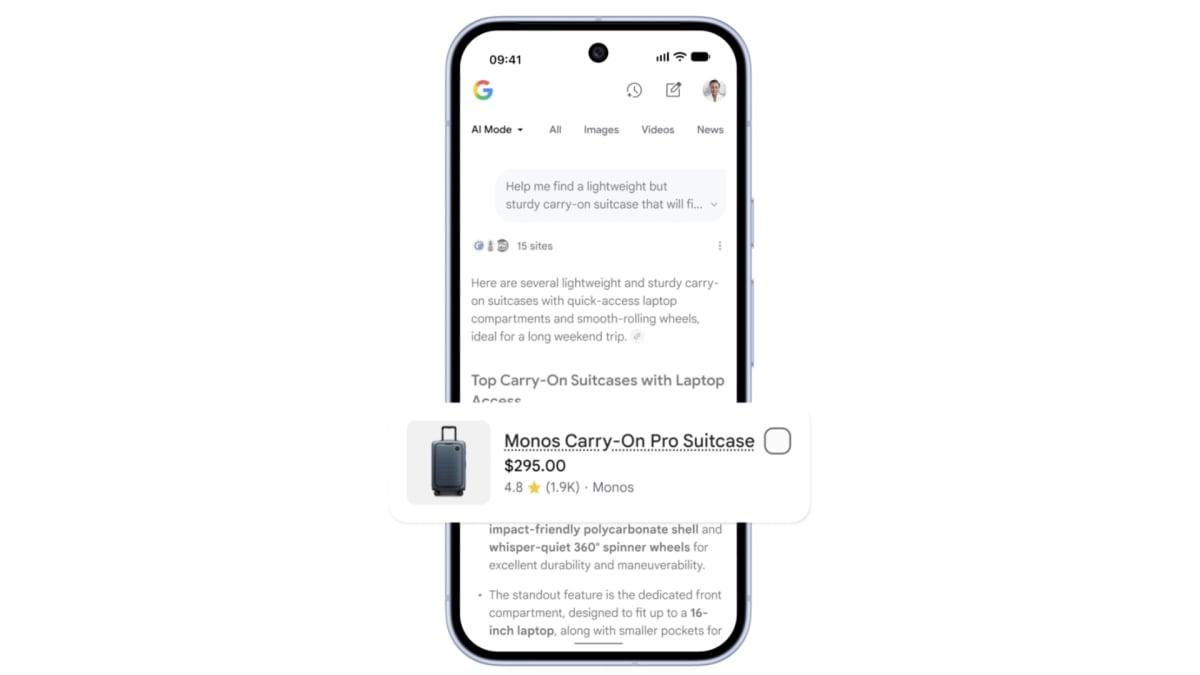
Source: Mashable
Related Stories

Competition Intensifies in AI Commerce Market
The Universal Commerce Protocol positions Google to compete more aggressively with OpenAI, Perplexity, and Amazon in the booming generative AI market for e-commerce
5
. OpenAI announced Instant Checkout in September, which allows users to buy products through ChatGPT while taking a fee from transactions5
. Perplexity partnered with PayPal to let users buy products directly in its chat, and Amazon launched Shop Direct with a "Buy for Me" AI agent feature5
. According to a McKinsey report from October, the retail market could represent a $3 trillion to $5 trillion opportunity globally by 2030 due to AI-powered tools and agentic commerce5
. Adobe noted that traffic driven to seller sites by generative AI grew by 693.4% during the holiday season, though the report didn't specify conversion rates1
.Protocol Compatibility and Industry Adoption
The Universal Commerce Protocol is designed to work with other agentic protocols, including Agent Payments Protocol (A2P), Agent2Agent (A2A), and Model Context Protocol (MCP)
1
. This compatibility allows agents and businesses to select specific extensions that suit their operational needs1
. Shopify CEO Tobi Lutke highlighted the serendipitous nature of agentic commerce, noting that AI agents excel at finding people with specific interests and matching them with products they would never have searched for independently1
. Notably, Shopify also unveiled a similar integration with Microsoft Copilot for shopping, allowing customers to check out easily within conversational flows1
. The broader impact will depend on how quickly retailers and AI platforms adopt the standard, with Google planning to expand capabilities globally in the coming months2
.References
Summarized by

Navi
[3]
Related Stories
Google Updates Universal Commerce Protocol to Make AI Shopping Work More Like Human Browsing
20 Mar 2026•Technology

AI Agents Revolutionize Online Shopping: From Search to Checkout
02 Oct 2025•Technology

Retailers embrace agentic commerce but warn AI shopping still faces major execution gaps
18 Mar 2026•Business and Economy

Recent Highlights


Recent Highlights
Today's Top Stories








Your Daily Dose of Curated AI News
Don’t drown in AI news. We cut through the noise - filtering, ranking and summarizing the most important AI news, breakthroughs and research daily. Spend less time searching for the latest in AI and get straight to action.

