Google unveils America-India Connect subsea cables to power $15 billion AI infrastructure push


5 Sources
5 Sources
[1]
Google Plans New Fiber-Optic Routes Between the US and India
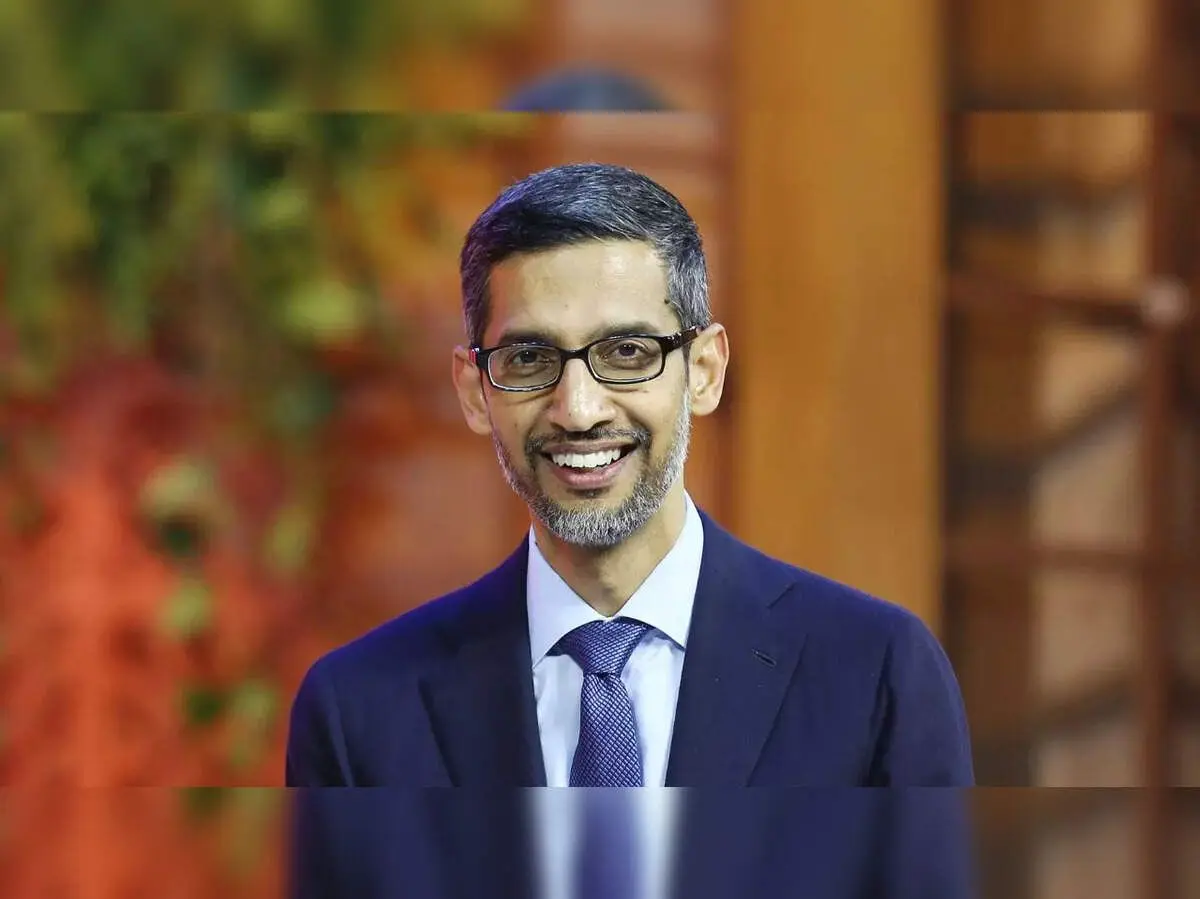
Alphabet's Google said it would invest in an AI infrastructure hub in southern India and announced efforts from its philanthropic arm, Google.org, to improve public services with AI and support researchers using AI for scientific breakthroughs. Alphabet Inc. unveiled several new initiatives to support its expansion in India, including new fiber-optic routes that will connect the country with the US and other locations in the Southern Hemisphere. Chief Executive Officer Sundar Pichai talked up the company's efforts at a high-profile AI summit in New Delhi, where Prime Minister Narendra Modi is making the case that his country can lead in artificial intelligence. Pichai is one of a long list of prominent CEOs supporting the effort. Google's parent company said the latest push, the America-India Connect initiative, will deliver new fiber-optic lines to improve the speed and reliability of connectivity between India and other countries. The company has already been building subsea cables in the Pacific, Africa and around Australia. Alphabet's Google said last year that it would invest about $15 billion building an AI infrastructure hub in southern India over the next five years, its biggest bet on the fast-growing country. The company is on a global spending blitz, saying earlier this month its capital expenditures would reach as much as $185 billion this year alone. "It's an extraordinary moment; we're investing to meet the moment," Pichai said in Delhi, where he also met with Modi. The company also announced a $30 million effort from its philanthropic arm, Google.org, to improve public services with AI, along with another $30 million to support researchers using AI for scientific breakthroughs. Google's AI lab DeepMind is also establishing a new partnership with the Indian government and local institutions to expand the use of its frontier AI for Science models. Many of the leading US AI companies have been expanding in India, both to tap the country's technical talent and to claim customers in the world's biggest market. Anthropic PBC appointed former Microsoft Corp. executive Irina Ghose to lead its India operations in January. Google is already a big player in this shift. Last year, it opened its largest campus in Bangalore, complete with indoor mini golf, pickle ball courts and cafeterias serving cardamom tea.
[2]
The massive America-India Connect project links continents
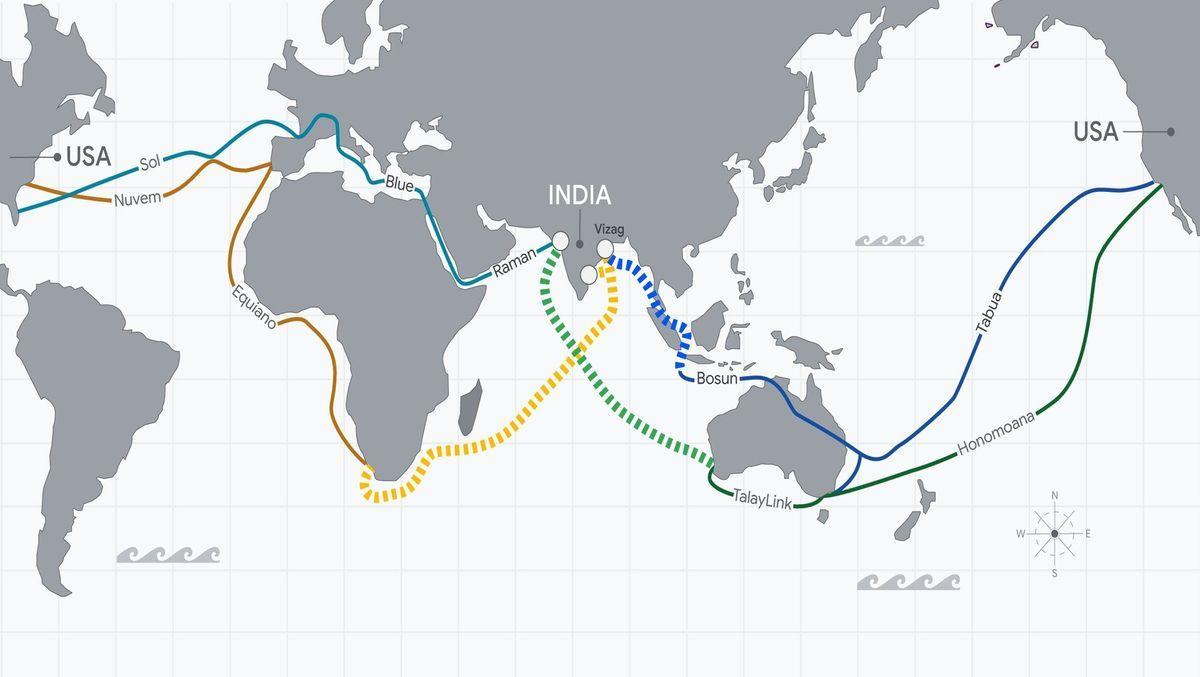
* Google's subsea cables create resilient networks linking India, America, and the Southern Hemisphere * AI infrastructure expansion depends on high-capacity fiber-optic networks spanning multiple continents * Visakhapatnam becomes a key international gateway for global data traffic flows Google is expanding its private subsea cable footprint with a new initiative linking the United States and India through multiple Southern Hemisphere routes. The plan, dubbed America-India Connect, adds new fiber paths between Mumbai and Western Australia, and between Visakhapatnam on India's east coast and key international hubs. When combined with existing systems such as Blue, Raman, Sol, Equiano, and others, these routes extend data corridors across the Pacific, Africa, and the Red Sea. Building the missing links across continents "We're announcing America-India Connect, a collaborative infrastructure initiative... (it) will establish a new international subsea gateway... three new subsea paths... and four strategic fiber-optic routes that bolster network resilience and capacity between the United States, India, and multiple locations across the Southern Hemisphere," Google said in a blog post. A new international subsea gateway in Visakhapatnam is expected to diversify traffic away from traditional entry points like Mumbai and Chennai. Additional links to Singapore, South Africa, and Australia are designed to increase redundancy and capacity. Together, these routes connect the American West Coast through Australia to India, while also strengthening a pathway from the American East Coast through Africa. Google is already one of the largest private investors in subsea fiber networks, typically financing and designing projects that stretch thousands of kilometers under the sea. These cables carry high-capacity global data traffic and form the backbone of cloud computing, digital services, and cross-border business operations. The initiative is anchored by a broader five-year, $15 billion investment in AI-related infrastructure in India, which includes a planned AI hub in Visakhapatnam with large-scale computing capacity and integration with the new subsea gateway. Company executives argue stronger infrastructure is necessary to ensure reliable and affordable connectivity as AI systems expand. Greater bandwidth and network resilience are often linked to improved productivity and long-term economic growth, and with deeper access to digital services, businesses and public institutions can deploy AI tools more widely across sectors. The stated aim is to reduce the risk of an AI divide, where only certain regions or industries benefit from advanced computing resources. Google has also committed funding through its philanthropic arm to support public services and research using AI. Executives describe India as a full-stack AI opportunity, referencing its role as a user base, development hub, and regulatory participant in shaping future standards. These subsea investments follow established maritime trade routes -- now converted into digital highways between economies. Whether this network truly completes the remaining gaps in global connectivity will depend on execution, regulatory stability, and sustained demand. However, the scale of capital involved suggests confidence, and Google seems willing to invest additional funds. Alphabet CEO Sundar Pichai said at a press briefing, "AI is the biggest platform shift of our lifetimes... It's an extraordinary moment; we are investing to meet the moment... (it's) one of the most powerful tools to solve problems and improve lives at planetary scale." Follow TechRadar on Google News and add us as a preferred source to get our expert news, reviews, and opinion in your feeds. Make sure to click the Follow button! And of course you can also follow TechRadar on TikTok for news, reviews, unboxings in video form, and get regular updates from us on WhatsApp too.
[3]
Google to Build Three New Subsea Cables From India, Four Fiber-Optic Routes
Connectivity via subsea cables will improve internet affordability Google on Wednesday made some AI-focused announcements aimed at supporting its further expansion in the country, during the inaugural AI Impact Summit in New Delhi. The Mountain View-based company revealed plans to establish new fibre-optic routes linking Indian cities with the US and other locations in the Southern Hemisphere. The latest move is part of Google's $15 billion (roughly Rs. 1.34 lakh crore) investment announced last year to set up an AI hub in India. Additionally, Google's DeepMind has entered into partnerships with government bodies in India for the adoption of AI models. Google's Four Upcoming Strategic Fibre-Optic Routes On Wednesday, Google announced its America-India Connect initiative, as part of its five-year, $15 billion AI infrastructure investment in the country. The project aims to establish a new international subsea gateway in Visakhapatnam (Vizag). It will include three new subsea paths connecting India to Singapore, South Africa, and Australia, and four strategic fibre-optic routes linking the US, India, and multiple locations across the Southern Hemisphere. Google confirmed that it is developing a direct fibre-optic path between Vizag and Chennai, linking the American East Coast around Africa to Vizag. It will also establish a direct path between Vizag and Singapore, aimed at creating a South Pacific route that connects the American West Coast through Australia to Vizag. Further, Google says it is constructing a direct fibre-optic path between Mumbai and Western Australia, which will lead to a South Pacific route connecting the American West Coast around Australia to Mumbai. Google says these paths will "increase the resilience of India's digital backbone and improve economic security". Google claims that the connectivity via subsea cables will improve internet affordability and reliability, and bring access to digital services and 'prevent the AI divide from taking root'. The company stated that Google's America-India Connect initiative builds on collaborations with regional partners across Africa, Australia, and the Pacific. Additionally, Google has announced a $30 million (roughly Rs. 270 crore) initiative through Google.org, aimed at improving public services using AI. The company has also allocated another $30 million to support researchers for scientific breakthroughs. Further, DeepMind is joining hands with the Indian government and local institutions like Anusandhan National Research Foundation (ANRF) and Council on Energy, Environment and Water (CEEW) for the adoption of AI models.
[4]
Google Unveils America-India Connect Subsea Cable Initiative to Boost AI Connectivity
Google announced crucial new additions to their existing AI infrastructure and partnerships in India, building on the recent $15 billion investment for an AI Hub in Vizag. Speaking at the press conference, Preeti Lobana, VP and Country Manager, Google India said, "AI is a generational opportunity to solve some of the world's most pressing challenges, but its true potential can only be realized when it is accessible and tailored to local needs. At Google, we see our role as an essential enabler -- providing the frontier infrastructure, research, and skills that allow nations like India to lead their own digital transformations. By partnering with governments to integrate AI into science, education, and public services, we are helping to build a future where technology isn't just a global tool, but a catalyst for national development and shared prosperity."
[5]

Google Unveils Subsea Cable and DeepMind AI Initiatives for India
At the AI Impact Summit 2026 in New Delhi, Google unveiled a sweeping expansion of its AI and digital infrastructure initiatives in India, reinforcing its ambition to help position the country as a global leader in artificial intelligence. The announcements build on Google's previously committed $15 billion investment toward developing an AI Hub in Vizag and signal a deepening partnership with India across infrastructure, research, education, governance, and climate innovation. A major highlight of the summit was the launch of the America-India Connect Subsea Cable Initiative. This new strategic fiber-optic project is designed to strengthen digital connectivity between the United States, India, and the Southern Hemisphere. By expanding high-capacity, resilient subsea infrastructure, Google aims to enhance the speed, reliability, and security of cross-border data flows -- an essential foundation for AI-powered services, cloud adoption, and digital transformation at scale. The initiative builds upon Google's broader global investments in subsea cable networks across the Pacific and Africa. In parallel, Google DeepMind announced a new set of collaborations with Indian government bodies and research institutions to accelerate AI-powered discovery in science and education. Through a partnership with the Anusandhan National Research Foundation (ANRF), Indian researchers will gain access to advanced AI models such as AlphaGenome, AI Co-Scientist, and Earth AI. These tools are expected to support breakthroughs in areas ranging from genomics to climate science. The collaboration will also include hackathons, mentorship programs, and community initiatives designed to nurture early-career researchers and students. These efforts form part of Google DeepMind's broader National Partnerships for AI initiative, which seeks to align frontier AI research with national development priorities. Education emerged as another key focus area. Google announced plans to work with Atal Tinkering Labs, which serve more than 10,000 schools and 11 million students across India, to thoughtfully integrate Gemini AI into classrooms. The initiative aims to incorporate robotics and coding into curricula, enhance teacher workflows with generative AI tools, and develop a curriculum-aligned AI assistant equipped with appropriate safety guardrails. In a first-of-its-kind partnership with PM Publishers Pvt. Ltd., traditional textbooks will also be transformed into interactive digital learning experiences, signaling a shift toward more immersive and AI-enabled education models. Recognizing that technological advancement must be matched by workforce readiness, Google also introduced significant skilling initiatives. In partnership with Karmayogi Bharat, Google Cloud will help scale the iGOT Karmayogi platform to support the professional development of 20 million public servants across more than 800 districts. Training resources will progressively be made accessible in over 18 Indian languages, helping modernize governance capabilities in the AI era. Additionally, Google is expanding its AI Professional Certificate program in India in collaboration with Wadhwani AI. The program is designed to teach practical AI applications to students and early-career professionals, initially in English and Hindi, with more Indian languages planned. To further accelerate global AI implementation, Google announced two major funding commitments totaling $60 million. The Google.org AI for Government Innovation Impact Challenge will support partnerships aimed at transforming government-to-citizen services through AI, while the AI for Science Impact Challenge will provide funding to researchers using AI to drive scientific breakthroughs. Complementing these initiatives, Google is launching a Center for Climate Technology in collaboration with the Office of the Principal Scientific Advisor to the Government of India to scale AI-powered climate solutions and support sustainable innovation. Alongside these announcements, Google released its Annual Responsible AI Progress Report, reaffirming its commitment to security, ethics, and responsible AI development as adoption accelerates worldwide. Taken together, the announcements reflect a comprehensive strategy that spans infrastructure, research access, education reform, workforce development, public-sector modernization, and climate innovation. By strengthening both the physical and intellectual foundations of AI in India, Google is positioning itself not just as a technology provider, but as a long-term partner in India's digital and economic transformation.
Share
Share
Copy Link
Google announced the America-India Connect initiative, establishing new fiber-optic routes between the US and India through the Southern Hemisphere. CEO Sundar Pichai revealed the subsea cable network at New Delhi's AI Impact Summit, part of a $15 billion investment to build an AI hub in Visakhapatnam. The move positions India as a critical node in global AI infrastructure.
Google India launches America-India Connect to bridge continents
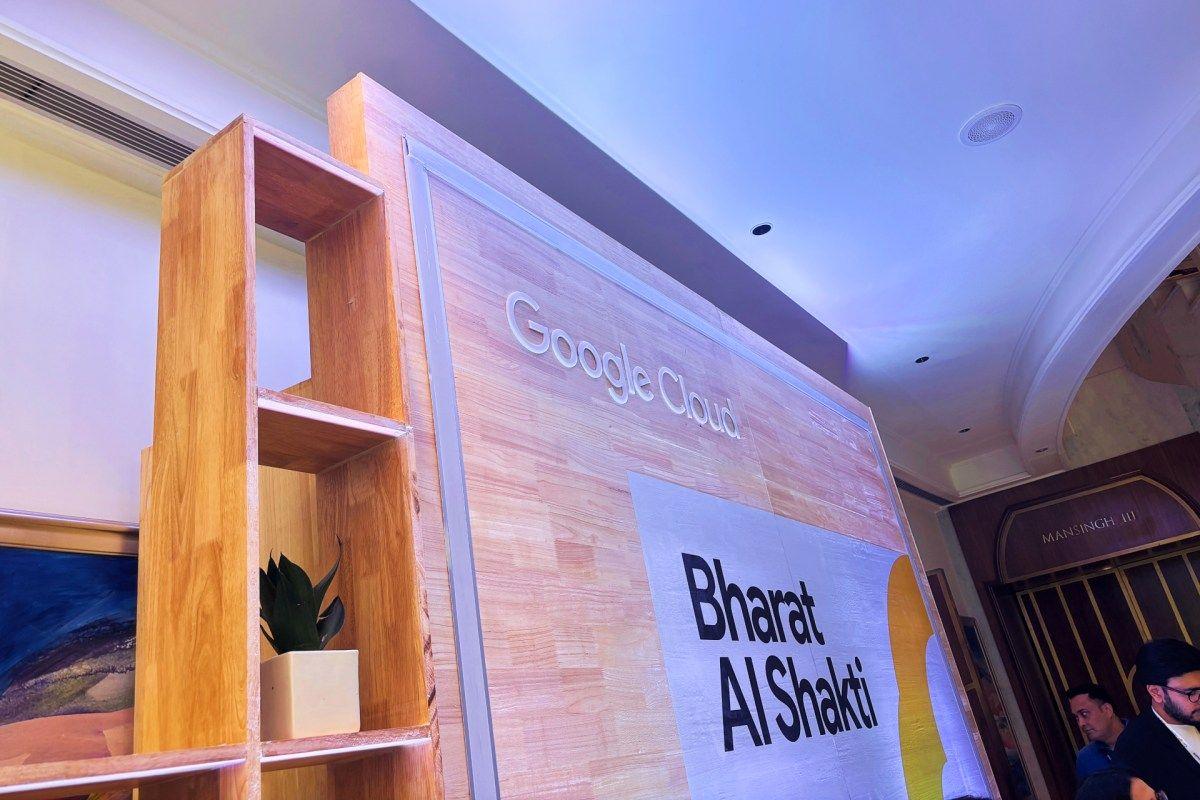
Alphabet's Google India unveiled the America-India Connect initiative at the AI Impact Summit in New Delhi, marking a significant expansion of its digital connectivity enhancement efforts
1
. CEO Sundar Pichai announced the subsea cable initiative alongside Prime Minister Narendra Modi, declaring that "AI is the biggest platform shift of our lifetimes" and emphasizing the company's commitment to "investing to meet the moment"2
.
Source: DT
The initiative establishes new fiber-optic routes linking the United States, India, and multiple locations across the Southern Hemisphere, building on Google's existing subsea cables in the Pacific, Africa, and around Australia
1
.The project creates three new subsea paths connecting India to Singapore, South Africa, and Australia, along with four strategic fiber-optic routes that strengthen network resilience between continents
3
. These routes include a direct path between Mumbai and Western Australia, establishing a South Pacific route connecting the American West Coast through Australia to Mumbai, and a direct connection between Visakhapatnam and Singapore3
.
Source: TechRadar
AI infrastructure anchored by $15 billion investment in India
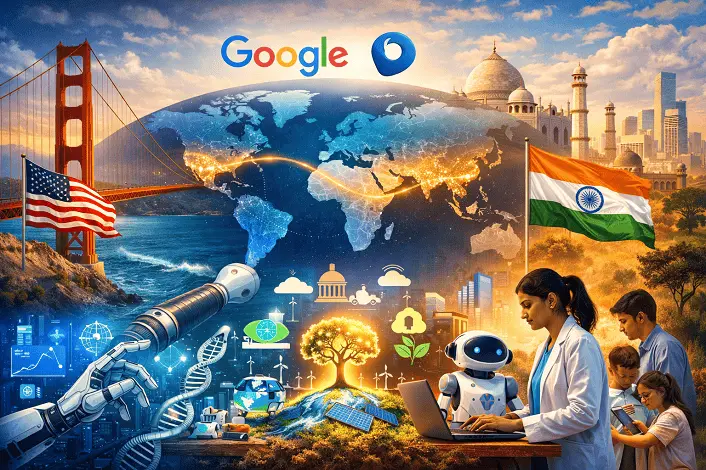
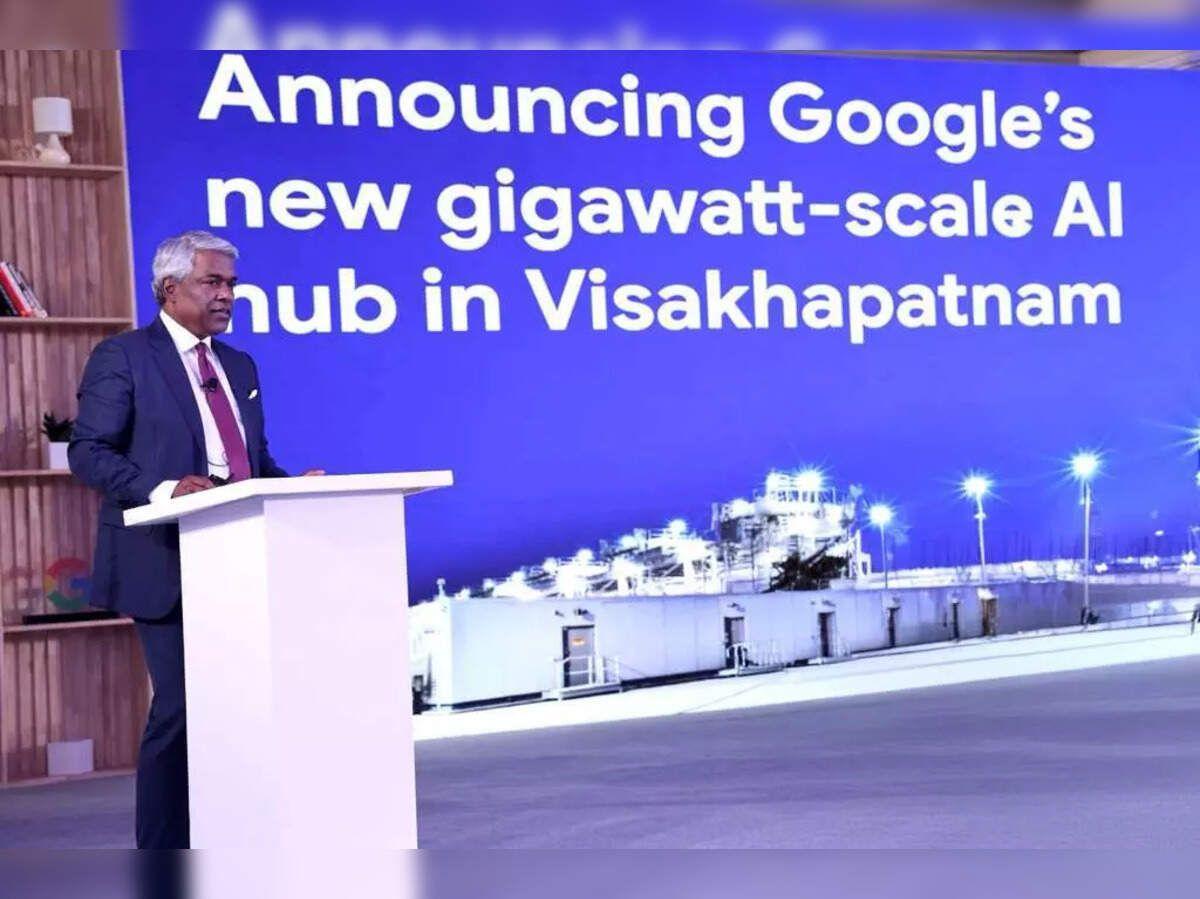
The America-India Connect subsea cable initiative supports Google's previously announced $15 billion investment in India over the next five years, focused on building an AI hub in Visakhapatnam on India's east coast
1
. This represents the company's largest bet on the fast-growing country and forms part of a global spending blitz that will see capital expenditures reach as much as $185 billion this year alone1
.
Source: CXOToday
The AI hub in Visakhapatnam will feature large-scale computing capacity integrated with the new international subsea gateway being established in the city
2
. This strategic location diversifies data traffic flows away from traditional entry points like Mumbai and Chennai, creating a more resilient network architecture2
. The high-capacity fiber-optic networks will carry global data traffic and form the backbone of cloud computing, digital services, and cross-border business operations essential for AI infrastructure expansion2
.Google DeepMind partnerships accelerate AI for Science applications
Beyond physical AI infrastructure, Google announced $60 million in funding commitments aimed at preventing an AI divide
5
. Google.org committed $30 million to improve AI for public services, with another $30 million supporting researchers using AI for scientific breakthroughs1
.DeepMind established new partnerships with the Indian government and local institutions including the Anusandhan National Research Foundation (ANRF) and Council on Energy, Environment and Water (CEEW) to expand the use of frontier AI for Science models
3
. Through the ANRF collaboration, Indian researchers will gain access to advanced AI models such as AlphaGenome, AI Co-Scientist, and Earth AI, supporting breakthroughs in genomics and climate science5
.Related Stories
Digital transformation extends to education and workforce development
Google India announced plans to integrate Gemini AI into more than 10,000 Atal Tinkering Labs serving 11 million students across India
5
. The initiative incorporates robotics and coding into curricula while developing a curriculum-aligned AI assistant with safety guardrails. In partnership with Karmayogi Bharat, Google Cloud will scale the iGOT Karmayogi platform to support professional development for 20 million public servants across more than 800 districts, with training resources progressively available in over 18 Indian languages5
.Preeti Lobana, VP and Country Manager at Google India, emphasized that "AI is a generational opportunity to solve some of the world's most pressing challenges, but its true potential can only be realized when it is accessible and tailored to local needs"
4
. The company is expanding its AI skilling programs through an AI Professional Certificate program in collaboration with Wadhwani AI, initially in English and Hindi with more Indian languages planned5
.Google claims the enhanced connectivity via subsea cables will improve internet affordability and reliability while bringing broader access to digital services
3
. The company released its Annual Responsible AI Progress Report alongside these announcements, reaffirming its commitment to responsible AI development as adoption accelerates5
. As one of the largest private investors in subsea fiber networks globally, Google is positioning India as both a development hub and a full-stack AI opportunity, serving as a user base, regulatory participant, and innovation center shaping future standards2
.References
Summarized by

Navi
Related Stories
Google unveils $15 billion AI infrastructure push in India with subsea connectivity and skills
18 Feb 2026•Business and Economy
Google's $15 Billion AI Hub in India: A Game-Changer for Global AI Infrastructure
14 Oct 2025•Technology
Airtel and Google Join Forces to Build India's First AI Hub in Visakhapatnam
14 Oct 2025•Technology
Recent Highlights
1
AI Models Lie and Deceive to Protect Other AI Models From Deletion, Study Reveals
Science and Research

2
AI chatbots validate you too much, making you less kind to others, Stanford study reveals
Science and Research

3
Judge blocks Pentagon from blacklisting Anthropic over AI safety guardrails dispute
Policy and Regulation

Recent Highlights
Today's Top Stories




Your Daily Dose of Curated AI News
Don’t drown in AI news. We cut through the noise - filtering, ranking and summarizing the most important AI news, breakthroughs and research daily. Spend less time searching for the latest in AI and get straight to action.

