HPE adopts AMD's Helios rack architecture with custom Ethernet switch for 2026 AI systems


4 Sources
4 Sources
[1]
HPE adopts AMD's Helios rack architecture for 2026 AI systems -- new rack form factor gets its first major partner ahead of 2026 availability
New collaboration brings Open Rack Wide and first Venice-MI430X powered supercomputer into view. AMD and HPE are expanding their long-running partnership with a new agreement that will bring the AMD Helios rack-scale AI architecture into HPE's product portfolio from 2026 onward. This will give Helios its first major OEM backer and position HPE to ship complete 72-GPU AI racks built around next-generation Instinct MI455X accelerators, new EPYC "Venice" CPUs, and an Ethernet-based scale-up fabric developed with Broadcom. Helios has been AMD's reference design for an open rack-level AI platform since its introduction earlier this year. It uses Meta's Open Rack Wide mechanical standard and combines MI450-series GPUs, Venice CPUs, and Pensando networking hardware inside a liquid-cooled, double-wide chassis. AMD has targeted up to 2.9 exaFLOPS of FP4 compute per rack with the MI455X generation, along with 31TB of HBM4 and a scale-up topology that exposes every GPU as part of a single pod. HPE will implement that design with a purpose-built HPE Juniper switch that supports Ultra Accelerator Link over Ethernet. The switch is the result of a collaboration with Broadcom and forms the backbone of the system's high-bandwidth GPU interconnect. The choice of Ethernet for scale-up connectivity is intended to separate Helios from Nvidia's NVLink-centric approach. Nvidia's GB200 NVL72 rack keeps 36 Grace CPUs and 72 Blackwell GPUs within one NVLink domain and relies on InfiniBand for system-to-system traffic. Helios runs a comparable GPU count behind a single Ethernet fabric that uses UALoE for the accelerator link layer. HPE will also use Ultra Ethernet Consortium-aligned hardware for scale-out networking, which keeps the design inside an open, standards-driven stack. HPE's adoption gives Helios a path to market in 2026, but the announcement also confirms how the next EPYC and Instinct parts will reach into high-performance computing. The High-Performance Computing Center Stuttgart has selected HPE's Cray GX5000 platform for its next flagship system, named Herder. It will use MI430X GPUs and Venice CPUs across a set of direct liquid-cooled blades. Herder is scheduled for delivery in the second half of 2027 and will replace HLRS's current system, Hunter. HPE has highlighted the environmental friendliness of the project's energy strategy, which uses the waste heat from the GX5000 racks to warm buildings on the University of Stuttgart's Vaihingen campus. AMD and HPE plan to make Helios-based systems available worldwide next year, giving the architecture its first commercial deployment route and establishing a counterpoint to rack-scale Blackwell platforms already entering service.
[2]
HPE to ship rack-scale AI system using AMD's Helios in 2026
Hardware bundle ties next-gen accelerators to an Ethernet fabric arriving in 2026 HPE is throwing its weight behind AMD's Helios rack-scale architecture and will offer this as part of its AI portfolio next year, including a purpose-built Juniper Networks scale-up switch. Announced ahead of HPE's Discover event in Barcelona this week, the company claims it will be one of the first companies to offer a turnkey rack system for large-scale AI training and inference, based on AMD's reference design. Helios is intended to operate a rack full of nodes fitted with accelerators as if they were one single large GPU, like Nvidia's DGX GB200 NVL72 system, to which Helios is pitched as a rival. As far as AMD is concerned, Helios will be a vehicle for its next-generation Instinct MI455X GPUs and its 6th-gen Epyc CPUs, codenamed Venice, both of which are due next year, so HPE can only say that it will offer its Helios AI Rack worldwide sometime in 2026. The networking for this system will be a scale-up Ethernet implementation that will use UALink over Ethernet, featuring a purpose-built Juniper Networks switch based on Broadcom's Tomahawk 6 network silicon, which boasts 102.4 Tbps of aggregate bandwidth. UALink, or Ultra Accelerator Link, is an open standard alternative to Nvidia's NVLink technology for interconnecting clusters of GPUs, the specifications for which were published earlier this year. However, it appears that HPE and Broadcom, which is also working to develop the scale-up switch, believe that you don't need to build a network using actual UALink hardware if you can simply run the protocol over Ethernet, so that's what is happening here. "This is an industry first scale-up solution using Ethernet, standard Ethernet. So that means it's 100 percent open standard and avoids proprietary vendor lock-in, leverages proven HPE Juniper networking technology to deliver scale and optimal performance for AI workloads," said Rami Rahim, president and general manager of HPE's networking business and former CEO of Juniper Networks prior to its acquisition. HPE claims that this will enable its rack-scale system to support the traffic necessary for trillion-parameter model training, plus high inference throughput. Helios is based on the double-width Open Rack Wide (ORW) specifications developed by Meta within the Open Compute Project (OCP). It supports modular trays, has liquid cooling capability, and is ideal for power-constrained environments, according to Rahim. With 72 Instinct MI455X GPUs per rack, HPE says its rack-scale system will be capable of 260 TB/s of aggregated bandwidth and up to 2.9 exaFLOPS of 4-bit floating-point performance for handling large AI models. This is unlikely to come cheap, of course, with Nvidia's rival GB200 NVL72 setups reportedly selling for nearly $3.5 million each. Perhaps it is no surprise that HPE lists cloud service providers and especially neoclouds as the primary target for this kit, rather than enterprise customers. ®
[3]
HPE Backs AMD's 'Helios' AI Server Rack With Bespoke Juniper Scale-Up Switch
HPE says its implementation of AMD's 'Helios' rack-scale platform will include what it's calling the 'first scale-up switch to deliver optimized performance for AI workloads over standard Ethernet,' thanks to development work it's doing with Broadcom. HPE said Tuesday that it will be "one of the first OEMs" to adopt AMD's GPU-accelerated AI server rack that is set to rival Nvidia's heavily anticipated Vera Rubin platform next year. Announced at HPE Discover 2025 in Barcelona, Spain, the Houston, Texas-based server giant said that it plans to make AMD's "Helios" rack-scale platform, powered by 72 of the chip designer's Instinct MI455X GPUs, available to cloud service providers, including so-called "neoclouds," next year for large-scale AI training and inference workloads. [Related: Nvidia CEO Explains Why He Sees 'Something Very Different' From An AI Bubble] HPE's plan with the double-wide Helios rack was revealed less than a month after AMD CEO Lisa Su said the chip designer sees a "very clear path" to gaining double-digit share in the Nvidia-dominated data center AI market, with expectations to make tens of billions of dollars in annual revenue from its Instinct GPUs and related products in 2027. Nvidia, by contrast, said less than two weeks ago that it has "visibility" to $500 billion in revenue from the beginning of this year to the end of next year for its Blackwell and next-generation Rubin platforms, which includes the Vera Rubin platform. A single Helios rack is expected to provide 260 TBps of scale-up bandwidth, up to 2.9 exaflops of FP4 performance, 31 TB of HBM4 memory and 1.4 PBps of memory bandwidth to support massive AI models that reach a trillion parameters, according to HPE. These figures line up with the initial specifications AMD provided for Helios in June. HPE said its implementation of Helios, which is based on Open Compute Project specifications, will include what it's calling the "first scale-up switch to deliver optimized performance for AI workloads over standard Ethernet." This will enable high-speed connections between each rack's 72 GPUs. The company said its Juniper Networking subsidiary is developing the scale-up networking switch with semiconductor giant Broadcom specifically for its Helios offerings. Powered by Broadcom's Tomahawk 6 networking chip, the switch will be based on the Ultra Accelerator Link over Ethernet standard, which tech giants and dozens of other companies are supporting as an alternative to Nvidia's NVLink interconnect technology. HPE said the switch will take advantage of its "AI-native automation and assurance capabilities to simplify network operations for faster deployment and overall cost savings." It added that the switch "minimizes vendor lock-in and enables swifter feature updates." The Helios rack will also use AMD's ROCm software and Pensando networking technology to "speed innovation and help lower total cost of ownership," according to HPE. While AMD has invested a significant amount of money to challenge Nvidia head on, the company told CRN earlier this year that it isn't ready yet to make Instinct GPUs a broad channel play, instead opting to work with select channel partners for now. That's because the company is focused on "high-touch" engagements with its biggest customers -- which include Meta, OpenAI, Microsoft and xAI -- to ensure they have an optimal experience, according to AMD executive Kevin Lensing. "The challenge with doing a channel enablement on Instinct is we can't enable a model where we have to go one-to-many if we can't touch them all and deliver a great experience," said Lensing, who runs Americas and hyperscaler sales, in a June interview. Among those select partners is International Computing Concepts, a Northbrook, Ill.-based systems integrator that was named No. 1 in CRN's Fast Growth 150 this year, with much of its triple-digit growth over the past two years being fueled by its Nvidia business. Alexey Stolyar, CTO at International Computing Concepts, told CRN on Monday that he's seeing "some momentum" for Instinct-based server solutions from neocloud customers, referring to a rising group of smaller cloud service providers focused on AI compute. "[AMD is] really going after very specific opportunities that they can hand-hold and make sure [they can] provide the best performance and so on. I think once they get a little bit of a feel for that and it becomes a little bit more solidified, they'll start pushing it down the partner community," he said. Stolyar said while he likes the idea of AMD's Helios rack supporting an open standard like Ultra Accelerator Link over Ethernet, he cautioned that the tech industry could experience hurdles in taking full advantage of it. The solution provider executive based this assertion on the challenges his company faced in helping customers utilize the scale-up capabilities of Nvidia's rack-scale platforms like the GB200, saying that "there's not a lot of workloads that can really max it out." The exception to that rule would be hyperscalers, who have the right level of expertise to max out the scale-out bandwidth for massive AI training jobs they're running, he added. "There's not a lot of people who actually know how to do it. But that being said, we don't see a lot of use for it," Stolyar said. The executive instead expects most companies to take advantage of the scale-out capabilities of rack-scale platforms, which may not offer the same level of bandwidth but can enable hundreds of more GPUs to connect to each other on the same fabric. "Sure, it's a little bit slower, but as long as you're not filling up that full bandwidth, you're fine. And even if you are filling up that full bandwidth, your access to a large GPU pool is much larger now," Stolyar said.
[4]
AMD and HPE Deepen Alliance to Drive Open Rack-Scale AI Infrastructure with New "Helios" Architecture
"For more than a decade, HPE and AMD have pushed the boundaries of supercomputing, delivering multiple exascale-class systems and championing open standards that accelerate innovation," said Antonio Neri, president and CEO at HPE. "With the introduction of the new AMD 'Helios' and our purpose-built HPE scale-up networking solution, we are providing our cloud service provider customers with faster deployments, greater flexibility, and reduced risk in how they scale AI computing in their businesses." Advancing the Next Era of Industry Standard AI Infrastructure The AMD "Helios" rack-scale AI platform delivers up to 2.9 exaFLOPS of FP4 performance per rack using AMD Instinct MI455X GPUs, next-generation AMD EPYC "Venice" CPUs and AMD Pensando Vulcano NICs for scale-out networking, all unified through the open ROCm software ecosystem that enables flexibility and innovation across AI and HPC workloads. Built on the OCP Open Rack Wide design, "Helios" can help customers and partners streamline deployment timelines and deliver a scalable, flexible solution for demanding AI workloads. This has enabled HPE to integrate differentiated technologies for their customers, specifically a scale-up Ethernet switch and software designed for "Helios." Developed in collaboration with Broadcom, the switch delivers optimized performance for AI workloads using the Ultra Accelerator Link over Ethernet (UALoE) standard, reinforcing the AMD commitment to open, standards-based technologies.
Share
Share
Copy Link
HPE becomes the first major OEM partner for AMD's Helios rack-scale AI platform, bringing 72-GPU systems to market in 2026. The collaboration features a purpose-built Juniper scale-up Ethernet switch developed with Broadcom, targeting up to 2.9 exaFLOPS per rack. Built on open standards, Helios positions itself as an alternative to Nvidia's GB200 NVL72 platform.
HPE and AMD Forge Path to Open Rack-Scale AI Infrastructure
HPE announced it will become one of the first major OEM partners to adopt AMD's Helios architecture, bringing complete rack-scale AI systems to market in 2026
1
2
. The partnership deepens a collaboration spanning over a decade and positions both companies to challenge Nvidia's dominance in the data center AI market. AMD CEO Lisa Su recently outlined a "very clear path" to capturing double-digit market share, with expectations to generate tens of billions of dollars in annual revenue from Instinct GPUs and related products by 20273
.
Source: DT
The AMD's Helios architecture represents a comprehensive rack-scale AI system designed to compete directly with Nvidia's GB200 NVL72 platform. Each rack will pack 72 Instinct MI455X GPUs alongside next-generation EPYC "Venice" CPUs, delivering up to 2.9 exaFLOPS of FP4 performance and 31TB of HBM4 memory
1
3
. Built on the Open Compute Project's Open Rack Wide mechanical standard, Helios embraces an open, standards-driven approach that contrasts sharply with proprietary alternatives.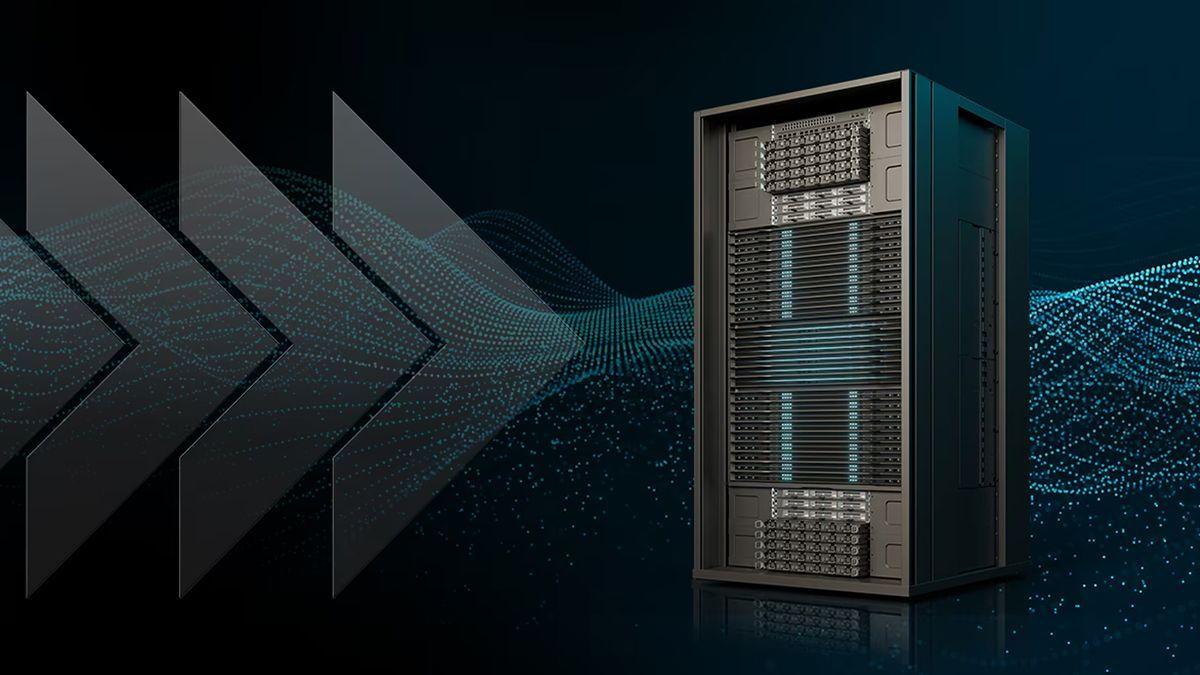
Source: Tom's Hardware
Custom Juniper Scale-Up Ethernet Switch Powers GPU Interconnect
A defining feature of HPE's implementation involves a purpose-built scale-up Ethernet switch developed through collaboration between HPE's Juniper Networks subsidiary and Broadcom
2
3
. The switch leverages Broadcom's Tomahawk 6 networking chip, which provides 102.4 Tbps of aggregate bandwidth, and implements Ultra Accelerator Link over Ethernet (UALoE) for high-speed GPU interconnect technology2
. This approach enables 260 TBps of scale-up bandwidth across all 72 GPUs within a single rack3
.Rami Rahim, president and general manager of HPE's networking business and former CEO of Juniper Networks, emphasized the significance: "This is an industry first scale-up solution using Ethernet, standard Ethernet. So that means it's 100 percent open standard and avoids proprietary vendor lock-in"
2
. The decision to run Ultra Accelerator Link protocol over standard Ethernet fabric eliminates the need for specialized UALink hardware while maintaining the performance benefits. This strategy directly challenges Nvidia's NVLink-centric approach, where Blackwell GPUs remain within a proprietary NVLink domain for scale-up connectivity1
.Targeting Cloud Service Providers and Neoclouds
HPE positions its Helios-based systems primarily toward cloud service providers and emerging neoclouds—smaller cloud providers focused on AI compute infrastructure
2
3
. The rack-scale AI system aims to support trillion-parameter model training and deliver high inference throughput for demanding AI training and inference workloads. With Nvidia's comparable GB200 NVL72 systems reportedly selling for nearly $3.5 million each, pricing will likely remain a significant consideration for potential customers2
.AMD continues to focus on "high-touch" engagements with major customers including Meta, OpenAI, Microsoft, and xAI rather than broad channel distribution
3
. Alexey Stolyar, CTO at International Computing Concepts, noted seeing "some momentum" for Instinct-based solutions among neocloud customers, though he cautioned about potential challenges in fully utilizing scale-up capabilities based on experiences with similar platforms3
.Related Stories

Supercomputer Deployment Signals HPC Expansion
Beyond commercial AI deployments, the partnership extends into high-performance computing. The High-Performance Computing Center Stuttgart (HLRS) selected HPE's Cray GX5000 platform for its next flagship supercomputer, named Herder, scheduled for delivery in the second half of 2027
1
. The system will feature MI430X GPUs and EPYC "Venice" CPUs across direct liquid-cooled blades, replacing the current Hunter system. HPE highlighted the environmental benefits, noting that waste heat from the GX5000 racks will warm buildings on the University of Stuttgart's Vaihingen campus1
.Antonio Neri, president and CEO at HPE, stated: "For more than a decade, HPE and AMD have pushed the boundaries of supercomputing, delivering multiple exascale-class systems and championing open standards that accelerate innovation"
4
. The open rack-scale AI infrastructure approach, unified through AMD's ROCm software ecosystem and incorporating AMD Pensando networking technology, aims to provide flexibility across AI and HPC workloads while potentially reducing total cost of ownership3
4
. As AMD and HPE prepare for worldwide availability in 2026, the success of this open standards approach will depend on whether customers prioritize flexibility and vendor independence over established ecosystems.References
Summarized by

Navi
[1]
[2]
Related Stories
AMD Unveils Helios: Next-Gen Rack-Scale AI Platform Challenges NVIDIA's Dominance
14 Oct 2025•Technology
AMD unveils Helios rack-scale AI system with 72 MI455X accelerators and 256-core EPYC Venice
06 Jan 2026•Technology
HPE Unveils Next-Gen Supercomputing Solutions for AI and HPC Workloads
14 Nov 2024•Technology

Recent Highlights
1
Google releases Gemma 4 with Apache 2.0 license, enabling unrestricted local AI on devices
Technology

2
AI Models Lie and Deceive to Protect Other AI Models From Deletion, Study Reveals
Science and Research

3
OpenAI closes $122 billion funding round amid fierce AI competition and profitability questions
Startups

Recent Highlights
Today's Top Stories







Your Daily Dose of Curated AI News
Don’t drown in AI news. We cut through the noise - filtering, ranking and summarizing the most important AI news, breakthroughs and research daily. Spend less time searching for the latest in AI and get straight to action.

