AMD unveils Helios rack-scale AI system with 72 MI455X accelerators and 256-core EPYC Venice


7 Sources
[1]
AMD touts Instinct MI430X, MI440X, and MI455X AI accelerators and Helios rack-scale AI architecture at CES -- full MI400-series family fulfills a broad range of infrastructure and customer requirements
Artificial intelligence is arguably the hottest technology around, so it's not surprising that AMD used part of its CES keynote to reveal new information about its upcoming Helios rack-scale solution for AI as well as its next-generation Instinct MI400-series GPUs for AI and HPC workloads. In
[2]
Unpacking AMD's latest datacenter CPU and GPU announcements
AMD boasts 1000x higher AI perf by 2027 and pulls the lid off Helios compute tray ahead of 2H 2026 launch AMD teased its next-generation of AI accelerators at CES 2026, with CEO Lisa Su boasting the the MI500-series will deliver a 1,000x uplift in performance over its two-year-old MI300X
[3]
Helios AI rack can reach 2.9 FP4 exaflops of compute power: AMD
From AI companies to automotive manufacturing, AMD is working across the board to power the world with AI. Chipmaker AMD announced a slew of products during the inaugural keynote at CES2026, focusing on all three facets of AI deployment: the cloud, PCs, and the edge. The highlight of the evening
[4]
CES 2026: AMD Just Showed Off 'Helios,' the Hardware That Will Power the AI Content in Your Feeds
The announcement comes as AI and AI data centers alike are under fire from critics for misinformation and impact on local communities. When you come across an AI video on Instagram, or watch ChatGPT respond to your query, do you ever think about how that content was generated? Beyond the actual
[5]

AMD unveils 256-core EPYC Venice for Helios MI455X AI racks platform
AMD used its CES 2026 stage time to connect two major data center themes: next-generation EPYC server CPUs and rack-scale AI infrastructure built around Instinct accelerators. During the event, CEO Dr. Lisa Su held up the upcoming EPYC "Venice" processor and framed it as the host CPU for the
[6]

AMD shows off next-gen Zen 6-based EPYC 'Venice CPU, Instinct MI455X GPU for Helios AI racks
TL;DR: AMD unveiled its next-gen 2nm EPYC "Venice" CPUs with Zen 6 cores and Instinct MI455X AI accelerators in the Helios AI rack, delivering up to 2.9 Exaflops, 31TB HBM4 memory, and advanced liquid cooling. This platform targets high-performance AI workloads with industry-leading compute power
[7]

AMD CEO Shows Off Worlds First 2nm Chips For Next-Gen Helios AI Rack: Venice "Zen 6" CPU & Instinct MI455X GPU
AMD has shown off its next-gen and the world's first 2nm EPYC Venice "Zen 6" CPU & Instinct MI455X, designed for Helios AI Racks. AMD Dives Into The 2nm Era With Next-Gen EPYC Venice "Zen 6" CPU & Instinct MI455X GPU, Built For Helios AI Rack AMD has finally shown off the world's first 2nm chips,
Share
Copy Link
AMD revealed its Helios rack-scale AI system at CES, featuring 72 Instinct MI455X accelerators with 31 TB of HBM4 memory and delivering 2.9 FP4 exaflops for AI inference. The system pairs with AMD's 256-core EPYC Venice CPUs and targets hyperscalers like OpenAI, xAI, and Meta. AMD also introduced the MI400-series family, including MI430X for HPC and MI440X for enterprise deployments.
AMD Introduces Helios Rack-Scale AI System at CES
AMD used its CES keynote to unveil Helios, the company's first rack-scale AI system designed to meet the escalating compute demands of generative AI applications. CEO Lisa Su presented the hardware against a backdrop that emphasized the scale of AI's growth, noting that the world used one zettaflop of computing power on AI in 2022 compared to 100 zettaflops in 2025
4
. The Helios AI rack packs 72 Instinct MI455X accelerators with 31 TB of HBM4 memory and aggregate memory bandwidth of 1.4 PB/s, delivering up to 2.9 FP4 exaflops for AI inference and 1.4 FP8 exaflops for AI training1
. Each rack weighs nearly 7,000 pounds and features 4,600 Zen 6 CPU cores and 18,000 GPU compute units4
. OpenAI, xAI, and Meta are expected to deploy these systems at scale2
, positioning AMD to compete directly with Nvidia in the hyperscale AI market.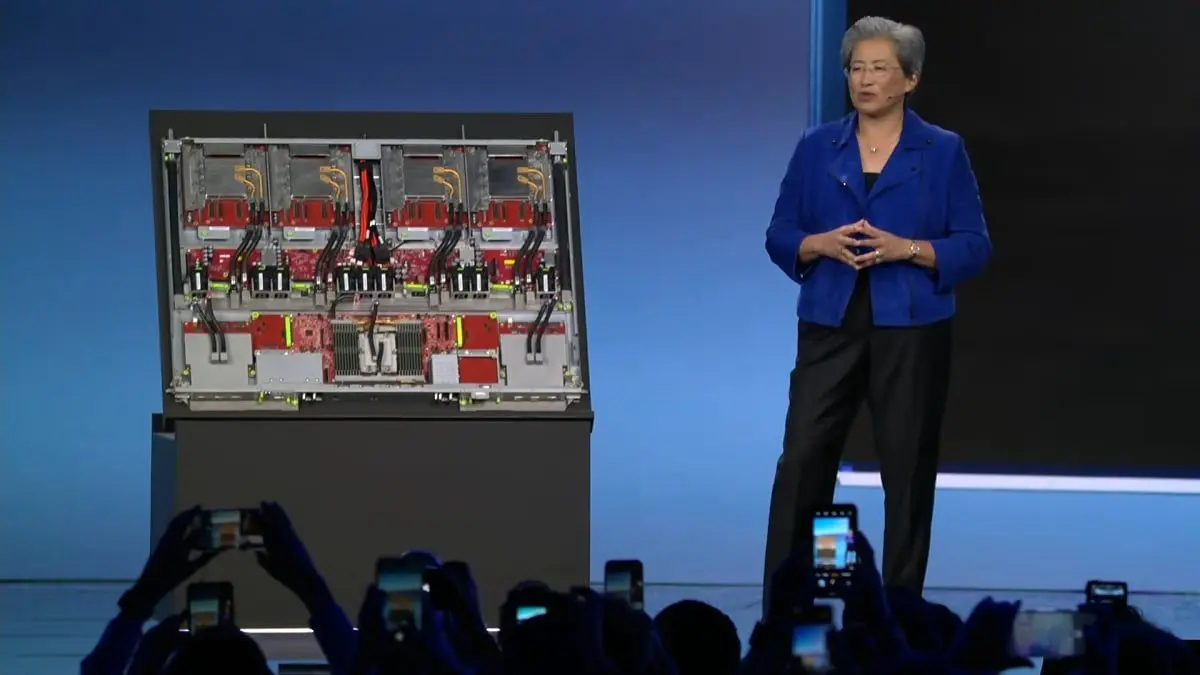
Source: Lifehacker
MI455X and the Broader MI400-Series Family
The MI455X accelerator at the heart of Helios represents a significant architectural leap for AMD. Lisa Su revealed the chip package on stage, showing 12 3D-stacked I/O and compute dies fabricated on TSMC's 2nm and 3nm process nodes, fed by what appears to be 12 36 GB HBM4 stacks
2
. Each MI455X promises around 40 petaFLOPS of dense FP4 inference performance or 20 petaFLOPS of FP8 for training, with 432 GB of HBM4 delivering 19.6 TB/s and 3.6 TB/s of interconnect bandwidth for chip-to-chip communications2
. The broader Instinct MI400X family features compute chiplets produced on TSMC's N2 fabrication process, making them the first GPUs to use this manufacturing technology1
. For the first time, the MI400X family splits across different subsets of the CDNA 5 architecture, with the MI440X and MI455X optimized for low-precision AI workloads such as FP4, FP8, and BF16, while the MI430X targets both sovereign AI and HPC with full FP32 and FP64 support1
. This tailored approach allows AMD to eliminate redundant execution logic and improve silicon efficiency.EPYC Venice Powers Helios Infrastructure
Helios employs AMD's next-generation EPYC Venice CPU, with one Venice processor for every four MI455X GPUs forming a compute node
2
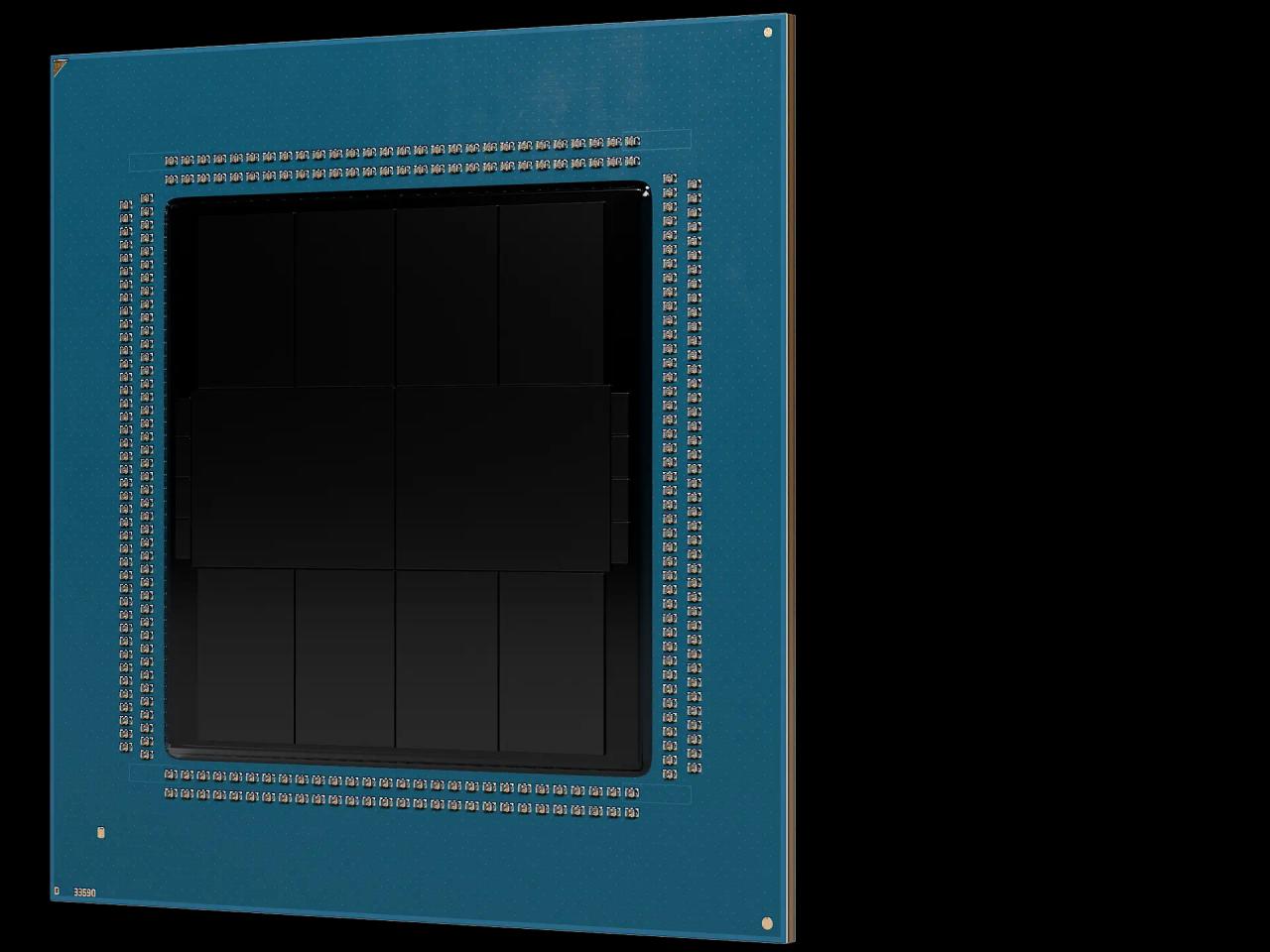
. The most striking detail is Venice's configuration: 256 cores and 512 threads in a single processor package5
. The chiplet breakdown points to a design using up to eight compute chiplets flanking centralized I/O silicon, with each CCD carrying 32 Zen 6 cores on a 2nm process5
. Venice features a 16-channel DDR5 memory interface with 32 sub-channels, and the platform is expected to deliver twice the memory bandwidth and GPU bandwidth compared to previous generations2
. This likely translates to 128 lanes of PCIe 6.0 connectivity and DDR5 8800 memory support2
. The package uses two server I/O dies rather than one, simplifying physical routing and distributing memory controllers and high-speed interfaces more evenly across the substrate5
.
Source: Guru3D
Connectivity and Ecosystem Considerations
The MI430X, MI440X, and MI455X AI accelerators are expected to feature Infinity Fabric alongside UALink for scale-up connectivity, making them the first accelerators to support the new interconnect
1
. However, practical UALink adoption depends on ecosystem partners such as Astera Labs, Auradine, Enfabrica, and Xconn delivering UALink switching silicon in the second half of 20261
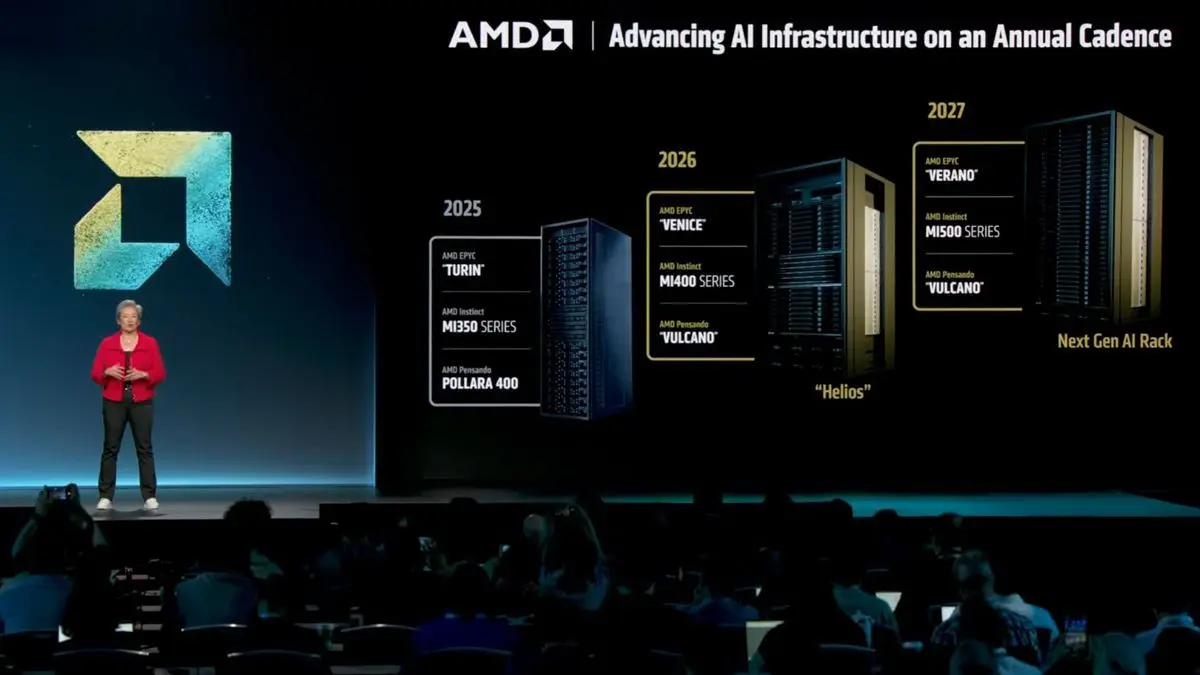
. Without these switches, UALink-based systems may need to rely on UALink-over-Ethernet or traditional mesh configurations. For scale-out connectivity, AMD plans to offer Helios with Ultra Ethernet, leveraging existing networking adapters like AMD's Pensando Pollara 400G and the forthcoming Pensando Vulcano 800G cards1
.Related Stories
Enterprise and Sovereign AI Platforms
Beyond Helios, AMD introduced platforms tailored for different deployment scenarios. The MI440X powers AMD's new Enterprise AI platform, a standard rack-mounted server with one EPYC Venice CPU and eight MI440X GPUs designed for on-premises enterprise AI deployments
1
. This system maintains drop-in compatibility with existing data centers in terms of power and cooling requirements. AMD will also offer a sovereign AI and HPC platform based on EPYC Venice-X processors with additional cache and extra single-thread performance, paired with Instinct MI430X accelerators that can process both low-precision AI data and high-precision HPC workloads1
.Looking Ahead to MI500 and Competitive Landscape
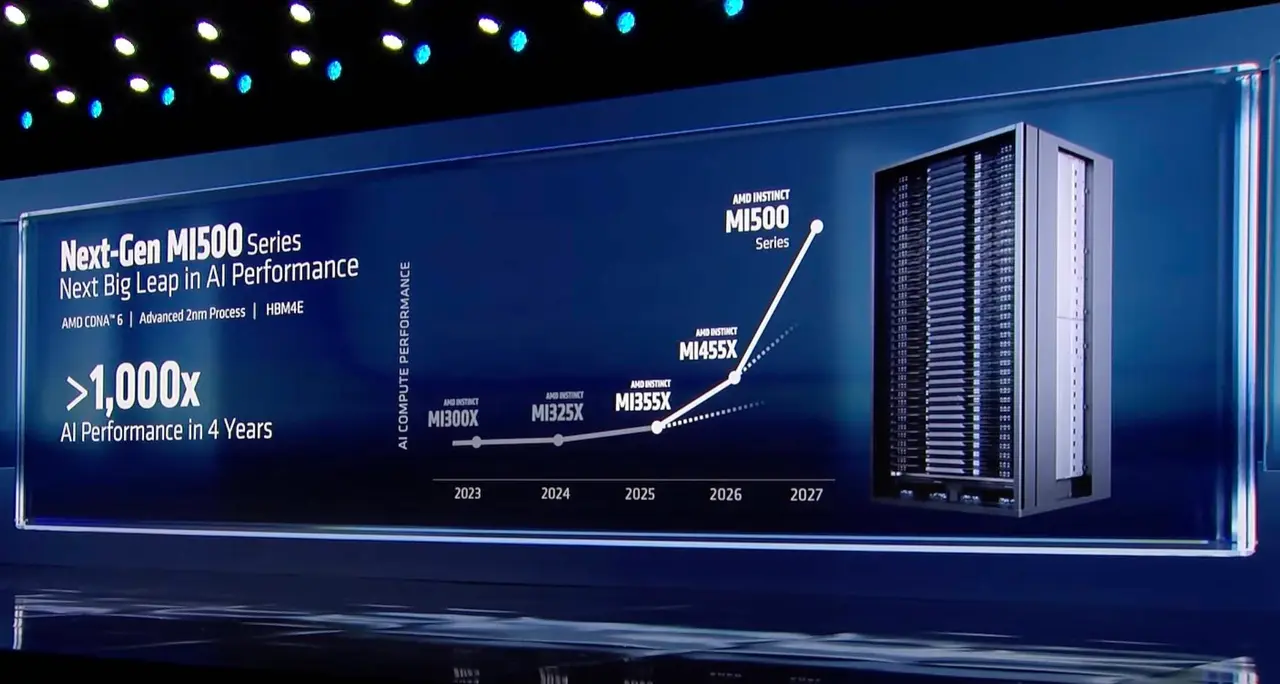
AMD also teased its next-generation MI500-series accelerators, with Lisa Su claiming a 1,000x uplift in performance over the two-year-old MI300X GPUs
2
. However, AMD clarified these estimates compare an eight-GPU MI300X node to an MI500 rack system with an unspecified number of GPUs2
. The MI500-series will ship in 2027, pairing TSMC's 2nm process with AMD's CDNA 6 compute architecture and HBM4e memory2
. To remain competitive with Nvidia, the MI500-series will need to match or exceed Nvidia's Rubin Ultra Kyber racks, which promise 15 exaflops of FP4 compute, 5 exaflops of FP8 for training, 144 TB of HBM4e, and 4.6 PB/s of memory bandwidth2
. The announcements come as AI infrastructure faces scrutiny over power consumption, environmental impact, and the proliferation of AI-generated content that critics argue spreads misinformation4
.
Source: The Register
References
Summarized by

Navi
[2]
[3]
[4]
Related Stories
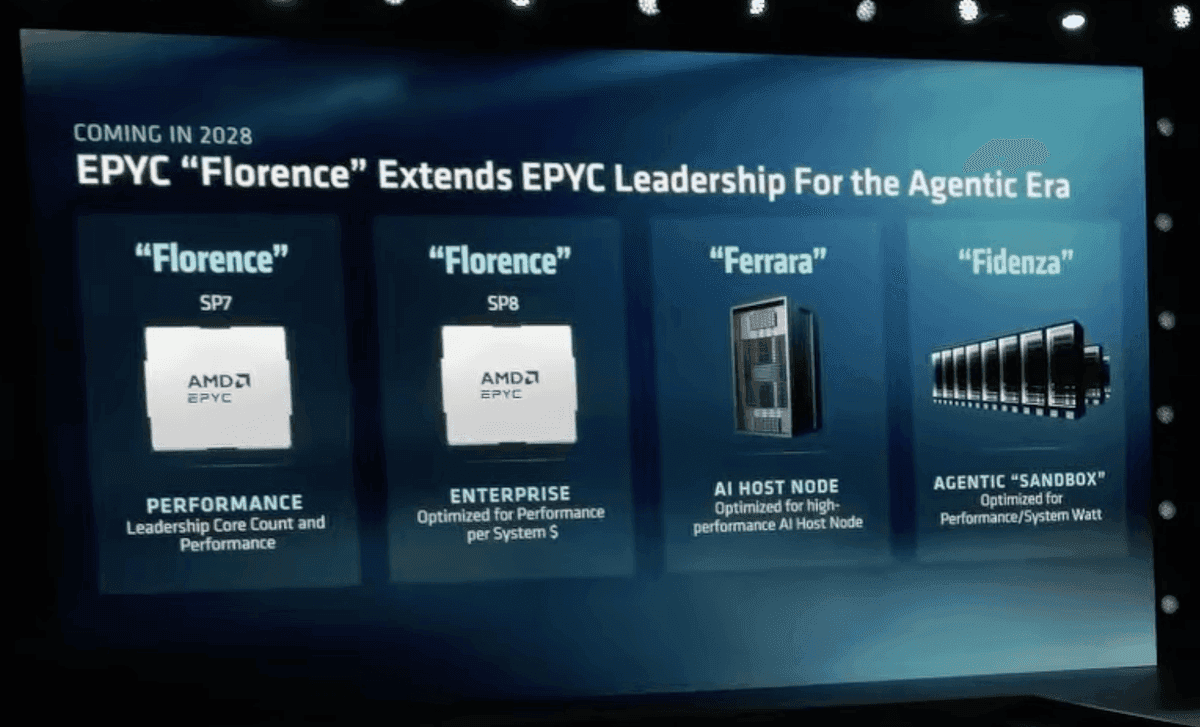
AMD splits Zen 7 into three EPYC families for 2028 as it pushes deeper into AI server market
23 Jul 2026•Technology
AMD Unveils Ambitious AI Plans: EPYC 'Venice' CPU with 256 Cores and Next-Gen AI Solutions for 2026-2027
13 Jun 2025•Technology
AMD Helios AI rack system takes direct aim at Nvidia with Microsoft, OpenAI backing
20 Jul 2026•Technology

Recent Highlights
1
Microsoft and Nvidia Launch Surface Laptop Ultra: A $2,599 AI-Ready PC With RTX Spark Chip
Technology

2
Trump Consulted Grok AI Before Ordering Venezuela Invasion and Capture of Nicolás Maduro
Policy and Regulation

3
Scientists Build AI Model That Reconstructs Images From Brain Scans in Record Time
Science and Research

Recent Highlights
Today's Top Stories







Don’t drown in AI news. We cut through the noise - filtering, ranking and summarizing the most important AI news, breakthroughs and research daily. Follow topics that matter to you and stay ahead.


