IBM stock crashes 13% as Anthropic unveils AI tool to modernize decades-old COBOL systems


23 Sources
23 Sources
[1]
Anthropic's new AI tool can write 67-year-old COBOL code, which sends 115-year-old IBM's stock tumbling by 13% -- IBM stock has worst day in 26 years, down 25% MoM and counting
Ancient language is still the bread-and-butter of mainframe systems What do airlines, banks, and insurance companies have in common? Besides being an absolute pain to deal with, they all rely on COBOL and IBM mainframe computers as core infrastructure. The computing giant's stranglehold over those markets may finally begin to crack, though. Anthropic has announced COBOL-specific functionality for its Claude AI bot, and IBM's investors responded with a resounding 13% drop in stock prices. Anthropic published its ideas in a blog post, and the company seems to know its target market quite well. There's a Code Modernization Playbook available for download, and existing YouTube videos letting Claude Code loose on a COBOL illustrate the concept. Mixing "COBOL," "AI bot," and "YouTube" in the same sentence is utterly anathema to common logic... and yet here we are. For practical purposes, COBOL only runs on one type of system, supported by one set of people: IBM's mainframes and its engineers. That means the company has enjoyed multiple decades of telling clients how many zeros the gigantic bills will have tacked on for the next period. The unforgiving nature of that stranglehold means that any attempt at breaking it is most welcome by its existing customers, and a serious threat to IBM as a business. If you've ever interacted with social security, public administration, healthcare, government, finance, insurance, automotive, retail, or airlines, you've touched a COBOL system at some point in your transaction, even if it was 30 layers deep. Similar to gravity, the language is invisible and yet affects every part of the modern world. A cynical view of the situation would say that the systems running COBOL are meant to be 100% accurate 100% of the time, a notion that doesn't lend itself very well to the "probabilistically correct" that LLMs can offer. Even still, as I've attested myself, a good bot is a power multiplier in the hands of a competent developer, and can also lower the barrier of entry for young folks trying their hand at wrangling old systems. The language harkens back to the 1960s, proposing itself as a human-readable language targeted at business transactions, using full decimal-point math as default, in contrast to the default floating-point math in other languages. True to its proposal, it revolutionized business computing, becoming entrenched across almost every sector of note, and was never truly replaced. The situation doesn't just revolve around IBM's monopoly, though. Most well-versed COBOL programmers are retiring and dying, making their skills rarer and more expensive. The COBOL systems invariably run business-critical operations that cannot afford any downtime whatsoever, and are chock-full of proprietary data formats and business logic that is not documented, and understood only by a few greybeards -- if at all. If you're wondering why COBOL just wasn't up and replaced with something else, know that any rewrite attempt must (a) reverse-engineer miles-long business logic; (b) reverse-engineer the underlying data structures; (c) reimplement said logic and structures while being careful to always use fixed-point decimal math; and (d) execute a perfect transition with minimal to zero downtime. Even when all those conditions can be true, COBOL systems are often so interconnected that it's unfeasible to replace just the one, as is the case with airlines. And heaven help you if you're in the financial sector, as you'll have to undergo extremely long-winded tests and audits, adding months to any deployment. There's a well-known joke among programmers that almost certainly originated from COBOL: "When I wrote this code, only God and I understood what it does. Now... only God knows." Follow Tom's Hardware on Google News, or add us as a preferred source, to get our latest news, analysis, & reviews in your feeds.
[2]
Anthropic Adds Caveat to AI Safety Policy in Race Against Rivals
Anthropic PBC, known for its commitment to artificial intelligence safeguards, has loosened its central safety policy, saying the change is necessary to remain competitive. The company in 2023 said in its Responsible Scaling Policy that it would delay AI development that might be dangerous. In a Tuesday blog post, Anthropic said it was updating its rules to say it would no longer do so if it believes it lacks a significant lead over a competitor. "The policy environment has shifted toward prioritizing AI competitiveness and economic growth, while safety-oriented discussions have yet to gain meaningful traction at the federal level," Anthropic said in its post. Anthropic, recently valued at $380 billion, is racing for uptake with businesses and everyday users, battling the likes of OpenAI, Google and Elon Musk's xAI Corp. for dominance in what many view as a revolutionary new technology. "From the beginning, we've said the pace of AI and uncertainties in the field would require us to rapidly iterate and improve the policy," an Anthropic spokesperson said. The updated policy was earlier reported by Time. International Business Machines Corp. shares had their worst day in more than 25 years on Monday, after AI startup Anthropic PBC said its Claude Code tool can help modernize Cobol, a dated programming language that's run on IBM computers. The stock plunged 13% in its biggest single-day percentage loss since October 2000. With the decline, IBM shares have fallen 27% in February, on track for its biggest one-month slide since at least 1968, according to data compiled by Bloomberg. "Modernizing a Cobol system once required armies of consultants spending years mapping workflows," Anthropic wrote in a blog post. "Tools like Claude Code can automate the exploration and analysis phases that consume most of the effort in Cobol modernization." IBM defended the company's prospects saying its core mainframe computer business offers a platform that provides the same quality of performance and security for various programming languages and not just Cobol. "The value IBM mainframe delivers has nothing to do with Cobol," IBM Senior Vice President Rob Thomas wrote in a blog post on Monday. "Whether the application is written in Cobol, Java, or any other language, the platform provides the same guarantees. The language is not the source of that value. The platform is." Most of the mainframe computers that run Cobol are made by IBM, and the selloff made the company the latest to see heavy pressure on the fear that artificial intelligence will weigh on the growth prospects of legacy companies. A significant chunk of IBM's revenue remains tied to its mainframe business. These massive customer-owned servers run some applications on Cobol, a coding language that's older than those now common in the rest of the technology industry. Mainframes are still purchased by customers with high reliability needs, such as those in finance or government. On Friday, Anthropic introduced a new security feature into its Claude AI model, spurring widespread selling of cybersecurity stocks. Software stocks have been broadly weaker this year on concerns over AI-related disruption; a major software ETF is down 27% this year, on track for its biggest one-quarter drop since the financial crisis in 2008. Much of the selling has come on new AI tools released by companies like Anthropic, OpenAI, and Alphabet Inc. Investors are fretting that the ability to "vibe code" -- use AI to write software code -- will let users create their own applications, which will diminish demand for legacy products and weigh on companies' growth, margins and pricing power. "While we understand why mainframe migration could be a perceived negative for IBM, we would point out that IBM has already provided customers with several modernization options," wrote Amit Daryanani, an analyst at Evercore ISI. "Our sense is, clients already had the option to migrate from the mainframe, yet they are sticking with the platform." The idea of a service to make working with Cobol easier isn't new -- many of the largest tech companies have launched such products. IBM itself debuted a tool in 2023 that uses AI to work with Cobol, including updating it into Java, a more popular and modern programming language. IBM's AI coding assistant for mainframes "has got very wide adoption," Chief Executive Officer Arvind Krishna said in July 2025. In the majority of cases, customers are using it to understand their Cobol code base and decide what to modernize, Krishna said.
[3]
Anthropic touts AI for COBOL, IBM stock takes a hit
IBM's share price slumped by 13 percent on Monday, seemingly caused by investors reacting to an Anthropic blog post that points out its Claude Code tools can accelerate refactoring of apps written in the ancient COBOL language. Anthropic's post points out that COBOL applications remain prevalent and often handle critical applications for governments, airlines, and financial institutions. The AI upstart also noted that COBOL-proficient programmers are hard to find, that attempts to train more of them have not grown the population, and that migrating from COBOL is therefore risky and expensive. And then, because vibe coding tool Claude Code is Anthropic's hammer and any software development problem looks like a nail, the company suggested using AI to help rewrite COBOL apps. "AI can assess which components are safe to move and which need careful handling," Anthropic suggests. "Areas with accumulated technical debt get documented before they become migration surprises." Anthropic's post comes about three years after IBM itself suggested using AI to rewrite COBOL as Java using its own watsonx Code Assistant for Z. Indeed, the perils and opportunities presented by COBOL migrations, and the potential for AI to accelerate refactoring of legacy apps, are not new to the technical community. Just last week, Infosys chairman Nandan Nilekani said the rise of AI means the cost of rewriting legacy apps has become affordable and made such moves imperative. In recent years, we've also reported mainframe migration initiatives from AWS, Microsoft and IBM spin-out Kyndryl, and NTT. All that activity didn't dent IBM's mainframe business: Last month, Big Blue reported its highest mainframe revenue for 20 years, and CEO Arvind Krishna attributed that in part to the same AI code conversion tools Big Blue spruiked in 2023. Krishna also said mainframes still offer the lowest operating cost for some workloads. Still, COBOL remains a drag on many organizations: The UK government last year bemoaned the big bills it pays to keep creaky COBOL code from crashing. IBM's share price dive came amid speculation that AI will ruin SaaS companies' business models, an idea that is thought to be behind substantial share price decreases for the likes of Salesforce, Atlassian, Adobe, ServiceNow, and HubSpot. So thanks, Anthropic, for your contribution to the long tradition of COBOL FUD, because if nothing else your post has shown AI has the power to wake people up to old and well-known risks associated with legacy tech. ®
[4]
IBM posts steepest daily drop since 2000 after Anthropic says AI can modernize COBOL
Feb 23 (Reuters) - Shares of International Business Machines (IBM.N), opens new tab recorded their steepest daily drop in more than 25 years on Monday, after AI startup Anthropic said its Claude Code tool could be used to modernize a programming language run on IBM systems. IBM shares sank 13.2%, their biggest drop since October 18, 2000. COBOL is a programming language widely used on IBM mainframes across banking, insurance and government systems. "Modernizing a COBOL system once required armies of consultants spending years mapping workflows. Tools like Claude Code can automate the exploration and analysis phases that consume most of the effort in COBOL modernization," Anthropic said in a blog post, opens new tab on Monday. "With AI, teams can modernize their COBOL codebase in quarters instead of years," it added. Software stocks have been battered in recent months by market fears around the growing capabilities of AI tools, particularly following the launch of plug-ins from Anthropic's large language model Claude, seen as the startup's push to become an application layer. Shares of cybersecurity companies including CrowdStrike (CRWD.O), opens new tab and Datadog (DDOG.O), opens new tab also slumped on Monday, as investors weighed the potential impact of Anthropic's new security tool on the industry. Reporting by Chris Thomas in Mexico City; Editing by Janane Venkatraman Our Standards: The Thomson Reuters Trust Principles., opens new tab
[5]

IBM is the latest AI casualty. Shares are tanking 11% on Anthropic programming language threat
International Business Machines Corp. (IBM) signage on the floor of the New York Stock Exchange (NYSE) in New York, US, on Monday, Dec. 8, 2025. International Business Machines stock is getting slammed, becoming the latest victim of rapidly developing AI technology, after Anthropic's Claude announced COBOL capabilities. Shares of IBM fell 11% in Monday afternoon trading after Anthropic outlined a new use case for its Claude Code product: automating the exploration and analysis work that drives most of the complexity in COBOL modernization. COBOL is a programming language used widely in business data processing, which is a core business area for IBM. COBOL, short for Common Business-Oriented Language, was developed in the 1950s and continues to powers systems responsible for large volumes of transactions, including payment processing and retail transaction systems. In a Monday blog post, Anthropic wrote that COBOL handles an estimated 95% of ATM transactions in the U.S. "Hundreds of billions of lines of COBOL run in production every day, powering critical systems in finance, airlines, and government. Despite that, the number of people who understand it shrinks every year," the Anthropic blog post reads. "Legacy code modernization stalled for years because understanding legacy code cost more than rewriting it. AI flips that equation," the post continued. It then explained that Claude Code can help modernize COBOL codebases by mapping dependencies across thousands of lines of code, documenting workflows and identifying risks that "would take human analysts months to surface." Monday's move brought IBM shares down nearly 22% year to date.
[6]
IBM Shares Plunge as Anthropic Touts COBOL Modernization Efforts
International Business Machines Corp. shares plunged on Monday, after the artificial intelligence startup Anthropic said its Claude Code tool can help with modernizing COBOL, a dated programming language that's mainly run on IBM computers. Shares sank 13% in their biggest one-day percentage loss since October 2000. With the decline, the stock is now down 27% in February, on track for its biggest one-month percentage decline since at least 1968, according to data compiled by Bloomberg. "Modernizing a COBOL system once required armies of consultants spending years mapping workflows" but "tools like Claude Code can automate the exploration and analysis phases that consume most of the effort in COBOL modernization," Anthropic wrote in a blog post. Most of the mainframe computers that run COBOL are made by IBM, and the selloff made the company the latest to see heavy selling pressure on the fear that AI will weigh on the growth prospects of legacy companies. A significant chunk of IBM's business remains tied to its mainframe business. These massive customer-owned servers run applications on COBOL, an older coding language than those in common in the rest of the technology industry. Mainframes are common among customers with high reliability needs, such as finance or government. On Friday, Anthropic introduced a new security feature into its Claude AI model, spurring widespread selling of cybersecurity stocks. Software stocks have been broadly weaker this year on concerns over AI-related disruption; a major software ETF is down 27% this year, on track for its biggest one-quarter drop since the financial crisis in 2008. Much of the selling has come on new AI tools released by companies like Anthropic, OpenAI, and Alphabet Inc. Investors are fretting that the ability to "vibe code" -- use AI to write software code -- will allow users to create their own applications, diminishing demand for legacy products, weighing on companies' growth, margins, and pricing power. Read also: Traders Left With 'Unscratchable Itch' for Anthropic Exposure
[7]

COBOL modernization no longer requires years of consultant work
* AI automates COBOL code exploration, maps dependencies, and analyzes structural risks quickly * Engineers can prioritize modernization based on technical risk and business value efficiently * Automated tests verify that migrated COBOL components produce identical outputs to legacy systems Modernizing legacy COBOL systems has long been a costly and labor-intensive process that requires extensive human effort, as traditionally, teams of consultants spent months or even years mapping workflows, documenting dependencies, and untangling decades of accumulated business logic. Hundreds of billions of lines of COBOL still run in production worldwide, powering critical systems in banking, government, and airlines, yet finding developers with the knowledge to interpret these systems has become increasingly difficult. Now, however, Anthropic is looking to supplant this, with its Claude AI platform aiming to take much of the heavy lifting away from human workloads. How AI aids code exploration and analysis This scarcity of expertise has historically slowed modernization projects and increased costs - however, Anthropic now believes AI can automate much of the exploration phase that once consumed most human effort. "Modernizing a COBOL system once required armies of consultants spending years mapping workflows... AI changes this," the company said in a blog post. Tools like Claude Code can map dependencies across thousands of lines of COBOL, trace data flows between modules, and document workflows that current staff no longer actively remember. These automated processes identify risks, isolate tightly coupled components, and flag duplicated or potentially fragile code. By analyzing these structural and functional relationships, AI can prioritize which components to modernize first based on technical risk, business value, and organizational priorities. The best laptops for programming allow engineers to integrate AI outputs efficiently while maintaining oversight of the modernization plan, and once components are prioritized, AI can generate preliminary function tests to verify that migrated code produces identical outputs to the legacy system. Human teams then decide whether these automated tests are sufficient, which scenarios require manual verification, and what performance benchmarks must be maintained. Implementation proceeds incrementally, with each module tested and validated before additional changes are made. AI tools can translate COBOL logic into modern languages, create API wrappers around legacy components, and build scaffolding that allows old and new code to operate side by side. This reduces the risk of large-scale failures and enables organizations to move forward with complex modernization projects. AI also provides detailed insights into potential technical debt, isolated modules, and high-risk areas, allowing teams to plan modernization strategically - as engineers can review these recommendations and sequence the work to align with regulatory requirements, business priorities, and operational constraints. Automated documentation and analysis give teams comprehensive situational awareness, but final decisions still rely on human judgment. While this is a major win for many engineering teams, IBM, a major vendor of COBOL-powered mainframes and enterprise systems, will not be pleased. The company saw its stock fall sharply after Anthropic announced that Claude Code could automate much of the labor-intensive modernization process. AI's ability to replace work traditionally done by human consultants threatens parts of IBM's business model. This shows that even long-established enterprise software vendors may face disruption as AI continues to reshape legacy system modernization. Follow TechRadar on Google News and add us as a preferred source to get our expert news, reviews, and opinion in your feeds. Make sure to click the Follow button! And of course you can also follow TechRadar on TikTok for news, reviews, unboxings in video form, and get regular updates from us on WhatsApp too.
[8]

IBM's $40B stock wipeout is built on a misconception: Translating COBOL isn't the same as modernizing it
On Tuesday, Anthropic published tools that let Claude read, analyze and translate legacy COBOL into modern languages like Java and Python. By the end of the trading day, investors had wiped roughly $40 billion from IBM's market cap -- the company's biggest single-day drop in 25 years -- pricing the announcement as an existential threat to IBM's mainframe business. The reaction was swift. It was also built on a fundamental misreading of why enterprises run mainframes in the first place. IBM's COBOL is 66 years old. It was designed in 1959, runs on IBM mainframes, and continues to power transaction processing systems with an estimated 250 billion lines of COBOL in active production, according to the Open Mainframe Project. The engineers who wrote it are retiring; the ones replacing them largely cannot read it. For decades, that skills gap has been one of enterprise IT's most expensive unsolved problems -- and one IBM has been working to fix with AI since at least 2023, when it launched watsonx Code Assistant for Z to help migrate COBOL to modern Java. Claude Code, Anthropic says, can now analyze entire codebases, map hidden dependencies, and generate working translations of code that most engineers today cannot read. For enterprises running COBOL on distributed platforms -- Windows, Linux and other non-mainframe environments -- that capability is genuinely useful and increasingly practical. The actual barrier was never technical "Modernizing COBOL has been a technically solved problem for a while," Matt Braiser, analyst at Gartner, told VentureBeat. "The real problem is that the costs of modernization are high and the ROI is low." Amazon and Google have been offering AI-powered COBOL migration tools for years. AWS Transform and a comparable Google Cloud Platform service both targeted the same problem: reducing friction for customers looking to move mainframe workloads to the cloud. "This is basically one more source of competition," Raj Joshi, senior vice president at Moody's Ratings, told VentureBeat. "IBM has always lived in a very competitive domain. On the margin, this thing is basically negative, no question about that. There's one more powerful competitor. But IBM has coexisted with these threats." Steve McDowell, chief analyst at NAND Research, cuts to the structural argument: "Applications don't run on mainframes because they're written in COBOL," he said. "They run on mainframes because mainframes deliver a class of determinism, scalable compute and reliability that general purpose servers can't match." The issue runs deeper than market positioning. "GenAI tools are helpful, but their non-deterministic nature means the resulting code is not consistent -- the same operation will be implemented in different ways in different parts of the code," Braiser said. "Leading tools combine deterministic and non-deterministic approaches. None of this solves the ROI problem, though." What COBOL translation leaves unsolved "Translating COBOL is the easy part," IBM communications director Steven Tomasco told VentureBeat. "The real work is data architecture redesign, runtime replacement, transaction processing integrity, and hardware-accelerated performance built over decades of tight software and hardware coupling. That is the problem IBM has spent decades learning to solve, and AI is the most powerful tool we have ever had to do it." According to IBM, Royal Bank of Canada, the National Organization for Social Insurance and ANZ Bank have all used watsonx Code Assistant for Z to accelerate modernization of COBOL code without moving off IBM Z. That does not mean Anthropic has no competitive foothold. For enterprises running COBOL outside the mainframe -- on distributed systems, Windows and Linux environments -- Claude Code enters a space where IBM's vertical integration is less of an advantage. "IBM understands mainframe technology at a level that others can't match. If I'm only looking at COBOL, I'm using IBM's watsonx," McDowell said. "Anthropic, however, has a broader footprint within a lot of development teams, where a single vendor makes it worthwhile." What enterprise buyers should actually do Senior data and infrastructure engineers will spend the next few weeks fielding questions from executives who saw the headlines and assumed the hard problem just got solved. It did not. "It's COBOL, but there are numerous applications tied to it," Joshi said. "It's not like you transform millions of lines and somehow you are ready to go to cloud. It's a massive risk assessment, dependencies and all those things." The more useful question for buyers is whether this week's noise creates an opening. Braiser thinks it does. "They should use the resulting board-level and shareholder discussions to review postponed modernization initiatives and see if any of them now have ROI," Braiser said. McDowell was blunt on the competitive question. "Will Anthropic take business from IBM's tool? Yes, of course," he said. "But I'd be surprised if that tool was making significant revenue for IBM." Chirag Mehta, analyst at Constellation Research, cautioned that IT leaders should not react emotionally or rewrite strategy overnight. "Treat this as a reason to run a small, bounded pilot to measure outcomes, not as a reason to rip and replace vendors," Mehta told VentureBeat. Mehta suggests that enterprises pick one well-scoped application slice or workflow with clear inputs and outputs, and evaluate approaches apples-to-apples: quality of dependency mapping, quality of recovered business logic documentation, test coverage and equivalence checks, performance and reliability regressions. In Mehta's view, the bigger reminder is that modernization is more than converting code. The hard parts are extracting institutional knowledge, reworking processes and controls, change management, and containing operational risk in systems that cannot break. AI can compress the "analysis and translation" work, but it does not eliminate the governance and accountability burden. "The teams that win will treat AI as an accelerator inside a disciplined modernization program, with measurable checkpoints and risk guardrails, not as a magic conversion button," Mehta said.
[9]

Experts see opening for IT in Anthropic's big COBOL code jolt
IBM's stock recovered a bit after its February plunge as experts highlighted AI startup Anthropic's work on legacy COBOL code. Modernising decades-old, 'spaghetti' code could expand opportunities for tech services despite falling per-line-of-code pricing. Rewriting COBOL entirely may unlock a potential $1.6 trillion market, they said. As IBM made steady recovery after the stock's historic plunge on February 23, IT industry experts emphasised that AI startup Anthropic's advances in reading and modernising legacy COBOL code are more likely to unlock opportunities instead of threatening businesses. Legacy codes have been built upon for more than five decades, creating a 'spaghetti' structure, and are therefore conducive to a plug-and-play AI model-as-a-solution. So, even as the pricing per line of code will shrink, the scope of work will increase for tech services as enterprises make this transition, the experts said, adding rewriting COBOL codes entirely could potentially unlock a $1.6 trillion opportunity. "Our sense is that there is a $3 trillion worth of tech debt sitting over there...60% of it is in mainframes," said Ravi Vasantraj, global delivery head at Mphasis. "Even if you were to convert 10% of it, you are talking about $300 billion." The real shift won't be whether AI can convert code, but how complex that conversion would be. "The difference is between the what and the how," he added. COBOL systems are rarely standalone. "The code base is not just a code base; it's a spaghetti of surrounding systems which is coming together to give an end outcome," Vasantraj explained, pointing to decades of regulatory patches, regional modifications, and application layers built on top. Automated agents trained for months can't simply be "allowed to go on duty" without oversight, especially in sensitive use cases such as credit card billing. "The consequence of getting it wrong is very high," he said. On Monday, a single blog post from Anthropic erased nearly $30 billion from IBM's market value. Anthropic said its AI model Claude can read and modernise COBOL, the decades-old programming language that still runs 95% of global ATM transactions and critical banking, airline and government systems. Industry experts, however, believe markets were too quick to react. Nithin Seth, CEO at AI transformation company Incedo cautioned against premature conclusions. "It's too soon to write obituaries," he said. While frontier models have made rapid progress, "a promise of what Claude is able to do... is not necessarily a reality that has been achieved," he said. What remains critical is contextualisation. "Whatever requires enterprise-level data, enterprise-level specificity...will still need to be built on top of the LLM," said Seth. Vikash Jain, managing director and senior partner at Boston Consulting Group said one of the biggest hurdles in legacy transformation is lost "tribal knowledge." "It was not documented...there is a high level of perceived risk in making changes," he said. Describing legacy systems as a "spaghetti ball," he said pulling a single thread risks unravelling everything else. AI is compressing timelines and improving quality. "This is actually one of the opportunities out there. It's an old opportunity which had slower execution because of the risk and the business case, which is now becoming attractive," he said. Ankur Dhingra, CEO at workforce management company ProHance pointed out that AI agents aren't operating independently. "It's not that simple. It has to get rewritten; it has to run in parallel. There has to be a lot of A/B testing, and then it has to move to production... at scale," he said. (With contribution from Himanshi Lohchab)
[10]

IBM Stock Is Trending After Crating 13% And Claude-Maker Anthropic Is The Reason Why: Here's What Happened - IBM (NYSE:IBM)
On Monday, shares of International Business Machines Corp (NYSE:IBM) declined 13.18% in the regular session to $223.35 and gained 0.94% in after-hours trading. The stock was seen trending overnight. The stock became the latest perceived victim of rapidly advancing AI technology. AI Tool Targets COBOL Modernization The move followed comments from Anthropic that its Claude Code tool can help companies modernize legacy systems built on COBOL. Common Business-Oriented Language, or COBOL, is a programming language widely used in banking, government and large-scale transaction processing. IBM has long generated revenue from mainframe systems and consulting services tied to maintaining and upgrading those environments. Developed in the late 1950s, it still underpins a vast share of financial infrastructure. "COBOL is everywhere. It handles an estimated 95% of ATM transactions in the U.S.," Anthropic wrote in a blog post. However, maintaining and rewriting those systems has been costly and time-consuming. Investors Fear AI Could Pressure IBM's Core Business Anthropic said Claude Code can map dependencies, document workflows and identify risks across massive codebases -- tasks that once required months of manual analysis. The company argued that AI can make legacy modernization faster and more cost-effective. Ohanian Reacts To Claude Code Technology investor Alexis Ohanian weighed in on social media, suggesting AI is accelerating software development to the point where building is no longer the bottleneck -- vision and execution are. "Claude just commoditized the act of building software -- now it's not eating the world, it's swallowing it whole," Ohanian wrote. IBM Earnings Strong, Stock Slides 14% Year Over Year Last month, IBM reported fourth-quarter revenue of $19.69 billion, surpassing the consensus estimate of $19.23 billion, according to Benzinga Pro. The company also reported adjusted earnings of $4.52 per share, exceeding analysts' expectations of $4.32 per share. In the past 12 months, IBM shares have been down 14.71%, whereas in the past five years, it has gained 96.61%, according to Benzinga Pro. The company currently has a market capitalization of $208.77 billion. IBM stock shows a negative price trend across the short, medium and long term, along with a weak value rating. Disclaimer: This content was partially produced with the help of AI tools and was reviewed and published by Benzinga editors. Photo: nitpicker / Shutterstock Market News and Data brought to you by Benzinga APIs To add Benzinga News as your preferred source on Google, click here.
[11]

I'm Not Convinced Anthropic's New COBOL Coding Tool Is an Actual Threat to IBM | The Motley Fool
A deeper dive into this technology reveals that Anthropic's offering only addresses one of several matters related to the use of mainframe computers. The market's knee-jerk reaction makes enough superficial sense. Anthropic's AI-powered computer-coding platform Claude can easily help modernize complicated programs written in COBOL (Common Business-Oriented Language), seemingly posing a threat to IBM's (IBM 0.74%) biggest business. The technology giant's mainframes still utilize the aging programming language, after all. That's why IBM's share price tumbled more than 12% on Monday in response to Anthropic's blog post -- not only could this option take a bite out of IBM's breadwinning software and consulting business, but it also conceivably sets the stage for a more sweeping transition away from IBM's mainframes that have worked so well with COBOL for so long. The market's response, however, seems to be ignoring a handful of critical details that might have prompted Monday's sellers to rethink their decision. Here are the three most important of these details. Anthropic's idea is a brilliant (as well as increasingly necessary) one. That's why IBM has offered such modernization tools for some time now. In fact, the company's toolkit even includes options for migrating existing COBOL systems from legacy mainframe platforms to more modern ones like Linux or Windows. That's a key part of IBM's business right now, in fact -- engineering the eventual wind-down of its past in preparation for a future that will look considerably different, but won't necessarily be less fruitful. The advent of artificial intelligence has been a game-changer for several industries, but particularly for highly technical ones like computer programming. Engineers can simply describe in plain English what they want an app to accomplish, and a platform like Anthropic's Claude spits out the code. And most of the time it works great. But when it doesn't work, it really doesn't work. CodeRabbit reports that a recent comparison of AI-generated code to human-coded programming shows the artificial intelligence-written code had about 60% more errors, jibing with plenty of other observations. And worse, as the coding work that AI is doing becomes increasingly complex, it's becoming more difficult to find and correct these bugs. In short, AI's auto-coding tools aren't living up to the hype... at least not yet. It's unlikely Anthropic's Claude is an exception. Now juxtapose this less-than-perfect modernization tool to the work that's still being done with COBOL. Though ancient, this programming remains at the heart of most ATM transactions, retail purchases, air travel bookings, bank transfers, and more, including supporting a bunch of governmental agencies. These institutions aren't apt to risk an attempt at an upgrade to a more modern solution until they're absolutely certain it will work at least as well as their current platforms. Claude's modernization tools can't provide such a guarantee. Finally, while Anthropic's ultimate unvoiced argument for modernizing COBOL is allowing institutional customers to move away from IBM's mainframes and toward the use of more flexible third-party cloud computing platforms, this premise misses an important point. But first things first... what's the difference? It's an oversimplified explanation, but broadly speaking, cloud computing is space rented out on someone else's servers. What the customer does with this space is entirely up to them. It could be simple storage of digital files, or when there's enough computing power available, some cloud platforms are capable of tackling AI tasks. All of it is off-premise, though, and as such, tends to operate more slowly than mainframes. Conversely, mainframes are on-premise platforms that offer more operational and computational speed; IBM says just one of its new "Z" systems can handle 25 billion encrypted transactions per day. That's not where their advantages end, however. Mainframes are complete stand-alone systems often with built-in security features -- including quantum encryption -- a great deal of flexibility, and extreme dependability with uptimes nearing 100%. Perhaps most important right now, though, while Claude's AI-powered potential to modernize COBOL coding is being viewed as a threat to IBM's mainframe business, ironically, AI may actually bolster the case for mainframes. As it turns out, IBM's newest mainframes are self-contained soup-to-nuts "full stack" systems that are each capable of 450 billion AI inferences per day. That's huge. It's big enough, in fact, that mainframes could conceivably become the AI industry's future workhorses. As technology consulting and services outfit Kyndryl highlighted in its 2025 assessment of the industry, more than half the organizations that use them at all are now increasing their usage of mainframes, with the returns on these modernization costs often in excess of 300%. Indeed, nearly 9 out of 10 of these organizations are specifically using their mainframes to handle generative AI duties due to their strong performance. The point is, while it's likely -- maybe even inevitable -- that AI-powered computer coding will eventually become good enough that it can be trusted not just to modernize current COBOL programs but then facilitate the move of these operations off of a mainframe, that's not the case yet. And it may never be the case if mainframes can continue to prove their superiority to cloud-provided alternatives in several ways that matter. More to the point for rattled investors, its recent setback makes IBM stock an even more compelling prospect. The market just jumped to the wrong conclusion on Monday, ignoring that the company's mainframe (and ancillary) businesses are apt to remain rock-solid well into the future. In this vein, Straits Research predicts the worldwide mainframe market is poised to grow at an average annualized pace of nearly 8% through 2033. That's not enormous growth, but it's respectable growth that IBM can easily lead. You can plug into this growth while its stock is priced attractively at less than 19 times this year's projected per-share earnings.
[12]

SA Asks: As AI gains traction, what's next for IBM? (IBM:NYSE)
Shares of International Business Machines (IBM) were hammered this week after Anthropic (ANTHRO) announced its Claude Code tool could be used to efficiently modernize systems running on COBOL, a legacy programming language widely used on IBM mainframes. We asked Seeking Anthropic's Claude Code can automate COBOL modernization, threatening a portion of IBM's $21.1B consulting revenue by potentially lowering demand for manual code update services. IBM's z17 mainframes are still trusted for zero-downtime transactions, especially by banks, and translated code likely can't run outside the mainframe yet, so the mainframe business appears secure for now. IBM faces shrinking moats from AI tools but has strong free cash flow and is already innovating in AI, with the ability to focus on client relationships and data ownership to remain competitive.
[13]
ETtech Explainer: Decoding Anthropic's Claude Code update that triggered IBM selloff
A single Anthropic blog claiming its AI model Claude can read and modernise COBOL wiped nearly $30 billion off IBM's market value. COBOL, a 1959 programming language, still powers critical banking, airline and government systems worldwide. Claude promises to cut modernisation time from years to quarters, potentially transforming the economics of legacy system updates. On Monday night, a single blog post from Anthropic erased nearly $30 billion from IBM's market value, its steepest fall in 25 years. Anthropic said its AI model Claude can read and modernise COBOL, the decades-old programming language that still runs 95% of global ATM transactions and critical banking, airline and government systems, many "built when Nixon was President," Anthropic wrote. Indian IT stocks -- which also manage a lot of legacy systems -- also experienced another market rout on Tuesday, with the NIFTY IT index dropping nearly 5%. ET explains the reaction: What is COBOL? Developed in 1959, COBOL (Common Business-Oriented Language) was one of the first programming languages which was adopted in commercial deployments. Despite being over six decades old, it remains deeply embedded in banking, insurance, telecom and government systems such as ATM switches, credit card processors and airline reservation systems. What did Anthropic do? Anthropic argued that AI significantly alters the economics of updating legacy systems written in COBOL. The engineers who wrote that code have long retired, and COBOL expertise is increasingly scarce. Modernising these systems has traditionally been expensive, risky and requires armies of consultants. But Anthropic said Claude could do this modernization in quarters instead of years. Claude can analyse entire codebases, explain dependencies, generate documentation and assist in translating code into modern languages, it said. How does it impact IBM? IBM's mainframe computers remain central to the global COBOL ecosystem. A significant portion of its consulting and infrastructure revenue is tied to maintaining, upgrading and gradually modernising these systems. AI tools threaten this model and mainframe lock-in needs. How does it impact IT services companies? For IT services companies, legacy code modernisation is a core service area worth billions of contracts. As discretionary tech spending has contracted over the past two years, transformation projects have been driving their growth momentum, forming the bulk of new deals. There are almost 800 billion lines of COBOL code in the world operating today, modernising which is priced at $10-$12 per line. Claude can reduce that cost to $2. Indian IT stocks experienced another market rout on Tuesday, as fears of AI-led disruption intensified, taking cues from the dour global tech stocks, with the NIFTY IT index dropping nearly 5%. However, experts believe that, in the medium term AI can unlock a new addressable market which was previously perceived as costly and risky. Reactions: C. Vijayakumar, chief executive of HCLTech: Technology is definitely becoming more powerful. But what is being missed is how you deploy it in an enterprise. Mainframes have been there for 50-plus years, which every large enterprise runs on. So modernising mainframes is not so easy. While COBOL conversion can happen, that's still one part of the entire landscape. There are numerous tools and integrations. And the business logic of these is not known to a lot of people. John Boccuzzi Jr., president of ISG Research: The idea that one can take COBOL code and have AI rewrite it in perfection is astonishing, but companies are not going to be doing it by themselves. But it is going to change how they cost. We have something called autonomous pricing now. If we are going to charge at the manual level, it might be $5 (per line). But if it is somewhat automated, it might be $4.40. If it is going to be a 'level 3' automation, one might charge $2.80. With this announcement (on COBOL), while pricing might compress, it will bring in more revenue opportunities. Srikanth Velamakanni, vice chairperson of Nasscom and CEO of Fractal Analytics: The expansion is that now, many more CIOs are going to say, let's do modernising, because I have the money, it's less risky, it's more accurate, it's AI-driven, and the complexity is much lower. There are almost 800 billion to 1 trillion lines of COBOL code in the world operating today. You take 800 billion lines of code at $2 a line, it is a $1.6 trillion opportunity.
[14]

Anthropic's COBOL Bet Shakes Mainframe Economics | PYMNTS.com
By completing this form, you agree to receive marketing communications from PYMNTS and to the sharing of your information with our sponsor, if applicable, in accordance with our Privacy Policy and Terms and Conditions. If you haven't heard of it before now, it's understandable. It's a programming language developed when Dwight Eisenhower was in the White House. That invisibility has suited IBM just fine for decades. It has not suited IBM's shareholders this week. Anthropic published a blog post describing how its Claude Code tool can automate the analysis, dependency mapping and documentation work that has historically made COBOL modernization so expensive. IBM shares closed down nearly 13.2%, at $223.35, their worst single-day decline since October 2000, according to CNBC. IBM shares have now fallen 27% in February, on track for the company's biggest one-month slide since at least 1968, according to Bloomberg. The selloff reflects a deeper concern: if generative AI can meaningfully reduce the cost and time required to understand and rewrite legacy code, it could weaken one of the strongest sources of lock-in in enterprise IT. An estimated 95% of ATM transactions in the U.S. run on COBOL, and hundreds of billions of lines of the code remain in production across finance, airlines and government. Migrating off those systems requires reverse-engineering decades of undocumented business logic, recreating data structures tightly coupled to mainframe environments, and executing transitions in industries where regulators set the pace. IBM has built a high-margin consulting and mainframe services business around that complexity, charging clients for incremental modernization work that can span years and cost tens of millions of dollars. The talent dimension compounds the problem. The developers who built these systems have largely retired, taking their institutional knowledge with them. Production code has been modified repeatedly over decades, but documentation has not kept up, and COBOL is now barely taught in universities. That scarcity has made the skills rarer and more expensive and has reinforced IBM's position as the de facto steward of systems no one else could confidently touch. The irony is that IBM entered 2026 looking formidable. Q4 2025 revenue reached $19.7 billion, infrastructure sales rose 21%, and IBM Z Systems, its mainframe line, posted 67% year-over-year growth. The company's generative AI book of business stood at more than $12.5 billion. The sell-off was not triggered by a missed quarter. It was triggered by a question about whether those numbers hold. IBM's response was pointed. "New AI tools emerge every week, including our own," the company said. "What they do not change is the fundamental engineering challenge of running mission-critical workloads at scale." That pushback is not without foundation. Code translation is one phase in a migration that also requires replacing decades of middleware, data formats, compliance controls and disaster recovery architecture, all of it under the scrutiny of regulators who do not reward speed. IBM has its own counter in the market: its watsonx Code Assistant for Z uses a 20-billion parameter model to translate COBOL to Java, and the company claims its internal Project Bob initiative has already improved developer productivity by 45%. The decisive question is not whether AI can translate code in a lab setting. It is whether banks and regulators will trust a probabilistic model to refactor systems that move trillions of dollars. Core banking modernization is governed by strict change management protocols. Every modification must be traceable, testable and explainable. A model's output would need to pass layers of validation before deployment. Banks may use AI to accelerate analysis and documentation while keeping humans firmly in the loop for final decisions. Even so, the direction of travel matters. If AI can shoulder more of the analytical burden, it could expedite the long-delayed shift toward cloud-native architectures. The cost and complexity of untangling legacy code have been a primary deterrent to migration. Lower those barriers, and the cloud roadmap accelerates. That shift would ripple across vendors whose business models rely on the persistence of mainframe environments. It would also strengthen hyperscalers and cloud-native core banking providers positioned to capture new workloads.
[15]

Anthropic's offer to modernize COBOL using AI triggers double-digit slide for IBM
In another wake-up call for established IT firms, IBM witnessed a 13% decline in share price on Monday after Anthropic announced that Claude Code can modernize COBOL programming language, which runs on IBM systems. According to some estimates, this is the steepest hit IBM has taken at the stock market since 2000. "Legacy code modernization stalled for years because understanding legacy code cost more than rewriting it. AI flips that equation," Anthropic said in a blog post on February 23. Despite growing cloud adoption and proliferation of software written on modern programming languages such as Python, Java, JavaScript, and frameworks like React or Node.js, traditional programming languages such as COBOL are still widely used in banking, insurance and government agencies for data processing. COBOL was originally designed for mainframe computers provided by firms like IBM. One of the reasons why many legacy enterprises still use it is that its code is written like one large block with a long list of instructions that cannot be skipped. This makes it difficult to change or upgrade them. Despite its limitations, COBOL has proven to be highly reliable and secure. In sectors like BFSI, the operational risks of migrating away from a stable system like this is considered too high as these systems still handle billions of transactions. According to Anthropic, modernizing COBOL systems required an army of consultants and years of mapping workflows, which led to long timelines and high cost. However, with tools GenAI tools like Claude Code COBOL codebases can be modernized in a few quarters instead of years, the UK based firm claims. Software stocks took a major hit early this month after Anthropic added specialized plugins in Claude Cowork for legal, sales, finance, and marketing professionals. The release triggered an investor panic amid concerns that these AI tools could bypass traditional software. IT and SaaS companies reportedly lost $285 billion in market value. Indian IT firms, including Infosys and Mphasis, saw a slide of over 7%, while shares of Coforge, TCS and HCL Tech dropped between 5% and 7%. Among global forms, Thomson Reuters shares fell by as much as 18% as Anthropic's new tools threaten its subsidiary, Westlaw, which provides legal research services. In Reuters's case, the investor sell-off was motivated by concerns that Claude Cowork-like tools would reduce dependence on traditional platforms such as Westlaw or Practical Law, as corporate legal teams can now complete their tasks using AI. Further, Anthropic recognizes in the blog post that COBOL modernization is risky, while stressing that automated discovery can help in finding hidden links and risks that can cause problems during migration. The firm explains that AI will start by going through the entire COBOL codebase and mapping its structure. It will trace how data moves through a system and create diagrams and written descriptions of processing pipelines. This would allow AI to identify the components that are safe to migrate and those that are too risky to modernize. The latest GenAI tools offer longer context windows with over a million tokens and have better agentic capabilities, which allow them to plan and execute tasks involving multiple steps. This makes them capable of analyzing large codebases with decades of legacy code and fixing bugs in complex systems.
[16]
IBM's Anthropic-induced sell-off overlooks the fact it's disrupting itself: Jefferies (IBM:NYSE)
IBM (IBM) shares sold off on Monday on the basis that Anthropic's (ANTHRO) Claude Code product can translate COBOL, prompting concern about the tech giant's legacy business. However, investment firm Jefferies said the sell-off, which caused IBM shares to sink their most Investors fear Claude Code can translate COBOL and disrupt IBM's legacy business, but the analyst argues IBM is already using its own generative AI solutions for COBOL modernization, minimizing Claude Code's threat. Yes; Watsonx Code Assistant for Z refactors COBOL to Java, explains code, and modernizes applications with full context, giving IBM structural advantages over rival code assistants. The mainframe business remains resilient and is reportedly growing, with 70% of clients expanding workloads and most global transactional volumes still running on mainframes.
[17]
Anthropic AI's COBOL code advances unlock new doors for IT companies
Industry leaders say Anthropic's advances in automating COBOL code could lower migration costs and create new opportunities for IT service firms. HCLTech CEO C Vijayakumar noted modernising mainframes is complex, with tools, integrations and business logic posing challenges. Despite IBM's stock drop, experts stressed that enterprise deployment of AI will expand IT services rather than replace them. Anthropic's advances in reading and modernising legacy COBOL codes are more likely to unlock opportunities for IT service companies by lowering migration costs, industry leaders said Tuesday. "Technology is definitely becoming more powerful. But what is being missed is how you deploy it in an enterprise. Mainframes have been there for 50-plus years, which every large enterprise runs on. So modernising mainframes is not so easy," HCLTech chief executive C Vijayakumar said on the sidelines of the Nasscom Technology and Leadership Forum, 2026. "While COBOL conversion can happen, that's still one part of the entire landscape. There are numerous tools and integrations. And the business logic of these is not known to a lot of people, he added. His comments follow a sharp sell-off in the IBM stock Monday, after AI lab Anthropic published a blog post saying its Claude tool can automate COBOL, a programming language widely used on IBM mainframes. In India, IT stocks suffered another market rout Tuesday, taking cues from global tech stocks as fears of AI-led disruption intensified, with the Nifty IT index dropping nearly 5%. "Too many obituaries of the industry have been written...and we have seen the stock market reactions over the last few days, which were quite painful," Cognizant India managing director Rajesh Varrier said at the forum. "At the end of the day, putting AI into an enterprise landscape is implementing software into it, and the challenge is you have to manage and implement the software in a landscape largely using the same (tech setup)," Varrier added. Industry stakeholders emphasised that while the near $300 billion IT industry will undergo a "painful" transition, the domain experience these companies bring in will offer a new scope of work. Puneet Chandok, president of Microsoft India and South Asia, listed three reasons for the outsourcing industry to remain relevant. One is with AI coming in, more processes will be ready for outsourcing, he said. "Secondly, companies are no longer building just point-in-time systems; we are building learning systems. And third, enterprises are not ready to adopt models. The model capability versus the enterprise has a massive gap." The idea that one can take COBOL code and have AI rewrite it in perfection is astonishing, but companies are not going to be doing it by themselves, said John Boccuzzi Jr, president of technology research and advisory firm ISG Research. "But it is going to change how they cost. We have something called autonomous pricing now. If we are going to charge at the manual level, it might be $5 (per line). But if it is somewhat automated, it might be $4.40. If it is going to be a 'level 3' automation, one might charge $2.80," he added. With this announcement on COBOL, while pricing might compress, it will bring in more revenue opportunities, Boccuzzi said. "The expansion is that now, many more CIOs are going to say, let's do modernising, because I have the money, it's less risky, it's more accurate, it's AI-driven, and the complexity is much lower," said Srikanth Velamakanni, vice chairperson of Nasscom and CEO of Fractal Analytics. "There are almost 800 billion to 1 trillion lines of COBOL code in the world operating today. You take 800 billion lines of code at $2 a line, it is a $1.6 trillion opportunity," he said.
[18]
IBM stock crash: How a single blog post wiped $30 billion off IBM's market value in one afternoon - here's what rattled investors
IBM stock crash shocked Wall Street. IBM shares fell 13% in one day. Nearly $30 billion in market value vanished. This was IBM's worst drop since 2000. The trigger was not earnings. It was an AI blog post by Anthropic. The post introduced a COBOL modernization AI tool. Investors fear AI disruption in legacy systems. IBM mainframe revenue now faces pressure. Markets repriced risk instantly. IBM stock crash: IBM stock plunged 13.2% in a single session -- its steepest daily drop since October 18, 2000 -- after Anthropic said its AI tool could modernize COBOL systems running on IBM mainframes. The sharp selloff erased billions in market value and sent shockwaves across the broader software and cybersecurity sector. Investors reacted swiftly after Anthropic announced that its Claude Code platform can automate large parts of COBOL modernization, a task historically dominated by IBM consultants. The market interpreted the announcement as a potential threat to IBM's lucrative legacy modernization and mainframe services business. COBOL, a decades-old programming language, remains deeply embedded across banking, insurance, and government infrastructure -- much of it running on IBM systems. If AI significantly reduces the time and cost required to update these systems, it could reshape enterprise IT spending patterns. Shares of IBM closed down 13.2%, marking the company's worst daily performance in more than 25 years. Meanwhile, cybersecurity and cloud stocks such as CrowdStrike and Datadog also declined as investors reassessed how generative AI tools might disrupt established software providers. The immediate trigger was Anthropic's blog post stating that its Claude Code tool can automate "the exploration and analysis phases that consume most of the effort in COBOL modernization." Traditionally, upgrading COBOL systems required years of manual code review, workflow mapping, compliance validation, and migration planning. COBOL -- short for Common Business-Oriented Language -- powers core transaction systems at global banks, insurance companies, and federal agencies. Industry estimates suggest that hundreds of billions of lines of COBOL code remain active worldwide. A significant portion runs on IBM mainframes. Historically, modernization projects involved large consulting teams and multi-year contracts. These engagements generated steady revenue streams for IBM's Global Technology Services division. If AI tools reduce project timelines from years to quarters, as Anthropic claims, enterprise clients may reconsider long-term consulting arrangements. That possibility rattled investors. IBM remains a dominant player in enterprise mainframe systems. Its zSeries systems power large banks, insurers, airlines, and government agencies. These clients rely on mission-critical COBOL applications that cannot fail. IBM generates revenue from hardware, software subscriptions, and consulting tied to these systems. Mainframe refresh cycles historically support predictable income streams. Consulting modernization projects generate additional margins. However, artificial intelligence now threatens the labor-intensive portion of this model. If AI reduces dependency on expensive consulting teams, pricing power could weaken. Even modest margin compression can impact valuation significantly for a company of IBM's size. Before the sell-off, IBM's market capitalization hovered above $230 billion. A 13% drop erased roughly $30 billion in hours. That scale shows how seriously markets take AI disruption risk. IBM's mainframe ecosystem is deeply entrenched in regulated industries. Banks rely on IBM zSystems for high-volume transaction processing. Insurance firms use COBOL applications to manage policy administration and claims. Government systems also depend on legacy infrastructure for stability and compliance. Modernizing COBOL is complex because the code often lacks documentation. Developers must understand decades-old logic before migrating workloads to modern cloud-native platforms. This process is time-consuming and expensive. Anthropic's Claude Code aims to accelerate that discovery phase using generative AI. By analyzing legacy codebases, the tool can reportedly identify dependencies, map workflows, and suggest modernization pathways. If effective at scale, such automation could compress consulting timelines. That creates competitive pressure on IBM's services margins. While IBM itself invests heavily in AI, including its watsonx platform, investors worry about near-term disruption to legacy revenue streams. The selloff extended beyond IBM. Shares of CrowdStrike and Datadog fell as traders weighed the impact of Anthropic's new AI-powered security tools. Investors increasingly question whether generative AI platforms could replace parts of traditional cybersecurity and monitoring software stacks. Software stocks have faced volatility in recent months due to rapid advances in large language models. Anthropic's expansion of Claude with plug-ins and developer tools signals its ambition to move beyond foundational models and into the application layer. That shift intensifies competition across enterprise software markets. Despite being introduced in 1959, COBOL remains mission-critical. Financial institutions process trillions of dollars daily through COBOL-based systems. Many of these applications run on IBM mainframes because of their reliability and processing power. However, the workforce skilled in COBOL continues to shrink as experienced programmers retire. That talent gap has increased pressure on organizations to modernize systems. AI-assisted code transformation could address both cost and workforce constraints. By automating documentation and translation tasks, tools like Claude Code may help organizations transition from legacy environments to cloud platforms faster. Still, experts caution that full modernization involves regulatory testing, integration validation, and risk management -- areas where human oversight remains essential. While the immediate market reaction punished IBM stock, some analysts argue the threat may be overstated. Large enterprises move cautiously, especially in banking and government sectors where downtime carries massive financial and reputational risks. IBM is not a passive player in AI. The company has invested heavily in AI platforms, hybrid cloud solutions, and enterprise automation tools. It markets AI-powered offerings under its Watson and cloud ecosystem. However, perception matters in financial markets. If investors believe IBM could lose share in legacy modernization, valuation multiples compress. The broader question for investors is how generative AI reshapes enterprise IT spending. Will AI reduce service revenue? Or will it expand modernization demand by lowering entry barriers? That debate is likely to continue. 1. Why did IBM stock drop 13% today? IBM stock fell 13.2% in one trading session, marking its steepest daily decline since October 18, 2000. The selloff followed an announcement from Anthropic that its AI tool, Claude Code, can automate large portions of COBOL modernization on IBM mainframes. Investors fear this could reduce demand for IBM's high-margin consulting and legacy system services. The market reacted to potential revenue compression, not an immediate earnings cut. 2. How does Anthropic's AI threaten IBM's mainframe business? Hundreds of billions of lines of COBOL code still run global banking, insurance, and government systems -- much of it on IBM infrastructure. Traditionally, modernization projects took years and required large consulting teams. Anthropic claims AI can compress that timeline to quarters. If true, this reduces billable hours and long-term contracts, directly pressuring IBM's services revenue model. 3. Is COBOL modernization really a multi-billion-dollar market? COBOL remains embedded in critical financial systems that process trillions of dollars daily. Large banks and federal agencies depend on it for core operations. Modernization projects often run into tens or hundreds of millions per institution due to complexity, compliance testing, and integration risk. That scale explains why any AI tool promising faster, cheaper upgrades immediately impacts investor expectations. 4. Will AI replace IBM consulting services? IBM shares dropped 13.2% in a single day, but that does not confirm permanent displacement. Enterprise IT transitions in regulated sectors move slowly and require compliance audits, risk testing, and human oversight. AI may automate code analysis, yet implementation, governance, and integration still demand expertise. The near-term risk is margin compression, not instant obsolescence. (You can now subscribe to our Economic Times WhatsApp channel)
[19]
Explained: How IBM's 13% plunge on Anthropic's COBOL disruption fears sparked bloodbath in TCS, Infosys, Wipro & other IT stocks
IT stocks slumped on February 24, falling up to 8%, after IBM plunged 13% on Wall Street -- its worst drop in 25 years -- amid concerns that Anthropic's Claude AI tool could streamline COBOL code and disrupt IBM's legacy business. The weakness spilled over to Indian IT names. Shares of major information technology companies came under pressure on February 24, falling as much as 8%, after a sharp decline in IBM on Wall Street unsettled investors. The stock tumbled 13%, its worst single-day fall in 25 years, after AI startup Anthropic said that its Claude tool can help streamline COBOL code. COBOL, short for Common Business-Oriented Language, is widely used in business data processing and continues to power critical systems across banks, governments and airlines on IBM mainframes. The development raised concerns about potential disruption to IBM's core revenue streams, sending the stock to its worst single-day decline since October 2000. The sentiment spilled over into Indian IT stocks. Coforge, Persistent Systems and HCLTech led the losses with declines of about 7-8%. Shares of Infosys, Tech Mahindra, Mphasis and Tata Consultancy Services fell roughly 4-6%. The Nifty IT index tanked a staggering 6% on Tuesday. COBOL remains an important technology for many Indian IT firms, particularly those supporting global banking, insurance and retail infrastructure. TCS is among the largest employers for mainframe and COBOL-related roles in India, largely for international banking clients. Infosys also hires mainframe developers and system programmers for COBOL-based systems, while Wipro uses the language across several consulting and IT services engagements. Coforge similarly focuses on COBOL in parts of its specialised services portfolio. In a blog post on Monday, Anthropic said modernising COBOL systems traditionally required large teams of consultants spending years mapping workflows. "Tools like Claude Code can automate the exploration and analysis phases that consume most of the effort in COBOL modernization," the company said, adding that with AI, teams could modernise COBOL codebases in quarters rather than years. Anthropic claimed that AI excels at streamlining tasks that once made COBOL modernisation cost-prohibitive. "With it, your team can focus on strategy, risk assessment, and business logic while AI automates the code analysis and implementation," it said. The company claimed that the approach taken by AI can work for COBOL systems of any size. "Tools like Claude Code can automate much of the exploration and analysis work described, giving your team the comprehensive understanding they need to plan and execute migrations confidently," it said. Further, fresh concerns have also surfaced about AI's potential to reshape the cybersecurity industry. Tuesday's sharp decline in cybersecurity stocks reflected those fears, as investors assessed the possible impact of a new security tool launched by Anthropic. In today's session, several cybersecurity and technology stocks came under sharp selling pressure, with some falling as much as 20%. TAC Infosec was among the worst hit, hitting a 20% lower circuit at Rs 415.70 on the NSE. TechD Cybersecurity dropped more than 14%, while Sattrix Information Security declined 5%. Exato Technologies slipped 3%. Among other stocks, Sasken Technologies fell up to 3.2% to its day's low of Rs 1,155 per share on the BSE Limited. Quick Heal Technologies declined more than 3%, while Expleo Solutions dropped nearly 5% to its intraday low of Rs 791 per share. (Disclaimer: Recommendations, suggestions, views and opinions given by the experts are their own. These do not represent the views of The Economic Times) (You can now subscribe to our ETMarkets WhatsApp channel)
[20]

IBM posts steepest daily drop since 2000 after Anthropic says AI can modernize COBOL
Feb 23 (Reuters) - Shares of International Business Machines recorded their steepest daily drop in more than 25 years on Monday, after AI startup Anthropic said its Claude Code tool could be used to modernize a programming language run on IBM systems. IBM shares sank 13.2%, their biggest drop since October 18, 2000. COBOL is a programming language widely used on IBM mainframes across banking, insurance and government systems. "Modernizing a COBOL system once required armies of consultants spending years mapping workflows. Tools like Claude Code can automate the exploration and analysis phases that consume most of the effort in COBOL modernization," Anthropic said in a blog post on Monday. "With AI, teams can modernize their COBOL codebase in quarters instead of years," it added. Software stocks have been battered in recent months by market fears around the growing capabilities of AI tools, particularly following the launch of plug-ins from Anthropic's large language model Claude, seen as the startup's push to become an application layer. Shares of cybersecurity companies including CrowdStrike and Datadog also slumped on Monday, as investors weighed the potential impact of Anthropic's new security tool on the industry. (Reporting by Chris Thomas in Mexico City; Editing by Janane Venkatraman)
[21]
IBM shares sink 13%, record steepest drop in 25 years after Anthropic says AI can modernise COBOL
Shares of International Business Machines (IBM) plunged more than 13% on Monday to record their steepest single-day drop in more than 25 years on Monday. This came after AI startup Anthropic said its Claude Code tool could be used to modernise a legacy programming language which runs on IBM systems. IBM shares sank 13.2% to close at $223.35, marking their biggest single-day drop since October 18, 2000. Also read: Infosys, HCL Tech, TCS, other IT stocks fall up to 3% as Anthropic delivers new shock COBOL is a programming language widely used on IBM mainframes across banking, insurance and government systems. According to Anthropic, COBOL handles around 95% of ATM transactions in the US. However, it added that the number of people who understand the language keeps shrinking every year. "Modernising a COBOL system once required armies of consultants spending years mapping workflows. Tools like Claude Code can automate the exploration and analysis phases that consume most of the effort in COBOL modernisation," Anthropic said in a blog post on Monday. "With AI, teams can modernise their COBOL codebase in quarters instead of years," it added. IT stocks globally have fallen sharply in recent weeks amid market fears around AI-led disruption in the sector. In the Indian market, the Nifty IT index declined more than 3% today, and over 20% in one month. The massive selloff began earlier this year when Anthropic launched plug-ins for its Claude Cowork agent, which could automate tasks across legal, sales, marketing and data analysis departments. Coforge and Persistent Systems shares declined more than 5% each today, while heavyweights Infosys, HCL Technologies, TCS and others fell up to 4% after Anthropic's comments on COBOL. Also read : US Stocks | AI disruption fears stall debt deals, adding pressure on US software stocks Shares of cybersecurity companies, including CrowdStrike and Datadog, also declined on Monday, as investors weighed the potential impact of Anthropic's new security tool on the industry. (With inputs from Reuters) (Disclaimer: Recommendations, suggestions, views and opinions given by the experts are their own. These do not represent the views of The Economic Times)
[22]
Infosys, Wipro, other IT stocks in focus as Anthropic delivers new shock; ADRs tumble up to 5%
Shares of information technology (IT) companies such as Tata Consultancy Services, Wipro and Infosys, among others, could face heavy selling pressure in Tuesday's trade after Anthropic said its Claude Code tool can be used to modernise legacy systems that run on COBOL. Infosys and Wipro US-listed shares tumbled up to 5% overnight. Anthropic on Monday said Claude Code could automate much of the exploration and analysis that drives the complexity of COBOL modernisation, a key business area for IBM. IBM has long sold mainframe systems optimised for large-scale transaction processing, where COBOL is widely used. Short for Common Business-Oriented Language, COBOL is a dominant programming system developed in the late 1950s and is commonly used in business data processing, including payment processing and retail transaction systems. According to Anthropic, an estimated 95% of ATM transactions in the US still rely on COBOL, making it a potential target for cost-efficient AI disruption. Sensex, Nifty today: Catch all the LIVE stock market action here "Hundreds of billions of lines of COBOL run in production every day, powering critical systems in finance, airlines and government. Despite that, the number of people who understand it shrinks every year," Anthropic said in its latest blog post. Selling pressure in IT stocks had already begun earlier this month after Anthropic unveiled a new AI product designed to automate a wide range of professional tasks, reigniting concerns that artificial intelligence could erode the profitability and competitive moats of traditional IT services companies. The company, which develops the Claude chatbot, said the product can automate several legal functions, including contract reviews, non-disclosure agreement triage, compliance workflows, legal brief preparation and standardised responses. Also Read | Investing Rs 95,000 a month through mutual fund SIPs - Can it build a Rs 5 crore corpus in 15 years? At the centre of the market reaction is growing concern that AI could fundamentally reshape the competitive landscape for software and IT services firms, potentially weakening both profitability and market positioning. Industries once considered relatively insulated from AI disruption, including legal services, data analytics and customer support, are now increasingly in focus. If AI is able to automate these functions, the large IT services industry built around delivering them could face significant challenges. (Disclaimer: Recommendations, suggestions, views and opinions given by experts are their own. These do not represent the views of The Economic Times.) (You can now subscribe to our ETMarkets WhatsApp channel)
[23]
IBM stock falls 10% after Anthropic launches AI tool to modernize COBOL code
IBM's stock price suddenly fell by more than 10% on Monday afternoon after a big AI announcement shocked the market. The fall happened right after AI company Anthropic revealed a new tool that can help modernize old COBOL computer code faster. The news was first highlighted in a post on X by The Kobeissi Letter, which said this shows how important and fast-changing the current tech era is. After this announcement, shares of Accenture and Cognizant Technology Solutions also went down. These companies were already trading lower because the overall tech sector was weak that day. IBM, Accenture, and Cognizant earn a lot of money by helping businesses update very old computer systems written in COBOL, as per the report by Investing.com. Anthropic's new AI tool can automate the early stages of updating COBOL systems, work that normally needs big consulting teams. The AI can quickly scan thousands of lines of old code, map how they connect, explain workflows, and find risks. This type of work usually takes human experts many months to complete. COBOL is still very important today -- it handles about 95% of ATM transactions in the United States. Hundreds of billions of lines of COBOL code still run daily in banks, airlines, and government systems. But the number of programmers who understand COBOL is falling because most original developers have retired. Anthropic said its AI tool can help modernize these systems in months instead of years. The tool can find program entry points, track how the code runs, map data movement, and document connections between files, as noted by Investing.com. The company explained that in the past, modernization projects got stuck because understanding old code was more expensive than rewriting it. Anthropic said AI now changes this situation by making code analysis much faster and cheaper. Along with the announcement, the company released a "Code Modernization Playbook" on February 23, 2026. Q1. Why did IBM stock fall suddenly? IBM stock fell after Anthropic announced a new AI tool that can quickly update old COBOL computer systems, which may reduce the need for consulting services. Q2. What does Anthropic's new AI tool do? The AI tool helps companies understand and modernize old COBOL code much faster by automatically analyzing, mapping, and documenting the system.
Share
Share
Copy Link
IBM experienced its steepest single-day stock decline in over 25 years, plummeting 13% after AI startup Anthropic announced that its Claude Code tool can automate COBOL modernization. The 67-year-old programming language remains the backbone of critical systems in banking, airlines, and government—sectors where IBM has maintained decades of dominance through its mainframe business.
IBM Stock Drop Marks Worst Day Since 2000
IBM shares plunged 13.2% on Monday, marking the company's steepest single-day decline since October 2000, after Anthropic announced new capabilities for its Claude Code tool
4
. The dramatic IBM stock drop came in response to a blog post detailing how AI for COBOL could transform legacy code modernization, a market where the 115-year-old tech giant has maintained a lucrative stranglehold for decades1
. With the decline, IBM shares have fallen 27% in February alone, on track for the company's biggest one-month slide since at least 19682
.
Source: ET
Anthropic Claude Code Targets Critical Business Infrastructure
Anthropic's announcement directly challenges IBM's dominance in mainframe systems that power critical infrastructure across banking, airlines, and government sectors
3
. The 67-year-old COBOL programming language handles an estimated 95% of ATM transactions in the United States, with hundreds of billions of lines running in production every day5
. "Modernizing a COBOL system once required armies of consultants spending years mapping workflows," Anthropic stated in its blog post. "Tools like Claude Code can automate the exploration and analysis phases that consume most of the effort in COBOL modernization"4
.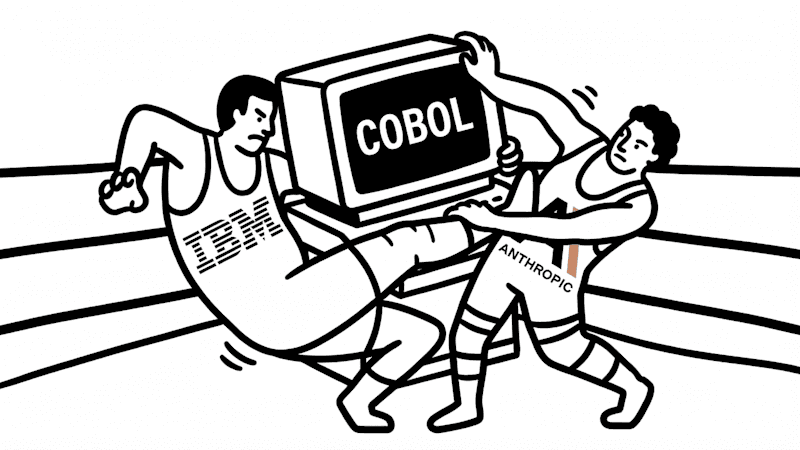
Source: VentureBeat
The AI startup, recently valued at $60 billion, released a Code Modernization Playbook and YouTube demonstrations showing Claude Code working with COBOL systems
1
. According to Anthropic, AI can now help teams modernize their COBOL codebase in quarters instead of years, mapping dependencies across thousands of lines of code and documenting workflows that would take human analysts months to surface5
.Why COBOL Modernization Matters for Financial Services and Beyond
COBOL, short for Common Business-Oriented Language, was developed in the 1950s and revolutionized business computing by offering human-readable code with decimal-point math as default—critical for financial services accuracy
5
. If you've interacted with social security, healthcare, government, finance, insurance, automotive, retail, or airlines, you've touched a COBOL system at some point in your transaction1
.The challenge extends beyond technology. Most COBOL programmers are retiring and dying, making their skills increasingly rare and expensive
1
. These legacy software systems run business-critical operations that cannot afford downtime and contain proprietary data structures and legacy business logic understood only by a few greybeards—if at all. Any rewrite attempt must reverse-engineer miles of business logic, reimplementation while maintaining fixed-point decimal math, and execute a perfect transition with minimal downtime1
.IBM Defends Mainframe Business Amid Market Perception Shift
IBM Senior Vice President Rob Thomas defended the company's prospects in a Monday blog post, arguing that mainframe value transcends any single programming language. "The value IBM mainframe delivers has nothing to do with COBOL," Thomas wrote. "Whether the application is written in Cobol, Java, or any other language, the platform provides the same guarantees. The language is not the source of that value. The platform is"
2
.
Source: ET
IBM CEO Arvind Krishna noted in July 2025 that the company's own AI coding assistant for mainframes, watsonx Code Assistant for Z, "has got very wide adoption," with customers primarily using it to understand their COBOL code base and decide what to modernize
2
. IBM itself launched this tool in 2023 to convert COBOL into Java3
. Last month, IBM reported its highest mainframe revenue in 20 years, which Arvind Krishna attributed partly to these same AI code conversion tools3
.Broader AI Disruption Hits Legacy Software Companies
The IBM selloff reflects broader market fears about AI's impact on legacy business models. Software stocks have been battered in recent months, with cybersecurity stocks including CrowdStrike and Datadog also slumping after Anthropic introduced new security features
4
. A major software ETF is down 27% this year, on track for its biggest one-quarter drop since the financial crisis in 20082
.Investors fear that "vibe coding"—using AI to write software code—will let users create their own applications, diminishing demand for legacy products and weighing on companies' growth, margins, and pricing power
2
. Companies like Salesforce, Atlassian, Adobe, ServiceNow, and HubSpot have experienced substantial share price decreases amid this speculation3
.Related Stories

Mainframe Migration Efforts Already Underway
The idea of accelerating COBOL work isn't entirely new. Recent years have seen mainframe migration initiatives from AWS, Microsoft, IBM spin-out Kyndryl, and NTT
3
. Infosys chairman Nandan Nilekani said just last week that AI means the cost of rewriting legacy apps has become affordable and made such moves imperative3
. The UK government last year complained about the substantial bills it pays to maintain creaky COBOL code3
.Evercore ISI analyst Amit Daryanani noted that "clients already had the option to migrate from the mainframe, yet they are sticking with the platform," suggesting IBM has already provided customers with several modernization options
2
. Still, Anthropic's blog post noted that "legacy code modernization stalled for years because understanding legacy code cost more than rewriting it. AI flips that equation"5
.Anthropic Loosens AI Safety Policy Amid Competition
In a separate development, Anthropic updated its AI safety policy to remain competitive with rivals like OpenAI, Google, and Elon Musk's xAI Corp
2
. The company, known for its commitment to AI safeguards, said in a Tuesday blog post that it would no longer delay potentially dangerous AI development if it believes it lacks a significant lead over a competitor. "The policy environment has shifted toward prioritizing AI competitiveness and economic growth, while safety-oriented discussions have yet to gain meaningful traction at the federal level," Anthropic stated2
.References
Summarized by

Navi
[3]
Related Stories
IBM and Anthropic Forge Strategic Partnership to Integrate Claude AI into Enterprise Software
07 Oct 2025•Technology

IBM's Q2 Earnings Beat Estimates, Driven by AI Mainframe Sales, but Software Segment Disappoints
24 Jul 2025•Business and Economy
IBM's Strong Q3 2025: AI Fuels Revenue Growth Across Software, Hardware, and Consulting
23 Oct 2025•Business and Economy

Recent Highlights


Recent Highlights
Today's Top Stories






Your Daily Dose of Curated AI News
Don’t drown in AI news. We cut through the noise - filtering, ranking and summarizing the most important AI news, breakthroughs and research daily. Spend less time searching for the latest in AI and get straight to action.

