US Launches Review of Nvidia H200 Chip Sales to China as Demand Surges and Production Ramps Up


17 Sources
17 Sources
[1]
Nvidia is reportedly weighs ramping up H200 production to meet surging demand in China | TechCrunch
After successfully lobbying the Trump administration to approve the sales of its H200 chips to China, Nvidia is now thinking of ramping up production of the chips as Chinese companies rush to place orders, Reuters reported, citing anonymous sources. The most powerful of Nvidia's previous Hopper generation of graphics processing units (GPUs) made for training large language models, the H200 chips previously could not be sold in China, as the previous Biden administration had proposed rules limiting sales of advanced AI chips in the country. But the Department of Commerce last week gave Nvidia the nod to sell H200 GPUs in China, in exchange for a 25% cut of sales of those chips. Nvidia is now seeing such strong demand from Chinese companies that it is considering adding more capacity, Reuters reported. However, Chinese officials are still deciding whether to allow the import of the H200 chips, which are said to be significantly more powerful than the H20 GPUs Nvidia had customized to sell in China. For the chipmaker, expanding production of the H200 GPUs would let it tap latent demand in a country that is racing to develop its own homegrown AI chips. Competition and national security concerns in the West have hampered the availability of the latest and most powerful hardware for training AI models in China, where companies have resorted to focusing on efficiency over sheer scale. Chinese companies, including Alibaba and ByteDance, which are developing their own AI models, have already been in touch with Nvidia to figure out large orders for the H200 chips, which are being produced in limited quantities, the report added. Nvidia did not immediately respond to a request for comment.
[2]
U.S. launches review of advanced Nvidia AI chip sales to China: Reuters
U.S. President Donald Trump's administration has launched a review that could result in the first shipments to China of Nvidia's second-most powerful AI chips, five sources said, making good on his pledge to allow the controversial sales. Trump this month said he would allow sales of Nvidia's H200 chips to China, with the U.S. government collecting a 25% fee, and that the sales would help keep U.S. firms ahead of Chinese chipmakers by cutting demand for Chinese chips. The move drew fire from China hawks across the U.S. political spectrum over concerns the chips would supercharge Beijing's military and erode the U.S. advantage in artificial intelligence. But questions have remained about how quickly the U.S. might approve such sales and whether Beijing would allow Chinese firms to purchase the Nvidia chips. Reuters reported last week that Nvidia was considering an increase to production of the H200, the immediate predecessor to its current flagship Blackwell chips, after initial orders from China outstripped the current capacity. The U.S. Commerce Department, which oversees export policy, has sent license applications for chip shipments to the State, Energy and Defense Departments for review, the sources said on condition of anonymity because the process is not public. Those agencies have 30 days to weigh in, according to export regulations, with the ultimate decision falling to Trump if agency officials disagree. The start of the inter-agency licensing review has not been reported previously. The Commerce Department and Nvidia did not immediately respond to requests for comment. A White House spokesperson did not comment on the review, but said "the Trump administration is committed to ensuring the dominance of the American tech stack - without compromising on national security."
[3]
Nvidia considers increasing H200 chip output due to robust China demand, Reuters sources say
Nvidia has told Chinese clients it is evaluating adding production capacity for its powerful H200 AI chips after orders exceeded its current output level, according to two sources briefed on the matter. The move comes after U.S. President Donald Trump said on Tuesday the U.S. government would allow Nvidia to export H200 processors, its second-fastest AI chips, to China and collect a 25% fee on such sales. Demand for the chip from Chinese companies is so strong that Nvidia is leaning toward adding new capacity, one of the sources said. They declined to be named as the discussions are private. Nvidia did not immediately reply to a Reuters request for comment. Major Chinese companies, including Alibaba and ByteDance, have already reached out to Nvidia this week about purchasing the H200 and are keen to place large orders, Reuters reported on Wednesday. However, uncertainties remain, as the Chinese government has yet to greenlight any purchase of the H200. Chinese officials convened emergency meetings on Wednesday to discuss the matter and will decide whether to allow it to be shipped into China, said one of the two sources and a third source. Very limited quantities of H200 chips are currently in production, Reuters reported on Wednesday, as the U.S. AI chip leader is focused on producing its most advanced Blackwell and upcoming Rubin lines. Supply of H200 chips has been a major concern for Chinese clients and they have reached out to Nvidia seeking clarity on this, sources said. As part of the briefing provided by Nvidia, the company has also given them guidance on current supply levels, said one of the first two people, without providing a specific number. The H200 went into mass deployment last year and is the fastest AI chip in Nvidia's previous Hopper generation. The chip is manufactured by TSMC using the Taiwanese firm's 4nm manufacturing process technology. TSMC and China's Ministry of Industry and Information Technology (MIIT) did not immediately reply to requests for comment. Chinese companies' strong demand for the H200 stems from the fact that it is easily the most powerful chip they can currently access. It is about six times more powerful than the H20, a downgraded chip from Nvidia tailored for the Chinese market that was released in late 2023. Trump's decision on the H200 comes at a time when China is pushing to promote its own domestic AI chip industry. As domestic chip companies have yet to produce products that match the H200, there have been concerns that allowing the H200 into China could stymie the industry. "Its (H200) compute performance is approximately 2-3 times that of the most advanced domestically produced accelerators," said Nori Chiou, investment director at White Oak Capital Partners. "I'm already observing many CSPs (Cloud Service Providers) and enterprise customers aggressively placing large orders and lobbying the government to relax restrictions on a conditional basis," he said, adding Chinese AI demand exceeds the capacity of local production. During the emergency meetings, there was a proposal to require each H200 purchase to be bundled with a certain ratio of domestic chips, one of the first two sources and a third source said. For Nvidia, adding new capacity is also challenging at a time when it is not only transitioning to Rubin but also competing with companies, including Alphabet's Google, for limited advanced chipmaking capacity from TSMC.
[4]
Nvidia H200 chips can now ship to China following Trump's ban lift
The White House has authorized the export of Nvidia H200 AI accelerators to China, attaching a 25% fee per shipment. According to reports, the decision was influenced by Huawei's rapid development of its Ascend 910C chips, particularly the CloudMatrix 384 system, which integrates 384 of these accelerators. Internal sources suggest that the US move aims to maintain American dominance in the global tech ecosystem while keeping the country's proprietary Blackwell and Rubin architectures restricted. Huawei's CloudMatrix 384 has been described as a "nuclear-level product" capable of delivering 300 petaflops of dense BF16 compute. It surpasses Nvidia's GB200 NVL72 system on certain performance metrics, highlighting its raw computational power. The system also provides 3.6 times more aggregate memory and over twice the memory bandwidth compared to Nvidia's platform. However, these gains come at the cost of nearly four times the power consumption, raising efficiency concerns. These accelerators have been deployed in Huawei data centers, where abundant electricity reduces the importance of energy efficiency. The company plans to scale Ascend 910C production to hundreds of thousands of units next year, with projections suggesting millions could be manufactured by 2026. Despite China's development of its own AI instruction set through CANN, Nvidia GPUs remain the preferred choice for many AI developers, including companies such as Deepseek. Huawei has made its CANN software for Ascend GPUs open source, offering multi-layer programming interfaces for AI applications. The move aims to challenge CUDA's nearly two-decade dominance, encouraging a domestic ecosystem that reduces reliance on American hardware. Early adoption remains uncertain, as CANN's ecosystem is still immature compared to the long-established CUDA platform. With the progress of Huawei, the US allegedly reviewed multiple scenarios, ranging from full export bans to attempts to overwhelm Huawei by flooding the market. The final decision represents a middle ground, balancing national security, global AI competitiveness, and economic interests. President Trump emphasized that authorized exports will support American jobs and manufacturing while retaining leverage over advanced AI technology. Nvidia's CEO, Jensen Huang, acknowledged uncertainty over whether Chinese customers would fully purchase H200 systems, noting a $5.5 billion revenue shortfall in AI chips earlier in 2025. The reversal, therefore, appears to be driven by Huawei's Ascend 910C performance trajectory, which poses a potential threat to US leadership in AI hardware. While exporting H200 chips allows the US to maintain influence over AI software ecosystems. It also reflects the recognition of China's growing capabilities in high-performance accelerators. Via Tom's Hardware
[5]
Exclusive-US Launches Review of Advanced Nvidia AI Chip Sales to China, Sources Say
WASHINGTON, Dec 18 (Reuters) - U.S. President Donald Trump's administration has launched a review that could result in the first shipments to China of Nvidia's second-most powerful AI chips, five sources said, making good on his pledge to allow the controversial sales. Trump this month said he would allow sales of Nvidia's H200 chips to China, with the U.S. government collecting a 25% fee, and that the sales would help keep U.S. firms ahead of Chinese chipmakers by cutting demand for Chinese chips. The move drew fire from China hawks across the U.S. political spectrum over concerns the chips would supercharge Beijing's military and erode the U.S. advantage in artificial intelligence. But questions have remained about how quickly the U.S. might approve such sales and whether Beijing would allow Chinese firms to purchase the Nvidia chips. Reuters reported last week that Nvidia was considering an increase to production of the H200, the immediate predecessor to its current flagship Blackwell chips, after initial orders from China outstripped the current capacity. The U.S. Commerce Department, which oversees export policy, has sent license applications for chip shipments to the State, Energy and Defense Departments for review, the sources said on condition of anonymity because the process is not public. Those agencies have 30 days to weigh in, according to export regulations, with the ultimate decision falling to Trump if agency officials disagree. The start of the inter-agency licensing review has not been reported previously. The Commerce Department and Nvidia did not immediately respond to requests for comment. A White House spokesperson did not comment on the review, but said "the Trump administration is committed to ensuring the dominance of the American tech stack - without compromising on national security." U.S. HAD BANNED H200 SALES TO CHINA While the H200 chips are slower than Nvidia's Blackwell chips at many AI tasks, they remain in wide use in the industry and have never been allowed for sale in China. Trump had previously opened the door to sales of a less-advanced version of Nvidia's Blackwell chips, its cutting-edge offering, but backed away from the move and approved sales of the H200 instead. Led by White House AI czar David Sacks, several members of the Trump administration now argue that shipping advanced AI chips to China discourages Chinese competitors like Huawei from redoubling efforts to catch up with Nvidia and AMD's most-advanced chip designs. Trump's move represents a dramatic reversal from his first term, when he drew international attention by cracking down on Chinese access to U.S. technology, citing claims that Beijing steals American intellectual property and harnesses commercially obtained technology to bolster its military, which Beijing denies. (Reporting by Alexandra Alper; Additional reporting by Stephen Nellis and Karen Friefeld; Editing by Peter Henderson and Jamie Freed)
[6]

US launches review of advanced Nvidia AI chip sales to China
The Trump administration has begun reviewing licences that could allow Nvidia to sell advanced H200 AI chips to China. The move marks a shift from Biden-era bans and has raised strong national security concerns in Washington. Supporters argue the sales could keep US firms ahead of Chinese rivals, despite political backlash. US President Donald Trump's administration has launched a review that could result in the first shipments to China of Nvidia's second-most powerful AI chips, five sources said, making good on his pledge to allow the controversial sales. Trump this month said he would allow sales of Nvidia's H200 chips to China, with the US government collecting a 25% fee, and that the sales would help keep US firms ahead of Chinese chipmakers by cutting demand for Chinese chips. The move drew fire from China hawks across the US political spectrum over concerns the chips would supercharge Beijing's military and erode the US advantage in artificial intelligence. But questions have remained about how quickly the US might approve such sales and whether Beijing would allow Chinese firms to purchase the Nvidia chips. The US Commerce Department, which oversees export policy, has sent license applications for the chip sales to the State, Energy and Defense Departments for review, the sources said on condition of anonymity because the process is not public. Those agencies have 30 days to weigh in, according to export regulations. One of the sources, an administration official, emphasized the review would be thorough and "not some perfunctory box we are checking." But under the regulations, the final decision rests with Trump. The start of the inter-agency licensing review has not been reported previously. The Commerce Department and Nvidia did not immediately respond to requests for comment. A White House spokesperson did not comment on the review, but said "the Trump administration is committed to ensuring the dominance of the American tech stack - without compromising on national security." Biden had banned advanced AI chips sales to China The Biden administration had imposed a raft of restrictions on advanced AI chip sales to China and countries it feared could become conduits for smuggling into the rival nation, citing national security fears. Trump's move represents a departure from that policy and a dramatic reversal from his first term, when he drew international attention by cracking down on Chinese access to US technology. Back then, he cited claims that Beijing steals American intellectual property and harnesses commercially obtained technology to bolster its military, which Beijing denies. Exporting large numbers of the chips to China would be "a significant strategic mistake," said Chris McGuire, a former White House National Security Council official under President Joe Biden and senior fellow with the Council on Foreign Relations. McGuire described the chips as "the one thing holding China back in AI." "I cannot possibly fathom how the departments of Commerce, State, Energy, and Defense could certify that exporting these chips to China is in the US national security interest," he said. Led by White House AI czar David Sacks, several members of the Trump administration now argue that shipping advanced AI chips to China discourages Chinese competitors like Huawei from redoubling efforts to catch up with Nvidia's and AMD's most-advanced chip designs. Reuters reported last week that Nvidia was considering an increase in production of the H200, the immediate predecessor to its current flagship Blackwell chips, after initial orders from China outstripped the current capacity. While the H200 chips are slower than Nvidia's Blackwell chips at many AI tasks, they remain in wide use in the industry and have never been allowed for sale in China. Trump had previously opened the door to sales of a less-advanced version of Nvidia's Blackwell chips, its cutting-edge offering, but backed away from the move and approved sales of the H200 instead.
[7]
Exclusive-Nvidia Considers Increasing H200 Chip Output Due to Robust China Demand, Sources Say
Dec 12 (Reuters) - Nvidia has told Chinese clients it is evaluating adding production capacity for its powerful H200 AI chips after orders exceeded its current output level, according to two sources briefed on the matter. The move comes after U.S. President Donald Trump said on Tuesday the U.S. government would allow Nvidia to export H200 processors, its second-fastest AI chips, to China and collect a 25% fee on such sales. Demand for the chip from Chinese companies is so strong that Nvidia is leaning toward adding new capacity, one of the sources said. They declined to be named as the discussions are private. Nvidia did not immediately reply to a Reuters' request for comment. Major Chinese companies including Alibaba and ByteDance have already reached out to Nvidia this week about purchasing the H200 and are keen to place large orders, Reuters reported on Wednesday. However, uncertainties remain, as the Chinese government has yet to greenlight any purchase of the H200. Chinese officials convened emergency meetings on Wednesday to discuss the matter and will decide whether to allow it to be shipped into China, said one of the two sources and a third source. Very limited quantities of H200 chips are currently in production, Reuters reported on Wednesday, as the U.S. AI chip leader is focused on producing its most advanced Blackwell and upcoming Rubin lines. CHINA PROMOTING ITS OWN AI INDUSTRY Supply of H200 chips has been a major concern for Chinese clients and they have reached out to Nvidia seeking clarity on this, sources said. As part of the briefing provided by Nvidia, the company has also given them guidance on current supply levels, said one of the first two people, without providing a specific number. The H200 went into mass deployment last year and is the fastest AI chip in Nvidia's previous Hopper generation. The chip is manufactured by TSMC using the Taiwanese firm's 4nm manufacturing process technology. TSMC and China's Ministry of Industry and Information Technology (MIIT) did not immediately reply to requests for comment. Chinese companies' strong demand for the H200 stems from the fact that it is easily the most powerful chip they can currently access. It is about six times more powerful than the H20, a downgraded chip from Nvidia tailored for the Chinese market that was released in late 2023. Trump's decision on the H200 comes at a time when China is pushing to promote its own domestic AI chip industry. As domestic chip companies have yet to produce products that match the H200, there have been concerns that allowing the H200 into China could stymie the industry. "Its (H200) compute performance is approximately 2-3 times that of the most advanced domestically produced accelerators," said Nori Chiou, investment director at White Oak Capital Partners. "I'm already observing many CSPs (Cloud Service Providers) and enterprise customers aggressively placing large orders and lobbying the government to relax restrictions on a conditional basis," he said, adding Chinese AI demand exceeds the capacity of local production. During the emergency meetings, there was a proposal to require each H200 purchase to be bundled with a certain ratio of domestic chips, one of the first two sources and a third source said. For Nvidia, adding new capacity is also challenging at a time when it is not only transitioning to Rubin but also competing with companies including Alphabet's Google for limited advanced chipmaking capacity from TSMC. (Editing by Miyoung Kim and Susan Fenton)
[8]

Trump Letting China Have Nvidia H200 Chips Raises Chances Of Beijing Matching West In AI: 'Naive' To Assume They Won't Be Used For Military Purposes - NVIDIA (NASDAQ:NVDA)
Former UK Prime Minister Rishi Sunak has criticized President Donald Trump's move to permit Nvidia Corp (NASDAQ:NVDA) to sell its H200 artificial intelligence chip to China. Sunak Says Nvidia H200 Sale Gives China A Major AI Boost In a column for The Times shared on X over the weekend, Sunak said allowing the sale of Nvidia's H200 chip -- while still barring the more advanced Blackwell -- should not be dismissed as a minor concession. He noted the H200 is multiple times "more powerful" than chips China could previously import and stronger than anything Chinese firms are expected to produce in the near term. "The significance of this decision should not be underestimated... It substantially increases the chance of China catching up with the West in the AI race, and then swiftly overtaking it," Sunak wrote. See Also: Investor Michael Burry Criticizes Nvidia, Warns Of Unpredictable AI Bubble Burst, Says 'There Is No Way To Time Or Predict' Export Controls Were Working, Sunak Argues Sunak stressed that export restrictions, though imperfect, had been effective. The U.S.'s key edge in the AI race has been its lead in advanced chip technology, an advantage that Sunak said Trump's decision has now reduced. He noted that DeepSeek, one of China's top AI companies, has made it clear that limited access to Nvidia chips has been its biggest constraint. Concerns Over Security, Surveillance And Military Use Sunak also warned against viewing Chinese tech companies as separate from the state, citing Beijing's civil-military fusion strategy. He said it is "naive" to assume chips sold for commercial purposes would not support surveillance or military applications. Trade Politics And Global Alliances At Risk Sunak suggested Trump's decision is driven by trade pressures rather than long-term strategy, saying the president is seeking to ease tensions with Beijing ahead of U.S. midterm elections. "A world where Beijing dominates both tech and manufacturing," Sunak wrote, would be deeply troubling for open, democratic societies. Beijing Considers Restricting Nvidia H200 Chips Earlier reports said Beijing was considering limiting access to Nvidia's advanced H200 chips, a move that was followed by the arrest of two Chinese nationals accused of illegally smuggling Nvidia chips into the country in violation of U.S. export rules. However, Futurum CEO Daniel Newman has said China's strongest chance of staying competitive in AI hinges on its ability to use Nvidia's chips. Benzinga's Edge Stock Rankings rank the company in the 97th percentile for growth and the 92nd percentile for quality. Click here to see how it compares to its peers and competitors. Read Next: Nvidia CEO Jensen Huang Warns China Could Beat America In AI: 'They Can Build A Hospital In A Weekend' While US Takes Years Photo: gguy/ Shutterstock Disclaimer: This content was partially produced with the help of AI tools and was reviewed and published by Benzinga editors. NVDANVIDIA Corp$175.170.09%OverviewMarket News and Data brought to you by Benzinga APIs
[9]

NVIDIA H200 AI GPUs Witness Massive Demand In China, Increasing Capacity To Ensure Zero Impact On US Customers
NVIDIA is reportedly seeing major demand for its last-gen Hopper H200 AI GPUs in China after the lifting of the ban by the US Government. In a report by Reuters, it is stated that NVIDIA's H200 AI GPUs are witnessing massive demand in China. The report comes days after the US Government lifted the ban on sales of older Hopper-based GPUs to China, while still keeping the ban on current-gen products such as Blackwell and Blackwell Ultra. As per the new sales agreement, NVIDIA will be paying 25% of each sale to the United States of America, which means that NVIDIA will either have to lower its margins on Hopper sales or impose a price hike for the Chinese markets. Earlier, it was reported that China would probably ignore the Hopper H200 AI GPUs and instead focus on domestically produced technologies for AI purposes, but it doesn't seem to be the case. As per the report, the demand for these GPUs is so strong that NVIDIA is now considering opening up further production lines through its partners to ensure a smooth supply. Demand for the chip from Chinese companies is so strong that Nvidia is leaning toward adding new capacity, one of the sources said. They declined to be named as the discussions are private. "We are managing our supply chain to ensure that licensed sales of the H200 to authorized customers in China will have no impact on our ability to supply customers in the United States," an Nvidia spokesperson said in a statement to Reuters after the story was published. via Reuters This extra capacity will help NVIDIA not disrupt the supply chain, leading to minimal or zero impact on existing AI GPU orders for its customers in the United States. NVIDIA is already ramping up production of its Blackwell Ultra GPUs, with Rubin planned to go into production next year. But demand and sales are two different things. While demand is said to be high for the procurement of NVIDIA's H200 AI GPUs, China has yet to finalize the sale of this chip in the domestic market. It is said that the Chinese authorities have called in meetings next week to finalize whether H200 will be sold or not in China. The NVIDIA Hopper H200 AI GPU, despite being an older chip, is still highly competitive in the Chinese domestic segment, and one that has a strong software suite backing it up. It has seen a lot of hardware and software-level optimizations that further improved its AI capabilities, and while it isn't as good as Blackwell, it's still a very desirable chip for those who don't have access to Blackwell or small/medium-tier AI sectors.
[10]
China is 'rejecting' Nvidia's H200 chips, outfoxing US strategy, White House AI czar says
China is reportedly turning away advanced Nvidia AI chips, opting for its own technology. This move challenges a US strategy aimed at competing with Chinese tech firms. Officials suggest China seeks semiconductor independence. The decision could affect Nvidia's revenue from the Chinese market. Beijing is also boosting its local chip industry. China has figured out the US strategy for allowing it to buy Nvidia Corp.'s H200 and is rejecting the AI chip in favor of domestically developed semiconductors, White House AI czar David Sacks said, citing news reports. President Donald Trump said on Monday he would allow shipments of Nvidia's H200 to China, part of an administration effort backed by Sacks to challenge Chinese tech champions like Huawei Technologies Co. by bringing American competition to their home market. On Friday, Sacks signaled that he was uncertain about whether that approach would work. "They're rejecting our chips," Sacks said in an interview on Bloomberg Tech, citing an unspecified news article he had seen that day. "Apparently they don't want them, and I think the reason for that is they want semiconductor independence." In a social media post Saturday, Sacks said he was referring to a Financial Times report that China was poised to limit access to the chips via a local approval process where Chinese buyers would need to justify their purchases. Sacks' comments raise questions about whether Nvidia will be able to recover revenue from China, a data center market it has removed entirely from its forecasts but that Chief Executive Officer Jensen Huang has put at $50 billion this year. Bloomberg Intelligence analysts estimate annual H200 revenue in China to be a $10 billion opportunity -- but only if the nation accepts the US firm's chips. In a statement from a spokesperson, Nvidia said it continues to work with the administration on H200 licenses for vetted customers. "While we do not yet have results to report, it's clear that three years of overbroad export controls fueled America's foreign competitors and cost US taxpayers billions of dollars," the company said. Liu Pengyu, a Chinese embassy spokesperson, said that cooperation on technology and the economy is in the common interest of China and the US. "We hope the US will work with China to take concrete actions to maintain the stability and smooth functioning of global supply chains," he said in a statement. China is weighing a package of incentives worth as much as $70 billion to support its local chipmaking industry, Bloomberg reported Friday, underscoring Beijing's resolve to reduce its reliance on foreign chipmakers such as Nvidia. It suggests the government will continue to support companies like Huawei and Cambricon Technologies Corp. even with the H200 cleared by the US for export to China. The H200, which was introduced in 2023 and began shipping to customers last year, is part of the Hopper generation of Nvidia's chips, second-best to the Blackwell line and two generations behind the upcoming Rubin series. An 18-month lag behind the latest Nvidia chips was part of the Trump administration's justification for the decision. Sacks, a venture capitalist who joined the administration in January, identified China's desire to prop up and subsidize Huawei as a key reason for its H200 reluctance. Even so, he defended the decision to allow China to access H200 chips, which he called a "lagging" technology and no longer state-of-the-art. "What you see is China's not taking them because they want to prop up and subsidize Huawei," Sacks said. "That was part of our calculation, of selling not the best but lagging chips to China, is that you can take market share away from Huawei, but I think the Chinese government has figured that out, and that's why they're not allowing them." The H200 decision was motivated by an assessment that Huawei -- Nvidia's Chinese archrival -- offers AI systems with comparable horsepower, including its Cloud Matrix 384 platform, which links hundreds of processors together to compensate for lower performance in individual chips. Some US officials saw the H200 as compromise from Nvidia's earlier push to export a version of the Blackwell chip to China, according to a person familiar with the matter. Last week, as officials weighed the decision, Huang told reporters in Washington that he had no clue if China would accept H200 chips. On Monday, Trump said in a Truth Social post that President Xi Jinping of China responded positively to the possibility of H200 export approvals. Beijing has yet to publicly agree to allow imports of Nvidia's H200 products. It also has yet to publicly reject them, despite the recent US policy change. Earlier this year, China shunned the H20, a significantly less capable chip Trump allowed this summer.
[11]
Nvidia Eyes Bigger AI Chip Output After China Orders Flood In - NVIDIA (NASDAQ:NVDA)
Nvidia Corp. (NASDAQ:NVDA) is evaluating an expansion of production capacity for its H200 artificial intelligence chips after orders topped output as per its Chinese clients. U.S. President Donald Trump announced on Tuesday that Washington will allow Nvidia to export H200 processors to China, as long as the company pays a 25% fee on each sale. Chinese demand is so strong that Nvidia is leaning toward adding new capacity, Reuters reported Friday, citing familiar sources. Also Read: US Lawmakers Push Bill To Stop Trump From Easing China's Access To Next-Gen Nvidia, AMD AI Chips Major Chinese Customers Line Up Alibaba Group Holding Limited (NYSE:BABA) and ByteDance have already contacted Nvidia this week to place large orders, Reuters previously reported. However, Beijing has not yet approved any H200 imports. The H200 manufactured by Taiwan Semiconductor Manufacturing Company Ltd. (NYSE:TSM) on its 4nm process remains the fastest chip from Nvidia's Hopper generation. Chinese officials held emergency meetings on Wednesday to evaluate whether to allow the shipments, according to sources. Analyst Commentary Bank of America Securities analyst Vivek Arya reaffirmed Nvidia as his top pick after a recent investor meeting. Arya said Nvidia continues to lead AI computing by a full generation, with current Large Language Models still trained on Hopper graphics processing units and Blackwell expected to deliver a 10x-15x performance jump when it arrives in early 2026. He noted that the next Vera Rubin platform remains on track for late 2026. Arya highlighted Nvidia's multi-year demand visibility, supported by at least $500 billion in expected sales across 2025-26 for Blackwell, Rubin, and networking products. He said partnerships with OpenAI and Anthropic add potential upside, and emphasized Nvidia's unmatched platform strength from central processing units and GPUs to scale-out systems and Compute Unified Device Architecture (CUDA) software. He added that China-related uncertainty persists as Nvidia evaluates potential H200 GPU exports under new U.S. rules. Nvidia became the first company to hit the $4.5 trillion mark in October as the AI demand fueled demand for its GPUs. NVDA Price Action: Nvidia shares were up 0.39% at $181.63 during premarket trading on Friday, according to Benzinga Pro data. Read Next: Nvidia's Smart Chips Could Soon Tell On Their Smugglers Image via Shutterstock NVDANVIDIA Corp$181.820.49%OverviewBABAAlibaba Group Holding Ltd$157.700.51%TSMTaiwan Semiconductor Manufacturing Co Ltd$303.00-0.61%Market News and Data brought to you by Benzinga APIs
[12]
Nvidia considers increasing H200 chip output due to robust China demand, sources say - The Economic Times
Nvidia has told Chinese clients it is evaluating adding production capacity for its powerful H200 AI chips after orders exceeded its current output level, according to two sources briefed on the matter. The move comes after US President Donald Trump said on Tuesday the US government would allow Nvidia to export H200 processors, its second-fastest AI chips, to China and collect a 25% fee on such sales. Demand for the chip from Chinese companies is so strong that Nvidia is leaning toward adding new capacity, one of the sources said. They declined to be named as the discussions are private. "We are managing our supply chain to ensure that licensed sales of the H200 to authorized customers in China will have no impact on our ability to supply customers in the United States," an Nvidia spokesperson said in a statement to Reuters after the story was published. Major Chinese companies including Alibaba and ByteDance have already reached out to Nvidia this week about purchasing the H200 and are keen to place large orders, Reuters reported on Wednesday. However, uncertainties remain, as the Chinese government has yet to greenlight any purchase of the H200. Chinese officials convened emergency meetings on Wednesday to discuss the matter and will decide whether to allow it to be shipped into China, said one of the two sources and a third source. Very limited quantities of H200 chips are currently in production, Reuters reported on Wednesday, as the U.S. AI chip leader is focused on producing its most advanced Blackwell and upcoming Rubin lines. China promoting own AI industry Supply of H200 chips has been a major concern for Chinese clients and they have reached out to Nvidia seeking clarity on this, sources said. As part of the briefing provided by Nvidia, the company has also given them guidance on current supply levels, said one of the first two people, without providing a specific number. The H200 went into mass deployment last year and is the fastest AI chip in Nvidia's previous Hopper generation. The chip is manufactured by TSMC using the Taiwanese firm's 4nm manufacturing process technology. TSMC and China's Ministry of Industry and Information Technology (MIIT) did not immediately reply to requests for comment. Chinese companies' strong demand for the H200 stems from the fact that it is easily the most powerful chip they can currently access. It is about six times more powerful than the H20, a downgraded chip from Nvidia tailored for the Chinese market that was released in late 2023. Trump's decision on the H200 comes at a time when China is pushing to promote its own domestic AI chip industry. As domestic chip companies have yet to produce products that match the H200, there have been concerns that allowing the H200 into China could stymie the industry. "Its (H200) compute performance is approximately 2-3 times that of the most advanced domestically produced accelerators," said Nori Chiou, investment director at White Oak Capital Partners. "I'm already observing many CSPs (Cloud Service Providers) and enterprise customers aggressively placing large orders and lobbying the government to relax restrictions on a conditional basis," he said, adding Chinese AI demand exceeds the capacity of local production. During the emergency meetings, there was a proposal to require each H200 purchase to be bundled with a certain ratio of domestic chips, one of the first two sources and a third source said. For Nvidia, adding new capacity is also challenging at a time when it is not only transitioning to Rubin but also competing with companies including Alphabet's Google for limited advanced chipmaking capacity from TSMC.
[13]

Trump administration reviews plan to allow Nvidia AI chip sales to China - Reuters By Investing.com
Investing.com-- U.S. President Donald Trump's administration has begun an inter-agency review that could pave the way for the first shipments of Nvidia's (NASDAQ:NVDA) H200 artificial-intelligence chips to China, Reuters reported on Thursday, citing sources. President Donald Trump earlier said he would allow sales of the chips, which are Nvidia's second-most powerful AI processors, with the U.S. government taking a 25% fee. The administration argues the policy would help U.S. companies maintain a lead over Chinese rivals by reducing incentives for domestic chip development in China. The U.S. Commerce Department has circulated export license applications to the State, Energy, and Defense departments for review, starting a 30-day consultation period under export rules. If the agencies fail to agree, the final decision would rest with Trump, the report said. The prospect of sales has drawn criticism from China hawks in Washington, who warn the chips could enhance Beijing's military capabilities. Reuters has previously reported that Nvidia was considering boosting H200 production after early Chinese interest exceeded capacity.
[14]
Nvidia China Chip Approval Reignites the AI Trade Vs. National Security Debate | Investing.com UK
President Trump's decision to authorize Nvidia (NASDAQ:NVDA) to resume sales of its H200 artificial intelligence chip to China has reopened a fault line that markets had assumed was largely settled. For investors, the issue is not political theater but whether the global AI supply chain will remain fragmented by policy risk just as demand is accelerating. The immediate pushback from seven Democratic senators underscores that this is not a narrow regulatory adjustment but a high-stakes test of how far Washington is willing to go in monetizing AI leadership without undermining its own strategic constraints. The H200 sits just below Nvidia's most advanced offerings and is meaningfully more powerful than the H20 variant previously designed for China. Allowing its export marks a sharp shift from April, when tightened controls effectively cut Nvidia off from selling advanced AI accelerators into the Chinese market. The administration's argument is that controlled sales to designated end users, combined with a commitment by Nvidia to remit 25 percent of China related revenue to the U.S. government, preserves oversight while keeping Chinese developers tethered to American hardware. From a market perspective, that framing matters because it directly links geopolitical access to earnings visibility. Investors quickly focused on the revenue implications rather than the political optics. Nvidia has been explicit that China could represent tens of billions of dollars in annual sales if advanced chips are permitted, a figure that materially alters medium term growth assumptions. The company's shares have been trading on the premise that data center demand tied to AI infrastructure remains structurally strong, but export controls have been one of the few clear external constraints on that thesis. By reopening China, even under license and conditions, the policy decision reduces one of the most significant downside risks embedded in valuations. The Senate backlash highlights why markets are unlikely to price this as a clean resolution. Lawmakers pointed out that the H200 is estimated to be multiple times more powerful than the H20 and noted the timing contradiction, with the Justice Department announcing prosecutions related to the illegal smuggling of the same chips into China just hours before the authorization became public. That juxtaposition reinforces the argument that enforcement risk and political scrutiny will remain elevated. For investors, this translates into a higher probability of abrupt policy reversals, tighter licensing rules, or legislative intervention such as the proposed Safe Chips Act, which would mandate a thirty month denial of licenses for certain advanced chip exports to China and other sanctioned countries. Nvidia's defense, that limiting exports only accelerates domestic competitors like Huawei, carries weight in markets that are increasingly focused on long term competitive positioning rather than near term headlines. The company has argued that a total ban erodes U.S. influence over global AI standards and supply chains. That logic resonates with investors who see ecosystem control as more durable than regulatory exclusion, particularly as Chinese firms continue to invest heavily in indigenous alternatives. What matters now is not whether the H200 sale proceeds in the coming weeks, but whether this episode signals a more transactional approach to tech export controls. The base case for investors is that licensed sales move forward under tight conditions, providing Nvidia with incremental revenue upside while keeping policy risk contained but unresolved. The risk scenario is that congressional pressure hardens into binding legislation, forcing another abrupt halt and reintroducing uncertainty just as capital spending on AI infrastructure is peaking. Investors will be watching two signals closely. First, whether the Commerce Department grants licenses smoothly or slows approvals under political pressure. Second, whether bipartisan support for stricter export laws gains momentum into the next legislative cycle. Until those questions are answered, Nvidia's China exposure remains a source of upside optionality rather than a fully bankable growth driver, and the AI trade as a whole will continue to price not just demand curves but Washington's tolerance for strategic compromise.
[15]

US launches review of advanced Nvidia AI chip sales to China, sources say
WASHINGTON, Dec 18 (Reuters) - U.S. President Donald Trump's administration has launched a review that could result in the first shipments ?to ?China of Nvidia's second-most powerful AI chips, five sources said, making good on his pledge to allow the controversial sales. Trump this month said he would allow sales of Nvidia's H200 chips to China, with the U.S. government collecting a 25% fee, and that the sales would help keep U.S. firms ahead of Chinese chipmakers by cutting demand ?for Chinese chips. The move drew fire from China hawks across the U.S. political spectrum over concerns the chips would supercharge Beijing's military and erode the U.S. advantage in artificial intelligence. But questions have remained about how quickly the U.S. might approve such sales and whether Beijing would allow Chinese firms to purchase the Nvidia chips. Reuters reported last week that Nvidia was considering ?an increase to production of the H200, the immediate predecessor to its current flagship Blackwell chips, after ?initial orders from China outstripped the current capacity. The U.S. Commerce Department, which oversees export policy, has sent license applications for chip shipments to the State, Energy and Defense Departments for review, the sources said on condition of anonymity because the process is not public. Those agencies have 30 days to weigh in, according to export regulations, with the ultimate decision falling to Trump if agency officials disagree. The start of the inter-agency licensing review has not been reported previously. The Commerce Department and Nvidia did not immediately respond to requests for comment. A White House spokesperson did not comment on the review, but said "the Trump administration is committed to ensuring the dominance of the American tech stack - without compromising on national security." U.S. HAD BANNED H200 SALES TO CHINA While the H200 chips are slower than Nvidia's Blackwell chips at many AI tasks, they remain in wide use in the industry and ?have never been allowed for sale in China. Trump had previously opened the door to sales of a less-advanced version of Nvidia's Blackwell chips, ?its cutting-edge offering, but backed away from the move ?and approved sales of the H200 instead. Led by White House AI czar David Sacks, several members of the Trump administration now argue that shipping advanced AI ?chips to China discourages Chinese competitors like Huawei from redoubling efforts to catch up with Nvidia and AMD's most-advanced chip designs. Trump's move represents a dramatic ?reversal from his first term, when he drew international attention by cracking down on Chinese access to U.S. technology, citing claims that Beijing steals American intellectual property and harnesses commercially obtained technology to bolster its military, which Beijing denies. (Reporting by Alexandra Alper; Additional reporting by Stephen Nellis and Karen Friefeld; Editing by Peter Henderson and Jamie Freed)
[16]
Nvidia considers more H200 chip output on China demand, sources say
STORY: Nvidia is looking into adding production capacity for its powerful H200 AI chips. Sources said that's what the U.S. tech giant told Chinese clients after orders exceeded its current output level President Donald Trump said on Tuesday the U.S. government would allow Nvidia to export H200 processors to China - although it will collect a 25% fee on those sales. The H200 is Nvidia's second-fastest AI chip and the most powerful Chinese companies can currently access. A source said Nvidia is leaning toward adding new capacity as demand from China is so strong. Nvidia didn't immediately respond to a request for comment. Major Chinese companies including Alibaba and ByteDance have already reached out to Nvidia this week about buying the H200, and would both like to place large orders. But there are still uncertainties around the issue. The Chinese government hasn't yet given permission for any purchase of the H200. Beijing has also more recently pushed to promote its own domestic AI chip industry. A source said Chinese officials held emergency meetings on Wednesday to talk about the matter.
[17]
Nvidia considers increasing H200 chip output due to robust China demand, sources say
Dec 12 (Reuters) - Nvidia has told Chinese clients it is evaluating adding production capacity for its powerful H200 AI chips after orders exceeded its current output level, according to two sources briefed on the matter. The move comes after U.S. President Donald Trump said on Tuesday the U.S. government would allow Nvidia to export H200 processors, its second-fastest AI chips, to China and collect a 25% fee on such sales. Demand for the chip from Chinese companies is so strong that Nvidia is leaning toward adding new capacity, one of the sources said. They declined to be named as the discussions are private. Nvidia did not immediately reply to a Reuters' request for comment. Major Chinese companies including Alibaba and ByteDance have already reached out to Nvidia this week about purchasing the H200 and are keen to place large orders, Reuters reported on Wednesday. However, uncertainties remain, as the Chinese government has yet to greenlight any purchase of the H200. Chinese officials convened emergency meetings on Wednesday to discuss the matter and will decide whether to allow it to be shipped into China, said one of the two sources and a third source. Very limited quantities of H200 chips are currently in production, Reuters reported on Wednesday, as the U.S. AI chip leader is focused on producing its most advanced Blackwell and upcoming Rubin lines. CHINA PROMOTING ITS OWN AI INDUSTRY Supply of H200 chips has been a major concern for Chinese clients and they have reached out to Nvidia seeking clarity on this, sources said. As part of the briefing provided by Nvidia, the company has also given them guidance on current supply levels, said one of the first two people, without providing a specific number. The H200 went into mass deployment last year and is the fastest AI chip in Nvidia's previous Hopper generation. The chip is manufactured by TSMC using the Taiwanese firm's 4nm manufacturing process technology. TSMC and China's Ministry of Industry and Information Technology (MIIT) did not immediately reply to requests for comment. Chinese companies' strong demand for the H200 stems from the fact that it is easily the most powerful chip they can currently access. It is about six times more powerful than the H20, a downgraded chip from Nvidia tailored for the Chinese market that was released in late 2023. Trump's decision on the H200 comes at a time when China is pushing to promote its own domestic AI chip industry. As domestic chip companies have yet to produce products that match the H200, there have been concerns that allowing the H200 into China could stymie the industry. "Its (H200) compute performance is approximately 2-3 times that of the most advanced domestically produced accelerators," said Nori Chiou, investment director at White Oak Capital Partners. "I'm already observing many CSPs (Cloud Service Providers) and enterprise customers aggressively placing large orders and lobbying the government to relax restrictions on a conditional basis," he said, adding Chinese AI demand exceeds the capacity of local production. During the emergency meetings, there was a proposal to require each H200 purchase to be bundled with a certain ratio of domestic chips, one of the first two sources and a third source said. For Nvidia, adding new capacity is also challenging at a time when it is not only transitioning to Rubin but also competing with companies including Alphabet's Google for limited advanced chipmaking capacity from TSMC.
Share
Share
Copy Link
The Trump administration has initiated an inter-agency review that could authorize the first shipments of Nvidia's H200 AI chips to China, with a 25% fee attached. The move comes as Chinese companies rush to place orders, prompting Nvidia to consider ramping up production capacity for the powerful processors.
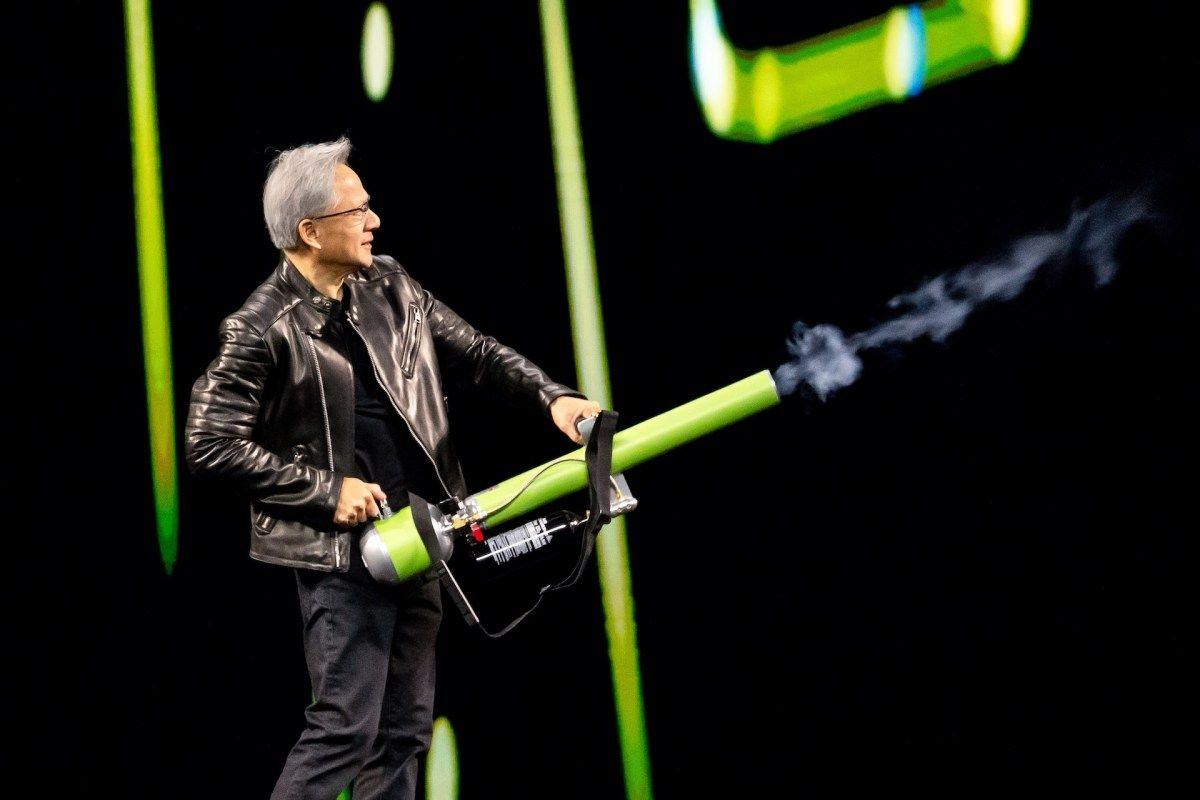
Nvidia Weighs Ramping Up H200 Production Amid Surging Demand in China
Nvidia is considering increasing H200 production capacity after orders from Chinese companies exceeded current output levels, following the Trump administration's decision to allow advanced AI chip sales to China
1
. The chipmaker has briefed Chinese clients about evaluating additional production capacity as demand for these powerful processors proves stronger than anticipated3
. Major Chinese companies, including Alibaba and ByteDance, have already reached out to Nvidia about placing large orders for the H200 chips, which are currently produced in limited quantities as the company focuses on its most advanced Blackwell and upcoming Rubin lines1
.US Government Review of Chip Sales Moves Forward
The US administration has launched a formal inter-agency review process that could result in the first shipments of Nvidia's second-most powerful AI chips to China
2
. The US Commerce Department, which oversees export policy, has sent license applications for chip shipments to the State, Energy and Defense Departments for review, with those agencies having 30 days to weigh in according to US export regulations5
. The ultimate decision falls to Trump if agency officials disagree. Trump announced earlier this month that he would allow sales of Nvidia's H200 chips to China, with the US government collecting a 25% fee on such sales2
.National Security Concerns and Strategic Calculations
The decision to authorize H200 exports has drawn criticism from China hawks across the US political spectrum over concerns the chips would enhance Beijing's military capabilities and erode the US advantage in artificial intelligence
5
. However, led by White House AI czar David Sacks, several members of the Trump administration now argue that shipping advanced AI chips to China discourages Chinese competitors like Huawei from redoubling efforts to catch up with Nvidia and AMD's most-advanced chip designs5
. Reports suggest the decision was influenced by Huawei's rapid development of its Ascend 910C chips, particularly the CloudMatrix 384 system, which integrates 384 accelerators and has been described as capable of delivering 300 petaflops of dense BF16 compute4
.H200 Performance and Market Positioning
The H200 represents the most powerful chip Chinese companies can currently access, operating at approximately six times the performance of the H20, a downgraded chip from Nvidia tailored for the Chinese market that was released in late 2023
3
. The H200 went into mass deployment last year and is the fastest AI chip in Nvidia's previous Hopper generation, manufactured by TSMC using the Taiwanese firm's 4nm manufacturing process technology3
. While the H200 chips are slower than Nvidia's Blackwell chips at many AI tasks, they remain in wide use in the industry and have never been allowed for sale in China until now5
.Related Stories

Chinese Government Deliberations and Market Uncertainties
Uncertainties remain as the Chinese government has yet to greenlight any purchase of the H200 chips
3
. Chinese officials convened emergency meetings to discuss the matter and decide whether to allow the processors to be shipped into China3
. During these emergency meetings, there was a proposal to require each H200 purchase to be bundled with a certain ratio of domestic chips3
. The Department of Commerce gave Nvidia approval to sell H200 GPUs in China last week, in exchange for the 25% fee on sales of those chips1
.Implications for Competitiveness and Production Capacity
For Nvidia, expanding production of the H200 GPUs would allow the company to tap latent demand in a country racing to develop its own homegrown AI chips
1
. However, adding new production capacity presents challenges at a time when Nvidia is transitioning to Rubin and competing with companies, including Alphabet's Google, for limited advanced chipmaking capacity from TSMC3
. Competition and national security concerns in the West have hampered the availability of the latest and most powerful hardware for training AI models in China, where companies have resorted to focusing on efficiency over sheer scale1
. Trump emphasized that authorized exports will support American jobs and manufacturing while retaining leverage over advanced AI technology, though Nvidia CEO Jensen Huang acknowledged uncertainty over whether Chinese customers would fully purchase H200 systems, noting a $5.5 billion revenue shortfall in AI chips earlier in 20254
.References
Summarized by

Navi
[1]
[3]
Related Stories
Nvidia's H200 AI chip sales to China stalled by US security review despite initial approvals
28 Jan 2026•Policy and Regulation
US export rules greenlight H200 sales to China, but strict limits put American buyers first
07 Jan 2026•Policy and Regulation
U.S. Imposes 15% Revenue Share on Nvidia and AMD's AI Chip Sales to China Amid Escalating Tech Rivalry
05 Aug 2025•Policy and Regulation

Recent Highlights
1
OpenAI Releases GPT-5.4, New AI Model Built for Agents and Professional Work
Technology
2
AI chatbots helped teens plan violent attacks in 8 of 10 cases, new investigation reveals
Technology
3
Pentagon shuts door on Anthropic talks as Microsoft and Big Tech rally behind AI firm's lawsuit
Policy and Regulation
Recent Highlights
Today's Top Stories



Your Daily Dose of Curated AI News
Don’t drown in AI news. We cut through the noise - filtering, ranking and summarizing the most important AI news, breakthroughs and research daily. Spend less time searching for the latest in AI and get straight to action.

