Nvidia DLSS 4.5 brings AI upscaling improvements to all RTX GPUs, but older cards may struggle


3 Sources
3 Sources
[1]
Nvidia's DLSS 4.5 is here to make your PC games look better and demand more power from your GPU
* DLSS 4.5 Super Resolution is now live in the Nvidia app. * 2nd-gen transformer boosts image quality but uses 5x power -- RTX 30/20 series GPUs may drop up to 20% FPS. * The new version of Super Resolution offers subtle visual gains, including better lighting, and less shimmer/trails. Following its announcement at CES 2026, Nvidia's DLSS 4.5 Super Resolution is now available to Nvidia app users. The update has been available in beta through the app since last week. "Today, Nvidia are rolling out DLSS 4.5 Super Resolution to all Nvidia app users. Announced at CES last week, DLSS 4.5 Super Resolution introduces a 2nd generation transformer model for DLSS Super Resolution, delivering state-of-the-art image quality for all GeForce RTX GPUs in over 400 games and apps," said Nvidia in a recent statement. Nvidia says that its second-generation Super Resolution is more advanced than its predecessor and that it requires 5x the power compared to the previous generation model. While this increase won't affect RTX 50 series graphics cards significantly in terms of power draw, RTX 30 and RTX 20 series GPUs are reportedly experiencing a performance loss of up to 20% compared to DLSS 4. It's unclear if Nvidia plans to improve DLSS 4.5's efficiency with older GPUs. Nvidia's DLSS 4.5 promises better quality and higher frame rates with your existing GPU It just keeps getting better Posts 3 By João Carrasqueira If you have a keen eye for graphics, you'll notice the visual upgrades 6x DLSS Multi-Frame Generation isn't available yet But what does DLSS 4.5 actually offer? The visual upgrades are pretty subtle, but lighting is improved alongside a reduction in the shimmer, flickering, and the image trails DLSS AI upscaling is known for. While I haven't tried DLSS 4.5 with my RTX 5090 yet, I watched a brief demo of it in action at CES, and was impressed with the improvements. In fact, I could barely see a difference between TAA and DLSS 4.5 set to quality mode in Arc Raiders. The visual upgrades are the sort of thing you might not notice initially, but once they've been pointed out to you, they're difficult to ignore, particularily with regard to ghosting. Alongside DLSS 4.5, Nvidia also revealed that DLSS 4 Multi-Frame Generation is now available in 240 games and apps. 6x DLSS Multi-Frame Generation, which was also revealed at CES, doesn't seem to be ready yet and isn't included in this update. To download the DLSS 4.5 update, open the Nvidia app and click update (I also needed to update my Nvidia app). One of the best game streaming apps is coming to Amazon Fire TV Stick Nvidia's GeForce now is coming to the Fire TV Stick 4K Plus and the Fire TV Stick 4K Max later this year. Posts By Patrick O'Rourke
[2]
NVIDIA App update rolls out DLSS 4.5 with improved transformer model
NVIDIA has started distributing DLSS 4.5 through an update to the NVIDIA App, making the latest revision of its DLSS upscaling technology available to the broader user base via the company's standard software channel. Users can receive the update through automatic app updates, or they can install the newest version manually if they prefer to manage software changes themselves. DLSS 4.5 is positioned as an update to the AI model that powers NVIDIA's image reconstruction pipeline. Rather than introducing an entirely new feature category, the focus is on refinements to the transformer-based model used for upscaling. That model is responsible for converting a lower-resolution render into a higher-resolution output while attempting to preserve detail and maintain stable motion across frames. In many modern games, this approach is used to improve performance while keeping image quality close to native rendering. NVIDIA says the updated transformer model can take advantage of additional processing headroom when it is available. In principle, that means the model can apply more compute to refine how it reconstructs textures, edges, and fine detail, particularly during motion. The impact of that change will still depend on the game's DLSS integration, the quality preset selected, and the performance budget on the user's GPU, but the company's aim is better reconstruction decisions when the workload allows it. Another stated improvement is stronger scene context interpretation. Upscaling systems rely heavily on temporal data, motion information, and heuristics to determine what should remain stable between frames and what should change. When the model misinterprets motion or geometry, artifacts can become visible, especially in fast camera pans, particle-heavy effects, or thin high-contrast edges. NVIDIA claims DLSS 4.5 improves how the model reads these scenarios and how it reconstructs pixels, which should reduce the visibility of common artifacts. Specifically, NVIDIA points to reduced ghosting and cleaner edge handling compared to the earlier DLSS 4 model. Ghosting typically presents as faint trails behind moving objects, while unstable edges can appear as shimmering or crawling along fine geometry. If the revised model delivers on its goals, users should see more consistent temporal stability and fewer distractions in motion-heavy scenes. For users, the practical change is simple: the NVIDIA App update is the distribution point. Once updated, players can enable DLSS in supported games as usual and evaluate image quality and performance in their typical workload. As always, results will vary by title and settings, but DLSS 4.5 is presented as a model-level refinement intended to improve reconstruction quality and stability.
[3]
Nvidia DLSS 4.5 reaches all RTX GPUs today, and that includes my hissing RTX 3070 laptop
It's technically a day late, but Nvidia is now rolling out DLSS 4.5 to RTX graphics cards. Yes, that's right, it's not just the 50-series getting this update, as everything from 2018 rigs to my RTX 3070 laptop that makes concerning cries for help whenever I open too many Chrome tabs is getting the AI upscaling suite. Announced during CES 2026, the update should now be available to more than just the best graphics cards of today in the Nvidia App. What I'm saying is that as long as you've got an "RTX" GPU, you should now be able to tap into AI upscaling that will attempt to improve lighting, texture edges, and motion clarity. Just keep in mind that while you're technically getting access to "DLSS 4.5 Super Resolution," that doesn't include fps-boosting features like Frame Generation, as the old Tensor cores of pre RTX 40-series GPUs lack FP8/FP4 support (the AI floating-point tricks). On that note, Nvidia does caveat that due to the lack of FP8 elements in RTX 20 and 30-series GPUs, DLSS 4.5's Super Resolution models will come with greater performance consequences. Simply put, while AI upscaling can be an fps saving grace, trying to use the latest version could end up with undesirable results. The solution? The green team suggests perhaps sticking with the 4.0 "Model K" by selecting the override in the app. But hey, at least the option is there. This latest update could be considered another chapter in Nvidia's quest to make AI in PC gaming a thing. Make no mistake, it has been pushing DLSS since way before the technology started invading other aspects of our lives. But, since it now considers itself more of an Artificial Intelligence company than a gaming GPU creator, and decided to use the feature as its big CES announcement, rather than any new graphics cards, it's safe to say it has specific priorities within the scene. DLSS has the potential to help players with aging hardware achieve playable frame rates across their Steam library, and 4.5 support across previous generations is a good thing. That said, there is still unrest among some gaming PC players who class the results as "fake frames," drawing on the idea of AI pairing natively generated images with artificial panels to fill in the blanks, in turn providing a perceived fps boost. Like it or not, all the big dogs of the gaming scene are using AI tools like DLSS, and even the Nintendo Switch 2 is using a version of the upscaler to hit 4K. On the flipside, Sony and AMD are in a partnership of sorts, with the PS5 gradually relying more on PSSR (PlayStation Spectral Super Resolution) to deliver a performance boost not unlike the FSR (FidelityFX Super Resolution) upscaling suite included with Radeon GPUs. Is the lurch to using AI upscaling by default a bad thing? Well, it certainly comes with surface-level benefits, and the fact that even my aging RTX 3070 laptop is getting the latest updates means it'll theoretically benefit when running compatible games. Is that worth the environmental impact of the industry responsible for such developments, and even more specific issues like RAM prices reaching levels that could make PC upgrades impossible for us mere mortals? Absolutely not, but the way these tools are being woven into GPUs and consoles means they're harder than ever to avoid.
Share
Share
Copy Link
Nvidia has rolled out DLSS 4.5 Super Resolution through its app, bringing enhanced image quality to over 400 games across all RTX GPUs. The update features a second-generation transformer model that improves lighting and reduces ghosting, but requires 5x more power. RTX 20 and 30 series users may experience up to 20% performance loss compared to DLSS 4.
Nvidia Launches DLSS 4.5 Super Resolution Across All RTX GPUs
Nvidia has officially released DLSS 4.5 Super Resolution to all users of the NVIDIA App, following its announcement at CES 2026. The update, which had been available in beta since last week, extends support to over 400 games and apps across the entire RTX GPU lineup, from 2018 models through the latest RTX 50 series
1
2
. Users can access the update through automatic app updates or manual installation via the company's standard software channel. This marks another step in Nvidia's ongoing push to integrate AI upscaling technology deeper into PC gaming, making advanced image reconstruction available to a broader base of graphics cards owners.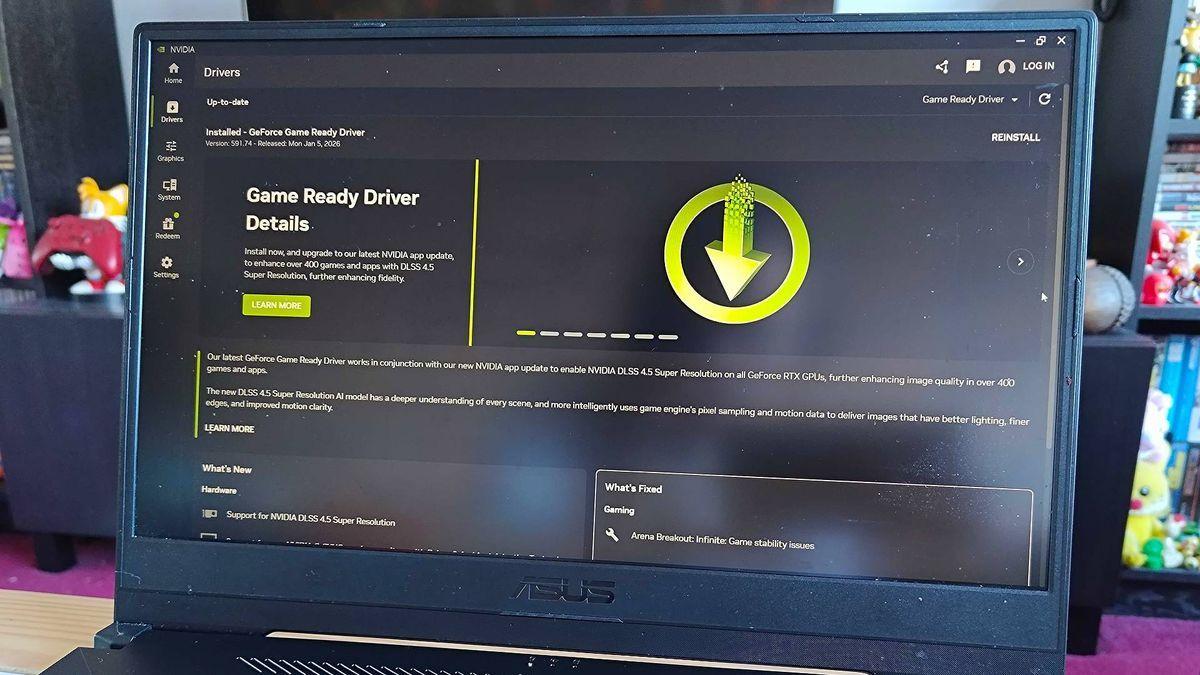
Source: GamesRadar
Enhanced Image Quality Through Improved Transformer Model
At the core of DLSS 4.5 lies a second-generation transformer model that delivers enhanced image quality through more sophisticated image reconstruction quality processes. The improved transformer model focuses on converting lower-resolution renders into higher-resolution outputs while preserving detail and maintaining stable motion across frames
2
. Nvidia claims the updated model can take advantage of additional processing headroom when available, applying more compute power to refine how it reconstructs textures, edges, and fine detail during motion. The visual improvements include improved lighting and textures, better edge handling, and enhanced motion clarity3
. These refinements specifically target common AI upscaling issues, working to reduce artifacts like ghosting and shimmer that have plagued earlier versions.Performance Trade-offs for Older RTX Hardware
While DLSS 4.5 brings image quality improvements, it comes with significant performance considerations, particularly for older hardware. Nvidia acknowledges that the second-generation Super Resolution requires 5x more power compared to the previous generation model
1
. This increased power draw translates into noticeable performance loss for RTX 30 series and RTX 20 series GPUs, with reports indicating frame rate drops of up to 20% compared to DLSS 4. The performance hit stems from older Tensor cores lacking FP8/FP4 support—the AI floating-point capabilities built into newer RTX 40 and 50 series cards3
. While RTX 50 series graphics cards handle the increased computational demands without significant power draw concerns, owners of older hardware may need to weigh the visual benefits against potential frame rates losses. Nvidia suggests users experiencing performance issues can stick with the DLSS 4.0 "Model K" by selecting the override option in the NVIDIA App.
Source: XDA-Developers
Related Stories
Stronger Scene Context and Artifact Reduction
The technical improvements in DLSS 4.5 extend beyond raw processing power. Nvidia emphasizes stronger scene context interpretation as a key advancement, with the model better understanding temporal data, motion information, and heuristics to determine what should remain stable between frames
2
. This enhanced interpretation helps reduce artifacts that become visible during fast camera pans, particle-heavy effects, or around thin high-contrast edges. The system now delivers cleaner edge handling and reduced ghosting—the faint trails that appear behind moving objects in motion-heavy scenes. Demonstrations at CES showed the improvements in action, with observers noting that the difference between native TAA rendering and DLSS 4.5 set to quality mode in games like Arc Raiders was barely perceptible1
. These subtle but meaningful visual gains become more apparent once pointed out, particularly regarding temporal stability and the reduction of flickering and image trails.What This Means for PC Gaming's AI Future
The rollout of DLSS 4.5 reflects Nvidia's strategic positioning as an AI company that happens to make gaming GPUs, rather than the reverse. The technology now competes in a landscape where Sony's PSSR and AMD's FSR offer alternative upscaling solutions
3
. For players with aging hardware, DLSS 4.5 offers potential to achieve playable frame rates across Steam libraries, though the "fake frames" debate continues among enthusiasts who question AI-generated imagery paired with natively rendered content. The update arrives as Frame Generation support reaches 240 games and apps, though the announced 6x DLSS Multi-Frame Generation remains unavailable in this release. It remains unclear whether Nvidia plans to improve DLSS 4.5's efficiency with older GPUs, leaving RTX 20 and 30 series owners to decide whether the enhanced image quality justifies the performance trade-off.References
Summarized by

Navi
[1]
Related Stories
Nvidia DLSS 4.5 brings Dynamic Multi-Frame Generation to RTX 50-series GPUs on March 31
10 Mar 2026•Technology
Nvidia DLSS 4.5 launches with 6x frame generation and dynamic mode for RTX 50 series GPUs
31 Mar 2026•Technology

Nvidia releases DLSS 4.5 with enhanced AI upscaling as 6x frame generation waits until spring
14 Jan 2026•Technology
Recent Highlights


Recent Highlights
Today's Top Stories








Your Daily Dose of Curated AI News
Don’t drown in AI news. We cut through the noise - filtering, ranking and summarizing the most important AI news, breakthroughs and research daily. Spend less time searching for the latest in AI and get straight to action.

