Nvidia releases DLSS 4.5 with enhanced AI upscaling as 6x frame generation waits until spring


4 Sources
[1]
Nvidia Proves It Still Has the Best Software for Better-Looking Games
While 6x frame gen won’t be here until spring, better AI upscaling is more than welcome. Nvidia’s latest version of its Deep Learning Super Sampling technology, aka DLSS, hit the scene early Wednesday. With the latest update in tow comes a slightly redesigned upscaler that is now better than
[2]
Deciphering DLSS 4.5: I tested Nvidia's new upscaler and figured out when to use Model L or M
DLSS 4.5 is out of beta and available to use by everyone. Make sure you update your Nvidia app and GPU drivers and it's all yours across all the games that already support DLSS 4! Just open the app to update or download it manually here. But after testing it over the past few days since going
[3]
I hate to agree with Nvidia about an AI thing, but come on, PC gamers -- it's time to stop whining about 'fake frames' and take the free performance boosts
DLSS 4.5 has arrived! Yes, Nvidia revealed yet another upgrade to its performance-boosting software suite at CES 2026 in Las Vegas last week, and it goes beyond just an iterative improvement to the resolution-upscaling tech at the core of DLSS: we're also getting a new level of Multi Frame
[4]
NVIDIA DLSS 4.5 Super Resolution: Full Guide, Image Quality Analysis & Performance Impact
NVIDIA DLSS 4.5 is the latest version of its machine learning based (ML) temporal upscaling and frame generation technologies, officially released for all GeForce RTX GPU users via updates to the NVIDIA app and with support from their latest Game Ready driver in January 2026 (temporal upscaling
Share
Copy Link
Nvidia launched DLSS 4.5, introducing a second-generation transformer model for AI upscaling that delivers sharper textures and reduced ghosting in games. While the new Model L and M presets show measurable improvements in performance modes, the highly anticipated 6x Multi Frame Generation capability won't arrive until spring 2026. Testing reveals DLSS 4.5 makes the biggest difference for mid-range GPUs running at 1440p resolution.
Nvidia DLSS 4.5 Launches with Second-Generation Transformer Model
Nvidia released DLSS 4.5 in early January 2026, delivering an updated version of its Deep Learning Super Sampling technology that focuses on refining AI upscaling rather than expanding frame generation capabilities
1
. The update, announced at CES 2026, incorporates a second-generation transformer model for Super Resolution that has been trained on a significantly larger dataset of game footage4
. This AI-powered upscaling system renders games at lower resolutions before using neural networks to upscale them to higher resolutions, enhancing visual fidelity while maintaining optimal gaming performance.
Source: Wccftech
The DLSS 4.5 upscaling technology marks a shift in Nvidia's approach, prioritizing improved image reconstruction over the "fake frames" controversy that has surrounded Multi Frame Generation (MFG) features
3
. According to Nvidia engineers, the new transformer model requires roughly five times the inference compute of the previous version but delivers better spatial and temporal detail understanding, leading to sharper anti-aliasing and reduced visual artifacts4
.Understanding Model L and Model M Performance Differences
The updated Nvidia app now allows GeForce RTX GPU users to override DLSS models in supported games, with two new presets based on DLSS 4.5
1
. Model L targets ultra-performance mode, designed for players attempting to reach 4K resolution, while Model M focuses on performance mode and above, prioritizing clarity and detailed graphics2
.Testing conducted on a Framework Laptop 16 equipped with a GeForce RTX 5070 laptop GPU with 8GB of VRAM revealed notable improvements in Black Myth: Wukong, where the Model M preset delivered framerates jumping from 45-48 fps with DLSS 4 to around 50-60 fps with DLSS 4.5 at very high graphics settings with ray tracing set to medium
1
. In Marvel's Spider-Man II running at medium settings with ray tracing set to high, foliage appeared sharper with DLSS 4.5, though performance improvements were minimal .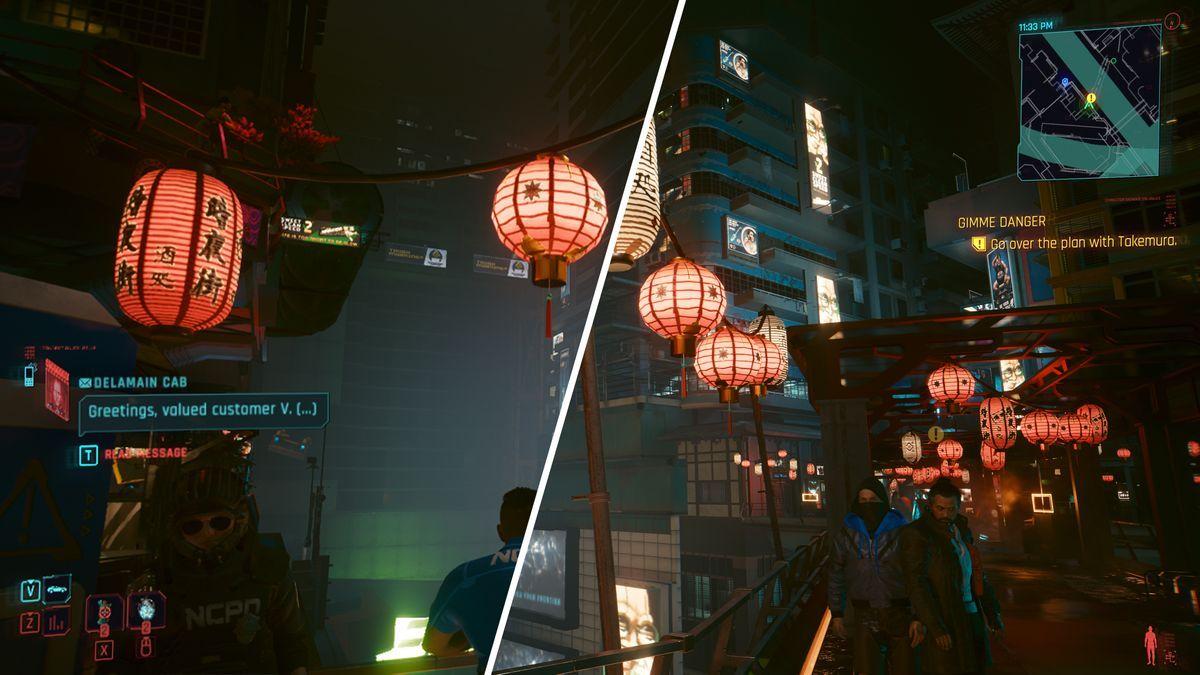
Source: Tom's Guide
Additional testing revealed that DLSS 4.5 performs best when using performance modes rather than quality or balanced settings
2
. Players focused on ultimate fidelity may want to stick with DLSS 4, as the new model shows reduced ghosting around objects, better distant detail, and less shimmering primarily in performance modes2
.Frame Generation Capabilities and Spring 2026 Timeline
While DLSS 4.5 brings immediate improvements to AI upscaling, the promised 6x Multi Frame Generation mode remains unavailable until spring 2026
1
. This Dynamic Multi-Frame Generation feature, exclusive to RTX 50 series GPUs, will dynamically adjust frame generation between 4x and 6x modes to maximize display refresh rates1
. Nvidia confirmed the dynamic frame gen plugin will be available to developers through the DLSS Multi Frame Generation Streamline Plugin this spring1
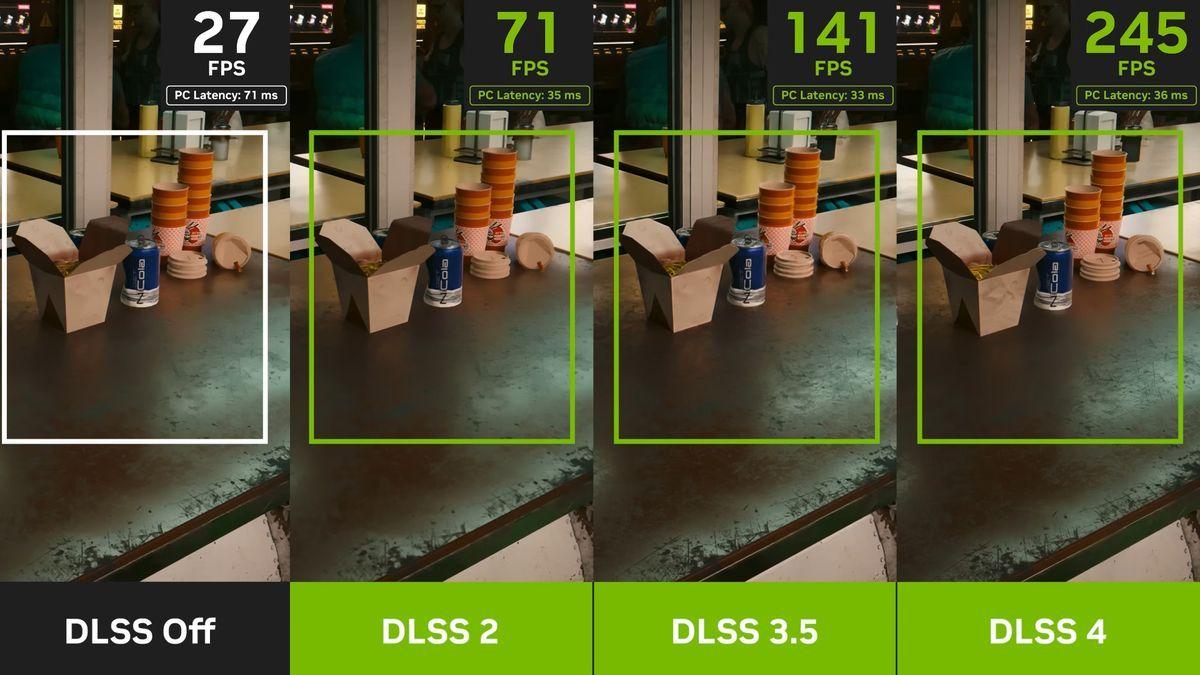
.Current testing with existing frame generation modes shows that 2x frame gen provides free performance boosts with minimal visual degradation. On the RTX 5060 at 1440p output resolution with DLSS set to Balanced, Alan Wake II jumped from 40 fps to 55 fps average with 2x frame generation, with extremely minimal loss in visual clarity
3
. However, 4x mode introduced noticeable ghosting, blurring, and input latency issues3
.
Source: TechRadar
Nvidia CEO Jensen Huang discussed the company's vision for gaming performance, suggesting that "more and more computation" could be done on "fewer and fewer pixels"
2
. This approach positions DLSS as central to future gaming performance optimization, though questions remain about how older RTX GPUs will handle the increased computational demands of the advanced transformer model2
.Related Stories

Image Quality Gains and Hardware Considerations
The second-generation transformer model in DLSS 4.5 works directly in linear color space rather than compressed domains, enabling more accurate handling of high-contrast elements like neon reflections and bright highlights
4
. This results in finer edge rendering, sharper details, and improved temporal stability compared to the first-generation transformer model4
.DLSS makes more of a difference for players running cheaper gaming rigs than for platforms with higher-end specs
1
. Environmental details like sparks from fires, which previous DLSS versions struggled to capture, now appear more prominently, while texture sharpness has improved and ghosting around environmental details has been reduced1
. On newer RTX 40 and RTX 50 series GPUs, FP8 precision acceleration helps mitigate the greater performance cost of the enhanced model while delivering superior upscaled visuals4
.References
Summarized by

Navi
[2]
Related Stories
Nvidia DLSS 4.5 launches with 6x frame generation and dynamic mode for RTX 50 series GPUs
31 Mar 2026•Technology

Nvidia unveils DLSS 4.5 with 6x Frame Generation and improved AI upscaling at CES 2026
06 Jan 2026•Technology
Nvidia DLSS 4.5 brings AI upscaling improvements to all RTX GPUs, but older cards may struggle
14 Jan 2026•Technology

Recent Highlights



Recent Highlights
Today's Top Stories









Don’t drown in AI news. We cut through the noise - filtering, ranking and summarizing the most important AI news, breakthroughs and research daily. Follow topics that matter to you and stay ahead.


