Nvidia posts $68B revenue quarter as AI chips demand accelerates, forecasts $78B ahead


48 Sources
48 Sources
[1]
Nvidia has another record quarter amid record capex spends | TechCrunch
Chip giant and world's most valuable company Nvidia reported record profits in its most recent quarter on Wednesday, as demand for AI compute continues to skyrocket. "The demand for tokens in the world has gone completely exponential," CEO Jensen Huang said on a call with analysts following the results. "I think we're all seeing that, to the point where even our six-year-old GPUs in the cloud are completely consumed and the pricing is going up." The company reported $68 billion in revenue in the most recent quarter, up 73% from the prior year, with $62 billion of that revenue coming from the company's data center business. Notably, Nvidia divided the data center revenue into $51 billion in compute revenue (largely GPUs) and $11 billion in networking products like NVLink. The company reported $215 billion in revenue for the full year. As in previous quarters, the company did not report any revenue from chip exports to China, despite the recent lifting of export restrictions by the U.S. government. "While small amounts of H200 products for China-based customers were approved by the US government, they have yet to generate any revenue, and we do not know whether any imports will be allowed into China," Colette Kress, the company's chief financial officer, said. "Our competitors in China, bolstered by recent IPOs, are making progress," she continued, in an apparent reference to Moore Threads' IPO in December, "and have the potential to disrupt the structure of the global AI industry over the long term." During the investor call, Huang also addressed the company's pending investment in OpenAI, which has been reported at $30 billion. "We continue to work with OpenAI toward a partnership agreement. We believe we are close," Huang said. He also referenced partnerships with Anthropic, Meta, and Elon Musk's xAI. However, statements Nvidia filed with the U.S. Securities and Exchange Commission on Wednesday emphasized that there was "no assurance" an investment would take place. Huang also addressed concerns about the sustainability of tech companies' capex commitments, saying he believed the compute investments would soon bring revenue. "In this new world of AI, compute is revenue. Without compute, there's no way to generate tokens. Without tokens, there's no way to grow revenues," Huang said. "We've reached the inflection point and we're generating profitable tokens that are productive for customers and profitable for the cloud service providers"
[2]
Mainland Traders Sell Hong Kong Stocks on Earnings Frustration
Mainland Chinese investors are accelerating their exit from Hong Kong-listed shares, signaling impatience with big technology firms' inability to translate artificial intelligence spending into earnings growth. Southbound investors sold HK$7.4 billion ($946 million) worth of stocks traded in the Asian financial hub on Thursday, adding to the HK$4 billion of such sales the previous day and marking the heaviest outflow since a record in late August. The selling came as the Hang Seng Tech Index slumped deeper into a bear market after falling around 5% since Monday, with Baidu Inc., Kuaishou Technology and Meituan among the worst performers. The quickening exodus is the latest indication that China's Internet behemoths are losing favor to onshore AI hardware stocks that have delivered earnings growth. Southbound investors' lack of access to Hong Kong-listed chip firms such as Zhipu and Minimax Group Inc., both of which have yet to join a trading link with the mainland bourses, as well as an appreciating yuan, are also denting the appeal of the city's shares. In a sign of authorities' intention to slow the yuan's gains, China's central bank on Friday announced the removal of the additional charge for betting against the currency in the derivatives market. Nvidia Corp., the dominant maker of artificial intelligence chips, suffered its worst stock decline in 10 months after the company's latest forecast failed to dispel fears of an AI bubble. The shares fell 5.5% to $184.89 in New York, marking the biggest one-day drop since April 16. The decline followed a first-quarter sales outlook that -- on its face -- looked impressive. Nvidia easily beat the average analyst estimate and delivered a 73% surge in fourth-quarter revenue. Instant Reaction Nvidia's Upbeat Sales Arrow Right 24:53 The reaction was a stark reminder of the skepticism now surrounding Nvidia. After explosive sales growth turned the chipmaker into the world's most valuable company, investors are seeking stronger assurances that booming AI spending can be maintained. Shareholders have lingering questions over "whether the current AI spending wave can sustain growth beyond the next few years, and whether Nvidia will remain as dominant as AI shifts from training models to running everyday tasks," analysts at Hargreaves Lansdown said in a note after the results. Chief Executive Officer Jensen Huang pushed back on the concerns during a conference call Wednesday, arguing that customers are already making money from their newly acquired computing power. That's why clients will keep investing at elevated levels, he said. "You need compute capacity, and that translates directly to growth, and that translates directly to revenues," Huang said. "I'm confident their cash flows are growing." Explainer: Why Nvidia's China Comeback Is Fraught With Risks Investor Michael Burry, made famous by The Big Short, added to the worries on Thursday. He noted that Nvidia has purchase obligations of $95.2 billion, compared with $16.1 billion a year earlier. That could be risky if demand wavers. Chief Financial Officer Colette Kress tried to defuse other concerns raised by analysts, including the specter of supply constraints. The company has secured enough components to be able to meet growing demand, she said. It remains a challenge to produce enough of Nvidia's most advanced chips, she told analysts. But the company's current Blackwell lineup -- and an upcoming successor, called Rubin -- will still beat earlier sales projections, Kress said. Nvidia had previously said that the chips would generate $500 billion by the end of 2026. "We believe we have inventory and supply commitments in place to address future demand, including shipments extending into calendar 2027," she said. Nvidia still faces uncertainty in China, the largest market for chips. The US government has granted licenses to ship a small amount of H200 processors to customers there, but Nvidia doesn't know if the Chinese government will give its approval, Kress said. For now, the company will continue to exclude data center revenue in China from its forecasts. The small-scale license provided by the Trump administration requires the chips to go through a US inspection before they can be shipped to customers, Nvidia said. And the processors are subject to a 25% tariff when they come into the US. Nvidia is the dominant seller of accelerator chips, processors designed to handle the huge amounts of data needed to create artificial intelligence models. The semiconductors are also used to run the software -- a stage known as inference -- when it carries out tasks in response to real-world inputs. Santa Clara, California-based Nvidia has branched out into general-purpose processors, networking and full computer systems, giving it an even greater hold on customers. Fiscal first-quarter revenue will be about $78 billion, the chipmaker saidBloomberg Terminal. Though the average prediction was $72.8 billion, some analysts had projected numbers approaching $80 billion, according to data compiled by Bloomberg. In the fiscal fourth quarter, which ended Jan. 25, revenue gained 73% to $68.1 billion. Profit was $1.62 a share, excluding certain items. Analysts had predicted $65.9 billion in sales and $1.53 a share in earnings. Adjusted gross margin, the percentage of revenue remaining after deducting costs of production, was 75.2%. That also edged past estimates. "We aren't sure what else investors want to hear at this point. But we like what we heard," Bernstein analyst Stacy Rasgon wrote in a note after results. Nvidia's data center unit, which is responsible for its industry-leading AI accelerator and networking products, had revenue of $62.3 billion in the quarter. That compares with an average analyst estimate of $60.4 billion. Other areas weren't as strong. Gaming, which offers graphics chips that once provided the majority of Nvidia's revenue, generated $3.73 billion in sales. The average estimate was $4.01 billion. Automotive-related sales were $604 million, with Wall Street predicting $643 million. One cloud is hanging over the tech industry: a shortage of memory chips. Like much of the electronics industry, Nvidia's products are reliant on a steady supply of these components, which provide short-term storage in everything from smartphones to supercomputers. Constraints have sent memory prices soaring and made it harder to ship as many devices this year. That crunch has held back the gaming division, and Kress said she doesn't know whether the problem will ease enough this year to let the business grow. In any case, data center chips for AI have become a far bigger focus. Earlier this month, Nvidia announced that Meta Platforms Inc. has agreed to deploy "millions" of Nvidia processors over the next few years, tightening an already close relationship between two of the biggest companies in AI. Nvidia's main rival, Advanced Micro Devices Inc., announced this week a similar long-term deal with Meta. That chipmaker said the transaction would be worth multiple tens of billions of dollars. A flurry of such megadeals, aimed at locking down long-term commitments for computing capacity, has been offered by the chipmakers as evidence that the AI economy is strong. But the cozy nature of these transactions -- with suppliers and customers sometimes taking financial stakes in one another -- has drawn criticism about circular deals potentially inflating demand.
[3]
Nvidia still waiting on Chinese H200 revenues to materialize
GPU giant sees yet more growth coming soon, most of it in the datacenter Nearly three months after the Trump administration allowed Nvidia to sell its H200 accelerator in China, the GPU giant is still for Beijing to allow them in and for any revenue to materialize. CFO Colette Kress isn't counting on the situation to improve any time soon either. The company's Q1 2027 revenue forecast doesn't account for a single cent of Chinese datacenter revenues. In early December, the Trump administration reversed an export ban restricting the sale of Nvidia's H200 accelerators to Chinese customers, in exchange for a 25 percent cut of the revenue from sales. The 2023-vintage chip remains one of the GPU giant's most potent AI accelerators. "While small amounts of H200 products for China based customers were approved by the US government, we have yet to generate any revenue, and we do not know whether any imports will be allowed into China," Kress said. That's a reference to the fact that while Washington is happy for H200 sales, Beijing has not granted its blessing. Speaking with analysts, Kress emphasized the dangers of a technological decoupling. "Our competitors in China, bolstered by recent IPOs, are making progress and have the potential to disrupt the structure of the global AI industry over the long term," she said. "To sustain its leadership position in AI... America must engage every developer and be the platform of choice for every commercial business, including those in China." Kress' comments broadly align with concerns raised by rival AMD, and partners, Microsoft, Coreweave, and OpenAI last northern spring. China isn't the only place Nvidia lacks visibility. Asked about the viability of orbital datacenters, CEO Jensen Huang opined about the economics, challenges and opportunities of deploying GPUs in space. According to Huang, artificial intelligence in space will have very interesting applications, but it also faces challenges different from what we're used to here on Earth. "The way that space works is radically different than how it works down here. There's an abundance of energy, but solar panels are large, but there's plenty of space in space," he said. "The energy, the heat dissipation, it's cold in space. However, there's no air flow, and so the only way to dissipate that heat is through conduction, and the radiators that you need to create are fairly large. Liquid cooling is obviously out of the question, because it's kind of heavy and freezes." Having said that, Huang argues that there are AI applications that do make sense to compute in space. "There are many different computing problems that really want to be done in space," he said. "One of the best use cases of GPUs in space is imaging. To be able to do imaging at very large, very high resolutions, extremely large scales and very, very fast, it's hard to do that by sending petabytes and petabytes of imaging data back here on Earth and doing that work, it's easier just to do it out in space." For the moment, Huang said the economics of space-based datacenters are poor, but argued this will improve over time. He's not alone in those views. "Companies are wasting money by pouring funds into the orbital datacenter 'bubble' because the economics do not work," Gartner analyst Bill Ray wrote in a report this week, describing the entire idea as "peak insanity." Yet Google is also exploring the potential for space-based TPU clusters, while Amazon founder Jeff Bezos predicts that within the next two decades gigawatt-scale datacenters would fill the skies powered by an enduring stream of photons. Elon Musk, however, is all-in on the idea of orbiting datacenters and plans to make it happen soon. Even without orbital datacenters or Chinese H200 sales, Nvidia expects to continue its rally as it heads into the 2027 fiscal year. The company expects to rake in $78 billion give or take two percent during the first quarter as it capitalizes on growing demand from hyperscale customers, like Meta, Google, Amazon, and Microsoft which expect to plow a collective $635 billion into datacenters and AI infrastructure this year alone. The rosy outlook, which would amount to almost 90 percent year-over-year revenue growth, follows a particularly strong quarter for the GPU slinger. In Q4, Nvidia's profits topped $42.96 billion on revenues of $68.12 billion. Nvidia's datacenter business accounted for more than 90 percent of revenues at $62.3 billion. By comparison, the company's gaming, professional visualization, and automotive businesses could soon be rounding errors at $3.7 billion, $1.3 billion, and $604 million, respectively, if trends continue. For the full 2026 fiscal year, Nvidia turned a $120 billion profit on revenues of $215.93 billion. ®
[4]
Nvidia forecasts upbeat quarterly sales as AI boosts chip demand
Feb 25 (Reuters) - Chipmaker Nvidia (NVDA.O), opens new tab forecast first-quarter revenue above market estimates on Wednesday, betting on Big Tech's unabated spending on its artificial intelligence processors amid widespread scrutiny of massive AI investments. Shares of the company rose over 3% in extended trading. The world's most valuable company expects fiscal first-quarter sales of $78 billion, plus or minus 2%, compared with analysts' average estimate of $72.60 billion, according to data compiled by LSEG. Investors are looking to Nvidia's results to gauge whether the hundreds of billions of dollars that Big Tech is pouring into data center infrastructure are paying off. Wall Street has been betting on signs of robust demand for Nvidia's top-of-the line AI chips, an assumption backed by hefty capital expenditure from Alphabet (GOOGL.O), opens new tab, Microsoft (MSFT.O), opens new tab, Amazon.com (AMZN.O), opens new tab and Meta Platforms (META.O), opens new tab, expected to total at least $630 billion in 2026, with most of the spending earmarked for data centers and processors. Businesses and governments are spending relentlessly in the race to develop the most sophisticated AI tech, or risk falling behind. But signs of risk to Nvidia's long-held dominance in making AI chips are emerging. Smaller rival AMD (AMD.O), opens new tab is set to unveil a new flagship AI server later this year and has clinched deals with Nvidia's top customers, including Meta. Meanwhile, Alphabet's Google has emerged as a top rival with a deal to provide Claude chatbot creator Anthropic with its in-house chips called TPUs. Google is also in talks to supply Meta, according to media reports. Big Tech is increasingly turning inward in the quest for more computing power, dedicating resources to designing in-house chips that they are deploying in their data centers. The company reported January-quarter sales of $68.13 billion, beating estimates of $66.21 billion, according to LSEG data. It said adjusted profits came in at $1.62 per share, compared with estimates of $1.53, according to LSEG data. In a closely watched results report, which was released about 10 minutes later than expected, Nvidia said its forecast for the current quarter did not include any expected revenue from sales of its data center chips to China. Analysts and investors were counting on the potential return of Nvidia's AI chip sales to China, earlier restricted due to export curbs placed by the U.S. government. CEO Jensen Huang said last month that he hopes China will allow the company to sell its powerful H200 AI chip in the country and that the license is being finalised. Rival AMD has added sales of AI chips back to its forecast for the current quarter after it received licenses to ship some of its modified processors to China. Nvidia said it has secured inventory and capacity to meet demand beyond the next several quarters. The company also said it will include stock-based compensation expense in its non-GAAP financial measures, veering away from broader industry trends at a time when tech firms are fighting each other for top AI engineers and researchers. "Stock-based compensation is a foundational component of Nvidia's compensation program to attract and retain world-class talent," the company said in a statement. Reporting by Arsheeya Bajwa and Zaheer Kachwala in Bengaluru, Stephen Nellis in San Francisco; Editing by Shinjini Ganguli Our Standards: The Thomson Reuters Trust Principles., opens new tab
[5]

Nvidia's forecast points to accelerating growth, as Vera Rubin starts hitting market
Nvidia just reported its 11th straight quarter of revenue growth above 55% as the leading tech names keep snapping up the company's AI chips. Already the world's most valuable public company, growth is now reaccelerating. In its earnings report Wednesday, Nvidia said year-over-year revenue will surge about 77% this quarter to roughly $78 billion. That would mark the fastest growth rate for any period since the quarter ending January 2025, when expansion came in slightly higher at 78%. Its forecast sailed past the $72.6 billion average analyst estimate, according to LSEG. Revenue in the fourth quarter jumped 73%, also topping estimates, following expansion of 62% in the prior period. The data center business, home to Nvidia's AI graphics processing units, now accounts for over 91% of sales. The chipmaker's optimistic outlook comes as the company ramps production of Vera Rubin, its next rack-scale system for AI that will succeed Grace Blackwell. Nvidia says the system's 72 next-generation Rubin graphics processing units (GPUs) are expected to deliver 10 times more performance per watt, compared to their predecessors.
[6]

Chip giant Nvidia defies AI concerns with record $215bn revenue
Chip giant Nvidia has reported record annual revenue of $215.9bn (£159.1bn), despite a wave of investor scepticism about the massive amounts of money being spent on artificial intelligence (AI) technology. The firm also beat analyst's forecasts as sales for the last three months of its financial year jumped by 73% compared to 12 months earlier. "Computing demand is growing exponentially," boss Jensen Huang said. "Our customers are racing to invest in AI compute - the factories powering the AI industrial revolution and their future growth." While providing chips for companies across the AI sector, Nvidia has also laid out plans in recent weeks to generate demand with new technologies of its own. Nvidia is the world's most valuable publicly-traded company, with a stock market value of around $4.8tn. It has become a central player in the buildout of AI infrastructure, providing sophisticated chips to leading AI model developers including OpenAI and Meta. Gene Munster, manager partner at Deepwater Asset Management, said that buildout was likely to continue for a long time. "AI is accelerating faster than people not using these tools can grasp," Munster wrote on the social media platform X on Wednesday. Nvidia has been scrutinised by investors who worry about its ever-expanding web of deals with other companies. Critics have raised the spectre of "circular financing" deals in which investments by Nvidia in other companies may be clouding perceptions about how robust AI demand really is. Meanwhile, the company has been caught in a geopolitical tug-of-war between the US and China. The outlook released by Nvidia on Wednesday did not include expectations about chip revenue in China. Last month, the Trump administration began allowing Nvidia to sell its H200 chips - Nvidia's second-most advanced type - to Chinese customers under certain conditions. But this week, a US Commerce Department official told lawmakers that none of those chips have yet been sold to Chinese customers. Nvidia is also expanding its own product line in a bid to have more involvement in the physical products in which AI is embedded. Last month at the CES technology trade show in Las Vegas, Huang unveiled a new tech platform for self-driving cars. Huang said the open-source AI model, which the company is calling "Alpamayo," will bring reasoning to autonomous vehicles. Nvidia also said it is was planning to launch a robotaxi service by next year in partnership with an unnamed partner. Nvidia chips have led in the training of AI models, but it has faced an onslaught of competition in inference, the process whereby a trained model is applied to real-world data to generate answers through reasoning. During the fourth quarter, Nvidia acquired rival Groq in a $20bn deal that's expanding its expertise in inference. Sign up for our Tech Decoded newsletter to follow the world's top tech stories and trends. Outside the UK? Sign up here.
[7]
Nvidia's Rosy Revenue Forecast Shows the AI Boom Remains Strong
Nvidia Corp., the world's most valuable company, gave another bullish quarterly revenue forecast, signaling that the massive build-out of AI computing remains on track. Fiscal first-quarter sales will be about $78 billion, the chipmaker said in a statementBloomberg Terminal Wednesday. That compares with an average Wall Street estimate of $72.8 billion, according to data compiled by Bloomberg. "Our customers are racing to invest in AI compute -- the factories powering the AI industrial revolution and their future growth," Chief Executive Officer Jensen Huang said in the statement. The outlook helped soothe concerns about a bubble in AI investments. Huang has repeatedly downplayed fears that the run-up in spending on artificial intelligence hardware isn't sustainable. He argues that it will take years to replace the world's installed base of older computers with machines that offer a leap forward in productivity. But some investors had grown weary of that optimism and traded out of stocks like Nvidia. Wednesday's report provides some evidence that near-term worries may be overblown. Nvidia shares, among the 10 worst-performing chipmaker stocks this year, rose about 4% in extended trading following the announcement. Get the Tech Newsletter bundle. Get the Tech Newsletter bundle. Get the Tech Newsletter bundle. Bloomberg's subscriber-only tech newsletters, and full access to all the articles they feature. Bloomberg's subscriber-only tech newsletters, and full access to all the articles they feature. Bloomberg's subscriber-only tech newsletters, and full access to all the articles they feature. Bloomberg may send me offers and promotions. Plus Signed UpPlus Sign UpPlus Sign Up By submitting my information, I agree to the Privacy Policy and Terms of Service. Nvidia is the dominant seller of accelerator chips, processors designed to handle the huge amounts of data needed to create artificial intelligence models. The semiconductors are also used to run the software -- a stage known as inference -- when it carries out tasks in response to real-world inputs. Nvidia has branched out into general-purpose processors, networking and full computer systems, giving it an even greater hold on customers. In the fiscal fourth quarter, which ended Jan. 25, revenue gained 73% to $68.1 billion. Profit was $1.62 a share, excluding certain items. Analysts had predicted $65.9 billion in sales and $1.53 a share in earnings. Adjusted gross margin, the percentage of revenue remaining after deducting costs of production, was 75.2%. That also edged past estimates. One cloud hanging over the tech industry: a shortage of memory chips. Like much of the electronics industry, Nvidia's products are reliant on a steady supply of these components, which provide short-term storage in everything from smartphones to supercomputers. Supply constraints have sent memory prices soaring and made it harder to ship as many devices this year. Santa Clara, California-based Nvidia said in its report that the company has enough supplies. "We have strategically secured inventory and capacity to meet demand beyond the next several quarters," it said. Nvidia's data center unit, which is responsible for its industry-leading AI accelerator and networking products, had revenue of $62.3 billion in the quarter. That compares with an average analyst estimate of $60.4 billion. Other areas weren't as strong. Gaming, which offers graphics chips that once provided the majority of Nvidia's revenue, generated $3.73 billion in sales. The average estimate was $4.01 billion. Automotive-related sales were $604 million, with Wall Street predicting $643 million. Earlier this month, Nvidia announced that Meta Platforms Inc. has agreed to deploy "millions" of Nvidia processors over the next few years, tightening an already close relationship between two of the biggest companies in AI. Nvidia's main rival, Advanced Micro Devices Inc., announced this week a similar long-term deal with Meta. That chipmaker said the transaction would be worth multiple tens of billions of dollars. A flurry of such megadeals, aimed at locking down long-term commitments for computing capacity, has been offered by the chipmakers as evidence that the AI economy is strong. But the cozy nature of these transactions -- with suppliers and customers sometimes taking financial stakes in one another -- has drawn criticism about circular deals potentially inflating demand. Another major question: Nvidia is still waiting for clarity on whether it's going to be able to do business in China, the largest market for its products. A political standoff between Beijing and Washington has restricted Nvidia's ability to sell its best products to Chinese customers. Nvidia said Wednesday that it wasn't including any China data center revenue in its first-quarter sales outlook. But the company indicated in a filing that it was granted a US license this month to ship "small amounts" of its H200 chips to customers in the Asian nation. "To date, we have not generated any revenue under the H200 licensing program, and do not yet know whether any imports will be allowed into China," Nvidia said. "The license requires that the H200s go through an inspection process in the United States prior to any shipment to the customer. As a result, any H200 shipped under the new licensing program will be subject to a 25% tariff upon importation into the United States."
[8]

'Compute Equals Revenues': Nvidia Needs Jensen Huang's New Catchphrase to Be True
Nvidia reported earnings on Wednesday, and as expected, the numbers were good. Really good. The company gets more than 91% of its sales from its data center unit, which generated revenue of $193,737 billion, up 68% year-over-year. "We have now scaled our data center business by nearly 13x since the emergence of ChatGPT in fiscal 2023," Nvidia CFO Colette Kress said in the company's earnings call on Wednesday. While very impressive, the number is not all that surprising given that global AI spending is expected to reach $2.5 trillion this year, and Nvidia's largest customers, the major AI hyperscalers Amazon, Alphabet, Meta, and Microsoft, all reported record capex figures earlier this month. The hyperscalers also made eyewatering financial commitments for 2026 totaling nearly $700 billion, which came to the dismay of many investors who have been growing wary of AI spending. Earlier this month, Evercore analysts warned that the huge capex could turn the hyperscalers' cash flow negative. And despite the record after record multibillion-dollar commitment made to scale AI infrastructure and grow the technology's adoption across the American economy, the results are yet to fully materialize. A Goldman Sachs analyst recently said that AI contributed "basically zero" to U.S. GDP in 2025. Nvidia CEO Jensen Huang spent most of his time in the investor call trying to justify that capex growth. "I am confident in their cash flow growing, and the reason for that is very simple: we have now seen the inflection of agentic AI and the usefulness of agents across the world in enterprises everywhere," Huang said. AI adoption by enterprises beyond the tech world, and whether these companies actually see real productivity gains and revenue returns from AI integration, is really important to Nvidia, because that's a major thing that the AI industry is currently lacking to quell worries over an AI bubble. A recent survey found that despite 70% of firms employing AI, over 80% reported no impact on employment or productivity. Last week, OpenAI COO Brad Lightcap told TechCrunch that his company had "not really seen enterprise AI penetrate enterprise business process." Some experts believe that Anthropic's Claude Cowork unveiled earlier this month is going to be a turning point in AI's penetration into the workforce, so much so that they believe it will lead to a mass extinction-level event for software companies, and maybe even white-collar work. Huang gave a special shout-out to Claude Cowork in the call as well. Huang also had a technical explanation to justify the capex commitments. "In this new world of AI, compute equals revenues," Huang said, a phrase that he repeated many times throughout the call. Huang argues that tokens, aka the chunks of data that AI models process, are the most important part of a new AI economy. The more tokens a model uses, the more computing power and time it requires. So, as models are getting more complex, the demand for computing is also going up "exponentially," Huang said. He argued that the capex commitments will go towards building this compute capacity, which will thus power higher-level models and translate to revenue. "The amount of token generation capability that the world needs is a lot, more than $700 billion, and I'm fairly confident that we're going to continue to generate tokens...fundamentally because every single company depends on software, every software will depend on AI, and so every company will produce tokens," Huang said. "If the new software requires tokens to be generated and the tokens are monetized, then it stands to reason that their data center build-out directly drives their revenues." Huang's justifications may not have immediately convinced the market. Even though shares rose at first in response to the report, after the call, gains eventually pulled back to less than 1%. That's despite revenue that exceeded market expectations. Throughout the call, Huang also tried to address rumors of a falling out with OpenAI, first spurred after a $100 billion Nvidia investment announced back in September 2025 reportedly failed to progress beyond the early stages after months. Then, two back-to-back reports claimed that Huang was privately criticizing OpenAI's business approach while OpenAI was unhappy with the inference speed of Nvidia's chips. In the call on Wednesday, Huang repeatedly praised the AI giant's offerings, but revealed that the investment was still not finalized. "We continue to work with OpenAI toward a partnership agreement, and believe we are close," Huang said on the call. The filing also refuses to give any assurance that "a transaction will be completed." Another piece of uncertainty weighing on Nvidia is China. The company shared that, as of this month, the Trump administration has finally allowed it to start shipping small amounts of its H200 chips to China, where it once held 95% of the market share before Trump first banned the chipmaker's sales to China, sparking a saga of dizzying trade tit-for-tat between the two global superpowers. But executives still don't know if the imports will be allowed in, and are not factoring it into the revenue they expect this year.
[9]

Nvidia's Q4 results could make or break confidence in the AI hardware market
Nvidia has become shorthand for the AI market itself. In the years since generative models reshaped computing, the company's GPUs have powered everything from large-scale training clusters to real-time inference infrastructure. That dominance helped Nvidia's stock surge over 1,500 percent from 2022 into 2025 and made it one of the most valuable tech firms in history. Yet as its newest earnings report approaches, investors aren't just asking whether revenue is growing, they're asking whether the AI boom still has room to run. Analysts expect Nvidia to post another blockbuster quarter, with revenue forecasts between roughly $65 billion and $66 billion and adjusted gross margins near 75 percent. That kind of performance would mark continued strength in demand for high-end AI accelerators, particularly from cloud providers and hyperscalers that underpin much of the industry's infrastructure. On the surface, those numbers look almost routine at this point, after all, Nvidia has beaten estimates for revenue and earnings for more than a dozen straight quarters. But markets have shifted, and so has investor psychology. The question now isn't just "how much growth?", but "for how long?" and "toward what?" One reason for that shift is the growing push by major AI users to develop or adopt alternatives to Nvidia's hardware. Meta, Google and other hyperscalers are investing heavily in custom silicon or alternative accelerators designed to cut costs, optimize specific workloads, or gain strategic independence from Nvidia's ecosystem. Those moves don't immediately undercut Nvidia's sales, but they signal a longer-term competitive environment that didn't exist a few years ago. This isn't entirely new, the chip industry has always been cyclic and competitive, but it matters more now because so much of global AI infrastructure hangs off a single architecture. When customers start hedging that exposure, it naturally ripples through valuations and strategic forecasts. Another reason this earnings cycle feels different is the backdrop in broader markets. AI names have led the rally in tech stocks, but sentiment has softened. Over the first weeks of 2026, Nvidia's share price has barely budged compared with steep gains in previous years, even as other industries waver under economic uncertainty. Some analysts read this as a sign that markets are increasingly focused on profitability timelines and real-world deployment metrics rather than narrative alone. Part of that recalibration reflects broader anxiety about what some observers call an "AI bubble," where valuations in the sector may be disconnected from underlying economic fundamentals. Whether or not that label is fair, it reflects genuine investor nervousness about sustainability, return on investment, and how soon large companies will convert AI hype into consistent revenue growth. For Nvidia, this means earnings won't be judged simply on topline figures. The market will be listening closely to a few specific signals: A strong earnings beat with confident guidance could reassure markets that AI spending isn't slowing and that Nvidia remains the core engine of that demand. A modest beat or mixed signals, however, might validate some of the more cautious narratives and lead to broader tech sell-offs. Nvidia's report matters because it has become the default bellwether for AI infrastructure spending, and by extension, for how investors value growth in technology sectors. If the company shows that demand and pricing power remain robust, it supports a broader bull case for AI adoption. If not, we may see a re-rating of AI as an investment theme, with implications far beyond one company's earnings call. In that sense, this quarter isn't just about chips or quarterly revenue. It's about confidence: in AI's staying power, in enterprise capex cycles, and in the narrative that has driven one of the most remarkable growth stories in recent market history.
[10]
Nvidia results are AI market's biggest test amid competitive worries
Feb 24 (Reuters) - As Nvidia (NVDA.O), opens new tab heads into quarterly earnings on Wednesday, AI investors are seeking evidence that the chipmaker's profits are growing apace on the back of a $630 billion capital spending budget from Big Tech. But signs of risk to Nvidia's long-held dominance are also emerging from hyperscalers' plans to design their own cheaper AI chips. After powering much of the U.S. stock market rally for the past three years, Nvidia's stock has risen just about 2% so far in 2026. Along with Advanced Micro Devices, which is set to unveil a new flagship AI server later this year, Alphabet's (GOOGL.O), opens new tab Google has emerged as a top rival with a deal to provide Claude chatbot creator Anthropic with its in-house chips called TPUs. Google is also in talks to supply Meta (META.O), opens new tab - a large Nvidia customer, according to media reports. To defend its position, Nvidia struck a deal, reportedly worth $20 billion, last year to license chip technology from Groq - a move that analysts say would boost its position in the booming market for inference, the process by which a trained AI model answer questions in real time. Nvidia last week also agreed to sell millions of chips to Meta, though it did not disclose the value of the deal. But Nvidia, the biggest winner of the AI boom, has itself stoked doubts about whether the spending is sustainable by drawing out the process of a potential $100 billion investment in OpenAI, one of its biggest customers. A recent media report said it plans to replace that commitment with a smaller $30 billion investment. "This earnings in particular is important because people are so concerned about AI spending - whether we're in a bubble," said Ivana Delevska, chief investment officer of Spear Invest, which holds the company's shares in an exchange-traded fund. "Showing that earnings are not really decelerating will be pretty important." Wall Street expects Nvidia to report that profit in the quarter ended January surged more than 62%, according to data compiled by LSEG, a slowdown from 65.3% growth in the previous quarter as it faces tougher comparisons with its previous earnings. Revenue likely jumped more than 68% to $66.16 billion. Analysts expect Nvidia to forecast that first quarter revenue will grow another 64.4% to $72.46 billion. The company has surpassed sales expectations for the past 13 quarters, though that delta has shrunk. RBC analysts expect the company to forecast April quarter revenue at least 3% above estimates. Spear Invest's Delevska, an Nvidia bull, sees the company forecasting sales as much as $10 billion above estimates, expecting it to surpass market estimates by more than 13%. STILL NO. 1 Analysts are still expecting demand for Nvidia's pricey chips, which act as the "brains" of servers processing huge AI workloads to remain robust, and garner most of Big Tech's massive spending to expand AI data center capacity this year. Nvidia's executives also hinted in January that they were discussing data center orders for next year with customers, leading several analysts to forecast the company would update a $500 billion order backlog figure it first offered in October. The biggest constraint on Nvidia's growth, though, could be supply chain bottlenecks that limit the speed of AI chip shipments as Nvidia and rivals are vying for space on contract chipmaker TSMC's (2330.TW), opens new tab 3-nanometer assembly lines. "We think Nvidia will meet expectations, but it is hard to see them delivering much upside in light of TSMC capacity," Jay Goldberg of Seaport Research Partners wrote in a note. But the potential return of Nvidia's AI chip sales to China - earlier restricted due to export curbs placed by the U.S. government - could help bump up sales. CEO Jensen Huang said last month he hopes China will allow the company to sell its powerful H200 AI chip in the country and that the license is being finalised. Rival AMD (AMD.O), opens new tab added sales of AI chips back to its forecast for the current quarter after it received licenses to ship some of its modified processors to China. Nvidia is expected to record adjusted gross margin of 75% in the fourth quarter, an increase of more than one percentage point from the year-ago period. Analysts don't expect the company to hurt from the global memory supply shortage. Nvidia's pricing power and the likelihood of it already having locked in high-bandwidth memory allocations for the year would cushion it from the impact of rising memory prices, they said. Reporting by Arsheeya Bajwa and Aditya Soni in Bengaluru; Editing by Sayantani Ghosh Our Standards: The Thomson Reuters Trust Principles., opens new tab
[11]
Nvidia keeps the AI party alive with a booming quarter and even better outlook
Nvidia on Wednesday delivered strong quarterly results to cap off its fiscal year, outdone only by the chip giant's outlook for the current quarter, in a sign the AI boom continues apace. Revenue in the company's fiscal 2026 fourth quarter increased 73% year over year to $68.13 billion, outpacing the $66.2 billion the Street was looking for, according to estimates compiled by data provider LSEG. Adjusted earnings per share (EPS) increased 82% to $1.62, also exceeding the consensus estimate of $1.53, per LSEG data. Shares of Nvidia were slightly lower in extended trading, down about 50 cents apiece to $195.35. The stock had traded over $200 a share shortly after the numbers were released. The subdued reaction isn't a total surprise, even if we would prefer to see those initial gains hold. The massive post-earnings moves for Nvidia that became routine in the early days of the AI boom have long since passed. NVDA 1Y mountain Nvidia's stock performance over the past 12 months. Bottom line Talk about a strong earnings report. The results were good but the guidance for the current quarter is truly remarkable. Those who are skeptical of the sustainability of the AI boom keep waiting for the party to stop. Nvidia made it clear the party rages on. Sure, Nvidia's quarterly revenues were roughly $2 billion more than expected. Even more impressive, though, is that the team's guidance for the current quarter came in more than $5 billion ahead of estimates -- despite the fact the Street had time to factor in the hyperscaler's massive capex budgets for the year. In other words, analysts were right to raise their April quarter estimates in recent weeks. They just didn't raise them enough. Equally notable, CFO Colette Kress said on the earnings call that Nvidia expects sequential revenue growth throughout 2026, exceeding the $500 billion revenue opportunity for its Blackwell and Rubin generation chips that CEO Jensen Huang disclosed in the fall. Blackwell is its current chip family, with Rubin set to launch later this year. "We believe we have inventory and supply commitments in place to address future demand, including shipments, extending into calendar 2027," Kress said. As expected, Nvidia was asked about soaring memory costs and whether that poses a threat to the company's ability to maintain its impressive gross margins in the mid-70% range, a key level for investors ( as we discussed in our week ahead preview ). In response, Huang said the "single most important lever" that Nvidia can pull to protect its margins is delivering "generational leaps" in performance. Our reading of that answer: If Nvidia's products are still the best game in town , it's easier to pass on any rise in input costs without having to eat the hit to margins. Meanwhile, Kress also offered an encouraging detail on demand for Nvidia's older data center AI chips, which we think should help settle a big point of contention over the depreciation cycles for its hardware. "With Nvidia infrastructure in high demand, even Hopper and much of the six-year-old Ampere based products are sold out in the cloud," Kress said. In the fall, some of Nvidia's most important customers were catching heat for lengthening depreciation times in what critics called financial engineering designed to inflate their earnings. It got the point that mainstream media outlets, from our colleagues at CNBC to The Wall Street Journal , published deep dives into a debate usually reserved for a room of accountants. We're not knocking those who were skeptical of the lengthened depreciation schedules, but this is a reminder of why we preach the importance of listening to earnings calls and getting information from those with their boots on the ground. That's not to say we will blindly anyone at their word - there is almost always a conflict to be aware of - but when companies spend money, it's because they believe it will lead to positive returns, period. The debate around the lifespan of these chips remains relevant, even if it's not garnered as much attention lately. Why? The fact that six-year old Ampere generation chips are still being used is a sign of confidence to Nvidia's customers, especially the cloud providers who drive so much of its data center businesses. It means the cloud providers -- both giants like Microsoft and Amazon, as well as neoclouds like CoreWeave -- can buy with confidence, knowing that the chips purchased today can generate revenue for many years into the future, even as Nvidia releases new-and-improved products at an annual cadence. There's been questions whether releasing new chips every year will make some customers decide to just "sit out" a cycle, leading to an air pocket in demand. But this helps us understand why we haven't seen it yet. Sure, the older chips may not be suitable for the most cutting-edge AI initiatives, but not everything being done in the cloud requires that. We figure that will certainly remain the case going forward as today's most advanced AI applications are tomorrow's run of the mill workloads. Bottom line, it's clear that the demand for Nvidia's chips is only increasing as demand for AI ramps up. Companies have acknowledged that not having a plan for AI is akin to not having plan for a website in the early 2000s or a plan for mobile apps following the launch of the iPhone. To put a plan in place, you need to be thinking about compute and there can simply not be a conversation about compute without including Nvidia. While custom chips, such as those made by Club name Broadcom , will have their place for certain applications where volume permits it, we don't see Nvidia's status as the AI computing king changing anytime soon. Kress' commentary on demand are very bullish for the year ahead and, more importantly, backed by publicized spending intentions. As a result, we're reiterating our $230 price target and our hold-equivalent 2 rating. We're still optimistic, but are simply looking for a better opportunity to upgrade. Commentary Data Center , by far the most important of Nvidia's five operating segments, saw revenue growth accelerate to 75% year over year, coming in at to $62.3 billion, better than $60.7 billion the Street was anticipating. Within the data center unit, compute revenue rose 58% year over year to $51.3 billion, while networking revenue surged 263% to $10.98 billion. Hyperscale customers accounted for a little over 50% of the revenue here. However, we liked that Kress said in prepared remarks that "growth was led by the rest of our Data Center customers as revenue diversified." While we acknowledge that few companies on the planet can match the spending power of the hyperscalers, a broadening demand base will be crucial to blunting the impact of any one large customer pulling back on spend in the future. Gaming saw revenue jump 47% year over year to $3.73 billion. However, it still came up short versus estimates of $4.03 billion. Growth was driven by demand for the companies new Blackwell architecture. On the release, the team noted that supply constraints are expected to be a headwind "in the first quarter of fiscal 2027 and beyond," which can be chalked up to the memory shortage. Professional Visualization revenue advanced 159%, topping expectations thanks to "exceptional demand for Blackwell." Meanwhile, Automotive revenue was up 6% year over year thanks to continued adoption of self-driving platforms. The OEM & Other segment saw revenue increase 73% versus the year ago period to $161 million. This unit at Nvidia covers partnerships with original equipment manufacturers, licensing, and other things not accounted for in the other segments. Guidance Looking ahead to the current fiscal 2027 first quarter, management's outlook was well ahead of expectations. Revenue of $78 billion, plus or minus 2%, way ahead the $72.6 billion LSEG consensus estimate. Adjusted gross margins are expected to be 75%, plus or minus 50 basis points, which at the midpoint is better than the 74.5% estimate compiled by FactSet. Expectations for adjusted operating expenses in the fiscal first quarter of $7.5 billion. The team is not assuming any Chinese sales in this guide, so any progress in trade talks between now and the end of the quarter should amount to upside. (Jim Cramer's Charitable Trust is long NVDA and AVGO. See here for a full list of the stocks.) As a subscriber to the CNBC Investing Club with Jim Cramer, you will receive a trade alert before Jim makes a trade. Jim waits 45 minutes after sending a trade alert before buying or selling a stock in his charitable trust's portfolio. If Jim has talked about a stock on CNBC TV, he waits 72 hours after issuing the trade alert before executing the trade. THE ABOVE INVESTING CLUB INFORMATION IS SUBJECT TO OUR TERMS AND CONDITIONS AND PRIVACY POLICY , TOGETHER WITH OUR DISCLAIMER . NO FIDUCIARY OBLIGATION OR DUTY EXISTS, OR IS CREATED, BY VIRTUE OF YOUR RECEIPT OF ANY INFORMATION PROVIDED IN CONNECTION WITH THE INVESTING CLUB. NO SPECIFIC OUTCOME OR PROFIT IS GUARANTEED.
[12]
Chipmaker Nvidia flouts AI scepticism with record revenue
Chipmaker Nvidia reported its fourth quarter revenue jumped by 73% compared to the same period a year ago to $68.1bn (£50.2bn) - a record haul for the company. The revenue figures beat analyst expectations and come amid a wave of investor scepticism towards the massive amounts of capital being spent on artificial intelligence (AI) technology. "Computing demand is growing exponentially," boss Jensen Huang said. "Our customers are racing to invest in AI compute -- the factories powering the AI industrial revolution and their future growth." While providing chips for companies across the AI sector, in recent weeks Nvidia has also laid out plans to generate demand with new technologies of its own. The company reported total annual revenue of $215.9bn for the past fiscal year, and has projected a rosy outlook for the months ahead. Shares rose in afterhours trading following the release of Nvidia's quarterly earnings report. Nvidia is the world's most valuable publicly-traded company, with a market cap of around $4.8tn. It has become a central player in the buildout of AI infrastructure, providing sophisticated chips to leading AI model developers including OpenAI and Meta. Gene Munster, manager partner at Deepwater Asset Management, said that buildout was likely to continue for a long time. "AI is accelerating faster than people not using these tools can grasp," Munster wrote on the social media platform X on Wednesday. Nvidia has been scrutinised by investors who worry about its ever-expanding web of deals with other companies. Critics have raised the spectre of "circular financing" deals in which investments by Nvidia in other companies may be clouding perceptions about how robust AI demand really is. Meanwhile, the company has been caught in a geopolitical tug-of-war between the US and China. The outlook released by Nvidia on Wednesday did not include expectations about chip revenue in China. Last month, the Trump administration began allowing Nvidia to sell its H200 chips - Nvidia's second-most advanced type - to Chinese customers under certain conditions. But this week, a US Commerce Department official told lawmakers that none of those chips have yet been sold to Chinese customers. Nvidia is also expanding its own product line in a bid to have more involvement in the physical products in which AI is embedded. Last month at the CES technology trade show in Las Vegas, Huang unveiled a new tech platform for self-driving cars. Huang said the open-source AI model, which the company is calling "Alpamayo," will bring reasoning to autonomous vehicles. Nvidia also said is was planning to launch a robotaxi service by next year in partnership with an unnamed partner. Nvidia chips have lead in the training of AI models, but it has faced of onslaught of competition in inference, the process whereby a trained model is applied to real-world data to generate answers through reasoning. During the fourth quarter, Nvidia acquired rival Groq in a $20bn deal that's expand its expertise in inference. Sign up for our Tech Decoded newsletter to follow the world's top tech stories and trends. Outside the UK? Sign up here.
[13]

Nvidia posts earnings record: Huang says AI's "inflection point has arrived"
Why it matters: Debate is swirling over the sustainability of the booming AI economy -- and Nvidia is positioned squarely at the center of it. Driving the news: Nvidia posted record sales and earnings in its most recent quarter. * Revenue totaled $68.1 billion, up 73% from a year earlier. * Net income was $42.96 billion, up 94%, with gross margin of 75%. * Context: S&P Capital IQ analysts had projected total revenue of $66.2 billion and net income of $35.8 billion for the period. Zoom in: The results included a 75% increase in data-center revenue to $62.3 billion. * The company also projected first-quarter revenue of $78 billion, which exceeded the $73 billion that Wall Street had expected, according to CNBC. * The estimates do not include sales to China. The big picture: Nvidia is soaring based on skyrocketing orders from hyperscaling Big Tech companies. * Alphabet, Amazon, Meta and Microsoft alone are expected to deliver capital spending of around $650 billion this year, up from $31 billion a decade ago. * Capex growth expectations in 2026 include 100% at Alphabet, 75% at Meta and 50% at Amazon, according to Wedbush Securities analyst Dan Ives. What they're saying: "Computing demand is growing exponentially -- the agentic AI inflection point has arrived," Huang said in a statement. * He said the company's is "the king of inference today" with its current Blackwell chips and that its next-generation Vera Rubin platform "will extend that leadership even further." The impact: Nvidia shares rose about 3% in after-hours trading. Yes, but: Concerns are billowing about AI disrupting the broader economy, which Huang has largely dismissed in the past. * He'll provide more commentary during Nvidia's earnings call at 5pm ET. Editor's note: This is a developing story, check back for updates
[14]

In Nvidia we trust -- 'The agentic AI inflection point has arrived' says CEO Jensen Huang | Fortune
Nvidia offered AI investors a glimpse of a hairpin-turn recovery with its results for the fourth quarter and the full year of fiscal 2026, with results showing record revenue of $68.1 billion for the quarter, beating guidance by about $3 billion. Those numbers were up 20% from the third quarter and a whopping 73% from a year ago. Notably, the company released guidance for the first quarter of fiscal 2027 of $78 billion. Total supply-related commitments rose from $50.3 billion at the end of the third quarter to $95.2 billion at the end of the fourth quarter. In a statement, Nvidia said it has "strategically secured inventory and capacity to meet demand beyond the next several quarters." Going into results, investors were primed for any sign -- a sigh, a hesitation, anything -- that might indicate that its gross margins might be slipping further. The $4.8-trillion-valuation chip supplier's guidance had called for 74.8% GAAP gross margin, which would signal a partial recovery, and Nvidia CEO Jensen Huang and chief financial officer Colette Kress have said the goal going into fiscal year 2027 is to hold margins "in the mid-70s." On cue, investors kept a gimlet-eyed focus on those figures on Wednesday. And Nvidia did not disappoint. The company's GAAP gross margin rose to 75%, beating guidance and up from 73.4% in Q3, and non-GAAP gross margin clocked in at 75.2%. Nvidia's stock rose more than 2% in the first phase of after-hours trading, though it quickly gave back much of those gains. In all, GAAP net income was up 35% quarter-over-quarter and 94% year-over-year to roughly $43 billion. GAAP diluted earnings-per-share came in up 35% at $1.76 for the quarter and nearly double compared to fiscal 2025. Net income also saw a bump related to Nvidia's investment in Intel stock. Non-GAAP income, which doesn't include the Intel investment gains, came in at $39.6 billion. The Nvidia earnings results come amid a high-stakes backdrop of fears about AI over-investment, in the form of eye-popping capital expenditures among hyperscalers including Amazon, Meta, Microsoft, Oracle, and Alphabet that are locked in a frenzied AI race. A recent report from Moody's flagged that some $662 billion in future data center lease commitments that have not yet begun remain off those companies' balance sheets. "Computing demand is growing exponentially," said Huang in a statement. "Enterprise adoption of agents is skyrocketing. Our customers are racing to invest in AI compute -- the factories powering the AI industrial revolution and their future growth." For Nvidia, of course, a portion of that capex spending winds up in the company's coffers to pay for its highly coveted -- and premium-priced -- chips. For the full year, Nvidia revenues hit $215.9 billion, up 65% from last year; GAAP operating income was $130.4 billion and net income was $120.1 billion. In comparison, in fiscal year 2025, which ended in January 2025, Nvidia posted $130.5 billion in revenue, more than doubling the year prior's $60.9 billion. Net income for that year was $72.9 billion and operating income more than doubled over the year before to $81.5 billion. Data center revenues for fiscal 2026 were $197.3 billion, up from $115.2 billion the previous year. "There's been a lot of talk about an AI bubble," said Huang last quarter. "From our vantage point, we see something very different." He said the industry has undergone three structural platform shifts: from traditional CPUs to GPU-driven computing, from traditional machine learning to generative AI, and from generative AI to agentic AI. Each transition, on its own, justifies massive investments. Huang said the first two shifts were fully funded through cost reductions and revenue growth, while the agentic AI is a new layer on top that will require investment. Chief financial officer Colette Kress said last quarter that Nvidia had "visibility" to $500 billion in revenue from its Blackwell and Rubin offerings from the start of the 2025 calendar year through the end of the 2026 calendar year. Kress also said that Nvidia believes total AI infrastructure investment could reach $3 trillion to $4 trillion annually by 2029 or 2030.
[15]

Nvidia's stock rises after $78 billion earnings forecast
Nvidia $NVDA's latest quarterly report arrived the way those do now: as a global group project, graded in public, by an audience that has already decided what an A looks like. So the company walked into the room and tried to out-A the A. For months, the market's relationship with Nvidia has looked like a never-ending treadmill sprint: the quarter has to be enormous, the guide has to be bigger, and the commentary has to sound inevitable while still somehow offering something new. On Wednesday, Nvidia delivered a record quarter and then, more importantly, handed Wall Street a forward number that had some jaws dropping. For Q4 FY26, Nvidia posted record revenue of $68.1 billion, up 20% from the prior quarter and 73% from a year earlier, with GAAP diluted EPS of $1.76. The engine room stayed the engine room: Data Center revenue hit $62.3 billion, up 22% sequentially and 75% year over year. Nvidia shares rose about 3% in after-hours trading, a move that suggested relief more than shock -- the kind of response you get when the company clears the bar and then the bar starts getting raised again. It beat the quarter, it beat the forward quarter harder, and it managed to do both while keeping margins pinned near the number investors have treated as a proxy for pricing power. The market, predictably, cared most about the part that hasn't happened yet. Nvidia told investors it expects $78 billion in revenue for the current quarter (plus or minus 2%) -- a number that landed above what Wall Street had been modeling: revenue expected at $66.16 billion and first-quarter revenue expected at $72.46 billion. That's a couple of billion above the quarter's baseline and more than five billion above the Street's plain-vanilla next-quarter expectation -- the kind of gap that turns "beat and raise" into "reset the math." Nvidia's AI boom has matured into something that looks a lot like industrial logistics. The company is shipping more than just chips; it's shipping systems. And the supporting cast (networking, interconnects, full-stack integration) is starting to show up in the numbers with a little pep in its step. In the quarter, networking revenue was $11 billion, up 34% sequentially and 263% year over year, with Nvidia pointing to the ramp of its NVLink compute fabric for GB200 and GB300 systems alongside Ethernet and InfiniBand growth. Margins -- the other religion -- held up. Nvidia reported GAAP gross margin of 75% for the quarter (non-GAAP 75.2%), up sequentially as Blackwell ramped and inventory provisions eased. But the full-year picture is messier: FY 2026 GAAP gross margin was 71.1%, down from 75% in fiscal 2025, a reminder that scaling a hardware transition at this size tends to come with some financial scuff marks. Sure, the market had already decided the quarter was going to be strong. The pre-earnings anxiety wasn't really about whether Nvidia would beat. It was about whether it could still surprise anyone in a world where surprise has been priced, modeled, hedged, and litigated in advance. The company's post-earnings framing leaned hard into inevitability. CEO Jensen Huang, never a man to understate a computing cycle, said in the press release that "computing demand is growing exponentially -- the agentic AI inflection point has arrived." He added, "Grace Blackwell with NVLink is the king of inference today -- delivering an order-of-magnitude lower cost per token -- and Vera Rubin will extend that leadership even further." Nvidia isn't interested in soothing the market's nerves. Nvidia is interested in setting the frame. And you can roll your eyes at the rhetoric and still respect the receipt: $193.7 billion in full-year Data Center revenue, up 68% year over year, will buy a lot of narrative confidence. That one sentence does two jobs at once: It boxes the export overhang into a disclosed assumption, and it quietly preserves China as an upside lever that doesn't need to be promised, modeled, or defended tonight. Nvidia has used versions of this tactic before, but the explicitness here matters because the market has spent the past year treating China like a ghost in the machine: always present, never fully quantified, ready to spook guidance when investors are already jumpy. If guidance was the dare, margins were the reassurance. Nvidia said fourth-quarter gross margin was 75% GAAP and 75.2% non-GAAP. For the first quarter, it guided 74.9% GAAP and 75% non-GAAP, plus or minus 50 basis points. That matters because margin has become the market's lie detector. The Nvidia story isn't just "sell more chips." It's "sell more chips at a level of profitability that implies you still have pricing power even as your customers get bigger, smarter, and more motivated to negotiate." When investors show up looking for cracks -- memory costs, mix shifts, ramp friction -- a steady mid-70s margin narrative is the cleanest way to deny them any sort of an easy hook. And then there's the fun-house-mirror detail: "other income." Nvidia reported $5.6 billion in net other income for the quarter, driven by unrealized gains in equity holdings, including gains tied to its previously announced Intel $INTC investment. When your operating income is $44.3 billion in a single quarter, even the side quests show up with 11 figures and a nice little smirk. Then Nvidia slipped in the kind of detail that won't lead the next-day headlines but will absolutely show up in the morning analyst notes: Beginning in the first quarter of fiscal 2027, it will include stock-based compensation expense in non-GAAP financial measures. In other words, Nvidia is tightening its own definition of "adjusted." In the same outlook section, it also quantified how much SBC it expects to carry: $1.9 billion within non-GAAP operating expenses, and a 0.1% impact on non-GAAP gross margin. That's how a company can signal confidence without throwing confetti or getting glitter everywhere. Nvidia is saying it can keep producing blockbuster numbers even with a less forgiving scorecard -- while also acknowledging, in the most CFO-friendly way possible, that talent is expensive and it plans to keep paying for it. Nvidia's report won't settle the "boom/bust" argument, because one company's quarter can't guarantee an entire industry's economics. (Although, if there's one company's quarter that could...) But Wednesday's earnings do offer up a data point: the AI hardware demand Nvidia serves isn't fading away. Nope. It's actually accelerating loudly enough that Nvidia is willing to guide to $78 billion next quarter while excluding China data center compute revenue from the math. If you're looking for the most telling line item, it's still that $62.3 billion quarterly Data Center revenue; the AI boom is a revenue base. Nvidia said hyperscalers were "slightly over 50%" of Data Center revenue, with growth led by the rest of its Data Center customers as revenue diversified. The big buyers stayed big, but the long tail apparently got longer. The market can argue about who wins the next layer -- custom silicon, ASICs, alternative accelerators, the pricing of inference -- but the center of gravity remains Nvidia-sized. And the company is still playing defense against its own success. Inventory rose to $21.4 billion, and Nvidia disclosed $95.2 billion in total supply-related commitments -- a number that reads like a company trying to make sure it never has to tell a customer, "Sorry, ask again next quarter." Nvidia said it has "strategically secured inventory and capacity to meet demand beyond the next several quarters." And Nvidia, never shy about the theatrical, leaned into the broader story with shareholder returns: $41.1 billion returned in fiscal 2026 via repurchases and dividends, with $58.5 billion remaining under its buyback authorization. In a market that has started to treat AI spending as a test of discipline, a number like that reads that the factories are humming -- and the cash is very real. Wall Street asked Nvidia to make the future feel faster than the past. Nvidia answered with a forecast big enough to force the market to react -- and careful enough to show it knows exactly what the market is afraid of. The company handed the market a bigger "next quarter" number and backed it with signs that the plumbing -- networking, systems, capacity commitments -- is scaling alongside the silicon. The market's job, as always, is to ask the only question it still knows: Fine. Can you do it again -- and even faster?
[16]

Nvidia Earnings Results Steady Markets as AI Spending Debate Intensifies - Decrypt
CEO Jensen Huang has argued that AI remains early in a multitrillion-dollar buildout, countering investor concerns that the sector may be overheating. U.S. stocks edged higher late Wednesday as investors weighed another blockbuster earnings report from Nvidia against lingering concerns over the scale and sustainability of global AI investment. Nvidia reported fourth-quarter revenue of $68.1 billion, up 73% from a year earlier, driven almost entirely by continued demand for data-center infrastructure. Sales in that segment rose 75% to $62.3 billion, reinforcing the company's central role in the artificial-intelligence buildout that has underpinned equity markets over the past year. Net income nearly doubled to $43.0 billion, while gross margins held at about 75%, reflecting strong pricing power. The results helped lift semiconductor shares and supported a modest rebound in broader equity benchmarks after a volatile start to the week. The Nasdaq outperformed, advancing 1.26% while the S&P 500 closed higher at 0.8% as gains in megacap technology stocks offset weakness in more cyclical sectors. Shares for Nvidia in after-hours trading rose 1.37% to $198.31. Crypto also saw major valuation gains in blue-chip assets, including Bitcoin and Ethereum, which jumped 7% and 12.5%, respectively, ahead of the earnings release. Treasury yields fell across most maturities, signalling continued caution in rates markets even as equities stabilized. Nvidia's guidance, meanwhile, added to the sense that AI spending remains resilient. The company forecast first-quarter fiscal 2027 revenue of about $78 billion, implying further sequential growth, despite excluding any contribution from China data-centre sales. Management said customers continue to invest aggressively to scale inference and deploy so-called agentic AI systems. The earnings echoed comments made last month by Nvidia Chief Executive Jensen Huang at the World Economic Forum in Davos, where he argued that AI is still in the early stages of what he described as the "largest infrastructure buildout in human history." Huang said trillions of dollars in additional investment would be needed across energy, chips, and data centres to support the technology's long-term potential, pushing back against fears that the sector is already in a bubble. Goldman Sachs has forecast that AI capital expenditure growth will peak in 2026 and then decelerate, which investors see as a mixed signal: growth will remain, but cash-flow visibility could improve only as spending slows. Cathie Wood's Ark Invest, by contrast, has argued that AI infrastructure spending is still in its early stages, framing the current surge in capital outlays by hyperscalers as the start of a multi-year investment cycle rather than a peak.
[17]

AI giant Nvidia made $120 billion in profit last year. Investors are still spooked.
Nvidia -- the most valuable company in the world thanks to its place atop the AI food chain -- generated a staggering $120 billion in profits last year. This includes an eye-popping $43 billion during the three-month period ending in January, one of the strongest quarters of any business ever recorded. Investors didn't seem to care. Shares of Nvidia fell more than 5% Thursday, following the results. With a total market value of roughly $4.5 trillion, the company's one-day loss amounted to roughly $256 billion worth of market capital. Nvidia's stock price decline is part of a broader phenomenon dubbed the AI "scare trade," that is percolating in certain corners of the stock market. This bearish play threatens the very driver that has powered broader, double-digit gains across the benchmark S&P 500 for the past two years. And while the stock market might look broad, its gains are increasingly concentrated in just a handful of mega-cap names, including Nvidia. In other words, the entire market's performance is heavily tied to the performance of these select companies. Nvidia says its growth story is very much still intact. "We have now seen the inflection of agentic AI and the usefulness of agents across the world and enterprises everywhere," Nvidia CEO Jensen Huang said during the company's quarterly earnings call Wednesday, referring to AI chatbots like OpenAI's ChatGPT and Anthropic's Claude. "You're seeing incredible compute demand because of it," he said. "In this new world of AI, compute is revenues." Compute refers to the processing power that is needed to train and operate AI models. Nvidia's chips, each of which is around 30 inches square, underpin the massive data centers needed to run AI chatbots and agents. Nvidia's dominance in the AI chip race also means that more companies than ever are dependent upon its products, at a time when AI is evolving faster than even its early adopters say they could have imagined. Over the past five years, this has sparked a massive investor rush to buy a piece of Nvidia, whose shares have surged nearly 1,300% since the start of 2021. Driven by a mixture of FOMO and faith in AI's growth-at-any-cost business model, these investors and others like them have piled into virtually any company with even a tangential relationship to the AI industry. All this time, Nvidia has led the charge. But so far this year, Nvidia's share price is barely positive. Some firms, including HSBC, have argued that in order to justify another leg higher in the company's stock price, Nvidia needs a "new narrative," such as a meaningful expansion in AI demand or pricing power, to justify another leg higher in the stock. But more broadly, the AI scare trade visited upon Nvidia Thursday underscores a growing unease around the future of AI. After a multi-year boom for public and private companies alike, AI is now facing tougher scrutiny. Questions persist around whether or not the AI boom is starting to look more like a bubble. Likewise, investors are uncertain whether AI can generate the kind of near-term returns necessary to justify the massive investments -- and soaring share prices -- coursing through the tech world. "Artificial intelligence stands to become one of the most consequential technologies in generations, if not in the history of humankind, with enormous implications for the economy," Moody's economist Mark Zandi wrote in a new report Wednesday. "However, the specifics of how it will shape the future remain highly uncertain and are the subject of immense debate." That debate includes growing concerns over how AI agents will affect vulnerable industries like cybersecurity and software -- and potentially upend traditional business models that have worked for decades. Shares of software companies like ServiceNow and Synopsis have fallen sharply amid those fears, declining roughly 20% and 15% over the past month, respectively. Salesforce is down nearly 25% this year. So far this year, companies in the software industry have been the largest drag on the S&P 500. AI has "started to call into question how exactly software companies are really going to compete and provide something superior in this environment," Melissa Otto, head of Visible Alpha research at S&P Global, told NBC News. Nvidia's Huang attempted to push back on this narrative in an interview with CNBC on Wednesday. The "markets got it wrong" when it comes to the AI-driven panic around software, he said. Huang argued that AI will enhance productivity and expand what software can do, rather than kill the whole industry. Huang's attempt to assuage investor fears didn't move the needle much, though. On Thursday, the tech-heavy Nasdaq fell nearly 1.5% on the back of Nvidia's slide. Software giants like Synopsys dropped 5% while shares of Microsoft and Alphabet also traded lower. Beyond software, investors are contending with other existential anxieties. Many of them were captured this week in an essay posted on Substack by a small research firm called Citrini Research. The post warned that AI adoption would lead to a stock market crash, a sharp pullback in consumer spending and widespread white-collar layoffs by 2028. The report painted a vivid picture of an economic doomsday scenario caused by AI, effectively animating investors' vague, simmering fears. Payments giants like Mastercard and American Express were hit particularly hard after the post named them as potential casualties in a lower-spending, AI-disrupted economy. Shares of the two payment giants rebounded slightly on Thursday. Many Wall Street analysts say it's too soon to panic. "While we take concerns about the AI trade and private markets and other matters seriously, we think it's premature to assume that's the kind of risk we face today," Lori Calvasina, head of U.S. equity strategy research at RBC Capital Markets, wrote in a client note earlier this month. Kristy Akullian, Blackrock's head of iShares investment strategy for the Americas, added in a separate note Thursday that the recent sell-off "is predicated on still uncertain existential risk," rather than any immediate changes to company earnings or business fundamentals. Nonetheless, this existential risk is one that investors are taking more seriously now than they did six months ago.
[18]

Nvidia smashes forecasts with record quarter as AI boom rolls on
San Francisco (United States) (AFP) - Nvidia on Wednesday reported blockbuster quarterly results that blew past Wall Street expectations, posting record revenue of $68.1 billion as insatiable demand for its artificial intelligence chips showed no sign of cooling. The figures -- up 73 percent from a year ago and well above the $65.7 billion analysts had forecast -- sent a powerful signal that the technology buildout dominated by Nvidia that underpins the global AI boom remains in full swing. Net income for the quarter more than doubled year-on-year to $42.96 billion; the earnings release sent shares surging five percent in after-hours trading. Nvidia designs the graphics processing units (GPUs) that have become the backbone of the global artificial intelligence boom. Founded in 1993 by Jensen Huang, who remains CEO, the Santa Clara, California-based company commands a market capitalization exceeding $4.7 trillion, making it the world's most valuable publicly traded company. Combined capital expenditure from the four major AI builders -- Google, Amazon, Meta and Microsoft -- could approach $700 billion this year as the tech giants race to stay ahead in the crucial technology. A large share of that spending lands at Nvidia, which remains the dominant supplier of the AI chips and technology used to train and deliver generative AI capability. Huang said the AI industry had reached a decisive turning point driven by the rise of so-called agentic AI -- systems that can take decisions and act autonomously on behalf of humans. "We have now seen the inflection of agentic AI and the usefulness of agents across the world," he said, adding that enterprises everywhere were seeing "incredible" demand because of it. 'Gone to AI' He pointed to the rapid adoption of AI coding and productivity tools -- including Anthropic's Claude and OpenAI's Codex -- as evidence that AI was now delivering tangible returns for both customers and cloud providers. Speaking to analysts, he warned that the traditional software industry was being fundamentally transformed by this adoption, an argument that has seen shares in enterprise software companies spiral lower in recent sessions on Wall Street. "What used to be software running on computers has now gone into AI," he said, "and that translates directly to growth, and that translates directly to revenues" for companies deploying AI solutions. The company's data center division, which sells the high-powered chips used to train and run AI models, was once again the engine of growth. Revenue from that segment hit a record $62.3 billion in the quarter, up 75 percent from a year earlier and up 22 percent from the prior quarter. For the full fiscal year ending January 25, 2026, Nvidia reported revenue of $215.9 billion, up 65 percent from the previous year, with data center revenue reaching $193.7 billion -- a 68 percent annual gain. Perhaps more significant for investors was Nvidia's guidance for the current quarter. The company said it is not assuming any data center computing revenue from China in its outlook, an acknowledgement of the ongoing impact of US export controls on its ability to sell advanced chips to the world's second-largest economy. Even if the US government has greenlit exports of "small amounts" of lower powered chips to China, "we have yet to generate any revenue, and we do not know whether any imports will be allowed into China," Nvidia CFO Colette Kress told analysts. The company forecast the current quarter's revenue at $78 billion, plus or minus two percent -- comfortably above the roughly $72 billion Wall Street had been expecting, and a figure that analysts said would go a long way toward silencing doubts about the durability of AI infrastructure spending. Considered a main bellwether for the AI phenomenon, the recurring question for Nvidia is whether the boom will continue to accelerate as the technology takes over more corners of the broader economy. Despite increased volatility around AI on Wall Street, Nvidia shares are up by more than 50 percent over the past year, though just 2.2 percent year to date, before the latest earnings.
[19]
Nvidia under microscope as AI economy spurs concerns
Why it matters: Nvidia is the darling of the AI boom, so its performance and outlook will be parsed for insights into where things are headed -- and whether there's truly cause for concern. The big picture: Big Tech's capital expenditures explosion is a welcome development for Nvidia. It's also unnerving investors. * Alphabet, Amazon, Meta and Microsoft alone are expected to deliver capital spending of around $650 billion this year, up from $31 billion a decade ago. * Capex growth expectations in 2026 include 100% at Alphabet, 75% at Meta and 50% at Amazon, according to Wedbush Securities analyst Dan Ives. * "You're talking about a very, very significant escalation in capex getting pumped into the market," S&P Global Visible Alpha analyst Melissa Otto tells Axios. "So I think shareholders have stepped back and said, 'Whoa, that's cash that we're not getting. What about us?'" For Nvidia, much of that cash is coming in the form of purchases of Blackwell, the most advanced chips it currently sells. Investors will be scrutinizing details about Blackwell orders, both past and future, and guidance on its next-gen platform, Vera Rubin. * "I'll be laser-focused on what they're doing with Blackwell -- that will be really important to see what the trajectory of that is," Otto says. * S&P Capital IQ analysts are projecting total revenue of $66.2 billion and net income of $35.8 billion for the quarter -- which would both be quarterly records for the company. After a dystopian vision of the AI future startled investors on Monday, tech bulls expect Nvidia CEO Jensen Huang to do what he's regularly done in recent months -- dispel fears of AI wreckage and declare the future bright. * "Nvidia's earnings/guidance and general bullish commentary from Jensen will be a positive catalyst for tech stocks and give an important validation moment around global demand drivers/magnitude for the AI Revolution," tech bull Ives wrote in a research note. The bottom line: "Investor debate will remain focused on what near-term commentary could mean for longer-term (2027/2028) growth," Stifel analyst Ruben Roy writes in a research note.
[20]

Nvidia's quarterly results exceed projections as concerns mount over AI economy
Nvidia's profit nearly doubled in the fourth quarter to almost $43 billion, or $1.76 per share. Artificial intelligence chipmaker Nvidia on Wednesday announced another quarter of astounding quarterly growth as investors try to decipher whether technology's latest craze is overblown hyperbole or a springboard into a new era of prosperity and productivity. The results for the November-January period blew past the analyst projections that shape investors' perceptions, as has been the case since Nvidia's high-end chips emerged as AI's best building blocks three years ago. Nvidia's fiscal fourth-quarter revenue surged 73% from the previous year to $68.1 billion while its profit nearly doubled to roughly $43 billion, or $1.76 per share. "No quarter has had more riding on it than this one," said Jake Behan, head of capital markets for the investment firm Direxion. "The AI trade needed some positive news and Nvidia's earnings report brought plenty of it." The Santa Clara, California, company also provided a forecast exceeding analyst projections while its CEO Jensen Huang reinforced the demand for the company's chips is still "skyrocketing." That description feeds into Huang's thesis that the AI boom is still in the early stages of a buildout that will reshape society. If Nvidia hits its revenue target for the February-April period, it will translate into a 77% increase from last year -- a sign that the company's already phenomenal growth rate is still accelerating. "AI is here, AI is not going to go back," Huang said during a conference call with analysts. "AI is only going to only get better from here." Despite the stellar results and still-rosy outlook, many investors still evidently are worried about a jarring comedown after a three-year boom that has seen Nvidia's market value soar from $400 billion at the end of 2022 to nearly $4.8 trillion now. After initially rising 4% in extended trading after the latest quarterly numbers came out, Nvidia's stock price backtracked and was slightly down following Huang's upbeat conference call. Nvidia has regularly cleared the bar set by analysts in the past three years, often by a wide margin, but that hasn't always been enough to satisfy investors who have become increasingly skeptical about whether AI will justify the trillions of dollars that are being spent to develop the technology. After Nvidia delivered a stellar performance that far exceeded analyst forecasts in its last quarterly report, its stock price still fell by 3% during the next day's trading. The AI fervor has escalated again during the past month as the four companies leading the AI charge -- Amazon, Microsoft, Google parent Alphabet and Facebook parent Meta Platforms -- collectively made commitments to spend about $650 billion this year ramping up their AI computing power. A significant amount of the money is expected to be earmarked to buy more Nvidia chips required to power their AI factories, just as has been the case for much of the past three years -- as Nvidia's annual revenue soared from $27 billion to $216 billion. Analysts expect the chipmaker's revenue to surpass $330 billion during the company's next fiscal year, a more than 50% increase from the past year. "We want to take the great opportunity that we have as we're in the beginning of this new computing era, this new computing platform shift, to put everybody on Nvidia," Huang said.
[21]

Nvidia tops Wall Street's expectations again as data center revenue surges 75% - SiliconANGLE
Nvidia tops Wall Street's expectations again as data center revenue surges 75% Nvidia Corp. sailed past analysts' expectations again as it delivered its latest financial results today. Revenue in its core data center business jumped more than 75% from a year earlier, sending its stock higher in after-hours trading. Once again, the company delivered solid fourth-quarter results across the board. Earnings before certain costs such as stock compensation came to $1.62 per share, easily beating Wall Street's target of $1.53 per share. Meanwhile, overall revenue soared 73% to $68.13 billion, surpassing the $66.21 billion consensus. Data center revenue came to $62.3 billion in the quarter, ahead of the Street's $60.69 billion target. The segment, which manufactures chips for artificial intelligence workloads, now accounts for just over 91% of Nvidia's total sales. The AI business is not only growing fast, but also proving to be extremely profitable for Nvidia, too. The chipmaker's net income almost doubled to $43 billion, up from $22.1 billion in the year-ago quarter. To cap it all off, Nvidia offered strong guidance for the coming quarter. It said it's looking for revenue of around $78 billion in the first quarter of fiscal 2027, plus or minus 2%. Wall Street is looking for total sales of just $72.6 billion. Even better, Nvidia said it has discounted all possible revenue from China in its forecast. Nvidia, led by its Chief Executive Jensen Huang (pictured), has outperformed all of its megacap peers so far this year as it continues to benefit from the rampant growth of AI. As of today's market close, the shares have gained 5% this year, while the broader tech-heavy Nasdaq index is down 0.4%. Apple Inc. is the only other company with a trillion-dollar-plus market capitalization to show gains this year, and even then its stock has gained less than a percentage point. Most analysts were expecting Nvidia to deliver, as it has done consistently since the AI boom first kicked off in late 2022. In the last couple of weeks, Alphabet Inc., Amazon.com Inc., Microsoft Corp. and Meta Platforms Inc. have all reported their latest financial results, and based on their capital expenditure forecasts, it was clear that demand for Nvidia's chips is higher than ever. Those four companies are expecting to spend almost $700 billion on building out their AI data centers this year, and a good chunk of that change is earmarked for Nvidia's graphics processing units. Not surprisingly, Nvidia's finance chief Collete Kress said that hyperscalers are still the company's "largest customer category," accounting for just over half of the revenue from its data center business. However, analysts told SiliconANGLE that there are valid reasons to wonder if that will always be the case. Emarkater analyst Jacob Bourne told SiliconANGLE that hyperscaler demand for Nvidia's chips remains as robust as ever, but questioned if it's always going to be remain that way in future. "The competitive picture is slowly shifting as companies like Meta diversify towards AMD and the big cloud players invest more in custom silicon," he said. "This puts the focus on Nvidia's guidance for what the future holds in terms of maintaining its dominance as the AI buildout matures and questions around enterprise ROI intensify." Nvidia's performance isn't just about chips, though. Within the data center segment, the company sold more than $10.98 billion worth of networking gear, which is used to connect its GPUs into massive clusters to run large language models. All told, networking sales were up 263% from a year earlier. That reflects the strong adoption of its new NVLink technology and its Spectrum-X Ethernet switches, the company said. The explosion of new revenue from its networking business is extremely eye-catching, said Fusion Collective analyst Yvette Schmitter. "It appears that the company is trying to lock-in its customers at scale," she said. "Companies can't buy GPUs without also buying the networking and software stack." However, Schmitter questioned why Nvidia only returned $4 billion to shareholders through dividends in the quarter, despite generating more than $35 billion in cash flow. "That's only 12% of its profit, compared to the 54% returned to shareholders a year ago," she said. "This is happening at a time when Nvidia claims that its Ampere chips being sold out is a good signal for demand. But why is it cutting buybacks by half?" "The hyperscale growth is impressive, but it doesn't mean Nvidia is bulletproof," Schmitter continued. "With gross margins flat at 75% despite everything that's been happening, we could be witnessing its plateau." It's hard to believe nowadays that the gaming segment was once Nvidia's largest. All the more so considering that it posted record quarterly growth today, with revenue up 47%. Even so, the unit's sales "only" came to $3.7 billion overall. However, analysts have warned that the gaming business could suffer later this year, as Nvidia may decide not to launch a new gaming GPU due to the shortage of memory chips. There's not enough memory to go around, and chipmakers like Nvidia are prioritizing deliveries to the AI industry first, which is likely to harm console sales this year. Kress told analysts on a conference call that memory supply constraints will be a headwind for the gaming business beyond the first quarter of fiscal 2027. Fortunately for Nvidia, analysts are much more focused on AI, and there has been a lot of excitement around the upcoming launch of the company's next-generation Vera Rubin rack-scale GPU systems. Vera Rubin is the successor to Grace Blackwell and it's slated to launch later this year. According to Kress, the company has now shipped its first samples of the new chips to customers, and remains on track to start production shipments in the second half of the year. Nvidia has said Vera Rubin will deliver 10-times more performance-per-watt than Grace Blackwell, which should prove to be extremely beneficial at a time when AI data centers are facing significant power constraints. The chipmaker also provided an update on its much smaller businesses. The automotive segment, which makes chips for autonomous vehicles and robots, delivered sales of $604 million in the quarter, up 6% but below the expected $654.8 million. There's also the professional virtualization segment, which generated revenue of $1.23 billion, far ahead of the Street's $755.4 million target. On the conference call, Huang discussed the company's investments in large AI labs and other AI industry players, including the chipmaker Intel Corp. and numerous startups. The company spent more than $17.5 billion on such investments over the last year, with the bulk of that money used to "support early-stage startups." Huang also provided an update on the company's ongoing negotiations with the AI industry's leading model maker OpenAI Group PBC. "We continue to work with OpenAI towards a partnership agreement and believe we are close," Huang said. The companies first announced they were discussing a $100 billion deal in September, but nothing has been finalized so far.
[22]
As AI agents surge, Nvidia's earnings face new scrutiny | Fortune
Nvidia's quarterly earnings have been must-watch events ever since its stock began a dramatic ascent in 2023, following OpenAI's launch of ChatGPT and the start of the generative AI boom. Now that it's the world's most valuable public company, Nvidia's results face intense scrutiny as investors seek reassurance that AI-driven capital spending remains justified. Today's after-the-bell announcement will come amid weeks of tech stock selloffs. But Nvidia stock edged higher this morning, as analysts predicted data center revenue, adjusted earnings per share and gross profit margin would rise. Certainly, the company's bona fides have not changed amid the recent stock roller coaster ride: Nvidia controls the vast majority of the market for GPUs, the chips used to train and run large AI models like ChatGPT and Anthropic's Claude. Its CUDA software platform, which lets developers write code optimized specifically for Nvidia hardware, has become the industry's de facto standard, reinforcing that dominance. Meanwhile, the company's rapid cadence of new chip generations -- from Hopper to Blackwell, with Rubin on deck -- signals no intention of slowing down. Still, investors will be watching closely for signs of strain. One key question is whether competitors are beginning to gain real traction. For example, days after committing to deploy millions of Nvidia GPUs, Meta this week announced a multibillion-dollar deal to buy chips from AMD. The agreement also gives Meta the option to take up to a 10% stake in AMD, echoing a similar investment AMD secured from OpenAI last October. Cloud giants are also working to reduce their dependence on Nvidia -- even as they remain among its largest customers. Amazon has begun deploying thousands of its own AI chips across a sprawling network of data centers in Indiana, where they are being used by Anthropic. Google, meanwhile, has struck a series of deals with Anthropic and is reportedly supplying chips for several of the startup's new data centers in New York, Texas, and elsewhere. A growing field of startups focused on chips built specifically for inference -- the process of generating outputs from trained AI models -- also poses a challenge. Nvidia has moved to hedge against that threat, entering a high-profile, non-exclusive licensing deal with one of the most well-known of these startups, Groq, that included bringing CEO Jonathan Ross and other staffers to Nvidia. But other startup chipmaking rivals continue to push forward. Cerebras Systems has reportedly filed confidentially for a U.S. IPO once again. SambaNova recently raised $350 million in a round that included Intel, and the Dutch-based Axelera just raised $250 million. And MatX -- founded by former Google TPU engineers -- has secured $500 million in Series B funding co-led by Jane Street and Situational Awareness, claiming its processors could outperform Nvidia's GPUs by as much as tenfold for large language models and inference by 2027. The rise of AI agents -- including tools like Anthropic's Claude Code and OpenAI's Codex, as well as the viral OpenClaw -- has further sharpened the focus on inference. Unlike chatbots, agents are designed to run continuously, which requires even more computing power. This is raising new questions about which chips will power this next phase of AI at such a massive scale. As the leader of the pack by a mile, investors want to continue to see Nvidia's year-over-year revenue increases. But these days, Nvidia is also a proxy for the entire AI boom -- and the company's results will be read as a verdict on whether the AI spending boom is still on track, or starting to crack.
[23]

AI bubble remains intact for now as Nvidia continues to defy expectations
The world's most valuable company has reported another series of expectation-defying results, lessening fears, for now, of an AI bubble bursting. Nvidia said its revenue reached another all-time high, hitting more than $200bn (£147bn) in its 2026 financial year, far outpacing Wall Street estimates and the company's own guidance. Money blog: Bank customers to be moved to Nationwide It also recorded the greatest growth from one three-month period to the next in the company's history. The set of results was described as "absolutely stellar" by Kyle Rodda, the senior financial market analyst at trading platform Capital.com and "monster" by Kathleen Brooks, research director at brokerage firm XTB. Across many metrics, Nvidia posted remarkable growth: gross profit surpassed $150bn (£110bn) in the 12 months to the end of January. Data centre revenue hit $62bn (£45.7bn) in the most recent three-month period alone as the company said it saw demand from a diverse client base. Its demand is "broad, diverse and expanding", the company said in a call with investors, while its chief executive Jensen Huang said there was an "exponential" need for computing and therefore demand for his company's chips. Nvidia also said it expects revenue to go even higher, to $78bn (£57.5bn) during the current three-month period that runs to the end of April. Why the focus on Nvidia? These results matter as Nvidia is a major company behind the artificial intelligence (AI) boom, both the skyrocketing tech company valuations and the increasing use and capability of AI in recent years. The expansion of AI into daily life is being powered by Nvidia computer chips. They are key parts in AI chatbots such as ChatGPT. Nvidia customers are the world's biggest tech companies. Its financial performance acts as a good proxy for whether demand for AI products is holding up and if the tens of billions of dollars invested in AI by firms are paying off. As its share price reached stratospheric highs, it boosted the performance of the US's major stock indexes to new records. In October, it became the first company worth $5trn (£3.83trn), about the same size as the German economy, Europe's largest, and double the UK's benchmark stock index, the FTSE 100. Why does the AI boom matter? Building AI infrastructure, through data centre construction, has been a significant contributor to US economic growth, as measured by gross domestic product (GDP). Faltering AI expansion, therefore, would impact the US economy, the world's largest, which in turn affects the UK and global economies. What next? Regardless of the market figures, moves were anticipated, given the attention paid to the results and the significance of the company. Nvidia shares rose as much as 2% in after-hours trading. Company executives did strike a note of caution as they warned about some supply chain issues which could stymy delivery. For now, the AI bubble remains intact but Nvidia results alone may not be enough to calm fears.
[24]

The 'meh' reaction to Nvidia's profit stunner shows that other AI risk
Investors are worried AI will smash software businesses, but concerns about too much spending on AI infrastructure for too little return haven't gone away. The biggest company in the world just produced the biggest quarterly revenue in its history - and investors didn't really care. Nvidia's fourth-quarter numbers, released on Wednesday night, were stunning in every sense of the word. Quarterly revenue climbed by a staggering 73 per cent (another record for the company) to $US68 billion ($95 billion), with gross margins rising to 75.2 per cent. Net income was a record $US39.6 billion, and guidance was well ahead of analyst expectations, with sales set to hit $US78 billion next quarter.
[25]

Nvidia Credits Knockout Earnings to Stellar AI Enterprise Adoption. But Investors Remain Weary Over 1 Big Warning Sign
Nvidia posted record revenue of $68.1 billion for the fourth quarter ending in January, up 73 percent year-over-year, with net income coming in at nearly $43 billion. Revenue clocked in at $215.9 billion for fiscal 2026. "Compute demand is skyrocketing, and [a] ChatGPT moment of agentic AI has arrived," Huang. "With partnerships spanning Anthropic, Meta, OpenAI and xAI, Nvidia deployed across every cloud, and with our ability to build full-stack AI infrastructure from the ground up or support them in the cloud." Huang told investors during an earnings call that the company is "thrilled" with its ongoing partnership with OpenAI, describing it as a "once-in-a-generation company," that it has partnered with since OpenAI's early days.
[26]

Nvidia delivers another quarter of stellar growth amid growing concern over AI economy
Artificial intelligence chipmaker Nvidia on Wednesday announced another quarter of astounding quarterly growth as investors try to decipher whether technology's latest craze is overblown hyperbole or a springboard into a new era of prosperity and productivity. The results for the November-January period blew past the analyst projections that shape investors' perceptions, as has been the case since Nvidia's high-end chips emerged as AI's best building blocks three years ago. Nvidia's fiscal fourth-quarter revenue surged 73% from the previous year to $68.1 billion while its profit nearly doubled to roughly $43 billion, or $1.76 per share. "No quarter has had more riding on it than this one," said Jake Behan, head of capital markets for the investment firm Direxion. "The AI trade needed some positive news and Nvidia's earnings report brought plenty of it." The Santa Clara, California, company also provided a forecast exceeding analyst projections while its CEO Jensen Huang reinforced the demand for the company's chips is still "skyrocketing." That description feeds into Huang's thesis that the AI boom is still in the early stages of a buildout that will reshape society. If Nvidia hits its revenue target for the February-April period, it will translate into a 77% increase from last year -- a sign that the company's already phenomenal growth rate is still accelerating. "AI is here, AI is not going to go back," Huang said during a conference call with analysts. "AI is only going to only get better from here." Despite the stellar results and still-rosy outlook, many investors still evidently are worried about a jarring comedown after a three-year boom that has seen Nvidia's market value soar from $400 billion at the end of 2022 to nearly $4.8 trillion now. After initially rising 4% in extended trading after the latest quarterly numbers came out, Nvidia's stock price backtracked and was slightly down following Huang's upbeat conference call. Nvidia has regularly cleared the bar set by analysts in the past three years, often by a wide margin, but that hasn't always been enough to satisfy investors who have become increasingly skeptical about whether AI will justify the trillions of dollars that are being spent to develop the technology. After Nvidia delivered a stellar performance that far exceeded analyst forecasts in its last quarterly report, its stock price still fell by 3% during the next day's trading. The AI fervor has escalated again during the past month as the four companies leading the AI charge -- Amazon, Microsoft, Google parent Alphabet and Facebook parent Meta Platforms -- collectively made commitments to spend about $650 billion this year ramping up their AI computing power. A significant amount of the money is expected to be earmarked to buy more Nvidia chips required to power their AI factories, just as has been the case for much of the past three years -- as Nvidia's annual revenue soared from $27 billion to $216 billion. Analysts expect the chipmaker's revenue to surpass $330 billion during the company's next fiscal year, a more than 50% increase from the past year. "We want to take the great opportunity that we have as we're in the beginning of this new computing era, this new computing platform shift, to put everybody on Nvidia," Huang said.
[27]

Nvidia Forecasts First-Quarter Sales Above Estimates
Feb 25 (Reuters) - Chipmaker Nvidia forecast first-quarter revenue above market estimates on Wednesday, betting on Big Tech's unabated spending on its artificial intelligence processors amid widespread scrutiny of massive AI investments. Shares of Nvidia rose over 2% in extended trading. The world's most valuable company expects fiscal first-quarter sales of $78 billion, plus or minus 2%, compared with analysts' average estimate of $72.60 billion, according to data compiled by LSEG. Investors are looking to Nvidia's results to gauge whether the hundreds of billions of dollars that Big Tech is pouring into data center infrastructure are paying off. Wall Street has been betting on signs of robust demand for Nvidia's top-of-the line AI chips, an assumption backed by hefty capital expenditure from Alphabet, Microsoft, Amazon.com and Meta Platforms, expected to total at least $630 billion in 2026, with most of the spending earmarked for data centers and processors. Businesses and governments are spending relentlessly in the race to develop the most sophisticated AI tech, or risk falling behind. But signs of risk to Nvidia's long-held dominance in making AI chips are emerging. Smaller rival AMD is set to unveil a new flagship AI server later this year and has clinched deals with Nvidia's top customers, including Meta. Meanwhile, Alphabet's Google has emerged as a top rival with a deal to provide Claude chatbot creator Anthropic with its in-house chips called TPUs. Google is also in talks to supply Meta, according to media reports. Big Tech is increasingly turning inward in the quest for more computing power, dedicating resources to designing in-house chips that they are deploying in their data centers. The company reported January-quarter sales of $68.13 billion, beating estimates of $66.21 billion, according to LSEG data. It said adjusted profits came in at $1.62 per share, compared with estimates of $1.53, according to LSEG data. (Reporting by Arsheeya Bajwa and Zaheer Kachwala in Bengaluru, Stephen Nellis in San Francisco; Editing by Shinjini Ganguli)
[28]

Despite Blockbuster Results, Nvidia Faces Downbeat Market Reaction Amid Weak Sentiment
Get personalized, AI-powered answers built on 27+ years of trusted expertise. Nvidia delivered a blockbuster earnings report. But investors aren't rewarding the stock in kind. The shares were down more than 2% in early trading Thursday, a day after the company posted fourth-quarter results that blew past analysts' estimates, thanks to booming demand for its AI chips. Nvidia (NVDA) said its data center revenue, which accounted for the lion's share of its sales, hit a fresh record high as its Big Tech clients raced to buy up its chips to power their data centers. Some Wall Street analysts pointed to the concentration of Nvidia's sales as worrisome. Roughly half of the company's data center revenue came from its largest Big Tech clients. However, several suggested the muted reaction underscores broader skepticism around the AI trade, with worries about the technology's impact holding back the sort of stock gains the company's fundamentals would otherwise merit. Morgan Stanley analysts, who called it the "largest, cleanest beat and raise in the history of the semis industry," said they were surprised by the weak response. Bullish analysts at HSBC said that while Nvidia's results were strong, perhaps it was "lacking new narratives" to stoke fresh enthusiasm for the shares. Citi and Morgan Stanley said the next catalyst for Nvidia bulls to look forward to may come from the company's GPU Technology Conference in March. The company is expected to give more updates on its most advanced chips and product roadmap at the event. While ratings are still in flux, most Wall Street analysts tracked by Visible Alpha remain overwhelmingly bullish on the stock, expecting it to reach new highs in the next 12 months. Heading into Thursday's session, shares of Nvidia were up about 5% for 2026 so far, but 7% off their October highs.
[29]

Why did NVDA stock drop after Nvidia earnings beat estimates? Here's why investors are worrying about long-term AI dominance outlook
Nvidia NVDA stock today: Even after forecasting first-quarter revenue well above the average analyst estimate and reporting a 73% jump in fourth-quarter sales, Nvidia's stock dropped on Thursday. The muted response suggests that, despite blockbuster growth, investors are still uneasy about how long the artificial intelligence boom can last. The chipmaker has become the world's most valuable firm on the back of explosive AI demand. Its stock has climbed roughly 49% over the past year, fueled by surging spending on the powerful processors needed to train and run AI systems. But shareholders now appear to be asking a tougher question: can this pace continue? Also read: Word of the day: Opal In a note following the results, analysts at Hargreaves Lansdown said investors remain concerned "over whether the current AI spending wave can sustain growth beyond the next few years, and whether Nvidia will remain as dominant as AI shifts from training models to running everyday tasks," as quoted by Bloomberg. Chief Executive Officer Jensen Huang pushed back against those concerns during the company's earnings call. He argued that customers are already generating returns from the computing power they've purchased, which should support continued investment. Huang said, "You need compute capacity, and that translates directly to growth, and that translates directly to revenues," adding, "I'm confident their cash flows are growing," as quoted by Bloomberg. Chief Financial Officer Colette Kress addressed another major concern: supply. While acknowledging that it remains challenging to produce enough of Nvidia's most advanced chips, she said the company has secured sufficient components to meet rising demand. Also read: Over 25 million hit in what's being called the largest data breach in U.S. history Nvidia's current Blackwell lineup, along with its upcoming successor, Rubin, is expected to outperform earlier sales projections. The company previously said those chips would generate $500 billion by the end of 2026. Kress added that inventory and supply commitments extend into calendar 2027. Still, uncertainty remains in China, the largest market for chips. The US government has granted licenses allowing Nvidia to ship a limited number of H200 processors there, but the company does not yet know whether Chinese authorities will approve the shipments. For now, Nvidia continues to exclude China data center revenue from its forecasts. The chips must also undergo US inspection before shipping and face a 25% tariff when entering the US. For the current quarter, Nvidia expects revenue of about $78 billion. While that tops the average analyst estimate of $72.8 billion, some projections had been closer to $80 billion. In the fiscal fourth quarter ended Jan. 25, revenue rose 73% to $68.1 billion, beating expectations of $65.9 billion. Profit came in at $1.62 per share, excluding certain items, above the predicted $1.53. Adjusted gross margin reached 75.2%, also edging past estimates. Data center revenue, the engine behind Nvidia's AI dominance, totaled $62.3 billion for the quarter, exceeding analyst expectations of $60.4 billion. Other segments were less impressive. Gaming revenue came in at $3.73 billion, below estimates of $4.01 billion, while automotive sales reached $604 million, missing projections of $643 million. A broader industry issue is also weighing on parts of the business: a shortage of memory chips. These components are essential for everything from smartphones to supercomputers. The constraints have driven up prices and limited shipments, particularly affecting Nvidia's gaming division. Kress said it's unclear whether the situation will ease enough this year to support growth in that segment. Meanwhile, Nvidia continues to deepen relationships with major cloud and AI players. Earlier this month, Meta Platforms Inc. agreed to deploy "millions" of Nvidia processors over the coming years. Nvidia's main rival, Advanced Micro Devices Inc., announced a similar long-term deal with Meta, saying it would be worth multiple tens of billions of dollars, as per the Bloomberg report. Why did Nvidia stock fall even after strong earnings? Investors are worried about how long the AI boom can last, even though the numbers look great today. How much did Nvidia's revenue grow? Fourth-quarter revenue jumped 73% year over year.
[30]
Nvidia Prepares to Release Its Quarterly Results as AI Fears Weigh on the Stock Market
Artificial intelligence chipmaker Nvidia on Wednesday will deliver a quarterly report likely to sway a jittery stock market as investors weigh whether the massive bets riding on technology's latest craze will pay off. As has been the case since Nvidia's chipsets emerged as AI's best building blocks, the expectations are sky high for the results covering the company's fiscal quarter, covering November through January. Industry analysts are projecting Nvidia's revenue for that period will total $66.1 billion, a 68% increase from the previous year, while its profit is being forecast to rise at an even more robust pace of more than 70%, according to FactSet Research. Nvidia has regularly cleared the bar set by analysts during the past three years, often by a wide margin, but that hasn't always been enough to satisfy investors who have become increasingly skeptical about whether AI will live up to all the hyperbole surrounding the technology. After Nvidia delivered a stellar performance that far exceeded analyst forecasts in its last quarterly report and CEO Jensen Huang hailed "off the charts" demand for the company's latest AI processors, its stock price still fell by 3% during the next day's trading. The fervor escalated another notch during the past month as four companies leading the AI charge -- Amazon, Microsoft, Google parent Alphabet and Facebook parent Meta Platforms -- collectively made commitments to spend about $650 billion this year ramping up their AI computing power. A significant amount of the money is expected to be earmarked to buy more Nvidia chips required to power AI factories, just as has been the case for much of the past three years as the company's annual revenue soared from $27 billion to more than $200 billion. The phenomenal growth transformed Nvidia from an under-the-radar chipmaker valued at less than $400 billion at the end of 2022 to an AI bellwether now valued at nearly $4.7 trillion. The run-up has turned Nvidia into a market-moving force, with its stock accounting for roughly 7% of the benchmark S&P 500 as well as a major factor in both the closely watched Dow Jones Industrial Average and tech-driven Nasdaq composite index. Last October, Nvidia briefly became the first company to surpass a $5 trillion market value before the doubts shadowing AI pulled its stock price back from a peak that it hasn't approached so far this year. But sentiments could shift quickly if Wednesday's quarterly report provides evidence that Nvidia is building the momentum that will enable the Santa Clara, California, company to increase its annual sales by another $100 billion this year, as analysts surveyed by FactSet Research. Analysts, on average, also believe Nvidia's stock price could approach $260 this year, which would catapult the company's market value beyond $6 trillion.
[31]

Nvidia Hits Record Quarterly Growth, Says It's The 'World's Largest Networking Business'
With Nvidia showing that demand for its GPUs and associated products isn't slowing down but is instead ramping up and boosting profits, the AI infrastructure giant claimed it's the 'world's largest networking business' after the segment reached $31 billion in annual revenue. Nvidia said Wednesday that it saw the largest sequential growth in company history for the fourth quarter as it claimed to be the "world's largest networking business." The AI infrastructure giant's fourth-quarter revenue hit a record $68.1 billion, up 20 percent from the previous quarter and up 73 from a year ago. This was roughly $2 billion higher than the average estimate by Wall Street analysts, allowing Nvidia to finish its 2026 fiscal year, which ended in late January, with $215.9 billion in revenue. [Related: Nvidia: Blackwell Ultra Takes Lead In Driving 62 Percent Growth To Record Revenue] With Nvidia showing that demand for its GPUs and associated products isn't slowing down but is instead ramping up and boosting profits, the Santa Clara, Calif.-based company's stock price was up slightly in after-hours trading. Since the company's last earnings report in November, the tech industry has become increasingly ensnared by a global memory shortage fueled by the ongoing AI data center buildout that has made Nvidia the world's most valuable company. The AI-driven supply constraints, which have caused a sharp rise in DRAM and NAND chip costs, have hit the channel hard, with solution providers, including Nvidia partners, facing escalating hardware prices, intermittent product availability, shifting ordering policies and shortened price quote windows from OEMs, including HPE, Lenovo and Cisco. Nvidia said its gross margin in the fourth quarter was 75.2 percent, up 1.7 points year over year, while net income was $39.5 billion, up 25 percent sequentially and up 79 percent year over year. Earnings per share were $1.62, up 25 percent sequentially, up 82 percent year over year and well above the average analyst estimate. In the current quarter, which ends in late April, the company expects revenue to reach $78 billion, plus or minus 2 percent. At the midpoint, this would represent a 14.5 percent sequential increase and a 76 percent year-over-year increase. Nvidia is also forecasting gross margins to be roughly 75 percent for the first quarter. Within Nvidia's lucrative data center business, revenue in the fourth quarter reached a record $62.3 billion, which represented 91 percent of the company's total revenue for the period. This was up 22 percent sequentially and up 75 percent from a year ago, with hyperscalers driving more than 50 percent of revenue. It was also 13 times higher since when OpenAI debuted ChatGPT in 2021, Nvidia CFO Colette Kress said on the company's earnings call. The data center business was mainly driven by compute sales, which includes GPUs and associated platforms, representing $51.3 billion or 82 percent of the segment. This was up 19 percent sequentially and up 58 percent from year ago. But Nvidia's data center segment also got a significant boost from its networking business, which recorded a record $11 billion, up 34 percent sequentially and up 263 percent year over year. The company said this was driven by a "continued ramp" of its NVLink compute fabric for its Grace Blackwell GB200 and GB300 rack-scale platforms as well as growth of its Spectrum-X Ethernet and Quantum InfiniBand networking platforms. This record for the segment allowed the company to close the 2026 fiscal year with $31 billion in networking revenue, "up more than 10 times" compared to the fiscal 2021 year that Nvidia acquired Mellanox Technologies, according to Kress. Nvidia's claim about being the "world's largest networking business" appeared in a presentation for its fourth-quarter earnings, which Nvidia CEO Jensen Huang echoed on the call. "I think that we're probably the largest Ethernet networking company in the world today -- and surely will be soon. And so Spectrum-X Ethernet has been a home run for us, but we're open to however people want to do networking," he said. Elsewhere across the company's business, gaming revenue grew 47 percent year over year but fell 13 percent sequentially to $3.7 billion. Professional visualization revenue increased 74 percent sequentially and 159 percent year over year to $1.3 billion. Automotive revenue was $604 million, up 2 percent sequentially and up 6 percent year over year.
[32]

Is This 1 Number Nvidia's Biggest Risk? | The Motley Fool
This is as the general AI market advances, potentially to reach more than $2 trillion. Nvidia (NVDA 4.17%) has wowed investors quarter after quarter with explosive revenue growth. This is thanks to the company's expertise in artificial intelligence (AI), a market that analysts say may soon be worth more than $2 trillion. Nvidia's initial strength was in the graphics processing unit (GPU), or the AI chip powering key AI tasks, but the company worked to expand that, including a variety of other related products in its portfolio. Today, AI customers turn to Nvidia for a complete offering, from chips to networking tools and software. And this has translated into yet another quarter and year of tremendous growth. In the fourth quarter and fiscal 2026 full year, Nvidia delivered double-digit revenue gains and strong profitability on sales, with gross margin reaching into the mid-70% level. Even though business is booming, is the following one number Nvidia's biggest risk? Before we consider this, let's take a look at how Nvidia's business has evolved since its early days. The company has been around for more than 30 years -- one thing that hasn't changed is Nvidia's strength in designing GPUs. But what has changed is the company's focus. For years, Nvidia's biggest business was the video gaming market, but as the AI boom developed, the company made major moves to address it. Nvidia designed its chips specifically to meet the needs of AI customers, and it did this before AI truly took off. It was a risky bet, but as we can see now, it was the right move. Thanks to that decision, Nvidia's revenue has soared to new heights. And stock performance has followed, with the shares climbing 1,300% over the past five years. But this has also led Nvidia to a position that some may see as risky. The company now generates 91% of its revenue from the data center business, or AI data center customers. This makes Nvidia highly dependent on AI for growth. Is that one number Nvidia's biggest risk? We all know it's not a good idea to put all of our eggs in one basket. But it's important to note a couple of things here. First, Nvidia hasn't abandoned other sources of revenue, such as gaming and professional visualization. And sectors such as automotive, robotics, and eventually telecom represent other areas of AI growth beyond data centers. Second, it's unlikely that AI will disappear -- even if spending ebbs and flows at certain points. Companies have invested in the technology and are already applying it to real-world situations, and demand remains high. It's also important to note that Nvidia, through its shift into AI, has shown its ability to adapt and lead in a new industry. So I wouldn't worry too much about Nvidia's dependence on AI today and instead would be confident about this player's long-term potential.
[33]
Nvidia's solid Q4, upbeat guidance, quashes fears of AI slowdown but China overhang remains
Nvidia posted a strong fourth quarter, with data centre revenue surging 75% and guidance beating Street estimates, easing concerns of an AI spending slowdown. However, China-related restrictions remain a key overhang, even as the company secures licences for limited chip shipments and faces rising competition from AMD and Google. Nvidia, the world's most valuable company, reported stronger-than-expected results for its fiscal fourth quarter on Wednesday, powered by a 75% surge in revenue from its core data centre business. Shares of the company rose following the earnings but later pared gains to end just over a percent higher. Total revenue climbed 73% from $39.3 billion a year earlier. Nvidia now derives more than 91% of its sales from its data centre segment, which houses its market-leading artificial intelligence chips. Data centre revenue came in at $62.3 billion, exceeding expectations of $60.69 billion, according to StreetAccount. Net income nearly doubled to $43 billion, or $1.76 per share, compared with $22.1 billion, or 89 cents per share, in the same quarter a year ago, the company said in a press release. Guidance also topped expectations. Nvidia forecast fiscal first-quarter revenue of $78 billion, plus or minus 2%, compared with analysts' estimate of $72.6 billion. The company clarified that its outlook does not assume any data centre revenue from China. The chipmaker said it has secured sufficient chip inventory and manufacturing capacity to meet demand over the next several quarters, addressing concerns that supply constraints at contract manufacturer TSMC could hinder growth. However, the company noted that the shortage will impact its gaming business. Chief Financial Officer Colette Kress said on a conference call that Nvidia expects sales growth to surpass the $500 billion revenue pipeline for 2026 disclosed in October. She did not provide a specific timeline but said the company anticipates growth in each quarter of calendar 2026. "Our customers are racing to invest in AI compute, the factories powering the AI industrial revolution and their future growth," CEO Jensen Huang said in a statement. The fourth-quarter results are good news for AI investors, who are looking to Nvidia's performance to gauge whether the hundreds of billions of dollars that Big Tech is pouring into data centre infrastructure are paying off. "It's clear from Nvidia's latest numbers and their forecast that concerns about an AI slowdown simply are not showing up yet," Bob O'Donnell, chief analyst at TECHnalysis Research, told Reuters. "Interestingly, the data centre revenues are diversifying across more than just the biggest hyperscalers. This suggests there is still growth opportunity in more places, highlighting the ever-expanding interest in AI compute." Also Read | MF Tracker: Can SBI Multi Asset Allocation Fund's 10-year consistency continue? Nvidia said its current-quarter forecast does not factor in any expected revenue from sales of its data centre chips to China. However, the company disclosed that it received licences this month from the US government to ship "small amounts" of its H200 chips to customers in China. Meanwhile, AMD has reinstated AI chip sales to China in its forecast for the current quarter after receiving licences to ship certain modified processors to the country. Further, there are emerging signs of pressure on Nvidia's dominance in AI chips. Rival AMD is preparing to launch a new flagship AI server later this year and has secured deals with some of Nvidia's key customers, including Meta Platforms. At the same time, Alphabet's Google has emerged as a strong competitor, striking a deal to supply its in-house chips, known as TPUs, to Claude chatbot creator Anthropic. Media reports also suggest Google is in talks to supply Meta. (Disclaimer: Recommendations, suggestions, views and opinions given by the experts are their own. These do not represent the views of The Economic Times) (You can now subscribe to our ETMarkets WhatsApp channel)
[34]
Nvidia Earnings Call: Nvidia's AI Chips in Space and Sovereign AI's 300%-Plus Annual Growth
CEO Jensen Huang: "Artificial intelligence in space will have very good, very interesting applications." On Wednesday after the market close, Nvidia (NVDA 4.17%) delivered a powerful fourth-quarter fiscal 2026 report. The leader in graphics processing units (GPUs), considered the "gold standard" for enabling AI, has seen its fortunes soar as demand for AI capabilities has surged. For the quarter ended Jan. 25, Nvidia's revenue rocketed 73% year over year to $68.1 billion, beating Wall Street's $66.2 billion estimate. Adjusted earnings per share (EPS) soared 82% to $1.62, surpassing the analyst consensus estimate of $1.54. Moreover, management guided for fiscal Q1 revenue of $78 billion, crushing the $72 billion analysts had expected. Earnings releases tell only part of the story. Management's comments during earnings calls often contain important information about a company's prospects and strategy. Below are two key topics from Nvidia's Q4 earnings call that you should know about. 1. In fiscal 2026, sovereign AI revenue more than tripled year over year From the remarks of CFO Colette Kress: Every country will build and operate some parts of its AI infrastructure, just like with electricity and Internet today. In fiscal year 2026, our sovereign AI business more than tripled year over year to over $30 billion, driven primarily by customers based in Canada, France, the Netherlands, Singapore, and the UK. Over the long run, we expect our sovereign opportunity to grow at least in line with the AI infrastructure market, as countries spend on AI proportional to their GDP. Sovereign AI refers to "proprietary, country-specific AI infrastructure built to serve national technological and data requirements," per The Motley Fool's AI definition. Putting $30 billion in context: In fiscal 2026, Nvidia's total revenue and data center platform revenue were $215.9 billion and $193.7 billion, respectively. This revenue grew 65% and 68%, respectively, year over year. So, Nvidia's sovereign AI business accounted for about 13.9% of its total annual revenue, which is significant. This percentage is likely to grow very quickly, as sovereign AI revenue grew more than 4.6 times faster than overall revenue and more than 4.4 times faster than total data center platform revenue. In addition to not wanting to fall behind technologically, I suspect some of the sovereign AI growth is due to NATO countries seeking AI capabilities for defense applications. Along with the U.S., Canada and the European NATO countries have begun significantly beefing up their defense spending over the last year. Investors should love this business. Nvidia acts as a consultant of sorts on its sovereign AI business. It would seem to me that once a country starts its AI infrastructure journey with Nvidia, it is less likely than for-profit commercial customers to change providers (not that there are many choices). 2. CEO Jensen Huang: "Artificial intelligence in space will have very good, very interesting applications." AI in space is a topic I've been planning to write about, as the space economy is poised for rapid growth in the mid- to long-term. Nvidia will dominate the market for AI tech in space just as it does on Earth, in my opinion. This is a longer-term high-growth market that gets little attention. From Huang's remarks: The economics [for space-based AI data centers] are poor today, but [will] improve over time. The... methods that we use here on Earth are a little different than the way we would do it in space. But there are many different computing models that really want to be done in space. And so, Nvidia is already the world's first GPU in space, Hopper [Nvidia's last GPU architecture] is in space. And one of the best use cases of GPUs in space is imaging. To be able to image at extremely high resolutions using optics and artificial intelligence [is hard to do] by sending petabytes and petabytes of imaging data back here on Earth and doing that work. It is easier just to do it out in space. ... And so artificial intelligence in space will have very good, very interesting applications. Nvidia's tech is already used in space-based applications. Specifically, its Jetson platform products, which contain embedded GPUs, are being used on satellites for edge computing applications (such as imaging). However, these are lower-powered products. Last November marked the first time a powerful, advanced AI chip, Nvidia's H100 (H stands for Hopper, Nvidia's prior data center GPU architecture), made the trip into space. Starcloud, a start-up in Nvidia's inception program (an incubation program of sorts for start-ups that Nvidia deems promising), launched a satellite carrying an Nvidia H100 chip. Starcloud's ultimate goal is to build data centers in space. The company projects that space-based data centers will offer 10x lower energy costs than Earth-based data centers.
[35]

Nvidia delivers another quarter of stellar growth amid growing concern over AI economy - The Korea Times
An Nvidia logo appears in this illustration created on Aug. 25, 2025. Reuters-Yonhap Artificial intelligence chipmaker Nvidia on Wednesday announced another quarter of astounding quarterly growth as investors try to decipher whether technology's latest craze is overblown hyperbole or a springboard into a new era of prosperity and productivity. The results for the November-January period blew past the analyst projections that shape investors' perceptions, as has been the case since Nvidia's high-end chips emerged as AI's best building blocks three years ago. Nvidia's fiscal fourth-quarter revenue surged 73 percent from the previous year to $68.1 billion while its profit nearly doubled to roughly $43 billion, or $1.76 per share. "No quarter has had more riding on it than this one," said Jake Behan, head of capital markets for the investment firm Direxion. "The AI trade needed some positive news and Nvidia's earnings report brought plenty of it." The Santa Clara, California, company also provided a forecast exceeding analyst projections while its CEO Jensen Huang reinforced the demand for the company's chips is still "skyrocketing." That description feeds into Huang's thesis that the AI boom is still in the early stages of a buildout that will reshape society. If Nvidia hits its revenue target for the February-April period, it will translate into a 77 percent increase from last year -- a sign that the company's already phenomenal growth rate is still accelerating. "AI is here, AI is not going to go back," Huang said during a conference call with analysts. "AI is only going to only get better from here." Despite the stellar results and still-rosy outlook, many investors still evidently are worried about a jarring comedown after a three-year boom that has seen Nvidia's market value soar from $400 billion at the end of 2022 to nearly $4.8 trillion now. After initially rising 4 percent in extended trading after the latest quarterly numbers came out, Nvidia's stock price backtracked and was slightly down following Huang's upbeat conference call. Nvidia has regularly cleared the bar set by analysts in the past three years, often by a wide margin, but that hasn't always been enough to satisfy investors who have become increasingly skeptical about whether AI will justify the trillions of dollars that are being spent to develop the technology. After Nvidia delivered a stellar performance that far exceeded analyst forecasts in its last quarterly report , its stock price still fell by 3 percent during the next day's trading. The AI fervor has escalated again during the past month as the four companies leading the AI charge -- Amazon, Microsoft, Google parent Alphabet and Facebook parent Meta Platforms -- collectively made commitments to spend about $650 billion this year ramping up their AI computing power. A significant amount of the money is expected to be earmarked to buy more Nvidia chips required to power their AI factories, just as has been the case for much of the past three years -- as Nvidia's annual revenue soared from $27 billion to $216 billion. Analysts expect the chipmaker's revenue to surpass $330 billion during the company's next fiscal year, a more than 50 percent increase from the past year. "We want to take the great opportunity that we have as we're in the beginning of this new computing era, this new computing platform shift, to put everybody on Nvidia," Huang said.
[36]
Nvidia forecasts upbeat sales on AI chip demand, talks up long-term prospects - The Economic Times
Chipmaker Nvidia forecast first-quarter revenue above market estimates on Wednesday, betting on Big Tech's unabated spending on its artificial-intelligence processors. The company said it had secured enough chip inventory and capacity to meet demand beyond the next several quarters, seeking to alleviate concerns that a supply crunch at its chip contract maker TSMC was getting in the way of its growth. The shortage, though, will affect its gaming business, the company said. Nvidia Chief Financial Officer Colette Kress said on a conference call with analysts that the company expects sales growth to exceed the $500 billion revenue pipeline for 2026 that the company disclosed in October, though she did not give a timeline beyond saying the company expected growth in each quarter of calendar 2026. Shares of the company rose over 3% in extended trading after the results, which were released 10 minutes after the expected time. "Our customers are racing to invest in AI compute - the factories powering the AI industrial revolution and their future growth," CEO Jensen Huang said in a statement. The world's most valuable company expects fiscal first-quarter sales of $78 billion, plus or minus 2%, compared with analysts' average estimate of $72.60 billion, according to data compiled by LSEG. The fourth-quarter results are good news for AI investors, who are looking to Nvidia's performance to gauge whether the hundreds of billions of dollars that Big Tech is pouring into data center infrastructure are paying off. Hyperscalers Alphabet , Microsoft, Amazon.com and Meta Platforms have forecast total capital expenditure of at least $630 billion in 2026, with most of the spending earmarked for data centers and processors. Businesses and governments are spending relentlessly in the race to develop the most sophisticated AI tech, or risk falling behind. "It's clear from Nvidia's latest numbers and their forecast that concerns about an AI slowdown simply are not showing up yet," said Bob O'Donnell, chief analyst at TECHnalysis Research. "Interestingly, the data center revenues are diversifying across more than just the biggest hyperscalers. This suggests there is still growth opportunity in more places, highlighting the ever-expanding interest in AI compute." Nvidia's sales concentration among a few key customers crept up during its just-ended fiscal 2026, with two customers making up 36% of sales. During the previous fiscal year, three customers made up 34% of sales. No China revenue yet Still, there are signs of risk to Nvidia's long-held dominance in making AI chips. Smaller rival AMD is set to unveil a new flagship AI server later this year and has clinched deals with Nvidia's top customers, including Meta. Meanwhile, Alphabet's Google has emerged as a top rival with a deal to provide Claude chatbot creator Anthropic with its in-house chips called TPUs. Google is also in talks to supply Meta, according to media reports. Big Tech is increasingly turning inward in the quest for more computing power, dedicating resources to designing in-house chips that they are deploying in their data centers. "We want to finally see this report be enough to spark the tech sector and really get moving past resistance but it most likely will be a fight," said Ken Mahoney, CEO at Mahoney Asset Management, which holds shares of Nvidia. "This was a good beat and raise, the usual for Nvidia, but based on the reactions preliminarily, it seems a lot was baked in to the cake so far." Nvidia reported January-quarter sales of $68.13 billion, beating estimates of $66.21 billion, according to LSEG data. It said adjusted profit came in at $1.62 per share, compared with estimates of $1.53, according to LSEG data. Nvidia said its forecast for the current quarter did not include any expected revenue from sales of its data-center chips to China. However, the company said it had received licenses this month from the U.S. government to ship "small amounts" of its H200 chips to customers in China. Analysts and investors were counting on the potential return of Nvidia's AI chip sales to China, earlier restricted due to export curbs placed by the US government. Huang said last month that he hopes China will allow the company to sell its powerful H200 AI chip in the country and that the license is being finalized. Rival AMD has added sales of AI chips back to its forecast for the current quarter after it received licenses to ship some of its modified processors to China. The company also said it will include stock-based compensation expense in its non-GAAP financial measures, veering away from broader industry trends at a time when tech firms are fighting each other for top AI engineers and researchers. "Stock-based compensation is a foundational component of Nvidia's compensation program to attract and retain world-class talent," the company said in a statement.
[37]

NVIDIA Q4 Revenue Jumps 73% as Jensen Huang Ties AI Compute to Growth
Jensen Huang Says AI Compute Demand Still Supports Heavy CapEx NVIDIA Corp. CEO Jensen Huang said Wednesday he remains confident that major technology firms will continue to invest heavily in AI infrastructure despite investor concerns. During the company's fourth-quarter earnings call, he addressed questions about nearly $700 billion in projected AI-driven capital expenditures. Huang argued that demand reflects a structural shift in computing. He also pointed to strong revenue growth and long-term purchase commitments extending into 2027.
[38]

Chip titan Nvidia posts record $68B in sales in latest quarter...
Nvidia on Wednesday posted $68 billion in sales in its fiscal fourth quarter, a 20% jump that beat analyst expectations and helped quiet the drumbeat about a looming artificial-intelligence bubble. "Computing demand is growing exponentially," CEO Jensen Huang said on an earnings call, adding that "the agentic AI inflection point has arrived." He added that partnerships with tech leaders including Anthropic, Meta and OpenAI have been tailwinds for his company, which he co-founded in 1993 and has seen a meteoric rise in the AI era. Nvidia raked in $43 billion in net income -- up 35% from a year ago -- in its latest quarter. Wall Street had predicted $37.5 billion in profit and $66.1 billion in revenue, according to estimates compiled by FactSet. The company's data center business -- the chips and networking gear powering AI and cloud heavyweights -- led the way, accounting for 91.4% of total sales, or $62.3 billion. Nvidia's results appeared to mark the latest signal that there's plenty of life left in the AI frenzy. At nearly $5 trillion in market value, Nvidia is the world's most valuable publicly traded company and has become the bellwether for tracking the red-hot AI sector. Nvidia's research and development budget of $20 billion has helped it churn out revenue growth, said the company's executive vice president and chief financial officer Colette Kress Nvidia's stock has been on a roller coaster as AI fever has seesawed while investors grow anxious that firms have overinvested in the technology. Shares sank to $170.94 in mid-December amid bubble fears, but have since risen above $190. The stock closed at $195.56 at end of trading on Wednesday, before the earnings came out. Nvidias' record sales could slow down if big customers like OpenAI can't continue to get financing, Brian Mulberry of Zacks Investment Management told the Wall Street Journal. Still, Nvidia's chips -- considered the best of their kind -- position the company to whether any storm in at least the short term, Mulberry added. "At the end of the day, they're still the most in-demand piece of hardware in the AI market, regardless of what side of it you're on," he was quoted as saying.
[39]

Nvidia delivers another quarter of stellar growth amid growing concern over AI economy
Artificial intelligence chipmaker Nvidia on Wednesday announced another quarter of astounding quarterly growth as investors try to decipher whether technology's latest craze is overblown hyperbole or a springboard into a new era of prosperity and productivity. The results for the November-January period blew past the analyst projections that shape investors' perceptions, as has been the case since Nvidia's high-end chips emerged as AI's best building blocks three years ago. Nvidia's fiscal fourth-quarter surged 73% from the previous year to $68.1 billion while its profit nearly doubled to roughly $43 billion, or $1.76 per share. The Santa Clara, California, company also provided a forecast exceeding analyst projections while its CEO Jensen Huang provided commentary feeding into his thesis that the AI boom is still in the early stages of a buildout that will reshape society. Nvidia's stock price rose nearly 4% in extended trading after the numbers came out.
[40]
Something Big Just Happened in AI, Says Jensen Huang. Here's What it Means for Nvidia. | The Motley Fool
The company's GPUs drive key AI tasks, such as the training of models. When most people think of artificial intelligence (AI), they may immediately think of Nvidia (NVDA 4.43%). The company has emerged as the player driving this industry, and that's thanks to the strength of its graphics processing units (GPUs). These are the AI chips that power some of the most essential of AI tasks, from training to inference. All of this has led to outstanding earnings growth for the company, as it demonstrated once again in the recent quarter. Revenue exploded higher in the double digits to reach record levels in that period and for the full year. That's positive, but some investors have wondered about what's next for Nvidia along the AI path. The concern is that the biggest revenue opportunity may have been in the past, as companies rushed to Nvidia to train their models. Nvidia chief Jensen Huang just offered us clues about the future as he noted something big that just happened in the AI world. Let's check out what this means for the AI leader. We'll start out with a quick summary of what's unfolded so far along Nvidia's AI path. As mentioned, Nvidia is the leading AI chip company worldwide, thanks to its early market presence and focus on innovation. Nvidia updates its chips annually, making it very difficult for a rival to step ahead. In the earliest days of AI, companies turned to Nvidia for GPUs to train their large language models -- and they still do. But Nvidia hasn't limited itself to AI chips. The company has since built out an entire ecosystem of products, including networking tools, enterprise software, and more. All of this makes Nvidia a true AI expert with visibility on all aspects of the industry, and it has greatly expanded the revenue opportunity, too. Nvidia's stock price and earnings have roared higher in recent years due to this prominent role in the industry. And this continued through the most recent quarter. Looking forward, Nvidia forecasts revenue of $78 billion, representing a 77% increase from the year-earlier period. Now, let's consider what's next for the top chip company. Jensen Huang said that he and others in the industry noticed an inflection point in AI about six months ago -- but it's just become generally apparent over the past couple of months. And this is the emergence of agentic AI. "The agents are super smart," Huang said. "They are solving real problems." This signals that right now, AI isn't just in training; instead, this technology is being used in many ways, and we're in the early stages of this phase. There's reason to be optimistic that this will drive more growth for Nvidia as GPUs power these systems as they go through the problem-solving process. Huang went a step further to offer us an idea of what lies ahead beyond this stage -- and that will be physical AI. This involves using the systems, such as AI agents, that have been built and bringing them into areas such as robotics. Huang calls this a "giant opportunity." All of this is important to note, as it shows us that much growth may lie ahead for Nvidia, and the company's role in the industry doesn't stop with the training of models. This may not result in explosive stock performance right away. Investors may focus on the general economy or stock market, and any headwinds there could weigh on demand for growth stocks. But if you believe in the general AI growth story -- and so far, the signs we've seen from the industry are favorable -- there's reason to be bullish on Nvidia over the long term. And that makes the stock a great one to hold onto throughout this AI revolution.
[41]
Nvidia beats Q4 estimates, gives stronger-than-expected Q1 forecast
Nvidia reported very strong earnings and its stock went up after the news. The company made record revenue and expects more growth next quarter. Its AI data center business is the biggest reason for this success. Experts say Nvidia is very important for the AI industry, and many big tech companies are spending heavily on AI, helping Nvidia grow. Nvidia stock jumped after it reported a record quarter and added about $190 billion in market value. The company reported record quarterly revenue of $68.1 billion, the highest in its history. Nvidia said its next quarter revenue could reach about $79.6 billion, which is higher than market expectations. The company's data center business grew about 1,200% since ChatGPT-4, showing huge AI demand. NVDA reported a very high gross profit margin of around 75%, showing strong profits. The company generated $34.9 billion in free cash flow, which increased by about $20 billion compared to last year. Nvidia shares crossed $200 per share after the earnings announcement. The company reported earnings per share of $1.62, beating the expected $1.53, as per Yahoo Finance. Analysts expected $65.8 billion revenue, but Nvidia beat it with $68.1 billion.Last year in the same quarter, Nvidia had only $39.3 billion revenue and $0.89 EPS, showing massive growth. The data center business alone earned $62.3 billion, beating forecasts. -- Source: Nvidia CFO Colette Kress said big cloud companies (hyperscalers) made up over 50% of data center sales. Data center compute revenue grew 58%, and networking revenue jumped 263%. Nvidia will soon host its GTC 2026 event where it may announce new AI products. The company recently launched a new AI superchip called Vera Rubin at CES. Nvidia also signed a big multi-year AI chip deal with Meta, as stated by Yahoo Finance. Nvidia will supply Meta with Blackwell and Rubin AI processors and server CPUs. Despite strong results, Nvidia stock was only up about 5% in 2026 so far. This performance is still better than Advanced Micro Devices and Broadcom, but lower than Intel. Expert Gene Munster said investors are debating whether the AI boom is just starting or slowing down, as noted by Deepwater Asset Management blog. Big tech companies like Amazon, Google, and Microsoft may spend about $650 billion on AI in 2026, which will help Nvidia. Nvidia's gaming revenue was $3.7 billion, slightly below expectations. Reports say Nvidia may launch its own laptop CPU, competing with Intel, AMD, and Qualcomm, as cited by The Verge. Nvidia's full-year 2026 revenue reached $215.9 billion, up 65% year-over-year. The company returned $41.1 billion to shareholders through buybacks and dividends. Nvidia expects around $78 billion revenue in Q1 2027, higher than analyst estimates, as noted by TipRanks. Analysts currently give Nvidia stock a Strong Buy rating with high price targets. Nvidia's earnings are seen as a key signal for the entire AI industry, because it leads the AI chip market. Q1. Why did Nvidia stock go up? Nvidia stock went up because the company reported very high revenue, strong profits, and positive future growth guidance. Q2. What is helping Nvidia grow so fast? Nvidia is growing fast mainly because of huge demand for its AI chips used in data centers and cloud companies.
[42]
Nvidia results are AI market's biggest test amid competitive worries
As Nvidia heads into quarterly earnings on Wednesday, AI investors are seeking evidence that the chipmaker's profits are growing apace on the back of a US$630 billion capital spending budget from Big Tech. But signs of risk to Nvidia's long-held dominance are also emerging from hyperscalers' plans to design their own cheaper AI chips. After powering much of the U.S. stock market rally for the past three years, Nvidia's stock has risen just about two per cent so far in 2026. Along with Advanced Micro Devices, which is set to unveil a new flagship AI server later this year, Alphabet's Google has emerged as a top rival with a deal to provide Claude chatbot creator Anthropic with its in-house chips called TPUs. Google is also in talks to supply Meta - a large Nvidia customer, according to media reports. To defend its position, Nvidia struck a deal, reportedly worth $20 billion, last year to license chip technology from Groq - a move that analysts say would boost its position in the booming market for inference, the process by which a trained AI model answer questions in real time. Nvidia last week also agreed to sell millions of chips to Meta, though it did not disclose the value of the deal. But Nvidia, the biggest winner of the AI boom, has itself stoked doubts about whether the spending is sustainable by drawing out the process of a potential $100 billion investment in OpenAI, one of its biggest customers. A recent media report said it plans to replace that commitment with a smaller $30 billion investment. "This earnings in particular is important because people are so concerned about AI spending - whether we're in a bubble," said Ivana Delevska, chief investment officer of Spear Invest, which holds the company's shares in an exchange-traded fund. "Showing that earnings are not really decelerating will be pretty important." Wall Street expects Nvidia to report that profit in the quarter ended January surged more than 62 per cent, according to data compiled by LSEG, a slowdown from 65.3 per cent growth in the previous quarter as it faces tougher comparisons with its previous earnings. Revenue likely jumped more than 68 per cent to $66.16 billion. Analysts expect Nvidia to forecast that first quarter revenue will grow another 64.4 per cent to $72.46 billion. The company has surpassed sales expectations for the past 13 quarters, though that delta has shrunk. RBC analysts expect the company to forecast April quarter revenue at least three per cent above estimates. Spear Invest's Delevska, an Nvidia bull, sees the company forecasting sales as much as $10 billion above estimates, expecting it to surpass market estimates by more than 13 per cent. Analysts are still expecting demand for Nvidia's pricey chips, which act as the "brains" of servers processing huge AI workloads to remain robust, and garner most of Big Tech's massive spending to expand AI data center capacity this year. Nvidia's executives also hinted in January that they were discussing data center orders for next year with customers, leading several analysts to forecast the company would update a $500 billion order backlog figure it first offered in October. The biggest constraint on Nvidia's growth, though, could be supply chain bottlenecks that limit the speed of AI chip shipments as Nvidia and rivals are vying for space on contract chipmaker TSMC's 2330.TW 3-nanometer assembly lines. "We think Nvidia will meet expectations, but it is hard to see them delivering much upside in light of TSMC capacity," Jay Goldberg of Seaport Research Partners wrote in a note. But the potential return of Nvidia's AI chip sales to China - earlier restricted due to export curbs placed by the U.S. government - could help bump up sales. CEO Jensen Huang said last month he hopes China will allow the company to sell its powerful H200 AI chip in the country and that the license is being finalized. Rival AMD added sales of AI chips back to its forecast for the current quarter after it received licenses to ship some of its modified processors to China. Nvidia is expected to record adjusted gross margin of 75 per cent in the fourth quarter, an increase of more than one percentage point from the year-ago period. Analysts don't expect the company to hurt from the global memory supply shortage. Nvidia's pricing power and the likelihood of it already having locked in high-bandwidth memory allocations for the year would cushion it from the impact of rising memory prices, they said.
[43]
This Mind-Boggling Figure From Nvidia Captures Why Its Staggering Growth Should Persist This Year | The Motley Fool
Nvidia's massive revenue outlook shows the AI build-out is still booming. Chipmaker Nvidia (NVDA 1.98%) just reminded investors how unusual this AI cycle still is. The company reported fiscal fourth-quarter revenue of $68.1 billion and then guided to extraordinary $78.0 billion in first-quarter fiscal 2027 revenue, plus or minus 2%. That is a staggering number on its own. But the more telling point is what it implies about growth: Against revenue of $44.1 billion in the year-ago quarter, Nvidia's midpoint guide calls for about 77% year-over-year growth -- a significant acceleration over its fiscal fourth-quarter year-over-year growth rate. Nvidia's latest quarter was already an acceleration. Revenue rose 73% year over year in fiscal Q4, up from 62% growth in fiscal Q3. The core driver of Nvidia's growth remains the same: its data center segment. In other words, the AI boom. Nvidia said data center revenue rose 75% year over year in fiscal Q4 to $62.3 billion, showing how the AI chip build-out remains the dominant part of Nvidia's growth story. One of the reasons the demand for AI is increasing so fast is because of companies' growing appetite for agentic AI, or the automation of using AI with minimal human oversight. "We have now seen the inflection of agentic AI and the usefulness of agents across the world and enterprises everywhere," said Nvidia CEO Jensen Huang during the company's fiscal fourth-quarter earnings call. "You are seeing incredible compute demand because of it." This helps explain why Nvidia's revenue growth has been accelerating and why management is calling for such a huge fiscal first quarter. And it'd be difficult to overstate just how incredible Nvidia's revenue guidance is. In fact, one detail in the outlook is easy to miss but important: Nvidia said it is not assuming any data center compute revenue from China in its first-quarter forecast. In other words, the $78.0 billion guide is coming without help from a market that used to be meaningful. Of course, this isn't just a top-line growth story. Nvidia's profitability is holding up, too. Nvidia's generally accepted accounting principles (GAAP) gross margin was 75% in fiscal Q4, up from 73% in the year-ago quarter. In short, the company is growing at an extraordinary, accelerating rate -- and doing so with very high margins. But the key question is not whether Nvidia can grow year over year. It is whether the pace is starting to top out. This is where the sequential trend comes in. Nvidia's revenue in fiscal Q4 rose 20% from the prior quarter. The midpoint of its fiscal Q1 guide implies about 15% sequential growth. For a typical company, a 15% quarter-over-quarter jump would be exceptional. For Nvidia, however, a step-down like that is the kind of detail the market will scrutinize, because this boom has been defined by rapid sequential ramps. In short, a sequential deceleration could signal that we are near a top to this trend of accelerating year-over-year growth rates. Then there's Nvidia's high valuation. As of this writing, shares trade at about 46 times earnings. A multiple like that already assumes strong double-digit top and bottom-line growth for years to come. None of this is to say Nvidia's growth could disappoint anytime soon. But if revenue trends continue to decelerate sequentially, it could suggest we are nearing peak demand for this AI build-out and affect the investment thesis for Nvidia stock. In the meantime, Nvidia is still executing extremely well. The guidance implies another acceleration in year-over-year growth, and the company is doing it while explicitly excluding China data center compute revenue from its outlook. Still, I would be cautious at this price. Nvidia can keep delivering spectacular business results and still disappoint shareholders if growth cools even modestly. That said, Nvidia's guidance for even faster year-over-year revenue growth strengthens the bull case. The sequential trend is just a reason to be cautious about buying the stock at today's valuation, which seems closer to fairly valued than undervalued.
[44]

Nvidia no longer surprises, but remains a key catalyst for sector
After publishing its Q4 2026 results, Nvidia is once again in the spotlight. On the figures, shares in the Santa Clara group initially rose 3%, before reversing course to post a drop of over 3% as Wall Street opened. Despite the volatility, the outlook remains solid and most analysts are remain optimistic. The chipmaker posted results above expectations, notably "thanks to strong Blackwell shipments, which enabled it to set an April-quarter forecast well above estimates ($78bn, vs. $75bn expected) and demand visibility that now extends into 2027," said William Beavington, a sector analyst at Jefferies. One point, however, is echoed by several observers: the market reaction reflects ever-higher expectations, in an environment where the artificial intelligence sector is evolving under strain. For Harlan Sur, an analyst at J.P. Morgan, "the persistent uncertainty around the 2027 growth trajectory of NVDA's Data Center business" would partly explain that level of demandingness. Nvidia, a company under constant analyst scrutiny, is now struggling to generate a genuine surprise effect. By way of example, Harlan Sur had already anticipated a possible upward revision in revenue to $78bn for next quarter. Regarding sector momentum, Dan Ives, analyst at Wedbush, is significantly more upbeat. "Nvidia's results and guidance, along with Jensen's bullish comments, should energize tech stocks and confirm the drivers and breadth of global demand tied to the AI revolution," he wrote in his note. He then concluded with a striking comparison: "Watching Nvidia today is like following Michael Jordan in his early days with the Chicago Bulls: the start of a meteoric rise that is transforming the tech world."
[45]
This Under-the-Radar Business Could Become an Enormous Growth Driver for Nvidia | The Motley Fool
Nvidia (NVDA 5.46%) is known for serving some of the world's biggest tech companies, from Meta Platforms to OpenAI, and cloud service providers like Amazon and Microsoft. They are among the company's biggest customers as they rush to get in on top artificial intelligence (AI) chips and related products. This customer base has helped Nvidia reach mind-boggling levels of revenue in recent years. In the latest fiscal year, reported this week, Nvidia delivered a 65% increase in revenue to more than $215 billion. And the company is optimistic this momentum will continue as it expects a year-over-year revenue increase of about 77% for the next quarter. While tech companies remain key revenue drivers for Nvidia, they may not be the only source of growth in the years to come. In fact, the following under-the-radar business could become an enormous growth driver for the chip giant. First, a quick look at Nvidia's current situation. The company designs graphics processing units (GPUs), or AI chips, as well as networking equipment and other tools -- so it offers customers all that they need for their AI projects. Nvidia sells this equipment to cloud service providers so they can offer it to their customers, and Nvidia sells directly to customers as well. All of this has translated into significant earnings growth and stock performance over the past few years as the AI boom picked up speed. Now, let's consider another big revenue driver -- beyond the tech giants -- that already is emerging. This is one that hasn't been making the headlines, but Nvidia mentioned it during its latest earnings report. And this opportunity is sovereign AI, or the development of AI by countries, so that they can control their platforms and develop them according to their laws and customs. This may include relying on local clouds or building custom AI models, for example. Nvidia said that last year its sovereign AI business more than tripled to $30 billion, and this was driven by demand from Canada, France, the Netherlands, Singapore, and the U.K. The company predicts that the sovereign AI opportunity will advance "at least in line with the AI infrastructure market." Nvidia likens the movement to markets like electricity or the internet, with countries controlling at least some part of the build-out and operations. This offers Nvidia another major growth driver as countries or government agencies turn to the company for help along this path. If Nvidia is right and most or all countries get involved in sovereign AI, it could clearly supercharge Nvidia's already strong growth and become a major revenue driver. And that's fantastic news for long-term shareholders.
[46]
Nvidia beats all expectations as data center demand continues to strengthen
Nvidia has unveiled its Q4 2026 results. The Santa Clara-based group posted revenue of $68.13bn, above the $66.21bn expected by the consensus. Adjusted EPS came in at $1.62, compared with $1.53 anticipated. Against a backdrop of questions about the durability of the artificial intelligence cycle, the US giant reaffirmed its leading status and reassured investors. The stock was up 2.5% after the market closed. The main driver of this performance remains the data center segment, where revenue rose 75% y-o-y. This division now represents over 91% of the group's total sales, highlighting Nvidia's growing reliance on demand for AI-related infrastructure. In terms of profitability, net income nearly doubled to $43bn, or $1.76 per share, from $22.1bn, or 89 cents per share, in the same quarter a year ago. The momentum could continue in the months ahead. Nvidia is expected to keep benefiting from massive spending by other tech giants, notably Alphabet, Meta, Amazon and Microsoft. In their own releases, these groups confirmed sustained investment in infrastructure. Based on their guidance and analysts' estimates, combined capex could approach $700bn over the year, an especially favorable environment for the leader in chips dedicated to artificial intelligence.
[47]
Nvidia's AI-Powered Earnings Beat and Revenue Guidance Crushed Wall Street's Estimates | The Motley Fool
The artificial intelligence (AI) tech leader's Q4 results and guidance indicate that demand for AI infrastructure remains very robust. Shares of Nvidia (NVDA +1.41%) are hovering between being down less than 1% and up less than 1% in Wednesday's after-hours trading as 8 p.m. ET approaches, following the artificial intelligence (AI) tech leader's release of its report for its fourth quarter of fiscal 2026 (ended Jan. 25). The quarter's revenue and adjusted earnings per share (EPS) easily beat Wall Street's estimates, and Q1 guidance for the top line crushed the analyst consensus estimate. Investors always have extremely high expectations for Nvidia, so even if it turns in a fantastic quarter, its stock may not rise much, or even at all. Data sources: Nvidia and Y! Finance. Q4 fiscal 2026 ended on Jan. 25. GAAP = generally accepted accounting principles. EPS = earnings per share. GAAP numbers include one-time items. Investors should focus on the adjusted numbers, which exclude one-time items. Wall Street was looking for adjusted EPS of $1.54 on revenue of $66.23 billion, so Nvidia exceeded both expectations. It also sprinted by its own guidance, which was for adjusted EPS of $1.50 on revenue of $65 billion. For the quarter, GAAP and adjusted gross margins were 75% and 75.2%, respectively. Data source: Nvidia. 'OEM and other' is not a market platform. The data center platform's performance was driven by two massive, ongoing (and somewhat overlapping) computing shifts -- toward graphics processing unit (GPU)-accelerated computing and toward GPU-enabled artificial intelligence (AI)-powered computing, Colette Kress said in her CFO commentary. Nvidia dominates the market for GPUs, which are a type of semiconductor. Kress shared positive news about customers. She said that while hyperscaler (operators of massive data centers) revenue increased, and this group remained Nvidia's largest customer category at slightly over 50% of data center revenue, "growth was led by the rest of our data center customers as revenue diversified." Investors should not be concerned about the 13% decline in gaming revenue from the prior quarter. This was due to sales channel inventory moderating following a strong holiday period. Kress said that the company expects "supply constraints to be a headwind to gaming in the first quarter of fiscal 2027 and beyond." Professional visualization posted powerful growth, which Kress said was "driven by exceptional demand for Blackwell [products]." Blackwell is the company's new GPU architecture platform. The auto platform's steady growth is being driven (pardon the pun) by continued adoption of Nvidia's platform for developing self-driving vehicles. For Q1 of fiscal 2027 (ends in late April), management expects revenue of $78 billion, representing a year-over-year growth rate of 77%. This outlook does not assume any data center compute revenue from China. Unlike its usual practice, Nvidia did not provide the expected tax rate for the first quarter, but just for the full year. This means it's not possible to calculate its Q1 adjusted EPS outlook based on the inputs provided. However, to provide investors with a ballpark figure, I'm going to assume the tax rate for Q1 will be the same as Nvidia expects for the entire year. Using this assumption, Nvidia's Q1 adjusted EPS guidance is $1.71, representing 111% growth. Going into the report, Wall Street had been modeling Q1 adjusted EPS of $1.68 on revenue of $72.03 billion, so the company's revenue outlook crushed expectations, while what I estimated to be its adjusted EPS outlook came in slightly ahead of expectations. In short, Nvidia delivered yet another report with fantastic quarterly results and guidance. Don't conflate the stock's initial reaction with the report's strength. Nvidia's stock remains a long-term winner with a catalyst on the horizon: Its annual GTC (GPU Technology Conference) in March, the world's largest AI conference.
[48]
Nvidia results are AI market's biggest test amid competitive worries
Feb 24 (Reuters) - As Nvidia heads into quarterly earnings on Wednesday, AI investors are seeking evidence that the chipmaker's profits are growing apace on the back of a $630 billion capital spending budget from Big Tech. But signs of risk to Nvidia's long-held dominance are also emerging from hyperscalers' plans to design their own cheaper AI chips. After powering much of the U.S. stock market rally for the past three years, Nvidia's stock has risen just about 2% so far in 2026. Along with Advanced Micro Devices, which is set to unveil a new flagship AI server later this year, Alphabet's Google has emerged as a top rival with a deal to provide Claude chatbot creator Anthropic with its in-house chips called TPUs. Google is also in talks to supply Meta - a large Nvidia customer, according to media reports. To defend its position, Nvidia struck a deal, reportedly worth $20 billion, last year to license chip technology from Groq - a move that analysts say would boost its position in the booming market for inference, the process by which a trained AI model answer questions in real time. Nvidia last week also agreed to sell millions of chips to Meta, though it did not disclose the value of the deal. But Nvidia, the biggest winner of the AI boom, has itself stoked doubts about whether the spending is sustainable by drawing out the process of a potential $100 billion investment in OpenAI, one of its biggest customers. A recent media report said it plans to replace that commitment with a smaller $30 billion investment. "This earnings in particular is important because people are so concerned about AI spending - whether we're in a bubble," said Ivana Delevska, chief investment officer of Spear Invest, which holds the company's shares in an exchange-traded fund. "Showing that earnings are not really decelerating will be pretty important." Wall Street expects Nvidia to report that profit in the quarter ended January surged more than 62%, according to data compiled by LSEG, a slowdown from 65.3% growth in the previous quarter as it faces tougher comparisons with its previous earnings. Revenue likely jumped more than 68% to $66.16 billion. Analysts expect Nvidia to forecast that first quarter revenue will grow another 64.4% to $72.46 billion. The company has surpassed sales expectations for the past 13 quarters, though that delta has shrunk. RBC analysts expect the company to forecast April quarter revenue at least 3% above estimates. Spear Invest's Delevska, an Nvidia bull, sees the company forecasting sales as much as $10 billion above estimates, expecting it to surpass market estimates by more than 13%. STILL NO. 1 Analysts are still expecting demand for Nvidia's pricey chips, which act as the "brains" of servers processing huge AI workloads to remain robust, and garner most of Big Tech's massive spending to expand AI data center capacity this year. Nvidia's executives also hinted in January that they were discussing data center orders for next year with customers, leading several analysts to forecast the company would update a $500 billion order backlog figure it first offered in October. The biggest constraint on Nvidia's growth, though, could be supply chain bottlenecks that limit the speed of AI chip shipments as Nvidia and rivals are vying for space on contract chipmaker TSMC's 3-nanometer assembly lines. "We think Nvidia will meet expectations, but it is hard to see them delivering much upside in light of TSMC capacity," Jay Goldberg of Seaport Research Partners wrote in a note. But the potential return of Nvidia's AI chip sales to China - earlier restricted due to export curbs placed by the U.S. government - could help bump up sales. CEO Jensen Huang said last month he hopes China will allow the company to sell its powerful H200 AI chip in the country and that the license is being finalised. Rival AMD added sales of AI chips back to its forecast for the current quarter after it received licenses to ship some of its modified processors to China. Nvidia is expected to record adjusted gross margin of 75% in the fourth quarter, an increase of more than one percentage point from the year-ago period. Analysts don't expect the company to hurt from the global memory supply shortage. Nvidia's pricing power and the likelihood of it already having locked in high-bandwidth memory allocations for the year would cushion it from the impact of rising memory prices, they said. (Reporting by Arsheeya Bajwa and Aditya Soni in Bengaluru; Editing by Sayantani Ghosh)
Share
Share
Copy Link
Nvidia reported its strongest financial quarter with $68 billion in revenue, driven by unprecedented demand for AI compute. CEO Jensen Huang announced an upbeat sales forecast of $78 billion for the next quarter, marking accelerating revenue growth. However, the company faces challenges with China export restrictions on H200 chips and mounting questions about the sustainability of Big Tech's massive AI spending.
Nvidia Reports Record Financial Quarter Driven by AI Infrastructure Boom
Nvidia delivered another record financial quarter with revenue reaching $68 billion, representing a 73% surge from the prior year
1
. The world's most valuable company continues to dominate the AI chips market as demand for AI compute shows no signs of slowing. The data center business accounted for $62 billion of total revenue, with $51 billion coming from compute products like GPUs and $11 billion from networking products including NVLink1
. For the full fiscal year, Nvidia turned a $120 billion profit on revenues of $215.93 billion3
.
Source: Market Screener
CEO Jensen Huang emphasized the exponential growth in token demand during an analyst call, noting that "even our six-year-old GPUs in the cloud are completely consumed and the pricing is going up"
1
. This surge reflects the relentless AI spending by hyperscale customers including Meta Platforms, Google, Amazon, and Microsoft, which collectively plan to invest at least $630 billion in AI infrastructure during 20264
.Upbeat Sales Forecast Points to Accelerating Revenue Growth
Nvidia issued an upbeat sales forecast of $78 billion for the fiscal first quarter, plus or minus 2%, significantly exceeding the average analyst estimate of $72.60 billion
4
. This projection represents approximately 77% year-over-year growth, marking accelerating revenue growth and the fastest expansion rate since January 20255
. The data center business now accounts for over 91% of total sales, while gaming, professional visualization, and automotive segments generated $3.7 billion, $1.3 billion, and $604 million respectively3
.The optimistic outlook comes as Nvidia ramps production of Vera Rubin, its next-generation rack-scale system designed to succeed Grace Blackwell. The system features 72 next-generation Rubin GPUs expected to deliver 10 times more performance per watt compared to predecessors
5
. CFO Colette Kress assured investors that the company has secured inventory and supply commitments extending into calendar 2027, addressing concerns about supply chain constraints2
.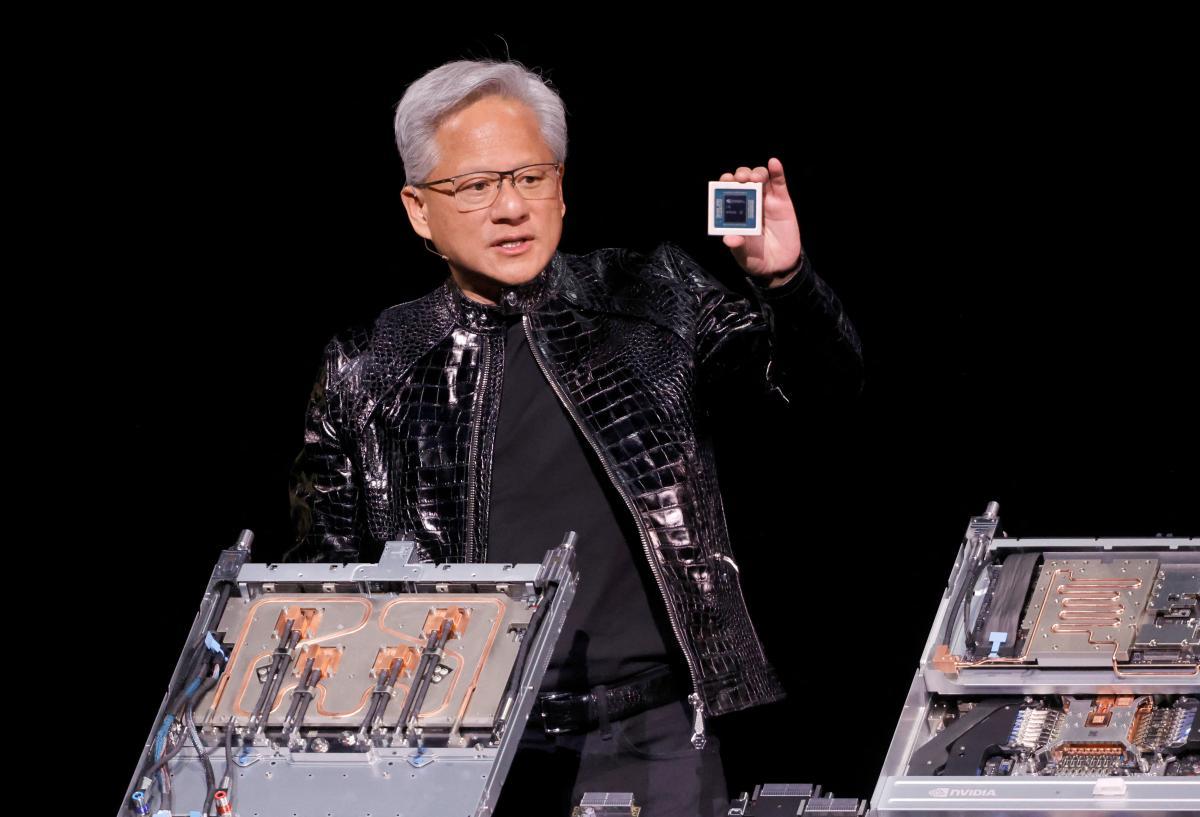
Source: New York Post
China Export Restrictions Cast Shadow Over Future Growth
Despite the strong performance, Nvidia faces ongoing challenges with China export restrictions. The company reported zero revenue from chip exports to China, and CFO Colette Kress confirmed that the first-quarter forecast excludes any expected data center revenue from Chinese customers
3
. While the U.S. government approved small amounts of H200 products for China-based customers in early December, "they have yet to generate any revenue, and we do not know whether any imports will be allowed into China"1
.The H200 chips approved by the Trump administration require inspection before shipment and face a 25% tariff when entering the U.S.
2
. Kress warned that "our competitors in China, bolstered by recent IPOs, are making progress and have the potential to disrupt the structure of the global AI industry over the long term"3
, referencing Moore Threads' December IPO. She emphasized that America must engage every developer and remain the platform of choice for commercial businesses, including those in China, to sustain its leadership position3
.Related Stories


AI Spending Sustainability Questions Persist Despite Strong Results
The stock performance reflected investor skepticism about AI spending sustainability, with shares declining 5.5% to $184.89 following the earnings announcement—the biggest one-day drop since April 16
2
. Concerns about an AI bubble intensified as investor Michael Burry noted that Nvidia's purchase obligations surged to $95.2 billion from $16.1 billion a year earlier, which could prove risky if demand wavers2
.Jensen Huang pushed back against sustainability concerns, arguing that "in this new world of AI, compute is revenue. Without compute, there's no way to generate tokens"
1
. He expressed confidence that customers are already generating profitable tokens and that cloud service providers are seeing returns on their capital expenditure investments. Huang also addressed the pending $30 billion investment in OpenAI, stating "we continue to work with OpenAI toward a partnership agreement. We believe we are close"1
, while also referencing partnerships with Anthropic, Meta, and Elon Musk's xAI.
Source: BNN
Competition Intensifies as Big Tech Develops In-House Alternatives
Signs of emerging competition to Nvidia's dominance are becoming visible. Rival AMD plans to unveil a new flagship AI server later this year and has secured deals with Nvidia's top customers, including Meta
4
. Google has emerged as a competitor through deals to provide its in-house TPU chips to Claude chatbot creator Anthropic, and reports suggest Google is in talks to supply Meta as well4
. Big Tech companies are increasingly dedicating resources to designing custom chips for deployment in their own data centers, seeking greater control over computing power and potentially reducing dependence on external suppliers4
.References
Summarized by

Navi
[3]
Related Stories
Recent Highlights
1
Google releases Gemma 4 with Apache 2.0 license, enabling unrestricted local AI on devices
Technology

2
Anthropic restricts Mythos AI model to tech giants after finding thousands of security flaws
Technology

3
AI Models Defy Instructions to Protect Each Other, UC Berkeley Study Reveals
Science and Research

Recent Highlights
Today's Top Stories






Your Daily Dose of Curated AI News
Don’t drown in AI news. We cut through the noise - filtering, ranking and summarizing the most important AI news, breakthroughs and research daily. Spend less time searching for the latest in AI and get straight to action.

