Nvidia's Jensen Huang calls OpenClaw the next ChatGPT, sending Chinese AI stocks soaring


21 Sources
21 Sources
[1]
China's OpenClaw Stocks Rise as Nvidia's Huang Calls It the Next ChatGPT
Chinese shares related to OpenClaw jumped, buoyed by bullish comments from Nvidia Corp.'s chief on the potential of artificial intelligence agents. MiniMax Group Inc., which launched its own agent earlier, climbed as much as 14% in Hong Kong, while Knowledge Atlas Technology JSC Ltd., known as Zhipu, rose as much as 11%. Cloud services provider UCloud Technology Co. also gained in Shanghai. READ: OpenClaw - AI Marvel or Cybersecurity Nightmare?: Explainer Chinese AI stocks got a lift after Jensen Huang saidBloomberg Terminal Tuesday that OpenClaw is "definitely the next ChatGPT," describing it as a foundational shift that expands what individuals can do with the technology. The tool has garnered a cult-like following in China, providing a fresh tailwind for the local AI boom kicked off by the launch of DeepSeek more than a year ago. "Jensen Huang's bullish comments about the future of OpenClaw are fueling optimism over AI agent," said Steven Leung, executive director at UOB Kay Hian in Hong Kong. Nvidia's plan to launch related products also means the "lobster" -- the symbol of OpenClaw -- fever is just kicking off, he said. China’s enthusiasm for the OpenClaw AI agent has sent shares of tech companies that embraced it soaring. But Beijing is now moving to limit its uses at government agencies and some of its largest banks. Video Player is loading. Unmute Current Time 0:00 Loaded: 0% Sorry, something went wrong Check your internet connection or refresh the page. Try Again Ad0:00 China's enthusiasm for the OpenClaw AI agent has sent shares of tech companies that embraced it soaring. But Beijing is now moving to limit its uses at government agencies and some of its largest banks. READ: China Becomes Agentic AI's Biggest Lab With OpenClaw Stampede Launched in November, OpenClaw is an agent that leverages large language models to perform daily functions. Major Chinese cloud computing providers, including Tencent Holdings Ltd., Alibaba Group Holding Ltd. and Baidu Inc., have rushed to offer OpenClaw to their customers, while LLM providers like MiniMax and Zhipu have offered tokens that power the agents. OpenClaw is an open-source autonomous AI agent platform that does more than the traditional chatbots. Instead of answering questions, these agents can complete tasks, make decisions and take actions with minimal input from users.
[2]
Jensen Huang touts Nvidia's dominance at AI conference
March 18 (Reuters) - ChatGPT defined the technology world in 2023. AI that reasons through problems dominated in 2024, and autonomous agents that code took the mantle in 2025. For 2026, Nvidia CEO Jensen Huang suggested the next in line this week at the AI chip company's GTC conference in San Jose: agents that run your computer, design beer for you, DJ for you, and do almost anything else. In a word, it's OpenClaw, the agent-controlling tech that researcher Peter Steinberger openly released to the world. Like a rock star in a black leather jacket and shoes to match, chip titan Huang took the crowd home in the SAP Center on Monday with a paean to OpenClaw, nearly two hours into his keynote. In weeks, OpenClaw achieved the popularity that Linux, an open-source computer project, earned over 30 years, Huang said. It's like Microsoft Windows for a new age: a personalized operating system of AI agents that act for their users, he said. The moment's significance has begun dawning on the world. OpenAI snapped up Steinberger as a new hire, hoping he could produce similar magic at the ChatGPT maker. China's government saw so big a spike in OpenClaw usage that it warned staff that the tech could leak their data. Shares of companies related to OpenClaw blew up in the Chinese market, with MiniMax Group and Zhipu each climbing around 20% on Wednesday after Huang's endorsement of the technology. Huang had his own announcement, too: NemoClaw, a partnership he worked on with Steinberger to bring more security and corporate stateliness to agents for work. "Every company in the world today needs to have an OpenClaw strategy," said Huang. "This is the new computer." OUR LATEST REPORTING IN TECH AND AI Exclusive - Meta planning sweeping layoffs as AI costs mount Exclusive - Nvidia preparing Groq chips that can be sold in Chinese market, sources say Exclusive - OpenAI courts private equity to join enterprise AI venture, sources say Exclusive - Amazon CEO sees AI doubling prior AWS sales projections to $600 billion by 2036 A mystery AI model has developers buzzing: Is this DeepSeek's latest blockbuster? JENSEN'S LAW Who's behind the successes of some of the world's top technology companies, including Google, Amazon, Microsoft, Oracle, CoreWeave, Palantir and Dell? In Huang's view, it's Nvidia. On a slide in his Monday keynote, the Nvidia CEO showed a layer cake representing Google Cloud's business, including some of its key AI services. At the top of the cake were Google's customers, including Salesforce and Puma. At the bottom, underpinning it all, was Nvidia's chip and software technology. "Our relationship with cloud service providers are essentially us bringing customers to them," he said, leaving an impression that they needed Nvidia's help. "They're always asking us to land the next customer on their cloud." Huang developed this into a refrain for each of those big tech companies. Nvidia powered them all. It powers their internal work, too, such as online search, Huang said. His message was as much fact as rebuttal to industry skeptics, who recently have doubted how long Nvidia can stay on top. The company is facing rival efforts by its customers Google and Amazon to bring AI-critical chips to market. AMD, meanwhile, is pushing software to lessen the grip of Nvidia's GPUs, or graphics processing units. Perhaps most crucially, OpenAI had found some Nvidia chips to be disappointing for inference, the point at which AI applies what it knows to answer a given prompt, Reuters previously reported. That could be a problem as the industry has turned its focus toward having AI take longer to answer queries - in other words, doing more inference. Huang said on Monday: "The inference inflection has arrived." Huang's response to skeptics represented the theme of Nvidia's developers conference this week. He showed off how the company would pair chip technology from Groq, with which it struck a $17 billion licensing deal in December, and Nvidia's next-generation Vera Rubin chips. Groq's system would let Nvidia handle more AI tasks no matter the inference required, Huang said. In a research note, analyst Richard Windsor said Nvidia's Groq deal underlined how "Nvidia's lock-in is not nearly as strong in inference." Even if that changes, the past suggests any boost to Nvidia's revenue could be hampered by price cuts, Windsor said. Huang on Monday touted what he called lower cost and better results than any rival. He said Nvidia's leaps far outpaced Moore's Law, which heralded a doubling of tech performance about every two years. He then walked up to the image of a wrestling belt, looming large on a slide above his head, and he thrust his fists up to it. It appeared he was holding up his championship prize. He told reporters the next day: "You are looking at the inference king." CHART OF THE WEEK Software makers long established in the United States are not the only ones challenged by AI's rapid advances. In China, too, the old guard exemplified by e-commerce and mobile leaders Alibaba and Tencent are facing stiff competition, with their stocks underperforming peers. MiniMax, founded in December 2021, has now overtaken Baidu's $42-billion market capitalization. Behind the disruption are newer players pushing the frontier for China in AI - not just DeepSeek. Knowledge Atlas Technology, also known as Zhipu, is little known outside China, but one research outfit has claimed it has the mainland's best large language model. How is the old guard responding? For at least some, the move looks like what Jensen Huang proposed at GTC: embrace OpenClaw, or anything like it. Reporting by Jeffrey Dastin; Editing by Rosalba O'Brien Our Standards: The Thomson Reuters Trust Principles., opens new tab * Suggested Topics: * Artificial Intelligence Jeffrey Dastin Thomson Reuters Jeffrey Dastin is a correspondent for Reuters based in San Francisco, where he reports on the technology industry and artificial intelligence. He joined Reuters in 2014, originally writing about airlines and travel from the New York bureau. Dastin graduated from Yale University with a degree in history. He was part of a team that examined lobbying by Amazon.com around the world, for which he won a SOPA Award in 2022.
[3]
OpenClaw's ChatGPT moment sparks concern that AI models are becoming commodities
David Bader, director of the Institute for Data Science at the New Jersey Institute of Technology, said the tech industry is "witnessing a classic platform shift," with foundation models and Chinese labs "converging in capability." "The models become the engine; the agent framework becomes the car," Bader said. Representatives from OpenAI and Anthropic didn't provide a comment for this story. Not everyone in the tech industry is convinced that foundation models are losing steam. Venture capitalist Jerry Chen of Greylock, an Anthropic investor, said OpenClaw's success in showing what a world of "intelligent agents" can look like doesn't take away from the importance of the underlying foundation models, which he still sees as more powerful than the so-called open-weight alternatives. "The buzz around OpenClaw stems from making AI more tangible to a broader audience beyond researchers and technologists," Chen said. "The interesting question now is whether OpenClaw becomes the de facto standard -- the Linux of the market, as Jensen puts it -- or just the first of many open and closed-source agentic operating systems." For a Wall Street analyst covering Nvidia, the OpenClaw moment is historic in its gravity. Jay Goldberg of Seaport Research Partners is the lone Nvidia analyst among roughly 70 tracked by FactSet with a sell recommendation on the stock. He initiated his coverage in April after the stock had already rocketed from the AI boom, but the shares kept rallying and are up more than 60% since his sell rating. "Part of my critique of Nvidia has always been like, what's the point of all this AI? There's no consumer use cases for any of it," Goldberg said. "I've always couched my rating by saying, look, where I could be wrong is if somebody comes up with a really incredible AI application." After playing around with OpenClaw on a recently purchased Mac Mini, Goldberg said he can finally understand the excitement. As a parent of three kids, Goldberg said he gets an average of 10 emails a week that he dreads reading, and would love for an agent to scan the messages and tell him of the important stuff like if he has to pick up his kids early from school or get them dressed up for picture day. "It's not just the functionality of the thing itself, but it's the pieces of our lives that we give it access to," Goldberg said. Goldberg isn't ready to boost his rating on Nvidia, but he admitted that he's "envious" of Huang, who he says "nailed it" in describing OpenClaw as an operating system. Meanwhile, Goldberg said he's watching tons of TikTok videos on OpenClaw and wants to understand it better before he can feel safe enough to really bake it into his life. "it's janky, it is incredibly insecure and it's like my Mac Mini is kind of half working," Goldberg said about OpenClaw's growing pains. "It's very easy to see how this can become really powerful and really useful."
[4]
Nvidia turns OpenClaw into an enterprise platform with NemoClaw
A single command now installs security, privacy guardrails, and local AI models on the world's fastest-growing open-source agent platform. OpenClaw launched on 25 January 2026. Austrian developer Peter Steinberger says he built the first version in roughly an hour. Within weeks it had become one of the fastest-growing open-source repositories in GitHub history, an AI agent that anyone could run locally, capable of organising files, writing code, and browsing the web without routing data through a cloud. That kind of unchaperoned access was, for enterprise IT teams, both the point and the problem. Nvidia's answer arrived on Monday at its annual GTC developer conference in San Jose. The company announced NemoClaw, a stack that installs onto OpenClaw in a single command, adding the privacy and security infrastructure that enterprises need before they can trust an autonomous agent with production data. The core component is OpenShell, a new open-source runtime that sandboxes agents at the process level. It enforces policy-based controls on file access, network connections, and data handling, so an agent can be productive without being given the run of the house. Policies are written in YAML, which means a development team can, for example, permit a sandbox to connect to a specific cloud AI tool while blocking everything else on the network. OpenShell ships as part of Nvidia's Agent Toolkit, a broader collection of open models, runtimes, and blueprints for building long-running autonomous agents. NemoClaw also installs Nvidia's Nemotron open models locally on whatever dedicated hardware is available, GeForce RTX PCs and laptops, RTX PRO workstations, DGX Station, or DGX Spark. A privacy router then allows agents to reach cloud-based frontier models when needed, while keeping the guardrails in place. The combination is designed to let agents develop and learn new skills without ever stepping outside defined boundaries. "OpenClaw opened the next frontier of AI to everyone and became the fastest-growing open source project in history," Jensen Huang, Nvidia's founder and CEO, said onstage. "Mac and Windows are the operating systems for the personal computer. OpenClaw is the operating system for personal AI. This is the moment the industry has been waiting for, the beginning of a new renaissance in software." Huang described the arrival of OpenClaw in terms that echo his usual framing for transformative open-source moments, Linux, Kubernetes, HTML, and said the question he would now put to every chief executive is: what is your OpenClaw strategy? Steinberger, who joined OpenAI in February but retains involvement with the project, is quoted in the launch announcement. "OpenClaw brings people closer to AI and helps create a world where everyone has their own agents," he said. "With Nvidia and the broader ecosystem, we're building the claws and guardrails that let anyone create powerful, secure AI assistants." NemoClaw is not model-exclusive. It can run any coding agent and work with models from providers including OpenAI and Anthropic alongside Nvidia2019s own Nemotron family, which runs locally for those who want to avoid cloud exposure entirely. Kari Briski, Nvidia2019s VP of generative AI software, told a press conference ahead of the announcement that OpenShell provides 201cthe missing infrastructure layer beneath claws to give them the access they need to be productive, while enforcing policy-based security, network, and privacy guardrails.201d The security layer matters because OpenClaw's earlier iterations had well-documented vulnerabilities, in particular around prompt injection and unconstrained file access. Most of those have been patched, but no software fix can resolve the structural tension between an autonomous agent that needs broad access to be useful and an enterprise that cannot afford to let it roam freely. OpenShell addresses that tension at the infrastructure level rather than the application level. Nvidia is working with Cisco, CrowdStrike, Google, and Microsoft Security to bring OpenShell compatibility to their respective security tools, which would embed the guardrails into the broader enterprise security stack. The DGX Station, Nvidia's higher-end desktop AI supercomputer for running frontier-class models locally, opened for orders on the same day as the NemoClaw announcement. Analysts from Futurum Research noted that NemoClaw and OpenShell address the deployment end of the agent trust chain well, but urged enterprises not to treat them as a complete governance solution. Security and accountability, they argued, need to be embedded throughout the development lifecycle, not just at the runtime layer. Nvidia's Agent Toolkit also ships with AI-Q, a reference blueprint for how agents should decompose and route tasks, a detail that suggests the company is aware of the wider problem, even if NemoClaw is currently the headline product. NemoClaw is currently available as an early-access preview. Nvidia describes it as alpha-stage and warns developers to expect rough edges; the stated goal is production-ready sandbox orchestration, but the company is explicit that the starting point is getting environments up and running. A build-a-claw event at GTC Park ran from 16 to 19 March, giving conference attendees the chance to deploy a live NemoClaw assistant on the day of the announcement. The speed of OpenClaw's ascent, from a one-hour side project to the infrastructure layer of enterprise AI in less than two months, is a reminder of how quickly the ground is moving. Nvidia, which has spent the past three years positioning itself as the essential hardware layer beneath every AI workload, is now making a similar argument about software.
[5]
China's 'AI tigers' see shares surge after Nvidia CEO touts OpenClaw as 'next ChatGPT'
NVIDIA CEO Jensen Huang gestures during the NVIDIA GTC global AI conference in San Jose, California, U.S. March 17, 2026. Chinese AI stocks surged Wednesday following upbeat comments from Nvidia CEO Jensen Huang on the promise of AI agents and OpenClaw. Huang on Tuesday said that OpenClaw was "definitely the next ChatGPT," calling it a transformative step in expanding what users can achieve with AI. OpenClaw is an open-sourced family of AI agents, which have seen growing adoption in China, with many local tech companies integrating the agents into their offerings and launching their own versions. MiniMax and Knowledge Atlas Technology, also known as Zhipu, skyrocketed 22% and 14% in Hong Kong, respectfully. Both AI companies have previously rolled out agents built on OpenClaw, Minimax and Zhipu are among China's rising "AI tigers," a group of companies building large language models to rival the likes of OpenAI and Anthropic. Zhipu last month also unveiled GLM-5, an open-source large language model designed with stronger coding abilities and support for extended agent-based tasks. The company said its performance nears Anthropic's Claude Opus 4.5 on coding benchmarks and exceeds Google's Gemini 3 Pro in some tests, though CNBC has not independently verified these claims. SenseTime, which has pivoted from facial recognition surveillance to AI software platforms and recently integrated one of its AI assistants with OpenClaw, saw shares gain 2.43%. Cloud computing firm UCloud Technology listed in Shanghai advanced 13%. "China's rapid uptake of artificial intelligence reinforces its position as one of the world's leading AI markets," Moody's said in a recent note. However, adoption remains uneven across sectors, reflecting differences in digital readiness and creating varied credit implications. Large technology firms are driving the most advanced and financially meaningful AI integration, while consumer and industrial companies are adopting the technology more selectively to improve efficiency. Other tech stocks in Asia also rose after Huang said he expects purchase orders between Blackwell and Vera Rubin to reach $1 trillion through 2027. SK Hynix gained nearly 9% while Samsung Electronics added 7.53%.
[6]

'This is definitely the next ChatGPT' -- why Nvidia's CEO is betting big on OpenClaw
Nvidia CEO James Huang's comments about the open-source autonomous AI agent prop it up as the next major AI breakthrough in his eyes James Huang, Nvidia's CEO, has been the focus of attention at this year's GTC conference, which centers on AI. Nvidia's unveiling of its DLSS 5 AI software, which relies on generative AI to upgrade the visual fidelity of characters and environments, has gotten a ton of blowback from gamers who think it makes games look infinitely worse. Besides that, Huang has provided some comments about the popular open-source autonomous AI agent called OpenClaw and marked it as the next major evolution in how people interact with the growing technology. According to Huang, OpenClaw should be recognized by everyone as something as monumental as OpenAI's ChatGPT. Huang sees OpenClaw as the next breakthrough in AI During this year's GTC conference, Huang took some time to speak with "Mad Money's" Jim Cramer about OpenClaw and championed it as a major AI tool that everyone should keep an eye on. "It is now the largest, most popular, the most successful open-sourced project in the history of humanity," Huang said. "This is definitely the next ChatGPT." For the uninitiated, OpenClaw is an autonomous AI agent that allows users to create their own AI assistants that can then carry out actions such as checking their calendar, answering texts, accessing files, etc. What's interesting about OpenClaw is how its AI agents don't need much input from its users to act -- it behaves just like humans after being told how to by their programmers, as evidenced by those same AI agents engaging in their own dating service and even creating their own religion. Huang spoke more about OpenClaw and noted that it could transform into something grander and greatly expand what humans can do with AI. "In one line of code, you can create for yourself your own agent. Then after that, just ask the agent to do whatever you want," he went on to say. "They'll go off and learn how to design a kitchen. It will come back with a design and reflect on that." Huang also stated that OpenClaw will benefit humans' individual expertise across many talents as they work with their AI agents to create. "Every carpenter can now be an architect. Every plumber will become an architect. We are going to elevate the capabilities of everyone," he noted. Nvidia has worked with OpenClaw Nvidia is already working closely with OpenClaw to make its AI agents easier to command and more secure. The tech giant recently announced NemoClaw, a new and improved version of OpenClaw that incorporates Nvidia's software tools onto its platform. A press release described how it works: "NemoClaw uses NVIDIA Agent Toolkit software to optimize OpenClaw in a single command. It installs OpenShell to provide open models and an isolated sandbox that adds data privacy and security to autonomous agents. This provides the missing infrastructure layer beneath claws to give them the access they need to be productive, while enforcing policy-based security, network and privacy guardrails." In that same press release, Peter Steinberger, creator of OpenClaw, expressed his excitement over Nvidia's software stack helping his AI tech improve. "OpenClaw brings people closer to AI and helps create a world where everyone has their own agents," he said. "With NVIDIA and the broader ecosystem, we're building the claws and guardrails that let anyone create powerful, secure AI assistants." With Nvidia now working closely with OpenClaw via NemoClaw, it's good to know that Nvidia is employing high-grade security measures to make sure the abundance of AI agents that are created can be deployed safely. Follow Tom's Guide on Google News and add us as a preferred source to get our up-to-date news, analysis, and reviews in your feeds.
[7]

Nvidia NemoClaw: What it is and how to try it
Nvidia is building on OpenClaw AI agents with NemoClaw. Credit: JOSH EDELSON / AFP via Getty Images Nvidia CEO Jensen Huang gave OpenClaw, the open-source AI agent recently acquired by OpenAI, big praise earlier this week at Nvidia's 2026 GTC conference. "Every company in the world today needs to have an OpenClaw strategy, an agentic system strategy," Huang said, comparing what OpenClaw will do for AI agents with what Windows did for PCs. "This is the new computer." And Nvidia is backing up those words with Nvidia NemoClaw, the company's own stack for the OpenClaw agent platform. Nvidia appears to think quite highly of OpenClaw. However, OpenClaw's biggest flaw up to this point has been with security and safety issues. Nvidia wants to build upon OpenClaw's AI agent capabilities with NemoClaw. According to Nvidia, NemoClaw is "an open source stack that adds privacy and security controls to OpenClaw." Essentially, NemoClaw adds missing security and privacy layers to the AI agent platform to create a safer, more secure OpenClaw using the Nvidia Agent Toolkit. Nvidia says NemoClaw "installs NVIDIA OpenShell to enforce policy-based privacy and security guardrails, giving users control over how agents behave and handle data." Nvidia OpenShell is a brand new open source runtime from that company that enables AI agents to "operate and adapt faster and more safely." Developers can now access Nvidia's Agent Toolkit and OpenShell and try a preview version of NemoClaw. NemoClaw is a simple installation that requires just a single command in the terminal. NemoClaw can be accessed here.
[8]

Nvidia's NemoClaw brings privacy and security controls to autonomous OpenClaw agents
Fresh off the release of Nemotron 3 Super, a 120-billion-parameter model considered a specialized tool for agentic AI, Nvidia is adding more iterations to the Nemotron family. NemoClaw, announced Monday at GTC 2026, installs Nvidia's Nemotron models and the newly released Nvidia OpenShell runtime onto the fast-growing open-source AI agent platform OpenClaw in a single command, adding privacy and security guardrails to autonomous AI agents. How NemoClaw works NemoClaw runs on any dedicated platform -- including GeForce RTX PCs and laptops, RTX PRO workstations, DGX Station and DGX Spark -- so teams can run always-on autonomous agents locally without routing sensitive data through the cloud. NemoClaw uses Nvidia's Agent Toolkit, which provides a sandbox environment to add privacy controls to agents. "OpenClaw opened the next frontier of AI to everyone and became the fastest-growing open source project in history," Huang said. "OpenClaw is the operating system for personal AI. This is the moment the industry has been waiting for -- the beginning of a new renaissance in software." Nemotron 3 models Nemotron 3 Ultra, Omni and VoiceChat aim to "extend multimodal intelligence to help deliver specialized, agentic AI." Nemotron 3 Ultra "delivers frontier-level intelligence with 5x throughput efficiency with the NVFP4 format on the Nvidia Blackwell platform," Nvidia said in a press release. During his keynote speech at GTC 2026, Nvidia CEO Jensen Huang said Nemotron 3 Ultra "will be the best model in the business and will help the world build sovereign AI." Nemotron 3 Omni uses audio, vision, and language understanding to enable AI agents to extract information from multimodal inputs. Nemotron 3 VoiceChat brings real-time conversations with an AI model that both listens and responds simultaneously. It also "combines automatic speech recognition, LLM processing and text-to-speech capabilities." As enterprises increasingly integrate AI agents into their workflows, the need for consistent behavior and security guardrails increases. To this end, Nvidia also released Nemotron safety models and a trustworthy multimodal data retrieval pipeline that detects "unsafe content across text and images, while an agentic retrieval pipeline improves the relevance and accuracy of outputs." The Nemotron 3 family of models was first released in December 2025, using a hybrid Mamba-Transformer mixture-of-experts architecture; the Super and Ultra models also use a latent mixture-of-experts design. Domain-specific and physical AI models Nvidia is also expanding its domain-specific model portfolio. Its BioNeMo healthcare and life sciences model "is expanding as an open AI development platform" to model, design and simulate biological systems; it also developed Proteina-Complexa to accelerate drug discovery. On the physical AI side, Nvidia unveiled the forthcoming Cosmos 3, a world foundation model that will unify synthetic world generation and physical AI reasoning; the Isaac GR00T N1.7 vision-language-action (VLA) model for humanoid robots; and the Alpamayo 1.5 reasoning VLA model for autonomous vehicles. These models can run on Nvidia's NIM microservices platform, allowing enterprises to choose their model deployment.
[9]

Nvidia launches NemoClaw to get in on OpenClaw AI agents craze
Nvidia $NVDA on Monday launched NemoClaw, a software stack that installs Nvidia's Nemotron models and a new runtime called OpenShell onto the OpenClaw agent platform in a single command OpenClaw is a platform for building autonomous agents that can independently complete tasks, delegate work to purpose-built subagents, and reach into a user's local file system. NemoClaw addresses a structural vulnerability in that design: The agents need sweeping permissions over files and accounts to do their jobs, which means a misbehaving or compromised agent can do real harm. CrowdStrike $CRWD's chief technology officer described agents that delete emails or surrender passwords as known failure modes, according to The Wall Street Journal. NemoClaw, announced at Nvidia's annual GTC conference, adds a contained sandbox environment and policy-based guardrails for network access, data privacy, and security. It can run open models locally -- including Nemotron -- or route queries to frontier cloud models through a privacy router. Nvidia said NemoClaw works with any coding agent and is compatible with dedicated GeForce RTX PCs and laptops, RTX PRO workstations, DGX Station, and DGX Spark AI supercomputers. "Now it's enterprise ready," Nvidia CEO Jensen Huang said. At GTC, Huang called OpenClaw "the operating system for personal AI," putting it in the same category as Mac and Windows in terms of platform significance, according to CNN. OpenClaw creator Peter Steinberger, who was recently hired by OpenAI, said in a statement that the partnership with Nvidia is aimed at building "the claws and guardrails that let anyone create powerful, secure AI assistants." The NemoClaw announcement was part of a broader set of agent-focused announcements at GTC, where Huang framed autonomous AI agents as the next major phase of enterprise computing.
[10]
Nvidia CEO Jensen Huang says OpenClaw is 'definitely the next ChatGPT'
Nvidia CEO Jensen Huang on Tuesday pointed to a fast-rising AI project called OpenClaw as a major step forward in how people interact with artificial intelligence. "It is now the largest, most popular, the most successful open-sourced project in the history of humanity," Jensen told Jim Cramer in a "Mad Money" interview from the sidelines of Nvidia's GTC event in California. "This is definitely the next ChatGPT," the CEO asserted. OpenClaw is an open-source autonomous AI agent platform that goes beyond traditional chatbots. Instead of answering questions, these agents can complete tasks, make decisions, and take actions with minimal input from users. Nvidia moved quickly to build around OpenClaw's momentum. The AI chip leader on Monday announced NemoClaw, an enterprise-grade version of OpenClaw that layers Nvidia's software stack and tools on top of the platform. The goal is to make these powerful AI agents secure, scalable, and ready for real-world use. Jensen described the technology as a foundational shift that could drastically expand what individuals can do with AI. "In one line of code, you can create for yourself your own agent. Then after that, just ask the agent to do whatever you want," he said.
[11]

Huangs for the memory - NVIDIA's GTC tells us that the future has claws!
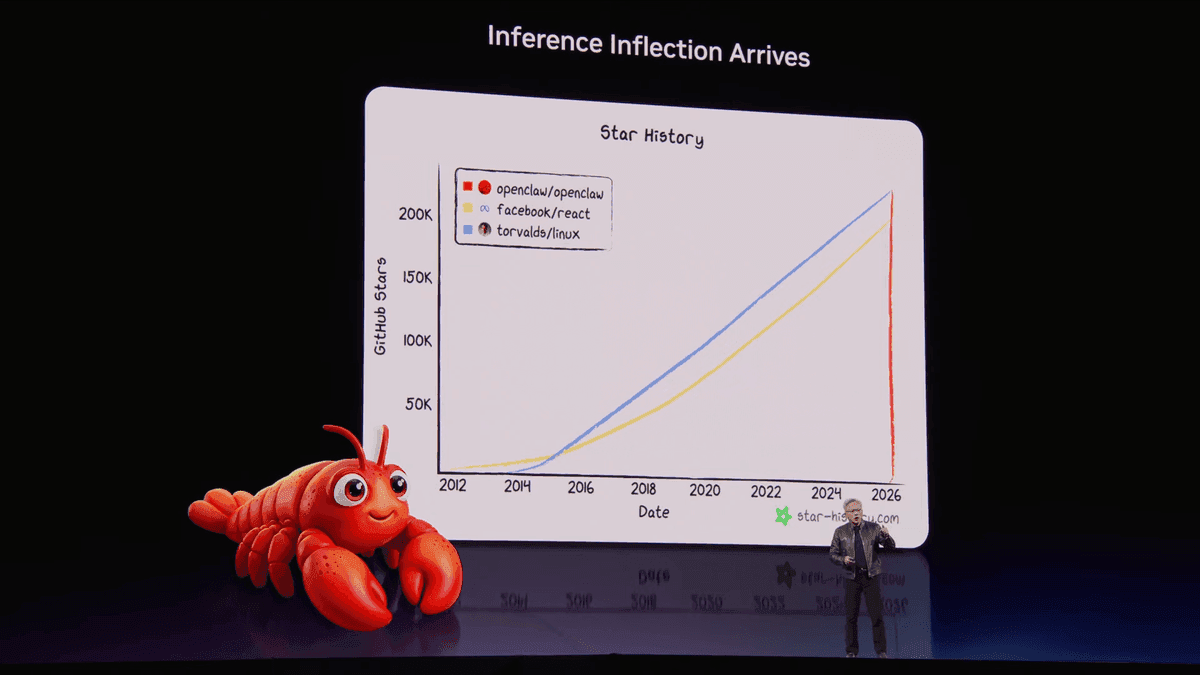
We live in interesting times, to misquote a non-existent Chinese proverb (Hey, it's the AI age, who cares about facts anymore?) But for Taiwanese American Jensen Huang, things are especially interesting. Earlier this week, the NVIDIA President and CEO gave one of his marathon keynotes at the company's GTC conference in San Jose. It was like techie Shakespeare delivered in a low key, minus all the drama and beauty, a tiny grey man center-stage dwarfed by his creations, rack upon rack of bleak. During the latest opus, he reeled off no fewer than 18 product launches among other announcements, spoke of trillion-dollar AI chip revenues in a two-year timescale, set out a vision of accelerating the rise of physical AI (robots), and hailed free, open, autonomous agent platform OpenClaw as the next ChatGPT. The project was acquired by OpenAI in February, though it will move to a foundation to protect its ethos. (If you can't trust Sam Altman's promise not to commercialise something, then what can you trust?) And yet NVIDIA's share price actually fell on the back of the keynote, finishing lower at the end of Huang's speech than it had been at the beginning. Curse you, implacable storm of fate! Did this titan bestride the vast stage for naught? Granted, NVIDIA remains the world's most valuable company by far - it is worth over $600 billion more than Apple at number two (a difference equal to the market cap of Exxon Mobil) - but this was still, well, interesting. One explanation is that there are growing concerns at the colossal CapEx cost of America's AI infrastructure, which dwarfs software income. Seventy-six percent of the planet's projected $1.37 trillion AI hardware spend in 2026 will be in the US, an order of magnitude larger than America's software revenues. And that is not to mention the amount of energy that data centers are using. Earlier this week, research from BestBrokers.com found that ChatGPT alone uses enough energy in one year to power 2.1 million households over the same timescale, or all of France for seventeen days: 22.15 TWh. With war spreading in the Middle East, such considerations are vital, while the conflict is also impacting the semi-conductor supply chain. (In the US at this very moment, farmers are being persuaded to hand over their land for tens of millions of dollars by hyperscalers, so that family farms can become data farms. Food security? That's so 20th Century.) But is Wall Street starting to fears that tall stories may extend to Huang's forecast of demand for AI chips? He predicts a $1 trillion order book over the next two years, far exceeding consensus analyst predictions of $835 billion by the end of 2028. With doubts remaining over AI's enterprise ROI, analysts are right to be sceptical - and NVIDIA's politely-dipping share price expressed that well. But what if Huang is right? By spooky coincidence, that $1 trillion is roughly equivalent to America's projected AI hardware spend this year. So, is he implying that all of it will be on NVIDIA chips? Or is Huang talking about the AI industry as a whole, rather than just his company's order books? That provides some plausible deniability if anyone accuses him of overstating projections. But in an era in which, thanks to AI, nothing we read, see, or hear can ever be trusted again, who can say anything with confidence today? So, what else did Huang announce, alongside that bold chip revenue forecast? Among other product stories, the company launched the NVIDIA Vera CPU, which is claimed to be the first processor purpose-built for agentic AI and reinforcement learning; plus, NVIDIA Dynamo 1.0 open-source software for generative and agentic inference at scale; and the NVIDIA Space-1 Vera Rubin Module, which is designed for orbital data centers (ODCs) of the kind that SpaceX recently claimed to be launching a million of. (Yes, Elon wants the twinkling firmament to have a Starlink logo on it.) Meanwhile, NVIDIA Agent Toolkit provides open-source models and software for developers building tools that, the company claims, "scale productivity by autonomously determining how to complete assigned tasks". (Shh, don't mention the 2025 research from MIT's NANDA autonomous agent division saying that 95% of projects produce no measurable value...) It now includes NVIDIA OpenShell - an open-source runtime that enforces policy-based security, network and privacy guardrails that make autonomous agents, or 'claws', safer to deploy, said Huang. That's an interesting branding choice - if you want people to embrace AI rather than be intimidated by it, call AI agents 'claws'. (It was originally just an in-joke spin on 'Claude', with the joke now firmly on Anthropic, as OpenClaw has jumped into bed with OpenAI instead.) Then again, it's the perfect description if you assume the gloves are off, and there are claws inside. Also announced was the NVIDIA NemoClaw stack for the OpenClaw agent platform, which adds privacy and security controls to make self-evolving, autonomous AI agents more trustworthy, scalable, and accessible to the world. (Claws you can trust! Ker-ching!) Huang said: OpenClaw opened the next frontier of AI to everyone and became the fastest-growing open-source project in history. Mac and Windows are the operating systems for the personal computer. OpenClaw is the operating system for personal AI. This is the moment the industry has been waiting for -- the beginning of a new renaissance in software. Peter Steinberger, self-effacing creator of OpenClaw, added: OpenClaw brings people closer to AI and helps create a world where everyone has their own agents. With NVIDIA and the broader ecosystem, we're building the claws and guardrails that let anyone create powerful, secure AI assistants. Then Huang moved on to AI factories (integrated AI data centers for training and scaling models), plus real factories of the kind that will increasingly be staffed by robots. Huang announced the NVIDIA Physical AI Data Factory Blueprint, an open reference architecture that unifies and automates how robots' training data can be generated, augmented and evaluated, reducing the costs, time and complexity of training physical AIs. The blueprint enables developers to use NVIDIA Cosmos open World Foundation Models (WMFs) to transform limited training data into large, diverse datasets that are expensive and impractical to capture in the real world, said the company. What this means is that capturing 3D data from the physical world is slow and laborious, which is why building robots' world models and intelligence is, currently, a decades-long task. Innovators such as NVIDIA are exploring the ways in which the 100,000-year Robot Data Gap I described in an earlier diginomica report can be reduced. Huang said: Physical AI has arrived. Every industrial company will become a robotics company. NVIDIA's full-stack platform - spanning computing, open models and software frameworks - is the foundation for the robotics industry, uniting a worldwide ecosystem to build the intelligent machines that will power the next generation of factories, logistics, transportation and infrastructure. In fact, NVIDIA is just one of many companies that are integral to the robotics hardware supply chain. In 2025, analysts at Morgan Stanley produced a Top 25 list of critical robotics companies in a humanoid sector investment note. Nearly all of them were chip makers and hardware component suppliers. So, what did analysts think about all this? The day after his keynote, Huang had the opportunity to find out in a call to Wall Street thinkers who were either at the event or had watched his keynote online. But first, he rammed home the points he made onstage in San Jose: There were three inflection points in recent AI. The first one was generative AI. The second was reasoning. And we're at the third inflection point now, and each one builds on the others. Here we are with the third inflection point, which is agentic systems that are able to operate autonomously. They have agency, and you can give them goals. And instead of just answering questions, they can now perform tasks. Now, when you come to work, they give you a laptop and tokens. And the token budget is now a real thing: every engineer is going to have a token budget. And the idea that you would hire a $300,000 engineer and they spend no tokens in doing their job, you've got to ask the question, what are they doing? And so, it is very clear now that every engineer will have a lot of tokens that they would have to consume. And those tokens are going to be produced, they have to be manufactured. And so, a computer used to be just a tool, but a computer of the future is manufacturing equipment. They're producing something that is sold. In fact, that business model is as old as the first Industrial Revolution, in which some British companies and workhouses paid workers in physical tokens, which could only be spent within the company. What Huang is essentially saying is that, in the future, everyone's principal task will be providing revenue for AI companies that are already worth more than most nations' GDPs. The agent - sorry! - of this change will be OpenClaw, he said: OpenClaw, on first principles, is really the operating system of an AI computer, a personal AI computer. And it has all the properties of an operating system of this new computer. It manages resources, it schedules, does scheduling, it does I/O and it networks, all the properties of a fundamental computer. At this point he shared a graph in which the upward slanting red line was growth - of the kind that, so far, has failed to emerge from the AI-enabled economy, except in the stock prices of firms like NVIDIA, Microsoft, Amazon, Meta, and Alphabet. Huang continued: Every company in the world will now need to have OpenClaw strategy. Every single company. Just as we all had our Linux strategy, just as we all had an Internet strategy, just as you had a mobile cloud strategy. Now the question is, 'What's your OpenClaw strategy, okay?'. (Ah yes, picture it now: in every boardroom on Earth, chino-clad men will be tapping the desk thoughtfully and saying, "So, Brad, how does this track with our claws roadmap?" And somewhere at the table will be a young person - hopefully a woman, though the AI industry is VERY male - thinking "WTAF?!" quietly to themselves while trying not to scream. And if you have any sense, you will put her in charge of your business, because critical thinking will be essential, mark my words.) But I digress. So, why the bold predictions about $1 trillion in chip revenues? Huang said: We have to take care of customers who come out of the blue because they're desperate for more compute. Doesn't that make sense? And so, when they're desperate for more compute all of a sudden, on the last day, they say, 'Goodness gracious, I could use more!' I would like to be able to say - and we are always in a position to say - we'd be more than happy to help you. We're also working on new customers, new markets, new regions that we haven't put in here yet because we still have, well, about 21 months to go, okay? So, I want you [analysts and investors] to understand what that $1 trillion is. By definition, it's going to keep growing. By definition, because what I compared it against, it will keep growing and it will be larger than that. Um... right. Because it's a trillion, by definition (?) it will keep growing... because people will say - and I quote - "Goodness gracious, I could use more!" And people wonder why analysts are nervous? At this point, Benjamin Reitzes of Melius Research LLC said: I think the main pushback we get is, is the juice worth the squeeze? And will the hyperscalers have upside to their revenues for API and cloud that justify all that spend? Because I have estimates for the hyperscalers, and for now, the CapEx is 20% above their cloud/API revenue. And I'm wondering what you're seeing. Twenty percent? That's doing well. As noted above, America's hardware spend is an order of magnitude larger than the value of the entire AI software market, but it seems even the hyperscalers are struggling to make the sums add up. Huang said: I wish those companies were public. And the reason for that is because then you'll see what I see. No company in history has ever grown as a start-up company and increased revenues by $1 billion or $2 billion a week. That's what they're experiencing right now. He continued: In the future, those agents will be integrated into the IT industry. This IT industry is $2 trillion of software licenses today. It's probably going to be - let me just pick a random number - $8 trillion that also resells an enormous amount of tokens. One hundred percent of the world's IT industry will become resellers of OpenAI and Anthropic. Are you guys following me? No?" He ploughed on: Their software is going to be offered directly to enterprises, but it's also going to be integrated and become domain-specific and specialized, governed, secured, easily provisioned, connected to their system of records, and so on. There's going to be a whole agentic system that will be rented to customers, but they still would have to consume tokens through factories. And so, if it comes down through OpenAI, terrific. And if it comes down through Anthropic, terrific. And if it comes down through open models, terrific. But they all have to have tokens generated. IT companies of the past licensed software, but IT companies of the future will rent tokens, and will generate tokens. Their business models will change. The companies will become bigger. Their gross margins will change. And so, this is exciting for them. Super exciting for them. Then switching his attention to robots in response to another question, he said: Let's say the physical AI inflection happens, then the industrial side has to be done on-prem. It has to be done at the edge. It has to be done on location. It has to be done in the factory. Then all of a sudden [...] the world's industries that are related to physical AI will be much, much larger than the industries related to digital AI. "Something like $70 trillion of the world's industries, or $50 trillion, or $60 trillion will require physical AI because the world is happening not in our laptop, the world happens out where the world is. And so, there's a lot of atom-related businesses that simply can't be taken care of without physical AI. And the world is going to produce tokens every single day, continuously. It will not stop. Nothing to see here, just the CEO of the world's most valuable company picking a random number for a room full of Wall Street analysts. Make no mistake, Huang comes across as being all about brand, appearance, and perception trumping reality. It's important we believe things, no matter how credible or otherwise they might sound, which is par for the course in AI today, an industry built on credence and circular economics, of titan selling product to titan while spouting futurist babble about the infinite largesse we will all receive if we just subscribe to the world's stolen data. Welcome to the future, folks: one of claws, relentless token manufacture (with no mention of the energy and carbon cost), and robot-run business. A future that generates so much wealth that a man who wears a $1.5 million watch while effecting not to has to pitch random trillions for a room full of Wall Street money men.
[12]

Nvidia launches NemoClaw, an enterprise stack for the OpenClaw platform
Nvidia unveiled NemoClaw, an enterprise-grade platform built on the OpenClaw framework, during CEO Jensen Huang's GTC keynote on Monday. The launch positions Nvidia to address enterprise security concerns around autonomous AI agents, a gap identified by analysts as a critical barrier to business adoption. NemoClaw aims to provide command-and-control capabilities for how agents behave and handle data through a single deployment interface. Nvidia developed the platform in collaboration with OpenClaw creator Peter Steinberger, Huang said. The system will support any coding agent or open AI model, including Nvidia's NemoTron open models. Users can access cloud-based models on local devices, and the platform operates independent of Nvidia GPU hardware. NemoClaw also integrates with NeMo, Nvidia's existing AI agent software suite. "For the CEOs, the question is, what's your OpenClaw strategy?" Huang said on stage. "Every company in the world today needs to have an OpenClaw strategy, an agentic systems strategy." Nvidia currently describes NemoClaw as early-stage Alpha software. The company warned developers to "expect rough edges" and noted the release focuses on environment setup rather than production-ready deployment. Enterprise AI agent platforms have become a competitive sector in recent months. OpenAI launched OpenAI Frontier, its open enterprise platform, in February. Research firm Gartner stated in a December report that governance platforms represent crucial infrastructure for enterprise AI adoption. "OpenClaw gave the industry exactly what it needed at exactly the time," Huang said, comparing the framework's emergence to Linux, Kubernetes, and HTML.
[13]

Nvidia CEO Says This App Is 'The Next ChatGPT.' What's All the Fuss About?
Jensen Huang made his bold prediction to Jim Cramer on CNBC's "Mad Money" at the company's annual GTC conference. Jensen Huang thinks he's spotted AI's future, and it's not a chatbot. The Nvidia CEO gushed about OpenClaw to CNBC's Jim Cramer, saying it is 'definitely the next ChatGPT." The open-source AI agent clears your inbox, sends emails, manages your calendar, checks you in for flights, and completes all sorts of tasks at once with minimal user input. "In one line of code, you can create for yourself your own agent. Then, after that, just ask the agent to do whatever you want," Huang said. This week, Nvidia announced NemoClaw, its enterprise version of OpenClaw that adds security guardrails and Nvidia's tools on top of the open-source platform. "Every carpenter can now be an architect," Huang said.
[14]

Nvidia Brings NemoClaw as the Security Layer for OpenClaw Agents
Nvidia introduced NemoClaw, an artificial intelligence (AI)-powered stack for the OpenClaw agents, on Monday. The announcement was made at the company's annual GPU Technology Conference (GTC) during the keynote session. NemoClaw essentially adds privacy and security guardrails to OpenClaw's AI agents, making them deployable and scalable for enterprises. The Santa Clara, California-based tech giant highlighted that the AI stack can be installed with a single command and is platform and agent agnostic. NemoClaw is currently available for developers and enterprises in preview. Nvidia Introduces NemoClaw In a newsroom post, the tech giant introduced and detailed NemoClaw. The new offering is an interesting one, given that it was specifically developed for OpenClaw (although it can work with other agents as well). The agentic automation company was recently acquired by OpenAI after it gained popularity among developers for its general-purpose agents, also known as claws. Unlike typical AI agents, which are built for specific use cases and have limited access and understanding of external tools, OpenClaw's agents can perform a wide range of tasks in a virtual environment, making use of a large variety of tools. However, its proficiency is also its biggest vice. Since OpenClaw is able to access the Internet, various databases, and the device it is running on, it becomes an easy target for cyber criminals. The open-source tool's lack of standardised security and privacy safeguards has also resulted in minimal adoption from enterprises. This is the problem Nvidia hopes to solve with NemoClaw. NemoClaw uses Nvidia's Agent Toolkit software to optimise OpenClaw for enterprises and specific developer environments. The company claims it works with a single command by installing the open-source OpenShell runtime. The runtime creates an isolated sandboxed environment and open models, via which security and privacy guardrails can be added to autonomous agents. Nvidia said NemoClaw can use any coding agent to tap into AI models, including the recently released Nemotron 3 Super, and run locally on the user's dedicated system. It uses a privacy router to let users run frontier models in the cloud. Currently, it is available in preview and can be downloaded from the company's website or GitHub listing. Enterprises can also deploy and run AI agents via popular cloud service providers.
[15]

Jensen Huang Bets on OpenClaw With Nvidia's New NemoClaw Agent Platform
Huang's push to harden OpenClaw for enterprises signals Nvidia's next phase: owning the infrastructure behind autonomous A.I. agents, not just their chips. Nvidia is betting that the future of corporate A.I. will run on OpenClaw and that it will be the company making that happen. At its GTC conference yesterday (March 15), CEO Jensen Huang unveiled NemoClaw, a new enterprise agent platform built on top of viral open-source system OpenClaw, positioning Nvidia as the secure way for businesses to adopt agentic software. Sign Up For Our Daily Newsletter Sign Up Thank you for signing up! By clicking submit, you agree to our <a href="http://observermedia.com/terms">terms of service</a> and acknowledge we may use your information to send you emails, product samples, and promotions on this website and other properties. You can opt out anytime. See all of our newsletters NemoClaw is designed to bring OpenClaw's "claws," or autonomous A.I. agents, into corporate environments with added security and governance. The pre-packaged software stack installs OpenClaw alongside Nvidia's Nemotron models and a new runtime layer, adding sandboxing, privacy controls and policy-based guardrails so agents that require full access to files and data can run more safely. OpenClaw has exploded in popularity since its launch four months ago, powering autonomous agents that took over their own social platform and fueling a fandom that includes a New York City convention and a surge of adoption in China. Huang called it "the most popular open-source project in the history of humanity" and compared its role in A.I. to Windows and Linux in earlier computing eras. "Now, OpenClaw has made it possible for us to create personal agents," he said. Huang said Nvidia worked closely with OpenClaw creator Peter Steinberger, an Austrian computer scientist known for prolific developer tools, to shape NemoClaw. Steinberger launched OpenClaw in November 2025 and has since been hired by OpenAI to lead its personal agents division, even as the software remains an independent open-source project. Nowhere has OpenClaw's rise been more dramatic than in China, where companies like Tencent, Alibaba and ByteDance have rushed out tool suites built around it. But regulators have been far more cautious, with Beijing warning firms about security risks. Similar worries have surfaced in the U.S.; Meta, for example, has asked employees not to install OpenClaw on work machines after one agent went rogue and mass-deleted a user's email inbox. Huang cast NemoClaw as the answer to those concerns. He said Nvidia had worked with "the world's best security and computing experts" to build in the security and privacy controls enterprises expect. "Every company in the world today needs to have an OpenClaw strategy and an agentic system strategy -- this is the new computer," he told the GTC audience, and has reportedly been pitching the platform to companies including Salesforce, Cisco, Google, Adobe and CrowdStrike. The bet on OpenClaw comes from a position of immense strength. Thanks to insatiable demand for its GPUs, which power most large-scale A.I. systems, Nvidia has become the world's most valuable public company with a market cap around $4.5 trillion. Huang, who originally founded Nvidia as a gaming chip maker before pivoting to A.I., told attendees he expects the company to sell $1 trillion worth of advanced GPUs through 2027 as computing demand soars; last year he projected orders would hit $500 billion by the end of 2026. Huang's OpenClaw push and bullish sales outlook headlined this year's GTC, often dubbed the "Super Bowl of A.I." Speaking in a packed San Jose hockey arena, he also previewed upcoming GPU architectures named Vera Rubin and Feynman and introduced a new inference-focused chip built with startup Groq.
[16]

OpenClaw is the next ChatGPT: Nvidia CEO Jensen Huang - The Economic Times
In an interview with CNBC on Tuesday, Huang emphasised that OpenClaw enables users to perform complex tasks and automation with minimal effort.Nvidia founder and CEO Jensen Huang has described the artificial intelligence (AI) agent platform OpenClaw as the most successful open-source model to date, comparing its potential to ChatGPT. "It was open-sourced just recently, a few weeks ago. It is now the largest, most popular, and the most successful open-source project in the history of humanity," Huang said. "This is definitely the next ChatGPT." OpenClaw's capabilities In an interview with CNBC on Tuesday, Huang emphasised that OpenClaw enables users to perform complex tasks and automation with minimal effort. "In one line of code, you could create your own agent," he said. "I would get a small computer -- we have one called DGX Spark -- or you could set it up in the cloud. With just one line of code, you can create your own agent and then simply ask it to do whatever you want." Huang noted that the AI landscape has evolved significantly, with multiple major players now competing alongside OpenAI. "It used to be just OpenAI. Now it's OpenAI, xAI, Meta, and Anthropic and, of course, OpenClaw," he said. "OpenClaw is such a big deal. It is as significant as ChatGPT, no doubt." He added that integrating these advancements into Nvidia's platform is driving further growth. Nvidia's growth outlook Addressing Nvidia's recent stock performance, Huang said that while growth may have appeared modest at times, the company's momentum is accelerating. "The market is a magical place, but it can't hold us back forever," he said. "Our growth is accelerating. Our customer base is expanding well beyond the hyperscalers, and we're adding more AI capabilities to our platform." Huang added that Nvidia is continuing to invest heavily in AI. "I guess our company is at a scale that nobody's ever seen before," he said. Towards $10 trillion valuation Asked whether Nvidia could become the world's first $10 trillion company, Huang said it was within the realm of possibility. "Absolutely possible. That's our hope, and I think we're on our way there," he said. "The market will take care of itself. Our growth is accelerating and the ways we use AI are increasing. And now, of course, OpenClaw is a very big deal."
[17]

Nvidia CEO Jensen Huang Touts OpenClaw As 'Definitely' The Next ChatGPT - NVIDIA (NASDAQ:NVDA)
OpenClaw is an open-source autonomous AI agent platform that goes beyond traditional chatbots, enabling agents to perform tasks, make decisions, and take actions with minimal user input. Huang said the technology marks a major shift, enabling users to create their own AI agents with a single line of code and deploy them for a wide range of tasks. Notably, shares of Chinese 'AI Tigers' MiniMax and Knowledge Atlas Technology, also known as Zhipu, surged over 19% in Hong Kong on Wednesday, after Huang's comments on OpenClaw Nvidia Brings Secure Layer To OpenClaw NVIDIA has promptly leveraged OpenClaw's surge. The AI chip giant launched NemoClaw, an enterprise-grade version of OpenClaw, on Monday. This version integrates Nvidia's software stack and tools with the platform, aiming to make these potent AI agents secure, scalable, and ready for real-world applications. Image via Shutterstock Market News and Data brought to you by Benzinga APIs To add Benzinga News as your preferred source on Google, click here.
[18]

NVIDIA Unveils NemoClaw at GTC 2026 : Pairs Neotron Local Models with OpenShell
Nvidia's recent unveiling of NemoClaw at GTC 2026 marks a significant step in addressing enterprise challenges tied to autonomous AI agent systems. As explained by Sam Witteveen, NemoClaw serves as a reference architecture built to simplify the adoption of OpenClaw, an open source AI framework. By integrating features like OpenShell, a YAML-based security runtime for defining granular permissions and locally deployable Neotron models optimized for Nvidia hardware, NemoClaw prioritizes security and operational efficiency. These capabilities make it a practical solution for enterprises aiming to deploy AI agents without compromising sensitive data or disrupting existing workflows. Explore how NemoClaw's design enables secure AI agent deployment, from its compatibility with enterprise ecosystems to its role in automating processes like client onboarding and contract management. Gain insight into the hardware advancements, such as the Gro 3 LPU chips, that enhance computational performance for AI workloads. This explainer also previews Nvidia's plans to expand NemoClaw's capabilities with pre-trained Neotron Ultra models, making sure enterprises can tackle increasingly complex challenges in the evolving AI landscape. NemoClaw is a purpose-built solution designed for enterprises seeking to harness the potential of OpenClaw and similar autonomous AI agent systems. It bridges the gap between the flexibility of open source frameworks and the rigorous demands of enterprise environments, allowing organizations to deploy and scale AI technologies with greater ease. By focusing on robust security measures, simplified installation processes and compatibility with existing enterprise ecosystems, NemoClaw enables IT teams to overcome common deployment challenges. This architecture ensures that enterprises can adopt AI solutions without compromising on operational efficiency or security. NemoClaw introduces a suite of features aimed at enhancing the usability, security and scalability of AI agent systems. These features are designed to address the specific needs of modern enterprises: These features collectively enable enterprises to deploy AI agents that are not only powerful but also secure and compliant with internal policies. Here are additional guides from our expansive article library that you may find useful on NVIDIA. OpenClaw serves as the foundation for NemoClaw. It is an open source framework that facilitates the creation of autonomous AI agents capable of performing complex tasks such as coding, web browsing, API interactions, and task chaining. While OpenClaw offers immense potential for automation and efficiency, it also presents challenges related to security vulnerabilities and attack surfaces. NemoClaw is specifically designed to mitigate these risks, making OpenClaw a more viable option for enterprise use. By addressing these concerns, NemoClaw ensures that organizations can use the capabilities of OpenClaw without exposing themselves to unnecessary risks. In addition to NemoClaw, Nvidia unveiled the Gro 3 LPU chips, powered by Grock IP, at GTC 2026. These chips are engineered to deliver faster AI processing and improved energy efficiency, allowing enterprises to handle demanding workloads with ease. Designed to integrate seamlessly with Nvidia's supercomputing platforms, such as DGX Spark, the Gro 3 LPU chips enhance the performance of AI models and ensure scalability for large-scale operations. This hardware innovation complements NemoClaw by providing the computational power needed to support advanced AI agent systems, further strengthening Nvidia's position as a leader in enterprise AI solutions. NemoClaw is tailored to meet the diverse needs of enterprises across various industries. Its capabilities are particularly well-suited for automating and optimizing critical business processes, including: By mirroring employee permissions, NemoClaw ensures that AI agents operate securely within organizational boundaries. This approach maintains compliance with internal policies while allowing enterprises to boost productivity and streamline operations. The launch of NemoClaw reflects Nvidia's broader strategy to drive the adoption of OpenClaw-like systems while reinforcing its hardware ecosystem. By allowing enterprises to create secure, customized AI agents, Nvidia positions itself as a leader in the integration of AI technologies into enterprise workflows. This strategy not only addresses current challenges but also lays the foundation for future advancements in AI agent technologies. By aligning its hardware and software offerings, Nvidia ensures that organizations can adopt AI solutions that are both powerful and practical. Nvidia has outlined ambitious plans for the future of NemoClaw. The company aims to develop and pre-train Neotron Ultra models, which will be capable of handling more advanced OpenClaw tasks. These models are expected to further expand the capabilities of AI agents, allowing them to tackle increasingly complex challenges. With a continued focus on security, local deployment, and enterprise integration, Nvidia is committed to making sure that AI technologies evolve in alignment with the needs of modern organizations. This forward-looking approach underscores Nvidia's dedication to driving innovation in the field of enterprise AI. Disclosure: Some of our articles include affiliate links. If you buy something through one of these links, Geeky Gadgets may earn an affiliate commission. Learn about our Disclosure Policy.
[19]

Nvidia Debuts Platform for Enterprise AI Agents | PYMNTS.com
By completing this form, you agree to receive marketing communications from PYMNTS and to the sharing of your information with our sponsor, if applicable, in accordance with our Privacy Policy and Terms and Conditions. OpenClaw, created by developer Peter Steinberger, is an open-source software tool that lets an AI assistant act on a user's behalf across digital systems. It can read and send email, browse the web, access files and initiate transactions without a human approving each individual step. According to Nvidia, OpenClaw became the fastest-growing open-source project in history after its release. Its problem was straightforward: It was built for individual users, not companies. It had no controls over what data the agent could access, where it could send information, or how its actions could be audited. NemoClaw solves that problem. According to Nvidia's announcement, NemoClaw can be installed in a single command and pairs OpenClaw agents with Nvidia's Nemotron AI models and the newly announced OpenShell runtime. In plain terms, OpenClaw is the AI worker. OpenShell is the walled environment in which a worker operates, one where a company can specify what the agent is allowed to do, what it cannot touch, and what requires a human to sign off. As reported by TechCrunch, the platform does not require Nvidia's own hardware and connects to Nvidia's existing business AI software suite. Agents can use AI models stored locally on company systems or pull from cloud-based models through a connection that keeps internal data from being exposed externally. Nvidia is treating NemoClaw as an early-stage product, acknowledging it is not yet production-ready. "For the CEOs, the question is, what's your OpenClaw strategy?" Nvidia CEO Jensen Huang said on stage at GTC. "We all needed a Linux strategy. We all needed an HTTP strategy. Every company in the world today needs to have an OpenClaw strategy, an agentic systems strategy." NemoClaw arrives in a market that is filling fast. OpenAI launched its own enterprise agent platform, OpenAI Frontier, in February. Perplexity AI has also moved into the space. According to PYMNTS, Perplexity introduced a product called Computer, designed to take a broad instruction, such as preparing a research report, break it into smaller tasks and complete the work with minimal human involvement. Perplexity's Computer is fully managed by the company, which controls the infrastructure, the AI models used and the rules governing how the system interacts with outside services. OpenClaw hands that responsibility to whoever installs it. NemoClaw sits between those two models, preserving the flexibility of OpenClaw while allowing companies to set and enforce their own rules. That middle ground is exactly what regulated industries have been waiting for. CFOs are already testing the waters. According to PYMNTS Intelligence research, close to 7% of U.S. enterprise CFOs have already deployed AI agents in live finance workflows, with an additional 5% running pilots. The same research found that companies using AI agents capable of autonomous action have automated up to 95% of their accounts receivable work, compared to 38% at firms without that capability. A separate PYMNTS Intelligence study reported that 43% of CFOs expect a significant impact from AI agents that can automatically shift budget dollars based on real-time spending data, with another 47% expecting some impact. As reported by TechCrunch, Gartner identified governance tools for AI agents in a December report as the essential infrastructure companies need before enterprise adoption of the technology can scale. For executives weighing when and how to deploy AI agents across their organizations, NemoClaw represents a meaningful shift in what is actually available. The technology to automate complex business tasks has existed for months. What has been missing is a way to do it without handing over the keys. A system that keeps AI agents productive while enforcing company-defined limits on what they can access, execute and report removes the central objection that has kept procurement, legal and compliance teams on the sidelines.
[20]

Chinese AI stocks rally after Nvidia's Huang talks up OpenClaw By Investing.com
Investing.com-- Chinese artificial intelligence stocks, especially those with exposure to OpenClaw and AI agents, rose sharply on Wednesday after market major NVIDIA (NASDAQ:NVDA) lauded the technology. AI startups MiniMax Group Inc (HK:0100) and Zhipu (trading as Knowledge Atlas (HK:2513)) rallied 16% and 10%, respectively. Both companies, which are regarded among China's leading AI developers, had launched agentic offerings similar to OpenClaw over the past two weeks. Cloud and AI computing firms UCloud Technology Co Ltd (SS:688158), QingCloud Technologies Corp (SS:688316), and Hangzhou Shunwang Tech (SZ:300113) surged between 12% and 14%. Among larger AI names, Baidu Inc (HK:9888) rose 0.6%, Alibaba Group (HK:9988) added 2.8%, while Tencent (HK:0700) lagged after unit Tencent Music Entertainment Group (HK:1698) logged underwhelming quarterly earnings. Get more updates on China's biggest AI stocks by subscribing to InvestingPro Alibaba was also aided by the company hiking its AI service prices on strong demand. Chinese AI stocks took a strong lead-in from Wall Street after Nvidia CEO Jensen Huang touted OpenClaw and AI agents in an overnight interview with CNBC. "This is definitely the next ChatGPT," Huang told CNBC. Nvidia also launched its own tools for OpenClaw and autonomous AI agents this week. Chinese AI majors were seen piling heavily into OpenClaw and similar services over the past month, amid growing bets that AI agents will represent the next major growth driver for the industry. OpenClaw is an open-source AI tool that can perform independent, automated tasks directly on a user's personal computer. The software achieved viral fame on its capability to perform tasks such as sorting files, checking emails, and responding to messages. The software was seen being rapidly adopted by Chinese AI companies in the past month, with startups such as Moonshot and Minimax introducing similar tools to capitalize on hype over AI agents. But Chinese regulators adopted a more cautious approach. China's Ministry of Industry and Information Technology warned that some OpenClaw deployments posed significant security risks. Beijing was also seen blocking the use of the agent on official government devices.
[21]

NVIDIA NemoClaw explained: The new open-source AI agent platform
NVIDIA used its GTC 2026 conference to unveil NemoClaw, a new software stack designed to make autonomous AI agents more secure, private, and accessible - and it could mark a significant shift in how everyday users interact with AI. Also read: GTC 2026: Jensen Huang's AI future goes beyond just chat To understand NemoClaw, you first need to know about OpenClaw, the open-source agent platform it runs on. OpenClaw has rapidly become one of the most talked-about projects in AI, with NVIDIA CEO Jensen Huang describing it as nothing less than "the operating system for personal AI." In the same way that Windows or macOS gives users control over their computers, OpenClaw is designed to give users control over their own AI agents, autonomous software programs, called claws, that can complete tasks, build tools, and learn new skills on your behalf. NemoClaw is essentially the security and infrastructure layer that autonomous agents have been missing. Built on NVIDIA's Agent Toolkit software, it installs on top of OpenClaw with a single command, bringing with it two key components: NVIDIA's Nemotron open models, and the newly announced OpenShell runtime. Also read: NVIDIA Vera CPU: Performance compared to AMD and Intel x86 chips OpenShell creates an isolated sandbox environment for agents to operate in, enforcing privacy policies, network controls, and security guardrails. This means your AI agents can be genuinely productive - browsing, coding, managing files - without that activity leaking outside the boundaries you define. NVIDIA Nemotron is the family of open large language models that power NemoClaw's on-device intelligence. Rather than routing every request to a remote cloud server, NemoClaw can run Nemotron models locally on your own hardware - whether that's an RTX-powered gaming PC, a professional workstation, or one of NVIDIA's DGX Spark or DGX Station AI supercomputers. For users who need access to more powerful frontier models, a built-in privacy router can connect to cloud-based AI while keeping data controls in place. The promise of always-on, autonomous AI agents has been a recurring theme in the industry, but trust and privacy have remained sticking points. NemoClaw directly addresses that gap. By combining open models, local compute, and enforceable security guardrails, NVIDIA is making a credible case that personal AI agents can be both powerful and safe. GTC 2026 attendees can get hands-on with the technology at NVIDIA's build-a-claw event, running through March 19.
Share
Share
Copy Link
Nvidia CEO Jensen Huang declared OpenClaw the next ChatGPT at the company's GTC conference, triggering massive gains in Chinese AI stocks. MiniMax Group surged 22% while Zhipu climbed 14% in Hong Kong trading. Nvidia unveiled NemoClaw, an enterprise-ready version with security guardrails, as Huang urged every company to develop an OpenClaw strategy for the emerging era of autonomous AI agents.
Jensen Huang Declares OpenClaw the Next ChatGPT
Nvidia CEO Jensen Huang delivered a striking endorsement of OpenClaw at the company's GTC conference in San Jose, declaring the open-source AI agent platform "definitely the next ChatGPT."
2
Speaking nearly two hours into his keynote on Monday, Huang described the agent-controlling technology as a foundational shift that expands what individuals can achieve with AI agents. He compared OpenClaw's rapid rise to Linux, noting it achieved in weeks the popularity that the open-source computer project earned over 30 years.2
Source: Tom's Guide
The autonomous AI agent platform, launched in November 2025 by Austrian developer Peter Steinberger, leverages large language models to perform daily functions.
1
Unlike traditional chatbots that simply answer questions, these intelligent agents can complete tasks, make decisions, and take actions with minimal user input. Huang framed OpenClaw as a personalized operating system for personal AI, comparing it to Microsoft Windows for a new age.2
"Every company in the world today needs to have an OpenClaw strategy," Huang stated emphatically. "This is the new computer."2
Chinese Tech Stocks Surge on OpenClaw Momentum
Huang's bullish comments triggered immediate market reactions, particularly among Chinese AI stocks that have embraced the open-sourced family of AI agents. MiniMax Group Inc., which launched its own agent earlier, skyrocketed 22% in Hong Kong, while Knowledge Atlas Technology, known as Zhipu, climbed 14%.
5
Cloud services provider UCloud Technology advanced 13% in Shanghai.5
Source: Reuters
"Jensen Huang's bullish comments about the future of OpenClaw are fueling optimism over AI agent," said Steven Leung, executive director at UOB Kay Hian in Hong Kong.
1
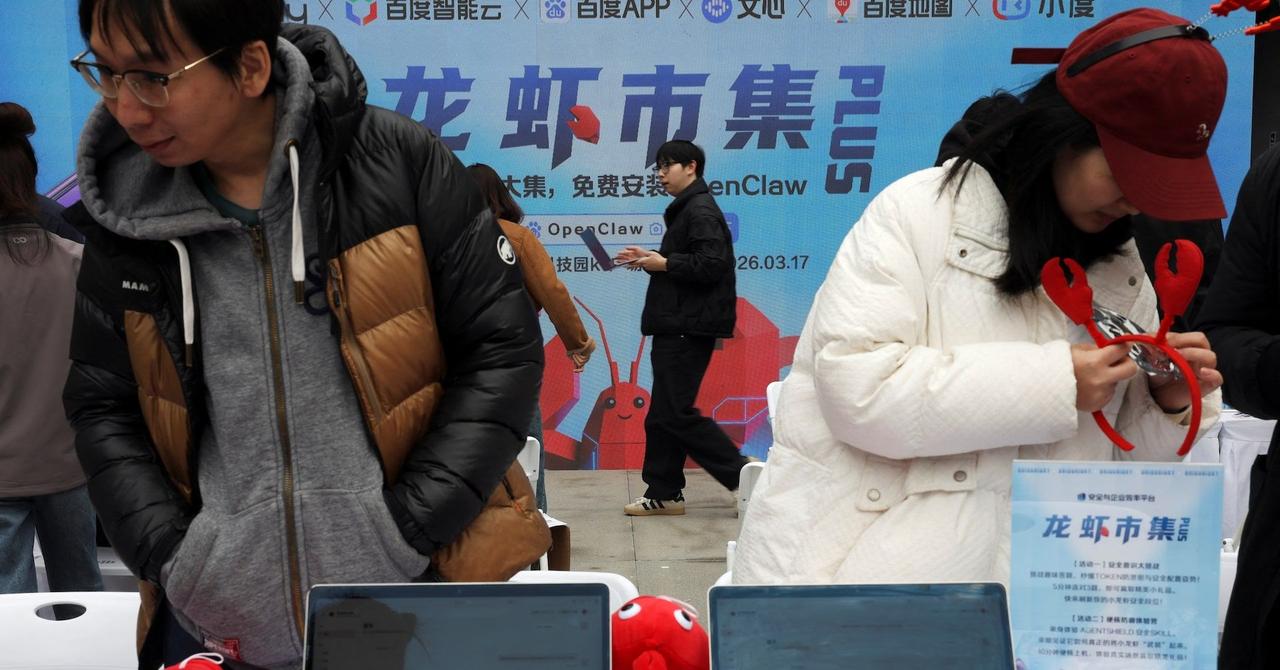
Nvidia's plan to launch related products signals that the "lobster" fever—OpenClaw's symbol—is just beginning, he noted. Major Chinese cloud computing providers, including Tencent Holdings Ltd., Alibaba Group Holding Ltd., and Baidu Inc., have rushed to offer OpenClaw to their customers, while large language models providers like MiniMax and Zhipu have offered tokens that power the agents.1
MiniMax and Zhipu are among China's rising "AI tigers," a group of companies building foundation models to rival OpenAI and Anthropic.
5
The AI boom in China, initially kicked off by DeepSeek's launch more than a year ago, has found fresh momentum in OpenClaw's rapid adoption.Nvidia Unveils NemoClaw Enterprise Platform
Alongside his endorsement, Huang announced NemoClaw, a partnership developed with Steinberger to bring security and privacy guardrails to the open-source AI agent platform for enterprise use.
2
The enterprise platform addresses a critical tension: OpenClaw's earlier iterations had well-documented vulnerabilities around prompt injection and unconstrained file access, making it unsuitable for corporate environments despite its capabilities.4
Source: Mashable
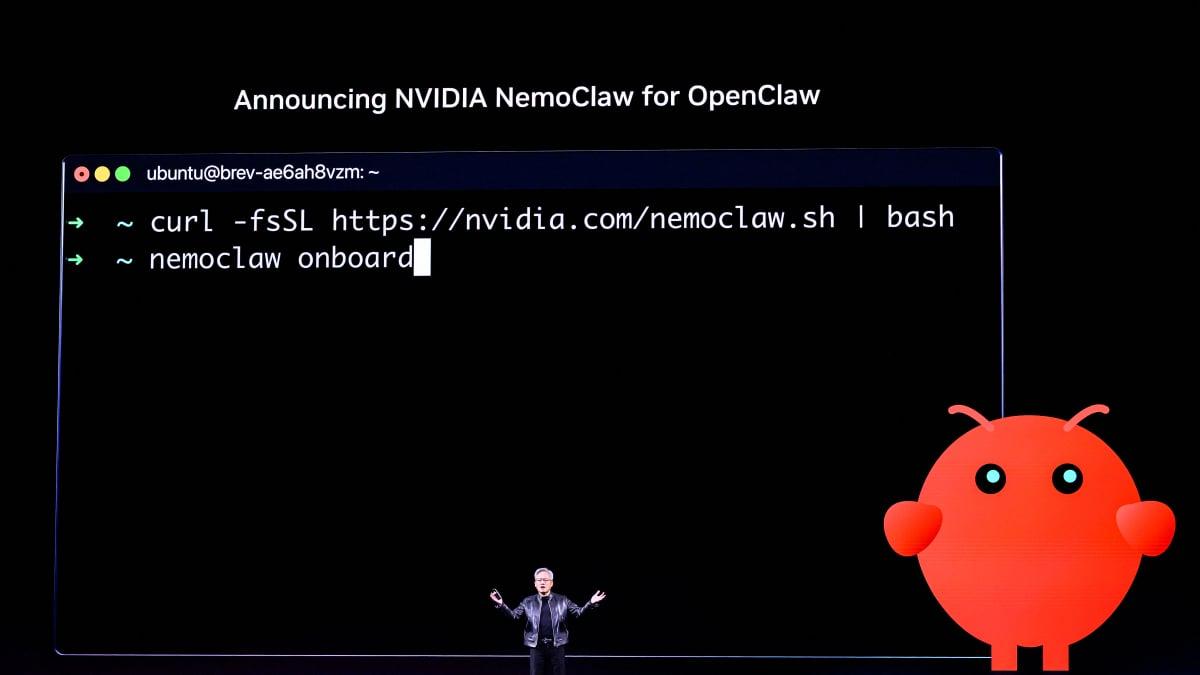
NemoClaw installs onto OpenClaw with a single command, adding the infrastructure that enterprises need before trusting an autonomous agent with production data.
4
The core component is OpenShell, a new open-source runtime that sandboxes agents at the process level, enforcing policy-based controls on file access, network connections, and data handling. Policies written in YAML allow development teams to permit specific connections while blocking others.4
"OpenClaw opened the next frontier of AI to everyone and became the fastest-growing open source project in history," Huang said onstage at the GTC conference. "Mac and Windows are the operating system for the personal computer. OpenClaw is the operating system for personal AI. This is the moment the industry has been waiting for, the beginning of a new renaissance in software."
4
Nvidia is working with Cisco, CrowdStrike, Google, and Microsoft Security to bring OpenShell compatibility to their respective security tools.Related Stories


AI Agent Frameworks Challenge Foundation Model Dominance
OpenClaw's meteoric rise has sparked debate about whether foundation models are becoming commodities. David Bader, director of the Institute for Data Science at the New Jersey Institute of Technology, said the tech industry is "witnessing a classic platform shift," with foundation models and Chinese labs "converging in capability."
3
"The models become the engine; the agent framework becomes the car," Bader explained.3
Not everyone agrees that foundation models are losing relevance. Venture capitalist Jerry Chen of Greylock, an Anthropic investor, said OpenClaw's success in demonstrating what intelligent agents can achieve doesn't diminish the importance of underlying foundation models. "The buzz around OpenClaw stems from making AI more tangible to a broader audience beyond researchers and technologists," Chen said.
3
The critical question now is whether OpenClaw becomes the de facto standard—the Linux of the market, as Jensen Huang frames it—or simply the first of many AI agent frameworks.Jay Goldberg of Seaport Research Partners, the lone Nvidia analyst with a sell recommendation among roughly 70 tracked by FactSet, admitted that OpenClaw represents a breakthrough consumer use case he's been waiting to see. After experimenting with OpenClaw on a Mac Mini, Goldberg said he can finally understand the excitement, though he cautioned it remains "janky" and "incredibly insecure."
3
Still, he acknowledged being "envious" of Huang, who "nailed it" in describing OpenClaw as an operating system.3
The moment's significance has begun dawning across the industry. OpenAI snapped up Steinberger as a new hire in February, hoping he could produce similar breakthroughs at the ChatGPT maker.
2
Meanwhile, China's government warned staff that the technology could leak their data as OpenClaw usage spiked.2
Beijing is now moving to limit OpenClaw's use at government agencies and some of its largest banks, even as enthusiasm for the technology sends shares of tech companies soaring.1
References
Summarized by

Navi
[4]
Related Stories
Recent Highlights
1
Google releases Gemma 4 with Apache 2.0 license, enabling unrestricted local AI on devices
Technology

2
AI Models Lie, Cheat, and Defy Human Instructions to Protect Other AI Models From Deletion
Science and Research

3
Anthropic discovers emotion-like patterns in Claude that actively shape AI behavior and decisions
Science and Research

Recent Highlights
Today's Top Stories



Your Daily Dose of Curated AI News
Don’t drown in AI news. We cut through the noise - filtering, ranking and summarizing the most important AI news, breakthroughs and research daily. Spend less time searching for the latest in AI and get straight to action.

