Generalist's GEN-1 robotics model achieves 99% reliability, masters complex physical tasks


2 Sources
[1]
From folding boxes to fixing vacuums, GEN-1 robotics model hits 99% reliability
Robotic machine learning company Generalist has announced GEN-1, a new physical AI system that it says "crosses into production-level success rates" on "a broad range of physical skills" that used to require the dexterity and muscle memory of human hands. Generalist is also touting the new model's
[2]
Generalist releases GEN-1 highly capable robotic intelligence AI foundation model - SiliconANGLE
Generalist releases GEN-1 highly capable robotic intelligence AI foundation model Artificial intelligence startup Generalist AI Inc., a startup focused on embodied robotics intelligence, has released GEN-1, a highly capable foundation model for robot learning and mastery of physical tasks. The
Share
Copy Link
Robotic AI startup Generalist unveiled GEN-1, a physical AI system reaching 99% success rates on delicate tasks like folding boxes and servicing vacuums. Trained on over 500,000 hours of human movement data, the model executes tasks three times faster than predecessors and improvises solutions when disrupted, marking what the company calls a GPT-3-style inflection point for embodied robotics intelligence.
Generalist Unveils GEN-1 with Production-Level Performance
Robotic machine learning company Generalist has released GEN-1, a physical AI system that achieves production-level success rates across a broad range of manual tasks requiring human-like dexterity
1
. The AI foundation model, announced Friday, reaches a 99% success rate on repetitive but delicate mechanical tasks such as folding boxes, packing phones, and servicing robot vacuums1
. This marks a significant advance in embodied robotics intelligence, arriving just five months after the company launched its proof-of-concept GEN-0 model2
.
Source: Ars Technica
Speed and Efficiency Leap Forward
The robotics model executes tasks at roughly three times the speed of the previous GEN-0 model
1
. Generalist reports that GEN-1 can assemble a box in around 12.1 seconds, approximately 2.8 times faster than the closest state-of-the-art model in the industry2
. Both GEN-0 and pi-0, another well-known robotics intelligence model from Physical Intelligence, took 34 seconds for an identical box2
. The model achieves these marks after only about an hour spent adapting its pretraining to robot data that applies to its specific robotic embodiment1
.Training Data Breakthrough Using Data Hands
To rapidly master physical tasks, Generalist relied on data hands, a set of wearable pincers that capture micro-movements and visual information as humans perform manual tasks
1
. The company has collected over 500,000 hours and petabytes of physical interaction data to train its physical model1
. This addresses a fundamental challenge in robot learning: unlike large language models that process trillions of words from the Internet, robotic models lack a readily accessible source of quality training data about how humans manipulate objects1
.Improvisation and Recovery from Disruptions
What distinguishes GEN-1 from traditional robotic systems is its ability to improvise based on previous experience and respond to disruptions naturally, even when they fall well outside the training distribution
1
. Generalist engineer Felix Wang explains that "nobody has programmed the robot to make mistakes, therefore nobody has programmed the robot to recover from mistakes. And that just happens for free"1
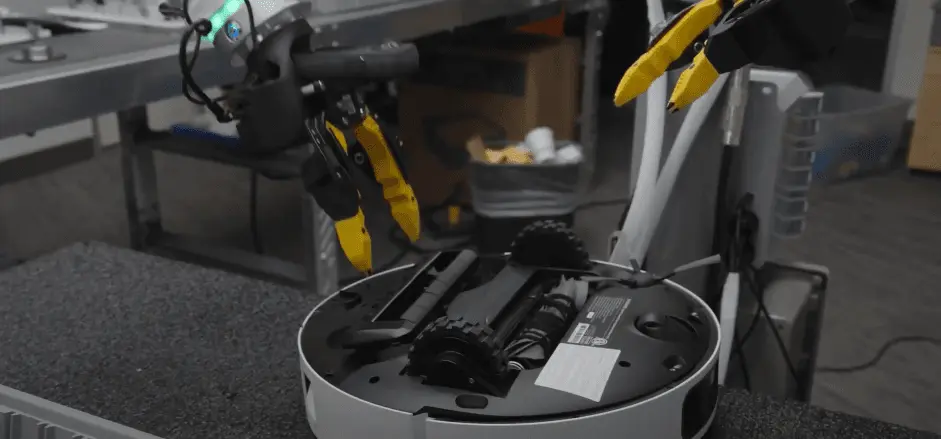
. The model demonstrates thinking outside the box by giving a plastic bag a shake to get a plush toy to shimmy inside, even though such a move wasn't explicitly programmed1
. Videos show robot hands adjusting intelligently as flexible objects spring out of expected positions or refolding a shirt that gets moved mid-task1
.
Source: SiliconANGLE
Related Stories

Competition in Physical AI Systems
Generalist isn't alone in bringing machine learning techniques into the physical realm. Google showcased the visual learning action capabilities of its Gemini Robotics models last year, which can understand and respond to general action prompts from humans
1
. Physical Intelligence has developed a pair of robotic hands on a wheeled platform, trained in specially designed simulated household environments to perform tasks from cleaning up spills to making beds1
. Meanwhile, Tesla first rolled out its humanoid Optimus robots in late 2024 with staged demos that were actually teleoperated by remote human pilots1
. In January, Tesla CEO Elon Musk admitted that current Optimus robots are still not doing useful work at Tesla, despite previous claims to the contrary1
.Reaching a GPT-3-Style Inflection Point
Generalist claims GEN-1 has reached a GPT-3-style inflection point, where some tasks are starting to cross the level of performance needed to be deployed in economically useful settings
1
. The company expects each new generation of model to result in a new set of increasingly complex tasks that can be mastered1
. However, researchers acknowledge that not all tasks hit the 99% success rate, with some complex tasks unable to reach that ambitious bar, especially at reasonable speed and reliability for everyday settings2
. For businesses and consumers watching the robotics space, the model's ability to handle longer step-by-step tasks like assembling items and folding multiple pieces of laundry without becoming confused suggests we may finally be approaching affordable, at-home automation for tedious manual tasks1
2
.References
Summarized by

Navi
Related Stories
Physical Intelligence's π0 Model: A Leap Towards Generalist AI Robots for Household Chores
01 Nov 2024•Technology

Google DeepMind's Gemini Robotics 1.5: A Leap Towards 'Thinking' AI-Powered Robots
25 Sept 2025•Technology
General Robotics Slashes Robot Setup Time from a Month to Just 2 Hours Using AI Platform
10 Sept 2026•Technology
Recent Highlights
1
Meta Unveils Muse Wonder Frontier AI Models, Claims Performance Matching OpenAI and Anthropic
Technology

2
IMF Report Warns AI Market Correction Could Spark Global Financial Crisis With $1.4T at Risk
Business and Economy

3
OpenAI Releases 722 AI-Generated Math Solutions, Triggering Existential Crisis in Mathematics
Technology

Recent Highlights
Today's Top Stories









Don’t drown in AI news. We cut through the noise - filtering, ranking and summarizing the most important AI news, breakthroughs and research daily. Follow topics that matter to you and stay ahead.


