OpenAI COO says enterprise AI hasn't penetrated business processes despite surging demand


2 Sources
2 Sources
[1]
OpenAI COO says 'we have not yet really seen AI penetrate enterprise business processes'
Earlier this month, OpenAI launched a new platform called OpenAI Frontier for enterprises to build and manage agents, but OpenAI COO Brad Lightcap said that businesses haven't yet seen AI adoption at scale. "One of the interesting things and some of the inspiration for the work we've been doing lately around OpenAI Frontier is we have not yet really seen enterprise AI penetrate enterprise business process," the AI exec said on the sidelines of the India AI summit held last week in New Delhi. "You've got really powerful AI systems that any person can use in their individual capacity. And enterprises are these highly complex organizations with a lot of people, teams, all having to work together, a lot of context. There are very complex goals that have to be achieved using a lot of different systems and tools." There is a lot of talk around AI agents taking over business processes and claiming that "SaaS is dead". While these predictions have moved SaaS stocks at times, they haven't really come true. In fact, Lightcap said OpenAI was a massive Slack user last year, indicating how much AI firms are still reliant on traditional enterprise software. In January, OpenAI CFO Sarah Friar posted that the company's revenue is on the rise, with the startup ending 2025 with over $20 billion in annualized revenue. Lightcap said that demand is strong, without sharing any numbers. "We almost always find ourselves having to manage too much demand. We are still an organization that is growing, and so there is this global demand factor that we would love to be able to meet, and we are working as best as we can to be able to meet," Lightcap said. At the same time, OpenAI is thinking about how to quantify success in the enterprise. Lightcap said that OpenAI will try to measure Frontier's impact based on "business outcomes, not on seat licenses." (The comapny hasn't yet shared pricing for Frontier.) "Frontier is a way for us to experiment iteratively with how to actually bring AI into the really messy and complex areas of businesses that I think if we get that right, we're going to learn a lot about both businesses and also AI systems," Lightcap noted. Days after TechCrunch's conversation, OpenAI partnered with consultancies like Boston Consulting Group (BCG), McKinsey, Accenture, and Capgemini to deploy its technology in an enterprise push. Even rival Anthropic launched plugins for finance, engineering, and design for enterprises to build agents based on Claude. Meanwhile, the company doesn't have a clear path of integrating recently acquired open-source tool OpenClaw, but Lightcap said that it gives OpenAI "a glimpse into the future" where agents can do "almost anything you want them to be able to do on a computer." In keeping with the India AI summit, OpenAI has made a number of recent announcements around its business in the world's largest market. The company said India was the second biggest user base of ChatGPT outside the U.S., with more than 100 million weekly users. Lightcap said that voice as a modality is picking up in India and enabling OpenAI to reach more people. "Voice is so important here. And voice models now feel good enough and also good enough to run in low-latency and low-bandwidth environments, where you really can start to enable access to technology for a group of people who maybe were more disenfranchised than not," Lightcap said. The company also signed an enterprise contract for the usage of its tools and to deploy compute. Lightcap noted India is fourth in India in terms of enterprise seats in Asia, which is low for a populous country, and OpenAI has a lot of scope to expand here. The AI company is also set to open two new offices in India in Mumbai and Bengaluru. However, these are likely to be sales and go-to-market offices. When I asked Lightcap if these offices would include technical talent, he said, "Never say never." There is also a fear of job impact, especially in countries like India, where the IT services and BPO (Business Process Outsourcing) industry is prominent, as AI tools automate some of the tasks. In the past few weeks, Indian IT company stocks have dipped as the market is taking into account the fact that areas like coding might require fewer humans. Lightcap said that the company is being "grounded" in what it has observed in terms of jobs market. "Our view is that over time, jobs will change. I think we don't yet know where, how, or what, but it seems inevitable that work will look different in the future than it looks today. And that's natural, that's part of the business cycle. It's part of the global and dynamic economy that we live in. And so I think what we have to do is be able to obviously have empathy for where jobs are changing at a high rate," he noted.
[2]
2026 will be the year of mass AI adoption: OpenAI's Brad Lightcap
Brad Lightcap, COO, OpenAI, says the company is going to make big investments in India: in infrastructure, in people and in AI deployment. India is OpenAI's second largest market at 100 million active users and could soon become its biggest with adoption rates outpacing the rest of the world. Chief operating officer Brad Lightcap spoke to Surabhi Agarwal in an interview about OpenAI's partnership with the Tata Group, why 2026 is the year AI moves from experiment to reality inside businesses, and what India means to the company's global ambitions. He was accompanied by Oliver Jay, managing director for international strategy. Edited excerpts: There's debate that the Indian IT industry could be disrupted by AI. What is your view? Brad Lightcap: I've only been here less than 24 hours, but the energy, excitement and determination are palpable. This is a country on the precipice of its next chapter. It's vibrant, young and technologically led. We see it in the data -- 100 million active users here. It's our second-largest market. It's one of our largest enterprise markets and among the fastest growing for Codex. The adoption cycle here is happening at a different rate than the world, and that's not a coincidence. As for the software industry, the adoption and deployment of AI will take an army. It won't be led by OpenAI alone. We will need to partner with the ecosystem, with organisations that have deep relationships with enterprises across the world. What we can do is build the tools in the best, most productive and safest way possible, and build systems that allow adoption at scale. The ecosystem here is a critical input to that. Our partnership with TCS is hopefully an example, but we're excited to partner widely. India will play an important role in the global transformation ahead. You mentioned strong demand in India. What are you seeing across segments? Oliver Jay: We're seeing explicit demand in India across all different segments -- enterprise, developers, startups. I get to fly around the world and meet enterprises everywhere, and the announcements with the Tata Group include many elements, but a big part is thinking about transformation groupwide. There are so many businesses and workflows they're going to rethink together. That kind of senior-level, top-down buy-in... We're seeing more of it every time we come here. I've been here five times in the last six months, and each time there's more momentum. It feels like we've hit a tipping point. You see it in our work with startups like Eternal and MakeMyTrip, and in our announcement with JioStar -- rethinking user experience in media, entertainment and sports in an AI-native way. We're seeing market leadership in India, and we're here to support that. How do you evaluate competition from players like Gemini and Anthropic? Do you feel the need to catch up in certain areas? Lightcap: I don't think that's the right way to look at it. We have quite a large footprint across tremendously fast growth, eye-wateringly fast. This is just scratching the surface of our research roadmap for this year. I always tell our team to focus on what we can control. Focus on users, focus on customers, and focus on our mission. If we get those things right and listen carefully to feedback, the rest takes care of itself. Given how Anthropic's Claude Cowork is making waves, should we expect a more aggressive play in digital agents and agent platforms from OpenAI? Lightcap: That's certainly the future. In 2025, we talked about it as the year of agents, and you saw the first sparks of that agent-driven future, AI systems starting to do real work. Now, 2026, is the year of adoption. It's no longer experimental. There is a push inside enterprises toward wanting to see real results. It's top-down, executive-led, and there's a willingness to rethink core parts of business, such as, sales, marketing, customer support, finance, legal, as well as verticals like life sciences, energy, and healthcare. That trend will accelerate as systems get better and infrastructure evolves. For us, infrastructure is critical to deploying agents at scale inside enterprises. That investment is as important as research. Integrating research and platforms in a way that allows enterprises to build powerful agents is differentiating for us. There are concerns that adoption is not keeping pace with capacity building, and that heavy data centre investments could create a bubble. Lightcap: Look at the growth rates. These are adoption rates we've never seen before. Businesses are getting built overnight, ours included, defying previous understanding of how fast a company could scale. We've always felt on the wrong side of the demand curve. The question I ask our team is how can we scale more quickly? We always feel behind relative to the demand that exists. If that's a bubble, I guess I would update my thinking. You're part of the $500 billion Stargate programme. India is already your second-largest market. Will you need more compute and storage in India? Lightcap: I suspect we will need more. We have never quite been on the right side of the demand curve when it comes to how much compute we have relative to the demand for AI. We've consistently underpredicted it, and it has consistently outpaced our ability to bring compute online. That is a big part of our plan for the future here -- ensuring that we've invested appropriately to make sure we have enough capacity, not only to serve Indians, but the Global South generally. Also, to be respectful of data and privacy laws here in the country, so that we can really be integrated into the tapestry that is the Indian economy. Our announcement with Tata was meant to hit every corner of that plan, where we are able to invest domestically here in infrastructure, but then also work together as we think about go-to-market transformation and AI adoption among Indians. You made your Pro plans free for consumers, which drove a lot of excitement among end users. As enterprise becomes the focus now, where do you see the biggest opportunities? Lightcap: In a lot of ways, there's almost an epicentre here in India of firms that serve so much for the world in terms of critical business processes and enabling enterprise transformation. We feel fortunate to partner with TCS, for example. I suspect we'll do more along the way. To the extent that work is going to change over time, and we think AI systems will bring change to work -- there's going to have to be a global coalition that thinks about how that's diffused into the business environment. We're excited to do that in a few ways here. One is through a diverse partner ecosystem that can help with diffusion not only in India but globally. Two is working with Indian enterprises, which are incredibly forward thinking in how they want AI adoption to accelerate their business. And third is working with people to think about what the future of work looks like, with a workforce that's young, optimistic, and very literate in these tools. You see that in the growth rates of tools like ChatGPT and Codex, where adoption among Indians is incredible and outpacing the rest of the world. All of that momentum will carry us toward what will be a collaborative and exciting partnership with India. What is the roadmap on models? When can we expect the next, more powerful one? Lightcap: It does feel like the cycle of progress is accelerating. I can't say specifically, but we're very excited for this year.
Share
Share
Copy Link
OpenAI COO Brad Lightcap revealed that despite the company's $20 billion annualized revenue, AI has not yet penetrated enterprise business processes at scale. Speaking at India's AI summit, Lightcap announced OpenAI Frontier, a new platform designed to deploy AI agents in complex organizational workflows, while confirming India as the second-largest ChatGPT market with over 100 million weekly users.
OpenAI Acknowledges Gap in Enterprise AI Penetration
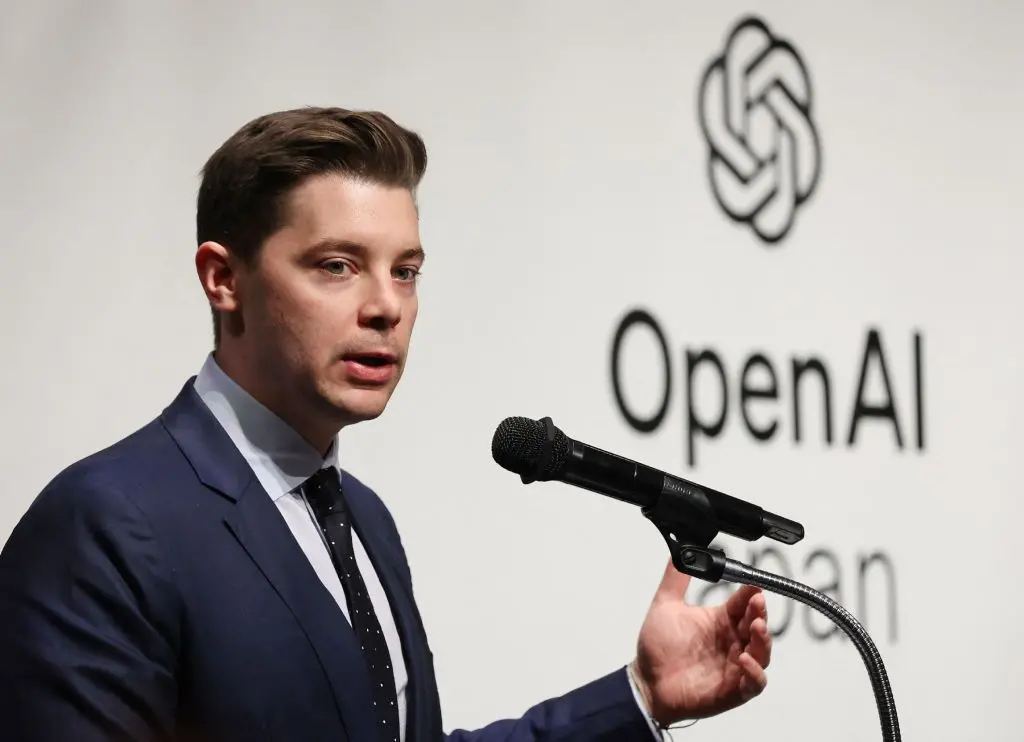
Despite reaching over $20 billion in annualized revenue by the end of 2025, OpenAI faces a paradox: artificial intelligence has not yet penetrated enterprise business processes at the scale many anticipated. Brad Lightcap, OpenAI's Chief Operating Officer, made this candid admission during the India AI summit in New Delhi, highlighting a critical gap between individual AI usage and organizational transformation
1
. "You've got really powerful AI systems that any person can use in their individual capacity. And enterprises are these highly complex organizations with a lot of people, teams, all having to work together, a lot of context," Lightcap explained, underscoring the challenge of integrating AI into workflows across departments1
.
Source: TechCrunch
OpenAI Frontier Targets Mass AI Adoption in Businesses
To address this adoption barrier, OpenAI launched OpenAI Frontier earlier this month, a platform specifically designed for deploying AI agents at scale within enterprise environments. Lightcap positioned 2026 as "the year of adoption," distinguishing it from 2025's experimental phase
2
. "It's no longer experimental. There is a push inside enterprises toward wanting to see real results. It's top-down, executive-led, and there's a willingness to rethink core parts of business," he stated2
. The company plans to measure success based on business outcomes rather than traditional seat licenses, signaling a shift in how enterprise deployment value is quantified1
.Strategic Partnerships Drive OpenAI's Strategy for Enterprise Deployment
OpenAI has forged partnerships with major consultancies including Boston Consulting Group, McKinsey, Accenture, and Capgemini to accelerate enterprise AI implementation
1
. In India, the company announced collaborations with the Tata Group, TCS, and JioStar, targeting transformation across sales, marketing, customer support, finance, legal, and sector-specific applications in life sciences, energy, and healthcare2
. These partnerships reflect OpenAI's recognition that mass AI adoption in businesses requires an ecosystem approach rather than a solo effort.High Demand for AI Outpaces Current Capacity
Despite the enterprise penetration challenge, Lightcap emphasized that OpenAI consistently manages excessive demand. "We almost always find ourselves having to manage too much demand," he noted, without providing specific numbers
1
. When questioned about concerns regarding data center investments creating a bubble, Lightcap pointed to unprecedented adoption rates: "These are adoption rates we've never seen before. Businesses are getting built overnight, ours included, defying previous understanding of how fast a company could scale"2
. The company's infrastructure investment, including participation in the $500 billion Stargate programme, aims to support this explosive growth.
Source: ET
Related Stories

India Emerges as Critical Market with 100 Million Users
The India market has become OpenAI's second-largest, with ChatGPT attracting over 100 million weekly users
1
. Oliver Jay, managing director for international strategy, noted that adoption cycles in India are "happening at a different rate than the world"2
. OpenAI plans to open two new offices in Mumbai and Bengaluru, primarily focused on go-to-market activities, though Lightcap suggested technical roles remain possible1
. Voice AI has proven particularly significant in India, enabling access in low-latency and low-bandwidth environments for previously underserved populations1
.Job Displacement Concerns and Competition Intensify
As Anthropic launched Claude Cowork plugins for finance, engineering, and design, competition in the enterprise AI space intensifies
1
. Addressing job displacement fears, particularly relevant in India's prominent IT services and BPO sectors, Lightcap acknowledged: "Over time, jobs will change. I think we don't yet know where, how, or what, but it seems inevitable that work will look different in the future"1
. The recently acquired OpenClaw offers what Lightcap described as "a glimpse into the future" where agents can perform nearly any computer task, though integration plans remain unclear1
. With top-down executive leadership now driving AI initiatives across organizations, the question remains whether 2026 will deliver on the promise of transforming enterprise business processes from potential to reality.References
Summarized by

Navi
[1]
Related Stories
Google Partners with Reliance to Offer Free AI Pro Access to 500 Million Jio Users in India
30 Oct 2025•Business and Economy

Enterprise AI adoption reveals 6x productivity gap between power users and typical workers
10 Dec 2025•Business and Economy

OpenAI Targets India as Key Growth Engine with First Office and Enterprise Focus
07 Nov 2025•Business and Economy

Recent Highlights



Recent Highlights
Today's Top Stories










Your Daily Dose of Curated AI News
Don’t drown in AI news. We cut through the noise - filtering, ranking and summarizing the most important AI news, breakthroughs and research daily. Spend less time searching for the latest in AI and get straight to action.

