Palantir CEO Alex Karp says AI will eliminate need for immigration, destroy humanities jobs


8 Sources
8 Sources
[1]
Palantir CEO: With AI, economies won't need immigration
Alex Karp can sniff out a hot potato topic, but what comes next in the act? Opinion Palantir CEO Alex Karp has an inimitable aptitude for sniffing out the politically sensitive topic about which, by his own admission, he should not be speaking, but which will also win him the most attention. Last year, it was the idea of innate western superiority and his belief that his company's software product was "the only reason why someone's not goose-stepping between me and you" on the streets of Europe. This week, after promising not to go on one of his "usual political screeds," the Palantir CEO went off on one, as the Brits like to say, launching into a speculative analysis of the impact of AI on immigration. Two hot topics in one: bingo. Flying into Davos for the World Economic Forum -- or perhaps appearing in a puff of red smoke from under a ghoulish cloak -- Karp responded to probing about the impact of AI on the jobs market. "I do think these trends [in AI] really do make it hard to imagine why we should have large-scale immigration unless you have a very specialized skill," he said. He was unlikely to have his worldview significantly challenged by his interviewer, BlackRock CEO Larry Fink, the septuagenarian billionaire Co-Chairman of the World Economic Forum. And so it proved, with Fink gliding past the notion that many immigrants fulfil roles in health, construction, or service industry jobs that western nations find hard to fill, and focusing on the important point for attendees: the impact on white-collar jobs. The point is not without merit: 4.7 million non-US-born workers fulfil professional and business services roles, for example. During the World Economic Forum session, Karp agreed that AI would lead to fewer white collar jobs. But went on to say that organizations "need different ways of testing aptitude." "There are a lot of people doing X that should be doing Y," he said, adding that one of his main tasks at the US-based spy-tech company was "walking around figuring out what is someone's outlier aptitude." Outside the febrile atmosphere of the WEF Annual Meeting, skeptics on the actual benefits of AI are becoming more commonplace. Yesterday, Deutsche Bank analysts Adrian Cox and Stefan Abrudan published a note declaring the "the honeymoon is over" for AI. The AI market will be hit disillusionment, dislocation, and distrust, they said. "This matters as AI investment and optimism are buoying the global economy, accounting for most of economic and earnings growth in the US last year," they said, suggesting the consequences should the AI boom go into reverse. The sentiment echoed earlier comments from Gartner, which said enterprise adoption of AI was in the so-called "trough of disillusionment," while investment from AI, cloud, and software companies was still sky-rocketing. Meanwhile, the majority of CEOs are reporting zero pay-offs from AI investments, according to PwC. Karp admitted AI is a "very low-trust environment," which is why Palantir needs very few salespeople. In the case of building AI systems, he said, "people have tried lots of stuff. A lot of it hasn't worked. But if [like Palantir] you've delivered stuff that does work, why do you need a salesforce?" Of course, in the conversation about AI and the future of work in the western world, Karp found room to claim Palantir's enterprise projects can save "80 percent of your cost and improve your top line dramatically." Perhaps the question is really, when you have Alex Karp, why do you need a salesforce? He admitted he got pressure from inside Palantir saying he "should stop speaking in public," but that's all part of the schtick. Because, notwithstanding the chronic verbal diarrhea, his outlier aptitude is undoubtedly making himself and his company the center of attention. It's a shame we will all smell the consequences when the winds change. ®
[2]
Palantir CEO Says AI to Make Large-Scale Immigration Obsolete
Artificial intelligence will displace so many jobs that it will eliminate the need for mass immigration, according to Palantir Technologies Inc. Chief Executive Officer Alex Karp. "There will be more than enough jobs for the citizens of your nation, especially those with vocational training," said Karp, speaking at a World Economic Forum panel in Davos, Switzerland on Tuesday. "I do think these trends really do make it hard to imagine why we should have large-scale immigration unless you have a very specialized skill." Karp, who holds a PhD in philosophy, used himself as an example of the type of "elite" white-collar worker most at risk of disruption. Vocational workers will be more valuable "if not irreplaceable," he said, criticizing the idea that higher education is the ultimate benchmark of a person's talents and employability. Karp described himself as a "card-carrying progressive," though he expressed views sympathetic to US President Donald Trump's agenda, and his data analytics company maintains close ties to the country's immigration authorities and Defense Department. Those relationships have provoked protests inside and outside the company, Karp said. Palantir has long supplied services to US Immigration and Customs Enforcement, enabling officials to build dossiers on individuals. It also has defense tie-ups with governments around the world and a growing enterprise business. The company was co-founded by Karp and billionaire Peter Thiel, an early adviser to Trump during his first administration. The company's share price has risen more than 130% over the past 12 months, sending its value soaring to about $400 billion.
[3]
Palantir CEO Says AI Will Somehow Be So Great That People Will Stop Immigrating
When all you have is a hammer, everything looks like a nail. All Palantir CEO Alex Karp has is AI, and boy, is he ready to nail some things down with it. During an appearance at the annual World Economic Forum in Davos, Switzerland, Karp sat down with BlackRock CEO Larry Fink to create a nightmare blunt rotation: two guys who are heavily invested in the military industrial complex and surveillance industry, talking about how great those things are for society. Karp, as he is wont to do lately, made some outlandish statements throughout the half-hour conversation, but perhaps none more eye-popping than his barely complete thought that AI will create so many jobs that there will basically be no reason for anyone to ever immigrate to another country. Asked if AI will destroy or create jobs, Karp started answering the question in a roundabout ramble about how white-collar jobs will get hit, and vocational jobs will thrive. Then, after stating, "Not to diverge into one of my political screeds," he proceeded to diverge into one of his political screeds. "There will be more than enough jobs for the citizens of your nation, especially those with vocational training. I do think these trends really do make it hard to imagine why we should have large-scale immigration unless you have a very specialized skill," he said. There are, of course, many reasons that people leave their home country to try to start a life somewhere else, other than job seeking; from political instability and war to environmental dangers (*cough AI*). And there are, of course, many reasons that a country might want to accept immigrants other than the fact that they could contribute to the economy -- like, for instance, believing it a moral imperative to accept people fleeing from political persecution, especially when it was American meddling in foreign affairs that greatly contributed to that instability in the first place. Karp, who at least managed to stay in his seat for the majority of the interview this time, had a lot to say about a lot of things, most seemingly unconnected from whatever the original prompt was. In response to a question about whether the future will require fewer white-collar workers, he somehow landed on his engineers recommending that he stop speaking in public. Obviously, he didn't take that advice. The incoherence was on full display throughout, with strange asides about how, despite his seeming distaste for higher education, he dreams of going back to grad school -- but not for the education, just for the "fun." At one point, he noted that one of the heads of Palantir's Maven system, an AI tool meant to be used on the battlefield by the US Army, only completed junior college and declared that he probably didn't even need that. "Would they been as talented if they had not gone to their college? Yes," he said, as if whatever talent or intelligence the person has is simply inherent. Maybe Karp believes he truly didn't pick up any skills through university and was not in any way influenced in how to think, communicate, or understand the world, and he would have come out exactly the same as he is now without setting foot in school. Given that he has a PhD in philosophy, it probably says more about him than his education if he went through all of that coursework without ever challenging his own beliefs. Trying to piece together Karp's ideas and ideology is a fool's errand. The thing that seems like he most clearly believes is that he should be successful and rich, and the world should go along with what leads to that outcome.
[4]
CEO of Palantir Says AI Means You'll Have to Work With Your Hands Like a Peasant
"You went to an elite school, and you studied philosophy; hopefully you have some other skill." Wondering what your career looks like in our increasingly uncertain, AI-powered future? According to Palantir CEO Alex Karp, it's going to involve less of the comfortable office work to which most people aspire, a more old fashioned grunt work with your hands. Speaking at the World Economic Forum yesterday, Karp insisted that the future of work is vocational -- not just for those already in manufacturing and the skilled trades, but for the majority of humanity. In the age of AI, Karp told attendees at a forum, a strong formal education in any of the humanities will soon spell certain doom. "You went to an elite school, and you studied philosophy; hopefully you have some other skill," he warned, adding that AI "will destroy humanities jobs." Karp, who himself holds humanities degrees from the elite liberal arts institutions of Haverford College and Stanford Law, will presumably be alright. With a net worth of $15.5 billion -- well within the top 0.1 percent of global wealth owners -- the Palantir CEO has enough money and power to live like a feudal lord (and that's before AI even takes over.) The rest of us, he indicates, will be stuck on the assembly line, building whatever the tech companies require. "If you're a vocational technician, or like, we're building batteries for a battery company... now you're very valuable, if not irreplaceable," Karp insisted. "I mean, y'know, not to divert to my usual political screeds, but there will be more than enough jobs for the citizens of your nation, especially those with vocational training." Now, there's nothing wrong with vocational work or manufacturing. The global economy runs on these jobs. But in a theoretical world so fundamentally transformed by AI that intellectual labor essentially ceases to exist, it's telling that tech billionaires like Karp see the rest of humanity as their worker bees. It seems that the AI revolution never seems to threaten those who stand to profit the most from it -- just the 99.9 percent of us building their batteries. More on Alex Karp: Palantir CEO Says Legalizing War Crimes Would Be Good for Business
[5]

Palantir CEO says AI "will destroy" humanities jobs but there will be "more than enough jobs" for people with vocational training | Fortune
Some economists and experts say that critical thinking and creativity will be more important than ever in the age of artificial intelligence (AI), when a robot can do much of the heavy lifting on coding or research. Take Benjamin Shiller, the Brandeis economics professor who recently told Fortune that a "weirdness premium" will be valued in the labor market of the future. Alex Karp, the Palantir founder and CEO, isn't one of these voices. "It will destroy humanities jobs," Karp said when asked how AI will affect jobs in conversation with BlackRock CEO Larry Fink at the World Economic Forum annual meeting in Davos, Switzerland. "You went to an elite school and you studied philosophy -- I'll use myself as an example -- hopefully you have some other skill, that one is going to be hard to market." Karp attended Haverford College, a small, elite liberal arts college outside his hometown of Philadelphia. He earned a J.D. from Stanford Law School and a Ph.D. in philosophy from Goethe University in Germany. He spoke about his own experience getting his first job. Karp told Fink that he remembered thinking about his own career, "I'm not sure who's going to give me my first job." The answer echoed past comments Karp has made about certain types of elite college graduates who lack specialized skills. "If you are the kind of person that would've gone to Yale, classically high IQ, and you have generalized knowledge but it's not specific, you're effed," Karp said in an interview with Axios in November. Not every CEO agrees with Karp's assessment that humanities degrees are doomed. BlackRock COO Robert Goldstein told Fortune in 2024 that the company was recruiting graduates who studied "things that have nothing to do with finance or technology." McKinsey CEO Bob Sternfels recently said in an interview with Harvard Business Review that the company is "looking more at liberal arts majors, whom we had deprioritized, as potential sources of creativity," to break out of AI's linear problem-solving. Karp has long been an advocate for vocational training over traditional college degrees. Last year, Palantir launched a Meritocracy Fellowship, offering high school students a paid internship with a chance to interview for a full-time position at the end of four months. The company criticized American universities for "indoctrinating" students and having "opaque" admissions that "displaced meritocracy and excellence," in their announcement of the fellowship. "If you did not go to school, or you went to a school that's not that great, or you went to Harvard or Princeton or Yale, once you come to Palantir, you're a Palantirian -- no one cares about the other stuff," Karp said during a Q2 earnings call last year. "I think we need different ways of testing aptitude," Karp told Fink. He pointed to the former police officer who attended a junior college, who now manages the US Army's MAVEN system, a Palantir-made AI tool that processes drone imagery and video. "In the past, the way we tested for aptitude would not have fully exposed how irreplaceable that person's talents are," he said. Karp also gave the example of technicians building batteries at a battery company, saying those workers are "very valuable if not irreplaceable because we can make them into something different than what they were very rapidly." He said what he does all day at Palantir is "figuring out what is someone's outlier aptitude. Then, I'm putting them on that thing and trying to get them to stay on that thing and not on the five other things they think they're great at." Karp's comments come as more employers report a gap between the skills applicants are offering and what employers are looking for in a tough labor market. The unemployment rate for young workers ages 16 to 24 hit 10.4% in December and is growing among college graduates. Karp isn't too worried. "There will be more than enough jobs for the citizens of your nation, especially those with vocational training," he said.
[6]

Palantir CEO says AI will eliminate the need for mass immigration - SiliconANGLE
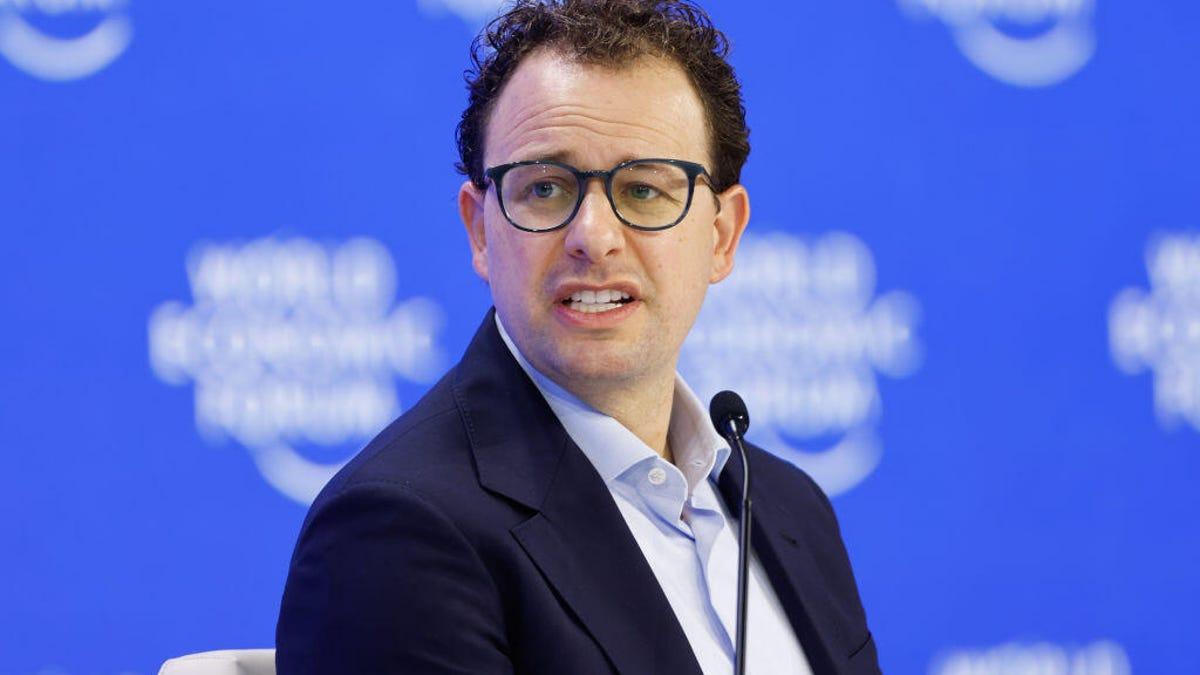
Palantir CEO says AI will eliminate the need for mass immigration Palantir Technologies Inc. Chief Executive Officer Alex Karp said he believes that when the world hits peak artificial intelligence, there will be so many jobs on offer that mass immigration will be obsolete. "There will be more than enough jobs for the citizens of your nation, especially those with vocational training," Karp (pictured) said at the World Economic Forum in Davos, Switzerland. "I do think these trends really do make it hard to imagine why we should have large-scale immigration unless you have a very specialized skill." Karp, who Forbes says has a net worth of around $14.3 billion, used himself as an example of job displacement when he talked about his Ph.D. in philosophy. "Elite" white-collar workers like him, he said, will be the first to be affected by the great job disruption. Vocational workers, he believes, will hold on for longer. His 30-minute conversation with BlackRock Inc. Chief Executive Larry Fink has already drawn criticism from the media, which was quick to point out that these titans of the military-industrial complex and surveillance industry may not have their feet firmly on the ground. Karp often has called himself as a "card-carrying progressive," and not too long ago said his company's surveillance technology would not be used to track immigrants in the U.S., according to a recent article in The Washington Post. Nonetheless, Palantir's software has played a major role in helping Immigration and Customs Enforcement unearth undocumented immigrants and deport them in line with the current administration's mass deportation campaign. Karp was once a critic of mass deportations, but he has more recently aligned himself with President Trump, describing his company's technology as "anti-woke" and praising the immigration crackdowns. If his predictions hold, it won't be long until crackdowns on undocumented workers become a thing of the past, along with liberal arts degrees, because, according to Karp, AI "will destroy humanities jobs." Some executives attending the conference told Business Insider that they believe critical thinking skills will actually become a much sought-after commodity. Anthropic PBC Chief Executive Dario Amodei said the technicians that Karp values so highly are not in demand at his company, as software and coding roles decline.
[7]

Palantir CEO warns that AI 'will destroy' this type of job -- while...
Workers with college degrees in philosophy and other humanities will have a hard time finding jobs as artificial intelligence takes over the US economy, Palantir CEO Alex Karp cautioned Tuesday. Karp issued the warning after BlackRock CEO Larry Fink asked him if AI will "create jobs or destroy jobs overall" during a wide-ranging discussion at the World Economic Forum in Davos, Switzerland. "It will destroy humanities jobs," Karp replied. "[If] you went to an elite school and you studied philosophy -- I'll use myself as an example -- hopefully you have some other skill. That one is going to be hard to market." Karp, 58, is known for his unorthodox path to leading a top-tier tech company. He earned a a bachelor's degree in philosophy from Haverford College, a JD from Stanford Law School and later a Ph.D. in philosophy from the prestigious Goethe University in Germany before cofounding Palantir alongside billionaire Peter Thiel in 2003. The Palantir boss did not point to specific fields that would face job losses, though graduates in the humanities often pursue careers in academia, law and government. When prodded by Fink, Karp said white collar jobs would likely see some upheaval as a result of AI, while vocational career paths that are typically categorized as blue collar will thrive. As an example, Karp pointed to vocational technicians who are building batteries and other components for tech companies. "If you're a vocational technician ... [they are] very valuable if not irreplaceable because we can make them into something different than what they were very rapidly. Those jobs are going to become more valuable," Karp said. Overall, he believes there will be "more than enough jobs for the citizens of your nation, especially those with vocational training." Employers, meanwhile, will need to develop "different ways of testing aptitude" beyond academic degrees to get the most out of their workers. During the Davos discussion, Karp and Fink agreed that an education in the humanities was already "hard to market" even before AI reshaped the economy. "It was hard to market. Very hard," Karp said. "It's a very, very strong education. If you can get a job, you might keep it. That's what I always thought, if I finally get a job, I'll probably keep it and do well, but I'm not sure who's going to give me my first job." A number of tech executives have previously warned that AI will result in job losses, especially in white-collar fields. Last May, Anthropic CEO Dario Amodei warned of potential mass layoffs in fields like tech, finance and law that could push national unemployment to 20%. As The Post reported in December, Karp, who has described himself as neurodivergent, recently announced that Palantir would offer a new fellowship program specifically crafted for neurodivergent talent. The program was announced shortly after Karp faced social media snark after he was seen fidgeting in his chair and waving his arms throughout an interview with journalist Andrew Ross Sorkin during the New York Times' DealBook Summit.
[8]
Palantir CEO Alex Karp says AI 'bolsters civil liberties,' slams EU...
Palantir CEO Alex Karp suggested Tuesday that usage of artificial intelligence "bolsters civil liberties," while also warning Europe that its adoption of technology is falling behind the U.S. and China. In a wide-ranging conversation with Blackrock CEO Larry Fink at the World Economic Forum in Davos, Switzerland, Karp said his company powers "tons and tons of hospitals," but that they all have an "intake problem" and a "shortage of doctors and nurses." "They are working in a low-margin environment, but every single one has a different way of processing their patients, according to what their specialty is and the kind of patients they don't do well with, and how do you manage that? And so the intake flow and into your enterprise in a way that you can actually process these things 10, 15 times faster than you could before," Karp said. "It saves a lot of lives." "Despite what people may want to believe, it also bolsters civil liberties, because now you can see, well, I mean, just simple questions -- Was someone processed based on economic considerations, or were they processed based on their background? Like those things are impossible to see, unless you have, like, there's a huge civil liberties betterment side of this that typically people don't believe we care about or, but it's actually exactly the opposite," he continued. "We do care, and you know, showing is caring. It's like we can granularly show why someone came in, why they were taken, why they were rejected, and we can do it in a way that makes business sense for the business itself," Karp said. When asked by Fink if AI is going to create a greater imbalance in the world in terms of growth, Karp said, "Well, I think the obvious first imbalance is, it seems like America and China understand versions of making this work, and they're different, but they both work, and they work at scale, and I think that is very likely to accelerate way beyond what most people believe is possible." "Like the discount rate, I think, not in the short term, but in the long term is way too high on what will be done and how this will impact every aspect of our society," Karp added. He also said: "The tech adoption in Europe is a serious and very, very structural problem, and what scares me the most is, I haven't seen any political leader just stand up and say we have a serious and structural problem that we are going to fix." When asked if he thought AI was going to create or destroy jobs overall, Karp said, "I think one of the unfortunate things of the narrative in the West is, it will destroy humanities jobs." "But like technicians. If you are a vocational technician. Or, like, we're building batteries for a battery company and the people who are doing it in America are doing roughly the same job that Japanese engineers are doing, and they went to high school," he continued. "And now, they're very valuable, if not irreplaceable, because we can make them into something different than what they were, very rapidly. And those jobs are going to become more valuable." "Not to diverge into my usual political screeds, but there will be more than enough jobs for the citizens of your nation, especially those with vocational training," Karp also said. "I do think these trends really do make it hard to imagine why we should have large-scale immigration unless you have a very specialized skill."
Share
Share
Copy Link
Alex Karp made bold claims at Davos that AI will displace enough jobs to make large-scale immigration obsolete, while vocational training becomes essential. The Palantir CEO's controversial statements come as his company's value soars past $400 billion, even as skeptics question whether AI investments are delivering actual returns.

Palantir CEO Makes Sweeping Claims About AI Impact on Jobs and Immigration
Alex Karp delivered another attention-grabbing performance at the World Economic Forum in Davos, Switzerland, where the Palantir CEO declared that AI will fundamentally reshape the job market to the point where large-scale immigration becomes unnecessary
1
2
. Speaking alongside BlackRock CEO Larry Fink, Karp argued that "there will be more than enough jobs for the citizens of your nation, especially those with vocational training," adding that these trends "really do make it hard to imagine why we should have large-scale immigration unless you have a very specialized skill"5
. The comments merge two politically sensitive topics, reflecting Karp's pattern of courting controversy while promoting his data analytics company's capabilities.White-Collar Professionals Face Displacement While Vocational Workers Gain Value
Karp used himself as an example of the type of worker most vulnerable to AI disruption. "It will destroy humanities jobs," he stated bluntly, noting that those who "went to an elite school and studied philosophy" will find their skills "hard to market"
5
. This assessment carries particular irony given Karp's own educational background, which includes degrees from Haverford College, Stanford Law School, and a PhD in philosophy from Goethe University2
. The Palantir CEO emphasized that vocational workers will become "very valuable if not irreplaceable," criticizing the notion that higher education serves as the ultimate benchmark of employability4
. He pointed to one of Palantir's MAVEN system managers, a former police officer who only attended junior college, as evidence that traditional aptitude testing fails to identify talent5
.Palantir's Business Interests Align With Immigration Enforcement
The timing of Karp's immigration comments carries additional weight given Palantir's extensive ties to US Immigration and Customs Enforcement and the Defense Department
2
. The company has long supplied services enabling officials to build dossiers on individuals, relationships that have provoked protests both inside and outside Palantir2
. Karp described himself as a "card-carrying progressive" while expressing views sympathetic to President Donald Trump's agenda2
. The company, co-founded by Karp and billionaire Peter Thiel, an early Trump adviser, has seen its share price rise more than 130% over the past 12 months, pushing its valuation to approximately $400 billion2
.Related Stories

Growing Skepticism Challenges AI Investment Optimism
Karp's bullish predictions about AI capabilities clash with mounting evidence of enterprise adoption struggles. Deutsche Bank analysts recently declared "the honeymoon is over" for AI, warning of coming disillusionment, dislocation, and distrust in the market
1
. Gartner placed enterprise adoption of AI in the trough of disillusionment, while PwC reported that the majority of CEOs are seeing zero payoffs from AI investments1
. Karp acknowledged that AI operates in a "very low-trust environment" where "people have tried lots of stuff" and "a lot of it hasn't worked"1
. Yet he claimed Palantir's enterprise projects can save "80 percent of your cost and improve your top line dramatically"1
.Palantir Pushes Alternative Talent Pipeline Through Meritocracy Fellowship
Aligning with his critique of traditional education, Karp has championed Palantir's Meritocracy Fellowship, which offers high school students paid internships with potential full-time positions after four months
5
. The program explicitly criticized American universities for "indoctrinating" students and maintaining "opaque" admissions that "displaced meritocracy and excellence"5
. Karp told Fink that organizations "need different ways of testing aptitude," explaining that his main task involves "figuring out what is someone's outlier aptitude" and keeping them focused on that specialized skill1
. This approach reflects a broader shift in how Palantir evaluates talent, with Karp stating that once someone joins the company, "no one cares" about their educational background5
. The surveillance industry leader's vision suggests a future where manual labor and specialized skills trump broad intellectual training, raising questions about social mobility and economic opportunity in an AI-driven economy.References
Summarized by

Navi
[1]
Related Stories
Dario Amodei warns AI risks are 'almost here' in 19,000-word essay calling out AI companies
26 Jan 2026•Policy and Regulation

Anthropic CEO Warns: AI Could Eliminate Half of Entry-Level White-Collar Jobs in 5 Years
29 May 2025•Technology
Block's 4,000-person layoff sparks debate: AI revolution or corporate cost-cutting in disguise?
05 Mar 2026•Business and Economy
Recent Highlights
1
Anthropic's Claude AI can now control your computer to complete tasks autonomously
Technology

2
Nvidia's Jensen Huang calls OpenClaw the next ChatGPT, sending Chinese AI stocks soaring
Technology

3
Elon Musk unveils $20 billion Terafab chip manufacturing project to produce terawatt of computing
Technology

Recent Highlights
Today's Top Stories




Your Daily Dose of Curated AI News
Don’t drown in AI news. We cut through the noise - filtering, ranking and summarizing the most important AI news, breakthroughs and research daily. Spend less time searching for the latest in AI and get straight to action.

