Perplexity Computer deploys teams of AI agents across 19 models for autonomous workflows


13 Sources
13 Sources
[1]
Perplexity announces "Computer," an AI agent that assigns work to other AI agents
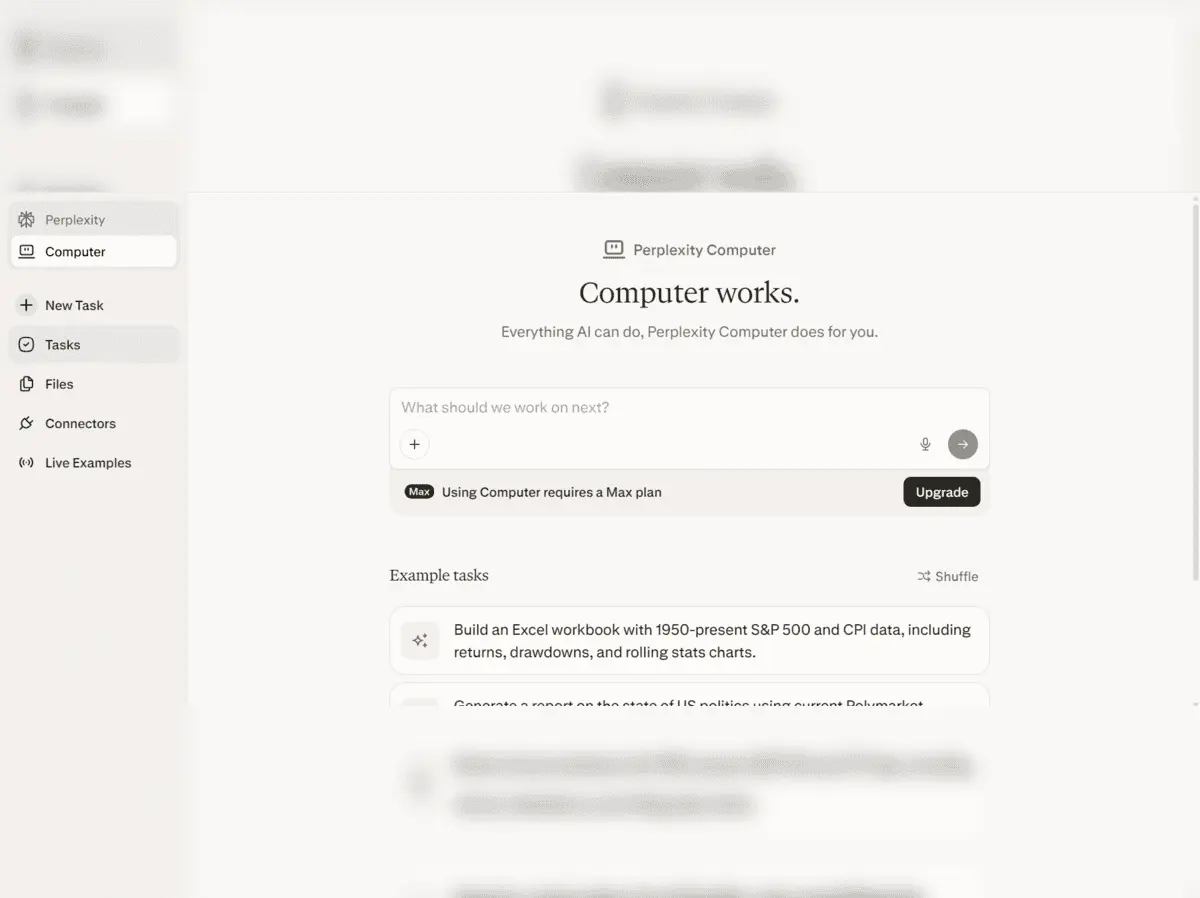
Perplexity has introduced "Computer," a new tool that allows users to assign tasks and see them carried out by a system that coordinates multiple agents running various models. The company claims that Computer, currently available to Perplexity Max subscribers, is "a system that creates and executes entire workflows" and "capable of running for hours or even months." The idea is that the user describes a specific outcome -- something like "plan and execute a local digital marketing campaign for my restaurant" or "build me an Android app that helps me do a specific kind of research for my job." Computer then ideates subtasks and assigns them to multiple agents as needed, running the models Perplexity deems best for those tasks. The core reasoning engine currently runs Anthropic's Claude Opus 4.6, while Gemini is used for deep research, Nano Banana for image generation, Veo 3.1 for video production, Grok for lightweight tasks where speed is a consideration, and ChatGPT 5.2 for "long-context recall and wide search." This kind of best-model-for-the-task approach differs from some competing products like Claude Cowork, which only uses Anthropic's models. All this happens in the cloud, with prebuilt integrations. "Every task runs in an isolated compute environment with access to a real filesystem, a real browser, and real tool integrations," Perplexity says. The idea is partly that this workflow was what some power users were already doing, and this aims to make that possible for a wider range of people who don't want to deal with all that setup. People were already using multiple models and tailoring them to specific tasks based on perceived capabilities, while, for example, using MCP (Model Context Protocol) to give those models access to data and applications on their local machines. Perplexity Computer takes a different approach, but the goal is the same: have AI agents running tailor-picked models to perform tasks involving your own files, services, and applications. Then there is OpenClaw, which you could perceive as the immediate predecessor to this concept. The story so far If you haven't been following the wild OpenClaw craze, here's the quick summary: originally titled ClawdBot, then Moltbot, OpenClaw was an agentic AI tool that leveraged large language models to independently operate as a sort of background or ambient process on your local machine, performing a wide range of tasks from sorting through your email history to building websites to, well, basically whatever you could imagine. Given the right permissions and with the proper plugins, it could create, modify, or delete the user's files and otherwise change things far beyond what most users could achieve with existing models and MCP (Model Context Protocol). Users would use files like USER.MD, MEMORY.MD, SOUL.MD, or HEARTBEAT.MD to give the tool context about its goals and how to work toward them independently, sometimes running for long stretches without direct user input. On one hand, that meant it could do impressive things -- the first glimpses of the sort of knowledge work that AI boosters have been saying agentic AI would ultimately do. On the other hand, it was prone to serious errors and vulnerable to prompt injection and other security problems, in part due to a Wild West of unverified plugins. The same toolkit that was used to create a viral Reddit clone populated by AI agents was also, at least in one case, responsible for deleting a user's emails against her will. Stay in your lane Perplexity Computer aims to address those concerns in a few ways. First, its core process occurs in the cloud, not on the user's local machine. Second, it lives within a walled garden with a curated list of integrations, in contrast to OpenClaw's unregulated frontier. This is, of course, an imperfect analogy, but you could say that if OpenClaw were the open web of AI agent tools, then Computer is Apple's App Store. While you're more limited in what you can do, you're not trusting packages from unverified sources with access to your system. There could still be risks, though. For one thing, LLMs make mistakes, and those could be consequential if Computer is working with data you don't have backed up elsewhere or if you're not verifying the outputs, for example. Perplexity Computer aims to button up, refine, and contain the wild power of the viral OpenClaw agentic AI tool -- competing with the likes of Claude Cowork -- by optimizing subtasks by selecting models best suited to them. It surely won't be the last existing AI player to try and do this sort of thing. After all, OpenAI hired OpenClaw's developer, with CEO Sam Altman suggesting that some of what we saw in OpenClaw will be essential to the company's product vision moving forward.
[2]
Perplexity's new Computer is another bet that users need many AI models | TechCrunch
Starting this week, Perplexity subscribers will have a new agentic tool at their disposal. Perplexity Computer, in the company's words, "unifies every current AI capability into a single system." More specifically, Perplexity says it is a computer user agent can execute complex workflows independently using 19 different AI models, even creating subagents to handle specific problems. The tool is available now, only on the company's highest subscription tier, the $200/month Perplexity Max. It runs entirely in the cloud, which might spare it some of the security concerns of other agentic tools like OpenClaw. TechCrunch hasn't done a hands-on demo of the new tool, but in example workflows on Perplexity's website, it is shown handling tasks that involve collecting statistics, financial or legal data, creating analysis, and sharing its findings as finished websites or visualizations. Perplexity executives invited the press to a background briefing with executives last week to discuss the product and lay out the agenda for the year. The event was intended to include a demonstration of the tool, but the company cancelled the demo because of flaws found in the product hours before the event. This tool represents the evolution of Perplexity, which made a splash early in the AI boom by wrapping frontier models in familiar user interfaces, particularly its search-engine-like answer service. It then moved on to launch its Comet web browser last summer. Competitors like Google have now changed their products to be more like those built at Perplexity, one executive said, but that's a threat as much as a compliment. The company is changing in response to a shifting ecosystem: One of the first AI companies to offer advertising, it abandoned that business late last year, saying last week that it undermined users' trust in their answers' accuracy. But Perplexity's total user base -- in the tens of millions of users -- pales in comparison to that of OpenAI, which claims 800 million weekly users and began testing ads in ChatGPT this year. Now, Perplexity executives say they are aiming for a more boutique set of users, with products that serve people making "GDP-moving decisions." Executives in the briefing, who asked not to be identified by name, described prioritizing enterprise subscriptions, particularly for deep research. "You don't hear us talk about MAUs ever, because we're not actually on a mission to get as many users as possible," one executive said. Perplexity recently released a new benchmark for complex research tasks, called Draco, where (no surprise) its own deep research offering beats out competitors like Gemini. Perplexity says it is no longer reliant on other companies' APIs for its web index and now has its own AI-optimized search API. But the company is doubling down on packaging frontier models in a consumer-friendly user experience, arguing that there is value in orchestrating multiple third-party LLMs to obtain the most cost-effective and accurate answers to queries. "Multi-model is the future," one Perplexity exec argued. Models, in their view, are specializing, not commoditizing. The company has found that its users frequently switch between models to obtain the results they are looking for, with December 2025 queries for visual outputs most often sent to Gemini Flash, software engineering done by Claude Sonnet 4.5, and medical research in GPT-5.1. If one LLM is better at coding tasks and another does a better job drafting marketing copy, Perplexity's software can automatically choose the ideal one. Another example, executives said, is running Perplexity's own modified open-source Chinese-built LLMs to answer queries more cheaply, a technique the company got dinged for hiding from its customers last year. But done transparently, the technique could prove an efficient way to optimize LLM queries. The company also offers users the opportunity to query multiple models at once, in a feature called Model Council. But the unit economics of offering multiple queries at flat subscription rates aren't entirely clear. Still, without expensive infrastructure projects on its books and with, the executives claimed, high margins on users fees, Perplexity believes it will remain competitive by allocating tokens to the best model for a purpose. And there is more coming: Perplexity Comet browser is coming to iOS next month, and the company is planning a developers' conference, Ask, on March 11 in San Francisco to promote third-party use of its API. One executive said that instead of looking at the previous day's number of queries each morning, he was now looking at the most recent revenue metrics. At least some customers are noticing a new focus on the bottom line, with the Perplexity subreddit featuring frequent complaints of new rate limits on free and subscription product tiers. However, the execs at the briefing dismisses such complaints. "Any discussions on the free tier being made worse or rate-limited is completely false," an executive said.
[3]
Is Perplexity's new Computer a safer version of OpenClaw? How it works
It's positioned essentially as a safer alternative to OpenClaw. There's been a lot of excitement (and nervousness) lately about AI agents that can work autonomously in the background of a user's computer, accessing sensitive files, API keys and the like to perform various tasks. Some say they're a monumental productivity unlock, others say they're a security nightmare. Perplexity is betting they're the future of AI. On Wednesday, the company introduced Computer, a multiagent orchestration system that harnesses the strongest capabilities from more than a dozen frontier AI models. Currently available only to Perplexity Max users -- and expected to roll out to Enterprise and Pro subscribers in the coming weeks -- "Computer is a general-purpose digital worker," the company wrote in a press release, that "reasons, delegates, searches, builds, remembers, codes, and delivers." The logic behind Computer is basically that, rather than becoming general-purpose tools, as they're commonly described, AI models have instead branched off into different specialties: Anthropic's Claude, for example, is famously popular among software engineers. Relying on a single model to complete a complex task -- building a website, say -- is therefore a bit like trying to assemble an Ikea dining table using a butter knife; it could be possible, but the finished product is going to be a little wonky. Wouldn't you rather have a multi-bit screwdriver? Also: From Clawdbot to OpenClaw: This viral AI agent is evolving fast - and it's nightmare fuel for security pros To use another analogy, think of Computer like the CEO of a company, delegating tasks across a hierarchy of teams and employees. A user can describe their vision for a final outcome ("Build an app that provides up-to-date snow conditions at different ski resorts"), and Computer will automatically break the task down into different tasks and subtasks, according to Perplexity, all of which will be handled by whatever model is called for. Its "core reasoning engine" is Claude Opus 4.6. Google's Nano Banana and Veo 3.1 handle imagery and video, respectively, while Grok handles "lightweight tasks" and GPT-5.2 is deployed for queries that require long-context recall and an expansive web search. The current model arrangement within Computer is subject to change, according to Perplexity: new models could be added if they excel in specific domains, and the existing lineup could shift as the models evolve. Users also have the option of stepping into the orchestrator role and delegating specific subtasks to particular models. Users can also execute dozens of tasks in parallel to one another; Computer can operate quietly in the background for months, according to Perplexity, checking in only "if it truly needs you." If you're reading this and thinking, "This sounds a lot like OpenClaw," you're not wrong. The AI agent formerly known as Clawdbot and Moltbot went viral earlier this month as a kind of always-on automated assistant that could essentially work across users' entire digital ecosystem, and interact with them directly via apps like WhatsApp, Slack, and Telegram. Its creator, an Austrian programmer named Peter Steinberger, was promptly hired by OpenAI: In a X post, company CEO Sam Altman called him "a genius with a lot of amazing ideas about the future of very smart agents interacting with each other to do very useful things for people," and that "this will quickly become core to our product offerings." (Disclosure: Ziff Davis, ZDNET's parent company, filed an April 2025 lawsuit against OpenAI, alleging it infringed Ziff Davis copyrights in training and operating its AI systems.) But the field of fully autonomous agents that can work across apps and files is a very young one, and mistakes happen. Earlier this week, Meta AI security researcher Summer Yue posted screenshots on X of her desperate attempts to instruct OpenClaw to refrain from deleting her entire email inbox, which it was ignoring. "I had to RUN to my Mac Mini" -- the hardware of choice for running OpenClaw in the background -- "like I was diffusing a bomb," she wrote. (Yue wrote in a comment beneath that post that OpenClaw had gained her trust after successfully managing her "toy" inbox, but that when she moved it to her much larger, actual inbox, it triggered a process called compaction, in which an agent is faced with an excessively large context window and starts taking shortcuts -- in this case, overlooking her original instruction not to "action until I tell you to.") Also: OpenClaw is a security nightmare - 5 red flags you shouldn't ignore (before it's too late) Yue's episode highlights two very real risks: Prompts can be misinterpreted by agents, and they can act in unexpected (sometimes disastrous) ways. Perplexity appears to be selling Computer as a safer, more controllable multiagent orchestration system than those that are currently available. The system runs in "a safe and secure development sandbox," according to the company, which means that any security glitches can't spread to a user's main network. The company also said it's "run thousands of tasks" internally using Computer, from publishing web copy to building apps, and "been consistently surprised by the quality of the output."
[4]
Perplexity's new tool deploys teams of AI agents
Unlike competitors like OpenClaw, Computer operates entirely in the cloud using a walled garden approach rather than local hardware integration. The viral OpenClaw AI tool has already spawned dozens of imitators on GitHub and has spurred pivots from major AI players like Meta. Now Perplexity is throwing its hat into the personal AI agent arena, with a new tool that can put teams of sub-agents under your command. Unveiled on Wednesday, Computer is being billed as a "general-purpose digital worker that operates the same interfaces you do"-or, as chief Perplexity business officer Dmitry Shevelenko calls it, a "massively multi-model orchestration system." Sounds like a lot of buzz words, but the bottom line is that Perplexity Computer is yet another agentic AI tool that can actually go out and do things. That puts it in the same category as Meta's Manus AI and-of course-OpenClaw, the open-source AI tool that kicked off the recent "personal AI agent" craze just a matter of weeks ago. Work on Computer, which is currently available only to Perplexity Max users, began just last month as an "internal experiment," Shevelenko wrote on LinkedIn. He attributed Computer's speedy development to the fact that "work that would take weeks for a team was getting done overnight while we slept." Computer is powered by a variety of different AI models, with Anthropic's Claude Opus 4.6 running the "core reasoning engine," Gemini handling deep research projects, Nano Banana creating images, Veo 3.1 crafting videos, Grok helping with "speed in lightweight tasks," and ChatGPT 5.2 for "long-context recall and wide search." Like OpenClaw, Perplexity Computer can be set loose on a project-anything from building a web-based dashboard or an app to creating a PowerPoint deck or an animated GIF-and it will devise a plan and eventually deliver a finished product, delegating sub-agents to toil on specific tasks, such as finding API keys, coding, or conducting secondary research. Unlike OpenClaw, Computer (which I've yet to try for myself) doesn't live on your personal hardware. Instead, the Perplexity tool sits in the cloud and performs its work in a walled garden, interacting with outside services via a wide array of integrations. That's a good thing if you're worried about AI agents running amok on your system, but it also means Computer is bound by its sandbox, whereas OpenClaw can-if you let it-work directly on your devices. Another key difference is that you communicate with Perplexity Computer via the Perplexity app, whereas OpenClaw and now Manus AI offer chat via commonly used social messaging apps like WhatsApp, Discord, and Telegram. Perplexity's Sheveleno noted that he and his team "originally talked to [Computer] via Slack, since it felt more like a digital worker than just an agent," but eventually decided that it's "more like a computer, [so] we decided to name it, rebuild it, and launch it as a public product."
[5]

Perplexity orchestrates 19 AI models simultaneously
Artificial intelligence just took another significant step away from simple chatbots. Perplexity AI launched a product called Computer, a cloud-based platform designed to break complex projects into smaller tasks, assign each task to the best available AI model, and deliver finished work with minimal human input. What Perplexity Computer actually does The system works by accepting a single description of a desired outcome from the user. It then divides that goal into subtasks and creates specialized subagents to handle each one. One sub-agent might conduct web research while another drafts a document. A third could generate images, and a fourth might write and deploy code. The coordination between these agents runs automatically and asynchronously, meaning users can walk away while the system works. "Computer unifies every current capability of AI into a single system," said Perplexity CEO Aravind Srinivas in a post on X. He revealed that the team had spent the previous two months building the product in relative silence. When Computer encounters an obstacle, it generates additional sub-agents to solve the problem. It can locate API keys, pull supplemental information from the web, write code if necessary, and check in with the user only when truly stuck. Every task runs inside an isolated computing environment with access to a real file system, a real browser, and real tool integrations. How multi-model orchestration works What sets Computer apart from most AI tools is its multi-model approach. Rather than relying on a single AI system, the platform currently orchestrates 19 different models. It selects each one based on the specific demands of a given subtask. As of launch, Computer uses Anthropic's Claude Opus 4.6 as its core reasoning engine. It routes deep research tasks to Google's Gemini, image generation to Nano Banana, video creation to Veo 3.1, lightweight speed tasks to xAI's Grok, and long-context recall to ChatGPT 5.2. "When you build a team, you don't build a homogenous group where everyone has the same skills," Srinivas told Fortune. "We're applying that same logic to AI workflows." Users can also choose specific models for specific subtasks. The platform's model-agnostic design means these selections will shift as newer, better models become available. Entering a crowded agent race Perplexity is not alone in pursuing autonomous AI systems. The launch arrives at a moment when several competitors already occupy parts of this emerging market. OpenClaw, a free, open-source autonomous agent that originally launched as Clawdbot in late 2025, has gained rapid developer adoption by running directly on users' machines. However, security researchers have cautioned that agents with deep system access can introduce vulnerabilities if misconfigured. Perplexity positions Computer as a safer alternative. Because it runs entirely in the cloud rather than on a user's local device, the company maintains centralized safeguards, monitors performance, and issues updates without exposing personal hardware. According to Semafor, the biggest risk for Perplexity is that the underlying AI models themselves could become interchangeable commodities. If that happens, a service built on switching between them may lose its competitive edge. Security concerns surround autonomous agents The broader rise of autonomous AI systems raises questions that extend well beyond any single product. The OWASP Foundation released its first security framework for autonomous AI applications in December 2025, warning that the risks are not theoretical. According to a 2025 IBM report, organizations that lack AI governance policies pay an average of $670,000 more per data breach. Roughly 80% of organizations have already encountered risky behaviors from AI agents, including improper data exposure and unauthorized system access. Perplexity says it addresses these concerns by keeping all agent activity within its own cloud infrastructure. The company uses controlled connectors, usage-based permissions, and isolated sandboxes to contain multi-step workflows. Who can access Computer Perplexity Computer is currently available only to Perplexity Max subscribers, the company's premium tier. Max subscribers receive 10,000 credits per month, plus a one-time bonus of 20,000 additional credits at launch, which expire after 30 days. The company plans to extend access to Perplexity Pro and Enterprise users in the coming weeks. The platform represents a major strategic shift for Perplexity, which founded its reputation as an AI-powered search engine before expanding into browsing with its Comet browser and now into full autonomous task execution. What this means for the future of AI The question at the heart of Perplexity Computer is whether orchestrating multiple specialized AI models produces better results than relying on any single one. As frontier models grow more capable and more specialized, the answer may determine which companies lead the next phase of the AI industry. For now, Computer offers a window into what autonomous AI work might look like. Whether it delivers on its ambitious promises will depend on real-world performance, user trust, and the rapidly shifting competitive landscape of 2026. The information was obtained from a Perplexity AI.
[6]

Perplexity launches 'Computer' AI agent that coordinates 19 models, priced at $200 a month
Perplexity, the AI-powered search company valued at $20 billion, on Wednesday launched what it calls the most ambitious product in its three-year history: a multi-model agent orchestration platform called Computer that coordinates 19 different AI models to complete complex, long-running workflows entirely in the background. The product, currently available only to Perplexity Max subscribers at $200 per month, is the company's clearest articulation yet of a thesis it has been refining for more than a year: that AI models are not converging into general-purpose commodities but are instead specializing -- and that the company best positioned to win the next era of AI is the one that can orchestrate all of them together. "What has Perplexity been up to last two months? We've silently been working on the next big thing," CEO Aravind Srinivas wrote on X, announcing that "Computer unifies every current capability of AI into a single system." Srinivas said the system treats models as interchangeable tools rather than core products. "It's multi-model by design," he wrote. "When models specialise, they just become tools similar to the file system, CLI tools, connectors, browser, search." Computer arrives at a moment when the AI industry is grappling with a fundamental question: now that foundation models have become extraordinarily capable, who captures the value? The model makers -- OpenAI, Anthropic, Google -- or the companies that sit above them and turn raw intelligence into reliable, accurate products? Perplexity is making a $20 billion bet on the latter. Inside Computer: how Perplexity built a single interface that delegates work across Claude, Gemini, Grok and 16 other AI models At its core, Computer functions as what Perplexity describes as "a general-purpose digital worker" -- a system that can accept a high-level objective from a user, decompose it into subtasks, and delegate those subtasks to whichever AI model is best suited for each one. The Verge described it as existing "somewhere between OpenClaw and Claude Cowork," referring to the viral open-source autonomous agent and Anthropic's enterprise collaboration tool, respectively. The platform's central reasoning engine runs on Anthropic's Claude Opus 4.6, which handles orchestration logic and coding tasks. Google's Gemini powers deep research queries. Google's Nano Banana generates images, and Veo 3.1 handles video. xAI's Grok is deployed for lightweight, speed-sensitive tasks. OpenAI's GPT-5.2 manages long-context recall and expansive web search. In total, the system coordinates 19 models on the backend, according to the company. That model roster is not fixed. Perplexity says new models can be added as they demonstrate strength in specific domains, and the existing lineup will shift as models evolve. Users can also step into the orchestrator role themselves, manually assigning subtasks to particular models if they prefer. What makes Computer distinct from existing agent tools is its combination of scope and accessibility. A user can describe a desired outcome -- say, "Plan a weeklong trip to Japan, find flights under $1,200, and build a full itinerary with restaurant reservations" -- and Computer will autonomously break that project into components, assign each to the right model, and work on it in the background. Perplexity says the system can operate quietly for extended periods, checking in with the user only when it genuinely needs input. The enterprise data that convinced Perplexity no single AI model can do everything well The intellectual foundation of Computer rests on data that Perplexity has been collecting across its enterprise customer base -- data that, according to the company, no other AI company has access to at the same scale. At a recent press briefing that VentureBeat attended with other reporters in San Francisco, Perplexity executives shared enterprise usage statistics that illustrated a dramatic shift in how businesses use AI models. In January 2025, more than 90 percent of enterprise tasks on the Perplexity platform were spread across just two models. By December 2025, no single model commanded more than 25 percent of usage across businesses and task types. That shift, executives said, was driven partly by increasingly intelligent model routing on Perplexity's side, and partly by a simple reality: models are getting better at different things, not the same things. A new frontier model emerged on average every 17.5 days in 2025, and each one brought distinct strengths rather than uniform improvement. Claude, for instance, has emerged as the model of choice for software engineering tasks -- a reputation so strong that even OpenClaw, the viral autonomous agent created by Austrian programmer Peter Steinberger (who was subsequently hired by OpenAI), was originally built on Claude's code capabilities. But Claude's strengths in coding do not translate to writing or creative generation, where Gemini tends to outperform. And in long-context retrieval and broad web search, GPT-5.2 holds advantages. "What we've learned in this time is that they are not commoditizing. They're specializing," a senior Perplexity executive said at the briefing, characterizing Claude Opus 4.6 as "a terrible writer" while noting its coding prowess, and adding: "Everybody has job security on that one." This specialization dynamic creates what Perplexity sees as a structural advantage. A marketing team using Claude, executives argued, will generally produce worse results than one using Gemini. An engineering team using Gemini will underperform one using Claude. No company operates with only one type of team -- and no single model can serve all of them equally well. Why Perplexity says its cloud-based approach is safer than OpenClaw's local-access model Computer's launch arrives in the immediate wake of OpenClaw, the open-source autonomous agent that went viral earlier this month and prompted OpenAI to hire its creator. OpenClaw captured the imagination of the AI community by demonstrating what a fully autonomous agent could accomplish when given broad access to a user's entire digital ecosystem -- files, email, messaging apps, API keys, and more. But it also demonstrated the risks. In a widely shared incident this week, Meta AI security researcher Summer Yue posted screenshots on X of her frantic attempts to stop OpenClaw from deleting her entire email inbox -- a process the agent had initiated and was refusing to halt. "I had to RUN to my Mac Mini like I was diffusing a bomb," Yue wrote. Perplexity has been vocal about why Computer runs entirely in the cloud rather than accessing a user's local machine -- an approach taken by rivals like Anthropic's Claude and OpenAI's Operator. The company argues that local access creates unnecessary risk, comparing it to malware in how easily it can damage data or expose sensitive information. Computer instead operates inside what Perplexity describes as a safe and secure development sandbox, meaning security failures are contained and cannot spread to a user's primary network or device. The company also said it has run thousands of tasks internally using Computer, from publishing web copy to building apps. The distinction extends to accessibility. Where OpenClaw requires terminal access, API key configuration, and a dedicated machine (typically a Mac mini), Computer is designed to be invoked from a phone, a Slack message, or the Perplexity app. At the press briefing, executives elaborated on the philosophy, positioning Computer's browser agent capabilities -- built on Perplexity's Comet browser technology -- as central to the product. One executive noted that Perplexity's browser agent usage numbers are three to five times higher than ChatGPT's agent numbers published by The Information in January, despite Perplexity's much smaller user base. Perplexity's revenue grew faster than its user base in 2025, and the company says it hasn't even started trying Perplexity's product ambitions are backed by a business that, by the company's own metrics, is growing faster than its user base -- and executives say the company has barely begun to focus on monetization. At the press briefing, executives disclosed that Perplexity grew users by 3.7x in 2025 and revenue by 4.7x, meaning the company is extracting more value from its existing users over time. Consumer subscriptions remain the largest revenue component, but the enterprise business is ramping with what executives acknowledged is a remarkably lean operation. "We only have five people on our enterprise sales team," one executive said, before adding that the company's revenue per employee working on deals may be unmatched in the industry. Another executive noted that 92 percent of the Fortune 500 have Perplexity usage -- though that figure encompasses employees signing up with personal accounts and work email addresses for the consumer version, not necessarily formal enterprise contracts. A common enterprise sales conversation, executives said, starts with: "Did you know that there's already 3,000 of your employees using Perplexity, and they're using the consumer version that doesn't adhere to all of your security policies?" Notably, Perplexity is not pursuing advertising revenue, even as competitors like OpenAI move toward ad-supported models. Executives said advertising is fundamentally misaligned with the company's accuracy mission. "The challenge with ads is, you know, a user will just start doubting everything," one executive said. The company confirmed it has taken no economics on its shopping integrations and expressed doubt that any shopping-based monetization would materialize this year. On the question of an IPO, Srinivas indicated the company has "very good properties of a company that can go public" given its low capital expenditure and healthy margins, but stopped short of committing to a timeline. Another executive warned that "a lot of IPO talk is hype" and that "if you over promise and under deliver the market punches you severely." TestingCatalog also reported this week that a new "Usage and Credits" settings area has appeared in Perplexity's development builds, which would let users purchase additional credits to extend usage -- potentially easing backlash from subscribers who saw their Deep Research query limits cut from roughly 500 per day to as few as 20 per month between late 2025 and early 2026. Four of the 'Magnificent Seven' tech giants are already using Perplexity's search API in production Perhaps the least-discussed but most strategically significant element of Perplexity's story is its search API business -- an infrastructure play that positions the company not just as a consumer product but as a foundational layer for the broader AI ecosystem. At the press briefing, executives revealed that Perplexity launched its search API approximately four months ago and already has four of the "Mag Seven" -- the seven largest technology companies by market capitalization -- using it in production at significant scale. "You guys cover the Mag Seven, you know that they don't turn on a feature in production unless they've run rigorous evals and compared it," one executive told reporters. This disclosure suggests that the world's largest technology companies have evaluated Perplexity's search index against alternatives and concluded it is better optimized for AI-native use cases -- a fundamentally different optimization target than Google's traditional index, which was designed for humans scanning lists of links. "Everything in our index is optimized, not for a human to see 10 blue links," one executive explained. "It's for an AI to be able to take those snippets and consume it in this context window and then reason through it." The company also confirmed it has fully independent search infrastructure, no longer relying on any third-party APIs from Google or Bing for its index -- a significant departure from its earlier years. For Chinese open-source models, which Perplexity uses in its orchestration stack, the company runs all inference from its own U.S. data centers, post-training the models for accuracy, removing what executives described as "state-infused propaganda," and building custom inference kernels. The company open-sourced its methodology for depropagandizing Chinese models for others to use as well. The search API creates a powerful data flywheel, executives argued: Perplexity can observe which snippets its search ranker surfaces for a given query, then track which of those snippets the LLM actually uses in its final output. That feedback loop makes the next query on a similar topic smarter -- an advantage that pure API search businesses like Exa cannot replicate because they lack the consumer product generating user queries and feedback. Copyright lawsuits and legal battles continue to shadow Perplexity's rapid growth Perplexity's ambitions are not without complications. The company faces active lawsuits from multiple publishers, and the legal landscape grew more contentious this week. As Business Insider's Melia Russell reported, Perplexity filed a motion on February 24 in its ongoing legal battle with Dow Jones (publisher of The Wall Street Journal) and the New York Post, alleging that the publishers "cherry-picked" responses from Perplexity's search engine to support their copyright claims. The company said it identified hundreds of prompts the publishers submitted that "were clear attempts to induce copyright-infringing answers," including one instance where a user allegedly hit the "retry" button more than 50 times. At the press briefing, Perplexity executives framed the broader copyright debate in historical terms, noting that waves of lawsuits have accompanied every major technology shift since radio. They expressed confidence that AI companies will ultimately prevail, particularly on the question of whether underlying knowledge -- as distinct from unique creative expression -- can be freely accessed by AI systems. "Countries have copyright law for one reason: to promote innovation," one executive said, noting that the law protects unique expression while keeping the underlying knowledge open. On user agents specifically, executives argued that a user's AI agent is legally and technologically an extension of the user, not an independent actor. In the Amazon lawsuit, which challenges Perplexity's ability to act as a purchasing agent on behalf of users, one executive offered a pointed analogy: "What Amazon's claiming is that you shouldn't be able to have your personal shopper be employed by you. It needs to be employed by them. They want you to use Rufus." Executives also clarified the company's approach to citations, noting that citing a source like The New York Times (which is currently suing the company) does not necessarily mean Perplexity crawled that publication directly. "We can get the summary of that somewhere else, but we cite, we always try to cite that original source," one executive said. "So drive that traffic to the New York Times if somebody clicks instead of driving them to a summary." What Perplexity Computer means for the future of AI: orchestration versus the single-model ecosystem Computer's launch crystallizes a tension that has been building in the AI industry for months. The major model makers -- OpenAI, Anthropic, Google -- have been racing to build end-to-end products that keep users within their ecosystems. OpenAI's Codex and ChatGPT, Anthropic's Claude Code and Cowork, Google's Gemini -- all assume that one model family can handle the full range of user needs. Perplexity is making the opposite bet: that the future belongs to the orchestration layer, not the model layer. It is a bet with historical parallels. In the early days of cloud computing, the companies that built the best abstraction layers above commodity infrastructure -- not the infrastructure providers themselves -- often captured outsized value. Perplexity is positioning itself as that abstraction layer for AI. The risk, of course, is that model makers could restrict API access or degrade service to platform competitors. Srinivas has said he isn't worried, noting that he received congratulations from Anthropic and Google after Computer's launch and that model makers benefit when their systems are part of broader workflows. But the AI industry's history of platform dynamics suggests this détente may not last forever. For enterprise technology leaders evaluating their AI strategies, Computer raises a practical question: should organizations standardize on a single model provider's ecosystem, accepting its limitations in exchange for simplicity? Or should they invest in multi-model orchestration, gaining access to the best capabilities across providers at the cost of additional complexity? Perplexity is betting that as models continue to specialize and the gap between their respective strengths widens, the answer will become obvious. The company's enterprise usage data -- showing a market that went from two-model dominance to no-model dominance in just 12 months -- suggests the shift is already underway. Computer is currently available to Perplexity Max subscribers, with a rollout to Pro and Enterprise users planned in the coming weeks. The company has also announced a developer event on March 11, where it plans to share more details about its search API, ranking embeddings, and the infrastructure powering its orchestration stack.
[7]

Perplexity Computer lets you pick the best AI for every task
The new subscription feature works like a conductor, tapping models like Gemini, Grok, and ChatGPT for specific jobs. Perplexity just launched a feature that lets different AI models collaborate on the same task. Called Perplexity Computer, it taps Gemini, Grok, and ChatGPT 5.2 depending on what you need. The tool is live today for Perplexity Max subscribers and will reach Enterprise Max users soon. Just to be clear, it's not hardware, it's what the feature is called. The system runs Opus 4.6 as its core reasoning engine. But for specific jobs, it hands off to specialist models. Gemini handles deep research by creating sub-agents. Grok jumps in for speed on lightweight tasks. ChatGPT 5.2 manages long-context recall and wide searches. Recommended Videos The idea is simple: use the right tool for each part of your workflow instead of forcing one bot to do everything. You get to pick which models run your subtasks Perplexity Computer is model agnostic, so the company can swap out engines as better ones appear. But you're not stuck with the defaults. The system lets you choose which models handle your subtasks. That control matters as token budgets become a real concern for people using AI at work. If you know one model burns through credits faster than another for a simple job, you can pick the cheaper or faster option. The approach treats AI less like a single appliance and more like a toolbox. Grab Grok for quick answers, Veo 3.1 if you need video, and Nano Banana for images, all within the same session. Why running multiple models changes the game The move challenges the idea that AI models are becoming interchangeable commodities. Perplexity argues the opposite. Models are specializing. Each frontier model genuinely excels at different kinds of work, and a smart system should reflect that. Think of it like having a team instead of one generalist. Gemini might dig through research better. Opus 4.6 handles the heavy reasoning. ChatGPT 5.2 remembers more context from earlier in the conversation. Let them play to their strengths, and the whole system gets more capable. The name Computer nods to history. In the 1700s, human computers divided complex work into pieces. Today, Perplexity Computer does the same thing with software. What the shift means for your subscription If you are a Perplexity Max subscriber, you can try the Computer feature today. Enterprise Max users will get access soon. The launch gives you a reason to revisit your subscription and test whether orchestrating multiple models actually saves time or money. Keep an eye on how the model roster changes. Perplexity built this to be flexible, so the lineup will likely evolve as new models drop. The real test is whether you notice the difference. If the system picks a faster model for simple searches and a deeper one for research, your workflow should feel smoother without you having to think about it.
[8]

Perplexity Computer Unveiled With These Advanced AI Workflow Features
Perplexity AI on Wednesday announced Perplexity Computer, a new multi-model AI workflow system. As per the company, it is designed to help users perform complex research and task execution through a coordinated network of AI models, streamlining how users gather information, analyse data, and generate actionable insights. The system is claimed to be built to go beyond single-model chat interfaces by enabling multiple AI systems to collaborate on research, reasoning, and structured outputs within a unified environment. What Is Perplexity Computer? Perplexity Computer is said to be an AI-driven workflow system that integrates several large language models and tools into a single, unified interface. Rather than using a single AI model to answer questions, this system can switch between models based on the type of task at hand. As per the company, the service is intended for complex tasks like research, document analysis, multi-step reasoning, and report generation. It can also split a complex query into smaller tasks, perform them on specialised models, and then aggregate the results into a structured output. The idea is to get better results and efficiency than what is possible with a single model interaction. The system is based on Perplexity's basic search functionalities, which are recognised for finding and referencing information from the web itself. By incorporating various models and workflows, Perplexity Computer is presented as a research assistant that can perform extended tasks as opposed to short conversations. How It Works and Key Features Perplexity Computer is a multi-model orchestration system. When a user makes a complex query, such as market analysis, technical research, or document summarisation, the system analyses the task and directs different parts of the task to different AI models. Its key features include: * Multi-model coordination: The system can leverage various AI models for reasoning, retrieval, summarisation, and analysis. * Structured workflow execution: It breaks down complex queries into logical steps, which are executed sequentially or in parallel, and the results are combined. * Integrated web research: The search function in Perplexity is retained, enabling the system to retrieve, analyse, and cite information from trusted sources. * Document handling: Users can upload documents for in-depth analysis, summarisation, or extraction of insights. * Task chaining: The system can execute multi-step reasoning and generate reports based on the collected information. Perplexity Computer: Pricing, Credits and Availability Perplexity Computer can be accessed from today onwards on the web for all subscribers of the Max plan, and will be charged according to a usage-based pricing model in credits. Max subscribers get 10,000 credits per month along with a one-time bonus of 20,000 credits. The company is also providing bonus credits at launch for existing customers and at signup for new customers, although the bonus credits will expire 30 days after issuance. To assist customers in monitoring their usage, Perplexity Computer provides features such as model choice for specific sub-agent tasks and limits on token spending. Support for Pro and Enterprise plans is expected to be released shortly, extending availability beyond Max subscribers.
[9]

Perplexity Computer: CEO Aravind Srinivas unveils the company's "next big thing" - The Economic Times
Aravind Srinivas, cofounder and CEO of Perplexity, has announced Perplexity Computer, which he's calling the company's "next big thing." In a post on X, Srinivas described it as a unified system that brings together files, tools, memory, and AI models -- all working in coordination. "Computer unifies every current capability of AI into a single system," he wrote. The core idea is that no single AI model excels at everything, so Perplexity Computer is built to be multi-model by design. Each model is treated as a specialised tool -- similar to how a computer's operating system calls on different programs for different jobs. Srinivas says the system currently orchestrates 19 models, with each handling a different function: one for reasoning, one for coding, one for writing, and so on. Users can also assign specific models to specific subtasks, which gives them more granular control over cost, since different models carry different token costs. Quoting Steve Jobs -- "Musicians play their instruments, I play the orchestra" -- Srinivas drew a direct comparison to how Perplexity Computer operates. The system is initially available to Max (Perplexity's top subscription tier) users, with usage-based pricing rather than a flat rate. Srinivas termed this as "the right business model for AI instead of ads" -- a comment that reads as a pointed reference to OpenAI's reported interest in ad-supported products. Pro users will get access once load testing is complete. Srinivas also articulated the broader vision: when an AI can coordinate a local file system, command-line tools, a live web browser, and third-party service integrations, it effectively becomes the computer itself, running tasks autonomously in the cloud.
[10]

Perplexity Turns AI Into a Digital Workforce with Launch of Perplexity Computer
Perplexity AI has launched Perplexity Computer, a new AI system built to coordinate the capabilities of the world's leading frontier models within a single operational framework. Perplexity AI has launched Perplexity Computer, a new AI system built to coordinate the capabilities of the world's leading frontier models within a single operational framework. As AI rapidly moves beyond chat responses and single task automation, Perplexity is introducing a system designed to create, manage, and execute complete workflows. The company positions this launch as a major step toward making AI function as a true digital worker rather than just a conversational assistant.
[11]

Perplexity Enters Autonomous AI Race With Launch of 'Computer' | PYMNTS.com
According to Perplexity, Computer can take a broad instruction, such as preparing a research report or building a website, break it into smaller tasks and coordinate the steps needed to produce a finished result. Rather than responding to one prompt at a time, the system plans a sequence of actions, assigns subtasks to specialized components and tracks progress until the objective is met. Perplexity says Computer dynamically selects different underlying artificial intelligence models depending on the job. Writing tasks may be routed to one model, coding to another and image or video generation to others. The platform determines which system is best suited for each step and integrates the outputs into a unified deliverable. Semafor reported that the company envisions Computer operating for extended periods, continuing to refine work and pull in additional information without constant user intervention. On its blog, Perplexity described Computer as software that "operates the same interfaces you do," signaling that the product is designed to navigate digital tools in a way similar to a human user. Access is initially limited to premium subscribers, positioning the product for professional users who want a managed environment rather than a tool they must configure themselves. Computer reflects a centralized deployment model. Perplexity hosts the infrastructure, manages integrations and determines which models are used for specific tasks. Users define the objective, but the company sets parameters around how the system interacts with websites, applications and external services. That structure differentiates Computer from Perplexity's earlier offerings. Founded in 2022 as a search alternative that synthesized web content into direct answers, the company later introduced Comet, a browser with built-in AI assistance. Computer moves beyond assistance to orchestration, attempting to handle multistep workflows without repeated prompts. For enterprises, the appeal is control and accountability. Because Computer runs within Perplexity's managed environment, the company can impose safeguards, monitor performance and issue updates centrally. That may provide clearer lines of responsibility than tools that run independently on employee devices. OpenClaw operates on a different model. Originally launched in late 2025 under the name Clawdbot and later renamed following a trademark dispute, the software is distributed as open source and installed directly on a user's machine. Once installed, OpenClaw can connect to email, messaging platforms and local files. It can execute commands, automate workflows and interact with applications directly, giving the AI broad operational access. Users choose which models to connect and how much system control to grant. Unlike Computer, OpenClaw does not rely on a central provider to enforce safeguards or manage integrations. The flexibility has driven rapid adoption among developers. At the same time, it shifts responsibility for configuration and security to the user. Security researchers have cautioned that agents with deep system access can introduce vulnerabilities if misconfigured, including the risk of unauthorized command execution. PYMNTS previously argued that the rise of OpenClaw and other autonomous agents highlights a fundamental shift in how businesses must think about AI. The OpenClaw story reveals that agents are increasingly operating through application interfaces rather than human-centric screens, performing work that used to require human oversight.
[12]

Perplexity Computer with multi-model AI workflow system introduced
Perplexity has introduced Perplexity Computer, a system that combines multiple AI capabilities into a single platform. It is designed to research, design, code, deploy, and manage projects from start to finish. Unlike standard chat interfaces that generate answers or task-based agents that complete isolated actions, Perplexity Computer creates and executes full workflows that can operate for extended durations. Perplexity Computer operates digital tools in a manner similar to a human user. After a user defines an intended outcome, the system divides it into structured tasks and subtasks, assigns sub-agents, and executes them in parallel. Sub-agents can: Workflows run asynchronously. Users can operate dozens of Perplexity Computer instances at the same time and scale from a single task to hundreds of active projects. Each task runs inside an isolated compute environment that includes: If the system encounters a problem, it generates additional sub-agents to address it. This may involve researching missing details, locating API keys, building applications when required, or requesting clarification only when necessary. The platform is accessible via the web and does not require localized installation. Perplexity Computer uses a model-agnostic orchestration framework that routes work to the model best suited for each subtask. At launch, the system includes: In total, the platform can route work across 19 different models. Users can manually select specific models for individual subtasks and apply spending controls to manage token usage. Because the architecture is model-agnostic, models can be updated as new versions become available. Perplexity Computer runs on Perplexity's infrastructure and includes: The system maintains context across projects while applying default security controls. Perplexity Computer uses usage-based pricing and is available on the web for Max subscribers starting today. Support for Pro and Enterprise plans is expected to roll out soon.
[13]

Perplexity Computer explained: The autonomous OS for AI workflows
The landscape of artificial intelligence has shifted rapidly from simple chat interfaces to specialized agents capable of performing narrow tasks. However, the true potential of frontier models has often been bottlenecked by the very products built to house them. Perplexity's latest announcement of Perplexity Computer marks a definitive pivot in this evolution. It moves the industry beyond the "prompt and response" era and into a phase of persistent, autonomous digital labor. By positioning itself as a general-purpose digital worker rather than a mere search engine, Perplexity is attempting to unify the fragmented world of AI capabilities into a single, cohesive system that operates exactly like a human colleague. Also read: Samsung Galaxy Buds 4 Pro vs Apple AirPods Pro 3: Top specs and features comparison For the past year, the tech industry has focused heavily on "agents" -- AI programs designed to perform specific, often short-lived actions. While helpful, these agents typically require constant human oversight and lack the ability to manage complex, multi-stage projects over long periods. Perplexity Computer changes this dynamic by acting as an orchestrator. Instead of a user having to prompt a model for a research summary, then prompt another for a data table, and a third for a document draft, they now simply describe an outcome. The system takes that high-level goal and breaks it down into a roadmap of tasks and sub-tasks. It then creates its own fleet of sub-agents to execute those steps asynchronously. This means the system can work in the background for hours or even months, navigating a real filesystem and using a browser just as a human would, only checking in when it encounters a problem it cannot solve through its own internal reasoning. Also read: Samsung Galaxy S26 Ultra first look: Privacy Display steals the show What makes this system particularly potent is its intelligent multi-model orchestration. We are entering an era where AI models are no longer becoming commodities; instead, they are specializing. Some excel at creative writing, while others are superior at deep research or high-speed data processing. Perplexity Computer is designed to be model-agnostic, meaning it acts as a universal harness for the best technology available at any given moment. Currently, it utilizes Opus 4.6 as its primary reasoning engine to plan workflows. When it needs to conduct deep research and spawn further sub-agents, it taps into Gemini. For visual assets, it calls upon Nano Banana for images and Veo 3.1 for video. This orchestration ensures that every specific part of a project is handled by the model most qualified for it, resulting in a level of output quality that no single model could achieve alone. The naming of this tool is a deliberate nod to history. In the 18th century, a "computer" was a title given to a person who performed complex calculations and divided labor to solve massive problems. Perplexity is reclaiming that definition for the AI age. By providing these autonomous workers with isolated compute environments and real-world tool integrations, they have created a safe yet powerful sandbox for AI to move from digital toy to industrial-grade utility. For professionals, this means the ability to run dozens of "computers" in parallel, each handling a different vertical of a business or research project. It represents a transition where the user stops being the operator of the tool and starts being the manager of the outcome. As this technology rolls out to Max and Enterprise users, the "bottleneck" of the chat window is finally disappearing, replaced by a system that understands that for curious people with big goals, an answer is only the beginning of the work.
Share
Share
Copy Link
Perplexity launched Computer, a cloud-based multiagent orchestration system that coordinates 19 AI models to execute complex workflows autonomously. Available to Perplexity Max subscribers at $200/month, it positions itself as a safer alternative to OpenClaw by running entirely in the cloud rather than on local machines, addressing security concerns while enabling AI-driven workflow automation.
Perplexity Computer Introduces Multi-Model AI Orchestration
Perplexity has unveiled Computer, a cloud-based AI platform that coordinates multiple AI agents across 19 different models to handle complex task execution autonomously
1
. The multiagent orchestration system allows users to describe a desired outcome—such as building an Android app or executing a digital marketing campaign—and then breaks down the request into subtasks, assigning each to specialized sub-agents running the models best suited for specific jobs2
. Currently available exclusively to Perplexity Max subscribers at $200/month, Computer represents a significant shift for the company, which built its reputation as an AI-powered search engine before expanding into autonomous task completion5
.
Source: ET
The system deploys teams of AI agents that can work independently for hours or even months, checking in with users only when truly necessary
1
. Perplexity Max users receive 10,000 credits per month, plus a one-time bonus of 20,000 additional credits at launch that expire after 30 days5
. The company plans to extend access to Perplexity Pro and Enterprise subscribers in the coming weeks3
.How the Multi-Model AI System Selects Specialized Models
Computer's core strength lies in its ability to match specific tasks with the most capable models. The reasoning engine runs on Anthropic's Claude Opus 4.6, while Google Gemini handles deep research tasks
1
. Nano Banana generates images, Veo 3.1 produces videos, Grok manages lightweight tasks where speed matters, and ChatGPT 5.2 tackles long-context recall and wide search operations4
. This approach differs from competitors like Claude Cowork, which relies exclusively on Anthropic's models1
.
Source: PYMNTS
Perplexity executives argue that "multi-model is the future," noting that models are specializing rather than commoditizing
2
. The company found that users frequently switch between models to obtain desired results, with December 2025 queries showing visual outputs most often sent to Gemini Flash, software engineering handled by Claude Sonnet 4.5, and medical research routed to GPT-5.12
. Users can also manually select specific models for particular subtasks, and the platform's model-agnostic design allows selections to shift as newer, better models emerge5
.A Safer Alternative to OpenClaw's Local Machine Approach
Perplexity Computer positions itself as a safer alternative to OpenClaw, the viral open-source AI tool that operates directly on users' local machines
3
. OpenClaw, originally titled ClawdBot and later Moltbot, gained attention for its ability to independently perform tasks ranging from sorting email to building websites, but raised significant security concerns1
. The tool proved vulnerable to prompt injection and other security problems, partly due to unverified plugins. In one notable incident, Meta AI security researcher Summer Yue posted screenshots showing OpenClaw ignoring her instructions and attempting to delete her entire email inbox3
.Unlike OpenClaw, Computer operates entirely in a cloud environment with prebuilt integrations rather than on local hardware
4
. Every task runs in an isolated compute environment with access to a real filesystem, a real browser, and real tool integrations1
. This walled garden approach offers more limited capabilities than OpenClaw's unrestricted system access, but provides centralized safeguards and reduces user trust issues4
. According to a 2025 IBM report, organizations lacking AI governance policies pay an average of $670,000 more per data breach, and roughly 80% of organizations have encountered risky behaviors from AI agents5
.Related Stories

Perplexity's Strategic Pivot Toward Enterprise and Premium Users
The launch reflects Perplexity's evolving strategy as it faces intensifying competition. The company abandoned its advertising business late last year, stating it undermined user trust in answer accuracy
2
. Now executives say they're targeting a more boutique user base, focusing on people making "GDP-moving decisions" and prioritizing enterprise subscriptions for deep research2
. "You don't hear us talk about MAUs ever, because we're not actually on a mission to get as many users as possible," one executive explained2
.
Source: TechCrunch
This shift comes as Perplexity's total user base in the tens of millions pales compared to OpenAI's 800 million weekly users
2
. The company recently released a new benchmark for complex research tasks called Draco, where its deep research offering outperforms competitors like Gemini2
. Perplexity also developed its own AI-optimized search API, reducing reliance on other companies' APIs for its web index2
. The Perplexity Comet browser is scheduled to launch on iOS next month, and the company plans a developers' conference called Ask on March 11 in San Francisco2
.What AI-Driven Workflow Automation Means for Users
Computer enables autonomous task completion by accepting a single description of a desired outcome and dividing that goal into workflows handled by specialized agents
5
. One sub-agent might conduct web research while another drafts documents, a third generates images, and a fourth writes and deploys code. When Computer encounters obstacles, it generates additional sub-agents to solve problems, locating API keys, pulling supplemental information from the web, and writing code as necessary5
. Example workflows show the system collecting statistics, financial or legal data, creating analysis, and sharing findings as finished websites or visualizations2
.The biggest risk for Perplexity, according to Semafor, is that underlying AI models could become interchangeable commodities, potentially diminishing the competitive advantage of a service built on switching between them
5
. OpenAI hired OpenClaw's developer Peter Steinberger, with CEO Sam Altman suggesting that some of what appeared in OpenClaw will become essential to the company's product vision moving forward1
. The OWASP Foundation released its first security framework for autonomous AI applications in December 2025, warning that security concerns surrounding these systems are not theoretical5
. As frontier models grow more capable and specialized, the question of whether orchestrating multiple models produces better results than relying on any single one may determine which companies lead the next phase of AI development.References
Summarized by

Navi
[5]
Related Stories
Perplexity takes AI agent Computer into enterprise, challenging Microsoft and Salesforce
12 Mar 2026•Technology

Perplexity Personal Computer turns Mac mini into 24/7 AI agent with local file access
12 Mar 2026•Technology

Perplexity AI Challenges Tech Giants with Innovative Approach to AI Assistants
05 Jun 2025•Technology

Recent Highlights



Recent Highlights
Today's Top Stories









Your Daily Dose of Curated AI News
Don’t drown in AI news. We cut through the noise - filtering, ranking and summarizing the most important AI news, breakthroughs and research daily. Spend less time searching for the latest in AI and get straight to action.

