Modi pitches India as affordable AI hub at summit, drawing $200 billion in investments


28 Sources
28 Sources
[1]
Modi Touts India as Hub for Affordable AI at New Delhi Summit
Several major companies announced billions of dollars in AI-related investments at the summit, with more than $200 billion in AI investments expected over the next two years, according to Technology Minister Ashwini Vaishnaw. Prime Minister Narendra Modi presented India as a hub for affordable and scalable artificial intelligence, saying innovations developed in the South Asian nation could be deployed globally. "Design and develop in India. Deliver to the world, deliver to humanity," the Indian leader said during his keynote address at an AI summit in New Delhi. The event, billed as the largest AI conference held in a developing nation, has given Modi a platform to assert India's role in a race largely dominated by the US and China. The government used the gathering to showcase the country's vast, tech-savvy population and deep engineering talent as evidence that it can offer an alternative to AI models shaped by major global technology firms. "Some countries and companies think AI is a strategic asset. But India believes AI will be helpful for the world only if shared, and codes are open," Modi said, underscoring the need to democratize AI. "We have the talent, energy capacity, and also the policy clarity." Over a dozen heads of state, including leaders from France and Brazil, are attending the summit this week, along with top executives from AI heavyweights such as OpenAI, Alphabet Inc. and Anthropic PBC. Several major companies used the summit to announce billions of dollars in AI-related investments. In one of the largest deals unveiled so far, OpenAI partnered with Indian conglomerate Tata Group to build a data center starting at 100 megawatts of capacity, with plans to scale up to 1 gigawatt. At the upper end, a 1-gigawatt facility can cost between $35 billion and $50 billion. Billionaire Gautam Adani's group also said it plans to invest $100 billion by 2035 to build AI-ready data centers, underscoring the scale of private-sector backing for Modi's ambition to position India as an AI hub. More than $200 billion in AI investments are expected over the next two years, Technology Minister Ashwini Vaishnaw told reporters at the summit on Tuesday. Made in India Modi's remarks also come amid a broader push to spur homegrown innovation. A day earlier, Bengaluru-based startup Sarvam AI unveiled a model it said is better tailored to India's diverse languages and cultural contexts than tools such as ChatGPT and Claude. The government has been promoting sovereign AI models and encouraging makers to roll out services locally. "India has diversity, demography, as well as democracy. Whichever AI model succeeds in India, that can be deployed globally," Modi said in his speech. French President Emmanuel Macron, who spoke before Modi at the summit, highlighted India's AI advances and their potential to transform sectors ranging from agriculture and healthcare to transportation. "The Indian model is truly revolutionary, providing solutions for everyone in the country," Macron said about India's digital journey. "From 200 million of Indian farmers in their own dialect, to travel advice for 400 million of pilgrims, or AI diagnostics for rural clinics, all running on India's digital public infrastructure."
[2]
Bill Gates' foundation says sudden withdrawal was 'to ensure the focus remains on the AI Summit's key priorities' | Fortune
Indian Prime Minister Narendra Modi on Thursday pitched India as a central player in the global artificial intelligence ecosystem, saying the country aims to build technology at home while deploying it worldwide. "Design and develop in India. Deliver to the world. Deliver to humanity," Modi told a gathering of some world leaders, technology executives and policymakers at the India AI Impact Summit in New Delhi. Modi's remarks came as India -- one of the fastest-growing digital markets -- seeks to leverage its experience in building large-scale digital public infrastructure and to present itself as a cost-effective hub for AI innovation. The summit was also addressed by French President Emmanuel Macron, Google CEO Sundar Pichai and U.N. Secretary-General António Guterres, who called for a $3 billion fund to help poorer countries build basic AI capacity, including skills, data access and affordable computing power. "The future of AI cannot be decided by a handful of countries, or left to the whims of a few billionaires," Guterres said, stressing that AI must "belong to everyone." India is using the summit to position itself as a bridge between advanced economies and the Global South. Indian officials cite the country's digital ID and online payments systems as a model for deploying AI at low cost, particularly in developing countries. "We must democratize AI. It must become a tool for inclusion and empowerment, particularly for the Global South," Modi said. With nearly 1 billion internet users, India has become a key market for global technology companies expanding their AI businesses. The country, however, lags in developing its own large-scale AI model like U.S.-based OpenAI or China's DeepSeek, highlighting challenges such as limited access to advanced semiconductor chips, data centers and hundreds of local languages to learn from. The summit opened Monday with organizational glitches, as attendees and exhibitors reported long lines and delays, and some complained on social media that personal belongings and display items had been stolen. Organizers later said the items were recovered. Problems resurfaced Wednesday when a private Indian university was expelled from the summit after a staff member showcased a commercially available Chinese-made robotic dog while claiming it as the institution's own innovation. The setbacks continued Thursday when Microsoft co-founder Bill Gates withdrew from a scheduled keynote address. No reason was given, though the Gates Foundation said the move was intended "to ensure the focus remains on the AI Summit's key priorities." Gates is facing questions over his ties to late sex offender Jeffrey Epstein.
[3]
What are world and tech leaders saying at the India AI summit?
World leaders want to regulate AI -- but they can't agree on how. Here is everything that is being said. World and technology leaders are gathering in India for the annual global AI summit, which aims to establish a unified framework for artificial intelligence (AI) governance and international cooperation. But given that last year's AI summit in Paris highlighted fragmentation amongst countries in how the technology should be regulated to keep the technology safe, it is unclear what, if anything, will be pledged. Here is what world and tech leaders have said so far at the AI Impact summit in New Delhi. The French President vowed to protect children from "digital abuse" during France's presidency of the G7. Macron urged for more safeguards following Elon Musk's Grok AI chatbot being used to generate deepfake images of sexualised women and children without consent. He also said AI should not be just in the hands of a few powerful AI companies. "AI has become a major field of strategic competition, and big tech got even bigger." Macron also hit back at criticisms that Europe overregulates AI to its detriment. "Opposite to what some misinformed friends have been saying, Europe is not blindly focused on regulation," he said. "Europe is a space for innovation and investment, but it is a safe space, and safe spaces win in the long run." He also said that Paris and New Delhi share a common vision of "sovereign AI," which he described as AI developed and governed in a way that protects the planet while fostering inclusive economic growth. India's Prime Minister highlighted the host country's culture and heritage, saying, "India is the land of Buddha, and Lord Buddha said, 'right action comes from right understanding. Therefore, it is very important that we together create a roadmap that shows the true impact of AI". "India's direction regarding AI is clear," he added, saying the technology is "a shared resource for the benefit of all humanity". "Together, we must create an AI future that advances innovation, strengthens inclusion, and moves forward by incorporating human values. When technology and human trust go hand in hand, the true impact of AI will be visible on the world." "We must resolve that AI is used for the global common good." "We are entering an era where humans and intelligence systems co-create, co-work and co-evolve," he added. Microsoft co-founder Bill Gates was supposed to deliver a keynote address at the summit. But the Gates Foundation philanthropic organisation said hours before he would pull out and that the decision was made after "careful consideration" and "to ensure the focus remains on the [summit's] key priorities", but did not explain why. The withdrawal comes after his ties to the late sex offender Jeffrey Epstein was reveleaed in files by the US Department of Justice in January. Gates has said he regretted spending time with Epstein. OpenAI's CEO and cofounder said the world should "urgently" regulate AI. "Democratisation of AI is the best way to ensure humanity flourishes," he saidbut he said centralising the tech in one company or country "could lead to ruin". "This is not to suggest that we won't need any regulation or safeguards," Altman added. "We obviously do, urgently, like we have for other powerful technologies." Anthopic's CEO said AI has been on an " exponential for the last 10 years... we are now well advanced on that curve". He warned that machines outperforming humans may be only years away, describing a future with "a country of geniuses in a data centre, a set of AI agents that are more capable than most humans at most things, and can coordinate at superhuman speed." He said that while AI could cure disease and lift millions out of poverty, it may also pose serious risks, such as misuse and job disruption. "India has an absolutely central role to play in these questions and challenges, both on the side of the opportunities and on the side of the risks," Amodei said.
[4]
At AI summit, Prime Minister Modi pitches India as global hub for artificial intelligence
India's Prime Minister Narendra Modi also called for inclusivity in the artificial intelligence sphere. Indian Prime Minister Narendra Modi on Thursday pitched India as a central player in the global artificial intelligence ecosystem, saying the country aims to build technology at home while deploying it worldwide. "Design and develop in India. Deliver to the world. Deliver to humanity," Modi told a gathering of some world leaders, technology executives and policymakers at the India AI Impact Summit in New Delhi. Modi's remarks came as India -- one of the fastest-growing digital markets -- seeks to leverage its experience in building large-scale digital public infrastructure and to present itself as a cost-effective hub for AI innovation. The summit was also addressed by French President Emmanuel Macron, Google CEO Sundar Pichai and U.N. Secretary-General António Guterres, who called for a $3 billion fund to help poorer countries build basic AI capacity, including skills, data access and affordable computing power. "The future of AI cannot be decided by a handful of countries, or left to the whims of a few billionaires," Guterres said, stressing that AI must "belong to everyone."
[5]

Modi Pitches India as Global Artificial Intelligence Hub at AI Summit
NEW DELHI (AP) -- Indian Prime Minister Narendra Modi on Thursday pitched India as a central player in the global artificial intelligence ecosystem, saying the country aims to build technology at home while deploying it worldwide. "Design and develop in India. Deliver to the world. Deliver to humanity," Modi told a gathering of some world leaders, technology executives and policymakers at the India AI Impact Summit in New Delhi. Modi's remarks came as India -- one of the fastest-growing digital markets -- seeks to leverage its experience in building large-scale digital public infrastructure and to present itself as a cost-effective hub for AI innovation. The summit was also addressed by French President Emmanuel Macron, Google CEO Sundar Pichai and U.N. Secretary-General António Guterres, who called for a $3 billion fund to help poorer countries build basic AI capacity, including skills, data access and affordable computing power. "The future of AI cannot be decided by a handful of countries, or left to the whims of a few billionaires," Guterres said, stressing that AI must "belong to everyone." India aims to ramp up its AI scale India is using the summit to position itself as a bridge between advanced economies and the Global South. Indian officials cite the country's digital ID and online payments systems as a model for deploying AI at low cost, particularly in developing countries. "We must democratize AI. It must become a tool for inclusion and empowerment, particularly for the Global South," Modi said. With nearly 1 billion internet users, India has become a key market for global technology companies expanding their AI businesses. Last December, Microsoft announced a $17.5 billion investment over four years to expand cloud and AI infrastructure in India. It followed Google's $15 billion investment over five years, including plans for its first AI hub in the country. Amazon has also pledged $35 billion by 2030, targeting AI-driven digitization. India is also seeking up to $200 billion in data center investment in the coming years. The country, however, lags in developing its own large-scale AI model like U.S.-based OpenAI or China's DeepSeek, highlighting challenges such as limited access to advanced semiconductor chips, data centers and hundreds of local languages to learn from. The summit has faced troubles The summit opened Monday with organizational glitches, as attendees and exhibitors reported long lines and delays, and some complained on social media that personal belongings and display items had been stolen. Organizers later said the items were recovered. Problems resurfaced Wednesday when a private Indian university was expelled from the summit after a staff member showcased a commercially available Chinese-made robotic dog while claiming it as the institution's own innovation. The setbacks continued Thursday when Microsoft co-founder Bill Gates withdrew from a scheduled keynote address. No reason was given, though the Gates Foundation said the move was intended "to ensure the focus remains on the AI Summit's key priorities." Gates is facing questions over his ties to late sex offender Jeffrey Epstein.
[6]

India's tech infra as public good can be emulated for AI across Global South, says ITU official
New Delhi: India deploying its massive technological infrastructure like Aadhaar and UPI as a public good instead of a for-profit commercial service serves as a highly replicable playbook for the Global South to drive AI diffusion, Fred Werner, chief of strategic engagement at UN International Telecommunications Union (ITU) told ET. "If India can scale technology for over a billion people, it can be adapted for a country of two million," Werner said, adding that the country strongly demonstrates the essential preconditions required to safely adopt and scale AI. Werner leads the ITU's AI For Good Summit that is working on creating standards that will be adapted by every player in the AI ecosystem. He said India proves that a country does not necessarily need to possess the world's largest language models or massive, centralised AI factories to be AI-ready. Its strength lies in AI diffusion and adoption. He said the country is combining the speed of startups, scale of government, and the technical rigour of academia, working with ITU professionals in a secure sandbox environment where it uses open datasets from the UN body to test and validate AI applications, which directly informs local policy and future standards. Werner praised Indian telecom operators distributing access to premium AI chatbots bundled with plans, stating it is a great way to increase adoption. "But simply putting the tool in people's hands is not enough," he said. "Similar to mobile payments, unregulated and unguided access can lead in any direction." The UN body has established an international AI standards exchange database to coordinate global efforts and prevent overlapping work with other bodies. The database currently hosts about 800 AI-related standards, Werner said. "While governments and organisations frequently create broad declarations and governance frameworks, the ITU uses standards to actually implement these ideas," Werner said, adding that the goal is to bake-in critical elements such as security, safety, privacy, human rights, and sustainability to AI technologies. "We should ensure these are baked-in to AI technologies from the very beginning, rather than relying on a band-aid approach to fix problems after deployment," Werner said. However, the timing to implement standards is also important. If standards are implemented too early, they risk stifling innovation. But if they are implemented too late, a few major players could dominate the market, leading to monopolies and vendor lock-ins. The UN body is currently developing targeted standards to address major hurdles such as fighting misinformation, where ITU has fast-tracked standards on multimedia content authenticity to help verify if the media is original or altered. It is also preparing telecom networks for AI's insatiable data and energy demands, where it is designing future 6G network specifications that can handle this bandwidth.
[7]
India to focus on providing affordable compute capacity to all: Statistics Secretary Saurabh Garg
India is prioritizing equitable access to affordable computing capacity for AI development through a collaborative model involving government, philanthropists, and the private sector. The focus is on intelligent prioritization rather than rationing, aiming to ensure AI benefits all and fosters innovation for public interest infrastructure. New Delhi: India is focusing on a model where the government, philanthropists and the private sector can collaborate to ensure that affordable computing capacities are accessible to all, Statistics Secretary Saurabh Garg said on Friday. Speaking at a session 'Building Public Interest AI: Catalytic Funding for Equitable Access to Compute Resources' at AI Impact Summit, Gard said, "The focus is not on rationing but on intelligent prioritising (of compute capacity access). I think that is going to be the focus that impute capacity is enabling platform". He said philanthropic organisations will have a large role to play, as their focus is on ensuring AI benefits for all. "So, with that focus in view, the government, philanthropic organisations and the private sector can collaborate to ensure that affordable computing capacities are accessible to all. I think that's the models that we are looking at and that will ensure experimentation going forward," he stated. Artificial intelligence (AI) will definitely transform the world, and the question is whether that transformation will be equitable, inclusive and aligned with public interest. "And I think that's really the issue, which concerns a lot of people. The AI Summit itself was built around guiding Sutras, the people, planet and Progress. And therefore, the concept being that AI ultimately must serve human welfare, development and enable shared prosperity," he said. Referring to the Working Group's discussions, Garg noted that from these discussions, there were six foundational pillars that we need to form the backbone of the collective roadmap for the future. "Compute, no doubt, is today's defining barrier. The access to GPU accelerators...is a major issue for all AI ecosystems. But the issue is how it can be made distributable, affordable and global across and not concentrated in a few geographies," he said. He also stated that we are focusing on innovation and how that part can be a public interest infrastructure. However, infrastructure alone would not be sufficient, he added. He noted that the skill gap is widening. "So, how can we consider capability diffusion, focusing on joint research, shared standards, open platforms, and mutual learning? What needs to be done for this responsible deployment is so that we can link innovators to computer resources and citizens to trustworthy AI-enabled services," he said. Equally important is the governance, where its framework needs to be robust enough to build trust, yet flexible enough to adapt to diverse social and cultural contexts. Open source, and possibly a modular AI tax, would help enable localisation without creating dependencies, he pointed out. In another separate session at the summit, Alexandria Walden from Google said, "I think it's important for companies to have a programmatic approach to stakeholder engagement, so we need to have ways in which we're regularly engaging with stakeholders in general, not just on a specific product question". She also stressed the need to consult specifically on a product to have a sort of process and way to do that. (You can now subscribe to our Economic Times WhatsApp channel)
[8]

Affordable Compute to All forms India's Foundation for Growing AI Use
The focus is on how innovation can bring about a digital public infrastructure that can deliver AI benefits at population scale India's is seeking to explore ways to generate an equitable transformation of society at large through artificial intelligence (AI) use. The idea is to create a model where government, private sector and philanthropists can collaborate to ensure affordable computing capacity access to all sections of society, a senior government official told the AI summit today. Saurabh Garg, Secretary in the Department of Statistics Saurabh, told delegates at a session on "Building Public Interest AI: Catalytic Funding for Equitable Access to Compute Resources," that the focus is not on rationing resources but on intelligent prioritising of compute capacity access. The official noted that philanthropic organisations would have to play a major part if the country is to use AI and compute capabilities to its advantage in the years to come. Their focus should be to ensure that AI benefits all and does not remain limited to the top echelons of society through a centralised model that is being practiced in the West. "So, with that focus in view, the government, philanthropic organisations and the private sector can collaborate to ensure that affordable computing capacities are accessible to all. I think that's the models that we are looking at and that will ensure experimentation going forward," Garg said during the session at the India AI Impact Summit in New Delhi. The official reiterated that AI would definitely transform the world, but raised the question whether that shift would be equitable, inclusive and aligned with public interest. "And I think that's really the issue, which concerns a lot of people. The AI Summit itself was built around guiding Sutras, the people, planet and Progress. And therefore, the concept being that AI ultimately must serve human welfare, development and enable shared prosperity," he said. The official brought up Working Group set up by the government to discuss the future of AI and noted that during these discussions, six foundational pillars that requires to form the backbone of a collective roadmap for the future were repeatedly brought up. "Compute, no doubt, is today's defining barrier. The access to GPU accelerators...is a major issue for all AI ecosystems. But the issue is how it can be made distributable, affordable and global across and not concentrated in a few geographies," Garg said, while also noting that the government was focusing on innovation and how it can become a public interest infrastructure. However, setting up this infrastructure alone would not be sufficient to create population scale solutions using AI as there is also a widening skill gap that needs to be addressed, he said. "So, how can we consider capability diffusion, focusing on joint research, shared standards, open platforms, and mutual learning? What needs to be done for this responsible deployment is so that we can link innovators to computer resources and citizens to trustworthy AI-enabled services," Garg noted. Another crucial aspect that requires immediate attention involves governance of such a network where the framework needs to be robust enough to build trust, but flexible too so that it can adapt to diverse social and cultural contexts. Open source, and possibly a modular AI tax, would help enable localisation without creating dependencies, he added. Alexandria Walden, founder of Google's Human Rights Program, noted in another session at the Summit that companies must have a programmatic approach to stakeholder management that facilitates regular engagement with all stakeholders at all times, and mot just one specific product or group discussion.
[9]
India's AI legacy: Leadership, youth power and a bold civilisational vision
India is integrating AI into its core economic systems, moving beyond policy to practical application. Leveraging its vast digital infrastructure, young talent, and democratic governance, the nation aims for productivity gains. India's artificial intelligence ambitions are moving from policy signalling to economic integration. With over Rs 10,000 crore committed under the India AI Mission, sovereign compute infrastructure under development and open datasets being structured for enterprise use, AI is increasingly positioned as a productivity driver rather than a speculative frontier. The significance of the India AI Impact Summit lies not in its optics but in what it reflects structurally: artificial intelligence is being embedded into the country's digital public infrastructure at scale. UPI processes billions of transactions each month. Aadhaar-linked systems anchor welfare delivery and financial inclusion. AI-assisted healthcare diagnostics are being deployed in resource-constrained districts. Agricultural advisory platforms are incorporating predictive analytics to improve yield resilience. These deployments signal that AI in India is moving beyond pilot projects and entering core economic systems. Globally, AI leadership is often framed as a competition between the United States, which leverages private capital depth and hyperscale cloud ecosystems, and China, which advances coordinated state-led deployment across industry. India's pathway is structurally distinct. It does not yet dominate frontier model development, but it combines three advantages that are economically significant: digital public infrastructure operating at population scale, one of the world's youngest talent pools and institutional accountability through democratic governance. For Indian enterprises, this convergence creates both opportunity and responsibility. Artificial intelligence has the potential to raise productivity across logistics, financial services, manufacturing, energy management and public administration. In an economy targeting sustained high growth, even incremental efficiency gains at scale can materially influence GDP outcomes and global competitiveness. The integration of machine learning into supply chains, fraud detection systems, credit underwriting and predictive maintenance is not merely technological adoption; it is capital efficiency. However, exponential technologies amplify risk alongside growth. As AI systems increasingly influence credit allocation, hiring decisions, insurance pricing and consumer targeting, governance failures can propagate quickly across interconnected markets. This elevates AI oversight from an IT function to a board-level economic concern. Leadership in this environment is less about speed and more about discipline. It requires enterprises to embed transparency into model development, conduct bias and stress testing and align deployment strategies with evolving regulatory frameworks. Companies that internalise governance as a competitive differentiator are likely to build stronger investor confidence and long-term market credibility. Trust, in this context, becomes an economic asset. Reputational erosion in algorithm-driven markets can move faster than revenue expansion, and regulatory misalignment can compress valuations. As AI integration deepens, leadership maturity increasingly determines enterprise durability. India's demographic profile further strengthens its economic position. With millions of STEM graduates entering the workforce annually and a rapidly expanding developer ecosystem, the country possesses a scalable talent pipeline that reduces dependence on imported AI capability. Skill initiatives such as YUVAi and expanding public-private collaborations are narrowing the gap between academic training and applied deployment. For startups, this environment presents a structural opportunity. Shared compute access lowers experimentation barriers, while operating within India's linguistic and socioeconomic diversity forces solutions to be adaptable rather than niche. Products validated at Indian scale often carry relevance across other emerging markets facing similar infrastructural constraints. The civilisational dimension of India's AI approach lies in its effort to align technological acceleration with institutional accountability. While democratic governance introduces complexity and regulatory friction, it also embeds legitimacy into market expansion. Economies that integrate innovation with public trust tend to produce more durable growth trajectories than those driven solely by rapid scale. Artificial intelligence will continue to advance irrespective of national preference. Compute costs will fall, capital will flow and models will evolve. The differentiating factor for nations and enterprises will be whether leadership can translate technological capability into sustained productivity gains while preserving institutional credibility. India's AI legacy, therefore, will not be determined solely by the size of its models or the volume of its funding rounds, but by its ability to convert digital infrastructure, youth capital and governance discipline into measurable economic advantage. For business leaders, the implication is clear. AI is no longer a peripheral innovation initiative. It is becoming a structural determinant of competitiveness, valuation and long-term resilience. How India governs this transition will shape not only its technological standing, but its economic trajectory in the decade ahead. The author is a social entrepreneur and impact strategist, founder of AudacityAI, and former Director of Social Impact at Stanford's CCARE.
[10]
Global leaders recognize India's growing role in steering AI for all
Tech leaders and policymakers, at the India AI Summit in New Delhi on Thursday, acknowledged India's growing role in the AI ecosystem and its commitment to making AI more inclusive. In a landmark move, 12 leading global and Indian AI firms signed the New Delhi Frontier AI Impact Commitments to promote inclusive and responsible AI development. It includes two key pledges. The first is to use anonymized and aggregated data to improve the understanding of real-world AI applications and support evidence-based policymaking for jobs, skills and economic transformation. The second is to strengthen multilingual and contextual evaluation of AI to ensure they work effectively across languages, cultures and real-world use cases. The 12 AI firms that have made the commitments include OpenAI, Anthropic, Google, Meta, Microsoft along with Indian firms Sarvam AI, Gnani AI, BharatGen, Soket AI, and Yani. Anthropic CEO Dario Amodei said during his address that the level of capability that AI brings is something the world has never seen before, and it brings a very wide range of both opportunities and concerns for humanity such as autonomous behavior of AI models, potential for misuse by individuals and governments, and risk of economic displacement. "India has an absolutely central role to play in these questions and challenges, regarding both the opportunities and the risks," said Amodei. Early this week, Anthropic announced the opening of its office in Bengaluru and the appointment of former Microsoft executive Irina Ghosh as the managing director of Anthropic India. Anthropic has also announced partnerships with major Indian enterprises this week, including Infosys, as well as non-profits such as the Pratham Foundation, to use it models to improve learning. Amodei said that India can be a partner and leader in addressing the global security and economic risks of AI. He added that his firm would like to work with India on testing and evaluation of models for safety and security risks. Anthropic regularly publishes data on AI's impact on jobs and the economy. Amodei said that he plans to share it with the Indian government to support evidence-based policymaking. UN Secretary General Antonio Guterres also congratulated India's leadership in organizing the first AI summit in the Global South. Guterres said that having the summit in India brings this conversation closer to the realities shaping much of the world, while adding that "the future of AI cannot be decided by a handful of countries or left to the whims of a few billionaires." Highlighting the relevance of sharing knowledge, Guterres said that heightened fear of AI needs to be replaced with shared evidence so knowledge gaps can be closed. He also called for guardrails to preserve human agency, human oversight, and human accountability. Guterres also called for the creation of a global AI fund to build basic capacity in developing countries, such as skills, data, affordable computing power, and inclusive ecosystems. The initial target for the fund is $3 billion, which he pointed out is less than 1% of the annual revenue of a single big tech company. French president Emmanuel Macron said that access for AI to all is critical and France and India share a similar vision. He also praised India's choice to back sovereign AI models and provide GPUs at subsidized rates for their development. He also noted that France too has invested in European large language models (LLMs), like Mistral, which is now valued at $12 billion. Macron called some of the Indian AI models, unveiled earlier at the Summit, as "revolutionary" as they provide solutions for everyone in the country including farmers, AI diagnostics for rural clinics and travel advice for pilgrims. On Wednesday, Sarvam AI unveiled two sovereign AI models trained on Indian language datasets and cultural nuances. The two models have 30-billion and 105-billion parameters, and they use Mixture of Experts (MoE) architecture, which makes them more efficient and cost-effective. Both models support 22 Indian languages and are designed for users who are more comfortable with speech-based prompts over text. Sarvam AI is working on making the 30B model available on cars, smart glasses and also feature phones. The Bengaluru-based firm has partnered with HMD to make the models accessible on Nokia feature phones. Macron further said that AI that doesn't understand dialect is not AI for all, which is why he is endorsing the initiative for diversity in language and sustainability. "Our coalition for sustainable AI now has more than 200 supporters. Today, with India and UNESCO, we launched an international challenge for sustainable AI models," said Macron. He also talked about the need for protecting children and urged Indian PM Narendra Modi to join them in banning social media platforms for children. During his address, PM Modi also acknowledged that AI is transformative just like nuclear power and can cause harm if it's directionless but with direction it can become the solution to a lot of humanity's problems. He added that to ensure humans are not reduced to just data points, AI has to be made a tool of inclusion and its control should be with humans. "The direction we take AI towards will determine our future," he cautioned. Further, Modi said that AI should be multiplier and not monopolistic. It should be lawful and verifiable. "Transparency is the biggest security. Some companies believe AI is strategic and so it should be developed confidentially. AI can benefit humanity, if its shared and its source codes are open. Then only millions can improve it and make it secure. We should pledge to use AI as a global common good," he added. Modi also talked about the threats from deepfakes and said that they are bringing instability to society. He reiterated his government's stance that digital content should have authenticity labels, so people can tell what is real and what is AI-generated. Google CEO Sundar Pichai, while reminiscing about his time in India, said that he never imagined India becoming a global AI hub. He added that "we cannot allow the digital divide to become an AI divide." Pichai also talked about the various skill development initiatives they have done in India and gave example of the work they have done with the Indian government to send AI-powered forecasts to millions of farmers. He also said that "we won't realize AI's full benefits unless we work together. Governments have a vital role that includes its regulators setting important rules and addressing key risks." On Wednesday, Google announced America-India Connect, a joint US-India infrastructure project backed by a five-year $15 billion investment in India. The project aims to establish a new international subsea cable link in Visakhapatnam and three new subsea paths connecting India to Singapore, South Africa, and Australia. Union IT Minister Ashwini Vaishnaw earlier said that India is expected to attract over $200 billion in investments across all layers of the AI stack over the next 2 years. This will be in addition to the ₹10,000 crore that the government of India has allocated under the national AI Mission for the development of the sovereign AI models by firms such as Sarvam AI, Gnani AI and Soket AI. The government is also planning to add 20,000 GPUs to the common compute over the next 6 months, in addition the existing 38,000 GPUs. Industry reports also show that India is emerging as a major talent hub for AI. A 2025 BCG report claims that India accounts for 16% of the global AI talent. Big tech firms including Microsoft and Amazon have also committed to invest $20 billion and $35 billion, respectively, by 2030 to build and expand datacentre infrastructure in the country and develop more AI talent.
[11]
AI on 'Open Networks' can allow innovation at scale: Nandan Nilekani
At the India AI Summit 2026, Nandan Nilekani and Kiran Mazumdar-Shaw emphasized that AI can deliver population-scale impact only when built on open, interoperable Digital Public Infrastructure like the Unified Payments Interface. Nilekani highlighted AI agents that remove complexity and enable inclusive access, while Mazumdar-Shaw outlined a health "stack" using secure data and AI-driven risk profiling to advance preventive, community-based care and long-term medical innovation. Speaking at the India AI Summit 2026, Nandan Nilekani, Founder of Networks for Humanity, on Friday said, "while AI is a powerful general-purpose technology, its true value emerges when it operates on Open Networks and Digital Public Infrastructure (DPI) that allow innovation at scale." Drawing on India's success with the Unified Payments Interface (UPI), he explained how open architecture enables multiple actors to build at the edge, accelerating adoption and inclusion. Across healthcare, education, agriculture, and energy, AI agents layered on such networks can remove complexity for users whether farmers, small entrepreneurs, or citizens seeking essential services -- through simple, multilingual, voice-enabled mobile interfaces, he added. Also Read: US Secy Jacob Helberg to visit India for AI Summit; Delhi set to join 'Pax Silica' "By hiding backend complexity and functioning within privacy-preserving frameworks, these agents can make digital systems universally accessible," Nilekani said. Building on this foundation, Kiran Mazumdar-Shaw - Chairperson, Biocon Group said, healthcare was a transformative opportunity. She proposed creation of a health stack on top of India's DPI to serve as a global reference model for universal, sustainable healthcare delivery. "By aggregating large-scale phenotypic, genomic, demographic, radiological, treatment, and outcomes data within consent-based, secure data-sharing systems similar to UPI, AI can enable rapid population-level risk profiling and innovative insurance models," she added. She also emphasised on empowering frontline ASHA workers with AI tools to shift care from hospital-centric systems to predictive, preventive, and community-based models. Looking ahead, Mazumdar-Shaw underscored the powerful convergence of biological intelligence and artificial intelligence -- pointing to breakthroughs like AlphaFold -- as a pathway to advancing regenerative science, reprogramming cells, and ultimately extending healthy lifespan.
[12]
Design, Develop in India, Deliver to World: Modi
India has the core attributes of diversity, demography and democracy, as well as a robust, resilient and secure ecosystem that make it an ideal choice for building artificial intelligence (AI) solutions, Prime Minister Narendra Modi said on Thursday while delivering his inaugural address at the India AI Impact Summit in the National Capital on Thursday. India has the core attributes of diversity, demography and democracy, as well as a robust, resilient and secure ecosystem that make it an ideal choice for building artificial intelligence (AI) solutions, Prime Minister Narendra Modi said on Thursday while delivering his inaugural address at the India AI Impact Summit in the National Capital on Thursday. Modi issued a clarion call to the technology industry to design and develop in India and deliver to the world while underscoring the availability of talent and stable policy to spur innovation. "From semiconductor and chip making to quantum computing, India is building a resilient ecosystem," he said. "Secure data centres, a strong IT backbone and dynamic startup ecosystem make India the natural hub for the buildout of affordable, scalable and secure AI solutions. India has diversity, demography and democracy. The AI models that succeed in India can be deployed globally." The six-day conference is the first-ever being hosted in the Global South. It will see more than 200,000 participants, including world leaders, heads of state, and global tech titans such as Sam Altman, Sundar Pichai, Alexandr Wang and Dario Amodei to discuss responsible and inclusive use of AI. French President Emmanuel Macron and Brazilian President Luiz Inacio Lula da Silva are among world leaders who attended the summit on Thursday. Modi highlighted the participation of more than 100 countries in the summit, along with leading figures from the global AI ecosystem, as a matter of pride not only for India but also for the Global South. He spoke of the need to democratise AI and make it a tool for inclusion and empowerment to ensure humans don't become just a data point or raw material. During his speech, Modi also unveiled his 'MANAV Vision' for AI -- an acronym for Moral and ethical systems, Accountable governance, National sovereignty, Accessible and inclusive, Valid and legitimate. The PM highlighted that India represents a sixth of humanity, has the world's largest young population, and a hub of the largest tech talent pool. He said India not only builds technology but also adopts it at an unprecedented pace. The Prime Minister said the world is entering an era where humans and intelligent systems would co-create, co-work, and co-evolve. Thus, AI will make work smarter, more efficient, and more impactful. "AI is a transformative power," said Modi. "If directionless, it becomes a disruption; if the right direction is found, it becomes a solution. How to make AI machine-centric to human-centric, how to make it sensitive and responsive, this is the basic objective of this Global AI Impact Summit." He said the theme of the summit clearly reflects the perspective from which India views AI. "Welfare of all, the happiness of all. This is our benchmark." Modi said India sees a strong future in AI driven by talent, energy capacity, and policy clarity. He noted that three Indian companies have launched their AI models and apps. However, while he highlighted the potential for innovation, the PM made it a point to pitch for strong guardrails as artificial intelligence progresses. "A crucial need today is to establish global standards," he said. "Deepfakes and fabricated content are destabilising the open society. Content should also have authenticity labels, so people know what's real and what's created with AI. As AI creates more text, images, and video, the industry increasingly needs watermarking and clear-source standards. Therefore, it's crucial that this trust is built into the technology from the start." Emphasising the need for open source, Modi said AI can benefit the masses only when it can be shared, and that countries should make a resolve to develop AI as a global common good. He cautioned that while one should give an 'open sky' to AI, the command should be firmly in the hands of humans, just like a GPS. "The direction in which we take AI today will determine our future," he said. "We have to have a big vision and shoulder an equally big responsibility. Along with the present generation, we also have to worry about what form of AI we will hand over to the coming generations. Therefore, the real question today is not what AI can do in the future. The question is, what do we do with AI in the present?" Modi underlined that while AI is making machines intelligent, it is also increasing human capabilities manifold. While he agreed that the world has experienced similar large shifts in the past, the difference this time is that the speed is unprecedented and the scale is also unexpected. "Earlier, the impact of technology used to take decades to be visible," said Modi. "Today, the journey from machine learning to learning machines is faster, deeper and wider than ever."
[13]
'After World War II..., AI will shape the new world order': PM Modi at AI Impact Summit
Making a pitch for democratising AI, Prime Minister Narendra Modi on Thursday unveiled the 'MANAV' vision for a human-centric approach and use of the fast emerging technology with a strong accent on sovereignty and inclusivity. Inaugurating the AI Impact Summit here, he said India believes that artificial intelligence will truly serve the good of the world when it is shared and its codes are open, asserting that the country does not fear AI but sees a fortune in it and a blueprint of tomorrow. Welfare and happiness of all is "our benchmark" for AI to ensure that humans don't become a data point or raw material, he stressed. "I present the M.A.N.A.V. vision for AI where M stands for moral and ethical systems, A for accountable governance, N for national sovereignty, A for accessible and inclusive, V for valid and legitimate," Modi said.
[14]
Experts at India AI Impact Summit urge compute parity and data sovereignty, amid access barriers for SMEs
On the third day of the India AI Impact Summit, held on February 18, experts discussed how SMEs can better access AI, while also sharing critical perspectives on striking the balance between sovereignty and protectionism. From God to kerosene and Exoskeletons, here's how the experts decoded AI's big barriers for India's SMEs at Bharat Mandapam. Did you know that every search query made on a public large language model (LLM) consumes half a litre of kerosene? Drawing attention to this phenomenon of AI guzzling gargantuan amounts of energy were experts who convened on the third day of the India AI Impact Summit 2026, held on 18 February at Bharat Mandapam in New Delhi. Anne Neuberger, Strategic Advisor at a16z; Gokul V Subramaniam, Intel India President; and Kalyan Kumar, Chief Product Officer at HCL Software, were part of a panel titled Understanding Big Barriers for Bharat's Growth with Stakeholders, moderated by Sunil Gupta, Co-founder, Managing Director, and CEO at Yotta. The panellists delved into the irony of India's massive artificial intelligence (AI) market projections on one hand, contrasting with access disparity on the other hand, especially when it comes to smaller businesses. India's small and medium enterprises (SMEs) risk being left out of the global artificial intelligence (AI) innovation race, owing to exceedingly high compute costs, often running into millions for even basic model training, and a glaring infrastructure gap that favours larger corporations with higher capital flows. Indian SMEs have typically been facing a persistent credit crisis, which acts as a deterrent for these small businesses to access hyperscale data centres or affordable GPUs. Hence, they struggle to deploy AI for everyday needs, such as inventory prediction or customer analytics, leaving them lagging behind larger firms already leveraging the technology. This disparity in accessing AI threatens the nation's broader economic leap, as SMEs form the backbone of job creation and innovation in sectors from manufacturing to agritech. Compute costs as the SME Chokepoint Gokul V Subramaniam, Intel India President, addressed engineering advances in AI deployment. He emphasised starting with end-user needs, likening it to choosing the right car for the journey. "Heterogeneous compute is one of the key capabilities," Subramaniam said. "So, you want to start with what workload, what user experience. Keep that in mind as you architect [AI]. And what I mean by heterogeneous compute is making sure that you can find a way to run it in the most affordable compute capability with the right performance and the right power efficiency." Subramaniam advocated for XPUs, that is, a combination of CPUs, GPUs, and NPUs, tailored to deployment contexts, from data centres to edge devices, all within an open ecosystem. This approach promises scalability for resource-strapped Bharat SMEs. From pilots to enterprise production Kalyan Kumar, Chief Product Officer at HCL Software, turned to enterprise hurdles, invoking a witty historical nod to explain legacy baggage. "God made the world in seven days because he had no installed base," Kumar remarked, highlighting decades of layered systems stifling AI. He pinpointed the core issue: organisations built apps first, burying data. "The fundamentals of AI are that it needs access to data, independence of data, so data products, having better metadata, definition of data, and then the ability to get access to LLMs [large language models] or SLMs [small language models] or agents to access them." Driving AI skills across talent pools Subramaniam outlined paths to broaden AI skills beyond elites. Fresh graduates adapt easily, he noted, but veterans require reinvention, especially in chip design. "Our goal is to make sure that for each function, each role, and each capability, in some way, they have an exoskeleton of sorts," Subramaniam explained. "They walk into the campus, when they badge in, they actually feel like they've brought in another assistant with them for what they're doing." Kumar echoed this, urging industry-academia pacts for curriculum revamps valuing grit and multi-disciplinarity. "You can't be teaching people programming languages that you're not going to use anywhere," he said. "Your curriculum has to go through a complete re-jig." Black box distrust warrants data transparency Anne Neuberger, Strategic Advisor at a16z, addressed the elephant in the room, talking about black box distrust, which is vital for high-stakes adoption. "Humans don't trust black boxes, and we shouldn't, particularly for things that touch important parts of our lives," Neuberger stated. She called for data transparency, explainability in model reasoning, such as outlier recommendations in water purification, and continuous training, backed by evolving regulations beyond mere checkboxes. Reconciling sovereignty with global data flows Neuberger advocated federated learning to reconcile the tension between AI's need for vast centralised data clusters and each nation's demand for sovereignty over sensitive information. "The key will need to be federated data learning," she said, citing US pilots with the Department of Health and Human Services that trained models on drug discovery and rare cancers while keeping health data local. This approach lets countries pool insights globally without physically moving data, protecting national security and privacy while enabling collaboration. Kumar reinforced this sentiment, advocating data architecture shifts, such as treating data as independent products through catalogues, metadata discovery, and knowledge graphs to map real flows. He invoked the former Intel CEO's wisdom on immutable forces: laws of physics, economics, and the land, explaining why pure centralisation remains elusive. "Centralisation is a dream, but it's never going to happen in reality," he observed, as data inevitably fragments to the edges in practice. Half a litre of kerosene per search query Kumar warned against compute gluttony, pushing small models and FinOps for optimisation. "Please don't use LLMs as a search engine alternative. I'll tell you, people are now using these public language models. And you're going to burn like half a litre of kerosene for every query," he cautioned. On democratisation, he hailed the India AI Impact Summit's real-time Indic language translation as democratisation in action. "One of the things that I, which we should also be very, despite all the challenges of how we got into this room and be sitting here, is the fact that the [India] AI Impact Summit has brought one aspect, which is just the Indic language translation," Subramaniam said. "Being able to take English and having that in all of our Indic languages... has actually broken that barrier." The India AI Impact Summit 2026, being held from February 16 to 20 at Bharat Mandapam in New Delhi, features participation from more than 110 countries and 30 international organisations, including about 20 heads of state or government and almost 45 ministers, alongside 400 exhibitors.
[15]
India can lead the way in showing how AI can address the great challenges of our time: Rishi Sunak
Former UK Prime Minister Rishi Sunak on Thursday placed India at the centre of the global artificial intelligence transition, saying the country's scale of digital adoption, optimism toward emerging technologies and rapidly expanding innovation ecosystem make it a decisive force in determining how AI reshapes everyday life. Delivering the keynote on Day 4 of the India AI Impact Summit in New Delhi, Sunak said Indians are among the world's most prolific users of mobile data and AI tools, adding that nearly nine out of ten citizens express optimism about using artificial intelligence even as scepticism rises across parts of the West. He noted that India has already produced 125 unicorns, with AI-driven companies increasingly leading the country's innovation surge, and argued that widespread public confidence is critical because "people don't adopt the tech they are scared of." Also read: Mukesh Ambani's Reliance makes Rs 10 lakh cr audacious bet on India's AI prowess Sunak framed India's progress as proof that the global AI contest is not confined to laboratories or large corporations but is unfolding in daily life. "What India shows is that the race for AI is an everyday race," he said, stressing that countries which "adopt, adopt and adopt" the technology will ultimately lead the transformation. Drawing a historical comparison, he said earlier technological revolutions--from the telephone to the internet--took years to reshape societies, whereas tools such as ChatGPT reached mass adoption within months. The speed of change, he added, makes it essential for governments and societies to actively shape AI's direction rather than passively react to it. AI Summit 2026: France's Macron warns against foreign cos turning nations into data market, says 'Jai Ho' India Sunak emphasised that trust in artificial intelligence will largely be "won or lost in the public sector," arguing that debates about the technology become tangible once governments begin deploying it in services that affect citizens directly. He pointed to efforts by South Korea, France and India to bridge the gap between AI's risks and its safe, responsible use, describing such initiatives as central to ensuring the technology delivers broad social benefit. Also read: Humans and AI will 'co-create and co-work': PM Narendra Modi at India AI Impact Summit Despite AI's expanding capabilities, Sunak said technology cannot replicate uniquely human experiences, citing the simple joy of eating a sweet laddoo or witnessing the Red Fort, while stressing that artificial intelligence can still play a transformative role in addressing major global crises such as famine and food shortages. He also compared India's current technological moment to the commercial dynamism of the Dutch Republic, suggesting the country is rapidly maximising the use of emerging tools to drive growth and innovation. Sunak's remarks positioned India not merely as a participant in the AI era but as a defining arena where public trust, rapid adoption and real-world application could determine how the technology evolves worldwide.
[16]
India can become one of the world's most consequential AI environments: Wipro's Rishad Premji
India has the opportunity to become one of the world's most consequential environments for AI application but the country's advantage will be defined by the choices it makes regarding where to apply, diffuse and responsibly deploy the new wave of technology to translate capability into real impact, Wipro executive chairman, Rishad Premji said on Thursday. AI is once in a generation a technology that emerges which doesn't just change "what we do, it truly changes what we must do", he said while speaking at the AI Impact Summit. "How we as a country, how India responds in the next few years, will shape not just our own economic trajectory, but our ability to solve problems that matter to over a billion people," Premji asserted. Stating that the conversation on AI has fundamentally shifted from possibility to practicality, from experimentation to adoption, and from pilots to scale impact, he said this shift matters tremendously, because technology creates value only when it is applied to solve real-world problems, responsibly and at scale. "It means India has the opportunity to become one of the world's most consequential environments for the application of AI, not just as a builder of the technology, but as a place where AI is tested against real-world complexity and made to work at scale," Premji asserted. As we look ahead, he said,"India's advantage in AI will not be defined only by the size of our models or the scale of our infrastructure. It will be defined by the choices we make, about where we apply AI, how we diffuse it, how responsibly is it deployed and whether we can translate capability into real impact for governments, citizens and enterprises." India's advantage will come from developing talent at scale, not just people trained on AI, but people who can apply it with context, judgement and an ability to adapt to change, he added. Citing India's strengths why it is well-placed today to take advantage of AI, Premji cited the example of the success of UPI payments which has been adopted at mass scale. "India also has one of the largest and fastest-growing pools of AI talent in the world. We are truly the AI and talent destination of the world. Approximately 6.5 lakh professionals in India work in AI-related roles today, and this number will double by 2027," he noted. Citing government initiatives to train 10 million young people in AI, along with industry partnerships with universities which are expanding access to practical, job-ready training, he said many of the foundations to build out talent are already in place. Stating that people are giving opportunities as apprenticeships to get exposure to real-world applications, he said, "This capability is reinforced by a vibrant innovation ecosystem. India is home, as many of us know, to the world's third-largest technology startup base, including more than 4,000 startups in the deep tech and AI space." India's advantage will come from developing talent at scale, not just people trained on AI, but people who can apply it with context, judgement and an ability to adapt to change, Premji noted. "That is why AI fluency must extend beyond engineers, to teachers, to nurses, to administrators, to supervisors, to small business owners, among everyone else. The dividing line will not be human versus machine, it will truly be between those who adapt and those who hesitate to adapt," he added. Noting that technology shifts inevitably create uncertainty, but for countries that act decisively, they also create opportunity, he said,"India has embraced such shifts in the past and I believe we are really well positioned to do so again." Citing the example of pioneering work done by Azeem Premji Foundation on early detection of tuberculosis using AI in a rural community in Tamil Nadu, he said it enabled early screening and faster referral, without requiring patients to travel. "If successful, this approach can help detect TB earlier and extend the reach of healthcare into communities that need it most," Premji said, it can help the country overcome the challenges of shortages of doctors in India, which has a national doctor-to-population ratio of roughly 1:800 "AI does not replace care, it multiplies scarce expertise infinitely. The same last-mile challenges exist across other countries, in continents of Asia, Africa and Latin America, home to more than 4 billion people," he added. Solutions that work here, in India, at scale, low-cost, multilingual and resilient, can travel far beyond its own borders, Premj said, adding "If we can do that, India's contribution can be vast, not just in building AI, but in applying it to solve problems for enterprises, for our own country and for the world at large, thoughtfully, inclusively and with impact, at scale."
[17]
India key global proving ground for industrialising AI 'extraordinary scale': Kyndryl Chairman
India AI Summit: Under the leadership of Prime Minister Modi, India has recognised AI as a strategic national priority, building policy and digital and talent foundations needed to support innovation and again at scale, Kyndryl Chairman & CEO Martin Schroeter said. New Delhi: India is a key global proving ground for industrialising AI at 'extraordinary scale' with the country's digital experience offering vital lessons on implementing national systems across essential public services and private sector, Kyndryl Chairman & CEO Martin Schroeter said on Thursday. How to make AI work in the real world for real world impact, not as a demo or a pilot experiment but in day to day operations under real constraints, with people working alongside AI agents at national and enterprise scale is a question that policymakers, business leaders, technologists and citizens have today, Schroeter said here in an address at the AI Impact Summit. "Scale means something here in India that's different than anywhere else where failure of these systems is just not an option," he said, adding when AI moves from labs into the systems that power economies, hospitals, banks, transportation networks, energy grids and governments getting it wrong is not just an inconvenience but it actually impacts lives. Stating that "these systems sit at the heart of what this summit represents -- the people, the planet and the progress -- that we're all working on", he said, "India is one of the world's most important proving grounds for industrialising AI at an extraordinary scale." Under the leadership of Prime Minister Modi, India has recognised AI as a strategic national priority, building policy and digital and talent foundations needed to support innovation and again at scale, Schroeter noted. "Through initiatives like Digital India and the India AI mission and investments in digital public infrastructure, India has positioned itself not just as an adopter of AI, but as a global contributor to how AI can be deployed responsibly and inclusively," he added. He stated that AI powered platforms like the unified lending interface are expanding access to credit at scale, reducing loan times from weeks to minutes, and while improving transparency and inclusion. "India's digital experience offers an important lesson for the world when technology must operate at a national scale across public services and financial systems, healthcare, transportation and energy," Schroeter said. Reliability, governance and human integration are not features, they are prerequisites, he asserted. "The question that we continuously come back to at Kyndryl, and one that I suspect many of the policymakers and the business leaders and the technologists and the citizens here among us have is, how do we actually make AI work in the real world for real world impact, not a demo, not a pilot or an experiment, and not in theory, but in day to day operations, under real constraints, with people working alongside AI agents at national and enterprise scale," Schroeter said. Commenting on what has impeded AI adoption at scale, he said it is not an innovation problem but is a "readiness problem" as AI is not industrialised today. "We've conducted global studies with business and IT leaders countless times, and our research shows that while more more than two thirds of global organisations are already heavily invested in AI, almost half still struggle to see meaningful returns. In India alone, 75 per cent said their innovation efforts stall after the proof of concept stage," he said. Based on the company's research and experience with its customers both in regulated and unregulated industries, he said,"The leading indicator why projects stall is not because the technology is not smart -- it is brilliant -- it is because we haven't industrialised it yet. AI today is not industrialised." Highlighting partnership of Kendryl -- a leading provider of mission-critical enterprise technology services -- with many of India's leading companies and government agencies, he said,"Our local engineering teams have built scalable platforms for banking, for citizen services, for telecoms and for airports to handle the millions of users and transactions every day." He cited the example of Bengaluru International Airport, where the company applied "agentic AI to shift IT operations from a reactive response to a proactive resilience, supporting, self healing capabilities that improve operational predictability and strengthen trust in the airport's digital backbone". "Through our community partnerships in India, we're helping build digital and cybersecurity skills because safe, responsible AI adoption depends on people being ready, not just technology because sophisticated adversaries are already using AI to move at machine speed," Schroeter said. The company is opening a new cyber defense operation center in Bangalore to "detect and contain threats that already start at the edge of the network before they become disruptions". He reiterated the company's commitment to helping India and its partners around the world implement AI at scale to drive people, planet and progress outcomes.
[18]
AI Summit: PM Modi pushes three-point agenda for responsible AI
Prime Minister Narendra Modi presented three crucial ideas for responsible artificial intelligence at the AI Summit 2026. He emphasized data sovereignty, transparent safety rules, and human-centric guidelines. Modi stated that ethical norms must expand alongside AI's growing potential for unethical behavior. He urged global collaboration to ensure AI benefits humanity. At the AI Summit 2026, Prime Minister Narendra Modi on Thursday outlined three key suggestions for shaping responsible artificial intelligence, calling for data sovereignty, transparent safety frameworks and clear human-centric guidelines to govern the technology. Modi said the rapid expansion of AI has widened the scope of unethical behaviour, making it imperative to equally expand ethical norms and safeguards. Also Read: Bharti Enterprises' Sunil Mittal bets on four sectors for AI-led growth "Previously, the scope of unethical behaviour was narrow, but now this scope is unlimited. So we must also expand the scope of ethical behaviour and norms," he said. Three Key Suggestions - First, Modi called for the creation of a robust data framework anchored in data sovereignty. "If data is not trustworthy, there will be no output," he said, underscoring the importance of credible and secure data systems. - Second, he stressed that AI platforms must operate with clear and transparent safety rules. "Humans need a glass box, not a black box," he said, arguing for explainability and accountability in AI systems. - Third, Modi said AI must be guided by clear human values and principles. "Technology is needed, but guidelines must be set by humans," he said, adding that right action stems from right understanding. He urged global stakeholders to jointly craft a roadmap that ensures AI delivers the right impact and serves as a companion to humanity rather than a disruptor. Also Read: 'AI won't kill work,' says Mukesh Ambani amid job market panic Highlighting India's past experience, Modi said the country has built a vibrant digital public infrastructure where technology is viewed not as power, but as a tool to empow. He cited digital vaccination platforms during COVID-19 and the success of UPI in bridging the digital divide as examples of technology delivering inclusive outcomes. The Prime Minister also emphasised that ethics focusing on purpose alongside profit are essential as AI adoption accelerates worldwide.
[19]
Humans shouldn't remain a data point for AI, need to be in control: PM Modi - The Economic Times
Speaking at the India AI Impact Summit, the PM said humans should not remain "just a data point", and that AI has to become a platform of inclusivity, especially for the Global South. "We have to give AI the open sky, but also have to keep the command in our hands. Like GPS shows us the way, but where we have to go is decided by us," he said.Prime Minister Narendra Modi on Thursday said artificial intelligence (AI) must be made inclusive and democratised so that it is a tool for empowerment. He urged nations to treat the technology as a medium for the "global common good." "The real question is not what we do with AI in the future but what we do with it now," Modi said, drawing a parallel with nuclear power. "We've seen both sides of it; it could mean disruption or solution, depending on which direction it is given," he added. Speaking at the India AI Impact Summit, the PM said humans should not remain "just a data point", and that AI has to become a platform of inclusivity, especially for the Global South. "We have to give AI the open sky, but also have to keep the command in our hands. Like GPS shows us the way, but where we have to go is decided by us," he said. Modi called for open access to technology and knowledge sharing. "India believes that when technology is shared, when code is open and shared, that's when millions of young minds can be enriched," he said. Raising concerns about misinformation, Modi said deepfakes and fabricated content are polluting open digital spaces. "Like food labels, the digital world's content needs authenticity labels so people know what's real and what's fake," he said, adding that watermarking and clear source standards are essential for building trust in AI systems. Modi also stressed the need to make the AI ecosystem safe for children, describing it as a "family-guided space" similar to a school syllabus. PM Modi also unveiled India's comprehensive "MANAV Vision" for AI, outlining a human-centric framework for ethical, accountable and inclusive AI governance. Addressing delegates at the summit in the national capital, the Prime Minister said, "Today at the New Delhi AI Impact Summit, I present the MANAV Vision for AI. MANAV means human." Explaining the acronym, he said, "'M' stands for moral and ethical systems - AI should be based on ethical guidance. 'A' stands for accountable governance, meaning transparent rules and robust oversight. 'N' stands for national sovereignty - whose data, his right. 'A' stands for accessible and inclusive - AI should be a multiplier, not a monopoly. 'V' stands for valid and legitimate - AI should be lawful and verifiable."
[20]
Humans and AI will 'co-create and co-work': PM Narendra Modi at India AI Impact Summit
Prime Minister Narendra Modi sees a future where humans and AI work together. He believes artificial intelligence will make workers smarter and more effective. The Prime Minister compared AI's potential to the internet's impact, predicting new job opportunities. He stressed the importance of continuous learning to prepare for this evolving work landscape. "We are entering an era where humans and intelligent systems will co-create, co-work and co-evolve," Prime Minister Narendra Modi said on Thursday, pitching artificial intelligence as a tool to make workers "smarter, more efficient and more impactful" -- not replace them. Delivering the keynote address at the India AI Impact Summit 2026 in New Delhi, Modi said AI should become a pillar for the welfare of humanity and not merely a technological race. "AI is a transformative power. If directionless, it becomes a disruption; if the right direction is found, it becomes a solution," he said. Also Read: AI Summit 2026: 'A turning point in human history,' Modi says as humanity reaches its next big shift Drawing parallels with the dotcom boom, he noted that few had anticipated the scale of job creation that followed the rise of the internet. AI, he said, stands at a similar inflection point. While it is difficult to predict what kinds of jobs will emerge, the outcome will depend on the choices made today. "We have to have a big vision and shoulder an equally big responsibility," he said, adding that policymakers must consider what form of AI will be handed over to future generations. He compared the moment to nuclear power -- a technology that has shown both destructive and constructive potential -- and said the real question is how AI is used in the present. Highlighting the speed of change, Modi said earlier technological shifts took decades to show their impact, but AI's scale and pace are unprecedented. "AI is making machines intelligent, but more than that, it is increasing human capabilities manyfold," he said. Also Read: AI Summit 2026: France's Macron warns against foreign cos turning nations into data market, says 'Jai Ho' India He also stressed that skilling, reskilling and lifelong learning must become a mass movement to prepare workers for the changes ahead. The future of work, he said, must be trusted, inclusive and centred on human welfare. The India AI Impact Summit, the first global AI summit hosted in the Global South, has brought together policymakers, industry leaders, academics and civil society to discuss governance, safety and the societal impact of artificial intelligence. Positioning India at the centre of global AI conversations, Modi called the summit "the most historic AI Summit of the world" and said it was a matter of pride for the Global South that such a gathering was being hosted in India. He stressed that AI must be democratic and accessible, especially for developing nations.
[21]
AI Summit 2026: 'A turning point in human history,' Modi says as humanity reaches its next big shift
Prime Minister Narendra Modi has proclaimed that artificial intelligence is a landmark achievement for humanity, drawing parallels to historic innovations such as fire and the advent of wireless communication. He articulated the diverse applications of AI within India -- from optimising agricultural practices to creating new opportunities for those with disabilities. Prime Minister Narendra Modi on Thursday declared that artificial intelligence marks a decisive "turning point" in human history, likening it to the earliest breakthroughs that quietly reshaped civilisation. Speaking at the AI India Impact Summit, Modi framed the moment not as a routine technological shift, but as a reset -- one of those rare inflection points that alter the rhythm of progress itself. Also Read: AI Summit 2026: France's Macron warns against foreign cos turning nations into data market, says 'Jai Ho' India "A turning point arrives after a long time -- and when it does, it changes the pace of civilisation's progress. It reshapes the very definitions of how we think and understand the world," he said, setting the tone for a gathering that brought together global AI leaders, heads of state and innovators from more than 100 countries. Drawing from history, the Prime Minister pointed to the first spark struck from stones. "When the first spark came out of stones, no one thought that same spark would become the foundation of civilisation." The analogy was deliberate: transformative shifts often look modest in their infancy. When wireless signals were first transmitted, he noted, "no one had imagined that one day the whole world would be connected in real time." "Friends, AI is that turning point of human civilisation," Modi said. "AI is a transformation in human history of a similar scale." For India, he argued, this transformation is not abstract. From agriculture and security to empowering persons with disabilities and supporting a vast multilingual population, artificial intelligence is already beginning to shape practical outcomes. He described it as a major boost that reflects the strength of "Made in India" and the country's deep innovative capacity. Also Read: India AI Impact Summit: Sundar Pichai offers a peek into the upcoming "hyper progress" phase, with a rider Acknowledging the natural skepticism that often greets new technologies, Modi highlighted the striking difference in how AI is being received. "Usually, there is skepticism around new technologies. But the speed and confidence with which the world's youth are accepting it, taking ownership of it, and actively using it is remarkable." He added, "The speed and trust with which the world's new generation is accepting AI is remarkable." For him, the real signal of confidence lay in the young faces present at the summit. "The presence of the younger generation gives us hope," he said. "The presence of the young generation that we have seen here creates a new sense of confidence." Positioning India at the heart of the global AI conversation, Modi called the summit's hosting a matter of collective pride. "The hosting of this summit in India is a matter of pride not only for India but for the entire Global South." With what he described as the "who's who of the AI world" in attendance, he said the participation would take shared ambitions to new heights. He underlined India's broader technological story -- not merely as a creator of new tools but as a rapid adopter. India, he said, remains optimistic about new technologies and stands as the "biggest example of a tech-enabled ecosystem." The country, he noted, is the world's largest youth nation and a major hub of tech talent. "This summit is being held in India, a nation that represents one humanity," he said, describing the moment as both national and global -- a convergence of youth, innovation and ambition at a time when, in his words, civilisation stands at a reset point. If the spark from stone marked the beginning of one era and wireless signals defined another, Modi suggested that artificial intelligence may now be writing the opening lines of the next.Earlier today, Prime Minister Narendra Modi inaugurated the India AI Impact Summit 2026 at Bharat Mandapam in New Delhi, formally opening one of the world's largest global forums dedicated to artificial intelligence.
[22]
AI Impact Summit: PM Modi to deliver keynote address on global AI vision today
PM Narendra Modi is set to welcome world leaders at Bharat Mandapam today as part of the India AI Impact Summit 2026. According to the official schedule, a family photo featuring the Prime Minister and the visiting global dignitaries will be taken at approximately 09:15 am, marking a significant moment of global cooperation in the national capital. Building on this momentum, the Prime Minister will participate in the Opening Ceremony of the India AI Impact Summit 2026, scheduled to begin at around 09:40 am. The event will reach a key moment when PM Modi delivers a keynote address at approximately 10:25 am, outlining a comprehensive vision for artificial intelligence and its global impact. These morning events follow a high-octane start to the summit on Wednesday, when the Prime Minister extended a warm welcome to world leaders, including Antonio Guterres and Kristalina Georgieva. Throughout that day, he maintained a hectic diplomatic schedule, conducting nine bilateral meetings with heads of state and global technology leaders. The arrival of international dignitaries at the elegantly adorned Bharat Mandapam was marked by a cultural showcase, underscoring the summit's blend of tradition and technology. Leaders such as Anura Kumara Disanayaka and Tshering Tobgay were received to the resonant sounds of traditional instruments, including drums, nadaswaram, and tanpura. PM Narendra Modi greeted each guest with handshakes and exchanges of pleasantries, setting a collaborative tone for the summit. Among the notable figures welcomed during these inaugural proceedings were Navinchandra Ramgoolam, Andrej Plenkovic, Aleksandar Vucic, and Sebastien Pillay. The ceremony also included Alar Karis, Petteri Orpo, Kyriakos Mitsotakis, and Bharrat Jagdeo, further highlighting the global scale of the event. Deepening this diplomatic engagement, the Prime Minister held seven bilateral meetings with world leaders and two exclusive meetings with global CEOs. These discussions included sessions with Bhutan's PM Tobgay, Pedro Sanchez, and Croatia's PM Plenkovic. On the corporate front, he met with industry titans Sundar Pichai and Vinod Khosla. Reflecting on his meeting with the Croatian Prime Minister, PM Modi shared on X, "Held fruitful discussions with the Prime Minister of Croatia, Mr Andrej Plenkovic. We discussed how to add momentum to our bilateral partnership in areas such as technology, innovation, shipbuilding, blue economy and boosting connectivity through the IMEEC corridor." Following a similarly productive dialogue with the Estonian President, the Prime Minister remarked, "Had an excellent meeting with President Alar Karis of Estonia, a nation which has made remarkable strides in tech and AI. Discussed how to add further vigour to our economic partnership, particularly in the context of the India-EU FTA, which is a historical agreement." These individual interactions align with the broader vision of the India AI Impact Summit 2026, which is being held under the theme 'Sarvajan Hitay, Sarvajan Sukhay' (welfare for all, happiness of all). The event is structured around seven thematic areas, including AI for Economic Growth and Social Good, Democratising AI Resources, and Safe and Trusted AI. These themes are being steered by seven working groups aligned with the pillars of people, planet, and progress. On Wednesday evening, the Prime Minister hosted a formal dinner and cultural programme for heads of state and international guests to celebrate the day's achievements. Sharing images on social media, he posted, "With world leaders at the AI Impact Summit dinner and cultural programme." He added, "The cultural programme at Bharat Mandapam showcased India's rich heritage and traditions!"
[23]
India AI Impact Summit 2026: PM Modi welcomes world leaders at Bharat Mandapam
New Delhi is hosting the India AI Impact Summit 2026. Prime Minister Narendra Modi welcomed global leaders in technology and policymaking. Dignitaries from Spain, Slovakia, Kazakhstan, Finland, Sri Lanka, Estonia, Mauritius, Bhutan, Seychelles, Netherlands, Greece, and Croatia attended. The summit focuses on AI-driven solutions, economic growth, and sustainable development. New Delhi: Prime Minister Narendra Modi on Wednesday warmly welcomed several world leaders at Bharat Mandapam, as the global leaders in tech and policymaking on Artificial Intelligence (AI) converged in the national capital for the ongoing India AI Impact Summit 2026. Among the dignitaries received were Pedro Sanchez Perez-Castejon, President of Spain; Peter Pellegrini, President of the Slovak Republic; Olzhas Bektenov, Prime Minister of Kazakhstan; Petteri Orpo, Prime Minister of Finland; Anura Kumara Dissanayake, President of Sri Lanka; and Alar Karis, President of Estonia. Check all the latest updates of AI Impact Summit 2026 Prime Minister Modi also welcomed Navinchandra Ramgoolam, Prime Minister of Mauritius; Tshering Tobgay, Prime Minister of Bhutan; Sebastien Pillay, Vice President of Seychelles; Dick Schoof, Prime Minister of the Netherlands; Kyriakos Mitsotakis, Prime Minister of Greece; and Andrej Plenkovic, Prime Minister of Croatia. Global institutions were represented by Antonio Guterres, Secretary-General of the United Nations, and Kristalina Georgieva, Managing Director of the International Monetary Fund, as well as Vice Presidents Bharrat Jagdeo of Guyana and Edmand Lara Montano of Bolivia. The series of high-level welcomes at Bharat Mandapam highlighted India's leadership in promoting global cooperation on artificial intelligence, innovation, and digital transformation. Leaders attending the summit are expected to discuss AI-driven solutions, economic growth, sustainable development, and technology partnerships. Also read: Is this AI-generated? French President Macron shares new pic with PM Modi; says 'Ready for the AI Impact Summit!' The India AI Impact Summit 2026 brings together nations and international institutions, reflecting India's focus on multilateral collaboration and the use of AI to address global challenges and unlock new opportunities for shared growth. India is hosting the AI Impact Summit 2026 from February 16 to 20. It is anchored in three foundational pillars, or 'Sutras': People, Planet and Progress. The Prime Minister inaugurated the India AI Impact Expo 2026 at Bharat Mandapam in New Delhi on Monday. The Summit, the first global AI gathering to be hosted in the Global South, has witnessed unprecedented participation, with over 20 Heads of State, 60 Ministers, and 500 global AI leaders. Bringing together policymakers, technology companies, innovators, academia, and industry leaders, the Summit seeks to translate global AI deliberations into actionable development outcomes under the IndiaAI Mission and the Digital India initiative. PM Modi will deliver the inaugural address on February 19, setting the tone for enhanced global cooperation and advancing India's vision for inclusive, trusted, and development-oriented artificial intelligence. (You can now subscribe to our Economic Times WhatsApp channel)
[24]
My vision for AI is sovereignty, inclusivity, innovation: PM Narendra Modi
New Delhi: Prime Minister Narendra Modi has said his vision of Artificial Intelligence in a self-reliant India is sovereignty, inclusivity and innovation even as he underlined that India should establish itself among the top three globally in consumption and creation of AI. In an interview to news agency ANI, Modi emphasised that technology exists to serve humanity, not replace it. He maintained that AI should be seen as a force multiplier. "Our vision is clear- AI must accelerate global development while remaining deeply human-centric.... I view AI as a force-multiplier which will further help us push the boundaries of what we thought possible," Modi said. He also affirmed that his vision for AI in Aatmanirbhar Bharat rests on three pillars: sovereignty, inclusivity and innovation. "Aatmanirbhar Bharat in AI means India writing its own code for the digital century," he said. He expressed the hope that India's AI models will be deployed worldwide, serving billions in their native languages. "Our AI startups will be valued in hundreds of billions, creating millions of high-quality jobs.... Aatmanirbhar Bharat in AI means India writing its own code for the digital century," the prime minister said. On India's efforts in AI, Modi stated that the country is not just nurturing talent, but also building infrastructure, policy ecosystem and skills base required for moving from participating in the AI revolution to shaping it. "We want our IT sector to lead not just in service delivery but in building AI products, platforms, and solutions that work for India and the world.... My vision is that India should be among the top three AI superpowers globally, not just in consumption of AI but in creation," Modi said. He emphasised that through the IndiaAI Mission, government is ensuring that "code reflects our values, serves our people, and positions India as a responsible AI leader for the world". He underscored that AI must accelerate global development while remaining deeply human-centric. "At a time when the world is worried about AI deepening divides, India is using it to dissolve divides... India has the talent and entrepreneurial energy to become an AI powerhouse, not just as a consumer, but a creator," he said. Allaying apprehensions about the impact of AI on jobs and other issues, the prime minister assured that his government remains committed to strengthening every effort by the talented youth to make AI a force-multiplier for innovation and inclusion. "While AI may enhance human capabilities, the ultimate responsibility for decision-making must always remain with human beings," he said, adding, "The world must work towards common principles and standards in AI." He also asserted that work does not disappear due to technology. "Its nature changes and new types of jobs are created. History teaches us that whenever innovation happens, new opportunities emerge. The same will be true in the age of AI," the prime minister said.
[25]
Intelligence, rationality make technology useful: PM Modi on public interest focus of AI Impact Summit
In a post on X, the Prime Minister stated, "Intelligence, rationality and decision-making make science and technology useful to the masses. The India AI Impact Summit also aims to see how AI can be used in the public interest. Service, hearing, grasping and holding. Delusion and delusion, knowledge of the meaning and knowledge of the truth are the attributes of intellect." Prime Minister Narendra Modi said intelligence and rationality are essential to ensure that artificial intelligence benefits society, underlining the public interest focus of the India AI Impact Summit. In a post on X, the Prime Minister stated, "Intelligence, rationality and decision-making make science and technology useful to the masses. The India AI Impact Summit also aims to see how AI can be used in the public interest. Service, hearing, grasping and holding. Knowledge of the meaning and knowledge of the truth are the attributes of intellect." His remarks come a day after he inaugurated the India AI Impact Summit 2026 at Bharat Mandapam in the national capital. The Prime Minister said the event brings together innovators, researchers and technology enthusiasts, offering insight into the potential of artificial intelligence and Indian talent. "Inaugurated the India AI Impact Expo 2026 at Bharat Mandapam. Being here among innovators, researchers and tech enthusiasts gives a glimpse of the extraordinary potential of AI, Indian talent and innovation. Together, we will shape solutions not just for India but for the world!" he posted on X. Meanwhile, President & Chief Executive Officer, Mukesh Aghi underlined the critical importance of how India is leading the effort to ensure democratisation and diffusion of AI. "India has taken a very strong lead in trying to make AI more affordable, scalable, and accessible to its citizens. And it has one of the largest structured database to leverage that. So in every aspect, India is going to play a very pivotal role in AI on a global basis. I think the message to the rest of the world, especially the global South, is look at how India has been able to provide digital infrastructure with citizens, not only just from a payment perspective, but also leveraging AI in the future," he told ANI. The Summit is the first global AI gathering to be hosted in the Global South and has drawn participation from over 20 Heads of State, 60 Ministers and 500 global AI leaders. Policymakers, technology companies, academia and industry representatives are attending the event, which aims to translate AI discussions into development outcomes under the IndiaAI Mission and the Digital India initiative. The Prime Minister is scheduled to deliver the inaugural address of the Summit on February 19. After inaugurating the Expo, he interacted with exhibitors, including startups and research institutions, showcasing AI applications across sectors. He was accompanied by Union Minister Ashwini Vaishnaw and Minister of State Jitin Prasada. The Expo spans 10 arenas across more than 70,000 square metres and features over 300 exhibition pavilions. More than 600 startups are participating, and the event is expected to draw over 2.5 lakh visitors, including international delegates.
[26]

India AI Impact Summit 2026, PM Narendra Modi backs AI as a job creator, not a job killer
The remarks aim to shift the AI debate from job loss fears to long-term opportunity and workforce transformation. Along with the MANAV Vision for AI, Prime Minister Narendra Modi expressed some optimism about the future of artificial intelligence. During his speech at the India AI Impact Summit 2026, he stated that AI will create new job opportunities, just as the internet did. While this does not provide an answer to the frequently asked question, 'Will AI replace jobs?', it does have the potential to change people's perception of AI. "When the internet first launched decades ago, no one could have predicted how many jobs it would generate. The same is true for AI," the Prime Minister stated, claiming that the future of work in artificial intelligence is still being written. "It is difficult to predict what types of jobs will be created in this field in the future. The future of work in AI is uncertain. It will be determined by our decisions, as well as our course of action." Modi positioned AI as an opportunity rather than a threat, claiming that collaboration between humans and machines would define the next decade. "This is the era of humans and intelligent systems working together," he said. "We are entering an era where humans and intelligent systems co-create, co-work and co-evolve," he added. The statement comes amid a growing global debate about automation and job displacement, with many economies grappling with how to prepare their workforce for AI-driven disruption. However, Modi framed the shift as an opportunity to reconsider skills, productivity, and innovation. He also stressed India's readiness to play a key role in the AI ecosystem. "India sees a bright future for AI. We have the talent, energy capacity, and policy clarity," he said, citing the country's large pool of engineers, expanding digital infrastructure and changing regulatory framework. In a sign of domestic momentum, the Prime Minister announced that three Indian companies will present their own AI models and applications at the summit. "These models showcase the talent of our youth," he said, inviting global firms and researchers to work with Indian partners.
[27]
India AI Impact Summit 2026: PM Narendra Modi announces MANAV Vision for ethical, human-centric AI
Modi said AI should empower people, protect children, and support inclusive growth, especially helping developing countries and the Global South. Prime Minister Narendra Modi unveiled what he called the "MANAV Vision" for AI at the India AI Impact Summit 2026, giving India's aspirations in the field a decidedly human touch. He discussed how AI should be founded on ethical principles while speaking in front of tech giants like OpenAI CEO Sam Altman and Google CEO Sundar Pichai. "MANAV means human," he explained, introducing an acronym he referred to as the philosophical foundation of India's AI roadmap. Breaking down the acronym, he explained that M stands for moral and ethical systems: "AI should be based on ethical guidance." A represents accountable governance with "transparent rules, robust oversight." N signifies national sovereignty "whose data, his right." The second A calls for accessible and inclusive AI, ensuring it is "a multiplier, not a monopoly." Finally, V stands for valid and legitimate systems, meaning AI must be "lawful and verifiable." Also read: India AI Impact Summit 2026: IT Minister Ashwini Vaishnaw reveals 5-layer roadmap to make India an AI superpower The Prime Minister framed AI as a transformative force with the potential to disrupt or uplift societies depending on its course. "If it is directionless, it becomes a disruption; if the right direction is found, it becomes a solution," he stated Modi stated that "deepfakes and fabricated content are destabilising the open society," and he called for authenticity labels, watermarking, and clear-source standards to help users distinguish between real and artificially generated content. "It's crucial that this trust is built into the technology from the start," he said. Also read: Is Samsung Galaxy Z TriFold too fragile? Users report issues with inner display He also identified children's safety as a priority. "The AI space should also be child safe and family guided," he said, urging caution as adoption grows. In a broader geopolitical context, Modi positioned India as an advocate for inclusive AI development, particularly in the Global South. "AI must be democratised," he stated. "To ensure that humans are not reduced to mere raw material, AI must be made a medium for inclusion and empowerment," he added. Drawing an analogy to GPS, he said, "GPS shows us the way, but the final decision on which direction we should go is ours." The same principle, he contended, should guide AI governance.
[28]
India AI Impact Summit: PM Modi says intelligence and wisdom must guide AI for society's benefit
The Prime Minister also welcomed French President Emmanuel Macron, signalling stronger strategic cooperation. Indian Prime Minister Narendra Modi has underlined the need for intelligence along with rational thinking and sound decision making to ensure that AI serves the larger good of the society. This comes a day after inaugurating the India AI Impact Summit 2026 in New Delhi and interacting with business leaders including Jio chairman Akash Ambani and startups. In a post on X, the Prime Minister stated that science and technology are only meaningful when guided by wisdom and applied for the benefit of the masses. He stated that the primary goal of the India AI Impact Summit is to investigate how AI can be applied in the public interest. In terms of deeper intellectual attributes, he focused the importance of understanding, reflection, and the pursuit of truth in shaping responsible technological progress. "Intelligence, rationality and decision-making make science and technology useful to the masses. The India AI Impact Summit also aims to see how AI can be used in the public interest. Service, hearing, grasping and holding. Delusion and delusion, knowledge of the meaning and knowledge of the truth are the attributes of intellect," he stated. The India AI Impact Summit is being held at Bharat Mandapam from February 16 to 20 and has brought together global technology leaders, policymakers, researchers, startups and more. Many industry leaders including Sundar Pichai, CEO, Google & Alphabet, Sam Altman, CEO, OpenAI, Dario Amodei, CEO, Anthropic among others are coming to the Summit. Meanwhile, PM Modi extended a warm welcome to French President Emmanuel Macron, stating that India looks forward to his visit and strengthening the two countries' long-standing strategic partnership. In his message, Modi expressed confidence that their upcoming discussions would deepen cooperation across key sectors and contribute meaningfully to global advancement.
Share
Share
Copy Link
Prime Minister Narendra Modi positioned India as a hub for affordable and scalable artificial intelligence at the India AI Summit in New Delhi. The event drew over a dozen heads of state and tech executives, with more than $200 billion in AI investments expected over the next two years. The summit faced organizational challenges and a surprise withdrawal by Bill Gates, but showcased India's ambition to bridge advanced economies and the Global South in AI development.
India Positions Itself as Cost-Effective AI Powerhouse
Prime Minister Narendra Modi used the India AI Summit in New Delhi to assert India's role in the global artificial intelligence landscape, presenting the nation as a hub for affordable and scalable AI innovation. "Design and develop in India. Deliver to the world, deliver to humanity," Modi told the gathering of world leaders, technology executives, and policymakers at what organizers billed as the largest AI conference held in a developing nation
1
. The event gave Modi a platform to challenge the AI race largely dominated by the US and China, showcasing India's vast, tech-savvy population and deep engineering talent as evidence that it can offer an alternative to AI models shaped by major global technology firms1
.Massive AI Investments Signal Industry Confidence
Several major companies announced billions of dollars in AI investments in India during the summit. Technology Minister Ashwini Vaishnaw revealed that more than $200 billion in AI investments are expected over the next two years
1
. In one of the largest deals unveiled, OpenAI partnered with Indian conglomerate Tata Group to build a data center starting at 100 megawatts of capacity, with plans to scale up to 1 gigawatt—a facility that can cost between $35 billion and $50 billion at the upper end1
. Billionaire Gautam Adani's group also announced plans to invest $100 billion by 2035 to build AI-ready data centers, underscoring the scale of private-sector backing for Modi's ambition1
. These investments build on earlier commitments from Microsoft's $17.5 billion investment over four years, Google's $15 billion over five years, and Amazon's $35 billion pledge by 20305
.Democratization of AI Emerges as Central Theme
Modi emphasized the need to democratize AI, stating that "some countries and companies think AI is a strategic asset. But India believes AI will be helpful for the world only if shared, and codes are open"
1
.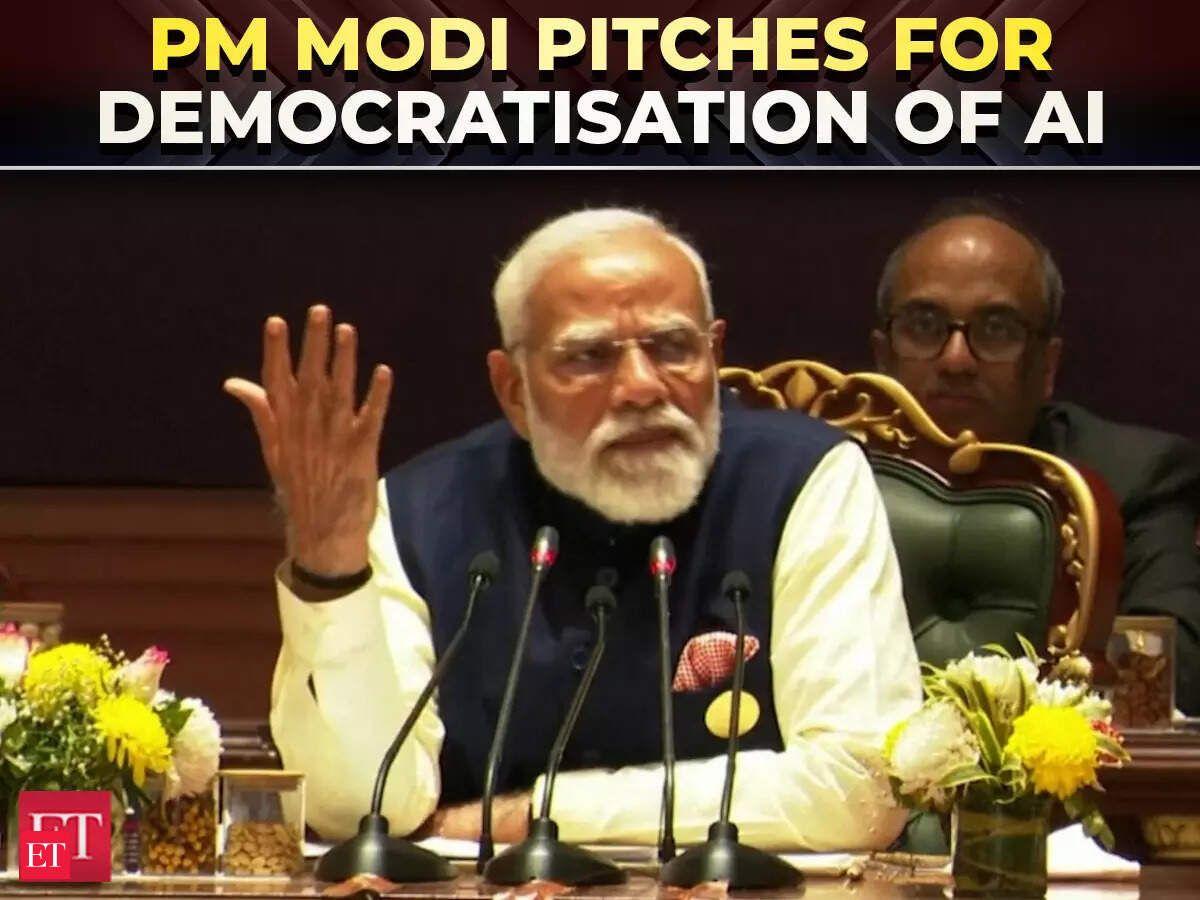
Source: ET
This vision resonated with other speakers at the summit. U.N. Secretary-General António Guterres called for a $3 billion fund to help poorer countries build basic AI capacity, including skills, data access, and affordable computing power. "The future of AI cannot be decided by a handful of countries, or left to the whims of a few billionaires," Guterres said, stressing that AI must "belong to everyone"
4
. India is using the summit to position itself as a bridge between advanced economies and the Global South, with Indian officials citing the country's digital ID and online payments systems as a model for deploying AI at low cost, particularly in developing countries5
.Global Leaders Debate AI Governance and Cooperation
Over a dozen heads of state, including leaders from France and Brazil, attended the summit this week, along with top executives from AI heavyweights such as OpenAI, Alphabet Inc., and Anthropic PBC
1
.
Source: ET
French President Emmanuel Macron spoke before Modi, highlighting India's AI advances and their potential to transform sectors ranging from agriculture and healthcare to transportation. "The Indian model is truly revolutionary, providing solutions for everyone in the country," Macron said about India's digital journey, citing examples from 200 million Indian farmers receiving advice in their own dialect to AI diagnostics for rural clinics
1
. Macron also vowed to protect children from "digital abuse" during France's presidency of the G7 and defended Europe's approach to AI regulation, saying "Europe is a space for innovation and investment, but it is a safe space, and safe spaces win in the long run"3
. OpenAI's CEO Sam Altman said the world should "urgently" regulate AI, warning that centralizing the technology in one company or country "could lead to ruin" .Related Stories
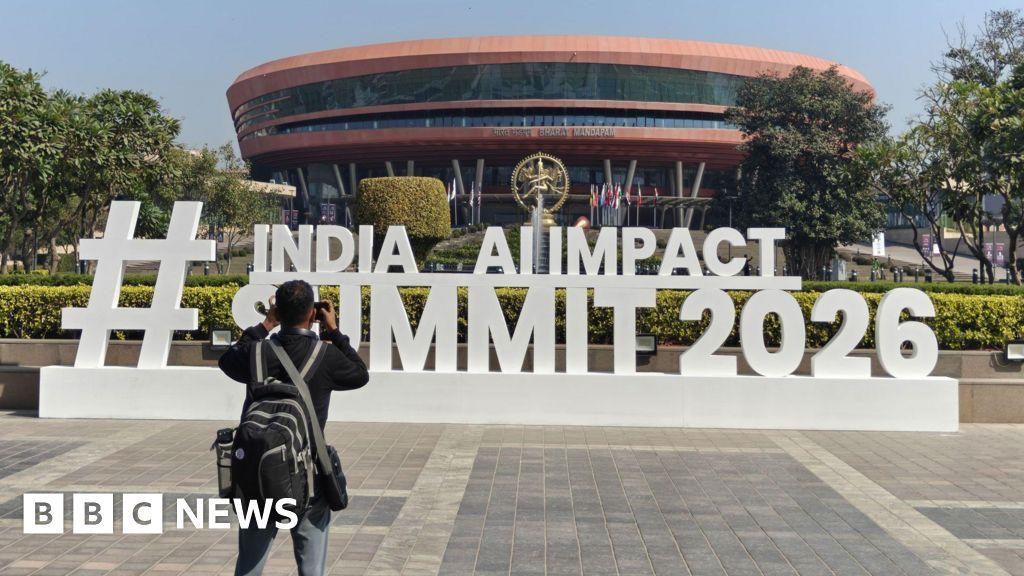
Homegrown Innovation and Sovereign AI Models
Modi's remarks came amid a broader push to spur homegrown innovation. A day earlier, Bengaluru-based startup Sarvam AI unveiled a model it said is better tailored to India's diverse languages and cultural contexts than tools such as ChatGPT and Claude
1
.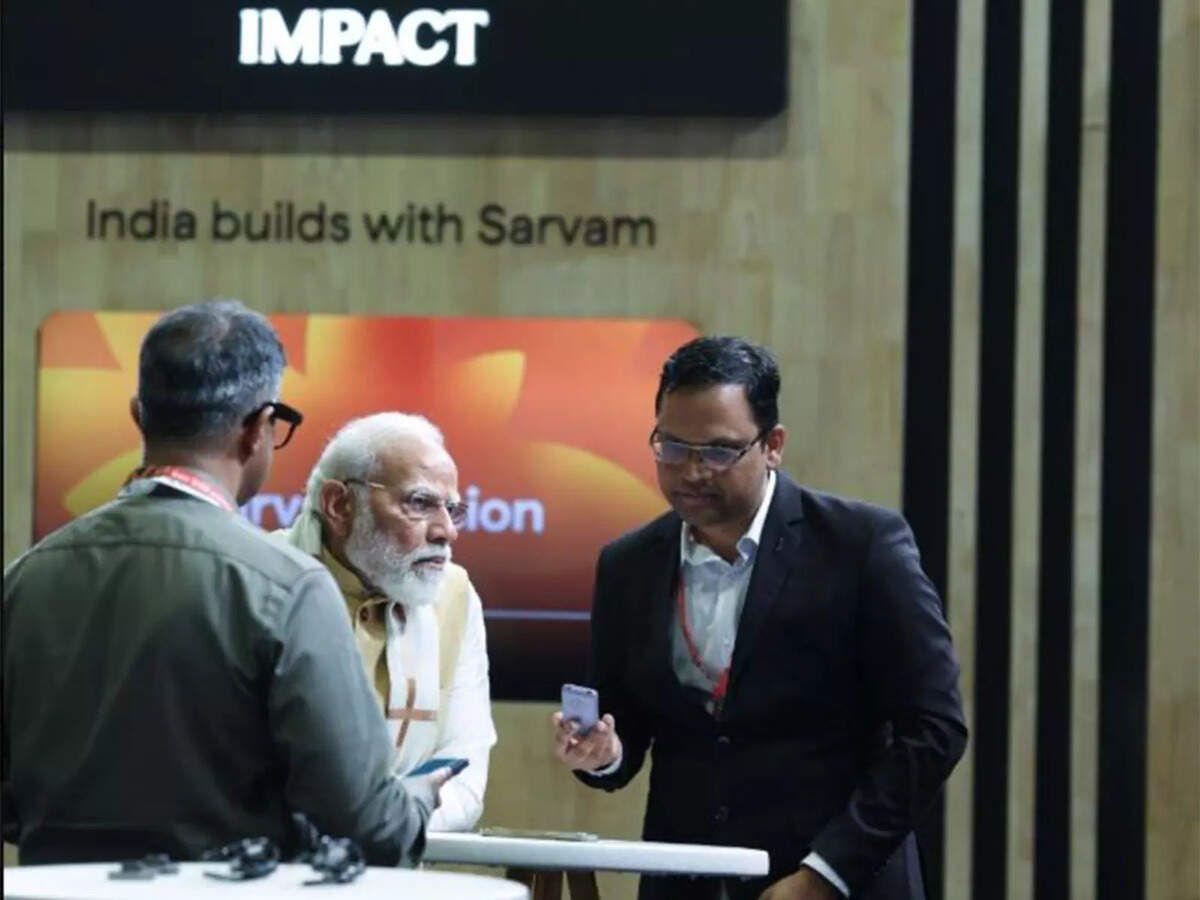
Source: ET
The government has been promoting sovereign AI models and encouraging makers to roll out services locally. "India has diversity, demography, as well as democracy. Whichever AI model succeeds in India, that can be deployed globally," Modi said in his speech
1
. With nearly 1 billion internet users, India has become a key market for global technology companies expanding their AI businesses5
. However, the country still lags in developing its own large-scale AI model like U.S.-based OpenAI or China's DeepSeek, highlighting challenges such as limited access to advanced semiconductor chips, data centers, and hundreds of local languages to learn from5
.Summit Faces Organizational Challenges and High-Profile Withdrawal
The summit opened Monday with organizational glitches, as attendees and exhibitors reported long lines and delays, and some complained on social media that personal belongings and display items had been stolen, though organizers later said the items were recovered
5
. Problems resurfaced Wednesday when a private Indian university was expelled from the summit after a staff member showcased a commercially available Chinese-made robotic dog while claiming it as the institution's own innovation2
. The setbacks continued Thursday when Microsoft co-founder Bill Gates withdrew from a scheduled keynote address. No reason was given, though the Gates Foundation said the move was intended "to ensure the focus remains on the AI Summit's key priorities"2
. The Bill Gates withdrawal came as he faces questions over his ties to late sex offender Jeffrey Epstein . Despite these challenges, the summit succeeded in drawing attention to India's ambitions and sparked important conversations about AI governance and cooperation, AI capacity building, and ensuring AI for Global South nations remains accessible and inclusive.References
Summarized by

Navi
[4]
Related Stories
India bets on tax breaks and data centers to attract AI investment, but funding cuts raise concerns
02 Feb 2026•Policy and Regulation

India AI push at Davos 2026: Infrastructure, sovereignty and real-world use cases take center stage
21 Jan 2026•Policy and Regulation

India's AI Ambitions: Balancing Innovation, Accessibility, and Cultural Relevance
31 Jan 2025•Technology

Recent Highlights
1
AI chatbots validate you too much, making you less kind to others, Stanford study reveals
Science and Research

2
Anthropic's Claude Code Source Leak Reveals Hidden AI Agent Plans and Extensive System Access
Technology

3
Judge blocks Pentagon from branding Anthropic a security risk over AI safety guardrails dispute
Policy and Regulation
Recent Highlights
Today's Top Stories










Your Daily Dose of Curated AI News
Don’t drown in AI news. We cut through the noise - filtering, ranking and summarizing the most important AI news, breakthroughs and research daily. Spend less time searching for the latest in AI and get straight to action.

