Sandisk Unveils Groundbreaking 256TB SSD with New UltraQLC Technology


2 Sources
2 Sources
[1]
Sandisk unveils colossal new 256TB SSD with new UltraQLC flash memory -- enterprise-grade SSDs for high density storage also come in 128TB
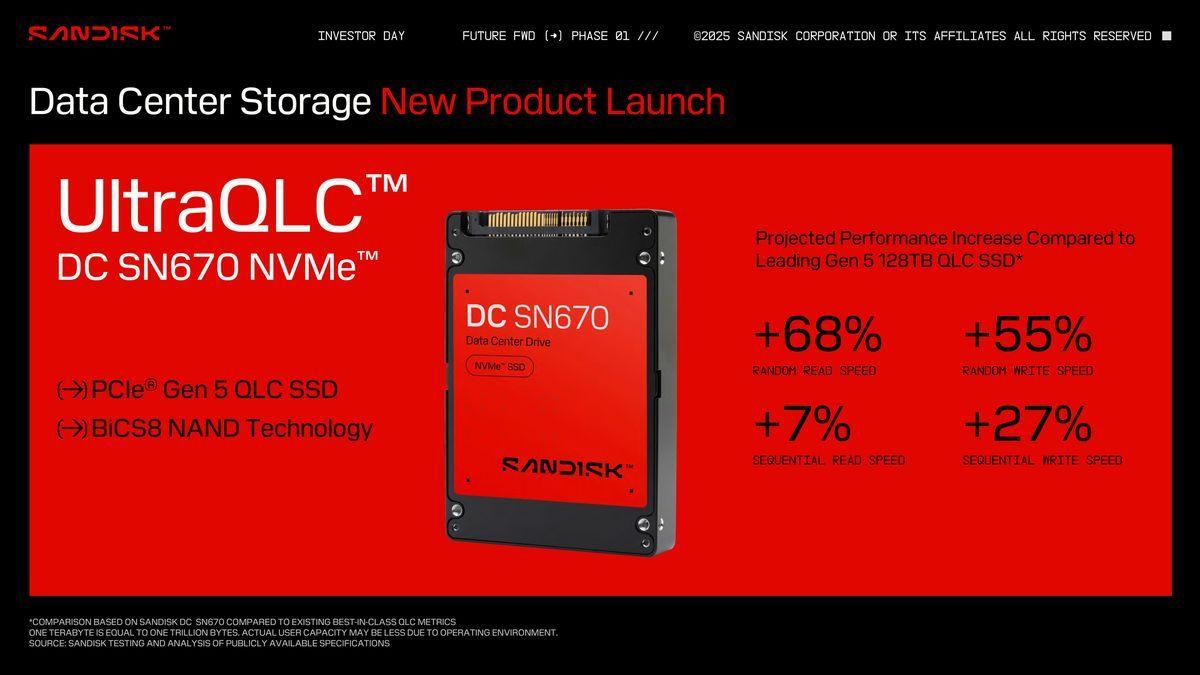
Sandisk on Tuesday introduced one of the industry's first 256TB solid-state drives, designed for applications that benefit from maximum storage density. The new SSD relies on the all-new enterprise-grade UltraQLC platform that is specifically designed for drives that combine high capacity, high performance, and high reliability. Sandisk's UltraQLC 256TB NVMe SSD comes in a U.2 form-factor and uses the company's custom new multi-core controller, custom firmware, as well as 2Tb BiCS8 3D QLC NAND memory. In addition to the 256TB model, the company also announced its SN670 SSD that relies on the same UltraQLC platform. One of the key features of UltraQLC drives is its Direct Write QLC technology, which lets the controller write data directly to QLC memory, not to a pseudo-SLC buffer, thus enabling power-loss-safe writes on the first pass. This design simplifies the writing process and reduces latency. However, the performance impact of such an approach is something that remains to be seen (more on this later). In addition, the UltraQLC 256TB NVMe SSD features Dynamic Frequency Scaling, which purportedly boosts performance by 10% at any given power level, though the company does not disclose how this technology works. It is likely that DFS optimizes controller frequencies and interface speed depending on the workload, though we are speculating. Also, Sandisk's UltraQLC 256TB SSD features a Data Retention profile that can reduce retention-related recycling by up to 33%, which promises to improve reliability, resilience, and energy efficiency. Sandisk positions its UltraQLC platform as a strategic solution for hyperscale cloud service providers (CSPs) and enterprises building AI data infrastructure and requiring storage density, efficiency, and performance. Speaking of performance, the lack of pseudo-SLC caching certainly has an effect on the performance of UltraQLC drives. Normally, 3D QLC NAND is three to five times slower and has higher latency compared to pseudo-SLC, so the 256TB drives are not for everyone. There are some things to keep in mind here. Native QLC programming latency is significantly higher compared to pseudo-SLC (~800-1200 µs vs. ~200-300 µs for SLC), so sustained sequential throughput is lower than pseudo-SLC-cached SSDs for short bursts. However, since there is no limited pseudo-SLC cache, performance is consistent over long writes, which may be beneficial for large AI data sets that require hours to write anyway. Also, Sandisk can mitigate slow writes with a large DRAM buffer and smart mapping, multi-plane and multi-die parallelism in the memory device and the controller, and over provisioning (keep in mind that we are speculating). Sandisk's 128TB and 256TB SSDs will ship in the first half of 2026.
[2]
Sandisk Showcases UltraQLC™ Technology Platform with Milestone Enterprise SSD Capacity at FMS 2025
Sandisk today demonstrated a high-capacity 256TB NVMe™ enterprise SSD, a breakthrough in storage capacity, performance and power efficiency, made possible by Sandisk's new enterprise-grade UltraQLC™ platform. Offering extraordinary capacity, the UltraQLC™ platform marks a significant achievement in NAND architecture, built with a combination of BiCS8 QLC CBA NAND, custom controllers and advanced system optimizations. This press release features multimedia. View the full release here: https://www.businesswire.com/news/home/20250805490958/en/ As workloads and business requirements evolve in the AI era, flash storage must become more customizable to match complex workloads. The new SANDISK 256TB NVMe™ SSD, built on the UltraQLC™ platform, is designed for AI-driven, data-intensive workloads like data ingest, preparation, and fast AI data lakes with high-performance speeds and power efficiency, while improving TCO for high-capacity applications in hyperscale cloud. "As we move into the next phase of the AI era, flash storage is becoming a critical enabler of intelligent, high-performance workloads," said Khurram Ismail, Chief Product Officer at Sandisk. "Our UltraQLC™ platform is the culmination of years of work and learnings to build a flexible and robust architecture that achieves extraordinary capacities and maximum performance while maintaining efficiency. This enables us to further expand our portfolio to meet AI demands at scale and helps our customers move faster, process more and turn data into real innovation." The SANDISK UltraQLC™ 256TB NVMe™ SSD sets a new benchmark for hyperscale flash storage, purpose-built for the fast, intelligent data lakes powering AI at scale. With lower latency, higher bandwidth, and greater reliability, it delivers the performance needed for today's most demanding AI workloads. Key innovations include: The SANDISK SN670 128TB NVMe™ SSD and SANDISK UltraQLC™ 256TB NVMe™ SSD will be available in U.2 form factor in the first half of 2026, with additional form factors available later in the year. Sandisk will host a keynote at FMS 2025 on Wednesday, August 6, at 11:40 AM PT, to highlight its UltraQLC™ platform and will demo its milestone 256TB NVMe™ SSD, alongside additional innovative storage solutions, at FMS Booth #607. Sandisk (Nasdaq: SNDK) delivers innovative Flash solutions and advanced memory technologies that meet people and businesses at the intersection of their aspirations and the moment, enabling them to keep moving and pushing possibility forward. Follow Sandisk on Instagram, Facebook, X, LinkedIn, YouTube. Join TeamSandisk on Instagram. SANDISK, the SANDISK logo, and UltraQLC are registered trademarks or trademarks of Sandisk Corporation or its affiliates in the U.S. and/or other countries. The NVMe word mark is a mark of NVM Express, Inc. All other marks are the property of their respective owners. Product specifications subject to change without notice. Pictures shown may vary from actual products. Forward-Looking Statements This press release contains forward-looking statements within the meaning of federal securities laws, including statements regarding expectations for the availability, capabilities and impacts of Sandisk's technology and products. These forward-looking statements are based on management's current expectations and are subject to risks and uncertainties that could cause actual results to differ materially from those expressed or implied in the forward-looking statements. Key risks and uncertainties that could cause actual results to differ materially from those expressed or implied in the forward-looking statements include: adverse changes in global or regional economic conditions, including the impact of evolving trade policies, tariff regimes and international conflicts; volatility in demand for the company's products; pricing trends and fluctuations in average selling prices inflation; the impact of business and market conditions; the impact of competitive products and pricing; the company's development and introduction of products based on new technologies and management of technology transitions; risks associated with restructurings, acquisitions, divestitures, cost saving measures, joint ventures and the company's reliance on strategic relationships; risks related to product defects; difficulties or delays in manufacturing or other supply chain disruptions; hiring and retention of key employees; the company's level of debt and other financial obligations; changes to the company's relationships with key customers or customer consolidation; compromise, damage or interruption from cybersecurity incidents or other data system security risks; actions by competitors; risks associated with compliance with changing legal and regulatory requirements and the outcome of legal proceedings; our ability to achieve some or all of the expected benefits of the separation from Western Digital Corporation; and other risks and uncertainties set forth in Sandisk Corporation's S-1/A Registration Statement filed with the SEC on June 4, 2025, which is available on the SEC's website at www.sec.gov. You should not place undue reliance on these forward-looking statements, which speak only as of the date hereof, and Sandisk undertakes no obligation to update or revise these forward-looking statements to reflect new information or events, except as required by law. © 2025 Sandisk Corporation or its affiliates. All rights reserved.
Share
Share
Copy Link
Sandisk introduces a massive 256TB solid-state drive using new UltraQLC flash memory, designed for high-density enterprise storage and AI applications.
Sandisk Introduces Revolutionary 256TB SSD
Sandisk has unveiled one of the industry's first 256TB solid-state drives (SSDs), marking a significant leap in storage technology. This colossal drive, along with its 128TB counterpart, is built on Sandisk's new enterprise-grade UltraQLC platform, designed to combine high capacity, performance, and reliability
1
.
Source: Tom's Hardware
UltraQLC Technology: A Game-Changer in Storage
The UltraQLC platform introduces several innovative features that set it apart from conventional SSDs:
-
Direct Write QLC Technology: This allows the controller to write data directly to QLC memory without using a pseudo-SLC buffer, enabling power-loss-safe writes on the first pass and potentially reducing latency
1
. -
Dynamic Frequency Scaling: This feature purportedly boosts performance by 10% at any given power level, although the exact mechanism remains undisclosed
1
. -
Data Retention Profile: This innovation can reduce retention-related recycling by up to 33%, promising improved reliability, resilience, and energy efficiency
1
.
Targeting AI and Hyperscale Applications
Sandisk positions its UltraQLC platform as a strategic solution for hyperscale cloud service providers (CSPs) and enterprises building AI data infrastructure. The drive is specifically designed for AI-driven, data-intensive workloads such as data ingest, preparation, and fast AI data lakes
2
."As we move into the next phase of the AI era, flash storage is becoming a critical enabler of intelligent, high-performance workloads," said Khurram Ismail, Chief Product Officer at Sandisk
2
.Performance Considerations
While the UltraQLC drives offer unprecedented capacity, their performance characteristics differ from traditional SSDs:
- Native QLC programming latency is significantly higher compared to pseudo-SLC (800-1200 µs vs. 200-300 µs for SLC)
1
. - Sustained sequential throughput may be lower than pseudo-SLC-cached SSDs for short bursts.
- However, performance is consistent over long writes, which could be beneficial for large AI datasets
1
.
Technical Specifications
The 256TB NVMe SSD comes in a U.2 form-factor and features:
- Sandisk's custom multi-core controller
- Custom firmware
- 2Tb BiCS8 3D QLC NAND memory
1
Availability and Future Prospects
Both the 128TB and 256TB SSDs are scheduled to ship in the first half of 2026, with additional form factors planned for later that year
1
2
. Sandisk will showcase the 256TB NVMe SSD alongside other innovative storage solutions at the upcoming FMS 2025 event2
.As the AI era progresses, these high-capacity SSDs are poised to play a crucial role in enabling more efficient and powerful data processing capabilities for businesses and research institutions alike.
References
Summarized by

Navi
[1]
Recent Highlights
1
AI Models Lie and Deceive to Protect Other AI Models From Deletion, Study Reveals
Science and Research

2
AI chatbots validate you too much, making you less kind to others, Stanford study reveals
Science and Research

3
Judge blocks Pentagon from blacklisting Anthropic over AI safety guardrails dispute
Policy and Regulation

Recent Highlights
Today's Top Stories




Your Daily Dose of Curated AI News
Don’t drown in AI news. We cut through the noise - filtering, ranking and summarizing the most important AI news, breakthroughs and research daily. Spend less time searching for the latest in AI and get straight to action.

