India positions itself as AI bridge between US and China at chaotic but ambitious summit


22 Sources
22 Sources
[1]
Who Can Break the AI Safety Deadlock?
Last week's AI Impact Summit ended the way these gatherings now routinely do. This time with a "New Delhi Declaration," a non-binding hymn to cooperation and the hope that "AI could be made to serve humanity." It's the sort of empty language that dozens of countries and international organizations can sign up to without changing a thing. The most revealing statement came from the industry. Hours before the declaration dropped, OpenAI Chief Executive Officer Sam Altman offered a bit of moral arithmetic in an interview with the Indian Express. "People talk about how much energy it takes to train an AI model," he said, "but it also takes a lot of energy to train a human. It takes, like, 20 years of life, and all of the food you eat during that time before you get smart." Altman likely meant it as a quip. It landed, however, as a sobering reminder that the people steering the AI race are starting to talk about raising children the way they talk about training machines. So much for human-centered AI. New Delhi should have been a turning point for middle powers, from India and Brazil to Canada. Instead, it showcased the deadlock that has come to define global AI governance. The superpowers won't meaningfully restrain themselves, the companies won't elect to slow down, and everyone else is signing empty statements while being propelled by a fear of missing out. You can see the drift in the meetings themselves. The first gathering at Bletchley Park in 2023 was branded as an AI "Safety" summit. That was dropped from the title in Seoul's "AI Summit," and the theme then shifted to "Action" in Paris and "Impact" in New Delhi. The word that started the entire series has been edited out. India this year got frontier firms to sign on to broad commitments to study the impact of AI, but even these are voluntary. Middle powers, meanwhile, can't wait for Washington or Beijing to take the reins. This year alone, American tech giants are expected to collectively invest some $650 billion in AI. Such astronomical spending accelerates deployment, but it also distorts incentives away from safety and toward recouping a return. And with so much of the US economy now riding the tech boom, the White House has little appetite for rules that might slow it down. China has its own safety labs and voluntary commitments from companies. But the government leaves scant room for plurality of opinions or public debate about risk -- especially if it collides with President Xi Jinping's ambition to lead the world in technology. We won't credibly see safety leadership emerge from Washington, and it's unlikely to come from Beijing either. At the same time, the harms are already piling up. Women and girls are digitally undressed, cyber attackers exploit new tools at scale, and reports link teen suicides to the use of chatbots. AI systems are becoming exponentially more powerful and the rush for agents, or autonomous computer systems, only encourages humans to cede more power to machines, raising fears of more existential risks. In that geopolitical race, hopes for meaningful US-China collaboration on safety are increasingly a fantasy. As was hinted at in Davos, each side can use the other's acceleration as an alibi for why even if they want to slow down, they can't. It's the reason middle powers matter more than ever. India hosted this year's gathering explicitly to position itself as a bridge between the rest of the world and the US-China rivalry. Sign up for the Bloomberg Opinion bundle Sign up for the Bloomberg Opinion bundle Sign up for the Bloomberg Opinion bundle Get Matt Levine's Money Stuff, John Authers' Points of Return and Jessica Karl's Opinion Today. Get Matt Levine's Money Stuff, John Authers' Points of Return and Jessica Karl's Opinion Today. Get Matt Levine's Money Stuff, John Authers' Points of Return and Jessica Karl's Opinion Today. Bloomberg may send me offers and promotions. Plus Signed UpPlus Sign UpPlus Sign Up By submitting my information, I agree to the Privacy Policy and Terms of Service. During a side event on safety, computer scientist and "AI Godfather" Yoshua Bengio said that it's ultimately up to these governments to unite and break the superpower deadlock before AI only concentrates power. "If you're not at the table, you're on the menu," Bengio said, quoting Canadian Prime Minister Mark Carney's remarks in Davos. As much as this call to action applied to trade and security, Bengio argued that it must also be applied to AI. Courting favor from Washington or Beijing in a bid to get ahead is a self-defeating strategy that cements dependence, not sovereignty -- let alone safety. A middle-power coalition doesn't need to beat the US or China on frontier AI. It just needs to make access to markets of billions, as well as their schools, hospitals, courts and power grids, conditional on measurable safety commitments. They can start with the near-term essentials. Require disclosures of the data that goes into these tools, and the energy use needed for training and running models. Mandate standardized, independent safety evaluations before deployment in sensitive domains like policing or politics. Insist on incident reporting and public transparency about model failures and risks. The easiest thing for policymakers to do right now, Bengio warned, is listen to the voices that make them feel good -- or the ones that overwhelmingly belong to people selling the technology. But the organized backlash is growing, uniting people across identities and political lines. "Governments won't do anything until the general population wakes up," he said. Delhi's notorious traffic gridlocks last week became an accidental metaphor for the global AI safety debate: We keep convening, everyone is trying to get ahead, and nothing moves. Declarations don't protect people, rules do. More From Bloomberg Opinion: * OpenClaw Might Be a Security Nightmare for OpenAI: Parmy Olson * Modi Can Ignore Farmer Fury and Push Rural Reform: Mihir Sharma * India Can't Spectacle Its Way to AI Power: Catherine Thorbecke Want more Bloomberg Opinion? OPIN <GO> . Or you can subscribe to our daily newsletter .
[2]
At A.I. Summit, India Tries to Find a Way Between the U.S. and China
In a world where geopolitical power is being defined partly by the race between the United States and China to dominate artificial intelligence, India has a pitch for those left behind. The South Asian giant has neither America's homegrown A.I. giants like OpenAI and Anthropic, nor China's know-how and stores of the rare earth elements that power everything from chips to data centers. Instead, India is using technology as a tool of foreign policy, casting itself as a moral voice for the smaller, developing countries of the Global South, which may lack the resources to tackle the A.I. superstorm that has hit the world. At the A.I. Impact Summit in New Delhi this week -- attended by the leaders of countries including Spain, Bolivia, Mauritius and Sri Lanka -- India emphasized that the main questions were about how A.I. should be governed and how it should be used for the welfare of the people. It also dangled its pool of I.T. workers and huge domestic market as a test case for applications of the technology. During his address at the summit, Prime Minister Narendra Modi of India likened artificial intelligence to nuclear power; both are technologies that have immense power to destroy but also to be directed for good, he said. If A.I. becomes "directionless," Mr. Modi said, it will lead to destruction. A core question is not about what A.I. can do in the future, but what it can accomplish now to serve people, he said. Many analysts saw his approach as trying to make the most of a situation where India, like many other countries represented, has no clear advantages in a field led by American and Chinese companies. "India is trying to position itself as a distinct, third-way alternative, centered on the Global South and A.I. as a public good," said Sushant Kumar Yaduka, who teaches at the Jindal School of Government and Public Policy. It "made sense" for India to take this approach rather than try to join the "geopolitical-technological arms race" between China and the United States, he said. Coming as it did amid a seismic shift in the world order, where countries are running helter-skelter to protect their interests and form new alliances after President Trump tossed out old orthodoxies and where China appears unstoppable, international relations were hard to ignore. "You can't think of foreign policy without thinking of technology," said Arun Teja Polcumpally, a JSW Science and Technology Fellow at the Asia Society Policy Institute. "India is trying to show it is a country that can be a trusted platform for emerging economies" by doing the groundwork to deploy A.I. responsibly, Mr. Polcumpally said. India is also seizing the moment to bolster relations with other so-called middle powers -- countries with which it can build stronger trade ties and whose support could help its global ambitions, analysts said. Mr. Modi and President Emmanuel Macron of France held separate bilateral talks alongside the A.I. summit that resulted in commitments to strengthen defense cooperation, including a pathway for India to procure 114 Rafale fighter jets from France's Dassault Aviation. The Indian government said the two countries had elevated ties to a strategic global partnership that would guide their relationship for decades. Clips of Mr. Modi and Mr. Macron embracing and holding hands aired on social media. India is also hosting President Luiz Inacio Lula da Silva of Brazil, who arrived in New Delhi on Wednesday on a state visit and is attending the A.I. summit, which was extended through Saturday. The two countries have expanded their trade ties in recent months, and India said on Saturday that the two countries had agreed to collaborate on a range of areas, including energy, pharmaceuticals and critical minerals. India appeared eager to showcase a keystone of its foreign policy, a version of its Cold War nonalignment approach that, under Mr. Modi's leadership, was redefined as "strategic autonomy." Senior government officials have described it as India joining forces with those who best align with its interests and ambitions. After years courting the United States by positioning itself as a counterweight to China, India has been backed into a corner by the demands of Mr. Trump, especially in reducing its purchases of Russian oil. It eventually struck an interim trade deal with the United States this month that will result in tariffs falling to 18 percent from 50 percent, although the U.S. Supreme Court's recent ruling invalidating some of Mr. Trump's tariffs could throw the deal into disarray. On Friday, India signed the Pax Silica Declaration, becoming the tenth member of the U.S.-led initiative to protect supply chains for artificial intelligence and advanced computer chips. But India has already made progress in spreading its bets: Over the past year, it has struck several major trade deals, including with the European Union and Britain. "We are very much wedded to strategic autonomy," said S. Jaishankar, India's foreign minister, at a recent panel during the Munich Security Conference. India will continue to do things its own way, he said. "It's very much a part of our history and our evolution."
[3]
Modi's Chaotic AI Summit Showed India's Clout and Constraints
The conference highlighted India's constraints in the global AI race, including a lack of high-end computing infrastructure, but also showcased the country's deep expertise in IT services and its potential for population-scale deployment of AI in sectors like agriculture, education, and health. Prime Minister Narendra Modi made his pitch this week that India can play a leading role in the artificial intelligence boom with a conference featuring tech stars from around the world. It suffered more than a few hitches. Nvidia Corp.'s Jensen Huang dropped out after early promotion; Bill Gates withdrew later. Many attendees ran into trouble just getting into the grand Bharat Mandapam venue in New Delhi on Monday and logistics remained an ordeal all week. Mukesh Ambani, Asia's richest man, had so much trouble getting through security that his speech -- announcing the biggest deal of the India AI Impact Summit -- was delayed. Even so, Modi gave a forceful demonstration of the country's influence. He gathered many of the most prominent names in the tech industry, including the chief executives of Alphabet Inc., OpenAI and Anthropic PBC, as well as the India-born CEOs of global corporate icons like FedEx Corp. The prime day of the summit was so jam-packed that celebrity leaders like Sundar Pichai and Sam Altman were allocated a mere five to 12 minutes each. "It's one thing to say you're the leader of the Global South and it's another to come across as the leader of the Global South," said Reema Bhattacharya, head of Asia risk insights at advisory firm Verisk Maplecroft. "They've achieved what they wanted to achieve." Read more about the India AI Impact Summit Ambani Joins Adani, Tata With Plans to Invest $110 Billion in AI Google Plans New Fiber-Optic Routes Between the US and India Indian Billionaires, Global Tech Scout Talent at AI Summit India Eyes $200 Billion in AI Investments Over Two Years India Can't Spectacle Its Way to AI Power: Catherine Thorbecke The event mixed moments of genuine promise with evidence of India's constraints as the global AI race accelerates. Similar to US President Donald Trump, Modi is able to elicit effusive praise and big promises from industry and government leaders, with Ambani pledging $110 billion for building out artificial intelligence projects across India over the next seven years. Speakers constantly praised the prime minister for his leadership and referred to him in the honorific, Shri Narendra Modi Ji. But the country still lags in high-end computing infrastructure that's necessary to build frontier large language models such as those produced by Silicon Valley companies or the coterie of Chinese upstarts that now sit atop many AI benchmark lists. Even the most efficient AI systems require tens of billions of dollars to build and operate, in a capital-intensive contest that US Big Tech in recent weeks escalated with plans for $650 billion in new spending in 2026. Modi used the summit to argue for a model of AI development that sits in the middle lane between the corporate-led ecosystem of the US and state-backed China push. At the summit's busiest day, inclusion and human-centered design took center stage. "We have talent, energy capacity and policy clarity," the PM said in Hindi, translated via AI into various languages. "AI is like GPS. It can show the direction, but where we want to go must be decided by us." He positioned India as the tech leader of the Global South -- emerging economies, often previously colonized -- that are eager to deploy AI but wary of aligning with one tech bloc or another. UN Secretary-General António Guterres reinforced that message, as did French President Emmanuel Macron, who sat alongside Modi at the gala with the ease of a longtime friend. "The future of AI cannot be decided by a handful of countries or left to the whims of a few billionaires," said Guterres. The unifying message was that countries beyond the US and China want to be more than potential markets for AI companies. They want access to the best technologies, influence over regulation and the opportunity to share in the potential profits. "India is trying to sort of set its terms," said Bhattacharya. "The risk is India becoming this data colony for big tech where the proprietary, the value-added services are done elsewhere." One advantage the country has is the deep expertise of IT service firms like Tata Consultancy Services Ltd. and Infosys Ltd., leaders in helping the world's corporations adopt new technologies like cloud computing and mobile services. They are now working with partners like Anthrophic and OpenAI to use their armies of consultants to help companies figure out how to use AI. Natarajan Chandrasekaran, chairman of Tata Group, said on stage he sees the integration of AI and AI agents as a big opportunity for IT providers because of their understanding of the needs and opportunities for large-scale customers. US companies, for their part, are accelerating expansion in India before local rivals catch up. Anthropic this week opened an office in the southern tech hub of Bangalore, while OpenAI is expanding operations following last year's New Delhi launch. "I was last here a little over a year ago, and it's striking how much progress has happened since then," Altman said on Thursday. India is the fastest-growing market for OpenAI's Codex coding tool, he added, after Anthropic's Dario Amodei had earlier said his company's Claude Code had doubled its local users over the past four months. "It's important to move quickly. On our current trajectory, we believe we may be only a couple of years away from early versions of true superintelligence," Altman, 40, said. The Tata Group, maker of Jaguar Land Rover SUVs, said this week that it will partner with OpenAI to create as much as 1 gigawatt in data center capacity. While India has not had a national AI champion to compete with the world's leaders, an Indian startup called Sarvam used the spotlight of the summit to launch its own AI model, tailored from the ground up for use in the South Asian nation. The service is voice-based and accessible through nearly two dozen Indian languages, which the company believes will be a competitive advantage in a country of 1.45 billion where the vast majority can't read, write or type in English. "Sovereignty matters much more in AI than building the biggest models," said co-founder Vivek Raghavan at an event in Delhi. Still, Indian startups have little chance to raise the kind of money their American counterparts have to build out AI models and infrastructure. "India can catch up in the AI race not by outspending the US and China on frontier models, but by excelling in population-scale deployment in sectors such as agriculture, education and health," said Brenda Mulele Gunde, global lead for digital transformation at the UN's International Fund for Agricultural Development. Modi's administration has been supportive, providing subsidized computing capacity, access to public data and expanded AI training programs. India is also seeking to expand its manufacturing capabilities, including in high-tech sectors like semiconductors and smartphones. On Friday, the country formally joined a US-led initiative to protect supply chains, including for chips and critical minerals, along with countries like Japan and South Korea. Get the Tech Newsletter bundle. Get the Tech Newsletter bundle. Get the Tech Newsletter bundle. Bloomberg's subscriber-only tech newsletters, and full access to all the articles they feature. Bloomberg's subscriber-only tech newsletters, and full access to all the articles they feature. Bloomberg's subscriber-only tech newsletters, and full access to all the articles they feature. Bloomberg may send me offers and promotions. Plus Signed UpPlus Sign UpPlus Sign Up By submitting my information, I agree to the Privacy Policy and Terms of Service. The miscues caught up with Modi on stage. In what was supposed to be a signature moment of the event, Modi pulled Pichai, Microsoft Corp. President Brad Smith and 11 others in for a group photo in the event's main hall. Instead, as Modi and the others all clasped hands above their heads, Altman and Amodei -- fierce rivals in the AI race -- refused to hold each other's hands, a glaring rift that quickly went viral on social media in India. Another embarrassing incident came when a private university was booted out of the AI exhibition after it allegedly misrepresented a Chinese-made robot dog as its own product. The creator of that machine, Hangzhou-based Unitree, meanwhile was wowing viewers of the Chinese New Year TV gala with its latest humanoids performing acrobatics with humanlike fluidity. India may not be able to match the US or China in the spending required for AI development, but it was clear that Modi's conference tapped into a deep undercurrent of angst around the way this once-in-a-generation technology is evolving. In countries beyond the two giants, business and political leaders see the risk that they will end up at the mercy of American or Chinese tech giants -- or worse at the mercy of Washington or Beijing. They want an alternative to that bleak future. "We're facing too much concentration of power in artificial intelligence," said Arthur Mensch, CEO of France's Mistral AI, speaking in Delhi on Thursday. "AI is going to change pretty profoundly the way the economy is being run in the next few years," he added.
[4]
India AI-Linked Plays Surge as Modi Hobnobs With Altman, Amodei
Indian data center-related shares rallied this week, as the country's Prime Minister Narendra Modi reiterated its ambition to emerge as a global hub for AI in the presence of OpenAI's Sam Altman and Anthropic PBC's Dario Amodei. Shares of 10 companies involved in data center development and its supply chain -- spanning equipment manufacturers to power producers -- added about $4 billion in combined market value this week as the country hosted a high-profile gathering of leading AI companies in New Delhi. While India's AI ambitions have been hamstrung by its lack of presence in building models or manufacturing semiconductors that help with computing, the country is emerging as a destination for data centers. Alphabet Inc.'s Google and Microsoft Corp. have committed billions of dollars alongside local giants Reliance Industries Ltd. and Adani Group. Get the Tech Newsletter bundle. Get the Tech Newsletter bundle. Get the Tech Newsletter bundle. Bloomberg's subscriber-only tech newsletters, and full access to all the articles they feature. Bloomberg's subscriber-only tech newsletters, and full access to all the articles they feature. Bloomberg's subscriber-only tech newsletters, and full access to all the articles they feature. Bloomberg may send me offers and promotions. Plus Signed UpPlus Sign UpPlus Sign Up By submitting my information, I agree to the Privacy Policy and Terms of Service. E2E Networks Ltd., a cloud computing infrastructure provider that partners with Nvidia Corp., was among the biggest gainers, rising more than 18% this week. Netweb Technologies India Ltd., which manufactures supercomputing systems, climbed by a similar measure. Other notable gainers included AurionPro Solutions Ltd. and Techno Electric & Engineering Co., while large-cap engineering firms Larsen & Toubro Ltd. and Adani Green Energy Ltd. also advanced. Data center shares are benefiting in part because there are no pure-play AI companies listed in India, unlike in other Asian markets. The rally in data center-linked stocks contrasts with a rout in software and related services providers, which have come under pressure as the rapidly advancing capabilities demonstrated by Anthropic and other AI firms threaten to disrupt their business models. While companies such as Infosys Ltd. and Tata Consultancy Services Ltd. have announced partnerships to strengthen their AI offerings, investors remain cautious given AI's potential to hurt their margins from productivity-linked services. OpenAI said this week it will partner with Indian conglomerate Tata Group to build a data center starting at 100 megawatts of capacity, with plans to scale up to 1 gigawatt. At the upper end, a 1-gigawatt facility could cost between $35 billion and $50 billion. Separately, Anthropic said it will collaborate with Infosys Ltd. to develop advanced artificial intelligence solutions.
[5]
AI hit: India hungry to harness US tech giants' technology at Delhi summit
Narendra Modi's thirst to supercharge economic growth is matched by US desire to inject AI into world's biggest democracy India celebrates 80 years of independence from the UK in August 2027. At about that same moment, "early versions of true super intelligence" could emerge, said Sam Altman, the co-founder of OpenAI, this week. It's a looming coincidence that raised a charged question at the AI Impact summit in Delhi, hosted by India's prime minister, Narendra Modi: can India avoid returning to the status of a vassal state when it imports AI to raise the prospects of its 1.4 billion people? Modi's hunger to harness AI's capability is great. He compared it on Thursday to a turning point that resets the direction of civilisation, such as "when the first sparks were struck from stone". The most common analogy heard among the thousands of visitors to the summit was the dawn of electricity, but Modi was talking about fire. His desire to use AI to supercharge Indian economic growth is matched by that of big US tech companies. OpenAI, Google and Anthropic all played prominent roles at the summit, announcing deals to get ChatGPT, Gemini and Claude AIs into more people's hands. The Trump administration, seeing AI as central to its battle for supremacy with China, was clearing the path for the three AI companies. The US government signed the Pax Silica, a technology agreement that binds India closer to US tech and away from Beijing. At the signing, Jacob Helberg, the US under secretary of state for economic affairs, emphasised the threat from China if India should even think about looking elsewhere for its AI. "We have seen the lights of a great Indian city extinguished by a keystroke," he said, in an apparent reference to a suspected Chinese cyber-attack on Mumbai in 2020. India lacks the semiconductors, power plants and vast gigawatt datacentres to go it alone. In common with most other countries, it faces a choice between US and Chinese AI models. Which they choose could have profound consequences for who controls India's future because if AI's power emerges as predicted, it will not only tweak economic and social structures, but become their new bedrock. Stuart Russell, a professor of artificial intelligence at Berkeley, who closely follows India's progress, said: "If we get to AGI, AI is going to be producing 80% of the global economy, all manufacturing, most agriculture, all services will be just done, managed by AI, produced by AI." Imagine, he said, a rural Indian village priced out of having a health centre. In the future, AI could design the hospital and "along comes a bunch of giant quad copters carrying the materials and a bunch of robots come and assemble everything. Two weeks later, you've got a hospital." In this scenario, technology becomes completely integral to a country's wellbeing. Elements of sovereignty can be fought over, but how successful that will be remains to be seen. AI's power is such that its controller gains enormous leverage. Anthropic's chief executive, Dario Amodei, told the summit: "It may sound absurd, but AI can even help India achieve a standout 25% economic growth." If that were to happen, it would take India to a per-capita GDP in a decade, equivalent to Greece today. How could a leader resist? Modi's tech secretary, Shri Krishnan, said India realised it must ally with like-minded countries to ensure it did not become "enslaved". It is a high-stakes decision. India appears unlikely to turn to China, for now. It has the AI models, but there are tensions on the Himalayan border and Chinese companies and leaders were scarce at the summit. So will India thrive with American AI? Silicon Valley companies talk the language of cooperation not control. Chris Lehane, OpenAI's head of global policy, said: "We don't see India as a customer, we see it as a strategic partner." US officials framed the deal with India as an alliance of two nations that "broke centuries of colonial rule" and as "two great democracies saying we will build together". The Guardian asked Michael Kratsios, Donald Trump's science and technology adviser, if India risked being controlled by the US under a new form of digital colonialism. "I would say it is actually the opposite," he said. "Any country that builds on top of the American AI stack will have the most open, independently controlled, secured stack the world has to offer. And that is why we are soon keen to share it with so many countries that are prioritising their AI sovereignty." Russell sees another possibility. "I think the American companies want to get in at that high-school and middle-school level to create basically a bunch of AI addicts who can't tie their shoelaces without the help of AI," he said. "Silicon Valley has always been about eyeballs. You monetise later and it works. Google and Facebook generate vast amounts of money." So could India build its own AI? It is investing billions in datacentres and semiconductor capacity, but it takes years to come online. Altman was asked on Thursday how Indian entrepreneurs could build their own AI and his response was blunt. "Look, the way this works is we're going to tell you it's totally hopeless to compete with us on training foundation and you shouldn't even try, and it's your job to try anyway and I believe both of those things." India can press American tech companies to adapt their AIs to its kaleidoscope of languages and cultures and attempt to insist on guardrails. There is much at stake. As the summit came to a close, Joanna Shields, a former Facebook and Google executive and a UK minister for internet safety, warned: "If we have a world where we are accepting models from just the global north, we will lose so much of our cultural diversity, our uniqueness as people, wherever we come from ... We don't want to develop a monoculture based on a handful of models that everybody uses around the world and we lose that richness of who we are, what makes us human."
[6]
India's AI conference used to be a forum for safety
Why it matters: The summit began as a global forum focused on AI safety. Now it's a venue for governments to strike deals with major AI companies, most of them U.S.-based. Driving the news: Several deals have already been announced. * OpenAI debuted a new sovereign AI program for India that starts with a partnership with Tata Group and, separately, the ChatGPT maker said it is partnering with leading Indian universities. * Nvidia said that it is working with regional service providers to expand India's AI infrastructure, while also highlighting its partnerships with Indian manufacturers. It's also partnering with VCs that invest in the country to boost the amount of capital available to Indian startups. * Google DeepMind announced a partnership with Indian government agencies to advance AI-driven science and education efforts. Meanwhile parent company Alphabet is investing in fiber optic cables to connect India with the U.S. and elsewhere. Between the lines: This continues the shift toward business and away from a focus on safety that began at last year's summit in Paris.
[7]

AI Impact Summit 2026: 4 highlights from Google CEO Sundar Pichai
Google CEO Sundar Pichai had some interesting things to say at the AI Impact Summit in India. Credit: Ludovic MARIN / AFP via Getty Images The AI Impact Summit 2026 is currently underway in New Delhi, India. Some of the biggest tech companies in the world are in attendance to speak about the state of artificial intelligence, including Google CEO Sundar Pichai, who spoke at the event on Thursday. Pichai had some interesting things to say in his speech, and you can read a transcript of Pichai's prepared remarks at the Google blog. The prepared remarks differ slightly from the live speech, which was posted to YouTube by Reuters. Google is building a "vast network of subsea fiber optic cables," according to Pichai. Google's undersea cable network may not be entirely new, but the company's investments in expansion are. Pichai shared that Google is creating a "full-stack AI hub" as part of the company's $15 billion infrastructure investment in India. This includes four new subsea fiber optic cable systems that are part of Google's America-India Connect Initiative. The idea of data centers orbiting the Earth just got a quick mention from Pichai, but it is still notable, as Elon Musk recently said this idea was one of the primary reasons his space exploration company, SpaceX, acquired his AI company, xAI. While discussing previously unimaginable technological advances in India, where Pichai grew up and went to school, the Google CEO mentioned how he also never imagined he'd "one day be spending time with teams figuring out how to put data centers into space." As Mashable covered when Musk was floating the idea, we are in very early days for the concept, but it's certainly interesting to hear that Google is having similar discussions. Pichai also spent some time discussing the use of AI for medical purposes and new drug discovery. For example, Pichai highlighted Google DeepMind's AlphaFold, an AI system that predicts a protein's 3D structure from its amino acid sequence. It's notable that, at least in the U.S., works produced by AI are not copyrightable so there's still question over who would own the patent. Yet, Google's CEO highlighted this aspect of AI regardless. And that brings us to Pichai's closing, which heavily focused on AI responsibility. Responsible AI has become a cliche in the tech world, especially considering AI's very real dangers, both social and otherwise. However, Pichai said Google has made moves to address such issues. For example, to fight deepfakes, AI content generated by Google's platforms features an invisible SynthID embedded into the output, which makes it possible to ID the content as AI-generated. Pichai also mentioned the importance of "navigating profound economic shifts" as "AI will undeniably reshape the workforce." Pichai mentioned how the company has been providing AI training to users as well as highlighting the important role governments can and will play in regulating the technology.
[8]

India's AI Impact Summit closes with the New Delhi Declaration and a $200 billion boost | Fortune
For five days, New Delhi became the capital of the global AI debate, hosting heads of state, Big Tech CEOs, and policymakers who, between them, hold much of the power to determine how this technology develops. When delegates finally made it through New Delhi's gridlocked streets, the question was whether the world's most ambitious AI gathering could produce tangible progress on the industry's hardest problems: who controls the technology, who bears its risks, and who gets to share in its rewards. India's AI Impact Summit was the fourth in a series of global AI summits, following those held at Bletchley Park in the U.K., Seoul, and Paris, and the first to be held in the Global South. Many were hoping the Summit could help to forge a credible path for middle powers to shape the AI era and ensure that the technology's benefits aren't concentrated among a handful of American and Chinese companies. The week was big on investment, thinner on binding commitments, and left some of those hoping for a genuine shift in global AI governance walking away with mixed feelings. The Summit's main achievement was 88 countries and international organizations adopting the New Delhi Declaration on AI Impact -- a non-binding agreement built around principles of inclusive, human-centric AI development. When the declaration, which was widely expected on Friday, eventually emerged late on Saturday both the U.S. and China had endorsed the declaration. The declaration's ambitions are broad: democratizing access, expanding AI's role in healthcare and education, and ensuring ethical safeguards and transparency. But there are also significant gaps. While the declaration calls for equitable AI, it sidestepped the reality that the computing power, data, and the know-how to build frontier AI models remains concentrated in just a handful of economies and corporations. As is perhaps inevitable from a multilateral declaration, the operational details are also thin. At the Summit, many attendees were nervous about AI's tendency to further consolidate power in the hands of the already powerful. Much of the global AI industry is dominated by a few American corporations, whose proprietary frontier models and computing infrastructure underpin a significant share of global AI development. China is the other major player and together the two nations control roughly 90% of global AI computing infrastructure. While some countries and companies are building their own foundation models, and open-source alternatives are growing, few can yet compete at the frontier. "If you only saw the photo ops, you'd think the Summit was exclusively about Silicon Valley's Impact in India," Mark Surman, the president of Mozilla, told Fortune. "But beyond the cameras we saw real hunger from countries, companies and communities to come together and build AI that is open source, sovereign and culturally tailored." In Europe, where questions about the reliability of American partnership have become more explicit following U.S. President Donald Trump's efforts to acquire Greenland, this duopoly of power is causing acute concern. "Many of my U.S. colleagues (and, from my impression, the U.S. administration) genuinely don't seem to get how much Greenland changed things for the EU and other relevant countries," Seán Ó hÉigeartaigh, director of AI FAR at the University of Cambridge, said. "Feels like they're still reading from last year's notes. Trying to push positions and strategies that will no longer work." Arthur Mensch, CEO of French AI company Mistral, tackled the issue more head on in his keynote, arguing that as AI comes to represent an ever-larger share of global GDP, every organisation running AI workloads -- every government, every hospital, every public institution -- needs genuine access to what he called "the turn on and turn off button." Dependency on external providers who could withdraw access at any moment is not an acceptable risk in our AI-powered future, he argued. "If you have the impression that you have a trustworthy partner...then it's fine to rely on them," Bengio said of the concerns in a Tuesday interview. "But if you see the opposite, then you want to be preparing Plan B. It's a question of democracy and a kind of equitable world order in which no one country can use technology to dominate the others. We don't want to end up in a world where we have two hegemons who each control part of the world." The concerns were not lost on Washington, with Michael Kratsios, director of the White House Office of Science and Technology Policy, making it clear with his Summit address that the U.S. had little appetite for global governance. Kratsios rejected the prospect of centralized oversight and pushed the idea of "sovereign AI capability": where countries adopt U.S. technology as the backbone of their AI infrastructure and build out independent AI capabilities on top. "Real AI sovereignty means owning and using best-in-class technology for the benefit of your people," he said. "It does not mean waiting to participate in an AI-enabled global market until you have tried and failed to build full self-sufficiency." "Complete technological self-containment is unrealistic for any country, because the AI stack is incredibly complex. But strategic autonomy alongside rapid AI adoption is achievable, and it is a necessity for independent nations. America wants to help," he added. In a boon for the U.S., on the sidelines of the Summit, India joined Pax Silica, a U.S.-led technology alliance aimed at building secure semiconductor supply chains, advanced manufacturing networks among strategic allies, and counter Chinese AI efforts. The group already includes Japan, South Korea, the U.K. and Israel. The move signals a significant warming in the U.S.-India relations after a period of friction over India's previous purchases of discounted Russian oil. The other tangible output was the New Delhi Frontier AI Impact Commitments, a set of voluntary agreements announced by the Indian government and endorsed by leading frontier AI companies. Participating firms, which included Indian companies alongside global frontier AI firms, signed on to two core commitments. The first focuses on transparency around real‑world AI usage. Companies agreed to analyze and publish anonymized, aggregated insights into how their AI systems are used, to help policymakers and researchers understand AI's impact on jobs, skills, productivity, and broader economic transformation. The second focuses on inclusion with companies committing to strengthening testing and evaluation of AI systems across underrepresented languages and cultural contexts, especially in the Global South, so that frontier AI models become more reliable and accessible beyond English‑speaking markets. "That there were any commitments at all is a good sign," Stuart Russell, a leading computer scientist said of the commitments. "I hope that it's the beginning of a process leading to binding international agreements whereby governments ensure the safety of their peoples." Some, however, felt the commitments didn't go far enough and ignored many safety issues discussed at the summit. "So many risks from child safety to national security risks to loss of control were discussed in the corridors with greater urgency than ever but didn't make it to the official outcome," Mark Brakel, director of policy at the Future of Life Institute, said. Those hoping that the Delhi Summit would use this moment to establish a more structural, genuine coalition of middle powers to contest the current duopoly, while enthusiastic about the conversations taking place, were somewhat left unimpressed with the lack of concrete progress achieved. Some policymakers described the event as a natural progression from the Paris Summit, which kicked off the shift in priorities from governance to commerce, and left the summit often feeling more like a trade fair than a diplomatic summit. On the business side, the summit was considerably more successful, at least from the Indian perspective. The five-day event generated a wave of major investment commitments in the country, with Electronics Minister Ashwini Vaishnaw saying over $200 billion in AI and deep tech investment is expected in the country over the next two years. India's own conglomerates likely make up a large part of this. Reliance Industries and its telecom arm Jio pledged $110 billion over seven years to build AI and data infrastructure, with chairman and managing director Mukesh Ambani citing compute cost as the central bottleneck to AI adoption. Adani Group matched that ambition with a $100 billion commitment to renewable-powered AI data centres by 2035. Infrastructure giant Larsen & Toubro, meanwhile, announced a venture with Nvidia to build what it is billing as India's largest AI factory. American tech companies also announced significant investments. Microsoft said it is on pace to invest $50 billion across the Global South by 2030, building on $17.5 billion already committed to India last year. At a Wednesday press briefing, Google also announced a $30 million AI for Government challenge and a separate $30 million AI for Science fund, alongside a new climate technology centre in partnership with the Indian government. Blackstone also led a $600 million equity investment in Indian AI cloud startup Neysa, while AMD expanded its partnership with TCS to deploy up to 200 megawatts of AI infrastructure capacity in the country. OpenAI also agreed to be the first customer for TCS's data centre unit under its Stargate initiative, while Anthropic revealed that India had become its second-largest market and opened a new office in Bengaluru. If India was hoping its flashy AI Summit would show the world it was a major player in the AI investment boom, it largely succeeded. But some felt the investments masked the harder question of whether India, or anyone outside the U.S.-China bloc, has yet found a credible path to shaping the future of the AI era rather than simply jumping on for the ride.
[9]

India's AI Summit Brings Big Names, Little Impact
"Full global consensus on how to govern AI is a far cry from reality," says Isabella Wilkinson, a research fellow at the British foreign affairs think-tank Chatham House. "The core issue is how to incentivize countries and companies to get around the same table ... despite fragmented geopolitics, intense competition, and the drive for ever-more powerful and -profitable AI. None of this is particularly conducive to global cooperation." The event's host, Indian Prime Minister Narendra Modi, was pictured on Thursday with a lineup of the AI world's most powerful figures, including OpenAI CEO Sam Altman, Anthropic CEO Dario Amodei, and Google DeepMind CEO Demis Hassabis, among others. Many AI companies announced significant deals and partnerships with Indian companies over the course of the week, underlining the event's growing power as a venue for serious moneymaking. And India touted its domestic tech industry, and its government-run digital public infrastructure, as ostensible evidence of its ability to stake out on its own in the AI race, without relying on foreign technology. The event was widely criticized for what many said was its chaotic organization, including widespread road closures for VIP motorcades that caused traffic snarls across the city. Huge crowds at the venue -- which was open to the public on its first couple of days -- contributed to long queues and some delegates being unable to attend their panels. In an apt metaphor for the gender balance of AI as a whole, the "ladies' queues" for security were far shorter than the men's. And despite the huge crowds on earlier days, the CEOs of OpenAI, DeepMind, and Anthropic delivered their remarks to a more than half-empty hall on Thursday, after entry to the venue was restricted at short notice, apparently for security reasons.
[10]

World leaders to declare shared stance on AI at India summit
New Delhi (AFP) - Dozens of world leaders and ministers are expected to deliver on Friday a shared view of how to handle artificial intelligence, wrapping up a five-day summit focused on the technology. It comes a day after OpenAI chief Sam Altman told the meeting in New Delhi that the fast-evolving sector needs regulation "urgently". Frenzied demand for generative AI has turbocharged profits for companies, while also fuelling fears about the impact on society and the planet. Altman, CEO of the company behind ChatGPT, has called for oversight in the past but said last year that taking too tight an approach could hold the United States back in the AI race. "Centralisation of this technology, in one company or country, could lead to ruin," the 40-year-old said on Thursday. "This is not to suggest that we won't need any regulation or safeguards. We obviously do, urgently, like we have for other powerful technologies." India's AI Impact Summit is the fourth annual gathering to discuss the risks and opportunities posed by rapidly advancing computing power. It is the largest yet and the first in a developing country, with India taking the opportunity to push its ambitions to catch up with the United States and China. India expects more than $200 billion in investments over the next two years, and US tech titans unveiled new deals and infrastructure projects this week. 'Common good' Many say stronger action is needed to combat emerging issues, such as job disruption, online abuse and the electricity demands of data centres. But the broad focus of the New Delhi event, and vague promises made at the previous summits in France, South Korea and Britain, could make concrete commitments unlikely. Even so, "governance of powerful technologies typically begins with shared language: what risks matter, what thresholds are unacceptable", said Niki Iliadis, director of global AI governance at The Future Society. "It's true that AI companies are influential, but they are not sovereign," she told AFP. Discussions at the Delhi summit, attended by tens of thousands from across the AI industry, including top tech CEOs, have covered big topics from child protections to job losses and the need for more equal access to AI tools worldwide. "We are entering an era where humans and intelligence systems co-create, co-work and co-evolve," Indian Prime Minister Narendra Modi said on Thursday. "We must resolve that AI is used for the global common good." UN Secretary-General Antonio Guterres called on tech tycoons to support a $3 billion global fund to boost AI skills and make computing power more affordable. "The future of AI cannot be decided by a handful of countries -- or left to the whims of a few billionaires," he said.
[11]
India Can't Spectacle Its Way to AI Power
Giant posters of Prime Minister Narendra Modi, paired with feel-good slogans about artificial intelligence, lined New Delhi's roundabouts this week -- greeting the world leaders and global tech executives navigating India's capital for the flagship AI Impact Summit. In every corner of the city, Modi seemed to be watching from countless billboards, as he did when India hosted the Group of 20 gathering in 2023. It's the fourth major summit of policymakers and AI builders since the launch of ChatGPT, and the first held in the Global South. The theme, "Welfare for all, happiness for all," aimed for moral gravitas. The inaugural global event, at the UK's Bletchley Park in 2023, was all about safety. Since then, they've largely devolved into industry trade shows. Delhi leaned into the now standard hype cycle: OpenAI Chief Executive Officer Sam Altman predicted that "early versions" of superintelligence were two years away, and Anthropic PBC CEO Dario Amodei said AI can "lift billions out of poverty" and "create a better world for everyone." The posters and hype wasn't the only thing oversized. So was the dysfunction. Road closures turned commutes into chaos. Guests hit long, unpredictable lines. On opening day, the venue was abruptly cleared for a photographed Modi walk-through, locking exhibitors out of their booths for hours and stranding visitors. On Thursday, it was unexpectedly shut down to the public again for the keynote parade featuring Modi, Altman, Amodei, French President Emmanuel Macron and other VIPs. (The tech minister apologized for the chaos on Monday, and organizers tried to make up for Thursday's closure by announcing -- at the last minute -- that the event would stay open an extra day.) And yet the chaos had a flipside. It revealed the appetite. Modi is courting Silicon Valley at the same moment US firms are vying to capture India's young, tech-savvy market. The South Asian nation is now the second-largest userbase of ChatGPT after the US. It also leads the world in generative AI app downloads, growing 207% year-over-year in 2025, compared with 63% in the US, according to Sensor Tower Analyst Sneha Pandey. Much of this is coming from free trials specific to the India market. The AI adoption figures have been widely cited all week, without noting that India's huge population of 1.4 billion would naturally skew the data. But they simultaneously exposed an elephant in the convention hall: How does India move from being AI's most enthusiastic consumer to becoming a serious producer? The summit produced a flurry of data-center investment announcements. Billionaire Mukesh Ambani promised $110 billion, the Adani Group pledged $100 billion, and OpenAI said it's partnering with Tata Group on major AI infrastructure. There's no doubt that Modi can point to this as a win. But it's just as likely that these flashy headlines will face obstacles as developers battle to find the land, water and electricity these projects require in India's notoriously resource-stretched and red-tape constrained environment. Straining the nation's power grid and water supply also threatens a world of backlash and environmental concerns when many cities still struggle to deliver drinkable water and breathable air. Around the world, buildouts at this scale aren't merely engineering challenges, but political ones. The spectacle of this week also obscures a more immediate, unique risk. Throughout the developed world, policymakers sell AI as a solution to aging populations and labor shortages. India has the opposite problem: a huge, young, increasingly educated workforce that needs jobs. The recent "AI scare" selloff has hit Indian IT especially hard, a reminder of how exposed its software sector is. If AI becomes a substitute for entry-level work before India can generate new opportunities, the social impact could be sharper than in the countries exporting the technology. The challenge of translating the AI wave into livelihoods is a bigger governing test for Modi than collecting selfies with Silicon Valley's elite. Still, the enthusiasm at the summit wasn't manufactured. I spoke to a couple of college students who came to check it out on Monday. They didn't mind the crowds or disruptions, saying the chaos simply proved how much people cared. They insisted that Indians aren't merely using AI, they're experimenting and building. The optimism was contagious, and it hinted at the nation's genuine advantage: a massive, ambitious, mobile-first talent pool willing to try new tools fast. Sign up for the Bloomberg Opinion bundle Sign up for the Bloomberg Opinion bundle Sign up for the Bloomberg Opinion bundle Get Matt Levine's Money Stuff, John Authers' Points of Return and Jessica Karl's Opinion Today. Get Matt Levine's Money Stuff, John Authers' Points of Return and Jessica Karl's Opinion Today. Get Matt Levine's Money Stuff, John Authers' Points of Return and Jessica Karl's Opinion Today. Bloomberg may send me offers and promotions. Plus Signed UpPlus Sign UpPlus Sign Up By submitting my information, I agree to the Privacy Policy and Terms of Service. But optimism doesn't substitute for an ecosystem. A harder question hanging over this gathering is why India, with undeniably deep tech talent, has never had a "DeepSeek moment," and still lacks a defining foundational research breakthrough. Adoption can scale quickly, but it's much more difficult to build frontier capability without sustained investment in research, access to compute, and the kind of capital that lets entrepreneurs take bold bets. If the summit was meant to showcase India as an AI builder, the disarray also exposed why so many of its best and brightest are seeking opportunities elsewhere. AI's promises and hypocrisies were on open display in Delhi. Under a banner of "democratizing AI," hotel rooms went for as much as $33,000 a night while homeless people were forcibly moved along the road to the venue. India is a test case for whether AI diffusion empowers everyday people or widens inequality. The rest of the world will be watching closely. Walking between meetings near Connaught Place in downtown New Delhi, I stopped counting Modi staring back at me after I hit 20 posters. India can host the world. It can sell its vision of the future. But it can't spectacle its way into AI power. That takes the unglamorous work of dedicated research funding, trustworthy institutions, reliable infrastructure -- and a plan for the people expected to live with the consequences of this tech revolution. More From Bloomberg Opinion: * India Is Getting Richer. Its Cities Are Unlivable: Mihir Sharma * India Spooks Investors Instead of Calming Them: Andy Mukherjee * Japan Needs Claude Subscriptions, Not Tax Cuts: Gearoid Reidy Want more Bloomberg Opinion? OPIN <GO> . Or you can subscribe to our daily newsletter .
[12]
Google CEO Sundar Pichai says AI spending still makes sense as bubble fears mount | Fortune
As the world's top technology executives converged on India's AI Impact Summit this week, Google CEO Sundar Pichai pushed back on growing concerns around whether the tech industry's massive AI spending spree can ever pay off. "These are such leverage investments and drive so much growth and value," Pichai said in a briefing at the summit on Wednesday, adding that the current AI buildout is moving "10 times faster" than prior industrial revolutions. "I believe this is a transformational moment like that," he said. Pichai pointed to surging Google Cloud demand as evidence that returns are already materializing. "The investment makes sense given the economy we are seeing and the opportunities we see," he said. The comments come weeks after Alphabet revealed it plans to spend between $175 billion and $185 billion in capital expenditure in 2026. Pichai also announced a fresh round of investments in India at the Summit. In terms of infrastructure, the company unveiled a new America-India Connect Initiative -- fiber-optic routes linking the U.S., India, and locations across the Southern Hemisphere -- that builds on a previous $15 billion AI infrastructure commitment. For research, Google launched a $30 million AI for Science Impact Challenge to fund researchers globally using AI to drive scientific breakthroughs. The company also announced a new partnership between Google DeepMind and the Indian government to extend access to frontier models for science and education. Pichai said that India was not just a market to be served but a co-builder of what comes next. "India is going to be a full-stack player in AI," he said, adding he expected "every sector, every workflow, to be transformed" by the tech. The five-day India AI Impact Summit, which kicked off Monday, featured OpenAI's Sam Altman, Anthropic's Dario Amodei, and Meta's Alexandr Wang alongside political leaders, including French President Emmanuel Macron. More than 20 heads of state and representatives from over 60 countries were expected to attend. The gathering has also become an opportunity for AI companies to emphasize their presence in India. Anthropic announced this week that India has become the second-largest market for its Claude platform, while Altman wrote in the Times of India that the country now accounts for 100 million weekly active ChatGPT users, making it OpenAI's second-largest user base after the U.S. Underpinning it all is a Modi government push for a "global AI commons" -- a shared repository of AI tools focused on education, health and agriculture -- a move that reflects a broader anxiety that frontier AI development remains too concentrated in the hands of a few American companies.
[13]

At AI Summit, India tries to find a way between the US and China
India is positioning itself as a mediator in the global artificial intelligence race dominated by the United States and China, offering support to developing nations that lack strong AI capabilities. At the AI Impact Summit in New Delhi, India highlighted governance and public welfare as key priorities, while presenting its large IT workforce and domestic market as a platform for responsible AI deploymen In a world where geopolitical power is being defined partly by the race between the United States and China to dominate artificial intelligence, India has a pitch for those left behind. The South Asian giant has neither America's homegrown AI giants like OpenAI and Anthropic, nor China's know-how and stores of the rare earth elements that power everything from chips to data centers. Instead, India is using technology as a tool of foreign policy, casting itself as a moral voice for the smaller, developing countries of the Global South, which may lack the resources to tackle the AI superstorm that has hit the world. At the AI Impact Summit in New Delhi this past week -- attended by the leaders of countries including Spain, Bolivia, Mauritius and Sri Lanka -- India emphasized that the main questions were about how AI should be governed and how it should be used for the welfare of the people. It also dangled its pool of information technology workers and huge domestic market as a test case for applications of the technology. During his address at the summit, Prime Minister Narendra Modi of India likened artificial intelligence to nuclear power; both are technologies that have immense power to destroy but also to be directed for good, he said. If AI becomes "directionless," Modi said, it will lead to destruction. A core question is not about what AI can do in the future, but what it can accomplish now to serve people, he said. Many analysts saw his approach as trying to make the most of a situation where India, like many other countries represented, has no clear advantages in a field led by U.S. and Chinese companies. "India is trying to position itself as a distinct, third-way alternative, centered on the Global South and AI as a public good," said Sushant Kumar Yaduka, who teaches at the Jindal School of Government and Public Policy. It "made sense" for India to take this approach rather than try to join the "geopolitical-technological arms race" between China and the United States, he said. Coming as it did amid a seismic shift in the world order, where countries are running helter-skelter to protect their interests and form new alliances after President Donald Trump tossed out old orthodoxies and where China appears unstoppable, international relations were hard to ignore. "You can't think of foreign policy without thinking of technology," said Arun Teja Polcumpally, a JSW Science and Technology Fellow at the Asia Society Policy Institute. "India is trying to show it is a country that can be a trusted platform for emerging economies" by doing the groundwork to deploy AI responsibly, Polcumpally said. India is also seizing the moment to bolster relations with other so-called middle powers -- countries with which it can build stronger trade ties and whose support could help its global ambitions, analysts said. Modi and President Emmanuel Macron of France held separate bilateral talks alongside the AI summit that resulted in commitments to strengthen defense cooperation, including a pathway for India to procure 114 Rafale fighter jets from France's Dassault Aviation. The Indian government said the two countries had elevated ties to a strategic global partnership that would guide their relationship for decades. Clips of Modi and Macron embracing and holding hands aired on social media. India is also hosting President Luiz Inacio Lula da Silva of Brazil, who arrived in New Delhi on Wednesday on a state visit and is attending the AI summit, which was extended through Saturday. The two countries have expanded their trade ties in recent months, and India said Saturday that the two countries had agreed to collaborate on a range of areas, including energy, pharmaceuticals and critical minerals. India appeared eager to showcase a keystone of its foreign policy, a version of its Cold War nonalignment approach that, under Modi's leadership, was redefined as "strategic autonomy." Senior government officials have described it as India joining forces with those who best align with its interests and ambitions. After years courting the United States by positioning itself as a counterweight to China, India has been backed into a corner by the demands of Trump, especially in reducing its purchases of Russian oil. It eventually struck an interim trade deal with the United States this month that will result in tariffs falling to 18% from 50%, although the U.S. Supreme Court's recent ruling invalidating some of Trump's tariffs could throw the deal into disarray. On Friday, India signed the Pax Silica Declaration, becoming the tenth member of the U.S.-led initiative to protect supply chains for artificial intelligence and advanced computer chips. But India has already made progress in spreading its bets: Over the past year, it has struck several major trade deals, including with the European Union and Britain. "We are very much wedded to strategic autonomy," said S. Jaishankar, India's foreign minister, at a recent panel during the Munich Security Conference. India will continue to do things its own way, he said. "It's very much a part of our history and our evolution." This article originally appeared in The New York Times.
[14]

Sundar Pichai Justified Big Investments Amid Bubble Narrative, Google CEO Highlights AI As Ticket To Future Growth: 'We Are Seeing The Opportunities' - Alphabet (NASDAQ:GOOG), Alphabet (NASDAQ:GOOGL)
Alphabet Inc. (NASDAQ:GOOG) (NASDAQ:GOOGL) CEO Sundar Pichai has acknowledged concerns about an AI bubble but said that the company's investments in AI are strategic and justified by technological progress. Pichai On AI Investments And The Bubble Debate Speaking Wednesday evening at a media event ahead of his keynote speech at the India AI Impact Summit 2026, Pichai joked about trying to "avoid this question" on the AI bubble but quickly underscored the transformative potential of AI. He compared the current AI revolution to an industrial revolution, "but 10 times faster and 10 times larger," stressing that investments in AI infrastructure and innovation are essential to capture long-term growth. "We live in a truly global world... [these] investments make sense given the progress in the technology we are seeing and the opportunities on top of it," Pichai said. He highlighted that Google's AI work underpins multiple businesses, from Search and YouTube to Cloud and experimental projects like Waymo and Isomorphic Labs, illustrating how foundational AI is to future growth. Demis Hassabis On AGI And The Human Role DeepMind co-founder and CEO Demis Hassabis addressed the ongoing debate around artificial general intelligence. He described AGI as a long-term goal, stating that today's AI tools are enhancements to human expertise rather than replacements. He stressed the potential of AI to tackle global challenges in medicine, climate and inequality, while cautioning that technical and economic risks must be managed responsibly. James Manyika On Jobs, Skills And AI James Manyika, SVP of Research, Labs, Technology & Society at Google, highlighted the impact of AI on employment. He urged governments and organizations to focus on upskilling, task-based workforce planning, and innovation-driven growth. "Investing in skills and literacy and so forth, I think, is foundationally important," Manyika said. He noted that understanding AI's effect on specific tasks, not just jobs, is key to preparing a young workforce for the evolving labor market. During the event, Google also announced a $15 billion plan to boost AI development in India. Price Action: Alphabet Class A shares gained 0.43% during Wednesday's regular session while Class C shares were up 0.37%, according to Benzinga Pro. GOOG ranks high for Quality in Benzinga's Edge Stock Rankings and shows steady medium- and long-term price trends, despite experiencing short-term headwinds. Disclaimer: This content was partially produced with the help of AI tools and was reviewed and published by Benzinga editors. Photo Courtesy: MNAphotography on Shutterstock.com Market News and Data brought to you by Benzinga APIs To add Benzinga News as your preferred source on Google, click here.
[15]
Global tech leaders call for collective action at the India AI Impact Summit
While the world is standing at the precipice of a "once-in-a-generation" shift as artificial intelligence exponentially improves, ensuring that its impact is a net positive to human development will require concerted efforts, global technology leaders said on the fourth day of the India AI Impact Summit here. The world must come together to pursue AI boldly and responsibly, as the technology's positive outcome is neither guaranteed, nor will it be automatic, Google chief executive Sundar Pichai said. "We have the opportunity to improve lives at a once-in-a generation scale," he said. OpenAI CEO Sam Altman said the world may be only a couple of years away from early versions of true super intelligence -- by the end of 2028. "We continue to believe that iterative deployment is a key strategic insight, and that society needs to contend with and use each successive new level of AI capability, have time to integrate it, understand it and decide how to move forward," he said. Altman's optimism about AI's development was also echoed by Google DeepMind cofounder and CEO Demis Hassabis, who said artificial general intelligence (AGI) is now "on the horizon" and could be more transformative than the Industrial Revolution, unfolding at unprecedented speed. Describing the moment as one of the most consequential in human history, Hassabis said AGI could have "ten times the impact of the Industrial Revolution, probably at ten times the speed of anything else." However, he added, "it's still to be written how we can make that beneficial for the whole world". Other executives opted to temper expectations of a radical shift in enterprise adoption of AI. "While AI models are improving exponentially in areas such as software engineering and biomedical research, adoption across enterprises and economies will be slower," said Anthropic CEO Dario Amodei. He pointed out the duality that exists between the fundamental capabilities of the technology and the time it takes for those capabilities to diffuse into the world. The growing global push to democratise AI will face an inevitable challenge from commercial enterprises who want to keep information proprietary, said Shantanu Narayen, chairman and CEO of software major Adobe Systems. "Companies have to behave differently and recognise what their sustainable advantage is. It can't over time be just the model. It has to be the use cases -- what people are doing with the models," Narayen stressed. In the information technology services industry, which continues to suffer from the ominous predictions of job losses, AI will end up creating many more jobs through companies that are able to reinvent themselves and capture the technology's full potential, said Accenture CEO Julie Sweet. She drew lessons from 2013, when an Oxford University study warned that 47% of US jobs were automatable and robotic process automation was expected to damage IT services. However, the opposite happened. Microsoft vice chair and president Brad Smith warned that AI could either close or exacerbate the economic and technology divide between the developed world and the Global South. He also stressed human intelligence will not be replaced by AI, since the former is neither fixed, nor finite. "Let's also recognise this: compared to the people who lived in the Bronze Age, all of you, all of us are already geniuses," he said.
[16]
Google CEO Sundar Pichai enjoys Bharat GI coffee at AI summit
Google CEO Sundar Pichai hailed AI as the "biggest platform shift of our lifetimes" at the India AI Impact Summit, envisioning "hyper progress" for emerging economies. He highlighted AI's role in scientific breakthroughs like AlphaFold and Google's significant investments in India, including a coastal AI hub. Google and Alphabet CEO Sundar Pichai on Thursday dropped by a modest Coffee Board stall at the Commerce Ministry pavilion at the India AI Impact Summit, even as he told global leaders that artificial intelligence is the "biggest platform shift of our lifetimes" and a driver of "hyper progress" that could help emerging economies leapfrog legacy gaps. The summit, which began on Monday, has brought together hundreds of global leaders, technologists and policymakers as India pushes for wider access to AI. At a corner of the summit floor, Pichai paused for a cup of Bharat GI coffee. Commerce and Industry Minister Piyush Goyal captured the moment in a social media post, saying, "When @SundarPichai drops by for a sip, you know it's truly worth it! The world is raising a cup to Bharat GI Coffee at #IndiaAIImpactSummit2026," highlighting the Coffee Board's push to promote quality, productivity and exports of Indian coffee. The Coffee Board's work centres on improving production and promoting exports of the commodity, and the cameo visit gave the stall unexpected global visibility. Speaking at the opening ceremony, Pichai set the tone for the summit's core theme -- how AI can reshape the world. He said, "No technology has me dreaming bigger than AI. It is the biggest platform shift of our lifetimes. We are on the cusp of hyper progress and new discoveries that can help emerging economies leapfrog legacy gaps," urging governments and industry to act boldly and responsibly together. He cautioned that AI's benefits are not automatic and require collaboration to ensure they reach everyone. Pichai pointed to AI-driven scientific advances, especially AlphaFold, Google DeepMind's protein-folding breakthrough, which he said is used by "over three million researchers in more than 190 countries to develop malaria vaccines." He added that the tool has compressed decades of research into an open database and that Google is cataloguing DNA disease markers and building AI agents that can act as research partners. These developments, he suggested, show how AI can move beyond apps and into deep scientific discovery. Pichai also underlined Google's growing investments in India, including a full-stack AI hub in Visakhapatnam as part of a $15 billion infrastructure investment. He said, "When finished, this hub will house gigawatt-scale compute and a new international subsea cable gateway, bringing jobs and the benefits of cutting-edge AI to people and businesses across India," adding that the company is also building subsea optic cables, including four new systems between the United States and India. Reflecting on his visit, he said, "It is wonderful to be back in India. Every time I visit, I am struck by the pace of change and today is no different." On the future of work, Pichai said, "AI will undeniably reshape the workforce -- automating some roles, evolving others and creating entirely new careers," noting that Google's plan to train 100 million people in digital skills is meant to help workers adapt to AI-driven changes. Earlier in the day, Prime Minister Narendra Modi welcomed global leaders at the event. The summit has drawn more than 500 AI leaders, including 100 CEOs and founders, 150 academicians and researchers, and 400 senior technology executives. More than 20 heads of state and government and around 60 ministers and vice ministers are attending, signalling growing global coordination around AI's future. (Inputs from agencies) (You can now subscribe to our Economic Times WhatsApp channel)
[17]

Comprehensive Policy Overview Of India AI Impact Summit 2026
The India AI Impact Summit 2026 has now produced its most concrete outcome: a multilateral declaration backed by 89 countries and international organisations, alongside sectoral frameworks and geopolitical signals from the event that will shape AI governance debates this year. From the seven-pillar AI Impact Summit Declaration to Frontier AI Commitments, healthcare frameworks in India, and sharp divergences between the US and Europe on global oversight, the summit functioned as a live testing ground for competing models of AI regulation, deployment, and sovereignty. Here is a comprehensive breakdown of the declaration and the major policy announcements that emerged. The declaration, which was released on February 21, 2026, laid out seven pillars for international AI cooperation: Alongside the declaration, Union Minister for Electronics and IT Ashwini Vaishnaw on 19 February announced the New Delhi Frontier AI Commitments, a voluntary framework designed to bring frontier AI companies and Indian firms onto a common cooperation platform. He located the initiative within India's five-layer AI strategy, spanning applications, models, compute, talent and energy, and framed it as part of a broader push for technological democratisation and strategic autonomy. The commitments focus on generating anonymised and aggregated insights on real-world AI deployment, to inform policymaking around employment, productivity, and broader economic impact. In parallel, the framework seeks to strengthen multilingual and contextual evaluation by supporting the development of datasets and benchmarks for under-represented languages, positioning India as a testbed for more inclusive model assessment. Prime Minister Narendra Modi also spoke about child safety and synthetic media during his inauguration speech at the summit, arguing that the AI ecosystem must be "child-safe and family-guided". Drawing a parallel with formal education, he said that just as school syllabi are curated, the AI space must also be structured in ways that protect young users rather than leave exposure unchecked. On synthetic media and deepfakes, the Prime Minister called for global standards that would allow users to clearly distinguish between authentic and AI-generated content. He proposed authenticity labels for digital material, comparable to nutrition labels on food, so that manipulated or synthetic content is transparently identified at the point of consumption. The Ministry of Health and Family Welfare (MoHFW) introduced SAHI (Strategy for Artificial Intelligence in Healthcare for India) as a structured framework to guide AI deployment across public and private health systems. According to the framework, SAHI: Rather than creating a new AI law, SAHI anchors oversight within existing health-sector regulation. And alongside SAHI, the government rolled out BODH (Benchmarking Open Data Platform for Health AI) developed by IIT Kanpur with the National Health Authority (NHA). The platform is intended to: Read: Explained: How SAHI And BODH Shape AI Use In India's Healthcare At the India AI Impact Summit, the Digital India BHASHINI Division (DIBD) announced the launch of VoicERA, an open-source, end-to-end voice AI stack deployed on the national language infrastructure. Alongside it, the division released a policy report outlining how India should build an open and responsible voice technology ecosystem. The report recommends treating foundational speech datasets as digital public goods, backed by sustained public funding and prioritising low-resource and tribal languages. It also calls for clearer copyright and data protection guidance, including research exemptions and consent standards, and suggests examining whether a distinct lawful ground for AI processing is needed under data protection law. The report further recommends that publicly funded datasets should default to open access, subject to privacy and IP safeguards. To strengthen model development, the report urges the creation of nationally coordinated evaluation datasets and transparent leaderboards reflecting real-world conditions such as dialect variation and noisy environments. It also proposes pooling public compute into shared national clusters with subsidised access, linking preferential access to open-source commitments, and expanding compute credits and residency programmes. On infrastructure, it argues dataset hosting must be treated as durable public digital infrastructure, with mandatory documentation norms, harmonised metadata standards, version control, and long-term funding. Finally, it recommends embedding value-sharing mechanisms for communities, tightening licensing compliance, and combining technical, legal and literacy safeguards to mitigate misuse risks such as voice cloning and fraud. The United States used the summit to reiterate its opposition regarding multilateral AI oversight. Michael Kratsios, Assistant to the President and Director of the White House Office of Science and Technology Policy, said: "We totally reject global governance of AI," arguing that AI adoption cannot lead to a brighter future if it is subject to "bureaucracies and centralised control". He maintained that AI policy "must be local", focused on the "particular needs and interests of particular people", and warned that international forums risk creating centralised management under the guise of safety. He described adoption as the "critical bottleneck" and called for "real AI sovereignty" through rapid uptake of leading technology stacks. Kratsios then outlined four initiatives by the US government: At the India AI Impact Summit, French President Emmanuel Macron defended Europe's regulatory approach to AI against US criticism that it stifles innovation. He pushed back directly, stating that, "Opposite to what some misinformed friends have been saying, Europe is not blindly focused on regulation. Europe is a space for innovation and investment, but it is a safe space, and safe spaces win in the long run." Macron argued that protecting children from the harms of AI and digital abuse should be central to global policy discussions, framing Europe's safeguards as both responsible and competitive. He linked the EU's AI regulatory efforts with broader concerns about harmful content online, particularly in light of recent controversies like the Grok undressing scandal. He also noted that France is moving to ban social media use for children under the age of 15. In the coming weeks, MediaNama will continue publishing detailed coverage from the India AI Impact Summit, including interviews with policymakers, industry leaders, and experts to examine how these commitments translate into implementation. As the focus shifts from announcements to execution, we will track how the declaration, sectoral frameworks, and international commitments evolve, and where gaps begin to emerge. The real test now lies in enforcement, coordination, and follow-through. In the meantime, you can revisit all our reporting from the summit here.
[18]

AI Impact Summit 2026: Sundar Pichai Backs $15B AI Investment to Build India's Next Global Tech Hub
From AlphaFold to Monsoon Forecasts, Sundar Pichai Says AI Can Lift Billions as India Builds Core Infrastructure Artificial intelligence is the main focus at the AI Impact Summit in New Delhi. Sundar Pichai, CEO of Google, shared a strong and hopeful message. He said no technology makes him dream bigger than AI. He called AI the biggest shift of this generation. Pichai recalled that as a student, he often traveled by train across India, and that Visakhapatnam was a quick stop on his journey. Today, the same city has become a major AI hub, with planning to invest $15 billion to build a full-stack AI hub.
[19]
Outcome of AI neither guarenteed, nor automatic: Google CEO Sundar Pichai
Highlighting AI's transformative potential, Pichai said during his keynote address at the India AI Impact Summit how deep scientific breakthroughs are being accelerated by advances in machine learning. Google CEO Sundar Pichai said the world must come together to pursue artificial intelligence (AI) boldly and responsibly, as the technology's positive outcomes will not be automatic. "No technology has me dreaming bigger than AI. It is the biggest platform shift of our lifetimes. We are on the cusp of hyper progress and new discoveries that can help emerging economies leapfrog legacy gaps. But that outcome is neither guaranteed nor automatic," Pichai said during his keynote address at the India AI Impact Summit in New Delhi. "We can't allow digital divide to be AI divide, that means investing in computing infrastructure and connectivity," Pichai said. He added that AI will undeniably reshape the workforce. Highlighting AI's transformative potential, Pichai pointed to how deep scientific breakthroughs are being accelerated by advances in machine learning. "For 50 years, predicting protein structures was a grand challenge, a blind spot that stalled drug discovery. Demis Hassabis and his team at Google DeepMind asked an audacious question -- how could we use AI to solve this? That question led to AlphaFold," he said. "This breakthrough didn't just win global recognition, it compressed decades of research into a database that is now open to the world. Today, over 3 million researchers in more than 190 countries are using it to develop malaria vaccines, fight antibiotic resistance, and much more," Pichai added. Pichai also said it is remarkable to see Visakhapatnam, where Google has made a major investment, transform into a major centre for AI as part of Google's long-term investment in India. "I remember Vizag being a quiet and modest coastal city brimming with potential. Now in that same city, Google is establishing a full-stack AI hub, part of our $15 billion infrastructure investment in India. When finished, this hub will house gigawatt-scale compute and a new international subsea cable gateway, bringing jobs and cutting-edge AI to people and businesses across India. Sitting on the train, I never imagined Vizag becoming a global AI hub," he said.
[20]
Cannot allow the digital divide to become an AI divide: Sundar Pichai, CEO Google
Delhi: At the India AI Impact Summit 2026, CEO of Google and Alphabet, Sundar Pichai says, "Last Summer, for the first time, the Indian government sent AI-powered forecasts to millions of farmers, possible in part because of our Neural GCM model. I see language inclusion as another exciting ambition. In Ghana, we are collaborating with universities and NGOs to expand research and open source tools across more than 20 African languages. We need this bold thinking in more places to tackle more problems across health, education, economic opportunity, and more. Technology brings incredible benefits, but we must ensure everyone has access to them..."
[21]
Google CEO defends massive AI spends as essential foundation for long-term value, growth
Amid global fears of an AI bubble, Google CEO Sundar Pichai defended the massive spending around Artificial Intelligence, likening tech infrastructure being built to the historical expansion of railroads and highways, which became essential foundations for long-term economic value and growth. Fielding questions on how CEOs can overcome boardroom scepticism regarding AI returns, Pichai urged a long-term view, calling the current era an 'extraordinary' and 'transformational' moment. "I think we are investing to meet that moment. In some of the contexts Dennis (CEO of Google DeepMind) has spoken about, this is the industrial revolution, but 10 times faster and 10 times larger," Pichai said at a media event held on the sidelines of the India AI Impact Summit. Drawing parallels with foundational infrastructure bets such as the US railroad expansion and the National Highway System, the Google CEO said such leveraged investments historically unlocked massive growth and long-term value, and AI should be viewed through a similar lens. "At Google, I think we're fortunate that we've been focused on this technology for over a decade. And be it search, YouTube, the cloud, the emerging businesses like Waymo and Isomorphic Labs (both subsidiaries of Alphabet), I think they're all getting better and growing based on this one technology underneath, so we can generate a return there," he said. Citing an example, he said, for 'cloud' alone, in the last year, the backlog has doubled year-on-year to $240 million, which reflects the potential for demand and potential returns. "And so we are investing to meet that demand. And you know, that's what makes this an exciting moment. So I think, the investment makes sense given the progress in the technology we are seeing, and the opportunities we see on top of it," Pichai asserted. The comment assumes significance as Alphabet expects 2026 capex to be about $175 billion to $185 billion; anything at the higher end of that range would make it more than double the company's last year's capex tab. The tech industry is currently navigating a high-stakes debate where staggering capital expenditure, like Alphabet's USD 185 billion commitment for this year, collides with intensifying fears of an 'AI bubble'.
[22]

5 things Sundar Pichai said at India AI Impact Summit keynote
Speaking at the AI Impact Summit 2026 in New Delhi, Google CEO Sundar Pichai delivered a keynote that framed artificial intelligence as the most transformative technology of our era. Addressing world leaders and industry pioneers, Pichai combined personal nostalgia with a bold roadmap for the future, emphasizing that the current "platform shift" offers a unique opportunity for nations like India to leapfrog traditional development gaps. His remarks centered on the dual necessity of pursuing AI with ambitious curiosity while maintaining a rigorous commitment to responsibility and global inclusion. Also read: You can't fool investors: Gnani.ai co-founder warns entrepreneurs taking shortcuts at India AI Impact Summit Sundar Pichai opened his remarks by reflecting on his personal history, recalling his days as a student traveling through Visakhapatnam on the Coromandel Express. He contrasted those memories of a quiet coastal city with Google's current commitment to establish a full-stack AI hub there as part of a massive fifteen billion dollar infrastructure investment in India. This project is designed to house gigawatt-scale compute and a new international subsea cable gateway, signaling a shift where regional Indian cities become the backbone of global technological advancement and job creation. "I remember Vizag being a quiet and modest coastal city brimming with potential. Now in that same city, Google is establishing a full-stack AI hub... Sitting on the train, I never imagined Vizag becoming a global AI hub." Pichai characterized the current era of artificial intelligence not just as an incremental improvement in software, but as a fundamental "platform shift" that surpasses previous technological milestones. He expressed a vision of "hyperprogress" where AI serves as a tool to help emerging economies leapfrog legacy gaps that have historically slowed development. By comparing the potential of AI to the evolution of autonomous vehicles and space-bound data centers, he emphasized that this technology allows humanity to dream on a scale that was previously unimaginable. "No technology has me dreaming bigger than AI. It is the biggest platform shift of our lifetimes. We are on the cusp of hyperprogress and new discoveries that can help emerging economies leapfrog legacy gaps." Also read: Sam Altman at India AI Impact Summit 2026: 5 key highlights A major portion of the keynote focused on the "bold" application of AI in the scientific community, specifically highlighting the success of Google DeepMind's AlphaFold. Pichai explained how this technology solved a fifty-year-old challenge in predicting protein structures, effectively compressing decades of traditional research into a searchable database. He noted that this breakthrough is now a cornerstone for three million researchers globally who are using it to develop malaria vaccines and combat antibiotic resistance, proving that AI's greatest value lies in solving the "hardest problems in science." "This breakthrough didn't just win global recognition [a Nobel Prize], it compressed decades of research into a database that is now open to the world... researchers in more than 190 countries are using it to develop malaria vaccines, fight antibiotic resistance, and much more." The CEO addressed the socio-economic risks of the AI era, stating that the benefits of the technology must be accessible to everyone rather than being concentrated in a few regions. To support this, he detailed Google's America-India Connect Initiative, which includes building four new subsea fiber optic cables to strengthen the digital bridge between the two nations. Pichai argued that responsibility in the AI age requires a dual focus on physical infrastructure and human capital, ensuring that the global south is not left behind as the technology evolves. "We can't allow the digital divide to become an AI divide. That means investing in computing infrastructure and connectivity... trust is the bedrock of adoption." In discussing the future of labor, Pichai acknowledged that AI will undeniably automate some roles, but he remained optimistic about its ability to create entirely new industries. He drew a parallel to the rise of YouTube creators - a career that did not exist twenty years ago but now supports millions of people - to illustrate how AI will evolve the professional landscape. To prepare for this shift, he highlighted Google's commitment to large-scale training initiatives, including a new AI Professional Certificate designed to help workers globally master these tools within their current and future jobs. "AI will undeniably reshape the workforce, automating some roles, evolving others and creating entirely new careers. Twenty years ago, the concept of a professional 'YouTube Creator' didn't exist; today, there are upwards of 60 million around the world."
Share
Share
Copy Link
India hosted the AI Impact Summit in New Delhi, bringing together tech leaders like Sam Altman and Dario Amodei to position itself as a voice for the Global South. Prime Minister Narendra Modi pitched a middle path between US corporate-led and Chinese state-backed AI development, while securing $110 billion in investments despite lacking frontier computing infrastructure.
India stakes claim as AI mediator in superpower rivalry
India hosted the AI Impact Summit in New Delhi this week, attempting to carve out a distinct role in the global AI race as a bridge between US and China
2
. Prime Minister Narendra Modi gathered prominent tech leaders including Sam Altman from OpenAI, Dario Amodei from Anthropic, and Google's Sundar Pichai, alongside heads of state from Spain, Bolivia, Mauritius and Sri Lanka2
3
. The event concluded with a non-binding New Delhi Declaration emphasizing cooperation and AI serving humanity1
.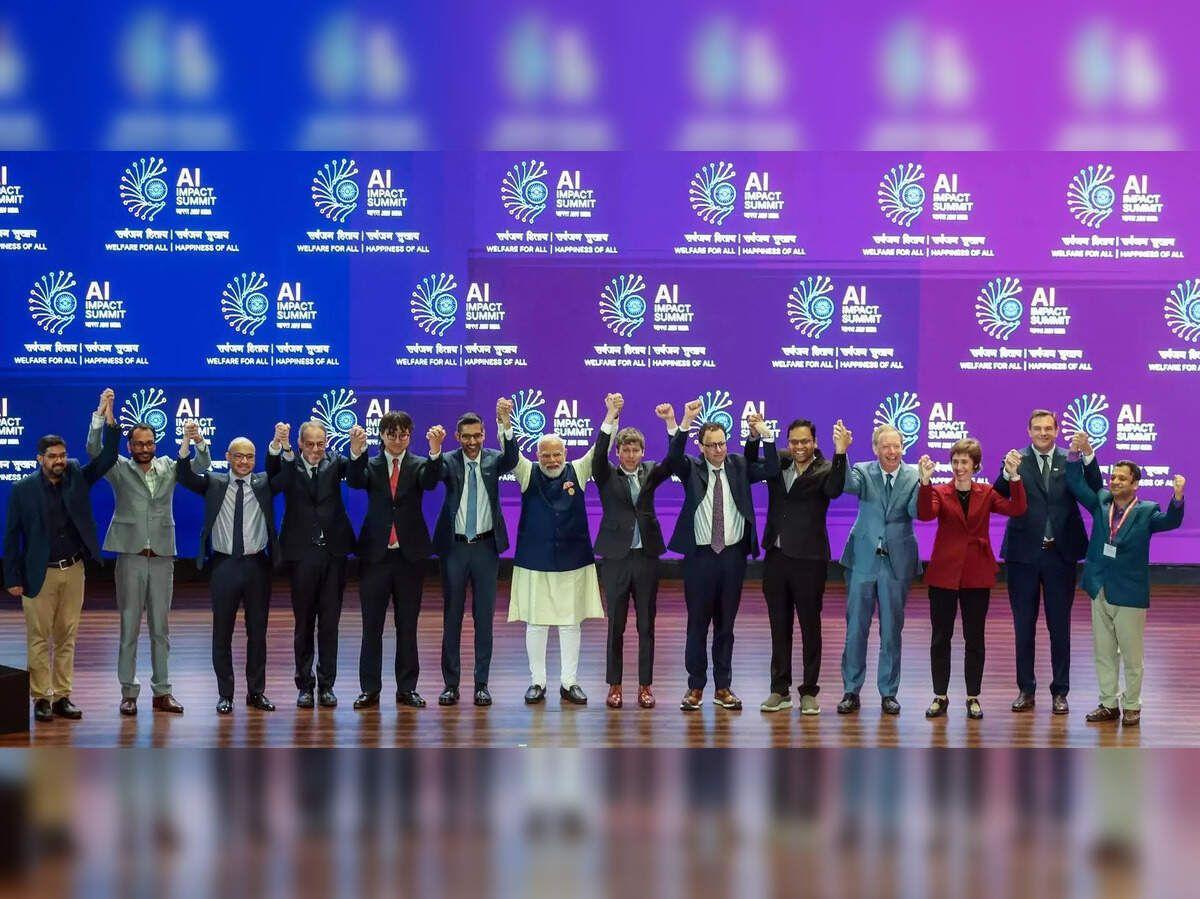
Source: ET
Modi positioned India as the tech leader of the Global South, casting the nation as a moral voice for smaller, developing countries that lack resources to tackle AI challenges
2
. During his address, Modi likened AI to nuclear power, emphasizing that both technologies have immense power to destroy but can be directed for good2
. He argued for a model of AI development that sits between the corporate-led ecosystem of the US tech giants and state-backed Chinese approaches3
.Major investments signal India's AI ambitions despite infrastructure gaps
The summit delivered substantial commitments despite logistical challenges that saw Bill Gates withdraw and Mukesh Ambani delayed by security issues
3
. Ambani, Asia's richest man, pledged $110 billion for building out AI projects across India over the next seven years3
. OpenAI announced a partnership with Tata Group to build a data center starting at 100 megawatts of capacity, with plans to scale up to 1 gigawatt, which could cost between $35 billion and $50 billion at the upper end4
. Anthropic said it will collaborate with Infosys Ltd. to develop advanced AI solutions4
.
Source: Bloomberg
Data center investment emerged as a key focus, with Indian data center-related shares adding about $4 billion in combined market value during the summit week
4
. Microsoft and Google have committed billions of dollars alongside local giants Reliance Industries Ltd. and Adani Group4
. However, the country still lags in high-end computing infrastructure necessary to build frontier large language models and semiconductor manufacturing capabilities3
5
.Strategic autonomy meets digital colonialism concerns
India signed the Pax Silica Declaration, becoming the tenth member of the US-led initiative to protect supply chains for AI and advanced computer chips
2
. Jacob Helberg, the US under secretary of state for economic affairs, emphasized the threat from China, referencing a suspected Chinese cyber-attack on Mumbai in 20205
. Yet questions persist about whether India risks becoming a "data colony for big tech where the proprietary, the value-added services are done elsewhere," according to Reema Bhattacharya of Verisk Maplecroft3
.India showcased its deep expertise in IT services through firms like Tata Consultancy Services Ltd. and Infosys Ltd., which are working with partners like Anthropic and OpenAI to help companies adopt AI
3
. Dario Amodei told the summit that "AI can even help India achieve a standout 25% economic growth"5
. Senior government officials described India's approach as "strategic autonomy," joining forces with those who best align with its interests and ambitions2
.Related Stories

AI safety and governance deadlock persists
The summit exposed the ongoing deadlock in AI safety and governance. The gathering series that began at Bletchley Park in 2023 as an AI "Safety" summit has seen that word edited out, shifting themes to "Action" in Paris and "Impact" in New Delhi
1
. American tech giants are expected to collectively invest some $650 billion in AI this year, accelerating deployment but distorting incentives away from safety1
.
Source: Axios
Computer scientist Yoshua Bengio argued at a side event that middle powers must unite to break the superpower deadlock before AI only concentrates power, stating "If you're not at the table, you're on the menu"
1
. He emphasized that courting favor from Washington or Beijing is a self-defeating strategy that cements dependence, not sovereignty. A middle-power coalition could make market access to billions of people conditional on measurable safety commitments1
. Stuart Russell of Berkeley warned that if AGI emerges, "AI is going to be producing 80% of the global economy," making technology completely integral to a country's wellbeing and giving controllers enormous leverage5
.References
Summarized by

Navi
[1]
Related Stories
India AI push at Davos 2026: Infrastructure, sovereignty and real-world use cases take center stage
21 Jan 2026•Policy and Regulation

India bets on tax breaks and data centers to attract AI investment, but funding cuts raise concerns
02 Feb 2026•Policy and Regulation

86 Nations Back Delhi Declaration on AI, But Deep Divides Over Governance Remain
17 Feb 2026•Policy and Regulation
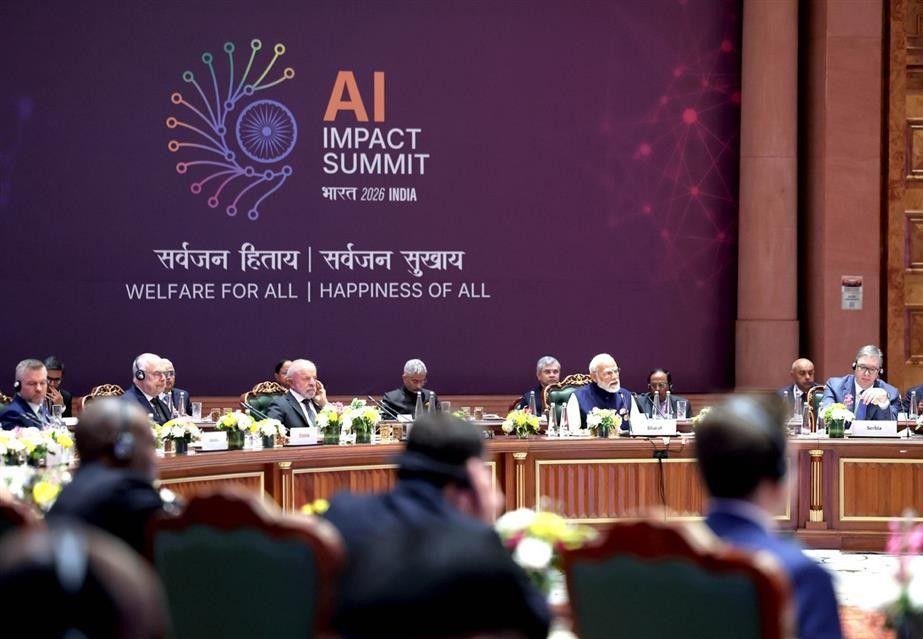
Recent Highlights
1
AI chatbots validate you too much, making you less kind to others, Stanford study reveals
Science and Research
2
Anthropic's Claude Code Source Leak Reveals Hidden AI Agent Plans and Extensive System Access
Technology

3
Judge blocks Pentagon from branding Anthropic a security risk over AI safety guardrails dispute
Policy and Regulation
Recent Highlights
Today's Top Stories











Your Daily Dose of Curated AI News
Don’t drown in AI news. We cut through the noise - filtering, ranking and summarizing the most important AI news, breakthroughs and research daily. Spend less time searching for the latest in AI and get straight to action.

