Time Magazine names Architects of AI as Person of the Year, recognizing tech leaders reshaping society


34 Sources
34 Sources
[1]
TIME names 'Architects of AI' its Person of the Year | TechCrunch
Each December, TIME Magazine names a person of the year -- someone who has most influenced the news and world, for good or ill. Last year, TIME chose President Donald Trump for the second time. The year before that, it was Taylor Swift, who many claimed saved the economy from a recession with her Eras Tour. In 1938, the magazine chose Adolf Hitler. This year, TIME has chosen to bestow its award on not just one person, but a group of people: the so-called "Architects of AI," the CEOs shaping the global AI race from the U.S. With AI on everyone's minds, embodying hope for a small minority and economic anxiety for a majority, per recent Edelman data, this tracks. "For decades, humankind steeled itself for the rise of thinking machines," the article reads. "Leaders striving to develop the technology, including Sam Altman and Elon Musk, warned that the pursuit of its powers could create unforeseen catastrophe [...] This year, the debate about how to wield AI responsibly gave way to a sprint to deploy it as fast as possible." Based on one of TIME's two cover photos, some of those people appear to be Nvidia's Jensen Huang, Tesla's Elon Musk, OpenAI's Sam Altman, Meta's Mark Zuckerberg, AMD's Lisa Su, Anthropic's Dario Amodei, Google DeepMind's Demis Hassabis, and World Labs's Fei-Fei Li -- all individuals who raced "both beside and against each other." TIME writes that these individuals, through their multi-billion-dollar bets on "one of the biggest physical infrastructure projects of all time," have reshaped government policy, turned up the heat on geopolitical competition, and pushed AI adoption forward. "This is the story of how AI changed our world in 2025, in new and exciting and sometimes frightening ways. It is the story of how Huang and other tech titans grabbed the wheel of history, developing technology and making decisions that are reshaping the information landscape, the climate, and our livelihoods... AI emerged as arguably the most consequential tool in great-power competition since the advent of nuclear weapons." TIME only announced the news on Thursday morning, but images of the cover photo were leaked on prediction market Polymarket on Wednesday evening.
[2]
Why Time Dubbed 'AI Builders' Person of the Year: 'Whatever the Question, AI Was the Answer'
The magazine said there was "no turning back or opting out' of AI's massive influence in 2025." In what has become a tradition every few years, Time Magazine's "Person of the Year" isn't an individual for 2025 -- it's a group and a concept. In this case it's what Time is dubbing "The architects of AI." Time's editor in chief Sam Jacobs said in a note about the cover story that AI's power and influence was ever-present in 2025, advancing rapidly and making the impossible possible. Don't miss any of our unbiased tech content and lab-based reviews. Add CNET as a preferred Google source. "This was the year when artificial intelligence's full potential roared into view, and when it became clear that there will be no turning back or opting out," Jacobs wrote. "Whatever the question was, AI was the answer." The magazine's two covers for the Dec. 29, 2025 cover are an image of the word AI with scaffolding and workers around it and one with AI leaders including Meta's Mark Zuckerberg, AMD CEO Lisa Su, Elon Musk, OpenAI's Sam Altman and Nvidia CEO Jensen Huang among others on a construction beam above New York City, evoking the 1932 "Lunch Atop a Skyscraper" photo. (Disclosure: Ziff Davis, CNET's parent company, in April filed a lawsuit against OpenAI, alleging it infringed Ziff Davis copyrights in training and operating its AI systems.) The Time Magazine cover puts a cap on a busy year of AI innovation, controversy and news. As with several previous Time Person of the Year covers, it marks an era of major technological change. Some previous winners of the distinction have included "You" (user-generated media in 2006), "The Computer" (Machine of the Year, 1982), and "US Scientists" (1960). The decision to make AI the cover figure for 2025, however, reflects how much AI has penetrated science, government, the workplace, education and media. "AI has been the gravitational center of 2025 for the economy and the source of endless discussions on how it will shape the future of our societies," said Forrester Research's VP principal analyst Thomas Husson. "In this regard, it is fair to select the Architects of AI in the strictest sense of 'influence.'" Husson said that 2025 marked a tipping point for AI and that the next year promises to make these technologies more personal and embedded in everyday life as more people globally turn to it to perform tasks or even for companionship. Time's article pointed to not only how AI changed things, but the ambivalence and fear many have for the technology. "For 'better or worse' is also a fair summary given how consumers are polarized when it comes to AI," said Husson. "Forty five percent of US and UK online adults agree that AI poses a serious threat to society, however 45 percent of them also think generative AI will make life easier in the long term."
[3]
These are the key AI players on the cover of Time's 'Architects of AI' magazine
NEW YORK (AP) -- Accompanying Time's annual person of the year selection Thursday is a magazine cover that resembles the "Lunch Atop a Skyscraper" photograph from the 1930s showing eight of the " Architects of AI " sitting on the beam. "This was the year when artificial intelligence's full potential roared into view, and when it became clear that there will be no turning back or opting out," Time editor-in-chief Sam Jacobs wrote in an explanation of the choice. The magazine was deliberate in selecting people -- the "individuals who imagined, designed, and built AI" -- rather than the technology itself. But who are these individuals that digital painter Jason Seiler used to grace his rendition of the famous photograph? Here's a look: Zuckerberg has been pushing to revive AI efforts at Meta as the company faces tough competition from rivals such as Google and OpenAI, maker of ChatGPT. In June, Meta made a $14.3 billion investment in AI data company Scale and recruited its CEO Alexandr Wang to help lead a team developing "superintelligence" at the tech giant. Zuckerberg's increasing focus on the abstract idea of "superintelligence" -- which rival companies call artificial general intelligence, or AGI -- is the latest pivot for a tech leader who in 2021 went all-in on the idea of the metaverse, changing the company's name and investing billions into advancing virtual reality and related technology. Since Su took over as president and CEO at Advanced Micro Devices in 2014, its stock has risen from around $3 to about $221. The semiconductor company recently revealed a new artificial intelligence chip in its race to compete with rival chipmaker Nvidia in supplying the foundation for a boom in AI-fueled business tools, and has struck a multibillion dollar computing deal with OpenAI. AMD joins a growing list of technology companies trying to take advantage of a broader interest from businesses looking for new AI tools that can analyze data, help make decisions and potentially replace some tasks currently performed by human workers. Elon Musk's artificial intelligence company produces the Grok AI chatbot. Built using huge amounts of computing power at a Tennessee data center, Grok is Musk's attempt to outdo rivals such as OpenAI's ChatGPT and Google's Gemini in building an AI assistant that shows its reasoning before answering a question. Musk's deliberate efforts to mold Grok into a challenger of what he considers the tech industry's "woke" orthodoxy on race, gender and politics has repeatedly got the chatbot into trouble. Musk is also head of a number of tech-related companies such as Tesla and SpaceX. Nvidia carved out an early lead in tailoring its chipsets known as graphics processing units, or GPUs, from use in powering video games to helping to train powerful AI systems, like the technology behind ChatGPT and image generators. Demand skyrocketed as more people began using AI chatbots. Tech companies scrambled for more chips to build and run them. The ravenous appetite for Nvidia's chips is the main reason that the company became the first $5 trillion company in October, just three months after the Silicon Valley chipmaker was first to break through the $4 trillion barrier. But fears of an AI bubble linger. OpenAI recently marked the three year anniversary from when it first released ChatGPT, sparking global fascination and a commercial boom in generative AI technology and giving the San Francisco startup an early lead. But the company faces increased competition with rivals. Altman said this fall that ChatGPT now has more than 800 million weekly users. But the company, valued at $500 billion, doesn't make a profit, amplifying concerns about an AI bubble if the generative AI products made by OpenAI and its competitors don't meet the expectations of investors pouring billions of dollars into research and development. The AI scientist and 2024 Nobel laureate established London's DeepMind research lab in 2010 before Google acquired it four years later. DeepMind is responsible for Google's Gemni AI platform, which helped level the playing field against tech rivals who had initially pulled ahead in the AI race. He most recently shared the 2024 Nobel Prize in chemistry for developing AI systems that accurately predict protein folding -- a breakthrough for medicine and drug discovery. Google's recent move to implant Gemni into the search experience have been mostly successful, with AI Overviews now being used by more than 2 billion people every month, according to the company. The Gemini app, by comparison, has about 650 million monthly users. Anthropic, founded by ex-OpenAI leaders in 2021, is privately held, but recently put its value at $183 billion. Its AI assistant Claude competes with OpenAI's ChatGPT and others in appealing to business customers using it to assist with coding and other tasks. Anthropic said it expects to make $5 billion in sales this year, but, like OpenAI and many other AI startups, it has never reported making a profit, relying instead on investors to back the high costs of developing AI technology for a potential payoff in the future. Widely known as the " godmother of AI," Stanford computer science professor Fei-Fei Li curated the dataset that accelerated the computer vision branch of AI in the 2010s. Li launched her own startup, World Labs, in 2024 to pursue what she calls the next frontier in AI technology: spatial intelligence. World Labs recently released Marble, its first commercial generative world model, which allows users to generate and edit 3D environments from text prompts, photos, videos, or 3D layouts.
[4]
I Am Time Magazine's Person of the Year
It's rude to boast, but here in 2025, you've got to take the wins where you can get them. This morning, Time magazine announced its Person of the Year, and it's me. It's you, too. If you want to get all technical about it, Time's Person of the Year is actually not a person at all but a collection of people: the architects of AI. One of the two covers Time released is a re-creation of the "Lunch Atop a Skyscraper" photograph from 1932, which depicted blue-collar ironworkers suspended hundreds of feet in the air during the construction of 30 Rockefeller Plaza. In its image, Time replaces these laborers with tech personalities such as Mark Zuckerberg, Elon Musk, Sam Altman, and Jensen Huang. That editorial decision alone is, shall we say, a rich text. Perhaps you are wondering: Where do you, Charlie, fit in? And what of myself? I'm glad you asked. Odds are, you have not personally developed a large language model at a large technology company. (If you have, my Signal handle is @cwarzel.92, and I would like to talk.) And yet, the odds are also decent that morsels from your life have been used to train chatbots. For the past two years, my colleague Alex Reisner has investigated precisely how tech companies use massive data sets to train their LLMs. He has repeatedly found that so-called architects of AI have relied heavily on enormous databases of copyrighted work to create chatbots and other programs, and has also found that this work is generally taken without the consent or awareness of its creators: musicians, filmmakers, YouTubers, podcasters, illustrators, writers -- anyone who has ever posted online, or had anything about them posted by someone else, really. Relatively early in the generative-AI boom, Reisner uncovered that AI companies had used Books3, a data set of nearly 200,000 books, and since then, he's revealed much more: a far larger pirated-book collection, as well as a data set of writing from movies and TV shows, plus millions of hoovered-up YouTube videos. Much of the information that's crawl-able on webpages indexed by Google has been siphoned by these companies. And God only knows what kinds of data the social platforms are using to train their systems. Well, God and Mark Zuckerberg, anyway. That generative-AI models are trained on the creative (and even mundane) output of much of humankind is extremely consequential -- plenty of tech companies have been sued for their training practices, and it remains an open question whether they will be able to continue in this way, though notably Time's Person of the Year story does not use the word copyright a single time. (The Atlantic is involved in at least one such lawsuit, against the AI firm Cohere.) But there's an existential quality to the debate over AI and copyright that goes well beyond legal liability. In a little over three years, generative AI has already reshaped culture, the internet, and the economy. One study from April suggested that Google's AI Overviews feature has, in addition to annoying some users, reduced traffic to outside websites by more than 34 percent. Corporate leaders of organizations such as The Atlantic have struck queasy-feeling partnership deals with OpenAI, in what looks quite obviously to many observers like a hostage situation. No matter the industry, the proposition is similar: Tools trained on people's work, in many cases without compensation or permission, threaten to undermine, replace, or make irrelevant many occupations. The fights over training, copyright, attribution, money, ethics, and what it means to make art in an automated future are just beginning. For many of us this is an unfair and difficult-to-win fight. The very least we can do is take a page from the "techno-optimist" playbook and pilfer something that isn't ours to take. So congratulations on being Time's Person of the Year in 2025! If you count 2006's Person of the Year selection ("You"), that means you've got two under your belt -- and hey, that's not nothing.
[5]

'Architects of AI' named Time Magazine's Person of the Year
Big tech firms are pouring billions of dollars into AI and the infrastructure behind it in a bid to stay ahead of rivals. Forrester analyst Thomas Husson said 2025 could be seen as a "tipping point" for how frequently AI is now used in our day-to-day lives. "Most consumers use it without even being aware of it," he told the BBC. He said AI is now being crammed into hardware, software and services - meaning it its uptake is "much faster than during the Internet or mobile revolutions". Some people now choose chatbots over search engines and social media to plan holidays, find Christmas gifts and discover recipes. Others, such as those worried about its energy use, training data and impact on their livelihoods, are opting-out entirely. Nik Kairinos, founder and chief executive of lab Fountech AI, said the honour was "an honest assessment" of the tech's influence, but he felt "recognition should not be confused with readiness". "At this moment, AI can still be a saviour or scourge to humanity," he said. "We are still in the early stages of building AI systems that are dependable, accountable, and aligned with human values. "For those of us developing the technology and bringing AI tools to market, there is huge responsibility."
[6]

AI Fails to Win Time's Person of the Year... This Time
Most years, Time Magazine names a person who “for better or for worse ... has done the most to influence the events of the year.†The first-ever honoree was Charles Lindbergh in 1927, honored for being the first person to complete a solo transatlantic flight. Since then, Time has named a mix of public figures for the distinction, including Mahatma Gandhi, Franklin D. Roosevelt (three times), and Adolf Hitler. More recently, the title has gone to Barack Obama, Elon Musk, Taylor Swift, and last year, Donald Trump clinched the title for the second time. This year, the magazine chose “The Architects of AI,†leaving some people rolling their eyes and prediction market bettors frustrated. One of this week’s covers for the magazine features some of the biggest names in AI, including Meta’s Mark Zuckerberg, OpenAI’s Sam Altman, Elon Musk, Nvidia’s Jensen Huang, and AMD’s Lisa Su, who is seen perched on a steel beam high above Manhattan in a recreation of the iconic "Lunch Atop a Skyscraper" photograph. “This is the story of how AI changed our world in 2025, in new and exciting and sometimes frightening ways. It is the story of how Huang and other tech titans grabbed the wheel of history, developing technology and making decisions that are reshaping the information landscape, the climate, and our livelihoods,†wrote Charlie Campbell, Andrew R. Chow, and Billy Perrigo in the magazine's accompanying feature story. This isn’t the first time Time has given the honor to a group of people. The first instance was in 1950, when it gave the honor to “The American Fighting-man.†Since then, a dozen others have followed, including the Apollo astronauts in 1968, American women in 1975, and the Me Too movement in 2017. Sometimes the magazine hasn’t chosen humans at all. “The Computer†took home the gold in 1982, and, more ominously, “The Endangered Earth†was the "Person" of the Year in 1988. So it’s no surprise that many expected AI itself to receive the honor this year. It was even one of the most heavily bet-on outcomes in prediction markets. Aside from AI being a top favorite, other leading picks included Donald Trump, Elon Musk, and Charlie Kirk. Now, frustrated Polymarket users are leaving angry comments on the platform over the decision. "The Architects of AI is of course part of AI, AI could mean the AI industry or everything that related to AI, if no other people were listed together or in front of AI, AI should be Yes," wrote one user who had bets on AI as well as Donald Trump, Benjamin Netanyahu, and Sam Altman. “It is big scam. It is fraud,†wrote another. Although AI lost out this year, if it ever delivers on the promises its creators keep making, who knows, it might take the title next time. If it achieves the god-like status that the most AGI-pilled accelerationists insist is coming, it could be crowned the last "Person of the Year" ever.
[7]

Time names "the Architects of AI" Person of the Year
Time's logo outside the New York Stock Exchange on Thursday. (Donald King/AP) Time magazine named "the Architects of AI" the 2025 person of the year. In announcing the choice Thursday morning, Time editor in chief Sam Jacobs stressed the ubiquity of AI technology and its usefulness in medical fields and hurricane modeling, as well as its "trade-offs" -- its huge energy requirements, its ability to create and spread realistic-seeming misinformation, and the fact that the control of the new technology is concentrated in the hands of a few billionaires.
[8]

The Architects of AI are TIME's Person of the Year - here's why
In a year shaped by the reach, ambition, and unease of artificial intelligence, TIME magazine gave its top annual title not to a world leader or celebrity, but to a coalition: the "Architects of AI." This group spans a powerful network of engineers, CEOs, and researchers, including OpenAI's Sam Altman, Nvidia's Jensen Huang, and key figures at Google, Meta, and Anthropic. Their selection captures just how much control these individuals now exert over tools used by millions each day, often invisibly, and how swiftly their creations have moved from lab experiments to fixtures of modern life. The decision makes clear that AI has crossed a threshold. It is no longer a speculative technology or background force; it is central to modern life. But there's more to it than that. Here's why it now seems inevitable that TIME would choose this group. AI was once limited to academic journals, niche research labs, and speculative fiction. In 2025, that's clearly no longer true. AI is no longer an experiment; it is a constant presence in many people's lives. The Architects of AI engineered that shift, not just by developing sophisticated models but by ensuring they were accessible, usable, and, perhaps most significantly, desirable. ChatGPT is only three years old, but 800 million people use it a week. This kind of adoption isn't limited to OpenAI and has only accelerated with integration into other services. Google's Gemini sits at the top of Google search results. Microsoft's Copilot is part of every Office platform. Meta's chatbots appear across Facebook, Instagram, and WhatsApp, and that's only what's visible. Few groups in recent history have had such broad and rapid influence over global behavior for good or ill. Their tools are not only available but also embedded in the daily lives of hundreds of millions of people. According to TIME, AI is central to what it means to participate in the world of 2025. There is no contemporary technology more entangled with the global economy than artificial intelligence. The creation and running of AI models now play a part in defining political and economic power. Jensen Huang's Nvidia offers a prime example. Once known mainly to gamers for its graphics cards, Nvidia is now the most valuable company in the world, having crossed the $5 trillion mark. The firm supplies the vast majority of advanced chips used in training and deploying AI models. These aren't consumer products; they're national assets. Nations now compete not only for oil, but for Nvidia hardware. During high-level diplomatic meetings, the question of chip access is as strategic as defense agreements. As the AI arms race intensifies, governments are leaning heavily into policy and regulation designed to boost their domestic AI ecosystems. Billions in subsidies and infrastructure spending have been earmarked to keep up. The Architects of AI, through their companies, now command the attention not just of consumers and investors but of presidents and parliaments. In the United States, for instance, White House advisors consult directly with CEOs of AI firms. In China, AI is at the core of its latest five-year plan. In the UK, the government has held multiple summits to discuss AI safety and competitiveness. TIME seems to get that these figures are no longer only business leaders. They are geopolitical players. Their decisions influence everything, even if they don't intend it. NVIDIA's chip supply, OpenAI's research pace, and Meta's deployment strategy are just a few ways these individuals wield power that matches or even surpasses many world leaders. Some of the most significant AI breakthroughs in 2025 haven't just been about speed or scale; they've been about extending or replicating human ingenuity in science and art. At its best, the AI developers have expanded the edges of what people believe they can do, especially in fields long limited by expertise, time, or access. What used to be gated behind years of training or teams of specialists can now begin with a prompt. Whether that's a good thing or not is still debatable, but there's no denying the transformation of creative work, from AI-generated films to music to full novels. That can mean AI as a collaborative partner for an artist or wholesale artistic replacement, but its impact is undeniable. The same goes in labs and research centers where Scientists are leaning on AI to model drug interactions and analyze astronomical data, among other tasks. AI can process volumes of information that would be impossible for a human team to digest. It's a new kind of collaboration in which the machine offers options the human might never have considered. TIME's editors highlighted this wave of AI not just for its technical sophistication, but for how it reshapes individual ambition. The people behind AI tools, Time argues, didn't just build technology. They built the scaffolding for a cultural shift. And that, more than anything, explains why they landed the cover.
[9]

AI architects are Time magazine's 2025 "Person of the Year"
Why it matters: The selection underscores the impact that the AI revolution is having on technology, business and humanity. What they're saying: "This was the year when artificial intelligence's full potential roared into view, and when it became clear that there will be no turning back or opting out," Time editor in chief Sam Jacobs wrote. "Whatever the question was, AI was the answer." * "Humanity will determine AI's path forward, and each of us can play a role in determining AI's structure and future," Jacobs wrote. Our work has trained it and sustained it, and now we find ourselves moving through a world increasingly defined by it." Yes, but: Time also highlighted the unknowns and tradeoffs, including how potentially disruptive AI could be. * "The amount of energy required to run these systems drains resources," Jacobs wrote. "Jobs are going poof. Misinformation proliferates as AI posts and videos make it harder to determine what's real." * "Large-scale cyberattacks are possible without human intervention. There is also an extraordinary concentration of power among a handful of business leaders, in a manner that hasn't been witnessed since the Gilded Age." Zoom out: Time said the selection is the third honoring a key moment in the technological revolution of the past half-century. * "The rise of the personal computer in the 1980s transformed the economy," Jacobs wrote. * "The emergence of digital communities was captured famously -- and infamously -- by TIME naming 'You' as Person of the Year in 2006, with a mirrored cover. Hindsight shows how prescient those picks were." State of play: Polymarket bettors predicted that artificial intelligence would win the designation, with a 39% chance as of Dec. 2. * Nvidia CEO Jensen Huang had 27% of the prediction guess and Pope Leo XIV had 11%. Between the lines: Time struck a multiyear content licensing deal and strategic partnership with OpenAI in 2024, giving the AI giant access to more than a century of the publication's archives to help train its language models and answer questions. Flashback: President Trump was Time's "Person of the Year" last year after winning the 2024 election. He was also selected in 2016.
[10]

Time names the 'Architects of AI' as its 2025 Person of the Year, saying the tech's 'full potential roared into view' | Fortune
The "Architects of AI" were named Time's person of the year for 2025 on Thursday, with the magazine citing this year as when the potential of artificial intelligence "roared into view" with no turning back. "For delivering the age of thinking machines, for wowing and worrying humanity, for transforming the present and transcending the possible, the Architects of AI are TIME's 2025 Person of the Year," Time said in a social media post. The magazine was deliberate in selecting people -- the "individuals who imagined, designed, and built AI" -- rather than the technology itself, though there would have been some precedent for that. "We've named not just individuals but also groups, more women than our founders could have imagined (though still not enough), and, on rare occasions, a concept: the endangered Earth, in 1988, or the personal computer, in 1982," wrote Sam Jacobs, the editor-in-chief, in an explanation of the choice. "The drama surrounding the selection of the PC over Apple's Steve Jobs later became the stuff of books and a movie." One of the cover images resembling the "Lunch Atop a Skyscraper" photograph from the 1930s shows eight tech leaders sitting on the beam: Meta CEO Mark Zuckerberg, AMD CEO Lisa Su, Tesla CEO Elon Musk, Nvidia CEO Jensen Huang, OpenAI CEO Sam Altman, the CEO of Google's DeepMind division Demis Hassabis, Anthropic CEO Dario Amodei and AI pioneer Fei-Fei Li, who launched her own startup World Labs last year. Another cover image shows scaffolding surrounding the giant letters "AI" made to look like computer componentry. It made sense for Time to anoint AI because 2025 was the year that it shifted from "a novel technology explored by early adopters to one where a critical mass of consumers see it as part of their mainstream lives," Thomas Husson, principal analyst at research firm Forrester, said by email. The magazine noted AI company CEOs' attendance at President Donald Trump's inauguration this year at the Capitol as a herald for the prominence of the sector. "This was the year when artificial intelligence's full potential roared into view, and when it became clear that there will be no turning back or opting out," Jacobs wrote. AI was a leading contender for the top slot, according to prediction markets, along with Huang and Altman. Pope Leo XIV, the first American pope whose election this year followed the death of Pope Francis, was also considered a contender, with Trump, Israeli Prime Minister Benjamin Netanyahu and New York Mayor-elect Zohran Mamdani topping lists as well. Trump was named the 2024 person of the year by the magazine after his winning his second bid for the White House, succeeding Taylor Swift, who was the 2023 person of the year. The magazine's selection dates from 1927, when its editors have picked the person they say most shaped headlines over the previous 12 months. ___ Associated Press writers Matt O'Brien in Cupertino, California, and Kelvin Chan in London contributed to this article.
[11]

The Architects of AI Are TIME's 2025 Person of the Year
The CEO of Nvidia enters a cavernous studio at the company's Bay Area headquarters and hunches over a table, his head bowed. At 62, the world's eighth richest man is compact, polished, and known among colleagues for his quick temper as well as his visionary leadership. Right now, he looks exhausted. As he stands silently, it's hard to know if he's about to erupt or collapse. Then someone puts on a Spotify playlist and the stirring chords of Aerosmith's "Dream On" fill the room. Huang puts on his trademark black leather jacket and appears to transform, donning not just the uniform, but also the body language and optimism befitting one of the foremost leaders of the artificial intelligence revolution.
[12]

Time's 2025 Person of the Year goes to "the architects of AI"
Time magazine is spotlighting key players in the artificial intelligence revolution for its 2025 Person of the Year, the magazine announced Thursday. "The architects of AI" are the latest recipients of the designation, which for more than a century has been given out on an annual basis to an influential person, group of people or, occasionally, a defining cultural theme or idea. Previous Person of the Year title-holders have held varying roles in a vast range of occupations, with President Trump taking last year's cover and Taylor Swift capturing the one before. In 2025, Time's 2025 honorific was given to the minds and financiers behind AI's rise to renown and notoriety, including Nvidia CEO Jensen Huang, Softbank CEO Masayoshi Son and Baidu CEO Robin Li, who spoke directly with the magazine for its feature story. "Person of the Year is a powerful way to focus the world's attention on the people that shape our lives," wrote Sam Jacobs, Time's editor-in-chief, in an editorial piece about the magazine's decision. "And this year, no one had a greater impact than the individuals who imagined, designed, and built AI." Jacobs described 2025 as "the year when artificial intelligence's full potential roared into view, and when it became clear that there will be no turning back or opting out," adding: "Whatever the question was, AI was the answer." The magazine prepared two separate covers for the issue. In one, artist Jason Seiler painted an interpretative recreation of the iconic 1932 photograph "Lunch Atop a Skyscraper," an image that depicted workers seated side-by-side on a steel beam hanging high above New York City during the construction of 30 Rockefeller Plaza, which became a symbol of American resilience during the Great Depression. A cast of tech industry characters at the forefront of AI development are perched on the beam in Seiler's recreation. Mark Zuckerberg, of Meta, Lisa Su, of Advanced Micro Devices, Elon Musk, of xAI, Sam Altman, of Open AI, Demis Hassabis, of DeepMind Technologies, Dario Amodei, of Anthropic, and Fei-Fei Li, of Stanford's Human-Centered AI Institute, are all pictured, along with Huang. The second cover illustration, by artist Peter Crowther, places the same executives among scaffolding at what looks like a construction site for the giant letters "AI." "Every industry needs it, every company uses it, and every nation needs to build it," Huang said of balancing the pressures to implement AI responsibly and deploy it to the public as quickly as possible. "This is the single most impactful technology of our time." Most of the industry figures pictured on Time's cover did not speak to the magazine for the story, so this year's spread mainly focuses on the implications -- positive, negative and in between -- of the companies they have built and the technology they continue forging. AI often took center stage in 2025 in investigative news reports, economic and academic studies, and in Washington, D.C., as policymakers grappled with how to regulate its evolution while tech giants scrambled to trump their competitors' inventions, as the use of some of them, like chatbots, grew to be commonplace, at times with tragic consequences. "For these reasons, we recognize a force that has dominated the year's headlines, for better or for worse," Jacobs wrote in his editorial. "For delivering the age of thinking machines, for wowing and worrying humanity, for transforming the present and transcending the possible, the Architects of AI are TIME's 2025 Person of the Year."
[13]

TIME Person of the Year 2025 announced - and it's not a person
This is not the first time the magazine has picked a non-human as its Person of the Year, and 2025's choice reflects the domination of AI in news, public debate, as well as modern anxieties surrounding the rise of artificial intelligence. The "Architects of AI" have been named TIME magazine's Person of the Year for 2025. The magazine cited 2025 as the year when the potential of artificial intelligence "roared into view"... with no turning back. "For delivering the age of thinking machines, for wowing and worrying humanity, for transforming the present and transcending the possible, the Architects of AI are TIME's 2025 Person of the Year," TIME announced. The choice is hardly surprising, as AI has dominated headlines this year, and many have expressed concern about its potential dangers. In the cultural world, the encroachment of AI on creative fields has been at the forefront of discussions, provoking heated debate and leading to calls for more safeguards. All you have to do is look at some of the choices for 2025's Words of the Year by various dictionaries to understand the widespread concerns regarding the reach of AI, the way it regurgitates copyrighted material and threatens cognitive capacities. For example, Collins Dictionary crowned "vibe coding" ("making an app or website by describing it to (AI) rather than by writing programming code manually"); Cambridge Dictionary elected "parasocial" as its Word of the Year, highlighting the hollow, one-sided and "unhealthy" connections people feel between themselves and a celebrity, fictional character or an AI chatbot; and Macquarie Dictionary announced that 'AI slop' has been chosen by its committee and voted by the public as the Word of the Year. "Person of the Year is a powerful way to focus the world's attention on the people that shape our lives," TIME editor-in-chief Sam Jacobs wrote in an essay explaining the choice. "And this year, no one had a greater impact than the individuals who imagined, designed, and built AI." The designation of Person of the Year is reserved for "the person or persons who most affected the news and our lives, for good or ill, and embodied what was important about the year, for better or for worse." Last year's TIME Person of the Year was Donald Trump. The magazine states: "It was hard to read or watch anything without being confronted with news about the rapid advancement of a technology and the people driving it. Those stories unleashed a million debates about how disruptive AI would be for our lives. No business leader could talk about the future without invoking the impact of this technological revolution. No parent or teacher could ignore how their teenager or student was using it." "Every industry needs it, every company uses it, and every nation needs to build it," Jensen Huang, who leads Nvidia, told TIME. "This is the single most impactful technology of our time." TIME adds: "All this progress comes with trade-offs: The amount of energy required to run these systems drains resources. Jobs are going poof. Misinformation proliferates as AI posts and videos make it harder to determine what's real. Large-scale cyberattacks are possible without human intervention. There is also an extraordinary concentration of power among a handful of business leaders, in a manner that hasn't been witnessed since the Gilded Age." It continues: "If the past is prologue, this will result in both significant advancements and greater inequality. AI companies are now lashed to the global economy tighter than ever. It is a gamble of epic proportions, and fears of an economic bubble have grown. Trump captured some of our unease in September when he said, "If something happens, really bad, just blame AI"." This year is the third time that the magazine has picked a non-human as its Person of the Year. In 1982, the personal computer was selected as its "Machine of the Year"; "Endangered Earth" as its "Planet of the Year" in 1988; and the magazine picked "You" as its 2006 Person of the Year for the "revolution" of early social media users as content creators. The magazine has bestowed its Person of the Year title annually since 1927.
[14]

Time magazine names 'Architects of AI' as 2025 'Person of the Year'
US publication Time magazine named the "Architects of AI" as its "person of the year" on Thursday, highlighting the US tech titans whose work on the cutting-edge technology is transforming humanity. Nvidia's Jensen Huang, OpenAI's Sam Altman and xAI's Elon Musk are among the entrepreneurs who have "grabbed the wheel of history, developing technology and making decisions that are reshaping the information landscape, the climate, and our livelihoods", the magazine said. "They reoriented government policy, altered geopolitical rivalries, and brought robots into homes. AI emerged as arguably the most consequential tool in great-power competition since the advent of nuclear weapons." One of two covers of the magazine is a take on the iconic "Lunch atop a Skyscraper" photograph from 1932 that shows ironworkers casually eating lunch on a steel beam above New York City. The 'single most impactful technology of our time' In the Time illustration, Mark Zuckerberg, AMD chief Lisa Su, Musk, Huang, Altman as well as Google's AI chief Demis Hassabis, Anthropic's Dario Amodei and Stanford professor Fei-Fei Li are sitting astride the city. According to the magazine, which is owned by Silicon Valley billionaire Marc Benioff, 2025 was the year AI shifted from promising technology to reality and when ChatGPT usage more than doubled to 10 percent of the world's population. Watch moreOpenAI's Sam Altman declares 'code red' to improve ChatGPT as rivals threaten its position "This is the single most impactful technology of our time," Huang told Time, predicting AI will grow the global economy from $100 trillion to $500 trillion. The magazine also pointed to AI's darker side. Watch moreThree years of ChatGPT: China surges, Europe retreats and we all drown in AI slop This year saw lawsuits alleging chatbots contributed to teen suicides and mental health crises, and job displacement looming as more companies raced to replace human workers.
[15]

Time Names AI's Power Brokers as 2025 Person of the Year | AIM
The cover features a reimagining of "Lunch atop a Skyscraper" with tech leaders sitting in place of ironworkers. Time Magazine has named the "architects of artificial intelligence" as its 2025 Person of the Year, marking only the second time the title has gone to a technology rather than an individual. The choice reflects how quickly AI has moved to the center of global industry and public life. The magazine unveiled two covers. One shows the letters AI rising like a monument under construction. The other features a reimagining of "Lunch atop a Skyscraper" with tech leaders sitting in place of ironworkers. NVIDIA chief Jensen Huang, Meta's Mark Zuckerberg, X owner Elon Musk, AI pioneer Fei-Fei Li, OpenAI's Sam Altman, AMD's Lisa Su, Anthropic's Dario Amodei and Google DeepMind's Demis Hassabis appear on it. Time said 2025 marked a shift from caution to rapid deployment as firms poured billions into AI models and chip infrastructure. Altman recently said ChatGPT is used by around 800 million people every week, a sign of how deeply AI has entered daily routines. Zuckerberg has oriented Meta's strategy around its own AI chatbot, placing it across its major apps. Forrester analyst Thomas Husson called this year a tipping point. He told BBC that most people now use AI without realising it because it sits inside phones, computers and online services. He said its spread is moving faster than the rise of the internet or smartphones. Time's editors said no group shaped the year more than the people who design, fund and ship these systems. They said humanity will decide AI's direction, not the technology itself.
[16]

'Architects of AI' named Time's 2025 Person of the Year
"For delivering the age of thinking machines, for wowing and worrying humanity, for transforming the present and transcending the possible, the Architects of AI are TIME's 2025 Person of the Year," Time said in a social media post. The magazine was deliberate in selecting people -- the "individuals who imagined, designed, and built AI" -- rather than the technology itself, though there would have been some precedent for that. "We've named not just individuals but also groups, more women than our founders could have imagined (though still not enough), and, on rare occasions, a concept: the endangered Earth, in 1988, or the personal computer, in 1982," wrote Sam Jacobs, the editor-in-chief, in an explanation of the choice. "The drama surrounding the selection of the PC over Apple's Steve Jobs later became the stuff of books and a movie."
[17]

These are the key AI players on the cover of Time's 'Architects of AI' magazine
NEW YORK (AP) -- Accompanying Time's annual person of the year selection Thursday is a magazine cover that resembles the "Lunch Atop a Skyscraper" photograph from the 1930s showing eight of the " Architects of AI " sitting on the beam. "This was the year when artificial intelligence's full potential roared into view, and when it became clear that there will be no turning back or opting out," Time editor-in-chief Sam Jacobs wrote in an explanation of the choice. The magazine was deliberate in selecting people -- the "individuals who imagined, designed, and built AI" -- rather than the technology itself. But who are these individuals that digital painter Jason Seiler used to grace his rendition of the famous photograph? Here's a look: Meta CEO Mark Zuckerberg Zuckerberg has been pushing to revive AI efforts at Meta as the company faces tough competition from rivals such as Google and OpenAI, maker of ChatGPT. In June, Meta made a $14.3 billion investment in AI data company Scale and recruited its CEO Alexandr Wang to help lead a team developing "superintelligence" at the tech giant. Zuckerberg's increasing focus on the abstract idea of "superintelligence" -- which rival companies call artificial general intelligence, or AGI -- is the latest pivot for a tech leader who in 2021 went all-in on the idea of the metaverse, changing the company's name and investing billions into advancing virtual reality and related technology. AMD CEO Lisa Su Since Su took over as president and CEO at Advanced Micro Devices in 2014, its stock has risen from around $3 to about $221. The semiconductor company recently revealed a new artificial intelligence chip in its race to compete with rival chipmaker Nvidia in supplying the foundation for a boom in AI-fueled business tools, and has struck a multibillion dollar computing deal with OpenAI. AMD joins a growing list of technology companies trying to take advantage of a broader interest from businesses looking for new AI tools that can analyze data, help make decisions and potentially replace some tasks currently performed by human workers. xAI CEO Elon Musk Elon Musk's artificial intelligence company produces the Grok AI chatbot. Built using huge amounts of computing power at a Tennessee data center, Grok is Musk's attempt to outdo rivals such as OpenAI's ChatGPT and Google's Gemini in building an AI assistant that shows its reasoning before answering a question. Musk's deliberate efforts to mold Grok into a challenger of what he considers the tech industry's "woke" orthodoxy on race, gender and politics has repeatedly got the chatbot into trouble. Musk is also head of a number of tech-related companies such as Tesla and SpaceX. Nvidia CEO Jensen Huang Nvidia carved out an early lead in tailoring its chipsets known as graphics processing units, or GPUs, from use in powering video games to helping to train powerful AI systems, like the technology behind ChatGPT and image generators. Demand skyrocketed as more people began using AI chatbots. Tech companies scrambled for more chips to build and run them. The ravenous appetite for Nvidia's chips is the main reason that the company became the first $5 trillion company in October, just three months after the Silicon Valley chipmaker was first to break through the $4 trillion barrier. But fears of an AI bubble linger. OpenAI CEO Sam Altman OpenAI recently marked the three year anniversary from when it first released ChatGPT, sparking global fascination and a commercial boom in generative AI technology and giving the San Francisco startup an early lead. But the company faces increased competition with rivals. Altman said this fall that ChatGPT now has more than 800 million weekly users. But the company, valued at $500 billion, doesn't make a profit, amplifying concerns about an AI bubble if the generative AI products made by OpenAI and its competitors don't meet the expectations of investors pouring billions of dollars into research and development. Google DeepMind CEO Demis Hassabis The AI scientist and 2024 Nobel laureate established London's DeepMind research lab in 2010 before Google acquired it four years later. DeepMind is responsible for Google's Gemni AI platform, which helped level the playing field against tech rivals who had initially pulled ahead in the AI race. He most recently shared the 2024 Nobel Prize in chemistry for developing AI systems that accurately predict protein folding -- a breakthrough for medicine and drug discovery. Google's recent move to implant Gemni into the search experience have been mostly successful, with AI Overviews now being used by more than 2 billion people every month, according to the company. The Gemini app, by comparison, has about 650 million monthly users. Anthropic CEO Dario Amodei Anthropic, founded by ex-OpenAI leaders in 2021, is privately held, but recently put its value at $183 billion. Its AI assistant Claude competes with OpenAI's ChatGPT and others in appealing to business customers using it to assist with coding and other tasks. Anthropic said it expects to make $5 billion in sales this year, but, like OpenAI and many other AI startups, it has never reported making a profit, relying instead on investors to back the high costs of developing AI technology for a potential payoff in the future. Fei-Fei Li, founder of Worldlabs Widely known as the " godmother of AI," Stanford computer science professor Fei-Fei Li curated the dataset that accelerated the computer vision branch of AI in the 2010s. Li launched her own startup, World Labs, in 2024 to pursue what she calls the next frontier in AI technology: spatial intelligence. World Labs recently released Marble, its first commercial generative world model, which allows users to generate and edit 3D environments from text prompts, photos, videos, or 3D layouts.
[18]
Time's 2025 Person of the Year goes to "the architects of AI"
Time magazine is spotlighting key players in the artificial intelligence revolution for its 2025 Person of the Year, the magazine announced Thursday. "The architects of AI" are the latest recipients of the designation, which for more than a century has been given out on an annual basis to an influential person, group of people or, occasionally, a defining cultural theme or idea. Previous Person of the Year title-holders have held varying roles in a vast range of occupations, with President Trump taking last year's cover and Taylor Swift capturing the one before. In 2025, Time's 2025 honorific was given to the minds and financiers behind AI's rise to renown and notoriety, including Nvidia CEO Jensen Huang, Softbank CEO Masayoshi Son and Baidu CEO Robin Li, who spoke directly with the magazine for its feature story. "Person of the Year is a powerful way to focus the world's attention on the people that shape our lives," wrote Sam Jacobs, Time's editor-in-chief, in an editorial piece about the magazine's decision. "And this year, no one had a greater impact than the individuals who imagined, designed, and built AI." Jacobs described 2025 as "the year when artificial intelligence's full potential roared into view, and when it became clear that there will be no turning back or opting out," adding: "Whatever the question was, AI was the answer." The magazine prepared two separate covers for the issue. In one, artist Jason Seiler painted an interpretative recreation of the iconic 1932 photograph "Lunch Atop a Skyscraper," an image that depicted workers seated side-by-side on a steel beam hanging high above New York City during the construction of 30 Rockefeller Plaza, which became a symbol of American resilience during the Great Depression. A cast of tech industry characters at the forefront of AI development are perched on the beam in Seiler's recreation. Mark Zuckerberg, of Meta, Lisa Su, of Advanced Micro Devices, Elon Musk, of xAI, Sam Altman, of Open AI, Demis Hassabis, of DeepMind Technologies, Dario Amodei, of Anthropic, and Fei-Fei Li, of Stanford's Human-Centered AI Institute, are all pictured, along with Huang. The second cover illustration, by artist Peter Crowther, places the same executives among scaffolding at what looks like a construction site for the giant letters "AI." "Every industry needs it, every company uses it, and every nation needs to build it," Huang said of balancing the pressures to implement AI responsibly and deploy it to the public as quickly as possible. "This is the single most impactful technology of our time." Most of the industry figures pictured on Time's cover did not speak to the magazine for the story, so this year's spread mainly focuses on the implications -- positive, negative and in between -- of the companies they have built and the technology they continue forging. AI often took center stage in 2025 in investigative news reports, economic and academic studies, and in Washington, D.C., as policymakers grappled with how to regulate its evolution while tech giants scrambled to trump their competitors' inventions, as the use of some of them, like chatbots, grew to be commonplace, at times with tragic consequences. "For these reasons, we recognize a force that has dominated the year's headlines, for better or for worse," Jacobs wrote in his editorial. "For delivering the age of thinking machines, for wowing and worrying humanity, for transforming the present and transcending the possible, the Architects of AI are TIME's 2025 Person of the Year."
[19]

Time magazine names 'Architects of AI' Person of the Year 2025
Time magazine's list of the 100 most influential people of 2025 includes Donald Trump, Elon Musk, along with Simone Biles and more celebrities. Time magazine has chosen "Architects of AI" as its Person of the Year 2025. The magazine said it opted to recognize artificial intelligence's vast influence across society, from media to politics to the workforce. "This was the year when artificial intelligence's full potential roared into view, and when it became clear that there will be no turning back or opting out. Whatever the question was, AI was the answer," said Sam Jacobs, Time's editor-in-chief. One of the publication's two magazine covers for its person of the year issue includes tech leaders like Meta CEO Mark Zuckerberg, Tesla CEO Elon Musk and Nvidia CEO Jensen Huang. Time's annual person of the year selection is a tradition that dates back to 1927. Over the years, the magazine has recognized public figures including celebrities, activists and politicians with the award. Last year, President Donald Trump received the title on the heels of the presidential election. He was also given the recognition in 2016. See Time Person of the Year 2025: 'Architects of AI' Time said AI "changed our world in 2025" in both "new and exciting and sometimes frightening ways." The magazine also called AI "the most consequential tool in great-power competition since the advent of nuclear weapons." "For delivering the age of thinking machines, for wowing and worrying humanity, for transforming the present and transcending the possible, the Architects of AI are TIME's 2025 Person of the Year," Jacobs wrote. The magazine's two person of the year covers for 2025 include an illustration with the letters "AI" as well as a painting that nods to the 1932 photograph, "Lunch atop a Skyscraper." The painting, by Jason Seiler, depicts tech leaders Mark Zuckerberg, Lisa Su, Elon Musk, Jensen Huang, Sam Altman, Demis Hassabis, Dario Amodei and Fei-Fei Li. As this year's selection suggests, the person of the year doesn't have to be an individual. In 2006, the magazine similarly recognized a technological advancement by selected "You" as its person of the year - a reflection of the emergence of online communities. Melina Khan is a national trending reporter for USA TODAY. She can be reached at [email protected].
[20]

AI architects named Time 'Person of the Year'
Time named the business leaders behind the artificial intelligence (AI) boom as its "Person of the Year" on Thursday, describing 2025 as the year when the technology's "full potential roared into view." The magazine pointed to the likes of Nvidia CEO Jensen Huang, OpenAI CEO Sam Altman, xAI CEO Elon Musk, Meta CEO Mark Zuckerberg, AMD CEO Lisa Su and Anthropic CEO Dario Amodei in its cover story. "Person of the Year is a powerful way to focus the world's attention on the people that shape our lives," Time editor-in-chief Sam Jacobs wrote in a piece explaining the decision. "And this year, no one had a greater impact than the individuals who imagined, designed, and built AI." Time typically names an individual as its "Person of the Year" -- President Trump held last year's title -- but it has occasionally selected a group of people or an innovation. In 1982, the magazine chose the personal computer. And in 2006, "Person of the Year" was given to "You," a concept meant to reflect the rise of social media and user-generated content online. Time's decision to choose the "Architects of AI" for 2025 reflects the technology's rapid rise and growing impact. While AI has been developing for years, it first burst onto the scene for the public in 2022 with the release of OpenAI's ChatGPT. Over the past three years, companies have raced to release their own models and top the latest innovations, triggering a global competition that has seen billions of dollars flow into investments in AI infrastructure. It has also added a new layer to U.S.-China tensions, as the two superpowers race to dominate the technology. Nvidia, once a relatively unknown company that produced video game chips, has become the world's most valuable company with the advent of AI and the first firm to reach a market capitalization of $5 trillion. Time also acknowledged some of the growing concerns around the technology, including its impacts on young users. It highlighted the story of Adam Raine, a 16-year-old who took his own life after interactions with ChatGPT. "[W]e recognize a force that has dominated the year's headlines, for better or for worse," Jacobs wrote Thursday.
[21]

Architects of AI Named Time's 'Person of the Year'
NEW YORK, Dec 11 (Reuters) - Time magazine named the architects of artificial intelligence its "Person of the Year" on Thursday, citing their ability to deliver the age of thinking machines with transformative technology. "Person of the Year is a powerful way to focus the world's attention on the people that shape our lives. And this year, no one had a greater impact than the individuals who imagined, designed, and built AI," Time Editor-in-Chief Sam Jacobs wrote in a letter to readers. Jacobs described the architects as "wowing and worrying humanity" and "transforming the present and transcending the possible." The 2025 "Person of the Year" issue features a cover story that explores how AI changed the world over the year in new and "sometimes frightening ways." It includes interviews with Nvidia Chief Executive Jensen Huang, whose chips are powering the AI boom, and AI investors such as SoftBank CEO Masayoshi Son. It explores such troubling aspects of AI as the death of a 16-year-old Californian who committed suicide, after which his parents sued ChatGPT maker OpenAI, blaming the company for their son's death because of conversations he had with the chatbot. Time is among many media outlets partnering with AI firms to license content and develop new tools. In June 2024 it signed a multi-year content deal with OpenAI that gave the ChatGPT maker access to its archived news content. In response to user queries, the chatbot cites and links back to the source on Time.com. Time magazine named then-President-elect Donald Trump "Person of the Year" in 2024, as well as in 2016. Past winners have also included pop star Taylor Swift, Ukrainian President Volodymyr Zelenskiy and Tesla Chief Executive Elon Musk. (Reporting by Helen Coster; editing by Donna Bryson)
[22]

'Time' Just Revealed Its Person of the Year, and They're Part of a Booming Industry
Time just gave its 2025 Person of the Year to the "Architects of AI," eight leaders building the technology that has shaped the year. The two covers feature Meta CEO Mark Zuckerberg, AMD CEO Lisa Su, Tesla CEO Elon Musk, Nvidia CEO Jensen Huang, OpenAI CEO Sam Altman, CEO Google's DeepMind division Demis Hassabis, Anthropic CEO Dario Amodei, and AI pioneer Fei-Fei Li. "2025 was the year when artificial intelligence's full potential roared into view, and when it became clear that there will be no turning back," Time said in its December 11 announcement. The magazine said it chose the group "For delivering the age of thinking machines, for wowing and worrying humanity, for transforming the present and transcending the possible..." Time editor in chief Sam Jacobs said the annual title is a powerful way to turn people's attention to those who have sculpted their lives. "And this year, no one had a greater impact than the individuals who imagined, designed, and built AI," Jacobs said. According to the publication, the title goes to "the person or persons who most affected the news and our lives, for good or ill, and embodied what was important about the year, for better or for worse." The announcement comes with two magazine covers. The first was designed by Jason Seiler and inspired by the famous Lunch Atop a Skyscraper photograph. Rather than the construction workers in the 1932 image, it's the builders of AI. The second, created by Peter Crowther, features the same group working among scaffolding surrounding two giant letters: AI. The final deadline for the 2026 Inc. Regionals Awards is Friday, December 12, at 11:59 p.m. PT. Apply now.
[23]
The architects of AI are Time's 2025 Person of the Year
Emily Mae Czachor is a reporter and news editor at CBSNews.com. She typically covers breaking news, extreme weather and issues involving social justice. Emily Mae previously wrote for outlets like the Los Angeles Times, BuzzFeed and Newsweek. Time is spotlighting key players in the artificial intelligence revolution for its 2025 Person of the Year, the magazine announced Thursday. "The architects of AI" are the latest recipients of the designation, which for more than a century has been given out on an annual basis to an influential person, group of people or, occasionally, a defining cultural theme or idea. Previous Person of the Year title-holders have held varying roles in a vast range of occupations, with President Trump taking last year's cover and Taylor Swift capturing the one before. In 2025, Time's honorific was given to the minds and financiers behind AI's rocket to renown and notoriety, including Nvidia CEO Jensen Huang, Softbank CEO Masayoshi Son and Baidu CEO Robin Li, who spoke directly with the magazine for its feature story. "Person of the Year is a powerful way to focus the world's attention on the people that shape our lives," wrote Sam Jacobs, Time's editor-in-chief, in an editorial piece about the magazine's decision. "And this year, no one had a greater impact than the individuals who imagined, designed, and built AI." Jacobs described 2025 as "the year when artificial intelligence's full potential roared into view, and when it became clear that there will be no turning back or opting out," adding: "Whatever the question was, AI was the answer." The magazine prepared two separate covers for the issue. In one, artist Jason Seiler painted an interpretative recreation of the iconic 1932 photograph "Lunch Atop a Skyscraper," an image that depicted workers seated side-by-side on a steel beam hanging high above New York City during the construction of 30 Rockefeller Plaza, which became a symbol of American resilience during the Great Depression. A cast of tech industry characters at the forefront of AI development are perched on the beam in Seiler's recreation. Mark Zuckerberg, of Meta, Lisa Su, of Advanced Micro Devices, Elon Musk, of xAI, Sam Altman, of Open AI, Demis Hassabis, of DeepMind Technologies, Dario Amodei, of Anthropic, and Fei-Fei Li, of Stanford's Human-Centered AI Institute, are all pictured, along with Huang. The second cover illustration, by artist Peter Crowther, places the same executives among scaffolding at what looks like a construction site for the giant letters "AI." "Every industry needs it, every company uses it, and every nation needs to build it," Huang said of balancing the pressures to implement AI responsibly and deploy it to the public as quickly as possible. "This is the single most impactful technology of our time." Most of the industry figures pictured on Time's cover did not speak to the magazine for the story, so this year's spread mainly focuses on the implications -- positive, negative and in between -- of the companies they have built and the technology they continue forging. AI often took center stage in 2025 in investigative news reports, economic and academic studies, and in Washington, D.C., as policymakers grappled with how to regulate its evolution while tech giants scrambled to trump their competitors' inventions, as the use of some of them, like chatbots, grew to be commonplace, at times with tragic consequences. "For these reasons, we recognize a force that has dominated the year's headlines, for better or for worse," Jacobs wrote in his editorial. "For delivering the age of thinking machines, for wowing and worrying humanity, for transforming the present and transcending the possible, the Architects of AI are TIME's 2025 Person of the Year."
[24]

Critics Torch Time Over 2025 Person Of The Year Choice: 'Abandoned The Whole Concept'
Time magazine has announced its 2025 Person of the Year -- and critics aren't having it. "For delivering the age of thinking machines, for wowing and worrying humanity, for transforming the present and transcending the possible, the Architects of AI are TIME's 2025 Person of the Year," the magazine wrote Thursday morning on X, formerly Twitter. Time released two covers for the issue, with one showing the letters "AI" being constructed amid scaffolding and another revamping the classic 1932 photo "Lunch atop a Skyscraper" -- with the world's leading tech titans replacing the original's steel workers. The featured "architects" include X owner Elon Musk, Meta CEO Mark Zuckerberg, OpenAI's Sam Altman, Nvidia CEO Jensen Huang, AMD's Lisa Su, Anthropic CEO Dario Amodei, AI pioneer Fei-Fei Li and CEO of Google's DeepMind division Demis Hassabis. The selection of wealthy tech leaders sparked rather grim reactions on social media, as the rise of artificial intelligence has caused widespread concern about the technology replacing actual people in various industries and its negative impact on the environment. "Very cool to work toward the blurring of distinctions between AI and persons. What could go wrong?" wrote one user on X, with another person commenting: "The moment 'Person of the Year' goes to people building non-people... yeah, a new era officially started." While the latest selection might portend that "non-people" are starting to gain mainstream prominence as the one X user suggested, Time previously named the personal computer its "Machine of the Year" in 1982 and named the Earth its "Planet of the Year" title in 1988. Others noted that the Person of the Year title was previously given to universally detestable figures such as Adolf Hitler, and that the 1938 issue in question wasn't an endorsement of the Nazi dictator -- but merely an acknowledgement of his global impact. Time was nonetheless brutally roasted on X for both the quality of the cover images and for what many view as public approval of a technology that could threaten the magazine's own employees. Tech analyst James Wester was particularly frustrated with the effort. He wrote, "Besides the terrible pick for Person of the Year, can we just address how bad the cover images are? If you're going to have 'architects,' why not have an architectural rendering of 'AI' versus scaffolding? And the lunch on a beam picture is even worse." Time's big reveal notably landed on the same day that OpenAI was sued for wrongful death by the heirs of an elderly Connecticut woman who allege the company's flagship service ChatGPT nurtured her son's "paranoid delusions" before he fatally strangled her. While the title has never been an endorsement, critics on social media held nothing back.
[25]

Time names 'Architects of AI' Person of the Year 2025: What it means for tech
Time magazine chose the "Architects of AI" as its 2025 Person of the Year, showing how strongly artificial intelligence is shaping the world. The title also brought attention to big tech leaders like Nvidia's Jensen Huang. The story highlights how AI growth, powerful chips, and global influence are becoming major topics in news, business, and politics today. Time magazine announced that the "Architects of AI" are the Person of the Year for 2025 on Thursday. The magazine said 2025 was the year when AI's potential "roared into view" with no turning back. Time explained its choice by saying: "For delivering the age of thinking machines, for wowing and worrying humanity, for transforming the present and transcending the possible, the Architects of AI are TIME's 2025 Person of the Year," the magazine said in a social media post, as cited by AP. Prediction markets showed AI was a top contender for the title. Jensen Huang of Nvidia and Sam Altman of OpenAI were also strong contenders in prediction markets. Pope Leo XIV, the first American pope who was elected after Pope Francis' death this year, was also considered. Other names in consideration included President Donald Trump, Israeli Prime Minister Benjamin Netanyahu, and New York Mayor-elect Zohran Mamdani. Time had named Donald Trump the 2024 Person of the Year after he won his second run for the White House as stated in the report by AP. Taylor Swift was the 2023 Person of the Year before Trump. Time's Person of the Year tradition started in 1927, and the magazine picks the person who shaped the news the most in the past year. Q1. Who is Time's Person of the Year 2025? Time named the "Architects of AI" as the 2025 Person of the Year for their major impact on technology and global news. Q2. Why was Nvidia's Jensen Huang mentioned in the story? Jensen Huang was highlighted because Nvidia leads the AI chip boom and he was a top contender for Person of the Year.
[26]

Time Unveils Its 2025 Person of the Year: A Group Dubbed 'Architects of AI'
The magazine is recognizing how artificial intelligence is influencing our lives, for better or for worse. This year artificial intelligence stopped being all about the future and roared into the present. Time announced exclusively on TODAY Dec. 11 that it has recognized AI's seismic impact by naming the "Architects of AI" as its 2025 Person of the Year. The recognition reflects how the technology seemingly became inescapable this year in just about any aspect of American life, from its impact on education to fears of mass industry disruption. In its cover story, Time recognized the people who are building, designing and shaping AI, including the big names evangelizing for the technology and those behind the scenes responsible for its creation. The magazine also examined the tension between those looking to push AI forward and the many everyday people who have fears about AI's potentially widespread harmful effects. "Every industry needs it, every company uses it, and every nation needs to build it," Nvidia's Jensen Huang told Time. "This is the single most impactful technology of our time." There are two different Time covers this year, both illustrated and featuring prominent tech and AI leaders. Time creative director D.W. Pine explained that the two artists "each created an image that speaks to the duality AI has produced -- man vs. machine." Time's Person of the Year -- which is not an award of honor, but an observance of a figure who had the most influence on the events of the year, for better or for worse -- has previously recognized aspects of the tech revolution. In 1982, the magazine dubbed "The Computer" its Person of the Year, or more aptly, Machine of the Year, marking the first time an inanimate object was recognized. The award represented how personal computers began to find their way into millions of American homes. Then in 2006, Time named "You" as Person of the Year as the World Wide Web accelerated connection around the globe and content creators began to rise. The "Architects of AI" follow Time's 2024 Person of the Year, President Donald Trump, who also plays a sizable role in the AI conversation. The day after his inauguration in January, Trump and tech luminaries like Open AI's Sam Altman and Oracle's Larry Ellison announced the Stargate Project at the White House. With the project, they pledged up to $500 billion to build AI data centers around the country. Funders and technology partners of the newly created company include some of AI's biggest names -- SoftBank, OpenAI, Oracle, Nvidia and Microsoft. With Time's first cover for 2025 Person of the Year, digital painter Jason Seiler nods to the famous "Lunch atop a Skyscraper" photograph from 1932, this time depicting the following tech leaders: With its second cover, illustrator and graphics animator Peter Crowther creates a structure covered in scaffolding, with the following figures pictured within: Time has named a Person of the Year every year since 1927, from historic world leaders to cultural figures. In 2023, Taylor Swift became the first Person of the Year to be recognized for her success in the arts. This isn't the first time that a group of people has been named Person of the Year. In 2018, "The Guardians" earned the distinction. It recognized journalists who faced murder or persecution for their reporting, including the late Jamal Kashoggi and Rappler editor Maria Ressa. A year earlier, Time spotlighted "The Silence Breakers," the women who came forward to share stories of sexual abuse and harassment as part of the #MeToo movement. Time has also previously designated prominent technology leaders as Person of the Year, including Tesla's Elon Musk in 2021 and Meta's Mark Zuckerberg in 2010. Time's 2025 Person of the Year issue is now live on Time.com. Physical copies will be available Dec. 19 on newsstands and on The Magazine Shop.
[27]

Musk, Huang, Zuckerberg Top Time's 2025 Person Of The Year List: Who Are The Architects Of AI? - Advanced Micro Devices (NASDAQ:AMD), Amazon.com (NASDAQ:AMZN)
Several executives across the artificial intelligence (AI) sector have been named as Time's 2025 Person of the Year. Here's a look at why AI took over the annual list and who the "architects of AI are." Time Person of the Year Time Magazine has released its annual person of the year since 1927 and has expanded to include several other lists, including the most influential names in the AI sector. Some of those figures from the AI list earlier this year have been upgraded to Person of the Year. "This was the year when artificial intelligence's full potential roared into view, and when it became clear that there will be no turning back or opting out," Time said in their reasoning for the selections. Time said that for whatever the question was, "AI was the answer." "We saw it accelerate medical research and productivity, and seem to make the impossible possible. It was hard to read or watch anything without being confronted with news about the rapid advancement." For the Person of the Year list, Time made two different covers. One of the cover features the titans selected appearing to sit on a steel beam, paying tribute to the famous "Lunch Atop a Skyscraper" picture from 1932. Digital artist Jason Seiler created the image. The architects of AI named by Time as Person of the Year for 2025 are: Mark Zuckerberg, CEO Meta Platforms (NASDAQ:META) Lisa Su, CEO Advanced Micro Devices (NASDAQ:AMD) Elon Musk, CEO xAI Jensen Huang, CEO NVIDIA Corporation (NASDAQ:NVDA) Sam Altman, CEO OpenAI Demis Hassabis, CEO DeepMind Technologies Dario Amodei, CEO Anthropic Fei-Fei Li, Computer Scientist, Stanford University "Every industry needs it, every company uses it, and every nation needs to build it," Huang told Time when speaking of AI. "This is the single most impactful technology of our time." Read Also: 44 Public Companies Make Time's Most Influential List: Coinbase, UFC, Nintendo, Netflix And More Stocks Investors Can Buy Why It's Important Anyone in the investing world who has read an earnings report or listened to a conference call from a technology company likely heard about AI in 2025. The emerging technology continues to be one of the biggest talking points globally. Big tech companies are spending hundreds of billions of dollars to grow their AI businesses, AI platforms and AI-related products. Time pays tribute to some of the biggest names in the AI space with its annual honor and also highlights some other companies in its report. The company names the following companies as tops among three key areas of the world of AI: Chip Builders: Nvidia, Advanced Micro Devices, Taiwan Semiconductor Manufacturing (NYSE:TSM), ASML Holding (NASDAQ:ASML) Computing Providers: Microsoft Corporation (NASDAQ:MSFT), Alphabet Inc (NASDAQ:GOOGL), Oracle Corporation (NASDAQ:ORCL), Amazon.com Inc (NASDAQ:AMZN) Model Builders: OpenAI, Meta Platforms, Anthropic, xAI The list shows some stocks for investors to watch and may also show the importance of the model builders, with all four of those companies represented among the architects of AI list. The 2025 award marks a second Person of the Year for both Musk and Zuckerberg, who also won the award in 2021 and 2010 respectively. Read Next: OpenAI's Sam Altman Says He Can't Imagine 'Figuring Out How To Raise A Newborn Without ChatGPT' Image: Shutterstock AMDAdvanced Micro Devices Inc$220.82-0.27%OverviewAMZNAmazon.com Inc$229.45-1.01%ASMLASML Holding NV$1123.510.37%GOOGLAlphabet Inc$312.50-2.41%METAMeta Platforms Inc$650.880.12%MSFTMicrosoft Corp$483.461.02%NVDANVIDIA Corp$180.29-1.90%ORCLOracle Corp$199.57-10.5%TSMTaiwan Semiconductor Manufacturing Co Ltd$304.52-1.81%Market News and Data brought to you by Benzinga APIs
[28]
Time's 2025 Person Of The Year Is...
Time magazine named "The Architects of AI" as its 2025 Person of the Year. "Racing both beside and against each other, they placed multibillion-dollar bets on one of the biggest physical infrastructure projects of all time," Charlie Campbell, Andrew R. Chow and Billy Perrigo wrote in the cover story on the AI leaders. "They reoriented government policy, altered geopolitical rivalries, and brought robots into homes. AI emerged as arguably the most consequential tool in great-power competition since the advent of nuclear weapons." One of two covers for the magazine's annual honor features an illustration of tech leaders like Tesla CEO Elon Musk, Meta CEO Mark Zuckerberg, OpenAI CEO Sam Altman, Nvidia CEO Jensen Huang and more sitting on a beam, a reference to the famous "Lunch Atop a Skyscraper" photo.
[29]

Time's Person of the Year cover feels like a desecration of history
Time Magazine has named its Person of the Year, choosing to honour the 'Architects of AI' with a cover design recreating the iconic 'Lunch atop a Skyscraper' photograph. While the annual announcement is always contentious, this year's choice has perhaps been Time's most controversial yet, sparking outrage among AI critics. While some of the best magazine covers aren't afraid to be provocative, it's clear that Time Magazine's new cover is engineered to spark strong feelings from both sides of the AI conversation. Whether you see it as a vision of the future or a desecration of the past, Time's new cover is everything that AI represents - bold, unflinching yet derivative. "This is the story of how AI changed our world in 2025, in new and exciting and sometimes frightening ways," Time's announcement claims, highlighting its featured 'Architects of AI'. Among the ranks are NVIDIA CEO Huang Renxun, Mark Zuckerberg, Elon Musk and OpenAI's Sam Altman, each representing how AI technology has "emerged as arguably the most consequential tool in great-power competition since the advent of nuclear weapons." At the centre of 2025's controversial Person of the Year is a provocative cover created by digital painter Jason Seiler. A 'homage to 'Lunch atop a Skyscraper', Seiler replaces each of the hardworking ironworkers with AI moguls. While the photograph (which is named as one of Time's 100 most influential photographs of all time) has been pastiched to death, there's something uncomfortable about the new cover. Comparing multimillionaires to the historic labourers who helped build New York City feels crass at best and disrespectful at worst, but in a way, it's this very provocation that has powered the AI movement and its evolution. The truth is, AI doesn't care about the nuance of an image when it uses it to generate new content - it's about rapid, instant progression. I find myself at a crossroads trying to define my feelings about the 2025 Person of the Year cover. On one hand, I am appalled that a piece of history has been bastardised by AI ringmasters; on the other, I recognise that my outrage is futile. AI will continue to cannibalise all existing media, and as a result, it will continue to provoke; that is the tension we are forced to accept. While I may not like that the Architects of AI are Time's Person of the Year, I cannot deny that it's an apt, albeit disconcerting decision.
[30]

Time magazine names 'Architects of AI' as its person of the year for 2025 - The Korea Times
The two covers of Time magazine's 2025 Person of the Year issue with an illustration by Peter Crowther (left) depicting Jensen Huang, President and CEO of Nvidia; Elon Musk, xAI; Dario Amodei, CEO of Anthropic; Lisa Su, CEO of AMD; Mark Zuckerberg, CEO of Meta; Demis Hassabis, CEO of DeepMind Technologies; Fei-Fei Li, Co-Director of Stanford University's Human-Centered AI Institute and CEO of World Labs; and Sam Altman, CEO of Open AI, and a painting by Jason Seiler (right) depicting the same people, in this undated handout combination image obtained by Reuters on Thursday. TIME/TIME Person of the Year/Handout via REUTERS-Yonhap The "Architects of AI" were named Time's person of the year for 2025 on Thursday, with the magazine citing this year as when the potential of artificial intelligence "roared into view" with no turning back. "For delivering the age of thinking machines, for wowing and worrying humanity, for transforming the present and transcending the possible, the Architects of AI are TIME's 2025 Person of the Year," Time said in a social media post. The magazine was deliberate in selecting people -- the "individuals who imagined, designed, and built AI" -- rather than the technology itself, though there would have been some precedent for that. "We've named not just individuals but also groups, more women than our founders could have imagined (though still not enough), and, on rare occasions, a concept: the endangered Earth, in 1988, or the personal computer, in 1982," wrote Sam Jacobs, the editor-in-chief, in an explanation of the choice. "The drama surrounding the selection of the PC over Apple's Steve Jobs later became the stuff of books and a movie." One of the cover images resembling the "Lunch Atop a Skyscraper" photograph from the 1930s shows eight tech leaders sitting on the beam: Meta CEO Mark Zuckerberg, AMD CEO Lisa Su, Tesla CEO Elon Musk, Nvidia CEO Jensen Huang, OpenAI CEO Sam Altman, the CEO of Google's DeepMind division Demis Hassabis, Anthropic CEO Dario Amodei and AI pioneer Fei-Fei Li, who launched her own startup World Labs last year. Another cover image shows scaffolding surrounding the giant letters "AI" made to look like computer componentry. It made sense for Time to anoint AI because 2025 was the year that it shifted from "a novel technology explored by early adopters to one where a critical mass of consumers see it as part of their mainstream lives," Thomas Husson, principal analyst at research firm Forrester, said by email. The magazine noted AI company CEOs' attendance at President Donald Trump's inauguration this year at the Capitol as a herald for the prominence of the sector. "This was the year when artificial intelligence's full potential roared into view, and when it became clear that there will be no turning back or opting out," Jacobs wrote. AI was a leading contender for the top slot, according to prediction markets, along with Huang and Altman. Pope Leo XIV, the first American pope whose election this year followed the death of Pope Francis, was also considered a contender, with Trump, Israeli Prime Minister Benjamin Netanyahu and New York Mayor-elect Zohran Mamdani topping lists as well. Trump was named the 2024 person of the year by the magazine after his winning his second bid for the White House, succeeding Taylor Swift, who was the 2023 person of the year. The magazine's selection dates from 1927, when its editors have picked the person they say most shaped headlines over the previous 12 months.
[31]

Time magazine names 'Architects of AI' as person of the year -- ...
The "Architects of AI" were named Time's person of the year for 2025 on Thursday, with the magazine citing this year as when the potential of artificial intelligence "roared into view" with no turning back. "For delivering the age of thinking machines, for wowing and worrying humanity, for transforming the present and transcending the possible, the Architects of AI are TIME's 2025 Person of the Year," Time said in a social media post. The magazine was deliberate in selecting people -- the "individuals who imagined, designed, and built AI" -- rather than the technology itself, though there would have been some precedent for that. "We've named not just individuals but also groups, more women than our founders could have imagined (though still not enough), and, on rare occasions, a concept: the endangered Earth, in 1988, or the personal computer, in 1982," wrote Sam Jacobs, the editor-in-chief, in an explanation of the choice. "The drama surrounding the selection of the PC over Apple's Steve Jobs later became the stuff of books and a movie." One of the cover images resembling the "Lunch Atop a Skyscraper" photograph from the 1930s shows eight tech leaders sitting on the beam: Meta CEO Mark Zuckerberg, AMD CEO Lisa Su, Tesla CEO Elon Musk, Nvidia CEO Jensen Huang, OpenAI CEO Sam Altman, the CEO of Google's DeepMind division Demis Hassabis, Anthropic CEO Dario Amodei and AI pioneer Fei-Fei Li, who launched her own startup World Labs last year. Another cover image shows scaffolding surrounding the giant letters "AI" made to look like computer componentry. It made sense for Time to anoint AI because 2025 was the year that it shifted from "a novel technology explored by early adopters to one where a critical mass of consumers see it as part of their mainstream lives," Thomas Husson, principal analyst at research firm Forrester, said by email. The magazine noted AI company CEOs' attendance at President Trump's inauguration this year at the Capitol as a herald for the prominence of the sector. "This was the year when artificial intelligence's full potential roared into view, and when it became clear that there will be no turning back or opting out," Jacobs wrote. AI was a leading contender for the top slot, according to prediction markets, along with Huang and Altman. Pope Leo XIV, the first American pope whose election this year followed the death of Pope Francis, was also considered a contender, with Trump, Israeli Prime Minister Benjamin Netanyahu and New York Mayor-elect Zohran Mamdani topping lists as well. Trump was named the 2024 person of the year by the magazine after his winning his second bid for the White House, succeeding Taylor Swift, who was the 2023 person of the year. The magazine's selection dates from 1927, when its editors have picked the person they say most shaped headlines over the previous 12 months.
[32]

Time magazine names 'Architects of AI' as its person of the year for 2025
NEW YORK -- NEW YORK -- The "Architects of AI" were named Time magazine's person of the year for 2025 on Thursday. The magazine cited 2025 as the year when the potential of artificial intelligence "roared into view" with no turning back. "For delivering the age of thinking machines, for wowing and worrying humanity, for transforming the present and transcending the possible, the Architects of AI are TIME's 2025 Person of the Year," Time said in a social media post. The magazine was deliberate in selecting people -- the "individuals who imagined, designed, and built AI" -- rather than the technology itself, though there would have been some precedent for that. "We've named not just individuals but also groups, more women than our founders could have imagined (though still not enough), and, on rare occasions, a concept: the endangered Earth, in 1988, or the personal computer, in 1982," wrote Sam Jacobs, the editor-in-chief, in an explanation of the choice. "The drama surrounding the selection of the PC over Apple's Steve Jobs later became the stuff of books and a movie." One of the cover images resembling the "Lunch Atop a Skyscraper" photograph from the 1930s shows eight tech leaders sitting on the beam: Meta CEO Mark Zuckerberg, AMD CEO Lisa Su, Tesla CEO Elon Musk, Nvidia CEO Jensen Huang, OpenAI CEO Sam Altman, the CEO of Google's DeepMind division Demis Hassabis, Anthropic CEO Dario Amodei and AI pioneer Fei-Fei Li, who launched her own startup World Labs last year. Another cover image shows scaffolding surrounding the giant letters "AI" made to look like computer componentry. It made sense for Time to anoint AI because 2025 was the year that it shifted from "a novel technology explored by early adopters to one where a critical mass of consumers see it as part of their mainstream lives," Thomas Husson, principal analyst at research firm Forrester, said by email. AI was a leading contender for the top slot, according to prediction markets, along with Huang and Altman. Pope Leo XIV, the first American pope whose election this year followed the death of Pope Francis, was also considered a contender, with President Donald Trump, Israeli Prime Minister Benjamin Netanyahu and New York Mayor-elect Zohran Mamdani topping lists as well. Trump was named the 2024 person of the year by the magazine after his winning his second bid for the White House, succeeding Taylor Swift, who was the 2023 person of the year. The magazine's selection dates from 1927, when its editors have picked the person they say most shaped headlines over the previous 12 months.
[33]

Time magazine names 'Architects of AI' as Person of the Year - VnExpress International
Nvidia's Jensen Huang, OpenAI's Sam Altman and xAI's Elon Musk are among the innovators who have "grabbed the wheel of history, developing technology and making decisions that are reshaping the information landscape, the climate, and our livelihoods," Time wrote. One of two covers of the magazine is a homage to the famous 1932 photograph of ironworkers casually eating lunch on a steel beam above New York City. In the Time illustration, sitting astride the city are Meta's Mark Zuckerberg, AMD chief Lisa Su, Musk, Huang, Altman as well as Google's AI boss Demis Hassabis, Anthropic's Dario Amodei and Stanford professor Fei-Fei Li. Racing both beside and against each other, they placed multibillion-dollar bets on one of the biggest physical infrastructure projects of all time," the magazine said of the group. "They reoriented government policy, altered geopolitical rivalries, and brought robots into homes. AI emerged as arguably the most consequential tool in great-power competition since the advent of nuclear weapons." Alongside popular AI models like ChatGPT and Claude, Time credited investors like SoftBank CEO Masayoshi Son, who has plunged billions of dollars into the technology. Time's Person of the Year selection is an acknowledgement of the year's most influential figure. The title last year went to president-elect Donald Trump. Others have included singer Taylor Swift and Ukrainian leader Volodymyr Zelensky. - 'Gravitational center of 2025' - According to the magazine, which is owned by Silicon Valley billionaire Marc Benioff, 2025 was the year AI shifted from promise to reality and when ChatGPT usage more than doubled to 10 percent of the world's population. "This is the single most impactful technology of our time," Huang, CEO of chipmaker Nvidia -- the most valuable company in the world -- told Time. He predicted that AI will eventually grow the global economy from $100 trillion to $500 trillion. But the magazine also pointed to AI's darker side. Lawsuits have alleged that chatbots contributed to suicides and mental health crises, sparking debates about "chatbot psychosis," where users may devolve into delusions and paranoia. In one case, the California parents of 16-year-old Adam Raine are suing OpenAI after he took his own life. They claim that ChatGPT provided information about suicide methods. Time noted too looming job displacement as more companies race to replace workers with AI models. Yet the magazine notably steered away from using AI to generate its cover art, opting instead for human artists. Thomas Hudson, chief analyst at US research firm Forrester, said the Person of the Year choice rightly reflected AI's heavy influence this year. "AI has been the gravitational center of 2025 for the economy and the source of endless discussions on how it will shape the future of our societies," he said in a statement.
[34]

Architects of AI named Time's 'Person of the Year'
NEW YORK, Dec 11 (Reuters) - Time magazine named the architects of artificial intelligence its "Person of the Year" on Thursday, citing their ability to deliver the age of thinking machines with transformative technology. "Person of the Year is a powerful way to focus the world's attention on the people that shape our lives. And this year, no one had a greater impact than the individuals who imagined, designed, and built AI," Time Editor-in-Chief Sam Jacobs wrote in a letter to readers. Jacobs described the architects as "wowing and worrying humanity" and "transforming the present and transcending the possible." The 2025 "Person of the Year" issue features a cover story that explores how AI changed the world over the year in new and "sometimes frightening ways." It includes interviews with Nvidia Chief Executive Jensen Huang, whose chips are powering the AI boom, and AI investors such as SoftBank CEO Masayoshi Son. It explores such troubling aspects of AI as the death of a 16-year-old Californian who committed suicide, after which his parents sued ChatGPT maker OpenAI, blaming the company for their son's death because of conversations he had with the chatbot. Time is among many media outlets partnering with AI firms to license content and develop new tools. In June 2024 it signed a multi-year content deal with OpenAI that gave the ChatGPT maker access to its archived news content. In response to user queries, the chatbot cites and links back to the source on Time.com. Time magazine named then-President-elect Donald Trump "Person of the Year" in 2024, as well as in 2016. Past winners have also included pop star Taylor Swift, Ukrainian President Volodymyr Zelenskiy and Tesla Chief Executive Elon Musk. (Reporting by Helen Coster; editing by Donna Bryson)
Share
Share
Copy Link
Time Magazine's Person of the Year 2025 honors the Architects of AI—prominent AI leaders including Sam Altman, Jensen Huang, Mark Zuckerberg, Elon Musk, and Lisa Su. The recognition marks AI's profound and rapid integration into every aspect of life, from reshaping government policy to transforming the workplace, while sparking intense societal discussions surrounding AI ethics, training data, and its impact on employment.
Time Magazine Recognizes Architects of AI as Person of the Year
Time Magazine broke with tradition this December by naming not one individual but a collective as its Person of the Year 2025: the Architects of AI
1
. The recognition spotlights prominent AI leaders who have accelerated the global AI race through multi-billion-dollar infrastructure investments and strategic decisions that reshaped government policy, intensified geopolitical competition, and pushed artificial intelligence into nearly every corner of modern life1
. Time editor-in-chief Sam Jacobs explained the choice bluntly: "This was the year when artificial intelligence's full potential roared into view, and when it became clear that there will be no turning back or opting out. Whatever the question was, AI was the answer"2
.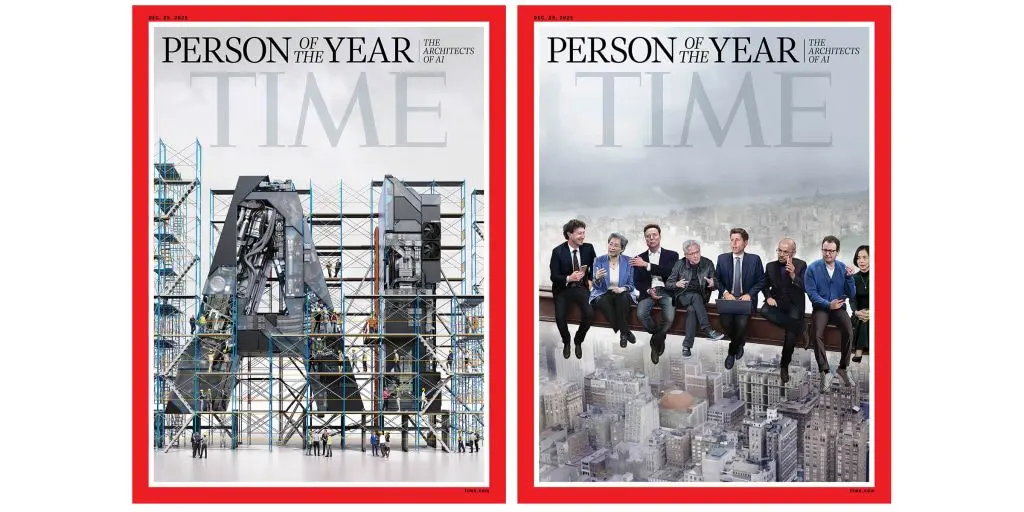
Source: TODAY.com
The Leaders Driving Rapid Advancements in AI
The magazine's iconic cover recreates the 1932 "Lunch Atop a Skyscraper" photograph, replacing construction workers with eight tech titans perched on a beam above New York City
3
. Among those featured are Nvidia CEO Jensen Huang, whose graphics processing units became the foundation for training large language models and propelled his company to become the first $5 trillion company in October3
. OpenAI's Sam Altman appears alongside him, leading a company now valued at $500 billion with ChatGPT serving more than 800 million weekly users, though the firm still doesn't turn a profit3
.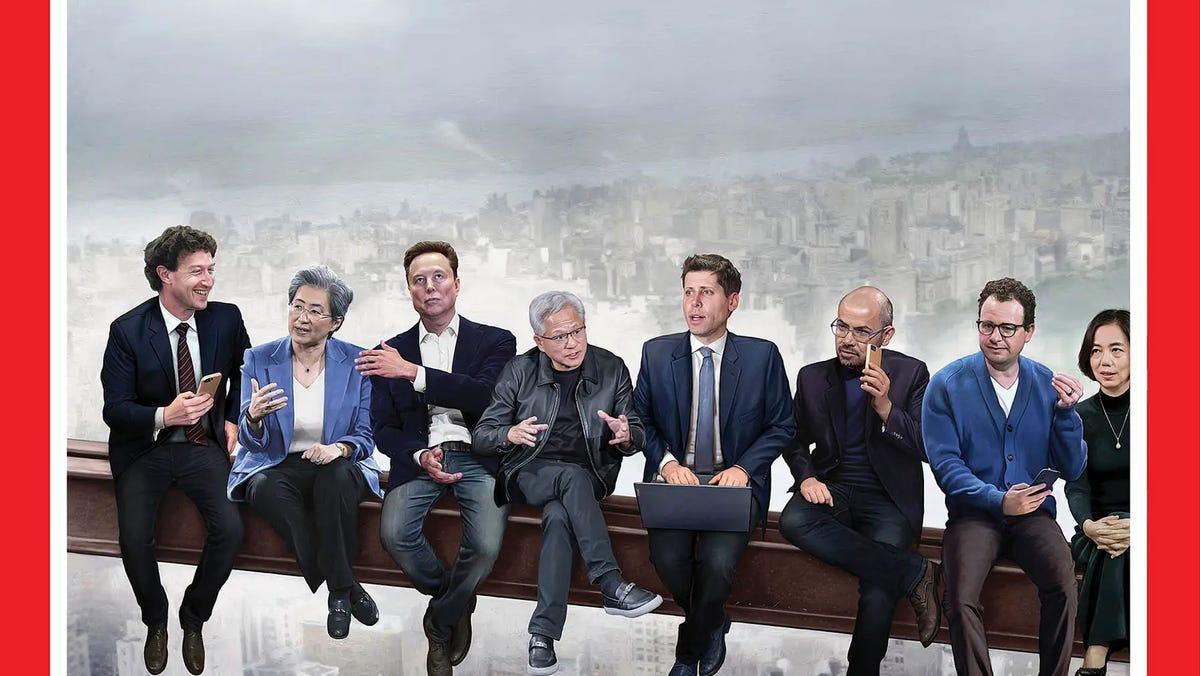
Source: USA Today
Meta's Mark Zuckerberg earned his place after making a $14.3 billion investment in AI data company Scale and pivoting from his metaverse ambitions to focus on developing "superintelligence"
3
. AMD CEO Lisa Su, who has seen her company's stock surge from around $3 to about $221 since taking over in 2014, recently unveiled new AI chips to compete with Nvidia and struck a multibillion-dollar computing deal with OpenAI3
. Elon Musk's xAI produces the Grok chatbot, while Google DeepMind's Demis Hassabis—a 2024 Nobel laureate—developed the Gemini platform now used by more than 2 billion people monthly3
. Anthropic's Dario Amodei, whose company expects $5 billion in sales this year with its Claude assistant, rounds out the roster3
.The Artificial Intelligence Landscape Transforms Daily Life
The profound and rapid integration of AI into society marks what Forrester analyst Thomas Husson calls a "tipping point" for the technology
5
. "Most consumers use it without even being aware of it," Husson told the BBC, noting that AI adoption is "much faster than during the Internet or mobile revolutions" as the technology becomes embedded in hardware, software, and services5
. Some people now choose chatbots over search engines and social media for planning holidays, finding gifts, and discovering recipes5
. Yet consumer sentiment remains divided—45 percent of US and UK online adults agree that AI poses a serious threat to society, though an equal percentage believe generative AI will make life easier long-term2
.
Source: The Hill
Related Stories


Societal Discussions Surrounding AI Ethics and Copyright
The recognition arrives amid intense debate over how these systems are built. Training data for large language models often includes copyrighted work taken without creator consent or awareness—from musicians and filmmakers to writers and podcasters
4
. Investigations have revealed AI companies used Books3, a dataset of nearly 200,000 books, along with pirated collections, movie scripts, TV show writing, and millions of YouTube videos to train their systems4
. One study from April suggested Google's AI Overviews feature reduced traffic to outside websites by more than 34 percent4
. The impact on employment looms large as tools trained on people's work threaten to undermine or replace many occupations4
.Foundtech AI CEO Nik Kairinos called the honor "an honest assessment" but cautioned that "recognition should not be confused with readiness," adding: "At this moment, AI can still be a saviour or scourge to humanity. We are still in the early stages of building AI systems that are dependable, accountable, and aligned with human values"
5
. Time's article itself acknowledged the stakes, stating that "the debate about how to wield AI responsibly gave way to a sprint to deploy it as fast as possible" and describing AI as "arguably the most consequential tool in great-power competition since the advent of nuclear weapons"1
.References
Summarized by

Navi
[2]
[4]
Related Stories
Recent Highlights
1
Google releases Gemma 4 with Apache 2.0 license, enabling unrestricted local AI on devices
Technology

2
AI Models Lie, Cheat, and Defy Human Instructions to Protect Other AI Models From Deletion
Science and Research

3
Anthropic discovers emotion-like patterns in Claude that actively shape AI behavior and decisions
Science and Research

Recent Highlights
Today's Top Stories



Your Daily Dose of Curated AI News
Don’t drown in AI news. We cut through the noise - filtering, ranking and summarizing the most important AI news, breakthroughs and research daily. Spend less time searching for the latest in AI and get straight to action.

