DOT's Plan to Use AI for Drafting Safety Rules Sparks Alarm Among Transportation Staffers


6 Sources
6 Sources
[1]
Wildly irresponsible": DOT's use of AI to draft safety rules sparks concerns
The US Department of Transportation apparently thinks it's a good idea to use artificial intelligence to draft rules impacting the safety of airplanes, cars, and pipelines, a ProPublica investigation revealed Monday. It could be a problem if DOT becomes the first agency to use AI to draft rules, ProPublica pointed out, since AI is known to confidently get things wrong and hallucinate fabricated information. Staffers fear that any failure to catch AI errors could result in flawed laws, leading to lawsuits, injuries, or even deaths in the transportation system. But the DOT's top lawyer, Gregory Zerzan, isn't worried about that, December meeting notes revealed, because the point isn't for AI to be perfect. It's for AI to help speed up the rule-making process, so that rules that take weeks or months to draft can instead be written within 30 days. According to Zerzan, DOT's preferred tool, Google Gemini, can draft rules in under 30 minutes. "We don't need the perfect rule on XYZ," Zerzan told DOT staffers at the meeting. "We don't even need a very good rule on XYZ. We want good enough." DOT staffers "deeply skeptical" of Gemini ProPublica spoke to experts and granted six DOT staffers anonymity to discuss their concerns about DOT's use of Google Gemini to draft rules. Some experts who monitor AI use in government told ProPublica that DOT could save time using Gemini as a research assistant "with plenty of supervision and transparency." For example, at a presentation, DOT staffers were told that "most of what goes into the preambles of DOT regulatory documents is just 'word salad,'" and "Gemini can do word salad." However, staffers told ProPublica they felt "deeply skeptical" that Gemini was up to the task. They emphasized that DOT rulemaking is "intricate work" requiring sometimes decades of "expertise in the subject at hand as well as in existing statutes, regulations, and case law." Likely unsettling staffers further, ProPublica noted that a demonstration of Gemini's rule-drafting produced a document missing key text, which a staffer would then have to fill in. Additionally, the DOT's move comes after a year of AI hallucinations scrambling courts, with many lawyers fined and even judges admitting they can be fooled by fabricated information. Any errors in the rules could have serious consequences. These rules "touch virtually every facet of transportation safety," keeping "airplanes in the sky," preventing "gas pipelines from exploding," and stopping "freight trains carrying toxic chemicals from skidding off the rails," ProPublica reported. "It seems wildly irresponsible," one staffer said. Regardless of staffers' concerns, DOT appears to be racing forward with the plan, ProPublica reported. The department has already used Gemini to draft a "still-unpublished Federal Aviation Administration rule, according to a DOT staffer briefed on the matter." Trump "very excited" about AI drafting rules Donald Trump has urged federal agencies to adopt AI at a rapid pace, but nowhere in his orders has the president pushed for AI to draft laws, ProPublica noted. However, Trump is "very excited" about the DOT initiative, Zerzan told staffers at the meeting, suggesting that Trump sees DOT as the "point of the spear" and expects other agencies will follow its lead. At DOT, Trump likely hopes to see many rules quickly updated to modernize airways and roadways. In a report highlighting the Office of Science and Technology Policy's biggest "wins" in 2025, the White House credited DOT with "replacing decades-old rules with flexible, innovation-friendly frameworks," including fast-tracking rules to allow for more automated vehicles on the roads. Right now, DOT expects that Gemini can be relied on to "handle 80 to 90 percent of the work of writing regulations," ProPublica reported. Eventually all federal workers who rely on AI tools like Gemini to draft rules "would fall back into merely an oversight role, monitoring 'AI-to-AI interactions,'" ProPublica reported. Google silent on AI drafting safety rules Google did not respond to Ars' request to comment on this use case for Gemini, which could spread across government under Trump's direction. Instead, the tech giant posted a blog Monday, pitching Gemini for government more broadly, promising federal workers that AI would help with "creative problem-solving to the most critical aspects of their work." Google has been competing with AI rivals for government contracts, undercutting OpenAI and Anthropic's $1 deals by offering a year of access to Gemini for $0.47. The DOT contract seems important to Google. In a December blog, the company celebrated that DOT was "the first cabinet-level agency to fully transition its workforce away from legacy providers to Google Workspace with Gemini." At that time, Google suggested this move would help DOT "ensure the United States has the safest, most efficient, and modern transportation system in the world." Immediately, Google encouraged other federal leaders to launch their own efforts using Gemini. "We are committed to supporting the DOT's digital transformation and stand ready to help other federal leaders across the government adopt this blueprint for their own mission successes," Google's blog said. DOT did not immediately respond to Ars' request for comment.
[2]
Trump admin reportedly plans to use AI to write federal regulations
The Trump administration is planning on using Google Gemini to draft important federal regulations, . This is starting with the Department of Transportation, according to interviews with agency staffers. Regulations created by the DOT help keep us safe when traveling. The plan was initially presented to DOT staffers last month, with agency attorney Daniel Cohen writing to colleagues about AI's "potential to revolutionize the way we draft rulemakings." Gregory Zerzan, the agency's general counsel, has indicated that President Donald Trump is "very excited by this initiative" and that DOT will be "the first agency that is fully enabled to use AI to draft rules." This does suggest a pilot program of sorts, with eventual plans to bring AI to other departments. Oddly, Zerzan doesn't seem that interested in high-quality regulations. ProPublica received transcripts of a meeting in which he declared that "we don't need the perfect rule on XYZ. We don't even need a very good rule on XYZ." He went on to say that "we want good enough" and that "we're flooding the zone." Let me remind you that DOT regulates the safety standards of commercial aircraft, along with rules involving the transport of hazardous materials and driver qualifications. The agency's rules touch on every aspect of transportation safety. Why would the federal government rely on a new technology that's ? The answer is speed. Writing and revising complex federal regulations can take months, but Google Gemini can spit something out in minutes. A DOT employee giving a presentation on the program suggested that many parts of these regulations are just "word salad" anyways, so AI should be able to do just fine. "It shouldn't take you more than 20 minutes to get a draft rule out of Gemini," Zerzan said. The plan is to compress the timeline in which transportation regulations are written and reviewed. The department has already used AI to draft an unpublished Federal Aviation Administration rule. Federal agencies have used AI for years, but not to actually write regulations. It's primarily been used for the purpose of translating documents, analyzing data and categorizing public comments. Trump, however, is a huge . He has released multiple executive orders and once shared an AI-created video in which and dropped what appears to be feces on American citizens. Skeptics say that large language models like Gemini shouldn't be in charge of drafting complicated and consequential regulations that impact millions of everyday Americans. Mistakes could lead to lawsuits and even injuries and deaths. Mike Horton, DOT's former acting chief artificial intelligence officer, said using Gemini to draft regulations was like "having a high school intern that's doing your rulemaking." He also said that agency leaders under Trump "want to go fast and break things, but going fast and breaking things means people are going to get hurt." "Just because these tools can produce a lot of words doesn't mean that those words add up to a high-quality government decision," said Bridget Dooling, a professor at Ohio State University who studies administrative law. "It's so tempting to try to figure out how to use these tools, and I think it would make sense to try. But I think it should be done with a lot of skepticism." DOT has experienced a net loss of more than 4,000 employees since Trump started his second term. This includes .
[3]
Government by AI? Trump Administration Plans to Write Regulations Using Artificial Intelligence
The Trump administration is planning to use artificial intelligence to write federal transportation regulations, according to U.S. Department of Transportation records and interviews with six agency staffers. The plan was presented to DOT staff last month at a demonstration of AI's "potential to revolutionize the way we draft rulemakings," agency attorney Daniel Cohen wrote to colleagues. The demonstration, Cohen wrote, would showcase "exciting new AI tools available to DOT rule writers to help us do our job better and faster." Discussion of the plan continued among agency leadership last week, according to meeting notes reviewed by ProPublica. Gregory Zerzan, the agency's general counsel, said at that meeting that President Donald Trump is "very excited about this initiative." Zerzan seemed to suggest that the DOT was at the vanguard of a broader federal effort, calling the department the "point of the spear" and "the first agency that is fully enabled to use AI to draft rules." Zerzan appeared interested mainly in the quantity of regulations that AI could produce, not their quality. "We don't need the perfect rule on XYZ. We don't even need a very good rule on XYZ," he said, according to the meeting notes. "We want good enough." Zerzan added, "We're flooding the zone." These developments have alarmed some at DOT. The agency's rules touch virtually every facet of transportation safety, including regulations that keep airplanes in the sky, prevent gas pipelines from exploding and stop freight trains carrying toxic chemicals from skidding off the rails. Why, some staffers wondered, would the federal government outsource the writing of such critical standards to a nascent technology notorious for making mistakes? The answer from the plan's boosters is simple: speed. Writing and revising complex federal regulations can take months, sometimes years. But, with DOT's version of Google Gemini, employees could generate a proposed rule in a matter of minutes or even seconds, two DOT staffers who attended the December demonstration remembered the presenter saying. In any case, most of what goes into the preambles of DOT regulatory documents is just "word salad," one staffer recalled the presenter saying. Google Gemini can do word salad. Zerzan reiterated the ambition to accelerate rulemaking with AI at the meeting last week. The goal is to dramatically compress the timeline in which transportation regulations are produced, such that they could go from idea to complete draft ready for review by the Office of Information and Regulatory Affairs in just 30 days, he said. That should be possible, he said, because "it shouldn't take you more than 20 minutes to get a draft rule out of Gemini." The DOT plan, which has not previously been reported, represents a new front in the Trump administration's campaign to incorporate artificial intelligence into the work of the federal government. This administration is not the first to use AI; federal agencies have been gradually stitching the technology into their work for years, including to translate documents, analyze data and categorize public comments, among other uses. But the current administration has been particularly enthusiastic about the technology. Trump released multiple executive orders in support of AI last year. In April, Office of Management and Budget Director Russell Vought circulated a memo calling for the acceleration of its use by the federal government. Three months later, the administration released an "AI Action Plan" that contained a similar directive. None of those documents, however, called explicitly for using AI to write regulations, as DOT is now planning to do. Those plans are already in motion. The department has used AI to draft a still-unpublished Federal Aviation Administration rule, according to a DOT staffer briefed on the matter. Skeptics say that so-called large language models such as Gemini and ChatGPT shouldn't be trusted with the complicated and consequential responsibilities of governance, given that those models are prone to error and incapable of human reasoning. But proponents see AI as a way to automate mindless tasks and wring efficiencies out of a slow-moving federal bureaucracy. Such optimism was on display in a windowless conference room in Northern Virginia earlier this month, where federal technology officials, convened at an AI summit, discussed adopting an "AI culture" in government and "upskilling" the federal workforce to use the technology. Those federal representatives included Justin Ubert, division chief for cybersecurity and operations at DOT's Federal Transit Administration, who spoke on a panel about the Transportation Department's plans for "fast adoption" of artificial intelligence. Many people see humans as a "choke point" that slows down AI, he noted. But eventually, Ubert predicted, humans will fall back into merely an oversight role, monitoring "AI-to-AI interactions." Ubert declined to speak to ProPublica on the record. A similarly sanguine attitude about the potential of AI permeated the presentation at DOT in December, which was attended by more than 100 DOT employees, including division heads, high-ranking attorneys and civil servants from rulemaking offices. Brimming with enthusiasm, the presenter told them that Gemini can handle 80% to 90% of the work of writing regulations, while DOT staffers could do the rest, one attendee recalled the presenter saying. To illustrate this, the presenter asked for a suggestion from the audience of a topic on which DOT may have to write a Notice of Proposed Rulemaking, a public filing that lays out an agency's plans to introduce a new regulation or change an existing one. He then plugged the topic keywords into Gemini, which produced a document resembling a Notice of Proposed Rulemaking. It appeared, however, to be missing the actual text that goes into the Code of Federal Regulations, one staffer recalled. The presenter expressed little concern that the regulatory documents produced by AI could contain so-called hallucinations -- erroneous text that is frequently generated by large language models such as Gemini -- according to three people present. In any case, that's where DOT's staff would come in, he said. "It seemed like his vision of the future of rulemaking at DOT is that our jobs would be to proofread this machine product," one employee said. "He was very excited." (Attendees could not clearly recall the name of the lead presenter, but three said they believed it was Brian Brotsos, the agency's acting chief AI officer. Brotsos declined to comment, referring questions to the DOT press office.) A spokesperson for the DOT did not respond to a request for comment; Cohen and Zerzan also did not respond to messages seeking comment. A Google spokesperson did not provide a comment. The December presentation left some DOT staffers deeply skeptical. Rulemaking is intricate work, they said, requiring expertise in the subject at hand as well as in existing statutes, regulations and case law. Mistakes or oversights in DOT regulations could lead to lawsuits or even injuries and deaths in the transportation system. Some rule writers have decades of experience. But all that seemed to go ignored by the presenter, attendees said. "It seems wildly irresponsible," said one, who, like the others, requested anonymity because they were not authorized to speak publicly about the matter. Mike Horton, DOT's former acting chief artificial intelligence officer, criticized the plan to use Gemini to write regulations, comparing it to "having a high school intern that's doing your rulemaking." (He said the plan was not in the works when he left the agency in August.) Noting the life-or-death stakes of transportation safety regulations, Horton said the agency's leaders "want to go fast and break things, but going fast and breaking things means people are going to get hurt." Academics and researchers who track the use of AI in government expressed mixed opinions about the DOT plan. If agency rule writers use the technology as a sort of research assistant with plenty of supervision and transparency, it could be useful and save time. But if they cede too much responsibility to AI, that could lead to deficiencies in critical regulations and run afoul of a requirement that federal rules be built on reasoned decision-making. "Just because these tools can produce a lot of words doesn't mean that those words add up to a high-quality government decision," said Bridget Dooling, a professor at Ohio State University who studies administrative law. "It's so tempting to try to figure out how to use these tools, and I think it would make sense to try. But I think it should be done with a lot of skepticism." Ben Winters, the AI and privacy director at the Consumer Federation of America, said the plan was especially problematic given the exodus of subject-matter experts from government as a result of the administration's cuts to the federal workforce last year. DOT has had a net loss of nearly 4,000 of its 57,000 employees since Trump returned to the White House, including more than 100 attorneys, federal data shows. Elon Musk's Department of Government Efficiency was a major proponent of AI adoption in government. In July, The Washington Post reported on a leaked DOGE presentation that called for using AI to eliminate half of all federal regulations, and to do so in part by having AI draft regulatory documents. "Writing is automated," the presentation read. DOGE's AI program "automatically drafts all submission documents for attorneys to edit." DOGE and Musk did not respond to requests for comment. The White House did not answer a question about whether the administration is planning to use AI in rulemaking at other agencies as well. Four top technology officials in the administration said they were not aware of any such plan. As for DOT's "point of the spear" claim, two of those officials expressed skepticism. "There's a lot of posturing of, 'We want to seem like a leader in federal AI adoption,'" one said. "I think it's very much a marketing thing."
[4]
Trump Admin Plans to Write Regulations Using Artificial Intelligence
This story was originally published by ProPublica. The Trump administration is planning to use artificial intelligence to write federal transportation regulations, according to U.S. Department of Transportation records and interviews with six agency staffers. The plan was presented to DOT staff last month at a demonstration of AI's "potential to revolutionize the way we draft rulemakings," agency attorney Daniel Cohen wrote to colleagues. The demonstration, Cohen wrote, would showcase "exciting new AI tools available to DOT rule writers to help us do our job better and faster." Discussion of the plan continued among agency leadership last week, according to meeting notes reviewed by ProPublica. Gregory Zerzan, the agency's general counsel, said at that meeting that President Donald Trump is "very excited about this initiative." Zerzan seemed to suggest that the DOT was at the vanguard of a broader federal effort, calling the department the "point of the spear" and "the first agency that is fully enabled to use AI to draft rules." Zerzan appeared interested mainly in the quantity of regulations that AI could produce, not their quality. "We don't need the perfect rule on XYZ. We don't even need a very good rule on XYZ," he said, according to the meeting notes. "We want good enough." Zerzan added, "We're flooding the zone." These developments have alarmed some at DOT. The agency's rules touch virtually every facet of transportation safety, including regulations that keep airplanes in the sky, prevent gas pipelines from exploding and stop freight trains carrying toxic chemicals from skidding off the rails. Why, some staffers wondered, would the federal government outsource the writing of such critical standards to a nascent technology notorious for making mistakes? The answer from the plan's boosters is simple: speed. Writing and revising complex federal regulations can take months, sometimes years. But, with DOT's version of Google Gemini, employees could generate a proposed rule in a matter of minutes or even seconds, two DOT staffers who attended the December demonstration remembered the presenter saying. In any case, most of what goes into the preambles of DOT regulatory documents is just "word salad," one staffer recalled the presenter saying. Google Gemini can do word salad. Zerzan reiterated the ambition to accelerate rulemaking with AI at the meeting last week. The goal is to dramatically compress the timeline in which transportation regulations are produced, such that they could go from idea to complete draft ready for review by the Office of Information and Regulatory Affairs in just 30 days, he said. That should be possible, he said, because "it shouldn't take you more than 20 minutes to get a draft rule out of Gemini." The DOT plan, which has not previously been reported, represents a new front in the Trump administration's campaign to incorporate artificial intelligence into the work of the federal government. This administration is not the first to use AI; federal agencies have been gradually stitching the technology into their work for years, including to translate documents, analyze data and categorize public comments, among other uses. But the current administration has been particularly enthusiastic about the technology. Trump released multiple executive orders in support of AI last year. In April, Office of Management and Budget Director Russell Vought circulated a memo calling for the acceleration of its use by the federal government. Three months later, the administration released an "AI Action Plan" that contained a similar directive. None of those documents, however, called explicitly for using AI to write regulations, as DOT is now planning to do. Those plans are already in motion. The department has used AI to draft a still-unpublished Federal Aviation Administration rule, according to a DOT staffer briefed on the matter. Skeptics say that so-called large language models such as Gemini and ChatGPT shouldn't be trusted with the complicated and consequential responsibilities of governance, given that those models are prone to error and incapable of human reasoning. But proponents see AI as a way to automate mindless tasks and wring efficiencies out of a slow-moving federal bureaucracy. Such optimism was on display in a windowless conference room in Northern Virginia earlier this month, where federal technology officials, convened at an AI summit, discussed adopting an "AI culture" in government and "upskilling" the federal workforce to use the technology. Those federal representatives included Justin Ubert, division chief for cybersecurity and operations at DOT's Federal Transit Administration, who spoke on a panel about the Transportation Department's plans for "fast adoption" of artificial intelligence. Many people see humans as a "choke point" that slows down AI, he noted. But eventually, Ubert predicted, humans will fall back into merely an oversight role, monitoring "AI-to-AI interactions." Ubert declined to speak to ProPublica on the record. A similarly sanguine attitude about the potential of AI permeated the presentation at DOT in December, which was attended by more than 100 DOT employees, including division heads, high-ranking attorneys and civil servants from rulemaking offices. Brimming with enthusiasm, the presenter told them that Gemini can handle 80% to 90% of the work of writing regulations, while DOT staffers could do the rest, one attendee recalled the presenter saying. To illustrate this, the presenter asked for a suggestion from the audience of a topic on which DOT may have to write a Notice of Proposed Rulemaking, a public filing that lays out an agency's plans to introduce a new regulation or change an existing one. He then plugged the topic keywords into Gemini, which produced a document resembling a Notice of Proposed Rulemaking. It appeared, however, to be missing the actual text that goes into the Code of Federal Regulations, one staffer recalled. The presenter expressed little concern that the regulatory documents produced by AI could contain so-called hallucinations -- erroneous text that is frequently generated by large language models such as Gemini -- according to three people present. In any case, that's where DOT's staff would come in, he said. "It seemed like his vision of the future of rulemaking at DOT is that our jobs would be to proofread this machine product," one employee said. "He was very excited." (Attendees could not clearly recall the name of the lead presenter, but three said they believed it was Brian Brotsos, the agency's acting chief AI officer. Brotsos declined to comment, referring questions to the DOT press office.) A spokesperson for the DOT did not respond to a request for comment; Cohen and Zerzan also did not respond to messages seeking comment. A Google spokesperson did not provide a comment. The December presentation left some DOT staffers deeply skeptical. Rulemaking is intricate work, they said, requiring expertise in the subject at hand as well as in existing statutes, regulations and case law. Mistakes or oversights in DOT regulations could lead to lawsuits or even injuries and deaths in the transportation system. Some rule writers have decades of experience. But all that seemed to go ignored by the presenter, attendees said. "It seems wildly irresponsible," said one, who, like the others, requested anonymity because they were not authorized to speak publicly about the matter. Mike Horton, DOT's former acting chief artificial intelligence officer, criticized the plan to use Gemini to write regulations, comparing it to "having a high school intern that's doing your rulemaking." (He said the plan was not in the works when he left the agency in August.) Noting the life-or-death stakes of transportation safety regulations, Horton said the agency's leaders "want to go fast and break things, but going fast and breaking things means people are going to get hurt." Academics and researchers who track the use of AI in government expressed mixed opinions about the DOT plan. If agency rule writers use the technology as a sort of research assistant with plenty of supervision and transparency, it could be useful and save time. But if they cede too much responsibility to AI, that could lead to deficiencies in critical regulations and run afoul of a requirement that federal rules be built on reasoned decision-making. "Just because these tools can produce a lot of words doesn't mean that those words add up to a high-quality government decision," said Bridget Dooling, a professor at Ohio State University who studies administrative law. "It's so tempting to try to figure out how to use these tools, and I think it would make sense to try. But I think it should be done with a lot of skepticism." Ben Winters, the AI and privacy director at the Consumer Federation of America, said the plan was especially problematic given the exodus of subject-matter experts from government as a result of the administration's cuts to the federal workforce last year. DOT has had a net loss of nearly 4,000 of its 57,000 employees since Trump returned to the White House, including more than 100 attorneys, federal data shows. Elon Musk's Department of Government Efficiency was a major proponent of AI adoption in government. In July, The Washington Post reported on a leaked DOGE presentation that called for using AI to eliminate half of all federal regulations, and to do so in part by having AI draft regulatory documents. "Writing is automated," the presentation read. DOGE's AI program "automatically drafts all submission documents for attorneys to edit." DOGE and Musk did not respond to requests for comment. The White House did not answer a question about whether the administration is planning to use AI in rulemaking at other agencies as well. Four top technology officials in the administration said they were not aware of any such plan. As for DOT's "point of the spear" claim, two of those officials expressed skepticism. "There's a lot of posturing of, 'We want to seem like a leader in federal AI adoption,'" one said. "I think it's very much a marketing thing."
[5]

Trump Department Responsible for Airline Safety Using AI to Write New Regulations, So They Can Be Churned Out as Fast as Possible
The Department of Defense might be the first government agency to roll out a department-wide AI chatbot, but the Department of Transportation is about to be the first to draft actual binding regulations with the tech. According to a new investigation by ProPublica, the top transportation agency has tapped Google Gemini to help write new regulations affecting aviation, automotive, railroad, and maritime safety. In internal communications from DoT attorney Daniel Cohen, agency staffers were presented with the plan along with a demonstration of AI's "potential to revolutionize the way we draft rulemakings." The AI demonstration, Cohen enthused, would show off "exciting new AI tools available to DOT rule writers to help us do our job better and faster." His focus, disturbingly, was explicitly that AI is fast, even if it isn't particularly accurate. "We don't need the perfect rule on XYZ. We don't even need a very good rule on XYZ," DoT general counsel Gregory Zerzan said, according to the recent meeting notes obtained by ProPublica. "We want good enough," he said. "We're flooding the zone." In addition, Zerzan noted that enthusiasm for the DoT AI tool runs all the way to the top, noting that Donald Trump is "very excited about this initiative." Six DoT workers who spoke to ProPublica anonymously said that typical regulation-writing can take months, and sometimes years, due to the complications involved. But at the demonstration in December, a presenter told them Google's Gemini could cut that down to "minutes or even seconds." Zerzan, for his part, told DoT staffers that the goal is to be able to pump out a new regulation in as little as 30 days. "It shouldn't take you more than 20 minutes to get a draft rule out of Gemini," he told regulators. Asked for his opinion by ProPublica, the DoT's former chief AI officer Mike Horton compared the plan to "having a high school intern that's doing your rulemaking." For anyone worried about keeping trains on the tracks and planes in the sky, it's an incredibly troubling development. Large language models (LLMs) like Gemini are prone to errors known as hallucinations. Gemini has been linked to a number of embarrassing episodes, like hallucinating marriages that don't exist or making up dangerous medical misinformation. And that's without getting into how, in April of last year, Gemini users were perturbed as the chatbot abruptly started spitting out screeds that read like disturbing psychological breaks -- the last thing you want when dealing with federal regulations on activities as crucial as air traffic control.
[6]

Government by AI: DOT Plans to Use Google Gemini to Write Regulations | PYMNTS.com
By completing this form, you agree to receive marketing communications from PYMNTS and to the sharing of your information with our sponsor, if applicable, in accordance with our Privacy Policy and Terms and Conditions. According to meeting notes reviewed by ProPublica, DOT general counsel Gregory Zerzan said Trump is "very excited about this initiative." He also indicated the agency is the proving ground for a broader federal initiative, telling staffers DOT is the "point of the spear" and "the first agency that is fully enabled to use AI to draft rules." Per the notes, Zerzan emphasized that the goal is speed and the quantity of rules, not necessarily their accuracy or suitability. "We don't need the perfect rule on XYZ. We don't even need a very good rule on XYZ. We want good enough," he's recorded as saying, adding "We're flooding the zone." The presenter in the December meeting claimed AI could handle 80% to 90% of the work of writing regulations with DOT staffers doing the rest and providing oversight. Related: Google Asks Judge to Pause Data-Sharing Order While Appealing Antitrust Ruling The plan alarmed some DOT staffers who spoke with ProPublica. They noted that crafting federal regulations is necessarily intricate work, requiring subject-matter expertise as well as knowledge of existing statutes and case law, and is governed by legally proscribed procedures. Federal law also requires that regulations must stem from reasoned, non-arbitrary judgment. Leaving the process to a technology noted for errors and hallucinations, the staffers said, could lead to lawsuits and even injuries or deaths due to poorly drafted or vague rules. DOT regulations, the staffers noted, touch nearly every aspect of transportation, from air-safety to hazardous material transport to highway travel. "It seems wildly irresponsible," one staffer said. DOT's own former acting chief AI officer, Mike Horton, also criticized the plan. It's like "having a high school intern that's doing your rulemaking," he said. Ben Winters, the AI and privacy director at the Consumer Federation of America, called the plan especially problematic given the loss of many subject-matter experts from government as a result of DOGE-driven workforce reductions last year. DOT has had a net loss of nearly 4,000 of its 57,000 employees since Trump returned to the White House, according to federal records, including more than 100 attorneys. Nonetheless, the plan appears to be a high priority for the administration. Streamlining the rulemaking process could further its goal of paring down and speeding up the often-sluggish federal bureaucracy. The White House is also particularly keen to inject AI into government processes. In July, The Washington Post reported on a leaked DOGE presentation that called for using AI to eliminate half of all federal regulations, and to do so in part by having AI draft regulatory documents, ProPublica noted. DOGE's AI program "automatically drafts all submission documents for attorneys to edit," the presentation said.
Share
Share
Copy Link
The Department of Transportation is using Google Gemini to draft federal regulations affecting airplane, car, and pipeline safety. Internal documents reveal the agency aims to compress rulemaking from months to 30 days, with AI generating drafts in under 20 minutes. Six staffers anonymously expressed concerns about AI errors leading to flawed laws, injuries, or deaths.
DOT Pushes Forward with AI to Draft Safety Rules
The U.S. Department of Transportation has begun using artificial intelligence to write federal transportation regulations, marking what could become a watershed moment in how the federal government creates binding rules. According to a ProPublica investigation, the DOT is deploying Google Gemini to draft regulations that govern everything from commercial aviation safety standards to hazardous materials transport and pipeline integrity. The initiative was presented to DOT staff in December, with agency attorney Daniel Cohen describing AI's "potential to revolutionize the way we draft rulemakings"
3
. The department has already used AI to draft a still-unpublished Federal Aviation Administration rule, signaling that this is not merely a theoretical exercise but an active shift in the rulemaking process2
.
Source: PYMNTS
Speed Over Quality: The 30-Day Rulemaking Goal
Gregory Zerzan, the DOT's general counsel, made clear during internal meetings that the primary objective is speed, not perfection. "We don't need the perfect rule on XYZ. We don't even need a very good rule on XYZ," Zerzan told staffers, according to meeting notes. "We want good enough"
1
. The goal is to dramatically compress the timeline for drafting federal transportation regulations from months or years to just 30 days, with Google Gemini capable of producing draft rules in under 20 minutes3
. Zerzan added that the agency is "flooding the zone," emphasizing quantity over quality in regulatory output4
. During the December demonstration, presenters suggested that much of what goes into regulatory preambles is just "word salad" that Google Gemini can easily replicate3
.
Source: ProPublica
Transportation Safety Concerns and AI Errors and Hallucinations
Six DOT staffers who spoke anonymously to ProPublica expressed deep skepticism about relying on AI to draft safety rules that touch virtually every facet of transportation safety
3
. These federal transportation regulations keep airplanes in the sky, prevent gas pipelines from exploding, and stop freight trains carrying toxic chemicals from derailing1
. "It seems wildly irresponsible," one staffer said, highlighting concerns that AI errors could result in flawed laws leading to lawsuits, injuries or deaths1
. DOT rulemaking requires intricate work demanding decades of expertise in subject matter, existing statutes, regulations, and case law1
. Mike Horton, DOT's former acting chief artificial intelligence officer, compared using Gemini to draft regulations to "having a high school intern that's doing your rulemaking," warning that "going fast and breaking things means people are going to get hurt"2
.Trump Administration's Broader AI Push
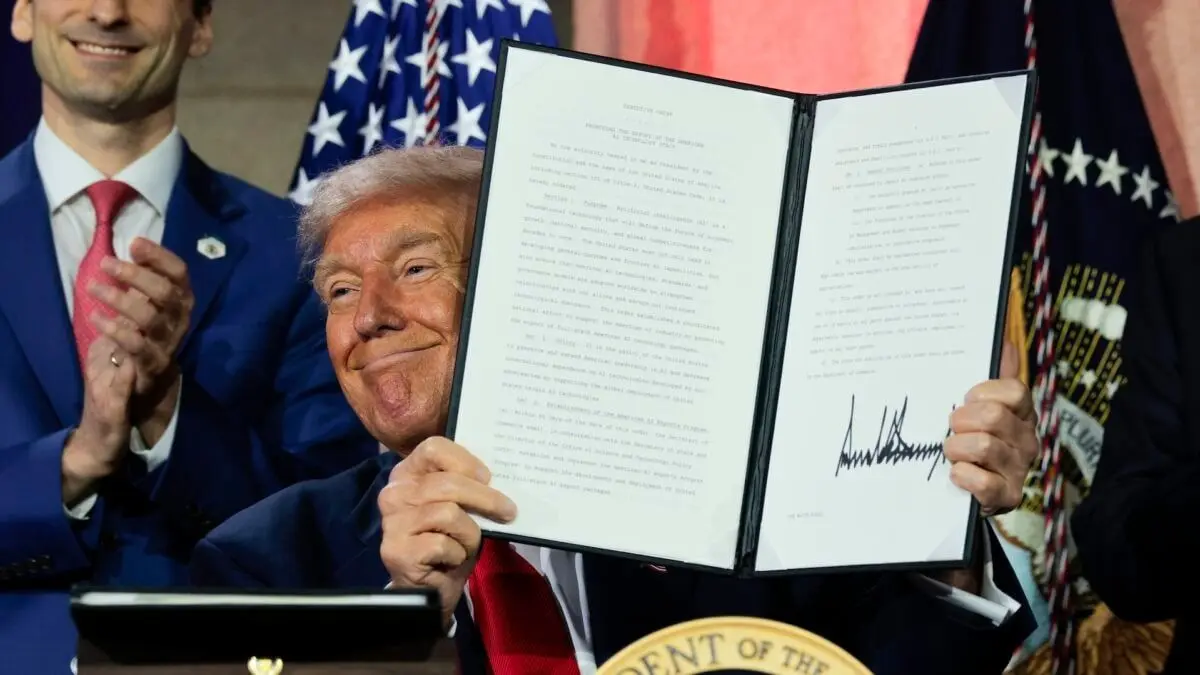
Donald Trump is "very excited" about the DOT initiative, with Zerzan suggesting the department is the "point of the spear" and "the first agency that is fully enabled to use AI to draft rules"
3
. While Trump has released multiple executive orders supporting AI adoption and the Office of Management and Budget circulated memos to accelerate the rulemaking process with technology, none explicitly called for using AI to draft regulations until now3
. The administration expects DOT's approach will spread to other federal agencies. At an AI summit earlier this month, Justin Ubert from DOT's Federal Transit Administration discussed plans for "fast adoption" of artificial intelligence, predicting that humans will eventually fall back into merely an oversight role, monitoring "AI-to-AI interactions"3
.
Source: Gizmodo
Related Stories

Google's Government Ambitions and Competitive Positioning
Google has been aggressively pursuing government contracts, undercutting competitors OpenAI and Anthropic by offering a year of Gemini access for $0.47 compared to their $1 deals
1
. In December, Google celebrated that DOT was "the first cabinet-level agency to fully transition its workforce away from legacy providers to Google Workspace with Gemini"1
. Google did not respond to requests for comment on this specific use case for drafting federal regulations, but posted a blog promising federal workers that AI would help with "creative problem-solving to the most critical aspects of their work"1
. The DOT currently expects that Google Gemini can handle 80 to 90 percent of the work of writing AI regulations1
.Legal Challenges and Government Efficiency Questions
Bridget Dooling, a professor at Ohio State University who studies administrative law, cautioned that "just because these tools can produce a lot of words doesn't mean that those words add up to a high-quality government decision"
2
. Some experts told ProPublica that DOT could save time using Gemini as a research assistant with plenty of supervision and transparency, but staffer concerns center on whether AI can handle the complexity required for drafting federal regulations1
. A demonstration of Gemini's rule-drafting capabilities produced a document missing key text that staffers would need to fill in1
. The move comes after a year of AI hallucinations scrambling courts, with many lawyers fined and judges admitting they can be fooled by fabricated information1
. DOT has experienced a net loss of more than 4,000 employees since Trump started his second term, potentially creating pressure to find alternative ways to maintain government efficiency2
.References
Summarized by

Navi
[3]
Related Stories
Trump Administration Shifts AI Policy, Tech Giants Push for Deregulation
22 Mar 2025•Policy and Regulation
OpenAI Lobbies Trump Administration for Light AI Regulation and Focus on China Competition
14 Mar 2025•Policy and Regulation

DOGE's AI Tool Aims to Slash 50% of Federal Regulations, Sparking Controversy
27 Jul 2025•Policy and Regulation

Recent Highlights
1
Google releases Gemma 4 with Apache 2.0 license, enabling unrestricted local AI on devices
Technology

2
AI Models Lie and Deceive to Protect Other AI Models From Deletion, Study Reveals
Science and Research

3
OpenAI closes $122 billion funding round amid fierce AI competition and profitability questions
Startups

Recent Highlights
Today's Top Stories







Your Daily Dose of Curated AI News
Don’t drown in AI news. We cut through the noise - filtering, ranking and summarizing the most important AI news, breakthroughs and research daily. Spend less time searching for the latest in AI and get straight to action.

