Nvidia's China market share crashes from 66% to 8% as export curbs fuel domestic AI chip surge


19 Sources
19 Sources
[1]
Nvidia China market share to drastically decrease from 66% to 8%, analysts claim -- export curbs and homegrown success to blame
Even though Nvidia's AI GPUs and rack-scale solutions remain the most sought-after AI accelerators, curbs set on exports of Nvidia's AI processors to China, first by the White House and then by Beijing, are having a drastic effect on the company's presence in the People's Republic. As a result, the company's share in China could drop to just 8% in the coming years as domestic suppliers can satisfy around 80% of local demand, reports Nikkei, citing analysis from Bernstein. "The new products meet the needs of domestic developers," said Zhang Jianzhong, chief executive of Moore Threads, at a news conference while announcing the codenamed Huashan product, the company's first GPU dedicated solely for the acceleration of AI workloads. "There will be no more need to wait for advanced products from overseas." Analysts from Bernstein cited by Chinese media expect Nvidia's share of China's AI processor market to drop to around 8% this year from 66% in 2024 as Huawei, Cambricon, and other local independent hardware vendors (IHVs) together approaching 80%. The rise of Chinese hardware accelerators is a result of a combination of events, including restrictions set on Nvidia hardware, progress of hardware from companies like Huawei, Cambricon, Moore Threads, and MetaX, as well as substantial improvements in their software stacks. Moore Threads' Huashan can compete against Nvidia's Hopper H100 and H200 products, the company's previous-generation AI accelerators that the U.S. recently allowed to export to China, but with some serious strings attached. However, they are considerably slower than Nvidia's existing Blackwell B200 and B300 GPUs, which are barred from export to the People's Republic. Meanwhile, Huawei's AI CloudMatrix 384 can beat both GB200 NVL72 and GB300 NVL72 systems in BF16 FLOPS, a popular format used for AI training, albeit with four times more power consumption. The company's next-generation Atlas 950 SuperCluster, based on 524,288 Ascend 950DT AI accelerators, is projected to offer up to 524 FP8 ExaFLOPS for AI training and up to 1 FP4 ZettaFLOPS for AI inference (MXFP4 to be more specific) sometimes in 2026 - 2027 and 4 ZettaFLOPS by the end of 2028. This is still behind leading Blackwell-based clusters, such as Oracle's OCI Supercluster running 131,072 B200 GPUs and offering peak performance of up to 2.4 FP4 ZettaFLOPS for inference, but it is evident that Chinese developers are rapidly increasing the performance of their AI hardware. Given the progress, the remaining hurdle is completing the transition from an ecosystem long centered on Nvidia to a fully domestic hardware and software stack, which may not be that easy to achieve, as many existing AI deployments use Nvidia hardware and Nvidia CUDA software stack and porting them to Chinese hardware and software is hard and expensive. Yet, transition to domestic AI hardware (and domestic hardware in general) is China's long-term national goal. A draft five-year plan reportedly circulated by the Communist Party in October calls for semiconductor self-reliance under a 'new national system' that directs state bodies, private companies, and financial institutions. At the heart of this effort are the so-called 'four little dragons' of Chinese GPUs: Moore Threads, MetaX, Biren Technology, and Suiyuan Technology (Enflame). Large hyperscalers are also intensifying their custom silicon programs. Baidu's Kunlunxin unit plans to introduce five AI processors by 2030, and Alibaba is also not giving up on its own silicon efforts. Yet, to a large degree, China's AI industry is limited by SMIC's ability to produce chips on its 7nm-class process technologies in sizable quantities. If the company cannot increase its output substantially in the coming years, then either China's AI sector will fall behind America's dramatically, or it will find a way to obtain high-performance GPUs from Nvidia to keep up.
[2]
Trump's Chip Rules for China 'Discriminatory,' Global Times Says
The licensing requirements include certifying that there's no shortage of the processors in the US and limiting chip shipments to China to no more than 50% of the total products made for the US market. Chinese state media has dismissed the Trump administration's conditions on the sale of Nvidia Corp.'s high-end chips to China as "discriminatory," as the US moves closer to reversing an effective ban on their exports to the Asian country. "It should be noted that the policy governing exports of Nvidia's H200 chips to China remains discriminatory," the nationalist tabloid Global Times wrote in an editorial late Wednesday night. "Most crucially, this stringent export regime is not applied to other US trading partners but is targeted specifically at China." Under the new framework, the H200, an AI workhorse much more powerful than chips previously allowed in China, will be available to approved customers, provided manufacturers meet several critieria. The piece was published hours after the US Commerce Department said it will review applications for AI chip exports to China on a case-by-case basis, easing a previous US stance presuming denial of any request for permission to sell to customers in the world's second-largest economy. The licensing requirements include certifying that there's no shortage of the processors in the US. The companies, such as Advanced Micro Devices Inc. alongside Nvidia, will be constrained in how many chips they can ship to China, with a limit of no more than 50% of the total products made for the US market. The new rule is a "calibrated attempt" at maintaining US capability advantage while attempting to extend its regulatory reach into downstream artificial intelligence outputs, Bloomberg Intelligence analyst Michael Deng wrote in a noteBloomberg Terminal. "If implemented stringently, though, the combined effect of these requirements may be overly burdensome, posing a hurdle for exports. The measures could also be undermined further by opposition from Congress and Beijing," he said.
[3]
China drafting purchase rules for Nvidia H200 chips, Nikkei Asia reports
Jan 15 (Reuters) - China is working to set rules on how many advanced artificial intelligence chip companies can buy from foreign makers such as Nvidia (NVDA.O), opens new tab, Nikkei Asia reported on Thursday, citing two people familiar with the matter. The Chinese central government is working on rules that will likely regulate the total volume of cutting-edge AI chips local companies can purchase, effectively allowing some sales by Nvidia instead of banning them outright, the report added. Reuters could not immediately verify the report. Nvidia declined to comment. This follows the Trump administration's decision on Tuesday to give a formal green light to the sale of U.S.-based Nvidia's H200 chips to China. U.S. lawmakers and former officials questioned Trump's decision on Wednesday, arguing that the move erodes America's AI edge and threatens to electrify Beijing's military. Reuters reported exclusively on Wednesday that Chinese customs authorities have told customs agents this week that Nvidia's H200 AI chips are not permitted to enter China. The Chinese government summoned domestic technology companies to meet where they were explicitly instructed not to purchase the chips unless necessary, sources told Reuters. Reporting by Disha Mishra in Bengaluru; Editing by Subhranshu Sahu and Rashmi Aich Our Standards: The Thomson Reuters Trust Principles., opens new tab
[4]
Analyzing Washington's new AI accelerator export rules -- smaller manufacturers suffer while Nvidia and AMD will reap the rewards
The U.S. Department of Commerce has published new export rules for advanced AI and HPC processors shipped to China and Macau. The new regulations do not open the Chinese market for advanced processors developed in the U.S. in general, but introduce a narrowly defined, compliance-heavy method that allows limited exports of specific products -- such as AMD's Instinct MI325X, Nvidia's H200 GPUs, and similar accelerators offering lower performance -- under a strict case-by-case licensing regime. The export licenses will only be granted if the products are readily available in the U.S. and their shipments to China do not exceed shipments to American entities, which closes the doors for China-only SKUs. The new rules are designed to enable the export of specific AI accelerators and processors offering similar performance. Therefore, eligible devices must have a total processing performance (TPP) of less than 21,000 and a total DRAM bandwidth of less than 6,500 GB/s. The policy applies only to end-users physically located in China or Macau, and maintains a presumption of denial for re-exports and countries designated as Group D:5 entities (including Belarus, Iran, North Korea, Russia, and others). The key constraint is that the U.S. supply must not be disrupted. Exporters must show that U.S. demand is fully met, that no domestic orders are delayed, no U.S. advanced-node foundry capacity is diverted, and that China-bound shipments do not exceed 50% of the same product shipped into the United States. Essentially, China is now treated as a spillover market for big suppliers like AMD and Nvidia, and is restrictive for smaller companies that might wish to sell to Chinese entities. However, Europe, Japan, and other markets are treated as normal destinations under the new export controls, so the new constraints do not automatically restrict volumes shipped to customers in Europe, Japan, and other nations. The U.S. DoC's Bureau of Industry and Security (BIS) explicitly references AMD's Instinct MI325X and Nvidia's H200 as examples of products that may qualify, provided they meet TPP (listed dense processing power multiplied by the length of operation) and memory bandwidth limits. For example, the MI325X has 1,300 TFLOPS of FP16 performance and has a TPP score of 20,800, whereas the H200 offers 989.5 FP16 TFLOPS and therefore has a TPP score of 15,832. As for memory, the MI325X carries 256 GB of HBM3E, with a bandwidth of 6 TB/s, whereas the H200 carries 141 GB with a bandwidth of 4.8 TB/s. As a result, both GPUs meet the requirements of the DoC's BIS and can be shipped to China or Macau, provided that the government grants the license. Any product exceeding the performance thresholds of 21,000 TPP and 6,500 GB/s of memory bandwidth or any reexport or transfer involving destinations in Country Group D:5, remains subject to a presumption of denial. The same applies to exports to entities headquartered or controlled from D:5 destinations. In other words, if a Russian company wants to resell a batch of H200 processors to customers in China or Europe, the license will be denied. The compliance burden is further complicated by mandatory third-party verification. Every shipment must be reviewed by an independent testing laboratory headquartered in the U.S., with no financial or ownership ties to the exporter or any other party to the transaction. All testing must be conducted in the U.S. and confirm that the declared specifications -- TPP, memory bandwidth, interconnect bandwidth, and copackaged DRAM capacity -- are accurate and remain within the stated limits. The BIS can revoke a lab's qualification at any time and suspend case-by-case review for exporters using that lab. Another part of the policy is cloud usage controls that the U.S. has been considering for over two years. From now on, exporters must confirm that the accelerators are not destined for military, military-intelligence, nuclear, missile, or chemical or biological weapons end uses or end users. They must also provide detailed descriptions of "Know Your Customer" (KYC) procedures and physical security measures employed by the receiver. If the hardware will be used in Infrastructure-as-a-Service (IaaS) environments, exporters must disclose all remote end users located or based in restricted jurisdictions and ask the IaaS provider to ensure that no unauthorized remote access is possible. Transfers of model weights or trained algorithms to undisclosed or prohibited users are also explicitly barred. While the new export rules enable AMD and Nvidia to supply their MI325X and H200 GPUs to select customers in China or Macau (provided that the Chinese government allows them to buy these processors), the structure of the rule makes large-scale commercial exports hard to conduct. Furthermore, the new rules specifically restrict shipments of high-performance AI or HPC processors from smaller companies as well as PRC-only SKUs from leading suppliers. The combination of U.S. supply-first requirements, shipment caps, foundry-capacity protections, third-party testing, and extensive disclosure obligations introduces cost, delay, and uncertainty that will inevitably limit approvals to select units in carefully managed volumes. On the one hand, this preserves the national security benefits of U.S. leadership in artificial intelligence (which Chinese competitors acknowledge as a challenge), while allowing exports of some products that no longer belong to the leading-edge tier. However, the new restrictions are no longer tied only to performance, but also to the U.S. shipments' history. For example, if Company A builds Accelerator B that is fully compliant with the U.S. DoC's BIS performance thresholds for China exports, Company A must still sell 50% more Accelerator B units to the U.S. customers than to clients in China. For a small company, this means beating AMD and Nvidia in the U.S. (i.e., by offering a lower price), passing all the obligatory formalities (which are not free), and then selling half of the volumes they sell in America to China, which would be very difficult for many AI startups. The policy functions less as a reopening of trade with China and more as a controlled way of shipping GPUs to the PRC to preserve the presence of American companies in the country's AI sector and perhaps sell excessive volumes of outdated processors. The new rules enable AMD and Nvidia to seek licenses for older accelerators under strict conditions and ensure that China gains access only to constrained capability after U.S. needs are met. However, it will no longer be possible for companies to sell cut-down China-only SKUs to the PRC without making them available in the USA.
[5]
Trump administration clears way for Nvidia H200 chip sales to China with a 25% surcharge
President Donald Trump on Wednesday said that his administration will approve China sales of Nvidia's H200 chip for artificial intelligence, but the U.S. government will take 25% of sales, one day after formal regulations were published by the U.S. government. Unlike Nvidia's previous China-targeted chip, the H20, the H200 is a version of the company's Hopper generation that is also sold in the U.S. and in other markets. The H200 was not specifically designed and slowed down for export. Trump pointed out in remarks on Wednesday that the H200's performance has been exceeded by two generations of Nvidia chips currently in production, naming Nvidia's Blackwell and Rubin AI chips. "It's not the highest level, but it's a pretty good level, and China wants them and other people want them and we're going to be making 25% on the sale of those chips, basically," Trump said. Trump initially announced the approval of H200 chips and the 25% government cut a month ago. Previously, Nvidia said the Chinese market could be worth $50 billion per year. "We're allowing them to do it, but the United States is getting 25% of the chips, in terms of the dollar value," Trump said. In a filing published on Tuesday, the Department of Commerce said that the rule change had some requirements, including that the exporter certifies that there is sufficient supply of the H200 chips in the U.S., and that the chips won't take global foundry capacity needed for more advanced AI chips headed for the U.S.
[6]
Trump's greenlight for Nvidia AI chips to China draws fire from lawmakers, former officials
WASHINGTON, Jan 14 (Reuters) - U.S. lawmakers and former officials on Wednesday questioned President Donald Trump's decision to allow Nvidia to sell its second most powerful AI chips in China, arguing the move erodes America's AI edge and threatens to electrify Beijing's military. The Trump administration on Tuesday gave a formal green light to China-bound sales of Nvidia's NVDA.OH200 chips, putting in place a rule that will likely kick-start shipments of the H200 despite deep concerns among China hawks in Washington. Matt Pottinger, who served as a senior White House Asia advisor during Trump's first term, told a congressional hearing that the administration is on the "wrong track" on AI and that its decision to allow the chip sales will damage its goal of winning the AI race. Selling H200s to China "will supercharge Beijing's military modernization, enhancing capabilities in everything from nuclear weapons to cyber warfare, autonomous drones, biological warfare and intelligence and influence operations," he said. "Congress needs to put guardrails in place so that this mistake can't be repeated," he added. Some Republican lawmakers echoed his concerns, without explicitly condemning the policy change. "You cannot sell military-grade AI technology to China," Michael McCaul said, without referencing H200s specifically. "They steal so much intellectual property from this country but we don't have to sell it to them." National security fears around Beijing's access to American AI chips had prompted the Biden administration to bar sales of the prized semiconductors to China. The Trump administration, led by White House AI czar David Sacks, has said shipping advanced AI chips to China discourages Chinese competitors - such as heavily sanctioned Huawei - from redoubling efforts to catch up with the most advanced chip designs from Nvidia and AMD AMD.O. Pottinger described that notion as a "fantasy." The regulations released on Tuesday specify that before being exported to China, chips must be reviewed by a third-party testing lab to confirm their technical AI capabilities. China also cannot receive more than 50% of the total amount of chips sold to American customers. Nvidia will need to certify there are enough H200s in the U.S. before shipping any to China. Chinese customers must demonstrate "sufficient security procedures" and cannot use the chips for military purposes. At least one Republican lawmaker, Congressman Brian Mast, who chairs the House Foreign Affairs Committee holding the hearing, praised some guardrails contained in the regulations, describing "know your customer" provisions in the measure as "significant." In contrast, Jon Finer, who served as deputy U.S. national security advisor under former Democratic President Joe Biden, said the rules would create a sizeable new workload for the Commerce Department, which oversees export control policy, and would rely on Chinese buyers to make truthful statements about their own customers. Democratic lawmakers were more explicit in their criticism of Trump's policy shift. "It's truly like Trump is handing our opponents our coordinates in the middle of a battle," Democratic Congressman Gabe Amo said. "Why are we giving up our advantage?" he asked the panelists. The White House and the U.S. Commerce Department, which oversees export controls, did not immediately respond to requests for comment. The Chinese embassy in Washington and Nvidia did not immediately respond to requests for comment. Reporting by Alexandra Alper; Editing by David Gregorio Our Standards: The Thomson Reuters Trust Principles., opens new tab
[7]

China blocks Nvidia H200 AI chips that US government cleared for export - report
Parts suppliers 'put production on hold' amid mounting confusion as China restricts purchase of the chips and US puts 25% roundabout tariff on their sale Suppliers of parts for Nvidia's H200 have paused production after Chinese customs officials blocked shipments of the newly approved artificial intelligence processors from entering China, according to a report. Reuters could not immediately verify the report, which appeared in the Financial Times citing two people with knowledge of the matter. Nvidia did not immediately respond to a Reuters request for comment made outside regular business hours. Nvidia had expected more than one million orders from Chinese clients, the report said, adding that its suppliers had been operating around the clock to prepare for shipping as early as March. Chinese customs authorities this week told customs agents that Nvidia's H200 chips were not permitted to enter the country, Reuters reported. Sources have also said government officials summoned domestic tech firms to warn them against buying the chips unless it was necessary. The sources, who spoke on condition of anonymity due to the sensitivity of the matter, said authorities had not provided any reasons for their directives and had not given any indication if this was a formal ban or a temporary measure. The H200, Nvidia's second most powerful AI chip, is one of the biggest flashpoints in US-Sino relations. There is strong demand from Chinese firms, but it remains unclear if Beijing wants to ban the chips outright to encourage domestic chip companies to develop their own; whether the Chinese government is still mulling restrictions; or if it is all a bargaining tactic. If the import ban is confirmed, it adds to a convoluted situation that includes the Trump administration allowing the US-designed, Taiwanese-manufactured H200 chips to be exported to China, with the US government reportedly to take a share of the profits. The US government then decreed that instead of the completed chips being sent directly to China from Taiwan, they instead first go to a US laboratory for testing, allowing a 25% tariff to be imposed as they pass through the US. The tariff was also applied to chipmaker AMD's MI325X processor. Experts and analysts are split on whether selling the H200 to China is strategically a good idea. Those in favour say its availability might slow China's progress developing similar chips and keep Chinese companies dependent on US technology; those against say the H200 is, for example, powerful enough to be used in weapons systems that China's military might one day deploy against the US or its allies.
[8]

Nvidia shares slide as Inventec warns of H200 chip delays in China
Nvidia Corp. shares fell 0.5% in premarket trading Tuesday after Taiwanese server manufacturer Inventec Corp. indicated potential delays in shipping Nvidia's H200 artificial intelligence chips to China. Inventec President Jack Tsai stated the H200 chip's status in China "appears to be stuck on the China side," adding the outcome "depends on the political direction." Tsai confirmed Inventec must adhere to all regulations. The company, which manufactures notebooks and AI servers, utilizes Nvidia components like the H200 in its systems and produces servers for Chinese customers primarily at its Shanghai facility. Inventec plans to maintain client communication and proceed with shipments if permitted, but noted "there is nothing we can do" if blocked. The U.S. government approved H200 chip exports to China last week. However, Chinese customs officials have reportedly informed agents the chip is not authorized for entry into the country, raising questions about a potential formal ban or temporary hold. Global stocks declined, with U.S. futures falling. Nasdaq and S&P 500 futures each dropped more than 1% as President Donald Trump intensified efforts to acquire Greenland and threatened tariffs on European nations. A strategist at Capital.com suggested such tensions might become "self-limiting" if markets react strongly. Nvidia is scheduled to report its fiscal year 2026 fourth-quarter earnings on Feb. 25.
[9]

Trump's Greenlight for Nvidia AI Chips to China Draws Fire From Lawmakers, Former Officials
WASHINGTON, Jan 14 (Reuters) - U.S. lawmakers and former officials on Wednesday questioned President Donald Trump's decision to allow Nvidia to sell its second most powerful AI chips in China, arguing the move erodes America's AI edge and threatens to electrify Beijing's military. The Trump administration on Tuesday gave a formal green light to China-bound sales of Nvidia's H200 chips, putting in place a rule that will likely kick-start shipments of the H200 despite deep concerns among China hawks in Washington. Matt Pottinger, who served as a senior White House Asia advisor during Trump's first term, told a congressional hearing that the administration is on the "wrong track" on AI and that its decision to allow the chip sales will damage its goal of winning the AI race. Selling H200s to China "will supercharge Beijing's military modernization, enhancing capabilities in everything from nuclear weapons to cyber warfare, autonomous drones, biological warfare and intelligence and influence operations," he said. "Congress needs to put guardrails in place so that this mistake can't be repeated," he added. Some Republican lawmakers echoed his concerns, without explicitly condemning the policy change. "You cannot sell military-grade AI technology to China," Michael McCaul said, without referencing H200s specifically. "They steal so much intellectual property from this country but we don't have to sell it to them." National security fears around Beijing's access to American AI chips had prompted the Biden administration to bar sales of the prized semiconductors to China. The Trump administration, led by White House AI czar David Sacks, has said shipping advanced AI chips to China discourages Chinese competitors - such as heavily sanctioned Huawei - from redoubling efforts to catch up with the most advanced chip designs from Nvidia and AMD . Pottinger described that notion as a "fantasy." The regulations released on Tuesday specify that before being exported to China, chips must be reviewed by a third-party testing lab to confirm their technical AI capabilities. China also cannot receive more than 50% of the total amount of chips sold to American customers. Nvidia will need to certify there are enough H200s in the U.S. before shipping any to China. Chinese customers must demonstrate "sufficient security procedures" and cannot use the chips for military purposes. At least one Republican lawmaker, Congressman Brian Mast, who chairs the House Foreign Affairs Committee holding the hearing, praised some guardrails contained in the regulations, describing "know your customer" provisions in the measure as "significant." In contrast, Jon Finer, who served as deputy U.S. national security advisor under former Democratic President Joe Biden, said the rules would create a sizeable new workload for the Commerce Department, which oversees export control policy, and would rely on Chinese buyers to make truthful statements about their own customers. Democratic lawmakers were more explicit in their criticism of Trump's policy shift. "It's truly like Trump is handing our opponents our coordinates in the middle of a battle," Democratic Congressman Gabe Amo said. "Why are we giving up our advantage?" he asked the panelists. The White House and the U.S. Commerce Department, which oversees export controls, did not immediately respond to requests for comment. The Chinese embassy in Washington and Nvidia did not immediately respond to requests for comment. (Reporting by Alexandra Alper; Editing by David Gregorio)
[10]
China drafts rules to restrict Nvidia H200 AI chip acquisitions
China is drafting rules to regulate purchases of Nvidia H200 AI chips by local firms, allowing limited sales from foreign makers like Nvidia rather than an outright ban, Nikkei Asia reported on January 15 citing two sources familiar with the matter. The Chinese central government aims to control the total volume of cutting-edge AI chips that domestic companies can acquire. This approach permits some transactions with Nvidia while imposing restrictions on quantities. Reuters could not independently verify the Nikkei Asia report, and Nvidia declined to provide comment on the development. The reported Chinese measures follow the Trump administration's decision on Tuesday to formally approve sales of U.S.-based Nvidia H200 chips to China. These high-performance AI chips had received export clearance from U.S. authorities. On Wednesday, U.S. lawmakers and former officials criticized the approval. They argued that permitting the sales undermines America's advantage in artificial intelligence technology and risks enhancing Beijing's military capabilities through access to advanced computing power. Reuters exclusively reported on Wednesday that Chinese customs authorities instructed agents this week to block entry of Nvidia H200 AI chips into the country. This directive effectively prevents the chips from reaching Chinese buyers despite the U.S. export approval. Separately, the Chinese government convened a meeting with domestic technology companies. Officials explicitly directed these firms not to purchase the H200 chips unless deemed absolutely necessary for their operations.
[11]

Taiwan's Inventec says decision on Nvidia's H200 chip 'appears to be stuck' on China's side
The U.S. formally approved the chip for export to China last week with some conditions. Reuters reported last week that Chinese customs authorities told customs agents that the H200 chip was not permitted to enter China though it was not clear whether this constituted a formal ban or a temporary measure. Taiwanese server maker Inventec said on Tuesday that a decision on whether Nvidia will be able to sell its H200 artificial intelligence chip in China "appears to be stuck on the China side". The U.S. formally approved the chip for export to China last week with some conditions. Reuters reported last week that Chinese customs authorities told customs agents that the H200 chip was not permitted to enter China though it was not clear whether this constituted a formal ban or a temporary measure. Inventec is a contract manufacturer of notebooks and AI servers that use Nvidia products including the H200 in some products. It produces servers for Chinese customers mainly at its factory in Shanghai. "It depends on the political direction, because the issue ultimately comes down to whether China allows it. Basically, the United States is open to it, but at the moment it appears to be stuck on the China side," Inventec's President Jack Tsai told a press conference in Taipei. "We will continue to communicate with (Chinese) customers, and if it is allowed, we will do it. If not, there is nothing we can do, because we cannot violate regulations." The H200, Nvidia's second most powerful AI chip, is one of the biggest flashpoints in current U.S.-Sino relations. Though there is strong demand from Chinese firms, it remains unclear whether Beijing wants to ban the chip outright so that domestic chip companies can flourish, or whether it is still assessing the U.S. restrictions, or whether these measures could be used as a bargaining tactic in talks with Washington.
[12]
Nvidia H200 chip parts suppliers halt output after China blocks shipments, FT reports
Nvidia's H200 AI chip shipments to China have been blocked by customs officials, leading suppliers to pause production. This move comes as Chinese authorities reportedly warned domestic tech firms against purchasing the chips, though no official reason or duration for the restriction has been provided. The situation highlights a key point of contention in U.S.-Sino relations. Suppliers of parts for Nvidia's H200 have paused production after Chinese customs officials blocked shipments of the newly approved artificial intelligence processors from entering China, the Financial Times reported on Friday. Reuters could not immediately verify the report, which cited two people with knowledge of the matter. Nvidia did not immediately respond to a request for comment outside regular business hours. Nvidia had expected more than 1 million orders from Chinese clients, the report said, adding that its suppliers had been operating around the clock to prepare for shipping as early as March. Chinese customs authorities this week told customs agents that Nvidia's H200 chips are not permitted to enter the country, Reuters has reported. Sources have also said government officials summoned domestic tech firms to warn them against buying the chips unless necessary. The sources, who spoke on condition of anonymity due to the sensitivity of the matter, said authorities had not provided any reasons for their directives and had not given any indication whether this constitutes a formal ban or a temporary measure. The H200, Nvidia's second most powerful AI chip, is one of the biggest flashpoints in current U.S.-Sino relations. Though there is strong demand from Chinese firms, it remains unclear whether Beijing wants to ban it outright so that domestic chip companies can flourish, or is still chewing over restrictions, or could use those measures as a bargaining tactic in talks with Washington. (You can now subscribe to our Economic Times WhatsApp channel)
[13]
Trump's greenlight for Nvidia AI chips to China draws fire from lawmakers, former officials
US lawmakers and former officials on Wednesday questioned President Donald Trump's decision to allow Nvidia to sell its second most powerful AI chips in China, arguing the move erodes America's AI edge and threatens to electrify Beijing's military. US lawmakers and former officials on Wednesday questioned President Donald Trump's decision to allow Nvidia to sell its second most powerful AI chips in China, arguing the move erodes America's AI edge and threatens to electrify Beijing's military. The Trump administration on Tuesday gave a formal green light to China-bound sales of Nvidia's H200 chips, putting in place a rule that will likely kick-start shipments of the H200 despite deep concerns among China hawks in Washington. Matt Pottinger, who served as a senior White House Asia advisor during Trump's first term, told a congressional hearing that the administration is on the "wrong track" on AI and that its decision to allow the chip sales will damage its goal of winning the AI race. Selling H200s to China "will supercharge Beijing's military modernisation, enhancing capabilities in everything from nuclear weapons to cyber warfare, autonomous drones, biological warfare and intelligence and influence operations," he said. "Congress needs to put guardrails in place so that this mistake can't be repeated," he added. Some Republican lawmakers echoed his concerns, without explicitly condemning the policy change. "They steal so much intellectual property from this country but we don't have to sell it to them," Congressman Michael McCaul said, without referencing H200s specifically. National security fears around Beijing's access to American AI chips had prompted the Biden administration to bar sales of the prized semiconductors to China. A spokesperson for Nvidia said "America should always want its industry to compete for vetted and approved commercial business, supporting real jobs for real Americans." The Trump administration, led by White House AI czar David Sacks, has said shipping advanced AI chips to China discourages Chinese competitors - such as heavily sanctioned Huawei - from redoubling efforts to catch up with the most advanced chip designs from Nvidia and AMD. Pottinger described that notion as a "fantasy." It was not clear how many chips would be sold to China. Reuters reported earlier on Wednesday that Chinese customs authorities told customs agents this week that Nvidia's H200 artificial intelligence chips are not permitted to enter the country. The regulations released on Tuesday specify that before being exported to China, chips must be reviewed by a third-party testing lab to confirm their technical AI capabilities. China also cannot receive more than 50% of the total amount of chips sold to American customers. Nvidia will need to certify there are enough H200s in the US before shipping any to China. Chinese customers must demonstrate "sufficient security procedures" and cannot use the chips for military purposes. At least one Republican lawmaker, Congressman Brian Mast, who chairs the House Foreign Affairs Committee holding the hearing, praised some guardrails contained in the regulations, describing "know your customer" provisions in the measure as "significant." In contrast, Jon Finer, who served as deputy US national security advisor under former Democratic President Joe Biden, said the rules would create a sizeable new workload for the Commerce Department, which oversees export control policy, and would rely on Chinese buyers to make truthful statements about their own customers. Democratic lawmakers were more explicit in their criticism of Trump's policy shift. "It's truly like Trump is handing our opponents our coordinates in the middle of a battle," Democratic Congressman Gabe Amo said. "Why are we giving up our advantage?" he asked the panelists. The White House and the US Commerce Department, which oversees export controls, did not respond to requests for comment. The Chinese embassy in Washington said Beijing "has consistently advocated that China and the United States achieve mutual benefit and win-win results through cooperation."
[14]

Chinese Chip Stocks Advance as Beijing Signals Limits on Nvidia H200 Imports
China semiconductor shares rose as authorities discouraged Nvidia H200 purchases to favor local chips Chinese chip stocks rose on Wednesday after Chinese authorities signaled tighter controls on imports of Nvidia's H200 artificial-intelligence chips, even as the United States shifted to a case-by-case export review for the product. The policy contrast highlighted how Beijing and Washington continue to test leverage in the technology rivalry. In Hong Kong, Semiconductor Manufacturing International Corp (SMIC) gained, while Hua Hong Semiconductor posted sharper advances. On the mainland, shares of Cambricon Technologies and Moore Threads Technology also moved higher as investors positioned for stronger demand for domestically produced AI processors.
[15]

Trump's China chip rules are 'discriminatory,' Global Times says By Investing.com
Investing.com-- U.S. President Donald Trump's policies on restricting advanced semiconductor exports to China, especially from Nvidia, are "discriminatory," state-backed tabloid Global Times said on late-Wednesday. In an editorial published on Wednesday, the Global Times lambasted U.S. restrictions on chip exports, stating that Washington's recent approval of Nvidia's H200 chip for China was intended to "slow down China's progress in developing advanced chip manufacturing processes through the restricted supply of "suboptimal" technology," Get breaking updates on China's AI efforts by subscribing to InvestingPro "It should be noted that the policy governing exports of Nvidia's H200 chips to China remains discriminatory," the tabloid wrote. The Global Times said that China's efforts for complete self-reliance in AI were the "only correct path" to breaking through trade blockades, lauding recent efforts by local AI developers and chipmakers. Washington earlier this week allowed NVIDIA Corporation (NASDAQ:NVDA) to begin selling its H200 chip in China, albeit with several caveats. The chip is the most advanced AI chip that Nvidia is allowed to sell to China, but greatly lags the company's latest offerings- specifically the Blackwell line- in performance. Beijing had shown a muted response to the approval, with reports stating that China will only allow select purchases of the chip by local entities. China was seen pushing for complete self-reliance across the AI stack over the past two years, with Beijing having largely balked at U.S. restrictions on chip exports. Analysts said that continued U.S. protectionism could see China accelerate its own AI and chipmaking efforts, with the country seen marking progress in technological advances in 2025. The Global Times echoed this rhetoric in its editorial. The tabloid is owned by the People's Daily, the official newspaper of the Chinese Communist Party.
[16]
China to pose bigger biological warfare, nuclear weapons threats due to Donald Trump's Nvidia H200 move, warn U.S experts
Chinese customs authorities told customs agents this week that Nvidia's H200 artificial intelligence chips are not permitted to enter the country, as per Reuters report. U.S. lawmakers and former officials have questioned President Donald Trump's decision to allow Nvidia to sell its second most powerful AI chips in China, arguing the move erodes America's AI edge and threatens to electrify Beijing's military. The Trump administration on Tuesday gave a formal green light to China-bound sales of Nvidia's H200 chips, putting in place a rule that will likely kick-start shipments of the H200 despite deep concerns among China hawks in Washington. Matt Pottinger, who served as a senior White House Asia advisor during Trump's first term, told a congressional hearing that the administration is on the "wrong track" on AI and that its decision to allow the chip sales will damage its goal of winning the AI race. Selling H200s to China "will supercharge Beijing's military modernization, enhancing capabilities in everything from nuclear weapons to cyber warfare, autonomous drones, biological warfare and intelligence and influence operations," he said. "Congress needs to put guardrails in place so that this mistake can't be repeated," he added. Some Republican lawmakers echoed his concerns, without explicitly condemning the policy change. "They steal so much intellectual property from this country but we don't have to sell it to them," Congressman Michael McCaul said, without referencing H200s specifically. National security fears around Beijing's access to American AI chips had prompted the Biden administration to bar sales of the prized semiconductors to China. A spokesperson for Nvidia said "America should always want its industry to compete for vetted and approved commercial business, supporting real jobs for real Americans." The Trump administration, led by White House AI czar David Sacks, has said shipping advanced AI chips to China discourages Chinese competitors - such as heavily sanctioned Huawei - from redoubling efforts to catch up with the most advanced chip designs from Nvidia and AMD. Pottinger described that notion as a "fantasy." It was not clear how many chips would be sold to China. Reuters reported earlier on Wednesday that Chinese customs authorities told customs agents this week that Nvidia's H200 artificial intelligence chips are not permitted to enter the country. The regulations released on Tuesday specify that before being exported to China, chips must be reviewed by a third-party testing lab to confirm their technical AI capabilities. China also cannot receive more than 50% of the total amount of chips sold to American customers. Nvidia will need to certify there are enough H200s in the U.S. before shipping any to China. Chinese customers must demonstrate "sufficient security procedures" and cannot use the chips for military purposes. At least one Republican lawmaker, Congressman Brian Mast, who chairs the House Foreign Affairs Committee holding the hearing, praised some guardrails contained in the regulations, describing "know your customer" provisions in the measure as "significant." In contrast, Jon Finer, who served as deputy U.S. national security advisor under former Democratic President Joe Biden, said the rules would create a sizeable new workload for the Commerce Department, which oversees export control policy, and would rely on Chinese buyers to make truthful statements about their own customers. Democratic lawmakers were more explicit in their criticism of Trump's policy shift. "It's truly like Trump is handing our opponents our coordinates in the middle of a battle," Democratic Congressman Gabe Amo said. "Why are we giving up our advantage?" he asked the panelists.
[17]

Taiwan's Inventec says decision on Nvidia's H200 chip 'appears to be stuck' on China's side
TAIPEI, Jan 20 (Reuters) - Taiwanese server maker Inventec said on Tuesday that a decision on whether Nvidia will be able to sell its H200 artificial intelligence chip in China "appears to be stuck on the China side". The U.S. formally approved the chip for export to China last week with some conditions. Reuters reported last week that Chinese customs authorities told customs agents that the H200 chip was not permitted to enter China though it was not clear whether this constituted a formal ban or a temporary measure. Inventec is a contract manufacturer of notebooks and AI servers that use Nvidia products including the H200 in some products. It produces servers for Chinese customers mainly at its factory in Shanghai. "It depends on the political direction, because the issue ultimately comes down to whether China allows it. Basically, the United States is open to it, but at the moment it appears to be stuck on the China side," Inventec's President Jack Tsai told a press conference in Taipei. "We will continue to communicate with (Chinese) customers, and if it is allowed, we will do it. If not, there is nothing we can do, because we cannot violate regulations." The H200, Nvidia's second most powerful AI chip, is one of the biggest flashpoints in current U.S.-Sino relations. Though there is strong demand from Chinese firms, it remains unclear whether Beijing wants to ban the chip outright so that domestic chip companies can flourish, or whether it is still assessing the U.S. restrictions, or whether these measures could be used as a bargaining tactic in talks with Washington. (Reporting by Wen-Yee Lee; Writing by Farah Master; Editing by Jacqueline Wong and Susan Fenton)
[18]
China drafting purchase rules for Nvidia H200 chips, Nikkei Asia reports
Jan 15 (Reuters) - China is working to set rules on how many advanced artificial intelligence chip companies can buy from foreign makers such as Nvidia, Nikkei Asia reported on Thursday, citing two people familiar with the matter. The Chinese central government is working on rules that will likely regulate the total volume of cutting-edge AI chips local companies can purchase, effectively allowing some sales by Nvidia instead of banning them outright, the report added. Reuters could not immediately verify the report. Nvidia declined to comment. This follows the Trump administration's decision on Tuesday to give a formal green light to the sale of U.S.-based Nvidia's H200 chips to China. U.S. lawmakers and former officials questioned Trump's decision on Wednesday, arguing that the move erodes America's AI edge and threatens to electrify Beijing's military. Reuters reported exclusively on Wednesday that Chinese customs authorities have told customs agents this week that Nvidia's H200 AI chips are not permitted to enter China. The Chinese government summoned domestic technology companies to meet where they were explicitly instructed not to purchase the chips unless necessary, sources told Reuters. (Reporting by Disha Mishra in Bengaluru; Editing by Subhranshu Sahu and Rashmi Aich)
[19]
Trump's greenlight for Nvidia AI chips to China draws fire from lawmakers, former officials
WASHINGTON, Jan 14 (Reuters) - U.S. lawmakers and former officials on Wednesday questioned President Donald Trump's decision to allow Nvidia to sell its second most powerful AI chips in China, arguing the move erodes America's AI edge and threatens to electrify Beijing's military. The Trump administration on Tuesday gave a formal green light to China-bound sales of Nvidia's H200 chips, putting in place a rule that will likely kick-start shipments of the H200 despite deep concerns among China hawks in Washington. Matt Pottinger, who served as a senior White House Asia advisor during Trump's first term, told a congressional hearing that the administration is on the "wrong track" on AI and that its decision to allow the chip sales will damage its goal of winning the AI race. Selling H200s to China "will supercharge Beijing's military modernization, enhancing capabilities in everything from nuclear weapons to cyber warfare, autonomous drones, biological warfare and intelligence and influence operations," he said. "Congress needs to put guardrails in place so that this mistake can't be repeated," he added. Some Republican lawmakers echoed his concerns, without explicitly condemning the policy change. "They steal so much intellectual property from this country but we don't have to sell it to them," Congressman Michael McCaul said, without referencing H200s specifically. National security fears around Beijing's access to American AI chips had prompted the Biden administration to bar sales of the prized semiconductors to China. A spokesperson for Nvidia said "America should always want its industry to compete for vetted and approved commercial business, supporting real jobs for real Americans." The Trump administration, led by White House AI czar David Sacks, has said shipping advanced AI chips to China discourages Chinese competitors - such as heavily sanctioned Huawei - from redoubling efforts to catch up with the most advanced chip designs from Nvidia and AMD . Pottinger described that notion as a "fantasy." It was not clear how many chips would be sold to China. Reuters reported earlier on Wednesday that Chinese customs authorities told customs agents this week that Nvidia's H200 artificial intelligence chips are not permitted to enter the country. The regulations released on Tuesday specify that before being exported to China, chips must be reviewed by a third-party testing lab to confirm their technical AI capabilities. China also cannot receive more than 50% of the total amount of chips sold to American customers. Nvidia will need to certify there are enough H200s in the U.S. before shipping any to China. Chinese customers must demonstrate "sufficient security procedures" and cannot use the chips for military purposes. At least one Republican lawmaker, Congressman Brian Mast, who chairs the House Foreign Affairs Committee holding the hearing, praised some guardrails contained in the regulations, describing "know your customer" provisions in the measure as "significant." In contrast, Jon Finer, who served as deputy U.S. national security advisor under former Democratic President Joe Biden, said the rules would create a sizeable new workload for the Commerce Department, which oversees export control policy, and would rely on Chinese buyers to make truthful statements about their own customers. Democratic lawmakers were more explicit in their criticism of Trump's policy shift. "It's truly like Trump is handing our opponents our coordinates in the middle of a battle," Democratic Congressman Gabe Amo said. "Why are we giving up our advantage?" he asked the panelists. The White House and the U.S. Commerce Department, which oversees export controls, did not immediately respond to requests for comment. The Chinese embassy in Washington and Nvidia did not immediately respond to requests for comment. (Reporting by Alexandra Alper; Editing by David Gregorio)
Share
Share
Copy Link
Nvidia faces a dramatic decline in China as its market share plummets from 66% in 2024 to just 8% this year. The collapse stems from tightening US export restrictions on high-end AI chips and rapid advances by homegrown Chinese AI hardware makers like Huawei and Moore Threads. While the Trump administration has opened limited sales of Nvidia H200 chips with a 25% surcharge, Beijing is drafting its own purchase rules as domestic suppliers now meet 80% of local demand.
Nvidia Loses Ground as China Market Share Collapses
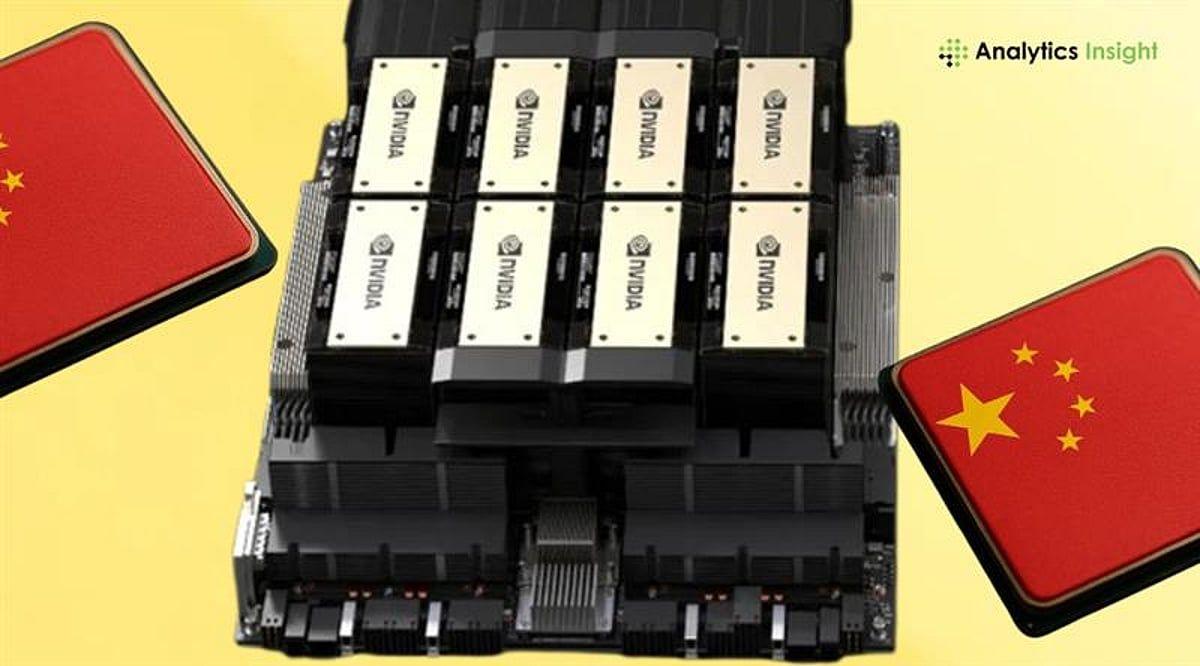
Nvidia is experiencing a precipitous decline in China as analysts from Bernstein predict the company's China market share will drop to approximately 8% this year, down from 66% in 2024
1
. This dramatic shift represents one of the most significant market transformations in the AI chips sector, driven by a combination of US export restrictions and the rapid maturation of homegrown Chinese AI hardware. Domestic suppliers including Huawei, Cambricon, Moore Threads, and MetaX are now positioned to satisfy approximately 80% of local demand1
. The collapse marks a turning point for Nvidia, which previously viewed China as a potentially $50 billion annual market5
.
Source: Analytics Insight
Trump Administration Opens Limited H200 Sales with 25% Surcharge
The Trump administration announced it will approve sales of Nvidia H200 chips to China, but with a 25% government surcharge on the dollar value of transactions
5
.
Source: ET
Unlike Nvidia's previous China-targeted H20 chip, the Nvidia H200 represents a full-performance version of the company's Hopper generation sold in other markets. The U.S. Department of Commerce published new AI accelerator export rules that introduce a narrowly defined, compliance-heavy method allowing limited exports under strict case-by-case licensing
4
. Eligible devices must have a total processing performance (TPP) of less than 21,000 and DRAM bandwidth below 6,500 GB/s4
. The H200 meets these thresholds with a TPP score of 15,832 and memory bandwidth of 4.8 TB/s4
.
Source: Bloomberg
Beijing Responds with Purchase Rules and Domestic Push
China is working to establish rules regulating the total volume of high-end AI chips local companies can purchase from foreign makers, effectively controlling rather than banning some sales
3
. Chinese customs authorities told agents that Nvidia's H200 chips are not permitted to enter China, while the government summoned domestic technology companies and explicitly instructed them not to purchase the chips unless necessary3
. Chinese state media outlet Global Times dismissed the licensing requirements as "discriminatory," noting the stringent export regime targets China specifically while not applying to other US trading partners2
. The licensing requirements include certifying no shortage of processors exists in the US and limiting chip shipments to China to no more than 50% of total products made for the US market2
.Chinese AI Hardware Makers Close Performance Gap
Moore Threads announced its Huashan product, the company's first GPU dedicated solely for AI training and inference, which can compete against Nvidia's Hopper H100 and H200 products
1
. "The new products meet the needs of domestic developers," said Zhang Jianzhong, chief executive of Moore Threads. "There will be no more need to wait for advanced products from overseas"1
. Huawei's AI CloudMatrix 384 can beat both GB200 NVL72 and GB300 NVL72 systems in BF16 FLOPS, though with four times more power consumption1
. The company's next-generation Atlas 950 SuperCluster, based on 524,288 Ascend 950DT AI accelerators, is projected to offer up to 524 FP8 ExaFLOPS for AI training sometime in 2026-20271
.Related Stories
Semiconductor Self-Reliance Becomes National Priority
China's transition to domestic AI hardware reflects a long-term national goal for semiconductor self-reliance. A draft five-year plan reportedly circulated by the Communist Party in October calls for a 'new national system' directing state bodies, private companies, and financial institutions toward this objective
1
. At the heart of this effort are the 'four little dragons' of Chinese GPUs: Moore Threads, MetaX, Biren Technology, and Suiyuan Technology1
. Large hyperscalers are intensifying custom silicon programs, with Baidu's Kunlunxin unit planning to introduce five AI processors by 2030, while Alibaba continues its own silicon efforts. However, China's AI industry remains constrained by SMIC's ability to produce chips on its 7nm-class process technologies in sizable quantities1
.Compliance Burden Limits Practical Export Potential
The new AI accelerator export rules impose substantial compliance requirements that may limit practical exports. Exporters must demonstrate US demand is fully met, no domestic orders are delayed, no US advanced-node foundry capacity is diverted, and China-bound shipments don't exceed 50% of the same product shipped to the United States
4
. Every shipment requires review by an independent testing laboratory headquartered in the US with no financial ties to the exporter, and all testing must be conducted domestically4
. The licensing regime also includes cloud usage controls, requiring exporters to confirm accelerators aren't destined for military or weapons-related end uses and to provide detailed "Know Your Customer" procedures4
. AMD's Instinct MI325X also qualifies under these rules with a TPP score of 20,800 and memory bandwidth of 6 TB/s4
. Bloomberg Intelligence analyst Michael Deng noted the combined effect of these requirements may be overly burdensome, posing a significant hurdle for exports2
. The remaining challenge involves transitioning from an ecosystem centered on Nvidia and CUDA to a fully domestic hardware and software stack, which proves difficult and expensive for existing AI deployments1
. If SMIC cannot substantially increase output in coming years, China's AI sector faces the prospect of falling dramatically behind America's High-Performance Computing capabilities, unless alternative supply channels emerge1
.References
Summarized by

Navi
[1]
[4]
Related Stories
Nvidia's H200 AI chip sales to China stalled by US security review despite initial approvals
28 Jan 2026•Policy and Regulation
Nvidia's AI Chip Strategy in China: Navigating Geopolitical Tensions and Domestic Competition
19 Aug 2025•Technology

Trump approves Nvidia H200 exports to China with 25% revenue cut, sparking national security debate
04 Dec 2025•Policy and Regulation
Recent Highlights


Recent Highlights
Today's Top Stories





Your Daily Dose of Curated AI News
Don’t drown in AI news. We cut through the noise - filtering, ranking and summarizing the most important AI news, breakthroughs and research daily. Spend less time searching for the latest in AI and get straight to action.

