75 Sources
75 Sources
[1]
Department of Commerce may approve Nvidia H200 chip exports to China | TechCrunch
Advanced Nvidia AI chips may be headed to China after all. The Department of Commerce is planning to allow Nvidia to ship H200 chips to China, according to Semafor, which cited sources. These chips are much more advanced than the H20 chips Nvidia developed specifically for the Chinese market, but the company would only be able to send H200s that are roughly 18 months old, Semafor reported. "We applaud President Trump's decision to allow America's chip industry to compete to support high paying jobs and manufacturing in America. Offering H200 to approved commercial customers, vetted by the Department of Commerce, strikes a thoughtful balance that is great for America," an Nvidia spokesperson told TechCrunch. The news report comes a week after U.S. Commerce Secretary Howard Lutnick said the decision on exporting these H200 chips to China was in President Donald Trump's hands. A decision to send these chips to China would conflict with Congressional concerns about national security. Pete Ricketts, a Republican senator from Nebraska, and Chris Coons, a Democratic senator from Delaware, introduced a bill on December 4 that would block the export of advanced AI chips to China for more than two years. The Secure and Feasible Exports Act (SAFE) Chips Act would require the Department of Commerce to deny any export license on advanced AI chips to China for 30 months. It's unclear when legislators will vote on the proposed bill. While Congress has long been clear about sending advanced AI chips to China -- on both sides of the aisle -- President Trump has waffled on whether or not to allow the exports. The Trump administration hit chip companies like Nvidia with licensing requirements to send their chips to China in April before it formally rescinded a Biden administration diffusion rule that would have regulated AI chip exports in May. Over the summer, the U.S. government signaled that companies would be able to start sending chips to China as long as the government got a 15% cut of all revenue, as chips became a bargaining tool in trade talks with China. However, by that point, the market for U.S.-developed chips in China was strained, if not permanently damaged. In September, China's internet regulator, the Cyberspace Administration of China, banned domestic companies from buying Nvidia's chips, leaving companies in the country to rely on less advanced domestic chips from Alibaba and Huawei.
[2]
Trump says Nvidia can sell more powerful AI chips to China
"This policy will support American jobs, strengthen US manufacturing, and benefit American taxpayers," Trump said. "Nvidia's US customers are already moving forward with their incredible, highly advanced Blackwell chips, and soon, Rubin, neither of which are part of this deal." While the Trump administration lifted AI chip export limits in May, a group of senators urged the President last month to continue denying China access to Nvidia's most powerful chips in an effort to preserve the US's leading position in AI. The new approvals further reward Nvidia CEO Jensen Huang's efforts to suck up to the White House, but rely on China actually wanting to purchase Nvidia's chips -- something it's barred Chinese companies from doing in favor of supporting domestic chip manufacturing.
[3]
Trump: Nvidia Can Sell H200 AI Chips to China, But US Will Get a 25% Cut
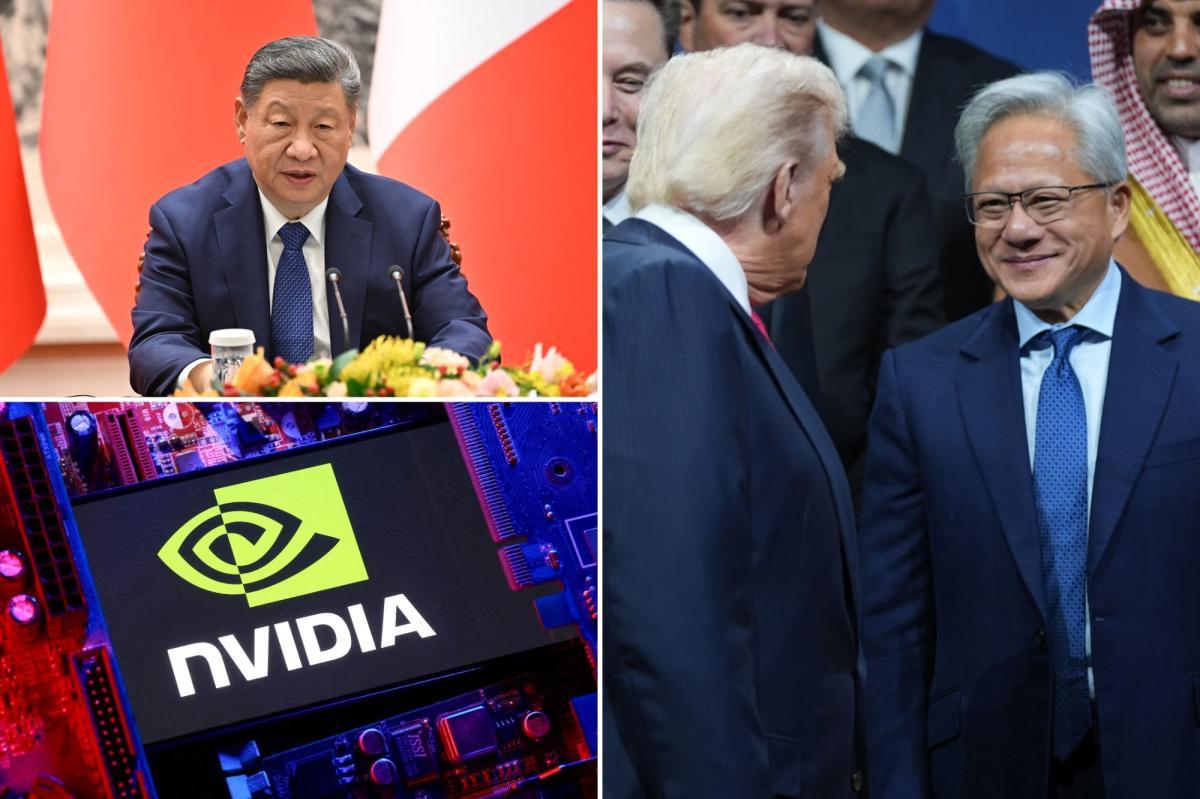
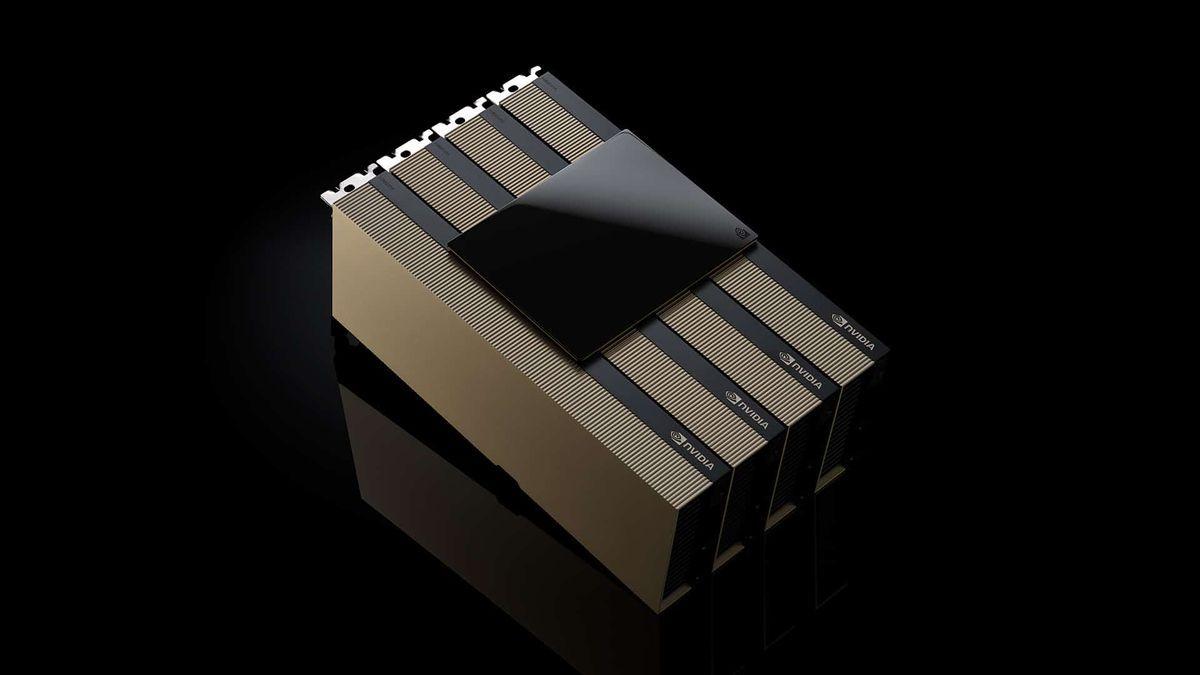
President Trump and Nvidia CEO Jensen Huang (Credit: Andrew Harnik via Getty Images) The US government has approved the sale of Nvidia's H200 AI graphics chip systems to China, with certain stipulations. "I have informed President Xi, of China, that the United States will allow NVIDIA to ship its H200 products to approved customers in China, and other Countries, under conditions that allow for continued strong National Security," President Trump wrote on Truth Social. According to Trump, the US will get a 25% cut of sales to "support American Jobs, strengthen U.S. Manufacturing, and benefit American Taxpayers," according to Trump, who notes that Nvidia's Blackwell and Rubin chips are not part of the deal. "The Department of Commerce is finalizing the details, and the same approach will apply to AMD, Intel, and other GREAT American Companies," Trump added. In August, AMD and Nvidia agreed to give the US a 15% revenue slice of the companies' AI chip sales to China. A few weeks later, the US took a 10% stake in Intel. Chinese access to high-end GPUs, AI accelerators, and chip fabrication machines has been a key sticking point in trade negotiations between the US and China. On-again, off-again tariffs have made the situation inconsistent at best and led to an increase in smuggling operations. The H200 is based on Nvidia's previous-generation Hopper design, which is built on a 4nm process node and has access to 141GB of HBM3E memory. CEO Jensen Huang might have joked that no one would give Hopper away once Blackwell comes out, but the H200 is still much faster than Chinese-produced hardware -- as much as double the speed, according to TechPowerUp -- and provides intimate access to the CUDA ecosystem, which in turn gives access to Nvidia's AI design and development tools. That said, Chinese authorities have encouraged Chinese companies to utilize domestic suppliers for their chips, with a government mandate to use at least 50% for inferencing workloads. In July, the Cyberspace Administration of China also flagged Nvidia's less-powerful H20 AI GPU as a potential spying risk, after Nvidia secured White House approval to sell that product in China. However, when China previously attempted to force DeekSeek developers to use Huawei hardware for training instead of Nvidia GPUs, they ultimately reverted to Nvidia hardware because the results weren't positive, the Financial Times reported in August. As much as China would like to strengthen its own supply chain and compete directly with US firms, it's not there yet. For now, Nvidia GPUs like Blackwell and even last-generation H200 Hopper designs are the best available for GPU training, and in many cases, inferencing too. We'll have to see how interested Beijing is in buying these chips, but Nvidia will no doubt make plenty of money from the deal, even if it's giving 25% of revenue to the US government.
[4]
Trump approves Nvidia H200 exports to China, with 25% fee attached -- report suggests that companies will have to follow strict Beijing rules to import foreign chip, AMD and Intel to benefit from policy shift
U.S. authorises shipments of Hopper-class AI accelerators to "approved" customers. The U.S. will allow Nvidia to export its H200 chips to "approved customers" in China, President Donald Trump announced on Monday, setting off a fresh round of political and regulatory manoeuvring on both sides of the Pacific. The decision authorises shipments of Nvidia's second-tier Hopper-generation chip in exchange for a 25% fee collected when parts arrive in the United States for security review before re-export. The Commerce Department is finalising the terms of the arrangement, which Trump said would also apply to AMD and Intel. H200 sits below Nvidia's latest Blackwell architecture yet remains far ahead of any processor China can legally import today. It is roughly six times more powerful than the H20, the downgraded model Nvidia specifically created to comply with earlier export controls. China restricted tech companies from buying the H20, arguing its performance gains over domestic alternatives were too modest to justify continued reliance on U.S. parts. Trump's announcement briefly lifted Nvidia's share price, but the company's prospects in China now potentially rest on decisions in Beijing as much as in Washington. The Financial Times reports that Chinese regulators have been discussing ways to allow only limited access to H200 -- including an approval process where buyers must explain why domestic chips cannot meet their needs -- and could bar the public sector from purchasing Nvidia hardware altogether. At the time of writing, no official confirmation of this has been released by the Chinese government. The provisional opening nonetheless matters to China's largest cloud providers. Alibaba, Tencent, and ByteDance have adopted domestic accelerators for some inference workloads but continue to prefer Nvidia products for training and maintaining large models, often sending jobs overseas where access to H100-class compute remains unrestricted. If allowed, H200 purchases would ease those workarounds, though companies would still have to navigate both governments' approval systems. Following the announcement, a group of senators described the move as a "colossal economic and national security failure", arguing that H200's performance would give Chinese AI firms a meaningful lift. The bipartisan "SAFE CHIPS Act" introduced last week seeks to prevent the administration from approving exports of advanced chips, including H200, for 30 months. The announcement also coincided with the Justice Department's announcement of "Operation Gatekeeper", which alleges a smuggling network routed Nvidia parts into China and Hong Kong despite existing controls, piling yet more pressure on Washington to create a regulated channel for hardware that continues to leak across borders. Whether H200 reaches China at scale now depends on two competing gatekeepers. Washington is attempting to shape the market through controlled exports and taxes, while Beijing reportedly weighs measures that would keep foreign accelerators available only where domestic suppliers cannot yet compete.
[5]
Trump says Nvidia can sell H200s to China
US President Donald Trump has signalled he will allow Nvidia to resume sales of its H200 accelerators to China. "I have informed President Xi, of China, that the United States will allow NVIDIA to ship its H200 products to approved customers in China, and other Countries, under conditions that allow for continued strong National Security," Trump wrote in a Monday post to his social network, Truth Social. "President Xi responded positively!" he added, before stating "$25% will be paid to the United States of America" - a seeming reference to past suggestions that the administration would charge license fees on chip exports to China. Trump's post does not contain any detail about how his proposal will protect the USA's national security, an issue that the Biden administration cited as the main reason for its ban on sales of advanced accelerators to China. "These items and capabilities are used by the PRC to produce advanced military systems including weapons of mass destruction; improve the speed and accuracy of its military decision making, planning, and logistics, as well as of its autonomous military systems; and commit human rights abuses," the Bureau of Industry and Security stated [PDF] in October 2022. The Biden administration did allow export of modest accelerators, notably Nvidia's H20 devices. Trump's post brands that policy as a failure. "The Biden Administration forced our Great Companies to spend BILLIONS OF DOLLARS building 'degraded' products that nobody wanted, a terrible idea that slowed Innovation, and hurt the American Worker. That Era is OVER!" Those remarks appear to ignore the Trump administration's April 2025 decision to ban exports of the H20, which it later reversed. The "nobody wanted" remark is also hard to support, as Nvidia valued lost H20 sales to China at $10.5 billion. The post says this new policy applies only to H200 accelerators - which Nvidia bills as ideal for generative AI and HPC workloads thanks to its inclusion of HBM3 memory - and not Nvidia's more recent Blackwell silicon and forthcoming Rubin hardware. Trump's post concludes by stating: "The Department of Commerce is finalizing the details, and the same approach will apply to AMD, Intel, and other GREAT American Companies." At the time of writing, the Department appears not to have made any public utterance about the matter. Correlation is not causation, but in the hours after Trump's post the price of shares in Nvidia and AMD jumped by over two percent. ®
[6]
Nvidia Set to Win US Approval to Export H200 AI Chips to China
The Trump administration is poised to allow Nvidia Corp. to sell its H200 artificial intelligence chip to China, according to people familiar with the matter, a move that would mark a major lobbying win for the world's most valuable company and potentially let it regain billions of dollars of business lost in a key global market. The decision caps weeks of deliberations by President Donald Trump and his advisers about whether to grant permission to ship the H200 to China. Nvidia Chief Executive Officer Jensen Huang met privately with Trump in Washington last week to discuss export controls, though neither the White House nor the company shared details on their conversation.
[7]
Trump blessing Nvidia AI chip sales to China gets chilly reception from GOP
The agreement, which Trump announced in a Truth Social post Monday evening, would allow Nvidia to sell its H200 artificial intelligence chips to China on the condition that the U.S. government gets 25% of the sales. The H200 chips aren't Nvidia's most advanced chip, but are more powerful than the company's H20s, which was previously developed specifically for the China market. The White House, over the summer, gave approval for Nvidia and Advanced Micro Devices to sell their less-powerful chips to China in exchange for 15% of sales revenue. Beijing reportedly told companies not to buy those chips. Chinese President Xi Jinping "responded positively" to the latest proposal, Trump wrote in the social media post. CNBC has reached out to the Chinese embassy in Washington, D.C., for comment. Experts warn that giving China access to the better chips will shrink America's hardware advantage and help Chinese developers vastly improve their AI models and other tech. Some of Trump's Republican allies appear to agree. "Alarm bells go off in my head here," Sen. Lindsey Graham, R-S.C., told CNBC on Tuesday when asked about the chip sales agreement. "I don't mind doing normal business with China. But if you can prove to me this will accelerate their military capability, I'll oppose it," Graham said. "My general view on this is that China's progress on AI is almost entirely parasitic on our technology, in particular on our hardware," Sen. Josh Hawley, R-Mo., said on Capitol Hill earlier Tuesday. "So I don't want China to win the AI race. I want to win the AI race," Hawley said. "But if we want to beat China, I think we need to constrain their ability to leverage our own technology, and I think we would want to reduce their access to our hardware, not increase it." Hawley did not directly criticize Trump, and noted that the president is privy to more information about the situation than he is. "So I think he deserves some deference here," he said. "But I think in the general matter I would want to constrain American hardware going to China," he added. The U.S. Select Committee on China, a Republican-led panel formed to focus on the "threat posed by the Chinese Communist Party," echoed Hawley's concerns. "Right now, China is far behind the United States in chips that power the AI race. Because the H200s are far better than what China can produce domestically, both in capability and scale, @nvidia selling these chips to China could help it catch up to America in total compute," the committee said in a statement on X. Beijing will use the H200s, which boast significantly more processing power and memory bandwidth than China's top chips, "to strengthen its military capabilities and totalitarian surveillance," the panel's statement said. "Finally, Nvidia should be under no illusions - China will rip off its technology, mass produce it themselves, and seek to end Nvidia as a competitor," the panel said. "That is China's playbook and it is using it in every critical industry." Not all Republicans are piling on. "I don't have a real problem with providing them some [chips]," Sen. Thom Tillis, R-N.C., told CNBC. "But we've got to know where it is, how they're using it, those sorts of things." But there is vocal support among both parties for slowing China's ability to obtain the world's best chips. Sen. Pete Ricketts, R-Neb., last week introduced bipartisan legislation that would direct the Trump administration to deny export licenses for advanced chips to China and other foreign adversaries for at least 30 months. "The best AI chips are made by American companies. Denying Beijing access to these AI chips is essential to our national security," Ricketts said in a press release unveiling the bill. Sen. Tom Cotton, R-Ark., one of the bill's cosponsors, said, "It's crucial that we protect American AI innovation from Communist China to win the AI race."
[8]
Nvidia reportedly wins H200 exports to China -- US Department of Commerce set to ease restrictions for full Hopper AI GPU
The U.S. Department of Commerce is about to let Nvidia import its H200 AI GPUs into China, Semafor reports, citing a person with knowledge of the matter. If true, Nvidia would be able to ship much more capable GPUs to China, enhancing its positions and ensuring dominance of its CUDA software stack. The only question is whether China lets these AI accelerators in, as it previously blocked imports of the weaker H20. The authorization reportedly only covers Nvidia's H200, a processor that originates from 2022, but features formidable performance and comes with 144 GB of HBM3 memory (an important spec for training large AI models), so it is years behind the leading edge Blackwell GPUs. When compared to the HGX H20 -- specifically designed to meet U.S. export control regulations of 2023 -- it still delivers a formidable performance advantage over H20. Although Huawei now offers accelerators and rack-scale systems that can compete against Nvidia's H200 and even GB200 NVL72 systems, many Chinese companies still prefer Nvidia hardware largely because of their reliance on the CUDA-based software stack. Semafor claims that the decision also reflects an assessment inside the U.S. government that the earlier restrictions did not significantly hinder progress by Chines AI leaders like Alibaba, DeepSeek, or Huawei. These companies continued to release advanced AI models and fill hardware gaps with domestically engineered products, therefore blunting the intended effect of U.S. policy and spreading Chinese AI standards when it comes to hardware, software, and eventually ethics. An avid reader would ask whether the Department of Commerce -- a part of the executive branch of the federal government -- is overriding laws set in 2023. This is not exactly the case. The DoC is not formally canceling or rewriting the 2023 export control rules, but it is preparing to apply them far more flexibly. The ECCN 3A090/4A090 framework -- which sets performance caps and interconnect thresholds for AI accelerators -- remains intact. What is changing is the DoC's willingness to grant licenses for hardware that sits above those limits. By approving Nvidia's H200, the U.S. is effectively raising the practical performance ceiling that China may receive, without altering the existing export rules. Whether or not AMD can receive appropriate indulgences is something that remains to be seen. One thing to keep in mind is that China rejected the H20 for political, not technological, reasons. On the one hand, China is more likely to permit H200 imports than it was to accept the H20, because the H200 is a full-fat Nvidia GPU rather than a deliberately slow-downed, export-only model. Meanwhile, H200 will help China to develop its AI prowess faster than any domestic hardware. On the other hand, China's approval is not guaranteed as availability of H200 could slowdown development of domestic AI hardware solution. Last but not least, China may hesitate to re-open reliance on U.S. technology that the U.S. government could cut off again. Therefore, it may prefer to protect the momentum of domestic manufacturers like Huawei as it fits into China's broader semiconductor self-sufficiency plan.
[9]
NVIDIA can now sell its high-end AI chips to 'approved customers in China,' Trump says
NVIDIA is now allowed to sell its second-best H200 processors to China, rather than just the sanction-approved H20 model that China had previously declined to buy, President Trump wrote on Truth Social. The United States will collect a 25 percent tariff on those sales, the Commerce Department confirmed yesterday. Trump said that he informed China's President Xi Jinping of the decision and that he "responded positively." The Commerce Department is finalizing details and the administration will take the same approach with AMD, Intel and other US companies. He added that the administration would "protect National Security," so the latest Blackwell and upcoming Rubin chips are not part of the deal. The 25 percent tariff would be higher than the 15 percent the White House suggested in August. Though the administration won't allow NVIDIA to send its latest high-end chips, it was reportedly concerned that the company would lose business to Huawei if it was completely shut out of China's market, according to Reuters. No details about the number of H200 chips or which companies would be eligible to buy them were released. "Offering H200 to approved commercial customers, vetted by the Department of Commerce, strikes a thoughtful balance that is great for America," NVIDIA said in a statement. The decision is not without controversy, though. Several Democratic US senators called it a "colossal economic and national security failure" that will aid China's industry and military. Republican representative John Mollenaar put it in even starker terms. "NVIDIA should be under no illusions -- China will rip off its technology, mass-produce it themselves and seek to end NVIDIA as a competitor," he said. Despite the current restriction on Blackwell B200 processors, $1 billion worth of those and other high-end NVIDIA chips have made their way to China via black market sales, according to previous reports. That model, along with the H100 and H200, is far more capable than the H20 chip, which was designed to comply with export restrictions for sale to China. NVIDIA has said that the B200 chip is almost ten times faster than the H200 for some jobs, and the H200 is six times faster than the H20. Washington's approval doesn't mean that China will purchase NVIDIA's chips, as Beijing has previously told companies not to use US technology. Huawei is currently the most advanced company in that regard and recently unveiled a three-year plan to catch up with NVIDIA and AMD. However, AI chip experts like Richard Windsor have said NVIDIA's tech is still far ahead of anything that Huawei or other Chinese companies can currently produce.
[10]
Live updates: Trump approves sale of more advanced Nvidia computer chips used in AI to China
President Donald Trump said Monday that he would allow Nvidia to sell an advanced type of computer chip used in the development of artificial intelligence to "approved customers" in China. There have been concerns about allowing advanced computer chips to be sold to China as it could help the country better compete against the U.S. in building out AI capabilities, but there has also been a desire to develop the AI ecosystem with American companies such as chipmaker Nvidia. Nvidia said in a statement that it applauded Trump's decision, saying the choice would support domestic manufacturing and that by allowing the Commerce Department to vet commercial customers it would "strike a thoughtful balance" on economic and national security priorities. But a group of Democratic senators objected to the chip sales.
[11]
How Much Could China Gain From Access to Powerful Nvidia Chips?
President Trump's announcement that the American chip maker Nvidia would be able to sell semiconductors to China appeared to roll back years of policies aimed at blocking the country's access to advanced technologies. At stake, officials in Washington have argued, is China's ability to use American technology to gain military and economic advantages, particularly through artificial intelligence. By cutting China off, lawmakers wanted to preserve the lead the United States has achieved in A.I. and slow China's efforts to catch up. On the other side, Nvidia's chief executive, Jensen Huang, spent months trying to persuade Mr. Trump to reverse course. He argued that limiting China's access to American technology has only spurred Chinese companies to improve faster. Mr. Trump's decision on Monday to allow Nvidia to sell its second-most-powerful chip, known as the H200, to Chinese commercial customers vetted by the U.S. Commerce Department strikes "a thoughtful balance that is great for America," an Nvidia spokesman said. The impact of Mr. Trump's decision is unclear. But the Chinese government has already spent billions in effort to become an A.I. superpower. The country's chip makers are racing to make advanced chips on their own, and Chinese A.I. companies have become more efficient at using the chips they have access to. "The push for domestic production will continue," said Jiang Tianjiao, an associate professor at Fudan University. "Beijing's strategy is clear." Investor bets that a Chinese company could soon compete with Nvidia have driven huge gains in the country's tech stocks this year. Shares of the partly state-backed chip designer Cambricon have risen more than 120 percent, compared with a year ago. Last week, Moore Threads, a start-up chip maker founded by a former Nvidia executive, went public in one of the Shanghai Star Market's largest offerings of the year. But even Huawei, the telecommunications giant leading China's race to compete with Nvidia, remains at least two years behind the Silicon Valley company, experts said. Chinese chips still lag behind Nvidia's in performance, and the companies face major constraints on their output. Chinese chips can produce, at most, 2 percent as much computing power as foreign rivals, said Tim Fist, a senior adjunct fellow at the Center for a New American Security, a think tank. Computing power is crucial in A.I. development. Advanced A.I. systems are powered by hundreds of thousands of chips known as GPUs, which companies pack into buildings known as data centers to create giant supercomputers that gobble electricity. OpenAI, the A.I. start-up that created ChatGPT, is planning to build five such facilities in the United States that would together consume more electricity than the three million households in Massachusetts. Chinese demand for cutting edge chips is also high. The biggest tech companies, including Alibaba, Tencent and ByteDance, TikTok's parent company, have poured money into A.I. efforts and infrastructure like data centers. For Chinese companies, "gaining access to higher-end chips like the H200 does indeed come at a critical moment," said Frank Kung, an analyst at TrendForce, a market research firm in Taipei, Taiwan. Some officials who worked for former President Joseph R. Biden Jr. have warned that access to the Nvidia chips could help China's A.I. companies buy time while the country's chip makers improve the supply and performance of their own offerings. Mr. Trump's decision to allow Nvidia to sell advanced chips in China has also renewed a debate about how much future advancements in A.I. technology will depend on vast stockpiles of powerful chips. Washington's constraints have pushed Chinese companies to be more efficient. This year, the Chinese start-up DeepSeek rocked the tech industry with its claim that it had created powerful A.I. systems that required fewer chips and were significantly cheaper to build than those of better-funded American rivals. The less powerful China-made chips require more electricity. But industrial electricity costs in China are far lower than in the United States, said Lian Jye Su, a chief analyst at Omdia, a tech research firm. The abundant cheap power has helped companies create sophisticated A.I. systems despite less powerful chips, Mr. Su said. The Chinese government has pushed companies there to buy domestic chips and warned Nvidia's chips may carry risks. In July, China's internet regulator said that it had summoned Nvidia to explain security risks associated with one of its chips developed for sale in China, saying the chips could be shut down remotely or used to track a user's location. Many Chinese tech companies are already using a mix of domestic and foreign chips, said Paul Triolo, a partner at DGA-Albright Stonebridge Group. "Just because some Chinese companies will choose to purchase some number of H200 does not mean domestic development of advanced A.I. hardware will stop," he added. Mr. Trump's willingness to widen China's access to advanced American chips has drawn condemnation from members of Congress and former Biden administration officials. This summer, Mr. Trump proposed the idea of the government taking a cut of A.I. chip sales to China. On Monday, he reiterated that, writing that 25 percent "will be paid to the United States of America." Mr. Trump's transactional approach to export controls on chips has led to some paradoxical outcomes. Hours before he said the Commerce Department was finalizing the details to allow sales of the H200 in China, the Department of Justice announced it had detained two people for selling those chips to the country. Xinyun Wu contributed reporting from Taipei.
[12]
Trump gives Nvidia the OK to sell advanced AI chips to China
Trump reversed the chip-selling ban in July, but demanded that Nvidia pay 15% of its Chinese revenues to the US government. Beijing then reportedly ordered its tech companies to stop buying Nvidia chips manufactured for use in the Chinese market. "We applaud President Trump's decision to allow America's chip industry to compete to support high paying jobs and manufacturing in America," Nvidia said in a statement provided to BBC News. Mr Huang told the BBC in September that the US needed "to make sure that people can access this technology from all over the world, including China." He has also repeatedly warned that China, which has cultivated a chip production ecosystem of its own, was close behind the US in chip development. Nvidia hailed Trump's announcement on Monday. "Offering H200 to approved commercial customers, vetted by the Department of Commerce, strikes a thoughtful balance that is great for America," Nvidia said in its statement. The companies shares rose slightly on the news. Trump said "$25% [sic] will be paid to the United States of America" in his post. The BBC has reached out to the White House for clarification on the arrangement, which will likely face opposition from national security hawks in Congress. Researchers at Georgetown University's Center for Security and Emerging Technology (CSET) said China's People's Liberation Army is using advanced chips designed by US companies to develop AI-enabled military capabilities. "By making it easier for the Chinese to access these high-quality AI chips, you enable China to more easily use and deploy AI system for military applications," said Cole McFaul, senior research analyst at CSET. "They want to harness advanced chips for battlefield advantage."
[13]
Trump Says Nvidia Can Sell the H200 Chip to China
Donald Trump says he's going to allow Nvidia to sell the H200 artificial intelligence chip to China, according to a new post from the president on Truth Social. The move will still bar Nvidia from selling its more advanced Blackwell chips to China, but it's still considered a win for the tech company since the lower quality H20 chip had been sidelined by the Chinese government for supposedly not being powerful enough. Trump wrote Monday that he had informed China's president Xi Jingping that he will allow the sale of H200 chips "under conditions that allow for continued strong National Security." Trump did not explain what those conditions might be, but said Nvidia will pay the U.S. government 25% from sales of the chips to China. Over the summer, Nvidia and AMD agreed to give the U.S. government 15% of revenue from chip sales to China in a bizarre quid pro quo arrangement, according to the Financial Times. Experts noted at the time that no private company had ever entered into such a deal and the legality was questioned. Trump's second term has been filled with extreme actions that often confound experts in a given field. Can presidents just unilaterally declare birthright citizenship null and void? Virtually every constitutional expert says no, but the U.S. Supreme Court has taken up the case, and if members of the conservative-dominated court so choose, they could very well invalidate the 14th Amendment. Trump touted the sale of H200 chips as a win for U.S. workers Monday, though it still needs to be formally finalized by the U.S. Commerce Department, which handles export controls. But federal agencies under Trump aren't exactly in the business of second guessing him these days. "This policy will support American Jobs, strengthen U.S. Manufacturing, and benefit American Taxpayers," wrote Trump. The president went on to claim that President Joe Biden's administration had "forced" U.S companies to spend billions of dollars building "'degraded' products that nobody wanted," which he called a terrible idea that slowed innovation and hurt American workers. Obviously those "degraded" products are created that way to give the U.S. a technological edge, just as his government has supposedly tried to do. "That Era is OVER! We will protect National Security, create American Jobs, and keep America’s lead in AI," wrote Trump. "NVIDIA’s U.S. Customers are already moving forward with their incredible, highly advanced Blackwell chips, and soon, Rubin, neither of which are part of this deal." As Bloomberg notes, the Chinese government urged potential customers to reject the less powerful H20 chips. It wasn't an outright ban, and there's still reportedly demand for the H20 in the country, but it still probably applied some pressure on the U.S. to reexamine the issue if the world's second largest market for chips was unlikely to bite. Nvidia CEO Jensen Huang has been cozying up to Trump during the president's second term, just like virtually every other tech CEO in the country. And it looks like Nvidia's lobbying has really paid off. David Sacks, the so-called AI and crypto czar, also pushed back on security concerns about selling chips to China, according to the New York Times. Sacks and Huang have reportedly argued that selling the more advanced chips to China will make the country more dependent on U.S. tech. It remains to be seen what will happen to the SAFE CHIPS Act, a bipartisan bill unveiled last week to restrict any efforts by Trump to loosen the export restrictions, according to Reuters. The bill is sponsored by Republican Senator Pete Ricketts and Democrat Chris Coons. Opposing Chinese tech influence seems to be the only thing that most elected Republicans and Democrats can agree on, though it often doesn't matter what Congress says when Trump wants something. For example, the TikTok ban was bipartisan legislation that even Trump supported until he pulled a 180 in 2024. Trump has unilaterally extended enforcement of the ban several times while a deal is worked out. The next deadline is Dec. 16. "My Administration will always put America FIRST," Trump wrote Monday. "The Department of Commerce is finalizing the details, and the same approach will apply to AMD, Intel, and other GREAT American Companies. MAKE AMERICA GREAT AGAIN!"
[14]
Nvidia can sell the more advanced H200 AI chip to China -- but will Beijing want them?
"This makes domestic self-sufficiency the only viable long-term strategy for Beijing," Shah said. Trump said Chinese President Xi Jinping "responded positively" to the approval of H200 exports to China. And while China held off on H20 purchases, there are reasons the country's companies could want to purchase the H200 product. The H200 is far more advanced than the H20, which could be tempting for China. Meanwhile, Alibaba CEO Eddie Wu said there were supply shortages across the entire semiconductor supply chain. "I think there will be demand for H200 as it is a better chip than H20 and there is a shortage of chips in China," Ben Barringer, head of technology research at Quilter Cheviot, told CNBC on Tuesday. "The big Chinese tech companies will want to use Nvidia and AMD if possible." China's semiconductor industry remains behind that of the U.S. and elsewhere. In particular, China struggles to manufacture the most advanced chips, putting it behind the world's largest chipmaker Taiwan Semiconductor Manufacturing Co. China is also restricted from buying chipmaking tools that could advance its capabilities. Meanwhile, domestic alternatives to Nvidia remain behind in performance. This makes Nvidia's H200 an attractive proposition. "What is not in China's favor right now is the supply -- ramping up advanced AI chips in terms of performance or yields still remains elusive, making it a less economically efficient push," Shah said. "The gap between Nvidia, AMD and Huawei and others is still quite wide when it comes to performance and power efficiency." Even if Chinese firms begin buying Nvidia's product, Beijing's longer-term trajectory of self-sufficiency will continue. "In the long run, for the next five to ten years, China's 'self-reliance' strategy for its own tech and innovation won't change. Jensen Huang of Nvidia has a good time window to sell H200 but it won't be ... forever," George Chen, partner and co-chair, digital practice, The Asia Group, told CNBC on Tuesday. "Xi will not be foolish that today Trump can sell H200, and then China just totally relies on U.S. chips. Huawei, Alibaba and other Chinese tech developers remain strategically important for China's marathon to win the AI race and this will be a long race," he added.
[15]
Trump approves sale of more advanced Nvidia computer chips used in AI to China
WASHINGTON (AP) -- President Donald Trump said Monday that he would allow Nvidia to sell an advanced type of computer chip used in the development of artificial intelligence to "approved customers" in China. There have been concerns about allowing advanced computer chips to be sold to China as it could help the country better compete against the U.S. in building out AI capabilities, but there has also been a desire to develop the AI ecosystem with American companies such as chipmaker Nvidia. The chip, known as the H200, is not Nvidia's most advanced product. Those chips, called Blackwell and the upcoming Rubin, were not part of what Trump approved. Trump said on social media that he had informed China's leader Xi Jinping about his decision and "President Xi responded positively!" "This policy will support American Jobs, strengthen U.S. Manufacturing, and benefit American Taxpayers," Trump said in his post. Trump said the Commerce Department was "finalizing the details" for other chipmakers such as AMD and Intel to sell their technologies abroad. The approval of the licenses to sell Nvidia H200 chips reflects the increasing power and close relationship that the company's founder and CEO, Jensen Huang, enjoys with the president. But there have been concerns that China will find ways to use the chips to develop its own AI products in ways that could pose national security risks for the U.S., a primary concern of the Biden administration that sought to limit exports. Nvidia has a market cap of $4.5 trillion and Trump's announcement appeared to drive the stock slightly higher in after hours trading.
[16]
Nvidia CEO Jensen Huang unsure if China would buy its H200 chips if restrictions are relaxed as Beijing prioritizes homegrown AI solutions -- 'We don't know. We have no clue.'
Will Beijing allow Chinese companies to buy last-generation Nvidia chips? Nvidia chief Jensen Huang said that he's uncertain whether Beijing would allow Chinese companies to purchase Nvidia chips if the company were allowed to sell them there. Huang said this in a statement to reporters after meeting U.S. President Donald Trump, where they talked about export control issues, according to Bloomberg. There has been some talk in Washington about the possibility of letting the AI GPU giant export its last-generation H200 chip to China, especially after Congress reportedly rejected the GAIN AI Act, which would have forced Nvidia to prioritize shipments to domestic companies. "We don't know. We have no clue," Huang said when asked whether the company would be able to sell the H200 in China. "We can't degrade chips that we sell to China, they won't accept that." The Biden administration has previously banned the export of this AI chip to Beijing, citing security concerns, especially its use in military applications. It was eventually replaced by the H20, which, even though it had limited capabilities versus Nvidia's then top-of-the-line chip, still offered formidable performance. However, even this AI GPU was banned in April 2025, resulting in a $5.5 billion write-off for Nvidia, before Washington allowed it to resume shipments some three months later. Things didn't go well for the AI tech giant for long, though, as Beijing ordered its tech companies to stop purchasing the H20 in August in response to U.S. Commerce Secretary Howard Lutnick's "addiction" comments. This has since expanded to a ban on RTX Pro 6000D GPUs as well, with the Chinese Communist Party (CCP) claiming that homegrown AI processors can now match Nvidia's China-only chips. Because of these moves, Huang said that Nvidia's market share in China has dropped from 95% to essentially zero in just a few years. This talk of finally allowing Nvidia to export fully-fledged H200 chips into China legally would be a major win for the company, especially as Huang has been lobbying for this and has been vocal against export controls. Nevertheless, even if the White House finally allows Nvidia to sell the unshackled version of its Hopper GPUs, it still wouldn't be a full 180 turn for Washington, as administration officials say that its rival can only have AI chips once they're outdated. And while the H200 is still a relatively powerful AI chip, it has since been supplanted by the arrival of the B200 chips.
[17]
Trump accused of 'colossal economic and national security failure' for allowing Nvidia to sell powerful AI chips to China - business live
Introduction: Trump clears way for Nvidia to sell powerful AI chips to China Good morning, and welcome to our rolling coverage of business, the financial markets and the world economy. Donald Trump has been accused of a "colossal economic and national security failure" for allowing Nvidia to export its H200 artificial intelligence chip to China. The US president announced last night he has granted Nvidia permission to ship H200 chips to China in exchange for a 25% surcharge for the US, a move that could allow the world's most valuable company to win back billions of dollars in lost business. Trump posted on his Truth Social site: "I have informed President Xi, of China, that the United States will allow NVIDIA to ship its H200 products to approved customers in China, and other Countries, under conditions that allow for continued strong National Security. President Xi responded positively!" They, and other Democratic senators, urged Trump to reverse the decision saying: "The Trump administration's announcement that it will allow the export of advanced H200 AI chips to China is a colossal economic and national security failure. The H200s are vastly more capable than anything China can make and gifting them to Beijing would squander America's primary advantage in the AI race. "Access to these chips would give China's military transformational technology to make its weapons more lethal, carry out more effective cyberattacks against American businesses and critical infrastructure, and strengthen their economic and manufacturing sector. Chinese AI giant DeepSeek said as recently as last week that the lack of access to advanced American-designed AI chips is the single biggest impediment to its ability to compete with U.S. AI companies. With this decision, President Trump is poised to remove that barrier. "Senate Democrats and Republicans both know that the 21st century will be defined by whether the leading AI systems are built on values of free societies and free markets or the repressive, authoritarian values of the Chinese Communist Party. The Trump administration clearly doesn't grasp the urgency of this contest. President Trump must reverse course and recommit to preserving American dominance in AI." In October Nvidia CEO Jensen Huang said his company has gone from having 95% of the Chinese market to having 0%, and called bans on its sales to China a "strategic mistake". Selling H200 chips to China - the world's second-largest economy - could mean a windfall worth billions of dollars for Nvidia, which is already valued at $4.5tn.
[18]
Nvidia boss Jensen Huang steers Trump, Congress against AI chip limits and state-level AI rules
Huang also warned that state-level AI laws would harm U.S. innovation and national security Nvidia CEO Jensen Huang isn't known for wading into the political fray, but this week, he made an exception with some quality time in Washington, DC. He met with President Trump to argue against the GAIN AI Act and its proposed rule requiring U.S. chipmakers like Nvidia and AMD to prioritize domestic buyers before selling advanced AI chips abroad. The act was pitched as a way to keep America ahead of China in the AI race, but it was not long after he met with the president that lawmakers removed it from the National Defense Authorization Act. Huang hastened to proclaim his support for export controls, just not this one. "The GAIN AI Act is even more detrimental to the United States than the AI Diffusion Act," Huang said in a press conference after the meeting. He called it "wise" that lawmakers are backing away from the plan. For Nvidia, which is the undisputed global heavyweight in AI hardware, that kind of disruption would be like asking Boeing to fly with half an engine. Their chips already dominate cloud computing and generative AI development worldwide. Losing the freedom to sell to vetted international customers without a government-imposed queue would erode their edge in a business built on speed and scale. Though Huang gave his corporate lobbying a patriotic veneer, he did point to more than just Nvidia's bottom line as a reason to oppose the GAIN AI Act. The law would have forced companies like Nvidia to delay foreign chip orders while confirming there was no outstanding demand in the U.S. But giving American institutions and companies a fair shot at high-end AI chips ahead of foreign markets would, he claimed, slow innovation for rivals as well, complicate global logistics, and damage America's ability to stay competitive in AI. For most people, the impact of these legislative debates is indirect, but very real. If Huange is right, the regulatory bottleneck would slow the pace of AI improvements for everyone. Although if he's wrong, it will make it harder for American businesses to compete if foreign groups can nab all of the most powerful chips. That wasn't Huang's only legislative foe this week. He met with lawmakers to criticize a separate idea gaining traction among U.S. states: local AI regulation. "State-by-state AI regulation would drag this industry into a halt," Huang warned. "It would create a national security concern." If AI laws start diverging wildly across California, Texas, New York, and every other state, it could create a compliance nightmare for developers. Imagine needing to tweak your chatbot's features depending on which zip code your user lives in. Bills are circulating in at least 30 states that propose different standards for disclosure, bias, transparency, and safety in AI systems. Trump reportedly echoed Huang's concern during their meeting and has publicly backed the idea of a national standard that would override state laws. So far, the NDAA doesn't have that kind of rule, but if it becomes a real problem, it might end up in the bill next year. To tech critics, this is familiar territory: Big Tech pushing for a single federal rule to avoid dealing with 50 regulatory headaches. And it's not as though the regulatory friction might not annoy the average AI user. It would be like 50 different versions of the GDPR, but without any way to fully comply. The shelving of the GAIN AI Act is, depending on your point of view, a signal that lawmakers aren't ready to clip the wings of America's most important chip company, or that they are in thrall to powerful and rich corporate interests. Or both. And while the future of AI regulation at every level is still in flux, Huang has outlined what tech's most powerful players envision as the ideal solution. If you use AI tools, or will soon, this matters. It's not just about export forms and legal frameworks. It's about who gets to move fast, who gets slowed down, and how much trust we're placing in a handful of companies to shape the technological infrastructure of the next decade.
[19]
Analysts warn Trump's Nvidia deal could help China win the AI war
The Trump administration has finally found a way to put a price on America's AI edge. For a 25% cut of Nvidia's China revenue, Washington is loosening its grip on H200 chips that security hawks thought were off the table -- and a growing chorus of analysts says that trade hands Beijing the initiative. On Truth Social, President Donald Trump cast the move as a tidy solution: limited access for approved Chinese customers, strict oversight by the Commerce Department, and a promise that Nvidia's newest -- and best -- hardware stays home. Nvidia put out a statement calling the H200 framework a "thoughtful balance that is great for America." But the Washington policy crowd isn't buying the "thoughtful balance" line. On X, Rush Doshi, a Georgetown professor and former National Security Council official, called the move "a big deal," and "essentially a reversal of the US export control policy on advanced chips," adding that it is "possibly decisive in the AI race." He noted that China already has an edge in electrical power, engineers, and "the entire edge layer" -- "so by giving this up we increase the odds the world runs on Chinese AI." The worry about the degradation of the United States' compute edge echoed across social media. Tim Fist, director of emerging technology at the Institute for Progress, warned that this move "gives Chinese AI labs chips that outperform anything China can make until 2028." Alec Stapp, the group's co-founder, was even blunter: "Massive own goal to export these AI chips to China. The H200 is 6x more powerful than the H20, which was previously the most powerful chip approved for export. Our compute advantage is the main thing keeping us ahead of China in AI." Chris McGuire, a senior fellow for China and emerging technologies at the Council on Foreign Relations, framed this decision as a hinge moment rather than a marginal tweak. "This is a seachange in U.S. policy, and a significant strategic mistake," he wrote on X. "If the United States sells AI chips to China that are 18 months behind the frontier, it negates the biggest U.S. advantage over China in AI." In a separate post, he called the approval "the single biggest change in U.S.-China policy of the entire administration" and described it as "a transformational moment for U.S. technology policy, which until now had been predicated on investing at home while holding China back. Now we are trying to win a race against a competitor who doesn't play by the rules." Tom Wright, a senior fellow at Brookings, wrote that the Nvidia-China deal is a "catastrophic decision" and, in another post, that this is "the modern day equivalent of letting China into the WTO." Shashank Joshi, defence editor at The Economist, said on X that this is an "extraordinary abdication of tech competition." Former U.S. ambassador to NATO Michael Carpenter read Trump's note about Xi's positive reaction and wrote, "Bet he responded positively. He's eating our lunch." He added that this was "such a strategically myopic move. We'll be looking back on this in years ahead and wondering what motivated such an own-goal." And Bill Bishop, who has watched the semiconductor rivalry evolve in slow motion, wrote that the arrangement is "just a gift to nvidia and China, not getting anything in return." Those warnings are colliding with a domestic political shift that's already in motion. A bipartisan bloc of senators has rolled out the SAFE Chips Act, which would impose a 30-month ban on exporting advanced AI chips such as the H200 and Blackwell to China and other strategic rivals. "The United States leads the AI race with Communist China due in large part to our dominance of global compute power," Republican senator Pete Ricketts said when announcing the bill. "Denying Beijing access to these AI chips is essential to our national security." Trump's deal cuts in the opposite direction. Democratic Congressman Ted Lieu wrote on X: "For Republicans who say we can't put any regulations on American AI companies because ... China, well guess what, Trump just made your argument look really stupid." But even as Trump describes a warm conversation with Xi, the Financial Times reports that Beijing plans to limit domestic access to H200s and force buyers to justify why they need Nvidia hardware instead of Huawei's Ascend chips or other homegrown GPUs. State-backed systems already run on local silicon. Domestic GPU startups have been minted and listed as mascots for self-reliance. Beijing can welcome the H200s where they help, ration them where they threaten political priorities, and keep pouring money into local champions either way. Nvidia, meanwhile, gets a shot at reviving a market it had written down to zero in its guidance. Trump gets to say he protected Blackwell, taxed China, and backed "GREAT American Companies." And the analysts who are actually paid to think about power, not just price targets, are looking at the same deal and seeing something else: a United States that has started charging rent on its AI moat, and a China that now gets to decide how much of that advantage it wants to buy.
[20]
Trump says he'll allow Nvidia to sell advanced chips to 'approved customers' in China | Fortune
There have been concerns about allowing advanced computer chips to be sold to China as it could help the country better compete against the U.S. in building out AI capabilities, but there has also been a desire to develop the AI ecosystem with American companies such as chipmaker Nvidia. The chip, known as the H200, is not Nvidia's most advanced product. Those chips, called Blackwell and the upcoming Rubin, were not part of what Trump approved. Trump said on social media that he had informed China's leader Xi Jinping about his decision and "President Xi responded positively!" "This policy will support American Jobs, strengthen U.S. Manufacturing, and benefit American Taxpayers," Trump said in his post. Nvidia said in a statement that it applauded Trump's decision, saying the choice would support domestic manufacturing and that by allowing the Commerce Department to vet commercial customers it would "strike a thoughtful balance" on economic and national security priorities. Trump said the Commerce Department was "finalizing the details" for other chipmakers such as AMD and Intel to sell their technologies abroad. The approval of the licenses to sell Nvidia H200 chips reflects the increasing power and close relationship that the company's founder and CEO, Jensen Huang, enjoys with the president. But there have been concerns that China will find ways to use the chips to develop its own AI products in ways that could pose national security risks for the U.S., a primary concern of the Biden administration that sought to limit exports. Nvidia has a market cap of $4.5 trillion and Trump's announcement appeared to drive the stock slightly higher in after hours trading.
[21]
Trump's pivot on Nvidia chips gives China a leg up over the U.S. in AI race, analysts say
BEIJING -- U.S. President Donald Trump's move to allow Nvidia to ship a more advanced artificial intelligence chip to China will significantly boost Beijing's tech capabilities, according to analysts. That signals a shift in policy as the U.S., over the past several years, has ramped up restrictions on Chinese access to advanced semiconductors. Though the curbs have not kept Chinese companies such as DeepSeek from finding ways to build AI models that rival their U.S. peers, often at lower operating costs. "Compute is our main advantage," Rush Doshi, assistant professor at Georgetown University, said on social media platform X, noting that China already has an edge over the U.S. in electrical power, engineers and other areas. "By giving this up we increase the odds the world runs on Chinese AI," said Doshi, who was a deputy senior director for China and Taiwan affairs with the National Security Council under the Biden administration. Trump's on Monday said in a post on his Truth Social platform that Nvidia can ship a more advanced chip called the H200 to "approved customers in China" and other countries -- on condition the U.S. gets a 25% cut. That's up from the 15% rate agreed to in the summer. He noted that Nvidia's more advanced Blackwell and Rubin chips were not part of the China deal. "The Biden administration forced our Great Companies to spend BILLIONS OF DOLLARS building "degraded" products that nobody wanted, a terrible idea that slowed innovation, and hurt the American Worker," Trump said. Nvidia had created a less powerful chip called the H20 to comply with U.S. rules, but had to halt shipments to China in April.
[22]
Nvidia CEO Jensen Huang visits Republicans as debate over intensifying AI race rages
WASHINGTON (AP) -- Nvidia CEO Jensen Huang met separately with President Donald Trump and Republican senators Wednesday as tech executives work to secure favorable federal policies for the artificial intelligence industry, including the limited sale of Nvidia's highly valued computer chips to U.S. rivals like China. Huang's closed-door meeting with Republicans on the Senate Banking Committee came at a moment of intensifying lobbying, soaring investments and audacious forecasts by major tech companies about AI's potential transformative effects. Huang is among the Silicon Valley executives who warn that any restrictions on the technology will halt its advancement despite mounting concerns among policymakers and the public about AI's potential pitfalls or the ways foreign rivals like China may use American hardware. "I've said repeatedly that we support export control, that we should ensure that American companies have the best and the most and first," Huang told reporters before his meeting at the Capitol. He added that he shared concerns about selling AI chips to China but believed that restrictions haven't slowed Chinese advancement in the AI race. "We need to be able to compete around the world. The one thing we can't do is we can't degrade the chips that we sell to China. They won't accept that. There's a reason why they wouldn't accept that, and so we should offer the most competitive chips we can to the Chinese market," Huang said. Huang also said he'd met with Trump earlier Wednesday and discussed export controls for Nvidia's chips. Huang added that he wished the president "a happy holidays." The Trump administration in May reversed Biden-era restrictions that had prevented Nvidia and other chipmakers from exporting their chips to a wide range of countries. The White House in August also announced an unusual deal that would allow Nvidia and another U.S. chipmaker, Advanced Micro Devices, to sell their chips in the Chinese market but would require the U.S. government to take a 15% cut of the sales. The deal divided lawmakers on Capitol Hill, where there is broad support for controls on AI exports. Members of Congress have generally considered the sale of high-end AI chips to China to be a national security risk. China is the main competitor to the U.S. in the race to develop artificial superintelligence. Lawmakers have also proposed a flurry of bills this year to regulate AI's impact on dozens of industries, though none have become law. Most Republican senators who attended the meeting with Huang declined to discuss their conversations. But a handful described the meeting as positive and productive. "For me, this is a very healthy discussion to have," said Sen. Mike Rounds, a South Dakota Republican. Rounds said lawmakers had a "general discussion" with Huang about the state of AI and said senators were still open to a wide range of policies. Asked whether he believed Nvidia's interests and goals were fully aligned with U.S. national security, Rounds replied: "They currently do not sell chips in China. And they understand that they're an American company. They want to be able to compete around the rest of the world. They'd love to some time be able to compete in China again, but they recognize that export controls are important as well for our own national security." Other Republicans were more skeptical of Huang's message. Sen. John Kennedy, a Louisiana Republican who sits on the upper chamber's Banking Committee, said he skipped the meeting entirely. "I don't consider him to be an objective, credible source about whether we should be selling chips to China," Kennedy told reporters. "He's got more money than the Father, the Son and the Holy Ghost, and he wants even more. I don't blame you for that, but if I'm looking for someone to give me objective advice about whether we should make our technology available to China, he's not it." Some Democrats, shut out from the meeting altogether, expressed frustration at Huang's presence on Capitol Hill. "Evidently, he wants to go lobby Republicans in secret rather than explain himself," said Massachusetts Sen. Elizabeth Warren, the top Democrat on the Senate Banking Committee. Warren added that she wanted Huang to testify in a public congressional hearing and answer "questions about why his company wants to favor Chinese manufacturers over American companies that need access to those high-quality chips."
[23]
Nvidia lobbies White House and wins loosened AI GPU export control to China -- U.S. lawmakers reportedly reject GAIN AI Act
The U.S. House of Representative on Wednesday rejected a new measure that would require suppliers of popular AI GPUs -- such as AMD or Nvidia -- to prioritize shipments of advanced processors to domestic companies over adversary nations like China, reports Bloomberg citing source familiar with the defense policy bill that the House was considering on Wednesday. The proposal was sidelined after Nvidia's chief executive met President Trump and U.S. lawmakers on Wednesday. If the information is accurate, it represents a policy win for Nvidia as the regulation would have reshaped how advanced accelerators reach China and other sanctioned markets. Yet, keeping in mind China's self-inflicted ban on Nvidia hardware, this is hardly a big deal for now. The sidelined proposal -- known as the Guaranteeing Access and Innovation for National Artificial Intelligence Act of 2025 (GAIN AI Act) -- would have mandated suppliers like AMD or Nvidia to prioritize American customers ahead of buyers in China and other arms-restricted countries. The mechanism was straightforward: to get an export license to ship a batch of advanced products to China or other countries, Nvidia and AMD would need to confirm the following: Supporters tried to attach the proposal to the annual defense bill -- a package that usually passes with few obstacles -- that is expected to be published on Friday. However, a person familiar with the bill told Bloomberg the GAIN AI proposal is not in the current draft, although it could still be added at the last minute. Nvidia argued that the rule would erode U.S. competitiveness rather than secure domestic supply, and argued there was no evidence that American buyers could not get high-end AI silicon on time. This is technically true, as Chinese buyers can only get cut-down versions of Nvidia's Hopper (H20) processors, whereas American clients can get either full-fat Hopper H100 or H200, or the latest Blackwell GPUs. On Wednesday, Donald Trump held talks in Washington with Nvidia chief executive Jensen Huang about U.S. export curbs on advanced AI accelerators, according to a source cited by Reuters. Huang spent the day also meeting members of Congress, where he argued that different AI-related regulations in different states would hold back AI progress. While the exclusion of the GAIN AI Act could be considered a big lobbying win for Nvidia and other hardware suppliers, China's self-imposed import bans on Nvidia's hardware greatly reduces the value of Nvidia's efforts. Yet again, it is better not to have a restriction that is part of a law, so sidelining of the GAIN AI Act could still be important for Nvidia and others. Despite the setback, China hardliners plan to keep pressing for tougher export controls on advanced AI hardware. They are preparing a new proposal -- the so-called Secure and Feasible Exports Act -- that would turn current limits on chip exports to China into permanent law, essentially only allowing American companies to ship cut-down version of their 2022 and 2023 products -- which are on the verge to become largely irrelevant -- to the People's Republic.
[24]
President Trump gives Nvidia green light to sell H200 chips to China
The US government said the approval, which comes in exchange for a 25% surcharge, would also be available to other chipmakers like Intel and AMD. President Trump said on Monday that he would allow Nvidia to sell its advanced H200 chips to "approved customers" in China for a 25% surcharge. The approval, which will also be available to chipmakers like Intel and AMD, comes after months of lobbying from Nvidia CEO Jensen Huang. The more advanced Blackwell chip and the upcoming Rubin model are not part of the deal. "I have informed President Xi, of China, that the United States will allow NVIDIA to ship its H200 products to approved customers in China, and other countries, under conditions that allow for continued strong National Security," Trump posted on Truth Social on Monday. "President Xi responded positively!" he added. The decision opens a major market for Nvidia despite concerns that China could use the advanced semiconductors for military purposes. The tiny chips are used to power a range of electronic devices from smartphones to medical equipment, and they're essential to artificial intelligence processing. Back in April, national security concerns led Trump to ban sales of the less advanced H20 chip to China, even though the chip had been designed to comply with Biden-era export curbs. In July, the president then walked back the decision after Nvidia agreed to pay 15% of its Chinese revenues to the US government. AMD signed a similar deal. Nvidia's H200 is slightly less advanced than its Blackwell chip, considered to be the world's most advanced AI semiconductor, although the H200 is at least a generation ahead of technology currently developed in China. Critics of the US export bans, including Nvidia's Huang, argue that instead of harming Chinese businesses, restrictions will benefit China's AI ambitions in the long run. Local producers can't currently keep up with domestic demand. If companies are therefore unable to access advanced foreign semiconductors, the homegrown industry will be forced to innovate. Such logic means Beijing has already discouraged state-affiliated firms against Nvidia adoption. "Offering H200 to approved commercial customers, vetted by the Department of Commerce, strikes a thoughtful balance that is great for America," Nvidia said in a statement. It added that the decision would also support high salaries and domestic manufacturing in the US. A group of Democratic senators has nonetheless objected to the approval. "Access to these chips would give China's military transformational technology to make its weapons more lethal, carry out more effective cyberattacks against American businesses and critical infrastructure, and strengthen their economic and manufacturing sector," said a statement from the opposing senators. They pointed to the fact that DeepSeek, a major Chinese AI company, recently said that the lack of access to advanced American-designed chips was its biggest challenge when competing with US-based AI companies.
[25]
Trump says US will allow sale of Nvidia AI chips to China
Washington (United States) (AFP) - President Donald Trump said Monday he had reached an agreement with President Xi Jinping to allow US chip giant Nvidia to export advanced artificial intelligence chips to China. The announcement marked a significant shift in US export policy for advanced AI chips, which Joe Biden's administration had heavily restricted over national security concerns about Chinese military applications. Democrats in Congress quickly dismissed the shift as a huge mistake that will help the Chinese military and economy. In a post on his Truth Social platform, Trump said he had informed Xi that Washington would permit Nvidia to ship its H200 products to "approved customers in China, and other countries, under conditions that allow for continued strong National Security." "President Xi responded positively! $25% will be paid to the United States of America," Trump wrote, without providing details on how the payment mechanism would work. Trump criticized his predecessor's approach, saying it "forced our Great Companies to spend BILLIONS OF DOLLARS building 'degraded' products that nobody wanted, a terrible idea that slowed Innovation, and hurt the American Worker." This referred to the Biden administration's requirement for chip companies to create modified, less powerful versions specifically for the Chinese market. These chips had reduced capabilities -- lower processing speeds, for example -- to comply with export control regulations. Under Biden-era restrictions, the H200 and similar advanced chips were blocked from export to China. "We applaud President Trump's decision to allow America's chip industry to compete to support high paying jobs and manufacturing in America," an Nvidia spokesperson told AFP. "Offering H200 to approved commercial customers, vetted by the Department of Commerce, strikes a thoughtful balance that is great for America." Not Blackwell The president said his decision aims to "support American Jobs, strengthen U.S. Manufacturing, and benefit American Taxpayers." Trump emphasized that Nvidia's most advanced chips -- the Blackwell series and forthcoming Rubin processors -- are not included in the agreement and remain available only to US customers. The H200s are roughly 18 months behind the company's state-of-the-art offerings. The chips -- graphic processing units or GPUs -- are used to train the AI models that are the bedrock of the generative AI revolution launched with the release of ChatGPT in 2022. The Commerce Department is finalizing implementation details, with Trump saying "the same approach will apply to AMD, Intel, and other GREAT American Companies." The announcement comes amid trade tensions between Washington and Beijing, as the two compete for dominance in artificial intelligence technology. Nvidia CEO Jensen Huang lobbied the White House intensely to reverse the Biden-era policy despite considerable opposition in Washington to giving Chinese companies access to powerful chips. Massachusetts Senator Elizabeth Warren, a Democrat, attributed the deal to a "backroom meeting" with Trump and Huang's company's donation to build the East Wing ballroom at the White House. She said this would "turbocharge China's military and undercut American technological leadership." She and other senior Democrats in the Senate issued a separate statement calling Trump's decision is "a colossal economic and national security failure." "Access to these chips would give China's military transformational technology to make its weapons more lethal, carry out more effective cyberattacks against American businesses and critical infrastructure and strengthen their economic and manufacturing sector," these lawmakers said. Alex Stapp, of the Washington-based Institute for Progress, called the policy a "massive own goal," with the H200 "6x more powerful than the H20, which was previously the most powerful chip approved for export."
[26]
Trump says he's letting Nvidia sell advanced chips to China
Joe Walsh is a senior editor for digital politics at CBS News. Joe previously covered breaking news for Forbes and local news in Boston. President Trump announced Monday he will allow California-based Nvidia to sell its advanced H200 computer chips to "approved customers" in China, a boost to the semiconductor giant whose chips are widely used for artificial intelligence. The United States will take a 25% cut of chip sales to China, the president said in a Truth Social post. The deal does not include Nvidia's more advanced Blackwell system or its soon-to-be-released Rubin system, Mr. Trump said. He said he informed Chinese President Xi Jinping of his decision, and the Chinese leader "responded positively." The sales will be carried out "under conditions that allow for continued strong National Security," Mr. Trump added. Details are being finalized by the Department of Commerce, according to Mr. Trump, who said "the same approach" will apply to other U.S.-based chip companies, including AMD and Intel. A Nvidia spokesperson lauded the president's decision Monday, saying it "strikes a thoughtful balance that is great for America." Nvidia specializes in designing advanced computer processors that are used to power artificial intelligence. In recent years, the AI boom has turned the firm into the U.S.'s most valuable publicly traded company, with a market capitalization of around $4.5 trillion as of Monday. The Biden and Trump administrations restricted exports of advanced chip technology to some Chinese entities, warning the chips could be used for military purposes or could help Beijing build up its AI industry in ways that could be contrary to U.S. interests. Members of both parties have supported limits to AI chip exports, both on national security grounds and to give the U.S. artificial intelligence industry an edge over China. Nvidia has pressed for greater access to the Chinese market. CEO Jensen Huang argues the U.S.'s export rules have backfired by compelling China to build up its own homegrown AI chip industry. Huang has met with Mr. Trump several times to discuss export controls, including last week. Meanwhile, Mr. Trump has sought to strike deals with U.S. chipmakers. In August, the Trump administration planned to grant export licenses to Nvidia and AMD in exchange for the U.S. government taking a 15% cut of revenue from sales to China. The administration also said over the summer that the U.S. government would take a 10% stake in Intel in exchange for federal grants to boost semiconductor manufacturing.
[27]
Trump says he will allow Nvidia to sell some AI chips in China
President Donald Trump looks on as Nvidia CEO Jensen Huang speaks at the White House in April.Jim Watson / AFP via Getty Images file President Donald Trump said on Monday that he has informed President Xi Jinping of China that "the United States will allow NVIDIA to ship its H200 products to approved customers in China." Nvidia's H200 is a generation behind its latest "Blackwell" chip, which is considered among the most advanced and high-powered AI chips available anywhere. Trump said the "Blackwell" chip would not be part of this deal. Still, the move could be worth billions of dollars for Nvidia, the world's most valuable company. Nvidia says is currently has more than $500 billion worth of orders for its best AI chips to fulfill this year and next -- and that's before factoring in any buyers in China. The president said he will also allow Intel, AMD "and other great American companies" to sell similar chips to customers in China. "The Department of Commerce is finalizing the details," he said. Monday's announcement would end what was effectively a ban on sales of AI chips from U.S. companies to China. The president wrote on Truth Social that the U.S. government would take a 25% cut of sales of the approved chips, up from a previously-announced 15%. However, it remains to be seen whether China will allow imports of the chips. After the U.S. said it would allow an even older generation of Nvidia chip to be sold in China, known as the H20, Xi's government essentially said it did not want them. In his social media post, Trump said: "President Xi responded positively!" "We applaud President Trump's decision to allow America's chip industry to compete to support high paying jobs and manufacturing in America," Nvidia told NBC News in a statement. "Offering H200 to approved commercial customers, vetted by the Department of Commerce, strikes a thoughtful balance that is great for America," the company said. For months, Nvidia CEO Jensen Huang has been advocating for the government to permit Nvidia to sell some chips to customers in China. "Just as the American dollar is the world standard that economies are built on, we want the American tech stack for the world's technology and industries to be built on, and that includes China," Huang said on Yahoo Finance in August. AMD did not immediately respond to a request for comment. Intel declined to comment. The easing of export controls on China would come just as relations thaw between Washington and Beijing. China recently started accelerating its purchases of American soybeans, and gave the green light to exports of many rare earth minerals to American buyers. Speaking during a White House event with farmers earlier on Monday, Trump said he believed China might buy even more soybeans than it had originally agreed to. Within minutes after the president's post, Nvidia shares rose nearly 3% in after-hours trading.
[28]
Trump clears way for Nvidia to sell powerful AI chips to China
Commerce department finalizing deal to allow H200 chips to be sold to China as strict Biden-era restrictions relaxed Donald Trump has cleared the way for Nvidia to begin selling its powerful AI computer chips to China, marking a win for the chip maker and its CEO Jensen Huang, who has spent months lobbying the White House to open up sales in the country. Before Monday's announcement, the US had prohibited sales of Nvidia's most advanced chips to China over national security concerns. "I have informed President Xi, of China, that the United States will allow NVIDIA to ship its H200 products to approved customers in China, and other Countries, under conditions that allow for continued strong National Security," Trump posted to Truth Social on Monday. "President Xi responded positively!" Trump said the Department of Commerce is finalizing the details and that he was planning to make the same offer to other chip companies, including Advanced Micro Devices (AMD) and Intel. Nvidia's H200 chips are the company's second-most powerful. The president said the US would receive 25% of the proceeds, which follows similar unorthodox plans for the federal government to take a financial cut from private business dealings. In August, Trump said the US would receive a 10% stake in the tech company Intel. Some lawmakers have questioned the legality of such arrangements. According to the Hill, Democratic senators Elizabeth Warren of Massachusetts and Andy Kim of New Jersey sent a letter to commerce secretary Howard Lutnick last week, outlining their concerns with selling these chips to China and saying it risked powering the country's "surveillance, censorship, and military applications". "I urge you to stop ignoring the input of bipartisan members of Congress and your own experts in order to cut deals that trade away America's national security," the senators wrote. Huang has worked closely with Trump since the inauguration, and has made several trips to the White House. The CEO attended the president's AI summit in July, met with Trump as recently as last week and was even a guest at the White House dinner for the Saudi crown price Mohammed bin Salman. Huang has also pledged to invest $500bn in AI infrastructure in the US over the next four years. Now, selling chips to China - the world's second-largest economy - could mean a windfall worth billions of dollars for Nvidia, which is already valued at $4.5tn. "We applaud President Trump's decision," said a Nvidia spokesperson. He added that offering the H200 chips "to approved commercial customers, vetted by the Department of Commerce, strikes a thoughtful balance that is great for America". The Nvidia spokesperson and Trump said the move would support US jobs and manufacturing. In his Truth Social post, Trump condemned the Biden administration's policies, which imposed strict export controls on powerful chips. The Biden administration had said withholding such technology from China bolstered US competition, protected national security and hampered AI development in China. "That Era is OVER!" Trump wrote. "My Administration will always put America FIRST." .
[29]
Trump allows Nvidia to sell H200 AI chips to China
There have been concerns about allowing advanced computer chips to be sold to China as it could help the country better compete against the U.S. in building out AI capabilities, but there has also been a desire to develop the AI ecosystem with American companies such as chipmaker Nvidia. The chip, known as the H200, is not Nvidia's most advanced product. Those chips, called Blackwell and the upcoming Rubin, were not part of what Trump approved. Trump said on social media that he had informed China's leader Xi Jinping about his decision and "President Xi responded positively!"
[30]
Nvidia could pay US a 25pc profit cut to sell H200 AI chips to China
The 'same approach' will apply to AMD and Intel, Trump said. Nvidia can start shipping its H200 AI chips to "approved customers" in China and "other" countries, on the condition that the US receives a 25pc cut. Although, it is unclear whether the cut refers to a license fee or some sort of a revenue-sharing agreement. US president Donald Trump announced the deal in a Truth Social post yesterday (8 December), claiming that Chinese president Xi Jinping has responded "positively" to it. Earlier this year, Nvidia and AMD agreed to a 15pc revenue-sharing agreement with the US in order to obtain export licenses to sell their chips to China. This deal related to Nvidia's H20 chips and AMD's MI308 chips. H20 is a low grade GPU that was created specifically for the Chinese market following Washington's export control measures in 2023. And while H200 is more powerful than H20, these are also not the company's strongest products. Trump has previously called H20 chips "obsolete", while reports suggest that China warned companies in the country from buying the chips over some concerns that they would be unsafe. "Nvidia's US customers are already moving forward with their incredible, highly advanced Blackwell chips, and soon, Rubin, neither of which are part of this deal," Trump wrote in his post yesterday. "The Department of Commerce is finalising the details, and the same approach will apply to AMD, Intel and other great American companies," he added. An Nvidia spokesperson told news publications that the deal "strikes a thoughtful balance that is great for America". "Chinese access to H200 could temporarily ease performance constraints, reducing urgency for some firms. However, China's strategic commitment to semiconductor independence remains unwavering," commented Forrester's VP principal analyst Charlie Dai. "The effect will be significant in the near term but will diminish over time as policy, funding, and talent continue to drive domestic innovation. China's accelerated push for tech self-reliance will ensure continued investment in indigenous chip design and manufacturing." According to the White House, the Chinese president last month agreed to ending the country's "retaliation" against US chip manufacturers, and eliminate export controls on rare earth elements and other critical minerals. Earlier this year, China's markets watchdog found in a preliminary investigation that Nvidia violated antitrust law in the country. China said it would carry out further investigations. Don't miss out on the knowledge you need to succeed. Sign up for the Daily Brief, Silicon Republic's digest of need-to-know sci-tech news.
[31]
NVIDIA Gains US Approval to Export H200 AI Chips to China | AIM
The 25% fee will be charged when the chips are shipped from Taiwan to the United States for inspection, before onward export. The United States will allow NVIDIA to export its H200 AI chips to China and other countries, under a new arrangement announced by President Donald Trump. The deal stipulates a 25% fee on the sale of the high-performance GPUs. The H200 chip -- considered NVIDIA's second-most advanced AI processor behind Blackwell GPUs -- can now be exported to vetted Chinese customers, contingent on national security safeguards and approval from the US Department of Commerce. Trump said he notified Chinese President Xi Jinping of the decision, and claimed Xi "responded positively." The decision comes after weeks of deliberation over export controls and follows a recent meeting between NVIDIA's chief executive and US officials. Other firms, including AMD and Intel, may become eligible to export their AI chips under similar provisions. Earlier this year, NVIDIA was authorised to resume shipments of the H20 chips to China, following assurances from the US government that license approvals were underway. AMD, too, secured regulatory approvals to resume shipping its MI308 AI chips to China. The 25% fee on sales proceeds of H200 chips will be collected as an import tax when they are shipped from manufacturing sites in Taiwan to the United States for inspection, before onward export. With this, the US avoids exporting its latest chips, such as the Blackwell or NVIDIA's Rubin-generation processors, while partially reopening access to the Chinese market. The H200 is more powerful than the older H20, previously permitted but ultimately blocked for Chinese buyers. The Chinese government even introduced incentives such as cheaper power for local AI firms willing to ditch NVIDIA chips and buy from regional players like Huawei. This came after complaints from tech giants like Alibaba, ByteDance and Tencent, which faced higher costs after Beijing restricted access to NVIDIA's AI chips due to US export controls. For NVIDIA, Trump's approval could restore access to a massive market, potentially yielding billions in revenue. The shares of the world's most valuable company rose about 2% in after-hours trading following the announcement. However, the deal comes as geopolitical uncertainty continues to govern US-China relations. Even if the US relaxes restrictions, China may refuse to allow imports in the same vein as it previously refused to buy the H20 chips on security grounds. As NVIDIA's CEO, Jensen Huang, admitted shortly before the policy shift, "We don't know. We have no clue," whether Chinese customers will accept the H200 under these terms.
[32]
President Trump agrees to let Nvidia sell more powerful H200 GPUs to Chinese companies - SiliconANGLE
President Trump agrees to let Nvidia sell more powerful H200 GPUs to Chinese companies U.S. President Donald Trump said today on social media that he will allow Nvidia Corp. to sell its H200 graphics processing units to "approved customers in China", reversing a policy that had previously prohibited the product from being shipped to the country. In a post on Truth Social, Trump (pictured) said that Chinese President Xi Jinping had "responded positively" to his proposal. He added that the policy will "support American jobs, strengthen U.S. manufacturing and benefit American taxpayers." The Nvidia H200 GPU is an older chip that's one generation behind the company's latest "Blackwell" chip, which is widely considered to be one of the most powerful artificial intelligence processors money can buy. Trump specifically pointed out that "Blackwell" would not be part of the deal. But nonetheless, the move could generate billions of dollars in revenue for Nvidia, which is already the world's most valuable company. Last month, the chipmaker said it currently has a backlog of more than $500 billion worth of orders for its current-generation AI chips, up until the end of next year, and that's not including any buyers from China. According to Trump, Nvidia rivals such as Advanced Micro Devices Inc., Intel Corp. and "other great American companies" will also be allowed to sell similar chips to some customers in China. He added that the Department of Commerce is currently "finalizing the details" of the agreement, which will likely still restrict some Chinese entities from doing business with the chipmakers. The decision by Trump partially brings to an end a long-running ban on the shipment of higher-end processors to China, and it's very likely that money played a big role in it. Trump said on Truth Social that the U.S. government will receive a 25% cut of any sales, up from a previously announced 15% slice of the pie. Still, it's not entirely clear how many chips Chinese companies will want to buy. Earlier this year, the U.S. approved the sale of a less powerful chip known as the H20 to China. The H20 chip is a scaled down version of the H200 that has less throughput, meaning it processes computations slower. It was designed to get around earlier rules on the export of chips to China, and although it was initially approved under previous President Joe Biden's administration, Trump banned its export shortly after he returned to the White House. He later reversed that stance, in return for a 15% cut of any sales, only to be snubbed by Xi, who said he wasn't interested in buying them. The H200 is a different kettle of fish, however, so Chinese firms might be interested in getting their hands on it. Nvidia seems to think so. In a statement, the company said it "applauds President Trump's decision to allow America's chip industry to compete to support high paying jobs and manufacturing in America." "Offering H200 to approved commercial customers, vetted by the Department of Commerce, strikes a thoughtful balance that is great for America," the company said. Nvidia Chief Executive Jensen Huang has been lobbying the White House for months to try and gain permission to sell more advanced chips to China. He has established close personal relations with Trump over the last year, which may have helped to swing the President's thinking in his favor. Not everyone is so happy about the deal. Earlier this month, a bipartisan group of lawmakers in Congress expressed major reservations about any deal that would allow Chinese firms to buy advanced American AI chips. One of the lawmakers, Sen. John Kennedy, R-La., said he refused to attend a recent meeting with Huang on Capital Hill because he believes the CEO is only interested in financial gain. He added that he doesn't consider him to be "an objective, credible source about whether we should be selling chips to China." Last week, Republican Sen. Pete Ricketts of Nebraska insisted that "denying Beijing access to these AI chips is essential to our national security." Ricketts, along with Democrat Sen. Chris Coons of Delaware, introduced a proposal known as the SAFE Chips Act, which is aimed at restricting the export of advanced AI chips to China, Russia, Iran and North Korea for at least 30 months. Despite the opposition, it seems likely that Trump will have his way. Semiconductors are one of the biggest issues at the heart of the rocky trade relationship between the U.S. and China. The U.S. has sought to restrict China's access to both the best chips and also the technology necessary to manufacture them, and Beijing responded recently by imposing export controls on so-called rare-earth materials, which are essential ingredients of processors. Trump hit back by threatening massive tariff increases on U.S. imports from China, but later struck a tentative truce after meeting with Xi in South Korea in October.
[33]
Nvidia gets a narrow path back into China with the H200
After Washington banned one of Nvidia's flagship GPUs, grandfathered another, pushed for a "China-safe" version -- and then yanked that -- the Trump administration has found a new line in the sand: the H200. The White House now reportedly plans to let Nvidia export the powerful chips to China under a controlled regime, betting that limited access to last-generation hardware will protect U.S. leverage in the AI race instead of giving it away. The move isn't formal yet, but the contours are clear. Semafor reports that the White House will direct the Commerce Department to license Nvidia's H200s -- roughly 18 months behind Nvidia's cutting-edge chips -- for export to China as a compromise between blanket bans and a full reopening. Spokespeople for Nvidia, the Department of Commerce, and the White House didn't immediately respond to a request for comment. For Nvidia, the news lands like the first crack in a brick wall it has spent a year describing as permanent -- and the stock jumped over 2% on the headline. The company's chips are used to train most AI models, run Wall Street's data centers, and keep Silicon Valley's market caps inflated. But in China, once a $7 billion revenue stream, Nvidia's racks have been sitting empty. U.S. export controls shut the door. Beijing's recommendations then dead-bolted it. "[China has] made it very clear that they don't want Nvidia to be there right now," Huang said at a media briefing at the company's October GTC event in Washington. "I hope that will change in the future." Before the bans, the ban reversals, and China's closed door, Nvidia controlled roughly 95% of China's advanced-AI chip market. Huang said the company was "100% out of China." Analysts estimated those lost sales could cost Nvidia as much as $15 billion in annual revenue -- and around $3 billion in U.S. tax receipts. Nvidia hasn't exactly been suffering in exile, though. The company walked into earnings carrying the weight of a monthlong AI panic and walked out with a $57 billion quarter that made any AI selloff look like stage fright. The data-center business alone grew into a $51 billion engine, the kind of gravitational force that reorganizes the rest of the sector around it. Wall Street had already braced for something good; Nvidia cleared the bar anyway and then raised guidance to $65 billion for the next quarter, all while assuming exactly zero from China. "In all of our forecasts, we assume zero for China," Huang told investors. "If anything happens there -- which I hope it will -- that will be a bonus." On paper, the company has retrained itself to live without one of its most important markets. In practice, it's been lobbying hard to make sure that "bonus" eventually exists. Trump has been unusually clear on that point. "We don't give (the Blackwell) chip to other people," he said on Air Force One. "The most advanced, we will not let anybody have them other than the United States." Commerce Secretary Howard Lutnick has described the decision on H-class exports as sitting directly on Trump's desk, with Huang on one side of the argument and national-security hawks on the other. The president, Lutnick said recently on CNBC, is caught between "Jensen from Nvidia, who really wants to sell those chips" and "an enormous number of other people who think that that's something that should be deeply considered." The decision, in Lutnick's words, is "in front of the president." And the president has given Huang the green light. Nvidia already agreed to one compromise this summer: handing the U.S. government roughly 15% of any China-related chip revenue in exchange for export licenses on disallowed parts, an unprecedented arrangement that blends national-security controls with a quasi-tax on individual companies. That deal covered chips such as the H20, the "China-safe" model Washington first blessed and then helped kill. Folding H200 into that same framework would turn the chip into exactly what Huang has been trying to sell in private -- a way for the U.S. to tax and monitor access without walking away from the world's second-biggest AI market. There's a geopolitical logic here that sounds suspiciously like Nvidia's lobbying deck. Huang has warned repeatedly that cutting American chips out of China doesn't freeze Chinese AI but rather forces Chinese labs and coders to optimize for someone else's hardware. Export controls, he said earlier this year, were "a failure" because they cost U.S. firms "billions of dollars in lost sales" while pushing customers toward domestic alternatives. For a company whose moat is as much about software and standards as raw silicon, that's the nightmare scenario. After meeting Trump at the White House last week, the Nvidia CEO admitted he has "no clue" whether Chinese buyers would even come back for H200-class chips if the U.S. opens the gate, because Beijing is now loudly prioritizing homegrown AI and domestic GPUs. China's Huawei moved quickly to fill the AI vacuum with its Ascend line, stitching together domestic supercomputers designed to mimic Nvidia-style GPU clusters. State-backed systems now run entirely on local silicon. The state has been busy minting "China's Nvidias." Domestic GPU startups tripled in valuation. Moore Threads -- founded by a former Nvidia executive -- just debuted in Shanghai with a stock-market pop big enough to turn it into a tens-of-billions-of-dollars mascot for Beijing's self-reliance drive. The chips still lag behind Nvidia's best, but the money and political capital flowing into local AI silicon is the point. But the U.S. policy ground under all of this is still shifting. Last week, a bipartisan Senate bill proposed a 30-month ban on exporting advanced AI chips such as the H200 and Blackwell to China -- the SAFE Chips Act -- a direct attempt by Trump-skeptical hawks to lock in a harder line. "The United States leads the AI race with Communist China due in large part to our dominance of global compute power," GOP Sen. Pete Ricketts, a co-author of the bill, said in his announcement. "Denying Beijing access to these AI chips is essential to our national security." A partial reopening of China would give Nvidia a shot at reclaiming a slice of a market it has already written down to zero, while still leaving its Blackwell line -- the real profit engine -- off-limits for now. AMD and other AI chipmakers would expect similar treatment. For now, it seems that the Trump administration is trying to move from whack-a-mole export controls to something more calibrated, where last year's GPU is the pressure valve and this year's stays locked away. But even if Commerce signs the licenses, Congress has to decide whether to pass SAFE Chips and slam the door on China; Beijing has to decide whether H200s are politically acceptable; and Chinese tech companies have to decide whether they still want to bet billions on Nvidia when their own government is leaning hard on homegrown silicon. If the H200 deal sticks, it could restore some of Nvidia's lost China revenue and keep U.S. chips embedded in the world's second-largest AI market. If it doesn't, the U.S. risks replaying the last three years: surrendering market share, hardening Beijing's resolve, and discovering again that the real leverage was just in the hardware.
[34]
Nvidia's Jensen Huang meets behind closed doors with Trump, then Republican senators | Fortune
Huang's closed-door meeting with Republicans on the Senate Banking Committee came at a moment of intensifying lobbying, soaring investments and audacious forecasts by major tech companies about AI's potential transformative effects. Huang is among the Silicon Valley executives who warn that any restrictions on the technology will halt its advancement despite mounting concerns among policymakers and the public about AI's potential pitfalls or the ways foreign rivals like China may use American hardware. "I've said repeatedly that we support export control, that we should ensure that American companies have the best and the most and first," Huang told reporters before his meeting on Capitol Hill. He added that he shared concerns about selling AI chips to China but believed that restrictions haven't slowed Chinese advancement in the AI race. "We need to be able to compete around the world. The one thing we can't do is we can't degrade the chips that we sell to China. They won't accept that. There's a reason why they wouldn't accept that, and so we should offer the most competitive chips we can to the Chinese market," Huang said. Huang also said he'd met with Trump earlier Wednesday and discussed export controls for Nvidia's chips. Huang added that he wished the president "a happy holidays." The Trump administration in May reversed Biden-era restrictions that had prevented Nvidia and other chipmakers from exporting their chips to a wide range of countries. The White House in August also announced an unusual deal that would allow Nvidia and another U.S. chipmaker, Advanced Micro Devices, to sell their chips in the Chinese market but would require the U.S. government to take a 15% cut of the sales. The deal divided lawmakers on Capitol Hill, where there is broad support for controls on AI exports. Members of Congress have generally considered the sale of high-end AI chips to China to be a national security risk. China is the main competitor to the U.S. in the race to develop artificial superintelligence. Lawmakers have also proposed a flurry of bills this year to regulate AI's impact on dozens of industries, though none have become law. Most Republican senators who attended the meeting with Huang declined to discuss their conversations. But a handful described the meeting as positive and productive. "For me, this is a very healthy discussion to have," said Sen. Mike Rounds, a South Dakota Republican. Rounds said lawmakers had a "general discussion" with Huang about the state of AI and said senators were still open to a wide range of policies. Asked whether he believed Nvidia's interests and goals were fully aligned with U.S. national security, Rounds replied: "They currently do not sell chips in China. And they understand that they're an American company. They want to be able to compete around the rest of the world. They'd love to some time be able to compete in China again, but they recognize that export controls are important as well for our own national security." Other Republicans were more skeptical of Huang's message. Sen. John Kennedy, a Louisiana Republican who sits on the upper chamber's Banking Committee, said he skipped the meeting entirely. "I don't consider him to be an objective, credible source about whether we should be selling chips to China," Kennedy told reporters. "He's got more money than the Father, the Son and the Holy Ghost, and he wants even more. I don't blame you for that, but if I'm looking for someone to give me objective advice about whether we should make our technology available to China, he's not it." Some Democrats, shut out from the meeting altogether, expressed frustration at Huang's presence on Capitol Hill. "Evidently, he wants to go lobby Republicans in secret rather than explain himself," said Massachusetts Sen. Elizabeth Warren, the top Democrat on the Senate Banking Committee. Warren added that she wanted Huang to testify in a public congressional hearing and answer "questions about why his company wants to favor Chinese manufacturers over American companies that need access to those high-quality chips."
[35]
Nvidia CEO Jensen Huang talks chip restrictions with Trump, blasts state-by-state AI regulations
Jensen Huang: State-by-state AI regulation would drag industry to a halt Nvidia CEO Jensen Huang said he met with President Donald Trump on Wednesday and that the two men discussed chip export restrictions, as lawmakers consider a proposal to limit exports of advanced artificial intelligence chips to nations like China. "I've said it repeatedly that we support export controls, and that we should ensure that American companies have the best and the most and first," Huang told reporters on Capitol Hill. Lawmakers were considering including the Guaranteeing Access and Innovation for National Artificial Intelligence Act in a major defense package, known as the National Defense Authorization Act. The GAIN AI Act would require chipmakers like Nvidia and Advanced Micro Devices to give U.S. companies first pick on their AI chips before selling them in countries like China. The proposal isn't expected to be part of the NDAA, Bloomberg reported, citing a person familiar with the matter. Huang said it was "wise" that the proposal is being left out of the annual defense policy bill. "The GAIN AI Act is even more detrimental to the United States than the AI Diffusion Act," Huang said. Nvidia's CEO also criticized the idea of establishing a patchwork of state laws regulating AI. The notion of state-by-state regulation has generated pushback from tech companies and spurred the creation of a super PAC called "Leading the Future," which is backed by the AI industry. "State-by-state AI regulation would drag this industry into a halt and it would create a national security concern, as we need to make sure that the United States advances AI technology as quickly as possible," Huang said. "A federal AI regulation is the wisest." Trump last month urged legislators to include a provision in the NDAA that would preempt state AI laws in favor of "one federal standard." But House Majority Leader Steve Scalise (R-LA) told CNBC's Emily Wilkins on Tuesday the provision won't make it into the bill, citing a lack of sufficient support. He and other lawmakers will continue to look for ways to establish a national standard on AI, Scalise added.
[36]
Nvidia gets green light to sell H200 chips to China with 25% US cut
The Department of Commerce has permitted Nvidia to export H200 artificial intelligence (AI) chips to approved customers in China, according to Semafor. The U.S. government will receive a 25% share of the revenue from these sales. This development allows for the sale of H200 chips that are approximately 18 months old, according to . Nvidia's H200 chips offer significantly more advanced capabilities compared to the H20 chips the company previously designed for the Chinese market. A Nvidia spokesperson commented on the decision, stating, "We applaud President Trump's decision to allow America's chip industry to compete to support high paying jobs and manufacturing in America. Offering H200 to approved commercial customers, vetted by the Department of Commerce, strikes a thoughtful balance that is great for America." This decision follows U.S. Commerce Secretary Howard Lutnick's statement last week, indicating that President Donald Trump would make the final determination regarding H200 chip exports to China. The approval to export chips to China contradicts national security concerns raised in Congress. Senator Pete Ricketts (R., Neb.) and Senator Chris Coons (D., Del.) introduced the Secure and Feasible Exports Act (SAFE) Chips Act on December 4. This proposed legislation would mandate the Department of Commerce to reject any export licenses for advanced AI chips to China for 30 months. The timing of a vote on this bill remains uncertain given the Trump administration's recent approval of H200 chip sales. Congressional sentiment regarding advanced AI chip exports to China has historically been consistent across party lines. The Trump administration initially imposed licensing requirements on chip companies for exports to China in April, later rescinding a Biden administration diffusion rule that would have governed AI chip exports in May. By summer, the U.S. government signaled that chip exports to China could resume with a 15% revenue share, positioning chip sales as a bargaining tool in trade negotiations. Despite previous policy shifts, the market for U.S.-developed chips in China encountered difficulties. In September, the Cyberspace Administration of China, China's internet regulator, prohibited domestic companies from purchasing Nvidia chips. This ban left Chinese companies to rely on less advanced domestic chips from providers such as Alibaba and Huawei. On Monday, President Trump stated in a Truth Social post that Chinese President Xi Jinping "responded positively" to the news concerning the H200 chips.
[37]
Trump approves sale of more advanced Nvidia computer chips used in AI to China
WASHINGTON -- President Donald Trump said Monday that he would allow Nvidia to sell an advanced type of computer chip used in the development of artificial intelligence to "approved customers" in China. There have been concerns about allowing advanced computer chips to be sold to China as it could help the country better compete against the U.S. in building out AI capabilities, but there has also been a desire to develop the AI ecosystem with American companies such as chipmaker Nvidia. The chip, known as the H200, is not Nvidia's most advanced product. Those chips, called Blackwell and the upcoming Rubin, were not part of what Trump approved. Trump said on social media that he had informed China's leader Xi Jinping about his decision and "President Xi responded positively!" "This policy will support American Jobs, strengthen U.S. Manufacturing, and benefit American Taxpayers," Trump said in his post. Nvidia said in a statement that it applauded Trump's decision, saying the choice would support domestic manufacturing and that by allowing the Commerce Department to vet commercial customers it would "strike a thoughtful balance" on economic and national security priorities. But a group of Democratic senators objected to the chip sales. "Access to these chips would give China's military transformational technology to make its weapons more lethal, carry out more effective cyberattacks against American businesses and critical infrastructure, and strengthen their economic and manufacturing sector," said the statement. The group included Sens. Chris Coons of Delaware, Jeanne Shaheen of New Hampshire, Jack Reed of Rhode Island, Elizabeth Warren of Massachusetts, Brian Schatz of Hawaii, Andy Kim of New Jersey, Michael Bennet of Colorado and Elissa Slotkin of Michigan. The senators noted that Chinese AI company DeepSeek recently said the lack of access to advanced American-designed chip was their biggest challenge in competing with U.S. companies involved in AI, with companies including OpenAI, Google, Microsoft, Anthropic, Perplexity and Palantir making major investments in developing the technology. Trump said the Commerce Department was "finalizing the details" for other chipmakers such as AMD and Intel to sell their technologies abroad. The approval of the licenses to sell Nvidia H200 chips reflects the increasing power and close relationship that the company's founder and CEO, Jensen Huang, enjoys with the president. But there have been concerns that China will find ways to use the chips to develop its own AI products in ways that could pose national security risks for the U.S., a primary concern of the Biden administration that sought to limit exports. Nvidia has a market cap of $4.5 trillion and Trump's announcement appeared to drive the stock slightly higher in after hours trading.
[38]
Trump allows Nvidia to sell chips to China - for a 25pc cut
Washington | President Donald Trump granted Nvidia permission to ship its H200 artificial intelligence chip to China in exchange for a 25 per cent surcharge, a move that lets the world's most valuable company potentially regain billions of dollars in lost business from a key global market. Trump said he had informed Chinese President Xi Jinping about the move, which caps weeks of deliberations between US advisers about whether to allow H200 exports to China. Trump added that shipments would only go to "approved customers," and that chipmakers such as Intel and Advanced Micro Devices would also be eligible.
[39]
Trump approves sale of more advanced Nvidia computer chips used in AI to China
WASHINGTON (AP) -- President Donald Trump said Monday that he would allow Nvidia to sell an advanced type of computer chip used in the development of artificial intelligence to "approved customers" in China. There have been concerns about allowing advanced computer chips to be sold to China as it could help the country better compete against the U.S. in building out AI capabilities, but there has also been a desire to develop the AI ecosystem with American companies such as chipmaker Nvidia. The chip, known as the H200, is not Nvidia's most advanced product. Those chips, called Blackwell and the upcoming Rubin, were not part of what Trump approved. Trump said on social media that he had informed China's leader Xi Jinping about his decision and "President Xi responded positively!" "This policy will support American Jobs, strengthen U.S. Manufacturing, and benefit American Taxpayers," Trump said in his post. Nvidia said in a statement that it applauded Trump's decision, saying the choice would support domestic manufacturing and that by allowing the Commerce Department to vet commercial customers it would "strike a thoughtful balance" on economic and national security priorities. Trump said the Commerce Department was "finalizing the details" for other chipmakers such as AMD and Intel to sell their technologies abroad. The approval of the licenses to sell Nvidia H200 chips reflects the increasing power and close relationship that the company's founder and CEO, Jensen Huang, enjoys with the president. But there have been concerns that China will find ways to use the chips to develop its own AI products in ways that could pose national security risks for the U.S., a primary concern of the Biden administration that sought to limit exports. Nvidia has a market cap of $4.5 trillion and Trump's announcement appeared to drive the stock slightly higher in after hours trading.
[40]
Trump strikes deal with Xi Jinping to allow Nvidia to export AI chips to China
US President Donald Trump said Monday that he reached an agreement with Chinese President Xi Jinping to let Nvidia export its H200 artificial intelligence chips to approved customers in China. This signals a major reversal of the restrictions put in place during former US President Joe Biden's time that had tightly limited such sales. President Donald Trump said Monday he had reached an agreement with Chinese President Xi Jinping to allow US chip giant Nvidia to export advanced artificial intelligence chips to China. The announcement marked a significant shift in US export policy for advanced AI chips, which former US President Joe Biden's administration had heavily restricted over national security concerns about Chinese military applications. In a post on his Truth Social platform, Trump said he had informed Xi that Washington would permit Nvidia to ship its H200 products to "approved customers in China, and other countries, under conditions that allow for continued strong national security." "President Xi responded positively! 25% will be paid to the United States of America," Trump wrote, without providing further details on how the payment mechanism would work. Trump criticised his predecessor's approach, saying it "forced our great companies to spend billions of dollars building 'degraded' products that nobody wanted, a terrible idea that slowed innovation, and hurt the American worker." Read moreEU moves to delay 'high-risk' AI rules amid pressure to boost innovation This referred to the previous administration's requirement for chip companies to create modified, less powerful versions specifically for the Chinese market. These chips had reduced capabilities -- lower processing speeds, for example -- to comply with export control regulations. The president said his decision aimed to "support American jobs, strengthen US manufacturing, and benefit American taxpayers." Trump emphasised that Nvidia's most advanced chips -- the Blackwell series and forthcoming Rubin processors -- were not included in the agreement and remain available only to US customers. Under Biden-era restrictions, the H200 and similar advanced chips were blocked from export to China. First released in the second quarter of 2024, the H200s are roughly 18 months behind the company's state-of-the-art offerings. The chips -- graphics processing units, or GPUs -- are used to train the AI models that underpin the generative AI boom that took off after the launch of ChatGPT in 2022. The Commerce Department is finalising implementation details, with Trump saying "the same approach will apply to AMD, Intel, and other great American companies." The announcement came amid trade tensions between Washington and Beijing, as the two compete for dominance in artificial intelligence technology. Nvidia CEO Jensen Huang has lobbied the White House intensely to reverse the Biden-era policy despite considerable opposition in Washington to giving Chinese companies access to the chips.
[41]
House Republican warns Nvidia H200 sales could help China 'catch up' on AI computing power
Rep. John Moolenaar (R-Mich.), chair of the House Select Committee on the Chinese Communist Party, warned Tuesday that allowing sales of Nvidia's more powerful H200 chips to China could help the country "catch up" to the U.S. on AI computing power. "Right now, China is far behind the United States in chips that power the AI race. Because the H200s are far better than what China can produce domestically, both in capability and scale, @nvidia selling these chips to China could help it catch up to America in total compute," Moolenaar said in a statement. "Publicly available analysis indicates that the H200 provides 32% more processing power and 50% more memory bandwidth than China's best chip," he continued. "The CCP will use these highly advanced chips to strengthen its military capabilities and totalitarian surveillance." President Trump announced Monday that he would allow H200 sales to China, noting that "$25% will be paid to the United States of America." The structure appears to mimic a similar deal the Trump administration reached with Nvidia earlier this year, in which the chipmaker agreed to share 15 percent of revenue in order to secure export licenses for its H20 chips. Nvidia cheered Monday's decision, suggesting it "strikes a thoughtful balance that is great for America" by permitting H200 sales to "approved commercial customers" that are vetted by the Commerce Department. However, the chair of the House China panel offered a word of caution for the chipmaker. "Nvidia should be under no illusions - China will rip off its technology, mass produce it themselves, and seek to end Nvidia as a competitor," Moolenaar added. "That is China's playbook and it is using it in every critical industry." Several Senate Democrats also voiced concerns about the H200 decision Monday, arguing the chips are "vastly more capable" than chips on the Chinese market and could be used to boost Beijing's military and cyber capabilities. "Senate Democrats and Republicans both know that the 21st century will be defined by whether the leading AI systems are built on values of free societies and free markets or the repressive, authoritarian values of the Chinese Communist Party," they said in a statement. "The Trump administration clearly doesn't grasp the urgency of this contest."
[42]
U.S. China Hawks Say Trump Approved Nvidia Chip Sales to China Will Supercharge Its Military
By Karen Freifeld and Alexandra Alper Dec 9 (Reuters) - China hardliners in Washington slammed the Trump administration for its decision to allow Nvidia to ship its second most advanced AI chip to China, citing fears Beijing could harness the technology to supercharge its military. Trump announced the move to allow H200 sales to China in a social media post on Monday, adding that the U.S. would collect a 25% fee on such sales, and that AMD and Intel would get approval to sell similar chips there. The decision "puts our competitive edge up for sale, all for a 25% cut of chip exports," said Brad Carson, a former Under Secretary of the Army. "When China starts supplying their military with AI built on U.S. chips, the world will regret this decision." The move is the most dramatic example yet of Trump's new push towards relaxing restrictions on sales of advanced American AI technology to China, as he seeks expanded overseas markets for U.S. companies and as he faces Beijing's muscular imposition of export controls on rare earth minerals, key ingredients for manufacturing a vast array of technology in the U.S. and abroad. It also marks a dramatic reversal from his first term, when Trump drew international attention by cracking down on Chinese access to U.S. technology, citing claims Beijing steals American intellectual property and harnesses commercially obtained technology to bolster its military, claims Beijing denies. But the administration, led by White House AI czar David Sacks, now argues that shipping advanced AI chips to China discourages Chinese competitors like Huawei from redoubling efforts to catch up to Nvidia and AMD's most advanced chip designs. If, in five years, AI chips made by sanctioned Chinese telecoms equipment giant Huawei were everywhere, "that means we lost...We can't let that happen," he said at an event in January. Many in Washington disagree. Stewart Baker, a former Homeland Security and National Security Agency official, said the notion that the U.S. can keep China dependent on U.S. chips by letting them have the H200 is "a delusion." "There's no world in which they are not going to continue to press as hard as possible to have a domestic industry that will ultimately have as its goal the bankruptcy of Nvidia and the dependence of the United States on Chinese AI," Baker said. Saif Khan, who served as director of Technology and National Security at the White House National Security Council under former President Joe Biden, echoed the remarks. Allowing H200 sales to China "could significantly erode America's advantages (in AI) and supercharge China's military modernization." (Reporting by Alexandra Alper; additional reporting by Michael Martina in Washington; editing by Chris Sanders and Chizu Nomiyama )
[43]
Nvidia CEO Jensen Huang lobbies Trump and Republicans over AI chip restrictions
Huang's closed-door meeting with Republicans on the Senate Banking Committee came at a moment of intensifying lobbying, soaring investments, and audacious forecasts by major tech companies about AI's potential transformative effects. Huang is among the Silicon Valley executives who warn that any restrictions on the technology will halt its advancement despite mounting concerns among policymakers and the public about AI's potential pitfalls or the ways foreign rivals like China may use American hardware. "I've said repeatedly that we support export control, that we should ensure that American companies have the best and the most and first," Huang told reporters before his meeting on Capitol Hill.
[44]
Nvidia Wins Trump's Approval to Sell H200 AI Chips to China, But There's a Catch
The move comes just months after a less advanced chip was approved in a 15% revenue-sharing deal. Nvidia could be set to sell more of its advanced chips to China, with some conditions. President Trump posted on Truth Social Monday that Nvidia (NVDA) will be allowed to sell its H200 AI chips to "approved customers" in China, in exchange for a 25% cut of revenues going to the U.S. government. "The Department of Commerce is finalizing the details, and the same approach will apply to AMD, Intel, and other GREAT American Companies," Trump said in his post. The H200, which is a generation behind Nvidia's Blackwell line, had been banned for sale to China previously on national security concerns, and its approval comes just months after Nvidia's less advanced H20 was greenlighted by President Trump in exchange for a 15% revenue-sharing deal. The move is expected open the door for more approvals for Nvidia and other chipmakers like rival Advanced Micro Devices (AMD), though Chinese limitations on purchases based on security concerns could still hold back sales. William Blair analysts told clients Monday it "remains unclear" if any sales will be made, given China's government may discourage firms from buying H200 chips, as it has with the H20. Nvidia shares were little changed in recent trading. They've gained close to 40% since the start of the year.
[45]
Nvidia CEO Jensen Huang visits Republicans as debate over intensifying AI race rages
WASHINGTON -- WASHINGTON (AP) -- Nvidia CEO Jensen Huang met separately with President Donald Trump and Republican senators Wednesday as tech executives work to secure favorable federal policies for the artificial intelligence industry, including the limited sale of Nvidia's highly valued computer chips to U.S. rivals like China. Huang's closed-door meeting with Republicans on the Senate Banking Committee came at a moment of intensifying lobbying, soaring investments and audacious forecasts by major tech companies about AI's potential transformative effects. Huang is among the Silicon Valley executives who warn that any restrictions on the technology will halt its advancement despite mounting concerns among policymakers and the public about AI's potential pitfalls or the ways foreign rivals like China may use American hardware. "I've said repeatedly that we support export control, that we should ensure that American companies have the best and the most and first," Huang told reporters before his meeting on Capitol Hill. He added that he shared concerns about selling AI chips to China but believed that restrictions haven't slowed Chinese advancement in the AI race. "We need to be able to compete around the world. The one thing we can't do is we can't degrade the chips that we sell to China. They won't accept that. There's a reason why they wouldn't accept that, and so we should offer the most competitive chips we can to the Chinese market," Huang said. Huang also said he'd met with Trump earlier Wednesday and discussed export controls for Nvidia's chips. Huang added that he wished the president "a happy holidays." The Trump administration in May reversed Biden-era restrictions that had prevented Nvidia and other chipmakers from exporting their chips to a wide range of countries. The White House in August also announced an unusual deal that would allow Nvidia and another U.S. chipmaker, Advanced Micro Devices, to sell their chips in the Chinese market but would require the U.S. government to take a 15% cut of the sales. The deal divided lawmakers on Capitol Hill, where there is broad support for controls on AI exports. Members of Congress have generally considered the sale of high-end AI chips to China to be a national security risk. China is the main competitor to the U.S. in the race to develop artificial superintelligence. Lawmakers have also proposed a flurry of bills this year to regulate AI's impact on dozens of industries, though none have become law. Most Republican senators who attended the meeting with Huang declined to discuss their conversations. But a handful described the meeting as positive and productive. "For me, this is a very healthy discussion to have," said Sen. Mike Rounds, a South Dakota Republican. Rounds said lawmakers had a "general discussion" with Huang about the state of AI and said senators were still open to a wide range of policies. Asked whether he believed Nvidia's interests and goals were fully aligned with U.S. national security, Rounds replied: "They currently do not sell chips in China. And they understand that they're an American company. They want to be able to compete around the rest of the world. They'd love to some time be able to compete in China again, but they recognize that export controls are important as well for our own national security." Other Republicans were more skeptical of Huang's message. Sen. John Kennedy, a Louisiana Republican who sits on the upper chamber's Banking Committee, said he skipped the meeting entirely. "I don't consider him to be an objective, credible source about whether we should be selling chips to China," Kennedy told reporters. "He's got more money than the Father, the Son and the Holy Ghost, and he wants even more. I don't blame you for that, but if I'm looking for someone to give me objective advice about whether we should make our technology available to China, he's not it." Some Democrats, shut out from the meeting altogether, expressed frustration at Huang's presence on Capitol Hill. "Evidently, he wants to go lobby Republicans in secret rather than explain himself," said Massachusetts Sen. Elizabeth Warren, the top Democrat on the Senate Banking Committee. Warren added that she wanted Huang to testify in a public congressional hearing and answer "questions about why his company wants to favor Chinese manufacturers over American companies that need access to those high-quality chips."
[46]
Trump's greenlight for Nvidia chip sales to China sparks US security concerns
President Donald Trump announced the move to allow H200 sales to China in a social media post on Monday, adding that the US would collect a 25% fee on such sales, and that AMD and Intel would get approval to sell similar chips there. China hardliners in Washington slammed the Trump administration for its decision to allow Nvidia to ship its second most advanced AI chip to China, citing concerns Beijing could harness the technology to supercharge its military. President Donald Trump announced the move to allow H200 sales to China in a social media post on Monday, adding that the US would collect a 25% fee on such sales, and that AMD and Intel would get approval to sell similar chips there. The decision "puts our competitive edge up for sale, all for a 25% cut of chip exports," said Brad Carson, a former Under Secretary of the Army. "When China starts supplying their military with AI built on US chips, the world will regret this decision." The move is the most dramatic example yet of Trump's new push towards relaxing restrictions on sales of advanced American AI technology to China, as he seeks expanded overseas markets for US companies and as he faces Beijing's imposition of export controls on rare earth minerals, key ingredients for manufacturing a vast array of technology in the US and abroad. It also marks a dramatic reversal from his first term, when Trump drew international attention by cracking down on Chinese access to US technology, citing claims Beijing steals American intellectual property and harnesses commercially obtained technology to bolster its military, which Beijing denies. But the administration, led by White House AI czar David Sacks, now argues that shipping advanced AI chips to China discourages Chinese competitors like Huawei from redoubling efforts to catch up with Nvidia and AMD's most advanced chip designs. If, in five years, AI chips made by sanctioned Chinese telecoms equipment giant Huawei were everywhere, "that means we lost ... We can't let that happen," he said at an event in January. But many in Washington disagree. Stewart Baker, a former Homeland Security and National Security Agency official, said the notion that the US can keep China dependent on US chips by letting them have the H200 is "a delusion." "There's no world in which they are not going to continue to press as hard as possible to have a domestic industry that will ultimately have as its goal the bankruptcy of Nvidia and the dependence of the United States on Chinese AI," Baker said. Saif Khan, who served as director of Technology and National Security at the White House National Security Council under former President Joe Biden, echoed the remarks. Allowing H200 sales to China "could significantly erode America's advantages (in AI) and supercharge China's military modernization." But some China hawks see the impact as more limited, including James Mulvenon, a Chinese linguist and military expert who authored a report that helped convince the first Trump administration to sanction Chinese chip manufacturer SMIC in 2020. "Regardless of this decision, the Chinese government has made it clear that it is not their long-term strategic goal to be dependent on Nvidia or any other Western technology, so these gains will likely be transitory," he said.
[47]
Trump Allows Sale Of Powerful Nvidia Chip Shipments To China Despite Security Concerns
Trump said that he had informed President Xi Jinping of China, where Nvidia's chips are under government scrutiny, about the move and he "responded positively," according to Trump's post. Trump said the U.S. Commerce Department was finalizing details of the arrangement and the same approach would apply to other AI chip firms such as Advanced Micro Devices and Intel . "We will protect National Security, create American Jobs, and keep America's lead in AI," Trump wrote on Truth Social. "NVIDIA's U.S. Customers are already moving forward with their incredible, highly advanced Blackwell chips, and soon, Rubin, neither of which are part of this deal." Allowing the shipments could signal a friendlier approach to China, after Trump and Xi brokered a truce in the two countries' trade and tech war in Busan, South Korea in late October.
[48]
Trump says he will allow Nvidia to sell H200 chips to China
President Trump said Monday that he will allow Nvidia to sell its H200 chips to China in a key win for the chipmaker. "I have informed President Xi, of China, that the United States will allow NVIDIA to ship its H200 products to approved customers in China, and other Countries, under conditions that allow for continued strong National Security," Trump wrote in a Truth Social post. "President Xi responded positively!" The company's H200 chips are more powerful than its H20 chips, which were developed with U.S. export controls in mind. After initially restricting H20 sales earlier this year, the Trump administration reversed course and allowed Nvidia to sell the chips to China for a 15 percent cut of revenue. The president appeared to suggest Monday that the company would share 25 percent of revenue from the H200 chips, writing "$25% will be paid to the United States of America." The White House did not provide immediate clarification on the president's comments. Trump said the policy would "support American Jobs, strengthen U.S. Manufacturing, and benefit American Taxpayers." "The Biden Administration forced our Great Companies to spend BILLIONS OF DOLLARS building 'degraded' products that nobody wanted, a terrible idea that slowed Innovation, and hurt the American Worker," he added. "That Era is OVER! We will protect National Security, create American Jobs, and keep America's lead in AI." "NVIDIA's U.S. Customers are already moving forward with their incredible, highly advanced Blackwell chips, and soon, Rubin, neither of which are part of this deal," Trump continued. The decision is likely to face pushback from China hawks, including within the GOP, who have argued against selling more powerful chips to Beijing. They contend the technology is boosting China's AI capabilities as it competes with the U.S. Trump also said Monday that "the same approach will apply to AMD, Intel, and other GREAT American Companies." AMD struck a similar deal to Nvidia in August, in which it agreed to share 15 percent of revenue to sell its MI308 chips in China. "We applaud President Trump's decision to allow America's chip industry to compete to support high paying jobs and manufacturing in America," an Nvidia spokesperson said in a statement. "Offering H200 to approved commercial customers, vetted by the Department of Commerce, strikes a thoughtful balance that is great for America."
[49]
Trump Approves Sale of More Advanced Nvidia Computer Chips Used in AI to China
WASHINGTON (AP) -- President Donald Trump said Monday that he would allow Nvidia to sell an advanced type of computer chip used in the development of artificial intelligence to "approved customers" in China. There have been concerns about allowing advanced computer chips to be sold to China as it could help the country better compete against the U.S. in building out AI capabilities, but there has also been a desire to develop the AI ecosystem with American companies such as chipmaker Nvidia. The chip, known as the H200, is not Nvidia's most advanced product. Those chips, called Blackwell and the upcoming Rubin, were not part of what Trump approved. Trump said on social media that he had informed China's leader Xi Jinping about his decision and "President Xi responded positively!" "This policy will support American Jobs, strengthen U.S. Manufacturing, and benefit American Taxpayers," Trump said in his post. Trump said the Commerce Department was "finalizing the details" for other chipmakers such as AMD and Intel to sell their technologies abroad. The approval of the licenses to sell Nvidia H200 chips reflects the increasing power and close relationship that the company's founder and CEO, Jensen Huang, enjoys with the president. But there have been concerns that China will find ways to use the chips to develop its own AI products in ways that could pose national security risks for the U.S., a primary concern of the Biden administration that sought to limit exports. Nvidia has a market cap of $4.5 trillion and Trump's announcement appeared to drive the stock slightly higher in after hours trading.
[50]
Beijing To Restrict Nvidia's H200 Chip Access Despite Trump's Approval: Report - Advanced Micro Devices (NASDAQ:AMD), Intel (NASDAQ:INTC)
Beijing is reportedly planning to restrict access to Nvidia Corporation (NASDAQ:NVDA)'s advanced H200 chips, despite the green light from President Donald Trump for their export to China. Chinese Buyers Must Prove Need for Foreign Chips Beijing is working on limiting access to Nvidia's H200 chips, the company's second-best generation of artificial intelligence chips, reported the Financial Times on Tuesday. Chinese regulators are reportedly weighing limited access to the chips, requiring potential buyers to obtain approval before purchasing. These buyers would have to justify why they cannot meet their chip needs through domestic providers. No final decision has been reached yet, according to the report, which cites sources familiar with the matter. Beijing has used this ban to encourage domestic chipmakers to develop products to compete with Nvidia. The Chinese government has also increased customs checks on chip imports and offered energy subsidies to data centers using domestic chips. See Also: Trump Says Inflation Is 'Essentially Gone,' But Warns Against Deflation: 'You Gotta Be Careful' China Tightens Grip on AI Chip Supplies The news of Beijing's plans to restrict access to Nvidia's H200 chips comes after Trump's announcement, on Monday, of the H200 chip export approval sparked a surge in the shares of U.S. chipmakers, including Advanced Micro Devices (NASDAQ:AMD), which closed 1.44% higher at $221.11. Notably, Trump also mentioned, "President Xi responded positively!" However, this was followed by the arrest of two Chinese nationals for allegedly smuggling Nvidia chips into China, in violation of U.S. export controls. In recent months, Chinese regulators have intensified efforts to curb reliance on foreign AI chips, reportedly banning Nvidia and other imported processors from new state-funded data center projects and requiring projects still early in construction to replace them entirely. Customs authorities also tightened checks on semiconductor imports, slowing large-scale GPU shipments. At the same time, China is accelerating domestic chip production, aiming to triple AI chip output by 2026 and build a fully self-sufficient tech stack. READ NEXT: Nvidia, SoftBank Target 'Robot Brain' Maker In Potential $14 Billion Deal Image via Shutterstock Disclaimer: This content was partially produced with the help of AI tools and was reviewed and published by Benzinga editors. AMDAdvanced Micro Devices Inc$222.480.62%OverviewINTCIntel Corp$40.560.65%NVDANVIDIA Corp$187.310.95%Market News and Data brought to you by Benzinga APIs
[51]
Nvidia wins Trump's approval to sell H200 AI chips in China
U.S. President Donald Trump has granted Nvidia permission to ship its H200 artificial intelligence chip to China in exchange for a 25% surcharge, a move that lets the world's most valuable company potentially regain billions of dollars in lost business from a key global market. The decision was announced by Trump in a post on his Truth Social network, capping weeks of deliberations with advisers about whether to allow H200 exports to China. Trump said he informed Chinese President Xi Jinping about the move and that Xi had responded favorably. He added that shipments would only go to "approved customers," and that chipmakers such as Intel and Advanced Micro Devices would also be eligible. "We will protect National Security, create American Jobs, and keep America's lead in AI," Trump said in his post. "NVIDIA's U.S. Customers are already moving forward with their incredible, highly advanced Blackwell chips, and soon, Rubin, neither of which are part of this deal," referring to more advanced lines of Nvidia chips.
[52]
The U.S. Just Authorized Nvidia Chip Sales to China. Here's What Investors Need to Know. | The Motley Fool
Nvidia's Jensen Huang says the China AI opportunity is worth billions of dollars. Nvidia's (NVDA 0.34%) business has been going strong over the past few years, thanks to its artificial intelligence (AI) chip leadership, but the company has faced one major problem in recent times: exclusion from a major market. The U.S. earlier this year halted sales of U.S. chips to China, a country that represented 13% of Nvidia's sales in the latest fiscal year. Though Nvidia, even without sales to China, has maintained double-digit quarterly growth and has delivered record revenue, the situation still has been a significant headwind. It's denied the company access to additional revenue and a key market. China is second after the U.S. in rankings of countries leading in AI, making it a player that AI companies wouldn't want to ignore. Yesterday, though, President Donald Trump delivered what may be game-changing news. The president announced he would allow the export of Nvidia's H200 chips to China. If you're a Nvidia shareholder or if you're considering a position in the stock, here's what you need to know. Before diving in, however, let's take a quick look at the recent chip export situation. The U.S. originally launched export controls in 2022 against China and certain other countries deemed security risks. Nvidia responded by designing a less-powerful chip, the H20, to meet guidelines and continued to generate sales in China. But, earlier this year, the government informed Nvidia -- and other U.S. chip companies -- that it would halt these exports and require specific licenses for potential exports. As a result, in the fiscal first quarter, Nvidia took a billion-dollar charge for inventory it was unable to sell to China, and soon afterward told investors it no longer would include China in its guidance. In August, chip designers, including Nvidia, agreed to share 15% of their Chinese sales with the U.S. if they could return to the market. But another stumbling block arose -- China discouraged its companies from using Nvidia's H20 and encouraged them to use chips from local players. All of this has left Nvidia -- and other U.S. chip designers -- on the sidelines of this market in 2025. Now, let's consider this recent news from Trump. The president, in a post on Truth Social, said Nvidia could sell another chip, the H200, "to approved customers" in China as long as the company shares 25% of its revenue from those sales with the U.S. "We applaud President Trump's decision to allow America's chip industry to compete to support high-paying jobs and manufacturing in America," Nvidia said in a statement. This suggests Nvidia is on board -- and Trump, in his post, said China's President Xi Jinping "responded positively" to the proposal. So, it looks as if each party is interested in moving forward. The deal involves H200 graphics processing units (GPUs) -- these are existing products, so rollout should be faster than if the deal involved the creation of a new GPU. The H200 also is a more powerful chip than the H20, so customers in China may be eager to get in on this product. (The U.S. isn't allowing the export of the Blackwell system, Nvidia's latest architecture, released about a year ago.) We don't know the exact time frame for Nvidia's return to China, so any news on that will be a point to watch in the coming weeks. Though Nvidia must share some of its sales from China with the U.S., it's important to remember that the company still has what it takes to generate a significant profit there. We know that because Nvidia's generally maintained a gross margin of more than 70% in recent quarters, showing it's highly profitable on sales. So, the terms of this deal still offer Nvidia a solid growth opportunity. This could even be a game changer for the tech giant: Nvidia chief Jensen Huang recently said the Chinese AI market may represent $50 billion this year, according to CNBC, and "a couple of 100 billion dollars by the end of the decade." As mentioned, Nvidia already has generated impressive revenue gains, and even without China, its long-term prospects are bright. But with the addition of this key market, the picture looks even better, and that's fantastic news for Nvidia shareholders today and down the road.
[53]
Trump approves export of old-gen Nvidia H200 Chips to China with conditions, revenue share
U.S. President Donald Trump said on Monday that he will allow Nvidia to ship its H200 chips to approved customers in China and other countries, under conditions that allow for continued strong national security. The U.S. Department of Commerce is finalizing the details, and the same approach will apply to AMD, Intel, and other U.S. companies, Trump said in a post on X. "$25% will be paid to the United States of America," Trump said in a post on his Truth Social platform. Meanwhile, according to a report of Financial Times, Beijing is set to limit access to Nvidia's advanced H200 chips despite Trump's decision to allow the export of the technology. The H200 is an older generation of Nvidia's AI chips, built on its Hopper architecture launched in 2022, which preceded the latest Blackwell architecture revealed last year. Nvidia's latest AI server, which packs 72 Blackwell chips into a single computer, improves the performance of some AI models by 10 times, compared with H200 servers, according to data published by the company earlier this month. According to a report released on Sunday by the non-partisan think tank, the Institute for Progress (IFP), the Blackwell chip now in use by U.S. AI firms is about 1.5 times faster than H200 chips for training AI systems and five times faster for inferencing work, where AI models are put to use. However, the H200 would be almost six times as powerful as the H20, the most advanced AI semiconductor that can legally be exported to China, according to IFP's report.
[54]
Nvidia CEO meets with Trump, talks export controls
Nvidia CEO Jensen Huang said he met with President Trump on Wednesday and discussed export controls amid a faltering push in Congress to place new restrictions on advanced chip sales to China. "We talked in general about export controls, and I wished him a Happy Holidays," Huang told reporters on Capitol Hill. The company, whose chips are central to the artificial intelligence (AI) boom, has often found itself caught between the U.S. and China as the two superpowers compete to dominate the technology. Amid this AI race, lawmakers sought to include a provision in the National Defense Authorization Act (NDAA) that would have required chipmakers to give U.S. companies first pick of chips before selling them to China or other foreign adversaries. The Guaranteeing Access and Innovation for National Artificial Intelligence (GAIN AI) Act, which passed the Senate in October as part of the annual defense bill, reportedly faced resistance from the Trump White House. It now appears unlikely to make it into the final version of the bill. "I think that's wise because the GAIN AI Act is even more detrimental to the United States than the AI diffusion act," Huang said Wednesday. He appeared to be referring to the Biden administration's AI diffusion framework, which would have placed caps on chip sales to most countries around the world. The proposal was rescinded by the Trump administration in May. Despite breaking with his predecessor on the diffusion rule, Trump initially appeared poised to continue expanding chip restrictions, placing new limitations on Nvidia's H20 chips in April. However, he reversed course this summer and agreed to allow H20 sales in exchange for a 15 percent cut of the revenue. Huang has since expressed hopes of selling Nvidia's more advanced Blackwell chips to China, although the administration has so far taken the issue off the table. It is reportedly considering allowing sales of the company's H200 chips, though, provoking pushback from lawmakers. In a letter to Commerce Secretary Howard Lutnick on Wednesday, Sens. Elizabeth Warren (D-Mass.) and Andy Kim (D-N.J.) voiced concerns that providing Beijing access to these chips "risks powering the PRC's surveillance, censorship, and military applications." "I urge you to stop ignoring the input of bipartisan members of Congress and your own experts in order to cut deals that trade away America's national security," the duo wrote. Warren, who was a key sponsor of the GAIN AI Act and serves as the top Democrat on the Senate Banking Committee, also slammed Huang's Wednesday meeting with Senate Banking Republicans. "NVIDIA CEO Jensen Huang has spent the past year lobbying the President to greenlight the sale of advanced AI chips to China, which could turbocharge China's military and undercut American technological leadership," she said in a statement. "He's now sneaking in to meet with Senate Republicans behind closed doors as he kills the bipartisan GAIN AI Act and tries to muzzle states from passing laws that protect children, renters, and working families from getting exploited by AI technologies," the Massachusetts Democrat added. "Mr. Huang should be brought in to testify publicly and under oath - not pushing his agenda in secret meetings." In addition to the GAIN AI Act, lawmakers have also been divided over a push to include a provision preempting state AI laws in the NDAA. The effort, backed by the Trump administration, similarly seems unlikely to be included in the bill, after House Majority Leader Steve Scalise (R-La.) said Tuesday that they were "looking at other places" for the measure. Senate Banking Chair Tim Scott (R-S.C.) said Wednesday that he brought together GOP members and Nvidia leadership to "discuss AI's growth and its impact on our financial system." "As Chairman, I've been encouraged by AI's potential to strengthen financial literacy, protect investors, and help America stay ahead of China," Scott said in a statement. "Maintaining that edge also means protecting sensitive U.S. technology through strong export controls and ensuring innovators have access to the capital they need to build here at home, including modernizing how companies raise funds in both private and public markets," he continued. "Our focus is on practical, responsible policies that keep America competitive."
[55]
Nvidia CEO Huang Blasts Proposed State AI Laws - NVIDIA (NASDAQ:NVDA)
America's escalating chip crackdown on China took center stage this week, drawing sharp warnings from Nvidia Corp (NASDAQ:NVDA) chief Jensen Huang and investors who say U.S. policy could redefine the future of the semiconductor industry. Huang met with President Donald Trump on Wednesday to discuss the high-stakes issue of chip export restrictions, just as Congress debates measures to keep advanced AI technology out of China's hands. While Huang told reporters on Capitol Hill that he supports ensuring American companies have "the best and the most and first," he criticized the proposed "GAIN AI Act," which would legally mandate that priority. Also Read: Nvidia's China Chip Boom Faces Threat As Beijing Pushes For Homegrown AI Huang argued the bill would actually harm the U.S. and expressed relief at reports that lawmakers dropped it from the annual defense spending package, CNBC reported Wednesday. The CEO also took aim at the growing patchwork of individual state AI laws. Huang warned that navigating 50 different regulations would grind the industry to a halt and pose a national security risk, arguing instead for a single federal standard. Although President Trump recently pushed Congress to override state laws with a federal mandate, House Majority Leader Steve Scalise confirmed on Tuesday that the provision lacks the votes to pass this year. China has effectively shut Nvidia out of its semiconductor market, ending years of dominance and cutting the company's AI-chip share "from 95% to 0%," as CEO Jensen Huang put it. Beijing has banned foreign AI chips from new state data-center projects, tightened port checks on semiconductor imports, and accelerated its push to triple domestic AI-chip production by 2026. With stockpiles of Nvidia GPUs and improving local alternatives, Chinese demand has collapsed. Looking Beyond China Huang countered that Nvidia no longer needs China, projecting $3 trillion to $4 trillion in global AI-infrastructure spending by the end of the decade, a bet that booming demand outside China can offset a full market loss. The $4.4 trillion Nvidia stock gained 34% year-to-date, topping the NASDAQ Composite Index's ~22% returns, becoming the biggest company this year. Skepticism from Industry Figures Canadian businessman, investor, and television personality Kevin O'Leary also shared similar skepticism over the sanctions. He warned that tightening U.S. semiconductor sanctions on China could backfire, arguing that restricting Nvidia and Advanced Micro Devices, Inc. (NASDAQ:AMD) chip exports only accelerates Beijing's push for self-reliance. He said the U.S. should instead sell its most advanced AI chips globally to keep foreign developers dependent on American hardware and to maintain long-term technological dominance. The Impact of U.S. Sanctions His comments come as Washington intensifies chip curbs and China shuts Nvidia out of its AI-chip market, moving, as Jensen Huang noted, "from 95% market share to 0%." Beijing's bans on foreign AI chips, stricter port checks, and aggressive domestic production have reduced demand for U.S. semiconductors. Meanwhile, the Trump administration recently blocked Nvidia's scaled-down B30A chip, and major cloud providers backed the Gain AI Act to tighten export controls, despite warnings that over-restricting sales could strengthen Chinese rivals like Huawei. NVDA Price Action: Nvidia shares were up 0.57% at $180.61 during premarket trading on Thursday, according to Benzinga Pro data. Read Next: Nvidia Open-Sources AI That Helps Self-Driving Cars Think Like Humans Photo by jamesonwu1972 via Shutterstock NVDANVIDIA Corp$180.300.40%OverviewAMDAdvanced Micro Devices Inc$217.18-0.19%Market News and Data brought to you by Benzinga APIs
[56]
Nvidia Stock Pops After President Trump OKs Sales of New H200 AI Chips to China
Nvidia (NASDAQ: NVDA) stock gained 2.3% in after-hours trading on Monday, following President Donald Trump's reportedly posting on Truth Social that the U.S. government will allow Nvidia to export its new H200 artificial intelligence (AI) chips to select customers in China. Nvidia will have to pay the government 25% of its revenue derived from the sales of these chips to Chinese customers. Trump reportedly stated that the same deal allowing AI chip exports to China would also apply to Nvidia's rivals, such as Advanced Micro Devices (AMD) and Intel. Granted, 25% is a hefty cut, but Nvidia boasts large profit margins, so it should be able to pay such a cut while still generating a significant profit on these chips. And certainly for investors, some profit generated from sales of data center AI chips to China is better than no sales of data center AI chips to China. The H200 is Nvidia's new data center AI chip for the Chinese market The H200 is Nvidia's new data center AI chip for the Chinese market. It's more powerful than the H20 chip, which was Nvidia's prior chip specifically for China. However, it's not as powerful as Nvidia's graphics processing units (GPUs) based on its Blackwell architecture, which are its current data center AI chips for U.S. customers and customers in allied nations. Earlier this year, the U.S. government enacted export controls on H2O, essentially restricting Nvidia from selling it to China. The government cited national security reasons. Then, in August, there was an about-face when the Trump administration announced that it would begin issuing licenses for Nvidia to sell its H20 chip to select Chinese customers, and that Nvidia would give the government a 15% cut of the revenue derived from these sales. However, according to reports, the Chinese government instructed Chinese companies not to buy Nvidia's H20 chip. So, Nvidia has had very little to no sales of the H20 for the last couple of quarters. It remains to be seen whether the Chinese government will take similar actions regarding the H200. However, I don't think this will be the case because the H200 is notably more powerful than the H20 and reportedly more powerful than the AI chips made by Chinese companies. In other words, the H200 chips should be hard for China to pass up. Good news for Nvidia and its investors Early reports on this H200 news indicate that Trump's decision is controversial, as some individuals have concerns about China gaining access to these more powerful AI chips. Nonetheless, for Nvidia and investors in Nvidia stock, this H200 news is good news. Nvidia should see a boost in revenue and profits in future quarterly reports, assuming the Chinese government doesn't instruct Chinese companies to refrain from buying the H200 chip.
[57]
Nvidia stock jumps as Trump approves H200 AI chip sales to China with 25% US revenue share - Is NVDA now a long-term buy as major uncertainty ends?
Nvidia stock today: Nvidia (NVDA) shares moved higher on Monday after President Donald Trump approved the sale of the company's H200 artificial-intelligence chips to "approved customers" in China and several other regions. The announcement, made on December 8 on Truth Social, ended months of uncertainty surrounding US export rules for advanced AI hardware. The policy requires Nvidia to pay 25% of the sales value of each H200 shipment to the US government. The structure mirrors earlier agreements where Nvidia shared 15% of H20 chip revenue. Chinese President Xi Jinping was described as "positive" about the arrangement, signaling rare alignment between Washington and Beijing on tech-trade terms. Nvidia shares rose about 2% in premarket and after-hours trading, reflecting renewed confidence in the company's China revenue stream. NVDA last traded at $185.55, up 1.73%, with premarket action lifting it to $186.04. The reaction highlights the importance of China for Nvidia's data-center business, which historically accounted for 20%-25% of segment revenue before strict export bans were implemented. Year-to-date, Nvidia shares have surged nearly 40%, far ahead of the S&P 500's 16.4% gain. Investors welcomed the clarity after months of shifting rules that had forced Nvidia to design weaker, low-demand chips for China. The new approval reinstates a high-value product line at a time when global AI infrastructure spending remains strong. The move marks a sharp departure from the Biden-era export restrictions, which blocked H100, H200, and comparable high-performance chips from being sold into China. Trump framed the new rule as a "balanced" approach that protects national security while supporting American manufacturing and tech leadership. The approval does not apply to Nvidia's most advanced Blackwell or Rubin chips. Only the H200 -- a powerful chip used in AI training and inference -- receives clearance under the revenue-share model. US officials will still screen buyers, and sales must follow Commerce Department approval. But the decision signals a new framework that may extend to AMD, Intel and other chipmakers seeking similar export permissions. Analysts say reopening the China channel for H200 chips could add $2 billion to $5 billion in annual revenue, depending on shipment volume and government vetting. Before the restrictions, Nvidia reported quarterly data-center revenue of $39 billion, and internal projections estimated $4.5-$8 billion in lost sales tied to China bans. The H200 sits directly in a demand gap left by downgraded alternatives like the H20, which saw low interest among major Chinese developers. Nvidia CEO Jensen Huang has repeatedly noted "surging inference demand" from Chinese AI companies, even under earlier restrictions. If the new export policy drives material orders, Nvidia's Q4 FY2026 revenue, currently projected at $61-$64 billion, could surpass expectations. Wall Street has also flagged potential EPS upside above the $1.25-$1.43 guidance range. The new policy does not eliminate all pressure. China continues to accelerate its domestic semiconductor push, raising questions about how long US-made AI chips will dominate the market. The 25% revenue-share requirement may also affect Nvidia's margins, depending on shipment scale. There is also the chance that Congress or national-security agencies push back if sales expand too rapidly. Lawmakers have already raised concerns that even controlled exports could strengthen China's AI capabilities in sensitive sectors. But for now, Nvidia gains breathing room in a market that is vital to its long-term AI roadmap. The positive response from Xi Jinping reduces the risk of retaliation and opens a more predictable channel for AI-chip trade. Nvidia (NVDA) increasingly looks like a strong long-term buy as the Trump administration's approval of H200 chip sales to China removes a major revenue overhang that previously cost the company billions. Wall Street remains firmly bullish, with 43 of 48 analysts rating NVDA a Strong Buy and average price targets of $235-$249, suggesting more than 35% upside from recent levels near $181-$184. Forward P/E valuations of 23-38 sit below past peaks, supported by data-center growth consistently above 50% per quarter and Citi's $270 target tied to accelerating AI inference demand. Growth visibility strengthens with Blackwell platform ramps and restored China access, which could add $2-$5 billion annually even after the 25% US revenue share. Nvidia maintains gross margins near 70%, net margins above 50%, and minimal debt, reinforcing its lead over rivals like AMD as hyperscalers expand AI infrastructure. Risks remain, including China's domestic chip ambitions, potential export-volume limits, and Nvidia's high beta of 2.28, which magnifies volatility. Still, the secular AI boom and Nvidia's unmatched GPU ecosystem position long-term investors well despite near-term fluctuations.
[58]
Trump Clears NVIDIA H200 Chip Sales to China, Sparks Security Debate
Trump Approves NVIDIA's H200 Chip Sales to China Amid Rising Security Concerns US President Donald Trump has announced that he will approve the sale of NVIDIA's H200 AI chips to China. The decision would be a key U-turn in the ongoing tech and geopolitical tug-of-war. Trump had previously rolled back restrictions on NVIDIA's degraded H200 chips, specifically made to meet export limits, but China refused to import the reduced capacity model. The US President wrote in a Truth Social post that Chinese President Xi Jinping responded 'positively' to the decision. He also disclosed that NVIDIA will pay the US 25% of chip sale revenue, up from the previously negotiated 15%, as part of the deal.
[59]
China to restrict access to Nvidia's advanced chips -- as Trump...
China is set to limit access to Nvidia's advanced H200 chips - even after President Trump said the US chipmaker could resume exports to Beijing, according to a report. Chinese companies have been forced to use less-powerful domestic alternatives as the US has enforced strict export controls on its AI chips - fearful Beijing could use the tech in military applications or to edge ahead in the AI race. But now that it appears those export curbs could be lifted, Chinese regulators are discussing ways to allow only limited access to the chips as it encourages domestic production, two people with knowledge of the matter told the Financial Times. Buyers would likely be required to go through a tedious approval process, including submitting requests to purchase the Nvidia chips and filing an explanation as to why domestic producers are unable to meet their needs, the sources said. A final decision on the matter has not yet been made, according to the report. In a Truth Social post on Monday, Trump announced the US "will allow NVIDIA to ship its H200 products to approved customers in China," and that "25% will be paid" to the US. He said the Commerce Department is working on the final details, and the same export approach will be applied to other American chipmakers like AMD and Intel. The White House and Chinese Embassy did not immediately respond to The Post's requests for comment. Exports of Nvidia's H200 chips - its second-best generation of AI chips - were initially banned under the Biden administration over national security concerns. Nvidia CEO Jensen Huang has been lobbying for the export curbs to be lifted. Those who support the resurgence of exports have argued it has the potential to make China reliant on American technology. Meanwhile, Beijing has been urging domestic producers to step up their game and create chips that can replace American counterparts like the H200. But Chinese tech giants like Alibaba, ByteDance and Tencent are eager to resume imports of Nvidia GPUs. As Beijing discourages companies from using American tech, it has ramped up its customs checks of chip imports and offered energy subsidies to AI data centers. The two regulators in charge of this independent chipmaking campaign could ultimately ban the public sector from buying H200 chips, sources told the Financial Times. While Trump announced that exports would resume, he does face some obstacles at home - including a group of US senators who introduced legislation that would ban such a move for at least 30 months. US lawmakers are also looking into adopting an approval process that would only allow the sale of H200 chips to companies it deems "safe," sources told the Financial Times. In the meantime, Nvidia has continued to export its H20 chip - a lower-performance variation - to China after it agreed in August to hand over 15% of revenues from such sales to the US government. Beijing officials, however, have clamped down on access to these chips, arguing the lower-tier Nvidia product is no better than Chinese alternatives. In a response to Trump's Truth Social post, Chinese foreign ministry spokesperson Guo Jiakun said: "China has consistently advocated that China and the US achieve mutual benefit and win-win results through co-operation." US officials have been stepping up their enforcement efforts as smugglers attempt to bypass chip trade restrictions. American authorities said Tuesday that they shut down yet another China-linked smuggling network that trafficked or attempted to traffic more than $160 million worth of Nvidia chips.
[60]
Trump approves sale of more advanced Nvidia computer chips used in AI to China
WASHINGTON -- U.S. President Donald Trump said Monday that he would allow Nvidia to sell an advanced type of computer chip used in the development of artificial intelligence to "approved customers" in China. There have been concerns about allowing advanced computer chips to be sold to China as it could help the country better compete against the U.S. in building out AI capabilities, but there has also been a desire to develop the AI ecosystem with American companies such as chipmaker Nvidia. The chip, known as the H200, is not Nvidia's most advanced product. Those chips, called Blackwell and the upcoming Rubin, were not part of what Trump approved. Trump said on social media that he had informed China's leader Xi Jinping about his decision and "President Xi responded positively!" "This policy will support American Jobs, strengthen U.S. Manufacturing, and benefit American Taxpayers," Trump said in his post. Trump said the U.S. Commerce Department was "finalizing the details" for other chipmakers such as AMD and Intel to sell their technologies abroad. The approval of the licences to sell Nvidia H200 chips reflects the increasing power and close relationship that the company's founder and CEO, Jensen Huang, enjoys with the president. But there have been concerns that China will find ways to use the chips to develop its own AI products in ways that could pose national security risks for the U.S., a primary concern of the Biden administration that sought to limit exports. Nvidia has a market cap of US$4.5 trillion and Trump's announcement appeared to drive the stock slightly higher in after hours trading.
[61]
China to limit access to Nvidia's H200 chips despite Trump export approval, FT reports - The Economic Times
Beijing is set to limit access to Nvidia's advanced H200 chips despite US President Donald Trump's decision to allow the export of the technology to China.Beijing is set to limit access to Nvidia's advanced H200 chips despite US President Donald Trump's decision to allow the export of the technology to China, the Financial Times reported on Tuesday, citing two people with knowledge of the matter. Regulators in Beijing have been discussing ways to permit limited access to the H200, Nvidia's second-best generation of artificial intelligence chips, according to the report. Such a move would add a hurdle to Nvidia and other top US chipmakers' ability to address the China market, after Trump's Monday announcement appeared to settle a debate over whether these companies should keep their global lead by selling AI chips to China or withhold shipments. Nvidia shares, which had risen as much as 2% in premarket trading, pared gains after the report and were last up about 0.6%. The company did not immediately respond to a Reuters request for comment on the report. Beijing has been pushing back against domestic firms' use of US technology, especially Nvidia chips, as it retaliates against American restrictions. Earlier US restrictions banned the sale of advanced AI processors to China, weighing on Nvidia's ability to grow in one of the world's largest markets for AI chips and development. The export of the H200 chips will be permitted with a 25% fee levied on such sales, Trump said in a post on Truth Social on Monday. Ipek Ozkardeskaya, senior analyst at Swissquote Bank, said the approval alone may have limited impact on Nvidia's business in China unless it is allowed to export other chip lines such as Blackwell or Rubin. Shares of AMD and Intel also pared gains and were last up about 0.3% in premarket trading. So far this year, Nvidia has gained nearly 40% compared with the S&P 500 benchmark index's 16.4% rise in the same period.
[62]
Trump gives green light to Nvidia to ship powerful AI chips to China...
The US government will allow Nvidia to export its H200 artificial intelligence chips to China, collecting a fee for each chip, President Trump said Monday. Shares of Nvidia, the world's most valuable company rose 1.2% in after-hours trading after Trump made the announcement on Truth Social, having closed 3.16% higher after Semafor first reported the possibility of approval. Trump said that he had informed President Xi Jinping of China, where Nvidia's chips are under government scrutiny, about the move and he "responded positively," according to Trump's post. He added: "25% will be paid to the United States of America." Trump said the Commerce Department was finalizing details of the arrangement and the same approach would apply to other AI chip firms such as Advanced Micro Devices and Intel. "We will protect National Security, create American Jobs, and keep America's lead in AI," Trump wrote on Truth Social. "NVIDIA's U.S. Customers are already moving forward with their incredible, highly advanced Blackwell chips, and soon, Rubin, neither of which are part of this deal." Allowing the shipments could signal a friendlier approach to China, after Trump and Xi brokered a truce in the two countries' trade and tech war in Busan, South Korea in late October. Administration officials consider the move a compromise between sending Nvidia's latest Blackwell chips to China, which Trump has declined to allow, and sending China no US chips at all, which officials believe would bolster Huawei's efforts to sell AI chips in China, the person familiar with the matter said. Nvidia and the Commerce Department did not immediately respond to requests for comment. China hawks in Washington are concerned that selling more advanced AI chips to China could help Beijing supercharge its military, fears that had first prompted limits on such exports by the Biden administration. The Trump administration had been considering greenlighting the sale, sources told Reuters last month. Earlier media reports of H200 export approvals drew sharp criticism from Senator Elizabeth Warren, a Massachusetts Democrat who supported a bipartisan effort to reserve powerful US AI chips for US firms. "After his backroom meeting with Donald Trump and his company's donation to the Trump ballroom, (Nvidia) CEO Jensen Huang got his wish to sell the most powerful AI chip we've ever sold to China," Warren said in a statement. "This risks turbocharging China's bid for technological and military dominance and undermining US economic and national security." The H200 chip, unveiled two years ago, has more high-bandwidth memory than its predecessor, the H100, allowing it to process data more quickly. According to a report released on Sunday by the non-partisan think tank the Institute for Progress, the H200 would be almost six times as powerful as the H20, the most advanced AI semiconductor that can legally be exported to China, after the Trump administration reversed its short-lived ban on such sales this year. Export of the chip would allow Chinese AI labs to build AI supercomputers that achieve performance similar to top US AI supercomputers, albeit at higher costs, the report also said. Faced with Beijing's muscular use of export controls on rare earth minerals, which are critical for producing a raft of tech goods, Trump this year threatened new restrictions on tech exports to China, but ultimately rolled them back in most cases.
[63]
Nvidia shares gain as Trump allows some AI chip sales to China
Nvidia shares rose 1.7% in US premarket trading on Tuesday after President Donald Trump said he will allow the sale of its H200 chips to approved Chinese customers, easing concerns over access to one of its biggest markets. Trump's decision appears to settle a debate over whether Nvidia and its rivals should keep their global lead by selling their AI chips to China or withhold shipments. It is unclear whether the move will result in new sales after Beijing told companies not to use US technology. The restrictions banned the sale of advanced AI processors to China, weighing on Nvidia's growth despite strong global demand. "The US has gone back and forth on restrictions, and may do so again in the future, but now we foresee at least a path to meaningful future AI revenue from China," Morningstar analysts said in a note. The export of the H200 chips, the company's second-tier AI chips, will be permitted with a 25% fee levied on such sales, Trump said in a post on Truth Social on Monday. However, Ipek Ozkardeskaya, senior analyst at Swissquote Bank, said the approval alone may have limited impact on Nvidia's business in China unless it is allowed to export other chip lines such as Blackwell or Rubin. The U.S. Commerce Department is finalizing details and the same approach would apply to other AI chip firms such as Advanced Micro Devices and Intel, Trump added. AMD and Intel rose 1.3% and 0.8% respectively in early premarket trade. China is also accelerating its domestic chip manufacturing capabilities to reduce reliance on Nvidia. There is "no guarantee" that the H200 will be widely adopted by the Chinese ecosystem versus domestic parts, Morningstar added. So far this year, Nvidia has risen nearly 40% compared with the S&P 500 benchmark index's 16.4% rise in the same period.
[64]
Trump's greenlight for Nvidia chip sales to China sparks US security concerns
Dec 9 (Reuters) - China hardliners in Washington slammed the Trump administration for its decision to allow Nvidia to ship its second most advanced AI chip to China, citing concerns Beijing could harness the technology to supercharge its military. President Donald Trump announced the move to allow H200 sales to China in a social media post on Monday, adding that the U.S. would collect a 25% fee on such sales, and that AMD and Intel would get approval to sell similar chips there. The decision "puts our competitive edge up for sale, all for a 25% cut of chip exports," said Brad Carson, a former Under Secretary of the Army. "When China starts supplying their military with AI built on U.S. chips, the world will regret this decision." The move is the most dramatic example yet of Trump's new push towards relaxing restrictions on sales of advanced American AI technology to China, as he seeks expanded overseas markets for U.S. companies and as he faces Beijing's imposition of export controls on rare earth minerals, key ingredients for manufacturing a vast array of technology in the U.S. and abroad. It also marks a dramatic reversal from his first term, when Trump drew international attention by cracking down on Chinese access to U.S. technology, citing claims Beijing steals American intellectual property and harnesses commercially obtained technology to bolster its military, which Beijing denies. But the administration, led by White House AI czar David Sacks, now argues that shipping advanced AI chips to China discourages Chinese competitors like Huawei [HWT.UL] from redoubling efforts to catch up with Nvidia and AMD's most advanced chip designs. If, in five years, AI chips made by sanctioned Chinese telecoms equipment giant Huawei were everywhere, "that means we lost ... We can't let that happen," he said at an event in January. But many in Washington disagree. Stewart Baker, a former Homeland Security and National Security Agency official, said the notion that the U.S. can keep China dependent on U.S. chips by letting them have the H200 is "a delusion." "There's no world in which they are not going to continue to press as hard as possible to have a domestic industry that will ultimately have as its goal the bankruptcy of Nvidia and the dependence of the United States on Chinese AI," Baker said. Saif Khan, who served as director of Technology and National Security at the White House National Security Council under former President Joe Biden, echoed the remarks. Allowing H200 sales to China "could significantly erode America's advantages (in AI) and supercharge China's military modernization." But some China hawks see the impact as more limited, including James Mulvenon, a Chinese linguist and military expert who authored a report that helped convince the first Trump administration to sanction Chinese chip manufacturer SMIC in 2020. "Regardless of this decision, the Chinese government has made it clear that it is not their long-term strategic goal to be dependent on Nvidia or any other Western technology, so these gains will likely be transitory," he said. (Reporting by Alexandra Alper. additional reporting by Michael Martina in Washington. Editing by Chris Sanders, Chizu Nomiyama and Mark Potter)
[65]
U.S. China hawks say Trump approved Nvidia chip sales to China will supercharge its military
Dec 9 (Reuters) - China hardliners in Washington slammed the Trump administration for its decision to allow Nvidia to ship its second most advanced AI chip to China, citing fears Beijing could harness the technology to supercharge its military. Trump announced the move to allow H200 sales to China in a social media post on Monday, adding that the U.S. would collect a 25% fee on such sales, and that AMD and Intel would get approval to sell similar chips there. The decision "puts our competitive edge up for sale, all for a 25% cut of chip exports," said Brad Carson, a former Under Secretary of the Army. "When China starts supplying their military with AI built on U.S. chips, the world will regret this decision." The move is the most dramatic example yet of Trump's new push towards relaxing restrictions on sales of advanced American AI technology to China, as he seeks expanded overseas markets for U.S. companies and as he faces Beijing's muscular imposition of export controls on rare earth minerals, key ingredients for manufacturing a vast array of technology in the U.S. and abroad. It also marks a dramatic reversal from his first term, when Trump drew international attention by cracking down on Chinese access to U.S. technology, citing claims Beijing steals American intellectual property and harnesses commercially obtained technology to bolster its military, claims Beijing denies. But the administration, led by White House AI czar David Sacks, now argues that shipping advanced AI chips to China discourages Chinese competitors like Huawei from redoubling efforts to catch up to Nvidia and AMD's most advanced chip designs. If, in five years, AI chips made by sanctioned Chinese telecoms equipment giant Huawei were everywhere, "that means we lost...We can't let that happen," he said at an event in January. Many in Washington disagree. Stewart Baker, a former Homeland Security and National Security Agency official, said the notion that the U.S. can keep China dependent on U.S. chips by letting them have the H200 is "a delusion." "There's no world in which they are not going to continue to press as hard as possible to have a domestic industry that will ultimately have as its goal the bankruptcy of Nvidia and the dependence of the United States on Chinese AI," Baker said. Saif Khan, who served as director of Technology and National Security at the White House National Security Council under former President Joe Biden, echoed the remarks. Allowing H200 sales to China "could significantly erode America's advantages (in AI) and supercharge China's military modernization." (Reporting by Alexandra Alper; additional reporting by Michael Martina in Washington; editing by Chris Sanders and Chizu Nomiyama )
[66]
Trump reverses US chip curbs in deal with Xi, allows Nvidia exports to China despite security fears
President Trump announced an agreement with China allowing Nvidia to export advanced H200 AI chips to approved customers, a reversal of Biden-era restrictions. Trump stated the deal will benefit American jobs and taxpayers, with a 25% payment to the US, while keeping the most advanced chips exclusive to the US. President Donald Trump said Monday he had reached an agreement with President Xi Jinping to allow US chip giant Nvidia to export advanced artificial intelligence chips to China. The announcement marked a significant shift in US export policy for advanced AI chips, which Joe Biden's administration had heavily restricted over national security concerns about Chinese military applications. Democrats in Congress quickly dismissed the shift as a huge mistake that will help the Chinese military and economy. In a post on his Truth Social platform, Trump said he had informed Xi that Washington would permit Nvidia to ship its H200 products to "approved customers in China, and other countries, under conditions that allow for continued strong National Security." "President Xi responded positively! $25% will be paid to the United States of America," Trump wrote, without providing details on how the payment mechanism would work. Trump criticized his predecessor's approach, saying it "forced our Great Companies to spend BILLIONS OF DOLLARS building 'degraded' products that nobody wanted, a terrible idea that slowed Innovation, and hurt the American Worker." This referred to the Biden administration's requirement for chip companies to create modified, less powerful versions specifically for the Chinese market. These chips had reduced capabilities -- lower processing speeds, for example -- to comply with export control regulations. Under Biden-era restrictions, the H200 and similar advanced chips were blocked from export to China. "We applaud President Trump's decision to allow America's chip industry to compete to support high paying jobs and manufacturing in America," an Nvidia spokesperson told AFP. "Offering H200 to approved commercial customers, vetted by the Department of Commerce, strikes a thoughtful balance that is great for America." The president said his decision aims to "support American Jobs, strengthen U.S. Manufacturing, and benefit American Taxpayers." Trump emphasized that Nvidia's most advanced chips -- the Blackwell series and forthcoming Rubin processors -- are not included in the agreement and remain available only to US customers. The H200s are roughly 18 months behind the company's state-of-the-art offerings. The chips -- graphic processing units or GPUs -- are used to train the AI models that are the bedrock of the generative AI revolution launched with the release of ChatGPT in 2022. The Commerce Department is finalizing implementation details, with Trump saying "the same approach will apply to AMD, Intel, and other GREAT American Companies." The announcement comes amid trade tensions between Washington and Beijing, as the two compete for dominance in artificial intelligence technology. Nvidia CEO Jensen Huang lobbied the White House intensely to reverse the Biden-era policy despite considerable opposition in Washington to giving Chinese companies access to powerful chips. Massachusetts Senator Elizabeth Warren, a Democrat, attributed the deal to a "backroom meeting" with Trump and Huang's company's donation to build the East Wing ballroom at the White House. She said this would "turbocharge China's military and undercut American technological leadership." She and other senior Democrats in the Senate issued a separate statement calling Trump's decision is "a colossal economic and national security failure." "Access to these chips would give China's military transformational technology to make its weapons more lethal, carry out more effective cyberattacks against American businesses and critical infrastructure and strengthen their economic and manufacturing sector," these lawmakers said. Alex Stapp, of the Washington-based Institute for Progress, called the policy a "massive own goal," with the H200 "6x more powerful than the H20, which was previously the most powerful chip approved for export." (You can now subscribe to our Economic Times WhatsApp channel)
[67]
Nvidia shares gain as Trump allows some AI chip sales to China
Dec 9 (Reuters) - Nvidia shares rose 1.7% in U.S. premarket trading on Tuesday after President Donald Trump said he will allow the sale of its H200 chips to approved Chinese customers, easing concerns over access to one of its biggest markets. Trump's decision appears to settle a debate over whether Nvidia and its rivals should keep their global lead by selling their AI chips to China or withhold shipments. It is unclear whether the move will result in new sales after Beijing told companies not to use U.S. technology. The restrictions banned the sale of advanced AI processors to China, weighing on Nvidia's growth despite strong global demand. "The U.S. has gone back and forth on restrictions, and may do so again in the future, but now we foresee at least a path to meaningful future AI revenue from China," Morningstar analysts said in a note. The export of the H200 chips, the company's second-tier AI chips, will be permitted with a 25% fee levied on such sales, Trump said in a post on Truth Social on Monday. However, Ipek Ozkardeskaya, senior analyst at Swissquote Bank, said the approval alone may have limited impact on Nvidia's business in China unless it is allowed to export other chip lines such as Blackwell or Rubin. The U.S. Commerce Department is finalizing details and the same approach would apply to other AI chip firms such as Advanced Micro Devices and Intel, Trump added. AMD and Intel rose 1.3% and 0.8% respectively in early premarket trade. China is also accelerating its domestic chip manufacturing capabilities to reduce reliance on Nvidia. There is "no guarantee" that the H200 will be widely adopted by the Chinese ecosystem versus domestic parts, Morningstar added. So far this year, Nvidia has risen nearly 40% compared with the S&P 500 benchmark index's 16.4% rise in the same period. (Reporting by Kanchana Chakravarty in Bengaluru; Editing by Tasim Zahid)
[68]
Trump praises Nvidia CEO Jensen Huang after discussion about export controls
President Trump met with Nvidia CEO Jensen Huang, stating Huang understands the administration's stance on export controls to China. Huang also met with lawmakers, arguing that state-by-state AI regulations would hinder development. He later downplayed concerns about Nvidia chips being smuggled, highlighting their size and cost. U.S. President Donald Trump said on Wednesday he had visited with Nvidia's CEO Jensen Huang and said the chip giant executive was aware of where he stood on export controls. "Smart man," Trump said about Huang when asked about the meeting. Pressed on whether he had made clear to Huang his views on export controls and the types of chips that the company could give to China, Trump said: "He knows." Nvidia did not immediately respond to a Reuters request for comment. Huang's meeting with Trump comes as the administration is considering whether to allow Nvidia to sell its H200 chips, which are one generation behind its current flagship chips, to China. Huang was in the U.S. capital meeting with lawmakers, where he told them that state-by-state U.S. regulations would slow the progress of AI development, he told CNBC. Nvidia had also opposed a separate proposed piece of legislation that would have required it to offer to sell its chips to U.S. customers before obtaining licenses to sell those chips to "countries of concern." Nvidia had argued the bill would restrict global competition in AI markets. Later in the day at an event hosted by the Center for Strategic and International Studies, where Nvidia is a corporate donor, Huang downplayed concerns that Nvidia's chips are being smuggled in large volumes to countries where they are banned. "A GPU for AI data centers, that GPU weighs two tons," Huang said, referring to the firm's graphics processing units. "It has one and a half million parts. It consumes 200,000 watts. It costs $3 million. Every so often somebody says, you know, these GPUs are being smuggled. I really would love to see it - not to mention you have to smuggle enough of them to fill a football field." (You can now subscribe to our Economic Times WhatsApp channel)
[69]
The US authorizes Nvidia to export its H200 chips to China, with a 25% tax
The announced rate, higher than the 15% planned in August, will be applied to Taiwan, where the chips are manufactured, before security checks in the United States, then shipment to China. The announcement immediately impacted the market, with the Nvidia stock rising 2% after Wall Street closed, after previously gaining 3% intraday, buoyed by rumors of the deal. According to Trump, Chinese President Xi Jinping welcomed the decision. The US Department of Commerce is still finalizing the terms of the agreement, which could also affect other AI chipmakers, such as AMD and Intel. This measure cuts through a fundamental debate: should the United States continue selling chips to China or restrict exports to preserve American technological supremacy? Some lawmakers, notably among Democrats, condemn the decision as "dangerous" on economic and security grounds. Experts note that the H200 is nearly six times more powerful than the H20, currently the most advanced chip exportable to China. However, it remains less capable than the Blackwell models, reserved for the American market and used for training and deployment of AI systems.
[70]
Trump approves sale of more advanced Nvidia computer chips used in AI to China
WASHINGTON (AP) -- President Donald Trump said Monday that he would allow Nvidia to sell an advanced type of computer chip used in the development of artificial intelligence to "approved customers" in China. There have been concerns about allowing advanced computer chips to be sold to as it could help the country better compete against the in building out AI capabilities, but there has also been a desire to develop the AI ecosystem with American companies such as chipmaker . The chip, known as the H200, is not 's most advanced product. Those chips, called Blackwell and the upcoming Rubin, were not part of what Trump approved. Trump said on social media that he had informed leader about his decision and "President Xi responded positively!" "This policy will support American Jobs, strengthen , and benefit American Taxpayers," Trump said in his post. Trump said the was "finalizing the details" for other chipmakers such as and to sell their technologies abroad. The approval of the licenses to sell H200 chips reflects the increasing power and close relationship that the company's founder and CEO, , enjoys with the president. But there have been concerns that will find ways to use the chips to develop its own AI products in ways that could pose national security risks for the , a primary concern of the Biden administration that sought to limit exports. has a market cap of and Trump's announcement appeared to drive the stock slightly higher in after hours trading. Copyright 2025 The Associated Press. All rights reserved. This material may not be published, broadcast, rewritten or redistributed without permission. , source
[71]
US to allow Nvidia to ship H200 chips to China, Trump says
Dec 8 (Reuters) - U.S. President Donald Trump said on Monday that he will allow Nvidia to ship its H200 chips to approved customers in China and other countries, under conditions that he said would allow for continued strong national security. The U.S. Department of Commerce is finalizing the details, and the same approach will apply to AMD, Intel, and other U.S. companies, Trump said in a post on X. Trump said in the post that he informed Chinese President Xi Jinping of his decision, and that Xi "responded positively." "$25% will be paid to the United States of America," Trump said. The White House did not immediately respond to questions about what Trump had intended. The H200 chip, unveiled two years ago, has more high-bandwidth memory than its predecessor, the H100, allowing it to process data more quickly. According to a report released on Sunday by the non-partisan think tank the Institute for Progress, the H200 would be almost six times as powerful as the H20, the most advanced AI semiconductor that can legally be exported to China, after the Trump administration reversed its short-lived ban on such sales this year. Export of the chip would allow Chinese AI labs to build AI supercomputers that achieve performance similar to top U.S. AI supercomputers, albeit at higher costs, the report also said. Trump said Nvidia's latest Blackwell chips would not be allowed to be exported to China. "Nvidia's U.S. Customers are already moving forward with their incredible, highly advanced Blackwell chips, and soon, Rubin, neither of which are part of this deal," he said. (Reporting by Ismail Shakil and Ryan Patrick Jones; additional reporting by Trevor Hunnicutt; editing by Costas Pitas)
[72]
US to open up exports of Nvidia H200 chips to China, Semafor reports
WASHINGTON, Dec 8 (Reuters) - The U.S. Commerce Department will soon allow Nvidia Corp's H200 chip to be exported to China, Semafor news outlet reported on Monday, citing a person with knowledge of the plan. Nvidia shares rose 2.2% immediately after the report. Reuters could not immediately confirm the plan, and the U.S. Commerce Department did immediately respond to a request for comment. Nvidia also could not be immediately reached. The Trump administration had been considering greenlighting the sale, sources told Reuters last month. The H200 chip, unveiled two years ago, has more high-bandwidth memory than its predecessor the H100, allowing it to process data more quickly. It is estimated to be twice as powerful as Nvidia's H20 chip, the most advanced AI semiconductor that can legally be exported to China, after the Trump administration reversed its short-lived ban on such sales earlier this year. (Reporting by Jasper Ward; Writing by Doina Chiacu; Editing by Katharine Jackson and Susan Heavey)
[73]
Nvidia CEO Huang meets with Trump to discuss export restrictions and federal AI regulations
He is a strong advocate of a unified federal regulatory framework for artificial intelligence (AI) instead of a patchwork of state-level rules. CEO met with President to discuss export restrictions on advanced artificial intelligence (AI) chips. Huang stressed Nvidia's support for export controls, while at the same time arguing for priority access for American companies to these crucial technologies. AI legislation Lawmakers had been considering the Guaranteeing Access and Innovation for National Artificial Intelligence Act (GAIN AI Act) as part of a broader defense bill. That law would have given companies preferential treatment when purchasing AI chips from manufacturers such as and AMD, thereby limiting sales to countries like . According to reports, however, it is unlikely that this proposal will be included in the final defense bill. Huang said he was relieved that the GAIN AI Act had been left out, as it was more harmful to than previous AI legislation. He was also strongly opposed to a state-by-state approach to AI regulation, arguing that such fragmentation would stifle innovation early on and pose a risk to national security. Huang highlighted the need for a unified federal regulatory framework to safeguard the rapid progress of AI technology. Federal framework Trump had earlier urged lawmakers to include a provision in the defense bill that would override state AI laws with a single national standard. However, House Majority Leader said there was not enough support for the provision and that it would not be included in the legislation. Despite that setback, Scalise and other lawmakers remain committed to finding ways to establish a comprehensive national standard for AI legislation. (uv) Follow Business AM on Want access to all articles? Take advantage of our temporary promotion and subscribe here!
[74]
Trump praises Nvidia's Huang after talks on chip export controls
STORY: President Donald Trump on Wednesday praised Nvidia CEO Jensen Huang after a private discussion on chip export controls. "I did with Jensen [Huang], smart man." Trump said that he had given a sense of where he stood on export controls and the types of chips that Nvidia can sell to China. "He knows, he knows very well. He's done an amazing job, Nvidia. Very good." Huang's meeting with Trump comes as the administration considers whether to allow Nvidia to sell its H200 chips to China. Those are one generation behind its current flagship semiconductors. Huang also met lawmakers in Washington, where he told them that state-by-state U.S. regulations would slow down AI development. Nvidia also opposed a proposal that would require it to offer its chips to U.S. customers before obtaining licenses to sell them to "countries of concern." The company argued the bill would restrict global competition in AI markets. Later in the day, at an event hosted by the Center for Strategic and International Studies, Huang downplayed concerns that Nvidia chips are being smuggled in large volumes to countries where they are banned. "A GPU for AI centers, AI data centers. That GPU weighs two tons. It has one and a half million parts. It consumes 200,000 watts. It costs $3 million. Every so often somebody says, you know, 'these GPUs are being smuggled.' I really would love to see it. Not to mention you have to smuggle enough of them to fill a football field full of these things so that you could run it as an AI data center."
[75]
US President Donald Trump says Nvidia can sell H200 chips in China, but there's a catch
\The company's top-tier chips, known as Blackwell and the upcoming Rubin, were not included in the approval. US President Donald Trump has announced that he will allow Nvidia to sell a type of advanced computing chip to "approved customers" in China. The chip in question is called the H200. It's important to note that it is not Nvidia's most advanced chip. The company's top-tier chips, known as Blackwell and the upcoming Rubin, were not included in the approval. The move comes amid ongoing concerns about China's growing capabilities in AI. Trump made the announcement on the social media platform Truth Social, saying he had informed China's President Xi Jinping and that "President Xi responded positively!" In his post, Trump added, "This policy will support American Jobs, strengthen US Manufacturing, and benefit American Taxpayers." Also read: Apple chip chief Johny Srouji shuts down exit speculation, says he has no plans to leave Nvidia welcomed the move. The company said the decision would support domestic manufacturing and allow the Commerce Department to check commercial customers, which it called a way to "strike a thoughtful balance" on economic and national security priorities, Fortune reports. Also read: Starlink India price was a website glitch, company explains what really happened Trump also mentioned that the Commerce Department is "finalising the details, and the same approach will apply to AMD, Intel, and other GREAT American Companies." There are concerns that China could use the chips to develop its own AI systems in ways that might pose national security risks for the US. This concern was a key reason the Biden administration had tried to limit exports. Nvidia, which has a market value of $4.5 trillion, saw its stock rise slightly in after-hours trading following Trump's announcement, according to the report.
Share
Share
Copy Link
President Donald Trump authorized Nvidia to sell more powerful AI chips to China, specifically H200 accelerators, with a 25% revenue cut going to the US government. The decision reverses previous export controls and faces bipartisan Senate opposition over national security concerns, while China's own restrictions on foreign chip purchases add uncertainty to the deal's impact.
President Donald Trump announced that the United States will allow Nvidia to ship H200 products to approved customers in China, marking a significant shift in US trade policies surrounding advanced semiconductor technology
1
. The Department of Commerce is finalizing details of the arrangement, which requires a 25% fee on sales to support American jobs and manufacturing3
. This policy represents a dramatic reversal from the Biden administration's export controls that cited national security concerns about China's military capabilities and human rights abuses5
.
Source: New York Post
The sale of Nvidia's H200 AI chips to China will only apply to approved commercial customers vetted by the Department of Commerce, with Nvidia's latest Blackwell and upcoming Rubin architectures explicitly excluded from the deal
2
. An Nvidia spokesperson praised the decision, stating it "strikes a thoughtful balance that is great for America"1
. The same export approach will apply to AMD and Intel, potentially opening new revenue streams for American chip companies5
.The H200 accelerators are based on Nvidia's previous-generation Hopper design, built on a 4nm process node with access to 141GB of HBM3E memory, making them ideal for generative AI and HPC workloads
3
. These chips are roughly six times more powerful than the H20, the downgraded model Nvidia specifically created to comply with earlier export controls4
. The H200 is much faster than Chinese-produced hardware, potentially double the speed according to industry analysis, and provides access to the CUDA ecosystem, which includes Nvidia's AI design and development tools3
.Source: Market Screener
China's largest cloud providers including Alibaba, Tencent, and ByteDance have adopted domestic accelerators for some inference workloads but continue to prefer Nvidia products for training and maintaining large models
4
. When DeepSeek developers were previously forced to use Huawei hardware for training instead of Nvidia GPUs, they ultimately reverted to Nvidia hardware because the results weren't positive, the Financial Times reported3
.The decision to resume sales of H200 accelerators faces significant pushback from Congress. Republican Senator Pete Ricketts of Nebraska and Democratic Senator Chris Coons of Delaware introduced the Secure and Feasible Exports Act (SAFE) Chips Act on December 4, which would block the export of advanced AI chips to China for more than 30 months
1
. Following Trump's announcement, a group of senators described the move as a "colossal economic and national security failure," arguing that H200's performance would give Chinese AI firms a meaningful lift4
.
Source: ET
The timing coincided with the Justice Department's announcement of "Operation Gatekeeper," which alleges a smuggling network routed Nvidia parts into China and Hong Kong despite existing controls
4
. This adds pressure on Washington to create a regulated channel for hardware that continues to leak across borders, though licensing requirements remain a contentious issue.Related Stories
The export of Nvidia's H200 AI accelerators faces obstacles from both governments. In September, China's Cyberspace Administration banned domestic companies from buying Nvidia's chips, encouraging domestic chip manufacturing from suppliers like Alibaba and Huawei
1
. The Financial Times reports that Chinese regulators have been discussing ways to allow only limited access to H200, including an approval process where buyers must explain why domestic chips cannot meet their needs, and could bar the public sector from purchasing Nvidia hardware altogether4
.By the time Trump's administration signaled openness to chip exports over the summer, the market for U.S.-developed chips in China was already strained, if not permanently damaged
1
. Whether H200 reaches China at scale now depends on competing gatekeepers, with Washington attempting to shape the market through controlled exports and taxes, while Beijing weighs measures that would keep foreign accelerators available only where domestic suppliers cannot yet compete4
. Trade tensions between the two nations continue to create inconsistency, with on-again, off-again tariffs leading to increased smuggling operations and uncertainty for Jensen Huang and other semiconductor executives navigating this complex landscape.🟡 untrained_model_prediction_confidence_explanation=🟡The chosen images directly align with the core themes of the news story: the key political figures (Trump, Xi), the company involved (Nvidia), and the technology (chips/AI). The placement ensures that images enhance understanding without disrupting readability or appearing too close together.Summarized by
Navi
[5]
05 Aug 2025•Policy and Regulation

21 Nov 2025•Policy and Regulation

10 Jul 2025•Technology

1
Science and Research

2
Technology

3
Business and Economy