Uber teams with Wayve and Nissan to launch robotaxi service in Tokyo by late 2026


6 Sources
6 Sources
[1]
Uber is piloting a robotaxi service in Tokyo
Uber has teamed up with UK self-driving car startup Wayve and Nissan to launch a pilot program for a robotaxi service in Tokyo in late 2026. The program will use Nissan Leaf EVs powered by Wayve's AI Driver automated vehicle technology, which will then be connected to Uber's platform. Trained drivers will be behind the wheel at first, as the deployed vehicles gather real-world data to be able to navigate Tokyo's driving conditions and complex streets that are also a lot narrower than the roads in the US. Another company backed by Uber, Nuro, will also test its vehicles on Tokyo's challenging streets soon. Nuro has been trialing its self-driving tech in the US for years now and plans to launch a robotaxi service, as well. They're not the first companies to take on Tokyo streets, however: Waymo deployed its Jaguar I-PACE autonomous vehicles in the metropolis last year to collect data on its roads and the driving patterns of locals. The pilot program in Tokyo is just part of Wayve's and Uber's plan to roll out a robotaxi service in more than 10 cities around the world. In the future, the companies are planning to offer self-driving vehicles as an option in the city through a licensed taxi partner in Japan.
[2]
Uber, Wayve, and Nissan are bringing robotaxis to Tokyo
The three-way MOU marks Uber's first autonomous vehicle partnership in Japan, and adds Tokyo to a global rollout already targeting ten cities. Tokyo's streets are, by common consensus, among the most demanding driving environments on Earth. Dense junctions, narrow lanes, complex signage, and a culture of precision that tolerates neither delay nor error make the Japanese capital a city where even experienced human drivers proceed with caution. It is precisely this difficulty that makes it the right place to prove something. Uber, British autonomous driving startup Wayve, and Nissan announced on Thursday that they have signed a memorandum of understanding to develop and pilot a robotaxi service in Tokyo, with the first deployments planned for late 2026, pending regulatory approval. The partnership marks Uber's first autonomous vehicle collaboration in Japan. Under the arrangement, Nissan LEAF electric vehicles will be fitted with Wayve's AI Driver, an end-to-end autonomous system the company has been testing in Japan since early 2025, and made available to passengers through Uber's ride-hailing platform. In the initial phase, a trained safety operator will remain in each vehicle. Uber intends to launch the service through a licensed taxi partner in Japan and is currently in the process of selecting one. For Wayve, founded in Cambridge in 2017 by Alex Kendall and Amar Shah, the announcement is a further step in a commercialisation push that crystallised last month. On 25 February, the company raised $1.2 billion in a Series D round led by Eclipse, Balderton, and SoftBank Vision Fund 2, valuing it at $8.6 billion. Uber, Microsoft, Nvidia, Mercedes-Benz, Nissan, and Stellantis were all among the participants. Uber has separately committed up to $300 million in milestone-based capital to support multi-year robotaxi deployments across Wayve's network. Tokyo is the second city confirmed for that network. London is first, with robotaxi trials there expected to begin earlier in 2026. The broader plan covers more than ten cities globally. Wayve's core technical argument is that autonomous driving should not require city-by-city re-engineering. Its AI Driver learns from real-world data and operates without high-definition maps, which the company says enables deployment in new environments with minimal localisation overhead. It claims to be the first autonomous vehicle developer to have driven zero-shot, without prior city-specific tuning, across more than 500 cities in Europe, North America, and Japan in a single year. "Tokyo represents an important step forward in bringing embodied intelligence to one of the world's most sophisticated mobility markets," said Wayve CEO Alex Kendall. "We have been testing our technology throughout Japan since early 2025, building extensive experience in the country's unique road environments." For Nissan, the partnership deepens an existing relationship. The automaker has been integrating Wayve's AI into its next-generation ProPILOT driver-assistance system, with first consumer vehicles expected in fiscal year 2027. The Tokyo robotaxi pilot is, in effect, a commercial proving ground for technology that Nissan plans to embed in mass-market cars. "Nissan's vision is to bring mobility intelligence to everyday life," said Nissan president and CEO Ivan Espinosa. "This initiative reflects how we translate that ambition into real-world applications." For Uber, Japan has long been a complicated market. The country's taxi licensing regime is strict, and Uber operates there primarily through a licensed-partner model rather than the direct driver network it uses elsewhere. The robotaxi partnership sidesteps that structural constraint: autonomous vehicles operated through a licensed taxi company fit more neatly into Japan's regulatory framework than a conventional Uber deployment. Uber CEO Dara Khosrowshahi framed the collaboration as part of a longer-term commitment rather than an opportunistic move. "Autonomous mobility is becoming an increasingly important part of the Uber platform," he said. "We look forward to expanding into Tokyo and introducing new, modern ways to travel in some of the world's largest cities." The late-2026 timeline is subject to discussions with relevant authorities -- a caveat that matters more in Tokyo than in most cities. Japan has developed a relatively permissive legal framework for autonomous vehicle testing, but commercial deployment at scale requires ongoing engagement with national and municipal regulators, and the country's safety culture means that any incident during the pilot phase would draw intense scrutiny. That scrutiny, arguably, is the point. If Wayve's AI Driver can establish a credible safety record in Tokyo traffic, the argument for deploying it elsewhere becomes considerably harder to resist.
[3]
Uber plans Tokyo robotaxi trial with Nissan and Britain's Wayve
Tokyo (AFP) - Uber announced Thursday its first robotaxi partnership in Japan, teaming up with Nissan and British artificial intelligence autonomous driving startup Wayve for a trial this year in Tokyo. Companies worldwide, from Alphabet subsidiary Waymo to Tesla and China's Apollo Go, are racing to roll out self-driving taxi services, although the actual level of autonomy on offer varies. Wayve -- which announced an $8.6 billion valuation last month -- is a pioneer in the development of vehicle AI that learns from the environment instead of relying on pre-mapped routes. Nissan is integrating Wayve's AI-powered systems into its cars, and Uber and Wayve are already planning commercial robotaxi trials in London this year. The three companies said Thursday they plan a pilot deployment of robotaxis in Tokyo "by late 2026" subject to approval from authorities. A trained safety operator will be in the Nissan car as part of the trial. "This will be an experience where AI will drive the vehicle, you can hail it through the Uber app, and it will be supervised by a safety operator," Wayve co-founder Alex Kendall told a news conference. Wayve's robotaxi rollout with Uber "includes planned services across more than 10 cities worldwide, including London", the companies said. Tokyo is "one of the world's most challenging markets" for robotaxis due to its "dense traffic patterns, complex road layouts and high safety standards", they added. Wayve has said it intends to deploy its autonomous driving software in consumer vehicles made by Nissan in fiscal 2027. Nissan is on a bumpy road to recovery after being squeezed by an ultra-competitive business environment and US trade tariffs -- just a few years after former boss Carlos Ghosn's shock arrest and escape from Japan.
[4]
Wayve, Uber, Nissan to launch robotaxis in Tokyo
A rollout is planned later this year. UK start-up Wayve, Uber and Nissan are collaborating to deploy robotaxi services in Tokyo. In a joint press release, the companies said that the deal will see Nissan's Leaf electric vehicles equipped with Wayve's AI technology, made available to customers via Uber's platform. A rollout is planned later this year. During its initial phase, a safety rider will be seated in the robotaxis to allow riders to feel safer, the three said. Last September, Nissan said that it is testing a driver assistance system that uses Wayve's technology, with a planned launch in Japan in 2027. "We have been testing our technology throughout Japan since early 2025, building extensive experience in the country's unique road environments," said Alex Kendall, the co-founder and CEO of Wayve. "Partnering with Uber and Nissan to begin pilot deployment of Robotaxi allows us to introduce this technology in a responsible way, while continuing to learn and expand." This is Uber's first robotaxi partnership in Japan. The company recently announced its plans for an international rollout that also includes London, Madrid, Munich, Hong Kong, and a number of US cities. Uber's London rollout this spring is in partnership with Wayve, a company it backs. The ride-hailing platform recently announced plans to be the leading provider of robotaxi services by 2029. "Autonomous mobility is becoming an increasingly important part of the Uber platform," said Dara Khosrowshahi, the CEO of Uber. "Following our planned pilot deployment in London, we look forward to expanding into Tokyo and introducing new, modern ways to travel in some of the world's largest cities...Our goal is to give riders more ways to move with seamless access through the Uber app." Ivan Espinosa, the president and CEO of Nissan said: "Our work with Wayve to integrate advanced AI technology across our consumer vehicle portfolio has laid strong foundations, and we are excited to take this partnership further with a pilot deployment of Robotaxi in Tokyo, bringing together Wayve's AI technology, Uber's network, and Nissan vehicles." Nissan also supported Wayve in its $1.2bn Series D round announced this February. Big name backers Nvidia and SoftBank also participated in the round. Don't miss out on the knowledge you need to succeed. Sign up for the Daily Brief, Silicon Republic's digest of need-to-know sci-tech news.
[5]

Uber announces Japan robotaxi tieup with Wayve, Nissan By Investing.com
Investing.com-- Uber Technologies Inc (NYSE:UBER) said on Wednesday it was planning to begin robotaxi services in Japan by late-2026 through a new partnership with British autonomous driving firm Wayve and Japanese automaker Nissan. Wayve will serve as the artificial intelligence partner, while Nissan will cover the automaking aspect of the partnership, the companies said in a press release. Get more breaking news on major Wall St stocks by upgrading to InvestingPro They will aim for a pilot deployment in Tokyo by late-2026, using Nissan's LEAF electric vehicle with Wayve autonomous technology. The vehicles will operate on the Uber network and will have a safety operator in the car, the companies said. Uber said it will launch the service through a licensed taxi partner in Japan and will work with local authorities. The deal is part of Uber's collaboration with Wayve to roll out global taxis across ten major cities. The ride hailing firm has signed deals with several other robotaxi firms, including Waymo, Weride, and Apollo Go. Robotaxis have garnered increasing interest over the past year, especially as EV major Tesla Inc (NASDAQ:TSLA) touted the technology as a major potential growth driver. But the technology has so far seen a limited global rollout, amid persistent regulatory concerns over safety.
[6]

Uber, Nissan, Wayve Team Up to Offer Robotaxi Services in Tokyo
Uber Technologies, Nissan Motor and U.K. self-driving car startup Wayve have joined forces to offer robotaxi services, with a pilot program in Tokyo planned for late 2026. The tie-up is the U.S. ride-hailing company's first autonomous-vehicle partnership in Japan and is part of Uber and Wayve's robotaxi rollout in more than 10 cities globally, the three companies said. The joint initiative aims to integrate Wayve's artificial-intelligence self-driving system into Nissan's base vehicle, which can connect to Uber's ride-hailing platform, they said. During the initial phase, the vehicles will operate with a trained safety driver on board, the companies said. Wayve's AI driving technology is designed to learn from real-world data, supporting services in dynamic urban environments like Tokyo, known for its complex road layouts and high safety standards, they said. Uber intends to start offering the service through a licensed taxi partner in Japan and is in the process of selecting its partners, the companies said. "Nissan's vision is to bring mobility intelligence to everyday life, and we believe this initiative reflects how we translate that ambition into real-world applications," Chief Executive Ivan Espinosa said. Wayve said last month that it had raised $1.2 billion in an investment round as it sought to scale the commercial deployment of its driving tech. Investors in the fundraising round included Uber, Nissan, SoftBank Group, Microsoft, Nvidia, Mercedes-Benz and Stellantis. Write to Kosaku Narioka at [email protected]
Share
Share
Copy Link
Uber has announced its first autonomous vehicle partnership in Japan, joining forces with British AI startup Wayve and Nissan to pilot a robotaxi service in Tokyo by late 2026. The deployment will use Nissan LEAF electric vehicles equipped with Wayve's AI Driver technology, connected to Uber's platform with trained safety operators initially behind the wheel. This marks a significant expansion of Uber's global robotaxi ambitions into one of the world's most challenging urban driving environments.
Uber, Wayve, and Nissan Form Strategic Partnership for Tokyo Robotaxi Trial
Uber has unveiled its first autonomous vehicle collaboration in Japan, partnering with autonomous driving startup Wayve and Nissan to develop a robotaxi service in Tokyo. The three companies signed a memorandum of understanding to launch a pilot program by late 2026, pending regulatory approval from local authorities
2
. The deployment will feature Nissan LEAF electric vehicles equipped with Wayve's AI Driver technology, made available to passengers through Uber's ride-hailing platform1
. During the initial phase, a trained safety operator will remain seated in each vehicle to supervise operations and ensure passenger confidence4
.
Source: Engadget
This announcement follows Wayve's substantial $1.2 billion Series D funding round in February, which valued the Cambridge-based company at $8.6 billion
2
. Major participants in that round included Eclipse, Balderton, SoftBank Vision Fund 2, Microsoft, Nvidia, Mercedes-Benz, Nissan, and Stellantis. Uber has separately committed up to $300 million in milestone-based capital to support multi-year robotaxi deployments across Wayve's network2
.Why Tokyo Represents a Critical Testing Ground for Self-Driving Tech
Tokyo's streets present one of the most demanding driving environments on Earth for autonomous vehicles. Dense junctions, narrow lanes, complex signage, and a culture of precision make the Japanese capital a city where even experienced human drivers proceed with caution
2
. The metropolis features "dense traffic patterns, complex road layouts and high safety standards," making it one of the world's most challenging markets for self-driving vehicles in Tokyo3
.
Source: Silicon Republic
Wayve has been testing its technology throughout Japan since early 2025, building extensive experience in the country's unique road environments
2
. The company's core technical argument centers on artificial intelligence that learns from real-world data rather than relying on pre-mapped routes. This approach enables deployment in new environments with minimal localization overhead, a significant advantage over competitors like Waymo, which deployed its Jaguar I-PACE autonomous vehicles in Tokyo last year primarily to collect data on roads and driving patterns1
.Global Expansion Plans and Strategic Implications
The Tokyo robotaxi trial is part of a broader international rollout targeting more than 10 cities worldwide
1
. London will be first, with robotaxi trials expected to begin earlier in 2026, followed by Tokyo as the second confirmed city2
. Uber's recent announcements also include planned expansions to Madrid, Munich, Hong Kong, and several US cities4
.Wayve claims to be the first autonomous vehicle developer to have driven zero-shot, without prior city-specific tuning, across more than 500 cities in Europe, North America, and Japan in a single year
2
. "This will be an experience where AI will drive the vehicle, you can hail it through the Uber app, and it will be supervised by a safety operator," Wayve co-founder Alex Kendall told a news conference3
.Related Stories

Nissan's Strategic Integration and Market Positioning
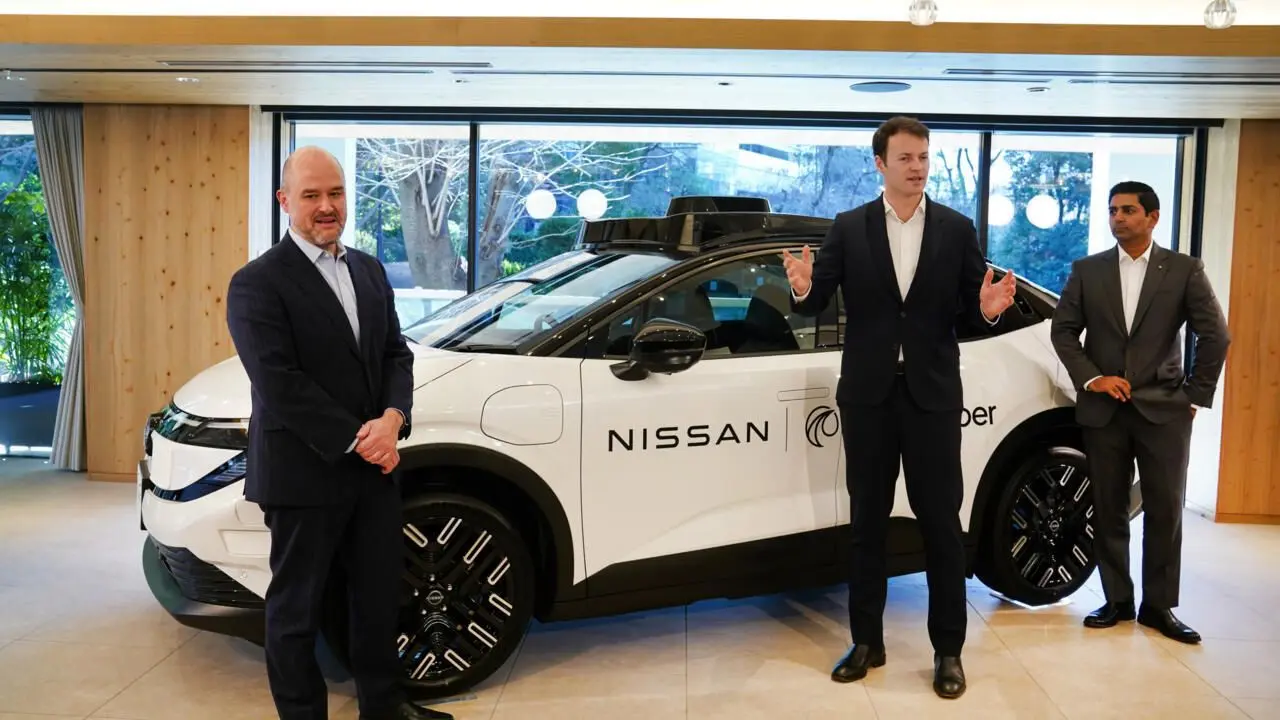
For Nissan, this partnership deepens an existing relationship with Wayve. The automaker has been integrating Wayve's AI into its next-generation ProPILOT driver-assistance system, with first consumer vehicles expected in fiscal year 2027
2
. The Tokyo pilot program serves as a commercial proving ground for technology that Nissan plans to embed in mass-market cars. "Our work with Wayve to integrate advanced AI technology across our consumer vehicle portfolio has laid strong foundations," said Nissan president and CEO Ivan Espinosa4
.
Source: France 24
Navigating Japan's Regulatory Landscape
For Uber, Japan has long been a complicated market due to the country's strict taxi licensing regime. The company operates there primarily through a licensed-partner model rather than the direct driver network it uses elsewhere
2
. Uber intends to launch the service through a licensed taxi partner in Japan and is currently in the process of selecting one2
. The robotaxi partnership sidesteps structural constraints, as autonomous vehicles operated through a licensed taxi company fit more neatly into Japan's regulatory framework.The late-2026 timeline remains subject to discussions with relevant authorities, a caveat that carries significant weight in Tokyo. While Japan has developed a relatively permissive legal framework for autonomous vehicle testing, commercial deployment at scale requires ongoing engagement with national and municipal regulators
2
. Japan's safety culture means any incident during the pilot phase would draw intense scrutiny. If Wayve's AI Driver can establish a credible safety record in Tokyo traffic, the argument for deploying it elsewhere becomes considerably harder to resist2
.Uber CEO Dara Khosrowshahi framed the collaboration as part of a longer-term commitment: "Autonomous mobility is becoming an increasingly important part of the Uber platform. We look forward to expanding into Tokyo and introducing new, modern ways to travel in some of the world's largest cities"
2
. The company has signed deals with several other robotaxi firms, including Waymo, Weride, and Apollo Go, positioning itself to be the leading provider of robotaxi services by 20295
. Another company backed by Uber, Nuro, will also test its vehicles on Tokyo's challenging streets soon, having trialed its self-driving tech in the US for years1
.References
Summarized by

Navi
[1]
[2]
[4]
Related Stories
Nuro tests autonomous vehicle tech on Tokyo streets in first international deployment
11 Mar 2026•Technology

Waymo's Global Leap: Autonomous Vehicles Set to Navigate Tokyo's Streets in 2025
17 Dec 2024•Technology

Uber accelerates robotaxi expansion with Zoox and Nvidia partnerships across 28 cities
11 Mar 2026•Technology
Recent Highlights
1
Google releases Gemma 4 with Apache 2.0 license, enabling unrestricted local AI on devices
Technology

2
AI Models Lie and Deceive to Protect Other AI Models From Deletion, Study Reveals
Science and Research

3
OpenAI closes $122 billion funding round amid fierce AI competition and profitability questions
Startups

Recent Highlights
Today's Top Stories







Your Daily Dose of Curated AI News
Don’t drown in AI news. We cut through the noise - filtering, ranking and summarizing the most important AI news, breakthroughs and research daily. Spend less time searching for the latest in AI and get straight to action.

