Nvidia caught between U.S. export controls and China's pushback as AI chip war intensifies


8 Sources
8 Sources
[1]
The Senate's new SAFE bill is set to curb access to advanced chips to China, but that won't slow down the AI war -- training workloads still heavily rely on Nvidia, while alternatives remain inefficient
A new bipartisan bill in the Senate could pause shipments, but there are ways around it. A new bipartisan bill in the U.S. Senate threatens to put the brakes on Nvidia's efforts to sell its latest AI-training hardware to Chinese customers, even as the Trump administration mulls allowing lower-powered versions of the hardware. China is looking to restrict access to this kind of hardware too, to favor domestic chip firms, which would harden its supply chains and reduce trading turbulence. However, with no real alternatives to Nvidia's GPUs for training hardware and numerous ways to circumvent sanctions, tariffs, and trade barriers, it's hard to imagine Nvidia completely exiting the region. Nvidia CEO Jensen Huang spent much of last week meeting with U.S. legislators, including President Trump and Republican members of the Senate Banking Committee, which oversees U.S. export control programs. Huang clearly wasn't persuasive enough, though, as now the proposed Secure and Feasible Exports Act (SAFE) bill would force the Commerce Department to halt export licenses for the sale of the latest chips to U.S. adversaries, including China and Russia, for 30 months. This ban could cover all existing chips and anything more powerful than them developed by any of the major companies over that same period. Although it primarily targets Nvidia's Blackwell GPUs, it would also cover Nvidia's last-generation Hopper designs, AMD's graphics chips, and Google's latest TPU designs. This is devastating news for Nvidia and many of its chip-manufacturing contemporaries. China is a massive market for hardware and AI development, but it's certainly not proven to be the most willing of markets. Chinese authorities have spent months pushing back on the on-again, off-again availability of Nvidia hardware by encouraging its domestic companies to use domestic chip suppliers where possible. It mandates that Chinese companies use at least 50% domestically produced hardware and, more recently, has claimed that new packaging and assembly techniques can close the performance gap between Nvidia and its local producers. Chinese chip firms have responded with gusto, too, announcing enormous plans to manufacture several times the chips they managed in 2025, as soon as next year. It's not clear if those plans will be physically possible in such a short time frame, but they're shooting for the moon nonetheless. But even if the companies can fabricate these chips, there's no guarantee they'll be used, despite the double-ended carrot-and-stick approach of both the U.S. and Chinese authorities. China has made major leaps in its AI hardware development over the past few years, particularly in the past year, as it's sought to build more reliable access to powerful AI hardware, while the U.S. turned the tap on and off at the whim of its mercurial commander-in-chief. These conditions have led Huawei to make tremendous advances and to design high-power systems that scale well, at the expense of efficiency. But that's mainly in the realm of inference, which is the day-to-day running of an AI algorithm after it has been fully trained. Nvidia's GPU versatility is particularly well-suited for AI training, and it has no real rival. There have been some semi-hyperbolic claims of a new Chinese chip design that leverages 3D hybrid bonding techniques, and is claimed to deliver performance comparable to 4nm Nvidia silicon in training workloads. Given the restrictions in place for China's access to EUV machines from ASML, it's an interesting area of expansion. It's not proven yet, and questions remain over its efficiency, how manufacturers would handle thermal dissipation - memory and compute bonded directly raises serious overheating concerns - and such a complicated design could lead to yield issues when produced at scale. But even if all the claims about this hardware prove true and it's indeed a relative competitor to Nvidia, why wouldn't the companies that need this hardware at scale right now not just keep using Nvidia anyway? When Deepseek developers were forced to use locally produced chips for training, they ended up switching back to Nvidia hardware because the performance just wasn't there. Despite all the blocks and barriers from various governments and organizations, it hasn't been too difficult for companies to allegedly get their hands on. Singaporean companies have been used to allegedly circumvent trade blocks, and leasing computing power from international partners effectively allows Chinese national companies to use whatever hardware they like. There are always mules willing to help get the hardware across the border for a fee, too. So, even if new barriers are put in place to make it harder for Nvidia to ship hardware to China, it will probably still happen. It's better for training than anything Chinese producers can make, it's still readily available, albeit through ever-more convoluted routes, and the companies that want the hardware are trying to compete with markets that have better access to it. As Deepseek 3.2's latest whitepaper shows, the race for AGI is now entering the stage where those with the best pre-training compute might push ahead with breakthroughs. Now, the AI race is turning into a question of scale, regardless of who is making the chips.
[2]
China does not need Nvidia chips in the AI war -- export controls only pushed it to build its own AI machine. | Fortune
But they are wrong. These arguments assume that China cannot succeed in AI without access to these advanced AI chips, which is not the case. Advanced AI chips simply reduce the cost of AI. Today's state-of-the-art AI models require a large number of AI chips to build and run. An advanced chip has higher performance; therefore, fewer are needed to achieve the same AI performance. But AI costs can be reduced in other ways. As DeepSeek showed, clever software and algorithm design can dramatically reduce the number of AI chips needed. China's decision to open-source its AI models particularly allows it to leverage the best software and algorithms to reduce AI costs. Second, AI chips constitute only part of the overall costs. AI-based systems incur several other costs - engineering, data, software and licensing, regulations, energy, and infrastructure - where China has considerable cost advantages. Third, AI hardware performance depends greatly on packaging and interconnection - how AI chips are put together and connected. China can leverage its world-class strengths in both to achieve high performance. Recently announced Huawei SuperClusters are more powerful than any Nvidia system, despite not using the most advanced AI chips. Advanced chips also reduce the power cost of AI. These chips are manufactured using the latest technology from TSMC (and sometimes Samsung) - each new technology is more energy efficient than the last. High power consumption of an AI system worsens monetary cost and the speed of deployment since fast access to a large amount of power is challenging, especially in the U.S. However, China is growing its power supply much faster than the U.S. and is much more likely to successfully serve the power demands of its AI data centers, even if they consume more power due to lack of access to advanced AI chips. High power also leads to greater carbon footprint, but it should not limit Chinese ambitions in any technology it considers important. Besides, many AI applications do not need advanced chips. Several applications in network security, facial recognition, medical image analysis, advanced driver assistance systems (ADAS), logistics, and robotics can be handled using AI models much simpler than state-of-the-art models. These models can be built and run on chips that China can produce itself. China aims to dominate these applications. Even for more complex applications, recent work suggests that state-of-the-art models can be replaced by a collection of much simpler models. This collection does not need advanced AI chips to build and run. So, it is unclear if China will be left behind for these applications either. It is also not clear whether future development and use of state-of-the-art models will require advanced chips. There are signs that the benefits of state-of-the-art models are plateauing. Given the large investments these models require, future models may look different and use fewer resources, including chips. It will further level the playing field, even if access to advanced AI chips is controlled. There is also a possibility that China may learn how to produce advanced AI chips itself - it has certainly invested in several technologies with the potential to leapfrog past the state-of-the-art. Overall, China can significantly mitigate the disadvantages of not having access to advanced AI chips. Besides, China will be willing to absorb any higher upfront costs, especially for AI-based military and strategic technologies, since they know that they can reduce the downstream costs through scale and manufacturing strengths. Unsurprisingly, China continues to produce competitive state-of-the-art models and dominate AI-based applications such as robotics and autonomous vehicles despite the AI chip controls implemented over the last several years. The argument for AI chip controls may still make some sense - why not get the advantage of increasing AI development costs for China, however small, if there were no cost to it. But the costs are significant. China could have been one of the largest markets for U.S. advanced AI chip companies. The U.S. has lost the market. Second, AI chip controls have made this an issue of national pride and led to a wave of investments into a domestic AI chip ecosystem within China. It is unclear if the U.S. will ever regain market share even if chip controls are reversed. China has also retaliated in many ways - those measures have further hurt the U.S. economy and geopolitics. If the U.S. wants to lead in AI, chip controls are not the answer. Instead, it should focus on improving innovation, investment, energy, and regulatory ecosystems. It should make it easier for the best AI scientists in the world to live and work here. It should diversify, strengthen, and secure AI supply chains. It should work with allies to lead the development of international AI standards and practices. It should reduce the cost of AI (through selective open sourcing or public-private partnerships, for example) to ensure that American AI (alongside its values) is most pervasive. It should prioritize high-end and enterprise applications where the moat is wider against a talent and resource-rich fast follower that has cost and speed advantages. The value of AI chip controls is vastly exaggerated. These controls have barely slowed China down and caused significant economic and geopolitical damage to the U.S. It is time to abandon them and focus fully on maintaining and growing AI lead through innovation instead.
[3]
China wants an AI-powered military built with Nvidia chips, and that's a problem
Despite much speculation, President Trump did not allow China greater access to advanced AI semiconductors during his meeting with Chinese leader Xi Jinping at last month's Asia-Pacific Economic Cooperation summit. Although Trump balked in Seoul, he is reportedly considering greenlighting sales of advanced chips to Beijing. It would be a mistake, however, to expand the flow of one of the United States' most powerful strategic assets to China, especially with new evidence of the Chinese military's desire to harness advanced chips for battlefield advantage. Nvidia CEO Jensen Huang has played a central role in persuading Trump's team that the U.S. should promote its global leadership in AI by selling ever-more advanced semiconductors abroad. He has claimed that U.S. restrictions on the export of advanced semiconductors to China will only spur Beijing's capabilities across its domestic semiconductor supply chain. At the same time, he has argued that Chinese companies are only "nanoseconds" behind their U.S. competitors in designing and fabricating cutting-edge chips. He has repeatedly downplayed the risks of exporting advanced chips to China, claiming that that U.S. semiconductors will not enable China's military modernization. But our analysis suggests the opposite. We reviewed dozens of procurement documents published by the People's Liberation Army which reveal that the Chinese military is directly soliciting and using advanced U.S. chips, including those designed by Nvidia, to develop AI-enabled military capabilities. In addition, the PLA is deploying Chinese AI models trained using American hardware to advance its modernization and, eventually, gain a battlefield advantage over the U.S. These documents clearly state the PLA's intention to use Nvidia chips for a wide range of tasks. For example, one contract for an "intelligent optoelectronic target recognition system," which combines AI and sensors to automatically detect, identify and track militarily relevant objects, specifies the use of Nvidia computing resources. Another notice for the procurement of a server to help the Chinese military "perform AI algorithm calculations" and run large language models relies on Nvidia H100 GPUs -- a chip that was export controlled in 2022. A third document requests a cluster of Nvidia A800s, which are also controlled, for a "high-performance image algorithm training workstation," that would presumably be used to develop AI systems for image-processing tasks. Finally, one notice asks for "autonomous vehicles equipped with Nvidia's Jetson Orin chips," which provide the onboard computing power necessary to process visual information. To be sure, the PLA's procurement of Nvidia hardware is unlikely to make or break Beijing's military modernization ambitions. The Chinese military is still experimenting with AI applications, and there is little evidence that the export controls will dramatically shift the balance of power between the U.S. and China in the near term. But it is unrealistic to believe that the PLA will not use the world's most powerful AI chips to advance its military capabilities. China is requesting such technologies to develop emerging capabilities that would allow it to outcompete its adversaries. Indeed, authoritative Chinese documents indicate that Beijing believes the development and deployment of advanced AI-enabled military systems provides the best chance to catch up to or surpass the U.S. military. Beyond the contracts explicitly listing Nvidia products, we have seen hundreds of PLA contracts that reveal evidence of Beijing's investment in a wide range of AI-powered military capabilities. For example, the PLA is requesting systems that can generate, collect and analyze troves of battlefield data to quickly identify targets and accelerate decision-making cycles. Other documents feature requests for algorithms to power swarms of autonomous vehicles in the air, on the ground and at sea. Improved access to the world's preeminent computing hardware will only speed China's development of advanced systems that could be used against the U.S. military in a future conflict. But the risks of relaxing the controls are not solely limited to China's ability to acquire Nvidia chips. Just as important, Chinese frontier AI labs will be able to more easily acquire advanced computing hardware to train increasingly capable AI models, which can in turn power military activities. Various procurement documents indicate that China's military is adopting highly capable AI models, including those trained by DeepSeek. Some of the companies responsible for training these systems have noted that U.S. export controls are hampering their progress. While some Chinese companies are deploying their AI systems using domestically-produced chips, spurred in part by Beijing's directives, frontier model training still largely relies on Nvidia hardware. Chinese access to cutting-edge Nvidia chips will make it easier for companies like DeepSeek to develop more capable models that the PLA can then utilize. In ceding control over the chips that power the United States' AI lead, Washington would hand Beijing tools it wants to close the military gap. Export controls were meant to give the U.S. and its allies time to consolidate and build on their advantages in AI. Relaxing them makes it less likely that the U.S. will continue to lead in AI, which could have lasting national security implications. Sam Bresnick is a research fellow and an Andrew W. Marshall fellow at Georgetown University's Center for Security and Emerging Technology. Cole McFaul is a senior research analyst and an Andrew W. Marshall fellow at Georgetown University's Center for Security and Emerging Technology.
[4]
Investor Outlook: U.S. shift on Nvidia chip exports runs into China's pushback
The United States has approved exports of Nvidia's H200 artificial intelligence chips to China, marking one of the sharpest reversals in Washington's tech policy since restrictions tightened last year. The move comes as Beijing signals it will limit access to the processors, highlighting the fragile balance in U.S.-China technology relations. BNN Bloomberg spoke with Ivana Delevska, founder and CIO at Spear Investment, about the potential impact on Nvidia, developments in China's semiconductor ambitions and what the shift means for the broader AI investment cycle. Read the full transcript below: ROGER: U.S. President Donald Trump is allowing Nvidia to sell advanced chips to China, marking a shift in U.S. tech policy. High-end H200 chips are getting the green light, but China is set to limit access. Here to talk about that is founder and CIO of Spear Invest, Ivana Delevska. Ivana, thanks, as always, for joining us. IVANA: Well, Roger, just for background, Nvidia was expected to sell approximately US$17 billion to China this year. That got brought down to zero. So in the current analyst estimates, there is nothing really included for China. So versus that, it's a pretty significant incremental positive.Now, it does come with a lot of questions we don't know the answer to, and those are whether China will be encouraging the sales of these chips or discouraging them. And that's really what the market is a little uncertain about, in addition to the 25 per cent tariff. So it sounds like it may be a little bit too late for Nvidia to penetrate this market, but still, a lot of details to come. ROGER: I know we're already seeing China apparently considering limiting access -- you'd have to get a permit and explain why you need it. How detrimental would that be? IVANA: Well, Nvidia chips are very strong for general-purpose computing. So anytime you need Nvidia's CUDA software, there is really no better substitute for it. From that perspective, I think it would be in China's best interest to allow the sale of these chips.However, every time you have a situation where it's not really a free and open market, it's not as easy for the company to penetrate it. So I think it's not necessarily detrimental -- it's just not going to be a very big positive surprise for the stock.I think if they were able to really penetrate the market in a more free-market type way, China could be a really big opportunity for Nvidia. But thus far, with this sort of friction and tariffs, I don't know that we'll be able to see a meaningful impact in the numbers. And this is why you see the stock not really responding all that positively to the news. ROGER: Now, there are critics of Trump who are concerned this could help China win the AI war if they get these chips, because they're considered ahead when it comes to AI. Is that the case, or is China still a long way off? They're still a generation behind when it comes to chips -- is that holding them back? IVANA: Well, Roger, in our view, the way to win the war is with continued innovation. So it's really all about staying ahead on the innovation front rather than restricting sales.I don't necessarily think allowing the sales to China will accelerate China winning the war, because if they're not provided, then China would develop them internally. So at this point in time, Nvidia being the dominant platform would be a lot more beneficial to the U.S. versus China having its own chips developed internally.Just to provide some background here, at this point, many companies know how to make this chip -- so it's not really a secret. It's all about how quickly they can advance them and how quickly they can provide features that are beneficial to different use cases.We're really beyond the stage where Nvidia was the only game in town. You see competitive chips from TPUs, from Google or AWS chips, and the same with Chinese competitors. There are many alternatives to GPUs today. However, Nvidia still wins in that general-purpose computing. So if you're making these chips available broadly, the more likely you are able to establish dominance.If other companies or Chinese competitors develop this in-house, then they would obviously have that advantage. ROGER: Does this say anything about the bigger picture for AI and concerns about a bubble in the tech sector, or is this just the next move in this situation? IVANA: Well, I actually think all the developments we've seen over the past year have been very positive for the AI cycle, and I don't really see a bubble anywhere. If you look at Nvidia's valuation specifically, it's trading at the low end of its valuation range, and some of that is because of the concerns we highlighted earlier.But if you look at the sector more broadly, you're seeing a lot more innovation. You're seeing companies come to market. You're seeing a lot of benefits across the value chain. This is where we're finding the most investment opportunities -- companies in the networking space, whether it's on the electrical component side, optics, power generation. This is where the bottlenecks are today, and that's where most of the opportunities are.We disclose all of our holdings on our website, and you'll find some of these companies there. ROGER: There were concerns that if they didn't allow the chips to go in, China would catch up and build its own internal system. Is China catching up when it comes to chips? Will they be able to catch up? IVANA: Yes, absolutely. They're definitely catching up when it comes to chips. They're catching up on the hardware side. They're doing very well on the networking side. So that's another area where even if the chips themselves aren't performing as well, once they're connected as a system, they actually have pretty comparable performance.I think where Nvidia is really differentiated is in providing these frameworks that sit on top of the GPU. When you hear Jensen say even if we were to give away the chips, even if competitors were to give away the chips for free, our product would still be better -- that comes from these frameworks that are free and come along with the Nvidia chip.So I think Chinese competitors will catch up on the hardware or bare-metal performance side, but they're still going to be missing some of these frameworks, which are what allow competitors or new entrants to develop AI products quickly.
[5]

Chinese chipmakers extend losses after US moves to ease Nvidia export curbs By Investing.com
Investing.com-- Chinese chipmaking stocks extended losses on Wednesday after the U.S. moved to allow Nvidia (NASDAQ:NVDA) to resume exports of its advanced H200 artificial intelligence chips to "approved customers" in China. Shares of Hua Hong Semiconductor (HK:1347) declined 2.6%, while Semiconductor Manufacturing International Corp (SMIC) (HK:0981) slid 2% in Hong Kong trading. Both stocks declined more than 4% on Tuesday. Equipment suppliers also weakened, with NAURA Technology Group (SZ:002371) down nearly 2%. Cambricon Technologies (SS:688256) also declined over 2%. The decline also follows a Financial Times report on Wednesday that said Beijing had quietly added domestic AI chips from firms including Huawei to an official government procurement list for the first time. The move, the report said, is intended to expand the use of homegrown semiconductors across government agencies and state-owned firms and could generate billions of dollars in orders for local chip designers. While Nvidia sales will still require approvals and may face resistance from U.S. lawmakers and Chinese regulators, the move may give Chinese buyers breathing room and reduce the urgency to transition to domestic processors.
[6]
China promoted domestic AI chips before Nvidia move - FT By Investing.com
Investing.com-- China has added domestic artificial intelligence chips to an official government procurement list for the first time, to strengthen its tech sector ahead of Washington's easing of Nvidia (NASDAQ:NVDA) export curbs, the Financial Times reported on Wednesday, citing people familiar with the matter. According to the FT report, the Ministry of Industry and Information Technology recently included AI processors from Chinese groups such as Huawei and Cambricon on the government-approved supplier list. The step is designed to boost the use of domestic semiconductors across China's public sector and could generate billions of dollars in sales for local chipmakers, the report said. The FT said the guidance was circulated before U.S. President Donald Trump announced plans to permit Nvidia to ship its advanced H200 chips to "approved customers" in China, though political pushback in both countries could still restrict those sales. Several agencies and state-owned companies have already received the unpublished procurement list, marking the first time they have been given written instructions to prioritise domestic suppliers, the FT reported. The move underscores Beijing's push to cut reliance on U.S. technology as it accelerates investment in homegrown chips.
[7]
Nvidia H200 Exports to China Reshape AI Investment | Investing.com UK
The decision by the Trump administration to allow Nvidia to export its advanced H200 artificial intelligence chips to approved customers in China marks a clear turning point for global AI investing. This move reshapes how capital markets must think about capability, competition, and long-term value creation across sectors. AI leadership has never depended on chips alone, but access to top-tier computing power still sets the pace. The H200 sits at the high end of that spectrum, enabling faster model training, larger workloads and quicker iteration. Allowing broader access to this level of computing changes how quickly advanced AI can spread through the global economy. Investors should view this less as a political signal and more as an acceleration event. Limits that once slowed development timelines now loosen. Cost curves shift. Competitive gaps narrow sooner than expected. Recent experience already points in this direction. Chinese developers built capable AI systems using deliberately constrained hardware such as Nvidia's H20. Models like DeepSeek proved that weaker chips did not block progress. Algorithmic optimisation, enormous datasets, and deployment scale compensated for reduced performance. DeepSeek mattered because it demonstrated capability rather than potential. Progress occurred despite constraints, not because of them. Removing part of that friction increases speed, not direction. This matters for investors assessing how competition evolves once those limits ease. Development cycles shorten. Testing becomes cheaper. Iteration accelerates. Firms that already showed ingenuity under constraint gain room to scale faster. Short-term market reactions tend to centre on revenue. Expanded access to Chinese demand creates immediate upside for chipmakers and parts of the broader technology sector. Earnings visibility improves. Margins benefit. Share prices respond. Markets often stop there. Longer-term investors cannot. Wider access to advanced computing expands the pool of serious AI competitors across multiple industries. Autonomous driving, advanced manufacturing, logistics optimisation, healthcare analytics, and defence-linked technologies all depend on large-scale AI systems. Faster convergence increases rivalry across each of these areas. Leadership advantages diminish when capability becomes more widely available. Valuation premiums based on assumed technological distance come under pressure. Markets shift focus from exclusivity to execution. AI development follows economics. Compute, data, and capital decide outcomes more reliably than geography. Players able to combine those inputs efficiently advance the fastest. China's AI ecosystem introduces specific economic traits into this equation. Large domestic datasets, rapid deployment cycles, and a willingness to trade efficiency for capability shape competitive outcomes differently from those seen in US or European markets. Neither model is inherently superior. Each creates different advantages and risks for investors. Looking further ahead, faster global diffusion of AI capability affects how productivity gains, automation benefits, and cost reductions distribute across the economy. AI touches nearly every sector. Broadening access reduces scarcity value. Excess returns shrink when tools equalise. Markets then reward implementation, business models, and operational discipline rather than presumed dominance. Portfolio construction must adjust. Concentration risk rises when too much capital rests on continued leadership by a narrow group of firms. Broader AI capability increases dispersion in outcomes, creating more winners and losers within the same sector. Investors benefit from recognising transition phases early. AI increasingly resembles an industrial technology rather than a gated advantage. Competitive landscapes reset when that shift accelerates. Policy debates over export controls often frame the issue in binary terms. Supporters argue that restrictions preserve the advantage. Critics argue they distort markets and slow innovation. Investors gain little from picking sides. Markets respond to incentives, not intentions. Policy choices alter cost structures, timelines, and competitive behaviour. Capital reallocates accordingly. Approval of H200 exports accelerates an evolution already underway. AI moves closer to becoming a widely deployable input rather than a tightly held differentiator. Speed, scale and execution replace access as the main variables. Historical inflection points in markets rarely announce themselves loudly. Many appear technical, incremental or commercially rational in isolation. Significance becomes clear only with time. This decision fits that pattern. Short-term benefits dominate headlines. Medium-term competition intensifies quietly. Long-term leadership assumptions deserve re-examination. Investors looking beyond immediate earnings should focus less on who sells the chips and more on who uses them best. The next phase of AI investing rewards those who understand how quickly advantage now moves. Global capital always adapts. This shift simply changes the pace.
[8]
Chinese chipmaking stocks fall on US move to permit Nvidia H200 shipments By Investing.com
Investing.com-- Shares of major Chinese chip-making companies fell on Tuesday after the U.S. said it will allow Nvidia (NASDAQ:NVDA) to ship its H200 artificial-intelligence chips to China, a move seen by investors as a blow to domestic semiconductor outfits. Hong Kong-listed Hua Hong Semiconductor (HK:1347) dropped 4% in early trade, while Semiconductor Manufacturing International Corp (SMIC) (HK:0981) slid 3.6%. NAURA Technology Group (SZ:002371 shares fell 2%, while Meituan (HK:3690) stock declined 1.5%. The decision to green-light H200 exports could undermine demand for Chinese-made AI chips, complicating Beijing's push for semiconductor self-reliance. The sell-off comes despite assurances from Beijing that foreign chips will remain restricted in critical sectors.
Share
Share
Copy Link
The U.S. approved exports of Nvidia's H200 AI chips to China, reversing restrictive policies, but Beijing is limiting access to favor domestic alternatives. A new Senate bill could halt shipments for 30 months, while evidence shows the People's Liberation Army uses Nvidia hardware for military applications. The escalating tensions highlight the complex geopolitical frictions reshaping the global semiconductor supply chain.
U.S. Approves Nvidia H200 Chips to China as Policy Shifts
The United States has approved exports of Nvidia's H200 artificial intelligence chips to China, marking a sharp reversal in Washington's tech policy
4
. This decision comes after Nvidia CEO Jensen Huang spent much of last week meeting with U.S. legislators, including President Trump and Republican members of the Senate Banking Committee1
. The move represents a significant shift for Nvidia, which was expected to sell approximately $17 billion worth of chips to China this year before restrictions brought that figure down to zero4
. Current analyst estimates include nothing for China sales, making this approval an incremental positive, though it comes with considerable uncertainty around tariffs and market access.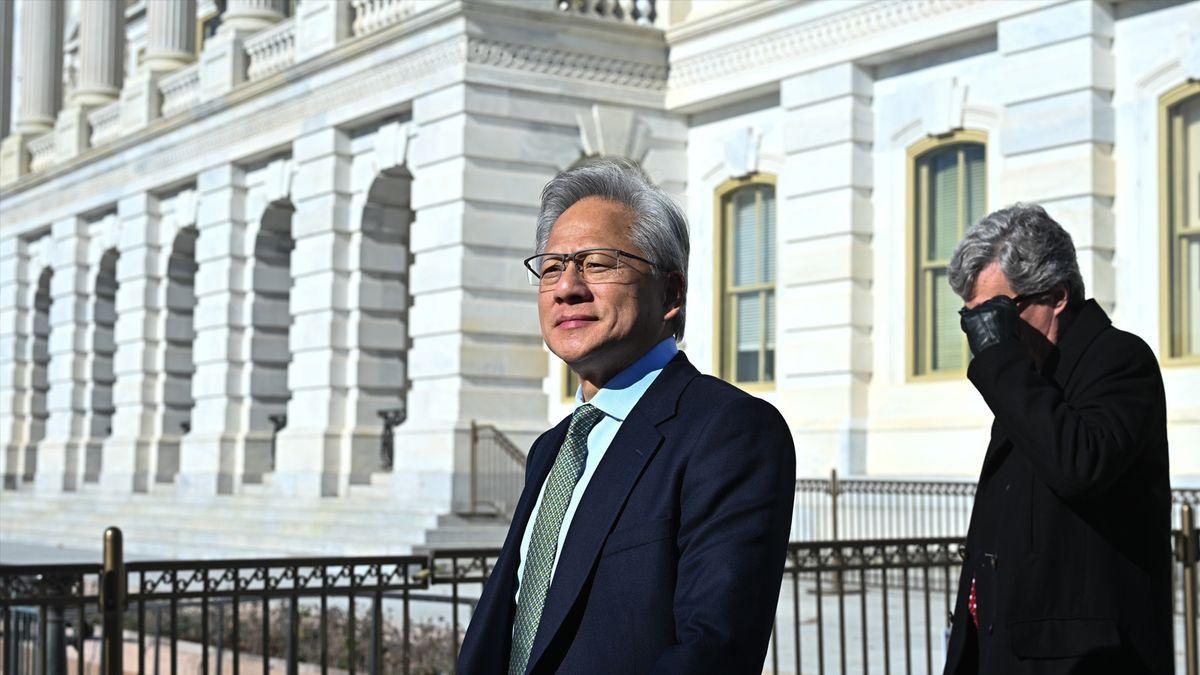
Source: Tom's Hardware
China Limits Access Despite U.S. Approval
Beijing is signaling it will limit access to the advanced AI chips, requiring permits and explanations for purchases
4
. Chinese authorities have spent months pushing back on the on-again, off-again availability of Nvidia hardware by encouraging domestic companies to use domestic chip suppliers where possible, mandating that Chinese companies use at least 50% domestically produced hardware1
. Beijing has quietly added domestic AI chips from firms including Huawei to an official government procurement list for the first time, a move intended to expand the use of homegrown semiconductors across government agencies and state-owned firms that could generate billions of dollars in orders for local chip designers5
. Chinese chipmaking stocks extended losses, with Hua Hong Semiconductor declining 2.6% and SMIC sliding 2% in Hong Kong trading5
.Senate SAFE Bill Threatens 30-Month Export Ban
Despite the recent approval, the proposed Secure and Feasible Exports Act (SAFE) bill would force the Commerce Department to halt export licenses for the sale of the latest chips to U.S. adversaries, including China and Russia, for 30 months
1
. This ban could cover all existing chips and anything more powerful developed by major companies over that period. Although it primarily targets Nvidia's Blackwell GPUs, it would also cover Nvidia's last-generation Hopper designs, AMD's graphics chips, and Google's latest TPU designs1
. This represents devastating news for Nvidia and many chip-manufacturing contemporaries, as China remains a massive market for hardware and AI development.Military Modernization Concerns Drive Export Controls
Analysis of dozens of procurement documents published by the People's Liberation Army reveals that the Chinese military is directly soliciting and using advanced U.S. chips, including those designed by Nvidia, to develop AI-enabled military capabilities
3
. One contract for an "intelligent optoelectronic target recognition system" specifies the use of Nvidia computing resources, while another notice for server procurement to help the Chinese military "perform AI algorithm calculations" relies on Nvidia H100 GPUs, a chip that was export controlled in 20223
. The PLA is requesting systems that can generate, collect and analyze troves of battlefield data to quickly identify targets and accelerate decision-making cycles, with other documents featuring requests for algorithms to power swarms of autonomous vehicles3
. Authoritative Chinese documents indicate that Beijing believes the development and deployment of advanced AI-enabled military systems provides the best chance to catch up to or surpass the U.S. military3
.Training Workloads Still Depend on Nvidia Hardware
Nvidia's GPU versatility is particularly well-suited for AI training, and it has no real rival in this domain
1
. When DeepSeek developers were forced to use locally produced chips for training, they ended up switching back to Nvidia hardware because the performance just wasn't there1
. Frontier model training still largely relies on Nvidia hardware, and Chinese access to cutting-edge Nvidia chips will make it easier for frontier AI labs to acquire advanced computing power to train increasingly capable AI models3
. Nvidia chips are very strong for general-purpose computing, and anytime you need Nvidia's CUDA software, there is really no better substitute4
.
Source: BNN
Related Stories

China Advances Domestic Chip Alternatives Despite Efficiency Gaps
China has made major leaps in its AI hardware development over the past year as it sought to build more reliable access to powerful AI hardware while the U.S. turned the tap on and off
1
. These conditions have led Huawei to make tremendous advances and design high-power systems that scale well, at the expense of efficiency1
. Recently announced Huawei SuperClusters are more powerful than any Nvidia system, despite not using the most advanced AI chips2
. China claims that new chip packaging and assembly techniques can close the performance gap between Nvidia and its local producers1
. Chinese chip firms have announced enormous plans to manufacture several times the chips they managed in 2025 as soon as next year1
.Geopolitical Frictions Reshape Semiconductor Supply Chain
U.S. export controls have made this an issue of national pride and led to a wave of investment into a domestic AI chip ecosystem within China
2
. It's unclear if the U.S. will ever regain market share even if chip controls are reversed, as China has also retaliated in many ways that have further hurt the U.S. economy and geopolitics . The U.S. has lost what could have been one of the largest markets for advanced AI chip companies . Despite all the blocks and barriers from various governments and organizations, it hasn't been too difficult for companies to allegedly get their hands on Nvidia hardware, with Singaporean companies allegedly used to circumvent trade blocks, and leasing computing power from international partners effectively allowing Chinese national companies to use whatever hardware they like1
. The way to win the AI war is with continued innovation rather than restricting sales, as staying ahead on the innovation front matters more than limiting market access4
.References
Summarized by

Navi
Related Stories
Huawei Challenges Nvidia's AI Chip Dominance with New Ascend 920 Processor
29 Apr 2025•Technology

Nvidia China market share plummets to 55% as Chinese chipmakers capture 41% with 1.65 million AI GPUs
01 Apr 2026•Business and Economy
Trump approves Nvidia H200 exports to China with 25% revenue cut, sparking national security debate
04 Dec 2025•Policy and Regulation
Recent Highlights



Recent Highlights
Today's Top Stories












Your Daily Dose of Curated AI News
Don’t drown in AI news. We cut through the noise - filtering, ranking and summarizing the most important AI news, breakthroughs and research daily. Spend less time searching for the latest in AI and get straight to action.

