Nvidia Reports Record $57B Revenue as CEO Dismisses AI Bubble Concerns


84 Sources
84 Sources
[1]
Nvidia's record $57B revenue and upbeat forecast quiets AI bubble talk | TechCrunch
Nvidia founder and CEO Jensen Huang struck a bullish tone in the company's third-quarter earnings. And based on the company's results, there may be a reason to. Nvidia reported revenue of $57 billion during its fiscal third quarter, 62% higher compared to the same quarter last year. The company's net income on a GAAP basis was $32 billion, 65% higher year-over-year. Both revenue and profit results beat Wall Street expectations. The revenue picture shows a company booming thanks largely to its data center business. Revenue generated by Nvidia's data center business was a record $51.2 billion, up 25% from the previous quarter and up 66% from a year ago. Nvidia's chief financial officer Colette Kress noted in a statement to shareholders its data center business has been fueled by an acceleration of computing, powerful AI models, and agentic applications. During the company's earnings call, Kress said there was an aggregate sale of 5 million GPUs. "This demand spans every market, CSPs, sovereigns, modern builders enterprises and super computing centers, and includes multiple landmark build outs," Kress said. Blackwell Ultra, a GPU unveiled in March and available in several configurations, has been particularly strong and is now the leader within the company. Previous versions of the Blackwell architecture also saw continued strong demand, according to the company. Huang said sales of its Blackwell GPU chips "are off the charts." "Blackwell sales are off the charts, and cloud GPUs are sold out," Huang said in the company's Q3 earnings statement. "Compute demand keeps accelerating and compounding across training and inference -- each growing exponentially. We've entered the virtuous cycle of AI. The AI ecosystem is scaling fast -- with more new foundation model makers, more AI startups, across more industries, and in more countries. AI is going everywhere, doing everything, all at once." Importantly, Nvidia is forecasting more growth with a projected revenue of $65 billion in the fourth quarter, helping push its share price up more than 4% in after-hours trading. The upshot, at least in Huang's view: Forget about the bubble, there is only growth.
[2]
Nvidia CEO Dismisses Concerns of an AI Bubble. Investors Remain Skeptical
Nvidia CEO Jensen Huang didn't need any prompting on Wednesday to address the elephant in the room. "There's been a lot of talk about an AI bubble," he said on an earnings call before quickly getting to his main point: "From our vantage point, we see something very different." Huang went on to spend about five minutes trying to explain how the chipmaker, which has soared to become the world's most valuable publicly traded company over the past three years, would be able to sustain unprecedented customer demand. His thesis is that AI is taking over the world, and Nvidia chips will be sorely needed to power that technological revolution underway. "All industries, across every phase of AI, across all of the diverse computing needs in a cloud, and also from cloud to enterprise to robots," will need Nvidia's products, Huang said. The CEO's pep talk ultimately drew mixed reactions from Wall Street. Nvidia shares have fallen about 10 percent in recent weeks after hitting an all-time high in late October. Shares budged up about 5 percent in after hours trading on Wednesday after Nvidia reported record quarterly sales and Huang made his anti-bubble comments. But the increase was not enough to fully make up for the recent selloff. Nvidia has enjoyed three years of booming success since OpenAI debuted ChatGPT and caused a massive surge in demand for the company's GPUs, which are used to train and operate generative AI systems. Nvidia dominates the global market for GPUs, and its latest releases have become highly sought after with demand far exceeding supply. On Wednesday, Nvidia executives reiterated that it has about $500 billion in unfilled orders. The company has used its newfound wealth to buy back its own shares and invest billions of dollars in AI companies, including top users and customers of its chips such as ChatGPT developer OpenAI, data center operator CoreWeave, and Elon Musk's xAI, which develops the chatbot Grok. Nvidia's deals have fueled concerns among some investors that the company is unsustainably propping up sales. AI industry executives contend that partnering closely with Nvidia is crucial for getting access to chips and technical support, and that their revenues will eventually increase enough to fund their GPU purchases. On Wednesday's call, Huang addressed a financial analyst's question about the rationale for investing in companies such as OpenAI. "The partnership that we have with them is one so that we could work even deeper from a technical perspective, so that we could support their accelerated growth," Huang said. "I fully expect that investment to translate to extraordinary returns."
[3]
Nvidia says its AI GPUs are sold out, grows data center business by $10B in a single quarter
Nvidia just sold more AI chips than it's ever sold before, blowing past its estimates in its Q3 2026 earnings. Not only did it pull in a record $57 billion in revenue -- and roughly $4,000 of pure profit per second -- it grew its data center business by $10 billion in a single quarter alone. It reported a record $51.2 billion from that data center business, a 66 percent increase over last year. A lot of eyes are on Nvidia's data center revenue right now as a bellwether for the "AI bubble" as a whole. Nvidia doesn't seem to expect its data center growth to slow down despite fears of that bubble popping -- its Q4 outlook is a whopping $65 billion, which would require it to grow quarterly revenue by another $8 billion in just three more months. Nvidia CEO Jensen Huang says the company's selling every AI server chip it can make: "Blackwell sales are off the charts, and cloud GPUs are sold out." Nvidia adds that its Blackwell Ultra chip is driving the bulk of that: "Blackwell Ultra is now our leading architecture across all customer categories while our prior Blackwell architecture saw continued strong demand." Additionally, gaming revenue is up 30 percent year-over-year, a good sign for Nvidia's Blackwell gaming chips, which got off to a bit of a rocky start with some mixed reviews of the RTX 50-series GPUs earlier this year. We're listening to Nvidia's investor call right now and will update you if there are additional notable details we hear.
[4]
Nvidia's revenue skyrockets to record $57 billion per quarter - all GPUs are sold out
Nvidia on Wednesday announced its financial results for the third quarter of its fiscal year 2025, once again beating its own sales records as all its data center GPUs were sold out during the quarter. The company's earnings totaled $57 billion as sales of all the company's products -- except gaming GPUs -- were up. Nvidia does not expect its revenue growth to stop, so it models that its revenue will hit $65 billion in Q4 FY2026 and the company expects sales of its Blackwell and Rubin GPU platforms to hit $0.5 trillion by the end of calendar 2026. Nvidia's GAAP revenue reached $57.006 billion, up 62% year-over-year and 22% quarter-over-quarter, in the third quarter of the company's fiscal year 2026. The company's net income hit $31.91 billion, a 65% increase compared to Q3 FY2025, while its gross margin totaled 73.4%, up 1% sequentially, but down 1.2% YoY. Nvidia's data center business delivered a rather whopping $51.215 billion revenue in Q3 FY2026, rising 66% year-over-year and 25% sequentially. Within the segment, compute revenue -- consisting of CPU and GPU sales -- reached $43 billion, as Blackwell and Blackwell Ultra platforms were adopted by all major clients, including cloud hyperscalers, enterprise AI, sovereign AI projects, and industrial. Networking revenue totaled $8.2 billion, up an extraordinary 162% year-over-year as customers purchased more networking hardware while switching to rack-scale solutions from individual AI servers or even standalone GPUs. "Blackwell sales are off the charts, and cloud GPUs are sold out," said Jensen Huang, founder and CEO of Nvidia. "Compute demand keeps accelerating and compounding across training and inference -- each growing exponentially. We have entered the virtuous cycle of AI. The AI ecosystem is scaling fast -- with more new foundation model makers, more AI startups, across more industries, and in more countries. AI is going everywhere, doing everything, all at once." Nvidia's gaming segment generated $4.265 billion in the third quarter of the fiscal year, rising 30% YoY but slipping 1% sequentially, which was a surprise. Nvidia said that channel inventories normalized ahead of the holiday season, though normally sales of GPUs are the strongest in the third quarter, so it looks like there were other factors affecting sales of graphics cards. Nonetheless, at $4.265 billion, Nvidia's Q3 of FY2025 is the company's second best quarter for consumer GPUs ever, so one of the explanations is that the market has peaked for the company at this time. While sales of GeForce RTX graphics cards were so strong in Q2 and Q3 that they could no longer grow, sales of professional vizualization solutions increased to $760 million, rising 56% year-over-year and 26% sequentially and setting an all-time record for Nvidia and probably the whole industry. The improvement was driven primarily by the launch and ramp of the DGX Spark AI workstation platform and increased demand for Blackwell-based professional GPUs used in CAD, CAM, DCC, and various emerging creative workflows. Nvidia's Automotive and Robotics revenue reached $592 million in Q3 FY2026, increasing 32% year-over-year and 1% sequentially, which was driven by continued adoption of the company's self-driving platforms. During the quarter Nvidia announced that its next-generation Drive AGX Hyperion 10 Level 4-capable vehicle platform has been adopted by major partners, including Uber, so expect this segment to become even more important for the company going forward. The OEM and Other segment recorded $174 million in revenue for the third quarter, up 79% year-over-year and 1% sequentially. Nvidia expects another quarter of strong growth ahead of it, so it guides revenue to $65 billion ±2% and GAAP gross margin of 74.8%. These results will be primarily driven by continued adoption of Blackwell and Blackwell Ultra platforms by various customers in the West. It is noteworthy that the company said nothing about sales of its AI GPUs to China, perhaps reflecting sentiment that this market has largely been lost for now.
[5]

Nvidia Q3 earnings show it's good time to be AI arms dealer
Nvidia kicked the can labeled "AI bubble" down the road on Wednesday. "There's been a lot of talk about an AI bubble," said CEO Jensen Huang during the AI arms dealer's third-quarter earnings call. "From our vantage point, we see something very different." Huang marked the occasion by noting, in a statement, that "Blackwell sales are off the charts, and cloud GPUs are sold out." Recent high-profile sales of Nvidia stock by Peter Thiel's hedge fund and by Softbank raised concern among investors about the GPU maker and the health of the AI boom. The company reported revenue of $57 billion, an increase of 22 percent from the previous quarter and an astonishing 62 percent from the year-ago quarter. It maintained this growth with a GAAP gross margin of 73.4 percent. That kind of margin is rarely seen outside monopolies such as Microsoft's Windows back before the mobile boom changed the addressable market for operating systems, and Google's search business in more recent years. Nvidia's continued growth suggests doubters have abandoned the ship prematurely. And it now appears the tech-dependent US economy still has some upside potential. One of the concerns related to Nvidia has more to do with its customers than the company itself. Noted investor Michael Burry has argued that companies like Oracle and Meta are understating the depreciation of their Nvidia GPUs, an accounting practice that distorts the market value of these firms. Treating Nvidia GPUs as if they will remain commercially useful for more than two or three years reduces annual costs, pushes paper profits higher, and generally makes financial statements look better. Nvidia's product cycle is faster than that: In 2023, the company said in an investor presentation [PDF] that it would shift "from two-year rhythm to one-year rhythm." So it would seem to be difficult to justify long depreciation schedules for the Nvidia kit. The lion's share of Nvidia's revenue came from the company's data center business, which reached $51.2 billion, an increase of 25 percent from Q2 and 66 percent from a year ago. Huang argued demand will continue to grow, as generative AI is shifting the work that hyperscalers used to do on CPUs over to GPUs. There were some small speckles of doubt in the earnings report, particularly around the circular deals that are arguably helping to prop up the AI boom. While Nvidia in September celebrated its intent to "invest up to $100 billion in OpenAI" as part of a data center partnership, the risk boilerplate in the GPU maker's form 10-Q filing [PDF] makes that deal sound less certain. "In the third quarter of fiscal year 2026, we entered into a letter of intent with an opportunity to invest in OpenAI," the filing says. "In November 2025, we entered into an agreement, subject to certain closing conditions, to invest up to $10 billion in Anthropic. There is no assurance that we will enter into definitive agreements with respect to the OpenAI opportunity or other potential investments, or that any investment will be completed on expected terms, if at all." ®
[6]

Nvidia's AI supremacy is a weapon that cuts both ways
It's hard to overstate how unlikely it is that a business with almost $200bn of annual revenue would grow at a rate of over 60 per cent. Yet such are the fantastical finances of Nvidia. The chipmaker that dominates artificial intelligence continued to break all the rules that apply to large companies with its quarterly earnings on Wednesday. Investors who try to predict how long this can persist do so at their peril. Nvidia is selling every piece of silicon it can make today, and piling up orders for those it plans to make tomorrow. Every indicator worth watching is therefore going up. The company breezed through analysts' estimates of sales and profit in its latest quarter. Founder Jensen Huang had previously predicted $500bn of sales from Nvidia's newer ranges of chips over 2025 and 2026; his finance chief now expects to beat that. The numbers go from wild to ridiculous. The $73bn growth in Nvidia's revenue over the past four quarters -- just the growth, mind -- is greater than an entire year's revenue at Morgan Stanley or IBM. When Google's top line was last increasing at the pace Nvidia's is now, the search engine operator had a $150bn market capitalisation, whereas Nvidia's is $4.5tn. Such momentum at such scale is unprecedented. To some, this might seem like proof of a bubble. Huang acknowledged as much in a call with analysts on Wednesday. He doesn't agree, naturally. Like many AI boosters, he argues that understanding of what AI can achieve is only in its infancy. As users experience the miracles of "agentic" and "physical" AI -- the latter including robots and driverless cars -- revenue will surely justify the trillions of dollars being invested now. In fairness, Nvidia's freakish performance isn't itself proof of a bubble. Rather, it's evidence that being a virtual monopoly pays. The company has a 90 per cent hold over the market for AI chips, and a 73 per cent gross profit margin, indicative of unearthly pricing power. Moreover, this is the kind of monopoly no antitrust regulator would ever want to hobble, because the entire developed world is now dependent on Nvidia's chips. Yet the very real demand for what Huang is selling does in no way prove that there isn't a bubble. After all, Nvidia's value really depends on what happens years from now, when supply and demand could look very different. How many data centres will still be being built 10 years hence? With whose chips? At what kind of profit margin? Estimates vary widely. As an illustration, assume Nvidia gets about two-thirds of what it costs to build a data centre, as Huang claims, and protects its 90 per cent market share. Based on Citigroup's generous estimate of $7.8tn of AI investment between now and 2030, that's $4.6tn of total revenue. But use McKinsey's less bullish estimate of $5.2tn of investment, and say Nvidia's market share slips to 70 per cent, the lump of future revenue almost halves, to $2.4tn. One thing that is certain: while Nvidia is the AI boom's big winner, it is singularly exposed to changing expectations. That makes it different from, say, Microsoft or Google, or any other company operating in a more competitive part of the market. They can still be relative winners so long as they can win share from weaker rivals. Nvidia's supremacy in chips means that if a correction does come, Huang has nowhere to hide.
[7]

Nvidia earnings takeaways: Bubble talk, 'half a trillion' forecast and China orders
Nvidia said it expects about $65 billion in sales in the current quarter, which ends in late January. That would be 65% growth on an annual basis. On Wednesday's earnings call with analysts, Huang began his comments by rejecting the premise of an "AI bubble" held by some investors who are concerned about the billions of dollars being spent on Nvidia chips and potential return on investment. "There's been a lot of talk about an AI bubble," Huang said. "From our vantage point, we see something very different." Huang said there were three different kinds of uses for AI that are currently growing, and that all three are contributing to the boom in infrastructure investments. He said that non-AI software, like for data processing, was increasingly being run on the company's GPUs, that AI will create new kinds of apps, and that "agentic AI" which doesn't need user input, will require additional computing power. Huang said that people will soon start appreciating what's happening underneath the surface of the AI boom, versus "the simplistic view of what's happening to CapEx and investment." Bernstein analysts said in a note that Huang's comments helped settle investor fears of a bubble after a recent pullback in AI names, saying "perhaps the AI trade is not yet dead after all." "More than just good numbers, we believe investors needed some hand-holding from Jensen which he provided in spades," the analysts wrote.
[8]

Nvidia's earnings attest to its leadership in the AI race. By the numbers
Nvidia reported more eye-catching numbers for its fiscal third quarter Wednesday, with net income jumping 65% and revenue increasing 62% from a year earlier. Last month, Nvidia became the first public company to reach a market capitalization of $5 trillion. The ravenous appetite for the Silicon Valley company's chips is the main reason that the company's stock price has increased so rapidly since early 2023. Nvidia carved out an early lead in tailoring its chipsets known as graphics processing units, or GPUs, from use in powering video games to helping to train powerful AI systems, like the technology behind ChatGPT and image generators. Demand skyrocketed as more people began using AI chatbots. Tech companies scrambled for more chips to build and run them. Nvidia's journey to be one of the world's most prominent companies has produced some extraordinary numbers. Here's a look. Nvidia's net income for the third quarter, up from $19.3 billion a year ago. Nvidia stock's gain for the year, as of the close of trading Wednesday. That follows gains of 171% in 2024 and 239% in 2023. Nvidia's total market capitalization as of the close of trading Wednesday, tops in the S&P 500. Apple at $3.98 trillion and Microsoft at $3.62 trillion were next among the most valuable companies in the S&P 500. In all, nine companies in the index have market cap's above $1 trillion. The gross domestic product of Japan, the world's fourth largest economy, according to the International Monetary Fund. The number of trading days it took for Nvidia's market cap to grow from $4 trillion to $5 trillion earlier this year. The market cap had jumped from $3 trillion on May 13, to $4 trillion on July 9 (41 trading days), although Nvidia had crossed and fallen back below the $3 trillion threshold a number of times between June 2024 and May 2025 before making the run to $4 trillion. The company's contribution to the gain in the S&:P 500 this year as of Oct. 31, according to S&P Dow Jones Indices. The net worth of Nvidia CEO Jensen Huang, according to Forbes, putting him eighth on its Real-Time Billionaires List. Elon Musk is No. 1 at $467.7 billion.
[9]

Nvidia's $57 billion quarter shows the AI boom isn't slowing down, for now
Serving tech enthusiasts for over 25 years. TechSpot means tech analysis and advice you can trust. TL;DR: Nvidia's third fiscal quarter, which ended on October 26, 2025, not only surpassed the company's previous sales records but further cemented its position at the center of the artificial intelligence hardware ecosystem. The Santa Clara-based chipmaker reported $57 billion in GAAP revenue, a 62 percent increase year-over-year and a 22 percent sequential rise from the previous quarter. Gross margins reached 73.4 percent, remaining within a narrow and stable range quarter-over-quarter despite ongoing supply constraints at the high end and intense competition for GPU capacity. Nvidia's data center segment accounted for $51.2 billion, an extraordinary 66 percent increase year-over-year and a 25 percent sequential rise. Compute hardware - specifically Nvidia's Blackwell and Blackwell Ultra platforms - was in such high demand among hyperscale cloud providers, large enterprise AI deployments, and sovereign AI initiatives that the company effectively ran out of inventory throughout the quarter. Networking hardware contributed an additional $8.2 billion, a substantial increase from prior periods as the market continued shifting toward larger rack-scale AI systems and away from isolated server clusters. CEO Jensen Huang described the overwhelming demand as a reflection of the rapidly expanding AI ecosystem. He characterized GPU acceleration for both training and inference as "compounding," and expressed strong confidence in the durability of the current growth trajectory. Huang also addressed concerns about a potential "AI bubble." On the earnings call, he emphasized that Nvidia sees broad, diversified demand spanning cloud providers, industries, and global regions - not a speculative spike. He rejected comparisons to past technology cycles, including the dot-com era, arguing that Nvidia is being propelled by three simultaneous platform shifts: the widespread adoption of accelerated computing, the transformation driven by generative AI, and the rapid emergence of agentic and physical AI applications. "There's been a lot of talk about an AI bubble. From our vantage point, we see something very different," Huang said. Growth was not uniform across segments. Gaming GPUs generated $4.27 billion in revenue - a 30 percent year-over-year increase but slightly below the previous quarter. With consumer graphics demand peaking and inventories stabilizing ahead of the holiday season, the segment trailed Nvidia's strong performance elsewhere, though it still marked the company's second-best quarter on record for consumer GPUs. Professional visualization products - including the DGX Spark AI workstation and Blackwell-based GPUs for industrial workloads - reached $760 million, setting new industry benchmarks for workstation compute in fields such as CAD, digital content creation, and AI-driven design. Nvidia's acceleration since the release of OpenAI's ChatGPT has been central to the AI market's explosive expansion. The company now holds a commanding lead in the global GPU market, and executives cited more than $500 billion in outstanding orders for the Blackwell and Rubin platforms. Strategic corporate investments have also helped fuel Nvidia's growth. The company has repurchased its own shares and committed capital to AI firms that, in many cases, are also major customers - including OpenAI, CoreWeave, and Elon Musk's xAI. A growing number of partnerships - now including OpenAI competitor Anthropic - are integrating their generative AI platforms directly onto Nvidia hardware to deepen technical collaboration and accelerate workloads as AI applications diversify. Despite the optimism, some institutional investors have raised concerns about potential overextension. Their worries focus on the possibility of a slowdown if supply chain constraints or energy limitations hinder data center construction - a significant risk given that roughly 90 percent of Nvidia's revenue now comes from data center demand, a dramatic shift from its gaming-focused origins. Nvidia's guidance projects continued expansion, forecasting Q4 revenue of $65 billion, well above average analyst estimates. However, company leadership acknowledges that headline growth may begin to normalize, with annual revenue expansion expected to ease from recent triple-digit gains to roughly 64 percent in the next fiscal year.
[10]

Nvidia's Profit Jumps 65% to $31.9 Billion. Is It Enough for Wall Street?
The company, which makes the computer chips essential to the artificial intelligence boom, also said revenue in its recent quarter rose to $57 billion. Just three weeks ago, Nvidia became the first publicly traded company to be worth more than $5 trillion thanks to the cutting edge computer chips it makes for artificial intelligence. On Wednesday, Nvidia provided a reminder of just how much the world craves those chips. The company said that in its most recent quarter, its profit was $31.9 billion, up 65 percent from a year ago and 245 percent from the year before that. Among the tech industry's giants, only Google's parent company, Alphabet, made more money in the same quarter. Nvidia controls about 90 percent of the market for the chips used in A.I. projects, and its financial performance has become a bellwether for what can be expected of the rest of the tech industry, which is investing trillions of dollars in big data centers all over the world. Nvidia's eye-popping profits could be enough to calm nerves on Wall Street, where there are increasing concerns that lavish spending is getting way ahead of demand for the products and services Silicon Valley's engineers are building. The S&P 500 is down 3.6 percent since Nvidia, the most valuable publicly traded company in the world, hit its $5 trillion milestone. Shares of Nvidia have fallen 10 percent during that time, though they are still up 34 percent so far this year. Nvidia has experienced heady growth since the A.I. boom started three years ago, and the most recent quarter was no different. In the three months that ended in October, the company said sales of its chips for A.I. data centers rose 44 percent to $51 billion. The business helped lift the company's total revenue to $57 billion, eclipsing Wall Street's expectations for sales of $55.2 billion. Importantly, Nvidia also provided hints that a company with a stranglehold on an essential product can continue growing fast, even as total sales mushroom. Nvidia's revenue in the current quarter is projected to rise 65 percent from a year ago to $65 billion, in line with recent quarters. The forecast blew past Wall Street's forecast for sales of $57 billion. "Blackwell sales are off the charts, and cloud GPUs are sold out," Jensen Huang, the company's chief executive and co-founder, said in a news release. "Compute demand keeps accelerating." Shares of the company rose more than 3 percent in after-hours trading. In recent months, Nvidia has worried investors because it is making investments in some of the customers that buy its chips. The deals have raised questions about whether Nvidia is paying itself. For example, it announced it would invest $100 billion in OpenAI, which makes ChatGPT. The start-up receives that money as it buys or leases Nvidia's chips. On Tuesday, it announced a similar deal with another A.I. company: Nvidia will invest $10 billion in Anthropic, which will purchase $30 billion in A.I. computing backed by Nvidia chips. Goldman Sachs has estimated that Nvidia will make about 15 percent of its sales next year from what critics call circular deals. "The fundamentals for the company are still intact, but you have these clouds that keep popping up," said Daniel Morgan, a senior portfolio manager at Synovus, a bank. Jensen Huang, Nvidia's chief executive, has defended Nvidia's investments. Speaking at a news briefing in Washington last month, he said that Nvidia hadn't invested any of the $100 billion yet and that the deal was really an invitation to invest "along the way" as OpenAI builds toward an eventual public listing. Nvidia is also facing questions about increased competition. AMD, which also makes high-quality A.I. chips, recently struck its own deal with OpenAI; and Qualcomm, another chipmaker, struck a deal to sell its A.I. products to Saudi Arabia. Mr. Huang has remained optimistic about Nvidia's prospects. Last month, he revealed that the company was expecting $500 billion in sales through the end of next year, which would more than double what it made over the previous two years. The company's sales are growing, even as it remains blocked from selling to China. Beijing has discouraged Chinese companies from buying Nvidia's chips, hindering its access to the world's largest semiconductor market. Mr. Huang had been campaigning President Trump to approve the sale of Nvidia's latest line of chips to China and encouraging Beijing to allow companies to buy them. But Mr. Trump's advisers discouraged him from weighing in on the issue for national security reasons when he recently met with China's leader, Xi Jinping. Mr. Trump instead said that Mr. Huang would have to negotiate directly with the Chinese.
[11]

Does Jensen Huang See a Bubble? No. He Sees 'Something Very Different'
Investors losing sleep over Nvidia's earnings can resume breathing normally. All the news from CEO Jensen Huang was reassuring for stakeholders in the world's largest publicly traded company. "There's been a lot of talk about an AI bubble. From our vantage point, we see something very different," Huang said on the company's investor call. That "something very different" seems to be tons and tons of money pouring in. The company posted a record $57.01 billion in revenue during its fiscal third quarter. That was well above market expectations of $54.92 billion, as reported by CNBC. Earnings per share also beat expectations at $1.30 versus $1.25. Nvidia's bread and butter, the data center business, also brought in record revenue at $51.2 billion, which was up 66% from this time last year. The tech giant is expecting that record demand to continue, as Huang said in the earnings press release that “Blackwell sales are off the charts, and cloud GPUs are sold out." Revenue expectations for the upcoming quarter were $65 billion, above market expectations of $61.66 billion. "We currently have visibility to a half a trillion dollars in Blackwell and Rubin [chips] revenue from the start of this year through the end of calendar year 2026," Nvidia CFO Colette Kress said in the company's investor call on Wednesday. The AI industry had been biting its nails in anticipation of this specific report for some time now. As Nvidia was busy hitting records over the quarter as the first company to ever hit $5 trillion market cap, worries over an AI bubble ballooned steadily. At the heart of every concern was Nvidia, which is considered central to the AI trade as the biggest global supplier of chips. A growing chorus of experts, from famous investors to economists, central banks and even top tech CEOs themselves, have raised concerns about an overvaluation of AI stocks in recent months. Then, on top of all that, two major investors, Japan's SoftBank and Peter Thiel's hedge fund Thiel Macro, offloaded their entire stake in the company back-to-back over the past two weeks. Investors were looking to Wednesday's report to see if Nvidia could back up its meteoric valuations and quell those worries of an impending bubble burst. The shares rose more than 5% in response to the report, so it seems they might be satisfied so far with what they have seen. Nvidia has had a whirlwind quarter. The tech giant announced a flurry of high profile partnerships, including its first ever with OpenAI competitor Anthropic. The partnerships added fuel to the AI bubble fire, as experts opined that this infinitely expanding and tangled web of multibillion dollar investments made amongst a handful of giant tech companies with overlapping interests was "circular dealmaking." The SEC filing had potentially interesting revelations about one of these partnerships. Though the company characterizes its commitment to invest up to $10 billion in Anthropic as a clear "agreement," the tech giant's whopping $100 billion investment into OpenAI is characterized as "a letter of intent with an opportunity to invest." The first to point that out was journalist Ed Zitron on X. Nvidia hasn't yet responded to a Gizmodo request for comment. Also this past quarter, the company hosted its first GPU Technology Conference in Washington D.C. as CEO Jensen Huang continued cozying up to the Trump administration in hopes of a desirable resolution to the on-again-off-again China chips sales ban saga. "Sizable purchase orders never materialized" this past quarter due to that political uncertainty, Kress said. "While we were disappointed in the current state that prevents us from shipping more competitive data center compute products to China, we are committed to continued engagement with the U.S. and China governments," she added. But Huang's efforts may be bearing some fruit. Axios reported earlier on Wednesday that White House officials were asking lawmakers to dump the GAIN AI Act that would heavily restrict Nvidia's ability to sell chips to China if it passes as part of the upcoming annual defense bill.
[12]
Nvidia reports strong growth from bumper AI chip sales
Nvidia grew sales of the chips at the heart of the artificial intelligence boom even faster than Wall Street anticipated in its latest quarter, reassuring investors that Big Tech's AI spending spree is set to continue. Revenue was $57bn in the three months to the end of October, up 62 per cent year-on-year, and beating consensus estimates of $55bn compiled by Visible Alpha. Nvidia's revenue forecast for the current quarter was $65bn well above Wall Street expectations of $62bn. Shares in the chip giant jumped in after-hours trading following the announcement, after rising 2.9 per cent earlier on Wednesday. "Blackwell sales are off the charts, and cloud GPUs are sold out," said Jensen Huang, Nvidia's chief executive, referring to its latest graphics processing units, which have become essential to training and running AI systems like those that power OpenAI's ChatGPT. The strong earnings from the $4.5tn chip company at the centre of a global AI boom comes as the stock market momentum behind the technology has sputtered. Nvidia shares were down 11 per cent from their peak in early November prior to the earnings report. Tech stocks have tumbled in recent weeks as investors fret over the lofty valuations of big US tech groups and their huge capital expenditure on chips and data centres. Bank of America analysts said Nvidia faced "the tough task of meeting high earnings expectations and high scepticism around AI capex". Nvidia's results are seen as a bellwether for the health of the AI sector because its advanced chips power cutting-edge models such as ChatGPT. Net income for the quarter was $31.9bn against estimates of $30bn, with a gross margin of 73.4 per cent. Data centre revenue, which refers to Nvidia's AI chip sales, was $51.2bn, above estimates of $49bn. Nvidia briefly surpassed $5tn in market capitalisation in October, helped by a bullish revenue projection from Huang, as well as hopes of a diplomatic breakthrough between Washington and Beijing that would allow it to resume AI chip sales in China -- which has not materialised.
[13]
Nvidia CEO Jensen Huang rejects talk of AI bubble: 'We see something very different'
Jensen Huang, chief executive officer of Nvidia Corp., during the US-Saudi Investment Forum at the Kennedy Center in Washington, DC, US, on Wednesday, Nov. 19, 2025. In the weeks leading up to Nvidia's third-quarter earnings report, investors debated whether the markets were in an AI bubble, fretting over the massive sums being committed to building data centers and whether they could provide a long-term return on investment. During Wednesday's earnings call with analysts, Nvidia CEO Jensen Huang began his comments by rejecting that premise. "There's been a lot of talk about an AI bubble," Huang said. "From our vantage point we see something very different." In many respects, Huang's remarks are to be expected. He's leading the company at the heart of the artificial intelligence boom, and has built its market cap to $4.5 trillion because of soaring demand for Nvidia's graphics processing units.
[14]
Nvidia earnings will shed a light on whether Big Tech is fueling an AI boom or bubble
SAN FRANCISCO (AP) -- Computer chipmaker Nvidia is poised to release a quarterly earnings report Wednesday that is expected to either deepen a recent downturn in the stock market or prompt an sigh of relief among investors increasingly worried that the world's most valuable company is perched atop an artificial intelligence bubble that's about to burst. Nvidia's report, due after the market closes, has turned into a pulse check on an AI boom that began three years ago when OpenAI released ChatGPT. That breakthrough transformed Nvidia from a mostly under-the-radar chipmaker -- best known for making graphics chips for video games -- into an AI bellwether because its unique chipsets have become indispensable for powering the technology underlying the craze. As OpenAI and longtime Big Tech powerhouses -- such as Microsoft, Google, Amazon and Facebook parent Meta Platforms -- buy more and more of Nvidia's chips, its annual revenue has soared from $27 billion in 2022 to a projected $208 billion this year. That rapid run-up has fueled a 10-fold increase in Nvidia's market value, which now stands at $4.5 trillion, surpassing Apple, Microsoft and Google parent Alphabet, currently valued in the $3 trillion to $4 trillion range. "Saying this is the most important stock in the world is an understatement," Jay Woods, chief market strategist of investment bank Freedom Capital Markets. As the meteoric rise in its market value suggests, Nvidia has made a habit of reassuring investors with quarterly reports peppered with numbers surpassing analyst projections and salted with bullish comments from CEO Jensen Huang indicating the company remains in the early stages of a growth trajectory likely to last another decade despite challenges such as President Donald Trump's trade war. But in the past few weeks, more investors are starting to wonder if the AI craze has been overblown, even as Big Tech companies like Alphabet increase their budgets for building more AI factories. That's why Nvidia's market value has fallen by more than 10% -- a reversal known as a correction in investors' parlance -- just three weeks after it became the first company to be valued at $5 trillion. "Skepticism is the highest now than anytime over the last few years," said Nancy Tengler, CEO of money management Laffer Tengler Investments. Despite the recent worries, it's widely assumed that Nvidia's quarterly numbers will at least mirror the analyst forecasts that steer investor reactions. The Santa Clara, California, company is expected to earn $1.26 per share on revenue of $54.9 billion, which would be a 59% increase from the same time last year. But the bar has been raised so high for Nvidia and AI that the company will likely have to deliver even more robust growth to ease the bubble worries. Investors also are likely to be parsing Huang's remarks about the past quarter and the current market conditions -- an assessment that has become akin to the State of the Union for the AI boom.
[15]

Nvidia earnings top expectations with "off the charts" chip demand
Why it matters: Nvidia is positioned in the center of the tech universe -- and its earnings are closely watched as an indicator of health of the booming AI economy. Driving the news: The company posted third-quarter revenue of $57 billion, up 62% compared with a year earlier, while net income soared 65% to $31.9 billion. * S&P Capital IQ analysts had expected revenue of $55.1 billion and net income of $29.2 billion. * Nvidia is forecasting about $65 billion in sales for the fourth quarter, higher than what Wall Street was estimating. Zoom in: "Blackwell sales are off the charts, and cloud GPUs are sold out," Huang said in a statement. "Compute demand keeps accelerating and compounding across training and inference -- each growing exponentially." * He added: "We've entered the virtuous cycle of AI. The AI ecosystem is scaling fast -- with more new foundation model makers, more AI startups, across more industries, and in more countries. AI is going everywhere, doing everything, all at once." The big picture: The earnings report comes amid growing concern about an AI bubble, fueled by companies investing in and buying from each other. * Nvidia shares -- and the broader stock market -- had slipped in recent days amid debate over whether investors have gotten too bullish on the AI trade. * They had risen 2.9% today, however. What we're watching: Axios' Maria Curi reported earlier Wednesday that key White House officials are pressing lawmakers on Capitol Hill to keep AI chip export restrictions to China out of the annual defense policy bill, citing four sources familiar with the matter. * Nvidia would win big if the GAIN AI Act doesn't make it into the final version of the National Defense Authorization Act. The impact: The stock -- which now represents about 8% of the S&P 500 -- jumped over 6% in after-hours trading following the results as of 5pm ET.. This article was updated with additional information and after-market trading numbers.
[16]

NVIDIA earnings report: What it means for AI in 2026
Jensen Huang has a few billion more reasons to be happy. Credit: Woohae Cho/Getty Images That sound you hear isn't the pop of the AI bubble -- it's every company that relies on the AI economy breathing a huge sigh of relief. NVIDIA, the king of fancy GPU chips that power most AI models, just beat market expectations again. During the third quarter of 2025, the company made $57 billion in revenue; this was $2 billion more than most Wall Street analysts expected. Even better for NVIDIA, and for the whole AI economy, almost all that extra revenue came from the company's data center business -- which is where the rubber of AI models meets the road of the internet. The one NVIDIA division that came in lower than estimates was its gaming chip business -- which AI world need not care about. "Sales are off the charts," NVIDIA CEO Jensen Huang said of the company's Blackwell chips, its latest GPU model, in a statement. "Cloud GPUs are sold out." For the fourth quarter of 2025, the company predicts even higher total revenue of $65 billion. Huang went on to claim that the "AI ecosystem" had "entered a virtuous cycle" and was "scaling fast." The CEO denied as recently as October that we're in an AI bubble; now he seems to be saying this growth can last indefinitely. That bubble still exists, however. OpenAI, Anthropic, Microsoft, and almost every other business in the space have so far failed to show any revenue growth from all the AI services that rely on NVIDIA chips. But given that almost all the market focus is on the health of NVIDIA's business, these companies effectively just got more runway in which to prove themselves. As invulnerable as NVIDIA looks now, there was bad news for Jensen Huang in Google's recent announcement of its latest top AI model, Gemini 3. The model "was trained using Google's Tensor Processing Units (TPUs)," the company says -- in other words, not NVIDIA GPUs. If Google, whose CEO has admitted there is a bubble, becomes a major player in the AI chip space, price wars between Google and NVIDIA could result. But that too could lift the players that rely on AI compute, making it significantly cheaper to provide services. In other words, don't count on the AI bubble popping immediately -- but don't count it out, either. At least, not after NVIDIA's next quarterly earnings report, due in January 2026.
[17]

Nvidia to report earnings amid market selloff and rising fears of AI crash
Company set to beat Wall Street expectations but analysts await projections for future demand for firm's AI chips All eyes are on Nvidia, the bellwether for the AI industry, as analysts and investors hope the chipmaker's third-quarter earnings assuage concerns about whether the high-flying valuations of AI firms have peaked. A great deal will ride on how confident Nvidia chief executive Jensen Huang appears in his forward-looking guidance. Analysts and experts say that although they are largely confident Nvidia will beat Wall Street expectations, they're anxiously awaiting news on the status of industry demand for the firm's AI chips. "There is still no doubt that Nvidia is far and away the leader for AI-focused chips," David Meier, senior analyst at investment website the Motley Fool, wrote. "So, I expect revenue, margins, and cash flows to be pretty close to analysts' estimates. But the valuable information is more likely to come from the commentary about where management sees its markets headed, whether it's in the AI market or [a] new market the company is currently pursuing." Shares in Nvidia have been down 7.9% in November after major investors dumped their stocks in the firm. Peter Thiel's hedge fund, Thiel Macro, sold off its entire stake in the chipmaker in the last quarter. His holdings would have been valued at about $100m, according to a Reuters report. Softbank has also sold off its $5.8bn holdings in the company, further boosting fears of an AI bubble. "I do not believe that Nvidia's growth is sustainable long-term," said Forrester's senior analyst Alvin Nguyen. "AI demand is unprecedented, but if there is a market correction due to supply meeting demand or a slowdown in the pace of innovation/businesses getting used to the pace, I expect that the continued growth in Nvidia share value will slow down." The company is expected to report $1.26 in earnings per share on $54.9bn in overall revenues and $49bn in data-center sales. That's a 56% jump in year-over-year overall revenues. Wall Street is also expecting the company to project $62.2bn in revenue for the fourth quarter of the year. Earnings that fall short of any of these numbers may lead to a tepid market reaction. Last quarter, the company beat most of Wall Street's expectations except for data center sales prompting a 2.3% drop in after-hours trading.
[18]

Nvidia Gloats as It Defies AI Bubble With Massive Revenue
AI chipmaker Nvidia reported a massive $57 billion in quarterly revenue on Wednesday, a whopping increase of 62 percent compared to the same period last year, exceeding Wall Street's wildest expectations. The numbers appear to have calmed nervous investors, who had been palpably nervous about a looming AI bubble during the days leading up to the earnings call. A major tech selloff highlighted ongoing concerns of an astronomical gap between sky-high valuations and relatively meager revenues. But considering Nvidia is selling shovels during an ongoing AI gold rush, the chipmaker was bound to mint astronomical amounts of money either way. Nvidia CEO Jensen Huang used the opportunity to rally weary investors, reminding them there's plenty of gold to be panned. "There's been a lot of talk about an AI bubble," Nvidia CEO Jensen Huang told investors during Wednesday's earnings call. "From our vantage point, we see something very different." Nvidia's shares spiked over four percent when trading resumed on Thursday, indicating the recently ebbing exuberance is roaring back in full force. The S&P 500 popped almost two percent as well, showing that traders are ready to hop back on the gravy train -- at least for now. The stakes are enormous as the booming AI industry continues to concentrate market value at an astonishing rate. Nvidia accounts for roughly eight percent of the entire S&P 500 in terms of market value, meaning that countless investors are tied to the company's fate. The industry's market value of $4.4 trillion would make it the fourth-largest economy after the United States, China, and Germany by GDP. In the meantime, Nvidia isn't just the bellwether of the global financial market; it's the one actually cashing in on the AI hype. "We're in every cloud," Huang said. "The reason why developers love us is because we're literally everywhere." Companies are increasingly desperate to secure hardware to power resource-intensive AI models, presenting Nvidia with a supply -- rather than demand -- side challenge. Huang claimed that demand for its Blackwell graphics processing units, which are AI-optimized chips that were unveiled in March, is "off the charts," while "cloud GPUs are sold out." "Compute demand keeps accelerating and compounding across training and inference -- each growing exponentially," the CEO said. "We've entered the virtuous cycle of AI." And the hype appears to be far from over, with Nvidia forecasting even rosier revenues of $65 billion in the fourth quarter of this year. Huang also promised the company had another half a trillion dollars of revenue in store over the next few quarters. Whether Nvidia's bullish tone will entirely wipe concerns of an AI bubble from the minds of investors remains uncertain. Regardless of the chipmaker beating expectations, the company still has plenty of tough questions to answer. For instance, analysts have warned that the company's deals with OpenAI and Anthropic could be creating artificial demand, as Bloomberg reports, "circular" financing that heightened concerns of an AI bubble. However, when pressed on the topic during Wednesday's call, Huang remained optimistic about the deals, claiming that they will provide a good return. "Business is very strong," he said later. "We have done a good job planning for a very strong year."
[19]

Jensen Huang pours cold water on an AI bubble. 'Nvidia is unlike any other accelerator' | Fortune
Jensen Huang, CEO of Nvidia, during the US-Saudi Investment Forum at the Kennedy Center in Washington, D.C. on Nov. 19, 2025. Stefani Reynolds/Bloomberg -- Getty Images The Nvidia CEO said on Wednesday that the chipmaker he co-founded excels at every phase of AI, and that the world is currently at a tipping point that Nvidia is uniquely positioned to preside over. "The transition to generative AI is transformational and necessary, supercharging existing applications and business models, and the transition to agentic and physical AI will be revolutionary, giving rise to new applications, companies, products and services," said Huang. "Nvidia is unlike any other accelerator." Huang's comments come amid white-knuckled fears among some investors over an AI bubble and the potential cascade effects should it burst, which recently drove down global stock prices and saw Nvidia's market value tumble 10% in three weeks. But on Wednesday, Nvidia announced soaring revenue of $57 billion, bashing past analyst's expectations as sales rose 22% from the previous quarter and 62% from a year ago. Leading the way was data center revenue of $51. 2 billion, up 25% over last quarter and 66% year over year, confirming Nvidia's dominant position as the key supplier for hyperscalers. In comparison, in the second quarter Nvidia saw total revenue of $46.7 billion and data center revenue of roughly $41 billion. Chief financial officer Colette Kress told analysts that Nvidia expects to benefit from $3 trillion to $4 trillion in AI infrastructure spending by 2030, although she warned that Nvidia needs access to China to remain competitive. Sales of Nvidia's flagship GPUs are blocked in China due to restrictions and bans by U.S. and Chinese authorities. Kress said Nvidia's forecasting assumed no revenue from China for the current quarter, same as the past two quarters. "America must win the support of every developer and be the platform of choice for every commercial business -- including those in China," said Kress. Huang told analysts the world is currently undergoing three massive platform shifts all at once, implying that the convergence was a rebuttal to the idea that current spending and investment represented a bubble. He said that this was the first time such a convergence of shifts has occurred "since the dawn of Moore's Law," which refers to the observation by Intel co-founder Gordon Moore that chips get twice as powerful every two years as technology improves. The first transition involves the shift from general purpose computing to accelerated computing. Huang said Nvidia has a 20-year ongoing investment in so-called "accelerated software" libraries, which positions the company firmly at the top when it comes to science and engineering simulations, computer graphics, and data processing. The second shift is all about generative AI, which will drive "substantial revenue gains for hyperscalers," said Huang. GenAI will eventually replace machine learning across search, rankings, systems that involve recommendations, advertising tech, and content moderation, he added. The third wave involves agentic AI systems that can reason, plan, and carry out coding tasks. Huang pointed to what he called the world's pioneers of agentic AI, including OpenAI, Anthropic, Elon Musk's xAI, Google, Tesla and others. "These systems mark the next frontier of computing," said Huang. Nvidia's "singular architecture" plays a key role in all three platform shifts -- and, as he went on to not, virtually all of the players in those shifts are Nvidia customers. Nvidia's earnings blockbuster comes one day after the chip manufacturer announced a partnership with Anthropic to collaborate on design and engineering, and an expanded partnership with Microsoft to offer expanded access to Anthropic's Claude chatbot. Kress said Nvidia will "continue to invest strategically while preserving our disciplined approach to cash flow management." Nvidia has raised eyebrows among skeptical investors with its equity investments in AI and data infrastructure projects and firms that are part of its ecosystem of customers. Nvidia disclosed several such investments in its most recent Form 13F filing, on Nov. 14. They include a $3.3 billion holding in CoreWeave, a cloud infrastructure provider and Nvidia customer, and a $177 million investment in data center maker Applied Digital Corp. Nvidia also has investments in chip design company ARM Holdings of $155.8 million, and cloud and AI infrastructure company Nebius Group NV of $133.7 million. The company has holdings in AI drug discovery company Recursion Pharmaceuticals, ($37.6 million), and autonomous driving tech company WeRide, of $17.2 million. Huang said the investments are all in the name of technical partnerships with "some of the best and most brilliant companies in the world." He said some of the investments are in "once-in-a-generation" companies. "We've entered the virtuous cycle of AI. The AI ecosystem is scaling fast -- with more new foundation model makers, more AI startups, across more industries, and in more countries," said Huang in a statement. "AI is going everywhere, doing everything, all at once."
[20]
Nvidia reports third-quarter earnings after the bell
Artificial intelligence chipmaker Nvidia is scheduled to report fiscal third-quarter earnings on Wednesday after the market closes. Here's what Wall Street is expecting, per LSEG consensus estimates: * EPS: $1.25 * Revenue: $54.92 billion Wall Street is expecting the chipmaker to guide in the current quarter to $1.43 in earnings per share on $61.66 billion of revenue. Nvidia typically provides one quarter of revenue guidance. Anything Nvidia or CEO Jensen Huang says about the company's outlook and its sales backlog will be closely scrutinized. He'll have lots to talk about. Nvidia is at the center of the AI boom, and it counts counts every major cloud company and AI lab as a customer. All of the major AI labs use Nvidia chips to develop next-generation models, and a handful of companies called hyperscalers have committed hundreds of billions of dollars to construct new data centers around Nvidia technology in unprecedented build-outs. Last month, Huang said Nvidia had $500 billion in chip orders in calendar 2025 and 2026, including the forthcoming Rubin chip, which will start shipping in volume next year. Analysts will want to know more about what Nvidia sees coming from the AI infrastructure world next year, because all five of the top AI model developers in the U.S. use the company's chips. As of Tuesday, analysts polled by LSEG expect Nvidia's sales to rise 39% in the company's fiscal 2027, which starts in early 2026. Investors will want to hear about Nvidia's equity deals with customers and suppliers, including an agreement to invest in OpenAI, a deal with Nokia and an investment into former rival Intel. Nvidia has kept its pace of deal-making up, agreeing to invest $10 billion into AI company Anthropic earlier this week. Nvidia management will also be asked about China, and the possibility that the company could gain licenses from the U.S. government to export a version of its current-generation Blackwell AI chip to the country. Analysts say Nvidia's sales could get a boost of as much as $50 billion per year if it is allowed to sell current-generation chips to Chinese companies.
[21]

Nvidia beats AI bubble fears with record revenues of $57 billion and 'off the charts' AI GPU sales
Nvidia has just announced its latest financial results and, who'd a thunk it, the company has beaten expectations -- and fears of an AI bubble burst -- with record revenues. Overall, Nvidia raked in $57 billion in the third quarter of 2025. That's 62% up on the same quarter in 2024 and 22% up on Q2 2025. It was enough to have CEO and leather jacket impresario Jensen Huang comment, "Blackwell sales are off the charts, and cloud GPUs are sold out." Reflecting the importance of Nvidia not just to the ongoing AI boom but the entire global economy, markets across the world rallied in response to Nvidia's record earnings. Nvidia's own share price went up, too, inevitably. However, at the time of writing, Nvidia's current share price of around $196 in after hours trading is still well down on its October peak of $212, perhaps reflecting that even these new and impressive results aren't enough to entirely erase concerns over a mooted AI bubble and what might happen if it bursts. As for the future, Nvidia is predicting even higher revenues. It has next quarter pencilled in at $65 billion and Nvidia CFO Colette Kress predicted another $350 billion in AI GPU sales between now and the end of 2026. That's an average of $70 billion in AI GPU sales, alone, per quarter. Apart from the headline results, there are a couple of additional takeaways of interest. First, Nvidia's profit's on that $57 billion were a hefty $32 billion. In other words, Nvidia has massive margins. Second, and more directly relevant for us, gaming revenue was $4.3 billion, down 1% from the previous quarter but up 30% from a year ago. So, the RTX 50 family of gaming GPUs is still selling very nicely. With all that in mind, one immediate conclusion is that Nvidia has plenty of margin to soak up recent price rises in the memory and storage markets. Net income of $32 billion on $57 billion sales means that profits will hardly evaporate on the back of more expensive memory. Sadly, however, we still think it's more likely that GPU prices will rise in the near future, something that's reportedly coming for AMD graphics cards and you have to think Nvidia will emulate. In the end, this is all both completely mind boggling and business as usual for Nvidia of late. Oh, and if you're wondering what happens to all this cash, a great deal of it is being pumped back to shareholders. "During the first nine months of fiscal 2026, Nvidia returned $37.0 billion to shareholders in the form of shares repurchased and cash dividends. As of the end of the third quarter, the company had $62.2 billion remaining under its share repurchase authorization," Nvidia also announced. So, there you go.
[22]

Nvidia reports 'off the charts' demand for AI chips
San Francisco (United States) (AFP) - Nvidia shares climbed Wednesday after it beat quarterly earnings expectations on fierce demand for its sophisticated chips that power artificial intelligence. The solid results come amid increasing talk among Wall Street analysts of an AI bubble, with all eyes on how Nvidia, the industry's bellwether company, will weather the doubts. "There's been a lot of talk about an AI bubble," Nvidia chief executive Jensen Huang said on an earnings call. "From our vantage point, we see something very different." Jensen reasoned that companies around the world are shifting from classical computing machines and software relying on CPUs to AI-infused systems needing graphics processing units (GPUs) that are Nvidia's specialty. Add to that software programs rapidly adapting to the AI age and a trend of AI "agents" capable of independently tending to computer work, according to Jensen. "Nvidia is chosen because our singular architecture enables all three transitions across every phase of AI," Jensen said. "Our customer financing is up to them. We see opportunity to grow for quite some time." AI is already paying off for internet giants in the form of improved recommendation engines and efficiencies, according to Jensen. "The internet has trillions of pieces of content," Jensen said. "How could they possibly figure out what to put in front of you and your tiny screen, unless they have really sophisticated recommender systems to do so well -- that has gone generative AI." AI industry rivals have been pouring billions of dollars into Nvidia's prized GPUs to power the technology despite questions regarding how the investments will pay off. Wedbush analyst Dan Ives referred to Nvidia earnings as a "pop the champagne" moment for the tech sector and a sign that worries of an AI bubble are overstated. China sales stalled Nvidia reported profit of $31.9 billion on record-high quarterly revenue of $57 billion, sending shares up more than 5 percent. It also took in some 60 percent more money in the quarter than it did during the same period the prior year, according to earnings figures. "Blackwell sales are off the charts, and cloud GPUs are sold out," Huang said, referring to the latest model of its state-of-the-art hardware. "The AI ecosystem is scaling fast -- with more new foundation model makers, more AI startups, across more industries, and in more countries." Revenue in the current quarter is expected to be $65.0 billion, nearly $3 billion more than forecast by Wall Street analysts. Most of the money brought in during the recently ended quarter came from Nvidia's unit devoted to GPUs for data centers. Nvidia was valued at more than $4.5 trillion based on the number of outstanding shares. In the period, Nvidia announced strategic partnerships with OpenAI to deploy at least 10 gigawatts of systems for next-generation AI infrastructure, while Anthropic will adopt one gigawatt of compute capacity using Nvidia's latest systems. Nvidia is caught up in President Donald Trump's trade war with China, where Beijing has responded by expressing national security concerns about Nvidia chips and urging Chinese businesses to rely on local suppliers instead. Sales of H-20 GPUs, which are designed for the Chinese market due to US restrictions on exports of AI chips to that country, tallied only $50 million in the quarter, according to chief financial officer Colette Kress. "Sizable purchase orders never materialized in the quarter due to geopolitical issues and the increasingly competitive market in China," Kress said on an earnings call. "To establish a sustainable leadership position in AI computing, America must win the support of every developer and be the platform of choice for every commercial business, including those in China."
[23]

Nvidia reports strong quarterly earnings, topping analyst expectations
Megan Cerullo is a New York-based reporter for CBS MoneyWatch covering small business, workplace, health care, consumer spending and personal finance topics. She regularly appears on CBS News 24/7 to discuss her reporting. Nvidia's third-quarter financial results on Wednesday topped analyst expectations, a sign that demand for its artificial intelligence chips remains robust amid investor concerns about an AI bubble. The chipmaker reported record revenue of $57 billion for the third quarter, up 22% from the previous quarter and up 62% from a year ago. Earnings per share were $1.30. The Santa Clara, Calif., company had been expected to earn $1.26 per share on revenue of $54.9 billion for the quarter, according to analysts polled by FactSet. "Blackwell sales are off the charts, and cloud GPUs are sold out," Nvidia CEO Jensen Huang said in a statement on Wednesday. In October, the chipmaker became the first publicly listed company worth $5 trillion, with its shares buoyed by Wall Street expectations of surging demand. But in recent weeks, some investors have expressed caution about the hype surrounding AI and whether the soaring market value of companies linked to the technology is warranted. Despite the promise of AI, most companies that are implementing AI have yet to see a measurable increase in productivity or profits, according to Wall Street analysts. The company's results were driven by demand for Nvidia's Blackwell graphics processing unit chips, which could help convince investors "that this AI spending trend is an unparalleled moment in modern tech history and is not a bubble moment," Wedbush Securities analyst Dan Ives said. The construction of data centers across the U.S. has boosted demand for Nvidia's chips. Data center investment, which includes spending on AI research and development, has become the largest contributor to U.S. growth this year, according to S&P Global. The S&P 500's 15% gain this year has been driven largely by big tech companies with AI investments. The combined market capitalization of the so-called "Magnificent 7" -- Google-owner Alphabet, Amazon, Apple, Meta, Microsoft, Nvidia and Tesla -- accounts for 37% of the index's total value, according to Morningstar.
[24]

NVIDIA Defies AI Bubble Fears as Revenue Jumps to $57 Billion | AIM
NVIDIA on November 19 posted record third-quarter fiscal 2026 revenue of $57 billion, up 22% sequentially and 62% year over year, driven by continued demand for accelerated computing and AI infrastructure. Data centre revenue rose to $51.2 billion, up 66% year over year. CEO Jensen Huang said demand for its Blackwell architecture continues to exceed supply. "Blackwell sales are off the charts and cloud GPUs are sold out," he said in the earnings release, adding that compute demand is accelerating and compounding across training and inference -- each growing exponentially. He described the industry as having "entered the virtuous cycle of AI." On the earnings call, CFO Colette Kress said, "Record Q3 data centre revenue of $51 billion increased 66% year over year, a significant feat at our scale." She attributed the growth mainly to the GB300 GPU ramp, strong networking demand and expanding AI deployment across hyperscalers and model builders. "The clouds are sold out, and our GPU installed base, both new and previous generations, including Blackwell, Hopper and Ampere, is fully utilised," Kress added. Addressing concerns about an AI bubble, Huang pushed back on the narrative. "There's been a lot of talk about an AI bubble. From our vantage point, we see something very different," he said. Blackwell's GB300 accounted for "roughly two-thirds of total Blackwell revenue", overtaking GB200 as customers transitioned to the new platform. Huang highlighted performance gains, saying Blackwell Ultra delivers "5x faster time to train vs Hopper", while on DeepSeek R1 benchmarks, it offers "10x higher performance per watt and 10x lower cost per token versus H200." The next-generation Rubin platform remains scheduled for a 2026 ramp, with first silicon already received. "Our ecosystem will be ready for a fast Rubin ramp," Kress said. NVIDIA said it is now involved in AI factory projects totalling five million GPUs, spanning cloud providers, sovereign initiatives, enterprises and supercomputing centres. The company highlighted several large-scale deployments, including xAI's Colossus 2, a gigawatt-scale data centre, an expanded collaboration with AWS and Humane, which plan to deploy up to 1,50,000 NVIDIA AI accelerators. A new strategic agreement with Anthropic, which is adopting NVIDIA's architecture for the first time and has committed up to one gigawatt of compute for its future systems. "We run every AI model -- OpenAI, Anthropic, xAI, Gemini, science models, biology models, robotics models," Huang said.
[25]

What AI bubble? Nvidia crushes expectations again, as revenue jumps 62% - SiliconANGLE
What AI bubble? Nvidia crushes expectations again, as revenue jumps 62% Nvidia Corp. reported sales that surpassed the lofty bar set by analysts in its latest financial results, easing some of the growing fears that the artificial intelligence boom may transform into a bust that cripples the world's most valuable company, and perhaps the rest of the economy. The AI chipmaker reported third-quarter earnings before certain costs such as stock compensation of $1.30 per share, beating Wall Street's consensus estimate of $1.25, while revenue for the period leaped by an impressive 62%, to $57.01 billion, easily surpassing the $54.92 billion target. Nvidia's net income came to $31.91 billion, up 65% from the $19.31 billion profit it posted a year earlier. The company also offered strong guidance for the current quarter, saying it expects around $65 billion in revenue, well ahead of the Street's $61.66 billion forecast. Nvidia's stock gained more than 4% in after-hours trading following the report. Since the AI boom kicked off in late 2022, Nvidia has emerged as its single biggest beneficiary, growing to become the world's most valuable publicly traded company with a market capitalization of approximately $4.548 trillion. It has grown immensely on the back of insatiable demand for its graphics processing units, which power AI training and inference workloads for customers including OpenAI Group PBC, Microsoft Corp., Google LLC, Amazon Web Services Inc., Oracle Corp., Meta Platforms Inc. and others. That's why Nvidia's earnings and revenue are closely watched by the rest of the technology industry, because its fortunes are viewed as one of the most accurate barometers of the health of the AI market. On a conference call, Nvidia Chief Executive Jensen Huang (pictured) told analysts that sales of the company's Blackwell GPUs are "off the charts" and all of its cloud GPUs are sold out. He added that the company sees compute demand accelerating and compounding across both AI training and inference. "There has been a lot of talk about an AI bubble," Huang said. "From our vantage point, we see something very different." Nvidia's key business is its data center unit, which generated $51.2 billion in sales during the quarter, up 66% from a year ago and cruising past the Street's target of $49.09 billion. Within that segment, Nvidia said $43 million of that revenue came from "compute", meaning sales of the company's GPUs, with much of the growth being driven by the new GB300 Blackwell Ultra chips, its newest processors. Networking components, which are used to link scores of GPUs into massive clusters so they can work as one, generated $8.2 billion in sales. Aptus Capital Advisors analyst David Wagner told SiliconANGLE that the magnitude of Nvidia's revenue beat is likely to catalyze the hype around AI and ensure it remains at the front and center of the market for the foreseeable future. "It's giving risk assets more of an all-clear sign into year end," he said. "Every investor has been waiting for an air pocket in demand, but supply looks like it is continuing to be the problem as the former continues to be off the charts, specifically in Blackwell and cloud GPUs." Nvidia Chief Financial Officer Colette Kress said Blackwell Ultra - the second-generation version of Blackwell - was the company's best-selling GPU during the quarter. The chipmaker's results come just a couple of weeks after its megacap peers and customers, such as Amazon, Microsoft, Google and Meta, issued their own quarterly results, lifting their forecasts for capital expenditures yet again due to their ongoing AI data center buildouts. Collectively, those four customers now forecast spending of more than $380 billion this year, with much of it being spent on Nvidia's hardware. Huang confirmed this when he revealed that cloud GPUs have been sold out, explaining that the company has now secured over $500 billion in orders for through to the end of 2026. Kress added that the company expects the number to grow further. Nvidia's results suggest there is no slack in the AI market's momentum, said Brian Mulberry of Zacks Investment Management. He stated his belief that the chipmaker is likely to continue growing and grab a "larger market space" for some time to come. "Nvidia is rapidly gaining traction in enterprise AI, expanding its market beyond cloud providers," he said. "Major companies across industries are integrating its AI platforms to automate workflows, enhance productivity and improve decision-making." But not every analyst was so optimistic about Nvidia's prospects going forward. Yvette Schmitter, an "AI ethicist" and analyst of Fusion Collective, told SiliconANGLE that there are valid concerns about whether the rest of the industry can keep up with the rapid pace of Nvidia's growth. She said it's telling that Nvidia announced a key deal with Anthropic PBC just one day before its earnings report. That deal saw the AI firm commit to $30 billion in Azure compute purchases from Microsoft, which in turn said it's investing $15 billion in the company, matching an investment from Nvidia. "I don't play poker, but I recognize a tell when I see one," she said. "It's managing expectations around a deployment crisis no one wants to name out loud. The AI revolution is real and unstoppable, but the electrical infrastructure to support it is still waiting on permits." "Nvidia is selling futures contracts backed by electricity that won't flow through transmission lines for another three-to-seven years," she added. "Financial engineering just lapped chip engineering, and Wall Street is still cheering the victory lap." AI has become so critical to Nvidia's business that it's easy to forget the company was once best known for making chips primarily for video games consoles. During the quarter, the company's gaming business - once its biggest segment - delivered $4.3 billion in revenue, up 30% from a year earlier. Nvidia also has a legacy professional visualization business, which did a meagre $760 million in sales during the quarter, up 56% from a year ago, while one of its newer segments is robotics. The company has previously highlighted this as a key growth opportunity, and sales from the automotive and robotics segment hit $592 million, up 32% on an annual basis. On the conference call, Kress said she was "disappointed" that the company is not able to ship its current generation Blackwell GPUs to China. While Nvidia has received an export license for its older H20 chips, it only generated $50 million of revenue during the quarter. "Sizable purchase orders never materialized in the quarter due to geopolitical issues and the increasingly competitive market in China," she said. The after-hours gain means that Nvidia's stock is now up more than 38% in the year to date, outpacing the broader S&P 500 Index, which has gained just over 12% over the same period.
[26]

Nvidia's Jensen Huang isn't feeling the "AI bubble
On the call, Nvidia reported better-than-expected revenues of $57 billion for its October-ending quarter, a 62% increase over the same quarter last year. Revenues rose by $10 billion, or 22%, from the prior quarter. Perhaps most importantly, the company projected revenues of $65 billion in the current quarter. As a result, Nvidia shares rose 5% after the earnings were announced at market close on Wednesday. That bump created an additional $205 billion of market capitalization. "There's been a lot of talk about an AI bubble," Nvidia CEO Jensen Huang said to open his comments during an earnings call with analysts Wednesday. "But from our vantage point we're seeing something very different." The "bubble" refers to the possibility that the stock prices and valuations of AI companies have become disconnected from their earning potential. Investors also fear that the massive investments that big tech and AI companies are sinking into infrastructure like data centers won't be backed up by rapid AI adoption.
[27]
The Whole Financial World Is Terrified of Nvidia's Earnings Call
The stock market has taken another beating this week, continuing a weeks-long tech selloff that ignited over fears of a growing AI bubble. The S&P 500 is down almost 3.5 percent over the last five days alone. The Dow Jones Industrial Average has slid more than a full percent on Tuesday alone. Looming over it all is AI chipmaker Nvidia's Wednesday earnings call -- results that could send ripples through rattled markets, for good or ill. Many AI companies have a problem, in the form of an astronomical gap between sky-high valuations and relatively meager revenues. In a sense, Nvidia is more grounded: it builds the physical chips that those companies use to power their AI models, meaning that if there's an AI gold rush, it's selling shovels. That's worked out well for Nvidia, which hit an unprecedented $5 trillion valuation last month. But it also means that if Nvidia is in trouble, the rest of the AI industry is also in deep trouble -- and, as if those stakes weren't high enough, the untold tens of billions of dollars being poured into data center buildouts are increasingly propping up the remainder of the US economy, meaning that if Nvidia starts to falter, virtually everyone else could be negatively affected. Essentially, many of the world's most powerful business leaders are going all-in on AI -- while critics say it's a house of cards that could come down if one load-bearing piece falls out. The economic underpinnings remain largely theoretical. Despite immense enthusiasm, there still isn't a "clear financial model for profitable AI," as the Wall Street Journal noted last week, even as the "Magnificent Seven" -- the tech megacorporations Nvidia, Microsoft, Apple, Alphabet, Amazon, Meta Platforms, and Tesla, all heavily invested in AI -- represent a whopping 35 percent of the entire S&P 500 index. Now, the market clearly has jitters. Nvidia alone, which should be the most secure in the AI industry, has lost hundreds of millions in market cap over the last week. The company's shares are down over seven percent in the past five days and more than three percent on Tuesday alone, indicating a nervous market ahead of Wednesday's call. Economic uncertainty is already putting markets on edge, with long-awaited economic data being delayed by the recent US government shutdown. On Thursday, the Bureau of Labor Statistics is set to release its September jobs report, Yahoo Finance reports -- which could be good, but could also be very bad. "The absence of timely official numbers left the markets and the Fed operating in a data fog, forced to scour alternate sources to gauge the underlying outlook," Bank of America economist Shruti Mishra in a note, as quoted by CNBC. "With the shutdown resolved, all eyes will now be on the incoming data dump." Despite macroeconomic "fog" caused by a political standoff in Washington, DC, Nvidia's earnings call could prove just as impactful, underlining how enormously influential the AI industry has become. "The monthly jobs report would normally dominate this week's economic calendar, but with the AI trade struggling the past couple of weeks, Nvidia's earnings are once again looking like a key piece of the market's momentum puzzle," Morgan Stanley's E-Trade managing director Chris Larkin told CNN.
[28]

Nvidia beats expectations again in defiance of AI bubble fears
The world's most valuable company has reported another series of expectation-beating results, heading off fears of an end to the AI bubble, for now. Nvidia had revenue of $57bn in the three months to October, higher than Wall Street estimates and the company's own guidance. A profit measure called earnings per share was also better than expected at $1.30. It matters as Nvidia has powered the artificial intelligence (AI) boom through its computer chips, which are key parts in AI chatbots such as ChatGPT. It counts major tech companies as clients and so acts as a good proxy for whether the tens of billions of dollars invested in AI is paying off. Money blog: Ryanair flights to EU banned in 'unprecedented' decision Its chief executive, Jensen Huang, has been described as the Godfather of AI and watch parties have been organised for those looking to follow the results announcement. The company has been a massive beneficiary of the push to put money into AI, with its share price reaching stratospheric highs. In October, it became the first worth $5trn (£3.83trn), about the size of the German economy, Europe's largest, and double the UK's benchmark stock index, the FTSE 100. Developing AI infrastructure, like the construction of data centres, has been a significant contributor to US economic growth, as measured by gross domestic product (GDP). A faltering of AI expansion, therefore, impacts the US economy, the world's largest, which in turn affects the UK and global economies. Anxiety around the massive valuations tech companies have accrued on the hope of AI revolutionising the world is likely to be staved off. A fall in these valuations could mean a drop in the value of pension pots or savings. Just seven dominant tech companies, many of which have borrowed to invest in AI, make up more than a quarter of major US stock index, the S&P 500. In the last year alone, Nvidia's share price has risen more than 230%. What next? Regardless of the figures released on Wednesday evening, significant market moves are anticipated, given the attention paid to the results and the significance of the company.
[29]
Nvidia CEO Jensen Huang surprised investors with a 'half a trillion' forecast. It'll come up at earnings
Jensen Huang attends a reception for the 2025 Queen Elizabeth Prize for Engineering, at St James' Palace in London, Brirain, Nov. 5, 2025. Nvidia CEO Jensen Huang revealed in October that his company has $500 billion in orders, in 2025 and 2026 combined, for its chips that are at the heart of the AI boom. For a company that has seen its quarterly revenue grow nearly 600% over the past four years, Huang's statement was a sign that Nvidia is confident of another year of strong -- but slowing -- growth for its next cycle of chips, implying that the AI boom still has room to run. "This is how much business is on the books. Half a trillion dollars worth so far," Huang said at the company's GTC conference in Washington. Huang included 2025 revenue so far, sales of Nvidia's current Blackwell graphics processing units and next year's Rubin GPUs and also related parts like networking. After parsing through the details of Huang's remarks, analysts concluded that the statement signaled a meaningfully higher year by revenue in 2026 than Wall Street had previously expected. "NVDA's disclosures suggest clear upside to current consensus estimates," wrote Wolfe Research analyst Chris Caso in a November note. Caso estimated that Huang's data point suggested data center sales that could be $60 billion over prior calendar 2026 estimates. He has the equivalent of a buy rating on the stock. But Nvidia stock is trading 5% under where it was when Huang called Nvidia's shot on Oct. 28. It's a reflection of the continued debate among investors about the AI boom, and whether a handful of big cloud companies called hyperscalers and AI labs are overspending on infrastructure. When Nvidia reports third-quarter earnings on Wednesday, analysts polled by FactSet are expecting $1.25 in earnings per share on $54.83 billion of sales, which would be a 56% increase on a year-over-year basis. They're also looking for guidance in the January quarter of $61.88 billion, which would indicate a re-acceleration of growth. Nvidia doesn't provide more than one quarter of forward-looking guidance at earnings. But anything Huang says about the company's sales backlog and outlook for calendar 2026 will be scrutinized not just for Nvidia's outlook but also that of the broader tech industry. Analysts polled by FactSet currently expect $285 billion in sales for Nvidia in 2026.
[30]

NVIDIA's GeForce RTX and RTX AI PC revenue hits $4.3 billion in Q3, up 30% from a year ago
TL;DR: NVIDIA reported a record $57 billion revenue in Q3 fiscal 2026, driven by a 66% year-over-year surge in Data Center sales to $51.2 billion. Strong demand for AI cloud GPUs and GeForce RTX gaming products fueled growth, highlighting NVIDIA's leadership in AI computing and advanced graphics technology. NVIDIA has announced its financial results for the third quarter of fiscal 2026, reporting record revenue of $57 billion, up 62% year over year. Naturally, the largest slice of this can be attributed to NVIDIA's Data Center revenue, which hit $51.2 billion for Q3, up 25% from Q2 and 66% from a year ago. "Blackwell sales are off the charts, and cloud GPUs are sold out," NVIDIA CEO and founder Jensen Huang said. "Compute demand keeps accelerating and compounding across training and inference - each growing exponentially. Adding, "The AI ecosystem is scaling fast - with more new foundation model makers, more AI startups, across more industries, and in more countries. AI is going everywhere, doing everything, all at once." When it comes to NVIDIA's GeForce RTX and consumer-class product revenue, which falls under the Gaming and AI PC banner, it hit $4.3 billion for Q3, which is up 30% from a year ago, but down 1% from Q2. Basically, any laptop with a GeForce RTX GPU is an AI PC, so this covers revenue from GeForce RTX 50 Series desktop graphics cards and systems, as well as laptops, notebooks, and off-the-shelf workstation products. NVIDIA highlights some of the biggest recent PC games as highlights for the quarter, name-dropping Borderlands 4, Battlefield 6, and ARC Raiders, all of which debuted with DLSS 4 and Multi Frame Generation support. It also cites the recent path-traced particle system update for its RTX Remix modding platform as a milestone. On the RTX AI PC front, NVIDIA cites TensorRT for Windows ML performance boosts and its NVIDIA Blueprint tool for AI-powered 3D object generation as highlights. NVIDIA doesn't provide any details or numbers on specific GeForce RTX products, so we can't gauge how they're performing compared to the previous generation. For that, we've only got tools like Valve's monthly Steam Hardware Survey, which indicates that the GeForce RTX 5070 is far and away the most popular option among PC gamers from the current RTX Blackwell generation.
[31]

Nvidia shrugs off AI bubble fears with bumper chip demand
San Francisco | Nvidia's sales of the computing chips powering the AI craze surged beyond the lofty bar set by stock market analysts in a performance that may ease recent jitters about a big tech boom turning into a bust that topples the world's most valuable company. The results announced late on Wednesday provided a pulse check on the frenzied spending on AI technology that has been fuelling both the stock market and much of the overall economy since OpenAI released its ChatGPT three years ago.
[32]

Nvidia's earnings attest to its leadership in the AI race. By the numbers
Nvidia reported more eye-catching numbers for its fiscal third quarter Wednesday, with net income jumping 65% and revenue increasing 62% from a year earlier. Last month, Nvidia became the first public company to reach a market capitalization of $5 trillion. The ravenous appetite for the Silicon Valley company's chips is the main reason that the company's stock price has increased so rapidly since early 2023. Nvidia carved out an early lead in tailoring its chipsets known as graphics processing units, or GPUs, from use in powering video games to helping to train powerful AI systems, like the technology behind ChatGPT and image generators. Demand skyrocketed as more people began using AI chatbots. Tech companies scrambled for more chips to build and run them. Nvidia's journey to be one of the world's most prominent companies has produced some extraordinary numbers. Here's a look. $31.9 billion Nvidia's net income for the third quarter, up from $19.3 billion a year ago. 38.9% Nvidia stock's gain for the year, as of the close of trading Wednesday. That follows gains of 171% in 2024 and 239% in 2023. $4.53 trillion Nvidia's total market capitalization as of the close of trading Wednesday, tops in the S&P 500. Apple at $3.98 trillion and Microsoft at $3.62 trillion were next among the most valuable companies in the S&P 500. In all, nine companies in the index have market cap's above $1 trillion. $4.28 trillion The gross domestic product of Japan, the world's fourth largest economy, according to the International Monetary Fund. 79 The number of trading days it took for Nvidia's market cap to grow from $4 trillion to $5 trillion earlier this year. The market cap had jumped from $3 trillion on May 13, to $4 trillion on July 9 (41 trading days), although Nvidia had crossed and fallen back below the $3 trillion threshold a number of times between June 2024 and May 2025 before making the run to $4 trillion. 19.8% The company's contribution to the gain in the S&:P 500 this year as of Oct. 31, according to S&P Dow Jones Indices. $162 billion The net worth of Nvidia CEO Jensen Huang, according to Forbes, putting him eighth on its Real-Time Billionaires List. Elon Musk is No. 1 at $467.7 billion.
[33]

Nvidia's Earnings Attest to Its Leadership in the AI Race. by the Numbers
Nvidia reported more eye-catching numbers for its fiscal third quarter Wednesday, with net income jumping 65% and revenue increasing 62% from a year earlier. Last month, Nvidia became the first public company to reach a market capitalization of $5 trillion. The ravenous appetite for the Silicon Valley company's chips is the main reason that the company's stock price has increased so rapidly since early 2023. Nvidia carved out an early lead in tailoring its chipsets known as graphics processing units, or GPUs, from use in powering video games to helping to train powerful AI systems, like the technology behind ChatGPT and image generators. Demand skyrocketed as more people began using AI chatbots. Tech companies scrambled for more chips to build and run them. Nvidia's journey to be one of the world's most prominent companies has produced some extraordinary numbers. Here's a look. $31.9 billion Nvidia's net income for the third quarter, up from $19.3 billion a year ago. 38.9% Nvidia stock's gain for the year, as of the close of trading Wednesday. That follows gains of 171% in 2024 and 239% in 2023. $4.53 trillion Nvidia's total market capitalization as of the close of trading Wednesday, tops in the S&P 500. Apple at $3.98 trillion and Microsoft at $3.62 trillion were next among the most valuable companies in the S&P 500. In all, nine companies in the index have market cap's above $1 trillion. $4.28 trillion The gross domestic product of Japan, the world's fourth largest economy, according to the International Monetary Fund. 79 The number of trading days it took for Nvidia's market cap to grow from $4 trillion to $5 trillion earlier this year. The market cap had jumped from $3 trillion on May 13, to $4 trillion on July 9 (41 trading days), although Nvidia had crossed and fallen back below the $3 trillion threshold a number of times between June 2024 and May 2025 before making the run to $4 trillion. 19.8% The company's contribution to the gain in the S&:P 500 this year as of Oct. 31, according to S&P Dow Jones Indices. $162 billion The net worth of Nvidia CEO Jensen Huang, according to Forbes, putting him eighth on its Real-Time Billionaires List. Elon Musk is No. 1 at $467.7 billion.
[34]

Nvidia beats expectations with strong third quarter earnings
Nvidia reported strong third-quarter earnings Wednesday, easily surpassing Wall Street's expectations for the chipmaker at the center of the AI race. The company posted $57 billion in revenue in the three-month period from July to September, up 62 percent from the same time last year. Analysts expected the firm to report a revenue of $54.92 billion for a 56 percent year-over-year increase, according to Reuters. Its data center segment alone brought in $51.2 billion in revenue, up 66 percent year-over-year. "Blackwell sales are off the charts, and cloud GPUs are sold out," Nvidia CEO Jensen Huang said in a statement. "Compute demand keeps accelerating and compounding across training and inference -- each growing exponentially." "We've entered the virtuous cycle of AI," he continued. "The AI ecosystem is scaling fast -- with more new foundation model makers, more AI startups, across more industries, and in more countries. AI is going everywhere, doing everything, all at once." Nvidia's earnings report was highly anticipated by investors, who are looking for clues about where the AI market is headed from the company powering the AI boom. The firm's chips, once intended for video games, have become vital for developing the technology. This has transformed Nvidia from a relatively unknown entity into the world's most valuable company in a matter of years. It became the first firm to reach a market capitalization of $5 trillion in late October and is currently valued at about $4.5 trillion. As Nvidia's profile has grown, it has found itself in an increasingly complicated role, seeking to sell chips to both the U.S. and China -- which see themselves as locked in a fierce competition to dominate AI. Amid this dynamic, Huang has managed to develop a strong relationship with President Trump, with the two frequently trading compliments in recent months. The president gave Huang a shoutout Wednesday at the U.S.-Saudi Investment Forum, touting the "amazing job you've done," while the Nvidia CEO offered expansive praise for Trump and the administration's policies at his company's conference in Washington last month. This relationship has proved essential as the chipmaker attempts to navigate U.S.-China tensions. After initially placing restrictions on sales of Nvidia's H20 chips to China, the Trump administration reversed course and allowed sales for a 15 percent cut of revenue. The decision faced bipartisan pushback, as have comments from the president hinting at the possibility of allowing sales of the firm's more advanced Blackwell chips to China. However, the administration appears to have mostly backed away from this stance for now.
[35]
Nvidia forecasts stronger-than-expected fourth-quarter revenue
The results from the AI chip leader mark a defining moment for Wall Street, as global markets looked to the chip designer to determine if investing billions of dollars in AI infrastructure expansion had resulted in towering valuations that potentially outpaced fundamentals. The world's most valuable company expects fiscal fourth-quarter sales of $65 billion, plus or minus 2%, compared with analysts' average estimate of $61.66 billion, according to data compiled by the London Stock Exchange Group (LSEG). Shares of the AI market bellwether rose over 4% in extended trading. Ahead of the results, doubts had pushed Nvidia shares down nearly 8% in November, after a 1,200% surge in the past three years. The broader market has declined almost 3% this month.
[36]

Why These Wall Street Experts Expect Big Things From Nvidia's Earnings Report Next Week
The results come as markets stumbled this week amid growing concern about how long AI spending will continue to grow. Nvidia (NVDA) is set to report its latest earnings after the market closes next Wednesday, and analysts are expecting big things. Analysts from Jefferies and Wedbush have each said in recent notes that they expect the artificial intelligence giant to "beat and raise," or report better financial metrics than analysts have projected and lift their future forecasts. "Hyperscale capex spending results for Q3 generally exceeded expectations," Wedbush analysts wrote, maintaining their $210 price target. "More importantly, the large hyperscalers nearly ubiquitously talked to an expectation of increasing spending trends into future periods as they continue to expand investment to support their AI efforts." Nvidia shares closed nearly 2% higher on Friday at around $190. The stock has gained 42% since the start of the year, far outpacing the gains of the benchmark S&P 500 index. The Wedbush analysts said that much of the growth in spending from "hyperscalers" such as Microsoft (MSFT), Alphabet (GOOGL) and Amazon (AMZN) seems to end up being funneled to Nvidia, as the chipmaker "supplies a disproportionate amount of the AI server value." However, some investors and analysts are starting to question how much the biggest tech companies should be willing to spend before they see a clearer path to getting a return on their investment into AI. Meanwhile, many market participants have been looking for signs of a bubble. Bank of America analysts, keeping their price target at $275, said they expect Nvidia executives to reassure investors about their ability to meet demand, and said the company is facing high earnings expectations and growing skepticism around AI spending. Nvidia is expected to report adjusted earnings per share of $1.26 on revenue of $55.28 billion, each up more than 55% from the same time a year ago, according to estimates compiled by Visible Alpha. Data center revenue, the chips Nvidia sells that other companies buy to train and run a variety of AI models, is expected to grow 61% and make up $49.53 billion of Nvidia's revenue. Oppenheimer analysts lifted their price target for Nvidia earlier this week, calling the chipmaker the single company that is "best positioned to win" in the AI sector.
[37]
Nvidia reports strong growth from bumper AI chip sales
San Francisco | Nvidia's sales of the computing chips powering the artificial intelligence craze surged beyond the lofty bar set by stock market analysts in a performance that may ease recent jitters about a big tech boom turning into a bust that topples the world's most valuable company. The results announced late on Wednesday (Thursday AEDT) provided a pulse check on the frenzied spending on AI technology that has been fuelling both the stock market and much of the overall economy since OpenAI released its ChatGPT three years ago.
[38]
Nvidia earnings will shed a light on whether Big Tech is fueling an AI boom or bubble
SAN FRANCISCO (AP) -- Computer chipmaker Nvidia is poised to release a quarterly earnings report Wednesday that is expected to either deepen a recent downturn in the stock market or prompt an sigh of relief among investors increasingly worried that the world's most valuable company is perched atop an artificial intelligence bubble that's about to burst. Nvidia's report, due after the market closes, has turned into a pulse check on an AI boom that began three years ago when OpenAI released ChatGPT. That breakthrough transformed Nvidia from a mostly under-the-radar chipmaker -- best known for making graphics chips for video games -- into an AI bellwether because its unique chipsets have become indispensable for powering the technology underlying the craze. As OpenAI and longtime Big Tech powerhouses -- such as Microsoft, Google, Amazon and Facebook parent Meta Platforms -- buy more and more of Nvidia's chips, its annual revenue has soared from $27 billion in 2022 to a projected $208 billion this year. That rapid run-up has fueled a 10-fold increase in Nvidia's market value, which now stands at $4.5 trillion, surpassing Apple, Microsoft and Google parent Alphabet, currently valued in the $3 trillion to $4 trillion range. "Saying this is the most important stock in the world is an understatement," Jay Woods, chief market strategist of investment bank Freedom Capital Markets. As the meteoric rise in its market value suggests, Nvidia has made a habit of reassuring investors with quarterly reports peppered with numbers surpassing analyst projections and salted with bullish comments from CEO Jensen Huang indicating the company remains in the early stages of a growth trajectory likely to last another decade despite challenges such as President Donald Trump's trade war. But in the past few weeks, more investors are starting to wonder if the AI craze has been overblown, even as Big Tech companies like Alphabet increase their budgets for building more AI factories. That's why Nvidia's market value has fallen by more than 10% -- a reversal known as a correction in investors' parlance -- just three weeks after it became the first company to be valued at $5 trillion. "Skepticism is the highest now than anytime over the last few years," said Nancy Tengler, CEO of money management Laffer Tengler Investments. Despite the recent worries, it's widely assumed that Nvidia's quarterly numbers will at least mirror the analyst forecasts that steer investor reactions. The Santa Clara, California, company is expected to earn $1.26 per share on revenue of $54.9 billion, which would be a 59% increase from the same time last year. But the bar has been raised so high for Nvidia and AI that the company will likely have to deliver even more robust growth to ease the bubble worries. Investors also are likely to be parsing Huang's remarks about the past quarter and the current market conditions -- an assessment that has become akin to the State of the Union for the AI boom.
[39]

Nvidia stock price today: Nvidia expected more, Nvidia delivered even more -- Is AI bubble narrative fading?
Nvidia stock price today: Nvidia stock rose after the company delivered another huge earnings beat, with Q3 revenue topping $57 billion against expectations of about $55 billion. Data-center sales hit $51 billion, showing demand for AI chips is still accelerating. Adjusted earnings came in at $1.30 per share, above forecasts. The company said several Blackwell GPUs are sold out and guided Q4 revenue to nearly $65 billion, calming AI-bubble worries. Nvidia also modeled zero China revenue due to export rules but still signaled strong global demand, keeping investor momentum intact. Nvidia stock price today: Nvidia stock surged after a blockbuster Q3 earnings report showed demand for its AI chips is still exploding, with the main keyword Nvidia stock driving the market conversation. The company delivered $57.01 billion in revenue, crushing expectations of $55.2 billion, and posted $1.30 EPS versus forecasts of $1.26, signaling that AI infrastructure spending remains "off the charts" and far ahead of what Wall Street expected. Even in short bursts, the data tells the story: Nvidia added more than $21 billion in revenue compared to the same quarter last year, when it reported $35.1 billion and $0.81 EPS, showing how AI acceleration is reshaping global spending at historic speed. Nvidia's data center revenue hit $51.2 billion, beating the $49.3 billion estimate and confirming the relentless demand from hyperscalers, cloud giants, and enterprise AI buyers. Gaming revenue reached $4.3 billion, just under the $4.4 billion projection, but the real momentum came from AI chips powering model training, large-scale inference, and multi-cluster GPU deployments. CEO Jensen Huang said "Blackwell sales are off the charts, and cloud GPUs are sold out," capturing the rare scenario where supply still cannot match demand. The company's latest Blackwell Ultra line has become its fastest-adopted architecture ever, according to CFO Colette Kress. The company also surprised the market with a strong Q4 revenue forecast of $65 billion plus or minus 2%, far above Wall Street's $62 billion expectation. This guidance alone lifted sentiment across the entire semiconductor sector, with AMD up over 4%, Micron rising more than 2%, and major tech stocks including Amazon, Google, Meta, and Microsoft making steady early gains. Huang reinforced that Nvidia has entered a "virtuous cycle of AI," as demand now spans more industries, more nations, more startups, and more foundation models than ever before. The surge is broad, fast, and global. One striking detail came from the company's China-specific hardware picture. Revenue from the H20 chip was described as "insignificant," showing how restrictions continue to reshape Nvidia's China strategy, while demand outside China fills -- and exceeds -- the gap. What keeps Nvidia uniquely strong is not just its hardware but the strategic role of CUDA. Kress noted that even Nvidia's six-year-old A100 GPUs remain widely active because CUDA updates extend their life and performance, countering market claims that companies may be underestimating depreciation. This point directly pushes back against concerns raised by some investors questioning AI-infrastructure accounting practices. Nvidia's financial momentum also comes at a moment when major investors made large moves. One hedge fund exited its $100 million Nvidia position, and another big investor sold $5.8 billion in shares, reallocating toward other AI bets. Yet the earnings results made it clear that these exits reflect timing rather than weakness. Nvidia's unmatched demand curve, multi-year customer commitments, and supply-constrained ecosystem position it as the central force in the global AI race. Nvidia traded near $186.52 today, rising about $5.16 or +2.85% from the previous close, keeping the stock up more than 2% over the past four weeks and about 28% in the last year. The company now holds a market value of roughly $4.55 trillion as of November 2025, underscoring its dominance in the AI chip market. AMD moved in the $224-$238 intraday band after closing at $240.52, slipping slightly but still holding strong long-term gains. The stock remains up 40-58% against its 50- and 100-day moving averages and is still ahead 85-87% year to date, despite the recent cooling. Analyst sentiment on AMD stays broadly positive, with a consensus "Buy" rating and an average target near $240, suggesting around 4% potential upside from current levels. Nvidia's Q3 performance is more than a beat -- it is a signal. A signal that global AI demand continues climbing in straight lines. A signal that data centers are entering their largest upgrade cycle in history. And a signal that Nvidia's position at the center of the AI revolution remains intact, powerful, and accelerating. The company's results show the simple truth behind the numbers: Nvidia stock is rising because AI demand isn't just expanding -- it's exploding. Nvidia delivered revenue of $57.01 billion, a clear beat against estimates of $55.2 billion, showing how quickly AI infrastructure spending is accelerating worldwide. Earnings per share reached $1.30, above the expected $1.26, reflecting stronger margins and higher datacenter demand. Each quarter now highlights how deeply AI training and inference workloads are reshaping corporate budgets across industries. A year earlier, Nvidia posted $35.1 billion in revenue and $0.81 EPS, meaning the company grew at a pace rare even in high-growth tech. This scale of expansion underscores how dominant the company has become in the global AI chip market. The ramp in demand continues to outpace forecasts, with businesses expanding AI capacities far faster than analysts expect. The company's data center segment contributed $51.2 billion, again beating forecasts and showing the strength of hyperscaler investment. Even the gaming division, although slightly below consensus at $4.3 billion, remained stable in a difficult consumer environment. What stands out is that AI infrastructure spending is more than offsetting any softness elsewhere. CEO Jensen Huang said "Blackwell sales are off the charts, and cloud GPUs are sold out," capturing the scale of demand from cloud providers, model makers, and enterprise AI adopters. Nvidia's architectural lead continues to be a core advantage as competitors struggle to match its ecosystem depth and software stack. According to the company, demand remains "off the charts." Nvidia noted that several of its top AI chips are effectively sold out, with lead times stretching as hyperscalers rush to expand GPU clusters. The data-center business added more than $10 billion in new revenue from the previous quarter alone, underscoring how rapidly organizations are investing in inference and training workloads. The company lifted its Q4 revenue outlook to roughly $65 billion, surpassing market expectations and easing concerns that the AI boom may be reaching a plateau. Nvidia set a powerful tone for the next quarter by forecasting $65 billion in revenue, with a buffer of plus or minus 2%. Wall Street expected about $62 billion, making this guidance a clear sign that AI infrastructure buildouts remain aggressive. This outlook immediately lifted sentiment across the semiconductor and cloud computing landscape. CEO Jensen Huang said Nvidia has now entered a "virtuous cycle of AI," emphasizing how AI adoption has spread across industries, countries, and every level of enterprise development. His message was simple: the AI boom is not slowing down. Instead, it is broadening in ways that keep expanding total addressable demand. Because cloud providers continue racing to train larger and more advanced models, Nvidia's order book remains tight. Hyperscalers and model developers are scaling toward multi-year compute plans, locking in procurement cycles far into the future. This creates unusually clear visibility for Nvidia compared with typical tech hardware cycles. The optimism also lifted shares of peer chipmakers. AMD rose over 4%, Micron gained more than 2%, and mega-cap tech companies saw smaller but steady climbs. Investors treated Nvidia's outlook as confirmation that AI-driven spending remains durable even as global economic conditions shift. Nvidia CFO Colette Kress said that Blackwell Ultra has become the company's leading architecture across all customer categories, pushing the next wave of performance and efficiency upgrades. This adoption rate shows how quickly hyperscalers and enterprise customers are transitioning from older GPU generations to newer systems that support larger model demands. Even the previous Blackwell generation continues to see strong demand because AI developers still require huge amounts of compute for training and inference. Customers are stacking different generations of GPUs into mixed clusters, allowing broader flexibility while retaining Nvidia's full CUDA software benefits. Kress also noted that revenue from Nvidia's China-specific H20 chip was "insignificant," highlighting how export controls have reshaped the company's China strategy. Despite that, global demand outside China is more than compensating for any restrictions. This makes Nvidia one of the few major hardware companies able to sustain record growth under tightened geopolitical rules. The continued usefulness of older GPU models is also notable. Nvidia's A100 GPUs, now six years old, remain widely deployed because CUDA updates maintain their value. This extends lifecycle returns for customers and shields Nvidia from depreciation-related criticisms circulating in financial debates. Several high-profile investors reduced or eliminated their positions ahead of the earnings release. One major fund exited a $100 million position, and another large investor sold about $5.8 billion worth of shares. These moves often reflect profit-taking after a strong multi-year rally or capital shifts toward competing AI investments rather than concerns about Nvidia's fundamentals. These exits also highlight how investors are recalibrating their AI strategies as more companies chase leadership in advanced chips, cloud compute, and AI models. While Nvidia remains dominant, the broader competition in AI infrastructure is heating up, leading some institutional investors to rebalance portfolios. Even with these exits, the company's Q3 results reaffirmed its leadership. The massive demand for AI compute ensures Nvidia stays central to enterprise spending cycles. Its ecosystem, including CUDA, networking hardware, and system-level integrations, creates high switching costs and protects margins. For long-term investors, the big question remains how long Nvidia can maintain this growth pace. But for now, the numbers show a company whose trajectory still points upward, even with higher scrutiny and heavier competition. Nvidia's stock is up 37% year-to-date and more than 25% over the last 12 months, proving that the AI trade remains one of the most powerful themes in global markets. AMD has also seen extraordinary gains, rising 82% year-to-date, showing how investor appetite for AI exposure extends beyond Nvidia alone. Recent debate emerged after one high-profile investor questioned whether some AI companies were understating the depreciation of data center equipment. On the earnings call, Kress pushed back indirectly, stressing that Nvidia's accelerators have long useful lives because their capabilities increase with CUDA updates. This durability is a major selling point for data center operators, who often invest billions in infrastructure that must remain relevant across multiple upgrade cycles. Nvidia's continued software support gives customers confidence that their large capital expenditures will deliver multi-year value. As the AI race expands, Nvidia remains the center of gravity. The company's results show that demand for AI compute continues at an unprecedented scale. From cloud providers to enterprise developers, the world is building AI systems faster than ever -- and Nvidia continues to power that shift. (You can now subscribe to our Economic Times WhatsApp channel)
[40]
Nvidia Earnings Will Shed a Light on Whether Big Tech Is Fueling an AI Boom or Bubble
SAN FRANCISCO (AP) -- Computer chipmaker Nvidia is poised to release a quarterly earnings report Wednesday that is expected to either deepen a recent downturn in the stock market or prompt an sigh of relief among investors increasingly worried that the world's most valuable company is perched atop an artificial intelligence bubble that's about to burst. Nvidia's report, due after the market closes, has turned into a pulse check on an AI boom that began three years ago when OpenAI released ChatGPT. That breakthrough transformed Nvidia from a mostly under-the-radar chipmaker -- best known for making graphics chips for video games -- into an AI bellwether because its unique chipsets have become indispensable for powering the technology underlying the craze. As OpenAI and longtime Big Tech powerhouses -- such as Microsoft, Google, Amazon and Facebook parent Meta Platforms -- buy more and more of Nvidia's chips, its annual revenue has soared from $27 billion in 2022 to a projected $208 billion this year. That rapid run-up has fueled a 10-fold increase in Nvidia's market value, which now stands at $4.5 trillion, surpassing Apple, Microsoft and Google parent Alphabet, currently valued in the $3 trillion to $4 trillion range. "Saying this is the most important stock in the world is an understatement," Jay Woods, chief market strategist of investment bank Freedom Capital Markets. As the meteoric rise in its market value suggests, Nvidia has made a habit of reassuring investors with quarterly reports peppered with numbers surpassing analyst projections and salted with bullish comments from CEO Jensen Huang indicating the company remains in the early stages of a growth trajectory likely to last another decade despite challenges such as President Donald Trump's trade war. But in the past few weeks, more investors are starting to wonder if the AI craze has been overblown, even as Big Tech companies like Alphabet increase their budgets for building more AI factories. That's why Nvidia's market value has fallen by more than 10% -- a reversal known as a correction in investors' parlance -- just three weeks after it became the first company to be valued at $5 trillion. "Skepticism is the highest now than anytime over the last few years," said Nancy Tengler, CEO of money management Laffer Tengler Investments. Despite the recent worries, it's widely assumed that Nvidia's quarterly numbers will at least mirror the analyst forecasts that steer investor reactions. The Santa Clara, California, company is expected to earn $1.26 per share on revenue of $54.9 billion, which would be a 59% increase from the same time last year. But the bar has been raised so high for Nvidia and AI that the company will likely have to deliver even more robust growth to ease the bubble worries. Investors also are likely to be parsing Huang's remarks about the past quarter and the current market conditions -- an assessment that has become akin to the State of the Union for the AI boom.
[41]

Nvidia Is Becoming The Operating System Of AI: 'We Run Everything,' Jensen Says - NVIDIA (NASDAQ:NVDA)
Nvidia Corp (NASDAQ:NVDA) didn't just clear another quarter -- it quietly staked out a claim far bigger than GPUs or guidance. CEO Jensen Huang spent the third-quarter earnings call describing a platform that now underpins every major AI model. And he didn't need superlatives to make the point. He just described reality. Track NVDA stock here. "NVIDIA's architecture, NVIDIA's platform is the singular platform in the world that runs every AI model," he told investors, before widening the aperture: "We're now the only architecture in the world that runs every AI model, every frontier AI model... We run everything." For investors trying to understand what Nvidia becomes in the next decade, the message lands harder than any datapoint: this is no longer a chip vendor. This is the substrate for global intelligence. Read Also: Nvidia Vs. AMD: The Gap Isn't Closing -- It's Getting Wider A Platform, Not A Product From OpenAI to Anthropic to xAI to Gemini -- and the explosion of open-source models in between -- the competitive landscape has shifted. These teams don't converge on Nvidia because they agree. They converge because they have no choice. "All of the investments that we've done so far, all the period, is associated with expanding the reach of CUDA expanding the ecosystem," Huang said, positioning every strategic check not as financial exposure, but as ecosystem expansion. It's the classic Nvidia flywheel: hardware pulls software, software pulls hardware, and switching costs calcify under the surface. Every Cloud. Every Model. Everywhere. Huang didn't leave room for misinterpretation when describing Nvidia's reach: "We're literally everywhere... We're in every cloud." In the enterprise phase of AI adoption -- where risk aversion beats experimentation -- ubiquity becomes the moat. Companies don't want five optimization stacks, five model paths, five hardware targets. They want one platform that already runs everything and keeps getting faster. Why It Matters To Investors The tell came late in the call: "The number of customers coming to us and the number of platforms coming to us after they've explored others, is increasing, not decreasing." That isn't a demand forecast. It's momentum and momentum layered on lock-in is how operating systems, not hardware vendors, get built. Nvidia isn't selling GPUs anymore. It's becoming the operating system of AI -- and operating systems don't get swapped out every cycle. Read Next: Nvidia At $20 Trillion Isn't Crazy, Says Kindig -- It's A Logical Outcome Of AI Spend Photo: Shutterstock NVDANVIDIA Corp$177.64-1.66%OverviewMarket News and Data brought to you by Benzinga APIs
[42]

Nvidia CEO Explains Why He Sees 'Something Very Different' From An AI Bubble
In arguing against comparisons to the dot-com bubble that led to the stock market crash in 2000, Jensen Huang says on Nvidia's earnings call that the AI infrastructure giant is benefiting from 'three massive platform shifts' happening at once. Nvidia CEO Jensen Huang took on the popular question of whether his company is at the center of an AI bubble Wednesday and said he sees "something very different" that will "contribute to infrastructure growth in the coming years." In arguing against comparisons to the dot-com bubble that led to the stock market crash in 2000, Huang said on his company's earnings call that the AI infrastructure giant is benefiting from "three massive platform shifts" happening at once. [Related: AMD Sees 'Very Clear Path' To Double-Digit Share In Nvidia-Dominated Data Center AI Market] "The first time since the dawn of Moore's law, Nvidia is uniquely addressing each of the three transformations," he said, referring to Intel founder Gordon Moore's observation that the transistors on a computer chip will double every two years. Huang made the remarks after his company reported that third-quarter revenue grew to a record $57 billion, marking a 62 percent year-over-year increase that was largely driven by sales of the company's Blackwell and Blackwell Ultra GPU platforms. On the call, Nvidia CFO Colette Kress reiterated recent remarks by Huang that the company has "visibility" to $500 billion in revenue from the beginning of this year to the end of next year for its Blackwell and next-generation Rubin platforms. The company expects the AI infrastructure market to reach up to $4 trillion by the end of the decade. With the company continuing to experience fast sales growth of its products and platforms for AI data centers, Huang spent the first few minutes of his earnings call appearance to explain why the massive infrastructure investments announced by Nvidia's customers and partners over the past few years for AI development do not represent a bubble. In addressing the tech industry's three platform shifts that are pointing to sustained growth, Huang said the first is the ongoing transition from general-purpose computing, made possible by CPUs, to accelerated computing enabled by GPUs and other accelerator chips. Reiterating his oft-mentioned point that Moore's law is slowing down, Huang said that previously CPU-bound applications -- including those for data processing and simulation -- are "rapidly shifting" to take advantage of Nvidia's GPUs through its CUDA programming platform. "Secondly, AI has also reached a tipping point and is transforming existing applications while enabling entirely new ones for existing applications," he added. "Generative AI is replacing classical machine learning in search ranking, recommender systems, ad targeting, click-through prediction [and] content moderation." To support his point, Huang pointed out how Meta reported a 5-percent increase in ad conversions on Instagram and a 3-percent gain on Facebook in its third quarter thanks to Meta's Generative Ads Model, which is trained on large-scale GPU clusters. "Transitioning to generative AI represents substantial revenue gains for hyperscalers," he said. To Huang, the third shift is focused on agentic AI and physical AI, which he said "will be revolutionary, giving rise to new applications, companies, products and services." Pointing to companies adopting agentic AI features, he cited coding assistants like Cursor and Quadcode, radiology tools like Aidoc, legal assistants like Harvey and autonomous taxis from the likes of Tesla and Google-owned Waymo. "The fastest-growing companies in the world today -- OpenAI, Anthropic, xAI, Google, Cursor, Lovable, Replit, Cognition AI, OpenEvidence, Abridge, Tesla -- are pioneering agentic AI," Huang said. Earlier in the call, Colette said that physical AI "is already a multibillion-dollar business, addressing a multitrillion-dollar opportunity and the next leg of growth for Nvidia." Huang claimed these shifts to accelerated computing, generative AI, agentic AI and physical AI will not only continue but accelerate over time to benefit the economy. "As you consider infrastructure investments, consider these three fundamental dynamics. Each will contribute to infrastructure growth in the coming years," he added. "Nvidia is chosen because our singular architecture enables all three transitions and does so for any form and modality of AI across all industries, across every phase of AI, across all of the diverse computing needs in a cloud, and also from cloud to enterprise to robots [with] one architecture," Huang said. With Nvidia now into its second year of its annual release cadence for data center GPUs and related products, Huang said Nvidia's impact on the economy will grow over time. This is thanks to the "co-design" work it does across its hardware and software portfolio, "across the frameworks and models, across the entire data center, even power and cooling optimized across the entire supply chain in our ecosystem," according to the CEO. "And so [with] each generation, our economic contribution will be greater, our value delivered will be greater, but the most important thing is our energy efficiency -- per watt -- is going to be extraordinary every single generation," he said.
[43]

NVIDIA Has Entered a "Virtuous Cycle of AI" as the Firm Sees Record Blackwell GPU Demand in Its Q3 Earnings; $500 Billion End-2026 Forecast Remains on Track
NVIDIA has reported its Q3 earnings, and it won't be wrong to say that the firm has 'validated' that the AI bandwagon is still up and running, credited to Blackwell and Rubin systems. While the world discusses the 'AI bubble' popping, it appears that Jensen & Co. has other plans for the future of the AI world, as evidenced by NVIDIA's recent Q3 earnings report, a $57 billion quarterly revenue, up 22% QoQ. Moreover, Team Green projects a revenue uptrend for the upcoming quarters as well, with Q4 FY2026 projected to bring in $65 billion. Speaking at the earnings occasion, NVIDIA's CEO Jensen Huang says that the firm is seeing 'record-level' demand for Blackwell systems, and it appears that the AI industry, coupled with three fundamental scaling laws, has taken compute requirements to new levels. While the AI front is 'roaring' for Team Green right now, there's a slight hiccup on the gaming front, as NVIDIA reported a 1% QoQ decline for consumer GPU sales, associating it with "channel inventories" getting normalized in the current season, but this is something odd, considering that the Q3-Q4 timeline usually marks a great time for gaming GPU sales, amid consumer upgrade cycle and the ongoing deals season. The 1% decline isn't too large to associate with the lack of interest around NVIDIA GPUs, and regardless of it, NVIDIA did see a 30% YoY rise in gaming revenue, so it's still a win for the company. One of the bigger questions around NVIDIA's revenue for the upcoming quarters was around how the firm would meet the '$500 billion' projection made by CEO Jensen Huang at GTC Washington. And interestingly, the firm's CFO, Colette Kress, talked about this at the Q3 earnings call, and here's what she had to say: We are working into our $500 billion forecast. And we are on track for that as we have finished some of the quarters, and now we have several quarters now in front of us to take us through the end of calendar year '26. The number will grow. And we will achieve, I'm sure, additional needs for compute that will be shippable by fiscal year '26. It won't be wrong to say that Rubin will be responsible for a larger chunk of the $0.5 trillion in revenue that NVIDIA expects in 2026, as customer adoption of the platform is expected to be significantly higher than that of Hopper and Blackwell. Of course, there are still skeptics who question how NVIDIA will achieve this sales figure, but Team Green says that demand is there, citing the 400K-600K GPU orders from Saudi Arabia. Therefore, NVIDIA appears to be more confident than ever that its QoQ revenue will be on a rapid rise. The revenue figures NVIDIA has reported for Q3 include no customers from China, despite having "sizeable" customers in the region. Therefore, most of the current computing demand is driven by CSPs and the buildout from AI companies such as OpenAI. The future indeed looks bright and green for NVIDIA and the AI industry.
[44]

Nvidia's upbeat forecast soothes fears of AI spending bubble
Nvidia delivered a surprisingly strong revenue forecast and pushed back on the idea that the artificial intelligence industry is in a bubble, easing concerns that had spread across the tech sector. Sales will be about $65 billion in the January quarter, the chipmaker said in a statement on Wednesday. Analysts had estimated $62 billion on average, according to data compiled by Bloomberg. The outlook signals that demand remains robust for Nvidia's artificial intelligence accelerators, the pricey and powerful chips used to develop AI models. Nvidia has faced growing fears that the runaway spending on such equipment isn't sustainable.
[45]

Here's 1 Number From Nvidia That You Shouldn't Ignore. It Says Something Momentous About the AI Giant's Growth. | The Motley Fool
Investors have wondered how long Nvidia's momentum will last. One of the most eagerly anticipated events of the past few weeks just unfolded. Nvidia (NVDA 3.15%) offered investors a glimpse into how it's faring in the artificial intelligence (AI) market and what might lie ahead. The top AI chip designer reported third-quarter earnings for the fiscal year 2026, with revenue and profit surpassing analysts' estimates. Nvidia also delivered strong profitability on sales and spoke of high demand for its products -- echoing comments about significant AI demand made by other tech leaders, from Amazon to Meta Platforms, over the past few weeks. This is great news for Nvidia shareholders and investors in other top AI stocks -- especially considering concerns in recent days about the possibility of an AI bubble taking shape. Each number in Nvidia's earnings report offers us valuable information about the company's current situation -- and often clues about what's ahead -- so it's key to consider this full picture. But one number, in particular, stands out as one you definitely shouldn't ignore. First, though, a quick summary of Nvidia's earnings story so far and a look at the main points in the latest report. Nvidia has been around for more than 30 years, initially serving the video gaming market, then progressively expanding the uses of its graphics processing units (GPUs). And when these high-powered chips emerged as a key tool for AI a few years ago, Nvidia's earnings took off. For example, the company's annual revenue grew from about $27 billion a couple of years ago to more than $130 billion in the latest fiscal year, thanks to its position in the AI market. Nvidia, seeing great opportunity, entered the AI chip market early and has become the dominant company, offering not only GPUs but entire systems to serve customers with AI ambitions. In the third quarter, Nvidia reported a 62% increase in revenue to $57 billion, a record, and a 65% gain in net income to more than $31 billion. The company also delivered a bright outlook, predicting fourth-quarter revenue of $65 billion and an expansion of gross margin to 74.8% from 73.4% in the third quarter on a GAAP basis. Now, let's consider the number in the report that you really shouldn't ignore, as it offers us a clear message about Nvidia's growth. In recent quarters, though Nvidia's revenue soared to records, the pace of growth on a year-over-year basis has progressively slowed. But, in the latest quarter, Nvidia's revenue bucked this trend. As I mentioned above, revenue climbed 62%, accelerating from 56% year-over-year growth in the previous quarter. Now, this doesn't mean that Nvidia's growth all of a sudden will return to triple-digit pace: It's important to keep in mind that it was much easier for the company to generate enormous growth when its revenue numbers were significantly lower than they are today -- that was back in the very early stages of the AI boom. This does show, however, that Nvidia's revenue isn't destined to simply decline from quarter to quarter until it reaches a low level. Instead, during various phases of this AI story, the pace of revenue gains may reaccelerate -- this is fantastic news for investors seeking growth players in the AI space. It means investors don't necessarily have to turn to a young and unproven company for a potentially big boost, and instead, may opt for market leader, Nvidia. This latest number from Nvidia also is important because it shows us that the pace of revenue growth doesn't have to be linear -- if Nvidia's growth slows as it's done in the past, this doesn't mean trouble. Over time, the company has seen its revenue progress significantly as demand for its products has exceeded supply -- and this suggests it's most important to consider the big picture, this long-term development. What does this mean for investors? Nvidia's growth story is far from over, as this reacceleration shows -- and this also is a reminder that even as the pace of growth picks up or slows, Nvidia has proven that over time revenue has marched higher, and the company is well positioned to keep that trend going.
[46]
Nvidia reports 'off the charts' demand for AI chips
Nvidia's shares surged after exceeding earnings expectations, driven by robust demand for its AI-powered chips. CEO Jensen Huang dismissed AI bubble concerns, highlighting a global shift to AI-infused systems and Nvidia's architectural advantage. Despite geopolitical headwinds impacting China sales, the company reported record revenue and strong outlook. Nvidia shares climbed Wednesday after it beat quarterly earnings expectations on fierce demand for its sophisticated chips that power artificial intelligence. The solid results come amid increasing talk among Wall Street analysts of an AI bubble, with all eyes on how Nvidia, the industry's bellwether company, will weather the doubts. "There's been a lot of talk about an AI bubble," Nvidia chief executive Jensen Huang said on an earnings call. "From our vantage point, we see something very different." Jensen reasoned that companies around the world are shifting from classical computing machines and software relying on CPUs to AI-infused systems needing graphics processing units (GPUs) that are Nvidia's specialty. Add to that software programs rapidly adapting to the AI age and a trend of AI "agents" capable of independently tending to computer work, according to Jensen. "Nvidia is chosen because our singular architecture enables all three transitions across every phase of AI," Jensen said. "Our customer financing is up to them. We see opportunity to grow for quite some time." AI is already paying off for internet giants in the form of improved recommendation engines and efficiencies, according to Jensen. "The internet has trillions of pieces of content," Jensen said. "How could they possibly figure out what to put in front of you and your tiny screen, unless they have really sophisticated recommender systems to do so well -- that has gone generative AI." AI industry rivals have been pouring billions of dollars into Nvidia's prized GPUs to power the technology despite questions regarding how the investments will pay off. Wedbush analyst Dan Ives referred to Nvidia earnings as a "pop the champagne" moment for the tech sector and a sign that worries of an AI bubble are overstated. China sales stalled Nvidia reported profit of $31.9 billion on record-high quarterly revenue of $57 billion, sending shares up more than 5 percent. It also took in some 60 percent more money in the quarter than it did during the same period the prior year, according to earnings figures. "Blackwell sales are off the charts, and cloud GPUs are sold out," Huang said, referring to the latest model of its state-of-the-art hardware. "The AI ecosystem is scaling fast -- with more new foundation model makers, more AI startups, across more industries, and in more countries." Revenue in the current quarter is expected to be $65.0 billion, nearly $3 billion more than forecast by Wall Street analysts. Most of the money brought in during the recently ended quarter came from Nvidia's unit devoted to GPUs for data centers. Nvidia was valued at more than $4.5 trillion based on the number of outstanding shares. In the period, Nvidia announced strategic partnerships with OpenAI to deploy at least 10 gigawatts of systems for next-generation AI infrastructure, while Anthropic will adopt one gigawatt of compute capacity using Nvidia's latest systems. Nvidia is caught up in President Donald Trump's trade war with China, where Beijing has responded by expressing national security concerns about Nvidia chips and urging Chinese businesses to rely on local suppliers instead. Sales of H-20 GPUs, which are designed for the Chinese market due to US restrictions on exports of AI chips to that country, tallied only $50 million in the quarter, according to chief financial officer Colette Kress. "Sizable purchase orders never materialized in the quarter due to geopolitical issues and the increasingly competitive market in China," Kress said on an earnings call. "To establish a sustainable leadership position in AI computing, America must win the support of every developer and be the platform of choice for every commercial business, including those in China."
[47]

Nvidia CEO Jensen Huang Rejects 'AI Bubble' After Record Q3 Results | PYMNTS.com
By completing this form, you agree to receive marketing communications from PYMNTS and to the sharing of your information with our sponsor, if applicable, in accordance with our Privacy Policy and Terms and Conditions. "There's been a lot of talk about an AI bubble. From our vantage point, we see something very different," he said. Huang added that Nvidia is operating through "three massive platform shifts at once" as companies move from traditional computing to accelerated computing, from classical machine learning to generative AI, and now toward agentic systems that perform multistep tasks. His remarks came as Nvidia reported another record quarter on Wednesday (Nov. 19) as demand for AI infrastructure continued to build across cloud platforms, enterprises and model builders. Revenue reached $57 billion, up 62% from a year earlier, driven by large-scale investments in training and running new AI systems. CFO Colette Kress said cloud providers "remain sold out," with fleets of Nvidia GPUs operating at high utilization as customers deploy larger models and new agentic applications. "We delivered another outstanding quarter, and we're continuing to see momentum across every part of the business," Kress said. She added that Nvidia has visibility into "a half trillion dollars in Blackwell and Rubin revenue" through 2026, reflecting multiyear agreements and expansion plans. Rubin, the successor to Blackwell in Nvidia's standard upgrade cycle, remains scheduled for the second half of 2026. The company positioned it as the next step in its annual cadence, with Blackwell continuing to drive near-term deployments. Beyond hyperscalers and model builders, Nvidia said more enterprises are transitioning AI systems from pilots to everyday use. Huang cited how RBC is using agentic systems to shorten analyst report generation, Lowe's is applying AI to supply-chain visibility, Unilever is accelerating content development, and Salesforce is reporting productivity gains in new code development. Large software platforms including ServiceNow, SAP and CrowdStrike have also integrated Nvidia's AI stack across their enterprise products, creating steadier consumption patterns as customers adopt these applications. Huang said the move toward agentic AI, where systems perform multistep tasks with reasoning and memory, is driving deeper compute needs and longer-running workloads across sectors. Huang emphasized supply chain planning as a central factor in supporting growth. He said the company has been coordinating with fabrication, memory, packaging and system-assembly partners "for many years," enabling it to secure components ahead of broader industry constraints. He said suppliers can "take it to the bank," referring to Nvidia's balance sheet and ability to make long-term commitments. This coordination, he said, helps customers scale deployments without major delays. Kress said the company expects cost pressures heading into fiscal 2027 but is working to keep margins stable. Input costs for components and manufacturing are rising, she said, but cost improvements, mix and cycle-time reduction are expected to offset part of the increase. Nvidia said it is targeting gross margins in the mid-70% range next year, similar to current levels. Operating expenses will continue to grow as engineering and product teams expand to support new architectures and software. Revenue reached $57 billion, up 62% year over year, with growth across cloud AI training, enterprise adoption and next-generation model builders. Data center revenue rose 66% to $51 billion. Gaming revenue reached $4.3 billion. The company expects $65 billion in revenue for the current quarter.
[48]
Nvidia At $20 Trillion Isn't Crazy, Says Kindig -- It's A Logical Outcome Of AI Spend - NVIDIA (NASDAQ:NVDA)
I/O Fund's CEO Beth Kindig has issued what may be the boldest valuation call of the AI era: Nvidia Corp (NASDAQ:NVDA) at $20 trillion by 2030. Track NVDA stock here. It sounds like a headline built to shock, but Kindig insists it's the opposite -- not hype, not hyperbole, but a "data-driven, fundamentally grounded" projection. Her argument rests on a simple premise: if Nvidia's data center business grows at a 36% CAGR, in line with exploding global AI capex, the company can compound its way to a valuation nearly 4.4X above today's $4.5 trillion. And the kicker? She says that might actually be conservative. Read Next: Nvidia's Silicon Silk Road: From China's Firewalls To Saudi Arabia's Data Palaces The Case: AI Capex Is Rising Faster Than Anyone Expected Wall Street has been playing catch-up. Big Tech's AI infrastructure capex was once expected to peak near $280 billion. Then forecasts moved to $300 billion, then $365 billion. Today, Kindig says 2025 is tracking above $405 billion -- a 62% year-over-year jump -- and UBS expects $1.3 trillion in annual AI spend by 2030. McKinsey goes even bigger: $5.2 trillion on AI data centers by 2030. If Nvidia maintains even its current ~50% share of that spend -- or edges toward 60% -- Kindig argues the $20 trillion outcome becomes less "moonshot" and more "compounding math." The Roadmap: One-Year GPU Cycles Change Everything Nvidia's roadmap has quietly shifted into something the industry has never seen before: Blackwell → Blackwell Ultra → Rubin → Rubin Ultra → Feynman, all inside tight 12-18 month windows. This turns Nvidia from a cyclical chip company into something closer to a subscription model for hyperscalers. Kindig calls this Nvidia's "offense-as-defense" era -- speeding up silicon cycles so custom chips can't catch up. And Jensen Huang is adding fuel. At GTC 2025, he said Nvidia has visibility into $500 billion of cumulative Blackwell and Rubin demand through 2026 -- 5X the entire Hopper cycle. Why Investors Can't Dismiss This Kindig has a track record: she called Nvidia early at $110 billion, again at $550 billion, and again at $3 trillion. Each time Wall Street scoffed -- and each time the stock outran consensus. Her message now? The AI buildout is still accelerating -- and Nvidia is still capturing the lion's share. If that continues, $20 trillion isn't crazy. It's just the logical conclusion of the largest capex cycle in tech history. Read Next: Nvidia Vs. AMD: The Gap Isn't Closing -- It's Getting Wider Image via Hepha1st0s/ Shutterstock NVDANVIDIA Corp$181.700.59%OverviewMarket News and Data brought to you by Benzinga APIs
[49]
Nvidia: Blackwell Ultra Takes Lead In Driving 62 Percent Growth To Record Revenue
Nvidia's record data center revenue was mostly driven by the company's Blackwell Ultra GPU platform, which its CFO, Colette Kress, says is 'now our leading architecture across all customer categories' after launching earlier this year. Nvidia said Wednesday that third-quarter revenue grew to a record $57 billion, marking a 62 percent year-over-year increase that was largely driven by sales of the company's Blackwell and Blackwell Ultra GPU platforms. In its third-quarter earnings release, the AI infrastructure giant also said that net income jumped by 59 percent year over year and 23 percent sequentially to $31.9 billion while its earnings per share grew 60 percent year over year to 24 percent sequentially to $1.30 -- both on a non-GAAP basis. Revenue was 22 percent higher than last quarter. [Related: AMD Sees 'Very Clear Path' To Double-Digit Share In Nvidia-Dominated Data Center AI Market] "Demand for AI infrastructure continues to exceed our expectations. The clouds are sold out, and our GPU installed base -- both new and previous generations, including Blackwell, Hopper and Ampere -- is fully utilized," Nvidia CFO Colette Kress said on its earnings call. Nvidia's quarterly revenue was roughly $1.9 billion higher than the average estimate of Wall Street analysts but fell short of the high-end estimate by approximately $1.3 billion, according to Yahoo Finance. Its earnings per share came in 4 cents higher than the average analyst consensus but was below the high-end expectation by just as much. Back in August, the company estimated that it would make $54 billion in revenue for the third quarter, plus or minus 2 percent. As for the fourth quarter, Nvidia said it expects revenue to reach $65 billion, plus or minus 2 percent. At the midpoint, this would amount to a 65 percent year-over-year increase and a 14 percent increase from the previous quarter. Wall Street responded well to Nvidia's earnings, sending the company's stock price up more than 5.5 percent in after-hours trading. The release came out after Nvidia announced a series of major deals -- sometimes involving investments by the company -- with several major and influential AI players, including OpenAI, Anthropic, CoreWeave and xAI, since its last quarterly report in August. Most of Nvidia's third-quarter revenue came from the data center segment, which grew 66 percent year over year and 25 percent sequentially to a record $51.2 billion, amounting to nearly 90 percent of total sales for the period. The data center revenue was mostly driven by the company's Blackwell Ultra GPU platform, which Kress said in her commentary is "now our leading architecture across all customer categories" after launching earlier this year. At the same time, the previous-generation Blackwell architecture "saw continued strong demand." This allowed Nvidia's data center compute segment to achieve record revenue of $43 billion, up 56 percent from a year ago and up 27 percent sequentially. Kress noted that the company's gross margins in the third quarter decreased from a year ago as its business model transitioned from offering its older "Hopper HGX systems to Blackwell full-scale data center solutions." As for the networking side of the data center segment, revenue grew 162 percent year over year and 13 percent sequentially to $8.2 billion. Kress credited the massive 12-month jump in revenue to the "introduction and continued growth" of Nvidia's NVLink compute fabric for its Blackwell-based GB200 and Blackwell Ultra-based GB300 systems. Sequential growth, on the other hand, was driven by the company's XDR InfiniBand products, NVLink and Ethernet solutions, according to Kress. She noted that "shipment timing and supply availability varied" for such products "compared to the prior quarter. Nvidia's gaming revenue in the third quarter reached $4.2 billion, down 1 percent sequentially but up 30 percent from the same period last year. While Blackwell-based gaming GPU drove year-over-year demand, the company attributed lower sequential sales to channel inventories reaching "more normalized levels heading into the holiday season," according to the CFO. Third-quarter revenue for Nvidia's professional visualization segment grew 56 percent year over year and 26 percent to $760 million, which Kress attributed to the launch of its DGX Spark mini-PC for AI developers and growing sales of Blackwell GPUs. Automotive revenue for the period grew 32 percent and 1 percent sequentially to $592 million due to continuing customer adoption of its self-driving platforms.
[50]
AI Bubble Worries Are Rising. Nvidia's $31.9 Billion Profit Says Otherwise. | The Motley Fool
While the stock market has been fretting in recent weeks about the idea of an artificial intelligence (AI) bubble, Nvidia (NVDA +2.92%) may have just let the air out of those fears. The company's earnings report for its fiscal third quarter of 2026 shows that the appetite for AI stocks -- and Nvidia's groundbreaking infrastructure in particular -- remains ravenous. Nvidia's earnings report after the bell on Nov. 19 showed record revenue of $57 billion, which is up 62% from last year and 22% on a sequential basis. Most of that revenue comes from Nvidia's data center sales, which recorded $51.2 billion in revenue - up 66% from last year. Nvidia's gross margin was an incredible 73.4% with net income of $31.9 billion -- up 65% from last year and 21% from the second quarter. Earnings per share were up 67% from a year ago to $1.30. "Blackwell sales are off the charts, and cloud GPUs are sold out," CEO Jensen Huang said. "Compute demand keeps accelerating and compounding across training and inference - each growing exponentially. We've entered the virtuous cycle of AI. "The AI ecosystem is scaling fast -- with more new foundation model makers, more AI start-ups, across more industries, and in more countries," Huang said. "AI is going everywhere, doing everything, all at once." Nvidia's guidance for its fiscal fourth quarter calls for revenue of $65 billion, and for margins to improve to between 74.8% and 75%. If there's an AI bubble to be had, it won't be with Nvidia or its major customers. Nvidia already has contracts with OpenAI, which is using at least 10 gigawatts of Nvidia architecture, and has a new agreement with Anthropic to build at least 1 gigawatt of compute power with Nvidia's chips. Nvidia's earnings report may be just the thing that the stock market -- and AI stocks in general -- need to finish the year strong. The technology sector has been slipping in recent weeks, having just broken even in the last month after a better than 20% gain in the first 10 months of 2025. With Nvidia showing continued strength and forecasting even better margins and revenue in the fourth quarter, fears of an AI bubble may fade away quickly.
[51]

Nvidia earnings clear lofty hurdle set by analysts amid fears about AI bubble - The Korea Times
SAN FRANCISCO -- Nvidia's sales of the computing chips powering the artificial intelligence craze surged beyond the lofty bar set by stock market analysts in a performance that may ease recent jitters about a Big Tech boom turning into a bust that topples the world's most valuable company. The results announced late Wednesday provided a pulse check on the frenzied spending on AI technology that has been fueling both the stock market and much of the overall economy since OpenAI released its ChatGPT three years ago. Nvidia has been by far the biggest beneficiary of the run-up because its processors have become indispensable for building the AI factories that are needed to enable what's supposed to be the most dramatic shift in technology since Apple released the iPhone in 2007. But in the past few weeks, there has been a rising tide of sentiment that the high expectations for AI may have become far too frothy, setting the stage for a jarring comedown that could be just as dramatic as the ascent that transformed Nvidia from a company worth less than $400 billion three years ago to one worth $4.5 trillion today. Nvidia's report for its fiscal third quarter covering the August-October period elicited a sigh of relief among those fretting about a worst-case scenario and could help reverse the recent downturn in the stock market. "The market should belt out a heavy sigh, given the skittishness we have been experiencing," said Sean O'Hara, president of the investment firm Pacer ETFs. The company's stock price gained nearly 4 percent in Wednesday's extended trading after the numbers came out. If the shares trade similarly Thursday, it could result in a one-day gain of about $170 billion in stockholder wealth. Nvidia earned $31.9 billion, or $1.30 per share, a 65 percent increase from the same time last year, while revenue climbed 62 percent to $57 billion. Analysts polled by FactSet Research had forecast earnings of $1.26 per share on revenue of $54.9 billion. What's more, the Santa Clara, California, company predicted its revenue for the current quarter covering November-January will come in at about $65 billion, nearly $3 billion above analysts' projections, in an indication that demand for its AI chips remains feverish. The incoming orders for Nvidia's top-of-the-line Blackwell chip are "off the charts," Nvidia CEO Jensen Huang said in a prepared statement that described the current market conditions as "a virtuous cycle." In a conference call, Nvidia Chief Financial Officer Collette Kress said that by the end of next year the company will have sold about $500 billion in chips designed for AI factories within a 24-month span Kress also predicts trillions of dollars more will be spent by the end of the 2020s. In a conference call preamble that has become like a State of the AI Market address, Huang seized the moment to push back against the skeptics who doubt his thesis that technology is at tipping point that will transform the world. "There's been a lot of talk about an AI bubble. From our vantage point, we see something very different," Huang insisted while celebrating "depth and breadth" of Nvidia's growth. The upbeat results, optimistic commentary and ensuring reaction reflects the pivotal role that Nvidia is playing in the future direction of the economy -- a position that Huang has leveraged to forge close ties with President Donald Trump, even as the White House wages a trade war that has inhibited the company's ability to sell its chips in China's fertile market. Trump is increasingly counting on the tech sector and the development of artificial intelligence to deliver on his economic agenda. For all of Trump's claims that his tariffs are generating new investments, much of that foreign capital is going to data centers for AI's computing demands or the power facilities needed to run those data centers. "Saying this is the most important stock in the world is an understatement," Jay Woods, chief market strategist of investment bank Freedom Capital Markets, said of Nvidia. The boom has been a boon for more than just Nvidia, which became the first company to eclipse a market value of $5 trillion a few weeks ago, before the recent bubble worries resulted in a more than 10 percent decline. As OpenAI and other Big Tech powerhouses snap up Nvidia's chips to build their AI factories and invest in other services connected to the technology, their fortunes have also been soaring. Apple, Microsoft, Google parent Alphabet Inc. and Amazon all boast market values in the $2 trillion to $4 trillion range.
[52]
Nvidia's earnings attest to its leadership in the AI race. By the numbers
Nvidia reported a significant surge in its fiscal third quarter, with net income up 65% and revenue climbing 62% year-over-year. This performance propelled the company's market capitalization to over $5 trillion, driven by immense demand for its AI-focused GPUs. The company's stock has seen extraordinary gains, reflecting its dominant position in the burgeoning AI sector. Nvidia reported more eye-catching numbers for its fiscal third quarter Wednesday, with net income jumping 65% and revenue increasing 62% from a year earlier. Last month, Nvidia became the first public company to reach a market capitalization of $5 trillion. The ravenous appetite for the Silicon Valley company's chips is the main reason that the company's stock price has increased so rapidly since early 2023. Nvidia carved out an early lead in tailoring its chipsets known as graphics processing units, or GPUs, from use in powering video games to helping to train powerful AI systems, like the technology behind ChatGPT and image generators. Demand skyrocketed as more people began using AI chatbots. Tech companies scrambled for more chips to build and run them. Nvidia's journey to be one of the world's most prominent companies has produced some extraordinary numbers. Here's a look. $31.9 billion Nvidia's net income for the third quarter, up from $19.3 billion a year ago. 38.9% Nvidia stock's gain for the year, as of the close of trading Wednesday. That follows gains of 171% in 2024 and 239% in 2023. $4.53 trillion Nvidia's total market capitalization as of the close of trading Wednesday, tops in the S&P 500. Apple at $3.98 trillion and Microsoft at $3.62 trillion were next among the most valuable companies in the S&P 500. In all, nine companies in the index have market cap's above $1 trillion. $4.28 trillion The gross domestic product of Japan, the world's fourth largest economy, according to the International Monetary Fund. 79 The number of trading days it took for Nvidia's market cto grow from $4 trillion to $5 trillion earlier this year. The market cap had jumped from $3 trillion on May 13, to $4 trillion on July 9 (41 trading days), although Nvidia had crossed and fallen back below the $3 trillion threshold a number of times between June 2024 and May 2025 before making the run to $4 trillion. 19.8% The company's contribution to the gain in the S&:P 500 this year as of Oct. 31, according to S&P Dow Jones Indices. $162 billion The net worth of Nvidia CEO Jensen Huang, according to Forbes, putting him eighth on its Real-Time Billionaires List. Elon Musk is No. 1 at $467.7 billion.
[53]
Nvidia CEO Jensen Huang Slams Market's Lacklustre Reaction To Blowout Quarter As AI Jitters Hit Stock: Report - Meta Platforms (NASDAQ:META), Amazon.com (NASDAQ:AMZN)
In a recent company meeting on Thursday, Nvidia Corp (NASDAQ:NVDA) CEO Jensen Huang reportedly expressed his dissatisfaction with the market's response to the company's exceptional quarter. Nvidia's "No-Win" Moment in AI Boom The company's stock soared on Wednesday but declined on Thursday, reflecting wavering confidence in the AI sector. Huang said the market "did not appreciate" what he described as an "incredible" quarter, according to a report by Business Insider. He also acknowledged the high expectations for Nvidia, stating that the company was in a "no-win" situation due to its massive economic influence. Huang also mentioned online discussions about the chip designer's role in preventing a U.S. recession. He humorously reminisced about the "good old days" when the company had a $5 trillion market cap, according to the report. Nvidia's current market cap is about $4.3 trillion. The company did not immediately respond to Benzinga's request for comment. See Also: Bitcoin Crashes To $88,000 But Cardano's Charles Hoskinson Says The Path To $250,000 Is 'Locked In' Investor optimism over Nvidia's strong earnings was tempered by renewed concerns about the lofty valuations of artificial intelligence companies and the rapid pace of investment by major tech firms such as Amazon (NASDAQ:AMZN) Meta (NASDAQ:META), and Oracle (NYSE:ORCL) in the data centers needed to support generative AI. Investor Michael Burry recently criticized Nvidia's capital allocation strategy, particularly its aggressive stock buybacks, which he claims have added zero shareholder value. On the other hand, Wedbush's Dan Ives said Nvidia's latest results were a key "validation moment" for the AI boom, even with the day's sell-off. He also stressed that it's "not an AI bubble," pointing to the company's "blowout quarter" and strong demand signals around Blackwell and Rubin. Benzinga's Edge Rankings place Nvidia in the 93rd percentile for quality and the 98th percentile for growth, reflecting its strong performance in both areas. Check the detailed report here. Price Action: Nvidia stock slipped 3.15% on Thursday to close at $180.64, per Benzinga Pro. On Friday, pre-market, it is trading over 2% lower. On a year-to-date basis, it gained 30.61%. READ NEXT: Nvidia's Jensen Huang Hails CUDA's Supremacy: 'We Run Every Model' In World -- From OpenAI To Anthropic, Robotics To Biology Image via Shutterstock Disclaimer: This content was partially produced with the help of AI tools and was reviewed and published by Benzinga editors. AMZNAmazon.com Inc$218.690.71%OverviewMETAMeta Platforms Inc$589.00-0.03%NVDANVIDIA Corp$180.21-0.24%ORCLOracle Corp$209.61-0.51%Market News and Data brought to you by Benzinga APIs
[54]

NVIDIA Q3 Earnings Climb as AI Chip Demand Surges
NVIDIA has posted stronger-than-expected Q3 earnings and revenue as demand for its AI platforms grew sharply. The company also projected an even stronger fourth quarter. These results strengthened wider market sentiment after a volatile session and pushed the stock higher. NVIDIA delivered $57.01 billion in Q3 revenue, which moved past the $55.2 billion estimate. Earnings per share reached $1.30 and rose from $0.81 reported last year. These gains reflected rising adoption across major industries. The data center division generated $51.2 billion. That figure moved above analyst expectations of $49.3 billion. The segment continued to grow as companies expanded AI infrastructure plans. CEO Jensen Huang said demand for the firm's AI computing platforms increased at record speed. He described Blackwell chip sales as "off the chart." He also said cloud GPUs sold out across its partners. CFO Colette Kress said the new Blackwell Ultra line became NVIDIA's leading architecture this year. She said customers continue to buy earlier Blackwell products. She added that revenue from the China-specific H20 chip stayed "insignificant."
[55]

'Off the charts': World's largest company smashes expectations
The world's largest company has posted a stellar profit in the third quarter of the year, calming concerns about an AI bubble and boosting its share price. Chip-maker Nvidia has revealed a record revenue of USD$57 billion (AUD$88 billion) in the three months to October 26, a 62 per cent increase on the same period last year. It posted an almost USD$32 billion (AUD$49.4 billion) total profit for the quarter as its CEO and founder Jensen Huang praised the stellar result. "Blackwell sales are off the charts, and cloud GPUs are sold out," Mr Huang said. "Compute demand keeps accelerating and compounding across training and inference -- each growing exponentially. "We've entered the virtuous cycle of AI. The AI ecosystem is scaling fast -- with more new foundation model makers, more AI startups, across more industries, and in more countries. AI is going everywhere, doing everything, all at once." The company exceeded expectations of taking in USD$54.9 billion of revenue and beat Wall Street's forecasted earnings-per-share of USD$1.26 with an earnings of USD$1.30 per share. It also predicts revenue will grow to USD$65billion in the fourth quarter, almost USD$3 billion above analyst projections. Mr Huang attempted to quell fears about an AI bubble during a call with analysts after the company posted its results. "There's been a lot of talk about an AI bubble. From our vantage point, we see something very different," CEO Jensen Huang said on a call with analysts, where he touted how much cloud companies wanted Nvidia chips. "We're in every cloud. The reason why developers love us is because we're literally everywhere. "We're everywhere from cloud to on-premise to robotic systems, edge devices, PCs, you name it. One architecture. Things just work. It's incredible." It comes as global markets have looked to the chip designer to determine whether investing billions of dollars in AI infrastructure expansion has resulted in an AI bubble. Some analysts, however, said Nvidia's earnings report may not be enough to quell AI bubble fears. "The concern that AI infrastructure spending growth is not sustainable is not likely to ebb," said Stifel analyst Ruben Roy. The Magnificent Seven - which also includes Amazon, Apple, Meta, Tesla, Alphabet and Apple - have driven Wall Street over the past year, sparking fears some poor results could be catastrophic. The company's share price is up more than five per cent in extended trading after rising 2.9 per cent on Wednesday. While the burgeoning tech company posted a massive profit, the company will pay its shareholders a quarterly cash dividend of just USD 1c per share on December 26. Nvidia last month became the world's first US$5 trillion company, which is about twice as large as the entire market cap of the ASX. Australian tech companies have surged off the back of Nvidia's blockbuster result. WiseTech is up more than 4.4 per cent, Xero has risen 3.8 per cent and TechnologyOne has jumped almost six per cent as of 2.15pm.
[56]

Nvidia earnings clear lofty hurdle set by analysts amid fears about an AI bubble
Nvidia's sales of the computing chips powering the artificial intelligence craze surged beyond the lofty bar set by stock market analysts in a performance that may ease recent jitters about a Big Tech boom turning into a bust that topples the world's most valuable company. The results announced late Wednesday provided a pulse check on the frenzied spending on AI technology that has been fueling both the stock market and much of the overall economy since OpenAI released its ChatGPT three years ago. Nvidia has been by far the biggest beneficiary of the run-up because its processors have become indispensable for building the AI factories that are needed to enable what's supposed to be the most dramatic shift in technology since Apple released the iPhone in 2007. But in the past few weeks there has been a rising tide of sentiment that the high expectations for AI may have become far too frothy, setting the stage for a jarring comedown that could be just as dramatic as the ascent that transformed Nvidia from a company worth less than US$400 billion three years ago to one worth US$4.5 trillion today. Nvidia's report for its fiscal third quarter covering the August-October period now seems likely to elicit a sigh of relief among those fretting about a worst-case scenario. The company's stock price gained more than 2 per cent in Wednesday's extended trading after the numbers came out.
[57]

Nvidia shares rise as booming demand for chips, bullish forecast calm...
Nvidia forecast fourth-quarter revenue above Wall Street estimates on Wednesday, betting on booming demand for its AI chips from cloud providers against the backdrop of widespread concerns of an artificial intelligence bubble. The results from the AI chip leader mark a defining moment for Wall Street, as global markets looked to the chip designer to determine if investing billions of dollars in AI infrastructure expansion had resulted in towering valuations that potentially outpaced fundamentals. The world's most valuable company expects fiscal fourth-quarter sales of $65 billion, plus or minus 2%, compared with analysts' average estimate of $61.66 billion, according to data compiled by LSEG. Shares of the AI market bellwether rose over 4% in extended trading. Ahead of the results, doubts had pushed Nvidia shares down nearly 8% in November, after a 1,200% surge in the past three years. The broader market has declined almost 3% this month. Still, analysts and investors widely expected the underlying demand for AI chips, which has powered Nvidia results since ChatGPT's launch in late 2022, to remain strong. Nvidia CEO Jensen Huang said last month the company has $500 billion in bookings for its advanced chips through 2026. Big Tech, among Nvidia's largest customers, has doubled down on spending to expand AI data centers and snatch the most advanced, pricey chips as it commits to multi-billion, multi-gigawatt build outs. Microsoft reported a record capital expenditure of nearly $35 billion for its fiscal first quarter last month, with roughly half of it spent primarily on chips.
[58]
Nvidia's upcoming earnings to sway Korean chipmakers' strategy - The Korea Times
AI outlook to determine Samsung, SK hynix fab strategies amid global investment frenzy The global tech industry is paying keen attention to Nvidia's upcoming earnings report, as it is expected to be the bellwether for Samsung Electronics, SK hynix and other domestic semiconductor firms' strategies for expanding their capacity. Industry officials say the announcement will be crucial to verifying whether the current investment frenzy over artificial intelligence (AI) is overhyped. Depending on the announcement, the current cash flow between Nvidia and hyperscale data center operators could be affected, potentially leading chipmakers to review the pace of their fab expansion plans. U.S.-based Nvidia is set to announce its 2026 third quarter earnings on Wednesday (local time) after the close of markets. Analysts are anticipating $55.2 billion in revenue, up 57 percent year-on-year, with an adjusted earnings per share of $1.26, up 55 percent from a year earlier. The growth rate is considered a key indicator of the genuine global market demand for AI. In recent months, Nvidia has faced questions over whether expectations have outpaced actual demand and whether the growing scale of AI investment is translating into real profit. If the company continues to show sharp growth in its earnings, confidence for AI will remain high. But if the pace slows, it could reinforce concerns that the market has been overly optimistic. Nvidia has posted revenue growth for six consecutive quarters, but its growth rate has gradually slowed. "Expectations are steep, and the reaction will depend on whether the company proves the AI boom is still delivering expanding profitability rather than just expanding scale," said Nigel Green, CEO of financial advisory organization deVere Group. Green added that investors are paying close attention to details such as data center contribution and the flow of orders from hyperscalers. A small miss in any of those areas "could change sentiment instantly, especially after one of the strongest multiyear share price performances in modern market history.... When expectations tower over reality, even a strong quarter can fall short of what the market has imagined." Some doubt has already materialized. Thiel Macro, a hedge fund led by PayPal and Palantir Technologies co-founder Peter Thiel, offloaded its entire stake in Nvidia on Monday, following SoftBank's earlier unloading of its Nvidia stock, sounding alarms over a possible AI bubble. If earnings growth falls short of expectations, it would suggest that actual demand for Nvidia's AI accelerators is not matching market forecasts, which would affect the expansion plans of Samsung Electronics and SK hynix regarding high-bandwidth memory (HBM), an advanced memory chip used in Nvidia's AI accelerators. Samsung Electronics and SK hynix are both scaling up their HBM capacity. Samsung said Sunday it decided to resume construction on its P5 line at its semiconductor campus in Pyeongtaek, Gyeonggi Province, with the goal of beginning operations in 2028. SK hynix is expediting the operation of its new M15X fab in Cheongju, North Chungcheong Province, as well as building a megasize chip cluster in Yongin, Gyeonggi Province, which is expected to complete its first fab in 2027. These investment decisions are based on the current AI demand, but the new fabs won't be fully operational until two to three years later. If questions arise about future demand for Nvidia's accelerators, strategies for these new fabs could be reconsidered. Investors are also awaiting more insights from Nvidia CEO Jensen Huang regarding the sales outlook for Nvidia products based on its next-generation architecture, Rubin. Nvidia said in August that it had taped out its Rubin graphics processing units (GPUs) and sent them to TSMC for production. Mass production is expected to begin around the third quarter of next year, meaning the schedule will coincide with the full-fledged operation of Samsung Electronics and SK hynix's new fabs. This means the new fabs' utilization rate could be swayed by the availability of Rubin-based GPUs. Despite lingering doubts, domestic analysts expect the current semiconductor upcycle to maintain its momentum. "Nothing has changed in the memory market," said Samsung Securities analyst Lee Jong-wook. "The strong data center demand next year, supply shortages, longer contract periods and sharp growth in prices all remain intact as investment drivers."
[59]
Jensen Huang Just Delivered Incredible News for Nvidia Stock Investors
The chipmaker's sales aren't showing any signs of slowing down. Nvidia (NVDA +1.68%) recently held its GTC conference in Washington, D.C., and CEO Jensen Huang made several big announcements. The chipmaker is seeing significant demand for its most advanced graphics processing units (GPUs), and it's going to be working with the U.S. Department of Energy. Both announcements bode well for the future of Nvidia and indicate that it still has plenty of potential upside for investors. Here's a closer look at the details. Half a trillion in orders Perhaps the biggest headline to come out of the GTC conference was that Nvidia has $500 billion in orders on the books for 20 million Blackwell and Rubin GPUs through 2026. That includes six million graphics processing units (GPUs) (30% of the total) that have already shipped, with the remainder to be fulfilled over the next five quarters. Based on those numbers, Nvidia is looking at $350 billion (the remaining 70% of the $500 billion in orders) in revenue over those five quarters, or $70 billion per quarter just from its most advanced GPUs. To put that number into perspective, in the second quarter of its 2026 fiscal year, Nvidia reported $47 billion in total revenue. It hasn't been all good news on the sales front for Nvidia lately. The company reported that it has zero share of the Chinese data center market due to U.S. export restrictions and the Chinese government instructing domestic companies not to buy Nvidia chips. Although President Trump previously said he may talk with President Xi about Nvidia's Blackwell GPU, the White House later confirmed that it wouldn't authorize sales of that GPU to China. The lack of sales in China is unfortunate, as it used to account for 20% to 25% of Nvidia's data center revenue. But the company is clearly continuing to thrive, even without that market, and there's still the possibility that a deal will be made in the future to allow the sale of some Nvidia GPUs in China. A partnership with the Department of Energy Huang's GTC speech also included an announcement that Nvidia and Oracle are partnering with the U.S. Department of Energy to build seven AI supercomputers and boost scientific discovery. This includes the Solstice system, the department's largest AI supercomputer featuring a record-breaking 100,000 Blackwell GPUs. Another, the Equinox system, will have 10,000 GPUs. With these supercomputers, thousands of researchers will have access to the most advanced AI infrastructure. They'll be able to develop and train AI reasoning models for open science, and then use those models to power agentic AI workflows. The collaboration is a major development in the relationship between Nvidia and the federal government, and it seems likely that there will be more of these deals in the future. The fact that the department chose Nvidia GPUs for its research facilities reinforces the company's dominant position in the GPU market. Nvidia continues to be one of the top tech investments If you're an Nvidia investor, there's a lot to like about the company's recent moves. It has been announcing deals left and right -- building supercomputers for the Department of Energy is just one of the most notable, but it's also going to be supporting Uber in deploying a robotaxi network. Revenue growth has been fantastic, with over 50% year-over-year growth in nine consecutive quarters. Nearly 90% of its revenue now comes from data centers, though, meaning Nvidia is heavily dependent on AI spending from hyperscalers. This is one of the bigger risks of investing in Nvidia, especially with growing concerns about whether we're in an AI bubble. Nvidia currently trades at 55 times trailing sales (as of Nov. 11), so any pullback in revenue could be problematic. The company's valuation is on the high side, but that's the case with many of the top tech stocks. Nvidia looks much more reasonably priced when you factor in those $500 billion in GPU orders through the end of 2026.
[60]

Nvidia's Compute Power Surge Shows AI Demand Still in Early Innings | Investing.com UK
What do Nvidia (NASDAQ:NVDA) and the Fed have in common? They are both data-dependent. Nvidia's GPUs are the latest stage of the Digital Revolution, which started during the mid-1960s with IBM's mainframes. The Digital Revolution is all about processing ever more data, faster and faster, and at ever lower cost. In this context, GPUs are just the latest development in the Digital Revolution. The next big, new thing is likely to be quantum computers. As data processing productivity increases, so does the amount of data that needs to be processed. The supply of data will continually expand to infinity and beyond, to quote Buzz Lightyear. We view AI as a high-powered App that is exponentially increasing the demand for computing power for ever more data. Nvidia reported Q3 earnings after the close yesterday, topping Wall Street expectations for sales and profits, and provided stronger-than-expected guidance for Q4 sales. Nvidia's most important business is data center sales. The company said it had $51.2 billion in data center sales, easily beating analyst expectations of $49.1 billion, a 66% year-over-year rise. Nvidia's forward revenues rose to a record $268 billion during the week of November 18, a fivefold increase since late 2023 (chart).
[61]
Nvidia's strong forecast calms AI bubble jitters, for now
Shares of the AI market bellwether jumped 5% in extended trading, setting up the company to add $220 billion in market value. Ahead of the results, doubts had pushed Nvidia's shares down nearly 8% in November, after a surge of 1,200% in the past three years. Nvidia CEO Jensen Huang on Wednesday shrugged off concerns about an AI bubble as the company surprised Wall Street with accelerating growth after several quarters of slowing sales. The chipmaker's stellar third-quarter earnings and fourth-quarter forecast calmed, at least temporarily, investor nerves over concerns an AI boom has outrun fundamentals. Global markets have looked to the chip designer to determine whether investing billions of dollars in AI infrastructure expansion has resulted in an AI bubble. "There's been a lot of talk about an AI bubble. From our vantage point, we see something very different," CEO Jensen Huang said on a call with analysts, where he touted how much cloud companies wanted Nvidia chips. "We're in every cloud. The reason why developers love us is because we're literally everywhere," he said. "We're everywhere from cloud to on-premise to robotic systems, edge devices, PCs, you name it. One architecture. Things just work. It's incredible." He reiterated a forecast from last month that the company had $500 billion in bookings for its advanced chips through 2026. Shares of the AI market bellwether jumped 5% in extended trading, setting up the company to add $220 billion in market value. Ahead of the results, doubts had pushed Nvidia's shares down nearly 8% in November, after a surge of 1,200% in the past three years. The broader market has declined almost 3% this month. After the results, S&P 500 futures rose 1%, showing traders expect the U.S. stock market to open sharply higher on Thursday. The world's most valuable company said it expected fiscal fourth-quarter sales of $65 billion, plus or minus 2%, compared with analysts' average estimate of $61.66 billion, according to data compiled by LSEG. It forecast an adjusted gross margin of 75% for the period, plus or minus 50 basis points, and Nvidia's finance boss Colette Kress said the company plans to hold gross margins in the mid-70% range during fiscal 2027. Nvidia's third-quarter sales rose 62%, their first acceleration in seven quarters. Sales in the data-center segment, which accounts for a majority of Nvidia's revenue, grew to $51.2 billion in the quarter ended October 26. Analysts expected sales of $48.62 billion. Nvidia's fortunes pushed up shares of rival AMD, as well as those of tech giants including Alphabet and Microsoft. Results may not be enough Some analysts, however, said the earnings report may not be enough to quell AI bubble fears. "The concern that AI infrastructure spending growth is not sustainable is not likely to ebb," said Stifel analyst Ruben Roy. Nvidia in the third quarter sharply increased how much money it spent renting back its own chips from its cloud customers who otherwise cannot rent them out. Those contracts totaled $26 billion, more than doubling from the previous quarter. Cloud giants including Microsoft and Amazon are investing billions in AI data centers, and some investors have argued these companies were artificially boosting earnings by extending the depreciable life of AI compute gear, such as Nvidia's chips. Nvidia's business has become increasingly concentrated in its fiscal third quarter, with four customers accounting for 61% of sales, up from 56% in the second quarter. The company has also increased its bets on AI companies, investing billions of dollars into firms that are often among its most significant customers, leading to concerns of a circular AI economy. In September, it decided to invest up to $100 billion in OpenAI and supply it with data center chips. "While results and outlook were stronger than consensus expectations, we think investors will remain concerned about sustainability of its customers' capex spending increase and the circular financing in the AI space," said Kinngai Chan, analyst at Summit Insights. Possible impediments to growth Largely locked out of China due to US export restrictions, the chipmaker is tapping the Middle East for a new avenue of growth. The US Commerce Department said on Wednesday it had authorised the export of the equivalent of up to 35,000 Nvidia Blackwell chips to two companies in Saudi Arabia and the United Arab Emirates. Per market estimates, those would be worth well above $1 billion. But factors beyond Nvidia's control could impede its growth. "While GPU demand continues to be massive, investors are increasingly focused on whether hyperscalers can actually put this capacity to use fast enough," said Jacob Bourne, an analyst with eMarketer. "The question is whether physical bottlenecks in power, land, and grid access will cap how quickly this demand translates into revenue growth through 2026 and beyond." Asked by an analyst on a call what the biggest constraint to Nvidia's growth was, Huang responded at length, underscoring the scale, newness, and complexity of the AI industry. He did not single out a reason, but said this transformation demanded careful planning across supply chains, infrastructure, and financing.
[62]
Nvidia's Earnings Outlook Lifted by Expanding Global AI Infrastructure Spending
Strong AI Chip Demand Shapes Expectations Ahead of Nvidia's Nov. 19 Earnings Release Nvidia is set to release its fiscal third-quarter 2026 results on November 19. Nvidia management recently stated that it expects global data center capital expenditure to reach $3 trillion to $4 trillion by 2030, underscoring its long-term confidence in the growth of AI infrastructure. The company already plays a central role in the artificial intelligence arms race. Large cloud providers continue to build AI data centers around Nvidia's GPUs and software stack, which makes switching to rival platforms costly and complex. This position gives Nvidia significant visibility into future demand.
[63]
Nvidia earnings will shed a light on whether Big Tech is fueling an AI boom or bubble
SAN FRANCISCO -- Computer chipmaker Nvidia is poised to release a quarterly earnings report Wednesday that is expected to either deepen a recent downturn in the stock market or prompt an sigh of relief among investors increasingly worried that the world's most valuable company is perched atop an artificial intelligence bubble that's about to burst. Nvidia's report, due after the market closes, has turned into a pulse check on an AI boom that began three years ago when OpenAI released ChatGPT. That breakthrough transformed Nvidia from a mostly under-the-radar chipmaker -- best known for making graphics chips for video games -- into an AI bellwether because its unique chipsets have become indispensable for powering the technology underlying the craze. As OpenAI and longtime Big Tech powerhouses -- such as Microsoft, Google, Amazon and Facebook parent Meta Platforms -- buy more and more of Nvidia's chips, its annual revenue has soared from US$27 billion in 2022 to a projected $208 billion this year. That rapid run-up has fueled a 10-fold increase in Nvidia's market value, which now stands at $4.5 trillion, surpassing Apple, Microsoft and Google parent Alphabet, currently valued in the $3 trillion to $4 trillion range. "Saying this is the most important stock in the world is an understatement," Jay Woods, chief market strategist of investment bank Freedom Capital Markets. As the meteoric rise in its market value suggests, Nvidia has made a habit of reassuring investors with quarterly reports peppered with numbers surpassing analyst projections and salted with bullish comments from CEO Jensen Huang indicating the company remains in the early stages of a growth trajectory likely to last another decade despite challenges such as President Donald Trump's trade war. But in the past few weeks, more investors are starting to wonder if the AI craze has been overblown, even as Big Tech companies like Alphabet increase their budgets for building more AI factories. That's why Nvidia's market value has fallen by more than 10% -- a reversal known as a correction in investors' parlance -- just three weeks after it became the first company to be valued at $5 trillion. "Skepticism is the highest now than anytime over the last few years," said Nancy Tengler, CEO of money management Laffer Tengler Investments. Despite the recent worries, it's widely assumed that Nvidia's quarterly numbers will at least mirror the analyst forecasts that steer investor reactions. The Santa Clara, California, company is expected to earn $1.26 per share on revenue of $54.9 billion, which would be a 59% increase from the same time last year. But the bar has been raised so high for Nvidia and AI that the company will likely have to deliver even more robust growth to ease the bubble worries. Investors also are likely to be parsing Huang's remarks about the past quarter and the current market conditions -- an assessment that has become akin to the State of the Union for the AI boom.
[64]
Nvidia Sends A $57 Billion Message: The AI Race Is Now A One-Horse Race - Microsoft (NASDAQ:MSFT), Meta Platforms (NASDAQ:META)
Nvidia Corp. (NASDAQ:NVDA) delivered a blowout third-quarter earnings report after the bell on Wednesday, sharply beating Wall Street expectations and issuing bullish guidance that reaffirmed its dominance in the AI hardware space. According to Benzinga Pro, the world's biggest company posted revenue of $57.01 billion, surpassing the $54.88 billion Street consensus. At the same time, earnings per share came in at $1.30, topping expectations of $1.25 and marking a 60.5% year-over-year increase. Gross margin stood at 73.6%, and operating income reached $37.75 billion, for an operating margin of 66.2% -- both among the highest in the S&P 500. But the story wasn't just about the beat. It was about what comes next. "We believe Nvidia has a sustainable model advantage over peers in AI training applications," wrote Goldman Sachs analyst James Schneider, in a Thursday note, adding that the company addressed "several key investor questions" that had been pressuring the stock in recent weeks. A Blistering Data Center Boom The driver of Nvidia's growth was once again its Data Center segment, where revenue exploded to $51.2 billion, up 56% from last year and more than $1.5 billion above Street estimates, fueled by relentless AI demand. According to Schneider, Nvidia's management provided evidence of upside to its prior $500 billion Data Center revenue outlook for 2025-2026. There's upside to that now. "Nvidia sees potential upside to its prior Data Center revenue outlook of $500 bn in 2025/26," Schneider said. And it's not just about chips anymore. Networking, which includes NVLink, SpectrumX and Infiniband, posted $8.2 billion in revenue, up 162% from last year. Customers driving that boom include Meta Platforms Inc. (NASDAQ:META), Microsoft Corp. (NASDAQ:MSFT), Oracle Corp. (NYSE:ORCL) and Elon Musk's xAI. Guidance Points To More Stock Upside Nvidia guided fourth-quarter revenue to $65 billion, well above Goldman's estimate of $63.2 billion and the Street's $62.4 billion. Gross margin guidance was set at 75%, topping estimates, and implied EPS at $1.50 also exceeded expectations. "Nvidia believes it can hold gross margins in the mid-70% range as higher pricing and other cost reductions offset these increased input costs," Schneider said. "We see significant upside to Street estimates, and we view valuation as relatively appealing at current levels," he added. Goldman Sachs raised its 12-month price target from $240 to $250, reflecting greater conviction in the company's earnings power and margin resilience. In the base case, Goldman Sachs expects Nvidia to continue commanding a 30x forward earnings multiple on its revised next-twelve-month EPS forecast of $8.25, resulting in a $250 price target and a 27.1% upside from current levels. In the bull case, Goldman assumes stronger earnings leverage driven by faster-than-expected growth in AI infrastructure and greater share capture across data center workloads. Under this scenario, Nvidia earns $9.50 per share, applies a 35x multiple, and reaches a $333 price target -- implying nearly 70% upside. In the bear case, the firm models a slowdown in AI capex, tighter competition, and some margin compression. With $5.80 in projected EPS and a more conservative 25x multiple, the price target drops to $145, representing a potential 26.3% downside. Goldman also introduced long-term EPS projections for the first time, forecasting $15.60 in 2028, $18.65 in 2029, and $22.10 in 2030, suggesting the firm sees Nvidia's trajectory extending well beyond the current product cycle. Image created using artificial intelligence via DALL-E. METAMeta Platforms Inc$602.142.00%OverviewMSFTMicrosoft Corp$492.361.08%NVDANVIDIA Corp$196.255.22%ORCLOracle Corp$232.032.88%Market News and Data brought to you by Benzinga APIs
[65]

Nvidia's results ease concerns over AI boom | BreakingNews
Nvidia's sales of the computing chips powering artificial intelligence have surged beyond the lofty bar set by stock market analysts. The performance may ease recent jitters about a Big Tech boom turning into a bust that topples the world's most valuable company. The results announced late on Wednesday provided an update on the frenzied spending on AI technology that has been fuelling both the stock market and much of the overall US economy since OpenAI released ChatGPT three years ago. Nvidia has been by far the biggest beneficiary of the run-up because its processors have become indispensable for building the AI factories that are needed to enable what is supposed to be the most dramatic shift in technology since Apple released the iPhone in 2007. But in the past few weeks there has been a rising tide of sentiment that the high expectations for AI may have become too frothy, setting the stage for a jarring comedown that could be just as dramatic as the ascent that transformed Nvidia from a company worth less than 400 billion dollars three years ago to one worth 4.5 trillion dollars today. Nvidia's report for its fiscal third quarter covering the August-October period now seems likely to elicit a sigh of relief among those fretting about a worst-case scenario. The company, run by chief executive Jensen Huang, saw its stock price gain more than 2% in Wednesday's extended trading after the numbers came out.
[66]
Nvidia pushes back on AI bubble narrative as Blackwell drives Q3 beat By Investing.com
Investing.com -- Nvidia posted strong guidance for the current quarter following fiscal third-quarter results that topped Wall Street estimates on Wednesday as the AI arms race continued to drum up demand for its latest AI Blackwell chips. NVIDIA Corporation (NASDAQ:NVDA) stock was up more than 5% in recent after-hours trading following the report and subsequent earnings call, where CEO Jensen Huang eased investor fears of an "AI bubble." For the three months ended Oct. 26, the company reported Q3 adjusted earnings per share of $1.30, up from $0.78 in the same period a year earlier, on revenue of $57.01B, up 62% from a year ago. Analysts polled by Investing.com anticipated per-share income of $1.25 and revenue of $54.8B. The company's data center business, which makes up the bulk of revenue and includes the next-generation Blackwell AI chips as well as prior-generation Hopper AI chips, saw revenue climb 66% to $51.22B, beating estimates of $49.09B. CFO Colette Kress said Blackwell momentum is driving unprecedented visibility, reiterating that Nvidia currently has "visibility on $500 billion in revenue from the beginning of the year to the end of 2026," with further opportunities on top of that. She added that roughly half of Nvidia's longer-term opportunity will come from hyperscalers transitioning to accelerated computing and generative AI. Blackwell sales were fueled by hyperscalers including Microsoft Corporation (NASDAQ:MSFT), Amazon.com Inc (NASDAQ:AMZN), and Alphabet Inc Class A (NASDAQ:GOOGL), with Huang saying demand is "off the charts" and cloud GPUs are effectively sold out. Kress later noted that the GB300 chip accounted for about two-thirds of total Blackwell revenue in the quarter. Networking, which also forms part of the data center business and which Nvidia has touted as a growth engine, saw sales rise 162% from a year ago. The gaming business, meanwhile, reported a 30% rise in sales to $4.27B. Gross margins fell 1.4 bps to 73.6%, though beat estimates of 73.4%. China, geopolitics, and chip mix Kress said sales of Nvidia's new H20 chip specialized for China totaled about $50M in Q3, while tougher U.S. export rules resulted in "sizable purchase orders" for Hopper-generation products failing to materialize. She added the company was "disappointed" by the new restrictions but remains committed to engaging with regulators. CEO pushes back on AI bubble narrative Huang directly addressed growing debate about an AI spending bubble, saying Nvidia is seeing "something different," driven by three concurrent platform shifts: "Don't just look at hyperscalers... Look at the world. Look at different industries," Huang said, adding that Nvidia's inference leadership and the number of customers switching to Nvidia platforms "after exploring others" is increasing. Huang also emphasized Nvidia's central position in the ecosystem, noting its platform runs "every major AI model," including OpenAI, Anthropic, xAI, Gemini, and others. He pushed back on "circular investment" criticism, specifically involving OpenAI, saying the move to invest in the ChatGPT-maker is intended "to expand our ecosystem and support their growth." Guidance beats Looking ahead, Nvidia said it expected about $65B in fiscal fourth-quarter revenue, plus or minus 2%, beating analyst estimates of about $61.84B. Kress reiterated that Nvidia's revenue visibility through 2026 exceeds $500B, with room for further upside as more industries adopt agentic AI.
[67]
16 Words From Amazon's Andy Jassy That Represent Spectacular News for Nvidia Investors Ahead of Nov. 19 | The Motley Fool
Nvidia's benefited greatly from the AI boom, thanks to the strength of its chips. Nvidia (NVDA +1.68%) has delivered fantastic news to investors quarter after quarter, and this is thanks to a wise move the company made more than a decade ago. The tech giant shifted its focus to the field of artificial intelligence (AI), with the goal of designing its chips to suit that technology perfectly. The company has won that bet, as we can see through its revenue, climbing in the double- and triple-digits in recent years and reaching a record of $130 billion in the latest fiscal full year. Profit has also advanced, and Nvidia aims to keep this high, with goals for gross margin to continue to surpass 70%. All this sounds great, but some investors have expressed worries about an element that could weigh on Nvidia. And this is competition from its very own customers. For example, players such as Amazon (AMZN 1.27%) and Alphabet have developed their own chips, meaning their cloud businesses don't have to turn to Nvidia or other outside providers exclusively. But before worrying too much about this issue, let's consider 16 words from Amazon chief Andy Jassy that represent spectacular news for investors ahead of Nov. 19 -- a big day for Nvidia. First, though, a quick note about how Nvidia and Amazon work together. Nvidia designs the graphics processing units (GPUs) that power AI, from the training of models to offering the fuel they need as they go on to solve problems. And Amazon buys these chips to offer its cloud customers. Rivals exist, from Advanced Micro Devices (AMD) to, as mentioned, chips designed by Nvidia's customers, but so far, Nvidia's chips remain the most powerful. And since AI customers are eager to win the AI race, they haven't hesitated to invest in the best possible tools. As a result, Nvidia's sales have roared higher. This doesn't mean other chips and their designers are wallowing in the doldrums, though. AMD, for example, this past week wowed investors with its latest earnings report -- quarterly revenue surged 36% to a record $9.2 billion. And Amazon has said its in-house-developed Trainium chip platform is seeing solid demand. All this has prompted some investors to wonder whether these trends will lead to slower growth for Nvidia down the road. And this brings me to the words from Amazon's Jassy that represent good news for Nvidia shareholders. It's key to note that Nvidia shareholders and Nvidia watchers are looking for any clue they can find about the company's future ahead of its earnings report on Nov. 19. Jassy, during Amazon's latest earnings call, spoke about Amazon Web Services (AWS), the company's cloud computing business, and its use of chips beyond those it designs in-house. The 16 key words are, "We expect to keep growing our relationships over time" with Nvidia and other outside chip designers, Jassy said, calling them "important partners," and adding that Amazon also continues "to order very significant amounts" of Nvidia chips. All this, along with Jassy's comments about seeing high demand for capacity, suggests that Amazon isn't looking to reduce its Nvidia chip orders -- and that there's plenty of room for both players to see significant growth in the years to come. Cost-conscious customers who turn to AWS's Trainium chip may not have necessarily opted for Nvidia in the first place, so AWS's product doesn't directly compete with Nvidia's latest GPUs. Instead, Trainium allows AWS to serve a broader range of customers, so it may boost AWS's revenue without hurting Nvidia's. This offers us another reason to be optimistic about Nvidia's upcoming earnings report, regarding both quarterly growth numbers and what the company may forecast for the next few months. Nvidia has a track record of surpassing analysts' expectations, and it's possible this will continue. And that could set the stock up for more growth through the upcoming chapters of the AI story.
[68]
Nvidia's profit jumps 65% to $31.9 billion. Is it enough for Wall Street?
On Wednesday, Nvidia provided a reminder of just how much the world craves those chips. The company said that in its most recent quarter, its profit was $31.9 billion, up 65% from a year ago and 245% from the year before that. Among the tech industry's giants, only Google's parent company, Alphabet, made more money in the same quarter. Just three weeks ago, Nvidia became the first publicly traded company to be worth more than $5 trillion thanks to the cutting-edge computer chips it makes for artificial intelligence. On Wednesday, Nvidia provided a reminder of just how much the world craves those chips. The company said that in its most recent quarter, its profit was $31.9 billion, up 65% from a year ago and 245% from the year before that. Among the tech industry's giants, only Google's parent company, Alphabet, made more money in the same quarter. Nvidia controls about 90% of the market for the chips used in AI projects, and its financial performance has become a bellwether for what can be expected of the rest of the tech industry, which is investing trillions of dollars in big data centers all over the world. Nvidia's eye-popping profits could be enough to calm nerves on Wall Street, where there are increasing concerns that lavish spending is getting way ahead of demand for the products and services Silicon Valley's engineers are building. The S&P 500 is down 3.6% since Nvidia, the most valuable publicly traded company in the world, hit its $5 trillion milestone. Shares of Nvidia have fallen 10% during that time, though they are still up 34% this year. Nvidia has experienced heady growth since the AI boom started three years ago, and the most recent quarter was no different. In the three months that ended in October, the company said sales of its chips for AI data centers rose 44% to $51 billion. The business helped lift the company's total revenue to $57 billion, eclipsing Wall Street's expectations for sales of $55.2 billion. Importantly, Nvidia also provided hints that a company with a stranglehold on an essential product can continue growing fast, even as total sales mushroom. Nvidia's revenue in the current quarter is projected to rise 65% from a year ago to $65 billion, in line with recent quarters. The forecast blew past Wall Street's forecast for sales of $57 billion. "Blackwell sales are off the charts, and cloud GPUs are sold out," Jensen Huang, the company's CEO and co-founder, said in a news release. "Compute demand keeps accelerating." Shares of the company rose more than 3% in after-hours trading. In recent months, Nvidia has worried investors because it is making investments in some of the customers that buy its chips. The deals have raised questions about whether Nvidia is paying itself. For example, it announced it would invest $100 billion in OpenAI, which makes ChatGPT. The startup receives that money as it buys or leases Nvidia's chips. On Tuesday, it announced a similar deal with another AI company: Nvidia will invest $10 billion in Anthropic, which will purchase $30 billion in AI computing backed by Nvidia chips. Goldman Sachs has estimated that Nvidia will make about 15% of its sales next year from what critics call circular deals. "The fundamentals for the company are still intact, but you have these clouds that keep popping up," said Daniel Morgan, a senior portfolio manager at Synovus, a bank. Huang has defended Nvidia's investments. Speaking at a news briefing in Washington last month, he said that Nvidia hadn't invested any of the $100 billion yet and that the deal was really an invitation to invest "along the way" as OpenAI builds toward an eventual public listing. Nvidia is also facing questions about increased competition. AMD, which also makes high-quality AI chips, recently struck its own deal with OpenAI; and Qualcomm, another chipmaker, struck a deal to sell its AI products to Saudi Arabia. Huang has remained optimistic about Nvidia's prospects. Last month, he revealed that the company was expecting $500 billion in sales through the end of next year, which would more than double what it made over the previous two years. The company's sales are growing, even as it remains blocked from selling to China. Beijing has discouraged Chinese companies from buying Nvidia's chips, hindering its access to the world's largest semiconductor market. Huang had been campaigning President Donald Trump to approve the sale of Nvidia's latest line of chips to China and encouraging Beijing to allow companies to buy them. But Trump's advisers discouraged him from weighing in on the issue for national security reasons when he recently met with China's leader, Xi Jinping. Trump instead said that Huang would have to negotiate directly with the Chinese. This article originally appeared in The New York Times. (You can now subscribe to our ETMarkets WhatsApp channel)
[69]

AI chips propel Nvidia to record profit and revenue
* Nvidia beat analysts' forecasts for both profit and revenue in its third-quarter report. * Strong demand for AI chips drove significant growth in Nvidia's data center operations. * Nvidia expects revenues of $65 billion (approximately €56.4 billion) and continues to invest in robotics as a key growth area. Nvidia surpassed Wall Street's profit and revenue expectations when it released its third-quarter report, sending its share price soaring. The company's strong performance was driven by overwhelming demand for its artificial intelligence (AI) chips, which are crucial components in developing new AI models across various industries. AI chips Nvidia's net profit rose sharply year-over-year to $31.91 billion (about €27.7 billion), or $1.30 (€1.13) per share. This growth was mainly attributed to the company's data center segment, with revenue up 66 percent compared to the same period last year. Jensen Huang, CEO of Nvidia, said the company is seeing significant demand for its AI chips, addressing concerns over a possible "AI bubble." He highlighted strong sales of the GB300 chip and noted that Nvidia's best-selling chip family is now the Blackwell Ultra, a second-generation version of its Blackwell chips. The company's financial results are in line with recent reports from other tech giants such as Microsoft, Meta, Amazon, and Alphabet, all of which have increased their capital expenditure forecasts amid ongoing investments in AI. Growth across all segments Nvidia also reported strong performance in its gaming and professional visualization arms. Gaming sales rose 30 percent year-over-year, while professional visualization sales jumped 56 percent, thanks to the success of the DGX Spark AI desktop. Looking ahead, Nvidia forecasts revenue of about $65 billion (approximately €56.4 billion) for the current quarter, exceeding analysts' expectations. The company continues to invest in robotics as a key growth area, reporting a year-over-year increase of 32 percent in automotive and robotics sales. Geopolitical Challenges While Nvidia has expressed disappointment at being limited in shipping current-generation Blackwell chips to China due to geopolitical factors and rising competition, it remains optimistic about future growth prospects. The company's strong financial position is further underscored by its share buybacks and dividend payouts during the quarter. Follow Business AM on Google News Want access to all articles? Enjoy our special promotion and subscribe here!
[70]
Dan Ives Says It Was The 'Most Bullish' Call, El Erian Calls Chipmaker's Earnings A 'Macro Event': Analysts Explode With Optimism On Nvidia - NVIDIA (NASDAQ:NVDA)
Leading analysts are beaming with optimism on NVIDIA Corp. (NASDAQ:NVDA) and the broader AI trade, following the company's strong third-quarter performance on Wednesday. Still 'Early Innings' For AI In a post on X, Wedbush Securities analyst Dan Ives described the quarter as a "Massive beat and raise," noting that Nvidia lifted its January revenue outlook by $3 billion. He said the company's commentary made it clear the AI boom is still in its "early innings," calling the report a "Major validation moment from the Godfather of AI, Jensen and Nvidia." He called it the "Most bullish Nvidia call," pointing to surging demand for the company's Blackwell and upcoming Rubin chips. See Also: Nvidia Taps Startup Menlo Micro To Fix Bottleneck In AI Chip Testing Ives also highlighted Nvidia's swelling "$500 billion backlog (and building quickly) into FY26," while dismissing concerns regarding an AI bubble, citing "trillions of more demand" that are on the horizon, according to CEO Jensen Huang. Significant Near-Term, Long-term Upside According to Ross Gerber of Gerber Kawasaki Wealth and Investment Management, if Nvidia's earnings touch $6.5 per share in fiscal year 2027, which marks a 42% increase from its forecasted $4.57 per share this fiscal year, the stock could touch "$292 a share" at 45 times earnings. This marks a 56% upside for the stock from current levels, for the most valuable company in the world, that already trades at a valuation of 4.53 trillion. Deepwater Asset Management's Gene Munster predicts that the stock will be up by 5% to 10% over the next week, following its after-hours move, in response to the strong earnings performance. Munster attributes this to Huang's "over the top near and long term bullish" views, the raise in the company's guidance for the January quarter, as well as the following fiscal year, both of which, he noted, were ahead of Wall Street consensus estimates. He also sees the company's margins being maintained at current levels, while volumes continue to grow and newer products get introduced as a win. NVIDIA Earnings A 'Macro Event' Economist Mohamed El-Erian said that the company's stronger-than-expected performance and outlook "reinforces the AI optimism that extends to the broader promise of productivity and growth." He also noted that the company's quarterly earnings release "has arguably evolved from a corporate update to a full-blown 'macro event,'" which he said illustrates the rapid growth of AI's systematic importance for the markets, companies and the economy. Stock Rallies On Strong Q3 Performance NVIDIA released its third-quarter results on Wednesday, reporting $57.0 billion in revenue, up 62% year-over-year, and ahead of consensus estimates of $54.88 billion. It posted a profit of $1.30 per share, which again beat analyst estimates of $1.25, marking the company's 12th consecutive double-beat quarter. The stock scores high on Momentum, Growth and Quality in Benzinga's Edge Stock Rankings, with a favorable price trend in the Medium and Long terms. Click here for deeper insights into the stock, its peers and competitors. Photo Courtesy: Mehaniq via Shutterstock Read More: Nvidia Sell Signal? 3 Market Legends Dump The Stock NVDANVIDIA Corp$196.005.08%OverviewMarket News and Data brought to you by Benzinga APIs
[71]
Nvidia earnings seen as AI validation moment, Wedbush's Ives says By Investing.com
Investing.com - In a highly anticipated report, NVIDIA (NASDAQ:NVDA) is set to post its quarterly earnings this Wednesday after market close. Wedbush tech analyst Dan Ives expects the chipmaker and CEO Jensen Huang, whom he calls the 'Godfather of AI,' to deliver amid ongoing AI demand. Ives described Nvidia as "a foundational piece of this AI Revolution," predicting the company will "handily exceed Street estimates" based on positive supply chain checks from Asia and strong capital expenditure numbers from major technology companies in late October earnings reports. Dive deep into NVIDIA ahead of earnings with cutting-edge tools and expert insight using InvestingPro - get 55% off today Ives believes Wall Street continues to underestimate Nvidia's future performance, projecting that Big Tech capital expenditures alone will exceed $550 billion in 2026, with additional growth coming from enterprise, government, and global adoption over the next 12 to 18 months. The analyst said the upcoming earnings report represents a potential "positive catalyst for tech stocks into year-end" and could provide "an important validation moment around global demand drivers/magnitude for the AI Revolution" from Huang's perspective. Ives estimates that for every dollar spent on Nvidia products, there is an $8-$10 multiplier effect across the broader technology ecosystem, with Nvidia's performance coming amid ongoing trade negotiations regarding China chip restrictions implemented by the Trump Administration. "We believe Nvidia's earnings will be another major validation moment for the AI Revolution and be a positive catalyst for tech stocks," Ives concludes.
[72]
Nvidia beats expectations and raises guidance, powered by AI demand
On Wednesday Nvidia reported quarterly results that were well above expectations, supported by strong demand for its artificial intelligence chips. Q3 revenue totaled $57.01bn, vs. $54.92bn expected, while adjusted EPS came in at $1.30. Net income surged to $31.91bn, up significantly from the $19.31bn a year earlier. These results pushed the stock up over 4% in after-hours trading. For Q4, Nvidia forecasts revenue of $65bn, well ahead of analysts' estimates (about $61.66bn), with EPS of $1.43. Having become the world's most valuable company, Nvidia continues to ride the wave of demand for graphics processing units (GPUs), which are now essential for AI development. Its clients include major cloud and tech players, such as Microsoft, Amazon, Alphabet, Oracle and Meta. The data center segment remains the main growth engine, with $51.2bn in revenue (+66% year on year), of which $43bn from GPUs and $8.2bn from networking equipment. The legacy divisions also continued to grow: gaming chips generated $4.3bn (+30%), professional visualization $760m (+56%), and the automotive and robotics division $592m (+32%). These performances confirm Nvidia's strategic position in a technology sector undergoing rapid change driven by AI.
[73]
Nvidia's strong forecast calms AI bubble jitters - for now
The results calmed - at least temporarily - investor nerves frayed over concerns that an AI boom has outrun fundamentals. Global markets have looked to the chip designer to determine whether investing billions of dollars in AI infrastructure expansion has resulted in an AI bubble. Nvidia forecast quarterly revenue well above Wall Street estimates on Wednesday and CEO Jensen Huang touted blockbuster demand for its AI chips from giant cloud providers. Shares of the AI market bellwether jumped 5% in extended trading, setting up the company to add $220 billion in market value. The results calmed - at least temporarily - investor nerves frayed over concerns that an AI boom has outrun fundamentals. Global markets have looked to the chip designer to determine whether investing billions of dollars in AI infrastructure expansion has resulted in an AI bubble. Ahead of the results, doubts had pushed Nvidia's shares down nearly 8% in November, after a surge of 1,200% in the past three years. The broader market has declined almost 3% this month. "Blackwell sales are off the charts, and cloud GPUs are sold out," Huang said in a statement. "The AI ecosystem is scaling fast - with more new foundation model makers, more AI startups, across more industries, and in more countries. AI is going everywhere, doing everything, all at once." On a call with analysts, he said: "There's been a lot of talk about an AI bubble. From our vantage point, we see something very different." The world's most valuable company said it expected fiscal fourth-quarter sales of $65 billion, plus or minus 2%, compared with analysts' average estimate of $61.66 billion, according to data compiled by LSEG. Nvidia's third-quarter sales rose 62%, their first acceleration in seven quarters. Sales in the data-center segment, which accounts for a majority of Nvidia's revenue, grew to $51.2 billion in the quarter ended October 26. Analysts expected sales of $48.62 billion, according to LSEG data. But some analysts said the earnings report may not be enough to quell AI bubble fears completely. "The concern that AI infrastructure spending growth is not sustainable is not likely to ebb," said Stifel analyst Ruben Roy. Cloud giants including Microsoft and Amazon are investing billions in AI data centers, and some investors have argued that these companies were artificially boosting earnings by extending the depreciable life of AI compute gear, such as Nvidia's chips. POSSIBLE IMPEDIMENTS TO GROWTH Factors beyond Nvidia's control could impede its growth. "While GPU demand continues to be massive, investors are increasingly focused on whether hyperscalers can actually put this capacity to use fast enough," said Jacob Bourne, an analyst with eMarketer. "The question is whether physical bottlenecks in power, land, and grid access will cap how quickly this demand translates into revenue growth through 2026 and beyond." Nvidia's business also became increasingly concentrated in its fiscal third quarter, with four customers accounting for 61% of sales, up from 56% in the second quarter. At the same time, Nvidia sharply increased how much money it spends renting back its own chips from its cloud customers who otherwise cannot rent them out, with those contracts totaling $26 billion - more than double its $12.6 billion in the previous quarter. Still, analysts and investors widely expect the underlying demand for AI chips, which has powered Nvidia's results since ChatGPT's launch in late 2022, to remain strong. Huang said last month the company has $500 billion in bookings for its advanced chips through 2026. Nvidia said on Wednesday it expected adjusted gross margin of 75%, plus or minus 50 basis points, in the fourth quarter, compared with market expectations of 74.5%. (Reporting by Arsheeya Bajwa in Bengaluru and Stephen Nellis in San Francisco; Editing by Arun Koyyur, Sayantani Ghosh and Matthew Lewis) (You can now subscribe to our ETMarkets WhatsApp channel)
[74]
Nvidia Says Surging AI Chip Demand Could Push Blackwell-Rubin Revenue Beyond $500 Billion Target As Stock Surges Over 5% After Hours - NVIDIA (NASDAQ:NVDA)
On Wednesday, Nvidia Corp. (NASDAQ:NVDA) said that demand for its newest AI chips continues to accelerate at a pace that may drive total revenue for its Blackwell and Rubin platforms past the previously announced $500 billion target through 2026. Nvidia Reaffirms Massive $500 Billion Roadmap With Significant Upside Ahead During the company's earnings call, Morgan Stanley analyst Joseph Moore pressed executives on whether Nvidia was still tracking toward the ambitious revenue outlook outlined at its GTC conference. At the time, the company projected $500 billion in cumulative revenue for Blackwell and Rubin through calendar year 2026. Moreover, Nvidia had already shipped roughly $150 billion. Moore asked whether the remaining $350 billion in expected sales over the next 14 months was still the general parameter and whether growing demand could push the total even higher. In response, Nvidia CFO Colette Kress said the company remains firmly on track -- and demand may exceed the original forecast. "We are on track for that as we have finished some of the quarters... The number will grow," she said, adding that Nvidia expects "additional needs for compute" that will be ready to ship by fiscal 2026. "We shipped $50 billion this quarter. But we would be not finished if we didn't say that we'll probably be taking more orders," she stated. See Also: Nvidia Vs. AMD: The Gap Isn't Closing -- It's Getting Wider New Mega-Deals Signal Soaring Global Appetite For Nvidia AI Chips Kress pointed to fresh demand signals, including Nvidia's newly announced partnership with Saudi Arabia. The agreement alone involves 400,000 to 600,000 additional GPUs over the next three years. She also highlighted ongoing large-scale orders from Anthropic, noting that such deals create clear upside beyond the original revenue target. "So there's definitely an opportunity for us to have more on top of the $500 billion that we announced," Kress said. Nvidia Extends Record-Breaking Streak With Another Earnings Beat Nvidia posted third-quarter revenue of $57.0 billion, a 62% jump from last year, surpassing the Wall Street consensus of $54.88 billion, according to Benzinga Pro. The chipmaker delivered earnings of $1.30 per share, ahead of analysts' expectations of $1.25. The results extended Nvidia's streak to 12 consecutive quarters of topping estimates on both revenue and earnings, with the latest period also setting a new all-time sales record. The tech giant currently has a market cap of $4.53 trillion. On Wednesday, Nvidia closed at $186.52, up 2.85% and climbed further to $196 in after-hours trading, reflecting a gain of 5.08%. The chipmaker places in the 98th percentile for Growth and 92nd percentile for Quality in Benzinga's Edge Stock Rankings, highlighting its standout performance relative to sector peers. Read Next: David Tepper's Hedge Funds Bets On AMD, Nvidia In Q3, Takes Profits On Intel Photo: gguy/ Shutterstock Disclaimer: This content was partially produced with the help of AI tools and was reviewed and published by Benzinga editors. NVDANVIDIA Corp$196.005.08%OverviewMarket News and Data brought to you by Benzinga APIs
[75]
Nvidia's earnings attest to its leadership in the AI race. By the numbers
reported more eye-catching numbers for its fiscal third quarter Wednesday, with net income jumping 65% and revenue increasing 62% from a year earlier. Last month, became the first public company to reach a market capitalization of . The ravenous appetite for the company's chips is the main reason that the company's stock price has increased so rapidly since early 2023. carved out an early lead in tailoring its chipsets known as graphics processing units, or GPUs, from use in powering video games to helping to train powerful AI systems, like the technology behind ChatGPT and image generators. Demand skyrocketed as more people began using AI chatbots. Tech companies scrambled for more chips to build and run them. Nvidia's journey to be one of the world's most prominent companies has produced some extraordinary numbers. Here's a look. 's net income for the third quarter, up from a year ago. stock's gain for the year, as of the close of trading Wednesday. That follows gains of 171% in 2024 and 239% in 2023. Nvidia's total market capitalization as of the close of trading Wednesday, tops in the S&P 500. Copyright 2025 The Associated Press. All rights reserved. This material may not be published, broadcast, rewritten or redistributed without permission. , source
[76]
Nvidia stock surges amid Blackwell-driven AI boom and Q3 revenue hits $57 billion
Nvidia stock rose after strong Q3 2026 results, with revenue of $57 billion and a 22% quarterly jump. Growth came from data centers, gaming, and AI platforms powered by Blackwell architecture. Profits, cash flow, and shareholder returns were strong. Nvidia expanded globally, launched new AI supercomputers, and partnered with top tech companies, showing leadership in AI and advanced computing. Nvidia's stock went up 2.85% and ended at $186.52. The company made a record $57.01 billion in sales in the third quarter of 2026. This is 22% more than last quarter and 62% more than last year. Growth was driven by strong demand for Blackwell-powered AI platforms in data centers, gaming, and professional visualization . Adjusted gross margin was 73.6%, adjusted operating income reached $37.75 billion, and adjusted net income rose to $31.77 billion. This shows Nvidia is running very efficiently and making more profit at scale, as reported by Parameter. Nvidia made $22.09 billion in free cash flow. The company will give a dividend of $0.01 per share on December 26, 2025. In the first nine months of 2026, Nvidia gave $37.0 billion back to shareholders through stock buybacks and dividends. Nvidia expects Q4 revenue around $65 billion, plus or minus 2%. Gross margins are expected near 75%, with operating expenses of about $6.7 billion. The Data Center business earned $51.2 billion, up 25% from last quarter and 66% from last year. This is due to more cloud GPUs and adoption of the Blackwell architecture by big companies. ALSO READ: Nvidia Q3 earnings report: Key takeaways for investors Nvidia works with OpenAI, Google Cloud, Microsoft, Oracle, and xAI to strengthen its AI infrastructure lead. Collaborations with Intel and Arm expand Nvidia's ecosystem in data centers and PCs. The company launched NVQLink and NVLink Fusion to make AI systems faster and more efficient, as stated by Parameter report. Plans for multiple next-gen supercomputers with thousands of Blackwell GPUs were revealed. Nvidia invested in the U.K. and South Korea to boost AI infrastructure. It also started the Industrial AI Cloud with Deutsche Telekom to help industries adopt AI faster. Gaming revenue was $4.3 billion, down 1% from last quarter but up 30% year over year. Nvidia improved its GeForce lineup and celebrated 25 years of GeForce with a gamer event in South Korea. This segment earned $760 million, up 26% quarter over quarter and 56% year over year. Nvidia shipped DGX Spark, a compact AI supercomputer for developers and enterprises, and saw more adoption of Omniverse-powered 3D workflows, as per the report by Parameter. Nvidia made $592 million in revenue, 32% more than last year. The company launched DRIVE AGX Hyperion 10 and worked with more partners to support advanced level 4 self-driving cars. Their robotics and industrial AI projects also grew around the world. Q1. Why did Nvidia stock rise after Q3 2026 results? Nvidia stock rose because revenue hit $57.01 billion, profits grew, and Blackwell AI platforms saw strong demand. Q2. What is driving Nvidia's growth in data centers and AI? Growth is driven by cloud GPU demand, Blackwell architecture adoption, and partnerships with OpenAI, Google Cloud, Microsoft, and other tech leaders. (You can now subscribe to our Economic Times WhatsApp channel)
[77]
Nvidia Q3: Record Revenue As Blackwell Demand Surges -- Huang Says 'AI Is Going Everywhere' - NVIDIA (NASDAQ:NVDA)
NVIDIA Corporation (NASDAQ:NVDA) reported third-quarter financial results on Wednesday after market close. Here are the key highlights. Q3 Results: Nvidia reported third-quarter revenue of $57.0 billion, up 62% year-over-year. The revenue total beat a Street consensus estimate of $54.88 billion, according to data from Benzinga Pro. The company reported earnings per share of $1.30, beating a Street estimate of $1.25. This marked the 12th straight double beat for Nvidia, with revenue and earnings per share both topping analyst estimates. Revenue also hit a record in the quarter. Benzinga readers of the "Ring the Bell" newsletter correctly predicted that Nvidia would beat earnings estimates. The poll found that 86.6% of respondents predicted Nvidia would beat earnings, with 127 votes. Readers have been successful recently with their predictions, as the Nvidia beat marked readers being correct 25 out of the last 26 earnings results they were polled on for this quarter. Here is a look at the revenue performance by operating business segment. Data Center segment revenue was a record in the quarter. "Blackwell sales are off the charts, and cloud GPUs are sold out," Nvidia CEO Jensen Huang said. "Compute demand keeps accelerating and compounding across training and inference - each growing exponentially." Read Also: Nvidia Q3 Preview: Analysts Predict Beat And Raise -- Can Jensen Huang Deliver 12th Straight Double Beat? What's Next: Nvidia is guiding for fourth quarter revenue to be in a range of $63.70 billion to $66.30 billion. The analyst estimate is currently $61.48 billion according to data from Benzinga Pro. "We've entered the virtuous cycle of AI. The AI ecosystem is scaling fast -- with more new foundation model makers, more AI startups, across more industries, and in more countries. AI is going everywhere, doing everything, all at once," Huang said. NVDA Price Action: Nvidia stock is up 2.8% to $191.81 in after-hours trading on Wednesday, versus a 52-week trading range of $86.63 to $212.19. A poll of Benzinga users during the "PreMarket Playbook" show Wednesday morning saw traders predict a big move for Nvidia after earnings. Thirty-four percent of viewers said they expect Nvidia to move 5% or more after earnings, which was the leading vote getter. A move of 0% to 5% was the second-most-voted option at 30%, followed by 24% predicting a 5% drop or flat. Nvidia stock declining 5% or more was the lowest vote total at 12%. Read Next: Nvidia Stock Upside May Already Be Priced In, Analyst Says 'Expectations Remain Elevated' Image created using photos from Shutterstock. NVDANVIDIA Corp$194.604.33%OverviewMarket News and Data brought to you by Benzinga APIs
[78]
AI leader Nvidia forecasts fourth-quarter revenue above estimates
(Reuters) -Nvidia forecast fourth-quarter revenue above Wall Street estimates on Wednesday, betting on booming demand for its AI chips from cloud providers against the backdrop of widespread concerns of an artificial intelligence bubble. The results from the AI chip leader mark a defining moment for Wall Street, as global markets looked to the chip designer to determine if investing billions of dollars in AI infrastructure expansion had resulted in towering valuations that potentially outpaced fundamentals. The world's most valuable company expects fiscal fourth-quarter sales of $65 billion, plus or minus 2%, compared with analysts' average estimate of $61.66 billion, according to data compiled by LSEG. Shares of the AI market bellwether rose over 4% in extended trading. Ahead of the results, doubts had pushed Nvidia shares down nearly 8% in November, after a 1,200% surge in the past three years. The broader market has declined almost 3% this month. Still, analysts and investors widely expected the underlying demand for AI chips, which has powered Nvidia results since ChatGPT's launch in late 2022, to remain strong. Nvidia CEO Jensen Huang said last month the company has $500 billion in bookings for its advanced chips through 2026. Big Tech, among Nvidia's largest customers, has doubled down on spending to expand AI data centers and snatch the most advanced, pricey chips as it commits to multi-billion, multi-gigawatt build outs. Microsoft reported a record capital expenditure of nearly $35 billion for its fiscal first quarter last month, with roughly half of it spent primarily on chips. Nvidia expects adjusted gross margin of 75%, plus or minus 50 basis points in the fourth quarter, compared with market expectation of 74.5%. (Reporting by Arsheeya Bajwa in Bengaluru and Stephen Nellis in San Francisco; Editing by Arun Koyyur)
[79]
Nvidia releases its earnings report, tech giant's stock price jumps in extended trade as it breaches all estimates; check here
NVIDIA announced a record third-quarter revenue of $57.0 billion, a 62% increase year-over-year, driven by soaring demand for its Blackwell GPUs and cloud services. CEO Jensen Huang highlighted the accelerating compute demand and the expanding AI ecosystem, as the company's stock rose in extended trading following the strong profit report. NVIDIA, a heavyweight chipmaker company, reported a record revenue for the third quarter ended October 26, 2025, of $57.0 billion, up 22% from the previous quarter and up 62% from a year ago. For the quarter, GAAP and non-GAAP gross margins were 73.4% and 73.6%, respectively. For the quarter, GAAP and non-GAAP earnings per diluted share were both $1.30. "Blackwell sales are off the charts, and cloud GPUs are sold out," said Jensen Huang, founder and CEO of NVIDIA, as quoted by the company. "Compute demand keeps accelerating and compounding across training and inference -- each growing exponentially. We've entered the virtuous cycle of AI. The AI ecosystem is scaling fast -- with more new foundation model makers, more AI startups, across more industries, and in more countries. AI is going everywhere, doing everything, all at once." As the tech giant released its much awaited profit report, its shares traded 4.1% higher in extended trade at $194.12, according to CNBC. The stock had declined 15% from its record high levels ahead of the results and had gained 2.8% in regular trade on Wednesday During the first nine months of fiscal 2026, the AI chipmaker returned $37.0 billion to shareholders in the form of shares repurchased and cash dividends. As of the end of the third quarter, the company had $62.2 billion remaining under its share repurchase authorization. NVIDIA, the most valid company of the world, will pay its next quarterly cash dividend of $0.01 per share on December 26, 2025, to all shareholders of record on December 4, 2025, it said. ALSO READ: S&P 500, Dow Jones and NASDAQ move upwards as Wall Street swings through another unsettled day ahead of Nvidia's profit report; WeShop Holdings gains nearly 450%, check top gainers and losers
[80]
Bubble or breakout? Nvidia earnings put AI boom under the microscope
(Reuters) -The fate of Wall Street's staggering bets on artificial intelligence will rest squarely on Nvidia on Wednesday when the chipmaker reports results, with investors seeking signs that bubble worries are overblown. Three years after ChatGPT's debut, investors are increasingly uneasy that the AI boom has outrun fundamentals. Some business leaders have noted that circular deals - where one partner props up another's revenue - add to the bubble risk. A few large investors have dumped some of their AI holdings, stoking fears that a market selloff is imminent. Tech billionaire Peter Thiel's hedge fund sold its entire stake in Nvidia in the third quarter, as has SoftBank CEO Masayoshi Son, although he has plowed those returns into a massive bet on OpenAI. Doubts have pushed Nvidia shares down 7.9% so far in November, after a 1,200% surge in the past three years. The broader market has declined 2.5% this month. "With every quarter that goes by, Nvidia earnings become more important in terms of clarification on where AI is moving and how much spending is being done," said Brian Stutland, chief investment officer of Nvidia investor Equity Armor Investments. Notwithstanding bubble fears, demand for Nvidia's chips remains strong, with cloud giants including Microsoft investing billions in AI data centers. CHIP DEMAND IS STRONG, BUT VALUE IS DEPRECIATING Nvidia is likely to report a more than 56% jump in its fiscal August-October quarter revenue to $54.92 billion, according to data compiled by LSEG, a far cry from the triple-digit growth it witnessed for many quarters as it faces tougher comparisons. The company has surpassed expectations for the past 12 quarters, though the delta has shrunk. Nvidia CEO Jensen Huang said last month the company has $500 billion in bookings for its advanced chips through 2026. "The old Wall Street adage 'one stock does not a market make' - that would be incorrect here," said Neil Azous, portfolio manager of the actively managed Monopoly ETF that holds Nvidia shares. "Nvidia has the ability to make a market." But Nvidia's chips are central to "Big Short" investor Michael Burry's bet against the company. Burry, who recently shut his hedge fund, argued that large cloud providers were artificially boosting earnings by extending the depreciable life of AI compute gear, such as Nvidia's chips. Nvidia now updates chips annually, making older models appear obsolete faster, even as the resale market thrives. MORE COMPLEX PROCESSES, MARGIN PRESSURE For now, Nvidia is struggling to supply enough chips. While contract chipmaker TSMC is adding advanced-packaging capacity to overcome a key bottleneck and plans to keep expanding through 2026, Nvidia is also rolling out more complex and larger systems that bundle graphics processors, central processing units, networking gear and a range of cooling options. That, in addition to the ongoing ramp-up of its top-of-the-line Blackwell chips and upcoming Rubin processors, has burdened margins. Nvidia is expected to report that its adjusted gross margin shrunk nearly 2 percentage points from the year-ago period to 73.6% in the third quarter. Net income likely grew 53% to $29.54 billion. Investors are watching to see how big AI deals including Nvidia's $100 billion investment in OpenAI and $5 billion stake in chipmaker Intel will affect its balance sheet. Nvidia had cash and cash equivalents of $11.64 billion as of July 27. China is another overhang. Nvidia cannot ship its most advanced chips there under U.S. export curbs and Huang has said there are "no active discussions" on selling Blackwell in the market despite speculation of a possible deal for a scaled-down version. Nvidia stripped China from its forecast for advanced processors last quarter. (Reporting by Arsheeya Bajwa and Aditya Soni in Bengaluru; Editing by Sayantani Ghosh and Anil D'Silva)
[81]
Nvidia CEO Jensen Huang was asked if US is going to have an AI bubble - watch his 3-minute response
Nvidia CEO Jensen Huang talked about whether the US is heading into an AI bubble. He explained why AI demand is growing and why companies are moving from CPUs to GPUs. Huang said big changes in computing and new AI tools are driving huge interest. His comments show why many people believe AI growth will continue. Jensen Huang talked at the US-Saudi Investment Forum. When asked about, "are we going to have an AI bubble?" Huang said what he sees happening in computer science. He said we must understand everything from "first principles" and look at what is truly happening in computing today. Huang explained the first key point, Moore's Law has basically ended, meaning general-purpose CPUs cannot keep up with rising demand for computing. Because CPUs can't keep up, the world has moved toward accelerated computing, something Nvidia has been pushing for over 20 years. Huang gave a statistic from a supercomputing event, six years ago, CPUs made up 90% of the world's top 500 supercomputers, but this year they dropped to less than 15%. He said accelerated computing rose in the opposite way, going from 10% to 90% of supercomputing in the same period. He called this a major "inflection point," showing the world is clearly moving from general-purpose computing to accelerated computing. Here is Jensen Huang explaining about the AI Bubble. Three factors explained by Huang on AI Bubble Huang then explained three factors, first how much computing is used just for raw data processing, such as names, ages, addresses, earnings, and more. He said this data processing costs hundreds of billions of dollars every year, even when it has nothing to do with AI. He said this massive data workload is the first major factor behind the AI boom, because CPUs can no longer handle that scale. The second factor, Huang said, is generative AI replacing the older "recommender system" model, which has powered the internet for the last 15 years. He explained recommender systems decide what social posts, ads, movies, or books we see, because the internet is too large to navigate without them. These recommender systems used to run on CPUs but now run on GPUs, which changes the entire scale of computing. Huang said many internet companies can now build huge GPU supercomputers just for these two things -- data processing and generative AI. The third factor he mentioned is the rise of "agentic AI", which he said includes Grok, OpenAI, Anthropic, and Gemini. He said agentic AI sits on top of all the earlier layers of computing, meaning it is built on a huge shift already happening beneath it. Huang warned people not to forget the massive shift from general CPUs to accelerated GPUs happening "underneath" AI, which is what really drives the industry. He concluded that once you understand this shift, you realize the remaining demand for AI is "substantially less than you thought and all of it justified." This implies Huang does not believe there is an AI bubble, because the demand is based on real, long-term computing changes. Q1. Did Jensen Huang say there is an AI bubble? No, Huang said the demand for AI is real and "all of it justified" because computing is shifting to accelerated GPUs. Q2. Why does Jensen Huang think AI demand will stay strong? He said three big factors -- data processing, generative AI, and agentic AI -- need massive GPU power that CPUs can't handle. (You can now subscribe to our Economic Times WhatsApp channel)
[82]
Nvidia's Jensen Huang needs investors to party like it's not 1999
Amid rising fears of an AI bubble, Nvidia's stock is under scrutiny, echoing the turbulent period of the dot-com crash that led to years of market stagnation. While Nvidia has impressive earnings projections, major hurdles remain, compounded by big investors selling off their stakes and the struggles of firms like CoreWeave. I keep hearing some version of this argument: Yes, we're in an AI bubble. But even in the dot-com crash, the best companies survived and made people rich. Just look at Amazon.com Inc. Fine, but it's easy to forget that it took more than eight years for Amazon's stock price to return to its March 1999 pre-crash level. And then there's Cisco Systems Inc., whose journey was even more arduous: Its post-dot-com crash recovery was finally completed on Monday. It's comparisons like this, to 1999 and the misery that ensued, that have dampened Nvidia Corp. in recent days. Its stock is down more than 7% over the past seven days despite expectations of another extraordinary quarterly earnings report on Wednesday. The leading AI chipmaker is expected to post 57% year-on-year revenue growth. Forecasts point to fiscal 2026 revenue hitting a staggering $208 billion. The ramp-up of production for its next-generation of hardware is said to be on track. But with the door to selling top chips to China now seemingly shut, cutting short what would have been a strong growth area, the fear is that we have reached peak Nvidia: The AI boom and associated infrastructure spending have been priced in and, with talk of 1999 in the air, the only way is down. "I don't believe we're in an AI bubble," Chief Executive Officer Jensen Huang told Bloomberg last month, bucking the prevailing mood, even among AI's biggest fans. But the backdrop for this talk has been some recent headline-making exits. Last week, SoftBank Group Corp. pulled its entire $5.8 billion Nvidia holding for reasons it said had "nothing to do with Nvidia itself" but was about freeing up money so it could funnel more of it toward backing OpenAI, which is burning an unprecedented amount of cash in the questionable pursuit of superintelligence. On Monday, Peter Thiel's hedge fund disclosed in a filing that it had sold its entire Nvidia stake, worth around $100 million. The move was in line with Thiel's comments about AI on a New York Times podcast earlier this year. "It's more than a nothing burger," he said, but "less than the total transformation of our society." Other warning signs come from companies like CoreWeave Inc., the pure-play AI data center company I've warned will be a reality check on the AI business. Its stock has slumped more than 40% over the past 30 days because of weak margins and lowered guidance. Critically for Nvidia, CoreWeave is finding it difficult to build the data centers required for the next industrial revolution despite the tidal wave of spending commitments -- numbers so large they are starting to lose all meaning. "Does it even matter if you keep counting after you get to $1 trillion of capital expenditure in the next couple of years? asked Marc Lipshultz, co-founder of Blue Owl Capital, which is financing many of the biggest infrastructure deals. Last year, Thiel predicted 2024 would be the new 1999. Clearly he was either wrong or early. If history repeats itself, 2026 might be the hangover investors have been fearing -- the onset of a slump that might take an extended period to recover from, even if AI does end up being as transformative as people predict. "We can look back at the internet right now," Alphabet CEO Sundar Pichai said in a BBC interview on Tuesday. "There was clearly a lot of excess investment, but none of us would question whether the internet was profound, or did it drive a lot of impact. It's fundamentally changed how we work digitally as a society. I expect AI to be the same." Nvidia is clearly no Pets.com. But some of its clients might well be, and their fortunes are inextricably linked, whether through sentiment or actual financial ties. On Tuesday came news of yet another circular AI deal, with Nvidia investing $10 billion in Anthropic, which in turn said it would pay Microsoft Corp. for access to Nvidia chips. Some have defended Nvidia's investment strategy as a smart diversification, reducing its reliance on the handful of biggest hyperscalers or on individual startups like OpenAI. But what Huang can't do is hedge against falling confidence in AI more broadly, which is what he and his company face now and into the new year.
[83]
Bubble or breakout? Nvidia earnings put AI boom under the microscope
China is another overhang. Nvidia cannot ship its most advanced chips there under U.S. export curbs and Huang has said there are "no active discussions" on selling Blackwell in the market despite speculation of a possible deal for a scaled-down version The fate of Wall Street's staggering bets on artificial intelligence will rest squarely on Nvidia on Wednesday when the chipmaker reports results, with investors seeking signs that bubble worries are overblown. Three years after ChatGPT's debut, investors are increasingly uneasy that the AI boom has outrun fundamentals. Some business leaders have noted that circular deals - where one partner props up another's revenue - add to the bubble risk. A few large investors have dumped some of their AI holdings, stoking fears that a market selloff is imminent. Tech billionaire Peter Thiel's hedge fund sold its entire stake in Nvidia in the third quarter, as has SoftBank CEO Masayoshi Son, although he has plowed those returns into a massive bet on OpenAI. Doubts have pushed Nvidia shares down 7.9% so far in November, after a 1,200% surge in the past three years. The broader market has declined 2.5% this month. "With every quarter that goes by, Nvidia earnings become more important in terms of clarification on where AI is moving and how much spending is being done," said Brian Stutland, chief investment officer of Nvidia investor Equity Armor Investments. Notwithstanding bubble fears, demand for Nvidia's chips remains strong, with cloud giants including Microsoft investing billions in AI data centers. CHIP DEMAND IS STRONG, BUT VALUE IS DEPRECIATING Nvidia is likely to report a more than 56% jump in its fiscal August-October quarter revenue to $54.92 billion, according to data compiled by LSEG, a far cry from the triple-digit growth it witnessed for many quarters as it faces tougher comparisons. The company has surpassed expectations for the past 12 quarters, though the delta has shrunk. Nvidia CEO Jensen Huang said last month the company has $500 billion in bookings for its advanced chips through 2026. "The old Wall Street adage 'one stock does not a market make' - that would be incorrect here," said Neil Azous, portfolio manager of the actively managed Monopoly ETF that holds Nvidia shares. "Nvidia has the ability to make a market." But Nvidia's chips are central to "Big Short" investor Michael Burry's bet against the company. Burry, who recently shut his hedge fund, argued that large cloud providers were artificially boosting earnings by extending the depreciable life of AI compute gear, such as Nvidia's chips. Nvidia now updates chips annually, making older models appear obsolete faster, even as the resale market thrives. MORE COMPLEX PROCESSES, MARGIN PRESSURE For now, Nvidia is struggling to supply enough chips. While contract chipmaker TSMC is adding advanced-packaging capacity to overcome a key bottleneck and plans to keep expanding through 2026, Nvidia is also rolling out more complex and larger systems that bundle graphics processors, central processing units, networking gear and a range of cooling options. That, in addition to the ongoing ramp-up of its top-of-the-line Blackwell chips and upcoming Rubin processors, has burdened margins. Nvidia is expected to report that its adjusted gross margin shrunk nearly 2 percentage points from the year-ago period to 73.6% in the third quarter. Net income likely grew 53% to $29.54 billion. Investors are watching to see how big AI deals including Nvidia's $100 billion investment in OpenAI and $5 billion stake in chipmaker Intel will affect its balance sheet. Nvidia had cash and cash equivalents of $11.64 billion as of July 27. China is another overhang. Nvidia cannot ship its most advanced chips there under U.S. export curbs and Huang has said there are "no active discussions" on selling Blackwell in the market despite speculation of a possible deal for a scaled-down version. Nvidia stripped China from its forecast for advanced processors last quarter (You can now subscribe to our ETMarkets WhatsApp channel)
[84]
Nvidia CEO drops half-trillion forecast -- Wall Street can't wait for earnings report
Nvidia is seeing huge demand for its AI chips, and investors are waiting for new earnings to understand the company's future growth. The CEO has shared big numbers that show strong interest in Nvidia's next-generation technology. Analysts expect more updates on sales, AI spending, and major partnerships. Wall Street wants to know how fast Nvidia can grow in 2026. Nvidia CEO Jensen Huang said in October that the company has $500 billion worth of chip orders for 2025 and 2026 combined. These chips are key to the global artificial intelligence boom, which is driving huge demand. Huang's comment showed Nvidia expects strong growth to continue, even if it is slightly slower than before. Huang said at the Washington GTC conference, "This is how much business is on the books. Half a trillion dollars worth so far", as reported by CNBC. The $500 billion number includes confirmed 2025 revenue, sales of current Blackwell GPUs, next year's Rubin GPUs, and networking parts. Analysts said Huang's details suggest Nvidia could make much more money in 2026 than Wall Street expected earlier. Wolfe Research analyst Chris Caso wrote that "NVDA's disclosures suggest a clear upside to current consensus estimates." Caso estimated Nvidia's data center sales could be $60 billion higher than earlier 2026 forecasts. He also has a buy-equivalent rating on Nvidia stock. But Nvidia shares today are still 5% below the level they were at when Huang revealed the $500 billion forecast on Oct. 28. This fall in stock price shows investors are still unsure if the AI boom is too expensive and if big cloud companies are overspending on infrastructure. Nvidia will announce Q3 earnings on Wednesday, and analysts expect $1.25 EPS and $54.9 billion revenue, up 56% from last year, as per the report by CNBC. Analysts also expect January-quarter guidance of $61.44 billion, meaning Nvidia may speed up its growth again. Nvidia only gives one-quarter guidance, but analysts will look closely at any comments from Huang about 2026 sales and backlog. Analysts currently estimate Nvidia will make $286.7 billion revenue in 2026. At the Washington conference, Huang said Nvidia has "visibility" into that revenue because of strong customer demand. Nvidia serves almost every huge tech company, including Google, Amazon, Microsoft and Meta, as stated by CNBC. In October earnings, all these companies said they were raising spending on AI infrastructure, meaning they will buy more Nvidia chips. Oppenheimer analyst Rick Schafer wrote that hyperscalers' rising capex shows an "insatiable AI appetite." Nvidia has also been very active with big deals in the last quarter, which analysts want updates on. Nvidia's biggest deal was agreeing to invest up to $10 billion in OpenAI equity in return for OpenAI buying 4-5 million GPUs over years. Nvidia also agreed to invest $5 billion in Intel, helping Intel chips work better with Nvidia GPUs. In late October, Nvidia bought a $1 billion stake in Nokia to integrate Nvidia GPUs into Nokia's telecom hardware. Nvidia also continued putting money into several small startups during the quarter. Citi analyst Atif Malik said the OpenAI deal will be a major investor focus during Wednesday's earnings call, as per CNBC report. Malik said that even though people worry about "debt and circular financing around AI capex froth," he believes AI supply is still below demand. Nvidia controls more than 90% of the market for AI GPUs. But some Nvidia customers are now promoting their own custom AI chips like Amazon's Tranium, Google's TPU, and OpenAI's upcoming ASIC with Broadcom. Huang may talk about competition during the earnings call, and investors want clarity on how Nvidia sees this challenge. All these forecasts ignore China because Nvidia couldn't export its China-chip H20 earlier this year. Huang later made a deal with President Donald Trump in August to get export licenses in exchange for the government taking 15% of China sales, CNBC noted. But Nvidia executives have recently given negative comments about China demand, and no new China-specific chip has been announced. Oppenheimer's Schafer said China could be a $50 billion annual revenue opportunity for Nvidia if restrictions ease. When CNBC asked Huang in late October if he wanted to sell Blackwell chips to China, he said, "I hope so. But that's a decision for President Trump to make." Q1. Why is Nvidia's $500 billion chip forecast important? It shows Nvidia expects very strong AI chip demand in 2025-26, even higher than Wall Street expected. Q2. What are investors waiting for in Nvidia's earnings report? They want clear guidance on 2026 sales, AI chip demand, and updates on big deals like OpenAI and Intel.
Share
Share
Copy Link
Nvidia delivered record-breaking Q3 results with $57 billion in revenue, driven by unprecedented demand for AI chips. CEO Jensen Huang dismissed AI bubble concerns while the company projects continued growth with $65 billion forecasted for Q4.
Record-Breaking Financial Performance
Nvidia delivered unprecedented financial results for its third quarter of fiscal 2026, reporting revenue of $57 billion, representing a 62% increase compared to the same quarter last year and a 22% jump from the previous quarter
1
. The company's net income reached $32 billion on a GAAP basis, marking a 65% year-over-year increase and significantly beating Wall Street expectations4
.The chipmaker maintained an impressive gross margin of 73.4%, a level rarely seen outside of monopolistic businesses like Microsoft's Windows or Google's search operations
5
. This performance generated roughly $4,000 of pure profit per second during the quarter3
.
Source: ET
Data Center Business Drives Growth
The lion's share of Nvidia's success came from its data center division, which generated a record $51.2 billion in revenue, up 25% from the previous quarter and 66% from a year ago
1
. This represents a remarkable $10 billion growth in data center business within a single quarter3
.CFO Colette Kress attributed this surge to "an acceleration of computing, powerful AI models, and agentic applications," noting that the company sold an aggregate of 5 million GPUs during the quarter
1
. The demand spans across cloud service providers, sovereign AI projects, enterprises, and supercomputing centers, with multiple landmark buildouts underway.Blackwell Architecture Leads Market Dominance
Nvidia's latest Blackwell and Blackwell Ultra GPU architectures have become the primary drivers of growth, with CEO Jensen Huang declaring that "Blackwell sales are off the charts, and cloud GPUs are sold out"
4
. The Blackwell Ultra chip has emerged as the company's leading architecture across all customer categories, while previous Blackwell versions continue to see strong demand3
.The company's networking revenue also surged to $8.2 billion, representing an extraordinary 162% year-over-year increase as customers transitioned to rack-scale solutions from individual AI servers
4
. Nvidia executives revealed the company maintains approximately $500 billion in unfilled orders, highlighting the massive demand-supply imbalance2
.
Source: ET
Related Stories

CEO Addresses AI Bubble Concerns
During the earnings call, Huang directly confronted growing speculation about an AI bubble, stating, "There's been a lot of talk about an AI bubble. From our vantage point, we see something very different"
2
. He spent approximately five minutes explaining how the company would sustain unprecedented customer demand, arguing that AI adoption is accelerating across all industries and computing needs5
.Huang emphasized that the company has "entered the virtuous cycle of AI," with the AI ecosystem scaling rapidly through more foundation model makers, AI startups across industries, and global expansion
4
. His message was clear: "AI is going everywhere, doing everything, all at once."
Source: ET
Market Response and Future Outlook
Despite the strong results, investor reaction remained mixed. Nvidia shares had fallen approximately 10% in recent weeks after hitting an all-time high in late October, though they gained about 5% in after-hours trading following the earnings announcement
2
. The increase was insufficient to fully offset the recent selloff, reflecting ongoing market skepticism about sustainability.Nvidia projects continued aggressive growth, forecasting $65 billion in revenue for the fourth quarter, which would require an additional $8 billion increase in just three months
3
. The company expects sales of its Blackwell and Rubin GPU platforms to reach $500 trillion by the end of calendar 20264
.References
Summarized by

Navi
[3]
[4]
[5]
Related Stories
Nvidia Surges Past $5 Trillion Market Cap as CEO Huang Reveals $500 Billion Order Backlog
04 Nov 2025•Business and Economy

Nvidia's AI Dominance: Jensen Huang's Diplomacy Pays Off as Company Reaches $4 Trillion Valuation
10 Jul 2025•Business and Economy
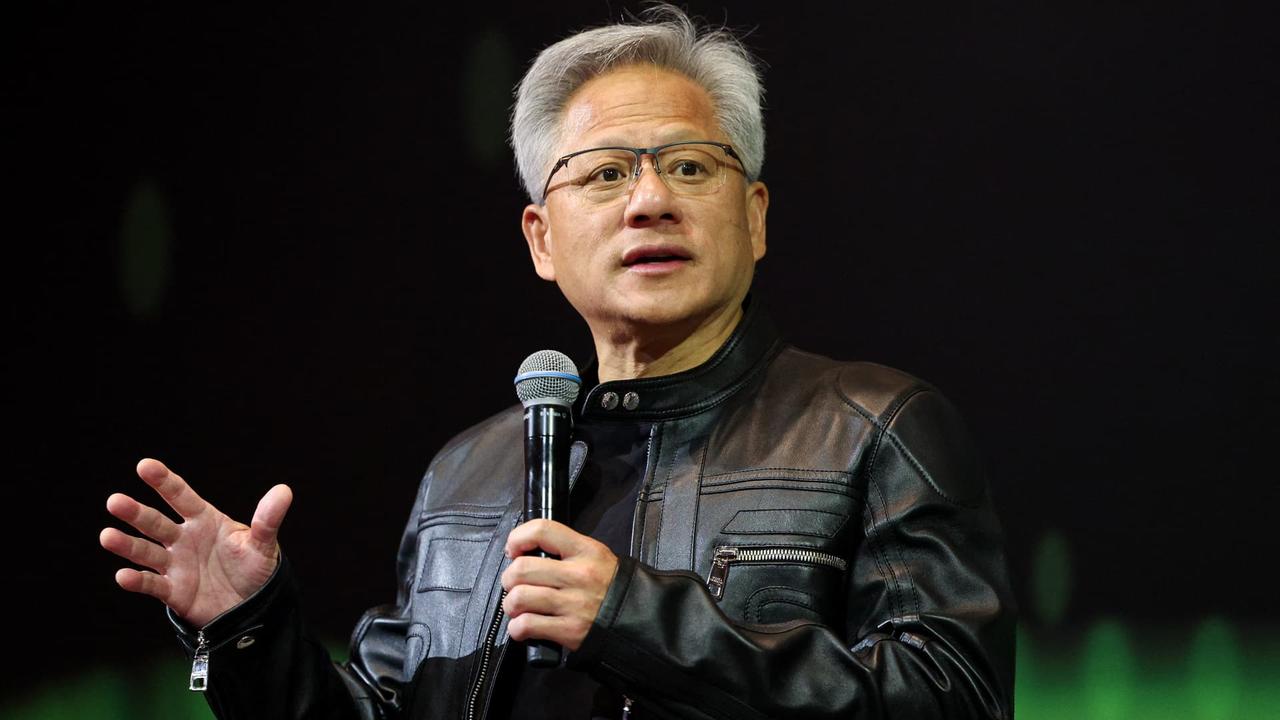
Nvidia's Potential $50 Trillion Market Cap: A Tech Investor's Bold Prediction
16 Jul 2024

Recent Highlights
1
Tennessee Teens Sue Elon Musk's xAI Over Grok AI-Generated Child Abuse Images
Policy and Regulation

2
Pentagon designates Palantir Maven AI as core US military system in major defense shift
Technology

3
Supermicro Co-Founder Indicted in $2.5 Billion Nvidia AI Chip Smuggling Scheme to China
Policy and Regulation
Recent Highlights
Today's Top Stories












Your Daily Dose of Curated AI News
Don’t drown in AI news. We cut through the noise - filtering, ranking and summarizing the most important AI news, breakthroughs and research daily. Spend less time searching for the latest in AI and get straight to action.

