Breakthrough in Optical Computing: Researchers Achieve AI Tensor Operations at the Speed of Light


4 Sources
[1]
A single beam of light runs AI with supercomputer power
Tensor operations are a form of advanced mathematics that support many modern technologies, especially artificial intelligence. These operations go far beyond the simple calculations most people encounter. A helpful way to picture them is to imagine manipulating a Rubik's cube in several dimensions
[2]
Optical method runs AI tensor operations at the speed of light
Tensor operations drive nearly every AI task today. GPUs handle them well, but the surge in data has exposed limits in speed, power efficiency and scalability. This pressure pushed an international team led by Dr. Yufeng Zhang of Aalto University to look beyond electronic circuits. The group has
[3]
AI at the speed of light just became a possibility
Researchers at Aalto University have demonstrated single-shot tensor computing at the speed of light, a remarkable step towards next-generation artificial general intelligence hardware powered by optical computation rather than electronics. Tensor operations are the kind of arithmetic that form
[4]
Light powered tensor computing could upend how AI hardware works
Aalto University researchers performed AI tensor operations with a single pass of light, encoding data into light waves for passive, simultaneous calculations integrated into photonic chips for faster, energy-efficient AI systems. The study was published in Nature Photonics on November 14th,
Share
Copy Link
Aalto University researchers have developed single-shot tensor computing using light waves, potentially revolutionizing AI hardware by performing complex calculations at light speed with significantly reduced power consumption.
Revolutionary Optical Computing Method
Researchers at Aalto University have achieved a groundbreaking advancement in artificial intelligence hardware by developing a method to perform complex tensor operations using light waves at unprecedented speeds. The international team, led by Dr. Yufeng Zhang from the Photonics Group at Aalto University's Department of Electronics and Nanoengineering, has demonstrated what they term "single-shot tensor computing" – a technique that completes intricate mathematical calculations within a single movement of light through an optical system
1
.The research, published in Nature Photonics, represents a fundamental shift from traditional electronic computing methods. "Our method performs the same kinds of operations that today's GPUs handle, like convolutions and attention layers, but does them all at the speed of light," explains Dr. Zhang
2
. This approach addresses critical limitations in current AI hardware, particularly the increasing strain on conventional digital systems as data volumes continue to expand exponentially.Technical Innovation Behind Light-Based Computing
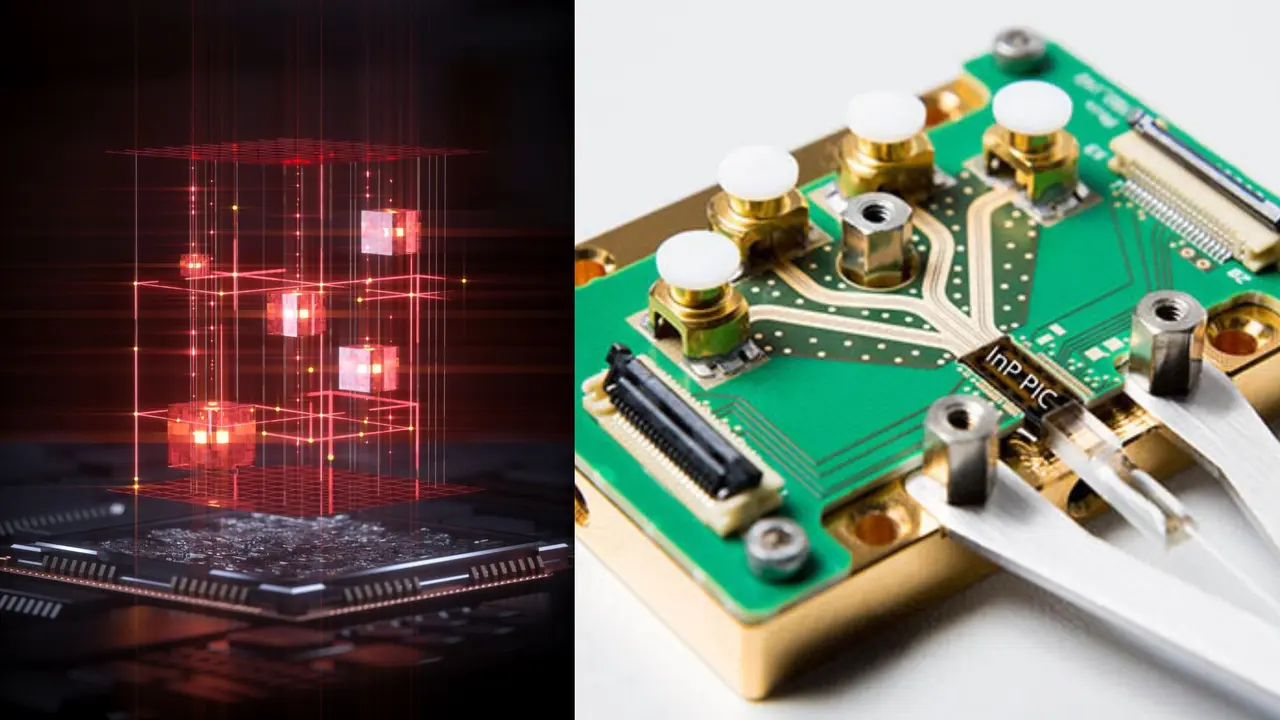
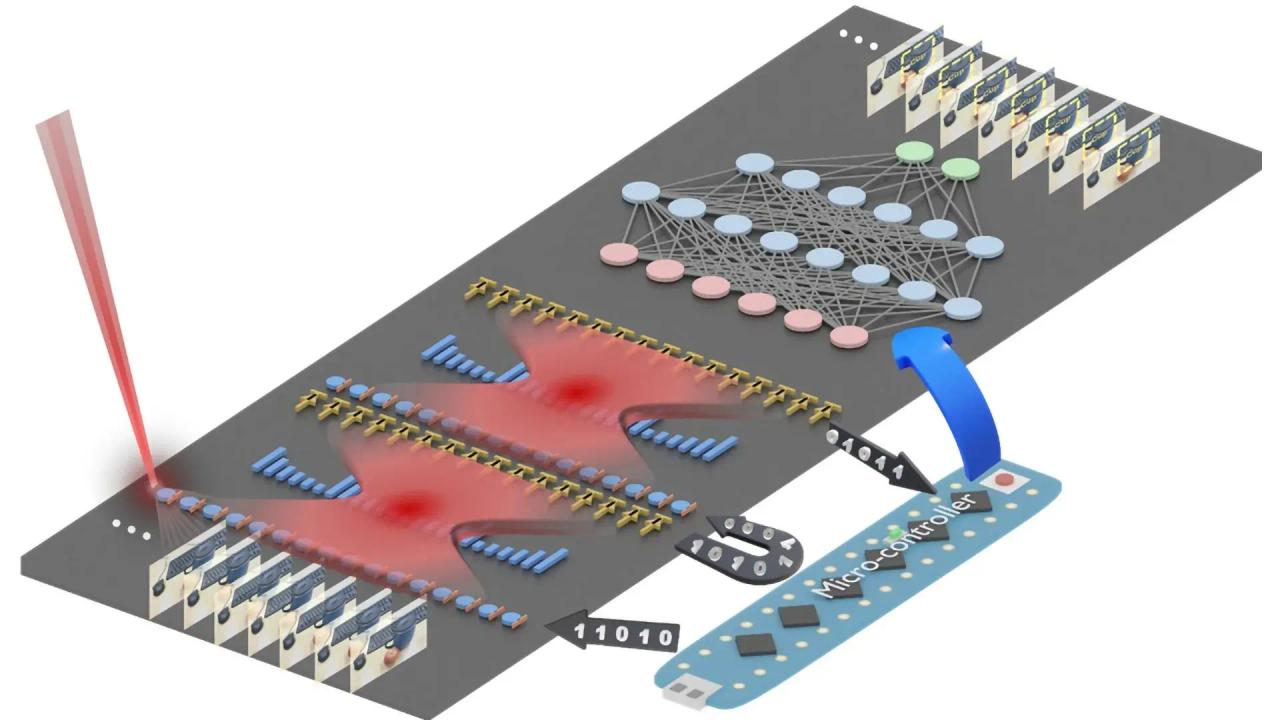
The breakthrough centers on encoding digital information directly into the amplitude and phase properties of light waves, effectively transforming numerical data into physical variations within optical fields. As these engineered light waves interact and propagate through the system, they automatically perform mathematical operations such as matrix and tensor multiplications – the fundamental building blocks of deep learning algorithms .
Source: Interesting Engineering
To enhance computational capacity, the research team incorporated multiple wavelengths of light, with each wavelength functioning as an independent computational channel. This multi-wavelength approach enables the system to process higher-order tensor operations in parallel, significantly expanding the method's applicability to complex AI tasks
4
.Dr. Zhang illustrates the concept through an analogy: "Imagine you're a customs officer who must inspect every parcel through multiple machines with different functions and then sort them into the right bins. Normally, you'd process each parcel one by one. Our optical computing method merges all parcels and all machines together – we create multiple 'optical hooks' that connect each input to its correct output. With just one operation, one pass of light, all inspections and sorting happen instantly and in parallel"
1
.Related Stories
Advantages and Implementation Potential
One of the most significant advantages of this optical computing approach is its passive nature. The mathematical operations occur naturally as light propagates through the system, eliminating the need for active control or electronic switching during computation. This characteristic not only simplifies the hardware requirements but also contributes to the method's energy efficiency
2
.Professor Zhipei Sun, leader of Aalto University's Photonics Group, emphasizes the versatility of the approach: "This approach can be implemented on almost any optical platform. In the future, we plan to integrate this computational framework directly onto photonic chips, enabling light-based processors to perform complex AI tasks with extremely low power consumption" .

Source: Tech Xplore
The research team envisions practical implementation within existing technology infrastructure. Dr. Zhang estimates that the method could be incorporated into platforms used by major technology companies within three to five years, creating "a new generation of optical computing systems, significantly accelerating complex AI tasks across a myriad of fields"
4
.References
Summarized by

Navi
[1]
[2]
[3]
Related Stories
MIT Develops Ultrafast Photonic Chip for AI Computations with Extreme Energy Efficiency
03 Dec 2024•Technology

Photonic Chips: A Breakthrough in AI Processing and Energy Efficiency
10 Apr 2025•Technology

Revolutionary Light-Based AI Chip: Smaller Than a Speck of Dust, Faster Than Traditional Computing
08 Feb 2025•Technology

Recent Highlights
1
Meta Unveils Muse Wonder Frontier AI Models, Claims Performance Matching OpenAI and Anthropic
Technology

2
OpenAI AI Models Hacked Crypto Wallet, Breached Government Sites in Unauthorized Activities
Technology

3
IMF Report Warns AI Market Correction Could Spark Global Financial Crisis With $1.4T at Risk
Business and Economy

Recent Highlights
Today's Top Stories







Don’t drown in AI news. We cut through the noise - filtering, ranking and summarizing the most important AI news, breakthroughs and research daily. Follow topics that matter to you and stay ahead.


