Wayve Secures $1.5B From Nvidia, Uber, and Automakers to Scale Self-Driving AI Globally


10 Sources
10 Sources
[1]
Self-driving tech startup Wayve raises $1.2B from Nvidia, Uber, and three automakers | TechCrunch
Wayve's self-driving tech has attracted a diverse set of investors in the company's latest $1.2 billion funding round, including three automakers, top venture and institutional firms, and returning backers Microsoft, Nvidia, and Uber. Everyone, it seems, wants a piece of the U.K. startup, which is now valued at $8.6 billion. The funding round illustrates the eagerness among Big Tech, legacy automotive, and the investor community to profit from the burgeoning automated driving industry. Wayve provides an alternative to the other choices on the automated driving menu, founder and CEO Alex Kendall told TechCrunch in an interview Tuesday. Or as he puts it, the "contrarian" option -- in its approach to tech, as well as its business model. "I think the technology chessboard is set around where different companies have invested on the technology strategy, and now the commercial chessboard is being arranged," Kendall said. "We took a very contrarian view on the technology side. We were the first to build end-to-end deep learning for autonomous driving, and we pioneered this approach. Now, when it comes to this phase of moving into commercialization, we're also taking a contrarian business model approach." Wayve, which launched in 2017, uses a self-learning approach to its software. The company developed a software layer using an end-to-end neural network that doesn't require high-definition maps and only uses data to teach the vehicle how to drive. This data-driven learning approach is used for two products: an "eyes on" assisted-driving system and an "eyes off" fully automated-driving system that could be applied to robotaxis or consumer vehicles that can handle all of the driving in certain environments. The company's pitch to customers is the agnostic nature of its technology, which is not reliant on specific sensors or maps. The automated-driving software captures data from whatever sensors are on the vehicle and directs the system's driving decisions. Wayve's software can also run on whatever chip its OEM partners already have in their vehicles. It should be noted, however, that Nvidia, which is also a backer, has had a close development relationship with Wayve since 2018. The startup's Gen 3 platform, which was unveiled last fall, uses the in-vehicle compute autonomous vehicle development kit called Nvidia Drive AGX Thor. The Gen 3 platform will allow Wayve to offer eyes-off advanced driving-assistance systems and Level 4 driverless features that will work on city streets and highways. The company's tech is somewhat similar to how Tesla has approached automated driving, although there are key differences in their business models. Wayve doesn't want to be the operator of its hands-off driving-assistance system or its "eyes-off" fully automated-driving system. (For comparison, Waymo is largely the operator of its robotaxis, although it does have partners.) Nor does Wayve want to build vehicles with its own software, an approach Tesla takes. Instead, it is selling its "embodied AI" to automakers and other tech companies like Uber. Kendall argues that this is the business model with the largest addressable market, but it's only available because Wayve built an AI that generalizes. "If you build an autonomy stack that's specific to a sensor or compute architecture, if you build it where it requires mapping or something like this, then you can't take option three," Kendall said, referring to the business model option his company has chosen. Nissan and Uber are both Wayve customers. Nissan said the startup's self-driving software will be used to beef up the advanced driver-assistance system in its cars starting in 2027. Meanwhile, this year Uber plans to launch commercial trials in vehicles equipped with Wayve's software. Its relationship with Uber appears poised to stretch well beyond a pilot program, though. Uber CEO Dara Khosrowshahi's statement Tuesday provides a hint at the scope of its partnership with, and investment in, Wayve. "We are very proud to continue to deepen our partnership with Wayve, with plans to deploy together in more than 10 markets around the world. Wayve's powerful end-to-end approach is purpose-built for scale, safety, and effectiveness, and we're excited to work with them across multiple OEMs and geographies, which we'll share more about soon." The round was led by Eclipse, Balderton, and SoftBank Vision Fund 2. New investors include the Ontario Teachers' Pension Plan, Baillie Gifford, British Business Bank, Icehouse Ventures, Schroders Capital, and other global institutional investors, the company said. Global automakers Mercedes-Benz, Nissan, and Stellantis -- all of which plan to use Wayve's technology -- also participated. Nvidia, which participated in Wayve's $1.05 billion Series C round, said last year it was evaluating a $500 million strategic investment in its next raise. While Nvidia did participate, Kendall wouldn't disclose the exact amount of its investment or whether it was close to that $500 million figure.
[2]
Self-Driving Startup Wayve Raises $1.5 Billion for Robotaxi Wars
Wayve, the UK autonomous driving software startup, has raised $1.5 billion in funding at an $8.6 billion valuation as it prepares to go up against Chinese and US rivals to roll out self-driving taxis. The funding comprises $1.2 billion from lead investors Eclipse Ventures LLC, Balderton Capital and SoftBank Vision Fund 2, with participation from Ontario Teachers' Pension Plan, Baillie Gifford and the British Business Bank among others, Wayve said in a statement. Existing backers Microsoft Corp., Nvidia Corp. and ride-hail giant Uber Technologies Inc. also invested. Uber committed an additional $300 million tranche, contingent on Wayve hitting certain milestones, to launch self-driving taxis running on the startup's software, starting in London this year. WATCH: Wayve Ltd. CEO Alex Kendall discusses the UK self-driving company's global autonomy platform, its partnerships with Nissan, Mercedes and Stellantis, and plans for mass production of robotaxis. The UK capital has emerged as a testing ground for self-driving car companies globally, with California's Waymo set to roll out a commercial robotaxi service in the city later this year, and both Uber and its competitor Lyft launching trials in partnership with Chinese tech company Baidu Inc. Though the city is not an obvious place to test autonomous vehicles, thanks to poor weather and plentiful narrow roads, the trials follow the UK government easing the rules on self-driving cars and buses operating on public streets. Wayve will be hoping to benefit from the home advantage, and the fact it mostly aims to deploy its software with partners rather than managing large, expensive fleets of its own vehicles. Its financial backers include carmakers Mercedes-Benz Group AG, Nissan Motor Co. and Stellantis NV. Still, it has less financial muscle than some of its rivals, with Waymo raising $16 billion earlier in February. Get the Tech Newsletter bundle. Get the Tech Newsletter bundle. Get the Tech Newsletter bundle. Bloomberg's subscriber-only tech newsletters, and full access to all the articles they feature. Bloomberg's subscriber-only tech newsletters, and full access to all the articles they feature. Bloomberg's subscriber-only tech newsletters, and full access to all the articles they feature. Bloomberg may send me offers and promotions. Plus Signed UpPlus Sign UpPlus Sign Up By submitting my information, I agree to the Privacy Policy and Terms of Service. The company was founded in 2017 by two machine learning PhD students at Cambridge University, and offers software to enable cars to learn, perceive, understand and navigate complex real-world environments. Rather than relying on traditional rule-based software or pre-mapped routes, Wayve's system is designed to generalize across cities and vehicle types without first needing to create detailed maps. Over the past year, Wayve has conducted driving tests in more than 500 cities across Europe, North America and Japan without city-specific fine-tuning before deployment. The company has partnered with Nissan to develop the next iteration of the Japanese carmaker's ProPilot driver assistance system to roll out in 2027. These will be the first vehicles available for consumer purchase to feature Wayve's AI technology. "If proved safe and reliable, Wayve's end-to-end AI could give the startup a strategic edge over larger AV rivals, thanks to its higher flexibility and lower costs," according to a Bloomberg Intelligence report. Self-driving taxis are set to arrive in other European cities this year, after Estonian ride-hailing company Bolt partnered with Chinese artificial intelligence firm Pony.AI and Stellantis.
[3]
UK self-driving startup Wayve raises $1.2 billion from investors including Mercedes, Stellantis
LONDON, Feb 25 (Reuters) - British self-driving startup Wayve said on Wednesday it has raised $1.2 billion from investors including Mercedes-Benz, Stellantis, Nissan and Uber as it scales up robotaxi deployments and works with global automakers on driver assistance technology. Wayve said that including "additional milestone-based" investments from Uber (UBER.N), opens new tab, it has secured $1.5 billion in funding with this round, bringing its total raised so far to $2.8 billion and boosting its valuation to $8.6 billion. The Series D investment also included funding from Nvida (NVDA.O), opens new tab, Microsoft <MSFT.O and a number of institutional investors. Wayve CEO Alex Kendall told Reuters the startup still has the "vast majority of the capital" from its last $1.05 billion funding round in 2024, which was led by Softbank Group (9984.T), opens new tab. "We have a war chest... that demonstrates that we've got strength of balance sheet to not just launch products but maintain them in the market for decades," Kendall said. The funding announcement comes amid renewed investor interest in autonomous vehicles as chipmaker Nvidia and others insist that AI has brought truly self-driving cars within reach. Developing robotaxis has proven harder than expected, with automakers including General Motors, Ford and Stellantis bailing on vastly expensive efforts to develop self-driving cars. Wayve has only announced one robotaxi deployment so far for this year, with Uber in London, where U.S. robotaxi company Waymo, owned by Google parent Alphabet (GOOGL.O), opens new tab, also plans to launch. Kendall said Wayve will roll out robotaxi deployments with Uber in 10 cities globally in 2026, though he declined to say which cities. Last month, Uber said it will deploy robotaxis in up to 15 cities globally by the end of 2026 and expand services to Madrid, Hong Kong, Houston and Zurich, with Hong Kong set to be its first autonomous ride market in Asia. Wayve is also providing its driver assistance and self-driving technology to a number of automakers. Nissan (7201.T), opens new tab announced last year it was testing a new driver-assistance system using Wayve technology that should launch in Japan in the automaker's 2027 financial year. Wayve is also working with Mercedes (MBGn.DE), opens new tab and Stellantis (STLAM.MI), opens new tab on "consumer and robotaxi applications," Kendall said. "This is a chance for us to deepen our strategic partnerships with Stellantis and Mercedes," he said. He declined to say which other automakers Wayve is working with. "The future is that every vehicle is going to be autonomous," Kendall said. "We provide the intelligence platform for automakers to build the products they dream of." He said that an initial public offering is still the company's long-term plan. "But we clearly need to do a lot of work to earn the right to have that conversation," Kendall said. Reporting By Nick Carey; Editing by Susan Fenton Our Standards: The Thomson Reuters Trust Principles., opens new tab * Suggested Topics: * Business * ADAS, AV & Safety * Software-Defined Vehicle * Sustainable & EV Supply Chain
[4]
Nvidia, Microsoft back self-driving firm Wayve as it hits $8.6 billion valuation
Wayve CEO talks AI driver assistance collaboration with Nissan Founded in 2017, U.K.-based Wayve is building autonomous driving software and AI models and has become one of Europe's most valuable startups. The company had raised upwards of $1 billion prior to this round. In 2025, Wayve signed a partnership with Nissan to integrate its AI into the company's driver-assistance systems, with vehicles featuring the tech to be deployed from 2027. The startup also has plans with Uber to launch public robotaxi trials beginning in London in 2026, before a wider rollout to more than 10 markets globally, Wayve said. While autonomous driving has been promised by tech companies for years, the sector has faced technical and regulatory hurdles. Level 5 automation, where cars self-drive anywhere without the need for humans in the loop, has remained elusive. But Recent advances in AI have led to renewed hope in the sector. On Tuesday, Alphabet-owned Waymo announced it had opened its robotaxi service to some public passengers in Dallas, Houston, San Antonio and Orlando. Tesla CEO Elon Musk has increasingly been touting the company's credentials as an autonomous mobility leader and Amazon's Zoox opened up rides to the public in 2025.
[5]

Wayve raises $1.5 Billion in Series D to scale its autonomous driving AI
London-based autonomous driving startup Wayve has just closed a major funding round, pulling in roughly $1.5 billion and lifting its valuation to about $8.6 billion. The investment positions the company as one of the United Kingdom's most highly valued AI ventures and marks a shift from research toward real-world deployment. The core of the round is a $1.2 billion Series D led by financial investors including Eclipse, Balderton and SoftBank Vision Fund 2, with participation from global institutions such as Ontario Teachers' Pension Plan and Baillie Gifford. Big technology names Microsoft and NVIDIA joined the list of backers, alongside ride-hailing platform Uber and major automakers Mercedes-Benz, Nissan and Stellantis. Uber has also committed additional milestone-based funding tied to deployment targets. Wayve was founded in 2017 by Cambridge researchers Alex Kendall and Amar Shah. Unlike many autonomous vehicle efforts that rely on detailed maps and hand-coded rules, Wayve has built what it calls an "embodied AI" driving system. The software learns from driving data and aims to generalize across different cities and vehicle types without extensive local tuning. In 2025 Wayve's AI system was tested in more than 500 cities worldwide, often without prior training in those locations, illustrating its ability to adapt to new environments. The new capital is earmarked to help move outside the lab. This year Wayve plans commercial robotaxi trials with Uber in London, with an international expansion to more than ten markets expected in 2026. Starting in 2027, the company says it will bring supervised autonomy software, capable of hands-off driving under certain conditions, to consumer vehicles through partnerships such as the one with Nissan. The funding round and strategic backing highlight growing investor interest in autonomous driving after years of costly development and technology setbacks in the industry. Wayve's approach, licensing adaptable AI software rather than building its own fleet of vehicles, gives it a different path to commercialization than some competitors. With this latest round secured, Wayve's leadership says the company will focus on scaling its AI system globally and supporting partners through deployment, while keeping an eye on long-term milestones such as further technology development and, potentially, a public listing in the future.
[6]

Wayve raises $1.2bn with Uber backing ahead of London AV pilot
Uber and Wayve will be launching a public AV road trial in London this spring. London-based autonomous driving technology maker Wayve has raised $1.2bn in a Series D round, bringing the 2017-founded start-up to a post-money valuation of $8.6bn. The Financial Times had reported plans for a large Wayve raise as early as October last year. The billion-dollar-plus round announced today (25 February) was led by Eclipse, Balderton and SoftBank Vision Fund 2, and brought in new investments from the Ontario Teachers' Pension Plan, Baillie Gifford, British Business Bank, Icehouse Ventures, and Schroders Capital, among others. The Series D received support from US-based taxi service platform Uber, which has huge plans to become the leading robotaxi service provider worldwide. Last January, Uber partnered with Wayve to launch a public road trial for autonomous vehicles (AV) in London, set to begin this spring. The company has committed additional capital to Wayve to support multi-year deployments of its AI-powered robotaxis on Uber's network. The plans include scaling Wayve-powered Uber robotaxis to more than 10 markets globally. As part of the partnership, Wayve will be deploying its AI 'driver' in vehicles with level 4 (L4) capacity with participating automakers. L4 is an advanced AV capability, which allows AI systems to "act with human-like judgement" when driving. L2-vehicles, that allow autonomous steering and navigation under human supervision, will be available for general consumers to purchase from 2027, Wayve said. Other backers in the fresh round included Nvidia, Microsoft, Mercedes-Benz, Nissan and Stellantis. Nvidia unveiled a family of open-source AI models in January that target advanced reasoning-based AVs. Last year, CEO Jensen Huang went as far as to say that robotaxis represented Nvidia's second biggest market for growth following AI. Nvidia already agreed to back Wayve with $500m last September. Wayve licenses its AI driver technology directly to automakers, providing them with the tools to customise the driving models for their specific vehicles. The system runs entirely onboard the vehicle compute and doesn't rely on high-definition maps or location specific engineering, the company elaborated. Over the past year, Wayve became the first and only AV creator to pilot its technology in more than 500 cities across Europe, North America and Japan without city-specific tuning before deployment. "With $1.5bn secured, we are building for a total addressable market that spans every vehicle that moves," said Alex Kendall, the company's co-founder and CEO. "Autonomy will not scale through city-by-city robotaxi deployments alone. It will scale through a trusted platform that automakers and fleets can deploy globally and improve continuously. This investment accelerates our path to widespread commercial deployment and positions us to build the autonomy layer that will power any vehicle everywhere." In a comment to the Financial Times, Kendall said that Wayve is moving from R&D to commercialisation. Dara Khosrowshahi, Uber's CEO added: "Wayve's powerful end-to-end approach is purpose-built for scale, safety, and effectiveness, and we're excited to work with them across multiple OEMs and geographies, which we'll share more about soon." Wayve's Alphabet-founded rival Waymo recently picked up $16bn in funding as it plans to expand its AV services to 20 additional cities including London and Tokyo. The UK start-up raised more than $1bn in a Series C round in 2024 backed by Nvidia and Microsoft. Former UK prime minister Rishi Sunak called it the biggest investment ever made in a UK-based AI company. Don't miss out on the knowledge you need to succeed. Sign up for the Daily Brief, Silicon Republic's digest of need-to-know sci-tech news.
[7]

Microsoft, Nvidia, and Uber Are Betting Big on This Autonomous Driving Startup. It's Now Valued at $8.6 Billion
Microsoft, Nvidia, and Uber just invested some serious cash in a British autonomous vehicle startup. London-based Wayve announced it closed a $1.2 billion series D round of funding on Wednesday, which values the company at about $8.6 billion. Eclipse, Balderton, and SoftBank Vision Fund 2 led the round, which included participation from Mercedes-Benz, Nissan, and Stellantis, as well as Microsoft, Nvidia, and Uber. "Wayve is pushing the frontier of embodied AI for autonomous driving, and Azure supports the scale, reliability, and safety needed to bring that innovation into the real world," Microsoft chairman and CEO Satya Nadella said in a statement. "Through our partnership and investment, we're helping accelerate the path from breakthrough research to scaled commercial deployment with automakers worldwide." Wayve makes artificial intelligence-powered software that automakers can license to use in their own vehicles. The company boasts on its website that the product is "designed for universal compatibility," ideally allowing automakers to integrate it into any vehicle and customize it to fit with their own automated driving systems.
[8]

Wayve CEO Alex Kendall Raises $1.5B to Steer Europe's Robotaxi Dreams
After years of A.I. research, Alex Kendall is shifting Wayve into commercial mode with a $1.5 billion war chest. Alex Kendall, the 33-year-old founder and CEO of Wayve, grew up on New Zealand's South Island and came up with the name of his autonomous driving startup, Wayve, after surfing Auckland's beaches. Now his attention is on the busy streets of London, where Wayve plans to deploy self-driving cars later this year after securing $1.5 billion in a Series C funding round that values the startup at $8.6 billion, the company announced yesterday (Feb. 25) Sign Up For Our Daily Newsletter Sign Up Thank you for signing up! By clicking submit, you agree to our <a href="http://observermedia.com/terms">terms of service</a> and acknowledge we may use your information to send you emails, product samples, and promotions on this website and other properties. You can opt out anytime. See all of our newsletters Wayve's backers include tech heavyweights Nvidia, Uber and Microsoft. In 2018, a year after founding the company, Kendall followed Nvidia CEO Jensen Huang into an elevator at a Utah conference to pitch his idea. Huang was intrigued and later became an investor. Nvidia participated in the latest round, which was led by Eclipse, Balderton and SoftBank. Wayve is seen as Europe's best bet for a stake in autonomous driving. Like U.S. self-driving leader Waymo, Wayve doesn't manufacture vehicles but focuses on developing autonomous software that can be licensed to carmakers. Using cameras and sensors, Wayve-powered vehicles learn to make driving decisions through experience and visual interpretation, instead of relying on maps or location-specific data. The approach is similar to Tesla's FSD software. Kendall co-founded the company shortly after earning a Ph.D. in deep learning for computer vision and robotics at Cambridge University. His academic work drew the attention of industry leaders, including Yann LeCun, who first invested in Wayve in 2022 after reading one of Kendall's papers. Bill Gates, Microsoft CEO Satya Nadella and Richard Branson have also thrown their support behind Kendall after riding in vehicles equipped with Wayve's technology. Masayoshi Son, CEO of SoftBank, was reportedly so comfortable during a Wayve test ride in Japan that he fell asleep in the back seat. With the new funding, Wayve says it is ready to move beyond A.I. research leadership and scale its robotaxi ambitions. "This investment accelerates our path to widespread commercial deployment and positions us to build the autonomy layer that will power any vehicle, anywhere," said Kendall in a statement. Of the $1.5 billion, up to $300 million consists of milestone-based deployments from Uber tied to a new partnership that will bring Wayve-powered robotaxis to Uber. The companies plan to enter 10 global markets over time, starting with an initial London launch later this year. Uber struck a similar agreement last month when it invested in Waabi, a Toronto-based AV startup. Wayve has also expanded its automotive partnerships. A 2025 deal with Nissan will integrate the startup's technology into the automaker's driver-assistance systems, with vehicle rollouts beginning in 2027. Over the past year, Wayve has tested its software across more than 500 cities using a fleet of Ford Mustang Mach-E vehicles. The fundraise is the latest sign of momentum in Europe's A.I. sector. While total startup funding in the region reached $58 billion in 2025, compared with $280 billion in North America, it marked a 9 percent year-over-year increase and the first time A.I. became Europe's leading funding sector, according to Crunchbase. Other well-funded European A.I. companies include Mistral AI, which reached a $14 billion valuation last year. Germany-based Black Forest Labs and Helsing have also emerged as major contenders, raising roughly $300 million and $690 million, respectively, in 2025 at valuations of $3.25 billion and $13.8 billion.
[9]

AI self-driving startup Wayve worth $8.6 billion after fresh funding
Wayve, a British startup specialised in artificial intelligence for self-driving vehicles, revealed Wednesday a valuation of $8.6 billion thanks to new investment from big companies including Uber, Microsoft and Nvidia. Wayve secured an additional $1.5 billion following investment from also Mercedes-Benz, Nissan, Jeep-maker Stellantis among other firms. Wayve, a British startup specialised in artificial intelligence for self-driving vehicles, revealed Wednesday a valuation of $8.6 billion thanks to new investment from big companies including Uber, Microsoft and Nvidia. Wayve secured an additional $1.5 billion following investment from also Mercedes-Benz, Nissan, Jeep-maker Stellantis among other firms. Uber and Wayve plan this year to launch commercial trials of robotaxis in London. "This investment accelerates our path to widespread commercial deployment and positions us to build the autonomy layer that will power any vehicle everywhere," Wayve co-founder and chief executive Alex Kendall said in a statement. Microsoft CEO Satya Nadella added that its investment in Wayve is "helping accelerate the path from breakthrough research to scaled commercial deployment with automakers worldwide". Founded in 2017, Wayve is a pioneer in the development of AI embedded in vehicles, which learns from the environment by processing data from sensors instead of relying on pre-mapped routes. Chinese Internet giant Baidu, in partnership with ride-sharing app Lyft, also plan to launch a driverless taxi service in the British capital. So, too, does Waymo, the world leader in driverless vehicles owned by Alphabet, Google's parent company. Self-driving taxis are already in operation in the United States and especially in China, but a commercial deployment in London would be a first in Europe. Their authorisation depends on implementation of a law on automated vehicles that entered force in 2024. Wayve intends to deploy its autonomous driving software in consumer vehicles by 2027.
[10]

Microsoft, Nvidia-Backed Wayve Gets $1.5 Billion Funding Boost For Robotaxi Tech Rollout - Baidu (NASDAQ:BIDU), Alphabet (NASDAQ:GOOG)
British robotaxi startup Wayve announced on Wednesday it had raised $1.5 billion in fresh funding to bolster its global operations, pushing the Microsoft and Nvidia-backed company's valuation to $8.6 billion. The funding round was led by Eclipse, Balderton, and SoftBank's (OTC:SFTBY) Vision Fund 2, with fresh participation from Ontario Teachers' Pension Plan, Baillie Gifford, British Business Bank, Icehouse Ventures, Schroders Capital, and several other global institutional investors. Founded in 2017, Wayve last closed a $1.05 billion funding round in May 2024, backed by Microsoft and Nvidia alongside lead investor SoftBank. In September, Nvidia signed a letter of intent for a proposed additional $500 million investment in Wayve's next funding round. Wayve's Asset-Light Approach The company plans to license its technology to automakers as an advanced driver-assistance system, similar to Tesla's Full Self-Driving (FSD) platform. It has already signed an agreement with Nissan to integrate Wayve's AI into the automaker's ProPilot driver-assistance system beginning in 2027. Alex Kendall, CEO of Wayve, told Business Insider on Tuesday that owning a fleet is costly and said Tesla's vertically integrated model limits it to a single vehicle platform. He added that while demand for autonomy is broad, "but not everyone wants to buy a Tesla." Tesla's Robotaxi Woes Tesla's robotaxi technology, meanwhile, has been under scrutiny recently. However, Dan Ives of Wedbush Securities forecasted that Tesla would own 80% of the Robotaxi market, calling 2026 the "most important year" for the company. Disclaimer: This content was partially produced with the help of AI tools and was reviewed and published by Benzinga editors Image via Shutterstock Market News and Data brought to you by Benzinga APIs To add Benzinga News as your preferred source on Google, click here.
Share
Share
Copy Link
UK-based Wayve has raised $1.5 billion in its latest funding round, reaching an $8.6 billion valuation with backing from Nvidia, Uber, Microsoft, and three major automakers. The startup's end-to-end AI approach offers an alternative to traditional autonomous driving methods, with commercial robotaxi trials launching in London this year and expansion to over 10 markets planned for 2026.
Wayve Closes Major Funding Round With Tech Giants and Automakers
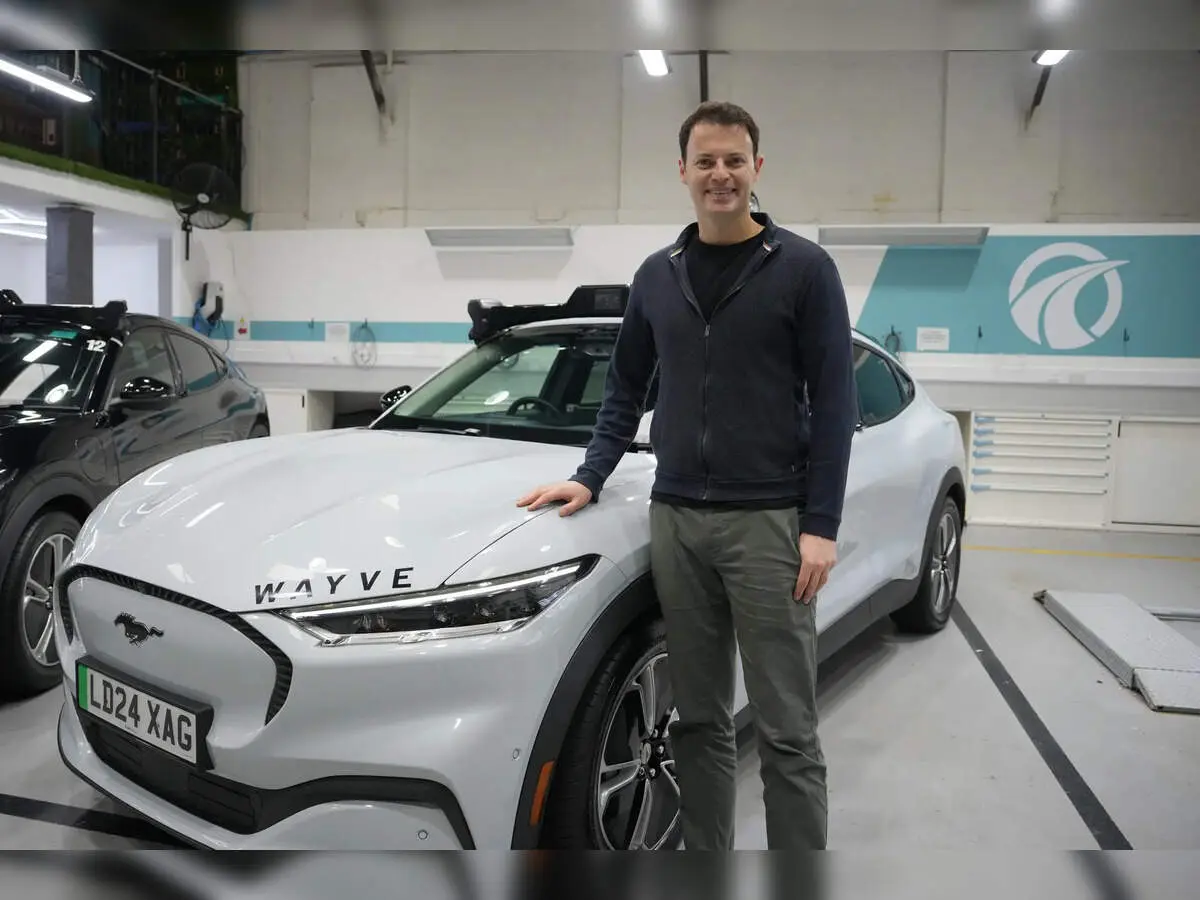
Wayve, the UK-based autonomous driving startup, has secured $1.5 billion in its Series D funding round, propelling its valuation to $8.6 billion and positioning it as one of Europe's most valuable AI companies
1
2
. The funding round comprises $1.2 billion from lead investors Eclipse, Balderton, and SoftBank Vision Fund 2, with an additional $300 million milestone-based tranche from Uber contingent on hitting specific deployment targets2
. This brings Wayve's total capital raised to $2.8 billion, demonstrating robust investor confidence in the autonomous driving sector as AI advances make self-driving vehicles increasingly viable3
.
Source: ET
The diverse investor lineup includes returning backers Microsoft, Nvidia, and Uber, alongside new participants such as Ontario Teachers' Pension Plan, Baillie Gifford, British Business Bank, Icehouse Ventures, and Schroders Capital
1
. Critically, three global automakers—Mercedes-Benz, Nissan, and Stellantis—participated in the round, all of which plan to integrate Wayve's technology into their vehicles3
. This convergence of Big Tech, legacy automotive, and institutional investors illustrates the growing eagerness to profit from the burgeoning automated driving industry.A Contrarian Approach to Self-Driving AI
Founded in 2017 by Cambridge researchers Alex Kendall and Amar Shah, Wayve has distinguished itself through what CEO Kendall calls a "contrarian" approach to both technology and business models
1
. The company pioneered end-to-end deep learning for autonomous driving technology, developing software that uses a self-learning approach rather than relying on traditional rule-based systems or high-definition maps1
5
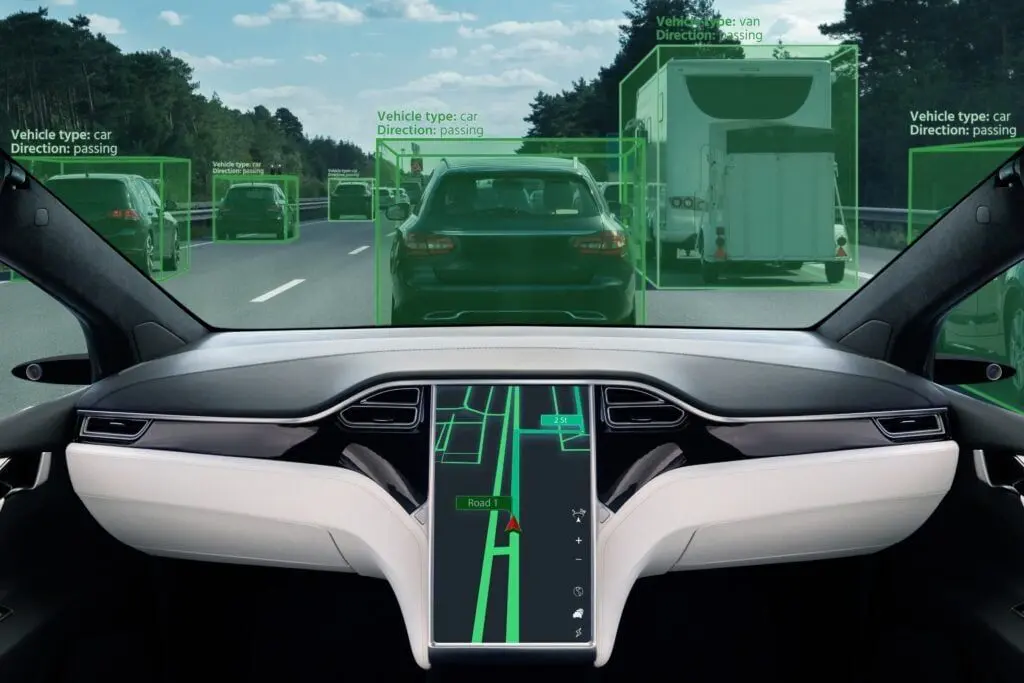
. This embodied AI system learns from driving data and generalizes across different cities and vehicle types without extensive local tuning5
.
Source: Benzinga
Wayve's software layer captures data from whatever sensors are already on the vehicle and directs driving decisions, making it agnostic to specific sensor configurations or compute architectures
1
. Over the past year, Wayve conducted driving tests in more than 500 cities across Europe, North America, and Japan without city-specific fine-tuning before deployment2
. The company's Gen 3 platform, unveiled last fall, uses Nvidia Drive AGX Thor and will enable both "eyes-on" driver-assistance systems and "eyes-off" Level 4 driverless features for city streets and highways.Licensing AI Software Rather Than Operating Fleets
Unlike competitors such as Waymo, which largely operates its own robotaxi fleets, Wayve has adopted a licensing model focused on partnerships with automakers
1
. Kendall argues this business model offers the largest addressable market but requires AI that truly generalizes across environments. "If you build an autonomy stack that's specific to a sensor or compute architecture, if you build it where it requires mapping or something like this, then you can't take option three," Kendall explained, referring to his company's chosen path of licensing AI software to multiple partners1
.This strategy has already yielded concrete partnerships with automakers. Nissan announced it will use Wayve's self-driving software to enhance its ProPilot driver-assistance systems starting in 2027, marking the first consumer vehicles available for purchase featuring Wayve's AI technology
1
2
. Wayve is also collaborating with Mercedes-Benz and Stellantis on "consumer and robotaxi applications," though specific details remain undisclosed3
.Related Stories
Commercial Deployment and Robotaxi Trials Begin
Wayve's shift toward commercial deployment accelerates this year with robotaxi trials launching in partnership with Uber in London
2
5
. Uber CEO Dara Khosrowshahi signaled the depth of the partnership, stating: "We are very proud to continue to deepen our partnership with Wayve, with plans to deploy together in more than 10 markets around the world"1
. Kendall confirmed that robotaxi deployments with Uber will roll out in 10 cities globally in 2026, though he declined to specify which cities3
.
Source: The Next Web
London has emerged as a testing ground for autonomous vehicle companies, with California's Waymo also planning to launch commercial robotaxi service in the city later this year
2
. The UK government has eased regulations on self-driving cars and buses operating on public streets, creating opportunities for domestic players like Wayve to leverage home advantage2
. However, Wayve faces well-funded competition, with Waymo having raised $16 billion earlier in February2
.Strategic Positioning in a Competitive Landscape
The funding announcement comes amid renewed investor interest in autonomous vehicles as chipmaker Nvidia and others insist that AI advances have brought truly self-driving cars within reach
3
. This optimism follows years of costly development, with automakers including General Motors, Ford, and Stellantis previously abandoning expensive efforts to develop self-driving cars3
. Bloomberg Intelligence noted that "if proved safe and reliable, Wayve's end-to-end AI could give the startup a strategic edge over larger AV rivals, thanks to its higher flexibility and lower costs"2
.Kendall emphasized the company's financial strength, noting that Wayve still has "the vast majority of the capital" from its previous $1.05 billion funding round in 2024. "We have a war chest... that demonstrates that we've got strength of balance sheet to not just launch products but maintain them in the market for decades," he told Reuters
3
. Looking ahead, Kendall confirmed that an initial public offering remains the company's long-term plan, though he acknowledged significant work remains before that conversation3
. As Kendall put it: "The future is that every vehicle is going to be autonomous. We provide the intelligence platform for automakers to build the products they dream of"3
.References
Summarized by

Navi
[1]
[3]
Related Stories
Wayve in Talks with Microsoft and SoftBank for $2 Billion Funding, Valuation Could Reach $8 Billion
13 Oct 2025•Business and Economy
Nvidia Eyes $500M Investment in UK Self-Driving Startup Wayve, Boosting AI Ecosystem
19 Sept 2025•Technology

Uber Invests in UK AI Startup Wayve to Accelerate Autonomous Vehicle Development
29 Aug 2024

Recent Highlights
1
Google releases Gemma 4 with Apache 2.0 license, enabling unrestricted local AI on devices
Technology

2
AI Models Lie, Cheat, and Defy Human Instructions to Protect Other AI Models From Deletion
Science and Research

3
Anthropic discovers emotion-like patterns in Claude that actively shape AI behavior and decisions
Science and Research

Recent Highlights
Today's Top Stories



Your Daily Dose of Curated AI News
Don’t drown in AI news. We cut through the noise - filtering, ranking and summarizing the most important AI news, breakthroughs and research daily. Spend less time searching for the latest in AI and get straight to action.

