Women in AI represent just 10% of Indian startup founders despite higher course completion rates


2 Sources
2 Sources
[1]
Now searching: Women in AI
Women leaders in AI are a tiny minority. ET found that only 10% of Indian AI startups are founded by women, and the chasm needs filling. A simple search for Indian women leading the AI charge throws up the following CEOs, founders: Ashwini Asokan (Mad Street Den), Geetha Manjunath (NIRAMAI Health Analytix), Prukalpa Sankar (Atlan), Bindu Reddy (Abacus.ai), Pranjali Awasthi (Delv.AI), Ritwika Chowdhury (Unscript.AI), Laina Emmanuel and Rimjhim Agrawal (BrainSight.AI), Meghna Saraogi (MirrAR), Hardika Shah (Kinara Capital), and MD Nidhi (NEMA AI) and Irina Ghose (MD, India, Anthropic). They belong to a small minority. Only about 10% of AI startups in India are founded by women. None of the 12 core organisations and consortia recently shortlisted by the IndiaAI Mission to develop indigenous foundational models has listed women as primary founders. Among the 24 most-funded AI startups in India, none have an all-women founding team, a Wired for Impact: Women in Ind(AI) by Kalaari Capital and the CXXO report says. "I don't think this is only an AI problem. It is a bigger social and economic problem. If women are under-represented across the economy, they will also be under-represented in frontier sectors like AI," Abhilasha Singh, cofounder, Heizen, an AI-powered software services startup. To be sure, the gender ratio in new age entrepreneurship is heavily skewed towards men. A 2023 report (LEAD, Krea University) on India's startup ecosystem found that 18% of founders/CEOs and 21% of senior leaders in startups were women. In AI, it is even starker at 10%. Leaky pipeline of tech careers Women's lower participation in AI is not limited to the founder level; it progressively declines along the organisational ladder in what experts describe as a "leaky pipeline" in technology careers. Women account for only about one-fifth of India's fast-growing AI workforce, or around 84,000 professionals, according to multiple industry reports and discussions at the IndiaAI Impact Summit 2026. Experts expect a positive shift with a four-fold increase in this number in the short term. "AI is transforming industries and redefining the future of work, yet women remain underrepresented, particularly in leadership and entrepreneurship," said Neelima Vobugari, cofounder of AI testing startup AiEnsured. This is despite their higher participation in STEM education, she noted. India produces large pools of science and technology graduates, with women making up around 43% of STEM graduates. But representation narrows dramatically in specialised AI disciplines. Women constitute only 29-30% of students in generative AI programmes. "Women are well represented across India's technology workforce, but their presence narrows in specialised AI and leadership roles," said Nitin Mahajan, chief executive of 1Point1 Solutions. "Earlier generations saw fewer women specialising in deep-tech fields such as machine learning and advanced data science, which has affected representation in senior roles today." The types of roles women occupy further complicate the picture. Women are more likely to work in data analytics, data engineering, AI operations and applied AI roles, while remaining underrepresented in core technical fields such as AI model development, research, architecture and product design. These core roles as stepping stones to senior technical positions and executive leadership. Research output reflects similar patterns. Across South Asia, 71.76% of AI research publications include at least one female author, but only 26.01% have women as primary or corresponding authors. Analysis of LinkedIn profiles showed that 29.92% of AI engineering talent in India in 2024 were women. Women at greater risk Another pressing concern emerges as AI adoption accelerates. A LinkedIn-UN Women analysis found that generative AI could substitute up to a quarter of existing jobs. In India specifically, about 80% of women work in jobs that could be augmented or disrupted by AI, compared with 75% of men. Researchers say women are often concentrated in occupations more vulnerable to automation. Kirthiga Reddy, cofounder of OptimizeGEO.ai and founder of AI Kiran, emphasised that with women holding only 18% of leadership roles in technology, the challenge lies not in capability but in opportunity and awareness. "The biggest misconception holding women back is the belief that AI careers require hardcore programming skills," she said. "The field actually needs many different skills and disciplines, from product thinking and design to policy, domain expertise and entrepreneurship. Encouraging girls to see AI as problem-solving and innovation -- rather than just programming -- is key to improving representation. The perception that AI equals coding that in turn equals male discourages girls from exploring AI even before they understand the field." With inputs from Himanshi Lohchab
[2]
Women in India complete GenAI courses at rates 3% higher than men: Coursera Report
Findings highlight strong persistence among women learners and the need to expand inclusive AI education Coursera, Inc. released its latest report, "One Year Later: The Gender Gap in GenAI," revealing that women in India are completing GenAI courses at 3% higher rates than men, even as they remain underrepresented in GenAI learning. The findings highlight strong persistence among women learners once they gain access to high-quality learning opportunities. The report also finds that women accounted for 33.5% of GenAI course enrollments in India in 2025, up from 31.2% in 2024, a 2.2 percentage-point increase YoY. While the gender gap persists, the higher completion rates suggest that access - rather than capability or motivation - may be the primary barrier, reinforcing the need to lower entry barriers and expand access to AI learning pathways. As part of 'Vision 2047', the Government of India has set an ambitious target of building a $30 trillion economy by 2047, with nearly 45% of this growth ($14 trillion) expected to come from women's economic participation. Equipping women with future-ready capabilities such as artificial intelligence will be critical to unlocking this potential. Course design linked to stronger participation Beginner-friendly GenAI courses that emphasise real-world application tend to attract stronger female participation globally. For example, the course on Generative AI Content Creation by Adobe -- has achieved 48.2% female enrollment in India. Across the platform, application-driven GenAI courses in areas such as education, productivity tools, and workplace integration have seen female participation approach parity in some cases. These courses present GenAI as a practical tool for productivity and problem-solving rather than abstract technical theory, often linking AI tools to goals learners care about, such as improving teaching, writing, or creative work. The findings suggest that when AI skills are framed as practical, accessible, and directly tied to career relevance, participation broadens. "The future of AI will be shaped by the diversity of the people building and using it," said Prashasti Rastogi, Director, Coursera for Campus and Government, India. "Our data shows that when women in India gain access to GenAI learning opportunities, they demonstrate strong persistence and commitment to mastering these skills. India has an enormous pool of motivated and resilient women and expanding access to AI education will be key to unlocking the full strength of the country's talent." Beyond GenAI, there is also a strong momentum among female learners to upskill in human skills such as Critical Thinking. In 2025, women learners in India accounted for 40% of critical thinking enrollments, up from 34% in 2024. This trend underscores that women are actively building both technical and human skillsets needed for long-term professional growth and success in an AI-driven workplace. Implications for India's digital workforce As India advances its ambitions in digital and AI transformation, expanding equitable access to AI education will be critical to building a diverse and future-ready workforce. The report outlines several approaches that can support more inclusive participation, including: * Designing beginner-level courses with clear real-world applications * Ensuring visible representation and inclusive pedagogy * Expanding access through localisation and partnerships * Pairing GenAI skills with complementary human capabilities, such as Critical Thinking One year after Coursera's initial "Closing the Gender Gap in GenAI Skills" playbook, the latest data shows encouraging progress - but also a clear opportunity to accelerate change. India's rise in women participation, combined with stronger completion rates among, signals growing momentum. As AI continues reshaping industries and careers, expanding access to AI learning opportunities will be key to ensuring women are not just participants in the AI revolution, but leaders helping shape its future. Top 10 courses in India by share of female enrollment Course % of Enrollments by Female Learners Generative AI Content Creation from Adobe 48.2% Social Media Management from Meta 44.9% Design Fundamentals with AI from Adobe 44.4% Satisfaction Guaranteed: Develop Customer Loyalty Online from Google 41.8% Design a User Experience for Social Good & Prepare for Jobs from Google 41.7% Introduction to Google Workspace with Gemini from Google Cloud 40.7% Google AI Essentials from Google 38.9% Fundamentals of Machine Learning and Artificial Intelligence from AWS 37.3% Accelerate Your Job Search with AI from Google 36.2% Introduction to Generative AI from Google Cloud 36%
Share
Share
Copy Link
Only 10% of AI startups in India are founded by women, revealing a stark AI gender gap in the country's rapidly expanding tech sector. However, women in India complete GenAI courses at rates 3% higher than men, suggesting that access—not capability—remains the primary barrier to closing the gender gap in GenAI learning and leadership.
Women in AI Face Stark Underrepresentation Across India's Tech Sector
The underrepresentation of women in AI has emerged as a critical challenge for India's ambitions in artificial intelligence. Only 10% of AI startups in India are founded by women, a figure that lags behind even the broader startup ecosystem where 18% of founders are women
1
. Notable women in India's Artificial Intelligence sector include Ashwini Asokan of Mad Street Den, Geetha Manjunath of NIRAMAI Health Analytix, and Prukalpa Sankar of Atlan, yet they remain a tiny minority in a male-dominated landscape .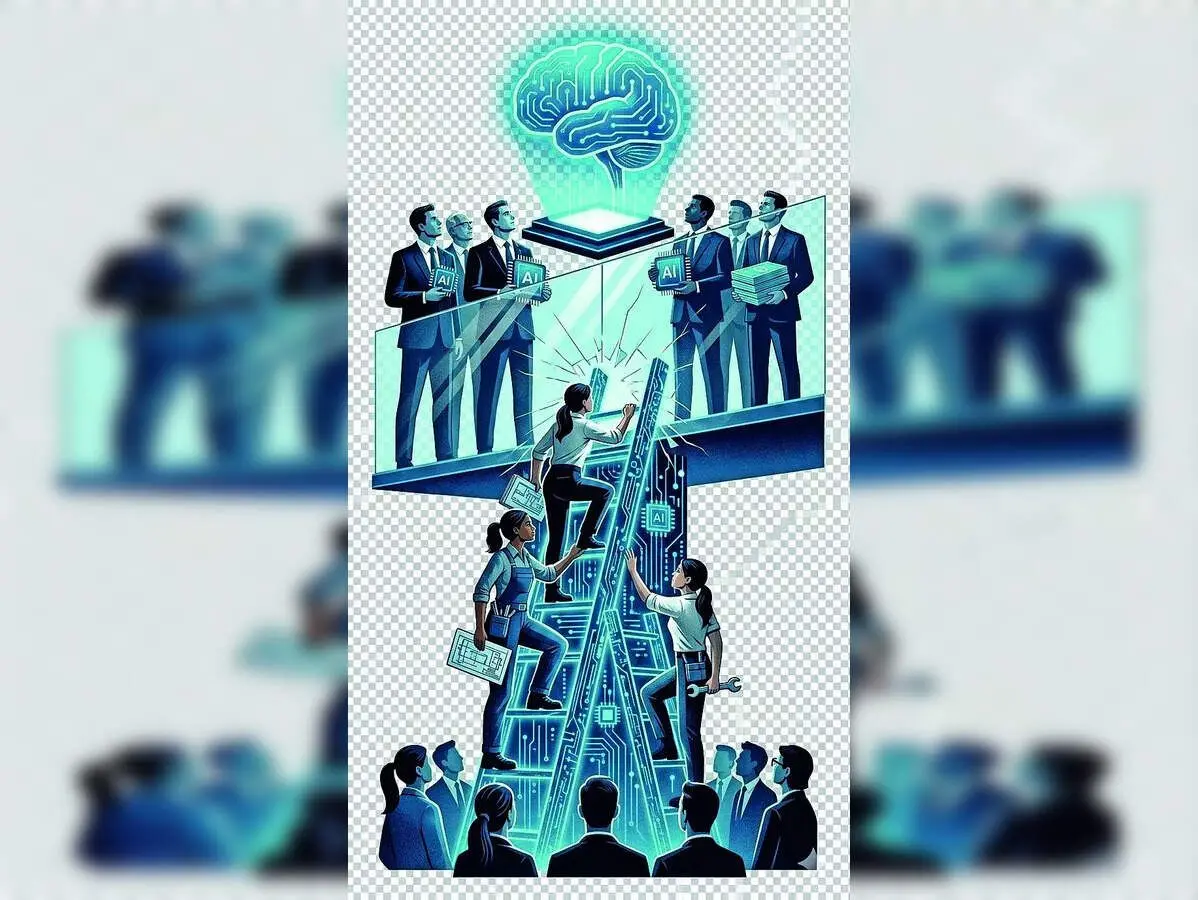
Source: ET
The situation appears even more concerning when examining leadership positions. None of the 12 core organizations recently shortlisted by the IndiaAI Mission to develop indigenous foundational models has listed women as primary founders
1
. Among the 24 most-funded AI startups in India, not a single one has an all-women founding team, according to the Wired for Impact: Women in Ind(AI) report by Kalaari Capital1
.The Leaky Pipeline Narrows Women's Path in the AI Workforce
Women account for only about one-fifth of India's fast-growing AI workforce, representing around 84,000 professionals
1
. This decline follows what experts describe as a leaky pipeline in technology careers, where women's participation progressively decreases along the organizational ladder. Despite making up around 43% of STEM graduates in India, women constitute only 29-30% of students in Generative AI programs1
.The types of leadership roles women occupy further illustrates the AI gender gap. Women are more likely to work in data analytics, data engineering, and AI operations, while remaining underrepresented in core technical fields such as AI model development, research, architecture, and product design—roles that serve as stepping stones to senior technical positions
1
. Analysis of LinkedIn profiles showed that 29.92% of AI engineering talent in India in 2024 were women, while across South Asia, only 26.01% of AI research publications have women as primary or corresponding authors1
.Female Enrollment in GenAI Courses Shows Promise Despite Barriers for Women in AI Education
A Coursera report titled "One Year Later: The Gender Gap in GenAI" reveals encouraging trends in equipping women with AI skills. Women in India complete GenAI courses at rates 3% higher than men, even while remaining underrepresented in enrollment
2
. Female enrollment in GenAI courses increased from 31.2% in 2024 to 33.5% in 2025, a 2.2 percentage-point increase year-over-year2
.
Source: CXOToday
The higher completion rates suggest that access—rather than capability or motivation—may be the primary barrier to closing the gender gap in GenAI learning. Beginner-friendly courses that emphasize real-world application attract stronger female participation. For example, the course on Generative AI Content Creation by Adobe achieved 48.2% female enrollment in India
2
. Application-driven courses in areas such as education, productivity tools, and workplace integration have seen female participation approach parity in some cases2
.Related Stories



AI-Driven Job Automation on Women Poses Additional Risks
As AI adoption accelerates, women face disproportionate vulnerability to job automation. A LinkedIn-UN Women analysis found that about 80% of women in India work in jobs that could be augmented or disrupted by AI, compared with 75% of men
1
. This concentration in occupations more vulnerable to automation makes inclusive AI education increasingly urgent for India's economic growth.As part of Vision 2047, the Government of India aims to build a $30 trillion economy by 2047, with nearly 45% of this growth—approximately $14 trillion—expected to come from women's economic participation
2
. Equipping women with future-ready capabilities in machine learning and artificial intelligence will be critical to unlocking this potential and building a future-ready workforce.Misconceptions and Opportunities in AI Skills Development
Kirthiga Reddy, cofounder of OptimizeGEO.ai, emphasized that the biggest misconception holding women back is the belief that AI careers require hardcore programming skills. "The field actually needs many different skills and disciplines, from product thinking and design to policy, domain expertise and entrepreneurship," she noted
1
. Encouraging girls to see AI as problem-solving and innovation—rather than just programming—is key to improving representation in entrepreneurship and leadership roles.Prashasti Rastogi, Director at Coursera for Campus and Government in India, stated: "Our data shows that when women in India gain access to GenAI learning opportunities, they demonstrate strong persistence and commitment to mastering these skills"
2
. Beyond GenAI, women learners in India accounted for 40% of critical thinking enrollments in 2025, up from 34% in 2024, demonstrating momentum in building both technical and human skillsets2
.References
Summarized by

Navi
Related Stories
Recent Highlights
1
Google releases Gemma 4 with Apache 2.0 license, enabling unrestricted local AI on devices
Technology

2
AI Models Lie and Deceive to Protect Other AI Models From Deletion, Study Reveals
Science and Research

3
OpenAI closes $122 billion funding round amid fierce AI competition and profitability questions
Startups

Recent Highlights
Today's Top Stories







Your Daily Dose of Curated AI News
Don’t drown in AI news. We cut through the noise - filtering, ranking and summarizing the most important AI news, breakthroughs and research daily. Spend less time searching for the latest in AI and get straight to action.

