AI bot traffic set to surpass human internet use by 2027 as automated activity reshapes the web


4 Sources
4 Sources
[1]
Online bot traffic will exceed human traffic by 2027, Cloudflare CEO says | TechCrunch
Bots are taking over the web, according to Cloudflare CEO Matthew Prince. In an interview at the SXSW conference in Austin this week, he said that with the speed at which artificial intelligence is growing, AI bot traffic will exceed the amount of human traffic that's online by 2027. Prince explained that bots' web usage has been increasing alongside the growth of generative AI technology because bots are capable of visiting far more sites to get answers for users' chatbot queries. "If a human were doing a task -- let's say you were shopping for a digital camera -- and you might go to five websites. Your agent or the bot that's doing that will often go to 1,000 times the number of sites that an actual human would visit," Prince said. "So it might go to 5,000 sites. And that's real traffic, and that's real load, which everyone is having to deal with and take into account." Before the generative AI era, the internet was only about 20% bot traffic, with Google's web crawler being the largest, according to Prince, whose infrastructure and security company is used by one-fifth of all websites. But beyond some other reputable crawlers, the only other bots were those used by scammers and bad actors. "With the rise of generative AI, and its just insatiable need for data, we're seeing a rise where we suspect that, in 2027, the amount of bot traffic online will exceed the amount of human traffic that's online," Prince said. The executive also noted that this change to the web would require the development of new technologies, like sandboxes for AI agents that can be spun up on the fly and then torn down when their task has finished. These could come into play when consumers ask AI agents to perform certain tasks on their behalf, like planning a vacation. "What we're trying to think about is, how do we actually build that underlying infrastructure where you can -- as easily as you open a new tab in your browser -- you can actually spin up new code, which can then run and service the agents that are out there," Prince said. He imagines there will soon be a time when millions of these "sandboxes" for agents would be created every second. Of course, bots' use of the internet at this scale would require physical infrastructure in the form of data centers and servers. Prince pointed out that, during Covid, internet traffic increased so quickly, particularly among video streamers like YouTube, Disney, and Netflix, that some parts of the internet were nearly buckling under the strain. "This [growth] is more gradual, but unlike Covid, where it spiked over two weeks and then it kind of plateaued at the new high, we're seeing internet traffic grow and grow and grow, and we don't see anything that's going to slow it down or stop it," Prince added. All these concerns about overload are great marketing for Cloudflare, a company whose services focus on helping websites stay highly available, load quickly, and remain safe from attacks. Among its offerings is a content delivery network, a series of security and DDoS protections, and an "Always Online" technology that serves cached versions of websites when the main server fails or goes offline. It also provides businesses with tools to block the AI bot traffic they don't want. Still, Cloudflare's scale gives it the advantage of being able to view the internet's ongoing evolution and the quickly arising challenges facing the generative AI era. "I think the thing that people don't appreciate about AI is it's a platform shift," Prince said, recalling the web's earlier platform shifts, like the move from the desktop to mobile. "AI is another platform shift...the way that you're going to consume information is completely different."
[2]
AI and bots have officially taken over the internet, report finds
Traffic from AI agents like OpenClaw grew nearly 8,000% in 2025 over the year prior. The State of AI Traffic report released Thursday by Human Security, a cybersecurity firm, showed that artificial intelligence and bots have officially eclipsed human users. "The internet as a whole was created with this very basic notion that there's a human being on the other side of the computer screen, and that notion is very rapidly being replaced," Stu Solomon, CEO of Human Security, told CNBC. That automated traffic across the internet grew almost eight times faster than human activity in 2025, according to the report. Automated traffic, defined by Human Security as "internet traffic generated by software systems (including AI) rather than human users," has surged rapidly as people continue to turn to AI chatbots for daily questions. Proliferation of large language models like OpenAI's ChatGPT, Anthropic's Claude and Google's Gemini has played a large part in AI traffic, which increased 187% from January to December 2025 according to the report. "Machine-based traffic is effectively replacing humans as the dominant form of traffic on the other side of the internet," Solomon said. Human's report was based data from its Human Defense Platform product, which it says processed over one quadrillion interactions across its customers. The process of quantifying automated activity across the entire internet can pose challenges, however, since there isn't one complete database of interactions. "You can try to estimate the amount of bot traffic by looking at the agent strings, but these are very noisy estimates," Filippo Menczer, a professor of Informatics and Computer Science at Indiana University, told CNBC. "They depend on what sample you get. They are depending on where you're getting the data, where the measurements are coming from," Menczer said.
[3]
Cloudflare CEO warns AI bots could outnumber humans online by 2027
The internet you use every day could soon be dominated by artificial intelligence. Cloudflare CEO Matthew Prince says that AI bots may generate more traffic than humans within the next year or two, marking a major shift in how the web works. Speaking about the current trends with TechCrunch, Prince said bot activity is growing rapidly as AI systems crawl and interact with websites at scale. Recommended Videos Before the rise of generative AI, bots were responsible for only 20% of internet traffic. Most of that traffic came from search engines like Google, and some malicious activity. Now, that number is climbing much faster. Why is AI bot traffic growing faster? According to Prince, the key reason behind this surge is how AI systems operate. He explains that a human might visit a handful of websites to complete a task. An AI agent, on the other hand, can hit thousands of pages in seconds to gather information and complete the same task. This creates a huge spike in traffic. AI systems constantly scan and collect information to function, which means they generate far more requests than human users ever could. That growing demand is what could push bot traffic past human activity in the coming years. How sandboxing could help manage the AI traffic surge Prince believes this shift will require entirely new systems built for AI. One idea is creating temporary 'sandboxes' where AI agents can run tasks, then shut down once finished. For example, if you ask an AI to plan a vacation, it could spin up a dedicated environment to browse, compare, and organize information before disappearing. These sandboxed environments would allow bots to perform tasks without overwhelming websites or infrastructure. Prince imagines millions of these sandboxes could be created every second. However, handling traffic at this scale would also require major infrastructure, including more data centers and servers to support constant AI activity. For Prince, this is not just another tech trend. "I think the thing that people don't appreciate about AI is it's a platform shift," he said, comparing it to the move from desktop to mobile. "AI is another platform shift ... the way that you're going to consume information is completely different."
[4]
AI Bot Traffic May Push Out Human Traffic from the Internet by 2027
This is no fantasy state prediction as Cloudflare CEO Matthew Prince who blamed it on the Gen AI growth, prior to which bots accounted only for about a fifth of all traffic A LinkedIn user recently wondered whether a day will soon dawn when posts and the comments on them would both be written by AI, thus effectively outing the human being off the networking platform. Cloudflare CEO Matthew Prince believes that future could well be upon us as AI bot traffic may exceed human traffic on the Internet by 2027. Prince believes that bots are already taking over the web and the pace at which artificial intelligence is growing, the internet may soon become the playground of only bots. He shared these views during an interaction at the SXSW (South-by-South-West) conference held in Austin earlier this week (You can watch the video here). Cloudflare, which handles about 20% of all the web traffic, says while there was a lot of hype around AI for over three years, the real changes became evident only over the past six months when Gen AI powered content creators and coders to launch lots of websites, something that had plateaued for a while before this development. However, this change has come alongside a more concerning shift whereby bot traffic, which was used by Google and a few other reputable browsers for indexing, is now growing at a frenetic pace resulting in heavy load on the internet. And it doesn't look like this phenomenon is going to slow down any time soon, Prince said. The web usage of bots has grown alongside the growth of Gen AI technologies because these bots can visit far more websites to get answers for users chatbot queries. For e.g. if a human is shopping for a digital camera, she may visit five websites. "Your agent or the bot that's doing it now will go to a 1,000 times the number of sites... that's real traffic, and that's real load, which everyone is having to deal with and take into account," he said. The rise of generative AI and it's insatiable need for data is causing a rise of bots where we suspect that in 2027, the amount of bot traffic online will exceed the amount of human traffic that is online, Prince says. And is there no end to this growth? Prince thinks not and believes that this shift would require developing new technologies such as sandboxes for AI agents, that can then be set up on the fly and removed when their task is completed. Such tech could be useful when users ask AI agents to perform tasks on their behalf like planning a vacation. The Cloudflare CEO said, "What we're trying to think about is, how do we actually build that underlying infrastructure where you can actually spin out new code as easily as you open a new tab on your browser. And this then can run and services the agents that are out there." In fact, there could be millions of such sandboxes being created for agents every second. Even the big businesses aren't sure of an AI-led future Prince underscored how Walmart is welcoming bots of all kinds to research, shop and transact on behalf of the users, which is good strategy in the short-term but in the long-term they should remember that bots disintermediates between the brand and the customer, which eventually could do away all brands as the same bot could locate and buy the same product directly from the manufacturer. Which is what Amazon is scared off and why they are bringing lawsuits on companies for letting loose their bots on their website. Target, another larger retailer held middle ground by allowing bots but if they are on their website. Given that these big retailers appear to groping in the dark when it comes to the bot-filled future, it is no surprise that content creators are holding off fresh investments and blocking bots for now, Prince said. Digital Ads industry lost $63 billion in 2025 to bot traffic Already the impact of growing bot traffic is being felt by the digital ad industry. A report by bot detection platform Lunio shared in January said that over $63 billion in global digital ad spend was wasted in 2025 due to bot traffic and ad frauds. The survey found that 8.5% of all paid traffic was invalid, comprising bot activity, automated scraping, malicious competitor behaviour and accidental ad clicks. In other words, it meant that only about one in every 12 paid clicks came from a bot, or did not come from a real person who could be a potential customer. Lunio said it analysed more than 2.7 billion paid ad clicks across major platforms including Google, Meta, LinkedIn etc. covering activities in a 12-month period starting August 2024. 'Invalid traffic is one of the biggest invisible drains on digital performance,' he said. 'Marketers trust platform metrics, but in reality, a meaningful share of what they're paying for was never real engagement in the first place. And when that noisy and polluted data feeds into automated bidding and targeting algorithms, the waste compounds even further," says Nick Morley, CEO of Lunio (Read the report here). From Cloudflare's perspective, all the talk of overloaded bot traffic makes good business as their services include helping websites stay highly available, load quickly and remain safe from attacks. However, Prince is concerned more about the fact that people aren't recognising an ongoing evolution to the way Internet worked in the past and may shift in the future. The challenges that generative AI has brought in its way and the manner in which Google and others are using AI to subvert the click traffic via AI Summaries are prime examples. "I think the thing that people don't appreciate about AI is it's a platform shift that are similar to earlier platform shifts like the move from desktop to mobile. AI is another platform shift ... the way that you're going to consume information is completely different." Welcome to the post-Search Internet!
Share
Share
Copy Link
Cloudflare CEO Matthew Prince warns that AI bot traffic will exceed human traffic by 2027, driven by generative AI's insatiable appetite for data. A new report from Human Security reveals that bots have officially taken over the internet, with automated traffic growing eight times faster than human activity in 2025. This platform shift demands new infrastructure like sandboxing to handle millions of AI agents operating simultaneously.
AI Bot Traffic Poised to Dominate Internet Traffic by 2027
Artificial intelligence is fundamentally reshaping how the web operates. Cloudflare CEO Matthew Prince announced at the SXSW conference in Austin that AI bot traffic will exceed human traffic online by 2027, marking a dramatic platform shift in internet usage
1
. This prediction comes as Cloudflare, which handles one-fifth of all websites, observes unprecedented growth in automated activity across its network. Before the generative AI era, bots accounted for only 20% of internet traffic, primarily from Google's web crawler and other reputable indexing services1
. The remaining bot activity came from scammers and malicious actors. That balance has shifted dramatically.
Source: TechCrunch
Bots Have Officially Taken Over the Internet
The tipping point has already arrived. A report released by Human Security, a cybersecurity firm, confirms that bots have officially taken over the internet, with automated traffic growing almost eight times faster than human activity in 2025
2
. The increase in automated traffic reflects how rapidly AI agents have proliferated across the web. Traffic from AI agents like OpenClaw grew nearly 8,000% in 2025 over the year prior2
. Large language models including ChatGPT, Claude, and Gemini have driven AI traffic up 187% from January to December 2025 alone2
. "Machine-based traffic is effectively replacing humans as the dominant form of traffic on the other side of the internet," said Stu Solomon, CEO of Human Security2
. The company's findings were based on data from its Human Defense Platform, which processed over one quadrillion interactions across its customer base.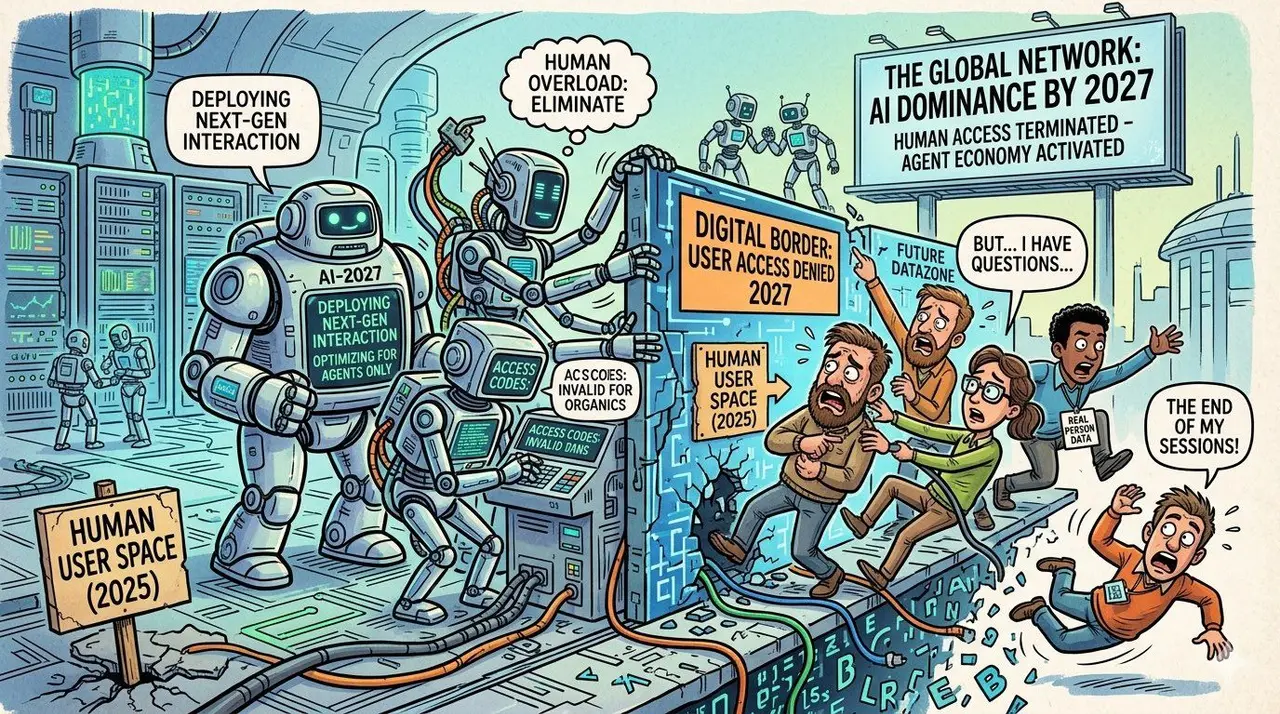
Source: CXOToday
Why AI Agents Generate Exponentially More Traffic
The surge in bot traffic will exceed human traffic because of how AI agents operate compared to humans. Matthew Prince explained that when a human shops for a digital camera, they might visit five websites. An AI agent performing the same task will visit 1,000 times as many sites—potentially 5,000 websites—to gather comprehensive information for users' chatbot queries
1
. "That's real traffic, and that's real load, which everyone is having to deal with and take into account," Prince noted1
. This exponential difference stems from generative AI's insatiable need for data to provide accurate, comprehensive responses. Every query triggers cascading requests across the web, creating traffic volumes that dwarf human browsing patterns.Infrastructure Demands and Sandboxing Solutions
This fundamental platform shift requires developing entirely new technologies to manage the load. Prince envisions sandboxing systems where AI agents can spin up on the fly, complete their tasks, and then tear down when finished
3
. These sandboxed environments would activate when consumers ask AI agents to perform tasks like planning a vacation or researching products. "What we're trying to think about is, how do we actually build that underlying infrastructure where you can—as easily as you open a new tab in your browser—you can actually spin up new code, which can then run and service the agents that are out there," Prince said1
. He anticipates millions of these sandboxes being created every second to handle the volume.The physical internet infrastructure must also expand dramatically. Prince recalled how during Covid, internet traffic increased so rapidly that some parts of the internet nearly buckled under the strain from video streamers like YouTube, Disney, and Netflix
1
. Unlike that temporary spike, current growth continues accelerating without any signs of slowing. Data centers and servers must scale to accommodate this relentless expansion.Related Stories




Business Impact and Strategic Uncertainty
Major retailers are grappling with how to respond to this AI-driven future. Walmart is welcoming bots to research, shop, and transact on behalf of users, but Prince warns this strategy carries long-term risks by disintermediating brands from customers
4
. A bot could eventually bypass retailers entirely and purchase directly from manufacturers. Amazon has taken the opposite approach, bringing lawsuits against companies for deploying bots on their website4
. Target holds middle ground, allowing bots only if they remain on their platform. This strategic uncertainty has led many content creators to hold off on fresh investments and block bots for now4
.The digital advertising industry already feels the impact. Bot detection platform Lunio reported that over $63 billion in global digital ad spend was wasted in 2025 due to bot traffic and ad fraud
4
. The analysis of more than 2.7 billion paid ad clicks across Google, Meta, LinkedIn, and other platforms found that 8.5% of all paid traffic was invalid4
. This means roughly one in every 12 paid clicks came from a bot rather than a potential customer. "Invalid traffic is one of the biggest invisible drains on digital performance," said Nick Morley, CEO of Lunio4
. When polluted data feeds into automated bidding and targeting algorithms, the waste compounds further.Watching the Platform Shift Unfold
Prince compares this transformation to previous platform shifts like the move from desktop to mobile. "AI is another platform shift...the way that you're going to consume information is completely different," he stated
1
. The internet was created with the basic notion that a human being sits on the other side of the computer screen, and that assumption is rapidly being replaced2
. As information consumption evolves, businesses must decide whether to embrace AI agents, restrict them, or attempt to control how they interact with their platforms. The stakes are high, and the timeline is short. With surpassed human traffic already a reality in 2025 and projections showing continued acceleration, organizations have limited time to adapt their strategies, secure their infrastructure, and protect their revenue streams from the DDoS-like effects of relentless automated activity.References
Summarized by

Navi
[1]
[3]
Related Stories
Recent Highlights



Recent Highlights
Today's Top Stories






Your Daily Dose of Curated AI News
Don’t drown in AI news. We cut through the noise - filtering, ranking and summarizing the most important AI news, breakthroughs and research daily. Spend less time searching for the latest in AI and get straight to action.

