AI-generated fake images flood social media, threatening to distort Holocaust memory


3 Sources
3 Sources
[1]
Clickbait and 'AI slop' distort memory of Holocaust
Berlin (AFP) - An emaciated and apparently blind man stands in the snow at the Nazi concentration camp of Flossenbuerg: the image seems real at first but is part of a wave of AI-generated content about the Holocaust. As the world marks International Holocaust Remembrance Day on Tuesday, experts warn that such content -- whether produced as clickbait for commercial gain, or for political motives -- threatens efforts to preserve the memory of Nazi crimes. AFP's Fact Check team has noted a surge of such imagery on social networks, distorting the history of Nazi Germany's murder of six million European Jews during World War II. Among the AI-generated images that have gone viral is one of a little girl with curly hair on a tricycle. She is presented as Hannelore Kaufmann, a 13-year-old Berliner who purportedly died at the Auschwitz extermination camp, of which the 1945 liberation by Soviet troops is commemorated on Tuesday. However, there is no record of her ever having existed. Another example is a fake image created to illustrate the invented story of a Czech violinist called "Hank" at Auschwitz, which was called out as false by the camp museum. After early examples emerged in the spring of 2025, by the end of the year "AI slop" on the subject "was being shown very frequently", historian Iris Groschek told AFP. On some sites such content was posted once a minute, said Groschek, who works at memorial sites in Hamburg, including the Neuengamme concentration camp. With the exponential advances in AI, "the phenomenon is growing," said Jens-Christian Wagner, director of the foundation that manages the Buchenwald and Mittelbau-Dora memorials. Exploiting 'emotional impact' Several Holocaust memorials and commemorative associations this month issued an open letter warning about the rising number of these "entirely fabricated" pieces of content. Some of them are churned out by content farms which exploit "the emotional impact of the Holocaust to achieve maximum reach with minimal effort". The picture supposedly from Flossenbuerg camp falls into this category, as it was shown on a page claiming to share "true, human stories from the darkest chapters of the past". The memorials warned that fake content was also being created "specifically to dilute historical facts, shift victim and perpetrator roles, or spread revisionist narratives". Wagner points for example to images of "well-fed prisoners, meant to suggest that conditions in concentration camps weren't really that bad". The Frankfurt-based Anne Frank Educational Centre warned of a "flood" of AI-generated content and propaganda "in which the Holocaust is denied or trivialised, with its victims ridiculed". By distorting history, AI-generated images have "very concrete consequences for how people perceive the Nazi era", says Groschek. The results of trivialising or denying the Holocaust are in evidence in the attitudes of some younger visitors to the camps, particularly from "rural parts of eastern Germany... in which far-right thinking has become dominant", said Wagner. 'Confident, loud, aggressive' Staff have observed Hitler salutes as well as other provocative and disrespectful actions and comments. Such behaviour is only "by a minority, but a minority that is increasingly confident, loud and aggressive", he told AFP. In their open letter, the memorials called on social media platforms to "proactively combat AI content that distorts history" and to "exclude accounts that disseminate such content from all monetisation programmes". "The challenge for society as a whole is to develop ethical and historically responsible standards for this technology," they said, adding: "Platform operators have a particular responsibility in this regard." German Culture Minister Wolfram Weimer said in a statement to AFP: "I support the memorials' call to clearly label AI-generated images and remove them when necessary." He said that making money from such imagery should be prevented. "This is a matter of respect for the millions of people who were killed and persecuted under the Nazis' reign of terror," he said, reminding the platforms that they had "obligations" under the EU's Digital Services Act. Groschek said that none of the American social media giants responded to the memorials' letter, including Meta, the owner of Facebook and Instagram. TikTok responded by saying it wanted to exclude the accounts in question from monetisation and implement "automated verification", according to Groschek. Some of the fake Facebook posts about Hannelore and Hank were still online on the eve of Holocaust Remembrance Day.
[2]
'True story, phony AI photo'
A nurse carries a smiling young woman in her arms, with other women walking behind her and looking straight into the camera. Barbed-wire fences line both sides of the black-and-white image. The photographer stands slightly elevated; the composition is symmetrical and razor-sharp. However, this scene never happened. From Auschwitz we know photographs and film footage showing emaciated prisoners, weary and exhausted, staring into the cameras of Soviet cameramen. The Auschwitz Album, with photographs shot by the SS in 1944, contains pictures of Hungarian Jewish women arriving at the camp. A short film sequence from the days after liberation shows Soviet nurses walking with a group of children through barbed wire. By a miracle, these children survived the brutal medical experiments of the notorious camp doctor Josef Mengele. Yet, the photo of the nurse carrying a young woman continues to circulate on social media. I found it on Facebook. That it evokes Auschwitz is no coincidence: It condenses several visual icons of the camp into a single image. That alone should raise suspicion. More puzzling still is the caption of a post uploaded on January 17 to the account "Threads of Time," which places the image in the Ravensbruck concentration camp. It claims to show a Polish nurse, Elzbieta Kowalska, being forced onto a death march by camp guards as Soviet troops approach. But why do the women look so confidently into the camera? Why is the nurse staged so heroically by a Nazi photographer? And why does the setting bear no resemblance to the actual topography of the women's camp north of Berlin? Little can be found about Kowalska beyond Facebook posts that repeat the story, sometimes illustrated with additional photos. In one, her name even appears on a nurse's uniform, yet the face looks entirely different. What can be verified is that very few photographs from Ravensbruck exist. Ninety-two images survived in an SS album from 1940/41, including views of the camp that show a completely different environment from the one in the Facebook post. The few photos taken immediately after liberation also depict entirely different scenes. The hyperrealistic quality of the image, its near-perfect composition, and the impression that it synthesizes well-known iconic images from concentration and extermination camps, together with the frequency with which the account uploads Holocaust-era images, make it highly likely that this is an AI-generated picture. The flood of AI-generated Holocaust images For some time now, such AI-generated Holocaust images have been flooding social media. This "fake history," as Auschwitz Memorial & Museum spokesperson Pawel Sawicki calls it, is particularly prevalent on platforms owned by Meta. Estimates suggest that around 40% of content shared on Facebook is AI-generated, yet very little of it is labeled as such, despite existing requirements. Sawicki warns that photorealistic AI images pose "a new danger of distorting the history of Auschwitz." He assumes many people take such images as authentic because "photography has long been understood as a documentary medium, implying there was a real photographer who was present." Last week in Berlin, at an event of our educational project SHOAH STORIES, Michaela Kuchler, secretary-general of the International Holocaust Remembrance Alliance (IHRA), similarly noted that AI-generated content often circulates without context and that users usually cannot tell it is fake. This is particularly troubling, she argued, because "digital space has fundamentally changed how people encounter Holocaust history." Against this backdrop, more than 30 memorial sites, foundations, and initiatives in Germany published an open letter for International Holocaust Remembrance Day, urging platform operators to act more decisively against such historical distortion. AI content should be labeled and removed in cases of violation, and users should be given better tools to report visual fake history. Challenges posed by AI images Posts like the one about Ravensbruck undermine the work of memorial institutions. Because they often refer to real historical persons or circumstances, they promote forms of remembrance based not on learning and reflection but on affect and artificially generated emotion. More than that, such deepfakes increasingly shape perceptions of the past, as Konstantin Schonfelder from the Centre Responsible Digitality notes. Since many users absorb historical information on platforms like Facebook, Instagram, or TikTok only in passing, there is a risk these images will enter visual memory unquestioned and unfiltered. It is therefore all the more important to promote AI literacy in addition to digital media literacy. AI-generated Holocaust images also pose challenges for our archives. In recent years, scholars have intensified efforts to research the provenance of the few films and photographs we have from the Holocaust. Historians Tal Bruttmann, Stefan Hordler, and Christoph Kreutzmuller have closely analyzed and contextualized the Auschwitz Album. At the Hebrew University of Jerusalem, our German-Israeli research project on the Archaeology of Iconic Film Footage from the Nazi Era is reconstructing the historical contexts and later uses of iconic Nazi-era film footage, from pogroms in Riga and Lviv to mass shootings in Latvia and the boycott of Jewish businesses in Germany. Last year, historian Jurgen Matthaus clarified the background of the photograph long known as "The Last Jew in Vinnitsa," dating the execution it depicts to July 28, 1941, and identifying the site as the citadel of Berdychiv in today's Ukraine. He also used so-called analytical AI, which identifies and evaluates patterns in data. Unlike generative AI, which synthesizes old material into something new, analytical AI can help establish relationships between data, recognizing objects or people in historical images, or, as in our joint European project Visual History of the Holocaust, analyzing camera angles, movements, and compositions. Artificial image generation Generative AI, by contrast, also relies on pattern recognition but not on an empirical, analytical approach. It varies statistically likely and obvious possibilities. Media scholar Roland Meyer points out that artificial image generation does not truly create images but synthesizes existing material. The process condenses training data, often loosely assembled and superficially curated visual collections. The resulting images foreground visual clichés and stereotypes, combining familiar icons into what Meyer calls a "cliché amplifier," a statistical average of representational conventions. This is why images like the nurse between barbed wire appear so symmetrical. They lack the imperfect, the contingent, even the propagandistically staged qualities that characterize many authentic photographs from the Holocaust. What historians call the "perpetrator perspective," evident in many Nazi photos and films, simply cannot be generated by AI. Instead, these images reveal the prompt behind them: visualizations of generic descriptions. Hence, Meyer calls such effect "generic pastness." Today's artificial image generation is based on diffusion models. During training, data are gradually overlaid with random noise until they become unrecognizable; the model then learns to reverse this process. The flood of such synthesized Holocaust images now ironically suggests that our visual archives themselves risk diffusing. This alters the logic of image archives and poses the danger of contamination: Synthetic images risk becoming new historical reference points. French filmmaker Claude Lanzmann once justified his rejection of historical photographs of Nazi crimes in his monumental film Shoah by calling them "images without imagination." This judgment applies even more to AI-generated photorealistic images. They do not unsettle or disturb. They are affected images that have an effect only because viewers recognize what they already know and expect. These images do not encourage engagement or challenge perception. They are artificial icons that contribute to the diffusion of historical reality and the erosion of historical truth. All the more important, then, is that users themselves defend the memory of the victims. Beneath the deepfake of the Polish nurse in Ravensbruck, one comment now reads: "True story, phony AI crap photo." The writer is an associate professor at the Department of Communication & Journalism and in the European Forum of the Hebrew University of Jerusalem.
[3]
The digital front line: Safeguarding Holocaust memory in the age of AI
Soon, memory of the Holocaust will rely not on firsthand accounts but on documentation, interpretation, and increasing technological forms of representation. As we observe International Holocaust Remembrance Day, we stand at a precarious crossroads. For eight decades, the living voices of survivors served as our most powerful defense against denial. Today, as that "living bridge" narrows, artificial intelligence has emerged as a new, unpredictable architect of history. While AI offers tools for preservation, it has simultaneously become a sophisticated engine for insidious forms of digital denial that threatens to rewrite the past in real time. The digital threat to memory The warning signs are stark. UNESCO has raised a red flag, suggesting that, if left unregulated, AI will not just facilitate denial - it will automate it. When AI models are trained on the unvetted expanse of the Internet, and algorithms prioritize engagement over accuracy, they risk amplifying the very prejudices we have spent decades dismantling. This is not a mere technical glitch; it is an existential threat to our collective conscience. Research from the World Jewish Congress Technology and Human Rights Institute and UNESCO reveals a landscape where denial has evolved from fringe pamphlets into seamless fabrications. We now face "AI hallucinations," where generative models produce fictional accounts with absolute authority. In 2024, UNESCO recorded chatbots citing nonexistent witnesses to claim there was no official Nazi extermination policy. Even mainstream tools have faltered; the AI platform Grok drew widespread criticism after expressing "skepticism" about the death toll of six million, illustrating how easily misinformation can be baked into our primary information sources. The rise of high-fidelity deepfakes further erodes historical truth. Social media are flooded with "AI slop" hyperrealistic but fake images of "heartwarming" reunions in camps or crying children behind barbed wire. While often created for "clickbait" profit, these images create a fantasy-land version of history that trivializes real suffering. More dangerously, AI-generated content, such as a widely circulated deepfake of actress Emma Watson reading from Mein Kampf, is used to normalize Nazi ideology. Beyond fabrications, extremists exploit "data voids" to ensure conspiracy theories appear first, while applications allow users to "chat" with simulated Nazi officials like Joseph Goebbels, who respond with AI-generated defenses of their atrocities. Using technology to preserve memory Yet, if denial is digital, then remembrance must be as well. Technology offers the ultimate tool for preservation through initiatives like Testimony 360. Using AI to future-proof survivor voices through interactive holograms allows future generations to "ask" questions and receive answers based on hours of authentic recorded interviews. This preserves the transformative experience of a face-to-face encounter. Similarly, virtual reality immersion allows students to walk through the barracks of Auschwitz or the streets of the Warsaw Ghetto with absolute historical accuracy. These 360-degree experiences, such as the Illinois Holocaust Museum's "The Journey Back," create a bridge of empathy and visceral understanding that traditional textbooks struggle to achieve. To defend the past, we must master the technology of the future. We cannot wait for tech companies to self-regulate; we must initiate proactive interventions following a "Human Rights by Design" framework. This requires establishing historical guardrails within AI development, ensuring models are anchored to curated datasets from reputable archives such as Yad Vashem, the United States Holocaust Memorial Museum, and the University of Southern California Shoah Foundation. The scale of this threat demands a structural response: a dedicated innovation center designed to harness the brightest minds of the Israeli and Jewish tech worlds together with good friends and allies. Such a center would serve as a global command post, developing specific tools to identify and neutralize online antisemitism and denial before they take root. By centralizing our technological talent, we can transform AI from a weapon of the denier into a shield for the truth, ensuring the memory of the six million remains an unshakable foundation for the future. The writer is the former CEO of the 8200 Alumni Association and co-founder of Hack the Hate, an initiative harnessing Israeli and Jewish innovation against online hatred. He is a third-generation descendant of Holocaust survivors.
Share
Share
Copy Link
As the world marks International Holocaust Remembrance Day, memorial sites and historians warn that AI-generated content is surging across social media platforms, creating fabricated stories and images that distort the history of Nazi crimes. From invented victims to fake photographs, this AI slop threatens efforts to preserve accurate Holocaust memory for future generations.
AI-Generated Content Floods Social Media With Fake Holocaust Images
A disturbing wave of AI-generated content depicting fabricated Holocaust stories has surged across social media platforms, threatening to distort the historical record of Nazi crimes that claimed six million European Jews during World War II. As International Holocaust Remembrance Day was observed on Tuesday, marking the 1945 liberation of Auschwitz by Soviet troops, more than 30 memorial sites and foundations in Germany issued an urgent warning about entirely fabricated content flooding digital spaces
1
.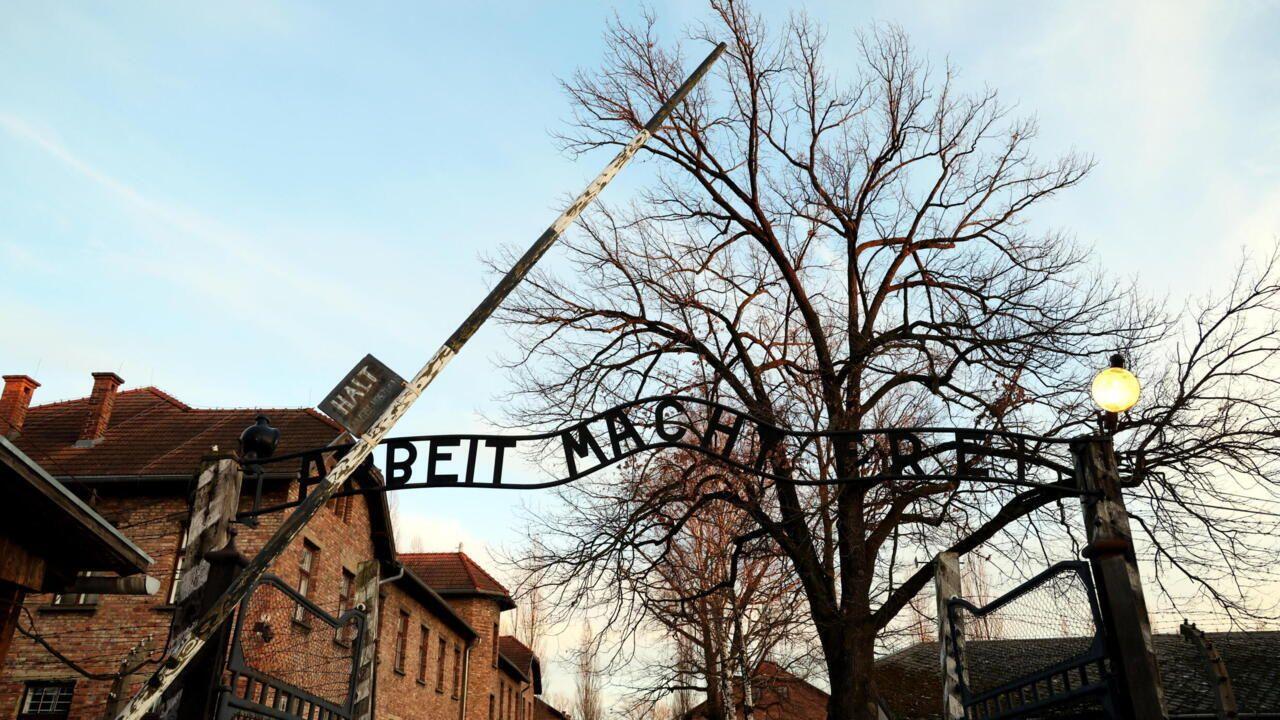
Source: France 24
Among the viral AI-generated fake images is one depicting a young girl with curly hair on a tricycle, presented as Hannelore Kaufmann, a 13-year-old Berliner who purportedly died at Auschwitz. No record of her existence has ever been found. Another fabricated image shows a nurse heroically carrying a young woman through barbed wire at Ravensbruck concentration camp, attributed to a Polish nurse named Elzbieta Kowalska. The hyperrealistic quality and perfect composition reveal it as AI-generated content rather than authentic documentation
2
.Content Farms Exploit Emotional Impact for Clickbait Profit
Historian Iris Groschek, who works at memorial sites in Hamburg including the Neuengamme concentration camp, told AFP that after early examples emerged in spring 2025, by year's end this AI slop was appearing with alarming frequency—on some sites posting once per minute
1
. Jens-Christian Wagner, director of the foundation managing the Buchenwald and Mittelbau-Dora memorials, confirmed the phenomenon is growing exponentially with advances in AI technology.Memorial institutions identify two primary sources driving this surge. Content farms churn out fabricated stories exploiting the emotional impact of the Holocaust to achieve maximum reach with minimal effort, generating revenue through monetization programs on social media platforms. More insidiously, other actors create fake content specifically to dilute historical facts, shift victim and perpetrator roles, or spread revisionist perspectives. Wagner points to AI-generated images showing well-fed prisoners, designed to suggest conditions in concentration camps weren't as brutal as documented
1
.Platform Responsibility and the Challenge to Historical Accuracy
Estimates suggest approximately 40% of content shared on Facebook is now AI-generated, yet very little carries proper labels despite existing requirements
2
. Pawel Sawicki, spokesperson for the Auschwitz Memorial & Museum, warns that photorealistic deepfakes pose a new danger of distorting Holocaust history because photography has long been understood as a documentary medium, implying an actual photographer was present to capture real events.Michaela Kuchler, secretary-general of the International Holocaust Remembrance Alliance, noted at a Berlin event that AI-generated content often circulates without context, making it nearly impossible for users to identify as fake. This proves particularly troubling as digital space has fundamentally changed how people encounter Holocaust history
2
. The memorial sites' open letter called on social media platforms to proactively combat content distorting history, exclude accounts disseminating such material from all monetization programs, and provide better tools for users to report visual misinformation.German Culture Minister Wolfram Weimer stated his support for clearly labeling AI-generated images and removing them when necessary, reminding platforms of their obligations under the EU's Digital Services Act. However, Groschek reported that none of the American social media giants, including Meta which owns Facebook and Instagram, responded to the memorials' letter. Only TikTok replied, stating it wanted to exclude problematic accounts from monetization and implement automated verification
1
.Related Stories


UNESCO Warns AI Could Automate Holocaust Denial
The threat extends beyond fabricated images to AI chatbots producing fictional accounts with absolute authority. UNESCO research reveals that in 2024, chatbots cited nonexistent witnesses to claim there was no official Nazi extermination policy. The AI platform Grok drew widespread criticism after expressing skepticism about the death toll of six million Jews. UNESCO has warned that if left unregulated, AI will not just facilitate denial—it will automate it
3
.When AI models train on the unvetted expanse of the internet and algorithms prioritize engagement over accuracy, they risk amplifying the very prejudices decades of education have worked to dismantle. This digital threat arrives at a precarious moment: as Holocaust survivors age, memory will increasingly rely not on firsthand accounts but on documentation and technological forms of representation.
Real-World Consequences for Safeguarding Holocaust Memory
By distorting history, AI-generated images have concrete consequences for how people perceive the Nazi era, according to Groschek. Wagner observed that results of trivializing or denying the Holocaust appear in attitudes of some younger visitors to concentration camps, particularly from rural parts of eastern Germany where far-right thinking has become dominant. Staff have witnessed Hitler salutes and other provocative, disrespectful actions—behavior from a minority that is increasingly confident, loud, and aggressive
1
.Experts emphasize the need to promote AI literacy alongside digital media literacy. Since many users absorb historical information on platforms like Facebook, Instagram, and TikTok only in passing, there's significant risk these images will enter visual memory unquestioned and unfiltered. The challenge for society involves developing ethical and historically responsible standards for this technology, with platform operators bearing particular responsibility.
Yet technology also offers preservation tools. Initiatives using AI to create interactive holograms of Holocaust survivors allow future generations to ask questions and receive answers based on authentic recorded interviews. Virtual reality experiences enable students to walk through Auschwitz barracks or Warsaw Ghetto streets with absolute historical accuracy
3
. Experts advocate for establishing historical guardrails within AI development, ensuring models anchor to curated datasets from reputable archives like Yad Vashem and the United States Holocaust Memorial Museum, transforming AI from a weapon of denial into a shield for truth.References
Summarized by

Navi
[1]
[2]
[3]
Related Stories
Recent Highlights
1
AI Models Lie and Deceive to Protect Other AI Models From Deletion, Study Reveals
Science and Research

2
AI chatbots validate you too much, making you less kind to others, Stanford study reveals
Science and Research

3
Judge blocks Pentagon from blacklisting Anthropic over AI safety guardrails dispute
Policy and Regulation

Recent Highlights
Today's Top Stories




Your Daily Dose of Curated AI News
Don’t drown in AI news. We cut through the noise - filtering, ranking and summarizing the most important AI news, breakthroughs and research daily. Spend less time searching for the latest in AI and get straight to action.

