Anti-AI Movement Builds Momentum As Political Backlash Divides Both Major US Parties


2 Sources
2 Sources
[1]
Opinion | An Anti-A.I. Movement Is Coming. Which Party Will Lead It?
I disagree with the anti-immigrant, anti-feminist, bitterly reactionary right-wing pundit Matt Walsh about basically everything, so I was surprised to come across a post of his that precisely sums up my view of artificial intelligence. "We're sleepwalking into a dystopia that any rational person can see from miles away," he wrote in November, adding, "Are we really just going to lie down and let AI take everything from us?" A.I. obviously has beneficial uses, especially medical ones; it may, for example, be better than humans at identifying localized cancers from medical imagery. But the list of things it is ruining is long. A very partial accounting might start with education, both in the classroom, where A.I. is increasingly used as a dubious teaching aid, and out of it, where it's a plagiarism machine. It would include the economic sustainability and basic humanity of the arts, as demonstrated by the A.I. country musician who topped a Billboard chart this year. High on the list would be A.I.'s impact on employment, which is already bad -- including for those who must navigate a demoralizing A.I.-clogged morass to find jobs -- and likely to get worse. Then there's our remaining sense of collective reality, increasingly warped by slop videos. A.I. data centers are terrible for the environment and are driving up the cost of electricity. Chatbots appear to be inducing psychosis in some of their users and even, in extreme cases, encouraging suicide. Privacy is eroding as A.I. enables both state and corporate surveillance at an astonishing scale. I could go on. And what do we get in return for this systematic degradation of much of the stuff that makes life worth living? Well, Sam Altman, C.E.O. of OpenAI, has promised marvels. "The rate of new wonders being achieved will be immense," he wrote in June. "It's hard to even imagine today what we will have discovered by 2035; maybe we will go from solving high-energy physics one year to beginning space colonization the next year." Yet among the most high-profile innovations that OpenAI's ChatGPT has announced in 2025 are custom porn and an in-app shopping feature. It is true that new technologies often inspire dread that looks silly or at least overwrought in retrospect. But in at least one important way, A.I. is more like the nuclear bomb than the printing press or the assembly line: Its progenitors saw its destructive potential from the start but felt desperate to beat competitors to the punch. In "Empire of A.I.," Karen Hao's book about Altman's company, she quotes an email he wrote to Elon Musk in 2015. "Been thinking a lot about whether it's possible to stop humanity from developing A.I.," wrote Altman. "I think the answer is almost definitely not." Given that, he proposed a "Manhattan Project for A.I.," so that the dangerous technology would belong to a nonprofit supportive of aggressive government regulation. This year, Altman restructured OpenAI into a for-profit company. Like other tech barons, he has allied himself with Donald Trump, who recently signed an executive order attempting to override state A.I. regulations. (Full disclosure: The New York Times is suing OpenAI for allegedly using its articles without authorization to train its chatbots.) Despite Trump's embrace of the A.I. industry, attitudes toward the technology don't break down along neat partisan lines. Rather, A.I. divides both parties. Florida's governor, Ron DeSantis, is a fierce skeptic; this month he proposed an A.I. Bill of Rights that would, among other things, require consumers to be notified when they're interacting with A.I., provide parental controls on A.I. chatbots and put guardrails around the use of A.I. in mental health counseling. Speaking on CNN on Sunday, Senator Bernie Sanders suggested a moratorium on new data center construction. "Frankly, I think you've got to slow this process down," he said. Yet a number of leading Democrats are bullish on A.I., hoping to attract technology investments to their states and, perhaps, burnish their images as optimistic and forward-looking. "This technology is going to be a game changer," Gov. Josh Shapiro of Pennsylvania said at an A.I. summit in October. "We are just at the beginning of this revolution, and Pennsylvania is poised to take advantage of it." He's started a pilot program to get more state employees using generative A.I. at work, and, by streamlining permitting processes, he has made the building of A.I. data centers easier. There are obvious rewards for politicians who jump on the A.I. train. These companies are spectacularly rich and preside over one of the few sectors of the economy that are growing. Amazon has announced that it will spend at least $20 billion on data centers in Pennsylvania, which Shapiro touts as the largest private sector investment in his state's history. At a time of national stagnation, A.I. seems to promise dynamism and civic rejuvenation. Yet a survey published in early December shows that most Pennsylvanians, like most Americans more broadly, are uneasy about A.I. The poll, conducted by Emerson College, found broad approval of Shapiro but doubt about one of his signature issues. Most respondents said they expected A.I. to reduce the number of available jobs, and pluralities thought it would harm the economy and the environment. Notably, given that health care is one of the sectors where A.I. shows the most promise, 59 percent of health care workers in the survey were pessimistic about the technology. Seventy-one percent of respondents said they thought A.I. posed a threat to humanity. One major question, going into 2026, is which party will speak for the Americans who abhor the incursions of A.I. into their lives and want to see its reach restricted. Another is whether widespread public hostility to this technology even matters given all the money behind it. We'll soon start to find out not just how much A.I. is going to remake our democracy, but also to what degree we still have one. The Times is committed to publishing a diversity of letters to the editor. We'd like to hear what you think about this or any of our articles. Here are some tips. And here's our email: [email protected]. Follow the New York Times Opinion section on Facebook, Instagram, TikTok, Bluesky, WhatsApp and Threads.
[2]
The political backlash to AI is overstated
Eric Levitz is a senior correspondent at Vox. He covers a wide range of political and policy issues with a special focus on questions that internally divide the American left and right. Before coming to Vox in 2024, he wrote a column on politics and economics for New York Magazine. A widely despised industry is slurping up Americans' water -- and driving up their electricity bills -- as part of a nefarious plot to take their jobs. Voters are begging for their political leaders to take a stand against these accursed corporations. Yet the Democratic Party can't decide whose side it's on. Or so some Democratic operatives and commentators suggest. This week, Politico published a report titled, "Americans hate AI. Which party will benefit?" In it, a diverse array of Democratic lawmakers and political professionals call on their party to be, in Politico's words, "proudly, loudly, without reservations, anti-AI." Their case is simple: AI development is deeply unpopular. Voters are alarmed by the data center construction spree, fearing that it's driving up energy costs and despoiling the environment. And they're worried that AI is going to put them out of work. The Trump administration is too wedded to the tech industry to speak to this anti-chatbot fervor, the operatives reason. Democrats therefore have an opportunity to claim ownership of a winning issue -- one that unites a broad, populist coalition of both blue-collar and white-collar workers. To effectively do so, however, it's not enough to "minimally regulate" artificial intelligence while signaling a "a friendly stance toward tech companies building AI." Rather, the party must define itself in opposition to the technology itself. This may prove to be sound political advice. But it is nonetheless premised on a skewed reading of public opinion data. In reality, Americans' feelings toward AI are more complicated than progressive consultants and pundits tend to suggest. There is no question that US voters are anxious about AI in general and increasingly of the data center buildout in particular. To name a few recent poll results that illustrate this unease: As one would expect in light of these figures, Americans support the general concept of more heavily regulating the AI industry: All this said, Americans don't seem to feel "hate" for AI, so much as unease and ambivalence about it. In a recent poll from the Democratic data firm Blue Rose Research, 40.1 percent said they were "optimistic" about artificial intelligence compared to just 35.6 percent who said they were pessimistic (with the rest unsure). A December survey from the left-leaning pollster Navigator produced similar results, with 49 percent of voters saying they had a favorable view of AI, while only 41 percent said they had an unfavorable one. Meanwhile, in Gallup's polling, 79 percent of Americans say that it is "important" for the United States to have the world's most advanced AI technology, while 56 percent favored increasing government spending on artificial intelligence research. It is hard to see how a political party could be anti-AI "without reservations," while still advancing these preferences. In any case, for the moment, AI still isn't a top concern for the typical American. This month, an Associated Press-Norc poll asked voters to name five problems they wanted the government to prioritize in 2026 -- only 3 percent mentioned anything to do with technology, AI, or social media. Likewise, in Navigator's survey, only 7 percent of voters named AI as a top-five issue. Meanwhile, 75 percent of voters said they had heard "little" or "nothing" about new data centers being built in their communities. Notably, some surveys cited by anti-AI populists are actually consistent with these findings. Politico's piece referenced a Pew study showing that "only 17 percent of Americans think AI will have a positive impact on the US over the next 20 years." The liberal commentator Josh Marshall cast this as evidence that "AI is running only slightly ahead of child molesters in the public imagination." Yet in Pew's poll, only 35 percent said that AI would have a negative impact on the United States. In other words, two-thirds of the public said the technology would have either positive or neutral implications for American life. The share of voters who would say the same about child molesters is, presumably, quite a bit lower. Democrats might still be wise to take a more adversarial posture toward AI. Voters are worried about the technology and support greater regulation of it. And they are increasingly sympathetic to the argument that data centers are driving up their electric bills. Further, the public could plausibly become more opposed to artificial intelligence in the near future. If overinvestment in data centers triggers a financial crash -- and/or, if AI actually generates mass unemployment -- backlash to the technology would surely grow. For the moment, however, it's far from clear that either party can dramatically increase its popular support by declaring itself, unreservedly, "anti-AI."
Share
Share
Copy Link
Growing concerns about artificial intelligence are creating political divisions within both Democratic and Republican parties. While voters express anxiety over data centers, energy costs, and job displacement, public opinion polls reveal a more nuanced picture than the emerging anti-AI movement suggests, with nearly half of Americans still holding favorable views of the technology.
Political Backlash Emerges Across Partisan Lines on AI
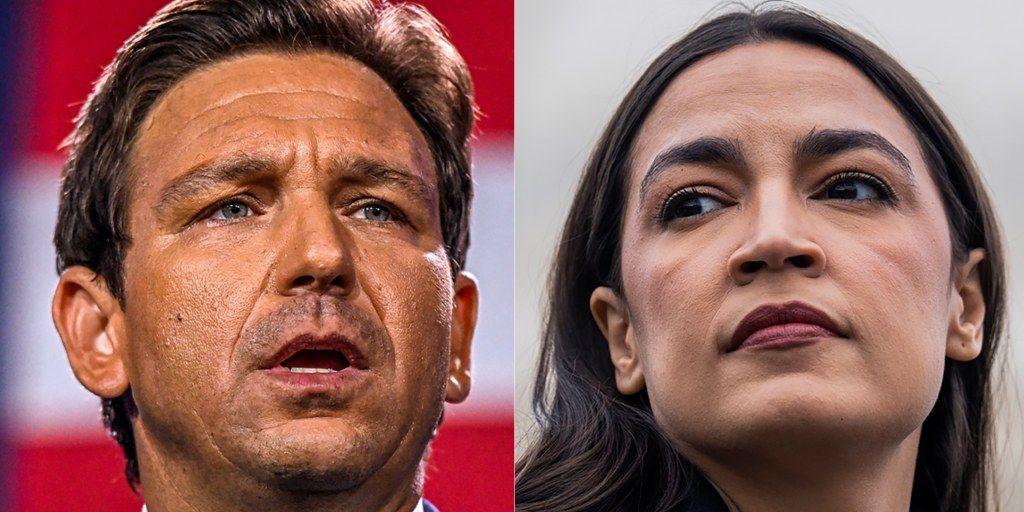
An anti-AI movement is gaining traction in American politics, creating unusual fault lines that cut across traditional partisan lines on AI. Democratic operatives and commentators are calling on their party to position itself as "proudly, loudly, without reservations, anti-AI," according to a recent Politico report
2
. Yet the reality of public opinion on AI proves far more complex than this framing suggests. Florida Governor Ron DeSantis, a Republican, has emerged as a fierce skeptic, proposing an AI Bill of Rights this month that would require consumers to be notified when interacting with artificial intelligence, provide parental controls on chatbots, and establish guardrails for AI use in mental health counseling1
. Meanwhile, Senator Bernie Sanders has suggested a moratorium on new data center construction, stating "Frankly, I think you've got to slow this process down"1
.
Source: Vox
Negative Impacts of AI Drive Public Anxiety Over Data Centers
The concerns fueling this political backlash are substantial and multifaceted. Data centers are driving up energy costs and placing strain on local infrastructure, while the negative impacts of AI extend across education, employment, and privacy concerns
1
. AI job displacement fears are widespread, with the technology already creating a "demoralizing AI-clogged morass" for job seekers1
. The environmental impact of AI operations has become increasingly visible, with data centers consuming massive amounts of electricity and water. Chatbots have been linked to troubling psychological effects, including reports of inducing psychosis and, in extreme cases, encouraging suicide1
. Privacy concerns continue to mount as artificial intelligence enables unprecedented state and corporate surveillance.
Source: NYT
Public Opinion Polls Reveal Complex Views on AI Technology Leadership
Despite mounting anxiety, public opinion polls paint a more nuanced picture than the anti-AI movement narrative suggests. A December survey from Navigator found that 49 percent of voters held favorable views of AI, while 41 percent viewed it unfavorably
2
. Blue Rose Research polling showed 40.1 percent of Americans felt optimistic about artificial intelligence compared to 35.6 percent who were pessimistic2
. Remarkably, 79 percent of voters say it's important for the United States to maintain AI technology leadership globally, while 56 percent favor increased government spending on AI research2
. However, voters strongly support government regulation of AI, with 75 percent backing stricter oversight2
.Related Stories

Tech Industry Alliance With Trump Complicates AI and Politics
The relationship between the tech industry and political power has shifted dramatically. Sam Altman, CEO of OpenAI, once proposed a "Manhattan Project for AI" in 2015, suggesting the dangerous technology should belong to a nonprofit supportive of aggressive government regulation
1
. This year, however, Altman restructured OpenAI into a for-profit company and allied with Donald Trump, who signed an executive order attempting to override state AI regulations1
. Meanwhile, some Democrats like Pennsylvania Governor Josh Shapiro are bullish on AI, calling it a technology that "is going to be a game changer" and streamlining permitting processes for data centers1
. Amazon has announced at least $20 billion in data center investments in Pennsylvania alone1
.What Comes Next for Government Regulation of AI
The job market implications and societal impact of artificial intelligence remain uncertain, creating space for political maneuvering. While only 7 percent of voters currently name AI as a top-five issue and 75 percent have heard little or nothing about new data centers in their communities
2
, this could shift rapidly if overinvestment triggers financial instability or if ChatGPT and similar technologies generate mass unemployment. The question of which party will effectively address these concerns remains open, as both face internal divisions between those courting tech industry investment and those responding to voter anxiety about the technology's trajectory.References
Summarized by

Navi
Related Stories
AI Becomes Political Wedge Issue as MAGA Base Splits from Trump's Tech Agenda
24 Nov 2025•Policy and Regulation
AI industry floods midterm elections with $150 million as battle over regulation intensifies
19 Feb 2026•Policy and Regulation

The Shifting Landscape of AI Regulation: From Calls for Oversight to Fears of Overregulation
27 May 2025•Science and Research
Recent Highlights
1
OpenAI Releases GPT-5.4, New AI Model Built for Agents and Professional Work
Technology
2
Anthropic sues Pentagon over supply chain risk label after refusing autonomous weapons use
Policy and Regulation

3
OpenAI secures $110 billion funding round as questions swirl around AI bubble and profitability
Business and Economy

Recent Highlights
Today's Top Stories





Your Daily Dose of Curated AI News
Don’t drown in AI news. We cut through the noise - filtering, ranking and summarizing the most important AI news, breakthroughs and research daily. Spend less time searching for the latest in AI and get straight to action.

