Apple launches M5 chips in new MacBook Pro and Air, targeting AI workflows with major upgrades


19 Sources
19 Sources
[1]
Apple unveils new MacBook Air and MacBook Pro with M5 | TechCrunch
Apple announced its new slate of laptops on Tuesday morning, including new MacBook Air and MacBook Pro models that use Apple's M5 chips. The Pro models were unveiled alongside the brand new M5 Pro and M5 Max chips, which Apple describes as its most advanced CPU cores yet. The company said these updated M5 chips were specifically designed to make the MacBook Air and MacBook Pro laptops better at handling intensive AI tasks, which are becoming more of a focal point for new Apple hardware. Both the new Air and Pro laptops can handle AI tasks up to 4x faster than their respective M4 predecessors, according to Apple. These AI-centric upgrades may not be immediately noticeable for more casual users who aren't trying to run a computationally intensive network of AI agents or generate fast 3D renderings. But these advancements permeate other aspects of the laptops as well. MacBook Air users get perks like 18 hours of battery life (a six-hour improvement compared with the last Intel-based Apple laptops from 2020), as well as a 12MP Center Stage camera for video calls, a three-mic array, and a sound system that supports Spatial Audio and Dolby Atmos. The MacBook Air has two Thunderbolt 4 ports, a MagSafe charging port, and a classic 3.5mm headphone jack. The new MacBook Air lineup comprises a 13-inch (starting at $1099) and 15-inch model (starting at $1299), with color options in sky blue, midnight, starlight, and silver. The Air also now comes with starting storage of 512 GB, doubling the previous model's base storage capacity. As usual, the MacBook Pro is geared toward more technical users, especially developers working with AI. The M5 Pro and M5 Max chips are up to 4x faster at LLM prompt processing than the M4 Pro and M4 Max, and up to 8x faster at AI image generation than the M1 Pro and M1 Max. Apple says this makes it possible for AI researchers and developers to train custom models on their device, and creative users could benefit from faster 3D rendering, video editing, and music production work. The MacBook Pro also features up to 2x faster read/write performance than the last generation, and will start at 1TB of storage for the MacBook Pro with M5 Pro, and 2TB for the MacBook Pro with M5 Max. Apple says these laptops have up to 24 hours of battery life, and with a 96W or higher USB-C adapter, users can charge to 50% battery in thirty minutes. The laptops support Thunderbolt 5 and have a six-speaker sound system. The 14-inch and 16-inch MacBook Pro models with the M5 Pro chips start at $2,199 and $2,699, respectively, whereas the models with the M5 Max chips start at $3,599 and $3,899, available in either black or silver colorways. All of these laptops will be available for preorder on Tuesday, March 4, and will available beginning on Wednesday, March 11.
[2]
Apple unveils M5 Pro and M5 Max chips with new 'Fusion Architecture'
Apple on Tuesday debuted the latest addition to the M-series of chips, as it announced its new M5 Pro and M5 Max, which are powering the new MacBook Pro. The tech giant says the chips are engineered around its new Fusion Architecture, an advanced design that merges two dies into a single, high-performance system on a chip (SoC), which includes a powerful CPU, scalable GPU, Media Engine, unified memory controller, Neural Engine, and Thunderbolt 5 capabilities. Both chips feature an 18-core CPU, marking an upgrade from the 14-core configuration in the M4 Pro and the 16-core in the M4 Max. The CPU now features six "super cores," which is Apple's term for its highest-performance cores, alongside 12 all-new performance cores. Collectively, the CPU boosts performance by up to 30% for pro workloads. "The GPU scales up the next-generation architecture introduced in M5 to an up-to-40-core GPU," Apple explained in a press release. "With a Neural Accelerator in each GPU core and higher unified memory bandwidth, M5 Pro and M5 Max are over 4x the peak GPU compute for AI compared to the previous generation." Graphics performance is up to 20% faster overall, with ray-tracing workloads improving by as much as 35%. M5 Pro supports up to 64GB of unified memory, up from 48GB on M4 Pro, with bandwidth of 307GB/s. M5 Max continues to support up to 128GB of unified memory, with bandwidth increased to 614GB/s. Apple says the M5 Pro is aimed at pro users such as data modelers, post-production sound designers, and STEM students who need strong CPU and GPU performance, along with large amounts of unified memory for complex projects and workloads. M5 Max is designed for pro users, such as 3D animators, app developers, and AI researchers who run workloads that demand maximum GPU compute and the highest unified memory bandwidth, the tech giant says. The new MacBook Pro models are available for pre-order tomorrow, with availability beginning March 11.
[3]
Apple Launches MacBook Pros With New M5 Pro, M5 Max Chips
After shipping the M5-based version of the MacBook Pro 14 in the latter part of 2025, Apple followed its usual pattern of releasing higher end models of the 14- and 16-inch models with Pro and Max versions of the processor, along with an M5 model of the MacBook Air. The M5 Pro and M5 Max bring updated connectivity and improved battery life -- which was already excellent -- to the laptops, which are otherwise mostly unchanged from earlier M4 Pro and M4 Max models: We'll have to keep waiting for versions equipped with an OLED display, though. Prices for the new laptops start at $2,199 for the MacBook Pro 14 and $2,699 for the MacBook Pro 16 with the M5 Pro and $3,599 and $3,899 for the M5 Max. The new laptops incorporate an N1 networking chip which brings Wi-Fi 7 and Bluetooth 6. Historically, the higher-end chips add CPU and GPU cores for improved speed overall as well as faster graphics processing, and the M5 introduced neural accelerator clusters on the GPU to boost performance on AI, notably the math that's essential for image and video generation which the Neural Engine can't handle as well. Apple also debuted two upgraded models of its relatively old Studio Display and very old Pro Display XDR. The new $3,299 Studio Display XDR now comes in a 27-inch 5K model that adds a long-awaited 120Hz refresh rate, while the cheaper 27-inch $1,599 Studio Display has an improved webcam and Thunderbolt 5 support -- no HDR or high refresh for the mainstream crowd. Preorders for all start tomorrow and start shipping on March 11.
[4]
I Went Hands On With the M5 MacBook Air. The Real Changes Are Hiding Inside
The MacBook Air is back, but this time in a new light. Apple used its March 2026 product event to bring M5 processing to the MacBook Air, along with a sizable storage upgrade and enhanced wireless connectivity, for a new starting price of $1,099. You're not seeing things: After a year at just $999 for the basic 13-inch version (and often on sale at a decent discount), the MacBook Air now costs $100 more at both of its screen sizes, 13 inches and 15 inches. Why the price increase? The easy answer is that the storage upgrade doubles both the capacity and the SSD speed, a tangible improvement overall. The more complicated answer is that Apple's shiny new budget MacBook Neo (starting at $599) also, arguably, gave the company some wiggle room to bump up the price a bit. At least, with the storage upgrades, the company has tried to make good on the higher price. I had the chance to play with the updated MacBook Air in both sizes during Apple's big launch event. You'll be either pleased or bummed (or maybe a bit of both?) to hear that it looks and feels just like last year's model. The biggest changes are on the inside. Design: It's the Air You Know Absolutely nothing has changed about the MacBook Air's design coming from the M4 generation. That may excite or disappoint you, depending on how you feel about the current MacBook Air design, which debuted years ago with the M2 models. Regardless of how well-received the MacBook Air has been, five generations of any laptop with no redesign would start to feel stale. Apple's iPhones and iPads, for example, have seen multiple design revisions within the same time frame. Did Apple all but ace its redesign back in 2022? Arguably, yes. But Apple's PC competition has leveled up its design game big-time in the years since. (And everyone knows how divisive Apple's screen notch is.) From a sharper display with deeper contrast (but, ahem, not OLED) to quality-of-life improvements like more ports and a webcam privacy shutter, the MacBook Air has plenty of room for improvement despite its top-tier status. With all that said, the 13-inch MacBook Air still weighs just 2.7 pounds and measures 0.44 inch thick. (The 15-incher's dimensions also remain unchanged.) Both sizes still include two Thunderbolt 4 ports, a MagSafe power connection, and a headphone jack. Also, the Airs still come in four colors of recycled aluminum: silver, blue, black, and gold. In short, a new design is not why you'd consider this year's MacBook Air. It's the laptop equivalent of choosing Classic Coke. Toying around with the laptops at Apple's New York launch event today, I can confirm that the design hasn't changed one bit, which isn't a letdown considering how much I already appreciate the keyboard and trackpad. Both continue to be top-notch parts. While I think we're about due for a design update, this year's laptop has all of that familiar MacBook Air feeling, but with a much mightier punch inside. Specs Check: What's Changed Inside This Time? Of course, the marquee upgrade -- like with every generation since the Apple M1 in 2020 -- is that a new processor, here the 10-core Apple M5, has made it into the MacBook Air. First seen in last year's 14-inch MacBook Pro, the M5 chip brings substantial gains in graphics performance with a new integrated graphics architecture that adds neural accelerator coprocessors to each of the M5 chip's eight or 10 GPU cores. (Getting Apple's 10-core GPU is a $100 upgrade in the Air.) These neural accelerators are geared mainly toward boosting the GPU's AI processing capabilities, but they also apply machine-learning techniques to graphics rendering (primarily around resolution upscaling and frame generation). Altogether, the MacBook Air will be much more prepared for content creation and gaming than the previous generation: Apple claims 2.7 times faster image processing from the M5 over the M1 in the Affinity app, and a 1.5 times increase over the M4. We'll have to wait for full testing to see for ourselves how the M5 elevates the MacBook Air in terms of performance. (We've only tested the M5 in the MacBook Pro, since that's been its only appearance to date, until now.) I'm particularly excited to see how the enhanced M5 GPU improves gaming on the latest Air models. Otherwise, Apple has doubled the starting storage capacity for its 13-inch and 15-inch MacBook Air models from 256GB to 512GB, respectively, while increasing the SSDs' overall data transfer bandwidth and upgrading the systems' storage controller. (Apple claims these changes have doubled the SSDs' read and write speeds.) These drives are now configurable up to 4TB, though that capacity costs an additional $1,200. (That extra cost also gains you the bump to the 10-core M5 GPU.) Beyond this, nothing about the MacBook Air's component mix has changed. It still starts with 16GB of Apple's unified memory at either of its screen sizes, and nothing about the supporting components has changed year-on-year. You'll still get the same display, webcam, keyboard, and touchpad as before when buying an M5 MacBook Air. And with the move to M5, Apple stays steady with its claim of up to 18 hours of battery life (measured via Apple TV playback). Oh, I almost missed an upgrade: The M5 MacBook Air models now have Wi-Fi 7 and Bluetooth 6 support, thanks to Apple's N1 wireless chip embedded in the package. Early Takeaway: Speed Gains Should Be the Story Despite the memory crunch forcing all laptop makers to make tough decisions on pricing and configurations this year, Apple might come out of it relatively unscathed for now. Losing the MacBook Air's three-digit $999 starting price hurts a lot, but Apple offset that in the 2026 Airs with a legitimate storage upgrade and faster Wi-Fi, in addition to the new processor. The MacBook Air has proven itself faster with every generation, thanks to an impressive succession of Apple silicon from M1 to M5, but this time the SSD gets a boost, too: now twice as fast, Apple says, which is the kind of change you'll notice if you spend lots of time transferring local files like photos and videos. The 2026 move was a lateral one for the MacBook Air, repositioning it as Apple's midrange laptop rather than its budget offering, and it just might work. You can preorder the new MacBook Air in either size and all colors right now, with the laptops hitting shelves on March 11.
[5]
10 Things To Know About Apple's New M5 Pro and M5 Max MacBook Pros
Apple's latest MacBook Pro refresh landed today with two new processors, the M5 Pro and M5 Max, built on what the company calls its Fusion Architecture. We have already been using the vanilla M5 chip in the latest version of the Apple Vision Pro headset, but these new MBP models crank up the power level even more. The new machines ship March 11 with pre-orders opening March 4. As always, Apple's claims are ambitious. Here's what you need to know before deciding whether this upgrade is worth your attention -- or your money. The M5 Pro and M5 Max represent a fundamental shift in how Apple builds its high-end silicon. Rather than scaling up a single monolithic die, these chips use what Apple calls Fusion Architecture: two separate third-generation 3-nanometer dies connected with high bandwidth and low latency into a single system-on-chip. The combined SoC houses the CPU, GPU, Media Engine, unified memory controller, Neural Engine, and Thunderbolt 5 capabilities all together. This is Apple's version of the chiplet approach that AMD uses in its Ryzen and EPYC processors, and it's a meaningful departure from how Apple has historically built its M-series Pro and Max variants. The practical benefit is that it lets Apple pack in more cores without production penalties. In previous generations, the Pro and Max variants had different CPU core counts. The M4 Pro had a 14-core CPU while the M4 Max had 16. This time, both the M5 Pro and M5 Max share an identical 18-core CPU: six high-performance cores Apple is now calling "super cores" and 12 all-new efficiency-oriented "performance cores." What Apple previously called "performance cores" in the base M5 chip have been rebranded as "super cores" across the entire M5 product line -- MacBook Air, MacBook Pro, iPad Pro, and Apple Vision Pro. These are the same core design in all of those products. The 12 "performance cores" alongside them are a new, separate design optimized specifically for power-efficient multithreaded work. Apple says the super cores deliver the world's fastest single-threaded performance, citing increased front-end bandwidth, a new cache hierarchy, and enhanced branch prediction. Overall, Apple says multithreaded CPU performance is up to 30 percent faster than the M4 generation, and up to 2.5x faster than M1 Pro and M1 Max. The M5 Pro packs up to 20 GPU cores while the M5 Max doubles that to 40. Each GPU core now includes what Apple calls a Neural Accelerator -- dedicated hardware designed to accelerate machine learning inference directly on the GPU. Combined with a 16-core Neural Engine that now has a higher-bandwidth connection to memory, Apple claims these chips deliver over 4 times the peak GPU compute for AI compared to the M4 generation, and over 6x compared to M1 Pro and M1 Max. Apple specifically cites up to 4x faster LLM prompt processing versus M4 Pro and M4 Max. For traditional graphics work, the gains are more incremental but still notable: up to 20 percent higher general graphics performance versus the M4 generation, and up to 35 percent improvement in ray-traced rendering thanks to Apple's third-generation ray-tracing engine. The GPU also features second-generation dynamic caching and hardware-accelerated mesh shading. The M5 Pro now supports up to 64GB of unified memory (up from 48GB on the M4 Pro) with 307 GB/s of bandwidth. The M5 Max pushes to 128GB with 614 GB/s. Those bandwidth numbers are particularly relevant for anyone running large language models locally. In LLM inference, the speed at which the processor can read model weights from memory directly determines token generation speed. Apple's claim of up to 4x faster LLM prompt processing, if accurate, would make the M5 Max one of the most capable consumer platforms for local AI inference. That said, 128GB, while impressive for a laptop, still limits you to running models around the 70-billion-parameter range. The largest open-weight models need more. The bandwidth increase also matters for traditional pro workflows -- Apple specifically calls out AI model training, massive video projects, and complex 3D scenes as benefiting from the higher memory throughput. Apple has increased SSD read speeds to up to 14.5 GB/s. That's roughly double the previous generation. It has also bumped the base storage configurations: 1TB standard on M5 Pro models, 2TB on M5 Max. Even the base 14-inch MacBook Pro with the standard M5 chip now starts at 1TB. The doubled SSD speed matters most for workflows involving large file transfers, editing high-resolution video (especially 4K and 8K projects), loading big datasets, and working with LLMs that need to page model data. The higher base storage also means entry-level configurations are more practically usable out of the box, which is welcome -- though it partially explains the price increases. Buried in the chip-focused press release is a detail that deserves more attention: M5 Pro and M5 Max support Memory Integrity Enforcement, which Apple describes as an industry-first, always-on memory safety protection that it claims won't compromise device performance. Memory safety vulnerabilities -- like buffer overflows and use-after-free bugs -- have been among the most exploited classes of software flaws for decades. Hardware-level enforcement of memory safety is something the security community has long advocated for, and Apple appears to be implementing it without requiring users to make a performance trade-off. The practical impact for everyday users is invisible by design -- it's a layer of protection running underneath everything else. But for enterprise buyers and security-conscious professionals, this could be a meaningful differentiator. The MacBook Pro now includes Apple's N1 wireless networking chip, bringing Wi-Fi 7 and Bluetooth 6 to the Mac for the first time. Wi-Fi 7 (802.11be) offers significantly higher theoretical throughput and lower latency compared to Wi-Fi 6E, which matters for large file transfers over a network, cloud-based workflows, and congested wireless environments. You will, of course, need a Wi-Fi 7 router to see any benefit -- and real-world wireless performance depends heavily on your specific environment. Bluetooth 6 brings improvements in range, efficiency, and device coexistence that should improve the experience with peripherals like headphones, keyboards, and spatial computing accessories. While the M4 MacBook Pro already offered Thunderbolt 5, Apple says each of the three Thunderbolt 5 ports on the new models now has its own custom-designed controller built directly onto the chip. The practical implication: you should be able to run multiple high-bandwidth peripherals including external storage arrays, high-resolution displays, capture card, and more at full Thunderbolt 5 speeds simultaneously, without ports sharing bandwidth through a common controller. The HDMI port now supports 8K resolution output, and the M5 Pro can drive up to two external displays while the M5 Max handles up to four. Don't expect a dramatic leap in this regard. Apple quotes up to 24 hours of battery life overall, with identical numbers for M5 Pro configurations compared to their M4 Pro predecessors. The M5 Max models see a modest improvement -- earlier reporting suggests the 14-inch M5 Max delivers up to 20 hours (versus 18 on the M4 Max) and the 16-inch gets 22 hours (versus 21). Given that the M5 Pro and M5 Max are built on the same third-generation 3nm process as the M4 chips, the similar battery life isn't surprising. The performance gains are coming from architectural improvements and more cores, not a process shrink. Apple does note that performance remains consistent whether the laptop is plugged in or on battery and that you can fast-charge to 50 percent in 30 minutes with a 96W or higher USB-C adapter. The 14-inch M5 Pro starts at $2,199 and the 16-inch at $2,699. M5 Max configurations start at $3,599 for the 14-inch and $3,899 for the 16-inch. There's also a 14-inch model with the base M5 chip at $1,699. Those are all price increases over the M4 generation. But the higher base storage -- 1TB and 2TB respectively -- likely accounts for a significant portion of the difference. Whether the M5 generation represents a worthwhile upgrade depends heavily on what you're upgrading from. If you're on an M1 or M2 Pro/Max machine, the cumulative gains are enormous -- Apple claims up to 8x faster AI performance and up to 2.5x faster multithreaded CPU performance versus M1 Pro and M1 Max. If you bought an M4 Pro or M4 Max last year, the case is harder to make unless you have specific AI or GPU-intensive workloads that will benefit from the new Neural Accelerators and higher memory bandwidth. The physical design hasn't changed -- same Space Black and Silver finishes, same Liquid Retina XDR display with its 1600 nits peak HDR brightness and nano-texture option. The machines ship with macOS Tahoe, which brings Apple's new Liquid Glass design language and expanded Apple Intelligence capabilities. Pre-orders open March 4 at 6:15 a.m. PT, with machines arriving starting March 11. We'll have full benchmark results and a hands-on review soon.
[6]

Apple jacks up MacBook pricing with M5 Pro, Max debut
RAM shortages and faster chips have a big impact on Apple's next-gen laptops. On Tuesday, the iGiant unveiled its M5 Pro and Max MacBook Pros and M5 Airs alongside steep price hikes across the lineup. Apple's refreshed MacBook Pros now start at $2,199 for the 14-inch and $2,699 for the larger 16-inch model, $200 higher than the M4 Pro equivalents. M5 MacBook Air starting prices, meanwhile, are up $100 to $1,099 for the 13-inch model and $1,299 for the 15-inch version. Memory prices have surged over the past few months amid a shortage of DRAM and NAND flash blamed squarely on the AI boom. To make its higher starting prices more palatable, Apple has doubled the onboard storage with the M5 Pro complemented by 1 TB of flash and the Max variant shipping with 2 TB on board. The MacBook Air's capacity has also been doubled to 512 GB. On one hand, this means Apple's M5 Pro and Max Mac cost about the same as a similarly-specced M4 system. On the other hand, Apple's storage and memory prices are notoriously high, and despite skyrocketing memory prices, Apple probably isn't paying an extra $200 to add another 512 GB of storage to the board. As we recently reported, NAND flash prices are hovering at around $0.2 per gigabyte. Instead, Apple appears to be trying to offset higher DRAM costs while making customers feel like they're still getting a good deal. The new chips now feature a heterogeneous multi-die design that pairs a CPU compute die with up to 18 cores with a GPU die that has up to 40 cores. Apple has used multiple dies in some M-series silicon, like the M1 Ultra, but those dies were essentially identical. In this respect, Apple's latest silicon is more akin to Intel and AMD's latest generation of high-end mobile processors. Much like past M-series silicon, those CPU cores are configured in a big-little arrangement. Rather than the traditional performance-and-efficiency split, Apple brands its fastest cores as "super" cores across M5, while M5 Pro and M5 Max add an all-new performance core optimized for multithreaded workloads. Both the M5 Pro and M5 Max can be had with up to 6 super and 12 performance cores. As we understand it, Apple hasn't simply rebranded its efficiency cores; the performance core appears to be a frequency-optimized variant of the super core tuned for multithreaded workloads. These performance cores are only found on the M5 Pro and Max. Apple advertises the standard M5 as having four super cores and six efficiency cores. Apple wouldn't be the first to embrace a big / slightly-less-big core architecture, which one could argue is still a big / little arrangement. Qualcomm's X2 Elite processors, announced back in September, now feature up to 12 of what it calls Prime cores and 6 performance cores. Turning to the GPU, the M5 Pro can be had with up to 20 graphics cores, twice that of the standard M5, while the M5 Max tops out at 40 cores. Apple is particularly proud of its latest GPUs, which now feature an integrated neural accelerator -- what Nvidia calls a tensor core -- that promises significant gains for matrix multiplication operations. This mostly benefits AI applications running on the GPU, something Apple is making a big deal about. Cupertino boasts that its top-specced part is now up to 3.8x faster than last gen for image generation and 4x faster for large language model (LLM) prompt processing. We'll note that LLM token generation - the speed at which a model produces a response - is often limited by memory bandwidth, which rises about 12 percent this generation to 307 GB/s on M5 Pro and 614 GB/s on M5 Max. For workloads that aren't AI-related, Apple says M5 Pro delivers up to 1.4x faster performance than M4 Pro in Maxon's Redshift renderer and up to 1.6x faster gaming performance in ray-traced titles such as Cyberpunk 2077: Ultimate Edition. For now, the M5 Pro and Max are only available in Apple's MacBook Pro chassis. This design hasn't changed much since the original M1 Pro and Max were released in late 2021. The systems feature the same 14 or 16-inch Liquid Retina displays with up to 1,600 nits of peak HDR brightness and up to 1,000 nits for regular content. The notebook's I/O also remains unchanged with three Thunderbolt 5 ports, a full-sized HDMI, and an SDXC card slot. According to Apple, you can expect battery life to be slightly better on the refreshed MacBook Pros, which can now last up to 24 hours. Of course, real world battery life is going to depend heavily on applications and workflow. It's a similar story with the M5 MacBook Air, which uses the same chassis as last-gen and can be had with either a 13 or 15-inch display good for 500 nits of brightness. We'll also note that while the MacBook Pros get Thunderbolt 5, the Air (and the base M5 MacBook Pro) is slumming it with older Thunderbolt 4 ports. Perhaps the biggest change to these devices, besides the refreshed M-series silicon, is the introduction of Apple's N1 network chip, which brings Wi-Fi 7 and Bluetooth 6 connectivity to the platforms. Apple's refreshed MacBooks are available for pre-order starting on March 4 with general availability set for March 11. ®
[7]

Apple unveils new M5 Pro and M5 Max chips
As part of its big week of announcements, Apple has unveiled a new pair of M5 chips alongside two new MacBooks. The new M5 Pro and M5 Max chips will power the new MacBook Pro that was just announced today, while the new MacBook Air comes with the base M5. According to the company's press release, the M5 Pro and M5 Max come with an "advanced GPU with Neural Accelerators and higher unified memory bandwidth for a massive increase in AI compute." At the heart of the M5 Pro and M5 Max are what Apple is calling a new "Fusion Architecture" that "combines two dies into a single system on a chip (SoC)." The chips both feature a new 18-core CPU, six of which Apple is now calling "super cores, that are the word's fastest CPU core." The other 12 are "all-new performance cores, optimized for power-efficient, multithreaded workloads." ALtogether, Apple says these CPU changes improve performance by "up to 30 percent for pro workloads." Meanwhile, the GPU is a jump over the next-gen design we saw in the M5, as it goes to up to 40 cores. Each GPU core has a Neural Accelerator in it, and together with the higher unified memory bandwidth, the company says the M5 Pro and M5 Max offer "over 4x the peak GPU compute for AI compared to the previous generation."
[8]

Apple's M5 Pro and M5 Max pack 18 CPU cores, up to 40 GPU cores, and faster unified memory
Serving tech enthusiasts for over 25 years. TechSpot means tech analysis and advice you can trust. Highly anticipated: Apple this week unveiled new MacBook Pro laptops powered by its latest M5 Pro and M5 Max processors, chips the company says deliver "the world's fastest CPU cores." The new SoCs also introduce next-generation GPUs with a neural accelerator embedded in each core, designed to boost on-device AI workloads. While the base Apple M5 chip retains a conventional single-die design, the M5 Pro and M5 Max move to Apple's new Fusion architecture. The approach relies on advanced packaging to combine two dies into a single SoC, integrating the CPU, GPU, media engine, unified memory controller, neural engine, and Thunderbolt 5 support into one package. Both the Pro and Max SoCs feature an 18-core CPU - up from the 14-core layout in the M4 Pro and the 16-core configuration in the M4 Max. Apple says six of those cores are "Super Cores," built to handle the most demanding tasks, while the remaining 12 are labeled "Performance Cores." Graphics capabilities also scale up. The M5 Pro carries a 20-core GPU, while the M5 Max doubles that to a 40-core design. Apple says the new GPUs deliver up to 20% higher graphics performance and can provide as much as 60% faster ray-traced gaming in titles such as Cyberpunk 2077 compared with a MacBook Pro powered by the M4 Pro. The chips also bring upgraded neural processing hardware aimed at accelerating on-device AI tasks. Apple claims up to 30% faster performance in professional workloads and as much as 4x faster LLM prompt processing versus the M4 Pro and M4 Max. In AI image generation, the M5 Max is said to reach up to 3.8x the performance of its predecessor. Another advantage with the new chips is support for high-bandwidth, high-capacity memory. The M5 Pro now supports up to 64GB of unified memory with bandwidth reaching 307GB/s, compared with 48GB and 273GB/s on the M4 Pro. The M5 Max keeps the same 128GB maximum unified memory capacity, but increases bandwidth from 546GB/s to 614GB/s. Apple has also updated the media engine. The M5 Pro and M5 Max support hardware-accelerated H.264 and HEVC, AV1 decode, and ProRes encode and decode. The chips also introduce an always-on memory safety feature called Memory Integrity Enforcement. Both processors support Thunderbolt 5 connectivity, with each port powered by a custom Apple-designed controller. The M5 Pro and M5 Max debut in Apple's newly announced 14- and 16-inch MacBook Pro models, though the chips are expected to appear in other Macs over time. Pricing for the new laptops starts at $2,199 for the 14-inch MacBook Pro with the M5 Pro, while the 14-inch M5 Max configuration begins at $3,599.
[9]

Apple updates MacBook Air with M5
Apple Inc. has introduced a new MacBook Air powered by its latest in-house processor, the M5 chip, continuing the company's steady annual cadence of silicon upgrades. The refresh brings Apple's newest system-on-chip architecture to its mainstream laptop line in 13-inch and 15-inch configurations. Base storage now starts at 512 GB, configurable up to 4 TB for the first time on the Air. M5 brings exceptional performance and expanded AI capabilities to MacBook Air, the world's most popular laptop. Source: Apple The M5 integrates a 10-core CPU and up to a 10-core GPU. Apple says the chip includes its fastest performance core to date and places a Neural Accelerator in each core, expanding parallel AI execution across the system. The GPU introduces improved shader cores and a third-generation hardware ray-tracing engine, targeting 3D rendering and graphics workloads previously associated more with Pro-class devices. Memory bandwidth reaches 153 GB/s, a reported 28% increase over M4. As with previous Apple Silicon designs, M5 uses a unified memory architecture, allowing CPU, GPU, and neural components to access the same memory pool. This reduces latency compared to discrete GPU systems and can improve efficiency in mixed workloads such as image processing or machine learning inference. MacBook Air now comes standard with 512GB of storage and a new SSD that delivers 2x faster read/write performance, significantly accelerating file access and speeding up workflows. Source: Apple Apple cites the following internal performance comparisons: These figures are derived from Apple's own testing. Independent benchmarks validating these claims are not yet broadly available. The new Air includes a redesigned SSD delivering up to 2x faster read/write speeds compared with the prior generation, according to Apple. Faster storage can have a measurable effect on large file transfers, creative asset imports, and local AI model execution. Connectivity upgrades include Apple's new N1 wireless chip, adding Wi-Fi 7 and Bluetooth 6 support. The device retains two Thunderbolt 4 ports and supports up to two external displays. The Liquid Retina display remains at 13.6 inches or 15.3 inches, with 500 nits of brightness and support for one billion colours. Battery life is rated at up to 18 hours. The design remains fanless and unchanged from the previous generation. Pre-orders opened March 4, with availability beginning March 11. US pricing starts at $1,099 for the 13-inch model and $1,299 for the 15-inch. The design language and core feature set largely carry over from the previous MacBook Air generation; there is no indication of a major industrial redesign. Industry reporting ahead of the launch projected that the new Air would remain similar in form factor and focus on internal upgrades. For European founders and investors, the updated Air underscores Apple's ongoing strategy to push proprietary silicon across its product lineup while maintaining a clear segmentation between consumer and professional tiers. The Air remains positioned as a mainstream laptop with broad appeal rather than a tool for high-end compute workloads. The inclusion of more storage and modern wireless standards reflects incremental adaptation to shifting use cases such as hybrid work and on-device AI tasks. The way Apple rolled out these announcements is also notable. Rather than a single event anchored in Cupertino, the company staged a series of product reveals over several days, including an updated iPad Air and other hardware news unrelated to the Mac line. This suggests a more distributed communications strategy, perhaps intended to sustain media and consumer engagement over a longer period. From a competitive standpoint, the MacBook Air with M5 does not on its own shift the dynamics between Apple and the wider PC market. Windows-based laptops have been emphasising discrete accelerators and specialised AI hardware in recent quarters, particularly at higher price points. Apple's unified architecture, combining CPU, GPU and Neural Engine, delivers energy efficiency and integration benefits, yet independent comparisons on metrics that matter to developers and power users remain sparse. Those comparisons will matter for buyers who weigh Air upgrades against rival Ultrabooks and AI-capable notebooks in similar price bands. Public data on these comparative performance vectors is limited at the time of writing.
[10]

Apple touts Fusion Architecture for M5 Pro and M5 Max chips with 'super cores'
Apple has just announced the new, more powerful MacBook Pro models powered by the M5 Pro and M5 Max chips. In previous editions of Apple Silicon, the Pro variant was essentially just two chips, while the Max was four. But for the M5 generation, Apple has combined two dies into a single chip ... From the M1 to the M4 chip lineup, the Pro variants gave you two of the base chips and the Max version gave you four. With the M5, Apple has used an advanced packaging method to combine pairs of the M5 into a single system on a chip. The chips are built using a new Apple-designed Fusion Architecture. This innovative design combines two dies into a single system on a chip (SoC), which includes a powerful CPU, scalable GPU, Media Engine, unified memory controller, Neural Engine, and Thunderbolt 5 capabilities [...] It brings together two third-generation 3-nanometer dies with high bandwidth and low latency using advanced packaging. Apple highlights four of the latest technologies embedded into the chips. Apple has also renamed the high-performance cores as "super cores." M5 Pro and M5 Max feature a new 18-core CPU architecture. It includes six of the highest-performing core design, now called super cores, that are the world's fastest CPU core. Alongside these cores are 12 all-new performance cores, optimized for power-efficient, multithreaded workloads. Collectively, the CPU significantly boosts performance by up to 30 percent for pro workloads. The GPU scales up the next-generation architecture introduced in M5 to an up-to-40-core GPU. With a Neural Accelerator in each GPU core and higher unified memory bandwidth, M5 Pro and M5 Max are over 4x the peak GPU compute for AI compared to the previous generation. The GPU substantially increases graphics capabilities -- now up to 35 percent for apps using ray tracing than M4 Pro and M4 Max -- enhancing advanced visual effects and 3D rendering. Apple says this approach results in an "unparalleled combination of performance, efficiency, and on-device AI capabilities." "M5 Pro and M5 Max are a monumental leap forward for Apple silicon, leveraging our new Fusion Architecture to scale the capabilities of Apple silicon while preserving its core tenets of performance, power efficiency, and unified memory architecture," said Johny Srouji, Apple's senior vice president of Hardware Technologies. "Both chips underscore our relentless pace of innovation, integrating the world's fastest CPU cores, a next-generation GPU with Neural Accelerators, a faster Neural Engine, and high-bandwidth, high-capacity memory -- resulting in an unparalleled combination of performance, efficiency, and incredible on-device AI capabilities for MacBook Pro." Apple says the M5 Pro chip is aimed at people like data modelers, sound designers, and STEM students, while the M5 Max is pitched toward 3D animators, app developers and AI researchers.
[11]

Apple's New MacBook Pro With M5 Pro and M5 Max Are Supercharged for Creative Pros
Apple has unveiled faster, more powerful MacBook Pro laptops with the all-new M5 Pro and M5 Max chips. Apple calls its new MacBook Pro "the world's best pro laptop." The latest 14- and 16-inch MacBook Pro laptops feature the new M5 Pro and M5 Max chips, promising "game-changing performance and AI capabilities" for Apple's super popular pro laptops. The new M5 Pro and M5 Max chips feature next-generation Fusion architecture, up to an 18-core CPU, and up to a 40-core GPU. Both chips promise significant improvements in CPU, GPU, and AI performance compared to the M4 Pro and M4 Max, and feature higher unified memory bandwidths than before. The up-to-18-core CPU features six "super cores," as Apple calls them. These form what the company says is the world's fastest CPU core. As for the GPU, each core, up to 40 in the M5 Max, has its own Neural Accelerator. AI tasks are up to four times faster than with M4 Pro and M4 Max, while AI image generation is up to nearly eight times faster compared to the M1 Pro and M1 Max. Both chips also offer up to 50 percent better graphics performance than the M4 Pro and Max chips. Taken together, the M5 Pro and M5 Max MacBook Pro laptops should not only be way better for AI-based tasks, which are plentiful in the latest creative applications, but also much better across all aspects of photo and video editing workflows. While PetaPixel will do its own benchmarking as soon as possible, Apple specifically notes that the M5 Max MacBook Pro is up to 5.4 times faster when working with video effects in Blackmagic's DaVinci Resolve Studio compared to M1 Max and up to three times faster compared to M4 Max. Topaz Video is up to 3.5 times faster on the M5 Max than on the M4 Max. There are also significant gains in SSD performance. Compared to prior models, the new MacBook Pro series offers up to two times faster SSD performance. Apple says the SSD can reach speeds of up to 14.5GB/s, which is extremely fast. The M5 Pro MacBook Pro starts with 1TB of storage, while M5 Max starts at 2TB. The new MacBook Pro includes the N1 chip, Apple's new wireless networking chip that supports Wi-Fi 7 and Bluetooth 6, which means better connectivity. The laptops promise up to 24 hours of battery life, feature the same great Liquid Retina XDR display as before, including a nano-texture matte-finish option, and the same 12-megapixel Center Stage camera and studio-quality internal mics. Both machines also feature Thunderbolt 5, which Apple describes as the best implementation in the industry, thanks to the M5 Pro and M5 Max's Thunderbolt 5 architecture. It is also worth noting that the new MacBook Pro has an 8K-capable HDMI port and can drive up to two high-resolution external displays with the M5 Pro and up to four with the M5 Max. "MacBook Pro with M5 Pro and M5 Max redefines what's possible on a pro laptop, now up to 4x faster than the previous generation," says John Ternus, Apple's senior vice president of Hardware Engineering. "With Neural Accelerators in the GPU, the new MacBook Pro enables professionals to run advanced LLMs on device and unlock capabilities that no other laptop can do -- all while maintaining exceptional battery life. Combined with even faster unified memory and storage, it empowers users to take their work even further, unleashing new possibilities and pushing the boundaries of what they can do." The new MacBook Pro with M5 Pro and M5 Max starts at $2,199 for the 14-inch M5 Pro model and $2,699 for the 16-inch M5 Pro version. MacBook Pro with M5 Max starts at $3,599 and $3,899 for 14- and 16-inch versions, respectively. Both laptops are available in space black and silver. The new notebooks will be available to preorder starting on March 4, with shipping starting on March 11. Apple also announced today that its 14-inch MacBook Pro with M5 now comes standard with 1TB of storage, up from 512GB, while still starting at $1,699.
[12]

Apple reveals new MacBook Pro with M5 Pro and M5 Max chips
The biggest release? A new MacBook Pro with Apple's newest and most powerful chipsets, the M5 Pro and M5 Max. The MacBook Pro with the M5 chip came out back in October, so the release of the M5 Pro and M5 Max was long overdue based on Apple's previous release cycles with its in-house Silicon chipset. Mashable gave the MacBook Pro M5 a stellar review, and these long-awaited MacBook Pros with the M5 Pro and M5 Max are basically just more powerful versions of that device for professional users with advanced computing needs. Before getting into specs, the first thing we should mention is that Apple has surprisingly raised MacBook Pro prices across the board. We're not just talking about the new MacBook Pro with M5 Pro and M5 Max chips being more expensive than their predecessors with equivalent silicon. Today, Apple has also effectively raised the starting price of the MacBook Pro M5 that was released in October. The 14-inch MacBook Pro M5 previously had a starting price of $1,599. Apple has raised the price by $100, bringing the new starting price to $1,699. Thankfully, Apple isn't asking consumers to just pay more for the same device. Apple has done away with the 512GB of storage option, making 1TB of storage the new base model. So, while Apple fans have to pay $100 more for a MacBook Pro, they're now getting double the storage. Now, as for the newest members of the MacBook Pro family, the 14-inch M5 Pro starts at $2,199, which is $200 more than its M4 Pro predecessor, and comes with a 15-core CPU and a 16-core GPU. The 16-inch M5 Pro starts at $2,699, also $200 more than its M4 Pro predecessor, and comes with an 18-core CPU and a 20-core GPU. Both the 14-inch and 16-inch MacBook Pro M5 Pros come with 24GB of RAM and 1TB of storage in their base models. By far the most expensive models are the ultra-powerful MacBook Pros with the M5 Max chipset. The 14-inch MacBook Pro M5 Max starts at $3,599, and the 16-inch M5 Max starts at a whopping $3,899. Both base models come with an 18-core CPU and a 32-core GPU and include 36GB of RAM and 2TB of storage. According to Apple, the new MacBook Pro M5 Pro and M5 Max altogether provide up to four times the AI performance compared to the equivalent M4 chipsets and up to eight times the AI performance when compared to the M1 chips, Apple's first Silicon chipset, which came out in 2020. The new MacBook Pros also include Apple's wireless networking chip called N1, which brings improved performance and reliability for wireless connections over Wi-Fi and Bluetooth. Apple says that the new MacBook Pros also boast two times faster SSD performance and up to 24 hours of battery life. Now, as for the M5 Pro and M5 Max specific upgrades, users will see huge performance boosts in AI processing, video editing, 3D modeling, gaming, and more. Apple says 14-inch and 16-inch MacBook Pros with M5 Pro will see: As for the 14-inch and 16-inch MacBook Pros with the M5 Max chip, Apple says that users will see:
[13]
Apple announces M5 MacBook Air with 2x storage, N1 wireless chip, $1099 starting price - 9to5Mac
Apple has officially announced the new M5 MacBook Air. While the starting price has increased by $100, it also comes with double the starting storage, Apple's N1 wireless chip, faster SSD speeds, and higher top-end storage. While the M4 MacBook Air started at $999, the new M5 MacBook Air returns to the $1099 price that previous models have had. The $100 price increase isn't all bad though. Apple has doubled the base storage from 256GB to 512GB. Apple also includes 16GB RAM across the board compared to just 8GB a few versions ago when the MacBook Air was priced from $1099. Like the previous model, the M5 MacBook Air is available in two sizes, 13- and 15-inch, and four colors: sky blue, midnight, starlight, and silver. Apple today announced the new MacBook Air with M5, bringing exceptional performance and expanded AI capabilities to the world's most popular laptop. M5 features a faster CPU and next-generation GPU with a Neural Accelerator in each core, enabling MacBook Air to power through a variety of workflows, from creative projects to complex AI tasks. MacBook Air now comes standard with double the starting storage at 512GB with faster SSD technology, and is configurable up to 4TB, so customers can keep their most important work on hand. Apple's N1 wireless chip delivers Wi-Fi 7 and Bluetooth 6 for seamless connectivity on the go. MacBook Air features a beautifully thin, light, and durable aluminum design, stunning Liquid Retina display, 12MP Center Stage camera, up to 18 hours of battery life, an immersive sound system with Spatial Audio, and two Thunderbolt 4 ports with support for up to two external displays. Combined with the power of macOS Tahoe and Apple Intelligence, MacBook Air delivers unmatched value for college students and creative professionals, and it's the most popular laptop for business users. Apple says the M5 MacBook Air will be available for pre-order starting on Wednesday, March 4. The M5 MacBook Air will reach customers a week later on Wednesday, March 11.
[14]
Apple Debuts M5 Pro and M5 Max Chips for Demanding Pro Workflows
Apple has announced the M5 Pro and M5 Max chips, both built to power professional creative workflows. Apple calls its brand-new M5 Pro and M5 Max chips "the world's most advanced chips for pro laptops," and has announced them alongside the new MacBook Pro. The M5 Pro and M5 Max build upon last year's base M5 chip and feature all-new Apple-designed Fusion Architecture. This new design combines two dies into a single system on a chip (SoC), including a "powerful CPU, scalable GPU, Media Engine, unified memory controller, Neural Engine, and Thunderbolt 5 capabilities," Apple explains. The M5 Pro and M5 Max feature a new 18-core CPU design, including six of Apple's highest-performing core designs, which it calls "super cores." The Cupertino tech giant says these are the world's fastest CPU cores. There are a dozen all-new performance cores designed for power-efficient, multithreaded workflows alongside these six super cores. Collectively, the CPU promises up to 30 percent better performance for pro workloads. The GPU scales up to a next-generation architecture with up to 40 cores, and each GPU core has a Neural Accelerator and higher unified memory bandwidth. The M5 Pro and M5 Max are up to four times more powerful in GPU compute for AI-based tasks than the previous generation, and their graphics capabilities, specifically ray tracing, are up to 35 percent better than the M4 Pro and M4 Max. "M5 Pro and M5 Max are a monumental leap forward for Apple silicon, leveraging our new Fusion Architecture to scale the capabilities of Apple silicon while preserving its core tenets of performance, power efficiency, and unified memory architecture," says Johny Srouji, Apple's senior vice president of Hardware Technologies. "Both chips underscore our relentless pace of innovation, integrating the world's fastest CPU cores, a next-generation GPU with Neural Accelerators, a faster Neural Engine, and high-bandwidth, high-capacity memory -- resulting in an unparalleled combination of performance, efficiency, and incredible on-device AI capabilities for MacBook Pro." Apple says M5 Pro is designed for all pro users who require "robust processing power and graphics." M5 Pro features an up-to-18-core CPU and up to 20 GPU cores. M5 Pro has four more max CPU cores compared to M4 Pro, delivering up to 30 percent better CPU performance. M5 Pro supports up to 64GB of unified memory with higher bandwidths of 307GB/s. Taken all together, M5 Pro offers up to four times the peak GPU compute compared to M4 Pro and up to six times the peak GPU compute compared to M1 Pro for AI-based tasks. Graphics performance for other tasks, like games, is up to 20 percent better than M4 Pro and 2.2 times higher than on M1 Pro. M5 Max is for users who demand maximum GPU compute. M5 Max has the same CPU cores as M5 Pro but offers up to 40 GPU cores, double that of the M5 Pro. Compared to M4 Max, M5 Max's CPU is up to 15 percent faster, and its graphics are 20 percent faster. M5 Max supports up to 128GB of unified memory with an even higher memory bandwidth of up to 614GB/s. Both the Apple M5 Pro and M5 Max feature a faster 16-core Neural Engine than before and Apple's latest Media Engine, with support for hardware-accelerated H.264 and HEVC, AV1 decode, and ProRes encode and decode engines. They also support an industry-first, always-on memory safety protection mode, Memory Integrity Enforcement. The new chips, of course, support Thunderbolt 5. Apple notes that each Thunderbolt 5 port has its own custom-designed controller, directly on chip, which is "the industry's most capable implementation of Thunderbolt 5." The new M5 Pro and M5 Max chips are only currently available in the updated MacBook Pro models, also announced today. If the past is any indication, M5 Pro and M5 Max will come to other future Mac models soon.
[15]

Apple updates MacBook Pro with M5 Pro/Max, Wi-Fi 7, TB5
Apple has announced refreshed 14-inch and 16-inch MacBook Pro models built around its new M5 Pro and M5 Max processors, positioning the update around higher on-device AI throughput, faster storage, and a connectivity refresh that includes Thunderbolt 5 plus Apple's new N1 wireless chip for Wi-Fi 7 and Bluetooth 6. Pre-orders are set to begin on March 4, with general availability starting on March 11. At the core of the update are M5 Pro and M5 Max, described as AI-oriented designs based on a new "Fusion Architecture" that combines two dies into a single system-on-chip. Apple's published configuration details include an up-to-18-core CPU split into 6 "super cores" and 12 performance cores, with a company claim of up to a 30% CPU performance increase over the previous generation. Apple also highlights a next-generation GPU design that includes a Neural Accelerator within each GPU core, alongside an updated Neural Engine, with the overall intent of improving local AI inference and creation workloads without pushing tasks to the cloud. Apple's performance claims are heavily focused on AI and content creation. Depending on configuration, Apple states M5 Pro and M5 Max can deliver up to 4x faster LLM prompt processing compared to M4 Pro/M4 Max, and up to 8x faster AI image generation compared to M1 Pro/M1 Max. The company also claims up to a 50% uplift in graphics performance versus M4 Pro/M4 Max, with example workloads ranging from 3D rendering in Maxon Redshift to accelerated video effects rendering in DaVinci Resolve Studio on M5 Max systems. Apple also calls out ray-traced gaming performance improvements, using Cyberpunk 2077: Ultimate Edition as a reference point. Memory bandwidth and unified memory capacity are key differentiators between the two chip tiers. Apple lists M5 Pro support up to 64 GB of unified memory with up to 307 GB/s bandwidth, while M5 Max scales to 128 GB unified memory with up to 614 GB/s bandwidth. Those figures are positioned for bandwidth-sensitive work such as large media projects, simulations, and local model development. Storage is also updated, with Apple claiming up to 2x faster SSD performance than the previous generation and peak throughput up to 14.5 GB/s. Base storage capacity moves upward as well: M5 Pro configurations now start at 1 TB, while M5 Max configurations start at 2 TB. Apple also notes that the 14-inch MacBook Pro with the base M5 now includes 1 TB of storage as standard. On the platform side, Apple continues to emphasize the Liquid Retina XDR display with optional nano-texture, a 12MP Center Stage camera with Desk View support, studio-quality microphones, and a six-speaker system. Port selection includes three Thunderbolt 5 ports, HDMI with up to 8K support, an SDXC card slot, and MagSafe 3. Apple lists up to 24 hours of battery life, plus fast-charge up to 50% in 30 minutes using a 96 W or higher USB-C power adapter.
[16]

Apple debuts M5 Pro and M5 Max chips with Fusion Architecture
Apple unveiled the M5 Pro and M5 Max chips, featuring a new "Fusion Architecture" that combines two dies into a single system on a chip. The new chips target professional workstations and artificial intelligence applications, promising significant performance gains over the previous M4 generation. Apple stated the architecture allows for higher unified memory bandwidth and increased AI compute capabilities. The M5 Pro and M5 Max feature an 18-core CPU with six "super cores" and 12 "all-new performance cores." Apple said this configuration improves performance by up to 30 percent for pro workloads. The company described the super cores as the "world's fastest CPU core," though this claim requires third-party verification. The GPU includes up to 40 cores, each equipped with a Neural Accelerator. Apple stated this design offers over 4x the peak GPU compute for AI compared to the previous generation. Graphics performance is boosted by up to 35 percent for apps using ray tracing compared to the M4 Pro and M4 Max. The new MacBook Pro, powered by the M5 Pro and M5 Max, is available for pre-order starting March 4. The hardware is scheduled to arrive on March 11. Devindra Hardawar, an Apple Silicon expert, stated that benchmarks have proven the company's previous claims of having the "world's fastest" core true. The two-die design is not novel, as companies like Intel and AMD have implemented similar architectures. Apple announced the new chips as part of a broader week of announcements, which also included a new MacBook Air powered by the base M5 chip.
[17]

Apple's new MacBook Air gets its biggest speed boost in years
Apple's MacBook Air has a new engine under the hood - meet the MacBook Air M5 Apple has launched a new MacBook Air powered by its M5 chip. It is the latest update to the world's most popular laptop, bringing processing speeds that dwarf earlier models - including the M1, which is still in millions of hands worldwide. On AI tasks specifically, the gap is striking. Apple claims the M5 is nine and a half times faster than the M1 for AI workloads, and four times faster than last year's M4. That matters as more software, from photo editors to writing tools, leans on on-device AI processing. The M5 chip itself carries a 10-core CPU alongside a GPU of up to 10 cores. Unusually, each of those GPU cores has its own Neural Accelerator built in. The result, Apple says, is a machine that handles everything from 3D rendering to large language models without breaking a sweat. MacBook Air storage has overdue for an update for a while now, and thankfully, Apple has listened. The base model now ships with 512GB, double what the previous generation offered, and a top-end 4TB option appears for the first time. The new SSD is also twice as fast for reading and writing files, which makes a real difference when importing large photo libraries or video footage. Connectivity gets a neat little upgrade, too, with Apple's new N1 wireless chip adding Wi-Fi 7 and Bluetooth 6. That should mean fewer dropped connections and snappier performance on fast networks. According to Apple, in Blender, 3D renders with ray tracing finish up to 6.5 times faster than on an M1 machine. Affinity image processing is 2.7 times quicker. And, against a current Intel Core Ultra X7 laptop, ordinary web browsing runs 50-percent faster. Everything else remains largely unchanged, which won't disappoint fans of the existing design. The Air is still fanless and silent, still remarkably thin, and still available in both 13-inch and 15-inch sizes. The colour lineup - sky blue, midnight, starlight, and silver - is the same as well, and the battery remains at up to 18 hours. The laptop ships with macOS Tahoe, which introduces a visual overhaul Apple calls Liquid Glass, plus deeper integration with Apple Intelligence. New features include real-time message translation and improved Shortcuts automation. On sustainability, Apple notes the chassis uses fully recycled aluminium, and the battery contains 100-percent recycled cobalt. Recycled content accounts for 55-percent of the machine overall, which I think is pretty impressive. Pre-orders go live tomorrow, on March 4, with laptops reaching customers and hitting store shelves on March 11. Pricing starts at $1099 / £1099 for the 13-inch and $1299 / £1299 for the 15-inch.
[18]

Apple unveils the M5 Pro and M5 Max with fusion architecture to power the Next-Gen MacBook Pro -- who is it designed for?
Apple Inc. has introduced its latest leap in Apple silicon with the debut of M5 Pro and M5 Max. Designed for demanding professional workflows, the new chips power the latest MacBook Pro and promise major gains in CPU, GPU, and AI performance. At the center of the upgrade is a brand-new Fusion Architecture aimed at pushing pro laptops even further. Apple says M5 Pro and M5 Max are built using a newly designed Fusion Architecture that connects two third-generation 3-nanometer dies into a single system on a chip. By combining high bandwidth and low latency packaging, the design integrates a CPU, scalable GPU, Media Engine, unified memory controller, Neural Engine, and Thunderbolt 5 support into one powerful platform, as per a report by Apple Newsroom. The result is a significant jump in performance for pro-level tasks, enabling the new MacBook Pro to handle complex workloads with greater efficiency. ALSO READ: Quote of the Day by Russell Crowe: 'You need to learn to live with your mistakes. And you need...' -- Inspiring quotes by the Gladiator actor Both chips feature a new 18-core CPU, made up of six high-performance "super cores" and 12 all-new performance cores built for power-efficient, multithreaded tasks. Apple says the CPU can deliver up to 30 percent faster performance for professional workflows and up to 2.5x higher multithreaded performance compared to M1 Pro and M1 Max, as per a report by Apple Newsroom. On the graphics side, the GPU scales up to 40 cores and includes a Neural Accelerator in each core. Combined with increased unified memory bandwidth, M5 Pro and M5 Max deliver over four times the peak GPU compute for AI compared to the previous generation. Graphics performance for apps using ray tracing is said to improve by up to 35 percent over M4 Pro and M4 Max. ALSO READ: Quote of the Day by Ozzy Osbourne: 'Of all the things I've lost I miss my mind the most...' -- Inspiring quotes by the 'Prince of Darkness' Apple positions M5 Pro as ideal for users such as data modelers, post-production sound designers, and STEM students who rely on strong processing power and graphics performance. The enhanced architecture also supports faster code compilation and on-device agentic coding in apps like Xcode. Johny Srouji, Apple's senior vice president of Hardware Technologies, said: "M5 Pro and M5 Max are a monumental leap forward for Apple silicon, leveraging our new Fusion Architecture to scale the capabilities of Apple silicon while preserving its core tenets of performance, power efficiency, and unified memory architecture." He added that the chips integrate "the world's fastest CPU cores, a next-generation GPU with Neural Accelerators, a faster Neural Engine, and high-bandwidth, high-capacity memory." Pre-orders for the new MacBook Pro begin tomorrow, with availability starting March 11, as per a report by Apple Newsroom. ALSO READ: Nancy Guthrie investigation takes dramatic turn as retired FBI agent points to a 'big find' What's new about M5 Pro and M5 Max? They introduce Apple's Fusion Architecture, an 18-core CPU with super cores, and a next-generation GPU with Neural Accelerators for stronger AI and graphics performance. Which device uses these new chips? The new MacBook Pro is powered by M5 Pro and M5 Max and is available for pre-order ahead of its March 11 release.
[19]

Apple MacBook Pro with M5 Max chip just launched: What's new?
How much power is too much power? This is exactly what you will be left wondering when you take a close look at Apple's new productivity beast, the M5 Max-powered MacBook Pro. With a starting price of Rs 3,99,900, the laptop has just been launched and it is the most powerful laptop by the Cupertino-based tech giant today. Along with the laptop, the M5 Max chipset has also made its debut and will be a good fit for 3D artists, AI researchers and professionals with heavy-duty needs. If you fit into any of these categories and have been thinking of upgrading, read on. We have done all the homework and broken it all down for you. Also read: Apple launches MacBook Pro with M5 Pro chip: Key features, upgrades and price in India Apple's new MacBook Pro powered by the M5 Max chipset runs on an 18 core CPU made up of six super cores and 12 new performance cores. Apple says these super cores are the fastest CPU cores in the world for single threaded tasks. The new performance cores are designed to handle multithreaded pro workloads more efficiently. Compared to the M4 Max, multithreaded performance is said to be up to 15 percent higher. When compared to M1 Max, the jump is even more. Now, the aspect that is bound to stand out the most about the M5 Max chipset is how it is built. The chipset is built on Apple's brand new Fusion Architecture and combines two third generation 3 nanometer dies into a single system. In simple terms, this allows Apple to pack in more CPU power, a larger GPU, faster memory bandwidth and stronger AI acceleration. Compared to the M4 Max generation, Apple has claimed some serious gains in graphics, AI compute and multithreaded performance. If you thought that CPU has all the gains, you are wrong. The GPU upgrades are also worth a serious look. The M5 Max scales up to a massive 40 core GPU. And each GPU core includes a dedicated Neural Accelerator, which is expected to play a big role in boosting AI performance. Apple has claimed over four times the peak GPU compute for AI compared to the M4 Max, and more than six times compared to M1 Max. For users running large language models locally or working with complex AI pipelines, this leap matters. In terms of graphics, Apple claims that the M5 Max delivers up to 20% higher performance than M4 Max. In apps that use ray tracing, users can expect to see up to 30% better performance. As for 3D rendering in tools like Cinema 4D or detailed architectural visualisation, faster previews and shorter export times can be expected. Apple didn't forget unified memory upgrades as well. The M5 Max supports up to 128GB of unified memory with bandwidth up to 614GB per second. This high bandwidth is critical for handling massive datasets, complex scenes and high token generation in LLM workloads. On top of that, the chip includes a faster 16 core Neural Engine, Apple's latest Media Engine with hardware accelerated H.264, HEVC and AV1 decode, ProRes encode and decode, and built-in Thunderbolt 5 controllers. Since the MacBook Pro M5 Max is priced at almost Rs 4 lakh, it certainly isn't for every kind of user. If your typical work day looks like Google docs and spreadsheets, it might not be wise to spend that much on a new laptop. However if you need a laptop that can do a lot of heavy lifting and often find yourself pushing your system to its limit, this might be a worthy upgrade. The people who might need this much power are 3D animators rendering detailed environments, AI researchers training and testing models locally, developers compiling massive codebases, and video editors working with multiple high resolution footage. There is no doubt that the combination of an 18 core CPU, up to 40 core GPU, Neural Accelerators in every GPU core and up to 128GB unified memory makes this one of the most capable pro laptops available right now. In other words, the M5 Max MacBook Pro is about power. It comes with more cores, more memory bandwidth, and promises better AI performance. And if your work demands maximum compute in a portable form factor, this is the answer.
Share
Share
Copy Link
Apple introduced its latest M5 chips across new MacBook Air and MacBook Pro models, delivering up to 4x faster AI processing than M4 predecessors. The M5 Pro and M5 Max feature Fusion Architecture, combining two dies into a single system-on-chip with 18-core CPUs and up to 40-core GPUs. Pre-orders start March 4, with availability beginning March 11.
Apple Brings M5 Chips to MacBook Air and MacBook Pro Lineup
Apple announced its new slate of laptops on Tuesday morning, unveiling the new MacBook Air and MacBook Pro models powered by M5 chips designed specifically to handle intensive AI tasks
1
. The Pro models feature the brand new M5 Pro and M5 Max chips, which Apple describes as its most advanced CPU cores yet. Both the new Air and Pro laptops can handle AI processing up to 4x faster than their respective M4 predecessors, marking a significant leap in enhanced AI processing capabilities1
.
Source: Guru3D
The MacBook Air lineup now comprises 13-inch and 15-inch models starting at $1,099 and $1,299 respectively, with base storage capacity doubled to 512GB
1
. The price increase of $100 over the previous generation reflects the storage upgrade, which doubles both capacity and SSD speed4
. Air users also benefit from improved battery life reaching 18 hours, a six-hour improvement compared with the last Intel-based Apple laptops from 20201
.Fusion Architecture Powers M5 Pro and M5 Max Chips
The M5 Pro and M5 Max chips represent a fundamental shift in Apple's silicon design through their new Fusion Architecture, which merges two dies into a single, high-performance system on a chip
2
. This approach, similar to AMD's chiplet strategy, allows Apple to pack in more cores without production penalties5
. The combined SoC houses a powerful CPU, scalable GPU, Media Engine, unified memory controller, Neural Engine, and Thunderbolt 5 capabilities all together2
.
Source: TechCrunch
Both chips feature an identical 18-core CPU, marking an upgrade from the 14-core configuration in the M4 Pro and the 16-core in the M4 Max
2
. The CPU includes six "super cores" alongside 12 all-new performance cores, collectively boosting performance by up to 30% for professional workflows2
. Apple says multithreaded CPU performance is up to 2.5x faster than M1 Pro and M1 Max5
.Neural Accelerators Drive Enhanced AI Processing Capabilities
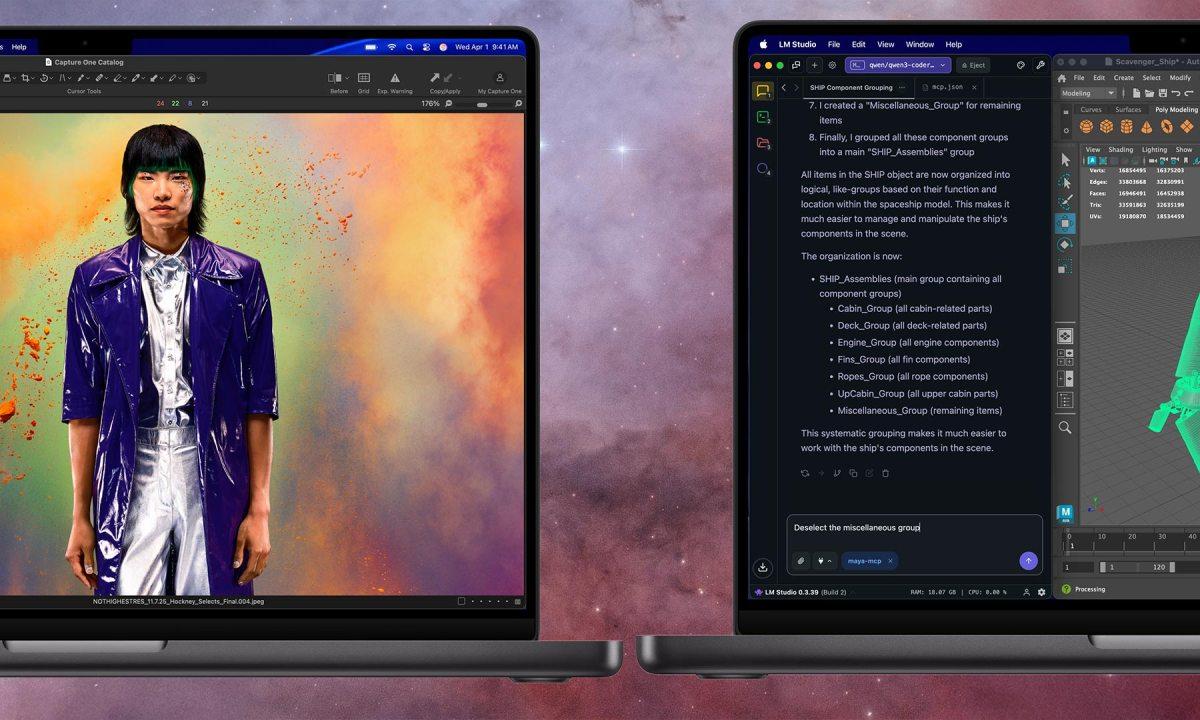
The GPU architecture scales up to 40 cores in the M5 Max, with each GPU core now including neural accelerators—dedicated hardware designed to accelerate machine learning inference directly on the GPU
5
. With a Neural Accelerator in each GPU core and higher unified memory bandwidth, M5 Pro and M5 Max deliver over 4x the peak GPU compute for AI compared to the previous generation2
.
Source: Popular Science
The M5 Pro and M5 Max are up to 4x faster at LLM prompt processing than the M4 Pro and M4 Max, and up to 8x faster at image and video generation than the M1 Pro and M1 Max
1
. Apple says this makes it possible for AI researchers and developers to train custom models on their device, while creative users benefit from faster 3D rendering, video editing, and music production work1
.Related Stories


Memory Bandwidth and Storage Upgrades Support Demanding Workloads
The M5 Pro now supports up to 64GB of unified memory, up from 48GB on M4 Pro, with memory bandwidth of 307GB/s
2
. M5 Max continues to support up to 128GB of unified memory, with bandwidth increased to 614GB/s2
. These bandwidth numbers directly determine token generation speed in LLM inference, making the M5 Max one of the most capable consumer platforms for local AI inference5
.Apple has increased faster SSD speeds to up to 14.5GB/s, roughly double the previous generation, with read/write performance up to 2x faster than the last generation
1
5
. The MacBook Pro with M5 Pro starts at 1TB of storage, while the M5 Max model starts at 2TB1
.Improved Battery Life and Connectivity Features
The MacBook Pro models feature up to 24 hours of improved battery life, and with a 96W or higher USB-C adapter, users can charge to 50% battery in thirty minutes
1
. The laptops support Thunderbolt 5 connectivity and include an N1 networking chip which brings Wi-Fi 7 and Bluetooth 63
.The 14-inch and 16-inch MacBook Pro models with the M5 Pro chips start at $2,199 and $2,699 respectively, while models with the M5 Max chips start at $3,599 and $3,899
1
. All laptops will be available for pre-order on Tuesday, March 4, with availability beginning on Wednesday, March 111
3
.References
Summarized by

Navi
[5]
Related Stories
Recent Highlights
1
Anthropic's Claude AI can now control your computer to complete tasks autonomously
Technology

2
Nvidia's Jensen Huang calls OpenClaw the next ChatGPT, sending Chinese AI stocks soaring
Technology

3
Elon Musk unveils $20 billion Terafab chip manufacturing project to produce terawatt of computing
Technology

Recent Highlights
Today's Top Stories




Your Daily Dose of Curated AI News
Don’t drown in AI news. We cut through the noise - filtering, ranking and summarizing the most important AI news, breakthroughs and research daily. Spend less time searching for the latest in AI and get straight to action.

