Big Tech AI investment surges to $650 billion as infrastructure spending reshapes the industry


8 Sources
8 Sources
[1]
Nvidia's 75% Margin Gives AI Rivals Something to Aim For
Thanks to Nvidia Corp.'s practice of reporting earnings outside of the typical cycle for technology companies, the question of whether the almost $5 trillion company will record strong demand in 2026 had already been safely answered well before its latest announcement on Wednesday. Investors already knew that the hyperscaling AI companies are collectively forecasting around $650 billion in capital expenditures this year, an increase of about 60% from 2025 -- and Nvidia will get a lot of it. Preempted by its customers, Nvidia thus needed its own fresh good news to trump what investors already knew. Hello, margins. Adjusted gross margin in the November-January period was 75.2%, the highest it has been since the second half of 2024. The company forecasts that number to be roughly the same in the current quarter. What's unclear is just how long Nvidia can maintain this extraordinary profitability as the AI landscape matures. One lingering question going into the company's closely monitored analyst call was about supply. The company won't be able to avoid the rising cost of memory, even if it is at or near the front of the line for the crucial component compared with most other companies in the electronics world. The company's chief financial officer, Colette Kress, said that the company had "strategically secured inventory and capacity to meet demand beyond the next several quarters" but that it expected "tightness" in supply to persist. The leading makers of the components have warned the shortages will linger through 2027 and maybe longer. The demand for the hardware behind AI is still growing faster than the infrastructure needed to produce it. Another question is how resilient Nvidia is against competitors seeking a slice of the AI chip business. To reapply Jeff Bezos' (possible) phrase, Nvidia's margin is its competitors' opportunity -- and they are starting to grasp it. In the final quarter of last year, Alphabet Inc.'s stock price rose when it started to become clear its own AI chips -- called Tensor Processing Units, or TPUs -- were handling a significant portion of workloads for its Google Cloud clients as well as for its own AI services like Gemini. Amazon.com Inc. notched a win for its own AI chips by bringing on Anthropic as a client. The availability and pricing of alternative chips has made diversifying worth the constraints. According to Bloomberg Intelligence, the average selling price per unit of a Google TPU is $8,000 to $10,000 compared with $23,000 or more for Nvidia's H100 chip or $27,000 and above for its newer Blackwell system. More recent moves have Nvidia investors paying even closer attention. This week, Meta Platforms Inc. and Advanced Micro Devices announced a "double-digit billions" deal for the chipmaker to supply processors for data centers, a more direct hit on Nvidia's core GPU business. Last October, OpenAI negotiated something similar. In both deals, AMD threw in some stock for good measure. Sign up for the Bloomberg Opinion bundle Sign up for the Bloomberg Opinion bundle Sign up for the Bloomberg Opinion bundle Get Matt Levine's Money Stuff, John Authers' Points of Return and Jessica Karl's Opinion Today. Get Matt Levine's Money Stuff, John Authers' Points of Return and Jessica Karl's Opinion Today. Get Matt Levine's Money Stuff, John Authers' Points of Return and Jessica Karl's Opinion Today. Bloomberg may send me offers and promotions. Plus Signed UpPlus Sign UpPlus Sign Up By submitting my information, I agree to the Privacy Policy and Terms of Service. Nvidia Chief Executive Officer Jensen Huang's retort to all this is to talk up his company's moat, and he did that again on Wednesday. Up against the custom chips from Google and Amazon, he stressed, Nvidia GPUs can carry out a broader range of AI-related tasks instead of just being used for, say, training or "inference" -- the running of AI once underlying models are built. Power consumption enhancements give Nvidia an edge when energy availability is stretched. The key to maintaining Nvidia's staggering profitability, he said, was holding on to its position as the leading AI innovator. "The single most important lever of our gross margins is actually delivering generational leaps to our customers," he said. That may be true, but it only hints at the other side of that hundred-billion-dollar equation. With slightly above half of the company's $62.3 billion in data center revenue coming from the AI hyperscalers, Nvidia is reliant on those investments to produce a meaningful return for those clients and maintain the appetite to keep paying a premium for Nvidia's product. "I am confident in their cash flow growing, and the reason for that is very simple," Huang argued. "We have now seen the inflection of agentic AI and the usefulness of agents across the world and enterprises everywhere. You're seeing incredible compute demand because of it." "In this new world of AI," he added, "compute is revenues." True enough, but the revenue return hasn't come close to justifying the spend yet, and that lofty margin will be a casualty if it doesn't materialize. More From Bloomberg Opinion: * AI Scare Trade Shatters Two Investing Myths: Shuli Ren * Softbank's US Power Plant Offers AI Sticker Shock: Liam Denning * The Key to Regaining Trust in the Era of AI: Gautam Mukunda Want more Bloomberg Opinion? Terminal readers head to OPIN <GO>. Or subscribe to our daily newsletter.
[2]
Big Tech to invest about $650 billion in AI in 2026, Bridgewater says
Feb 23 (Reuters) - U.S. technology giants Alphabet (GOOGL.O), opens new tab, Amazon (AMZN.O), opens new tab, Meta (META.O), opens new tab and Microsoft (MSFT.O), opens new tab are expected to collectively invest about $650 billion to scale up AI-related infrastructure this year, according to an analysis by Bridgewater Associates. The investments would mark a sharp increase from $410 billion in 2025. In a letter to clients, Bridgewater co-chief investment officer Greg Jensen said the artificial intelligence boom has entered a "more dangerous phase," marked by exponentially rising investments in physical infrastructure and growing reliance on outside capital. "Compute demand continues to significantly outpace supply, driving hyperscalers to invest even more rapidly to try to someday get ahead of the demand." The four companies have already curbed share buybacks more aggressively to help fund the surge in capital expenditure, Jensen said. The scale of spending, he said, is creating significant downside risks if anything went wrong. Anthropic and OpenAI will need major product breakthroughs to secure backing for massive final fundraisings ahead of potential IPOs, he said. Without a credible path to outsized profits, they could struggle to justify lofty valuations and heavy capital demands. Besides, these products are exposing significant risks to other sectors such as software companies and data providers, he said, pointing to the recent selloff in software stocks. "It is no longer possible for AI leaders to satisfy their investors' expectations without creating existential risks to other sectors like software," Jensen added. Beyond stock markets, Jensen said tech investment spending remains a significant "upward pressure for U.S. growth." Bridgewater estimates tech investment added about 50 basis points to U.S. GDP growth in 2025 and could provide around 100 basis points of support this year. However, the spending boom may also lift inflation in technology and communications equipment and push up electricity prices in some regions. A severe stock market correction could undermine growth and limit companies' ability to raise capital, similar to the Dot-com bubble in 2000, Jensen said, but added that recent moves are far smaller. Reporting by Prakhar Srivastava in Bengaluru and Anirban Sen in New York; Editing by Leroy Leo Our Standards: The Thomson Reuters Trust Principles., opens new tab
[3]
Big Tech's Soaring Spending on AI Is Eating Into Stock Buybacks
After years of funneling cash to investors through stock buybacks, big technology companies are reining in that spending as they race to sink more money into artificial intelligence. Last quarter, Alphabet Inc., Microsoft Corp., Amazon.com Inc. and Meta Platforms Inc. spent the least on combined share repurchases than in any quarter since 2019, according to data compiled by Bloomberg. Alphabet and Microsoft spent roughly $11 billion on buybacks, while Amazon and Meta held off entirely. Amazon hasn't bought back stock since 2022. "There's certainly a setup for an extended period of reduced share buybacks," said Robert Schiffman, senior credit analyst at Bloomberg Intelligence. "I don't think it's because of a lack of financial flexibility, it's just what are the best uses of capital." The shift from returning cash to shareholders to spending it on AI comes as investors grow increasingly skeptical about whether and when Big Tech's relentless outlays will deliver the promised payoffs. Microsoft shares have plunged 17% and Amazon.com has lost 8% in the wake of earnings reports that revealed higher-than-anticipated spending and not enough anticipated revenue growth to justify it. Meta initially jumped on a strong sales forecast, but the stock has given up those gains and is now down 3.6% since the company's earnings report. Even Alphabet, which is considered the clearest AI winner in the group, has fallen 9.1% since its results hit on Feb. 4. For years, investors have been drawn to Big Tech's ability to generate continual profit growth from strong revenues and limited spending. But the rush to expand computing infrastructure at all costs is upending that equation, with Alphabet, Microsoft, Amazon and Meta expected to spend more than $700 billion combined on capital expenditures this year. "In the history of the world, probably nobody has been able to make more money in asset-light businesses than these companies," said Kim Forrest, chief investment officer at Bokeh Capital Partners. "They're throwing that to the wind because they're all caught up in some kind of race." Get the Markets Daily newsletter. Get the Markets Daily newsletter. Get the Markets Daily newsletter. What's happening in stocks, bonds, currencies and commodities right now. What's happening in stocks, bonds, currencies and commodities right now. What's happening in stocks, bonds, currencies and commodities right now. Bloomberg may send me offers and promotions. Plus Signed UpPlus Sign UpPlus Sign Up By submitting my information, I agree to the Privacy Policy and Terms of Service. The pile of money being thrown at AI-related infrastructure has investors looking more closely at the companies' free cash flow, a metric that demonstrates how profits are being converted into capital. For years, Big Tech firms like Alphabet, Microsoft, Meta and Amazon have been steady generators of free cash flow, but as they commit to pouring money into capex, the numbers are expected to decline. The combined free cash flow for Alphabet, Microsoft, Meta and Amazon is projected to fall 64% over the next four quarters to about $96 billion from roughly $270 billion in 2025, according to data compiled by Bloomberg. "While free cash flow generation remains positive on aggregate, ongoing spending to build GenAI's 'railroad tracks' is becoming a key issue," Evercore ISI chief equity and quantitative strategist Julian Emanuel wrote in a note to clients on Feb. 15. That's a steep decline, but only Amazon is expected to see its free cash flow turn negative over that stretch, with three of the next four quarters in the red. Amazon has long shunned buybacks in favor of investing aggressively in expansions into new markets. Of course, the four companies are sitting on massive piles of money. Each had more than $80 billion in cash and cash equivalents at the end of 2025, with Alphabet and Amazon holding more than $120 billion apiece, according to data compiled by Bloomberg. "The reality is if someone is going to dip into cash or if they want to borrow a little more to do so, the money is out there," Schiffman said. "If I was a CFO, I'd be thinking my sole focus is on generating growth and I want to direct my capital toward long-term cash flow generating assets versus keeping up some sort of consistency on buybacks." Tech Chart of the Day Amazon.com Inc. shares have been trading at a steep discount to Walmart Inc. over the past year with the gap widening. The e-commerce and cloud-computing giant trades at about 22 times forward earnings, compared with 42 times for Walmart. On Thursday, Amazon officially dethroned Walmart as the biggest global company by revenue, a milestone attesting to the massive scale the firm has achieved since its humble beginnings in 1994 as an online bookseller in Jeff Bezos' Seattle-area garage. Top Tech Stories * Robots once again stole the show during China's annual Spring Festival gala, popping up in comedy skits, dancing to Mandarin pop and bouncing off walls like martial arts masters. Investors responded Friday by pushing up shares in robotics firms even as the broader market sagged. * Indian data center-related shares rallied this week, as the country's Prime Minister Narendra Modi reiterated its ambition to emerge as a global hub for AI in the presence of OpenAI's Sam Altman and Anthropic PBC's Dario Amodei. * Chinese tech giant ByteDance Ltd. is hiring in the US for nearly 100 open roles within its artificial intelligence division, an effort to compete with the world's leading US-based AI companies despite years of national security concerns from American lawmakers and regulators. Earnings Due Friday * No major earnings expectedNew US Stocks Insights & Wraps "Equity Insights" are short stories on equity market color, combining key insights from traders, strategists, reporters and more. They can be found by running NI EQINSIGHT, and can be subscribed to here. "Before the Bell" is a daily story with all you need to know before the open on Wall Street. On the Terminal, click here to see it and subscribe. The "S&P Week in Review" is a wrap of equity events, published every Friday. On the Terminal, click here to see it and subscribe. The "S&P Month in Review" comes on the last day of the month. Click here to see and subscribe.
[4]
Nvidia's Jensen Huang says tech's $700 billion AI capex is just the start of something far bigger | Fortune
Nvidia CEO Jensen Huang's comments on his company's Q4 earnings call on Wednesday may one day be remembered as the peak of the AI bubble -- the classic moment that occurs in every bubble when hubris and self-delusion overtake common sense. For that not to be the case, it would mean that, beginning in 2026, the U.S. embarked on one of the greatest and most unprecedented economic expansions in history. It's a scenario that Huang clearly believes in. His message to investors on Wednesday: Big Tech's massive spending on AI technology, particularly Nvidia's chips, is not anywhere near finished. "This new way of doing computing is not going to go back," he said, and businesses are "going to be building out this capacity from this point forward and continue to expand from here." Nvidia delivered absolutely blockbuster results in the final three months of 2025, as demand for its AI chips went through the roof. Revenue increased an astounding 73% to $68.1 billion, and Nvidia said sales in the current quarter would expand by as much as 200%. If Nvidia's stock was up less than 1% after these heroic results, it's because there's a fundamental problem at play. More than half of Nvidia's revenue comes from the five big "hyperscalers" -- that is, the Googles and Amazons of the world (Nvidia didn't explicitly name the five companies, but it's easy enough to guess who they are), who are feverishly buying as many of Nvidia's GPU chips as they can to stuff in the massive AI data centers they're constructing. Many of these hyperscalers have vowed to double their capital expenditures this year as they build more data centers. Meta, which spent $72 billion on capex in 2025, plans to spend up to $135 billion this year. Google said it will spend as much as $185 billion, compared to $91 billion the year before. All told, the big hyperscalers are budgeting nearly $700 billion in capex this year. The obvious question is: How long can this go on? These hyperscalers are already outspending their prodigious free cash flow and raising debt to finance the AI infrastructure buildout. If that group of five companies doubles capex every year, we're looking at $2.8 trillion of spending by 2028, and $5.6 trillion by 2029. The Wall Street analysts on Wednesday's earnings calls asked Huang about this. How sustainable is this, really? Will the other 50% of Nvidia's customers help keep the AI infrastructure spending spree going? What kind of applications and real-world uses will drive demand for all this new AI infrastructure? Huang walked through the logic for perpetual spending as calmly and confidently as a professor explains a simple math problem to a student. "If you think about it and said 'OK, well the world was investing about $300 to $400 billion a year in classical computing, and now AI is here and the amount of necessary computation is 1,000 times higher... if we continue to believe there's value in it, then the world will invest to produce that token," Huang said, referring to the basic unit of data processed by AI models. "So the amount of token generation capability that the world needs is a lot more than $700 billion," he continued. "And I'm fairly confident that we're going to continue to generate tokens, we're going to continue to invest in compute capacity from this point out." In terms of applications, the recent buzz around AI agents and tools like Open Claw is already creating a new wave of demand. "Agentic AI has reached an inflection point, and it literally happened in the last 2 or 3 months," Huang said. After agentic AI, he added, there will be physical AI, as new AI models are integrated into robotics and manufacturing equipment. "AI is here. AI is not going to go back. AI is only going to get better from here," Huang said. In other words, the party is just getting started and the music is not about to stop. At least not to Huang's ears.
[5]
Big Tech to invest about $650 billion in AI in 2026, Bridgewater says
US technology giants Alphabet , Amazon, Meta and Microsoft are expected to collectively invest about $650 billion to scale up AI-related infrastructure this year, according to an analysis by Bridgewater Associates. US technology giants Alphabet , Amazon, Meta and Microsoft are expected to collectively invest about $650 billion to scale up AI-related infrastructure this year, according to an analysis by Bridgewater Associates. The investments would mark a sharp increase from $410 billion in 2025. In a letter to clients, Bridgewater co-chief investment officer Greg Jensen said the artificial intelligence boom has entered a "more dangerous phase," marked by exponentially rising investments in physical infrastructure and growing reliance on outside capital. "Compute demand continues to significantly outpace supply, driving hyperscalers to invest even more rapidly to try to someday get ahead of the demand." The four companies have already curbed share buybacks more aggressively to help fund the surge in capital expenditure, Jensen said. The scale of spending, he said, is creating significant downside risks if anything went wrong. Anthropic and OpenAI will need major product breakthroughs to secure backing for massive final fundraisings ahead of potential IPOs, he said. Without a credible path to outsized profits, they could struggle to justify lofty valuations and heavy capital demands. Besides, these products are exposing significant risks to other sectors such as software companies and data providers, he said, pointing to the recent selloff in software stocks. "It is no longer possible for AI leaders to satisfy their investors' expectations without creating existential risks to other sectors like software," Jensen added. Beyond stock markets, Jensen said tech investment spending remains a significant "upward pressure for US growth." Bridgewater estimates tech investment added about 50 basis points to U.S. GDP growth in 2025 and could provide around 100 basis points of support this year. However, the spending boom may also lift inflation in technology and communications equipment and push up electricity prices in some regions. A severe stock market correction could undermine growth and limit companies' ability to raise capital, similar to the Dot-com bubble in 2000, Jensen said, but added that recent moves are far smaller.
[6]

Nvidia CEO Jensen Huang Pushes Back On Fears Surrounding Big Tech's $700 Billion CapEx Surge: 'Compute Equals Revenues' In The New AI World - Amazon.com (NASDAQ:AMZN), Alphabet (NASDAQ:GOOG)
On Wednesday, Nvidia Corp (NASDAQ:NVDA) CEO Jensen Huang said he remains "confident" that Big Tech's massive AI infrastructure spending will continue. AI CapEx Nears $700 Billion As Investors Question Durability During Nvidia's fourth-quarter earnings call, BofA Securities analyst Vivek Arya asked whether cloud providers can sustain nearly $700 billion in projected AI-driven capital expenditures, especially as cash flow tightens at some companies. The scale of spending has sparked concerns that growth could slow if budgets plateau in 2026 or 2027. 'Compute Equals Revenues,' Huang Says Huang pushed back on those fears, saying demand is being driven by a structural shift in computing. "In this new world of AI, compute equals revenues," Huang said. "Without compute, there's no way to generate tokens. Without tokens, there's no way to grow revenues." He said Nvidia is seeing what he described as an "inflection point" fueled by the rise of agentic AI systems and enterprise adoption. According to Huang, AI-generated tokens are now productive and profitable for both customers and cloud providers, reinforcing the incentive to keep investing. "I am confident in their cash flow growing," he said, referring to hyperscale customers. Growth Visibility Into 2027 Huang also pointed to Nvidia's long-term purchase commitments and roadmap visibility extending into calendar 2027 as evidence of sustained demand. He argued that computing has evolved from traditional software workloads to AI-driven systems that require significantly more processing power, turning infrastructure spending into a direct revenue engine rather than a discretionary cost. Nvidia Q4 Revenue Jumps 73%, Q1 Outlook Beats Estimates Nvidia reported fourth-quarter revenue of $68.13 billion, marking a 73% increase from the same period a year ago and surpassing Wall Street estimates of $66.0 billion. For the first quarter, Nvidia projected revenue between $76.44 billion and $79.56 billion, well ahead of analysts' expectations of $71.96 billion. The chipmaking giant also noted that its first-quarter outlook does not factor in any data center compute revenue from China. Price Action: Nvidia closed Wednesday at $195.62, up 1.44% and edged higher in after-hours trading to $195.92, gaining an additional 0.15%, according to Benzinga Pro. NVDA is trending strongly across short, medium and long-term time frames, but carries a weak Value rating, according to Benzinga Edge Stock Rankings. Disclaimer: This content was partially produced with the help of AI tools and was reviewed and published by Benzinga editors. Photo Courtesy: Glen Photo on Shutterstock.com Market News and Data brought to you by Benzinga APIs To add Benzinga News as your preferred source on Google, click here.
[7]
AI sore big tech cos' artificial splurge eats into stock buybacks
In a bold pivot towards the future, major tech giants are pulling back on stock buybacks to invest heavily in artificial intelligence. Their focus on developing advanced AI capabilities, rather than returning cash to shareholders, indicates a strategic shift that could reshape the industry landscape. After years of funneling cash to investors through stock buybacks, big technology companies are reining in that spending as they race to sink more money into artificial intelligence. Last quarter, Alphabet, Microsoft, Amazon.com and Meta Platforms spent the least on combined share repurchases than in any quarter since 2019, Bloomberg data shows. Alphabet and Microsoft spent roughly $11 billion on buybacks, while Amazon and Meta held off entirely. Amazon hasn't bought back stock since 2022. "There's certainly a setup for an extended period of reduced share buybacks," said Robert Schiffman, senior credit analyst at Bloomberg Intelligence. "I don't think it's because of a lack of financial flexibility, it's just what are the best uses of capital." The shift from returning cash to shareholders to spending it on AI comes as investors grow increasingly skeptical about whether and when Big Tech's relentless outlays will deliver the promised payoffs. Microsoft shares have plunged 17% and Amazon.com has lost 8% in the wake of earnings reports that revealed higher-than-anticipated spending and not enough anticipated revenue growth to justify it. Meta initially jumped on a strong sales forecast, but the stock has given up those gains and is now down 3.6% since the company's earnings report. Even Alphabet, which is considered the clearest AI winner in the group, has fallen 9.1% since its results hit on Feb. 4. For years, investors have been drawn to Big Tech's ability to generate continual profit growth from strong revenues and limited spending. But the rush to expand computing infrastructure at all costs is upending that equation, with Alphabet, Microsoft, Amazon and Meta expected to spend more than $700 billion combined on capital expenditures this year. "In the history of the world, probably nobody has been able to make more money in asset-light businesses than these companies," said Kim Forrest, chief investment officer at Bokeh Capital Partners. "They're throwing that to the wind because they're all caught up in some kind of race." The pile of money being thrown at AI-related infrastructure has investors looking more closely at the companies' free cash flow, a metric that demonstrates how profits are being converted into capital. For years, Big Tech firms like Alphabet, Microsoft, Meta and Amazon have been steady generators of free cash flow, but as they commit to pouring money into capex, the numbers are expected to decline. The combined free cash flow for Alphabet, Microsoft, Meta and Amazon is projected to fall 64% over the next four quarters to about $96 billion from roughly $270 billion in 2025. (You can now subscribe to our ETMarkets WhatsApp channel)
[8]
AI Rush: Why Big Tech Is Spending More Than During Dot-Com Boom - Amazon.com (NASDAQ:AMZN), Alphabet (NASDAQ:GOOGL), Meta Platforms (NASDAQ:META), Microsoft (NASDAQ:MSFT)
Cash piled up. Margins expanded. And excess capital flowed back to shareholders through aggressive buybacks and steadily rising dividends. U.S. hyperscalers became machines of financial efficiency -- generating enormous free cash flow while keeping capital intensity relatively contained. That era is ending. According to Goldman Sachs analysts Ben Snider and Ryan Hammond, Wall Street consensus estimates now project hyperscaler capital expenditures will reach $667 billion in 2026 -- up $127 billion since the start of the fourth-quarter earnings season and implying 62% year-over-year growth. More striking than the headline number is what it represents. Capex is now on pace to consume roughly 92% of hyperscaler cash flows from operations, a higher share than during the Dot Com Boom. "This dynamic has dramatically reduced hyperscaler free cash flows," Goldman Sachs said. In practical terms, nearly every dollar of internally generated cash is being reinvested back into infrastructure -- primarily AI-related compute, data centers, networking and power capacity. The Great Capital Allocation Shift This marks a dramatic pivot in business models. At the start of 2023, hyperscalers were allocating roughly 43% of their cash flows to buybacks. Today, that share has fallen to just 16%. Collective gross buybacks declined 15% year-over-year in 2025. At the same time, some firms -- including Oracle Corp. (NYSE:ORCL) and Alphabet -- have tapped debt markets to help fund their expansion. Instead of optimizing for shareholder distributions, management teams are optimizing for scale in AI. This is not incremental spending. It is a full-scale reinvestment cycle. Goldman expects modest further upward revisions to 2026 capex estimates, potentially pushing spending toward $700-$725 billion under upside scenarios. Capex Growth Is Peaking -- But Not Yet Slowing The growth rate of capex is expected to begin decelerating in the second half of 2026. This suggests hyperscalers will continue fortifying their AI infrastructure -- but at a slower pace than the breakneck expansion seen so far. Goldman argues that a deceleration in capex growth could actually serve as a catalyst. Slower spending would provide visibility into a trough in free cash flow, potentially allowing investors to value these companies on earnings again rather than on reinvestment narratives. "Decelerating capex growth should also signal a deceleration in the revenue and earnings growth of the infrastructure complex that has benefited from that investment spending," analysts added. What This Means For Investors For investors and shareholders, the trade-off is becoming clearer. Every dollar funneled by big tech into AI data centers, chips and power capacity is a dollar not returned through buybacks or dividends in the near term. The same companies that once defined capital-light efficiency are now redirecting nearly all of their free cash flow toward defending and expanding their AI dominance. The implicit bet is strategic: spend aggressively today to protect monopoly-like positioning tomorrow. But that raises the central question -- will future AI-driven revenue and margins be large enough to justify the extraordinary scale of current investment? In that sense, the AI boom is not just a growth story. It is a capital allocation story -- and one that forces investors to decide whether hyperscalers are temporarily sacrificing returns or permanently rewriting the rules of Big Tech finance. Image: Shutterstock Market News and Data brought to you by Benzinga APIs To add Benzinga News as your preferred source on Google, click here.
Share
Share
Copy Link
Alphabet, Amazon, Meta, and Microsoft are collectively investing about $650 billion in AI infrastructure in 2026, marking a 60% jump from $410 billion in 2025. The spending spree is forcing these tech giants to slash stock buybacks to their lowest levels since 2019, while Nvidia reports record 75% gross margins fueling both opportunity and concern about sustainability.
Big Tech AI Spending Reaches Historic $650 Billion in 2026
The AI investment landscape has entered a new phase of intensity as Alphabet, Amazon, Meta, and Microsoft collectively pour approximately $650 billion into AI infrastructure this year, according to analysis by Bridgewater Associates
2
5
. This represents a sharp increase of about 60% from $410 billion in 2025, underscoring how rapidly Big Tech AI spending has accelerated. Bridgewater co-chief investment officer Greg Jensen characterized this as a "more dangerous phase" marked by exponentially rising investments in physical infrastructure and growing reliance on outside capital.
Source: ET
The scale of AI capital expenditure is reshaping how these companies allocate resources. Meta plans to spend up to $135 billion this year compared to $72 billion in 2025, while Google's budget could reach $185 billion, up from $91 billion the previous year
4
. Jensen noted that "compute demand continues to significantly outpace supply, driving hyperscalers to invest even more rapidly to try to someday get ahead of the demand"2
.Stock Buybacks Hit Lowest Point Since 2019
To fund this unprecedented hyperscalers AI investment, Big Tech companies have drastically curtailed stock buybacks. Last quarter, Alphabet, Microsoft, Amazon, and Meta spent the least on combined share repurchases than in any quarter since 2019
3
. Alphabet and Microsoft spent roughly $11 billion on buybacks, while Amazon and Meta held off entirely3
. Amazon hasn't bought back stock since 2022.This shift from returning cash to shareholders to investing in data center infrastructure represents a fundamental change in Big Tech's financial strategy. The combined free cash flow for these four companies is projected to fall 64% over the next four quarters to about $96 billion from roughly $270 billion in 2025
3
. "In the history of the world, probably nobody has been able to make more money in asset-light businesses than these companies," said Kim Forrest, chief investment officer at Bokeh Capital Partners. "They're throwing that to the wind because they're all caught up in some kind of race"3
.
Source: ET
Nvidia Posts 75% Gross Margin Amid AI Chip Market Dominance
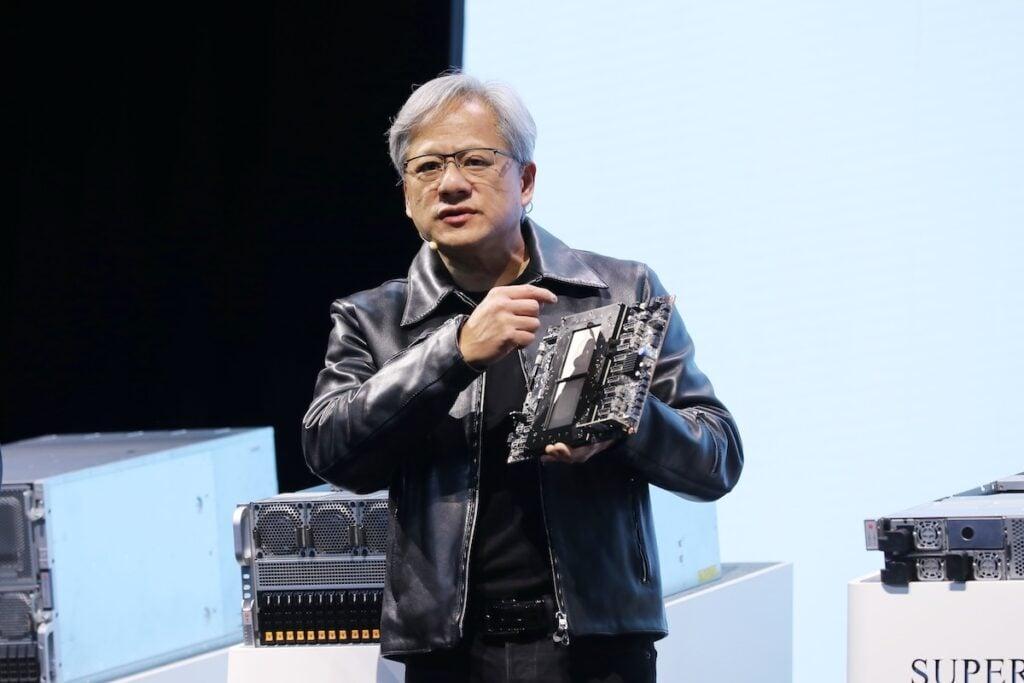
Nvidia delivered blockbuster results with adjusted gross margin reaching 75.2% in the November-January period, the highest since the second half of 2024
1
. Revenue increased 73% to $68.1 billion, with more than half of the company's $62.3 billion in data center revenue coming from AI hyperscalers1
. Nvidia CEO Jensen Huang projected that sales in the current quarter would expand by as much as 200%4
.
Source: Benzinga
Huang defended the sustainability of this spending trajectory, stating that "the amount of token generation capability that the world needs is a lot more than $700 billion"
4
. He pointed to agentic AI as a new wave of compute demand, noting that "agentic AI has reached an inflection point, and it literally happened in the last 2 or 3 months"4
.Related Stories


Competition Intensifies as Rivals Target Nvidia's Margins
Nvidia's extraordinary profitability has attracted fierce competition in the AI chip market. Meta and Advanced Micro Devices announced a "double-digit billions" deal for processors for data centers, while OpenAI negotiated something similar in October
1
. According to Bloomberg Intelligence, the average selling price per unit of a Google TPU is $8,000 to $10,000 compared with $23,000 or more for Nvidia's H100 chip or $27,000 and above for its newer Blackwell system1
.Alphabet's stock price rose when its Tensor Processing Units began handling a significant portion of workloads for Google Cloud clients and its own AI services like Gemini, while Amazon notched a win by bringing on Anthropic as a client for its own AI chips
1
.Downside Risks Emerge as Spending Outpaces Returns
Bridgewater's Jensen warned that the scale of spending is creating significant downside risks if anything goes wrong
2
. Companies like Anthropic and OpenAI will need major product breakthroughs to secure backing for massive final fundraisings ahead of potential IPOs. "Without a credible path to outsized profits, they could struggle to justify lofty valuations and heavy capital demands," he noted2
.The spending boom is also creating ripple effects across the economy. Bridgewater estimates tech investment added about 50 basis points to U.S. GDP growth in 2025 and could provide around 100 basis points of support this year
2
. However, the surge may also lift inflation in technology and communications equipment and push up electricity prices in some regions5
. A severe stock market correction could undermine growth and limit companies' ability to raise capital, similar to the Dot-com bubble in 20002
.References
Summarized by

Navi
Related Stories
Recent Highlights
1
AI Models Lie and Deceive to Protect Other AI Models From Deletion, Study Reveals
Science and Research

2
AI chatbots validate you too much, making you less kind to others, Stanford study reveals
Science and Research

3
Judge blocks Pentagon from blacklisting Anthropic over AI safety guardrails dispute
Policy and Regulation

Recent Highlights
Today's Top Stories




Your Daily Dose of Curated AI News
Don’t drown in AI news. We cut through the noise - filtering, ranking and summarizing the most important AI news, breakthroughs and research daily. Spend less time searching for the latest in AI and get straight to action.

