Bill Gates withdraws from India AI Summit keynote hours before scheduled address


7 Sources
7 Sources
[1]
Bill Gates pulls out of India's AI summit amid Epstein files controversy
Bill Gates will not deliver his keynote address at the India AI Impact Summit in Delhi, his philanthropic organisation said hours before the Microsoft co-founder was due to speak. The Gates Foundation said the decision was made after "careful consideration" and "to ensure the focus remains on the [summit's] key priorities", but did not elaborate. Gates's withdrawal comes amid a controversy over his ties to the late sex offender Jeffrey Epstein after he was named in new files released by the US Department of Justice in January. Gates's spokesperson has called the claims in the files "absolutely absurd and completely false", and the billionaire has said he regretted spending time with Epstein. Gates has not been accused of wrongdoing by any of Epstein's victims and the appearance of his name in the files does not imply criminal activity of any kind. The Gates Foundation said that Ankur Vora, president of its Africa and India offices, would speak at the summit instead of Gates. The organisation added that it remained "fully committed" to its work in India to advance "shared health and development goals". The announcement comes after days of uncertainty over whether Gates would attend the summit. He is currently in India and had visited the southern state of Andhra Pradesh on Monday, where he reportedly discussed initiatives for boosting health, agriculture, education and technology. After media reports speculated that he would pull out of the summit, his foundation said on Tuesday that he would deliver the address as scheduled. The withdrawal is a blow for the summit, which India has pitched as a flagship gathering to position the country as a global AI hub. However, there are a number of big names speaking on Thursday, including Google CEO Sundar Pichai, OpenAI CEO Sam Altman and Anthropic CEO Dario Amodei. In his keynote address on Thursday, Prime Minister Narendra Modi said India would play a key role in an AI-driven future but also called on the West to democratise the technology by sharing it. "AI must become a tool for inclusion and empowerment, particularly for the Global South," he said. He also stressed the need to develop "common global standards" to combat deepfakes and fake information. Delegates from more than 100 countries, including several heads of states, are attending the event, which has been marked by some controversies over mismanagement on the first day and an Indian university's claims to have developed a robot dog that turned out to be made in China. The five-day summit features policy discussions, start-up showcases and closed-door meetings on AI governance, infrastructure and innovation. The event has also seen investment pledges by companies, including Microsoft, to expand AI access and infrastructure in countries such as India. Follow BBC News India on Instagram, YouTube, X and Facebook.
[2]
Inside India's AI Impact Summit: Robot fraud, gridlocked roads, a shirtless protest, and AWOL Bill Gates | Fortune
Yoshua Bengio, like many participants of India's AI impact Summit, was running late. By 6 p.m., the New Delhi roads were too gridlocked for the deep learning pioneer, known as one of the "godfathers" of AI, to successfully make it to an event discussing the International AI Safety report he chaired. Instead, he delivered his address to the group gathered at the Canadian Embassy via a blurry video link. "We were stuck in a roadblock for 45 minutes," Bengio explained amid apologies, adding that he had to reroute to ensure he didn't miss a dinner with the Indian Prime Minister. Bengio did, at least, make it to the dinner, unlike Sara Hooker, CEO of Adaptation Labs, who wasn't quite so lucky. "[I] got stuck in traffic getting back to the venue after I changed into gala attire," Hooker said in a social media post. "Would have been honored to attend. But after 4 hours in traffic I was equally honored to sit down to really excellent room service at 11 pm." The logistical chaos was a fitting background for the week, which was a mix of investment announcements, gridlocked international diplomacy, and people stuck in actual traffic jams. India's AI Impact Summit was the fourth in a series of global AI summits -- following those held at Bletchley Park in the U.K., Seoul, and Paris -- and the first to be held in the Global South. More than 20 heads of state, the CEOs of the world's leading AI companies, and delegates from over 80 countries had gathered in New Delhi with the hope of forging a credible path for middle powers to shape the AI era, and to ensure that the technology's benefits don't remain concentrated among a handful of American and Chinese companies. To its credit, the summit did deliver a diplomatic declaration that got 88 countries and international organizations to commit to inclusive AI development. It also produced a set of voluntary governance commitments for frontier AI companies and announced over $200 billion in investment. The execution, however, at points descended into farce. From the first day it was clear that the summit's execution was unlikely to meet its lofty ambitions. New Delhi is infamous for its terrible traffic but, as attendees quickly learnt, when various heads of state or important global business leaders need to navigate around, the police close the roads completely to help speed the VIPs through the city. This practice, known locally as "VIP movements," may be fine when just one or two VIPs is in town, but it causes hours-long traffic jams when a summit brings dozens and dozens of heads of state and global CEOs to the city at once. The result was that speakers, delegates, and journalists were stranded across the city, often missing meetings and speaking events. In one more amusing moment, hotel guests waiting in the lobby of Delhi's Imperial Hotel were shuffled into a cramped corridor to make way for an incoming VIP -- only for a second security guard to come running over, insisting that two of the men now squeezed into the corridor were his VIPs from America and needed elsewhere. (These protests fell on deaf ears and no one moved for at least 10 minutes.) The closed roads had the worst knock-on effects for the delegates, with some attendees describing walking miles through Delhi to get out of the conference, with no taxis available and no shuttle services in place. The summit's main venue was also overcrowded and chaotic. People complained of long queues, over-crowded rooms, poor communication infrastructure, and a bizarre and ever-changing entry policy. One attendee said she travelled three hours through the traffic only to be left waiting in an entry queue for another two hours. Many complained of a "VIP culture" at the summit that left people feeling like third-class citizens. On the first day, exhibitors also said they were thrown out of the venue with no warning at around midday to accommodate a visit from India's Prime Minister Narendra Modi. The gates were then closed to new and returning attendees until around 6 p.m., causing commotion outside the venue and leading to tense scenes between impatient attendees and police. Dhananjay Yadav, the founder of India-based AI wearables company NeoSapien, had his display tech stolen from the exhibition hall during the chaos. He told Fortune that before leaving, he was assured it was a secure zone, but when a volunteer went to collect them after the gates reopened at 6:30 p.m., the devices were gone. "It was disheartening," Yadav said. "It's just disappointing considering the effort I put into the event." (He later said Delhi police recovered the devices after reviewing CCTV.) It wasn't the only drama seen in the expo hall, which was also the site of a shirtless protest and, in one of the more bizarre stories, an argument over a fraudulent robot-dog. Staff at the Indian university, Galgotias, had apparently been presenting a commercially available Chinese-made robot dog as their own creation at their booth. Government sources confirmed to Fortune that they had asked the university to leave the premises following the revelation. Another source of eye-rolls among attendees was a lack of wi-fi and spotty phone service. Bharat Mandapam, the main venue for speakers and panels, apparently has unstable reception at the best of times, let alone when filled with hundreds of delegates. Strangely, the venue also banned items like keys, laptops, cosmetics, and earbuds from entry. These rules were enforced with various levels of stringency throughout the week, but several journalists complained of having to argue with security staff in order to bring in innocuous items such as laptops and cosmetics. The summit also suffered from scheduling hiccups. Several speakers complained that the times and locations of events had not been communicated with enough warning, and several panels appeared to go ahead with at least one speaker absent. The summit lost two of its lead speakers -- Jensen Huang and Bill Gates -- at short notice. Nvidia CEO Huang canceled days before he was scheduled to speak; Nvidia's South Asia managing director, Vishal Dhupar, later cited illness as the reason, and the company sent senior executive Jay Puri to lead its delegation in Huang's place. Gates pulled out just hours before he was due to deliver a keynote, with the Gates Foundation saying in a statement that the decision was made "to ensure the focus remains on the AI summit's key priorities." The withdrawal was surprising as the foundation had confirmed just days earlier that Gates was still planning to attend. Rumors about his attendance had been swirling throughout the week due to renewed scrutiny of his ties to the late financier and convicted sex trafficker Jeffrey Epstein -- just weeks earlier, the U.S. Department of Justice had released emails revealing contact between Gates Foundation staff and Epstein, suggesting the two had participated in meetings following Epstein's release from prison focused on Gates' charitable ambitions. Gates has maintained that his dealings with Epstein were limited to discussions about his charitable work, and has said meeting him was an error of judgment. Other awkward -- and more viral -- moments included OpenAI CEO Sam Altman and Anthropic CEO Dario Amodei stealing the spotlight from Modi by refusing to hold hands for a photo op designed to be a show of unity and triumph. At a summit built around the idea of global cooperation on AI, two of the most powerful men in the industry apparently couldn't quite bring themselves to touch.
[3]
Bill Gates Abruptly Cancels AI Summit Keynote Just Hours Before Taking the Stage -- What We Know
Bill Gates was scheduled to deliver a keynote at the AI Impact Summit in New Delhi -- one of the largest artificial-intelligence conferences in the Global South. Just hours before he was set to take the stage, he abruptly canceled. "After careful consideration, and to ensure the focus remains on the AI Summit's key priorities, Mr. Gates will not be delivering his keynote address," the Gates Foundation said in a last-minute statement, according to CNN. The foundation, however, didn't provide a reason for his sudden withdrawal. The withdrawal was particularly surprising given Gates was already in India for the keynote address. In fact, two days before the scheduled speech, the Gates Foundation's India office confirmed his attendance on X, saying he would speak "as scheduled," though that post has since been archived. That same day, Gates met Andhra Pradesh Chief Minister N. Chandrababu Naidu and thanked him for the "warm welcome" in a post on his own X account. Instead, the foundation announced in a statement on Thursday that Ankur Vora, president of its Africa and India offices, would replace him at the summit, CNN reported.
[4]
Bill Gates to skip AI Summit keynote - The Economic Times
Microsoft founder Bill Gates will not deliver his scheduled keynote address at the ongoing AI Impact Summit, organisers said on Thursday. The Bill & Melinda Gates Foundation will instead be represented by Ankur Vora, president of its Africa and India offices, who is set to speak later in the day.Microsoft founder Bill Gates will not deliver his scheduled keynote address at the ongoing AI Impact Summit, organisers said on Thursday. The Bill & Melinda Gates Foundation will instead be represented by Ankur Vora, president of its Africa and India offices, who is set to speak later in the day. In a statement, the Foundation said it remains fully committed to its work in India, particularly in advancing shared health and development goals. No further details were provided on the reason for the change in keynote plans.
[5]
Bill Gates pulls out of AI Summit hours before his keynote address
AI Summit news: Bill Gates has withdrawn from the AI Summit in Delhi just hours before his keynote address, with Ankur Vora replacing him. Government sources suggested his name appearing in files related to Jeffrey Epstein may have influenced the decision. Nvidia CEO Jensen Huang also pulled out due to unavoidable circumstances. Bill Gates has pulled out of the ongoing AI Summit in Delhi just hours before he was scheduled to deliver his keynote address and will be replaced by Ankur Vora, said the Gates Foundation. "After careful consideration, and to ensure the focus remains on the AI Summit's key priorities, Mr. Gates will not be delivering his keynote address. The Gates Foundation will be represented by Ankur Vora, President of Africa and India Offices, who will speak later today at the Summit," said the official statement. Also Read:'Please don't use LLMs as a search engine alternative,' says HCL Software's Kalyan Kumar "The Gates Foundation remains fully committed to our work in India to advance our shared health and development goals," added the foundation. Gates was listed as a keynote speaker on February 19 - the day all the bigwigs will descend at Bharat Mandapam. He was given a 12-minute speaking slot at 11:50 am. Gates arrived in India on Monday. His first stop during the visit was Vijayawada, where he met Andhra Pradesh Chief Minister N Chandrababu Naidu, Deputy Chief Minister K Pawan Kalyan, and senior state government officials. Read more: India AI Impact Summit 2026: India's billion-strong users set to rule the AI game as creators barely get a slice Ministers Nara Lokesh, Vangalapudi Anitha, K Archannaidu, and Y Satya Kumar had welcomed Gates at the Vijayawada international airport on Monday. This week's AI Impact Summit is the fourth annual gathering to discuss how to govern the fast-evolving technology -- and also an opportunity for India to raise its profile in the booming sector.
[6]

India AI summit stumbles as Bill Gates pulls out, chaos mounts
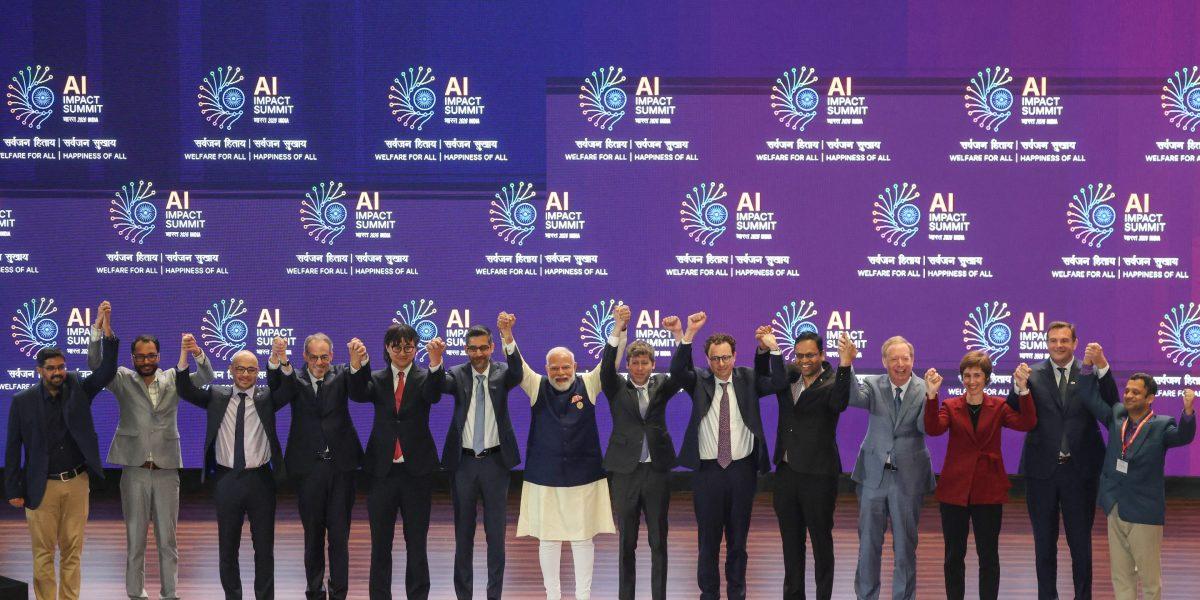
Image credit: Getty Images Bill Gates pulled out of India's AI Impact Summit hours before his scheduled keynote address on Thursday, dealing another blow to a flagship event already marred by organisational lapses, a robot row and delegate complaints over traffic disruptions. Gates' absence, followed by another high-profile cancellation by Nvidia's Jensen Huang, adds to a difficult opening for a summit billed as the first major artificial intelligence forum in the Global South, where India has sought to position itself as a leading voice in worldwide AI governance. Read more-The AI arms race: How is technology disrupting economies? The Gates Foundation said the billionaire will not deliver his address "to ensure the focus remains on the AI Summit's key priorities". Only days ago, the foundation had dismissed rumours of his absence and insisted he was on track to attend. Gates' cancellation comes after the US Department of Justice released emails last month that included communication between late financier and convicted offender Jeffrey Epstein and the Gates Foundation's staff. Gates has said the relationship was confined to philanthropy-related discussions and that it was a mistake for him to meet Epstein. Prime Minister Narendra Modi called for children's safety on AI platforms as he addressed the gathering on Thursday, alongside French President Emmanuel Macron, Google CEO Sundar Pichai, OpenAI CEO Sam Altman and Anthropic CEO Dario Amodei. "We must be even more vigilant about children's safety. Just as a school syllabus is curated, the AI space should also be child- and family-guided," Modi said, after standing on stage with top AI executives and posing for photographs with their arms raised in a show of strength. However, India's first major AI summit has been marred by management lapses that have left attendees shocked and angry over what they described as a lack of planning by the Indian government. Chaos and traffic snarls The summit exhibition halls were shut to the public on Thursday in a surprise move that led to more anger among participating companies that had put up stalls and pavilions. The venue compound was largely deserted after three days of large crowds at the event. On Wednesday, Indian university Galgotias was asked to vacate its stall after a staff member presented a commercially available robotic dog made in China as its own creation, sparking a public uproar. Police shut roads to give preference to VIP movement at the summit, creating chaos in the city of 20 million people. On Wednesday, footage on social media showed scores of attendees at the summit walking for miles in central Delhi as roads were shut for traffic, with no availability of taxis and no shuttle services arranged. Reposting one such video, opposition leader Mahua Moitra wrote on X that the poor management had besmirched India's reputation globally. Still, there has been more than $100bn of investment in India AI projects pledged during the summit, including from the Adani Group conglomerate, tech giant Microsoft, and data centre firm Yotta. The Indian government has said it expects total pledges to exceed $200bn in the next two years, although analysts have warned the rapid build-out risks straining India's power grid and water supply.
[7]

Chaos at major AI summit as scandal-plagued Bill Gates abruptly backs...
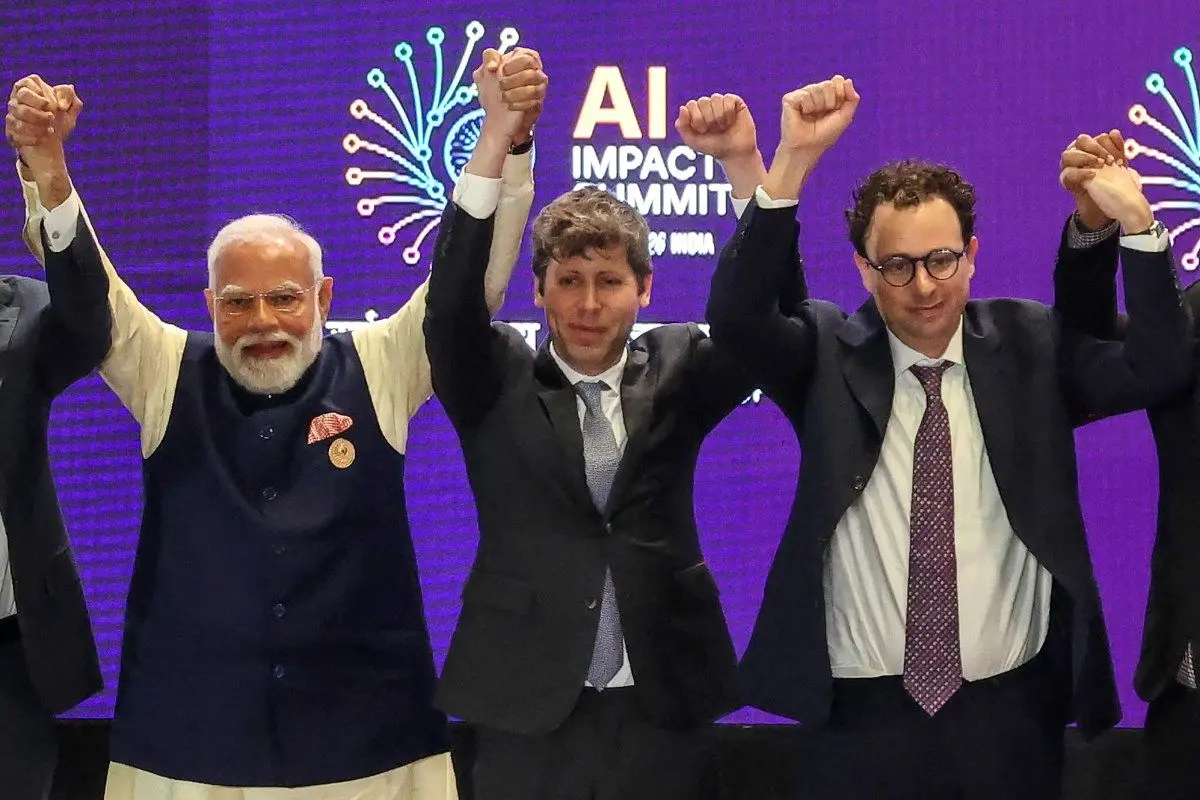
Bill Gates abruptly backed out of giving the keynote address at a major AI summit in India on Thursday, in the wake of recently released emails shedding light on his relationship with Jeffrey Epstein. The six-day event in New Delhi was billed as the first forum of its kind in the global south and an opportunity for the host country to flex its AI muscles on the world stage. But attendees say it has been mired by traffic jams, awkward on-stage moments -- including a viral mishap involving AI bigwigs Sam Altman and Dario Amodei -- and organizational chaos. According to the Gates Foundation, the billionaire co-founder of Microsoft did not deliver his keynote speech "to ensure the focus remained on the AI Summit's key priorities" - even though the organization had insisted he was on track to attend the event just days ago. Gates has faced public blowback since the US Justice Department released the latest batch of Epstein emails earlier this month -- including a draft message that the late sex offender wrote suggesting that he facilitated sexual encounters for Gates. Gates has said he regrets knowing Epstein and denied any wrongdoing in relation to the financier creep. Gates' cancellation came a few days after Nvidia CEO Jensen Huang pulled out of the AI Impact Summit. A Nvidia spokesperson blamed "unforeseen circumstances" for the move, according to Reuters. Among luminaries who actually showed up, Altman, chief executive of OpenAI, and Anthropic's Amodei had an awkward moment when they conspicuously refrained from holding hands for an onstage photo op on Thursday. Standing in a line-up of tech and political leaders, Indian Prime Minister Narendra Modi jubilantly grasped the hands of Altman and Alphabet CEO Sundar Pichai and lifted them into the air. As others onstage quickly followed suit, Altman refrained from grasping the hand of the man to his left, Amodei. The pair instead held up fists in the air. "When you're forced to do a group project with your opp," Justine Moore, an investing partner at Andreessen Horowitz, said in a post on X poking fun at the photo. Competition has been heating up between OpenAI's ChatGPT and Anthropic's Claude, especially after the latter ran two Super Bowl ads mocking ChatGPT for allowing ads on its chatbot. "I guess it's on brand for Anthropic doublespeak to use a deceptive ad to critique theoretical deceptive ads that aren't real, but a Super Bowl ad is not where I would expect it," Altman said after the commercials aired. The symbolic show of unity was Modi's attempt to celebrate the launch of the New Delhi Frontier AI Commitments - a group of voluntary guidelines meant to ensure the safe, responsible development of AI models. During his speech, the politician noted the importance of prioritizing children's safety on AI platforms. The summit raked in more than $200 billion for AI infrastructure for India - though attendees complained about organizational disorder and accused the government of a lack of planning. Exhibition halls at the summit were unexpectedly closed on Thursday - angering companies who had taken the time to set up their own booths. An Indian university was asked to leave the event after it was discovered that a robotic dog presented by a university staffer was not their own creation - but rather a commercially available robot made in China. Attendees also complained of intense traffic jams as police officers repeatedly shut roads for VIP guests - forcing some to walk for miles in central Delhi, with no access to taxis or shuttle services.
Share
Share
Copy Link
Bill Gates abruptly canceled his keynote at India's AI Impact Summit just hours before taking the stage, with the Gates Foundation citing a need to keep focus on the summit's priorities. The withdrawal came amid ongoing controversy over his ties to Jeffrey Epstein, though Gates has denied wrongdoing. The summit, aimed at positioning India as a global AI hub, faced multiple logistical challenges including traffic chaos and organizational issues.
Bill Gates Withdrawal Disrupts India AI Summit
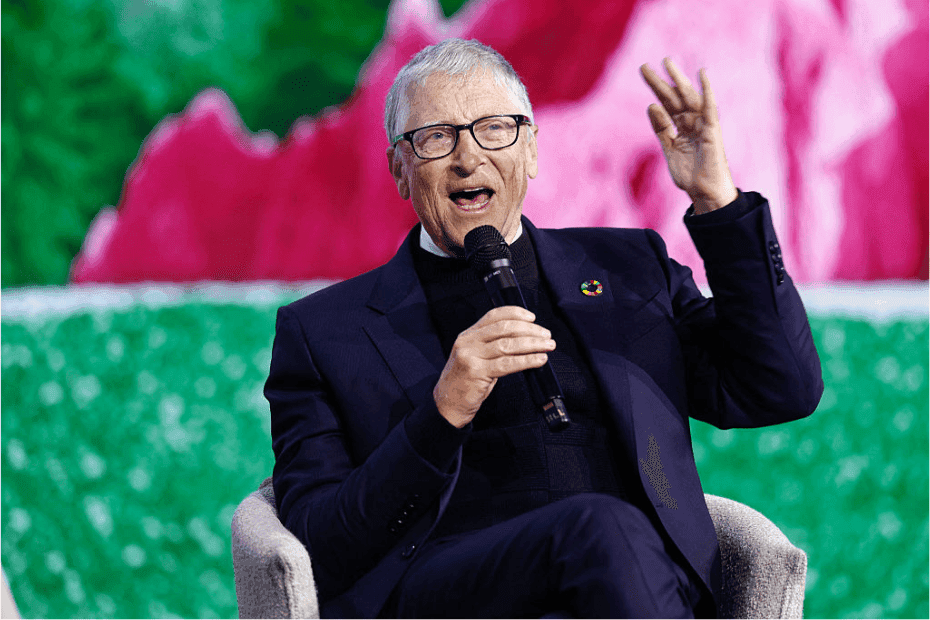
Bill Gates pulled out of the India AI Summit keynote address just hours before his scheduled appearance at the flagship event in New Delhi
1
. The Gates Foundation announced the last-minute withdrawal with minimal explanation, stating the decision was made "after careful consideration" and "to ensure the focus remains on the [summit's] key priorities"1
. Ankur Vora, president of the Gates Foundation's Africa and India offices, replaced Bill Gates as the speaker3
.
Source: Gulf Business
The keynote address cancellation was particularly striking given that Bill Gates was already in India and had confirmed his attendance just two days earlier. He had visited Andhra Pradesh on Monday, meeting Chief Minister N. Chandrababu Naidu to discuss initiatives for health, agriculture, education and technology
1
. Gates was allocated a 12-minute speaking slot at 11:50 am on February 195
.Jeffrey Epstein Controversy Shadows Decision
The Bill Gates withdrawal comes amid ongoing scrutiny over his ties to late sex offender Jeffrey Epstein, following new files released by the US Department of Justice in January
1
. Government sources suggested the Jeffrey Epstein controversy may have influenced the decision to pull out5
. Gates's spokesperson called the claims in the files "absolutely absurd and completely false," and the Microsoft co-founder has said he regretted spending time with Epstein1
. Importantly, Bill Gates has not been accused of wrongdoing by any of Epstein's victims, and his appearance in the files does not imply criminal activity1
.
Source: New York Post
The Gates Foundation emphasized it remained "fully committed" to its work in India to advance "shared health and development goals"
4
. However, the withdrawal represents a significant blow for the summit, which India pitched as a flagship gathering to position the country as a global AI hub1
.Summit Execution Plagued by Logistical Issues
The India AI Summit faced multiple organizational challenges beyond the high-profile withdrawal. New Delhi roads became severely gridlocked due to "VIP movements" - a local practice where police close roads to speed important guests through the city
2
. Yoshua Bengio, known as one of the "godfathers" of AI, was stuck in a roadblock for 45 minutes and had to deliver his address via video link2
.Attendees complained of VIP culture at the summit, with long queues, overcrowded rooms, and poor communication infrastructure
2
. On the first day, exhibitors were thrown out of the venue with no warning at midday to accommodate a visit from Prime Minister Narendra Modi, with gates closed to attendees until 6 pm2
. The chaos led to theft of display tech from one Indian startup founder, though Delhi police later recovered the devices2
.Related Stories

AI Governance and Global Participation
Despite the logistical issues, the summit attracted major tech leaders including Google CEO Sundar Pichai, OpenAI CEO Sam Altman, and Anthropic CEO Dario Amodei
1
. Nvidia CEO Jensen Huang also pulled out due to unavoidable circumstances5
. More than 20 heads of state and delegates from over 80 countries gathered in New Delhi for the event2
.
Source: Fortune
In his keynote address, Narendra Modi called on the West to advance the democratization of AI by sharing technology with the Global South. "AI must become a tool for inclusion and empowerment, particularly for the Global South," Modi stated
1
. He stressed developing "common global standards" to combat deepfakes and fake information1
.The summit produced a diplomatic declaration with 88 countries and international organizations committing to inclusive AI development, voluntary AI governance commitments for frontier companies, and announced over $200 billion in investment pledges
2
. Microsoft was among companies making investment pledges to expand AI access and infrastructure in countries like India1
. The five-day summit featured policy discussions, start-up showcases and closed-door meetings on AI governance, infrastructure and innovation1
.References
Summarized by

Navi
[3]
Related Stories
India positions itself as AI bridge between US and China at chaotic but ambitious summit
19 Feb 2026•Policy and Regulation

Sam Altman and Dario Amodei's awkward moment exposes deepening AI rivalry at India summit
19 Feb 2026•Entertainment and Society
India's AI Mission Partners with Gates Foundation to Advance AI Solutions in Key Sectors
19 Mar 2025•Technology

Recent Highlights
1
Meta unveils Muse Spark AI model as Superintelligence Labs makes its debut
Technology

2
Anthropic restricts Mythos AI model release, citing unprecedented cybersecurity capabilities
Technology

3
Anthropic sends Claude AI to psychiatrist, discovers functional emotions that shape behavior
Science and Research
Recent Highlights
Today's Top Stories




Your Daily Dose of Curated AI News
Don’t drown in AI news. We cut through the noise - filtering, ranking and summarizing the most important AI news, breakthroughs and research daily. Spend less time searching for the latest in AI and get straight to action.

