ChatGPT launches interactive visuals to transform how 140 million users learn math and science


4 Sources
4 Sources
[1]
ChatGPT can now create interactive visuals to help you understand math and science concepts | TechCrunch
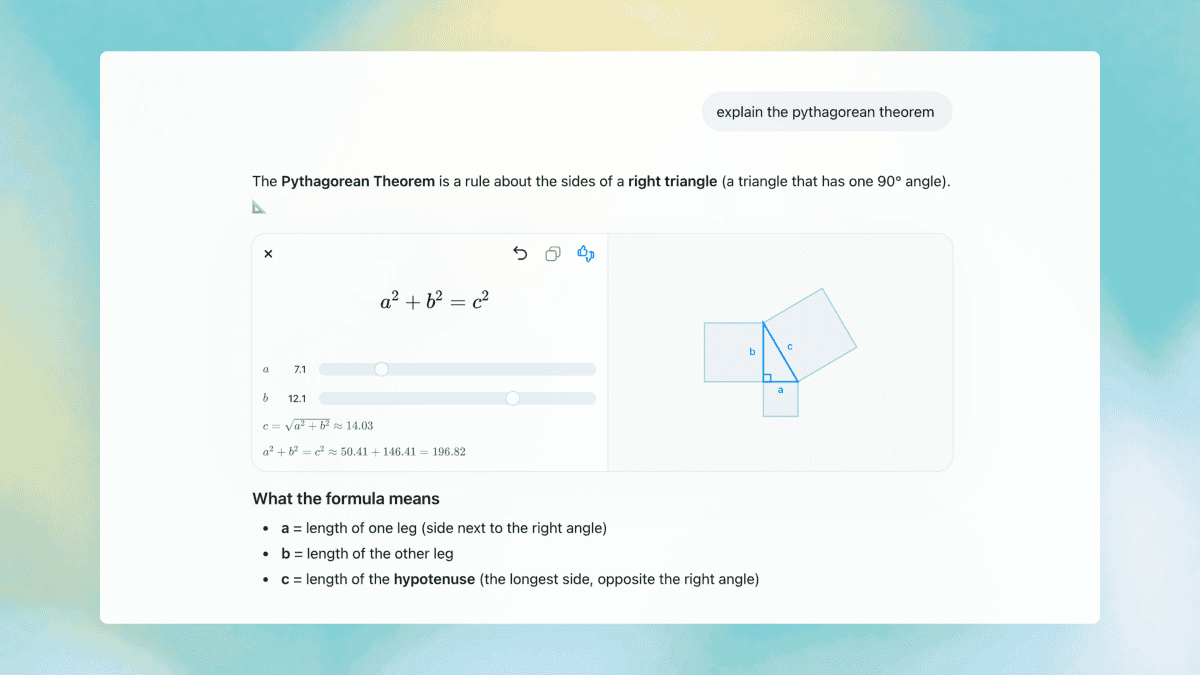
On Tuesday, OpenAI introduced dynamic visual explanations, a new ChatGPT feature that allows users to see how formulas, variables, and mathematical relationships change in real time. Instead of just reading an explanation or looking at a static diagram, users can now interact directly with interactive visuals. For example, when exploring the Pythagorean theorem, you can adjust the lengths of the triangle's sides and instantly watch the hypotenuse update. Users can adjust numbers and variables and see changes reflected immediately. To try out the feature, ask ChatGPT questions like "What is a lens equation?" or "How can I find the area of a circle?" ChatGPT will respond not only with an explanation but also with an interactive module you can manipulate. Currently, these visuals are available for over 70 math and science topics, including the binomial square, Charles' law, area of a circle, compound interest, Coulomb's law, difference of squares, exponential decay, Hooke's law, kinetic energy, linear equations, and Ohm's law. OpenAI plans to expand the feature later on to include more interactive topics. It's available to all logged-in ChatGPT users. The launch of dynamic visual explanations is notable in that it shifts the tool's role somewhat -- rather than just delivering answers, it asks users to engage with the underlying concepts directly. Whether that translates to deeper understanding will likely depend on how it's used. As AI continues to transform the way people approach learning, it has sparked heated debates in the education community. Though some educators worry about overreliance on AI, many teachers and students have already embraced these tools, integrating them into daily study routines. According to OpenAI, more than 140 million people use ChatGPT each week for help with math and science, subjects that have traditionally challenged learners. Other major AI companies are also exploring similar interactive features. In November, Google's Gemini launched its own interactive diagrams and visuals. This new feature joins other recent ChatGPT educational tools, such as study mode, which guides users through problems step by step. There's also QuizGPT, where users can make flashcards and ask ChatGPT to quiz them on any topic before exams.
[2]
ChatGPT's Latest Homework Help Tool Will Show How Math and Science Concepts Work
Some of my strongest memories from growing up, while not my fondest, are struggling with my math homework at the kitchen table while my parents fruitlessly tried to help me. OpenAI today hopes its newest ChatGPT feature will help students (and parents) avoid such, uh, intense bonding. The new interactive learning experiences, as the company called them in a blog post on Tuesday, intend to illustrate complex ideas. The new answers include interactive widgets, so you can adjust different numbers in a formula and see how the answer changes. For example, if you ask ChatGPT to help you understand the Pythagorean theorem, the chatbot is now going to do more than just tell you it's a formula used to calculate the side length of right-angled triangles. It will bring up a triangle model in its answer and prompt you to play around with the side lengths, allowing you to watch in real time how the formula changes. The ability of the AI to illustrate complex STEM concepts should help students struggling to understand how all the pieces fit together. There's added help for more than 70 different concepts from math and science, primarily from high school and college-level courses. The concepts come from algebra, geometry, calculus and physics. It's available now globally for all logged-in ChatGPT users. OpenAI reports that 140 million people use ChatGPT for math and science help each week. Last summer it beefed up its educational offerings with Study Mode, which aims to make the chatbot more of a digital tutor than an answer machine. The company said that it plans introduce more education-minded features, but the debate about the role AI should (or shouldn't) play in education rages on. Like every industry, AI in education has fans and opponents. Studies have found that students who outsource entire assignments to AI, like having a chatbot write an essay, aren't always using or building critical thinking skills. AI programs designed to do homework for students are popular but worrisome. But smaller, more practical applications of AI hold promise to help students learn, especially as they prepare to enter a workforce that is now rapidly adopting AI.
[3]
ChatGPT now offers interactive visuals for math, science learning
If you're stumped by an abstract math problem or a complicated physics concept, ChatGPT can help. Announced today, OpenAI's chatbot can now generate interactive visuals in response to prompts on math and science questions, including dynamic, customizable graphs, diagrams, and geometric renderings. Once generated, users can adjust variables and manipulate formulas directly in the chat and watch the visuals change in real-time. For now, visual explanations are available for 70 "core concepts" in science and math, including specific physics and geometric formulas like the Pythagorean theorem, Charles' and Ohm's laws, kinetic and potential energy, and more. The subjects are curated for high school and college-age learners, OpenAI says, and the company plans to expand the feature with additional subjects in the future. ChatGPT fields math and science questions from 140 million users each week, according to parent company OpenAI. Last year, the company launched Study Mode, a toggle-on ChatGPT experience designed to act more like an AI tutor rather than an all-around helper. With Study Mode on, ChatGPT is instructed not to give direct solutions but to encourage a more socratic style of learning. In Mashable's tests, however, the chatbot still provided answers, even when unprompted. Dynamic visuals aren't a Study Mode-only feature, however, and the company told Mashable that the experience was designed and tested using the standard ChatGPT mode. Math and science visuals will appear across all ChatGPT experiences and plans, and are available now.
[4]
New ChatGPT feature lets users interact with 70+ math formulas
OpenAI introduced a new ChatGPT feature called "dynamic visual explanations" that allows users to interact with visuals to understand formulas and mathematical relationships in real time. This launch targets the more than 140 million people who use ChatGPT weekly for math and science help. The feature shifts the tool's role from simply delivering answers to asking users to engage with underlying concepts directly. It joins other recent educational tools within the platform, including study mode and QuizGPT. Video: OpenAI OpenAI stated that the visuals are currently available for over 70 topics. These topics include the binomial square, Charles' law, and compound interest. The company plans to expand the number of interactive topics available in the future. The feature is accessible to all logged-in ChatGPT users. Users can ask questions such as "What is a lens equation?" or "How can I find the area of a circle?" to trigger the modules. For example, users can adjust the lengths of a triangle's sides to see the hypotenuse update instantly to demonstrate the Pythagorean theorem. Google's Gemini launched its own interactive diagrams and visuals in November. The rollout highlights the ongoing debate within the education community regarding the integration of AI tools into study routines.
Share
Share
Copy Link
OpenAI introduced dynamic visual explanations for ChatGPT, allowing users to manipulate formulas and see real-time changes across 70+ math and science topics. The feature shifts the chatbot from delivering answers to encouraging direct engagement with concepts like the Pythagorean theorem and Ohm's law. Available to all logged-in users, it joins Study Mode and QuizGPT as OpenAI expands its educational toolkit.
ChatGPT Introduces Dynamic Visual Explanations for Learning
OpenAI unveiled a new interactive learning feature for ChatGPT on Tuesday, marking a significant shift in how the platform approaches math and science learning. The dynamic visual explanations allow users to interact directly with formulas and variables, watching mathematical relationships change in real time rather than relying solely on static diagrams or text-based explanations
1
. This homework help tool transforms the chatbot from an answer machine into an engagement platform where students can adjust variables in formulas and immediately observe the results2
.
Source: Mashable
When exploring the Pythagorean theorem, for instance, users can now adjust the lengths of a triangle's sides and instantly watch the hypotenuse update accordingly. To access these interactive visuals, users simply ask ChatGPT questions like "What is a lens equation?" or "How can I find the area of a circle?" The chatbot responds with both an explanation and an interactive module that can be manipulated directly within the conversation
1
. The feature generates customizable graphs, diagrams, and geometric renderings that users can modify to see how changes affect outcomes3
.Coverage Spans 70+ Math and Science Topics
Currently, these real-time visuals are available for over 70 math and science topics curated primarily for high school and college-level courses. The subjects span algebra, geometry, calculus, and physics, including specific concepts like binomial square, Charles' law, area of a circle, compound interest, Coulomb's law, difference of squares, exponential decay, Hooke's law, kinetic energy, linear equations, and Ohm's law
1
4
. OpenAI plans to expand the feature to include additional interactive topics in the future, though no specific timeline has been announced1
.The launch targets a substantial user base, as OpenAI reports that 140 million people use ChatGPT each week for help with math and science, subjects that have traditionally challenged learners
1
. The feature is available globally to all logged-in ChatGPT users across all plans and experiences, not limited to any specific mode3
.Expanding Educational Toolkit and AI's Role in Education
This development joins other recent educational tools within the platform, including Study Mode, which guides users through problems step by step and aims to act more like a digital tutor using a Socratic style of learning rather than simply providing direct answers
1
2
. There's also QuizGPT, where users can create flashcards and ask the chatbot to quiz them on any topic before exams1
.The ability to manipulate dynamic graphs and understand math and science concepts through hands-on interaction should help students struggling to grasp how all the pieces of complex STEM concepts fit together
2
. Whether this translates to deeper understanding will likely depend on how students and educators integrate these tools into their learning routines1
.Related Stories

Competitive Landscape and Ongoing Debates
OpenAI isn't alone in exploring interactive educational features. In November, Google Gemini launched its own interactive diagrams and visuals, highlighting the competitive push among major AI companies to capture the education market
1
4
.As AI continues to transform learning approaches, AI's role in education has sparked heated debates within the education community. While some educators worry about overreliance on AI and studies have found that students who outsource entire assignments to chatbots may not build critical thinking skills, many teachers and students have already embraced these tools
1
2
. Smaller, more practical applications of AI in education hold promise to help students learn, especially as they prepare to enter a workforce rapidly adopting AI technologies2
.References
Summarized by

Navi
[1]
Related Stories
OpenAI Tests New 'Study Together' Feature for ChatGPT: A Potential Game-Changer in AI-Assisted Learning
09 Jul 2025•Technology
ChatGPT Gains Real-Time Video and Screen Sharing Capabilities
13 Dec 2024•Technology

OpenAI Launches ChatGPT Study Mode: A New Approach to AI-Assisted Learning
30 Jul 2025•Technology

Recent Highlights
1
Apple Plans Major Siri AI Overhaul in iOS 27 With Third-Party Chatbot Integration
Technology

2
OpenAI shuts down Sora after six months, ending Disney's $1 billion licensing partnership
Technology

3
AI chatbots validate you too much, making you less kind to others, Stanford study reveals
Science and Research

Recent Highlights
Today's Top Stories



Your Daily Dose of Curated AI News
Don’t drown in AI news. We cut through the noise - filtering, ranking and summarizing the most important AI news, breakthroughs and research daily. Spend less time searching for the latest in AI and get straight to action.

