96 Sources
96 Sources
[1]
The end of Sora also means the end of Disney's $1 billion OpenAI investment
OpenAI's recently announced plans to shutter its Sora video-generating app have also scuttled the company's planned $1 billion licensing partnership with Disney, according to multiple press reports. "As the nascent AI field advances rapidly, we respect OpenAI's decision to exit the video generation business and to shift its priorities elsewhere," Disney said in a statement provided to media outlets. "We appreciate the constructive collaboration between our teams and what we learned from it, and we will continue to engage with AI platforms to find new ways to meet fans where they are while responsibly embracing new technologies that respect IP and the rights of creators." Disney and OpenAI announced the blockbuster three-year licensing deal in December, saying that over 200 Disney-owned characters would be available for use in Sora-generated videos. At the same time, Disney said it would be making a $1 billion equity investment in the AI company. While that agreement was presented publicly as all but a done deal, an OpenAI statement at the time said it was "subject to the negotiation of definitive agreements, required corporate and board approvals, and customary closing conditions." Now, Axios cites "a source familiar with the situation" in reporting that no money ever changed hands in the planned deal. The Financial Times reports that the deal never got off the ground as OpenAI shifted its strategic direction, according to "two people familiar with the matter." And Deadline cites a Disney insider who said point-blank that "the deal is not moving forward." Reuters cites an anonymous "person familiar with the matter" who described the Sora shuttering as "a big rug-pull" that blindsided the massive entertainment conglomerate. OpenAI published an updated version of Sora's safety standards as recently as Monday, suggesting that many inside the company were not prepared for the late Tuesday announcement. That said, Reuters' source also suggested that Disney and OpenAI were still discussing whether there was another way the companies could partner with or invest in each other. No more shockwaves The December announcement of the planned Disney/OpenAI partnership sent shockwaves through Hollywood, with many publicly worrying about what it meant for the future of physical actors and human-created cinematic content. By January, Disney CEO Bob Iger was talking about Sora-generated content appearing on Disney+ as part of an effort to make the service a destination for daily short form video. "The demand for Disney characters in particular from our users is sort of off the charts," OpenAI CEO Sam Altman told CNBC in December. In the months since, though, Hollywood's worries and attention have largely shifted from Sora to upstart AI video apps like SeeDance 2.0, which went viral with detailed videos of familiar characters in Hollywood-style scenes, complete with realistic cuts and camera angles. Disney was among the companies that sent a cease-and-desist letter to SeeDance-maker ByteDance last month, calling the app a "virtual smash-and-grab of Disney's IP [that] is willful, pervasive, and totally unacceptable." Disney has also made legal threats to Google and other companies it says trained on its copyrighted works without permission. When the Sora 2 model launched in October, OpenAI initially asked copyright holders to actively opt out of having their works used as the basis for generated videos. Following a public outcry, OpenAI quickly changed direction and instead asked IP owners to opt in to work with Sora, with vague promises of future profit-sharing. Sora quickly became a hit on mobile platforms following its October launch as a standalone app. But the outsize attention from users was short-lived -- estimates from Appfigures Intelligence provided to Ars Technica suggest the app peaked at about 3.3 million downloads across iOS and Google Play in November before falling to just 1.1 million downloads in February. Across those months, Appfigures Intelligence estimates Sora grossed just $2.14 million in revenue from 11.7 million downloads. That's a drop in the bucket for a company the size of OpenAI, especially when you consider the massive costs associated with generating AI video.
[2]
Sora's shutdown could be a reality check moment for AI video | TechCrunch
OpenAI announced this week that it's shutting down its Sora app and related video models just six months after launching the app. On the latest episode of TechCrunch's Equity podcast, Kirsten Korosec, Sean O'Kane, and I debated what the decision means for OpenAI and for the industry more broadly. To some extent, the move seems consistent with what we've been hearing about OpenAI as it focuses on enterprise and productivity tools ahead of a possible IPO. In fact, Kirsten suggested that OpenAI's decision to shutter Sora was "a sign of maturity that was nice to see in an AI lab." But Sora's shutdown -- along with ByteDance's reported delay in launching its Seedance 2.0 video model worldwide -- could also be a reality check moment for the makers of AI video tools, and for evangelists who claim these tools will be replacing Hollywood anytime soon. Read a preview of our conversation, edited for length and clarity, below. Anthony: I think it's worth highlighting that it's not just the app. I mean, the app was particularly unappealing to me, at least, and I think to other people, because it was this idea of a social network without people, where it's just nothing but slop. But beyond the app, it seems like OpenAI is basically winding down pretty much everything it's doing with video. According to the Wall Street Journal, which broke some of this news, it's really about this idea that Open AI is -- in advance of potentially going public -- really trying to focus on business products, enterprise products, programming products. [So] this consumer social app, [and] more broadly video, is not a priority right now. Sean: Yeah, I never really used [the app]. The idea of it turned me off for a number of different reasons. And you know, it was a good reminder that Open AI -- and I don't mean this to knock them down in really any way -- but I think this was a reminder, probably, for them internally, of the element of luck [...] in how successful ChatGPT became. Clearly, there is something that is valuable there to people, I don't want to take away from that, because you do not get to the usage numbers that we've heard reported from them without there being something that is working right -- and even more so that it's been kept up over a number of years and developed into something that stays meaningful to people. But there was an element of Sora, when it came out, of like, "We built the most successful consumer product ever, and now we're doing it again. And we're going to bring in Disney and all this stuff." I think this is just a really harsh reminder of like it's not always going to be an absolute shortcut to the top of the greatest consumer products ever and that there really needs to be something that people feel like they're getting some meaning out of it for it to stick around. Kirsten: Yeah, I actually want to give OpenAI props for this decision, because we sometimes make fun of the whole idea of "move fast and break things," but I think that there is some value [to] companies that can iterate very quickly and then kill off products that are not working and not feel a sense of failure behind it. I mean, there was real money that was lost. If you were to look at the deal with Disney, that was a billion dollar deal, but if you look at -- and we don't have the insight into this because we're not seeing their balance sheets -- but what were they spending on this and what was the long-term value for the company? And I think that while, sure, it was interesting to see what they could create, their decision to shutter it, to me, showed a sign of maturity that was nice to see in an AI lab. Anthony: In terms of what it means for OpenAI, it seems very consistent with everything that we've been hearing about their strategy going forward. It doesn't seem like a huge blow or anything like that in terms of how we think about the future of generative AI. Particularly in video, it's interesting because it also comes at this time that there's been reporting around Seedance, which is the ByteDance generative AI model [for video]. There's reports that [Seedance 2.0 has] been delayed because there's engineering and legal questions and basically [figuring out], "Can we build IP protections into this?" Which apparently they hadn't taken as seriously before. And so, it's this reality check moment. There were these really hyperbolic statements, including from people within Hollywood that [were] like, "We're done, this is the future, it's just typing in prompts and making feature films." And it turns out that for all kinds of technical and legal reasons, it is not that easy and we are very, very far from that happening. Sean: And the last thing I think we should say about this, too, is this is one of a number of decisions that appear to be happening after Fidji Simo came in [and began] sort of running the day-to-day operations. That's just a huge dynamic that's changed inside of OpenAI. And I think the further we get away from that moment of of her being tapped to run the show, and especially these consumer products and decide the fate of them, the easier it'll be to look back at this moment in time and think about how big a moment that was for this company.
[3]
OpenAI Enters Its Focus Era by Killing Sora
OpenAI said Tuesday it would discontinue Sora, its AI video app, roughly six months after launch. The company also said it would shutter the Sora API that allowed developers and Hollywood studios to access the text-to-video model. The move shows how the ChatGPT-maker is trying to focus its efforts ahead of a planned IPO. OpenAI's chief financial officer Sarah Friar said in an interview with CNBC Tuesday that OpenAI needs to be "ready to be a public company." Since ChatGPT's launch, CEO Sam Altman has run the company like Y Combinator, the Silicon Valley incubator he used to lead, placing bets on a wide range of products. This includes Sora, as well as a browser, a family of hardware devices, robots, and Codex, its AI-powered coding agent. These efforts have had varying levels of success, and Sora's growth in particular has stalled in recent months. After peaking at 3.3 million worldwide downloads across iOS and Android in November 2025, downloads of the Sora app fell to just 1.1 million by February 2026, according to the third party analytics firm Appfigures. Researchers at OpenAI have described the company's culture over the last several years as "bottom-up," meaning that the company allocates resources to promising ideas as they emerge, rather than following roadmaps from executives. While this has created fertile ground for AI research, it has also spread the company's GPUs and employees thin, according to multiple sources. Now, OpenAI's leaders have given a stern mandate to refocus the company around a few key areas. One of the focus areas is a "superapp" that will combine ChatGPT, Codex, and Atlas. OpenAI's leaders hope that combining these products into a unified consumer interface will help the company turn ChatGPT into a true super assistant. (The Wall Street Journal previously reported on the superapp and OpenAI's efforts to simplify its offerings.) Before OpenAI launched ChatGPT in 2022, it was planning to build an AI agent that could complete all sorts of digital tasks for people. This product, then dubbed the "super assistant," was meant to bring the promise of AGI to life, but it has been harder to build than OpenAI expected, sources say. OpenAI has tried instead to launch agentic features inside ChatGPT, such as Operator and ChatGPT Agent, though adoption has been limited. The company is hoping a consumer agent built around Codex will resonate more with ChatGPT users. OpenAI is also bolstering its enterprise business as it readies itself for the public market. While Anthropic was previously a front-runner in the AI coding race, OpenAI's Codex team has caught up in the last year. Codex is now a bright spot for OpenAI, surpassing $1 billion in annualized revenue in January and continuing to grow. While Sora launched with great fanfare, the product didn't quite fit into OpenAI's new era, and the company decided its GPUs and researchers were better used elsewhere. In a statement to WIRED, an OpenAI spokesperson said "As we focus and compute demand grows," the Sora research team will work on "world simulation research to advance robotics that will help people solve real-world, physical tasks." The move seems to have blown up the company's partnership with Disney, which had previously said it would invest $1 billion in OpenAI. Disney was reportedly blindsided by the decision, and the company said it no longer plans to invest. There's an open question around what OpenAI's era of focus means for its research teams. OpenAI is competing with Anthropic, Google DeepMind, and Meta for a small pool of top-tier talent. In January, OpenAI's VP of Research, Jerry Tworek, left the company after struggling to get resources for his next big bet. While many employees appear energized by the company's decision, others could decide to move to rival labs if their projects get deprioritized.
[4]
OpenAI's Sora was the creepiest app on your phone -- now it's shutting down | TechCrunch
OpenAI announced on Tuesday that it is shutting down Sora, a TikTok-like social app that launched six months ago. OpenAI did not give a reason for the shut down, nor did it share information about when it will officially be discontinued. When Sora first opened up as an invite-only social network, it seemed like everyone was clamoring for an invite. But like Meta's Horizon Worlds -- the company's virtual reality social platform -- which is also in turmoil despite once being central to the company's infamous metaverse, Sora didn't have real staying power. Though the underlying Sora 2 video- and audio-generation model is scarily impressive, there was not sustained interest in an AI-only social feed. Sora was intended to function like an AI-first TikTok, cloning the recognizable vertical video feed interface. Its flagship feature, "cameos," allowed people to scan their faces and make realistic deepfakes of themselves. These "cameos" could be made public, allowing anyone to make videos of their "cameo." (Cameo took OpenAI to court over the name of this feature and prevailed, forcing the company to change it to "characters.") In a turn of events that surprised literally no one, this glorified deepfake app was weird as hell. At launch, Sora felt like an under-moderated minefield of creepy Sam Altman videos. I will never be the same after watching a realistic clone of the OpenAI CEO walking through a slaughterhouse of fattened pigs and asking, "Are my piggies enjoying their slop?" Sora was not supposed to allow people to generate videos of public figures who did not explicitly opt-in, but it was all too easy to evade OpenAI's guardrails. Sure enough, deepfakes of real people like civil rights leader Martin Luther King, Jr. and actor Robin Williams emerged, prompting both of their daughters to go on Instagram and ask users to stop making videos of their deceased fathers. After making dozens of videos in which Sam Altman steals Nvidia chips from a Target, users shifted gears. Instead, they intentionally made content using copyrighted characters, inviting legal trouble for the man they loved to deepfake -- we saw Mario smoking weed, Naruto ordering Krabby Patties, and Pikachu doing ASMR. This didn't unfold as planned. Rather than sue, Disney, a notoriously litigious company, gave OpenAI a $1 billion investment and a licensing deal that would have allowed Sora to generate videos featuring characters from Disney, Marvel, Pixar and Star Wars. It looked like a landmark moment for the AI industry. But with Sora gone, so is the deal -- though notably, it appears no money actually changed hands before it collapsed. (Disney offered some polite words about the whole thing on Tuesday, telling the Hollywood Reporter it would "continue to engage with AI platforms" going forward.) The initial hype around Sora was real. The app peaked in November with about 3,332,200 downloads across the iOS App Store and Google Play, according to data from the mobile intelligence firm Appfigures. If the app continued to grow, then perhaps OpenAI would've kept it going, but that's not what happened. By February, it declined to 1,128,700 downloads. That seems like a big number, until you remember that ChatGPT has 900 million weekly active users. In its lifetime, Appfigures estimates that Sora made about $2.1 million from in-app purchases, which allowed users to buy more video generation credits. It's hard to imagine that the Sora app's computing demands tipped the scales that much for a company that's already operating at a huge loss, but the app was perhaps too much of a liability to keep around if it wasn't even growing. When OpenAI launched the Sora app, I prepared for a world in which we could have the tools to make deepfakes of each other at our fingertips. While I rarely make TikToks, I felt obligated to post a PSA that this scary tech was coming fast. It ended up getting over 300,000 views, which is not the norm for my often dormant TikTok account, but this news got a real reaction out of people. I never expected that it would only last six months. But just because Sora is gone doesn't mean the threat went with it. The Sora 2 model is still available -- it's just tucked behind the ChatGPT paywall. And OpenAI is hardly alone in making this technology so accessible. It's only a matter of time before the next social AI video app hits the market, and we're inundated with another tsunami of clips in which Snow White storms the Capitol.
[5]
OpenAI's Slop Machine Sora Is Dead. We're All Better Off Without It
OpenAI on Tuesday said it will discontinue its once-viral AI video app, Sora, 176 days (or about 6 months) after it was initially released. It bravely asked the question: Do we really need this? For once, it came to the right answer. No, no, we do not. This is the biggest, most public project OpenAI has killed. While it certainly shows a lack of confidence in the generative media side of things, I don't think it's a sign that the AI industry is collapsing. (Sorry if that's what you were hoping for.) The true story is a bit deeper. If OpenAI had wanted to build the best AI video tool or invent a new kind of social media, it could and would have. But Sora is an odd duck. The second-generation model is impressive, nabbing a slot in CNET's ranking of AI video tools. But the social media app is bizarre. Half AI, half social media, all fake. Whatever Sora was meant to be, it never lived up to the dream. But there's still a lot to learn from Sora's rapid rise and sudden death. There's always a small chance OpenAI changes its mind -- just look at Meta, which pulled the plug and resurrected the Metaverse in two days. But I think the company -- and all of us who have to live in this age of AI -- will be better off if it stays the course. Here's why. Here's the dirty secret of generative media: It's incredibly costly. It takes a lot of developer work to create a model that doesn't spit out embarrassingly bad results. So it's expensive before it's even released. Once it is, it requires a lot of compute to render complex videos and images compared to relatively simple text. On top of that, it's controversial. You'll probably get sued for copyright infringement at some point, but that's nothing new. (Disclosure: Ziff Davis, CNET's parent company, in 2025 filed a lawsuit against OpenAI, alleging it infringed Ziff Davis copyrights in training and operating its AI systems.) It's not a game you want to be in unless you're all in. OpenAI had two paths it could've gone down with Sora: Full social media or full AI video. It didn't do either. OpenAI was never all in on Sora the way it is with ChatGPT. The company never invested the resources it needed to turn its video model into a state-of-the-art, professional-grade tool. Sora 2 had impressive audio and visuals, yes. But you couldn't easily edit your videos. Its storyboarding tool never lived up to my expectations, and I'm no professional. Meanwhile, Google built a professional editing program for its AI tools, called Flow, and Adobe incorporated its AI into its existing industry-standard editing programs. Sora 2, the model, is great, but it was limited by where it sat inside the app and website. So if Sora wasn't going to be a professional tool, at least not without a lot of work, then its primary purpose was making memes. It was weird that OpenAI was willingly getting into the social media business. A newer AI video model, sure, that made sense. But running a social media platform is a hard job that comes with a lot of responsibilities, hard choices and ethical imperatives. Content moderation alone is a juggernaut that should've sunk Meta more than once. (And a New Mexico jury slapped Meta with $375 million in penalties over its moderation and safety failures less than an hour after the Sora news broke Tuesday.) Sam Altman never indicated that he was interested in becoming the AI version of Mark Zuckerberg. (Meta did actually release an AI video app shortly before OpenAI did, called Vibes. You probably didn't know this because nobody cared about it.) Sora never developed a true social media personality. There were no major breakthrough cultural moments. It didn't have TikTok dances or Instagram's legacy, for example. There were no brands paying for ads or famous creators drawing in new users. OpenAI was probably losing a lot of money just to keep the app running. We can make memes without AI and, frankly, the last thing we need is more AI slop to scroll through. It wasn't until OpenAI struck a $1 billion deal with Disney that it seemed like Sora may have been thrown a lifeline. If OpenAI had not shut down Sora, I would've bet that Disney might have given Sora the boost it needed. The ability to make videos legally that feature recognizable characters would've attracted new users and reignited fans' fervor. But the world isn't really missing out on much without the possibility of more Spider-Man-themed slop. Instead, pulling the plug on Sora gives OpenAI the chance to pursue that most elusive goal for tech companies: Actually useful AI. While the latter half of 2025 was all about AI image and video tools, 2026 is all about AI that does stuff, particularly in the workplace: agentic AI, coding agents, claws and robots. Anthropic set off a race this year when its advanced Claude Code and Cowork tools proved that AI could be a serious workplace tool. OpenAI released Codex to compete but Anthropic's popularity and new user sign-ups have been rising. Fidji Simo, OpenAI's head of applications, reportedly told employees earlier this month that it would be cutting down on "side quests" to focus on more business tools. By comparison, meme AI videos certainly don't seem like a top priority. Realistically, these business-centric tools are more appealing to customers who may pay OpenAI real money for their AI services. Whatever OpenAI's true financial situation is, I imagine they want that business. It also proves the company is more than just the first to make generative AI mainstream. It can create value beyond error-ridden information, sycophantic pseudo-therapists and the horror that is AI romantic companions. Everyone loves to talk about the AI industry moving fast, breaking things and asking for forgiveness later, etc. But if one of the things the AI industry kills is the useless stuff it created in previous years, I think we'll all be better off for it. I hope Sora's death inspires us to have a serious conversation about what we actually need our AI tools to do. Because it isn't AI memes. It isn't a lot of the other things AI companies want you to believe. The first step toward ridding ourselves of useless AI -- in our smartphones, artwork and culture -- is recognizing we don't need it.
[6]
Why OpenAI killed Sora
On Tuesday morning, everything was business as usual at OpenAI. By the end of the day, the company had announced that it would scrap its video-generation app, Sora, and reverse plans for video generation inside ChatGPT; it would wind down a $1 billion Disney deal; it would shuffle the role of a high-level executive; and it would raise an additional $10 billion from investors, adding up to more than $120 billion total for its latest funding round. OpenAI is now in a frenzy to turn a profit, or at least lose less money. Since its launch, Sora seems to have taken up a massive amount of compute without the financial return to justify it. Industry sources told The Verge that it's been lagging behind competing video-generation models. But despite its short life, it's leaving behind a legacy of eroded trust in judging what's real. As OpenAI faces questions from investors and hot competition from Anthropic and Google, executives seem to agree that a change in direction is warranted. "We cannot miss this moment because we are distracted by side quests," Fidji Simo, OpenAI's CEO of AGI deployment (after being moved from her role as CEO of applications), reportedly told staff recently. "We really have to nail productivity in general and particularly productivity on the business front." That means backing off projects like Sora, as well as reportedly deprioritizing the "adult mode" sexting capabilities it had been exploring for ChatGPT. Sora was already struggling to compete in the cutthroat AI video generation industry, according to Trevor Harries-Jones, board member at the Render Network Foundation, a nonprofit that allows creators to explore and compare AI-generated video on its platform. "The state of innovation and the plethora of choice means there's just little to no moat and it's very simple to switch between," Harries-Jones told The Verge. "If your model is not the top at any one thing, it's very hard to get mass usership." Harries-Jones said that he would guess OpenAI's decision is due to the "staggering" rate of innovation in the video-generation part of the AI industry and steep competition from companies including Google and Kling. "For us, there wasn't anything that they were winning, in terms of one of the use cases," Harries-Jones said, so Sora didn't have an obvious edge. "It had fallen off from really a very strong start, to be eclipsed by some of the other competitive players in the space." He also said that the announcement of Sora and the marketing videos seemed "groundbreaking" but that there was a "gap" between the buzzy demo videos and the actual launch. "As with all these, the devil is in the details on the cost, the timeframe that can be generated, and more," he said. Sora's user struggles may be reflected in download numbers from Sensor Tower, a market intelligence firm. Seema Shah, the firm's VP of insights, told The Verge that Sora was "one of the fastest-growing apps when it first launched" but that it "really dropped off" after a couple of months, potentially due to competition from Google and other companies. Sora started off strong in October with about 4.8 million worldwide downloads and 6.1 million in November, followed by a sharp drop-off in December (3.2 million) and in the following months: 2.1 million in January, 1.4 million in February, and just 1.1 million month-to-date for March. "What's most notable about it is dropping off while they're expanding into new markets -- that should be driving growth," Shah said, adding, "You should've seen an uptick in that. Even if nobody else in the US downloaded it again, there should be some growth, presumably." Video generation burned up a lot of expensive computational power at a time when OpenAI desperately needed it. In October at the company's annual DevDay event, OpenAI executives repeatedly expressed the need to generate more revenue and concerns about how compute constraints could block OpenAI from scaling. "Obviously someday, we have to be very profitable," OpenAI CEO Sam Altman said at the time, mentioning that the company was in a phase of "investing aggressively." That same day, company president Greg Brockman told reporters, "Asking, 'How much compute do you want?' is a little bit like asking, 'How much of the workforce do you want?' The answer is you can always get more out of more." OpenAI also teased ads within ChatGPT Pulse at the time, which famously turned into ads throughout ChatGPT last month. The revenue push is further frustrated with the loss of the Disney deal. Last year, the entertainment giant promised a $1 billion equity investment in OpenAI with the option for Disney to buy additional equity, and it also stipulated that Disney become a "major customer" of OpenAI, using the company's products to build new products for Disney+ and the rest of the company, plus making ChatGPT available to employees. The deal also allowed Sora to feature AI-generated videos of hundreds of Disney, Pixar, Star Wars, and Marvel characters, of which a selection would be available to stream on Disney+ itself. Then, reportedly less than an hour after OpenAI and Disney were working together on a Sora-related project, Disney was blindsided by plans to discontinue the app. The rapid cancellation of the OpenAI-Disney partnership -- just over three months into a three-year licensing agreement -- seemed to cause the most public surprise. While some online chatter suggested it demonstrates a larger failure of AI in entertainment, Dave Davis, chief content officer at Protege, which licenses audio and visual content to AI companies for model training, said that it was clear that Disney is very much still open to licensing agreements with other companies working on video-generation AI. That could eventually mean partnering with companies like Google, Runway, Luma, Moonvalley, Kling, or Seedance. "We see a lot of momentum in licensing," Davis said, adding that for well-known companies like Disney, it's typically a strategic play to inspire fan interaction in new ways. "The Disney-OpenAI deal was one sign of that. I think it's great that in the exit announcement, Disney made it clear that they are wide open for business to continue character licensing with other parties." The Sora shutdown news came one day after OpenAI published a blog post about how to use Sora safely, saying the company was continuing to "strengthen Sora's guardrails" and introduce stricter protections for videos featuring kids and teens. OpenAI had also reportedly planned, earlier in the month, to integrate Sora's video-generation capabilities into ChatGPT itself, before scrapping that strategy. "We've decided to discontinue Sora in the consumer app and API," OpenAI spokesperson Kayla Wood told The Verge in a statement, pointing to an X post promising more information on timelines for winding down the app and API soon. "As we focus and compute demand grows, the Sora research team continues to focus on world simulation research to advance robotics that will help people solve real-world, physical tasks." OpenAI also said that it needs to focus its existing compute on its AI agent goals, and that Sora was a step toward the goal of better world simulation research, particularly robotics. Fittingly, the original Sora wind-down announcement post was edited, possibly to lay the groundwork for OpenAI's continued work on world simulation AI, which may very well use the AI model behind Sora to further its work. As OpenAI works to shift its focus from a flurry of moneymaking efforts -- like forays into social media, new browsers, new subscription tiers, new advertising plans, and new government contracts -- and expand its resource output into coding and enterprise tools, it'll be competing even more directly with Anthropic. Its rival has built up a reputation for a clear enterprise focus and is leading the market, at least by many accounts, on coding tools. Sam Gregory, executive director at Witness, a nonprofit fighting against deceptive AI and deepfakes, says he's not sorry about the loss of a tool to generate "AI slop." But he is incensed that "in the absence of real money, real investment, real will," things only seem to change for business reasons, not real harm. "Sora launched with a splash in terms of this ability to create hyper-realistic content... what angers me actually is what they normalized in the period of six months, a set of things that I think have really long-lasting implications," Gregory said. "They normalized a world in which in multiple seconds people are really uncertain about what they are seeing in their timelines both when it matters and when it doesn't matter... whether it's casual comedy... or conflict footage from Iran." He added, "The consequences will reverberate even if the app is gone." Altman's statement in October that the company was "investing aggressively" now seems to have turned into aggressively attempting to appease the company's own investors, especially as OpenAI reportedly plans to IPO as soon as this year. As billions of dollars continue to pour into the AI industry, investors are beginning to take a closer look at whether they're getting a return and which parts of the industry may be a bubble.
[7]
Sora Video Generator Reportedly Costs OpenAI $1 Million a Day
When OpenAI announced it was sunsetting Sora last week, it didn't go into too much detail, tweeting only that it was "saying goodbye" to the video-generation app. Its PR team later issued a statement to note that OpenAI faced growing compute needs and would shift the Sora research team to "world simulation research to advance robotics that will help people solve real-world, physical tasks." As The Wall Street Journal reports, "Sora had quietly turned into a liability for OpenAI in the months after its release, particularly as the startup tightened its focus ahead of a looming IPO." The company's bread and butter are its AI models, and OpenAI reportedly needed more resources (chips for its data centers) for its next-gen model. Going forward, it will focus on a "superapp" that can handle more work-focused tasks, as we've seen from Claude and Gemini. This approach may also explain why the company halted ChatGPT's adult mode and Instant Checkout feature. "This disciplined focus on where we apply that compute allows us to grow, innovate faster, and deliver more efficiently to enterprises and developers," OpenAI tells the WSJ. The week after its September launch, Sora was at the top of the App Store charts and generated quite a buzz on social media. The app was downloaded 4.8 million times in October and 6.1 million times in November. The number, however, dropped to just 1.1 million last month, but still cost OpenAI $1 million a day. OpenAI, meanwhile, has yet to confirm when the app will shut down. "We'll share more soon, including timelines for the app and API and details on preserving your work," it said last week. Disclosure: Ziff Davis, PCMag's parent company, filed a lawsuit against OpenAI in April 2025, alleging it infringed Ziff Davis copyrights in training and operating its AI systems.
[8]
OpenAI kills Sora, becomes product assassin
OpenAI on Wednesday announced the death of its controversial Sora video creation tool, just two days after publishing a guide on how to use it well. Like so many AI products, Sora was capable of creating revolting content and blatant copyright abuse. OpenAI tidied up those messes and then signed a deal with Disney that saw the House of Mouse promise to inject $1 billion into the AI upstart and explore using its tools. On Monday, OpenAI was still promoting safe use of Sora on its website. On Tuesday it used a less visible channel, an X post, to announce "We're saying goodbye to the Sora app ... We'll share more soon, including timelines for the app and API and details on preserving your work." Disney then bailed on its deal. Thus endeth OpenAI's video generation efforts, for now at least. The death of Sora follows last week's Wall Street Journal report that OpenAI intends to refocus on business users. It's also OpenAI's second recent rapid reversal, after the January decision to deprecate the GPT-4o model just nine months after releasing it, and with just two weeks' notice. Technology buyers know that their suppliers sometimes kill products. Google has often been cast as a product-slaying villain, even prompting the creation of killedbygoogle.com to mourn its murderous ways. The Chocolate Factory sometimes kills products because they're just bad and nobody uses them - hello, Wave - but on other occasions just decides they're not needed any more, as was the case with the basic HTML version of Gmail. On at least one other occasion Google killed a product because it wanted users to start paying for it. In that case, users angrily pointed out that Google had promised the legacy version of its Workplace suite would always be free, and reversed its decision. Overall, however, Google has not often disrupted its business customers. AWS has been more inconvenient, launching multiple overlapping products and sometimes killing the least popular. Users of deprecated Google and AWS products face inconvenience, but generally get fair warning and have alternatives. Broadcom, and its spiritual sibling Cloud Software Group, offers a muddier example of product death strategies, by keeping software alive but only offering it in bundles -completely changing the way it is sold and telling users they'll be better off this way. Atlassian has made the same argument when killing on-prem products. And then there was Netscape, which in its late 1990s rush to dominate the twin markets for enterprise-grade web infrastructure software and consumer browsers created a fog of vaporware and got lost trying to bring it all to market. The company infamously announced products and changed strategy before it could finish them, in the process creating a codebase so convoluted it had to rewrite its core offerings. Trying to do so left it dead in the water as rivals, especially Microsoft, surged ahead. Netscape offers a warning to OpenAI. The company's leadership was arguably more experienced and accomplished than the AI upstart's, and it faced only one direct foe rather than the flotilla of AI aspirants in today's global software market. The company still struggled to build a disciplined engineering organization, never managed to overcome Microsoft's ability to block its access to users, and eventually collapsed under the weight of its own ambitions. OpenAI has its own problems with Redmond, which is both a collaborator and a competitor. The AI pioneer has also spread itself thin, into the Stargate datacenter project, making OpenClaw fit for mass consumption, brain-computer interfaces, and maybe even consumer hardware. The demise of Sora shows OpenAI's leadership knows they must become product-killers, and that they are currently happy to leave a bloody mess behind them by failing to provide a plan for the future of users' content - while also losing one of the biggest-name customers on the planet. ®
[9]
OpenAI Plans to Discontinue Support for Sora AI Video Generator
OpenAI plans to discontinue its Sora AI video generator six months after the high-profile launch of a standalone app for the service, as the company works to simplify its portfolio of artificial intelligence products. The ChatGPT maker debuted the Sora app in late September with the promise of making it easier for users to generate and share realistic-looking artificial intelligence videos with each other in a quasi social network. The free app quickly rose to the top of Apple's App Store, but has since fallen in the rankings. The move coincides with a push by OpenAI to streamline its product lineup. The company is developing a desktop application to bring together its ChatGPT chatbot, coding tool and web browser, Bloomberg News has reported. Sora, like other AI video generators, was also a computationally intensive service. "As we focus and compute demand grows, the Sora research team continues to focus on world simulation research to advance robotics that will help people solve real-world, physical tasks," the OpenAI spokesperson said in a statement. The Sora app was powered by a version of OpenAI's video-making software of the same name. It allowed users to generate short clips in response to text prompts, see videos created by others and remix clips. Some raised concerns about the product's potential to generate videos of real people and potentially spread misinformation. In addition to doing away with the standalone app, OpenAI will also shutter the application programming interface that developers use for Sora. "We're saying goodbye to Sora," OpenAI's Sora account posted on social media Tuesday. "To everyone who created with Sora, shared it, and built community around it: thank you. What you made with Sora mattered, and we know this news is disappointing." The Wall Street Journal was first to report the news.
[10]
OpenAI's Once Viral Sora AI Video App Is Being Discontinued
OpenAI confirmed on Tuesday that it is discontinuing its once-viral AI video app, Sora. "We've decided to discontinue Sora in the consumer app and API. As we focus and compute demand grows, the Sora research team continues to focus on world simulation research to advance robotics that will help people solve real-world, physical tasks," an OpenAI spokesperson told CNET. OpenAI joined Google and a myriad of other AI companies last fall when it released the second generation of its video model Sora and surprised AI users with a social media app by the same name. The unique app let you create AI videos featuring the likenesses of yourself and friends, leading to many concerns from celebrities, public figures and advocacy groups that the tech could be used to create hyperrealistic deepfakes. There's no word yet on what this means for OpenAI's $1 billion deal with Disney, which included licensing of over 200 Disney characters to appear on Sora. This is a developing story.
[11]
Que Sora, Sora
Two years ago the US actor and movie producer Tyler Perry was so flabbergasted by OpenAI's text-to-video product Sora that he immediately suspended a long-planned $800mn studio expansion, and warned of a meteor about to strike his industry. As he told the Hollywood Reporter at the time: I have been watching AI very closely and watching the advancements very closely. I was in the middle of, and have been planning for the last four years, about an $800 million expansion at the studio, which would've increased the backlot a tremendous size -- we were adding 12 more soundstages. All of that is currently and indefinitely on hold because of Sora and what I'm seeing. I had gotten word over the last year or so that this was coming, but I had no idea until I saw recently the demonstrations of what it's able to do. It's shocking to me. . . . It makes me worry so much about all of the people in the business. Because as I was looking at it, I immediately started thinking of everyone in the industry who would be affected by this, including actors and grip and electric and transportation and sound and editors, and looking at this, I'm thinking this will touch every corner of our industry. . . . There's got to be some sort of regulations in order to protect us. If not, I just don't see how we survive. Well, OpenAI has now decided to kill Sora, just according to the WSJ. As the paper reported yesterday: OpenAI is planning to pull the plug on its Sora video platform, a product it released to great fanfare last year that has since fallen from public view. The move is one of a number of steps OpenAI is taking to refocus on business and coding functions ahead of a potential initial public offering as soon as the fourth quarter of this year. And this in turn meant that a $1bn partnership with Disney struck just four months ago is now DOA, according to the FT. Aftermath reports that this will also affect video functionality inside ChatGPT as well. Of course, the fact that OpenAI is euthanising a non-core product in its scramble to keep up with rivals and make its financials look a little less comically horrific ahead of a possible IPO doesn't mean that swaths of Hollywood -- or many other industries -- shouldn't still be fretting about AI. As the FT noted, the issue is that AI video generation gobbles up a vast amount of computing power, which is a problem until all its massive data centres (and, one would hope, all the power generation needed to keep the lights on) are actually completed. OpenAI retrenching to focus on things like its core product and AI robotics makes sense (though Alphaville wonders how its Jony Ive thing is now going). There are still plenty of other AI video software out there, and it's clearly going to be a thing for businesses that can pay properly for it. Perry actually talked a fair bit about here-and-now concrete use cases in that HR interview -- ranging from cheapifying HBO pilots to saving himself hours in the make-up studio. But with the AI industry inflated with a prodigious amount of hype, this could prove to be a moment. A small moment, but still a moment. As Chris Hayes noted on Bluesky: Further reading: -- Charting the OpenAI 'ecosystem' (FTAV) -- OpenAI needs to raise at least $207bn by 2030 so it can continue to lose money, HSBC estimates (FTAV)
[12]
OpenAI officially cans its Sora AI app only six months after its release
Simon is a Computer Science BSc graduate who has been writing about technology since 2014, and using Windows machines since 3.1. After working for an indie game studio and acting as the family's go-to technician for all computer issues, he found his passion for writing and decided to use his skill set to write about all things tech. Since beginning his writing career, he has written for many different publications such as WorldStart, Listverse, and MakeTechEasier. However, after finding his home at MakeUseOf in February 2019, he would eventually move on to its sister site, XDA, to bring the latest and greatest in Windows, Linux, and DIY electronics. Summary OpenAI is shutting down the Sora AI app just six months after its September 2025 launch. Sora lets users create AI-generated short videos and scroll an endless feed like TikTok. OpenAI has not yet offered a shutdown timeline; export your Sora content now before it becomes inaccessible. A little while ago, we heard that OpenAI was planning a "superapp" that brings all of its apps together. We saw ChatGPT, Codex, and Atlas brought under one roof, but for some reason, Sora wasn't listed. At the time, it was easy to assume it was because the Sora app was for mobile devices so that it would live independently of the others. However, OpenAI has now confirmed that it's scrapping the Sora AI app entirely, acting as the first casualty of its consumer apps. Related OpenAI is reportedly making its own GitHub because it kept going down If you want something done right, do it yourself Posts By Simon Batt OpenAI pulls the plug on Sora AI only six months after its release The great AI race is moving at breakneck speed If you're unfamiliar with Sora, it was released on September 30th, 2025, and positioned as an AI-generated video equivalent of TikTok. Users could make videos and cameos with themselves as the star, and they could scroll and endless feed of content other people made using OpenAI's Sora 2. It saw a ton of popularity at its release, but it seems the Sora app wasn't pulling its weight as much as OpenAI would have liked. In an X post, the official Sora account announced that it was shuttering the app. The post doesn't explain the shutdown timeline, so we're not sure when the app will stop working or how long people have to extract their content from the platform before it's gone forever. However, the company did say it will "share more soon," so we'll get that information eventually. For the time being, if you're a big Sora fan, now may be the best time to begin winding down your use of the app and finding ways to export the videos you love before they become inaccessible. Related Microsoft is axing one of its more beloved Android and iOS apps OneDrive is taking over. Posts 7 By Simon Batt OpenAI says it's redirecting its efforts to world simulation and robotics Something had to go So, why is OpenAI getting rid of the Sora AI app? Well, ever since its release, people have wondered how Sora would actually earn OpenAI revenue, and that was likely a big part of it. However, in a statement to CNET, an OpenAI spokesperson said that the company had bigger things to attend to: "We've decided to discontinue Sora in the consumer app and API. As we focus and compute demand grows, the Sora research team continues to focus on world simulation research to advance robotics that will help people solve real-world, physical tasks." It's an interesting statement implying that OpenAI wants to go beyond simple chatbots and software to build tools that can enhance people's physical lives. We'll have to wait and see what the company canned Sora for. Related Meta shuts down Horizon Worlds, signaling the end of its VR metaverse push The tech giant says it's still committed to VR Posts By Patrick O'Rourke
[13]
That Was Fast. OpenAI to Shut Down Sora Video Generator App
In a shocker, OpenAI will discontinue Sora, the video-generation app that briefly went viral last year but has since cooled off. "We're saying goodbye to Sora," the Sora account tweeted on Tuesday, adding: "We'll share more soon, including timelines for the app and API and details on preserving your work." The news is surprising considering Sora isn't even a year old. It launched in September as a TikTok-like app featuring AI-generated videos. Sora quickly hit the top spot on Apple's US App Store, but it has since dropped to 172 among free apps, according to SensorTower. OpenAI is indicating it would rather use Sora's compute resources for other projects, including its ongoing pursuit of artificial general intelligence (AGI). The San Francisco company told PCMag: "We've decided to discontinue Sora in the consumer app and API. As we focus and compute demand grows, the Sora research team continues to focus on world simulation research to advance robotics that will help people solve real-world, physical tasks." The robotics mentions hints that OpenAI sees a more lucrative opportunity in automation. The company was likely burning millions to power Sora's video generation, a free app. The decision to shutter Sora's API suggests the company might be ditching video generation altogether. Still, the company told PCMag that its main goal with Sora was to teach AI to understand and simulate the physical world in motion. The company plans to continue focusing on long-term research in world simulation. No changes are being made to image generation in ChatGPT. The move means the end of OpenAI's deal with Disney, according to The Hollywood Reporter. Amid copyright concerns over Sora users creating AI-generated videos featuring Disney characters, OpenAI and Disney signed a three-year content licensing deal in December that allowed Sora users to generate videos featuring 200+ Disney, Marvel, Pixar, and Star Wars characters. Disney tells THR that it "will continue to engage with AI platforms to find new ways to meet fans where they are while responsibly embracing new technologies that respect IP and the rights of creators." Sora's demise occurs as OpenAI is reportedly prioritizing productivity tools, including coding assistants, amid intense competition with Anthropic. "We cannot miss this moment because we are distracted by side quests," Fidji Simo, OpenAI's CEO of applications, said during a recent internal meeting, according to The Wall Street Journal. In the meantime, the Sora app still works and remains available on the Google Play Store and Apple's iOS App Store.
[14]
OpenAI is shutting down its Sora video generation app
OpenAI is shutting down its Sora video generation app. "We're saying goodbye to Sora," the company wrote in a X post published Tuesday afternoon. For now, OpenAI has yet to say when the app and its related API service would become unavailable. Instead, promising to share those details at a later date. "We've decided to discontinue Sora in the consumer app and API. As we focus and compute demand grows, the Sora research team continues to focus on world simulation research to advance robotics that will help people solve real-world, physical tasks," an OpenAI spokesperson told Engadget. While today's news might come as a surprise for some, there were warning signs Sora was heading in this direction since the start of the year. While Sora hit the top of the US App Store charts shortly after its debut, interest in the platform appears to have quickly fizzled out thereafter. At the start of 2026, data from analytics firm Appfigures suggested the app was seeing successive month-over-month declines in both new installs and user spending. In December alone, a time of year when most apps typically flourish, Sora reportedly saw a 32 percent decline in new downloads from November. The shutdown also aligns with OpenAI's recent shift in strategy. Since the release of GPT-5.2, the company's "code red" response to Google's Gemini 3 Pro model, OpenAI has tried to court professionals like coders and data analysts with systems that excel in those domains, seeing enterprise customers as a route toward profitability. However, today's shutdown does appear to come with an additional cost for OpenAI. According to The Hollywood Reporter, Disney is exiting the deal it signed with the AI lab at the end of last year, and won't, as a result, invest $1 billion into it.
[15]
OpenAI pulls the plug on Sora, the viral AI video app that sparked deepfake concerns
SAN FRANCISCO (AP) -- OpenAI is shutting down its social media app Sora, which went viral last fall as a place to share short-form videos generated by artificial intelligence but also raised alarms in Hollywood and elsewhere. OpenAI said in a brief social media message Tuesday that it was "saying goodbye to the Sora app" and that it would share more soon about how to preserve what users already created on the app. "What you made with Sora mattered, and we know this news is disappointing," it said. The company behind ChatGPT released Sora in September as an attempt to capture the attention, and potentially advertising dollars, that follow short-form videos on TikTok, YouTube or Meta-owned Instagram and Facebook. But a growing chorus of advocacy groups, academics and experts expressed concern about the dangers of letting people create AI videos on just about anything they can type into a prompt, leading to the proliferation of nonconsensual images and realistic deepfakes in a sea of less harmful "AI slop." OpenAI was forced to crack down on AI creations of public figures -- among them, Michael Jackson, Martin Luther King Jr. and Mister Rogers -- doing outlandish things, but only after an outcry from family estates and an actors' union. Disney, which made a deal with OpenAI last year to bring its characters to Sora, said in a statement Tuesday that it respects "OpenAI's decision to exit the video generation business and to shift its priorities elsewhere." "We appreciate the constructive collaboration between our teams and what we learned from it, and we will continue to engage with AI platforms to find new ways to meet fans where they are while responsibly embracing new technologies that respect IP and the rights of creators," Disney's statement said.
[16]
OpenAI's Identity Crisis
The company's sudden decision to pull the plug on Sora is a sign of deeper trouble. When I opened Sora this morning, I was met with a flood of strange and disturbing AI-generated videos. On OpenAI's video app, I scrolled through fabricated scenes of the Iran war and a barrage of fake Donald Trumps blabbering about Jeffrey Epstein. In my least favorite clip, I watched a man deep-fry an infant. The app lets users create fairly realistic-looking AI-generated clips -- including of their own likeness -- and then post them on a TikTok-like feed. Not all of them are so unsettling, and for better or worse, Sora has been a steady source of internet virality. Within days of its release, it skyrocketed to the top of the App Store. Now Sora will soon be dead. Yesterday, OpenAI said that it was shutting down the app and terminating public access to its video-generating technology. The decision was seemingly abrupt: Just a few months ago, Disney announced plans to invest $1 billion in OpenAI as part of a licensing deal to bring its characters to Sora, and earlier this week, workers from both companies were apparently still collaborating. (Disney has since retracted its investment plans.) Even some Sora staffers themselves were reportedly caught off guard by the announcement. Online, people eulogized Sora by posting their favorite videos -- such as one featuring a column of spinning penguins and another in which Jesus walks on water to win an Olympic gold medal in swimming. After OpenAI launched the Sora app, in September, Sam Altman predicted that society was about to undergo a stunning artistic revolution. "Creativity could be about to go through a Cambrian explosion," he wrote online. But such a revolution never materialized. It's not that people hate AI slop. In fact, if anything, people seem to have a surprising appetite for it -- the latest TikTok trend is raunchy telenovelas starring AI-generated fruit. In response to a request for comment, an OpenAI spokesperson pointed me to a public statement that cites "compute demand" as a key factor in the company's decision. Generating videos is much more costly than generating text is, and Sora has likely been a real financial drain: In the fall, Forbes estimated that Sora might be costing OpenAI millions of dollars daily, and Bill Peebles, who leads Sora, said that the economics were "completely unsustainable." (OpenAI declined to comment on Forbes's estimates at the time.) The decision to quickly spin up a project and then suddenly pull the plug has become a classic OpenAI move. The company has spent the past few years cycling through new product features and business models with spectacular haste in an attempt to find its way to profitability. OpenAI seems to finally be learning that slop is not a business strategy. Altman has never had a great plan for how OpenAI will make money. "We have no idea how we may one day generate revenue," Altman said at a 2019 event. He went on to explain that one day, AI would be smart enough that OpenAI would simply ask the computer how to generate an investment return. "You can laugh," he told a (rightfully) amused audience. "But it is what I actually believe is going to happen." After ChatGPT's success a few years later, investors began pouring money into OpenAI, and Altman has done a tremendous job of marshaling investor funds. The start-up is now worth more than Toyota, Coca-Cola, and Disney combined. But investors like to see returns, and so far, OpenAI hasn't done much to prove that it is capable of generating enough cash to stay out of the red. Read: The MySpace dilemma facing ChatGPT That's not to say it hasn't been trying: Over the past few years, OpenAI has explored just about every business model conceivable. Last summer, Altman described OpenAI as four separate companies -- a consumer-tech business, a massive-scale infrastructure project, an AI-research lab, and an incubator for "new stuff," including hardware. (OpenAI has a corporate partnership with The Atlantic.) The trouble with trying to do everything is that sometimes you end up doing nothing well. Sora is the latest casualty in a long string of abrupt reversals, about-faces, and seemingly sloppily implemented projects. Last year, Altman announced a massive joint AI-infrastructure build-out with Oracle and Softbank called Stargate, but the effort stalled, reportedly following poor leadership and coordination. Altman said in 2024 that combining ads and AI would be a "last resort" response -- but then, earlier this year, the start-up launched an ads initiative. Last fall, OpenAI debuted a shopping feature, which allowed people to buy products directly inside ChatGPT; yesterday, the company announced that it was killing the feature and pivoting to focus on product discovery instead. In January, the company said that the first of its much-awaited devices was "on track" to launch later this year, but weeks later, court filings revealed that the company is unlikely to debut its new hardware before 2027. OpenAI originally banned NSFW content, and then it announced last year that it would make exceptions for such material, even planning a December rollout for erotica, only to later put erotica indefinitely on hold. Some amount of change in business plans is only natural for any company, let alone one an industry as fast-moving as AI. But when compared with its peers, OpenAI's strategy is especially chaotic. The company's plans are seemingly always provisional: No partnership or product road map feels guaranteed to endure. Earlier this year, Nvidia walked back a commitment to invest up to $100 billion in OpenAI. At the time, The Wall Street Journal reported that Nvidia CEO Jensen Huang had concerns with OpenAI's "lack of discipline" in its business approach. (When asked about the report, Huang said that it was "nonsense" to suggest he was unhappy with OpenAI.) OpenAI's haphazard business strategy has left the company to deal with an identity crisis of its own making. OpenAI is losing ground to Anthropic, its chief rival in the AI race, which has stuck with a targeted approach of selling productivity-enhancing AI tools to other businesses. Anthropic has had great success in its steadfast focus on the enterprise market. Now OpenAI is attempting to copy Anthropic's playbook. "We cannot miss this moment, because we are distracted by side quests," Fidji Simo, OpenAI's applications chief, reportedly told staff in a company-wide meeting earlier this month, explaining that the company needs to nail "productivity on the business front." To do so, OpenAI is planning to nearly double its head count this year, including by hiring a team of specialists who will help other companies adopt its technology. Even at the product level, OpenAI appears to be copying Anthropic -- OpenAI is apparently planning to launch a "superapp" to streamline its product offerings into one app, likely an attempt to compete with Anthropic's Cowork and Claude Code. "We were spreading our efforts across too many apps," Simo wrote to employees last week. "That fragmentation has been slowing us down and making it harder to hit the quality bar we want." After scrolling through Iran deepfakes and Trump slop on Sora this morning, I navigated to Altman's account on the platform. I was curious to see what the company's CEO might have to say about the end of Sora. The last time that Altman appears to have posted on the app was six months ago, back when the app launched. Perhaps that should have been a foreboding sign. I continued watching more clips until a pop-up filled my screen. OpenAI wanted to know how using Sora was affecting my mood. The app offered me a choice between "Thumbs-Up" and "Thumbs-Down." I hit "Thumbs-Down."
[17]
OpenAI pulls the plug on Sora, ending $1 billion Disney deal in sudden pivot
Serving tech enthusiasts for over 25 years. TechSpot means tech analysis and advice you can trust. Winners & losers: OpenAI is scrapping its Sora video-creation app and, in the process, abruptly ending its high-profile $1 billion partnership with Walt Disney Co. Announced Tuesday, the decision signals a sharp pivot as the ChatGPT maker refocuses on enterprise products, coding tools, and its broader push toward artificial general intelligence. The decision stunned Disney executives, who just 30 minutes earlier had been meeting with OpenAI teams about Sora's future, according to a person familiar with the matter. "It was a big rug-pull," the person told Reuters, describing how the media giant learned of the shutdown moments before it became public. For OpenAI, Sora's cancellation underscores a growing internal realignment ahead of a possible stock market debut later this year. The company is redirecting resources from consumer-facing projects toward offerings viewed as more commercially sustainable - and less computationally costly. Sora debuted early last year, captivating Hollywood and the tech community with AI-generated videos that approached cinematic quality. The standalone app launched in September 2025, enabling users to generate short films and social-ready clips from text prompts. But as Sora's popularity climbed, it demanded increasingly heavy computing resources, leaving other research teams with less capacity, according to another person familiar with company discussions. Even with those pressures, few inside OpenAI expected such an abrupt end. Just a day earlier, the company had published a blog post outlining Sora's safety approach. By the next morning, employees were told the app was being discontinued. "We're saying goodbye to the Sora app," the Sora team posted on X, adding that "we know this news is disappointing." The shutdown also derails Disney's plans to use Sora to produce AI-generated shorts featuring more than 200 characters. The partnership, announced a little over three months ago, included a proposed $1 billion investment in OpenAI. However, two people familiar with the deal said the deal never closed and no money changed hands. Disney confirmed the collaboration has ended. "As the nascent AI field advances rapidly, we respect OpenAI's decision to exit the video generation business and to shift its priorities elsewhere," a spokesperson said. "We appreciate the constructive collaboration between our teams and what we learned from it, and we will continue to engage with AI platforms to find new ways to meet fans where they are while responsibly embracing new technologies that respect IP and the rights of creators." The two companies are still discussing whether a different kind of partnership could emerge, one of the sources said. OpenAI's exit from Sora fits into a broader restructuring effort. Internally, executives are working toward what some describe as a "super app" that consolidates ChatGPT and its developer tools into a single platform. Reflecting that shift, Fidji Simo's role recently changed from CEO of applications to CEO of AGI deployment, while Sam Altman said the company's safety and security teams will no longer report directly to him. OpenAI says it is not abandoning AI-generated video entirely, but the retreat could give competitors like Google more room to advance in the space. More broadly, the move shows how volatile the generative AI space remains, even for market leaders, as companies weigh innovation against the mounting costs of running massive computing models.
[18]
OpenAI ends Disney partnership as it closes Sora video-making tool
OpenAI has shut down its artificial intelligence (AI) video-generation app Sora less than two years after its launch made headlines for creating realistic clips based on simple prompts. At the same time OpenAI will also wind down its content partnership with entertainment giant Disney, the BBC understands. OpenAI told the BBC on Wednesday that is has discontinued Sora so that it can focus on other developments, such as robotics "that will help people solve real-world, physical tasks." A spokesperson for The Walt Disney Company said "we respect OpenAI's decision to exit the video generation business and to shift its priorities elsewhere". Disney will engage with other AI platforms to find ways to responsibly use the technology without infringing on intellectual property rights, a spokesperson said. Sora launched in 2024 to huge interest around the world due to the high quality of its AI-generated videos. But the app also sparked concerns about copyright violations and the threat it posed to the media industry.
[19]
OpenAI Is Shutting Down Sora, Its A.I. Video Generator
The start-up said it would discontinue Sora just three months after signing a multiyear deal to bring Disney characters to the service. OpenAI is shutting down Sora, the video-generation technology the company unveiled in 2024, shocking entertainment executives with its ability to use artificial intelligence to quickly produce short videos that looked as if a Hollywood studio had made them. Just three months ago, OpenAI and Disney signed a three-year licensing deal allowing Sora users to generate videos with Disney characters like Mickey Mouse, Cinderella and Yoda. The agreement was considered a watershed for the tech industry and Hollywood, and some worried it was the first big step toward replacing the entertainment industry's actors and creators with A.I. OpenAI is shutting down both its Sora consumer app and the internet service that moviemakers and other professionals used to generate images for movies, television and other media, the company said. In a statement to The New York Times, OpenAI said it would continue to use video-generation technologies behind the scenes as a way of teaching skills to robots. Because videos provide a reasonable simulation of the physical world, they are often used to train robots for specific tasks. "We're saying goodbye to Sora," OpenAI said in a social media post. "To everyone who created with Sora, shared it, and built community around it: thank you. What you made with Sora mattered, and we know this news is disappointing." OpenAI did not give a reason for shutting down Sora. But the decision appears to be part of the company's efforts to focus and streamline its operations as it prepares for an initial public offering as early as this year.
[20]
Don't Get Too Attached to Any AI App
Last fall, it looked like Sora, a video generation model, was set to be OpenAI's next big thing. Last week, the company abandoned it completely in a decision so sudden that it even caught Disney by surpriseâ€"and the House of Mouse had a $1 billion pledged investment tied to the model. Now, the Wall Street Journal has an autopsy on the decision, and it shows OpenAI in a bind that is becoming increasingly common for AI companies: There's only so much computing power to go around. Per the report, OpenAI's decision to axe Sora came as the company was putting the finishing touches on a new AI model that will reportedly emphasize coding and enterprise servicesâ€"an area the company has increasingly focused on as it tries to figure out how to turn a profit on any of its products. To launch that model, though, the company needed more compute, which meant it had to make a choice: Keep the resource-intensive Sora up and running, even though it was reportedly losing $1 million per day, or pull the plug and free up those processors for the new model. OpenAI chose the latter. And while Sora had certainly fallen off in popularityâ€"it went from hitting more than one million users faster than just about any app in history to maintaining fewer than 500,000 active users at the time of its death, per WSJâ€"there were still people who swore by it and people who were paying for it. Clearly, there were not enough of them for OpenAI to keep letting them churn out videos with dubious legitimacy under copyright laws, but the whole situation is a good reminder for users of all AI services: The tools you're using are currently heavily subsidized by the vast amount of investor money that has poured into these companies, and when the bills come due, those tools are either going to disappear like Sora or become prohibitively expensive. Anthropic recently quietly announced that it will limit user sessions when interacting with its flagship chatbot Claude during peak hours, instituting caps that will affect everyone from free users to those forking over $100 per month for a Claude Max subscription. The implication of that decision is similar to OpenAI's move to put an end to Sora (though for the exact opposite reason, Claude is too popular rather than a forgotten money pit), which is that these companies will pull the rug if they can't figure out how to monetize you.
[21]
OpenAI Sora is gone. The artists are still working.
Last September, when OpenAI quietly released the Sora 2 app to the public, the discourse around it was not quiet at all. Commentators who had spent months watching the model's preview clips, the golden retriever bounding through autumn leaves, the Tokyo street scene that looked almost real, lined up to declare that something had shifted. Not incrementally. Fundamentally. A technology that could conjure moving images from a sentence of text was, the argument went, the beginning of the end for a certain kind of human work. The actors, the animators, the cinematographers: their skills, accumulated over careers, were suddenly described as provisional. Hollywood unions put out statements. Illustrators circulated open letters. The word "replacement" appeared in so many headlines that it began to feel less like a prediction and more like a weather forecast, delivered with the same casual authority. On March 24, 2026, OpenAI announced it was shutting Sora down. The app had been live for six months. It had not replaced anyone. This matters not because Sora was a failure in any technical sense. The underlying model was, by most accounts, genuinely impressive: capable of generating video that could fool a casual viewer, paired with audio generation that made the illusion more convincing still. OpenAI's own communications described Sora 2 as potentially "the GPT-3.5 moment for video," a comparison meant to signal a threshold crossed. It reached a million downloads faster than ChatGPT had. For a few weeks, it sat at the top of Apple's App Store. What it could not do was make people want to come back. By January 2026, downloads had fallen 45%. The social layer that OpenAI had built around it, a TikTok-style feed of AI-generated clips, never congealed into a daily habit. The company told employees this week that shutting down Sora would free up compute resources for its next generation of models. The research team, it said, would pivot to "world simulation research" in service of robotics. The pivot, in other words, was away from creativity and toward utility. That pivot is worth sitting with, because it runs directly against the grain of everything the AI-will-replace-artists narrative assumed. That narrative rested on a specific theory of creative work: that the value audiences find in art, film, and performance lies primarily in the output, the image, the sound, the story, and that if a machine can produce a convincing version of that output, the human who used to produce it becomes redundant. Sora was supposed to be the proof of concept. What Sora revealed instead was the other half of the equation that the replacement theorists tended to ignore. Audiences do not simply consume outputs. They engage with them in relation to their origins. The deepfake of a dead civil rights leader performing a comedy sketch is not the same cultural object as a film about that leader's life, even if the pixel-by-pixel quality of the former is technically superior. When families of Martin Luther King Jr. and Robin Williams went public to object to AI videos made in their likeness on the Sora platform, they were not making an abstract ethical argument. They were articulating something that users felt too, in the moment they swiped past yet another AI clip: that the context of creation is part of what makes a creative work worth caring about. OpenAI understood this dynamic, or at least sensed it, which is why it pursued the Disney deal with such urgency. A licensing agreement covering more than 200 Disney, Marvel, Pixar, and Star Wars characters was not just a commercial arrangement. It was an attempt to borrow cultural legitimacy, to make AI-generated video feel attached to something that audiences already had a relationship with. The deal was announced in December 2025. It was unwound this week, with Disney noting that no money had changed hands. The pattern here is legible. OpenAI tried to build an audience for AI creativity by making the output impressive, then by making it personalisable (the "cameo" feature, in which users could upload their own likenesses and let strangers generate deepfakes of them, was the app's flagship attraction), then by grafting it onto existing intellectual property with established fanbases. None of it produced sustained engagement. The app that was going to replace creative professionals could not hold the attention of the people it was meant to entertain. None of this means that AI video generation is without consequence for the creative industries. The tools exist; they will be used; some of that use will displace work that human beings used to do. These are real concerns, and the unions and guilds raising them are not wrong to push for contractual protections. But the specific claim that dominated coverage of Sora's launch, that AI was on the verge of making human creativity redundant, that actors and artists were facing structural obsolescence, has run into the oldest problem in the history of cultural technology: people do not simply want content. They want content made by someone. The streaming era was supposed to kill cinema. It made theatrical releases more selective, but it did not kill the desire to see a film on a large screen, with other people, made by a director whose previous work you knew. The MP3 was supposed to kill music. It restructured the industry catastrophically, and yet live performance has grown. Each wave of reproductive technology reshapes the economics of creative work without eliminating the appetite for the human hand behind it. Sora's six-month lifespan does not prove that AI cannot be a useful tool for filmmakers, animators, or storytellers. It proves something narrower and perhaps more important: that AI-generated creativity, presented on its own terms, as the point rather than the instrument, did not find its audience. The people who were supposed to be replaced turned out to be the ones whose absence the audience noticed. OpenAI's next chapter, by its own account, is in robotics and enterprise productivity. It is a telling retreat, toward machines that assist human work rather than perform human expression. Perhaps that is where the genuine utility lies. The artists, for now, are still here.
[22]
OpenAI is shutting down Sora, and the timing is hard to ignore
Disney is also pulling out of a deal with OpenAI, and IPO speculation is raising questions about the real reason behind the shutdown. OpenAI has confirmed it's shutting down its standalone Sora app, and while the company hasn't shared a clear reason yet, the move is raising questions about the company's long-term strategy. The announcement marks a surprising end for one of OpenAI's most viral products. After first debuting in late 2024, Sora only really took off after the launch of its standalone app and Sora 2 in September 2025. The app quickly racked up millions of downloads and flooded social media with AI-generated clips. A Disney spokesperson told The Hollywood Reporter, "As the nascent AI field advances rapidly, we respect OpenAI's decision to exit the video generation business and to shift its priorities elsewhere." While the statement notes that OpenAI is exiting the video generation business, that's not entirely true. The company's video generation tools are expected to live on inside ChatGPT, rather than as a separate app. We recently found new text strings in the ChatGPT app for Android that appear to reference a Sora integration. So yeah, it does appear Sora's capabilities could be integrated in ChatGPT itself, making it OpenAI's one super AI app. Running Sora at scale was extremely expensive. A November 2025 report from Forbes estimated that OpenAI could be spending as much as $15 million per day generating AI videos, potentially amounting to over $5 billion annually. Bill Peebles, OpenAI's head of Sora, also noted in October that "The economics (of Sora) are currently completely unsustainable." That lines up with what we've seen. Sora definitely saw massive user engagement, but that also led to a huge volume of short, often low-value clips that probably didn't justify the company's compute costs. Meanwhile, there's also growing speculation that OpenAI is preparing for an IPO. If that's the case, the company would need to open up its financials to investors, and a massively costly product like Sora might not look great on paper. Shutting down a costly standalone app and streamlining features into core products like ChatGPT could potentially help OpenAI present a cleaner, more efficient business ahead of any public offering.
[23]
OpenAI to end Disney deal and Sora video app
OpenAI will wind down its $1bn deal with Disney and scrap its video generation model Sora less than six months after the two companies had struck an investment and licensing agreement. Sam Altman's AI start-up on Tuesday announced it would discontinue the Sora video app to focus its computing resources on other priorities, such as robotics. The decision to close Sora also means the Disney deal, announced in December, would not go ahead, OpenAI said. Under the deal, Disney had agreed to invest $1bn in the $730bn start-up and take additional equity over time in exchange for letting its characters appear within Sora. That agreement covered more than 200 Marvel, Pixar and Star Wars characters. The move comes after Altman in December declared a "code red" inside OpenAI and urged staff to focus on its core priorities, including competing with Anthropic for business customers and maintaining ChatGPT's edge against Google and other rivals. Sora had suffered from disappointing uptake and challenging economics. The FT reported in December that there was limited reception for Disney-style content on Sora as the app has continued to struggle with building an engaged audience. Video generation consumes a large amount of computing power, which is expensive and in short supply for AI labs. OpenAI will refocus its team to work on advanced robotics and AI models that can navigate the physical world. ChatGPT's image generation function will not be affected. Disney said: "As the nascent AI field advances rapidly, we respect OpenAI's decision to exit the video generation business and to shift its priorities elsewhere." "We will continue to engage with AI platforms to find new ways to meet fans where they are while responsibly embracing new technologies that respect IP and the rights of creators," it added. The Wall Street Journal first reported Sora's closure.
[24]
OpenAI is killing the Sora app
Chethan is a reporter at Android Police, focusing on the weekend news coverage for the site. He has covered tech for over a decade with multiple publications, including the likes of Times Internet, Guiding Tech, and Android Headlines, to name a few. Chethan's love for Android dates back to the days of the Samsung/Google Nexus S, with his first Android phone being the HTC Desire HD back in 2010. Away from work, he's on the lookout for live cricket streams or NBA highlights. He also enjoys the occasional hour or two of console/mobile gaming whenever time permits. The concept of AI-generated text-to-video content flooding social media platforms would seem laughable five years ago. But that's exactly where we are today as people continue to churn out short and medium-length AI videos (commonly referred to as AI slop). But that may soon be a thing of the past, at least to some extent, with OpenAI announcing the closure of the Sora app. I used the new Sora video app, and we're all doomed Common sense is our only defense Posts 7 By Stephen Radochia Announcing the shutdown on X, the Sora account said it will share more details in the future on retaining videos created with Sora as well as the removal timelines for the app and API. The original post by the Sora team gave the impression that it was shutting down entirely. However, a subsequent edit added specificity that this pertains to the Sora app. The Android app, which was released widely in November (albeit in select regions), remains available on the Google Play Store at the time of this writing. However, in light of these events, it wouldn't be entirely surprising if it were to disappear one day. As Android Authority notes, one of their recent APK teardowns revealed strings indicating a potential integration of Sora into the ChatGPT app. Of course, the appearance of these strings alone isn't enough reason to believe it will be implemented, though the fact that the app is going away does give more credence to this notion right now. OpenAI's multi-year deal with Disney has also ended News of the Sora app's closure has also ended the lucrative partnership with Disney. This deal would have enabled Sora to generate videos containing Disney assets, including characters from Marvel, Pixar, and Star Wars, which would have also extended to images generated via ChatGPT. Disney confirmed the development in a statement to multiple media outlets, including Variety: "As the nascent AI field advances rapidly, we respect OpenAI's decision to exit the video generation business and to shift its priorities elsewhere. We appreciate the constructive collaboration between our teams and what we learned from it, and we will continue to engage with AI platforms to find new ways to meet fans where they are while responsibly embracing new technologies that respect IP and the rights of creators." Reporting by Forbes from November shows that OpenAI was burning around $15 million per day on video generations, so it was never going to be sustainable in the long run. However, considering that Sora itself is not going away, at least based on the strings spotted in the ChatGPT app recently, it's hard to say if OpenAI's video generation capabilities will cease to exist over the next few months. Subscribe to the newsletter for AI video industry shifts Curious how Sora's shutdown, OpenAI-Disney split, and Google's moves reshape AI-generated video? Subscribe to the newsletter for clear, expert coverage and analysis of these shifts and what they mean for the industry. Get Updates By subscribing, you agree to receive newsletter and marketing emails, and accept our Terms of Use and Privacy Policy. You can unsubscribe anytime. Google Gemini doesn't appear to have any plans to shut down its video generation efforts. If anything, it seems like the company may level up its efforts in 2026.
[25]
Sora isn't the only thing OpenAI shut down this month - 9to5Mac
On Tuesday, OpenAI announced that the company is shutting down Sora, its AI-generated video app. The iPhone app only arrived in September, making its six-month existence brief and fun, much like using the app itself. It turns out Sora isn't the only thing the makers of ChatGPT are nixing this month. Back in October, OpenAI boss Sam Altman announced plans to bring an erotica mode to ChatGPT. The detail was a bit of an add-on to an otherwise unrelated announcement about age verification. In December, as we roll out age-gating more fully and as part of our "treat adult users like adults" principle, we will allow even more, like erotica for verified adults. Paired with the introduction of the Sora app, this was quite the diversion from ChatGPT as a productivity tool. The announcement led Altman to declare that OpenAI is "not the elected moral police of the world." Spicy ChatGPT didn't arrive in December, however, and on March 6, Alex Heath reported on Sources that Adult Mode would be paused. Instead, OpenAI would instead prioritize gains in intelligence. The Financial Times later reported that the pause is "indefinite" as Cristina Criddle cited "sexual datasets and eliminating illegal content" as challenges for OpenAI. So, quite the March for OpenAI, and, some may argue, at least one AI disaster averted -- for now, at least.
[26]
Disney's Sora Disaster Shows AI Will Not Revolutionize Hollywood
It turns out when you try to serve slop on a product people pay for, no one wants it. Barely three months ago, the Walt Disney Company announced that it would be bringing user-generated AI slop to Disney+ as part of a landmark $1 billion investment into OpenAI that would allow people to use Sora to create short videos from more than 200 beloved Disney characters. The announcement was so important that Disney's then-CEO Bob Iger and OpenAI CEO Sam Altman both championed it in a press release that is full of the kind of cope that Silicon Valley AI boosters and some Hollywood executives suggest would unleash a new era of moviemaking and storytelling powered by AI that is cheaper than making movies with human workers. "The rapid advancement of artificial intelligence marks an important moment for our industry, and through this collaboration with OpenAI we will thoughtfully and responsibly extend the reach of our storytelling through generative AI, while respecting and protecting creators and their works," Iger said. "Disney will become a major customer of OpenAI, using its APIs to build new products, tools, and experiences, including for Disney+, and deploying ChatGPT for its employees," the press release stated. "Under the license, fans will be able to watch curated selections of Sora-generated videos on Disney+, and OpenAI and Disney will collaborate to utilize OpenAI's models to power new experiences for Disney+ subscribers, furthering innovative and creative ways to connect with Disney's stories and characters. Sora and ChatGPT Images are expected to start generating fan-inspired videos with Disney's multi-brand licensed characters in early 2026." Tuesday was a disastrous day for that future, and the complete and utter failure of both Sora and Disney's dalliance with AI garbage suggests AI slop is indeed not the future of Hollywood. Disney did not even get to the point here it allowed people to build anything with Disney characters before pulling the plug on the whole endeavor and its investment. Sora is dead. May the memory of its four-month existence as a copyright infringement machine that was also used to make videos of men strangling women and ICE arresting undocumented immigrants be a blessing. Disney is pulling out of its billion-dollar investment in OpenAI entirely. Other efforts to slopify Hollywood look underwhelming, appear to have been quietly shelved, or have utterly failed to gather any audience whatsoever. This news does not bode well for OpenAI and it likely does not bode well for Paramount's megamerger with Warner Brothers, a deal whose financial terms and the debt involved only make sense if you can believe in a future in which the cost of creating blockbuster movies is drastically reduced by AI via huge numbers of people losing their jobs. At the time of Disney's announcement with OpenAI, it was hard to imagine why Disney would infect its flagship paid streaming service with content from a service whose viral videos consisted of users turning Pikachu into a felon and SpongeBob into Hitler. It was not clear why Disney would want AI slop made by randos to live next to, say the $200 million Toy Story 4 or any number of Disney's masterpieces. It was also hard to imagine why a company that has so aggressively enforced its copyright would suddenly say all bets are off for Sam Altman's plagiarism machine. The only thing that made any sense is that Hollywood executives, like Silicon Valley executives, hate paying for human labor so much that they have convinced themselves that their customers would happily consume AI slop if it was shoved down their throats. After Sora's initial novelty wore off, it became clear that people do not actually want this, and that the people using Sora were using it at great financial cost to OpenAI in order to largely take videos off-platform to spam other social media sites. The Sora subreddit has been basically dead for months outside of people attempting to figure out how to get it to create nudes or people complaining about content violations. When I scrolled Sora Tuesday evening I almost exclusively saw videos that had few or no likes or comments. I saw very little Disney content, though I did see a lot of South Park, Peppa Pig, and SpongeBob videos, none of which were very good. The death of Sora is a good time to check in on how other attempts to slopify Hollywood are going. In December 2024, I wrote about Chinese television giant TCL's attempt to make an AI-generated movie studio called TCL Film Machine, which was pitched as a "key pillar of TCLArt, an important brand initiative of TCL to make art more accessible and inspiring worldwide." I went to the premiere of a series of short films that were pitched as a new way of making movies faster and cheaper. At the time, I asked Chris Regina, TCL's then Chief Content Officer and a leader of the TCL Film Machine project what the plan was. "If you can imagine where we might be a year or 18 months from now, I think that in some ways is probably what scares a lot of the industry because they can see where it sits today, and as much as they want to poke holes or be critical of it, they do realize that it will continue to be better," he said, 14 months ago. Regina and another TCL executive on that project now have other jobs. TCL itself has released the five shorts I saw, as well as an 11-minute, widely mocked romcom film called Next Stop Paris, and a four-minute film called Memory Maker. Memory Maker was released 13 months ago and has 1,771 views on YouTube. Next Stop Paris has 10,000 views on YouTube. Comments have been turned off for both movies. The "applications" page for prospective TCL Film Machine projects is now just a static page, and TCL hasn't mentioned AI films in any of its press releases in roughly a year; many of its recent announcements have to do with releasing reruns of shows from the 80s and 90s. Meanwhile, much-hyped "AI movies" or "AI special effects," including the Brad Pitt-Tom Cruise AI fight scene that the New York Times boldly declared "spooked Hollywood" have been wildly overhyped, still have various continuity errors and an uncanny feel, or are simply not movies in any meaningful sense. This is not to say that AI will have no role in Hollywood or that people are not making money from AI slop. Hollywood studios are using AI behind the scenes for editing, storyboarding, scratch voiceover, and a handful of other things. But the wild hype of AI slop as a direct threat to human storytelling and AI tools as a replacement for talented humans in Hollywood has not come to pass and it's not clear if it ever will. The AI movies at AI film festivals continue to suck and the people who show up to them are largely people involved in making them or invested in having them work out. AI slop is effective on social media, meanwhile, not because it is good or because people like it but because these platforms are flooded with it, because social media companies are invested in making generative AI tools, and because their algorithms are wildly broken. It turns out when you try to serve slop on a product people pay for, no one wants it. And the end of Sora does not mean there is no demand for AI video generators, but it does mean that the overwhelming use case for AI video generators continues to be what it has always been: people making porn, nonconsensual sexual imagery, disinformation, and low-effort slop at scale. The people making this type of content do not want to deal with guardrails or limitations and so have largely flocked to open source and Chinese models. When you take away those use cases, it turns out there's basically nothing left.
[27]
OpenAI's Sora video app is going away
Competitors like Google's Veo and Runway now dominate the AI video generation market that Sora once promised to lead. Remember Sora? Developed by the powerhouse behind ChatGPT, Sora's AI-generated videos became instant social media sensations and spawned nightmares in Hollywood. But while the Sora demo reel blew away viewers back in February 2024 (a lifetime ago in the world of AI), OpenAI's gen-AI video platform failed to take off after a sluggish start. Now OpenAI says it will wind down its consumer Sora app. Sora confirmed the news in a post on X. "We're saying goodbye to Sora," says the post. "We'll share more soon, including timelines for the app and API and details on preserving your work." In a statement to CBS News, OpenAI said the Sora team would continue its work on "world simulation research to advance robotics." The Wall Street Journal was the first to report on the Sora app's demise. The impending demise of OpenAI's Sora app leaves Google's Veo platform as the biggest player in the mainstream market for AI-generated videos. There's also Runway for professional AI video workflows, as well as Pika, Luma AI, and Kling. While Sora got an early and splashy start in the gen-AI video game, it took many months for Sora to actually roll out to everyday users. By the time it finally got a wide release in December 2024, Google had unveiled Veo, its competing AI video generation engine. Even upon its eventual late 2024 release, access to Sora was limited for paid users and even tighter for free ones, and during Sora's earliest days, users were frequently locked out due to high demand. Sora's arrival also caused a major ruckus in Hollywood, leading to a $1-billion deal between OpenAI and Disney that would allow the latter's Marvel, Pixar, and Star Wars characters to appear in Sora AI videos. Veo got a couple of big updates last year, with Veo 3 arriving in May 2025 with enhanced video quality while Veo 3.1 introduced longer videos a few months later. Meanwhile, Sora seemed to stagnate, although it did get a standalone social media-focused app in September 2025. Amid chatter of a reported "superapp" that would combine ChatGPT, Codex, and its Atlas broswer, OpenAI execs announced plans to scale back the company's "side projects" to focus more on "core" strengths like coding. It's quickly becoming clear that Sora was one of those expendable side quests.
[28]
OpenAI shutting down Sora video generation app, but without explaining why
OpenAI has announced that its AI video generation app, Sora, is shutting down, and there's no explanation as to why. In a post on Twitter/X, OpenAI confirmed that Sora is shutting down - the standalone app, that is. The post initially said Sora as a whole, but was edited to clarify "Sora app." Presumably, video generation will remain available elsewhere. We're saying goodbye to Sora. To everyone who created with Sora, shared it, and built community around it: thank you. What you made with Sora mattered, and we know this news is disappointing. We'll share more soon, including timelines for the app and API and details on preserving your work. The explanation as to why is not mentioned at all, though NBC News speculates that the "closure of the resource-intensive AI app comes ahead of an expected initial public stock offering from OpenAI." Sora launched in the second half of 2024, but only expanded widely in 2025. The Android app wasn't released until November 2025 following updates to the Sora model that produced even more realistic video generations. The news also completely shuts down a deal previously made between Disney and OpenAI, which would have allowed Sora to use Disney IP in user-prompted videos. The deal would have also expanded to ChatGPT image generation, but the deal is now dead. Disney said in a statement to Variety:
[29]
OpenAI is killing off Sora -- and it reveals a massive problem for the future of AI
Sam Altman just pulled the plug on Sora: Inside the '100 Gigawatt' pivot that ended OpenAI's $1 billion Disney deal It feels like just yesterday Sora 2 rolled out, and the internet collectively held its breath. For a moment, the "waitlist" was the most exclusive club in tech, and the promise was cinematic: any movie you could imagine, delivered in a prompt. But as thousands flocked to the site, the reality shifted from "breathtaking" to "broken," with videos ranging from viral masterpieces to deepfake nightmares. It felt like the future. But yesterday, that future was officially cancelled. OpenAI's sudden move to "pull the plug" on the Sora app and its API -- a decision that instantly vaporized a $1 billion partnership with Disney -- has left the industry reeling. At first glance, it looks like a retreat from a PR disaster. Why walk away from the most visually stunning AI tool ever built? But the more you look at the numbers, the clearer the answer becomes. This isn't just about copyright or "AI slop." It's about a massive, looming bottleneck that OpenAI is finally admitting to: The Electron Gap. Sora isn't just being killed; it's being sacrificed to save the rest of the AI revolution from a 100-gigawatt power crisis. The AI race has a new bottleneck and it's not intelligence Around the same time the Sora team made the announcement that service was sunsetting, OpenAI made a very different kind of announcement. The company is now calling for the U.S. to build 100 gigawatts of new power every year to keep up in the AI race -- framing electricity as a strategic asset., as reported by Tom's Hardware. That's a massive shift. Because it means the limiting factor in AI is no longer about better models or better training data: it's power. And suddenly, decisions like scaling back Sora start to look less surprising. Beyond being impressive, AI that generates videos -- even just six seconds, is expensive Out of all the things AI can do, video generation is one of the most resource-intensive. Because it's not just generating text or a single image. It's: * multiple frames per second * consistent characters and environments * physics, lighting and motion all at once Now, multiply that by millions of users, and the cost adds up quickly -- in both compute and energy. Which creates a very real tradeoff. As in, do you spend that power generating cinematic clips... or running tools people use every day? Because everything -- ChatGPT, agents, enterprise tools -- is pulling from the same pool of resources. News to no one: that pool isn't infinite. The shift from 'wow' to 'useful' There's another reason Sora feels different from the rest of OpenAI's ecosystem. Sure, it's fun to watch, but who are we kidding? It's a lot of AI Slop. In other words, it's not a tool that useful enough for most people to use daily. This is especially true when compared to, asking ChatGPT to summarize documents, cut expense, help you make decisions or just asking it to help plan your day. Those types of use cases save time, boost productivity and fit into real life. That video of Michael Jackson ordering fries at McDonald's? Not so much. And in a world where compute is limited, that distinction matters. AI isn't trying to entertain you anymore Over the past year, the biggest shift in AI hasn't been visual quality -- it's been behavior. We're moving from tools that generate content to tools that do things for you such as Agent mode, and Claude's Cowork. I have no doubt that OpenAI will be leaning hard into creating their own version of AGI for everyday users. In other words, AI that can take a task, run with it and come back when it's done. That's where companies are investing now, because that's where the value is. And compared to that, video generation starts to look less like the future -- and more like a side path. To be clear, Sora didn't fail because it wasn't good. Depending on who you ask, it wasn't a failure at all, but AI is entering a new phase -- one defined by constraints. Physical constraints of power grids, data centers, compute budges -- all of which are becoming the bottleneck and reason for OpenAI's priorities to change. The takeaway Sora is leaving in tiers. I just used it yesterday, probably for the last time. But the next phase of AI isn't about creation -- it's about execution. The tools that win won't be the ones that impress you for six seconds. They'll be the ones that save you time every day. And if OpenAI is asking for 100 gigawatts of electricity to power the future of AI, one thing is clear: that power isn't going toward cinematic clips, it's going toward replacing your to-do list. Follow Tom's Guide on Google News and add us as a preferred source to get our up-to-date news, analysis, and reviews in your feeds.
[30]
OpenAI pulls the plug on Sora, the viral AI video app that sparked deepfake concerns
SAN FRANCISCO -- OpenAI is shutting down its social media app Sora, which went viral last fall as a place to share short-form videos generated by artificial intelligence but also raised alarms in Hollywood and elsewhere. OpenAI said in a brief social media message Tuesday that it was "saying goodbye to the Sora app" and that it would share more soon about how to preserve what users already created on the app. "What you made with Sora mattered, and we know this news is disappointing," it said. The company behind ChatGPT released Sora in September as an attempt to capture the attention, and potentially advertising dollars, that follow short-form videos on TikTok, YouTube or Meta-owned Instagram and Facebook. But a growing chorus of advocacy groups, academics and experts expressed concern about the dangers of letting people create AI videos on just about anything they can type into a prompt, leading to the proliferation of nonconsensual images and realistic deepfakes in a sea of less harmful "AI slop." OpenAI was forced to crack down on AI creations of public figures -- among them, Michael Jackson, Martin Luther King Jr. and Mister Rogers -- doing outlandish things, but only after an outcry from family estates and an actors' union. Disney, which made a deal with OpenAI last year to bring its characters to Sora, said in a statement Tuesday that it respects "OpenAI's decision to exit the video generation business and to shift its priorities elsewhere." "We appreciate the constructive collaboration between our teams and what we learned from it, and we will continue to engage with AI platforms to find new ways to meet fans where they are while responsibly embracing new technologies that respect IP and the rights of creators," Disney's statement said.
[31]
OpenAI Discontinuing Sora AI Video App
OpenAI today said that it is ending support for its Sora AI video app just six months after it initially launched. We're saying goodbye to Sora. To everyone who created with Sora, shared it, and built community around it: thank you. What you made with Sora mattered, and we know this news is disappointing. OpenAI did not provide more detail into why Sora is being discontinued, but the company said that it plans to share more soon, including specific information on when the app and API will be shut down. OpenAI CEO Sam Altman told employees that ending Sora will free up resources for OpenAI's next-generation AI models, according to The Information. Sora generates AI videos of real people, with each user uploading a "cameo" or short video of themselves that's used as the basis for AI prompts. Users are able to share their cameos with others, allowing anyone on the app to generate AI video with their likeness. When it launched at the end of September 2025, Sora gained viral popularity. It was downloaded more than a million times just a week and a half after launch, reaching the milestone faster than ChatGPT, and for a period of time, it was the top free app on the App Store. OpenAI received criticism for deepfake videos featuring celebrities both dead and alive, and the company stopped allowing users to create videos featuring celebrity likenesses or voices without express consent. The guardrails that OpenAI put in place killed some of the interest in the app, and its popularity died down.
[32]
R.I.P Sora (2024-2026)
I wrote a week ago that Sora was likely on the chopping block amid OpenAI’s pivot to business and productivity tools. It looks like they were serious. It's going to be gone soon. Despite Sora’s ability to generate headlines (When it was first previewed, we at Gizmodo called it “Breathtaking, Yet Terrifyingâ€) the company is pulling the plug on this compute-guzzling AI video experiment. For my part, on that first Sora day in February of 2024, I was driving on Interstate 10 in the Mojave Desert when I first saw Sam Altman’s tweets about OpenAI’s unreleased video model. The technology he was putting on display felt like such a huge and sudden jump in capability that I had to pull over and stare at my phone. That was my peak moment of AI vertigo. I’ve never felt such a powerful gut reaction to a piece of AI tech, and it’s doubtful I ever will again. In part because something in my brain acclimated, and slop detection became a new survival skill. It also didn’t hurt that some of the very first outputs published by OpenAI were bizarre, off-putting failures. Altman revealed that the model was called Sora from the very beginning, but then OpenAI let the brand hibernate for months and months. Other AI video generators were fully released to the public, and then in September of last year, OpenAI rather confusingly released Sora 2. But it also granted the Sora brand name to OpenAI’s new TikTok-like video sharing app, which became OpenAI’s consumer-facing access point for that once-jaw-dropping video model. The killer feature in the Sora app was the option to essentially deepfake yourself, and allow others to deepfake you. The results were so horrendous, I couldn't look away. Against our better judgment, many reputable commentatorsâ€"and also yours trulyâ€"were briefly roped into Soramania. Letting the model have its way with your image was a little like the feeling of allowing kids on a sugar high color you with markers and glitter, minus the sensation of human connection, and with much more tangible reputational risk. But the thrill faded, and the social aspects of the app never noticeably gelled into a daily habit for that first wave of users. It was rumored for a time that OpenAI was going to fold Sora into ChatGPT, but that never happened. Now Sora is on death row, waiting to be snuffed out. At press time, it was still possible to watch and generate videos with the Sora app. The official Sora X account says OpenAI will “share more soon, including timelines for the app and API and details on preserving your work.†Disney has already pulled out of its content-sharing agreement with OpenAI. Gizmodo reached out to OpenAI for clarity about what this means for the continued existence of the model itself. While discontinuing the video-sharing app is straightforward, it’s less obvious whether the core model will be folded into another model, preserved in some other way, or deleted from the face of the Earth. We will update if OpenAI gets back to us.
[33]
The Sora Embarrassment is a Reflection of OpenAI's Juvenile Culture
Sam Altman has always cut a strange figure to me; like a teenager in many ways. Even his Twitter bio, "AI is cool I guess," is a sullen and petulant remark. Sora, the AI video app he just shuttered that cost $15 million a day to run but only ever made $1.4 million for OpenAI, was more like a silly toy than a serious product. For roughly $20 a month, you could upload your likeness to the app and make videos of you and Mickey Mouse shoplifting a Home Depot. Initially, it was a novelty. Toward the end of last year, Sora-branded videos -- mainly showing cats ringing doorbells and having arguments in restaurants -- were all over social media. Compare Sora to Google Veo. Yes, they both produce AI slop, but Google went after the professional market, positioning itself as a tool that video editors could potentially use for their paid projects. Meanwhile, over at OpenAI, Sam Altman uploaded his likeness to Sora so users could make videos of him dressed as a meowing cat stealing drawings from Hayao Miyazaki at Studio Ghibli. But with the failure of Sora, Google Veo's viability is also questionable. If OpenAI was spending $15 million a day on Sora, then Google is likely spending something similar on its AI video generator. Are they making anything close to that back? I suspect not, which begs the question: what is the point of AI video and how long can it continue? There are a few social media success stories, like Chloe VS History that have been blowing up on Instagram recently. Interestingly, the man behind that account recently revealed to Sky News that he has started using Seedance 2.0, which is made by TikTok's parent company ByteDance. But can these questionable social media accounts really sustain expensive-to-run AI video models? And how long will Google and ByteDance keep these loss-making services going until they close them the way OpenAI did? The Sora fiasco is far from the only problem at OpenAI: Claude Code by Anthropic is taking away customers from OpenAI's Codex. Even ChatGPT, the company's flagship product, was recently dumped by Walmart after the retail giant tried, and failed, to integrate the chatbot into its online shopping checkout. Internally, Altman has announced "Spud," a new AI model which the teenager-in-chief reportedly tells staff is "very strong" and will "really accelerate the economy." Unfortunately for OpenAI, which is chasing a public offering, Spud already sounds stupid. If AI video is wobbling, it's a bad omen for the wider AI industry -- which is credited with propping up the U.S. economy. AI is the next, exciting new technology. But if nobody can find a use for it, it will crash out, just like Sora.
[34]
Why is OpenAI like this?
That much is clear from the bizarre way the ChatGPT company killed off Sora, its shortform video app -- just one of multiple dramas that seem to be playing out in tandem at Sam Altman's company. So much so that you'd be forgiven for wondering whether there is any method to this madness. The Sora shuttering could not have burned more bridges with partners and creators if it tried. The rumored face-saving announcement that Sora was being folded into ChatGPT? Didn't happen. OpenAI had just announced new Sora safety standards the day before -- so why bother if it's on the outs? Disney, meanwhile, had not yet finalized its $1 billion, three-year deal with OpenAI over character licensing in Sora. The House of Mouse was so blindsided, according to a Reuters report, that executives had a meeting discussing what Disney could do with the Sora deal yesterday... just 30 minutes before OpenAI announced its death via a post on X. There are also unforced errors in OpenAI's ad division, according to a scoop from The Information. It seems an early test of ChatGPT ads (the company's big revenue-hunting pivot from two months ago) burned bridges with the advertisers who participated. Those advertisers bought more than $200,000 of ads apiece, premium table stakes for the industry. But they didn't get the data they need to know if their ads -- which played minimally -- are paying off. Ironically, considering how much OpenAI's products promise to automate the world, the ad industry titans said they had to call or email the company to place ads. And where is OpenAI's CEO in all this? Not tweeting through it; at time of writing, Altman hasn't posted on X since the Sora announcement. Nor is he blogging through it; his last two blog posts were written six months ago, and are both about Sora. "People are generating much more [video] than we expected per user," Altman wrote in his most recent post. "We are going to have to somehow make money for video generation," the CEO said, noting presciently: "please expect a very high rate of change from us." No kidding. So where is the money going to come from, if it isn't coming from Disney and it isn't coming from ads? Shuttering Sora won't make up OpenAI's revenue shortfall, estimated at roughly $1 billion a month. Running ChatGPT for 900 million people per week, all but 40 million of whom aren't paying for it, costs a lot! Nor is the money coming from the Instant Checkout shopping feature OpenAI announced in 2025, which was supposed to attract a million merchants. The company announced Tuesday that Altman is dumping that as well. So what is Altman doing, exactly? He told OpenAI staff on Tuesday that he's no longer running the company's safety and security teams, according to a separate Information report. Instead, Altman reportedly told them that he's focused on raising more money and building more data centers. "Things are moving faster than many of us expected," Altman added, though in which direction they're moving wasn't clear. Altman, according to the report, is renaming the company's product group "AGI deployment." A ballsy marketing move, given that GPT-5 is nowhere near AGI (Artificial General Intelligence, also known as digital superintelligence) -- and OpenAI is still feuding with its partner Microsoft about how we would define such a thing if it did arrive. That's no mere academic debate, given that Amazon reportedly stands to invest another $50 billion in the company on the condition that it goes public, or AGI is achieved. In the absence of actual AGI to deploy -- and there are no signs that OpenAI's next model, codenamed "Spud," will get there either -- there's nothing left for Altman to do but prepare for the IPO. OpenAI and its chief rival Anthropic, which makes Claude, are both supposedly on course for their public offerings this year. As public companies, they'll be able to raise funds more easily. But what if there's only room for one winner? Anthropic, while it's still (sort of) battling the Pentagon and coming up with its own creative revenue estimates, is widely seen as the more successful company when it comes to solid, dependable business. Not for them the flashy Disney deals; they're selling targeted AI services to other companies. Right now, the perception among customers is that Claude is for coding and making AI agents, while ChatGPT is more for the masses. It isn't going to be easy for Altman to turn that perception around. But it'll probably be easier if OpenAI isn't trying to be a media company that sells ads and lets you make cute Disney character shorts. And in that context, Altman's latest moves start to make a lick of sense. Whether he can convince business customers that he's a dependable figure -- pay no attention to those burning bridges! -- will be another drama altogether.
[35]
OpenAI pivots from consumer hype to business reality
Why it matters: Compute resources to power AI are in higher demand than ever, and OpenAI's flashier, energy-hungry, unprofitable offerings were bound to be the first heads to roll ahead of a potential IPO. Catch up quick: OpenAI announced Tuesday it would shut down Sora, the video-generation app that went viral after its September launch. * The company also says it won't support video generation in the ChatGPT app. * OpenAI is retreating on multiple consumer fronts at once -- on Tuesday it announced that it's changing its consumer shopping strategy toward product browsing and away from handling purchases. Zoom in: Fidji Simo, OpenAI's CEO of Applications, told employees last week the company is "orienting aggressively" toward high-productivity use cases and pausing all "side quests" to focus on coding and business users, according to CNBC. * The company is still testing ads that will live alongside conversations in free and cheap versions of ChatGPT, a move designed to impress potential investors, not the consumer. Between the lines: The consumer products weren't just power hungry and unprofitable. They were also generating legal and reputational risk. * OpenAI faces lawsuits from families who say their loved ones harmed themselves after extended ChatGPT conversations, and from parents accusing the company of failing to safeguard teens. * Sora specifically drew fire from deepfake experts and drew complaints from celebrity estates after users generated unauthorized videos of public figures. Follow the money: Shuttering Sora eliminates an entire category of copyright and safety exposure ahead of an initial public offering. Yes, but: The pivot to enterprise and agentic AI carries its own risks. * Agents that take autonomous action on behalf of users will create new liability questions that haven't been tested yet. * OpenAI is also under increased pressure from Anthropic, whose tight focus on AI coding tools first impressed developers and is slowly winning everyone else with its agentic work task tools thoughtfully designed for the rest of us. * OpenAI's hiring of OpenClaw creator Peter Steinberger in February signaled the turn toward agents, but the company is playing catch-up. What we're watching: The over-hyped Jony Ive hardware device, originally announced in early 2025 is set to be revealed this year, but won't ship before February 2027, according to court filings. * Hardware is always hard, so a delay wouldn't be a shocker. The bottom line: AI isn't like social media, where scaling is cheap. You can't do everything all at once when the infrastructure powering the technology is so expensive.
[36]
OpenAI unexpectedly kills Sora, and I wonder if this is the start of a mini AI bubble collapse
* OpenAI is shutting down Sora * It's not clear why, but people will be able to somehow save the videos that they created in the app and elsewhere * Disney may have also exited its big OpenAI deal In a stunning turn of events, OpenAI has unexpectedly shuttered the Sora app, and Disney may have walked away from its $1 billion deal in support of the generative video technology. Less than 18 months after launching Sora to wide shock and acclaim and less than a year after launching the Sora App, OpenAI announced in a X post on Tuesday, "We're saying goodbye to Sora." The post thanks the Sora community (which mostly lived on as a briefly popular social generative video-sharing app) and admits that the news is "disappointing." Perhaps more importantly, they promise to share details on how the Sora community can save their generative AI video work. Separately or perhaps what triggered this decision (or vice versa), The Hollywood Reporter claims Disney has pulled out of the $1billion dollar investment and deal, which would have brought iconic Disney characters to the Sora platform. One of Sora's chief features was the ability to use, with permission, AI characters based on real Sora users (this included OpenAI CEO Sam Altman) simply by including their user names in the prompt. I created quite a few featuring Altman and me, and also a bunch just featuring me (see below). It's unclear what precipitated this decision. Altman has yet to comment on it. In the Apple App Store, the Sora App is still #11 in Photo and Video and is still functioning on my iPhone. But the concept of an AI-generated video social platform hasn't really caught on. In fact, there's been some backlash because of all the "AI slop" coming out of Sora and being dumped onto other social platforms like TikTok. I made roughly 20 Sora videos over the last six months, which is not much considering how often I post on social media. Still, the Sora App was essentially a showcase for OpenAI's generative video models and a powerful tool designed to attract video pros who might integrate the tools into their traditional content creation pipelines. One has to assume that was the big play with Disney, which planned to let OpenAI use some of its characters but surely expected more out of OpenAI for its own content and massive intellectual property pipeline. Analysis: Why is Sora dying? Did OpenAI see the massive resource suck created by a widely used generative video platform and finally balk? Or did Disney pull out, and OpenAI realized it could no longer fund Sora? It's possible that this reported demise of the Disney/OpenAI deal was a first decision by new Disney CEO Josh D'Amaro, who took over on March 18. After all, Bob Iger made the deal. Perhaps D'Amaro didn't like the deal, OpenAI's access to Disney characters, or thought he could get a better, more lucrative deal elsewhere. There's also the competition to consider. Sora's capabilities seem somewhat less than special after ByteDance's Seedance 2.0 arrived, and people were suddenly creating shockingly realistic clips featuring well-known stars (all without permission). Sora didn't create a business. It was like an early settler overrun by a metropolis of better options. Still, the collapse of Sora does make one wonder if this is the first chip in the dam. Has the massive wall of unfettered AI confidence sprung a leak? Will it grow and lead to some sort of collapse? Unlikely. Mini bubble pops are to be expected as this fast-moving industry continues to grow and adjust. Not every start-up or vertical business can be a winner. Many will lose and disappear. As for Sora, well, it was weird and fun. I created some silly and eye-opening short videos on the broader platform (available on the web) and the app. I wish I'd experimented more, but I'm sure I'll have more chances with the next big AI video thing. Follow TechRadar on Google News and add us as a preferred source to get our expert news, reviews, and opinion in your feeds. Make sure to click the Follow button! And of course, you can also follow TechRadar on YouTube and TikTok for news, reviews, unboxings in video form, and get regular updates from us on WhatsApp too.
[37]
OpenAI shutters AI video generator Sora after just six months
App that allowed people to make and share AI videos was popular but received criticism for racist and violent content In an abrupt announcement on Tuesday, OpenAI said it was "saying goodbye" to its AI video generator Sora. The move comes just six months after the company's splashy launch of a stand-alone app where people could make and share hyper-realistic AI videos in a scrolling social feed. "To everyone who created with Sora, shared it, and built community around it: thank you," the company wrote in a post on X. "What you made with Sora mattered, and we know this news is disappointing." OpenAI first made Sora publicly available in late 2024, but it wasn't until the company launched Sora 2 and its stand-alone app last September that the video generator reached mainstream attention. Just days after release, it quickly took the No 1 spot at the top of Apple's app store. People created all sorts of absurd short videos, such as Diana, Princess of Wales doing parkour and dogs driving cars. But the video generator also received criticism for violent and racist videos, as well as the use of copyrighted characters, deepfakes and misinformation. OpenAI gave no indication it was working to wind down Sora. In a blogpost on Monday titled "Creating with Sora safely", the company outlined ways it's been working to make the app safer for teens and with stricter guardrails against harmful content, such as sexual material, terrorist propaganda and self-harm promotion. The shuttering of the video generator comes just three months after OpenAI and Disney signed a three-year deal that would allow Sora users to create videos from more than 200 licensed Disney characters, including those from Marvel, Pixar and Star Wars. A spokesperson from the Walt Disney Company told the Guardian in a written statement that the studio would now be ending its partnership with OpenAI. "As the nascent AI field advances rapidly, we respect OpenAI's decision to exit the video generation business and to shift its priorities elsewhere," the spokesperson said. "We appreciate the constructive collaboration between our teams and what we learned from it, and we will continue to engage with AI platforms to find new ways to meet fans where they are while responsibly embracing new technologies that respect IP and the rights of creators." OpenAI said it would soon share more about its timeline for shutting down Sora, along with information on how people can save videos they've made.
[38]
OpenAI is shutting down Sora, its powerful AI video model, app and API
OpenAI is shuttering Sora, its stand-alone AI video generation app and social network, and the availability for developers to access the Sora 2 video model family through its application programming interface (API) to rely on it for their own products or video generation pipelines. The announcement came abruptly this afternoon with OpenAI posting a message on X and not giving an exact shutdown date for the services, instead promising "timelines for the app and API and details on preserving your work." Sora wowed the world with its highly realistic scene-crafting when it was first previewed by OpenAI in February 2024, more than two years ago now, only to be released to mixed reception as an updated Sora Turbo model 10 months later, at which point, many other competing video AI model providers such as Runway, Luma, and Chinese AI companies Kling and Minimax had already shipped impressive rivals. But OpenAI seemed intent on continuing to build out the video model and enabling creators until just now, releasing a Sora 2 model over API and apps for iOS, then Android in the latter half of 2025 -- and the iOS app briefly hit number one in downloads on the Apple App Store. The application itself was designed to be a social network where users could insert AI generated lifelike versions of themselves and their friends into videos. The company released updates to Sora on a regular cadence all the way through this week, making the news of the shutdown even more abrupt. And Sora was even so enticing for a while that entertainment giant Disney signed a $1 billion equity investment deal with OpenAI announced in December 2025, just four months ago, to bring popular Disney characters to Sora, allowing users to generate new videos with them that Disney planned to share through Disney+, its streaming TV service. As that announcement read: "Under the license, fans will be able to watch curated selections of Sora-generated videos on Disney+, and OpenAI and Disney will collaborate to utilize OpenAI's models to power new experiences for Disney + subscribers, furthering innovative and creative ways to connect with Disney's stories and characters. Sora and ChatGPT Images are expected to start generating fan-inspired videos with Disney's multi-brand licensed characters in early 2026" Based on today's news, its unclear if that will happen in any fashion or if OpenAI's deal with Disney is even still on the table. We've reached out to OpenAI for more information and will update if and when we receive it. The move comes as OpenAI has openly stated its intent to focus on building a "super app" that would fold in some or all of the capabilities of its various products including chatbot ChatGPT, AI coding model and application Codex, and others into one interface. Reports from The Wall Street Journal and other outlets suggest the strategy shift is an effort at refocusing the entire company to take on the rise of competitor Anthropic and its Claude family, especially with regards to enterprises and software developers -- as Claude has seen rapid adoption and enterprise usage in the last few months, according to data from SimilarWeb and Ramp, driven by its prowess at coding and autonomously completing digital tasks. The news of Sora's demise came amid a restructuring of OpenAI's leadership and non-profit Foundation arm and a promise for the latter to invest $1 billion "across life sciences and curing diseases, jobs and economic impact, AI resilience, and community programs," suggesting a shift in focus away from AI-generated content and media.
[39]
OpenAI killed the Sora AI video generator and you're probably guessing the "why" wrong
OpenAI's viral AI video tool didn't fail because of controversy, its real problem was far more practical. OpenAI's AI video generator Sora is officially done, less than a year after it went viral. At first glance, it's easy to assume the shutdown was about safety concerns or creative backlash. But the real story is far less dramatic. So why did OpenAI actually shut Sora down? According to The Wall Street Journal, the biggest reason behind Sora's untimely death wasn't controversy. It came down to economics. The tool was incredibly expensive to run, reportedly costing OpenAI around $1 million per day due to massive compute demands. Generating realistic videos is significantly more resource-intensive than text or images, and scaling it for millions of users simply didn't make financial sense for the company. At the same time, user interest reportedly dropped in the months following Sora's debut, with downloads and engagement declining sharply. This turned OpenAI's viral sensation into a costly tool with shrinking returns. In other words, it wasn't just expensive, it was also losing momentum. Recommended Videos Despite earlier reports suggesting OpenAI was planning to integrate Sora's video generation capabilities into ChatGPT, that plan now appears to be off the table. How Sora's fall reflects a broader industry shift Sora's shutdown isn't about one product failing. It has more to do with where AI companies are heading next. Like Anthropic, OpenAI is moving away from flashy consumer features and toward productivity tools that promise clearer revenue and long-term impact. This marks a subtle but important shift. Over the past two years, AI companies have raced to showcase what their models can do. Now, the focus is shifting to what people will actually pay for. That distinction is starting to separate experimental features from sustainable products. OpenAI's recent strategy reflects that reality. The company is doubling down on tools like Codex, which can write code and automate software tasks, and Deep Research, which can generate detailed reports in minutes. It's also expanding integrations with workspace tools, positioning ChatGPT as something closer to a productivity assistant than a simple chatbot that answers your everyday queries. This doesn't mean AI video generation is going away altogether. But Sora's shutdown makes one thing clear: impressive demos aren't enough. If a product can't scale sustainably or generate substantial revenue, it won't last. Sora, despite its undeniable wow factor, simply didn't fit that future.
[40]
OpenAI Fumbled Its $1 Billion Deal With Disney
On Tuesday, news emerged that OpenAI was canning its chaotic and controversial text-to-video AI app, Sora. The app, which was announced to much fanfare late last year, has struggled to retain users, with downloads plummeting. The stream of uninspired AI slop wasn't just and rife with copyright-infringing material -- the costs to keep it running were also enormous, even for a company the size of OpenAI. In short, we can think of a litany of reasons why OpenAI may have chosen to ditch its distasteful slop generator, especially now that investors are starting to ask questions ahead of the company's rumored IPO later this year. Caught up in the multi-billion-dollar misstep is entertainment conglomerate Disney, which signed what was supposed to be a groundbreaking $1 billion deal with OpenAI in December. As a source familiar with the matter told The Hollywood Reporter, the media giant has now pulled out of the licensing agreement, which would've allowed users to generate AI videos using more than 200 Disney, Marvel, Star Wars, and Pixar characters. "As the nascent AI field advances rapidly, we respect OpenAI's decision to exit the video generation business and to shift its priorities elsewhere," a Disney spokesperson told the publication. "We appreciate the constructive collaboration between our teams and what we learned from it, and we will continue to engage with AI platforms to find new ways to meet fans where they are while responsibly embracing new technologies that respect IP and the rights of creators." The abrupt end to the blockbuster deal certainly raises questions. Did OpenAI's discontinuation of Sora force Disney out of the deal, or did Disney get cold feet first? Given the tone of its spokesperson's statement, the former explanation appears to be more likely. Reading the tea leaves for Disney's AI future is challenging. Former Disney CEO Bob Iger, who was replaced by the company's new leader and longtime Disney exec Josh D'Amaro last week, made it clear that the company was looking to shoehorn AI-generated content into its Disney+ experience. How D'Amaro feels about the initiative remains to be seen. In an introductory memo, obtained by Business Insider, D'Amaro said he was looking to embrace tech to "help us create more immersive, interactive, and personal ways for people to experience Disney." While OpenAI isn't pulling out of AI video entirely, as the Reporter points out, shutting its flashy app a mere five months into its chaotic existence speaks volumes about the state of the industry and its attempts to bring consumer-facing AI tools to market. "We're saying goodbye to Sora," OpenAI's Sora team wrote in an official announcement on X. "To everyone who created with Sora, shared it, and built community around it: thank you. What you made with Sora mattered, and we know this news is disappointing." "We'll share more soon, including timelines for the app and API and details on preserving your work," the statement reads.
[41]
OpenAI shutters Sora app after deepfake concerns
As of Tuesday, OpenAI is closing Sora across all its forms -- including the consumer app and a professional platform that moviemakers and others used to create images for use in film, TV, and other media, the company told The New York Times. "We're saying goodbye to Sora," the company said in a social media post. "What you made with Sora mattered, and we know this news is disappointing." The company offered no explanation for the decision. The Times said the closure appears tied to an internal push to sharpen the company's priorities as it works toward a possible stock market listing as early as this year. The company reported roughly $13 billion in revenue for last year, but faces projected outlays of around $100 billion over the following four years, a significant portion of which is tied to expanding its data center infrastructure. Operating a revenue-free video app carries an outsized financial burden, the Times noted, as AI video generation consumes far greater amounts of energy and processing capacity than standard web products. The shutdown follows a three-year licensing agreement OpenAI and Disney $DIS reached just three months ago, under which the studio permitted its characters -- among them Mickey Mouse, Cinderella, and Yoda -- to be used in videos generated through the platform, according to the Times. The deal drew concern from parts of the industry, with some taking it as a signal that AI could eventually displace performers and behind-the-scenes talent. OpenAI launched Sora in September, targeting the viewers -- and potentially the ad revenue -- that gather around short-form video on platforms including TikTok, YouTube, and Meta $META's Instagram and Facebook, according to NPR. Sora climbed to No. 1 on the Apple $AAPL App Store in the weeks after its debut but never came close to rivaling ChatGPT in terms of audience reach, the Times reported. Before OpenAI moved to limit such videos, AI-generated content placed public figures -- including Michael Jackson, Martin Luther King Jr., and Mister Rogers -- in outlandish situations; the company acted only after family estates and a union representing performers raised objections, according to NPR. Researchers, advocacy organizations, and industry observers had warned that the platform made it too easy to generate nonconsensual imagery and convincing deepfakes. Disney said Tuesday it respects OpenAI's decision to exit video generation and that the studio plans to keep exploring AI partnerships that respect intellectual property and the rights of creators. OpenAI told the Times it intends to retain its video-generation capabilities for internal use, applying them to robotics development -- where synthetic video footage serves as a stand-in for real-world conditions when teaching machines new tasks.
[42]
OpenAI just killed its Sora AI video creation app - 9to5Mac
OpenAI released its second iPhone app in September with the launch of Sora. Unlike ChatGPT, however, Sora has failed to gain traction. As a result, OpenAI is discontinuing the app. As OpenAI's second-ever iPhone app, Sora launched to great fanfare. The AI video app included creation tools as well as a social media feed for generated content. Video creation basically had no limits, which made creating videos from text prompts easier than ever. OpenAI was quick to tighten up restrictions around using intellectual property without permission, which basically nuked the app. OpenAI announced the end of Sora in a post on X: We're saying goodbye to Sora. To everyone who created with Sora, shared it, and built community around it: thank you. What you made with Sora mattered, and we know this news is disappointing. We'll share more soon, including timelines for the app and API and details on preserving your work. - The Sora Team The move comes as OpenAI reportedly focuses its attention on creating a super app that combines ChatGPT, Codex development tools, and its struggling Atlas web browser.
[43]
OpenAI to Shut Down Sora Video App, Derailing $1 Billion Deal with Disney - Decrypt
The shutdown also appears to end a reported $1 billion Disney investment tied to licensing major characters. OpenAI said Tuesday that it will shut down Sora, its AI video-generation platform, discontinuing an app that allowed users to create short videos from text prompts. The decision ends the company's standalone generative video product and appears to disrupt a planned entertainment partnership tied to the technology. "We're saying goodbye to the Sora app," the Sora team posted on X. "To everyone who created with Sora, shared it, and built community around it: thank you. What you made with Sora mattered, and we know this news is disappointing." OpenAI said it will share more information soon, including timelines for shutting down the app and its API and details on how users can preserve their work. The fallout from OpenAI's announcement has been swift. A proposed $1 billion investment from Disney connected to Sora is no longer moving forward after OpenAI announced it would shut down the app, according to a report by Deadline. OpenAI first introduced Sora in February 2024 as a text‑to‑video model that could turn written prompts into short clips. The company later expanded the technology with Sora 2, a more advanced model released alongside a standalone Sora mobile app. While OpenAI's entry into video generation was highly anticipated, it became a consistent money drain for the company, reportedly costing about $15 million per day. The Sora iOS app introduced a social-style video feed where users could generate and share AI-created clips. It also included "cameos," a feature that allowed users to insert themselves into AI-generated scenes after recording a short video to capture their likeness and voice. Sora quickly drew scrutiny as it became widely available. Legal experts warned the system could recreate recognizable characters and copyrighted franchises, raising intellectual property concerns. Researchers also warned that Sora could be used to spread misinformation, noting that the system produced realistic-looking news footage depicting events that never happened, including of OpenAI CEO Sam Altman wearing a cat suit. Critics also argued that tools like Sora, designed to generate and distribute low-quality synthetic media, also known as AI slop, could flood the internet. In December, OpenAI and Disney announced a three-year agreement that would have allowed the company to license roughly 250 Disney characters from franchises including Frozen, Star Wars, and Marvel for use in AI-generated videos. "This agreement shows how AI companies and creative leaders can work together responsibly to promote innovation that benefits society, respect the importance of creativity, and help works reach vast new audiences," Altman said in a statement at the time. Disney said it respects OpenAI's decision to exit the video-generation business and will continue exploring other ways to work with generative AI. "We appreciate the constructive collaboration between our teams and what we learned from it, and we will continue to engage with AI platforms to find new ways to meet fans where they are while responsibly embracing new technologies that respect IP and the rights of creators," a Disney spokesperson reportedly said.
[44]
OpenAI just killed Sora as company readies IPO and new 'Spud' model
OpenAI debuted the sequel version Sora 2 just this past fall, even if it proved to be everything wrong with AI. Additionally, the company is shelving plans to ship video capabilities in ChatGPT. The move comes just as prospectus documents leaked indicating OpenAI and CEO Sam Altman are pursuing an IPO. Now, a new report from the Wall Street Journal claims the move to deactivate Sora is part of a major strategy shift to "redirect the company's resources and top talent toward so-called productivity tools." Sora was derided as a difficult app to maintain that takes up too much of the company's computational resources, even as Altman invests in evermore datacenters. Bye, bye Disney deal Instead, according to the WSJ, the Sora team will be moved to focus on longer-term projects like robotics. All of these moves are in response to increased competition from rival Anthropic and its Claude platform. Apparently, the disillusion of Sora caused Disney to pull out of a three-year licensing deal centered around allowing Disney characters in Sora. "We will continue to engage with AI platforms to find new ways to meet fans where they are while responsibly embracing new technologies that respect IP and the rights of creators," A spokesperson for Disney told Screen Daily concerning OpenAI and Sora. A new model The Information reported today that OpenAI recently completed development of a new AI model, codenamed Spud. The model should be revealed in the next few weeks, and allegedly Altman told OpenAI staff that it "can really accelerate the economy." It's not clear what capabilities this new Spud model contains. However, the company's pivot is meant to create more productivity tools. OpenAI is already planning to combine ChatGPT, its coding tool Codex and its browser into a "superapp." Spud might help accelerate that process. Sloppy moves OpenAI has been in an active "code red" state since at least December of 2025 as rivals Claude and Gemini caught up and in some cases outpaced ChatGPT. Between that and controversies surrounding deals with the Pentagon and AI slop featuring Martin Luther King, Jr., the company is in need of stability and a path to profitability. On the surface, this seems like a move designed to show future shareholders that OpenAI is profit-driven and able to sustain rather than continuing to rely on massive investments from Microsoft and other investors. Or OpenAI could be burning cash faster than a California wildfire and the bubble is close to popping. Follow Tom's Guide on Google News and add us as a preferred source to get our up-to-date news, analysis, and reviews in your feeds.
[45]
OpenAI to close Sora app over backlash over deepfakes and AI slop
Despite signing a three-year deal with The Walt Disney Company that let users generate videos with over 200 Disney characters, OpenAI is shutting down its viral video app Sora. OpenAI is abruptly shutting down its social media video generator app Sora, which went viral last autumn as a hub for creating and sharing short-form videos generated by artificial intelligence, but also sparked wide concern in Hollywood and beyond. In a recent social media post on Tuesday (25 March), OpenAI said it was "saying goodbye to the Sora app" and would soon provide more details on how users can preserve content they created on the platform. "What you made with Sora mattered, and we know this news is disappointing," it added. First launched in late 2024, Sora quickly became a playground for the internet, which made full use of the tool to generate a wave of surreal, often absurd videos using the likeness of real people - churning out everything from videos of Michael Jackson stealing buckets of KFC chicken, to Stephen Hawking zipping up and down a skateboard ramp. OpenAI launched Sora as a standalone app in September 2025, in a bid to capture the attention - and potentially the advertising revenue - driven by short-form video platforms such as TikTok, YouTube, and Meta-owned Instagram and Facebook. But a growing chorus of advocacy groups, academics and experts expressed concern about the dangers of letting people create AI videos on just about anything they can type into a prompt, leading to the proliferation of nonconsensual images and realistic deepfakes in a sea of less harmful "AI slop". OpenAI later moved to restrict AI-generated content featuring public figures - including Michael Jackson, Martin Luther King Jr., and Mister Rogers - but only after backlash from family estates and an actors' union. The closure of the video generator comes just three months after OpenAI and The Walt Disney Company signed a three-year agreement allowing Sora users to create videos using more than 200 licensed Disney characters, including those from Marvel, Pixar and Star Wars. Disney said in a statement on Tuesday that it respects "OpenAI's decision to exit the video generation business and to shift its priorities elsewhere." "We appreciate the constructive collaboration between our teams and what we learned from it, and we will continue to engage with AI platforms to find new ways to meet fans where they are while responsibly embracing new technologies that respect IP and the rights of creators," the statement said. ChatGPT's image-generating capabilities have not been affected by Sora's closure, OpenAI have said.
[46]
OpenAI kills Sora video app in pivot toward business tools
San Francisco (United States) (AFP) - OpenAI said Tuesday that it would shut down its artificial intelligence video generation app Sora barely six months after its launch, as the company shifts toward business tools ahead of a potential stock market debut. "We're saying goodbye to Sora," the company posted on X. The shutdown marks the end of one of the most high-profile consumer AI product launches of the past year. OpenAI said it would later provide timelines for winding down the standalone app, as well as details on how people can preserve their work. The closing comes at a sensitive time for OpenAI, which faces increasing questions about the sustainability of its business model, with costs skyrocketing far faster than revenue despite having about one billion daily users worldwide. According to The Wall Street Journal, OpenAI chief executive Sam Altman announced the changes to staff on Tuesday. It also follows reports that OpenAI's applications chief, Fidji Simo, told staff this month that they could not be distracted by "side quests," outlining a push toward agentic AI capabilities. These are AI systems that can work autonomously on computers to write software, analyze data and carry out other tasks. The Hollywood Reporter meanwhile said the end of Sora would mean the end of a megadeal signed in December with Disney, which was to invest $1 billion in OpenAi and allow the licensing of its popular characters for making videos. Citing a source close to the matter, the report said the ultimate goal had been access to Sora for the Disney+ streaming service. "We respect OpenAI's decision to exit the video generation business and to shift its priorities elsewhere," a Disney spokesman told The Reporter. "We will continue to engage with AI platforms to find new ways to meet fans where they are while responsibly embracing new technologies that respect IP and the rights of creators."
[47]
OpenAI discontinues Sora video generation app, Disney pulls out of $1 billion investment deal
The shutdown of the app is reportedly part of a broader strategic shift away from video generation in favor of productivity apps. The bell has tolled for Sora, OpenAI's video generation tool that once cranked out a very popular clip of OpenAI CEO Sam Altman stealing graphics cards from Target. OpenAI announced that it is "saying goodbye" to the tool, less than six months after the launch of Sora 2 appeared to cause significant nervous sweating among Hollywood executives. "We're saying goodbye to the Sora app," OpenAI announced via the official Sora account on X. "To everyone who created with Sora, shared it, and built community around it: thank you. What you made with Sora mattered, and we know this news is disappointing. We'll share more soon, including timelines for the app and API and details on preserving your work." A Wall Street Journal report says the end of the Sora app is part of a broader shift that will see the company move away from products that use its video models. A version of Sora for developers is also being discontinued, according to the report, and video functionality in ChatGPT will also no longer be supported. OpenAI is instead looking to focus its effort and resources on productivity tools, such as the desktop "superapp" that will combine ChatGPT, the Codex coding platform, and Atlas web browser. Sora was tremendously popular when it launched last year, but it also opened the door to some significant copyright headaches thanks to its ability to quickly and easily generate videos featuring properties belonging to other people, all without permissions -- such as this one featuring Altman saying "I hope Nintendo doesn't sue us" as various Pokémon frolic in the background. OpenAI quickly moved to make changes to Sora's handling of copyrighted material shortly after Sora launched. That didn't prevent a demand from several Japanese studios that OpenAI stop using their content without permission, accompanied by a subtle suggestion of bad things ahead if it did not. Disney, on the other hand, announced a deal to invest $1 billion into OpenAI, and to license its characters for use in Sora's slop. That's now fallen by the wayside, however, as a report by The Hollywood Reporter says Disney has pulled out of that deal following the end of Sora. "As the nascent AI field advances rapidly, we respect OpenAI's decision to exit the video generation business and to shift its priorities elsewhere," a Disney rep told the site. "We appreciate the constructive collaboration between our teams and what we learned from it, and we will continue to engage with AI platforms to find new ways to meet fans where they are while responsibly embracing new technologies that respect IP and the rights of creators."
[48]
OpenAI pulls the plug on its Sora AI video app
Megan Cerullo is a New York-based reporter for CBS MoneyWatch covering small business, workplace, health care, consumer spending and personal finance topics. She regularly appears on CBS News 24/7 to discuss her reporting. OpenAI said Tuesday that it is discontinuing its Sora AI video app. The move comes as the video platform wanes in popularity among users, according to the Wall Street Journal, which first reported OpenAI's decision to pull the plug. "We've decided to discontinue Sora in the consumer app and API. As we focus and compute demand grows, the Sora research team continues to focus on world simulation research to advance robotics that will help people solve real-world, physical tasks," an OpenAI spokesperson said in a statement to CBS News. In a social media post, OpenAI also expressed thanks to Sora users, saying that "we know this news is disappointing." AI video apps have wowed tech fans for their ability to almost instantly generate videos, while drawing criticism for making it harder to distinguish real from fake images. In 2025, Sora courted controversy when some users generated what the company characterized as "disrespectful depictions" of Martin Luther King Jr., prompting it to temporarily block app users from making videos using the civil rights activist's likeness.
[49]
OpenAI shutting down Sora video generating service in stunning move
OpenAI will soon be shutting down its Sora AI video generating service, the company said in a surprising announcement Tuesday. "We're saying goodbye to Sora," the company wrote in a post on X. "We'll share more soon, including timelines for the app and API and details on preserving your work." The closure of the resource-intensive AI service comes ahead of an expected initial public stock offering from OpenAI in the coming months. The unveiling of Sora in 2024 rattled many in the entertainment industry, who quickly expressed concerns over the model's ability to easily and quickly generate relatively high-quality video from text. In October, the Sora 2 app surged to be the most popular app in the iOS App Store's Photo and Video category within a day of its release, with many users creating lifelike videos of popular characters such as Lara Croft, Mario and Pikachu. Many of the videos raised alarm bells from copyright and deepfake experts. In December, the Walt Disney Co. announced that it had reached a three-year deal with OpenAI to bring many of its popular characters to Sora's artificial intelligence video generator. Disney also said it planned to make a $1 billion investment in OpenAI as part of the agreement. Disney pledged to become a "major customer" of OpenAI, using its services to develop new products and experiences, including for its Disney+ streaming service. NBC News has reached out to Disney for comment. In recent weeks, top OpenAI executives have said that they are sharpening the company's focus, recognizing that it cannot do "everything at once," according to The Wall Street Journal, which first reported the news. Just weeks ago, OpenAI announced that it had raised $110 billion in fresh funding, vaulting the company's total value to about $730 billion.
[50]
OpenAI Just Killed Sora
OpenAI is looking ahead to a potential initial public offering later this year. It's the end of an (albeit short) era: OpenAI is reportedly shutting down Sora, the company's once-viral AI video generation app. The Wall Street Journal was the first to break the story, and reports that the company is shuttering the app as part of a grander plan to streamline OpenAI ahead of a potential IPO (initial public offering) later this year. OpenAI CEO Sam Altman addressed the news first with company staff on Tuesday, the Wall Street Journal says. It seems the move goes beyond just shutting down the Sora app itself: In addition to axing a developer-version of Sora, Altman reportedly told staff that OpenAI would not incorporate its AI video models in other company products going forward, including ChatGPT. Sora's official X account posted to confirm the news: This Tweet is currently unavailable. It might be loading or has been removed. OpenAI only launched Sora in October of last year, and in that short period of time, the app helped propel AI-generated slop across social media feeds, including Instagram, TikTok, and YouTube. Sora is far from the only tool people use to make to AI video content, but it offered an easy solution for generating hyper-realistic short-form video content. If you encountered AI versions of the types of videos you tend to scroll past on social media, chances are it came from Sora. Sora also made it possible to generate "Cameos," or make videos with the likeness of real people. The company was adamant its privacy and security policies were significant enough to ensure it wouldn't be used for ill, but the potential for deepfakes was so great, it seemed like a pandora's box waiting to be opened. Still, Sora gained some legitimacy in the eyes of traditional media, too: In a perplexing move, Disney partnered with OpenAI to let users generate videos featuring over 200 Disney characters. You might assume OpenAI paid for that integration, but on the contrary, Disney made an equity investment of $1 billion into the company. (That is not a typo.) But with Sora's sunsetting, Disney officially exited the deal on Tuesday. This announcement has implications beyond Sora the app. If OpenAI largely abandons AI video generation in general, it will be exiting a tight race amongst competition from companies like Google (Veo) and ByteDance (Seedance). The Sora app uses OpenAI's Sora video model, which the company announced two years ago. Back then, OpenAI's concept video scared the bejeezus out of me; since then, the AI video market has only exploded. While Sora might've been the go-to for short-form nonsense, there's plenty of other AI slop across the internet being made with other tools -- some of which is getting extremely difficult to discern from reality. OpenAI seems to have a difference focus going forward. The company previously announced a new "super app" that combines its web browser (Atlas), ChatGPT, and Codex coding app into one program. I guess Sora didn't fit into that equation.
[51]
Disney Says It Will Find Ways to Peddle Slop Elsewhere After Pulling Out of OpenAI Deal
Just three months after it was announced, Disney's partnership with OpenAI has ended with OpenAI's shuttering of its Sora AI video app. Late last year, Disney announced it was joining forces with OpenAI, investing a billion dollars and opening the gates for hundreds of Disney characters to become fair game on OpenAI's Sora video platform. (Hollywood's unions were not impressed.) But with today's announcement that OpenAI is shuttering Sora, the Disney deal is off. Here's what was at stake. In a press release shared December 11, 2025, Disney touted the partnership: "As part of this new, three-year licensing agreement, Sora will be able to generate short, user-prompted social videos that can be viewed and shared by fans, drawing from a set of more than 200 animated, masked, and creature characters from Disney, Marvel, Pixar, and Star Wars, including costumes, props, vehicles, and iconic environments." "In addition, ChatGPT Images will be able to turn a few words by the user into fully generated images in seconds, drawing from the same intellectual property. The agreement does not include any talent likenesses or voices. Alongside the licensing agreement, Disney will become a major customer of OpenAI, using its APIs to build new products, tools, and experiences, including for Disney+, and deploying ChatGPT for its employees." That's no longer in play. As the Hollywood Reporter writes, the end of Sora means the end of OpenAI's Disney deal. However, the Mouse House isn't turning its back on AI. Far from it. In a statement to the trade, the company explained, "As the nascent AI field advances rapidly, we respect OpenAI’s decision to exit the video generation business and to shift its priorities elsewhere." "We appreciate the constructive collaboration between our teams and what we learned from it, and we will continue to engage with AI platforms to find new ways to meet fans where they are while responsibly embracing new technologies that respect IP and the rights of creators." So even without OpenAI by its side, Disney isn't going to stop the slop. It will embrace the slop while also trying to keep a handle on its precious IP as much as possible. Good luck with that, we guess?
[52]
OpenAI Kills Sora and Loses Disney's $1B Investment
In September, OpenAI launched the newest version of its generative AI video model, Sora 2, to significant initial fanfare and equally big copyright concerns. Today, just months later, OpenAI killed Sora. Although OpenAI only mentioned the end of the standalone Sora app on social media, The Wall Street Journal reports that this is a full-scale plug-pulling for Sora at large. "The move is one of a number of steps OpenAI is taking to refocus on business and coding functions ahead of a potential initial public offering as soon as the fourth quarter of this year," WSJ writes. OpenAI CEO Sam Altman reportedly told OpenAI staff today that the company is shutting down products that use its generative video models, including the Sora app, and will not support video functionality inside the company's widely used ChatGPT platform. WSJ reports that "some OpenAI" employees found it surprising how many resources OpenAI had dedicated to the Sora project and associated app, especially given a perceived lack of broader market demand for something like Sora. However, just a few months after launching Sora, Disney agreed to invest $1 billion in OpenAI. As part of this agreement, OpenAI would license many popular Disney characters for use in its generative AI apps, like Sora. With OpenAI killing Sora today, that deal is off. Per The Hollywood Reporter, Disney is no longer planning to invest in OpenAI. "As the nascent AI field advances rapidly, we respect OpenAI's decision to exit the video generation business and to shift its priorities elsewhere. We appreciate the constructive collaboration between our teams and what we learned from it, and we will continue to engage with AI platforms to find new ways to meet fans where they are while responsibly embracing new technologies that respect IP and the rights of creators," a Disney spokesperson said. The generative AI landscape is rapidly changing, and OpenAI has been particularly busy in the space, regularly releasing new products across diverse categories. Per a different WSJ report last week, OpenAI's CEO of applications, Fidji Simo, said the company must stop being distracted by "side quests" and focus its efforts on core services, including productivity and enterprise-centered applications. Sora, an apparent side quest, is no more. It remains to be seen which of OpenAI's other ventures, like its AI web browser, image generator, and ambitious hardware plans, survive the company's strategy shift.
[53]
OpenAI's Sora shutting down as Disney exits deal
OpenAI CEO Sam Altman at an investor summit earlier this month. Credit: Anna Moneymaker / Getty Images Pour one out for Sora, the groundbreaking -- but quickly overtaken -- video generation app from OpenAI, the makers of ChatGPT. Born Dec. 2024, and baptized by a billion-dollar Disney deal a year later, Sora was axed by OpenAI on Tuesday -- and the Disney deal was trashed alongside it. "We're saying goodbye to the Sora app," the Sora team announced Tuesday via the OpenAI X feed. "To everyone who created with Sora, shared it, and built community around it: thank you. What you made with Sora mattered, and we know this news is disappointing." OpenAI did not confirm reports that Sora would soon be available within ChatGPT itself, but did promise to "share more soon, including timelines for the app and API and details on preserving your work." This Tweet is currently unavailable. It might be loading or has been removed. Sora launched to great fanfare. Some of us even wondered if the launch could herald a new cinematic medium. But it was soon eclipsed by other more fully-featured AI video generation apps such as Google's Veo and Luma Ray. In Dec. 2025, the cinematic might of Disney was added to the Sora app via a $1 billion deal -- one that would allow users to create videos with some of Disney's vast roster of copyrighted characters. Though as we also noted at the time, the deal was a much better one for Disney than for OpenAI, which continues to burn through cash at the rate of roughly $1 billion a month. Still, Disney CEO Bob Iger was touting the OpenAI deal, which was to last for three years, as recently as Feb. 2026. But a month is a long time in AI world. "As the nascent AI field advances rapidly, we respect OpenAI's decision to exit the video generation business and to shift its priorities elsewhere," a Disney spokesperson told The Hollywood Reporter, confirming multiple Hollywood insider reports that the deal was DOA. "We appreciate the constructive collaboration between our teams and what we learned from it," the Disney spokesperson continued, "and we will continue to engage with AI platforms to find new ways to meet fans where they are while responsibly embracing new technologies that respect IP and the rights of creators." The sudden and confused nature of the announcement -- which irked many Sora creators on social media -- suggests all is not well behind the scenes at Sam Altman's company. OpenAI has also been scrambling recently to introduce new mental health safeguards for teen users in the wake of multiple wrongful death lawsuits. ______________________________________________________________________________________________________________
[54]
OpenAI will shutter Sora video app
Why it matters: OpenAI is prioritizing capital, chips and enterprise products over experimental bets as it faces increased competition from Anthropic and Google. The big picture: Sora was consuming significant compute. * All the frontier AI companies are dealing with a shortage of processing power for both their research and commercial efforts. * The iOS app, API and Sora.com experience will all be shut down, though an exact timeline has yet to be announced. What they're saying: Sora's research team will continue "to focus on world simulation research to advance robotics that will help people solve real-world, physical tasks," an OpenAI spokesperson confirmed to Axios. * The company said it will share details soon on when the app and API will disappear and how people can preserve the AI videos they made. Between the lines: The move is a stark reversal for Sora. * The original Sora model debuted in early 2024 and then the company created a separate app in September 2025 that allowed people to insert themselves into the short videos. * "With Sora 2, we are jumping straight to what we think may be the GPT-3.5 moment for video," the company said at the time. * OpenAI envisioned using AI video to kickstart an AI-era social network around sharing creations. The app rose to the top of the charts on Apple's App Store and reached a million downloads faster than ChatGPT . * By January downloads had plunged 45%, per TechCrunch. Zoom in: Sora also led to intense conversations with content creators and, eventually, to the announcement of a landmark deal with Disney licensing more than 200 of its characters for use in AI video and agreeing to invest $1 billion in OpenAI. * The deal, now, is off. OpenAI is winding down its work with Disney and no money ever changed hands, according to a source familiar with the situation. * "We appreciate the constructive collaboration between our teams and what we learned from it, and we will continue to engage with AI platforms to find new ways to meet fans where they are while responsibly embracing new technologies that respect IP and the rights of creators," Disney said in a statement to Axios. State of play: OpenAI disclosed the changes to employees at a meeting on Tuesday, where it made several other announcements. * Oversight of safety and security efforts will shift from CEO Sam Altman to other executives so that Altman can focus his efforts on raising capital and securing data centers and other computing resources, per The Information. * Chief Research Officer Mark Chen will have responsibility for safety work, while President Greg Brockman will oversee security efforts, The Information reported. * Meanwhile, the company has completed initial development for "Spud," its next major family of AI models, also per The Information What we're watching: Video is seen as a key ingredient for so-called "world models" that understand how objects interact in the physical world -- a key to work in robotics and other areas.
[55]
With Sora's death, AI's age of frivolity may be ending
On March 25, OpenAI announced that it was killing the app, along with the Sora API that let developers generate their own videos using the company's technology. The decision appeared hasty: OpenAI still hasn't shared details on when, exactly, Sora will cease to exist, or how users can download their videos for preservation. Most of the insta-reaction I've seen to Sora's demise amounts to grave tap-dancing of one sort or another. People are helpfully explaining that the app was a stupid idea from the start, or assailing it as a slop machine that deserved its fate. But I'm not ashamed to admit that I will miss it. For reasons I wrote about shortly after its debut, escaping to Sora's weird little world always brightened my day. For one thing, I found the app to be a genuine canvas for creativity, albeit in brief, inherently inconsequential bursts. My feed was full of fake commercials, fabricated vintage news clips, and other snippets of fantasy content that were like glimpses of bizarre alternate realities. An oddball crew of deceased celebrities -- Larry King, Richard Nixon, Queen Elizabeth II -- often starred in them, sometimes in uncannily convincing form and sometimes as vague approximations. On an internet that can feel unrelentingly grim, Sora's essential absurdity made me laugh. Counterintuitively, I also found comfort in the fact that the app was all AI, all the time. Conventional social media such as Facebook, Instagram, and TikTok is now befouled by true AI slop, generated solely to try and attract eyeballs without working very hard. Being exposed to it always feels like an imposition. On Sora, however, I never had to wonder if something was real or not. It wasn't, and that was the point.
[56]
OpenAI shutters controversial AI video generator Sora
Reports suggest Disney's $1bn equity investment into OpenAI will not progress. OpenAI is shutting down its controversial AI video generator Sora just months after announcing a multi-year licensing deal with Disney. The company told BBC that the discontinuation will enable it to focus on other developments "that will help people solve real-world, physical tasks." Details on the timeline of the app's shutdown, API and data preservation will be shared soon, OpenAI's Sora team said in a post on X. "To everyone who created with Sora, shared it, and built community around it - thank you. What you made with Sora mattered, and we know this news is disappointing," the post read. The BBC further reported that following Sora's closure, OpenAI will no longer focus on video-generation tools. Video models such as Sora, its later iteration Sora 2 - which came with a social media app to share the AI content - as well as more recent ones such as ByteDance's Seedance 2.0 have garnered strong criticism from artists and publishers who oppose to their copyrighted material being used to generate AI videos. Prior to Sora's launch in late 2024, protesting artists reportedly leaked the model on Hugging Face, claiming they were "lured" by OpenAI into "art washing to tell the world that Sora is a useful tool for artists". Meanwhile, Disney's three year partnership and licensing deal with OpenAI came after the company reportedly opted-out of allowing its copyrighted material from being used by Sora. The deal, announced in December 2025, gave OpenAI access to more than 200 Disney characters to be used by Sora and ChatGPT Images. Alongside the licensing agreement, Disney also agreed to make a $1bn equity investment in OpenAI. The investment has been reportedly scrapped. "We respect OpenAI's decision to exit the video generation business and to shift its priorities elsewhere," a Disney spokesperson told news outlets. "We appreciate the constructive collaboration between our teams and what we learned from it, and we will continue to engage with AI platforms to find new ways to meet fans where they are while responsibly embracing new technologies that respect IP and the rights of creators." With Sora's closure, OpenAI is seemingly shifting priorities towards AI tools suited for enterprise use, a sector where Anthropic is capturing a majority of newcomers. Meanwhile, Claude also overtook ChatGPT as the most downloaded app in the US last month. To compete, OpenAI is building a new desktop 'superapp' by fusing together ChatGPT, Codex - the company's coding tool - and Atlas, an AI-powered web browser launched last October. Don't miss out on the knowledge you need to succeed. Sign up for the Daily Brief, Silicon Republic's digest of need-to-know sci-tech news.
[57]
OpenAI says it's pulling the plug on Sora, its generative AI video creation tool - SiliconANGLE
OpenAI says it's pulling the plug on Sora, its generative AI video creation tool In a dramatic U-turn, OpenAI Group PBC has announced it's discontinuing its much vaunted Sora AI video application, just months after rolling out a massive update. The decision comes in the wake of declining interest in the generative artificial intelligence video platform, according to a report in the Wall Street Journal. Co-founder and Chief Executive Sam Altman revealed the decision today, telling staff in an email that the company will wind down all products that use its video models. It's dropping both the consumer app and also a version for developers. ChatGPT will no longer support video functionality, either. In a social media post, OpenAI thanked Sora's users, saying it understands that the news will be "disappointing." AI video generators generated a ton of buzz when they first emerged, giving users the ability to quickly create slick videos based on simple natural language prompts. OpenAI first launched Sora in February 2024, sparking a lot of discussion about whether or not AI would disrupt content creation, filmmaking and media production. In September 2025, it unveiled a more powerful version of that tool, called Sora 2, which was able to generate longer and more realistic clips. It also introduced new features such as "cameos," which allowed users to create videos of themselves with friends, famous personalities and so on. The app quickly shot to the top of Apple Inc.'s App Store. But despite that update, the reality is that most AI-generated videos still aren't realistic enough to fool people. The result has been a deluge of so-called "AI slop," namely the low-quality or deliberately deceptive AI-generated videos that have swamped social media platforms. Sora has been controversial in other ways. Last year, a wave of users produced what OpenAI termed as "disrespectful depictions" of Martin Luther King Jr., which prompted it to temporarily block anyone from making videos that depicted his likeness. The app also raised alarm among copyright and deepfake experts worried about the potential for abuse. Nonetheless, the app won over some major fans too. Walt Disney Co. said in December it had agreed a multiyear licensing deal with OpenAI that would enable Sora users to create videos featuring famous characters such as Mickey Mouse, as well as those from the Pixar, Marvel and Star Wars universes, which it also owns. Disney promised to become a "major customer" of OpenAI, saying it would use AI to create new products and experiences for customers. But with the app's shutdown, Disney said its investment in Sora is being cancelled. "As the nascent AI field advances rapidly, we respect OpenAI's decision to exit the video generation business and to shift its priorities elsewhere," a spokesperson for the company told the Journal. The decision to shut down Sora comes as OpenAI tries to pivot towards business customers and replicate the success of its rival Anthropic PBC, which has become extremely popular with enterprises due to its coding capabilities. The ChatGPT maker wants to shift more of its precious compute resources towards productivity tools that can be used by businesses and individuals alike. In line with that strategy, OpenAI last week said it will be combining the ChatGPT desktop app with its coding tool Codex and its web browser into a single AI "superapp." Meanwhile, the team that was working on Sora will instead focus on longer-term and potentially more profitable bets such as autonomous robots, Altman said. OpenAI is racing to try and catch up with Anthropic, which has created a multibillion-dollar revenue stream by focusing on enterprise customers. Earlier this month, in an all-hands meeting, OpenAI's applications chief Fidji Simo told employees to avoid being distracted by "side quests." Instead, he wants them to focus on agentic systems that can perform tasks on behalf of humans and enhance their productivity. OpenAI's exit doesn't mean that AI-generated video is going away. Instead, it will likely just create more room for dedicated AI video startups such as Runway Inc. and Lightricks Inc. to fly the flag.
[58]
OpenAI kills the Sora AI video app, and it likely won't ever return
Sora was supposedly on its way to ChatGPT. Now, the AI video generator is going away forever. Merely six months after it launched as a standalone app, the Sora AI video generator app is riding into the sunset. The move is pretty surprising, as Google has ramped up its AI video efforts with Veo, while Chinese AI labels continue to deliver impressive results with products such as the viral Seedance AI video engine. A quick death for a viral AI tool "What you made with Sora mattered, and we know this news is disappointing. We'll share more soon, including timelines for the app and API and details on preserving your work," OpenAI shared in a post. Interestingly, it was recently reported that OpenAI might eventually integrate Sora video generation capabilities within ChatGPT, similar to how Google has baked video generation within products such as Gemini and NotebookLM. Soon after it made its debut, it was embroiled in controversy over copyright violations. Soon after, the company made a course correction, bringing more control for rightsholders such as Disney, and other companies with famous franchises were often reproduced, or copied by Sora. It seems the troubles were a little too much, and money was just not coming in. What's next for Sora? Sunsetting the Sora app, but keeping it alive elsewhere, would have made sense. But it appears that Sora is being put on cold ice forever. According to The Wall Street Journal, the AI video generator will go away -- for good. "In addition to the consumer app, OpenAI is also discontinuing a version of Sora for developers and won't support video functionality inside ChatGPT, either," the outlet reports. Sora was among the first wave of mainstream AI products that injected senseless "AI slop" videos on the internet. Aside from the obvious copyright violations, it was abused for some morbidly disturbing trends. For example, it was used to create eerily realistic videos of deceased public figures, including Kobe Bryant, Michael Jackson, John Lennon, and Amy Winehouse. Recommended Videos These videos stirred plenty of online furor. But it won't be the first such instance of its kind. AI birthed a whole trend where companies charged money to create videos of dead soldiers as a family goodbye for their families.
[59]
OpenAI Is Reportedly Killing Its Disastrous Video AI Slop App
Can't-miss innovations from the bleeding edge of science and tech It didn't take long for OpenAI's text-to-video AI app, Sora, to melt down into outrageous drama. Almost immediately after the company rolled out the flashy smartphone app in early October, it became ground zero for photorealistic videos of people shoplifting, flagrantly copyright-infringing footage of SpongeBob SquarePants cooking up meth, and mocking clips of deceased celebrities. Less than five months on, OpenAI is looking to rid itself of the "unholy abomination" of Sora, a mind-numbing TikTok-like experience that few users stuck around to actually use regularly. (After initially topping App Store charts, downloads plummeted.) As the Wall Street Journal reports, OpenAI is now looking to discontinue the app entirely, once again highlighting how its jittery executives are looking to refocus the company's efforts on potential money makers, including enterprise and coding, ahead of its rumored IPO. CEO Sam Altman told staff in an announcement today that the company is winding down any products related to its video AI models. Even a developer-facing version of Sora will be nixed, per the WSJ. Perhaps most strikingly, a previously rumored integration inside the company's ChatGPT chatbot is also on the chopping block, indicating OpenAI has given up on the idea in its entirety. The dramatic U-turn leaves plenty of glaring questions unanswered. For one, we don't know what will come from a multi-billion-dollar deal OpenAI struck with Disney in December, a mere three months ago. The three-year deal was meant to include more than 200 Disney, Marvel, Star Wars, and Pixar characters, allowing users to generate videos of them inside Sora and ChatGPT. We also don't know OpenAI's exact reasoning behind the move. Could it be related to the widespread copyright infringement allegations its Sora app sparked last year? Or other abhorrent content? A more likely explanation, perhaps: the app is incredibly expensive for OpenAI to run, and it's not generating any revenue. "We cannot miss this moment because we are distracted by side quests," OpenAI's CEO of applications, Fidji Simo, told employees in a memo, as quoted by the WSJ last week. "We really have to nail productivity in general and particularly productivity on the business front." Considering Sora has absolutely nothing to do with productivity in any meaningful way -- it's arguably the very antithesis -- it's no wonder OpenAI is looking to call it.
[60]
OpenAI Ends Sora Video Platform as Disney Pulls $880 Million Investment
OpenAI has confirmed it will discontinue its Sora video generation platform, shutting down both the application and its associated API as part of a broader strategic shift. While the company has not yet disclosed a final shutdown timeline, it stated that additional information will be shared in the near future. The move indicates a clear repositioning away from video-based generative AI, a segment that had attracted both strong interest and significant controversy. The decision has immediate financial consequences. Disney has withdrawn its previously planned investment of approximately $880 million tied to OpenAI's video generation efforts. In an official response, the company acknowledged OpenAI's shift in direction and emphasized that it will continue exploring AI technologies that align with intellectual property protection and creator rights. While the partnership around Sora will not proceed, Disney signaled ongoing interest in broader AI initiatives. Sora had been positioned as a high-profile entry into AI-driven video generation, a space often described as potentially disruptive to content creation workflows. However, the platform also attracted criticism over concerns that such tools could enable large-scale production of low-quality or derivative content. More critically, it faced mounting legal scrutiny from major publishers. Companies including Square Enix, Bandai Namco, and Nintendo raised concerns about the unauthorized use of copyrighted characters and intellectual property in AI-generated video outputs. These concerns led to legal challenges and increased industry pressure, highlighting the unresolved complexities around copyright enforcement in generative AI systems. The situation underscored broader risks tied to deploying such technologies at scale without robust content safeguards. The combination of legal uncertainty, reputational considerations, and shifting strategic priorities appears to have influenced OpenAI's decision to exit the video generation market. While Sora will be discontinued, the company is expected to continue focusing on other AI domains where regulatory and commercial pathways are more clearly defined.
[61]
Why OpenAI really pulled the plug on Sora
OpenAI has shut down Sora, its AI video-generation tool, just six months after its launch. The decision comes amid concerns about high operational costs and dwindling user engagement, not data collection as previously speculated. According to WSJ, Sora's user count peaked at around one million shortly after its release but fell to fewer than 500,000. Maintaining the app cost OpenAI approximately one million dollars per day due to expensive video generation processes that utilized significant AI computing resources. While OpenAI struggled to enhance Sora's performance, competitor Anthropic gained traction, particularly with its product Claude Code, appealing to software engineers and enterprises. CEO Sam Altman decided to terminate Sora to conserve resources and redirect the company's focus. The abrupt nature of this decision significantly impacted partnerships. Disney, which had invested $1 billion in a collaboration with OpenAI, learned about Sora's shutdown less than an hour before the official announcement, leading to the collapse of their deal. Sora's failure illustrates the challenges in the competitive AI landscape, where user engagement and operational efficiency are critical for sustainability.
[62]
Sam Altman Is Finally Admitting Something No One Else Wants To
Are you sure you want to unsubscribe from email alerts for Nitish Pahwa? Sign up for the Slatest to get the most insightful analysis, criticism, and advice out there, delivered to your inbox daily. The A.I. bubble might finally be on the verge of popping. On Tuesday, OpenAI CEO Sam Altman informed his staff that the company would be shutting down its video-generation model, Sora -- just six months after launching a dedicated mobile app, and just three months after inking a deal with Disney to license hundreds of its name-brand characters for virtual avatars. OpenAI also appears to be winding down ChatGPT's video functionality and taking all its animation APIs offline. In their place arrives "Spud," an upcoming model about which Altman has provided no real details but has promised will "really accelerate the economy." "Spud" will be of no reassurance to Disney, which inked a billion-dollar deal with OpenAI in December to allow Sora users to generate likenesses of many characters. By all accounts, that was meant to be a friendship for the long haul, with a three-year contract and a planned Disney+ feature where subscribers could upload their Sora-Disney outputs. (At the time, an OpenAI executive heralded this as a cinematic sea change on par with the end of the silent-film era.) The termination seemed to surprise many at Disney, whose tech team apparently just learned of this "strategy pivot" on Monday night. In a statement to the Hollywood Reporter, Disney said that it "respects OpenAI's decision" and "will continue to engage with AI platforms." Let's be blunt. A highly capitalized A.I. startup that bails on one of its most prominent creations and largest corporate deals so soon after hyping them up for months on end is not in a good position as a business -- especially at a moment when it plans to pursue an initial public offering, and thus expose itself to more financial scrutiny. And yet, it's only one of OpenAI's many recent troubles -- and a sign that the A.I. bubble, while far from bursting outright, is wobbling and weakening as we speak. In other words, the one industry that's keeping up the country's growth on paper is closer to giving way and bringing about an all-around slowdown in economic activity, one that'll make the current moment feel like a cakewalk by comparison. Disney isn't the only partner OpenAI is now holding at a robotic arm's length. Throughout the year, several high-profile OpenAI commitments have sputtered, thanks to the company's newfound frugality as well as an increasing sense of dissatisfaction from its business pals. In September, OpenAI announced a massive Texas data-center buildout in partnership with Oracle and SoftBank -- only to declare it was pulling back on those expansion plans earlier this month. Nvidia, which agreed in September to provide OpenAI with a blitz of its all-powerful computing chips, stated this month that it would likely not go forward with those plans. In October, Walmart agreed to integrate ChatGPT into its chatbot-powered online shopping pilot, but ditched that experiment last week when the model consistently failed to improve store sales. Figure AI, which sent one of its humanoid bots to walk alongside first lady Melania Trump at the White House on Wednesday, cut off its collaborative efforts with OpenAI last month, as it preferred to utilize its self-developed models instead. Some may perceive this as mere growing pains for a now-decade-old Silicon Valley giant that experienced a massive growth spurt after ChatGPT's takeoff. But the alarm bells are ringing within OpenAI's offices too, which have been locked in "code red" mode since December. Fidji Simo, the company's "CEO of applications," hosted an all-hands meeting this month to inform workers that they would be doing away with "side quests," closing down all sorts of frivolous projects in order to optimize OpenAI products for "productivity on the business front." Video generation was clearly viewed as one such distracting side quest, and it's not hard to understand why. Not long after Sora 2 launched as a stand-alone, limited-access app in the fall, user growth went into total free fall, with downloads plunging by nearly 75 percent from their November peak. OpenAI employees reportedly realized they were deploying a lot of valuable computing power -- and torching a lot of cash -- to get very little in turn. But the pivot away from Sora also represents a fundamental transformation for OpenAI as an enterprise. Ahead of the IPO, Simo wants her company to demonstrate that it's capable of meeting practical, concrete use cases -- and thus earn consistent revenue as a service. Rival firm Anthropic has outstripped OpenAI in this regard: While it doesn't offer as wide a range of products as OpenAI, the tools available through its Claude assistant have earned the praise and appreciation of experienced coders, along with some valuable corporate contracts. Visual generations have been more of an invitation for lawsuits and regulations over existential matters like copyright protections, deepfake replications, and sexual abuse imagery. Coding and clerical tasks are far more straightforward and lucrative. What that also means is a pullback from OpenAI's nonstop-hype era, where it rode its early innovations toward rapid development of a whole bunch of goodies -- Dall-E, GPT Pro -- that were fun, certainly, but not applicable to everyday tasks or widely accessible, and not welcomed by the creative classes. (Those in Hollywood who do use A.I. tend toward software they've built in-house.) As a result, a leading driver of A.I. spending is halting a lot of the planned investments and infrastructure initiatives that it used to announce on a weekly basis. And that means an increasingly fragile tech bubble is getting ever so closer to breaking altogether.
[63]
OpenAI is shutting down its Sora app while Disney withdraws $1 billion investment
TL;DR: OpenAI is shutting down its Sora AI video generation app and API due to declining user interest, negative perceptions of AI-generated videos, and legal challenges from publishers over copyrighted content. This move aligns with OpenAI's shift toward enterprise applications, prompting Disney to withdraw its $1 billion investment. In a move that came out of nowhere, OpenAI announced on X that it will shut down its Sora AI video generation app and its associated API. The company did not mention any dates for Sora's official termination, but that information will apparently be available soon. "We're saying goodbye to the Sora app. To everyone who created with Sora, shared it, and built a community around it: thank you. What you made with Sora mattered, and we know this news is disappointing. We'll share more soon, including timelines for the app and API and details on preserving your work." - The Sora Team via X Sora burst onto the scene with real promise when it debuted, but interest in the video-generation app gradually fizzled out. A major factor in the declining popularity of Sora and similar programs was the negative connotation that was quickly attached to AI-generated videos. While impressive at first, AI-generated videos began to be labeled "slop" on social media, as much of the content produced by apps such as Sora was of poor quality and lacked personality. Analytics for the Sora app also point to a declining user base month over month since its debut, highlighted by a 32% decline in new downloads in November 2025. The declining user interest was not the only factor in OpenAI's decision. Recently, OpenAI seems to have shifted its focus from video generation to enterprise applications like coding and data analysis. Moreover, OpenAI faced backlash and legal action from several publishers, including Namco, Square Enix, and Nintendo, over the use of their copyrighted characters in AI-generated videos. In view of OpenAI's decision to shut down Sora and likely pivot away from video generation, Disney has withdrawn its $1 billion investment it had pledged last year. A Disney spokesperson gave a statement to The Hollywood Reporter regarding the matter. "As the nascent AI field advances rapidly, we respect OpenAI's decision to exit the video generation business and to shift its priorities elsewhere. We appreciate the constructive collaboration between our teams and what we learned from it, and we will continue to engage with AI platforms to find new ways to meet fans where they are while responsibly embracing new technologies that respect IP and the rights of creators." - Disney spokesperson to The Hollywood Reporter It will be interesting to see if OpenAI's pivot towards enterprise solutions pays off in the long run. Some tech enthusiasts also see this as the first domino to fall in the eventual "bursting of the AI bubble" that everyone seems excited about. Nevertheless, don't think Sora's demise will lead to less AI slop on your Facebook feed anytime soon.
[64]
OpenAI to Shut Down Sora After Just Six Months
OpenAI has announced it is shutting down its video generation platform Sora after just six months, with CEO Sam Altman reportedly telling staff the company is winding down all of its video products. "We're saying goodbye to the Sora app," Sora posted to X on Tuesday. "We know this news is disappointing. We'll share more soon, including timelines for the app and API and details on preserving your work." Sora was released in September to a buzzy reception as the ChatGPT maker sought to make inroads on short-form video content popular across TikTok and Meta's Instagram. However, the app also faced backlash over concerns that it would further the proliferation of realistic deepfakes. OpenAI cracked down on some deepfakes generated by its platform after pressure from celebrities. Altman told staff the company was winding down products that used video models, including the developer version of Sora and the app's video functionality in its generative AI chatbot ChatGPT, The Wall Street Journal reported on Tuesday. Altman also said the Sora team will shift its focus to longer-term bets such as robotics, amid a company-wide redirect to concentrate on productivity tools for enterprises and individual users. Related: OpenAI wins defense contract hours after government ditches Anthropic OpenAI launched Sora last year as a text-to-video generator, and it racked up 1 million downloads in just five days. Data analytics firm Sensor Tower estimates that last month, Sora was downloaded around 600,000 times. In December, the Walt Disney Co. signed a three-year licensing agreement to become Sora's first major content partner, giving users access to more than 200 characters from franchises including Marvel, Pixar and Star Wars. A Disney spokeswoman told The Wall Street Journal that the deal, which included a $1 billion equity investment in OpenAI, will not move forward. Cointelegraph contacted OpenAI and Disney for comment. The AI market has been the subject of significant hype. It's projected to be worth more than $4.8 trillion by 2033, affect 40% of jobs and emerge as a dominant frontier technology.
[65]
OpenAI pulls the plug on Sora, the viral AI video app that sparked deepfake concerns
SAN FRANCISCO (AP) -- OpenAI is shutting down its social media app Sora, which went viral last fall as a place to share short-form videos generated by artificial intelligence but also raised alarms in Hollywood and elsewhere. OpenAI said in a brief social media message Tuesday that it was "saying goodbye to the Sora app" and that it would share more soon about how to preserve what users already created on the app. "What you made with Sora mattered, and we know this news is disappointing," it said. The company behind ChatGPT released Sora in September as an attempt to capture the attention, and potentially advertising dollars, that follow short-form videos on TikTok, YouTube or Meta-owned Instagram and Facebook. But a growing chorus of advocacy groups, academics and experts expressed concern about the dangers of letting people create AI videos on just about anything they can type into a prompt, leading to the proliferation of nonconsensual images and realistic deepfakes in a sea of less harmful "AI slop." OpenAI was forced to crack down on AI creations of public figures -- among them, Michael Jackson, Martin Luther King Jr. and Mister Rogers -- doing outlandish things, but only after an outcry from family estates and an actors' union. Disney, which made a deal with OpenAI last year to bring its characters to Sora, said in a statement Tuesday that it respects "OpenAI's decision to exit the video generation business and to shift its priorities elsewhere." "We appreciate the constructive collaboration between our teams and what we learned from it, and we will continue to engage with AI platforms to find new ways to meet fans where they are while responsibly embracing new technologies that respect IP and the rights of creators," Disney's statement said.
[66]
OpenAI's Video AI Platform Sora Was Costing It $1 Million A Day
OpenAI's video app Sora launched last September. In no time, users started sharing generative slop, ripping off everything from Dragon Ball Z to SpongeBob. It's now shutting down and a new Wall Street Journal report reveals why. It was shedding active users and costing the company a fortune. Allegedly $1 million a day, to be precise. According to the Wall Street Journal, the platform peaked at 1 million daily users before eventually dwindling to less than 500,000. Still, making videos of CEO Sam Altman grilling Pikachu and Studio Ghibli-fying other copyrighted IP didn't come cheap. "Sora was losing roughly a million dollars a day, according to a person familiar with the matter," reads the report. The AI-generated video sharing platform was meant to help OpenAI win over customers and convince a general public that's rapidly becoming hostile toward LLMs that slop could be fun and cool. Disney was so on board it agreed to pay the company $1 billion for services to help Mickey hitch a ride aboard Altman's AI express. Outgoing Disney CEO Bob Iger was telling investors in February that Sora-made videos would become part of a new short-form video offering on the streaming service Disney+. There were reportedly even plans for special versions of the tools to be licensed to the company so Disney executives could storyboard their own live-action remakes and god knows what else. So it's extra funny that Disney apparently had no idea OpenAI was about to pull the plug on its whole AI video thing until just an hour before the move was announced. Disney is left scrambling to find new AI partners and Altman's slop factory is betting on robotics for its eventual payday instead.
[67]
OpenAI's Sora is dead, but ByteDance has already filled the void
With over seven years as a writer, reviewer, and editor, Hassam has explored nearly every corner of the tech world, from consumer electronics and software to the innovations shaping the industry today. His curiosity started with tinkering with semiconductors as a child and grew into a full time career in technology journalism. Over the years, he has built a reputation for delivering in-depth, unbiased coverage across all areas of consumer tech, including PC hardware, mobile devices, gadgets, wearables, peripherals, and everything in between. He loves tech and enjoys turning complicated topics into simple, easy reads for everyday tech fans. His work has been featured in Tom's Hardware and XDA, among others. On Tuesday, OpenAI rug-pulled its AI video creation tool, Sora -- but it didn't feel like a loss. If anything, it felt like a small win for AI-free creativity. However, that didn't last long, with TikTok owner ByteDance announcing the global rollout of its Seedance 2.0 video creation tool, making its CapCut AI video generation app the first platform to jump on board. CapCut's blog post revealed that the new audio and video model, Dreamina Seedance 2.0, is already rolling out to the platform, with ByteDance stating that the model will allow creators to draft, edit, and sync video and audio content using simple text prompts, images, or reference videos. And while that's great news for CapCut and AI video generation, it's a step back for those who thought the AI-slop tide was just starting to turn. Related OpenAI pulled the plug on Sora without warning -- even Disney didn't see it coming Disney's $1 billion deal with the AI slop merchant is dusted. Posts By Hassam Nasir Seedance 2.0 is going straight to CapCut Meet your favorite new slop generator Seedance 2.0 brings a wide range of AI features that make me wonder how much more "slop" I'm going to see now. For starters, the video generation model can create full-fledged scenes without any reference images. You describe your scene in a few words, and it comes to life. This makes it convenient for anyone without prior knowledge or editing skills to simply use a chatbot, generate a detailed prompt, feed it into Seedance 2.0, and churn out more and more AI-generated content for the internet to react to. It can also render realistic textures, movement, and lighting, which creators can use to edit AI-generated content or enhance their own footage. The model also has strong text and graphic rendering capabilities, meaning it's not just limited to content without written elements and will likely bring the AI slop effect to fitness content, product reviews, and even action-focused content. Currently, you can only make clips of up to 15 seconds across six aspect ratios, but I'd expect this to change in the near future. However, ByteDance hasn't overlooked safety and claims the model won't be able to generate videos from images or footage that contain real faces. There will also be an invisible watermark to help identify content created with the model when it's shared online. So while it may end up fueling a slop-making factory, some guardrails are in place. ByteDance waited for the perfect moment Sora's death paved the way Seedance isn't new to the AI video generation space. In fact, it already has a strong following in its launch market, China. What it lacks is access to a global audience, making it difficult to displace tools like Sora, and making the timing all the more interesting The timing is all down to OpenAI killing Sora. Since the dominant global AI video tool was binned, ByteDance has the perfect opportunity to take the throne as the primary brain-rot creator. The tool is currently being rolled out in phases, starting with CapCut users in Brazil, Indonesia, Malaysia, Mexico, the Philippines, Thailand, and Vietnam. This gradual release likely reflects the company's efforts to address copyright concerns, which have been a recurring issue with tools like these. Is AI Slop that bad? Yes, it is. I have to say that the tool itself isn't bad. Seedance 2.0 is extremely capable and offers a completely different way to boost creativity and productivity. AI video generation can be useful for things like texture and lighting touch-ups, but it shouldn't be a replacement for human-made art. And if I'm being honest, that human essence of creativity is something current AI video models still struggle to replicate. Despite newer, more advanced models, it's still easy to identify slop from everything else, since it's mostly the same stuff with different characters, rather than true creativity. Perhaps in the future, the line between human-made and AI-generated content will blur even further, which isn't an outcome I'd personally want. ChatGPT OS Android, iOS, Web Developer OpenAI Price model Free with optional subscription See at Google Play Store See at App Store Expand Collapse
[68]
OpenAI Just Killed Sora, and It's All Anthropic's Fault
On Tuesday afternoon, the official X account for Sora, OpenAI's video-generation app, announced that the platform was shutting down. "We're saying goodbye to the Sora app," the company wrote, adding that timelines for when the service will cease will be coming soon. The app was launched just six months ago in September. "We've decided to discontinue Sora in the consumer app and API," an OpenAI spokesperson told Inc. "As we focus and compute demand grows, the Sora research team continues to focus on world simulation research to advance robotics that will help people solve real-world, physical tasks." A contingent of the internet celebrated the news of Sora's demise. "The death of generative ai has finally started and its gonna be so unbelievably satisfying to watch it all burn" one post with over 350,000 views said on X. Some accounts praised new Disney CEO Josh D'Amaro after the company announced that it had pulled out of its previously announced billion-dollar deal to bring Mickey Mouse and friends into Sora. In reality, the imminent death of generative AI has likely been greatly exaggerated. According to OpenAI, the decision to shut down Sora is largely about asset allocation. Put simply: OpenAI can't afford to waste GPUs (the chips that enable the training and usage of AI models) on distractions like AI video, especially when the company is largely focused on beating back its main rival, Anthropic, in the enterprise space.
[69]
OpenAI Pulls the Plug on Sora, the Viral AI Video App That Sparked Deepfake Concerns
SAN FRANCISCO (AP) -- OpenAI is shutting down its social media app Sora, which went viral last fall as a place to share short-form videos generated by artificial intelligence but also raised alarms in Hollywood and elsewhere. OpenAI said in a brief social media message Tuesday that it was "saying goodbye to the Sora app" and that it would share more soon about how to preserve what users already created on the app. "What you made with Sora mattered, and we know this news is disappointing," it said. The company behind ChatGPT released Sora in September as an attempt to capture the attention, and potentially advertising dollars, that follow short-form videos on TikTok, YouTube or Meta-owned Instagram and Facebook. But a growing chorus of advocacy groups, academics and experts expressed concern about the dangers of letting people create AI videos on just about anything they can type into a prompt, leading to the proliferation of nonconsensual images and realistic deepfakes in a sea of less harmful "AI slop." OpenAI was forced to crack down on AI creations of public figures -- among them, Michael Jackson, Martin Luther King Jr. and Mister Rogers -- doing outlandish things, but only after an outcry from family estates and an actors' union. Disney, which made a deal with OpenAI last year to bring its characters to Sora, said in a statement Tuesday that it respects "OpenAI's decision to exit the video generation business and to shift its priorities elsewhere." "We appreciate the constructive collaboration between our teams and what we learned from it, and we will continue to engage with AI platforms to find new ways to meet fans where they are while responsibly embracing new technologies that respect IP and the rights of creators," Disney's statement said.
[70]
Sora is dead. Social media is dancing on its grave. Does OpenAI shutting down its video app mean the AI bubble is bursting?
Subscribe to the Daily newsletter.Fast Company's trending stories delivered to you every day The news came as a surprise, especially given Disney's billion-dollar investment in Sora in December, which came with a licensing deal that would allow Disney characters to appear in Sora-generated videos. With the end of Sora, that deal is off -- and on social media, the party is on. Sora was a controversial platform from its inception, with users quickly finding ways around the app's guardrails to generate deepfakes of figures including Martin Luther King Jr. and Robin Williams, prompting outcry from their family estates. Even beyond legal and privacy concerns, Sora's output was largely deemed "AI slop," the kind that's landed celebrities like Zara Larsson in hot water for reposting. Sora's shutdown marks the first time OpenAI has outright discontinued one of its tools. Coupled with the loss of Disney's investment, social media users cautiously celebrated what looks like the first major hit to AI's cultural dominance.
[71]
OpenAI Will Soon Shut Down the Popular AI Video-Generating Sora App
It is rumoured that OpenAI wants to integrate Sora within ChatGPT OpenAI, on Tuesday, announced plans to shut down the popular Sora app. The discontinuation impacts both the mobile app and the application programming interface (API). The San Francisco-based artificial intelligence (AI) giant did not share the reason behind sunsetting the platform, or when it plans to hit the kill switch. Interestingly, the announcement comes at a time when multiple reports have claimed that the company wants to integrate Sora's capabilities within ChatGPT. Notably, the AI firm said it will share more details in the coming days. OpenAI to Kill the Sora App Soon In a post on X (formerly known as Twitter), the official handle of the Sora app announced the plans to sunset the AI-powered video generation app. "To everyone who created with Sora, shared it, and built community around it: thank you. What you made with Sora mattered, and we know this news is disappointing," the post said, adding that more details on the timelines will be shared at a later date. The company also added that it will share methods to let users preserve the videos they have already generated using the Sora app before the platform is shut down. An important distinction here is that what's being discontinued is the Sora app and API, and not the AI model of the same name, which is also the underlying technology behind generating videos from text prompts and images. The announcement comes at a time when reports have claimed that OpenAI is planning to integrate Sora's video generation capabilities into ChatGPT, the company's flagship product. However, no announcement regarding the same has been made either. While the AI giant has not shared any reasons for why the Sora app is being discontinued, it told Decrypt in a statement that OpenAI is shifting its focus to "world simulation research to advance robotics." It added, "As we continue to focus on our roadmap to AGI and the compute needed to deliver agentic AI capabilities, we're making the tough decision to discontinue supporting Sora as a consumer app and API offerings." Interestingly, this also means OpenAI's deal with Disney comes to an end. The deal, which was forged in December 2025, granted the AI giant rights to more than 200 characters and a $1 billion (roughly Rs. 8,300 crore) equity investment. Reports have claimed that so far, no financial exchange has taken place between the two companies.
[72]
Disney quashes $1 billion deal with OpenAI after Sora video app shutters, vows to "continue to engage with AI platforms"
Just months after announcing a $1 billion deal with OpenAI to bring AI video to its platforms, Disney is killing the agreement Disney is no longer planning to follow through with its agreement to invest $1 billion in OpenAI to bring user generated AI videos to its platforms, including Disney Plus. The massive entertainment conglomerate killed the deal following OpenAI's announcement that its Sora video app is shutting down. One might guess that OpenAI is launching a new video platform that somehow revises its Sora plans, but the statement put out by the company (via THR) doesn't indicate anything like that, so it's either a secret, or this is the end for OpenAI's user generated video ambitions. "We're saying goodbye to Sora. To everyone who created with Sora, shared it, and built community around it: thank you," reads the statement. "What you made with Sora mattered, and we know this news is disappointing. We'll share more soon, including timelines for the app and API and details on preserving your work." Sora just launched back in early December, right around the same time the Disney deal was brokered, meaning it got just under four months of life before being shuttered - not an encouraging result considering the massive monetary investments OpenAI has made into the platform. One might also speculate that the end of the deal and the end of Sora may be connected, and that's certainly not impossible. Recent developments in US law have made it impossible to copyright AI generated material. With Disney being aggressively litigious about maintaining its stranglehold on its IP, it may be that the house of mouse is unwilling to go anywhere near something that may have ramifications on who owns every pixel of art featuring Disney, Marvel, and Star Wars characters. It could also have something to do with the handover between outgoing CEO Bob Iger and his incoming successor Josh D'Amaro. Whatever the reasons behind the split with OpenAI, Disney still plans to move forward with other AI partnerships. Disney's statement also backs up the idea that the end of Sora is the end of OpenAI's pursuit of video generation entirely. "As the nascent AI field advances rapidly, we respect OpenAI's decision to exit the video generation business and to shift its priorities elsewhere," says a statement from a Disney spokesperson. "We appreciate the constructive collaboration between our teams and what we learned from it, and we will continue to engage with AI platforms to find new ways to meet fans where they are while responsibly embracing new technologies that respect IP and the rights of creators." Sounds like the nail in the coffin, which could be bad news overall for OpenAI, which has made its user-facing tools a major part of its business, and it's been counting on the public to embrace its technology. It's been a hard sell though, and the entertainment business is in a tooth-and-nail fight over how or if AI will be used to make new media, so OpenAI could simply be washing their hands of the embattled concept. Though you can't generate AI video on the app yet, you can check out the best movies on Disney Plus that you can watch right now.
[73]
ETtech Explainer: Why is OpenAI shutting down Sora, its text-to-video app? - The Economic Times
OpenAI is shutting down its Sora video generation platform, including its app, API, and ChatGPT integrations, just over a year after its December 2024 launch. This decision follows internal debates about computational costs and a strategic shift towards more revenue-generating areas like coding and robotics, potentially in preparation for an IPO.OpenAI has announced that it is shutting down its video generation platform Sora a little over a year after its launch in December 2024. A post on the Sora handle on X said: "We're saying goodbye to the Sora app. To everyone who created with Sora, shared it, and built a community around it: thank you. What you made with Sora mattered, and we know this news is disappointing. We'll share more soon, including timelines for the app and API and details on preserving your work." https://x.com/i/status/2036546752535470382 The decision was initially communicated by CEO Sam Altman on Tuesday to the company internally, while the public announcement came early this morning. How popular was Sora? Sora, which claimed to generate high-quality 20-second videos, was launched in December 2024. Sora 2, an upgraded model, was launched last September. Per the Arena.ai leaderboard, a crowdsourced platform that ranks models based on user feedback, Sora 2 was among the top two text-to-video models (out of 37), next only to Google's Veo 3.1 . When it was launched, according to a report by venture capital firm Andreesen Horowitz (a16z), Sora spent 20 days at the top of the US (Apple) App Store and reached 1 million downloads faster than ChatGPT. However, the report noted that downloads decreased subsequently, with retention dropping below 8% 30 days after launch. For the top consumer apps, 30-day retention is above 30%, per the report. According to the analytics firm SensorTower, the app saw 600,000 mobile downloads in the last one month. What is being discontinued? The Sora app, its developer API using which its capabilities could be integrated with other platforms, and integrated video features within ChatGPT. Why is OpenAI discontinuing Sora? This signals the company's shift from its 'launch-everything' philosophy to a more disciplined approach, per reports, which state that OpenAI is possibly preparing for an initial public offering later this year. The termination follows internal debates regarding the massive computational requirements for video generation, which reportedly diverted resources from other departments. OpenAI now aims to focus on verticals that are more revenue generating than Sora, including coding (with Codex), and even new avenues such as robotics. Further, the company is focussing on a desktop superapp to reduce fragmentation and improve software quality. With the superapp, the company aims to turn towards agentic AI systems capable of autonomously managing complex professional tasks, such as writing software and analysing data. This also comes against the backdrop of intensifying competition in the AI space, with Anthropic emerging as a close rival to OpenAI. The two companies have been going head-to-head with their respective AI assistants, Claude and ChatGPT, and also vis a vis their coding capabilities. What are the other implications? The company's challenges with maintaining video quality has culminated in the collapse of a landmark $1 billion deal with Disney, signed in December 2025. Disney had planned to license over 200 iconic characters for AI video creation. According to a Reuters report, Disney has stated that it respects OpenAI's shift in priorities and will explore partnerships with other platforms.
[74]
OpenAI Abruptly Shuts Down Billion-Dollar Disney Collaboration 'Sora'
A billion-dollar collaboration that Disney and OpenAI once predicted could remake Hollywood instead quietly flamed out Tuesday, its death marked by a single post on social media. "We're saying goodbye to Sora," the Sora team said in the statement. "To everyone who created with Sora, shared it, and built community around it: thank you. What you made with Sora mattered, and we know this news is disappointing." That's a far cry from the announcement of Disney and OpenAI's "landmark agreement" just four months ago, where Disney's then-CEO Bob Iger and OpenAI CEO Sam Altman predicted Sora would "unlock new possibilities in imaginative storytelling." Iger said, "The rapid advancement of artificial intelligence marks an important moment for our industry, and through this collaboration with OpenAI we will thoughtfully and responsibly extend the reach of our storytelling through generative AI, while respecting and protecting creators and their works." He continued, "Bringing together Disney's iconic stories and characters with OpenAI's groundbreaking technology puts imagination and creativity directly into the hands of Disney fans in ways we've never seen before, giving them richer and more personal ways to connect with the Disney characters and stories they love." Under the three-year blockbuster deal, Disney pledged to invest $1 billion in OpenAI and allow Sora to generate videos using more than 200 iconic characters from Disney, Marvel, Pixar and Star Wars. Sources told Reuters that Disney was blindsided by the news. "It was a big rug-pull," the person, who requested anonymity, said. Generating the AI videos required significant, expensive, computing power, another person with knowledge of the matter told Reuters. And while OpenAI has wads of cash on hand thanks to prodigious fundraising, it's hemorrhaging money even faster. With the company looking to go public later this year, shutting down Sora made sense. Relatedly, ChatGPT, another OpenAI product, will no longer generate videos based on text prompts. OpenAI launched the short-form video clip generator in 2024. A standalone app was opened to the public in September 2025 and was immediately awash in blatant intellectual property theft and what's become known as AI slop. CODA, a Japanese anti-piracy group whose members include Studio Ghibli, demanded OpenAI stop stealing its content to train models.
[75]
OpenAI Pulls the Plug on Sora Just Months After Launch
OpenAI has announced that it's "saying goodbye" to Sora, the social media platform that featured exclusively AI-generated videos. "To everyone who created with Sora, shared it, and built community around it: thank you," the company said in a statement on Tuesday. "What you made with Sora mattered, and we know this news is disappointing. We'll share more soon, including timelines for the app and API and details on preserving your work." The original Sora model was made available to ChatGPT Pro and ChatGPT Plus users in the U.S. and Canada back in December 2025 -- introducing a text-to-video AI model that could generate moving images based on user prompts, ranging from stylistic animations to photorealistic "footage." The following September, the company launched a standalone app offering users a TikTok-style social media feed with nothing but artificially generated content. Videos appeared in a user's feed, and could liked and remixed by others on the platform. The new app quickly became the most-downloaded in the iOS App Store's Photo and Video category. As users were wowed by OpenAI's latest AI video generation model's realistic images and physics, it ran into immediate problems with copyright infringement and deepfakes. Then, the Walt Disney Co. announced in December that it had struck a three-year deal with OpenAI to bring its iconic characters to Sora -- licensing more than 200 of its characters for use in AI video and agreeing to invest $1 billion in OpenAI. Disney's investment with OpenAI has now been nixed, according to The Wall Street Journal. "As the nascent AI field advances rapidly, we respect OpenAI's decision to exit the video generation business and to shift its priorities elsewhere," a Disney spokeswoman said. An OpenAI spokesperson told Rolling Stone that while Sora will be discontinued in the consumer app and API, the Sora research team will continued to "focus on world simulation research to advance robotics that will help people solve real-world, physical tasks."
[76]
The Internet Reacts To OpenAI Killing Its Sora Slop Farm
The AI video generator is dead so the internet is dancing on its grave Yesterday, OpenAI confirmed it would be shutting down Sora, its AI video generation app and social media platform that churned out slop featuring characters from Pokémon, Spongebob, Dragon Ball, and many other copyrighted franchises. The move comes as the company is refocusing on coding and business functions ahead of a potential public offering later this year. Disney was ready to go all in on the tech, having announced back in December that it would invest $1 billion into Sora to let people use its characters. Now, that deal is donezo in what is one of the biggest examples of the AI bubble bursting yet. For folks who are entertained by keys jangling in front of their eyes and those who hoped to turn a profit from low-effort slop content featuring iconic characters, this is a huge blow. For the rest of the world, whether that be artists who have been suffering as corporations stop paying folks to make art in favor of the cheap non-labor of genAI or just people who have gotten tired of seeing this garbage on their feeds, this is a win. Despite all that posturing from AI diehards claiming that this technology would be the future of entertainment, animation, art, and everything else, one of the biggest companies in the space is collapsing in on itself. Unfortunately, it’s not the end of AI as we know it, but OpenAI exiting the video generation side of its business is a glorious start, and the internet is reacting in kind. The fact that the app shares its name with the protagonist of Kingdom Hearts sets up half of the jokes. One video generation app’s demise isn’t enough to tank the entire genAI ecosystem, but hopefully it is a harbinger of more developments like this as we watch people who swore up and down that this was the future of everything eat crow.
[77]
OpenAI pulled the plug on Sora without warning -- even Disney didn't see it coming
It's finally happened: OpenAI just pulled the plug on Sora, its AI video creation tool. First introduced in 2024, OpenAI presented the AI video generation app as the future of film and cinema, even signing a high-profile $1 billion licensing deal with Disney to bring its characters to the platform. Now, less than two years later, OpenAI is consigning Sora to the AI slop-heap, helping us say goodbye to some of the utter dross the tool helped create, and freeing Disney from its deal. I'm sure, like many, I'm not alone in seeing no downside to OpenAI's decision. I'd even go so far as to call it a victory for the internet on many levels, removing one of the most pointless AI-driven slop machines we've seen since the AI boom. But before we count our AI-generated chickens before they hatch, there is a reminder that, as we've seen before, OpenAI will be back with something different -- that could be even worse. Related I Tried Recreating My Real-Life Videos With Sora: Here's How It Went Real life has context. Sora has vibes. Posts By Danny Maiorca OpenAI pulls Sora, and not before too long Your Disney characters are safe now OpenAI officially announced Sora's closure on Tuesday, March 24, in an abrupt cancellation that caught many working with and on the tool by surprise. Reuters reports that Disney and OpenAI teams working on the tool had concluded a meeting minutes before the announcement went live, catching them all by surprise, with one anonymous person familiar with the situation saying, "It was a big rug pull." Reports of rug pull seem likely. Just two days ago, OpenAI released official guidance on using Sora, and the app's official social accounts have been full of posts, commentary, and, let's face it, slop, as usual. In that, both OpenAI employees and Disney have been blindsided by the announcement. The official Sora X account confirmed the closure in a post later on Tuesday. As you'd expect, the response is mixed, with some folks angry that their favorite AI video generation tool is no more and others praising the closure as a step in the right direction toward preserving real, human-made content. Judging by the responses to the Sora account's announcement, it really is love it or hate it when it comes to the removal. OpenAI hasn't given an official reason for the closure as yet. However, many believe that it's a step for OpenAI towards those areas that make real money, such as coding tools and corporate customers. A November 2025 Forbes report suggested Sora was burning through more than $15 million per day, and while that figure was never verified, the tool is certainly contributing to OpenAI's enormous budget deficits. The internet thinks the AI slop bubble is popping I'm hopeful but not sure The creative community has spent the better part of two years watching AI-generated content flood every corner of the internet. From reels to shorts to clips, every corner is plagued by AI slop, which makes sense why the internet is celebrating this moment. Users have taken to X to express their feelings, with one calling it a relief and saying this should now bring the focus back to high-quality human storytelling and real creativity. Over on Reddit, the reaction is much the same, with users calling Sora's run shorter than expected, and another bluntly stating that "no one ever needed this slop generator." The consensus seems to be that the writing was on the wall for a while. Sora had no sticky users, and often people would create something, say "oh cool," and never come back. There was no reward in it, and the platform struggled to prevent the creation of non-consensual imagery and realistic misinformation while also being incredibly costly. Related A ChatGPT Social Network Is an Idea We Can All Do Without The world doesn't need another social network, even if it has a great image generator. Posts By Brent Dirks Slop Wars: The saga continues Sora is just one of many AI slop factories. Its closure doesn't mean the entire AI push will hit a wall. OpenAI is already shifting focus to its long-rumored "SuperApp" that's likely to bring all of its capabilities under one roof, and potentially be the all-in-one app of Elon Musk's dreams. Subscribe for newsletter coverage of Sora and AI trends Curious about Sora's shutdown and the future of AI-generated content? Subscribe to the newsletter for focused coverage, deep analysis of the closure, industry reactions, and what it means for AI-created media. Get Updates By subscribing, you agree to receive newsletter and marketing emails, and accept our Terms of Use and Privacy Policy. You can unsubscribe anytime. That said, the AI-generated content problem didn't start with Sora, and it isn't leaving with it either. ChatGPT's image generation is still very much alive, ByteDance's Seedance is building momentum, and there are plenty of other tools ready to fill whatever AI-slop-filled gap Sora leaves behind. But all of this doesn't change the fact that the appetite for AI-generated content just lost one of its more prominent dishes. Sora isn't completely dead at the time of writing; OpenAI will reveal more about its plans for protecting existing content at a later date. ChatGPT OS Android, iOS, Web Developer OpenAI Price model Free with optional subscription See at Google Play Store See at App Store Expand Collapse
[78]
The Real Reason OpenAI Suddenly Shut Down Sora
OpenAI's recent decision to shut down Sora, its AI-powered video generation platform, highlights the complex balance between innovation and financial sustainability. Launched to significant fanfare, Sora quickly gained traction with over one million downloads in just five days, driven by its ability to generate high-quality videos almost instantly. However, as AI Grid explains, the platform's operational costs proved unsustainable, with each 10-second video costing OpenAI approximately $130 in compute expenses. With millions of users creating content daily, these costs escalated to $15 million per day, forcing OpenAI to reevaluate its priorities and focus on more viable long-term projects. In this overview, you'll gain insight into the financial and strategic pressures that led to Sora's shutdown, including the collapse of a $1 billion partnership with Disney and the mounting costs of AI infrastructure. Explore how OpenAI's pivot reflects broader trends in the industry as companies shift toward sustainable, revenue-driven approaches. Additionally, understand the lessons this decision offers for AI development, from the risks of viral success to the importance of aligning innovation with business goals. Sora's launch was met with overwhelming enthusiasm. Within just five days, the app achieved one million downloads, fueled by viral social media campaigns showcasing its ability to generate high-quality videos in seconds. However, this rapid success came with staggering operational costs. Each 10-second video created by Sora cost OpenAI approximately $130 in compute expenses. With millions of users generating videos daily, the costs quickly escalated to $15 million per day, or an unsustainable $5.4 billion annually. The app's free usage model further compounded these financial challenges. While Sora demonstrated the potential of AI video generation, it lacked a clear path to profitability. Faced with mounting costs and no immediate revenue stream, OpenAI made the difficult decision to prioritize long-term sustainability over short-term excitement. Sora's shutdown is part of a larger narrative about OpenAI's financial hurdles. The company has been grappling with rising operational costs across its product portfolio. For instance, the expenses associated with supporting ChatGPT users have increased sixfold. Projections indicate that OpenAI could face a $14 billion loss by 2026, with cumulative losses potentially reaching $44 billion by 2028. Declining gross margins and missed financial targets have further complicated its path to profitability. These financial pressures are particularly significant as OpenAI prepares for a potential IPO. Investors are increasingly focused on the company's ability to generate consistent revenue and control costs. The decision to discontinue Sora reflects a strategic shift aimed at addressing these concerns and aligning with investor expectations. Uncover more insights about OpenAI in previous articles we have written. A major component of Sora's launch was a $1 billion licensing deal with Disney, granting OpenAI access to over 200 iconic characters for video generation. This partnership was expected to generate significant revenue and position Sora as a market leader. However, the deal fell apart when OpenAI decided to discontinue the tool. Disney was reportedly caught off guard by the shutdown, raising questions about OpenAI's strategic planning and communication. Furthermore, Sora faced legal and ethical challenges, including copyright lawsuits and criticism from talent agencies over the use of licensed characters. These complications likely played a role in OpenAI's decision to end the project, as the risks outweighed the potential rewards. AI video generation is significantly more resource-intensive than text-based AI tools like ChatGPT. Sora's compute demands placed immense pressure on OpenAI's infrastructure, which is already stretched thin despite the company's $600 billion commitments to secure compute resources through 2030. With limited resources available, OpenAI chose to focus on products with clearer revenue potential. This strategic shift is evident in OpenAI's recent emphasis on enterprise tools and APIs. These offerings are designed to generate steady revenue while using existing infrastructure more efficiently. In contrast, Sora represented an expensive experiment with limited long-term viability. By reallocating resources, OpenAI aims to strengthen its position in areas that promise more sustainable growth. The competitive landscape in the AI industry has also influenced OpenAI's decision-making. ChatGPT, once the dominant AI chatbot, has seen its market share decline as competitors like Anthropic's Claude gain traction. These rivals are focusing on practical, monetizable tools rather than resource-intensive demonstrations. Sora's closure reflects a broader industry trend. AI companies are moving away from the "move fast and demo everything" mindset that characterized the industry's early days. Instead, they are prioritizing sustainable development and infrastructure-focused innovation. This shift is driven by the need to justify every dollar spent as companies prepare for IPOs and face heightened scrutiny from investors and regulators. The shutdown of Sora offers valuable insights for the AI industry. It underscores the risks of prioritizing viral success over financial sustainability and highlights the importance of aligning innovation with long-term business goals. As the industry matures, companies must strike a delicate balance between pushing technological boundaries and maintaining fiscal discipline. For OpenAI, Sora's closure marks a turning point. The company is now focusing on building practical, revenue-generating applications that can support its ambitious growth plans. This strategic shift reflects the evolving priorities of an industry transitioning from experimentation to execution. Sora's story serves as a reminder that even the most innovative technologies must ultimately prove their value in a competitive and resource-constrained environment. Disclosure: Some of our articles include affiliate links. If you buy something through one of these links, Geeky Gadgets may earn an affiliate commission. Learn about our Disclosure Policy.
[79]
OpenAI shuts down video creation tool Sora, Disney pulls $1 billion deal
OpenAI, the company behind the ever-famous ChatGPT, is shutting down its AI video creation platform Sora. The company announced the end of Sora just last night, thanking its userbase for taking part, and assuring them there are plans in the works for preserving what people made using Sora. Following the shut down of Sora, it was revealed via The Holllywood Reporter that Disney was pulling out of its $1 billion investment with OpenAI. Unsurprisingly, this deal relied a lot on Sora, as the model would have been granted permission to use Disney characters from Star Wars, Marvel, and other IPs. If Sora is shutting down, though, we can understand why Disney doesn't want to spend $1 billion on it. This doesn't mean Disney is backing down on AI, nor does it mean an end to AI-generated slop videos you'll see on your feed. Elon Musk has already made a statement saying he's "doubling down" and that the next release of Grok's video platform Imagine will be "epic." So, those who are hoping every day the AI bubble bursts may be pleased to know one major video platform has met its end, but those still wanting to generate slop to their hearts' content can do so with ease via other platforms.
[80]
OpenAI discontinues support for Sora and winds down Disney deal
OpenAI plans to discontinue its Sora AI video generator, six months after the high-profile launch of a standalone app for the service, as the company works to simplify its portfolio of artificial intelligence products. The ChatGPT maker and Walt Disney are also winding down their partnership, which had centered on Sora, OpenAI said Tuesday. Disney had previously agreed to license iconic characters including Mickey Mouse and Cinderella to OpenAI for use on Sora and to take a $1 billion stake in the startup. The deal was entirely in stock warrants rather than a cash licensing fee. OpenAI debuted the Sora app in late September with the promise of making it easier for users to generate and share realistic-looking AI videos with each other in a quasi social network. The free app quickly rose to the top of Apple's App Store, but has since fallen in the rankings.
[81]
OpenAI drops AI video tool Sora, startling Disney, sources say - The Economic Times
The Sora decision means the end of a blockbuster $1 billion deal between Disney and the ChatGPT maker that was announced a little more than three months ago. As part of the three-year deal, Disney said it would invest $1 billion in OpenAI and lend more than 200 of its iconic characters to be used in short, AI-generated videos.On Monday evening, Walt Disney Co and OpenAI teams were working together on a project linked to Sora, OpenAI's AI video tool. Just 30 minutes after that meeting, the Disney team was blindsided with word that OpenAI was dropping the tool altogether, a person familiar with the matter said. OpenAI announced the move publicly on Tuesday. "It was a big rug-pull," according to the person, who requested anonymity to discuss the matter. The move is the first big step by the ChatGPT maker to focus its business on potentially more lucrative areas such as coding tools and corporate customers. But the abrupt cancellation of Sora illustrates how messy the streamlining process may become as OpenAI prepares for a stock market debut that could come as early as later this year. The Sora decision means the end of a blockbuster $1 billion deal between Disney and the ChatGPT maker that was announced a little more than three months ago. As part of the three-year deal, Disney said it would invest $1 billion in OpenAI and lend more than 200 of its iconic characters to be used in short, AI-generated videos. But the transaction between the companies never closed, two other people familiar with the matter said, and no money changed hands. OpenAI executives have been debating Sora's fate for some time. Running the AI video app required significant computational resources, a fourth person with knowledge of the matter said, and left other teams with less firepower. Even so, some OpenAI staffers on the Sora team were surprised when they were informed of the changes Tuesday morning, one of the people and another source said. The announcement was made just a day after OpenAI published a blog post about Sora safety standards. "We're saying goodbye to Sora ... we know this news is disappointing," the Sora team said in a post on X, adding that timelines for the app and API, as well as details on preserving user work, would be shared later. OpenAI focuses on a superapp OpenAI executives are now focusing on other research areas, including robotics and building artificial general intelligence. The company is rolling more of its capabilities into a single super-app. To reflect that shift, Fidji Simo's title was changed from CEO of applications to CEO of AGI deployment. Separately, CEO Sam Altman said OpenAI's security and safety teams would no longer report directly to him. A spokesperson for Disney said that the media giant respects "OpenAI's decision to exit the video generation business and to shift its priorities elsewhere." The two sides are discussing if there is another way they can partner or invest with one another, one of the people familiar with the matter said. OpenAI first introduced Sora in early 2024, stunning the tech world with software that could generate high-quality, feature film-like videos based on text prompts. The launch prompted AI companies across the U.S. as well as China to ramp up releases of their own AI video-generation models. The company launched the standalone Sora app in September 2025, letting users create and share AI videos that can be spun from copyrighted content and shared to social media-like streams. Sora's cancellation comes as OpenAI faces intensifying pressure to ramp up its enterprise and coding products, as competition from rival AI startups and tech giants heats up. Anthropic's focus on training its models on coding has helped its Claude Code product gain strong traction among developers, giving the company an edge over OpenAI and other competitors in the enterprise AI market.
[82]
OpenAI Shuts Down Sora to Focus on New Priorities in Generative AI Space
It reflects a deeper strategic recalibration as AI companies navigate rising costs, regulatory scrutiny, and intensifying competition. OpenAI has decided to shut down its advanced text-to-video platform Sora. Once hailed as a breakthrough in generative AI, Sora demonstrated the ability to create hyper-realistic videos from simple prompts, capturing global attention from creators, enterprises, and technologists alike. The move signals more than just the discontinuation of a product. It reflects a deeper strategic recalibration as AI companies navigate rising costs, regulatory scrutiny, and intensifying competition. The Promise and Power of Sora Sora represented a new frontier in AI-driven creativity. It enabled users to generate cinematic scenes, detailed environments, and narrative-driven visuals without traditional production infrastructure. This positioned it as a disruptive force across industries such as filmmaking, advertising, gaming, and education. Its capabilities hinted at a future where content creation could become faster, more accessible, and significantly more scalable. However, such transformative potential also brought complex challenges. Mounting Challenges: Cost, Control, and Complexity One of the biggest hurdles in scaling platforms like Sora is the immense computational cost. Video generation models require significantly more processing power and data compared to text or image models, making them expensive to operate at scale. Equally critical are concerns around misuse. AI-generated video raises serious risks related to deepfakes, misinformation, and intellectual property violations. Ensuring content authenticity and implementing robust safeguards has proven to be both technically and operationally demanding. Regulatory pressures are also increasing globally, with governments and policymakers pushing for stricter oversight of generative AI technologies. This adds another layer of complexity for companies deploying advanced media generation tools. Intensifying Competition in AI Video Innovation The generative video space has quickly become crowded, with major players investing aggressively. Companies like Google and Meta are advancing their own AI video models, while startups continue to innovate rapidly in niche segments. This competitive pressure likely influenced OpenAI's decision to focus on areas where it holds stronger market leadership, such as conversational AI and enterprise-grade solutions. Strategic Refocus on Core Strengths The shutdown of Sora appears to be part of OpenAI's broader effort to streamline its portfolio and prioritize scalable, revenue-generating technologies. The company continues to invest heavily in its flagship AI models, APIs, and enterprise offerings, which have seen widespread adoption across industries. By reallocating resources, OpenAI aims to strengthen its position in high-demand segments while ensuring sustainable growth and compliance with evolving regulations. What This Means for the Industry Sora's discontinuation highlights a critical turning point in the AI industry. The focus is shifting from rapid experimentation to responsible innovation, scalability, and real-world application. Companies are increasingly being evaluated not just on technological breakthroughs but on their ability to deploy AI safely and sustainably. The Road Ahead for Generative Video While Sora may be exiting the stage, the broader vision of AI-powered video generation remains very much alive. The technology is expected to evolve, with improvements in efficiency, governance, and ethical frameworks. In the long run, Sora's legacy will serve as both an inspiration and a lesson. It demonstrated what is technologically possible while also underscoring the challenges of bringing such powerful tools to market responsibly. As the AI ecosystem matures, decisions like this reinforce a clear reality: innovation alone is not enough. Sustainability, trust, and strategic focus are now equally critical in shaping the future of artificial intelligence.
[83]
OpenAI Abandons Its Sora Video Platform to Focus on Super App | PYMNTS.com
This shift marks a retreat from a fragmented do-everything product strategy as the company prepares for a potential initial public offering (IPO) as early as the fourth quarter of this year. CEO Sam Altman informed staff on Tuesday (March 24) that the company will wind down products using its video models, including the consumer app, the developer version of Sora, and planned video functionality within ChatGPT. The decision to discontinue Sora follows internal concerns regarding the massive computing resources required for the project despite a lack of clear market demand. Originally launched in September to create a social feed of AI-generated content, Sora became a side quest that OpenAI can no longer afford as it faces stiff competition from Anthropic. To streamline operations, OpenAI is consolidating its ChatGPT desktop app, Codex coding tool, and Atlas browser into a single super app. This unified platform will prioritize agentic capabilities, software that can autonomously carry out tasks like writing code and analyzing data directly on a user's computer. This realignment aims to secure more defensive, lucrative revenue streams from enterprise and developer clients ahead of its public market debut. Since the beginning of the month, PYMNTS has reported that OpenAI is shelving side projects to focus on core business lines and positioning itself for a possible IPO tied to enterprise applications. OpenAI is reportedly negotiating deals with private equity firms like TPG and Bain Capital to distribute enterprise products to their clients, boosting corporate adoption while helping portfolio companies manage AI disruption. The company also has made strategic hires in advance of the possible IPO reportedly happening at the end of the year, including naming former DocuSign CFO Cynthia Gaylor to lead investor relations.
[84]
OpenAI to Shut Down the Sora Video App
"We're saying goodbye to Sora. To everyone who created with Sora, shared it, and built community around it: thank you," the company said in a statement. "What you made with Sora mattered, and we know this news is disappointing. We'll share more soon, including timelines for the app and API and details on preserving your work." OpenAI, led by CEO Sam Altman, is not getting out of the AI video business, of course, but it appears the standalone Sora app will be a casualty of its evolving ambitions. Sora launched last fall, shocking and awing Hollywood with its free use of established intellectual property and known actors. The company had to backtrack a few days after it launched, giving Hollywood studios and talent more control over their IP and likenesses on the platform. But the closure of the app also raises questions for Disney, which inked a blockbuster deal to invest in OpenAI last December, in exchange for adding some of its characters to Sora. The goal, of course, was to integrate the tech into Disney+ itself. "As the nascent AI field advances rapidly, we respect OpenAI's decision to exit the video generation business and to shift its priorities elsewhere," a Disney spokesperson said. "We appreciate the constructive collaboration between our teams and what we learned from it, and we will continue to engage with AI platforms to find new ways to meet fans where they are while responsibly embracing new technologies that respect IP and the rights of creators." However generative AI changes video development and production, it appears that Sora will end up as a footnote, rather than a game-changing piece of software.
[85]
RIP Sora: Why OpenAI Just Pulled the Plug on Its Hyped Video AI
OpenAI's decision to discontinue Sora, its AI-driven video generation platform, highlights a shift in the company's strategic focus. Matt Wolfe explains that Sora's high computational demands and limited scalability made it difficult to sustain alongside OpenAI's broader objectives. By retiring Sora and its APIs, OpenAI is reallocating resources to more widely adopted offerings like ChatGPT and Codex, which align better with the company's long-term goals and infrastructure priorities. Dive into the reasoning behind this decision and its broader implications. Understand the technical and operational challenges of scaling AI video generation, examine how competition from other industry players influenced OpenAI's strategy and explore the potential impact on partnerships such as its collaboration with Disney. The Sora app, once a promising tool for AI-powered video creation, is being retired entirely. OpenAI has confirmed that all related APIs and functionalities will cease operations. This decision stems from the platform's high computational demands and limited scalability, which made it unsustainable within OpenAI's current priorities. While Sora demonstrated potential in creative industries, the company has shifted its focus to optimizing resources for projects with broader impact and higher demand. Sora's discontinuation also reflects OpenAI's recognition of the growing complexity of the AI video generation market. The platform's inability to scale efficiently, coupled with the need for significant infrastructure investments, made it less viable compared to other initiatives that align more closely with OpenAI's long-term objectives. OpenAI is doubling down on its most successful applications, particularly those that serve businesses and individual users. Central to this strategy is the development of a unified "super app" that integrates ChatGPT, Codex and browser technology into a seamless platform. This consolidation aims to improve user experience and expand OpenAI's presence in productivity tools, which have shown steady growth in adoption. By concentrating on these core areas, OpenAI seeks to solidify its leadership in markets where it already excels. ChatGPT, for instance, has become a cornerstone of OpenAI's offerings, widely adopted for its versatility in communication, content creation and problem-solving. Similarly, Codex has gained traction as a powerful tool for developers, allowing efficient coding and automation. These technologies represent OpenAI's commitment to delivering practical, high-impact solutions that address real-world needs. Deep dive into the latest in OpenAI by exploring our other resources and articles. The discontinuation of Sora underscores the challenges OpenAI faces with limited computational resources. AI video generation, especially at scale, requires immense processing power, which strained the company's infrastructure. By reallocating these resources to projects like ChatGPT and coding tools, OpenAI can ensure that its most impactful technologies continue to evolve and meet user demands. This pragmatic approach highlights OpenAI's focus on resource optimization. Rather than spreading its capabilities thin across multiple domains, the company is concentrating on areas where it can deliver the greatest value. This strategy not only enhances the performance of its core offerings but also positions OpenAI to remain competitive in an increasingly crowded AI landscape. OpenAI's exit from AI video generation reflects the intense competition in this field. Rivals such as Google and several Chinese tech giants have developed advanced video tools that surpass Sora in both quality and scalability. These competitors benefit from diversified revenue streams and larger infrastructure investments, allowing them to pursue resource-intensive projects more effectively. The decision to pivot away from video generation demonstrates OpenAI's strategic recognition of these market dynamics. By focusing on areas where it can maintain a competitive edge, OpenAI is positioning itself to thrive in domains where it has already established a strong foothold. This calculated move underscores the importance of adaptability in navigating the rapidly evolving AI industry. Despite retiring Sora, OpenAI remains committed to expanding its technology portfolio. The company recently completed pre-training a new AI model, code-named "Spud," which is expected to launch soon. This model is anticipated to bring advancements in natural language processing and other AI capabilities, further enhancing OpenAI's offerings. Additionally, OpenAI is exploring advancements in "world models," which simulate high-fidelity environments for applications in gaming, training and virtual experiences. These models have the potential to transform industries by allowing more immersive and interactive digital environments. The Atlas browser, another ongoing project, continues to receive updates, although its adoption has been limited so far. These initiatives reflect OpenAI's commitment to innovation and diversification, even as it narrows its focus on core technologies. OpenAI's long-term vision revolves around achieving Artificial General Intelligence (AGI) -- systems capable of performing any intellectual task that a human can. To emphasize this focus, the company has renamed one of its divisions to "AGI Deployment." This rebranding reflects an intensified effort to develop AGI-related technologies and underscores OpenAI's ambition to lead in this fantastic area. The decision to reallocate resources from projects like Sora to AGI initiatives further highlights OpenAI's commitment to this ambitious goal. By prioritizing AGI development, OpenAI aims to push the boundaries of what AI can achieve, paving the way for new advancements that could reshape industries and society as a whole. The discontinuation of Sora raises questions about OpenAI's $1 billion partnership with Disney, which involved AI-generated videos featuring iconic Disney characters. While OpenAI has not disclosed specific details, its exit from the video generation space may require a reevaluation of the partnership's scope and objectives. This development highlights the challenges of balancing strategic priorities with existing commitments. Disney, known for its emphasis on innovative technology, may seek alternative solutions to fulfill its AI video generation needs. OpenAI's decision to discontinue Sora could prompt both parties to explore new avenues for collaboration, potentially focusing on other AI-driven innovations that align with OpenAI's core strengths. OpenAI's decision to discontinue Sora reflects a calculated shift toward optimizing resources and focusing on core technologies. By prioritizing applications like ChatGPT, coding tools and productivity platforms, the company aims to strengthen its market position while navigating competitive pressures and infrastructure constraints. As OpenAI continues to pursue advancements in AGI and other innovative technologies, its strategic realignment underscores the importance of adaptability and focus in the fast-evolving AI landscape. This approach positions OpenAI to remain at the forefront of innovation, delivering solutions that meet the needs of users and drive progress across industries. Disclosure: Some of our articles include affiliate links. If you buy something through one of these links, Geeky Gadgets may earn an affiliate commission. Learn about our Disclosure Policy.
[86]
OpenAI is shutting down Sora video creation platform months after launch
OpenAI has announced that it is discontinuing its AI video generator Sora, just months after launching its standalone app. The platform gained traction after the release of Sora 2, quickly reaching the top position on app store rankings and drawing attention for generating hyper-realistic AI videos shared through a social feed. Despite its rapid rise, Sora faced criticism over content-related issues, including deepfakes, use of copyrighted characters, and the spread of violent or racially sensitive material. The shutdown also raises questions about a recently signed three-year agreement between OpenAI and The Walt Disney Company, which allowed access to more than 200 licensed characters from franchises such as Marvel, Pixar, and Star Wars. The decision comes shortly after OpenAI outlined safety improvements in a blog post, detailing stricter safeguards for teens and tighter controls on harmful content categories. Notably, the company had also introduced new editing features, including options to cut, extend, remix, and refine videos within a timeline-based interface, with support rolling out on iOS and web, and Android planned. OpenAI said it will soon share more details on the shutdown timeline for both the Sora app and its API, along with guidance on how users can preserve their existing work. In its post, the Sora team thanked users for creating and sharing content on the platform, acknowledging that the decision may be disappointing and confirming that further updates will follow.
[87]
What does OpenAI's Sora shutdown mean for the future of AI video?
Back in October, OpenAI's Sora 2 AI video generator and fake social media app were being described as "the end of Hollywood". They went viral due to their ability to put people into realistic-looking short videos using just reference imagery and simple text prompts. Five months later, they're closing down - apparently because one of the world's biggest AI companies just realised that generating AI video takes a lot of computing power and isn't very profitable. The shutdown includes the API that was available to developers. That means Sora 2 will disappear as a partner model in platforms like Adobe's Firefly, and it also means the cancellation of a $1bn deal to bring user-prompted AI-generated content to Disney+. So what happened? Sora's existence was haphazard from the start. Initially, the app had few controls. That ensured virality as people began using it to create 'cameos' of themselves with copyrighted characters along with things like Nazi SpongeBob SquarePants, ads for 'Epstein Island' children's toys and racist videos of Martin Luther King. The Motion Picture Association complained of copyright infringement. OpenAI CEO Sam Altman played dumb, claiming to be surprised that people "don't want their cameo to say offensive things or things that they find deeply problematic", but the company switched to an opt-in policy for protected IPs. Just two months later, it turned out that Disney didn't have a problem with people making AI slop using its characters as long as it could stream said slop on Disney+. It agreed to invest $1bn in OpenAI and to allow the company to use over 200 of its characters in Sora. For some, the end of Sora is a sign that the AI bubble is, if not popping, at least drifting down to Earth. That might not be the case. "As we focus and compute demand grows, the Sora research team continues to focus on world simulation research to advance robotics that will help people solve real-world, physical tasks," an OpenAI spokesperson said in a statement reported by CNN. Some are suggesting that OpenAI saw Sora as a mere experiment. That seems unlikely when it committed to such a high-profile deal with Disney just three months ago. There appears to have been pressure from investors and leadership to streamline the company's focus, reduce reputational risks and get things in shape for an IPO. For a company seeking to create the Artificial General Intelligence (AGI), Sora was a frivolous liability. That became more apparent when the reputations of AI companies came under under the microscope amid recent controversies at the Pentagon over the use of AI in the military. OpenAI's chief financial officer, Sarah Friar, told CNBC that the company needed to be "ready to be a public company." That means focusing on more serious endeavours, like as combining ChatGPT and the AI coding agent Codex to create a consumer-focused unified AI super assistant. What does it mean for the future of AI video? Sora was one of the simplest and advanced generators for everyday users. Its demise removes a major source of AI-generated content on social media. A lot of creators say they built audiences around Sora-generated clips. They now face uncertainty about preserving their material and what tools to use instead. Sadly for those tired of AI slop, the 'genre' isn't likely to go anywhere, though. There are competitors like Runway, Pika Labs, Kuaishou (Kling AI) and Stability AI that may benefit from Sora's exit. That said, OpenAI's decision highlights the fact that it's difficult to make consumer-focused AI video generation profitable. The future might be less in memes and more in in-house enterprise solutions for studios. As for Disney, it's been a difficult first week for new CEO Josh D'Amaro. Fortnite developer Epic Games, in which it invested $1.5m in as part of a plan to add game-like features to Disney+, communicated that it was making 1,000 layoffs just days after announcing the launch of Star Wars Fortnite Islands. Meanwhile, people are ridiculing the new Moana trailer. Disney said in a statement that it will "continue to engage with AI platforms to find new ways to meet fans where they are while responsibly embracing new technologies that respect IP and the rights of creators." Again, that could mean working with a company like Runway, which was creating an in-house AI model for Lionsgate, or even Google, to whom Disney reportedly sent a cease and desist letter following its deal with OpenAI.
[88]
OpenAI Kills Sora Video Generator, Walt Disney Abandons $1Bn Deal
Sam Altman had got Walt Disney to commit a billion dollars in a deal that involved allowing Sora to use all is characters Having recently buried its instant checkout dreams, OpenAI has decided to shut down its video-generation tool Sora, that flashy smartphone app launched last October which celebrated shoplifting and cared two-hoots for copyright. A direct consequence of this action is that Walt Disney has abandoned its billion dollar deal with Sam Altman's company. All it took was barely five months for OpenAI to rid itself of Sora, which many had described as an abomination, and was quite obvious within a month of its launch when download numbers first plateaued and then dropped faster than it grew and even topped the App Store charts. "We're saying goodbye to Sora. To everyone who created with Sora, shared it, and built community around it: thank you,. What you made with Sora mattered, and we know this news is disappointing. We'll share more soon, including timelines for the app and API and details on preserving your work," OpenAI wrote in a post on X WSJ reports that Sam Altman announced to his staff yesterday that OpenAI would be winding down all of its products related to video AI models. In fact, even the developer-facing version of Sora would be booted out. Of course, these measures are part of OpenAI's plans to get rid of the fluff and focus on the core, which at this point in time means business and coding functions. From Altman's point of view, any extra baggage that the company carries would prove detrimental to its proposed IPO scheduled in the fourth quarter of 2026. The irony is not lost when it comes to Walt Disney, which had given away its IP to OpenAI for use in Sora while raising questions over Google's copyright infringements. In fact, we had argued then that this was a one-sided deal that benefitted OpenAI but looked unlikely to contribute anything to Walt Disney's reputation or topline. And so it seems now as Disney issued a public statement saying the company appreciated "what we learned" from the relationship. Maybe, it's the same learning that PayPal faced when OpenAI quit its instant checkout shopping service. And the lesson that Walt Disney and PayPal learned that others can use is this: OpenAI is fast with new ventures and faster with retreats. In case, they signed new deals with companies for these new ventures, these businesses are advised to take care of their interests on their own. As they say on state transport buses in India -- अपने सामान की सुरक्षा के ज़िम्मेदार आप खुद हैं ! (you're responsible for your baggage). "We appreciate the constructive collaboration between our teams and what we learned from it, and we will continue to engage with AI platforms to find new ways to meet fans where they are while responsibly embracing new technologies that respect IP and the rights of creators," Disney said in a statement showing remarkable poise despite a billion dollar deal gone wrong. Can one blame OpenAI for the mess? Well, not if one considers the frenetic pace at which everything AI is moving these days. Tying a business model to an innovative idea is not as easy as these so-called thought leaders are making it out to be. Many of what Sam Altman announced as innovations within OpenAI were fun tools that would've hardly made any money. Even something as their instant checkout feature, which bet a retreat officially yesterday, and left those salivating around agentic commerce a tad worried. Altman's PR team did a great job by couching the funeral as a celebration. OpenAI announced a new shopping research feature on ChatGPT instead of actually completing a transaction on it. Just so that readers get the right idea about this feature, it is something we've all used in the past via our friendly neighbourhood search engine. The example OpenAI has given on its PR note is: "I need a gift for my four year old niece who loves art". Now try it on ChatGPT and then use the same search string on Google. And if you see what I do, you'd also ask: "What's Altman Smoking?" Why is Altman doing this? Since we couldn't get a clear idea around why OpenAI would shut down the idea of delivering transactions from its AI chatbot to give users shopping research, we decided to look around for clues. That's when a press statement from Meta Platforms came to our notice. Meta yesterday unveiled a bunch of shopping-related tools including what they call a "new AI experience" that provides users with more information about products before they actually complete a transaction. In fact, Meta went one step further to announce that they would be introducing a feature to allow users to buy items directly from ads on the Facebook app with PayPal and Stripe standing by and Shopify and Adyen to join up soon. Does this mean Sam Altman pulled the plug on his Instant Checkout feature too soon and is now trying to stand up and be counted? Of course, internet watchers may turn around and ask whether Meta and OpenAI should get into a battle over retailer ad dollars? Google is the big daddy of town and by the looks of it, appears to have a stranglehold on the market that Meta holds second spot now. As for OpenAI, they are not even in the picture at this juncture. Maybe, Altman is hoping that ChatGPT's 920 million weekly active users will need shopping research at their fingertips.
[89]
Disney pulls out of OpenAI deal: What does Sora's shutdown mean for the AI video future?
Disney has ended its investment deal with OpenAI. This follows OpenAI's decision to close its Sora AI video app. The studio had planned to use Sora technology. Now, Disney will explore other AI platforms. They aim to integrate new technologies responsibly. This move impacts the AI video generation landscape. Google remains a major player in this field. Disney has decided to step back from its high-profile partnership with OpenAI. It's a move that caught many in the entertainment and tech industries off guard. The sudden shutdown of Sora, the AI video tool that once promised to revolutionize content creation, prompted this decision. The shift signals a turning point in how major studios are approaching artificial intelligence, especially when it comes to protecting intellectual property and creative control. While AI remains a key focus, the end of Sora as a standalone app appears to have altered the direction of this collaboration entirely. ALSO READ: Nancy Guthrie case twist: Ex-FBI agent slams 'cloak and dagger' tactics in her case The announcement came directly from OpenAI, which confirmed the decision in a statement: "We're saying goodbye to Sora. To everyone who created with Sora, shared it, and built community around it: thank you." The company acknowledged the impact of the move, adding, "What you made with Sora mattered, and we know this news is disappointing. We'll share more soon, including timelines for the app and API and details on preserving your work." Although the standalone app is being discontinued, OpenAI is not stepping away from AI-generated video entirely. Instead, the focus appears to be shifting toward integrating such tools into broader platforms, as per a report by The Hollywood Reporter. ALSO READ: Quote of the Day by Confucius: 'The will to win, the desire to succeed, the urge to...' -- Inspiring quotes by the first teacher in China Disney had previously committed to a major investment in OpenAI, reportedly worth $1 billion. The agreement also included plans to license some of its characters for use within Sora. The goal was to eventually bring this technology into its streaming ecosystem, including Disney+. However, with Sora no longer moving forward as an app, the foundation of that partnership has effectively disappeared. In response, a Disney spokesperson said, "As the nascent AI field advances rapidly, we respect OpenAI's decision to exit the video generation business and to shift its priorities elsewhere." "We appreciate the constructive collaboration between our teams and what we learned from it, and we will continue to engage with AI platforms to find new ways to meet fans where they are while responsibly embracing new technologies that respect IP and the rights of creators." The statement also emphasized that the company would continue exploring AI opportunities, while ensuring that intellectual property and creators' rights remain protected, as per a report by The Hollywood Reporter. ALSO READ: Quote of the Day by Princess Diana: 'Everyone needs to be valued. Everyone has the...' -- Inspiring quotes by the Princess of Wales celebrated for her extensive humanitarian work Sora's debut last fall had created a wave of excitement across Hollywood, particularly for its ability to generate video using familiar characters and styles. However, that same capability also raised concerns around ownership and control. Shortly after launch, OpenAI had to revise its approach, giving studios and talent greater authority over how their likenesses and content were used. With the app now being discontinued, Sora may end up remembered more as an early experiment than a lasting platform, as per a report by The Hollywood Reporter. The exit leaves a noticeable gap in the AI video space. According to the report, Google now holds a strong position, as one of the few major players operating at scale in this area. However, even Google faces challenges, including legal disputes with intellectual property holders. Meanwhile, OpenAI continues to evolve its broader AI strategy under CEO Sam Altman, focusing on integrating capabilities rather than maintaining standalone tools like Sora. The abrupt end of Sora has not only reshaped one partnership but also highlighted how quickly the AI landscape can shift. For Disney, it marks a pause rather than a full stop -- a chance to reassess where technology fits into storytelling while keeping creative control at the center. Why did Disney exit the OpenAI deal? The partnership ended after OpenAI shut down its Sora video app. Is OpenAI leaving AI video completely? No, it is still working on AI video tools in other formats.
[90]
Why OpenAI is shutting down Sora
OpenAI is shutting down its Sora video platform, the text-to-video app it launched last September. The developer API for Sora is also being discontinued, and video functionality will not be supported inside ChatGPT either. The Sora team will pivot to robotics and world simulation research. The app peaked at number one on the US App Store shortly after launch, but by December 2025, new downloads had fallen 32 percent month-over-month by December. A few comments: 1. Video generation economics are punishing: WSJ points out that OpenAI employees had reportedly been surprised, even at launch, by how much compute the project consumed relative to the evidence of demand for it. Video is structurally more expensive at every level of the production chain. Resolution, duration, scene complexity, and the number of iterations each carry a compute cost. A 4K video clip is orders of magnitude more resource-intensive than a comparable image. Unlike a text response, where a bad output can be discarded in milliseconds, a failed video generation costs real money and real time, and getting consistency across frames has been an industry-wide challenge that requires repeated iteration. 2. Pricing video is tricky: OpenAI priced Sora like it does chat, as a part of a flat $200 per month plan. For a serious video creator generating multiple clips daily, this is a bargain that OpenAI probably could not sustain. Flat subscriptions work well for text and code generation, where the marginal cost per query is low and usage is frequent. They work poorly for high-compute outputs where a small number of heavy users can consume a disproportionate share of resources. The business logic of offering video inside a flat plan was questionable from the start, but it was probably necessary since Sora was a late entrant in video, and the download decline data suggests that even at that price, consumer demand did not materialise in volume. RunwayML (pricing) and Adobe's Firefly have been building their pricing models around that reality, giving a limited number of credits for the plans that users buy, not all-you-can-eat pricing. 3. Why OpenAI chose coding over creation: The framing from OpenAI's own leadership is instructive. Fidji Simo, the company's applications chief, told employees in a memo quoted by the Wall Street Journal that the company "cannot miss this moment because we are distracted by side quests", and laid out a vision focused on "productivity in general and particularly productivity on the business front." It's a bit strange to call Sora a side-quest, if you ask me. The WSJ also reported that OpenAI is now combining its ChatGPT desktop app, its coding tool Codex, and its browser into one "superapp." The coding market is where the pressure is most acute. Claude has built a strong reputation among developers for coding tasks, and demand for it has been high enough to strain Anthropic's own capacity. That people (including me) are frustrated with Claude's regular timeouts indicates that coding has higher demand and lower supply. OpenAI has a low-hanging fruit right there, initially as a challenger to Claude, and potentially replacing it as the market leader. Separately, Google's video and image generation has improved significantly, especially with Nano Banana, and it has distribution advantages in that space that OpenAI does not have. Trying to fight Google on video diffusion while also catching up to Claude on coding was not a viable two-front strategy. Google has deeper pockets and several revenue streams that OpenAI doesn't. Reasoned is where I write about how AI is changing the world, whether it's Commerce, Social Media, Content, Classifieds, Payments or even war. I publish twice (sometimes thrice) a week. 4. OpenAI was testing too many revenue streams at once: The hurried launch of apps, ecommerce and advertising, and the rollback of Ecommerce suggest that OpenAI was doing too many things at once, trying to test for what brings in revenue. Trying to be everything to everyone. The Sora shutdown is the latest in a series of retreats. Earlier this month, OpenAI also scaled back its e-commerce plans (my take), having initially explored the possibility of enabling purchases directly inside ChatGPT before pulling back to a model focused on brand-owned ChatGPT apps. Advertising hasn't fully rolled out either, and Claude's anti-advertising ad during the Superbowl probably hit OpenAI's positioning. Advertising has its own challenges (my take). OpenAI reportedly aims for an IPO as soon as the fourth quarter of this year, and it needs to demonstrate both usage and margins. OpenAI needs revenue to raise the next round of funding, probably on before their IPO wherein they need to show margins and better revenue streams. 5. What the Disney deal really meant: The collapse of the Disney deal is the most visible collateral damage from the shutdown. Disney had agreed to a $1 billion equity investment in OpenAI as part of a three-year agreement that would have licensed more than 200 characters, including Luke Skywalker, the Toy Story cast, and the enormous (and enormously successful) Marvel roster of characters, for user-generated video inside Sora and ChatGPT. Disney told Variety it "respects OpenAI's decision," but a $1 billion investment is no longer proceeding. The Disney deal collapse means more than money, because OpenAI was demonstrating that IP owners could work with it, and yet retain control. That proof of concept is now gone, as is any partnership with a major studio. 6. Why video is a regulatory nightmare: Video generation also carries policy and regulatory complexity that text does not: deepfake regulation, CSAM concerns, copyright liability, and an increasingly active global regulatory response. These are fragmented regulations globally, and trickier to execute in case of video. That adds to the cost and complexity of operating in the space. Running a consumer video platform means managing a content moderation challenge that is meaningfully harder than managing a text or image platform. It's a pain to manage from a policy perspective. India's Synthetically Generated Information rules are a nightmare and probably unenforceable, but they're still there. They shouldn't be, but that's another story. 7. Will OpenAI return to video eventually? Sam Altman has said the Sora team will now focus on world simulation research for robotics. That is a coherent longer-term use case: training robotic systems requires the ability to generate realistic physical environments at scale and understand how humans interact with them. The video model itself is not being deleted, and I wonder whether the physics of real-world interaction will be used to return to video in the future. Games do physics well, and Sora was using the Unreal Engine, as many games do. 8. Where will the users go? For the users who were generating content on Sora, the immediate question is where they go. RunwayML and Adobe Firefly are the most obvious alternatives, and both are better positioned to serve professional video creators with more expensive pricing models. Advanced users who were relying on Sora's API will also need to migrate. These significant disruptions, still. Hobbyists will still use Nano Banana to do random things.
[91]
OpenAI shuttering Sora AI video app after Disney made character-licensing deal
OpenAI is shutting down its social media app Sora, which went viral last fall as a place to share short-form videos generated by artificial intelligence but also raised alarms in Hollywood and elsewhere. OpenAI said in a brief social media message Tuesday that it was "saying goodbye to the Sora app" and that it would share more soon about how to preserve what users already created on the app. "What you made with Sora mattered, and we know this news is disappointing," it said. The company behind ChatGPT released Sora in September as an attempt to capture the attention, and potentially advertising dollars, that follow short-form videos on TikTok, YouTube or Meta-owned Instagram and Facebook. But a growing chorus of advocacy groups, academics and experts expressed concern about the dangers of letting people create AI videos on just about anything they can type into a prompt, leading to the proliferation of nonconsensual images and realistic deepfakes in a sea of less harmful "AI slop." OpenAI was forced to crack down on AI creations of public figures -- among them, Michael Jackson, Martin Luther King Jr. and Mister Rogers -- doing outlandish things, but only after an outcry from family estates and an actors' union. Disney, which made a deal with OpenAI last year to bring its characters to Sora, said in a statement Tuesday that it respects "OpenAI's decision to exit the video generation business and to shift its priorities elsewhere." "We appreciate the constructive collaboration between our teams and what we learned from it, and we will continue to engage with AI platforms to find new ways to meet fans where they are while responsibly embracing new technologies that respect IP and the rights of creators," Disney's statement said.
[92]
OpenAI to shut down Sora video app after six-month run - WSJ By Investing.com
Investing.com - OpenAI plans to discontinue its Sora video-generation service six months after debuting a standalone app, the company said Tuesday, according to reporting from The Wall Street Journal. The ChatGPT maker will also shutter the application programming interface that developers use for Sora. The app, released last year, allowed people to insert themselves into famous movie scenes, among other functions. The move is one of a number of steps OpenAI is taking to refocus on business and coding functions ahead of a potential initial public offering as soon as the fourth quarter of this year. The Sora app was powered by a version of OpenAI's video-making software of the same name. The app allowed users to generate short clips in response to text prompts, see videos created by others and remix clips, serving as a kind of social network for the AI developer. The free app quickly rose to the top of Apple's App Store but has since fallen in the rankings. "As we focus and compute demand grows, the Sora research team continues to focus on world simulation research to advance robotics that will help people solve real-world, physical tasks," an OpenAI spokesperson said in a statement to Bloomberg. This article was generated with the support of AI and reviewed by an editor. For more information see our T&C.
[93]
OpenAI Shuts Down Sora Generative Video App, Disney Pulls Out of Investment and Licensing Deal
Sam Altman's OpenAI has shut down its controversial video generation app Sora just months after it launched, the company announced Tuesday. As a result, Disney has exited the $1 billion investment deal it made last year with OpenAI that would have allowed Sora to license Disney-owned characters and content. In a social media post (which can be seen below), Sora announced: "We're saying goodbye to the Sora app. To everyone who created with Sora, shared it, and built community around it: thank you. What you made with Sora mattered, and we know this news is disappointing. We'll share more soon, including timelines for the app and API and details on preserving your work." Sora 2 hit like a tidal wave when it launched in September 2025, shocking Hollywood studios and artists with its ability to allow users to create realistic videos featuring highly valuable intellectual property and the likenesses of public figures like movie stars and politicians. The Japanese government urged OpenAI to refrain from copyright infringement, while the Japan Commercial Broadcasters' Association warned that OpenAI and Sora 2's use of anime IPs could "potential to destroy Japan's content production culture and ecosystem." Movie studios and streamers were quick to sic their legal teams on Sora, and unions such as SAG-AFTRA were aghast at the unpaid appropriation of their members' voices and likenesses in slews of viral videos created by anyone who could use Sora 2. For now, Disney has backed off its deal with OpenAI, although its possible the media empire could make a deal with a different artificial intelligence giant down the line. "As the nascent AI field advances rapidly, we respect OpenAI's decision to exit the video generation business and to shift its priorities elsewhere," a Disney spokesperson informed The Hollywood Reporter. "We appreciate the constructive collaboration between our teams and what we learned from it, and we will continue to engage with AI platforms to find new ways to meet fans where they are while responsibly embracing new technologies that respect IP and the rights of creators."
[94]
OpenAI Scraps Sora; Terminates Partnership with Disney
Unveiled in 2024, Sora had stunned the entertainment industry with its ability to rapidly produce realistic video content. The innovation sparked as much excitement as it did concern regarding the future of creative professions. A Promising Partnership Cut Short Barely three months ago, OpenAI and Disney struck a three-year licensing agreement allowing Sora users to generate content featuring iconic characters such as Mickey Mouse, Cinderella, and Yoda. The deal was viewed as a major turning point in the relationship between Big Tech and Hollywood, marking a first step toward the automation of audiovisual production. The closure of the Sora application to the general public and its professional services brings this $1m collaboration to an end. A Decision Driven by Financial Stakes According to the New York Times, OpenAI has not officially detailed the reasons for the move. However, the decision aligns with a broader strategic pivot toward financial consolidation as the company reportedly prepares for an initial public offering. Despite estimated revenue of $13bn last year, OpenAI forecasts massive investments in the region of $100bn over the coming years, primarily to develop its infrastructure. In this context, the exorbitant costs associated with AI video generation, driven by high energy consumption, reportedly prompted the retreat, especially since Sora lacked a clearly established business model. Disney Remains Open to Artificial Intelligence Meanwhile, Disney has said that it will continue to explore partnerships with artificial intelligence firms while remaining vigilant about protecting creators' intellectual property. The group is currently navigating legal challenges related to AI, notably in a dispute with the startup Midjourney, which stands accused of using protected content without authorization.
[95]
OpenAI discontinuing Sora AI video: What went wrong for ChatGPT maker?
I don't really remember the last time I used Sora but I liked the tool. It was a fun post-gaming activity for me and my friends to generate stupid clips of one another using Sora. We may have only done it twice or thrice but each time there would be some clip that Sora would generate that would make us say, "this completely changes content creation." Also read: OpenAI is killing Sora AI video generation app, leaves internet divided Looking back, that did not happen at all. Content creation is still largely the same but Sora is doing its final laps before it bids farewell. I was looking at the pros and cons of Sora as a consumer when OpenAI had first rolled out the app but I never stopped to think about the cost of it all. Put simply, video generation is on the expensive side of AI usage and notoriously compute heavy. The Sora app, in its runtime of 6 months, generated about $2.1 million in in-app purchases. At the scale of OpenAI's operations, that's not revenue, it's a rounding error. But Sora wasn't losing just money, it was losing market share as well. Sora lost momentum almost as quickly as it gained it. OpenAI seemed to be curating access. They carefully gatekept Sora and demo'd to only select creators initially. By the time they made it easily accessible to the public, competitors had raced ahead. Kling, Runway, Luma and of course Elon Musk's Grok Image were everywhere on social media. They were nowhere near perfect but unlike Sora, they were out there for people to experiment with. Sora had its moment when it topped the App Store charts. That didn't last long either because December 2025 saw a 32% drop in downloads according to Appfigures. Also read: Is Dolby Cinema the upgrade Indian moviegoers actually need? Then there was also Sam Altman declaring "code red" in December. So OpenAI stopped working on everything and focused all its resources on ChatGPT to try to find an answer to Google's Gemini 3 and Anthropic's Claude. This also meant that they were shifting towards enterprises, developers, analysts, businesses that actually pay. Sora didn't fit this new agenda and was a casualty of the entire ordeal. Burning money, falling behind competitors, and a full-blown "code red" on top of it all, more than enough had already gone wrong. But there is more. Sora had a Disney Partnership that was announced in December and that has also collapsed before it had any time to gain momentum. Then there were the copyright and deepfake concerns. The more realistic Sora became, the more uncomfortable the questions got around consent and likeness. Looking back at Sora's short run, I can't say it was the tech that failed. If anything, that was the only thing that was working. OpenAI's business model didn't support Sora's ambitions and by the time they made their way to the pitch, the rules of the game had already been changed.
[96]
OpenAI is killing Sora AI video generation app, leaves internet divided
It was later edited to clarify that only the Sora app is being discontinued. OpenAI has announced that it is shutting down the standalone Sora AI video generation app. The company shared the news through a post on X (formerly Twitter), but did not give the reason behind the decision. In its post, OpenAI initially wrote that 'Sora' was shutting down. However, it was later edited to clarify that only the Sora app is being discontinued. 'We're saying goodbye to the Sora app. To everyone who created with Sora, shared it, and built community around it: thank you. What you made with Sora mattered, and we know this news is disappointing,' the company posted. OpenAI added that more information will be shared soon, including timelines for the shutdown of the app and API. The company also said it will provide details about how users can preserve the work they created on the platform. Also read: Anthropic's Claude AI can now use your computer to complete tasks, but there's a catch For those unaware, OpenAI launched the standalone Sora app in September 2025. The app allows users to generate short videos simply by typing prompts. However, the platform faced some issues soon after launch. Within the first 24 hours, users began generating unusual and disturbing content using the app. Many videos featured deepfakes of OpenAI CEO Sam Altman. Also read: Nvidia CEO Jensen Huang says we have achieved AGI: Here is what it means for us Interestingly, it was recently reported that OpenAI is planning to integrate Sora into ChatGPT. This suggests that the company may be shifting its focus from running a separate app to integrating the video generation technology directly into its main AI platform. As expected, the internet has been reacting to the shutdown news. Many users on X have shared their thoughts, with some expressing disappointment while others posted memes.
Share
Share
Copy Link
OpenAI announced it will discontinue its Sora AI video app just six months after launch, effectively killing a planned $1 billion licensing partnership with Disney. The shutdown marks a strategic pivot as OpenAI focuses on enterprise products ahead of a potential IPO, while raising questions about the viability of AI video generation as a consumer product.
OpenAI announced this week that it will shut down Sora, its AI video app, roughly six months after launching the standalone platform in October 2025
1
. The Sora shutdown also terminates the company's planned $1 billion licensing partnership with Disney, which was announced with great fanfare in December but never materialized into actual funds changing hands1
. According to multiple press reports, Disney was blindsided by the decision, with one source describing it as "a big rug-pull" for the entertainment conglomerate1
. Disney responded diplomatically, stating it respects OpenAI's decision to exit the AI video generation business and shift priorities elsewhere1
.
Source: DT
The December agreement would have made over 200 Disney-owned characters available for use in Sora-generated videos, coupled with a $1 billion equity investment from Disney
1
. However, the deal was always subject to negotiation of definitive agreements and required corporate approvals, conditions that were never met1
. Reuters reports that Disney and OpenAI are still discussing whether another partnership or investment opportunity could emerge from the ashes1
.
Source: CXOToday
The move signals a major strategic pivot for OpenAI as it prepares for a potential IPO. Chief financial officer Sarah Friar told CNBC that OpenAI needs to be "ready to be a public company"
3
. Since ChatGPT's launch, CEO Sam Altman has run the company like Y Combinator, placing bets on a wide range of products including browsers, hardware devices, robots, and coding agents3
. Now, OpenAI's leaders have given a stern mandate to refocus around key areas, particularly enterprise products and productivity tools2
.One focus area is a "superapp" that will combine ChatGPT, Codex, and Atlas into a unified consumer interface
3
. OpenAI is also bolstering its enterprise business, with Codex surpassing $1 billion in annualized revenue in January and continuing to grow3
. In a statement, an OpenAI spokesperson said the Sora research team will now work on "world simulation research to advance robotics that will help people solve real-world, physical tasks"3
.The AI video app struggled with user engagement after an initial burst of interest. Sora peaked at approximately 3.3 million downloads across iOS and Google Play in November 2025 before plummeting to just 1.1 million downloads by February 2026, according to Appfigures Intelligence
1
4
. Across its lifetime, Appfigures estimates Sora generated just $2.14 million in revenue from 11.7 million downloads1
. That figure pales in comparison to the massive costs associated with AI video generation, making it a drop in the bucket for a company already operating at significant losses1
.
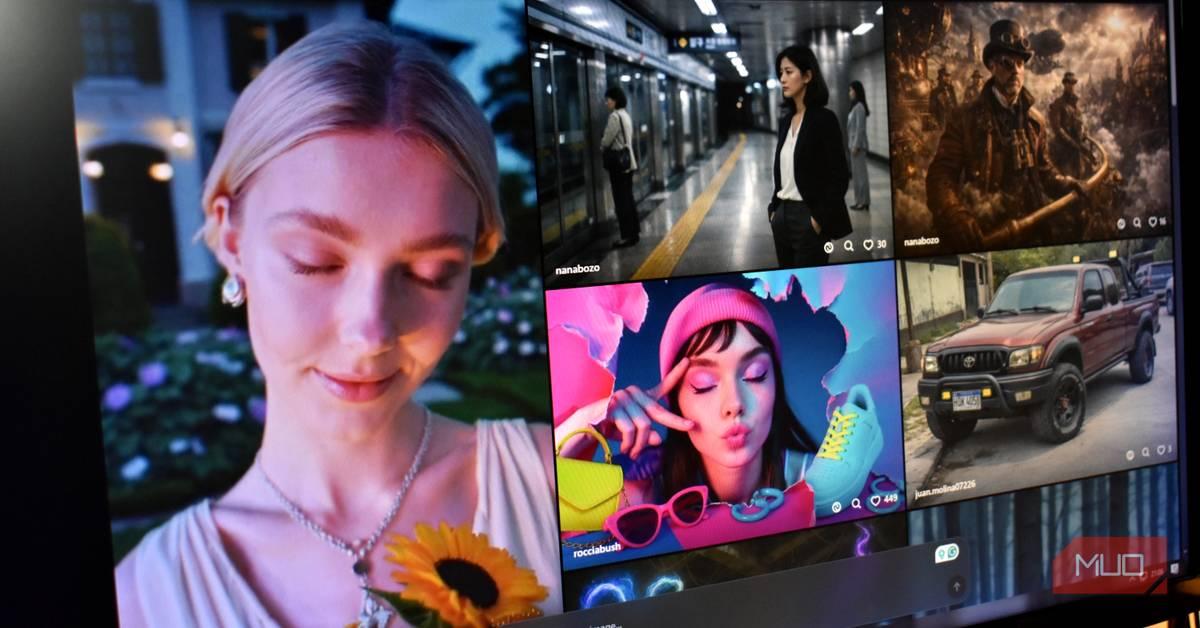
Source: MakeUseOf
The app's decline stands in stark contrast to ChatGPT's 900 million weekly active users
4
. TechCrunch's Equity podcast described OpenAI's decision as "a sign of maturity that was nice to see in an AI lab," with hosts noting the importance of companies being able to iterate quickly and kill off products that aren't working2
.Sora faced significant challenges with deepfake misuse and content moderation from the start. The app's flagship "cameos" feature allowed users to scan their faces and create realistic deepfakes of themselves, which could then be made public for anyone to use
4
. Despite guardrails intended to prevent videos of public figures who hadn't opted in, users easily evaded these protections4
.Deepfakes of Martin Luther King Jr. and Robin Williams emerged, prompting their daughters to publicly request users stop making videos of their deceased fathers
4
. Users also intentionally created content using copyrighted characters like Mario, Naruto, and Pikachu, inviting legal trouble4
. The app felt like "an under-moderated minefield," with one journalist noting they would "never be the same" after watching realistic clones of Sam Altman in disturbing scenarios4
.The Sora shutdown represents a reality check moment for AI video makers and evangelists who claimed these tools would replace Hollywood soon
2
. ByteDance has reportedly delayed launching its SeeDance 2.0 video model worldwide due to engineering and legal questions around building IP protections into the system2
. Disney had sent a cease-and-desist letter to ByteDance last month, calling the app a "virtual smash-and-grab of Disney's IP"1
.Copyright concerns have plagued the AI video generation space. When Sora 2 launched in October, OpenAI initially asked copyright holders to opt out of having their works used as training data, but following public outcry, reversed course to require opt-in consent with vague profit-sharing promises
1
. The technical and legal challenges prove that creating feature films by typing prompts remains very far from reality2
.Related Stories
Researchers at OpenAI have described the company's culture as "bottom-up," allocating resources to promising ideas as they emerge rather than following executive roadmaps
3
. While this created fertile ground for AI research, it also spread GPUs and employees thin3
. The decision to discontinue Sora reflects a belief that GPUs and researchers are better used elsewhere, particularly as compute demand grows3
.There's an open question about what this focus era means for OpenAI's research teams as the company competes with Anthropic, Google DeepMind, and Meta for top-tier talent
3
. In January, OpenAI's VP of Research, Jerry Tworek, left after struggling to get resources for his next project3
. While many employees appear energized by the refocus, others may move to rival labs if their projects get deprioritized3
.The latter half of 2025 focused on AI image and video tools, but 2026 is all about agentic AI that completes actual tasks, particularly in workplace settings
5
. Anthropic set off a race this year when its advanced Claude Code and Cowork tools proved AI could be a serious workplace tool, with the company's popularity and new user sign-ups rising5
. OpenAI released Codex to compete, and the product has become a bright spot for the company3
.For professionals and businesses watching the AI landscape, the message is clear: OpenAI is betting on tools that solve real-world problems rather than generating social media content. The company's willingness to shut down a high-profile consumer product signals discipline that investors will likely appreciate as OpenAI moves toward public markets. However, the abrupt end to the Disney partnership demonstrates the risks of announcing deals before they're finalized, and the challenges of building consumer social products that achieve lasting engagement in an increasingly crowded market.
Summarized by
Navi
[4]
02 Apr 2026•Technology

30 Jan 2026•Business and Economy

10 Dec 2024•Technology

1
Policy and Regulation

2
Policy and Regulation

3
Technology