China's Five-Year Plan Bets on AI and Tech Independence as US-China Rivalry Intensifies


3 Sources
3 Sources
[1]
China's New 5-Year Plan: More AI, Less US
For whatever reasonâ€"maybe it was the 145% tariffs, maybe it was the kidnapping of a foreign leader, or the sudden and undeclared rush to war with Iranâ€"China's President Xi Jinping doesn't seem to think relying on America is going to be the best idea for his nation going forward. On Thursday, the nation's head of state introduced a customary five-year plan at the annual meeting of the National People's Congress. The next half-decade for China, per the plan, could be best described as pursuing technological leaps and weaning itself off dependence on the US. According to Reuters, Xi's plan calls for China to "seize the commanding heights of science and technological development" and seek "decisive breakthroughs in key core technologies." Those technologies include quantum computing, alternative energy sources like hydrogen and fusion energy, 6G mobile networksâ€"and, of course, AI. “In the midst of fierce international competition, we must win the strategic initiative,†the plan said, per the New York Times. Depending on who you ask, China has already built itself a bit of a cushion in the tech arms race. In fact, Reuters reported that China's state-planning body issued its own report that claimed the country is already outpacing others in AI research and development. Journalist Rebecca Fannin, author of the upcoming book "The New Tech Titans of China," recently made claims along similar lines, based on China's heavy and rapid investment in research and development that has led to breakthroughs like the open-source AI model DeepSeek. Xi's five-year document includes an "AI+ action plan" that calls for the nation to invest more in robotics that can be deployed to perform tasks in industries experiencing labor shortages. It also called for a rapid expansion and deployment of AI agents that can perform autonomous tasks. As it pushes to achieve those goals, the country is also looking to cut America out of the supply chain. The reality for China is that, despite its own breakthroughs with AI and other emerging technologies, it has continued to rely on American tech. The country has continued to use Nvidia's GPUs to train its AI models, including DeepSeek, and has struggled to homebrew a viable alternative. But it's going to make a concerted effort to ditch US-based tech going forward. It also intends to do everything in its power to hold onto its control of rare earths that are key to chip manufacturing, per NYT. It's not hard to see the potential for China to position itself to shake up the US-led world order. In recent months, China cut a new trade deal with Canada, and the European Union and South America crafted a free trade agreement without the US involved. The Trump administration seems set on isolating just about everyone (except Israel) as it attempts to flex its strength, both militarily and economically. Suddenly, dealing with China might seem more predictable and reliable than dealing with Trump, however many terms he plans to serve.
[2]
What China's latest economic plans say about its tech ambitions and rivalry with US
China's new economic blueprints focus on strengthening its home market and accelerating tech progress. This strategy aims to shift the nation from low-cost manufacturing to a tech-driven economy. The plans also address current economic slowdowns. These decisions will significantly impact global markets and jobs. China is investing heavily in key technologies like AI and semiconductors. Two major economic plans unveiled at the annual meeting of China's legislature outline top priorities that have different ramifications for the global economy. In the government plan for 2026, the No. 1 task is "building a robust domestic market". Then comes accelerating technological progress. But longer-term, a plan for the next five years, gives more prominence to achieving advances in tech. Also read: China's factory activity contracts for a second month The subtle difference highlights the government's balancing act. Its overarching goal is to transform from a low-cost manufacturing to a tech-driven economy. But a more immediate concern is dealing with a prolonged period of sluggishness that has depressed consumer and business confidence. China is such a large exporter that the choices it makes affect countries and jobs around the world. The plans, presented at the recent opening of the National People's Congress, offer a window into the government's thinking. They are set to be formally endorsed by the rubber-stamp legislature at the end of the eight-day session on Thursday. Also read: China to boost spending to meet growth target Analysts believe technological prowess remains the far more important goal for Chinese leader Xi Jinping and his vision to build the nation into a major power that can contend with the United States on issues ranging from trade to Taiwan tensions. Speaking to a provincial delegation at the National People's Congress, Xi called for new breakthroughs, original innovation and "seizing the strategic high ground of science and technology", according to a state media report. China's rapid growth into the world's second-largest economy has lifted it to the level of a middle-income nation. To keep advancing, Xi has promoted polices that move the economy into higher-value industries. A government-backed push into electric vehicles, for example, has transformed China into an emerging player in the global auto industry, while dovetailing with national climate goals. The five-year plan vows to "target the frontiers of science and technology", speeding up development in areas such as artificial intelligence, quantum technology, biotechnology and new energy. Also read: Trump's China visit likely won't yield breakthrough, aims to maintain stability The push has expanded and morphed as technology has evolved into an area of competition with the US, with national security implications. The US has restricted the access of Chinese companies to the most-advanced technologies, including semiconductors that drive AI. The justification is that these parts can wind up in weapons at a time when the two countries are military rivals as well. China's government has responded by pouring resources into trying to develop these components itself as well as engineer ways to remain competitive with less advanced parts. China must "fight the battle for key core technologies", the five-year plan said. Specific goals, apart from AI, electric vehicles and robotics, include making advancements in semiconductors, batteries, biomedicine and 6G mobile networks. The plan also pledged to expand production of China's homegrown passenger jet, the C919, and make breakthroughs in developing its own commercial jet engine. The US temporarily cut off the supply of Western-supplied engines for the C919 last year during an escalation in the trade war with China. Rare earths -- where China is the global leader -- was highlighted as an area where it should maintain its competitive edge as the US and other countries seek to develop their own supplies of the critical elements for many advanced tech and military products. Also read: China says it can keep jobs stable over next 5 years despite AI, labour challenges Even as China's economy has cooled at home, rising exports have kept it growing overall. But tariffs imposed by US President Donald Trump have exposed the risk of relying too heavily on overseas markets. China was able to shift exports to other markets, but that is facing challenges as its record trade surplus of almost USD 1.2 trillion raises alarm about the threat to factory jobs and the broader economies in other countries. That has added impetus to China's push to pump up consumer spending, so the economy is less dependent on outside forces. "Facing a complex and challenging international environment, we must remain committed to the strategy of expanding domestic demand," the annual economic plan said. But for all the strong words, analysts say the effort appears aimed at keeping the economy afloat rather than boosting it. The annual plan sets a growth target of 4.5 per cent to 5 per cent for 2026, leaving room for a drop from last year's 5-per cent rise. Meanwhile, the government is primed to offer huge subsidies for high-tech advances in manufacturing, analysts said. "Technological development and self-sufficiency remain central priorities, and industrial policy will continue to be deployed as an essential tool to achieve them," economists at Capital Economics wrote in a research note. Similar subsidies to the wind and solar industries led to manufacturing oversupply that was exported at rock-bottom prices, undercutting overseas competitors. The end result could be an even larger imbalance between China's immense manufacturing capacity and its weaker domestic demand, further driving up its exports.
[3]
China ramps up 'high stakes' tech race with US as economic imbalances deepen
In its 15th strategic plan since adopting Soviet-style quinquennial policy cycles in the 1950s, Beijing has outlined a bet that technology - not consumption - will drive its next phase of development despite growing structural pressures. China on Thursday set out a five-year roadmap to turbocharge scientific breakthroughs and embed AI across its industrial economic machine, framing technological dominance as a core national security goal in its sharpening rivalry with the US. In its 15th strategic plan since adopting Soviet-style quinquennial policy cycles in the 1950s, Beijing has outlined a bet that technology - not consumption - will drive its next phase of development despite growing structural pressures. The objectives reflect President Xi Jinping's vision of developing "new productive forces" to escape the middle-income trap, counter the demographic downturn, and enhance self-sufficiency to insulate China from US export controls. At the opening of the annual parliament meeting, Premier Li Qiang praised China's ability to withstand US President Donald Trump's tariff hikes, but said "multilateralism and free trade are under severe threat," announcing 7% increases in the defence budget, as well as in research and development. Li acknowledged an "acute" imbalance between strong supply and weak demand and risks from a worsening property sector crisis and high local government debt. These challenges have pushed Beijing to set a slightly lower growth target of 4.5%-5% for 2026, down from last year's 5%, which was met largely through a one-fifth surge in its trade surplus to a record $1.2 trillion. As widely expected, the five-year plan also pledged a "notable" increase in household consumption, without specifying figures, dampening expectations for demand-side reforms. Last year's trade punches with the Trump administration, which briefly escalated to embargo-like conditions of triple-digit tariffs, showed the importance of its supply chain dominance as leverage. China vowed to maintain its competitive edge in rare earths. The US and its allies are still years away from breaking their reliance on China for these materials vital to everything from AI chips to defence systems. "China's government remains laser-focused on spurring technological breakthroughs and high-tech investment," said Fred Neumann, chief Asia economist at HSBC. "In part, this is motivated by competition with the United States for control over the technologies of the future." "Many international observers may be left disappointed, therefore, by slower progress in rebalancing the economy away from investment towards consumption." China invests 20 percentage points of GDP more than the global average, while its households spend roughly 20 points less - a state-controlled, debt-driven development model that analysts say creates industrial overcapacity and fuels trade tensions abroad and deflationary pressures at home. "The rebalancing challenge that China faces, and that will take years to achieve, is implicitly acknowledged by a weaker growth target for the coming year," Neumann added. The five-year plan aims to raise the value-added of "core digital economy industries" to 12.5% of GDP and roll out new policies for an integrated national data market, AI adoption across the full supply chain, and an AI security system. Ambitions span biomedicine, quantum tech, atomic-scale manufacturing, hyper-scale computing clusters, nuclear fusion, brain-computer interfaces and even commercialising AI-powered humanoid robots. "Beijing is trying to manage a 'controlled glide' in growth while building a new economy based on technology rather than property," said Andy Ji, Asian FX & rates analyst at ITC Markets. "It is a high-stakes rebalancing where the government is betting the house on AI and advanced manufacturing." State-owned enterprises were enrolled to create demand for made-in-China semiconductors and drones. The 141-page plan name-checks AI over 50 times, envisioning robots plugging labour shortages and factories operating with little human oversight. It builds on a breakout year for Chinese developers - led by DeepSeek - who rapidly closed the gap with U.S. leaders such as OpenAI and Gemini. But the five-year plan also lists bigger ambitions in areas China already dominates: it accounts for 85% of the world's electric vehicle charging stations, but still aims to double their number within three years. Steady stimulus, careful capacity cuts Economists say a lower growth target allows Beijing to experiment with cutting overcapacity in low-value added industries, but cautioned that this did not mean a departure from its production-focused growth model. Beijing also appeared to suggest tightened supervision of local government spending, some of which had gone into unproductive infrastructure projects, warning many officials had "a misguided understanding of what it means to perform well." The US Supreme Court's decision to strike down some of Trump's tariffs and expectations that a meeting between the two countries' presidents later in March could stabilise relations in the short-term bode well for such adjustments. Dan Wang, China director at Eurasia Group, said Beijing appeared to take advantage of "the trade truce" to absorb the job market pressure created by any production curbs. Stimulus-wise, China plans a budget deficit of 4.0% of GDP and has set special debt issuance quotas at 1.3 trillion yuan ($188.5 billion) for the central government and 4.4 trillion yuan for local authorities - all unchanged from last year. China pledged to raise minimum monthly pensions by 20 yuan per person and basic medical insurance subsidies for rural, non-working people by 24 yuan - marginal, rather than structural, moves. It said it wants to increase education spending, subsidise childcare and reform public hospitals, acknowledging the demographic downturn. Yuan Yuwei, fund manager at Trinity Synergy Investment, warned that China's growth and policy aims for this year - prepared at the end of 2025 - do not take into account the US-Israeli attacks in Iran. "That's very negative for China, which counts the Strait of Hormuz as a crucial trade route," said Yuan.
Share
Share
Copy Link
China unveiled its 15th five-year plan at the National People's Congress, prioritizing artificial intelligence, quantum computing, and semiconductors to reduce reliance on US technology. President Xi Jinping aims to transform China into a tech-driven economy despite a lower growth target of 4.5%-5% and mounting economic pressures from tariffs and trade tensions.
China Five-Year Plan Shifts Focus to Technological Dominance
China has unveiled an ambitious strategy to reduce its technological independence from the US while accelerating technological progress across critical sectors. At the annual meeting of the National People's Congress, President Xi Jinping introduced the nation's 15th five-year plan, framing technological supremacy as essential to national security amid intensifying US-China tech rivalry
1
.
Source: ET
1
. This strategic pivot comes as the country faces 145% tariffs and mounting pressure to achieve self-reliance in semiconductors, artificial intelligence, and other advanced technologies.The timing reflects Beijing's calculation that depending on American technology and markets has become increasingly risky. Premier Li Qiang acknowledged that "multilateralism and free trade are under severe threat," while announcing 7% increases in both defense and research and development budgets
3
. The plan aims to transform China from a low-cost manufacturing hub into a tech-driven economy, though this transition occurs against a backdrop of economic headwinds including a lower growth target of 4.5%-5% for 2026, down from last year's 5%3
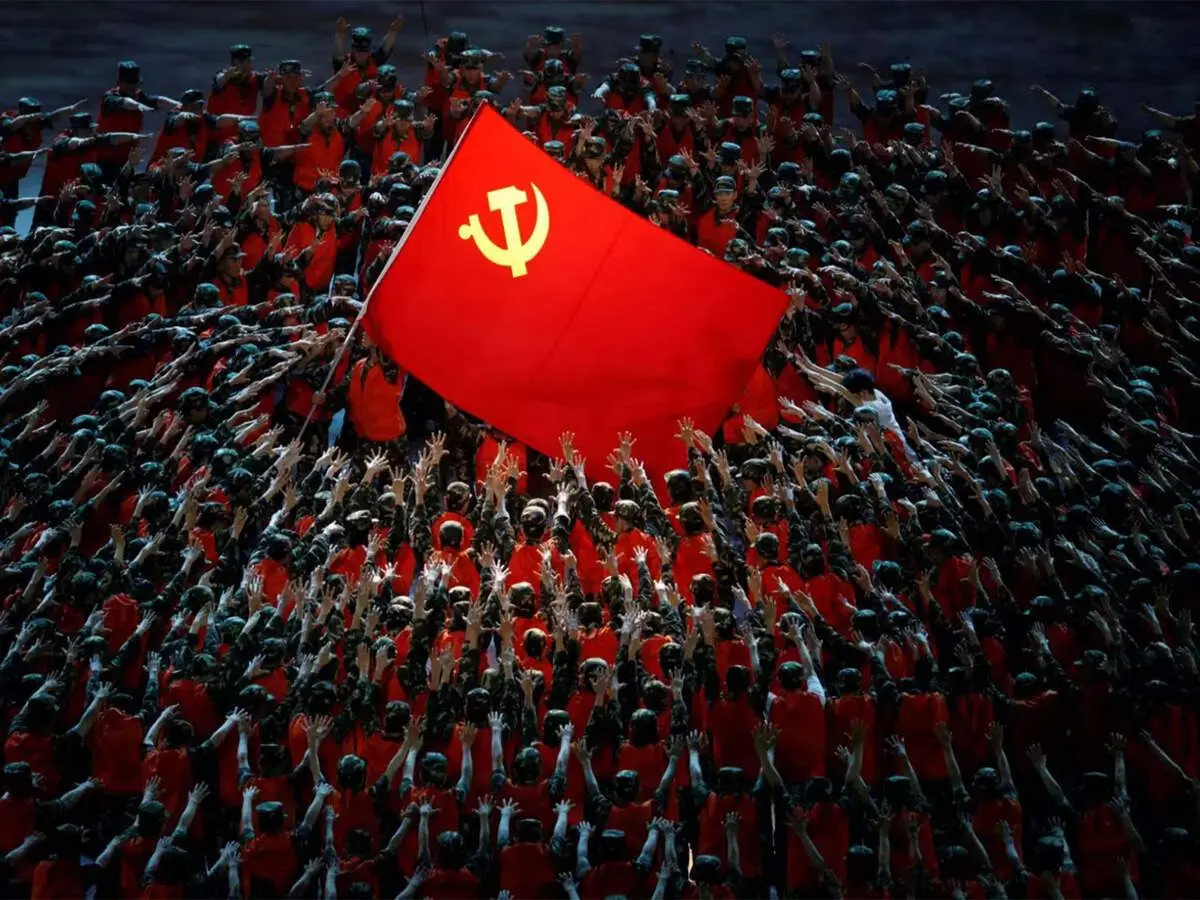
.
Source: ET
Artificial Intelligence Takes Center Stage in Development Strategy
Artificial intelligence emerges as the cornerstone of China's development vision, with the 141-page plan mentioning AI over 50 times
3
. The document includes an "AI+ action plan" that envisions deploying robotics to address labor shortages and establishing factories operating with minimal human oversight1
3
. The plan also calls for rapid expansion of AI agents capable of performing autonomous tasks across industries. China's state-planning body has issued reports claiming the country already outpaces others in AI research and development, pointing to breakthroughs like the open-source DeepSeek model as evidence of rapid progress1
.The five-year plan sets a specific target to raise the value-added of "core digital economy industries" to 12.5% of GDP
3
. Investment in key technologies extends beyond AI to encompass quantum computing, quantum tech, biomedicine, brain-computer interfaces, nuclear fusion, and even commercializing AI-powered humanoid robots2
3
. Fred Neumann, chief Asia economist at HSBC, observed that "China's government remains laser-focused on spurring technological breakthroughs and high-tech investment," motivated partly by competition with the United States for control over future technologies3
.Breaking Free from US Technology Dependence
Despite recent innovation breakthroughs, China continues to rely on American technology, particularly Nvidia GPUs for training AI models including DeepSeek
1
. The country has struggled to develop viable alternatives but is now making a concentrated effort to eliminate US-based tech from its supply chain. The plan pledges to "fight the battle for key core technologies," with specific goals in semiconductors, batteries, 6G mobile networks, and advanced manufacturing2
. State-owned enterprises have been enrolled to create demand for made-in-China semiconductors and drones3
.The strategy also emphasizes maintaining supply chain dominance in critical areas where China already leads. The plan vows to preserve competitive advantages in rare earths, where China controls global supply of materials vital to AI chips and defense systems
1
3
. The US and allies remain years away from breaking their reliance on China for these critical elements. Last year's trade war with the Trump administration, which briefly escalated to embargo-like conditions with triple-digit tariffs, demonstrated the strategic importance of this supply chain leverage3
.
Source: Gizmodo
2
.Related Stories

Balancing Ambition with Economic Reality
The plan reveals a delicate balancing act between long-term technological ambitions and immediate economic pressures. While the five-year plan prioritizes tech advancement, the annual government plan for 2026 lists "building a robust domestic market" as the top priority, followed by accelerating technological progress
2
. Premier Li acknowledged "acute" imbalances between strong supply and weak demand, along with risks from a worsening property sector crisis and high local government debt3
. China invests 20 percentage points of GDP more than the global average while households spend roughly 20 points less, creating industrial overcapacity that fuels trade tensions abroad and deflationary pressures at home3
.Despite pledging a "notable" increase in household consumption without specifying figures, analysts remain skeptical about demand-side reforms materializing. Andy Ji, Asian FX & rates analyst at ITC Markets, characterized the approach as "a high-stakes rebalancing where the government is betting the house on AI and advanced manufacturing"
3
. The strategy reflects Xi Jinping's vision of developing "new productive forces" to escape the middle-income trap, counter demographic decline, and build self-sufficiency against US pressure3
. With China's record trade surplus of nearly $1.2 trillion raising alarm globally about threats to factory jobs, and recent trade deals between China-Canada and EU-South America excluding the US, the geopolitical landscape appears to be shifting as dealing with China may seem more predictable than navigating Trump administration policies1
2
.References
Summarized by

Navi
[1]
Related Stories
China's 2025 Policy Priorities: Balancing Consumer Spending and Technological Advancement
05 Mar 2025•Business and Economy

China declares itself world leader in AI R&D, pledges to accelerate tech self-reliance
05 Mar 2026•Policy and Regulation
China Unveils Ambitious 10-Year Plan for Nationwide AI Integration
29 Aug 2025•Technology
Recent Highlights


Recent Highlights
Today's Top Stories








Your Daily Dose of Curated AI News
Don’t drown in AI news. We cut through the noise - filtering, ranking and summarizing the most important AI news, breakthroughs and research daily. Spend less time searching for the latest in AI and get straight to action.

