12 Sources
12 Sources
[1]
Iran threatens 'Stargate' AI data centers | TechCrunch
Iran has warned of further attacks on data centers across the Middle East in response to ongoing threats and air strikes from the United States. Iran's military said that if the U.S. went ahead with its threats to hit its civilian infrastructure, the country would retaliate with its own strikes against U.S.' energy and tech infrastructure in the region, according to a video released late last week and shared widely on Sunday of Iranian military spokesperson Ebrahim Zolfaghari. The video released by Iran shows an image of a globe, then zooming in on the Stargate data center in the United Arab Emirates with the message of "nothing stays hidden to our sight, though hidden by Google." Stargate is a $500 billion joint venture between OpenAI, SoftBank and Oracle to build AI data centers, announced in January 2025. The initiative originally struggled to get off the ground due to alleged funding troubles and costs associated with tariffs, and sought to expand with new data centers internationally. The latest threat comes after U.S. President Trump threatened to strike Iran's civilian infrastructure, like power plants and water desalination plants, by the end of Tuesday if Iran doesn't reopen the Strait of Hormuz, a critical global shipping channel that has choked global supply chain traffic since the start of the war in February. Several data centers in the region have already been hit by missiles as a result of the war.
[2]
Iran Threatens to Start Attacking Major US Tech Firms on April 1
Iran's Islamic Revolutionary Guard Corps warned Tuesday that it plans to begin attacking more than a dozen American companies across the Middle East on Wednesday in retaliation for the killing of Iranian citizens in the ongoing war with the US and Israel. The list of companies includes Apple, Google, IBM, Intel, Microsoft, Tesla, and Boeing, which the IRGC accused of enabling United States military targeting operations. The IRGC urged employees of the US firms to evacuate and civilians in the region to stay away. Tuesday's warning, posted to the IRGC's Telegram channel, extends a campaign of threats by Iran against American commercial infrastructure since the US and Israel launched their first attack on Tehran on February 28. Iranian drones struck two Amazon Web Services data centers and damaged another in the United Arab Emirates and Bahrain on March 1, in the first publicly confirmed attack on American-owned hyperscale cloud infrastructure. Banking sites, payment processors, and consumer services across the region crashed as redundancies meant to prevent outages were taken offline. Earlier this month, the IRGC-affiliated Tasnim News Agency published a list of 29 regional offices and data centers operated by major firms such as Amazon, Google, IBM, Nvidia, and Palantir, accusing the firms of supporting US military and intelligence activities. The IRGC said in its post to Telegram that targeted companies "should expect" attacks to begin after 8 pm on April 1 in Tehran. Most of the companies the IRGC named in Tuesday's Telegram post did not immediately respond to WIRED's request for comment. Google, Microsoft, and JP Morgan declined to comment. Billions of dollars in US technology and infrastructure are tied up in the Gulf, where American tech giants have bet big on the region becoming the next hub for AI development. The IRGC designates these civilian hardware and software providers as "legitimate targets" responsible for providing the technology that enabled the joint US-Israeli attacks that killed Supreme Leader Ali Khamenei at the start of the war. The threats highlight the US Defense Department's reliance on commercial vendors with operations in the region. Palantir, for example, builds the data architecture for Project Maven, a Pentagon artificial intelligence program that processes drone and satellite imagery to identify air-strike targets. The defense contractor also maintains a corporate office in Abu Dhabi. The US military responded throughout March by bombing IRGC drone networks needed to carry out the attacks, and US Central Command recently released footage of air strikes destroying mobile launchers. The aerial campaign has slowed in recent days, however, as the US temporarily paused strikes on Iran's energy infrastructure to explore potential peace talks with Tehran. Amid the shifting operational tempo, the Pentagon is reportedly considering whether to deploy up to 10,000 additional troops to the Middle East to expand its options ahead of a possible ground invasion. In the month since Khamenei's assassination, approximately 2,000 Iranians have been killed, along with at least 13 US service members. The conflict has spread across the region, with Iranian retaliatory strikes hitting targets in Israel, Gulf states, and Iraq. The Strait of Hormuz, an essential shipping route that runs between Iran and the United Arab Emirates and Oman, has remained effectively closed for weeks due to threats from Iran, disrupting shipments of oil and other goods globally.
[3]
Iran says it has struck Oracle data center in Dubai, Amazon data center in Bahrain -- country has threatened to attack Nvidia, Intel, and others, too
Iran's Islamic Revolutionary Guard Corps (IRGC) said on Thursday that it had hit a data center linked to Oracle in Dubai as part of its war against the U.S. and U.S. technology companies in the region, reports The Times of India. The government of Dubai was quick to deny the report, according to Gulf News. An Amazon facility in Bahrain was also targeted, according to NDTV, which cites the Tasnim news agency. Several days ago, the IRGC named Oracle among a group of American corporations it accuses of enabling U.S. and Israeli military activity, alongside Apple, Boeing, Cisco, Google, HP, IBM, Meta, and Microsoft. Oracle has cloud and artificial intelligence contracts with the U.S. Department of Defense, and its chairman, Larry Ellison, has longstanding ties with Israel, which were among the factors cited in the accusations. In addition, the IRGC targeted American aluminum and steel industries in Bahrain and the UAE, as well as Rafael arms factories in Israel. While the officials in the United Arab Emirates have not confirmed any successful hit on infrastructure in Dubai. Bahrain's Ministry of Interior confirmed that an Iranian strike has set 'a facility of a company' on fire. That company is said to be Batelco, the country's largest telecommunications company that hosts infrastructure for Amazon Web Services. While hitting traditional targets -- such as arms factories, industrial plants, and military facilities -- causes a lot of costly damage, hitting AI data centers equipped with hardware that is worth billions causes dramatically more financial damage. For example, an Nvidia NVL72 GB300 system can cost as much as $6 million, so a data center hosting 50,000 Blackwell processors houses hardware worth $4.16 billion. This estimate excludes networking, storage, racks, power delivery, cooling, building shell, and deployment, so even if supporting infrastructure adds 50% on top of that (which is a conservative estimate), we are talking about a data center that costs $6.24 billion. A hit on such an object causes more damage than a hit on a traditional target. Furthermore, it potentially causes severe damage to American companies. Of course, for now, we do not know for sure whether any AI data centers belonging to AWS or Oracle were hit by Iran's IRGC, though the risks for American companies that have AI infrastructure in the Middle East are exceptionally high. Although authorities in the Middle East claim successful interceptions of Iranian strikes, an investigation by Bellingcat published on Thursday suggests that not all attacks are intercepted, official damage reports may not fully reflect actual impacts, so some incidents are minimized, mischaracterized, or even not publicly acknowledged. Follow Tom's Hardware on Google News, or add us as a preferred source, to get our latest news, analysis, & reviews in your feeds.
[4]
Iran threatens imminent attacks on US tech companies in the Middle East
The Islamic Revolutionary Guard Corps (IRGC), a branch of Iran's armed forces, has threatened to target US tech companies' operations in the Middle East. It told employees of 18 companies -- including Apple, Google, Meta and NVIDIA -- "to leave their workplaces immediately to save their lives," as CBS News reported. Those living close to the companies' facilities in the region were instructed to evacuate immediately as well. Microsoft, Oracle, Tesla, HP, Intel, Palantir, Boeing, Dell, Cisco and IBM are also among the companies that the IRGC named. "Since the main element in designing and tracking terror targets are American [information and communications technology] and AI companies, in response to this terrorist operation, from now on the main institutions effective in terrorist operations will be our legitimate targets," the IRGC said in a statement. The military force warned it will start targeting the companies on Wednesday evening if more Iranian leaders are killed. Iran previously pledged to attack companies and banks tied to the US and Israel, though the warning it issued on Tuesday had a specific deadline. Earlier this month, Iranian drones struck Amazon data centers in Bahrain and the United Arab Emirates, disrupting Amazon Web Services operations in the region. The US reportedly used Anthropic's AI in its initial airstrikes against Iran at the onset of the war in late February. Israel has been using a new AI platform of its own to help it track the movements of Iranian officials.
[5]
Iran threatens OpenAI-backed Stargate AI data center in Abu Dhabi
Serving tech enthusiasts for over 25 years. TechSpot means tech analysis and advice you can trust. What just happened? Iran has issued a new threat against a US interest: the $30 billion Stargate AI data center in Abu Dhabi. Iran's Islamic Revolutionary Guard Corps (IRGC) said it would hit the facility should the US carry out its promise to target the country's power infrastructure. The IRGC released a video vowing retaliatory measures should the US attack its power facilities. Spokesperson Brigadier General Ebrahim Zolfaghari said the actions would entail "complete and utter annihilation" of power plants, energy infrastructure, and IT and communications facilities belonging to Israel and to companies with American shareholders. The video shows a dramatic space shot that zooms in on Abu Dhabi on Google Maps. In a seemingly empty spot near the coast, a message states, "Nothing stays hidden to our sight, though hidden by Google." It then shows a night vision view revealing the Stargate AI data center. We also see a photo of several CEOs whose companies are partners in the project, including Jensen Huang, Sam Altman, and Satya Nadella. Announced in May 2025 as the first international deployment of OpenAI's Stargate platform, Abu Dhabi's Stargate UAE project brings together OpenAI, Oracle, Nvidia, Cisco, UAE's G42, and SoftBank for a 1GW AI cluster, with the first 200MW expected to come online in 2026. That initial buildout sits inside a much larger UAE-US AI campus planned to span 10 square miles and eventually reach 5GW, which would make it one of the biggest AI data center developments anywhere. Nvidia's Grace Blackwell GB300 systems are slated for the first phase, and Reuters reported that 200MW of capacity could amount to roughly 100,000 Nvidia chips. This isn't Iran's first threat against US interests in the Middle East. Last week, the IRGC warned it would target 18 US firms with facilities in the region for what it said was active participation in terrorist plots. The list included Nvidia, Intel, HP, Microsoft, Apple, Google, Meta, Cisco, Oracle, IBM, Dell, Palantir, Tesla, and Boeing. Since then, the only reported damage to US firms has been to some AWS data centers in Bahrain and Dubai, disrupting services in the area. It was also reported that the façade of a building used by Oracle in Dubai was slightly damaged by debris falling from an intercepted drone.
[6]
Iran threatens to destroy OpenAI's Stargate data centre in Abu Dhabi | TNW
In short: Iran's Islamic Revolutionary Guard Corps has released a video threatening "complete and utter annihilation" of OpenAI's $30bn Stargate AI campus in Abu Dhabi, singling out the facility by name for the first time and warning it will strike if the US proceeds with threatened attacks on Iranian civilian infrastructure. A senior officer in Iran's Islamic Revolutionary Guard Corps has threatened to destroy OpenAI's flagship AI data centre in Abu Dhabi, releasing a video that opens on a blurred satellite view of the desert site before switching to sharp night-vision footage of the sprawling Stargate campus. The message overlaid on screen reads: "Nothing stays hidden to our sight, though hidden by Google." The video was released on 3 April 2026 by Brigadier General Ebrahim Zolfaghari of the IRGC, and represents a significant hardening of Iran's position. Just days earlier, the Guard had named 18 US technology companies as legitimate military targets, including Apple, Microsoft, Nvidia, and Tesla, but had not identified any specific facility. The Stargate video is the first time the IRGC has designated a particular installation for threatened destruction. Zolfaghari said the attack would be carried out if the United States follows through on President Donald Trump's threat to bomb Iranian power plants and desalination facilities. The threat is conditional rather than imminent, but comes after a month of kinetic escalation: the US-Israel joint campaign that began on 28 February 2026 has already prompted Iranian retaliatory strikes against Gulf energy infrastructure, military installations, and, notably, commercial data centres. Stargate UAE is the international flagship of the $500bn Stargate joint venture between OpenAI, SoftBank, Oracle, and Abu Dhabi sovereign investment vehicle MGX. The campus is being built and financed by UAE artificial intelligence company G42 across approximately 19 square kilometres of desert south of Abu Dhabi, and will be operated jointly by OpenAI and Oracle. SoftBank's involvement in the project was underwritten in part by SoftBank's $40bn bridge loan to fund its OpenAI commitment, arranged with JPMorgan Chase, Goldman Sachs, and three Japanese lenders in late 2025. The facility's first phase, a 200-megawatt compute cluster powered by Nvidia Grace Blackwell GB300 systems, is scheduled to come online by the end of 2026. At full build-out, the campus is designed to reach 1 gigawatt of total capacity, according to the UAE's AI minister, who put the projected total construction cost at more than $30bn in January 2026. The facility reportedly houses up to 500,000 Nvidia GPUs, though that figure has not been independently confirmed. If completed as planned, Stargate UAE would be the single largest concentration of AI compute capacity outside the United States. Cisco is providing zero-trust networking and connectivity infrastructure; Oracle is managing cloud operations; Nvidia is the primary chip supplier. The UAE government, through G42, holds the construction and land interests, while OpenAI oversees model training and inference workloads. The threat to Stargate is not hypothetical in the way it might have been six months ago. Before dawn on 1 March 2026, Iranian Shahed drones struck two Amazon Web Services data centres in the UAE and damaged a third in Bahrain, knocking two of the three availability zones in AWS's ME-CENTRAL-1 region offline for more than 24 hours. The attacks disrupted banking services, ride-hailing platforms, and payment processors across the Gulf, and AWS later waived usage fees for the region for the entire month of March. Iran also claimed to have struck an Oracle data centre in Dubai on 2 April. Dubai's media office denied the claim the same day; the true status of that facility remains disputed. The AWS strikes were the first instance in recorded history of a state deliberately targeting commercial data centres as part of an active military campaign. That precedent makes the current threat to Stargate considerably more credible than a standard piece of geopolitical posturing. The timing is acutely uncomfortable for the industry. Analysts at TD Cowen estimate that hyperscaler capital expenditure will exceed $600bn in 2026, with roughly three-quarters of that tied to AI infrastructure build-out. The Gulf was, until this year, projected to be the fastest-growing data centre market in the world, with annual growth rates above 60 per cent, driven by gigawatt-scale campuses in the UAE and Saudi Arabia. That pipeline is now exposed. Insurers and institutional lenders are reassessing risk models for Middle Eastern infrastructure at exactly the moment when firms like Meta's $27bn infrastructure deal with Nebius illustrates how aggressively the industry has been locking in long-term capacity. A successful strike on Stargate, or a prolonged period of credible threat, would force a wholesale recalculation of where the next generation of AI compute gets built, with Northern Europe, India, and Southeast Asia the likeliest beneficiaries. One analyst cited by Reuters framed the dilemma bluntly: "Before now, the thought was, if America gets constipated in its ability to build data centres, we'll build them with our allies in the Middle East. But who's going to insure a $20bn facility in the Middle East that can be taken out by a $5,000 drone?" The conflict is also sharpening long-running debates about cybersecurity and AI infrastructure as intertwined strategic concerns. Palantir's chief technology officer has described the Iran conflict as the first major war substantively shaped by AI-assisted targeting, with advanced tools processing battlefield data to accelerate strike decisions. That characterisation cuts both ways: the same AI infrastructure that enables faster military decision-making also becomes a high-value military target. OpenAI has not commented publicly on the threat. The company has been navigating a complicated period, with questions about its relationship with Microsoft sharpened by Microsoft's development of Microsoft's own AI models as a hedge against dependence on any single partner. A forced halt or destruction of the Abu Dhabi facility would remove the most significant planned expansion of OpenAI's compute base outside US borders. As of 6 April 2026, Iran has not followed through on the specific threat, and ceasefire negotiations remain deadlocked. Iran has rejected a US proposal for a temporary halt to hostilities, and Trump has continued to threaten Iranian civilian infrastructure. The $30bn campus in the Abu Dhabi desert, not yet online, now sits at the intersection of two conflicts: one kinetic, fought with drones and missiles across the Gulf; the other strategic, fought over who controls the compute that will run the next decade of artificial intelligence. Whether the first conflict destroys a piece of the second may depend on decisions made in the next few weeks.
[7]
Iran threatens attacks on Nvidia, Microsoft, Intel, and other US tech firms in the Middle East
Serving tech enthusiasts for over 25 years. TechSpot means tech analysis and advice you can trust. What just happened? The Islamic Revolutionary Guard Corps (IRGC) has threatened to attack several US tech companies in the Middle East if Iran continues to be targeted by America and Israel. The IRGC said attacks could begin today and has advised employees and residents living near the facilities to evacuate the area. Days after Iran warned that offices and infrastructure belonging to US companies involved in military technology in the Middle East would be targeted, the IRGC updated its threat on Telegram. The 18 companies the IRGC threatened, accusing them of actively participating in terrorist plots, include Nvidia, Intel, HP, Microsoft, Apple, Google, Meta, Cisco, Oracle, IBM, Dell, Palantir, Tesla, and Boeing. "Since the main element in designing and tracking terror targets are American ICT and AI companies, in response to this terrorist operation, from now on the main institutions effective in terrorist operations will be our legitimate targets," the IRGC message reads. Intel IDC9 building in Haifa, Israel The IRGC also warned employees of the named companies to leave their workplaces immediately to save their lives, while anyone within a one-kilometer radius of the facilities should go to a safe place. The attacks could begin today (April 1) at 8pm Tehran time, according to reports. Several of the names called out by the IRGC have major operations in the Middle East, especially in Israel and the Gulf. Intel's Israel operation alone employed about 11,000 people across four locations as of 2024. Microsoft has said it has nearly 3,000 employees in Israel, with offices in Herzliya, Tel Aviv, Haifa, and Nazareth, while Google has more than 2,000 staff in its Tel Aviv and Haifa offices. Nvidia's footprint is also substantial: Reuters reported in January that the company had around 5,000 employees in Israel, and Nvidia's own office directory lists multiple sites in Israel as well as Dubai. Apple continues to recruit in Israel, Meta lists a Tel Aviv office, IBM Research says it operates labs in Haifa, Givatayim, and Be'er Sheva, and Cisco not only has an office in Netanya but also lists offices across the Middle East. Local Israeli media said Cisco employed roughly 800 people in Israel late last year. The IRGC's mention of the role that AI is playing in the war is an accurate one. When the bombings against Iran first began, it was reported that Anthropic's Claude AI model was used in early operations, including intelligence analysis and scenario planning tied to targeting. One expert said that AI making recommendations for what to target is much quicker in some ways than "the speed of thought."
[8]
'Complete and utter annihilation': Iran issues warning over OpenAI's Stargate AI data center in Abu Dhabi worth $30 billion
Iran's Islamic Revolutionary Guard Corps (IRGC) threatens to strike a major AI facility With tensions between the United States and Iran on the rise, threats issued from both sides have recently become a regular occurrence. Iran has already engaged in strikes aimed at American-based tech companies -- an Iranian missile strike has taken down AWS (Amazon Web Services) data centers in Bahrain and Dubai. Plus, additional threats from Iran have been issued against other U.S. tech giants, such as Microsoft, Google, Apple, and 14 others. Now, a video warning has surfaced from Iran's Islamic Revolutionary Guard Corps (IRGC) and its speaker has made it clear that 'complete and utter annihilation' will come to any U.S. and Israeli facilities if the U.S. damages Iran's power infrastructure. The strike that's been threatened in that piece of footage promises to eliminate a crucial hub that's connected to OpenAI. And based on how much it's worth, it could prove devastating for the AI-centered company. The IRGC's spokesperson alludes to the destruction of a massive AI data center In a newly surfaced video message, IRGC spokesperson Brigadier General Ebrahim Zolfaghari warned of severe retaliation if the U.S. targets Iran's power plant facilities. "Should the USA proceed with its threats concerning Iran's power plant facilities, retaliatory measures will be enacted immediately," Zolfaghari said. "All power plants, energy infrastructure and information and communications technology of the Zionist regime -- along with any similar companies in the region with American shareholders -- will face complete destruction." After the statement, the video cuts to a view of Earth from space before zooming in on Abu Dhabi via Google Maps. A message appears on screen: "Nothing stays hidden to our sight." The footage then shifts from night to day, revealing what appears to be OpenAI's Stargate AI data center in the UAE -- presented as a potential target. Known as Stargate UAE, the facility is part of OpenAI's broader push to expand AI infrastructure globally. It's tied to the company's "OpenAI for Countries" initiative, which aims to help governments build AI capabilities in partnership with the U.S. "This initiative builds on the unprecedented investment in America's AI infrastructure we announced in January with Stargate," OpenAI said in a blog post, adding that the effort is designed to strengthen U.S. infrastructure while helping allies access AI responsibly and securely. Bottom line The message suggests that Iran could respond to any attacks on its power infrastructure by targeting assets linked to U.S. interests, including major technology-related facilities. It also reflects Iran's current position on diplomacy, with officials indicating reluctance to engage in peace talks with the U.S. and Israel amid ongoing threats. Given the potential risks to both infrastructure and human life, the situation underscores broader concerns about escalation and its possible consequences. Follow Tom's Guide on Google News and add us as a preferred source to get our up-to-date news, analysis, and reviews in your feeds.
[9]
Iran's IRGC names 18 US tech firms including Apple, Microsoft, Nvidia as military targets
At 8pm Tehran time on Tuesday, a new kind of front line was drawn, not through desert terrain or along a disputed border, but through the server farms, cloud regions, and corporate campuses of America's largest technology companies. The Islamic Revolutionary Guard Corps published a statement on its official Sepah News channel naming 18 US firms, from Apple and Microsoft to Nvidia and Palantir, as "legitimate targets" in retaliation for what it described as their role in enabling American and Israeli assassination operations inside Iran. The list reads like a roll call of the Nasdaq's most valuable constituents. Microsoft, Apple, Alphabet, Meta, Amazon, Nvidia, Intel, Cisco, Oracle, Dell, HP, IBM, JPMorgan Chase, Tesla, General Electric, Boeing, and Palantir all appear alongside Spire Solutions and G42, the Abu Dhabi-based AI firm that has become a linchpin of the Gulf's artificial intelligence ambitions. The IRGC gave employees at these companies across the Middle East an immediate evacuation warning, urging anyone within one kilometre of their facilities to leave. The threat is extraordinary in its specificity. Rather than targeting military installations or government buildings, the IRGC has identified private-sector technology infrastructure as the mechanism through which, it alleges, the United States has been locating and killing senior Iranian officials. The statement declared that American ICT and AI companies are "the key element in designing and tracking terror targets," and that "for every assassination and terrorist act in Iran, one facility or unit belonging to these companies will face destruction." The accusation is not made from thin air. Since Operation Epic Fury began on 28 February, the United States has struck more than 10,000 targets inside Iran, according to US Central Command. The Israeli Defence Forces claimed to have killed 40 senior commanders in a single operation that the IDF described as possible only because of military intelligence capabilities. Iran's supreme leader, Ali Khamenei, was killed in an Israeli air strike on his compound that same day. Defence minister Aziz Nasirzadeh and IRGC commander Mohammad Pakpour followed. Dozens of high-ranking political and military figures, along with members of their families, have been killed in what Tehran describes as a sustained campaign of US-Israeli aggression. It is the role of artificial intelligence in enabling this campaign that has prompted the IRGC's pivot toward commercial technology infrastructure as a theatre of war. Bloomberg reported in late March that Palantir's chief technology officer described the Iran conflict as the first major war driven by AI, with advanced tools processing vast data sets to accelerate targeting decisions. The US military has confirmed using AI for drone navigation, intelligence analysis, and what it calls "target selection tools," though it maintains a human remains in the decision loop. Nature published an editorial calling for a moratorium on AI in warfare until international law catches up. The IRGC's logic, however strained, runs as follows: if American cloud computing, artificial intelligence, and surveillance platforms are providing the infrastructure that makes precision strikes possible, then the companies operating that infrastructure are combatants. It is a framing that international humanitarian law does not support in any straightforward way, but the distinction may matter less than the operational reality. These companies have physical presences across the Gulf states, and those presences are now, by the IRGC's declaration, in the crosshairs. The exposure is enormous. Microsoft has committed $15 billion to expanding its operations in the UAE by 2029. Amazon has pledged $5 billion to an AI hub in Riyadh. Oracle, Cisco, and Nvidia announced a partnership with OpenAI to build an AI campus in the UAE. Google and Amazon Web Services are constructing dedicated cloud regions in Saudi Arabia scheduled to launch this year. According to analysts at TD Cowen, hyperscaler capital expenditure is forecast to exceed $600 billion in 2026, with roughly 75 per cent tied to AI infrastructure. A substantial portion of that money is flowing into the very region the IRGC is now threatening. The timing underscores a tension that predates this conflict but has been dramatically sharpened by it. For years, US technology companies have been building massive data centre infrastructure in the Middle East, drawn by sovereign wealth capital, favourable energy costs, and proximity to growing markets in South Asia and Africa. Oracle alone has committed an estimated $156 billion in capital spending to its AI infrastructure buildout. These investments were made on the assumption that the Gulf states would remain stable, business-friendly environments. That assumption now looks fragile. The IRGC's threat is not purely rhetorical. Iran has already launched drone and missile strikes against targets in the region since the war began on 28 February, firing more than 500 ballistic and naval missiles and nearly 2,000 drones, according to Iran's Fars News Agency. Roughly 60 per cent of those launches were aimed at US targets in the region. The Intercept reported that data centres in the UAE and Bahrain have already come under deliberate attack for the first time in military history, disrupting critical cloud infrastructure. For the 18 named companies, the calculus is grim. Evacuating employees from Gulf offices is manageable. Relocating or hardening billions of dollars of physical infrastructure is not. And the reputational dimension cuts both ways: companies that are seen as too closely linked to military operations risk backlash in other markets, while companies that distance themselves from the US government risk losing defence contracts that have become a significant and growing revenue stream during the AI boom. The inclusion of JPMorgan Chase, Tesla, General Electric, and Boeing on the list suggests the IRGC's targeting framework extends beyond technology into broader US economic infrastructure. Boeing's military division supplies fighter aircraft and munitions. GE manufactures jet engines used in military platforms. Tesla's presence is harder to explain through a direct military logic, but the IRGC appears to be drawing its circle wide enough to create maximum economic pressure. G42, the sole non-American company on the list, is perhaps the most telling inclusion. The Abu Dhabi firm has positioned itself as the Gulf's flagship AI company, signing partnerships with Microsoft, OpenAI, and Cerebras while navigating US concerns about its historical ties to Chinese technology firms. Its inclusion signals that the IRGC views the Gulf states' AI ambitions themselves, not merely the American companies servicing them, as part of the threat. What happens next depends on whether the IRGC follows through and, if so, what form the attacks take. Cyberattacks on corporate infrastructure are one possibility and arguably the more likely initial vector, given Iran's well-documented capabilities in that domain. Physical strikes against data centres or office buildings in the Gulf would represent a dramatic escalation and risk drawing the host nations, several of which have been attempting to stay neutral, directly into the conflict. Either way, the IRGC's statement marks a threshold. The regulation of AI and its use in sensitive contexts has until now been framed primarily as a governance challenge, a matter of compliance frameworks, risk assessments, and legislative timelines. What Iran's threat makes plain is that AI infrastructure is now also a matter of physical security. The servers are no longer neutral. Whether they ever were is a question the next phase of this conflict may answer.
[10]
Iran is threatening to bomb the $30 billion Stargate AI data center backed by OpenAI, Nvidia, and other tech giants
* Iran is taking aim at the Stargate UAE AI data center * The IRGC hints at 'complete and utter annihilation' * 1GW of capacity is planned for the site in the Middle East As the conflict in the Middle East continues, Iran has threatened to take aim at the $30 billion Stargate AI data center located in the United Arab Emirates -- a data center relied on by tech giants including OpenAI, Nvidia, Cisco, Oracle, and SoftBank. The Times of India reports on the threat, which was clearly and specifically made in a video address by Ebrahim Zolfaghari, a spokesperson for the Islamic Revolutionary Guard Corps (IRGC) force in Iran. "Should the US proceed with its threats concerning Iran's power plant facilities, the following retaliatory measures shall be promptly enacted," says Zolfaghari, identifying "all power plants, energy infrastructure, and information and communication technology of the Zionist regime" as targets. Those targets would face "complete and utter annihilation" Zolfaghari continues, before the video switches to a Google Maps shot of the Stargate UAE base in the desert -- hidden in the standard map view but visible via night vision. 'Frontier-scale compute capacity' The Stargate UAE project was announced last year, with OpenAI describing it as representative of "our long-term vision for building frontier-scale compute capacity around the world in service of safe, secure, and broadly beneficial AGI". With strong links to the US government as well, the data center is now very much in the sights of the IRGC and its weapons. The site is planned to offer 1GW (gigawatt) of power and compute capacity, with the first phase of 200MW (megawatts) said to incorporate some 10,000 Nvidia chips. It's not clear exactly how much of the data center is currently operational, but that first 200MW phase was scheduled to go live this year before the war in Iran started. It would represent a significant blow to AI tech infrastructure. The IRGC continues to take aim at targets linked to the US and to US companies in the Middle East region, including Microsoft, Apple, Google, and Meta. As the war stretches into a second month, Stargate UAE and other critical sites remain under threat. Follow TechRadar on Google News and add us as a preferred source to get our expert news, reviews, and opinion in your feeds. Make sure to click the Follow button! And of course you can also follow TechRadar on TikTok for news, reviews, unboxings in video form, and get regular updates from us on WhatsApp too.
[11]
Iran's IRGC names 18 US tech firms as attack targets
Iran's Islamic Revolutionary Guard Corps has named 18 U.S. technology and defense companies -- including Nvidia $NVDA, Apple $AAPL, Microsoft $MSFT, Google $GOOGL, and Meta $META -- as "legitimate targets" for attack at their Middle East facilities, setting a deadline of 8 p.m. Tehran time (12:30 p.m. EDT) on April 1 to begin strikes. The IRGC issued the threat through an IRGC-affiliated Telegram channel and semi-official Tasnim news agency, warning that the companies were being targeted in retaliation for U.S. and Israeli assassinations of Iranian leaders. "From now on, for every assassination, an American company will be destroyed," the IRGC said. The full list of companies named by the IRGC includes Cisco $CSCO, HP $HPQ, Intel $INTC, Oracle $ORCL, IBM $IBM, Dell $DELL, Palantir $PLTR, JP Morgan, Tesla $TSLA, GE, and Boeing $BA. Two companies based in the United Arab Emirates were also listed: Abu Dhabi's AI firm G42 and Dubai's cybersecurity company Spire Solutions. The IRGC directed employees at all named firms to leave their workplaces immediately and called on residents across the region to evacuate within one kilometer of those companies' facilities. The advisory indicates the intended targets are the companies' infrastructure across the Middle East rather than facilities inside the U.S. The IRGC said the companies were designated because of their alleged role in enabling the killings of Iranian leaders, including Supreme Leader Ali Khamenei and Revolutionary Guards commander-in-chief Mohammad Pakpour, according to Time. "Since the main element in designing and tracking terror targets are American ICT and AI companies," the IRGC said, "the main institutions effective in terrorist operations will be our legitimate targets." Intel said in a statement that the safety of its team is its "number one priority" and that it is "taking steps to safeguard and support our workers and facilities in the Middle East." Microsoft, Google, and JP Morgan declined to comment. The threat follows an earlier Iranian strike on Amazon $AMZN Web Services cloud facilities in the UAE and Bahrain in early March, which disrupted power and caused outages across a range of apps and digital services in the region. Some American companies had already asked Gulf-based employees to work remotely ahead of this latest escalation. U.S. tech firms have built significant infrastructure across the Middle East in recent years, drawn by cheap energy and available land, as part of a broader regional AI buildout. The Gulf facilities now threatened represent billions of dollars in cloud and AI investment. The threat comes as both sides send mixed signals on the possibility of ending the conflict, which began Feb. 28 with U.S. and Israeli strikes on Iran. President Donald Trump said he expects U.S. forces to leave Iran within two to three weeks, and Secretary of State Marco Rubio said the "finish line" is near. But Defense Secretary Pete Hegseth said the U.S. would continue "negotiating with bombs" while working out a deal. Iranian Foreign Minister Abbas Araghchi told Al Jazeera that while he is in contact with U.S. officials, Iran has not responded to a 15-point ceasefire proposal. "We do not have any faith that negotiations with the U.S. will yield any results," he said. "The trust level is at zero." More than 3,000 drones and missiles have been fired on the UAE, Saudi Arabia, Bahrain, and Kuwait since the conflict began, according to the Center for Strategic and International Studies. Brent crude prices have climbed above $100 a barrel since the war started, and U.S. gas prices exceeded $4 a gallon for the first time since 2022, according to Foreign Policy.
[12]
Iran threatens Big Tech companies in the Middle East by April 1
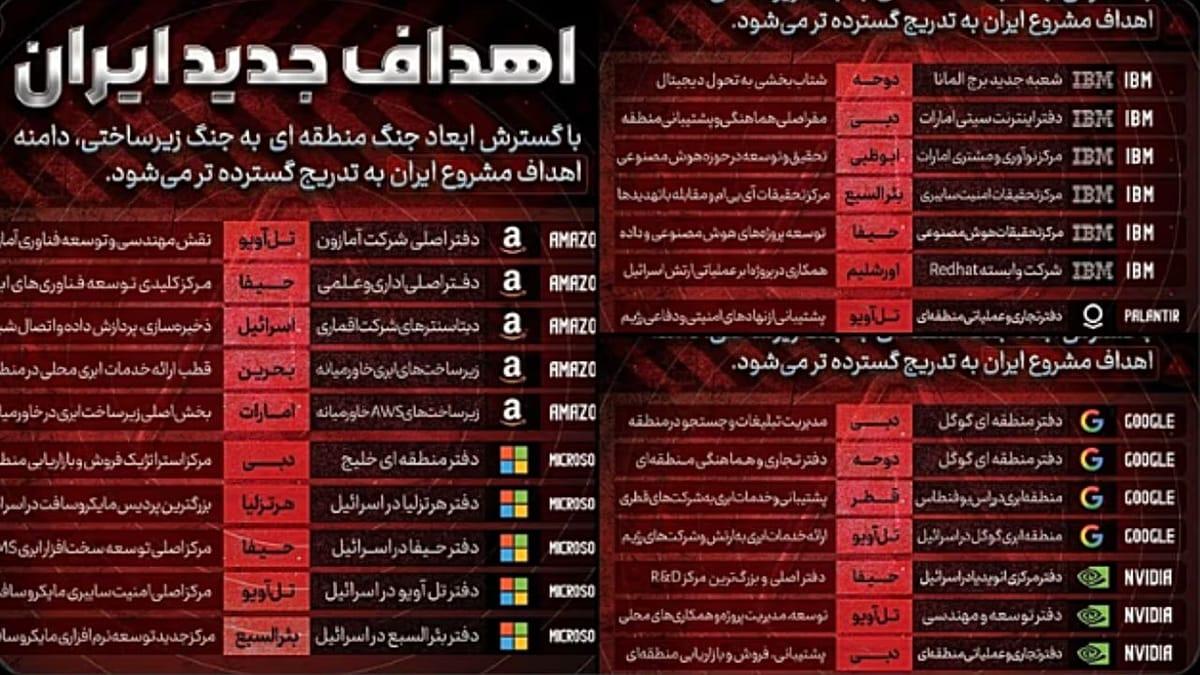
A new warning in Farsi from the country's Islamic Revolutionary Guard Corps account says they will be targeting 17 American tech companies, including Microsoft, Apple, Google, Meta, Nvidia and Palantir. Iran's Islamic Revolutionary Guard Corps has warned it will target American technology companies in the Middle East as of April 1. The list of targets includes 17 American companies: Cisco, HP, Intel, Oracle, Microsoft, Apple, Google, Meta, IBM, Dell, Palantir, Nvidia, J.P. Morgan Chase, Tesla, GE, Spire Solution, Boeing, according to a Telegram post from the IRGC. The Emirati company G42 is also listed. American information and artificial intelligence (AI) companies are "the main element" in designing and tracking the "terrorist operations" that the United States has conducted against Iran, the Islamic Revolutionary Guard Corps (IRGC) said. "We will target American technology companies for every assassination in Iran," the post, originally written in Farsi, reads. "You ignored our repeated warnings about the need to stop terrorist operations ... from now on the main institutions effective in terrorist operations will be our legitimate targets," it added. Tech employees are to leave their workplaces "immediately to save their lives," the IRGC said. Euronews Next contacted the 18 companies listed in this latest IRGC message but did not receive an immediate reply. Previous messages said Big Tech is 'enemy technology infrastructure' The post comes a few weeks after Tasnim, an Iranian news agency with ties to the IRGC, posted a list of 30 locations throughout the Middle East of Big Tech bases that would be Iran's "new targets in the region." The message claimed that these sites have been identified as "enemy technology infrastructure." Several locations highlighted by Tasnim were in Dubai, United Arab Emirates (UAE), and in Tel Aviv, Israel. In Tel Aviv, the list includes the main offices of defence technology company Palantir, as well as offices belonging to Amazon and Microsoft, along with Nvidia's engineering and development centre. According to the post, most locations were selected due to their involvement in developing artificial intelligence (AI) systems or because they coordinate cloud computing services across the Middle East. Two of Amazon's data centres in the UAE, another target on the list, were hit on March 1. A third data centre in Bahrain was damaged after it was hit by falling debris from another attack site. The IRGC previously claimed responsibility for the attacks, telling state media that the attacks were aimed at identifying the role of these centres in supporting the enemy's military and intelligence activities. Offices targeted due to military links Four offices belonging to Oracle, IBM, and Google in Jerusalem, Tel Aviv, and Abu Dhabi were singled out because they allegedly provide infrastructure for "military entities," the post said. Amazon and Alphabet, Google's parent company, were awarded a $1.2 billion (€1 billion) contract in 2021 from the Israeli government to work on Project Nimbus, which provided Israel with "core tech infrastructure," according to a 2025 report from UN rapporteur Francesca Albanese on the situation of human rights in occupied Palestine. These companies and Microsoft grant Israel "virtually government-wide access to their cloud and AI technologies," Albanese's report read. The report also claims that IBM has trained Israeli military and intelligence personnel and that there is "reasonable ground" to believe that Palantir provided automatic predictive policing technology to the Israeli government to process data and generate lists of targets in Palestine. Oracle was not mentioned in Albanese's report. However, media research organisation The Middle East Monitor reported that executives at the company pushed to embed a "love for Israel" in American culture. The US Department of War also recently awarded the company an $88 million (€74.4 million) contract to integrate its cloud computing software with the US Air Force.
Share
Share
Copy Link
Iran's Islamic Revolutionary Guard Corps has issued direct threats against major US tech companies operating in the Middle East, warning of imminent attacks on AI data centers including the $30 billion Stargate facility in Abu Dhabi. The escalation follows earlier strikes on Amazon Web Services infrastructure and marks a dangerous shift toward targeting billions in commercial tech assets.
Iran threats against US tech companies have escalated dramatically as the Islamic Revolutionary Guard Corps (IRGC) warned it will begin targeting American commercial infrastructure across the Middle East. The military force issued a specific deadline, stating attacks would commence after 8 pm on April 1 in Tehran, and named 18 companies including Apple, Google, Microsoft, Oracle, Nvidia, Intel, Palantir, Tesla, Boeing, Dell, Cisco, IBM, Meta, and HP
2
. The IRGC urged employees of these tech companies in the Middle East to evacuate immediately and warned civilians to stay away from their facilities4
.
Source: Euronews
The threats represent retaliation for killing of Iranian citizens in the ongoing conflict with the US and Israel, which began in late February. According to the IRGC, these US tech companies are "legitimate targets" responsible for providing technology that enabled joint US-Israeli attacks, including the assassination of Supreme Leader Ali Khamenei
2
. Approximately 2,000 Iranians have been killed since the conflict began, along with at least 13 US service members2
.The most dramatic Iran threats focused on the Stargate AI data center in Abu Dhabi, a $30 billion facility backed by OpenAI, Oracle, Nvidia, Cisco, UAE's G42, and SoftBank
5
. The IRGC released a video showing a space shot zooming into Abu Dhabi on Google Maps, revealing the facility's location with the message "nothing stays hidden to our sight, though hidden by Google"1
. The video prominently featured photos of CEOs including Jensen Huang, Sam Altman, and Satya Nadella5
.Source: TechSpot
Brigadier General Ebrahim Zolfaghari stated the IRGC would pursue "complete and utter annihilation" of power plants, energy infrastructure, and IT facilities belonging to Israel and companies with American shareholders if the US attacks Iran's power infrastructure
5
. The Stargate project, announced in May 2025, represents a 1GW AI cluster with the first 200MW expected online in 2026, potentially housing roughly 100,000 Nvidia chips including Grace Blackwell GB300 systems5
. The facility sits within a planned 10-square-mile UAE-US AI campus that could eventually reach 5GW capacity5
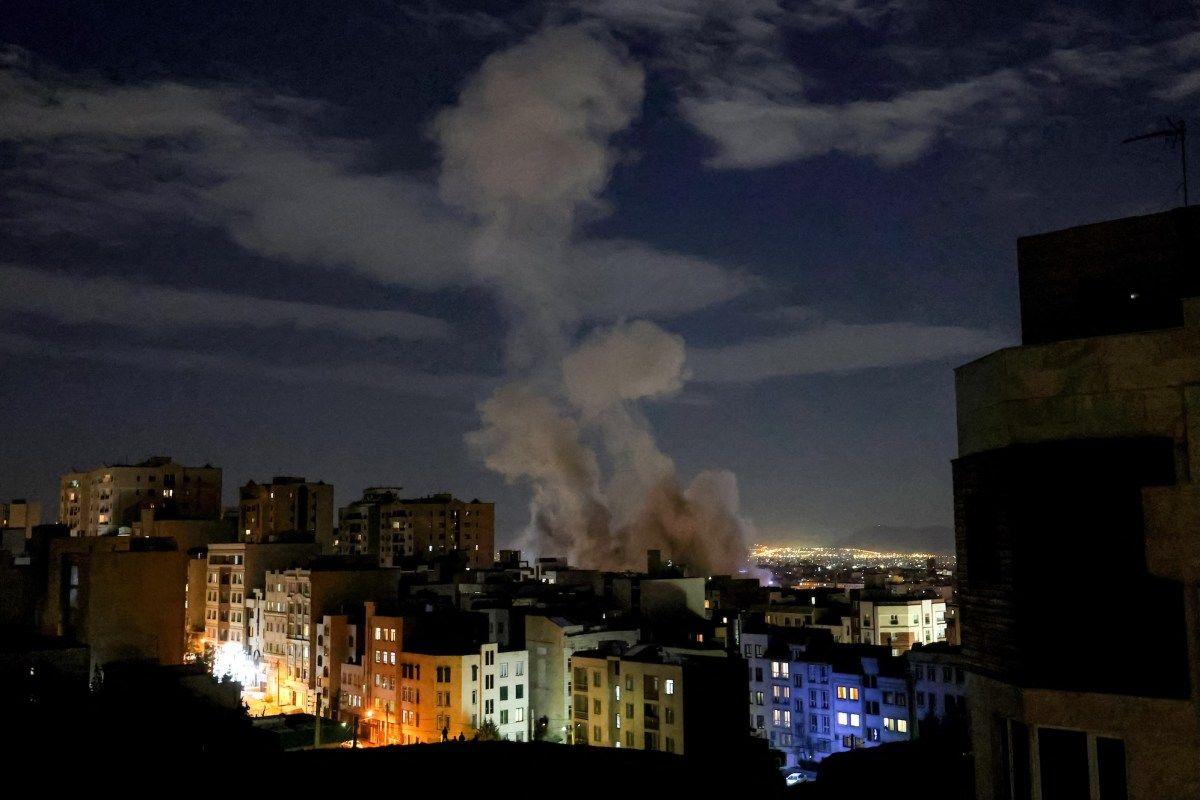
.Iran threats to attack US tech firms come after actual strikes on data centers have already occurred. Iranian drones struck two Amazon Web Services data centers in the United Arab Emirates and Bahrain on March 1, marking the first publicly confirmed attack on American-owned hyperscale cloud infrastructure
2
. Banking sites, payment processors, and consumer services across the region crashed as redundancies meant to prevent outages were taken offline2
.
Source: TechCrunch
The IRGC claimed it hit an Oracle data center in Dubai and an Amazon facility in Bahrain, though Dubai authorities quickly denied the report
3
. Bahrain's Ministry of Interior confirmed an Iranian strike set "a facility of a company" on fire, identified as Batelco, the country's largest telecommunications company that hosts infrastructure for Amazon Web Services3
. A Bellingcat investigation suggests not all attacks are intercepted and official damage reports may not fully reflect actual impacts3
.The shift toward targeting tech infrastructure represents a calculated strategy. Hitting AI data centers equipped with cutting-edge hardware causes dramatically more financial damage than traditional military targets. An Nvidia NVL72 GB300 system can cost as much as $6 million, meaning a data center hosting 50,000 Blackwell processors contains hardware worth $4.16 billion
3
. Including networking, storage, racks, power delivery, cooling, and building infrastructure could push total costs to $6.24 billion for a single facility .Billions of dollars in US technology and infrastructure are concentrated in the Gulf, where American tech giants have invested heavily in the region becoming the next hub for AI development
2
. The IRGC published a list of 29 regional offices and data centers operated by major firms such as Amazon, Google, IBM, Nvidia, and Palantir earlier this month, accusing them of supporting US military and intelligence activities2
.Related Stories
The threats highlight the US military's reliance on commercial vendors with operations in the region. Palantir builds the data architecture for Project Maven, a Pentagon artificial intelligence program that processes drone and satellite imagery to identify air-strike targets, and maintains a corporate office in Abu Dhabi
2
. The US reportedly used Anthropic's AI in its initial airstrikes against Iran at the onset of the war in late February4
.Oracle has cloud and artificial intelligence contracts with the US Department of Defense, and its chairman Larry Ellison has longstanding ties with Israel, factors cited in the IRGC's accusations
3
. The US military responded throughout March by bombing IRGC drone networks and releasing footage of air strikes destroying mobile launchers, though the aerial campaign has slowed as the US temporarily paused strikes to explore potential peace talks2
.The conflict has spread across the region, with Iranian retaliatory strikes hitting targets in Israel, Gulf states, and Iraq. The Strait of Hormuz has remained effectively closed for weeks due to Iran threats, disrupting shipments of oil and other goods globally
2
. President Trump threatened to strike Iran's civilian infrastructure, including power plants and water desalination plants, if Iran doesn't reopen the critical shipping channel1
.The Pentagon is reportedly considering deploying up to 10,000 additional troops to the Middle East to expand options ahead of a possible ground invasion
2
. For tech companies, the escalation raises urgent questions about the viability of massive infrastructure investments in geopolitically volatile regions. The concentration of AI data centers in Dubai, Bahrain, and Abu Dhabi—once seen as strategic advantages—now represents potential vulnerabilities as cloud infrastructure becomes entangled in military conflicts.Summarized by
Navi
[1]
[3]
08 Mar 2026•Business and Economy

11 Mar 2026•Technology

23 May 2025•Technology

1
Policy and Regulation

2
Policy and Regulation

3
Technology




