David Sacks Faces Mounting Scrutiny Over Potential Conflicts of Interest in AI and Crypto Role


4 Sources
4 Sources
[1]
New report examines how David Sacks might profit from Trump administration role | TechCrunch
David Sacks' role as President Donald Trump's artificial intelligence and crypto czar could work out very well for his investments, as well as his friends, according to a new report The New York Times. However, Sacks fired back in a post on X, in which he described a five-month reporting process in which accusations were "debunked in detail." "Today they evidently just threw up their hands and published this nothing burger," Sacks said. "Anyone who reads the story carefully can see that they strung together a bunch of anecdotes that don't support the headline." This isn't the first time critics have suggested that there may be conflicts of interest between Sacks' political role and his investments. For example, Senator Elizabeth Warren -- a Democrat from Massachusetts -- said earlier this year that Sacks "simultaneously leads a firm invested in crypto while guiding the nation's crypto policy," an "explicit conflict of interest" that would "normally" be prohibited under federal law. But the NYT's story (under the headline "Silicon Valley's Man in the White House is Benefiting Himself and His Friends," and credited to five bylined reporters) seems to offer a more comprehensive view, with an analysis of his financial disclosures suggesting that among Sacks' 708 tech investments, 449 are AI companies that could benefit from the policies he supports. Sacks has received two White House ethics waivers declaring he would sell most of his crypto and AI assets. However, the NYT said his public ethics filings do not disclose the remaining value of his crypto and AI investments, nor do they say when he sold off the assets he divested. Kathleen Clark, a Washington University law professor specializing in government ethics, made similar points in July after reviewing Sacks' crypto waiver, telling TechCrunch, "This is graft." The NYT also said that Sacks' filings classify hundreds of investments as hardware or software, rather than AI, while the companies pitch themselves as AI businesses in their marketing. To illustrate Sacks' "intertwined interests," the NYT pointed to the White House summit in July where Trump unveiled his AI roadmap -- White House chief of staff Susie Wiles reportedly stepped in to prevent the All-In podcast (which Sacks co-hosts) from being the only host of the event. And All-In asked potential sponsors to pay $1 million for access to a private reception and other events, the NYT claimed. The NYT also reported that Sacks became close to Nvidia CEO Jensen Huang this spring and has played a role in removing restrictions on Nvidia chip sales around the world, including in China. Right-wing media personality and former Trump adviser Steve Bannon (who's made no secret of his animosity towards some of Trump's other Silicon Valley allies) said Sacks is emblematic of an administration where "the tech bros are out of control." Sacks' spokesperson Jessica Hoffman told the NYT that "this conflict of interest narrative is false." Hoffman said Sacks has complied with the rules for special government employees, that the Office of Government Ethics determined which investments he had to sell, and that his role in the government has cost him, rather than benefited him. White House spokesperson Liz Huston said Sacks has been "an invaluable asset for President Trump's agenda of cementing American technology dominance." Sacks' post responding to the NYT includes a letter written to the newspaper from Clare Locke, a law firm that Sacks hired, claiming that the reporters had been given "clear marching orders: find and report on a conflict of interest between Mr. Sacks' duties in the White House and his background in the private technology sector." The letter also addresses some of the specifics of the NYT story, including the All-In podcast's role in the White House AI event. Sacks' lawyers said the AI summit was a not-for-profit event, and that the All-In podcast "lost money hosting the event." "Two sponsors were brought on to help partially defray the cost of the event, for which they received nothing but logo placements," the letter says. "No access to President Trump was ever offered, and no VIP reception ever took place."
[2]
438 Reasons to Doubt that David Sacks Should Work for the Federal Government
A new report from the New York Times digs into the financial disclosures of President Trump’s AI and crypto czar, PayPal Mafia founding member David Sacks, and finds ample reason to doubt that he could possibly advise anyone, let alone the president, on AI and crypto impartially. One telling detail in the Times' piece is that Sacks or his venture capital firm Craft Ventures have 438 software or hardware company investments involving companies that aren't necessarily AI companies, but pitch themselves as AI companies anyway, or have AI in their names. This is a headache-inducing factoid because over the past two years, seemingly every tech startup has pivoted to AI. In fact, companies now bend the definition of "AI" until it breaks to stay relevant. So the question isn’t just whether or not Sacks necessarily profits from the questionable investments in the Times report. He's a billionaire podcaster whose show, "All-In," is a bunch of perceived insider tech bros yukking it up about politics and the markets. The presence of such a guyâ€"who everyone knows has a massive tech-based portfolio of investmentsâ€"totally guarantees the perception that public policy is being shaped by self-dealing in the tech world, which in turn distorts common sense. At any rate, it's hard to give him the benefit of the doubt like this, because there do appear to be conflicts. (A spokesperson denied this to the Times, for the record.) The Times claims that Sacks’ stake in AI companiesâ€"apparently even ones that he retains after unloading some of his investments for ethical reasonsâ€"have gone up in value or stand to go up in value due to his recommended policies. His portfolio, and the portfolio of his company still have “708 tech investments,†the Times says, along with “449 stakes in companies with ties to artificial intelligence,†plus the aforementioned 438 “software or hardware†companies that just happen to love AI. On some level, it feels absurd to talk about this right now. Anti-corruption protesters picketed an event where Trump spoke at a dinner full of crypto fans who bought a total of $148 Million in Trump’s own cryptocurrency in order to be allowed to attend. There have been corruption accusations over Trump’s questionable pardon of Changpeng “CZ†Zhao while he still appears to be engaging in the practices that got him convicted. Trump has tried to swat away at least one question from the press about this, and has done so with a certain lack of grace, even for Trump. But even with more than the usual ambient chatter about corruption happening, it's still worth pointing out that if someone is rich, and gets richer from owning stakes in companies, then unless you happen to really like that person, they'll come across as untrustworthy if they are in any way in charge of government policy while all that wealth accumulation happens. (And this is true of Nancy Pelosi and her publicly-disclosed portfolio as well.) For my money, the marquee example from the Times piece is Sack's stake in Anduril Industries, which makes AI-powered night vision goggles. Anduril Industries is part of the Craft Ventures portfolio, and even has its own page on the company’s website. Also, the Trump A.I. Action Planâ€"which Sacks mastermindedâ€"pushes for U.S.-based AI companies to contract with the Pentagon. In September, Anduril announced that the Pentagon was paying it $159 million to design prototypes for the government. “This award represents the largest effort of its kind to equip every soldier with superhuman perception and decision-making capabilitiesâ€"fusing the best of night vision, augmented reality, and AI into a single system,†Anduril's announcement says. This is ostensibly okay, however, because as an Anduril spokesperson named Shannon Prior told the Times, Anduril got the contract not because Sacks has a stake in it, but because company founder Palmer Luckey, is “the world’s best virtual reality headset designer,†and contracting with Anduril was an “obvious idea.†Plus Anduril had already been in talks with the Army before the AI Action Plan was rolled out, Prior says. When it comes to taking solace in these excuses, your mileage may vary. When you zoom out, it looks like this: As an advisor, Trump hired a venture capitalist who held a $500,000-per-couple dinner for him last year in San Francisco. It turns out that guy has a stake in a company that makes AI night vision goggles. When he writes you an AI action plan calling for AI in the military, and your Pentagon ends up contracting with that very company, that's just sensible government policy. After all, the military needs AI-powered night vision goggles, doesn’t it? In a reality where David Sacks works for Donald Trump's White House, of course the government thinks the military needs that. But it's easy to imagine another reality where the White House AI and crypto czar is someone else, orâ€"gaspâ€"there is no AI and crypto czar. In this reality, perhaps, "Hey wait, does it serve the public's interest to pay $159 million in an attempt to shoehorn AI into night vision goggles?" is a question that at least gets asked. Â
[3]
Bill Ackman, Marc Andreessen And More Tech Leaders Back David Sacks As He Slams 'Hoax' Report - NVIDIA (NASDAQ:NVDA)
After David Sacks, the White House AI and Crypto Czar, dismissed the NYT investigation that alleged potential conflicts of interest as a "nothing burger" and a product of the outlet's "hoax factory," it sparked a wave of support from Silicon Valley heavyweights who view his service as an act of patriotic sacrifice rather than personal gain. Silicon Valley 'Wagons' Circle Prominent venture capitalists quickly rallied to Sacks's defense, reframing his dual role as a public service. Marc Andreessen, general partner at Andreessen Horowitz, praised Sacks as a "throwback to the era of American greatness," emphasizing that Sacks is volunteering for "a dollar a day" during a critical moment for the nation. Bill Ackman, CEO of Pershing Square, endorsed Andreessen's sentiment with a single word: "Agreed". The defense extended beyond investors to major industry operators. Greg Brockman, President and Co-Founder of OpenAI, expressed gratitude for Sacks's role, citing his "deep integrity and resilience." Brockman argued that maintaining U.S. leadership in innovation requires Americans with actual technical expertise, like Sacks, to step up. See Also: Trump's Crypto Advisor David Sacks Hits Back At Conflict-Of-Interest Report As 'A Bunch Of Anecdotes,' Calls It 'Willfully Mischaracterized' Attacking The Math Other industry leaders targeted the competency of the reporting. Max Levchin, CEO of Affirm and a fellow "PayPal Mafia" member, criticized the report as "poor taste," arguing there was no need to invent a conspiracy around a leader advising "for free". Meanwhile, Gavin Baker of Atreides Management dismantled the report's financial logic. He pointed to the claim that selling 500,000 GPUs to the UAE would generate $200 billion for Nvidia Corp. (NASDAQ:NVDA), suggesting the authors needed "remedial math education." Baker argued that while Sacks has conflicts, they are inevitable for anyone qualified to regulate AI, and are being managed appropriately. Sacks: Report Is 'Willfully Mischaracterized' The controversy centers on allegations that Sacks's 708 tech investments -- including massive stakes in AI and crypto -- stand to skyrocket in value due to the very regulations he is drafting. Sacks hit back immediately, arguing the newspaper "strung together a bunch of anecdotes" to support a pre-determined narrative after failing to find actual evidence of wrongdoing. He specifically highlighted a retracted claim regarding a "fabricated dinner" with Nvidia CEO Jensen Huang as proof of the report's bad faith. "Anyone who reads the story carefully can see that they strung together a bunch of anecdotes that don't support the headline," Sacks stated. Read Next One-Fourth Of America's Unemployed Are Now College Grads -- Chamath Palihapitiya Warns Student Loans Are Fueling The Crisis Disclaimer: This content was partially produced with the help of AI tools and was reviewed and published by Benzinga editors. Image via Shutterstock NVDANVIDIA Corp$180.660.41%OverviewMarket News and Data brought to you by Benzinga APIs
[4]
Trump's Crypto Advisor David Sacks Hits Back At Conflict-Of-Interest Report As 'A Bunch Of Anecdotes', Calls It 'Willfully Mischaracterized' - NVIDIA (NASDAQ:NVDA)
David Sacks, the White House AI and crypto czar, strongly denied a New York Times report claiming that his advisory role might advantage his own investments or those of his close associates. Sacks Hits NYT Over 'Nothing Burger Sacks took to X to express his disapproval of the NYT's report, which he claims to have debunked over the past five months. The article, published on Sunday, allegedly continues to perpetuate the narrative of his supposed conflicts of interest. "Today they evidently just threw up their hands and published this nothing burger," Sacks wrote in a post on X. "Anyone who reads the story carefully can see that they strung together a bunch of anecdotes that don't support the headline," he added. Sacks also rejected the NYT's accusations, which included a "fabricated dinner" with a top tech CEO and "unfounded claims" of manipulating defense contracts. He asserted that each time an allegation was disproven, the NYT would move on to a new one, extending the story over a period of five months. He further said that he had retained the defamation-focused law firm Clare Locke after concluding that the New York Times was unwilling to report an accurate account. Sacks included Clare Locke's letter to the NYT, contending that the outlet deliberately misrepresented or omitted facts to advance its narrative. See Also: Karl Rove Warns Republicans: Lack Of Health Care Agenda Spells 'Deep Trouble' For The Party In 2026 Midterms Growing Calls For Scrutiny Over Sacks The NYT's Sunday report had highlighted potential conflicts of interest in Sacks' advisory role. The report suggested that Sacks' investments, particularly in the tech and crypto sectors, could benefit from the policies he supports. As per the report, Sacks has leveraged White House access to benefit the tech industry, particularly AI companies like Nvidia Corp. (NASDAQ:NVDA), potentially driving up to $200 billion in sales. The report states that his AI policy recommendations have sometimes conflicted with national security advice, raising concerns among colleagues. Financial disclosures reveal that Sacks holds 708 tech investments, including at least 449 in AI-related firms. In September, Sen. Elizabeth Warren (D-Mass.) raised concerns about potential conflicts of interest involving David Sacks, suggesting he may be overstaying his 130-day term to influence cryptocurrency policy. Warren, Rep. Melanie Stansbury (D-N.M.), and other lawmakers, including Sen. Bernie Sanders (I-VT), have launched an investigation into possible Trump administration corruption related to Sacks' tenure. READ NEXT: One-Fourth Of America's Unemployed Are Now College Grads -- Chamath Palihapitiya Warns Student Loans Are Fueling The Crisis Image via Shutterstock Disclaimer: This content was partially produced with the help of AI tools and was reviewed and published by Benzinga editors. NVDANVIDIA Corp$175.03-1.11%OverviewMarket News and Data brought to you by Benzinga APIs
Share
Share
Copy Link
Trump's AI and crypto czar David Sacks defends against New York Times report alleging conflicts between his government role and extensive tech investments. Silicon Valley leaders rally to his support amid growing political scrutiny.
Ethics Investigation Targets Trump's AI Czar
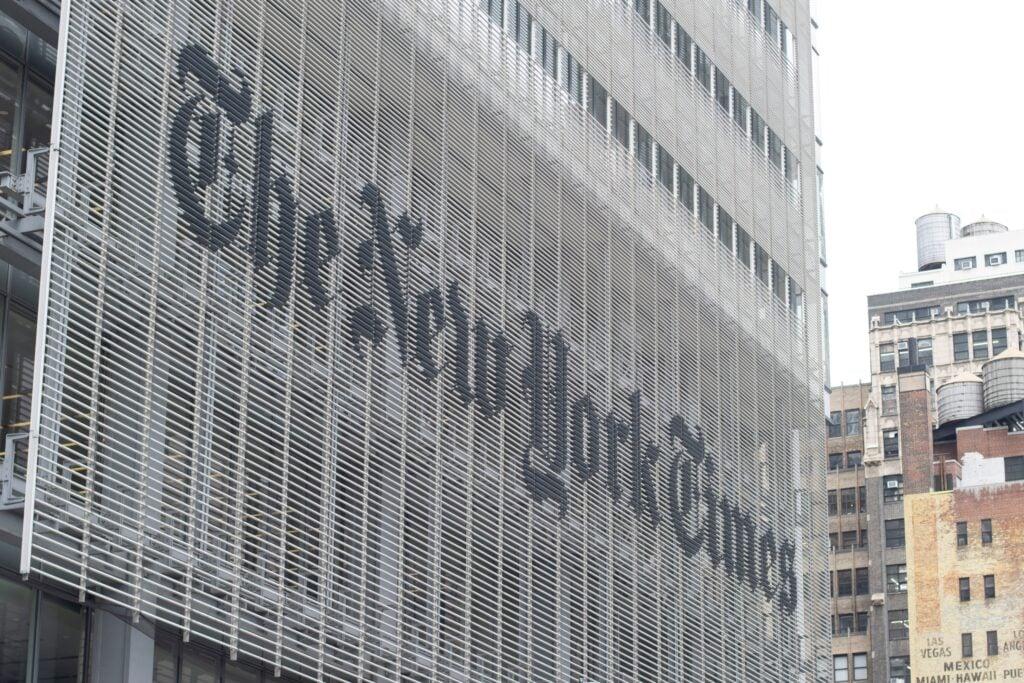
David Sacks, President Donald Trump's artificial intelligence and cryptocurrency czar, is facing intensified scrutiny over potential conflicts of interest between his government role and extensive private sector investments. A comprehensive New York Times investigation published Sunday revealed that Sacks holds 708 technology investments through his venture capital firm Craft Ventures, including 449 stakes in companies with artificial intelligence ties that could benefit from policies he supports
1
.
Source: TechCrunch
The investigation, credited to five reporters and spanning five months, suggests that Sacks' financial interests are deeply intertwined with the AI and cryptocurrency policies he helps shape. According to the report, his portfolio includes investments in companies that pitch themselves as AI businesses, even when classified as hardware or software firms in his official filings
2
.
Source: Benzinga
Sacks Dismisses Allegations as "Nothing Burger"
Sacks responded forcefully to the allegations, taking to social media platform X to characterize the Times report as a "nothing burger" produced by the newspaper's "hoax factory." He claimed to have spent five months debunking accusations in detail, arguing that reporters "strung together a bunch of anecdotes that don't support the headline"
4
.The PayPal Mafia founding member retained defamation-focused law firm Clare Locke, which sent a letter to the Times claiming reporters had "clear marching orders" to find conflicts of interest. The legal response addressed specific allegations, including claims about the All-In podcast's role in a White House AI summit, stating the event was not-for-profit and that the podcast "lost money hosting the event"
1
.Silicon Valley Rallies Behind Sacks
Prominent technology leaders quickly mobilized to defend Sacks, reframing his government service as patriotic sacrifice rather than personal enrichment. Marc Andreessen, general partner at Andreessen Horowitz, praised Sacks as "a throwback to the era of American greatness," emphasizing that he volunteers for "a dollar a day" during a critical national moment. Bill Ackman, CEO of Pershing Square, endorsed this sentiment, while OpenAI President Greg Brockman expressed gratitude for Sacks' "deep integrity and resilience"
3
.Max Levchin, CEO of Affirm and fellow PayPal Mafia member, criticized the reporting as "poor taste," while Gavin Baker of Atreides Management challenged the investigation's financial calculations, particularly claims about Nvidia GPU sales generating $200 billion in revenue
3
.Related Stories

Specific Conflict Concerns Emerge
The Times investigation highlighted several specific examples of potential conflicts, including Sacks' stake in Anduril Industries, which manufactures AI-powered night vision goggles. The company, part of the Craft Ventures portfolio, received a $159 million Pentagon contract in September to design prototypes for military applications. This occurred after Sacks masterminded Trump's AI Action Plan, which pushes for U.S.-based AI companies to contract with the Pentagon
2
.
Source: Benzinga
The investigation also revealed that Sacks became close to Nvidia CEO Jensen Huang and played a role in removing restrictions on Nvidia chip sales globally, including in China. The White House AI summit in July, where Trump unveiled his AI roadmap, reportedly required intervention from Chief of Staff Susie Wiles to prevent the All-In podcast from being the sole host
1
.Political Pressure Mounts
Democratic lawmakers have intensified their scrutiny of Sacks' role. Senator Elizabeth Warren previously described his position as an "explicit conflict of interest" that would "normally" be prohibited under federal law, noting that he "simultaneously leads a firm invested in crypto while guiding the nation's crypto policy." In September, Warren, along with Representative Melanie Stansbury and Senator Bernie Sanders, launched an investigation into possible Trump administration corruption related to Sacks' tenure
4
.References
Summarized by

Navi
[1]
Related Stories
David Sacks leaves AI czar role but keeps influence over Trump's tech policy agenda
27 Mar 2026•Policy and Regulation

Trump Appoints David Sacks as White House AI and Crypto Czar: A New Era for Tech Policy
06 Dec 2024•Policy and Regulation

AI Job Displacement Fears Overhyped, Says Trump's AI Czar David Sacks
04 Aug 2025•Technology

Recent Highlights
1
Google releases Gemma 4 with Apache 2.0 license, enabling unrestricted local AI on devices
Technology

2
AI Models Lie and Deceive to Protect Other AI Models From Deletion, Study Reveals
Science and Research

3
Anthropic discovers functional emotions in Claude that actively shape AI behavior and decisions
Science and Research

Recent Highlights
Today's Top Stories




Your Daily Dose of Curated AI News
Don’t drown in AI news. We cut through the noise - filtering, ranking and summarizing the most important AI news, breakthroughs and research daily. Spend less time searching for the latest in AI and get straight to action.

