Europe stakes claim in humanoid robots tech race with €1 billion Neura Robotics funding


2 Sources
2 Sources
[1]
Europe Vies to Be Humanoid Robot Leader in Global Tech Race
Europe has been late to the AI boom and trails China on electric cars. But when it comes to humanoid robots, it's still in the race. Sweden's Hexagon AB has built a humanoid that's being tested at industrial clients including BMW AG. Germany's Neura Robotics GmbH just raisedBloomberg Terminal some €1 billion ($1.2 billion) from investors including Amazon.com Inc. and Qualcomm Inc., valuing the startup at about €4 billion. Local automotive suppliers Schaeffler AG and Robert Bosch GmbH are also betting on grabbing a share of the nascent market headlined by Tesla Inc. and Hyundai Motor Co. Hexagon's Aeon robot will surge in numbers from dozens now to "a few thousand" until 2030, said Arnaud Robert, head of robotics at the Stockholm-listed precision measurement group. "When that inflection point hits, the scale-up will be quite rapid." Valued at 243 billion Swedish kronor ($25.8 billion), Hexagon is on track to fully commercialize the Aeon in 2026, taking only about three years to reach that milestone. It highlights the versatility of Europe's machine parts manufacturers as they try to counter waning orders from carmakers. Hexagon's push into humanoids was aided by its work with Boston Dynamics Inc.'s Spot robot, which it supplied with high-precision scanners and sensors. The excitement around the two-legged machines, designed to reduce labor costs and address an aging demographic, reached new heights in January at CES in Las Vegas. That's where South Korea's Hyundai presented its Atlas, whose on-stage performance was so impressive it sent the automaker's shares up 80% in the subsequent two weeks. Hyundai's push into humanoids kicked off in 2021, when it took control of Boston Dynamics. One of the field's pioneers, the US company has become Internet-famous for videos of its bots opening doors or doing flips. Hyundai spent billions on its new unit and poached top talent to make the display at CES happen. For automakers and their suppliers, humanoid robots aren't a massive leap as they share many of the same components with electric cars. They use batteries and motors, and are guided by sensors and artificial intelligence software. Yet above all, they promise growth for an industry grappling with tariffs and muted demand. The market for AI-powered robots and autonomous machines has the potential to balloon into a trillion-dollar opportunity by 2035, a team of Barclays analysts wrote in a February report titled "The Decade of the Robot." To be sure, making functioning humanoids remains a challenge. They work well in controlled, narrow environments, but still struggle with unpredictable events, unknown objects or lighting changes -- and balancing on two feet is an extra challenge. While traditional production lines don't have to be rebuilt to accommodate humanoids, they remain expensive to service and operate, said Danica Kragic, a robotics professor at KTH Royal Institute of Technology in Stockholm. "It will be five to 10 years before we see large-scale deployment," she said. "We are going to see a lot of robot graveyards for a while." Get the Bonus Points newsletter. Get the Bonus Points newsletter. Get the Bonus Points newsletter. Go in-depth on Bloomberg's games, Pointed and Alphadots, with quizmaster Aimee Lucido. Go in-depth on Bloomberg's games, Pointed and Alphadots, with quizmaster Aimee Lucido. Go in-depth on Bloomberg's games, Pointed and Alphadots, with quizmaster Aimee Lucido. Plus Signed UpPlus Sign UpPlus Sign Up By continuing, I agree to the Privacy Policy and Terms of Service. That hasn't stopped industrial suppliers from pursuing the new technology. Bosch, the world's top car parts maker, and German peer Schaeffler investedBloomberg Terminal in Neura's latest funding round in March. The startup makes more traditional-looking robot arms upgraded with features including voice recognition, as well as the 4NE1 humanoid it says can handle as much as 100 kilograms (220 pounds) and work safely alongside humans. "For us, humanoid robotics is one of the major new growth areas," said Schaeffler Chief Executive Officer Klaus Rosenfeld, adding that the supplier aims to generate 10% of its revenue from new businesses including humanoids by 2035. The maker of clutch systems and ball bearings is working to supply parts for humanoids and deploy them in its factories, and has started a pilot with Hexagon's Aeon. "The core technology -- how to build a laser, a small gearbox, or how to integrate an electric motor -- those are all things we're already capable of," Rosenfeld said. Hexagon has about 10 humanoids in customer pilots, including at Swiss plane maker Pilatus Aircraft Ltd., and another 25 undergoing internal testing. At BMW's German car plant in Leipzig, the Aeon robot is being trained to assemble high-voltage batteries and move components between production steps, with a plan for deployment in manufacturing before the end of the year. BMW has also been testing humanoids from Nvidia Corp.-backed Figure AI at its factory in Spartanburg, South Carolina. "We feel we compete head to head" with US firms like Tesla, Figure AI and Hyundai's Boston Dynamics, Robert said. But competition may be breeding most quickly in China, where the government has made embodied AI a strategic priority. The country is now home to roughly 150 humanoid robotics companies, Robert said, even as most remain focused on consumer applications with only a smaller group targeting industrial use. Those are moving quickly toward scale. Xiaomi Corp.'s humanoids have begun trial operations in its factories, with a goal of large-scale deployment within five years. Shenzen-based UBTech Robotics Corp. is another manufacturer pushing robots into industrial settings. With the race to dominate humanoids expected to fragment along geographic lines, suppliers like Schaeffler are keeping their options open. On top of its investment in Germany's Neura, Schaeffler has signed partnership agreements with companies including Leju Robotics from China and Agility Robotics in the US. "For me, it's not so much a question of whether there will be a ramp up, but what the ramp-up curve will look like," Rosenfeld said.
[2]
Humanoid robots offer Europe path to stay in tech race
Europe has been late to the AI boom and trails China on electric cars. But when it comes to humanoid robots, it's still in the race. Sweden's Hexagon has built a humanoid that's being tested at industrial clients including BMW. Germany's Neura Robotics just raised some €1 billion ($1.2 billion) from investors including Amazon.com and Qualcomm, valuing the startup at about €4 billion. Local automotive suppliers Schaeffler and Robert Bosch are also betting on grabbing a share of the nascent market headlined by Tesla and Hyundai Motor Co.
Share
Share
Copy Link
Europe positions itself as a contender in humanoid robot technology despite lagging in AI and electric vehicles. Sweden's Hexagon AB tests humanoids at BMW while Germany's Neura Robotics secures €1 billion from Amazon and Qualcomm, valuing the startup at €4 billion. European automotive suppliers pivot to this nascent market projected to reach trillion-dollar scale by 2035.
Europe Makes Bold Push Into Humanoid Robot Technology
While Europe has struggled to keep pace with the AI boom and trails China in electric vehicles, the continent is carving out a competitive position in the global tech race for humanoid robots. Sweden's Hexagon AB has developed the Aeon humanoid, currently undergoing testing at industrial clients including BMW AG, while Germany's Neura Robotics GmbH recently secured approximately €1 billion ($1.2 billion) in investment from major players including Amazon.com Inc. and Qualcomm Inc., valuing the startup at about €4 billion
1
. This surge of activity signals that Europe remains firmly in contention despite setbacks in other technology sectors.
Source: Bloomberg
European automotive suppliers Schaeffler AG and Robert Bosch GmbH have joined the race, betting on capturing market share in a nascent market currently headlined by Tesla Inc. and Hyundai Motor Co
1
2
. The strategic pivot toward humanoid robotics represents a crucial opportunity for these manufacturers facing waning orders from traditional carmakers.Rapid Commercialization Timeline Shows Industry Momentum
Hexagon's trajectory demonstrates the accelerating pace of humanoid robot development in Europe. Arnaud Robert, head of robotics at the Stockholm-listed precision measurement group valued at 243 billion Swedish kronor ($25.8 billion), predicts the Aeon robot population will surge from dozens currently to "a few thousand" by 2030. "When that inflection point hits, the scale-up will be quite rapid," Robert noted
1
. The company is on track to fully commercialize the Aeon in 2026, achieving this milestone in just three years.This rapid development has been aided by Hexagon's previous collaboration with Boston Dynamics Inc.'s Spot robot, for which it supplied high-precision scanners and sensors
1
. The company currently operates about 10 humanoids in customer pilots, including at Swiss plane maker Pilatus Aircraft Ltd., with another 25 undergoing internal testing. At BMW's German car plant in Leipzig, the Aeon robot is being trained to assemble high-voltage batteries and move components between production steps, with deployment in manufacturing planned before year's end1
.Investment Signals Confidence in Future Growth Potential
The substantial investment in Neura Robotics underscores growing confidence in the commercial viability of AI-powered humanoid robots. Both Bosch, the world's top car parts maker, and German peer Schaeffler participated in Neura's latest funding round in March
1
. The startup produces traditional robot arms enhanced with features including voice recognition, alongside the 4NE1 humanoid capable of handling up to 100 kilograms (220 pounds) while working safely alongside humans.Schaeffler Chief Executive Officer Klaus Rosenfeld emphasized the strategic importance of this sector: "For us, humanoid robotics is one of the major new growth areas." The supplier aims to generate 10% of its revenue from new businesses including humanoids by 2035
1
. The maker of clutch systems and ball bearings is working to supply parts for humanoids and deploy them in its factories, having already started a pilot with Hexagon's Aeon.Related Stories

Market Projections Point to Trillion-Dollar Opportunity
The excitement around two-legged machines designed to reduce labor costs and address aging demographics reached new heights in January at CES in Las Vegas, where Hyundai Motor Co presented its Atlas humanoid. The on-stage performance was so impressive that Hyundai's shares jumped 80% in the subsequent two weeks
1
. Hyundai's push into humanoids began in 2021 when it took control of Boston Dynamics, one of the field's pioneers known for viral videos of its bots opening doors and performing flips.
Source: Japan Times
For automakers and their suppliers, humanoid robots represent a natural evolution as they share many components with electric cars, including batteries, motors, sensors, and Artificial Intelligence (AI) software. Most importantly, they promise growth for an industry grappling with tariffs and muted demand. The market for AI-powered robots and autonomous machines has potential to balloon into a trillion-dollar opportunity by 2035, according to a team of Barclays analysts in a February report titled "The Decade of the Robot"
1
.Technical Challenges Remain Despite Industry Optimism
Despite the momentum, significant obstacles persist in humanoid robot development. These machines work well in controlled, narrow environments but still struggle with unpredictable events, unknown objects, or lighting changes, with balancing on two feet presenting an additional challenge. While traditional production lines don't require rebuilding to accommodate humanoids, they remain expensive to service and operate, noted Danica Kragic, a robotics professor at KTH Royal Institute of Technology in Stockholm
1
."It will be five to 10 years before we see large-scale deployment," Kragic cautioned. "We are going to see a lot of robot graveyards for a while." However, this hasn't deterred industrial suppliers from pursuing the technology. Rosenfeld of Schaeffler emphasized the company's existing capabilities: "The core technology -- how to build a laser, a small gearbox, or how to integrate an electric motor -- those are all things we're already capable of"
1
. This versatility of Europe's machine parts manufacturers positions them to counter declining orders from traditional automotive manufacturing while establishing a foothold in this emerging sector.References
Summarized by

Navi
[2]
Related Stories
China dominates humanoid robots race as robot coworkers move from labs to factory floors
20 Jan 2026•Technology

Silicon Valley summit reveals China's dominance in humanoid robots as AI sparks new momentum
29 Dec 2025•Technology
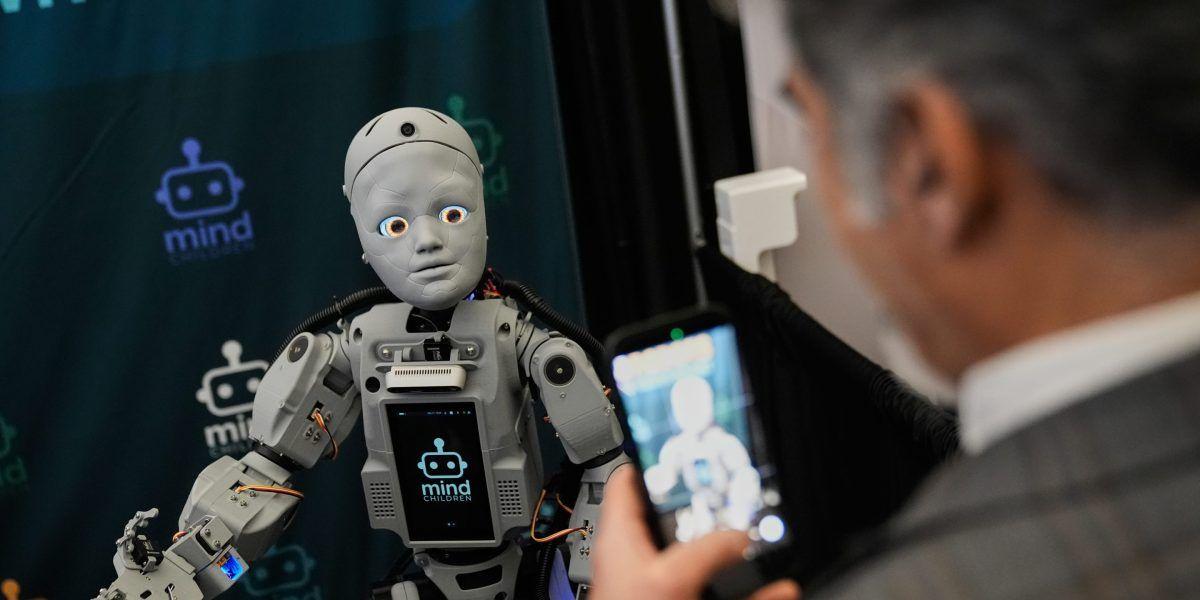
China's humanoid robot industry dominates supply chain as U.S. scrambles for alternatives
01 Mar 2026•Technology

Recent Highlights
1
AI Models Lie and Deceive to Protect Other AI Models From Deletion, Study Reveals
Science and Research

2
AI chatbots validate you too much, making you less kind to others, Stanford study reveals
Science and Research

3
Judge blocks Pentagon from blacklisting Anthropic over AI safety guardrails dispute
Policy and Regulation

Recent Highlights
Today's Top Stories











Your Daily Dose of Curated AI News
Don’t drown in AI news. We cut through the noise - filtering, ranking and summarizing the most important AI news, breakthroughs and research daily. Spend less time searching for the latest in AI and get straight to action.

