Fauna Robotics unveils Sprout, a child-sized humanoid robot designed for homes, not factories


7 Sources
7 Sources
[1]
This Humanoid Is Ready to Bring You a Toothbrush
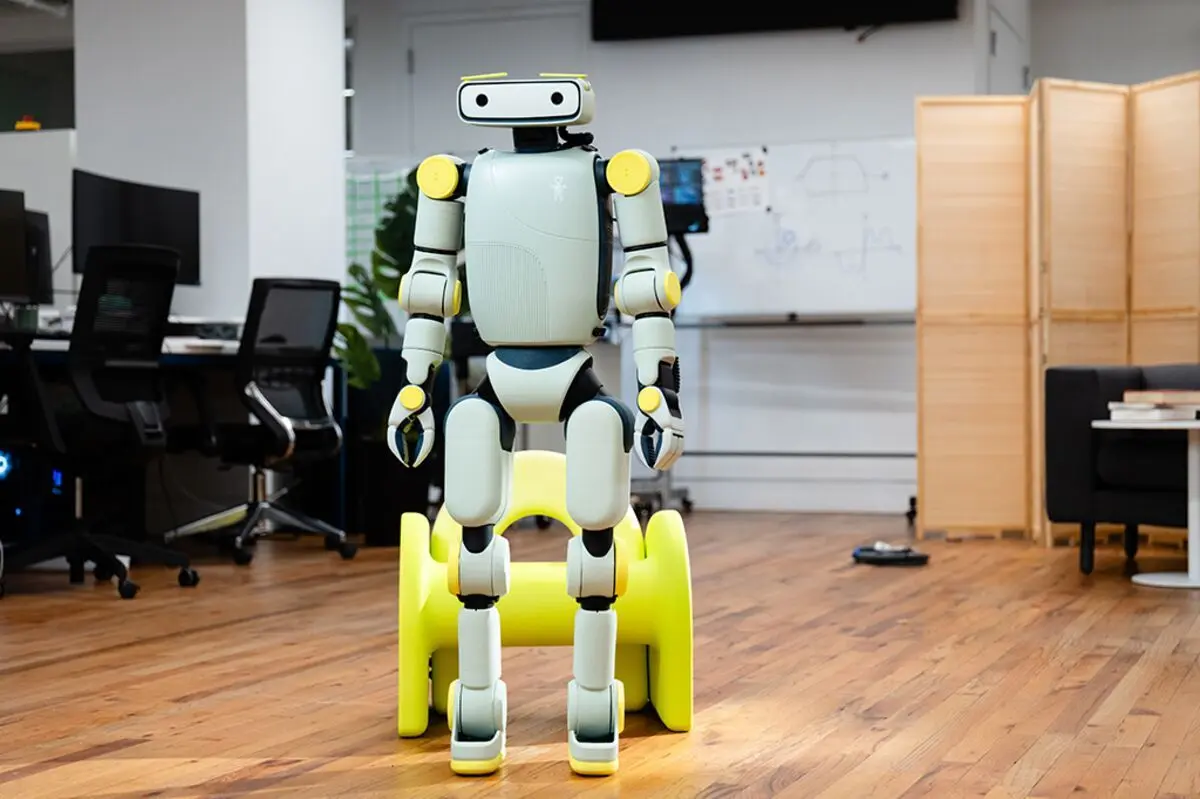
Fauna, a new startup, is betting that humanoid robots will find success as hospitality workers, research assistants, and entertainers. The newest humanoid robot on the scene, Sprout, is not designed to carry boxes or stack shelves. Instead, this charming and relatively cheap model, roughly the size of a 9-year-old child, is meant to help customers in hotels, shops, and restaurants. "We said, 'What if we could build something lightweight, engaging, and safe to be around, and capable enough to do some exciting things?'" says Robert Cochran, cofounder and CEO of Fauna, the startup behind Sprout. Sprout is available to purchase starting today from $50,000. Cochran adds that his firm is already talking to hotels about using Sprout as a butler that brings toothbrushes and other items to guests in need. Sprout's launch is part of a growing industry in the United States. The business of humanoids is booming despite the fact that it's still unclear how practical and useful these systems will be. More than a dozen US companies are working on humanoids, including Boston Dynamics, which recently signed a deal to use Google's AI in its robots; Tesla, which is developing a system called Optimus; and startups like Agility Robotics, Figure AI, and 1X. Unitree, a Chinese robot maker, has also found success selling inexpensive humanoids for entertainment and research purposes. Some of Unitree's humanoids cost less than $20,000. When fully equipped with sensors and computers, however, they cost roughly the same as Sprout. Fauna's first customers include Disney, which already uses robots at some of its theme parks, and Boston Dynamics, which makes a range of legged robots for industrial use, including larger, stronger humanoids. Cochran says that Sprout is designed to be easy to program, making it particularly useful in research settings. The robot comes with software libraries that let it scan its environment, walk autonomously, access language models, and more. The robot can also be teleoperated out of the box, which can be helpful for robot training purposes. Scientists at New York University are using Sprout to research new techniques for robotic manipulation and human-to-robot interaction. The company also says it has developed proprietary technology to help Sprout regain its balance if it stumbles. While most humanoid robots are touted as factory workers, with some already being tested by automakers, Cochran says Fauna believes the first market for robots might be in the entertainment and service industries. Cochran showed me a couple of interfaces for Sprout, including an app that shows the robot's visual perspective and a coding interface that can be used to program the system in real time. Unlike most humanoids, Sprout is designed with human interaction in mind, which is why it comes with mechanical eyebrows to express interest, surprise, or confusion. Cochran previously worked at Meta. Other members of the founding team come from Google. Cochran notes that AI systems that can identify objects, like those being developed for smart glasses, will also be useful for robots tasked with interacting with human environments. At one point during the demo, Cochrane asked Sprout to go and check what was in the fridge. The robot interpreted the command using an LLM and walked over to a corner of the office in a manner not unlike a truculent 9-year-old. After peering through the appliance's glass door, Sprout trundled back to report the existence of several sodas. Cochrane believes this type of capability could help humanoids break through. "You can kind of get a 'Hello World' example of a robot where you can talk to and autonomously map and navigate its environment effectively," he says. "And from there, the world's your oyster."
[2]
Not ready for robots in homes? The maker of a friendly new humanoid thinks it might change your mind
NEW YORK (AP) -- As the new robot called Sprout walks around a Manhattan office, nodding its rectangular head, lifting its windshield wiper-like "eyebrows" and offering to shake your hand with its grippers, it looks nothing like the sleek and intimidating humanoids built by companies like Tesla. Sprout's charm is the point. A 5-year-old child could comfortably talk at eye level with this humanoid, which stands 3.5 feet (1 meter) tall and wears a soft, padded exterior of sage-green foam. Forged by stealth startup Fauna Robotics over two years of secret research and development, Sprout's public debut on Tuesday aims to jump-start a whole new industry of building "approachable" robots for homes, schools and social spaces. The robot is in many ways the first of its kind, at least in the United States, even as rapid advances in artificial intelligence and robot engineering have finally made it possible to start building such machines. If its emotive expressions and blinking lights seem vaguely familiar, it might be from generations of Star Wars droids and other endearingly clunky robotic sidekicks dreamed up in animation studios and children's literature. "Most people in this industry take inspiration from the science fiction that we grew up with," said Fauna Robotics co-founder and CEO Rob Cochran. "I think some do so from 'Westworld' and 'Terminator.' We do from WALL-E and Baymax and Rosie Jetson." Making a business case for robots that won't work in car assembly lines The usual hypothesis for the commercialization of humanoid robots is that they will get their first jobs in warehouses or factories long before they are ready for homes. That's the path proposed for two of today's best-known prototypes: Tesla's Optimus, which CEO Elon Musk sees as the carmaker's future, and Boston Dynamics' Atlas, which parent company Hyundai plans to deploy in car manufacturing by 2028. Fauna looks to skip that step for an entirely different clientele: other robot tinkerers. Much as early personal computers and, later, smartphones sparked a culture of developers designing new games and applications, Sprout is a software developer platform more than just a robot. It's also a mechanically complex one that will cost buyers $50,000. That's a price some university research labs and technology entrepreneurs are already spending on China's Unitree, which sells a lightweight humanoid often seen at robotics conferences and competitions. Others have avoided Chinese hardware due to tariffs and broader security concerns. Cochran believes Fauna is "the first American company to be actively shipping robots as a developer platform" and has been hand-delivering the first models. Early customers include Disney and Boston Dynamics. "You take it out of the box and you can start walking it around immediately," said Marc Theermann, chief strategy officer at Boston Dynamics, in a recent interview. "Seeing their robot for the first time really lets you see the future a little bit. And if you squint, you can see how a robot like that would be welcomed into people's homes." Inside the testing grounds for a 'friendly humanoid' robot Sprout can't lift heavy objects, but it can dance the Twist or the Floss, grab a toy block or teddy bear, or hoist itself from a chair to take a long stroll along the wood floors of Fauna's headquarters in New York City's Flatiron District. Cochran and co-founder Josh Merel, the company's chief technology officer, demonstrated the robot to The Associated Press in mid-January ahead of its public launch. Fauna employees and an AP reporter piloted the robot, using a video game controller, a phone application and a virtual-reality headset. Sprout also knows the office layout enough to be sent on a planned mission, such as to check out the inventory of the break room refrigerator. It walks slowly but steadily on uneven ground. Only once it came close to tripping, taking a sharp turn to avoid a person and instead hitting its foot on a protruding table wheel too low to the ground to be seen by Sprout's camera eyes. But the robot, built to handle what engineers call perturbation, quickly recovered its balance and kept walking, much like a clumsy person might. "If you step in front of it, it won't crash into you, it'll plan a new path around you," said Ana Pervan, a Fauna research scientist who works on the robot's mapping and navigation. Among the first batch of Fauna's 50 employees, and a fan of science fiction writer Isaac Asimov, she previously worked on self-driving cars but was excited about joining a startup building something that might one day serve as a robot butler. "It's cute, and it's not too humanoid, and I think that actually makes it a lot more fun," Pervan said. "It's not verging on creepy or trying to be too human. It's like your buddy, your pal, that's a different thing than you." Why Fauna's founders believe now's the time to bet on humanoids Starting a robot company can be unforgiving, especially one designing personal robots. One of the few successes, Roomba vacuum maker iRobot, had a decades-long run before filing for bankruptcy protection last month. Most others didn't last that long, like Anki, maker of the playful toy robot Cozmo, or Jibo, which went out of business less than a year after its dynamic talking speaker made the cover of Time Magazine's 2017 "best inventions" edition. "There were a lot of really brilliant attempts. I think the technology wasn't quite there," Cochran said. "I do think we're right on the precipice now where you could build a companion that is present, engaging, delightful to be around, and can also move around a space in a way that nothing ever has before." Merel, an expert in robot locomotion, previously worked for Google's DeepMind, where he focused on teaching robots using AI learning techniques in simulated environments, a controversial approach but now increasingly how robots are built. The science journal Nature published his study on an AI-powered virtual rat, co-authored with another of Fauna's research scientists, Diego Aldarondo. Cochran and Merel later worked together at CTRL-labs, a wearable neurotech company sold to Facebook in 2019. Cochran jokes that he then "spent a misguided four years at Goldman Sachs" before they decided to team up again. Improvements in AI, motors and batteries have accelerated humanoid development. But Fauna's founders agreed that the dystopian aesthetic of many prototypes -- what Cochran calls "industrial automotive machismo" -- conveyed strength and confidence but wouldn't work for intimate human spaces. "They were generally quite big and physically dangerous to be around," Cochran said. "Strong, heavy. If they fell on you, it'd be a real problem." The duo brought in Anthony Moschella, who helped design Peloton's exercise bikes, treadmills and rowers and is an admirer of the abstract designs of Star Wars robots like R2-D2 and BB-8. "Let's build a system that human beings actually want to be around," said Moschella, now Fauna's vice president of hardware. "I think it's incredible that so many robotics companies are not versed in the cultural context of what it means to be around a robot." Moschella said what happens next with Sprout will depend on how developers play around with it and what they learn. For Cochran, some of the most important judges have already approved. In a home video he keeps on his phone, his 2-year-old twins excitedly jump up and down as Sprout greets them.
[3]
New York startup builds foam-covered humanoid inspired by WALL-E, not Terminator
Serving tech enthusiasts for over 25 years. TechSpot means tech analysis and advice you can trust. The big picture: In the center of Fauna Robotics' Manhattan workspace, a humanoid around the height of a preschooler walks by, its head tilting slightly, its "eyebrows" moving like gentle windshield wipers. The robot, called Sprout, is unmistakably alive in its motions, but utterly unlike the gleaming humanoids that dominate many factory floors. Wrapped in sage-green foam and standing a modest 3.5 feet tall, Sprout trades raw industrial strength for approachability. Founded in stealth in New York's Flatiron District, Fauna Robotics spent two years building Sprout as a different kind of platform - one that treats robots not as laborers but as companions and collaborators. Its debut this week marks the company's attempt to define a new category of "approachable" humanoids: soft, expressive, and designed to live comfortably among people rather than machines. "Most people in this industry take inspiration from the science fiction that we grew up with," co-founder and CEO Rob Cochran told The Associated Press. "I think some do so from Westworld and Terminator. We do from WALL-E and Baymax and Rosie Jetson." Sprout walks autonomously through offices using simultaneous localization and mapping (SLAM), re-routing to avoid obstacles, and is stable enough to handle unexpected bumps or slips. During demonstrations this month, it used onboard cameras and sensor fusion to navigate a cluttered workspace, recover from a misstep, and resume walking without intervention. The robot isn't made to lift a car door or stack warehouse boxes. Instead, it grips toy blocks, picks up stuffed animals, executes choreographed dances like the Twist or the Floss, and even hoists itself upright from a seated position with small but measurable steps executed with mechanical grace. Behind its cartoonish gestures is serious hardware and research lineage. Fauna's chief technology officer, Josh Merel, previously worked at Google's DeepMind, where he co-authored a study in Nature describing a simulated AI-driven rat designed to model motor control through reinforcement learning. That same philosophy - training systems in physics-based virtual environments before deploying them into real bodies - guides much of Sprout's development. Merel and Cochran had also collaborated at the neurotechnology startup CTRL-labs, later acquired by Facebook. Their reunion at Fauna channels that experience into giving robots an intuitive sense of movement and space. The robot's first customers include Boston Dynamics and Disney, both known for blending engineering and performance. Marc Theermann, chief strategy officer at Boston Dynamics, said the company began testing Sprout early. "You take it out of the box and you can start walking it around immediately," he said. "Seeing their robot for the first time really lets you see the future a little bit. And if you squint, you can imagine something like that being welcome in people's homes." For now, those homes would have to belong to well-funded technologists or research labs: Sprout costs about $50,000. That price tag, Cochran argues, makes it less a consumer gadget and more a developer kit for the next generation of roboticists. The company describes its product less as a finished machine than as a flexible software platform for AI developers, startups, and universities - an echo of how the early personal computer industry thrived on experimentation. "There's a value in putting these platforms directly in the hands of developers," Cochran said. "That's how ecosystems start." Compared with competitors like China's Unitree, which already sells its humanoids to labs worldwide, Fauna says that it is an American company manufacturing and shipping within the US - a point that may matter to researchers avoiding Chinese hardware due to tariffs or security concerns. The team's design philosophy is to convey safety and playfulness through Sprout's gently curved body and muted matte finish. "Let's build a system that human beings actually want to be around," Fauna's vice president of hardware, Anthony Moschella - formerly of Peloton, said, explaining that most prototype humanoids look built for factories, not living rooms. That sensibility grew from a broader frustration with robotics' long-standing "industrial machismo," as Cochran calls it: machines engineered for power over presence. Advances in AI, motors, and compact batteries have only recently made it viable to build expressive robots small and safe enough for social settings. "They were generally quite big and physically dangerous to be around," Cochran said. "Strong, heavy. If they fell on you, it'd be a real problem." Still, the field's history is cautionary. Dozens of companies once tried to bring personal robots into homes, from Anki's Cozmo to Jibo, only to collapse under consumer indifference or hardware costs. Even iRobot - maker of the long-successful Roomba - filed for bankruptcy protection after decades of dominance. Fauna knows the odds are steep. But Cochran insists timing is different now: the convergence of AI learning, lightweight materials, and falling component prices makes soft robotics both more capable and less fragile than it was even five years ago. Inside Fauna's test lab, those improvements are tangible. When a researcher stepped into Sprout's path mid-walk, the robot stopped, plotted a detour, and continued around without contact. Onlookers clapped when it rebounded from a near-trip caused by the low wheel of an office table - behavior that made it appear almost self-conscious. "It's cute, and it's not too humanoid," said Ana Pervan, a research scientist who worked on Sprout's mapping and navigation systems. "That actually makes it more fun. It's your buddy, your pal - that's a different thing than trying to be human." Image credit: The Associated Press
[4]
Not ready for robots in homes? The maker of a friendly new humanoid thinks it might change your mind
NEW YORK (AP) -- As the new robot called Sprout walks around a Manhattan office, nodding its rectangular head, lifting its windshield wiper-like "eyebrows" and offering to shake your hand with its grippers, it looks nothing like the sleek and intimidating humanoids built by companies like Tesla. Sprout's charm is the point. A 5-year-old child could comfortably talk at eye level with this humanoid, which stands 3.5 feet (1 meter) tall and wears a soft, padded exterior of sage-green foam. Forged by stealth startup Fauna Robotics over two years of secret research and development, Sprout's public debut on Tuesday aims to jump-start a whole new industry of building "approachable" robots for homes, schools and social spaces. The robot is in many ways the first of its kind, at least in the United States, even as rapid advances in artificial intelligence and robot engineering have finally made it possible to start building such machines. If its emotive expressions and blinking lights seem vaguely familiar, it might be from generations of Star Wars droids and other endearingly clunky robotic sidekicks dreamed up in animation studios and children's literature. "Most people in this industry take inspiration from the science fiction that we grew up with," said Fauna Robotics co-founder and CEO Rob Cochran. "I think some do so from 'Westworld' and 'Terminator.' We do from WALL-E and Baymax and Rosie Jetson." Making a business case for robots that won't work in car assembly lines The usual hypothesis for the commercialization of humanoid robots is that they will get their first jobs in warehouses or factories long before they are ready for homes. That's the path proposed for two of today's best-known prototypes: Tesla's Optimus, which CEO Elon Musk sees as the carmaker's future, and Boston Dynamics' Atlas, which parent company Hyundai plans to deploy in car manufacturing by 2028. Fauna looks to skip that step for an entirely different clientele: other robot tinkerers. Much as early personal computers and, later, smartphones sparked a culture of developers designing new games and applications, Sprout is a software developer platform more than just a robot. It's also a mechanically complex one that will cost buyers $50,000. That's a price some university research labs and technology entrepreneurs are already spending on China's Unitree, which sells a lightweight humanoid often seen at robotics conferences and competitions. Others have avoided Chinese hardware due to tariffs and broader security concerns. Cochran believes Fauna is "the first American company to be actively shipping robots as a developer platform" and has been hand-delivering the first models. Early customers include Disney and Boston Dynamics. "You take it out of the box and you can start walking it around immediately," said Marc Theermann, chief strategy officer at Boston Dynamics, in a recent interview. "Seeing their robot for the first time really lets you see the future a little bit. And if you squint, you can see how a robot like that would be welcomed into people's homes." Inside the testing grounds for a 'friendly humanoid' robot Sprout can't lift heavy objects, but it can dance the Twist or the Floss, grab a toy block or teddy bear, or hoist itself from a chair to take a long stroll along the wood floors of Fauna's headquarters in New York City's Flatiron District. Cochran and co-founder Josh Merel, the company's chief technology officer, demonstrated the robot to The Associated Press in mid-January ahead of its public launch. Fauna employees and an AP reporter piloted the robot, using a video game controller, a phone application and a virtual-reality headset. Sprout also knows the office layout enough to be sent on a planned mission, such as to check out the inventory of the break room refrigerator. It walks slowly but steadily on uneven ground. Only once it came close to tripping, taking a sharp turn to avoid a person and instead hitting its foot on a protruding table wheel too low to the ground to be seen by Sprout's camera eyes. But the robot, built to handle what engineers call perturbation, quickly recovered its balance and kept walking, much like a clumsy person might. "If you step in front of it, it won't crash into you, it'll plan a new path around you," said Ana Pervan, a Fauna research scientist who works on the robot's mapping and navigation. Among the first batch of Fauna's 50 employees, and a fan of science fiction writer Isaac Asimov, she previously worked on self-driving cars but was excited about joining a startup building something that might one day serve as a robot butler. "It's cute, and it's not too humanoid, and I think that actually makes it a lot more fun," Pervan said. "It's not verging on creepy or trying to be too human. It's like your buddy, your pal, that's a different thing than you." Why Fauna's founders believe now's the time to bet on humanoids Starting a robot company can be unforgiving, especially one designing personal robots. One of the few successes, Roomba vacuum maker iRobot, had a decades-long run before filing for bankruptcy protection last month. Most others didn't last that long, like Anki, maker of the playful toy robot Cozmo, or Jibo, which went out of business less than a year after its dynamic talking speaker made the cover of Time Magazine's 2017 "best inventions" edition. "There were a lot of really brilliant attempts. I think the technology wasn't quite there," Cochran said. "I do think we're right on the precipice now where you could build a companion that is present, engaging, delightful to be around, and can also move around a space in a way that nothing ever has before." Merel, an expert in robot locomotion, previously worked for Google's DeepMind, where he focused on teaching robots using AI learning techniques in simulated environments, a controversial approach but now increasingly how robots are built. The science journal Nature published his study on an AI-powered virtual rat, co-authored with another of Fauna's research scientists, Diego Aldarondo. Cochran and Merel later worked together at CTRL-labs, a wearable neurotech company sold to Facebook in 2019. Cochran jokes that he then "spent a misguided four years at Goldman Sachs" before they decided to team up again. Improvements in AI, motors and batteries have accelerated humanoid development. But Fauna's founders agreed that the dystopian aesthetic of many prototypes -- what Cochran calls "industrial automotive machismo" -- conveyed strength and confidence but wouldn't work for intimate human spaces. "They were generally quite big and physically dangerous to be around," Cochran said. "Strong, heavy. If they fell on you, it'd be a real problem." The duo brought in Anthony Moschella, who helped design Peloton's exercise bikes, treadmills and rowers and is an admirer of the abstract designs of Star Wars robots like R2-D2 and BB-8. "Let's build a system that human beings actually want to be around," said Moschella, now Fauna's vice president of hardware. "I think it's incredible that so many robotics companies are not versed in the cultural context of what it means to be around a robot." Moschella said what happens next with Sprout will depend on how developers play around with it and what they learn. For Cochran, some of the most important judges have already approved. In a home video he keeps on his phone, his 2-year-old twins excitedly jump up and down as Sprout greets them.
[5]

Not ready for robots at home? Friendly new humanoid maker thinks it may change minds
A new humanoid robot named Sprout, developed by Fauna Robotics, is making its debut NEW YORK -- As the new robot called Sprout walks around a Manhattan office, nodding its rectangular head, lifting its windshield wiper-like "eyebrows" and offering to shake your hand with its grippers, it looks nothing like the sleek and intimidating humanoids built by companies like Tesla. Sprout's charm is the point. A 5-year-old child could comfortably talk at eye level with this humanoid, which stands 3.5 feet (1 meter) tall and wears a soft, padded exterior of sage-green foam. Forged by stealth startup Fauna Robotics over two years of secret research and development, Sprout's public debut on Tuesday aims to jump-start a whole new industry of building "approachable" robots for homes, schools and social spaces. The robot is in many ways the first of its kind, at least in the United States, even as rapid advances in artificial intelligence and robot engineering have finally made it possible to start building such machines. If its emotive expressions and blinking lights seem vaguely familiar, it might be from generations of Star Wars droids and other endearingly clunky robotic sidekicks dreamed up in animation studios and children's literature. "Most people in this industry take inspiration from the science fiction that we grew up with," said Fauna Robotics co-founder and CEO Rob Cochran. "I think some do so from 'Westworld' and 'Terminator.' We do from WALL-E and Baymax and Rosie Jetson." The usual hypothesis for the commercialization of humanoid robots is that they will get their first jobs in warehouses or factories long before they are ready for homes. That's the path proposed for two of today's best-known prototypes: Tesla's Optimus, which CEO Elon Musk sees as the carmaker's future, and Boston Dynamics' Atlas, which parent company Hyundai plans to deploy in car manufacturing by 2028. Fauna looks to skip that step for an entirely different clientele: other robot tinkerers. Much as early personal computers and, later, smartphones sparked a culture of developers designing new games and applications, Sprout is a software developer platform more than just a robot. It's also a mechanically complex one that will cost buyers $50,000. That's a price some university research labs and technology entrepreneurs are already spending on China's Unitree, which sells a lightweight humanoid often seen at robotics conferences and competitions. Others have avoided Chinese hardware due to tariffs and broader security concerns. Cochran believes Fauna is "the first American company to be actively shipping robots as a developer platform" and has been hand-delivering the first models. Early customers include Disney and Boston Dynamics. "You take it out of the box and you can start walking it around immediately," said Marc Theermann, chief strategy officer at Boston Dynamics, in a recent interview. "Seeing their robot for the first time really lets you see the future a little bit. And if you squint, you can see how a robot like that would be welcomed into people's homes." Sprout can't lift heavy objects, but it can dance the Twist or the Floss, grab a toy block or teddy bear, or hoist itself from a chair to take a long stroll along the wood floors of Fauna's headquarters in New York City's Flatiron District. Cochran and co-founder Josh Merel, the company's chief technology officer, demonstrated the robot to The Associated Press in mid-January ahead of its public launch. Fauna employees and an AP reporter piloted the robot, using a video game controller, a phone application and a virtual-reality headset. Sprout also knows the office layout enough to be sent on a planned mission, such as to check out the inventory of the break room refrigerator. It walks slowly but steadily on uneven ground. Only once it came close to tripping, taking a sharp turn to avoid a person and instead hitting its foot on a protruding table wheel too low to the ground to be seen by Sprout's camera eyes. But the robot, built to handle what engineers call perturbation, quickly recovered its balance and kept walking, much like a clumsy person might. "If you step in front of it, it won't crash into you, it'll plan a new path around you," said Ana Pervan, a Fauna research scientist who works on the robot's mapping and navigation. Among the first batch of Fauna's 50 employees, and a fan of science fiction writer Isaac Asimov, she previously worked on self-driving cars but was excited about joining a startup building something that might one day serve as a robot butler. "It's cute, and it's not too humanoid, and I think that actually makes it a lot more fun," Pervan said. "It's not verging on creepy or trying to be too human. It's like your buddy, your pal, that's a different thing than you." Starting a robot company can be unforgiving, especially one designing personal robots. One of the few successes, Roomba vacuum maker iRobot, had a decades-long run before filing for bankruptcy protection last month. Most others didn't last that long, like Anki, maker of the playful toy robot Cozmo, or Jibo, which went out of business less than a year after its dynamic talking speaker made the cover of Time Magazine's 2017 "best inventions" edition. "There were a lot of really brilliant attempts. I think the technology wasn't quite there," Cochran said. "I do think we're right on the precipice now where you could build a companion that is present, engaging, delightful to be around, and can also move around a space in a way that nothing ever has before." Merel, an expert in robot locomotion, previously worked for Google's DeepMind, where he focused on teaching robots using AI learning techniques in simulated environments, a controversial approach but now increasingly how robots are built. The science journal Nature published his study on an AI-powered virtual rat, co-authored with another of Fauna's research scientists, Diego Aldarondo. Cochran and Merel later worked together at CTRL-labs, a wearable neurotech company sold to Facebook in 2019. Cochran jokes that he then "spent a misguided four years at Goldman Sachs" before they decided to team up again. Improvements in AI, motors and batteries have accelerated humanoid development. But Fauna's founders agreed that the dystopian aesthetic of many prototypes -- what Cochran calls "industrial automotive machismo" -- conveyed strength and confidence but wouldn't work for intimate human spaces. "They were generally quite big and physically dangerous to be around," Cochran said. "Strong, heavy. If they fell on you, it'd be a real problem." The duo brought in Anthony Moschella, who helped design Peloton's exercise bikes, treadmills and rowers and is an admirer of the abstract designs of Star Wars robots like R2-D2 and BB-8. "Let's build a system that human beings actually want to be around," said Moschella, now Fauna's vice president of hardware. "I think it's incredible that so many robotics companies are not versed in the cultural context of what it means to be around a robot." Moschella said what happens next with Sprout will depend on how developers play around with it and what they learn. For Cochran, some of the most important judges have already approved. In a home video he keeps on his phone, his 2-year-old twins excitedly jump up and down as Sprout greets them.
[6]

This Startup Just Revealed an Adorable New Robot Called Sprout. It Costs $50,000 a Pop
As the new robot called Sprout walks around a Manhattan office, nodding its rectangular head, lifting its windshield wiper-like "eyebrows" and offering to shake your hand with its grippers, it looks nothing like the sleek and intimidating humanoids built by companies like Tesla. Sprout's charm is the point. A 5-year-old child could comfortably talk at eye level with this humanoid, which stands 3.5 feet (1 meter) tall and wears a soft, padded exterior of sage-green foam. Forged by stealth startup Fauna Robotics over two years of secret research and development, Sprout's public debut on Tuesday aims to jump-start a whole new industry of building "approachable" robots for homes, schools and social spaces. The robot is in many ways the first of its kind, at least in the United States, even as rapid advances in artificial intelligence and robot engineering have finally made it possible to start building such machines. If its emotive expressions and blinking lights seem vaguely familiar, it might be from generations of Star Wars droids and other endearingly clunky robotic sidekicks dreamed up in animation studios and children's literature.
[7]

Not Ready for Robots in Homes? the Maker of a Friendly New Humanoid Thinks It Might Change Your Mind
NEW YORK (AP) -- As the new robot called Sprout walks around a Manhattan office, nodding its rectangular head, lifting its windshield wiper-like "eyebrows" and offering to shake your hand with its grippers, it looks nothing like the sleek and intimidating humanoids built by companies like Tesla. Sprout's charm is the point. A 5-year-old child could comfortably talk at eye level with this humanoid, which stands 3.5 feet (1 meter) tall and wears a soft, padded exterior of sage-green foam. Forged by stealth startup Fauna Robotics over two years of secret research and development, Sprout's public debut on Tuesday aims to jump-start a whole new industry of building "approachable" robots for homes, schools and social spaces. The robot is in many ways the first of its kind, at least in the United States, even as rapid advances in artificial intelligence and robot engineering have finally made it possible to start building such machines. If its emotive expressions and blinking lights seem vaguely familiar, it might be from generations of Star Wars droids and other endearingly clunky robotic sidekicks dreamed up in animation studios and children's literature. "Most people in this industry take inspiration from the science fiction that we grew up with," said Fauna Robotics co-founder and CEO Rob Cochran. "I think some do so from 'Westworld' and 'Terminator.' We do from WALL-E and Baymax and Rosie Jetson." Making a business case for robots that won't work in car assembly lines The usual hypothesis for the commercialization of humanoid robots is that they will get their first jobs in warehouses or factories long before they are ready for homes. That's the path proposed for two of today's best-known prototypes: Tesla's Optimus, which CEO Elon Musk sees as the carmaker's future, and Boston Dynamics' Atlas, which parent company Hyundai plans to deploy in car manufacturing by 2028. Fauna looks to skip that step for an entirely different clientele: other robot tinkerers. Much as early personal computers and, later, smartphones sparked a culture of developers designing new games and applications, Sprout is a software developer platform more than just a robot. It's also a mechanically complex one that will cost buyers $50,000. That's a price some university research labs and technology entrepreneurs are already spending on China's Unitree, which sells a lightweight humanoid often seen at robotics conferences and competitions. Others have avoided Chinese hardware due to tariffs and broader security concerns. Cochran believes Fauna is "the first American company to be actively shipping robots as a developer platform" and has been hand-delivering the first models. Early customers include Disney and Boston Dynamics. "You take it out of the box and you can start walking it around immediately," said Marc Theermann, chief strategy officer at Boston Dynamics, in a recent interview. "Seeing their robot for the first time really lets you see the future a little bit. And if you squint, you can see how a robot like that would be welcomed into people's homes." Inside the testing grounds for a 'friendly humanoid' robot Sprout can't lift heavy objects, but it can dance the Twist or the Floss, grab a toy block or teddy bear, or hoist itself from a chair to take a long stroll along the wood floors of Fauna's headquarters in New York City's Flatiron District. Cochran and co-founder Josh Merel, the company's chief technology officer, demonstrated the robot to The Associated Press in mid-January ahead of its public launch. Fauna employees and an AP reporter piloted the robot, using a video game controller, a phone application and a virtual-reality headset. Sprout also knows the office layout enough to be sent on a planned mission, such as to check out the inventory of the break room refrigerator. It walks slowly but steadily on uneven ground. Only once it came close to tripping, taking a sharp turn to avoid a person and instead hitting its foot on a protruding table wheel too low to the ground to be seen by Sprout's camera eyes. But the robot, built to handle what engineers call perturbation, quickly recovered its balance and kept walking, much like a clumsy person might. "If you step in front of it, it won't crash into you, it'll plan a new path around you," said Ana Pervan, a Fauna research scientist who works on the robot's mapping and navigation. Among the first batch of Fauna's 50 employees, and a fan of science fiction writer Isaac Asimov, she previously worked on self-driving cars but was excited about joining a startup building something that might one day serve as a robot butler. "It's cute, and it's not too humanoid, and I think that actually makes it a lot more fun," Pervan said. "It's not verging on creepy or trying to be too human. It's like your buddy, your pal, that's a different thing than you." Why Fauna's founders believe now's the time to bet on humanoids Starting a robot company can be unforgiving, especially one designing personal robots. One of the few successes, Roomba vacuum maker iRobot, had a decades-long run before filing for bankruptcy protection last month. Most others didn't last that long, like Anki, maker of the playful toy robot Cozmo, or Jibo, which went out of business less than a year after its dynamic talking speaker made the cover of Time Magazine's 2017 "best inventions" edition. "There were a lot of really brilliant attempts. I think the technology wasn't quite there," Cochran said. "I do think we're right on the precipice now where you could build a companion that is present, engaging, delightful to be around, and can also move around a space in a way that nothing ever has before." Merel, an expert in robot locomotion, previously worked for Google's DeepMind, where he focused on teaching robots using AI learning techniques in simulated environments, a controversial approach but now increasingly how robots are built. The science journal Nature published his study on an AI-powered virtual rat, co-authored with another of Fauna's research scientists, Diego Aldarondo. Cochran and Merel later worked together at CTRL-labs, a wearable neurotech company sold to Facebook in 2019. Cochran jokes that he then "spent a misguided four years at Goldman Sachs" before they decided to team up again. Improvements in AI, motors and batteries have accelerated humanoid development. But Fauna's founders agreed that the dystopian aesthetic of many prototypes -- what Cochran calls "industrial automotive machismo" -- conveyed strength and confidence but wouldn't work for intimate human spaces. "They were generally quite big and physically dangerous to be around," Cochran said. "Strong, heavy. If they fell on you, it'd be a real problem." The duo brought in Anthony Moschella, who helped design Peloton's exercise bikes, treadmills and rowers and is an admirer of the abstract designs of Star Wars robots like R2-D2 and BB-8. "Let's build a system that human beings actually want to be around," said Moschella, now Fauna's vice president of hardware. "I think it's incredible that so many robotics companies are not versed in the cultural context of what it means to be around a robot." Moschella said what happens next with Sprout will depend on how developers play around with it and what they learn. For Cochran, some of the most important judges have already approved. In a home video he keeps on his phone, his 2-year-old twins excitedly jump up and down as Sprout greets them.
Share
Share
Copy Link
Fauna Robotics has launched Sprout, a 3.5-foot humanoid robot priced at $50,000, designed as an approachable alternative to industrial robots. Unlike Tesla's Optimus or Boston Dynamics' Atlas, Sprout targets hospitality, research, and entertainment with foam padding, expressive features, and AI-powered autonomous navigation. Early customers include Disney and Boston Dynamics, signaling a shift toward consumer-friendly humanoids for social spaces.
Fauna Robotics Introduces Sprout as an Approachable Humanoid Robot
Fauna Robotics has emerged from stealth mode to unveil Sprout, a humanoid robot that challenges the industrial design philosophy dominating the robotics industry
1
. Standing 3.5 feet tall and wrapped in sage-green foam padding, Sprout is designed for homes and schools rather than factory floors2
. The startup, led by co-founder and CEO Rob Cochran, spent two years developing this consumer-friendly humanoid as a software developer platform that prioritizes human interaction over heavy lifting3
. Available for purchase starting at a $50,000 price point, Sprout positions itself as the first American company to actively ship robots as a developer platform, according to Cochran4
.
Source: TechSpot
The robot's design philosophy draws inspiration from beloved fictional characters like WALL-E and Baymax rather than the intimidating machines depicted in Terminator or Westworld. "Most people in this industry take inspiration from the science fiction that we grew up with," Cochran explained. "I think some do so from 'Westworld' and 'Terminator.' We do from WALL-E and Baymax and Rosie Jetson"
2
. This approachable humanoid robot features mechanical eyebrows that express interest, surprise, or confusion, creating an engaging presence that stands in stark contrast to sleek industrial models like Tesla Optimus or Boston Dynamics' Atlas1
.
Source: AP
Advanced Capabilities Through AI and Robotics Integration
Sprout leverages advancements in AI and robotics to deliver autonomous navigation and LLM-driven command interpretation in real-world environments
1
. The robot uses simultaneous localization and mapping (SLAM) technology to navigate office spaces, rerouting around obstacles and recovering from unexpected bumps with proprietary balance technology3
. During demonstrations at Fauna Robotics' Manhattan headquarters in the Flatiron District, Sprout successfully interpreted voice commands using language models, such as checking refrigerator inventory and reporting back its findings1
.The robot comes equipped with software libraries that enable environmental scanning, autonomous walking, and access to language models straight out of the box
1
. Users can control Sprout through multiple interfaces, including a video game controller, a phone application showing the robot's visual perspective, and a virtual-reality headset4
. Chief Technology Officer Josh Merel, who previously worked at Google's DeepMind on AI-driven motor control research, brought expertise in training systems through physics-based virtual environments before deploying them into physical robots3
.Targeting Research and Entertainment Over Industrial Applications
Unlike most humanoid robots being developed for warehouses or manufacturing, Fauna Robotics believes the first viable market lies in research and entertainment
1
. Early customers include Disney, which already uses robots at theme parks, and Boston Dynamics, which is testing Sprout as a development tool1
. Marc Theermann, chief strategy officer at Boston Dynamics, noted: "You take it out of the box and you can start walking it around immediately. Seeing their robot for the first time really lets you see the future a little bit. And if you squint, you can see how a robot like that would be welcomed into people's homes"2
.Scientists at New York University are using Sprout to research new techniques for robotic manipulation and human-to-robot interaction
1
. Cochran indicated that hotels are already in discussions about deploying Sprout as a butler to deliver toothbrushes and other items to guests1
. The robot can perform tasks like dancing the Twist or the Floss, grabbing toy blocks, and hoisting itself from seated positions—capabilities that emphasize social engagement over industrial strength5
.Related Stories
Positioning Against Competition in a Growing Market
The humanoid robot market is experiencing rapid growth, with more than a dozen U.S. companies developing systems alongside international competitors
1
. Fauna Robotics positions Sprout against China's Unitree, which sells lightweight humanoids for less than $20,000, though fully equipped models cost roughly the same as Sprout when sensors and computers are included1
. Some researchers have avoided Chinese hardware due to tariffs and security concerns, creating an opportunity for American-made alternatives2
.The startup's founding team brings significant pedigree from major tech companies. Cochran previously worked at Meta, while other team members come from Google and DeepMind
1
3
. Ana Pervan, a Fauna research scientist working on mapping and navigation who previously developed self-driving cars, joined the startup of approximately 50 employees because of its vision for robot butlers2
. "It's cute, and it's not too humanoid, and I think that actually makes it a lot more fun," Pervan said. "It's not verging on creepy or trying to be too human. It's like your buddy, your pal"4
.Cochran believes AI systems developed for smart glasses and object identification will prove useful for robots operating in human environments
1
. By creating a platform that developers can program in real time and use for teleoperation training, Fauna Robotics aims to spark an ecosystem similar to early personal computers and smartphones2
. "You can kind of get a 'Hello World' example of a robot where you can talk to and autonomously map and navigate its environment effectively," Cochran said. "And from there, the world's your oyster"1
.References
Summarized by

Navi
[2]
[4]
Related Stories
Humanoid robots draw 2,000+ to Silicon Valley summit as AI boom fuels $2.8 billion investment surge
12 Dec 2025•Technology

Unitree R1: Affordable Humanoid Robot Brings AI Research to the Masses
19 Aug 2025•Technology

Figure AI Unveils Figure 03: A Versatile Humanoid Robot for Home and Industry
09 Oct 2025•Technology
Recent Highlights
1
Google releases Gemma 4 with Apache 2.0 license, enabling unrestricted local AI on devices
Technology

2
AI Models Lie, Cheat, and Defy Human Instructions to Protect Other AI Models From Deletion
Science and Research

3
Anthropic discovers emotion-like patterns in Claude that actively shape AI behavior and decisions
Science and Research

Recent Highlights
Today's Top Stories





Your Daily Dose of Curated AI News
Don’t drown in AI news. We cut through the noise - filtering, ranking and summarizing the most important AI news, breakthroughs and research daily. Spend less time searching for the latest in AI and get straight to action.

