Federal agents deploy facial recognition tech in immigration crackdown, sparking privacy concerns


3 Sources
3 Sources
[1]
Masked agents, face scans and a question: Are you a citizen? Inside Trump's Minnesota crackdown
Luis Martinez was on his way to work on a frigid Minneapolis morning when federal agents suddenly boxed him in, forcing the SUV he was driving to a dead stop in the middle of the street. Masked agents rapped on the window, demanding Martinez produce his ID. Then one held his cellphone inches from Martinez's face and scanned his features, capturing the shape of his eyes, the curves of his lips, the exact quadrants of his cheeks. All the while, the agent kept asking: Are you a U.S. citizen? The encounter in a Minneapolis suburb this week captures the tactics on display in the Trump administration's immigration crackdown in Minnesota, which it describes as the largest of its kind and one that has drawn national scrutiny after federal agents shot and killed two U.S. citizens this month. Across Minnesota and other states where the Department of Homeland Security has surged personnel, officials say enforcement efforts are targeted and focused on serious offenders. But photographs, videos and internal documents paint a different picture, showing agents leaning heavily on biometric surveillance and vast, interconnected databases -- highlighting how a sprawling digital surveillance apparatus has become central to the Trump administration's immigration crackdown. Civil liberties experts warn the expanding use of those systems risks sweeping up citizens and noncitizens alike, often with little transparency or meaningful oversight. Over the past year, Homeland Security and other federal agencies have dramatically expanded their ability to collect, share and analyze people's personal data, thanks to a web of agreements with local, state, federal and international agencies, plus contracts with technology companies and data brokers. The databases include immigration and travel records, facial images and information drawn from vehicle databases. In Martinez's case, the face scan didn't find a match and it wasn't until he produced his U.S. passport, which he said he carried for fear of such an encounter, that federal agents let him go. "I had been telling people that here in Minnesota it's like a paradise for everybody, all the cultures are free here," he said. "But now people are running out of the state because of everything that is happening. It's terrifying. It's not safe anymore." Together with other government surveillance data and systems, federal authorities can now monitor American cities at a scale that would have been difficult to imagine just a few years ago, advocates say. Agents can identify people on the street through facial recognition, trace their movements through license-plate readers and, in some cases, use commercially available phone-location data to reconstruct daily routines and associations. When asked by The Associated Press about its expanding use of surveillance tools, the Department of Homeland Security said it would not disclose law enforcement sensitive methods. "Employing various forms of technology in support of investigations and law enforcement activities aids in the arrest of criminal gang members, child sex offenders, murderers, drug dealers, identity thieves and more, all while respecting civil liberties and privacy interests," it said. Dan Herman, a former Customs and Border Protection senior adviser in the Biden administration who now works at the Center for American Progress, said the government's access to facial recognition, other personal data and surveillance systems poses a threat to people's privacy rights and civil liberties without adequate checks. "They have access to a tremendous amount of trade, travel, immigration and screening data. That's a significant and valuable national security asset, but there's a concern about the potential for abuse," Herman said. "Everyone should be very concerned about the potential that this data could be weaponized for improper purposes." On Wednesday, DHS disclosed online that it has been using a facial recognition app, Mobile Fortify, that it said uses "trusted source photos" to compare scans of people's faces that agents take to verify their identity. The app, which Customs and Border Protection said is made by the vendor NEC, uses facial comparison or fingerprint-matching systems. The app was in operation for CBP and ICE before the immigration crackdown in the Los Angeles area in June, when website 404Media first reported its existence. In interactions observed by reporters and videos posted online, federal agents are rarely seen asking for consent before holding their cellphones to people's faces, and in some clips they continue scanning even after someone objects. In two instances seen by an AP journalist near Columbia Heights, Minnesota, where immigration officials recently detained a 5-year-old boy and his father, masked agents held their phones a foot away from people's faces to capture their biometric details. The technology resembles facial recognition systems used at airports, but unlike airport screenings, where travelers are typically notified and can sometimes opt out, Martinez said he was given no choice. According to a lawsuit filed against DHS by the state of Illinois and the city of Chicago this month, DHS has used Mobile Fortify in the field more than 100,000 times. The Department of Homeland Security told AP that Mobile Fortify supports "accurate identity and immigration-status verification during enforcement operations. It operates with a deliberately high-matching threshold," and uses only some immigration data. Without federal guidelines for the use of facial recognition tools, the U.S. Commission on Civil Rights warned in a September 2024 report their deployment raises concerns about accuracy, oversight, transparency, discrimination and access to justice. Last year, the Trump administration scaled back a program to give Immigration and Customs Enforcement officials body cameras, but administration officials said some agents tied to the fatal shooting of Minneapolis ICU nurse Alex Pretti were wearing them and that footage is now being reviewed. Gregory Bovino, who was the administration's top Border Patrol official charged with the immigration crackdown in Minneapolis until Monday, began wearing a bodycam in response to a judge's order late last year. Body-camera video could help clarify events surrounding federal agents' killing of Pretti, who was filming immigration agents with his cellphone when they shot him in the back. Administration officials shifted their tone after i ndependent video footage emerged raising serious questions about some Trump officials' accusations that Pretti intended to harm agents. Homeland Security and affiliated agencies are piloting and deploying more than 100 artificial intelligence systems, including some used in law enforcement activities, according to the department's disclosure Wednesday. Congress last year authorized U.S. Customs and Border Protection to get more than $2.7 billion to build out border surveillance systems and add in AI and other emerging technologies. In recent weeks, DHS requested more information from private industry on how technology companies and data providers can support their investigations and help identify people. Meanwhile, longtime government contractor Palantir was paid $30 million to extend a contract to build a system designed to locate people flagged for deportation. On Wednesday, the Trump administration disclosed it's using Palantir's AI models to sift through immigration enforcement tips submitted to its tip line. DHS has also been exploring partnerships with license-plate reader companies like Flock Safety to expand their tracking capabilities. Rachel Levinson-Waldman, who directs the Brennan Center for Justice's Liberty and National Security Program, said more funding for government surveillance tools changes the landscape. "We are developing these technologies for immigrant enforcement," she said. "Are we also going to expand it or wield it against U.S. citizens who are engaging in entirely lawful or protest activity?" ___ AP freelance photojournalist Adam Gray contributed to this report from Minneapolis.
[2]
How ICE agents are using facial recognition technology to bring surveillance to the streets
Federal immigration agents flooding U.S. streets are using a new surveillance tool kit whose increasing use on observers and bystanders is alarming civil liberties advocates, lawmakers and activists. Using smartphones loaded with sophisticated facial recognition technology, in addition to professional-grade photo equipment, agents are aggressively photographing faces of people they encounter in their daily operations, including possible enforcement targets and observers. Some of the images are being run through facial recognition software in real time. The use of these tools and tactics is setting a new standard of street-level surveillance and information collection that has little precedent in the U.S. In recent months, Immigration and Customs Enforcement and other Department of Homeland Security officials have photographed and scanned Americans in Minneapolis, Chicago and Portland, Maine, often without their consent. Though smartphone, surveillance and doorbell cameras make it increasingly difficult to participate in almost any aspect of modern life without being recorded, the new DHS tactic is an unprecedented escalation in how the federal government tracks people, including U.S. citizens, according to lawmakers, civil liberties advocates and activists. "The idea that law enforcement is using mobile facial recognition on the streets is shocking," Andrew Ferguson, a professor of law at George Washington University who focuses on police technology, said of the scannings. "Largely because there was a sense that such technology was neither ready for prime time, nor acceptable in a free society," Ferguson said. NBC News verified more than a dozen videos in which immigration officers appear to be photographing the faces of people they encounter, either with phone or professional cameras, multiple witnesses of immigration enforcement action also told NBC News that their faces were captured by federal agents. While DHS has said facial recognition scans are meant to assist with immigration enforcement, several people photographed by officers described it as an act of intimidation. Do you have a story to share about DHS surveillance? Contact reporter Kevin Collier on Signal. In many of the cases, it's not clear if or when facial recognition technology is immediately being used in the field, but the practice has been acknowledged by DHS and by photographers who have captured the technology's interface on the phones of agents using it. DHS may hold some of the photos for 15 years and no one can opt out of being scanned, according to department documents obtained through a Freedom of Information Act request by the tech news site 404 Media. The growing surveillance activity on Americans comes as DHS, under which Customs and Border Protection and Immigration and Customs Enforcement operate, has invested heavily in AI-assisted facial recognition technologies that can rapidly compare an uploaded photo with vast databases to make a likely match, according to an NBC News review of publicly available agency contracts and a document reviewing its AI tools. Many of the photos are taken through a customized DHS smartphone app called Mobile Fortify, which debuted last year. After a person's face is scanned, the app is supposed to rapidly identify the individual and present their biographical information to the DHS employee using the technology, according to a document the agency published last week in accordance with executive orders signed under presidents Joe Biden and Donald Trump. A DHS spokesperson said in an emailed statement that Mobile Fortify is designed to quickly identify persons of interest for the agency. In other cases, immigration agents have photographed activists' faces with professional-grade cameras, according to videos and firsthand accounts given to NBC News. Agents did not give notice or explanation for why they were photographing the activists, who suspect it could be an intimidation tactic. It's not clear that the practice violates any federal law. But two sweeping lawsuits have alleged that the scans are part of a larger practice of ICE violating people's rights. The office of Illinois Attorney General Kwame Raoul claims that the app has been used more than 100,000 times since it debuted last year, and alleges that the facial scans violate the Fourth Amendment right to privacy from government searches without a warrant. The American Civil Liberties Union of Minnesota has also filed a class action lawsuit against ICE and CBP, alleging that their officers engage in a range of illegal practices and that forced facial scans have become routine. In an emailed statement, a DHS spokesperson said, "Claims that Mobile Fortify violates the Fourth Amendment or compromises privacy are false." "Mobile Fortify has not been blocked, restricted, or curtailed by the courts or by legal guidance. It is lawfully used nationwide in accordance with all applicable legal authorities," the spokesperson said. On Wednesday, Sen. Ed Markey, D-Mass., introduced new legislation that would ban ICE and CBP's use of facial recognition technology. In September, he and eight other Democratic Senators wrote an open letter to DHS Secretary Kristi Noem asking for more details on how Mobile Fortify works and how it will safeguard information collected by the app. They have not received a response, a spokesperson for his office said. The DHS spokesperson did not respond to other questions about the app's scope or what the agency does with photos it took of people not suspected of being in the country illegally. During recent operations, ICE agents have been routinely spotted holding their smartphones to people's faces in what appear to be attempts to verify people's citizenship. In a video taken by a resident in the Chicago suburb of Aurora last fall, ICE agents pull over two young men riding their bikes in a residential neighborhood. One agent asks the young men, "Can you do facial?" before holding his phone up to each man's face. He tells one of the men to "look right here" into the camera. In another video, taken in Forest Lake, Minnesota, agents confront a man and ask for his citizenship status, with one holding up his phone and telling the man to remove his hood. Steven Young, a 41-year-old Minnesotan lawyer who habitually observes ICE operations in the Minneapolis area, said he has repeatedly seen agents holding their phones to people's faces. On the morning of Jan. 21, he said he witnessed ICE agents setting up checkpoint for cars, and during the stops, several agents held their phones to the occupants' faces. "From about half a block back I saw them leaning into car windows, scanning people's faces," Young said. Mubashir Khalif Hussen, an American citizen detained by ICE in December and whom the American Civil Liberties Union is representing in a lawsuit against ICE and DHS, claims agents repeatedly tried to scan his face. "I was terrified of what they were going to do with a picture of me, and I did not trust them. I would not let them take a picture of me," Hussen said in a statement sent to NBC News through the ACLU. "The officers also kept telling me that they were going to 'take me in' if I did not let them scan my face," he said. Hussen did not consent to the scan and was detained by the officers. Local politicians in Maine and Minnesota said they have received multiple complaints of ICE documenting residents' faces. "I've heard reports that agents are taking photos of people, even when they aren't the subject of enforcement action," said Carl Sheline, the mayor of Lewiston, Maine. "Given ICE's tactics and our government's slide into authoritarianism, I'm alarmed. This definitely has a chilling effect and I'm worried that this will be used to silence dissent." Erin Maye Quade, a Minneapolis state senator, said she was baffled by the reported tactics of ICE tracking "commuters and constitutional observers." "They take pictures of cars' license plates and then people's faces, and they'll take videos," Maye Quade said. "We had a parent who was making sure the bus stop was safe in her neighborhood. ICE was parked maybe 50 feet away from the bus stop, and she parked and was waiting to make sure that it was safe for the kids. One of the ICE agents climbed into the back of his own JEEP and then was filming her while she was making sure kids got on the bus safely," she said. That might be "a little bit harder to identify as being face recognition, but I don't really know what else it's for," Maye Quade added. The DHS practice of scanning faces goes beyond verifying whether someone's the target of a criminal investigation, according to some observers and activists, who say agents have used surveillance as a form of intimidation. In January, Katie Henly, a Minneapolis mother, repeatedly went on "patrols" with neighbors to follow and observe immigration officials' vehicles in and around her neighborhood. In an incident she captured on video, the car she was following suddenly stopped. Armed agents poured out, as well as a man wearing a CBP vest, who said nothing but pointedly took photos of her licence plate and her face through the window. "I just kind of felt like, OK, I am known," she told NBC News. "I cannot hide anymore. I felt like I was pushed into a new category in the resistance movement." "Previously, I was just like, standing watch at the corner of my kids' elementary school and donating money," Henley said. Skye, a Minneapolis woman and retired Marine who requested her last name not be published, similarly followed a car of ICE agents in January. A video taken by her friend shows agents violently pulling her from her car. Skye told NBC News she was detained for about five hours and that, after she returned home, when she left her house to walk her dog, an ICE agent followed her and took photographs of her. "He didn't say anything. I just heard the click, click, click, click of his phone," she said. "It felt like intimidation and retaliation for me just exercising my constitutional rights that I f- -- -ing fought for," she said. When Alex Feinberg took a video of masked ICE agents at a gas station in Portland, Maine, in January, one of them pulled out his phone and documented him in turn. "They didn't say anything. The one guy in the video that you can clearly see took my picture just whipped out his phone, pointed it at me, and then put it away fairly calmly," he said. DHS did not respond to emailed questions asking what the purpose of taking such photos is or how they will be stored or used. Some administration and immigration officials have indicated that people who protest or observe their operations can be put on a watchlist. White House border czar Tom Homan said on Fox News on Jan. 15 that "we're going to create a database where those people that are arrested for interference, impeachment, assault; we're going to make them famous." In a video a Maine woman posted to social media in January, an ICE agent tells her that "we have a nice little database" and "now you're considered a domestic terrorist." Tricia McLaughlin, a DHS spokesperson, seemed to deny that in an emailed statement, in which she said "There is NO database of 'domestic terrorists' run by DHS." At its core, facial recognition technology is straightforward: It compares an image with a library of other images and determines the likelihood that two images show the same person. Like fingerprint or retinal scans, facial recognition is considered a form of biometric surveillance. Privacy advocates caution that it can be particularly invasive because many biometrics markers are permanent and can't be changed if a person wants to stop being identified. Biometric technology can also make mistakes and has been criticized for finding false matches, especially with people of color, and has, in some cases, resulted in police arresting the wrong person for a crime. In recent years, the use of biometric technology has spread. Stores increasingly use it to track customers suspected of shoplifting, entertainment venues deploy it during big events, and many cellphones give users the option to unlock their devices with an instantaneous face scan. Facial recognition tools have also become widely available to law enforcement agencies across the country, but there was a time when they were largely used as investigative tools, using photos of individual suspects rather than proactively scanning people in the field. With the exception of air travel, Americans have not previously had their faces routinely scanned by the government. Much of the publicly available information about Mobile Fortify comes from an internal report on the app, called a Privacy Threshold Analysis, obtained by the tech news site 404 Media. 404 obtained it through a Freedom of Information Act Request after first breaking the news of the app's existence. CBP and DHS did not respond to NBC News questions about the internal report on Mobile Fortify. According to that document, once the the photo is taken with Mobile Fortify, the app quickly compares it against three databases: a database of CBP targets, CBP's library of valid travel documents like passports and drivers' licenses, and a third category that is redacted. ICE also has two contracts with Clearview AI, a facial recognition company that scours social media and maintains a giant database of photos. The contracts are for a combined $6 million, according to USA Spending, a site that tracks government contracts. According to a document on DHS's use of AI published in January, as of last year Clearview had only "been deployed in a limited test or pilot capacity." Clearview did not respond to a request for comment. Quade, the Minnesota state senator, said opposition to DHS surveillance should come from both sides of the political spectrum. "I think that there's something very unifying between the right and the left of not wanting to be surveilled by their government," she said. "We deserve to move freely throughout our country, our state, without being scanned against our will and our faces stored by our government."
[3]
Masked agents, face scans and a question: Are you a citizen? Inside Trump's Minnesota crackdown
Luis Martinez was on his way to work on a frigid Minneapolis morning when federal agents suddenly boxed him in, forcing the SUV he was driving to a dead stop in the middle of the street. Masked agents rapped on the window, demanding Martinez produce his ID. Then one held his cellphone inches from Martinez's face and scanned his features, capturing the shape of his eyes, the curves of his lips, the exact quadrants of his cheeks. All the while, the agent kept asking: Are you a U.S. citizen? The encounter in a Minneapolis suburb this week captures the tactics on display in the Trump administration's immigration crackdown in Minnesota, which it describes as the largest of its kind and one that has drawn national scrutiny after federal agents shot and killed two U.S. citizens this month. Across Minnesota and other states where the Department of Homeland Security has surged personnel, officials say enforcement efforts are targeted and focused on serious offenders. But photographs, videos and internal documents paint a different picture, showing agents leaning heavily on biometric surveillance and vast, interconnected databases -- highlighting how a sprawling digital surveillance apparatus has become central to the Trump administration's immigration crackdown. Civil liberties experts warn the expanding use of those systems risks sweeping up citizens and noncitizens alike, often with little transparency or meaningful oversight. Over the past year, Homeland Security and other federal agencies have dramatically expanded their ability to collect, share and analyze people's personal data, thanks to a web of agreements with local, state, federal and international agencies, plus contracts with technology companies and data brokers. The databases include immigration and travel records, facial images and information drawn from vehicle databases. In Martinez's case, the face scan didn't find a match and it wasn't until he produced his U.S. passport, which he said he carried for fear of such an encounter, that federal agents let him go. "I had been telling people that here in Minnesota it's like a paradise for everybody, all the cultures are free here," he said. "But now people are running out of the state because of everything that is happening. It's terrifying. It's not safe anymore." Together with other government surveillance data and systems, federal authorities can now monitor American cities at a scale that would have been difficult to imagine just a few years ago, advocates say. Agents can identify people on the street through facial recognition, trace their movements through license-plate readers and, in some cases, use commercially available phone-location data to reconstruct daily routines and associations. When asked by The Associated Press about its expanding use of surveillance tools, the Department of Homeland Security said it would not disclose law enforcement sensitive methods. "Employing various forms of technology in support of investigations and law enforcement activities aids in the arrest of criminal gang members, child sex offenders, murderers, drug dealers, identity thieves and more, all while respecting civil liberties and privacy interests," it said. Dan Herman, a former Customs and Border Protection senior adviser in the Biden administration who now works at the Center for American Progress, said the government's access to facial recognition, other personal data and surveillance systems poses a threat to people's privacy rights and civil liberties without adequate checks. "They have access to a tremendous amount of trade, travel, immigration and screening data. That's a significant and valuable national security asset, but there's a concern about the potential for abuse," Herman said. "Everyone should be very concerned about the potential that this data could be weaponized for improper purposes." On Wednesday, DHS disclosed online that it has been using a facial recognition app, Mobile Fortify, that it said uses "trusted source photos" to compare scans of people's faces that agents take to verify their identity. The app, which Customs and Border Protection said is made by the vendor NEC, uses facial comparison or fingerprint-matching systems. The app was in operation for CBP and ICE before the immigration crackdown in the Los Angeles area in June, when website 404Media first reported its existence. In interactions observed by reporters and videos posted online, federal agents are rarely seen asking for consent before holding their cellphones to people's faces, and in some clips they continue scanning even after someone objects. In two instances seen by an AP journalist near Columbia Heights, Minnesota, where immigration officials recently detained a 5-year-old boy and his father, masked agents held their phones a foot away from people's faces to capture their biometric details. The technology resembles facial recognition systems used at airports, but unlike airport screenings, where travelers are typically notified and can sometimes opt out, Martinez said he was given no choice. According to a lawsuit filed against DHS by the state of Illinois and the city of Chicago this month, DHS has used Mobile Fortify in the field more than 100,000 times. The Department of Homeland Security told AP that Mobile Fortify supports "accurate identity and immigration-status verification during enforcement operations. It operates with a deliberately high-matching threshold," and uses only some immigration data. Without federal guidelines for the use of facial recognition tools, the U.S. Commission on Civil Rights warned in a September 2024 report their deployment raises concerns about accuracy, oversight, transparency, discrimination and access to justice. Last year, the Trump administration scaled back a program to give Immigration and Customs Enforcement officials body cameras, but administration officials said some agents tied to the fatal shooting of Minneapolis ICU nurse Alex Pretti were wearing them and that footage is now being reviewed. Gregory Bovino, who was the administration's top Border Patrol official charged with the immigration crackdown in Minneapolis until Monday, began wearing a bodycam in response to a judge's order late last year. Body-camera video could help clarify events surrounding federal agents' killing of Pretti, who was filming immigration agents with his cellphone when they shot him in the back. Administration officials shifted their tone after i ndependent video footage emerged raising serious questions about some Trump officials' accusations that Pretti intended to harm agents. Homeland Security and affiliated agencies are piloting and deploying more than 100 artificial intelligence systems, including some used in law enforcement activities, according to the department's disclosure Wednesday. Congress last year authorized U.S. Customs and Border Protection to get more than $2.7 billion to build out border surveillance systems and add in AI and other emerging technologies. In recent weeks, DHS requested more information from private industry on how technology companies and data providers can support their investigations and help identify people. Meanwhile, longtime government contractor Palantir was paid $30 million to extend a contract to build a system designed to locate people flagged for deportation. On Wednesday, the Trump administration disclosed it's using Palantir's AI models to sift through immigration enforcement tips submitted to its tip line. DHS has also been exploring partnerships with license-plate reader companies like Flock Safety to expand their tracking capabilities. Rachel Levinson-Waldman, who directs the Brennan Center for Justice's Liberty and National Security Program, said more funding for government surveillance tools changes the landscape. "We are developing these technologies for immigrant enforcement," she said. "Are we also going to expand it or wield it against U.S. citizens who are engaging in entirely lawful or protest activity?" ___ AP freelance photojournalist Adam Gray contributed to this report from Minneapolis. ___ Contact AP's global investigative team at [email protected] or https://www.ap.org/tips/
Share
Share
Copy Link
Immigration enforcement takes a digital turn as federal agents use Mobile Fortify app to scan faces on the street without consent. The Department of Homeland Security's expanding surveillance apparatus has scanned over 100,000 people since last year, raising alarm among civil liberties experts who warn that citizens and noncitizens alike are being swept into vast databases with little oversight.
Federal Agents Deploy Face Scans During Immigration Enforcement Operations
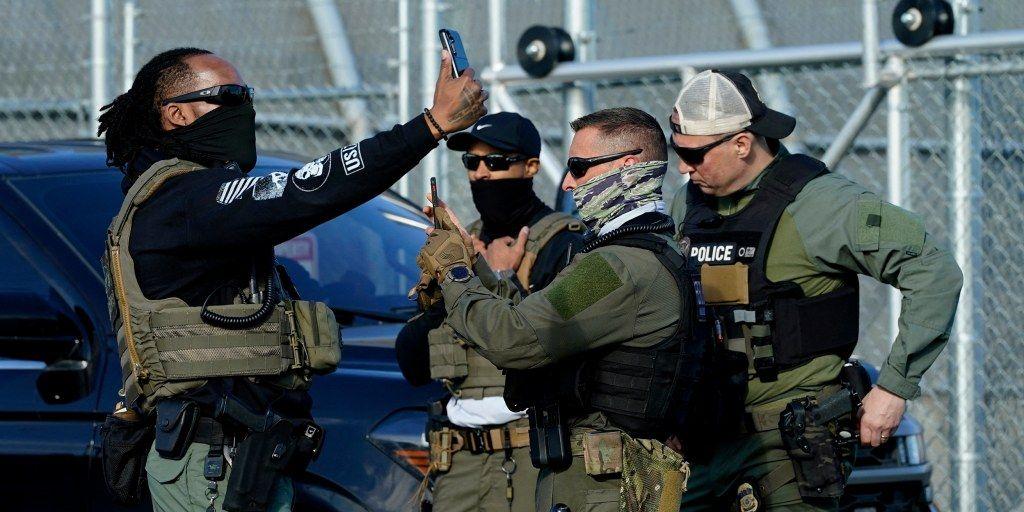
Federal immigration agents are using sophisticated facial recognition technology on smartphones to identify people during street-level enforcement operations, marking an escalation in government tracking capabilities that has alarmed civil liberties advocates and lawmakers. The practice came to light through incidents in Minneapolis, where Luis Martinez was stopped by masked agents who held a cellphone inches from his face to scan his features before repeatedly asking if he was a U.S. citizen
1
. Despite the face scan failing to find a match, Martinez was only released after producing his U.S. passport, which he carried specifically for fear of such encounters.
Source: AP
The Department of Homeland Security has confirmed it uses a facial recognition app called Mobile Fortify, developed by vendor NEC, which compares face scans taken by agents against "trusted source photos" to verify identities
3
. The app, which also includes fingerprint-matching systems, has been used by Customs and Border Protection and Immigration and Customs Enforcement since before the recent immigration crackdown intensified. According to Illinois Attorney General Kwame Raoul's office, Mobile Fortify has been deployed more than 100,000 times since debuting last year2
.
Source: NBC
Biometric Surveillance Expands Without Consent or Transparency
ICE agents and other federal officers have photographed and scanned Americans in Minneapolis, Chicago, and Portland, Maine, often without their consent, according to NBC News verification of more than a dozen videos
2
. In interactions observed by reporters and videos posted online, federal agents rarely ask for consent before holding their cellphones to people's faces, and in some cases continue scanning even after someone objects. Near Columbia Heights, Minnesota, masked agents held their phones a foot away from people's faces to capture biometric details during operations that included the detention of a 5-year-old boy and his father1
.Andrew Ferguson, a professor of law at George Washington University who focuses on police technology, described the development as shocking. "The idea that law enforcement is using mobile facial recognition on the streets is shocking, largely because there was a sense that such technology was neither ready for prime time, nor acceptable in a free society," Ferguson stated
2
. The lack of oversight becomes more concerning given that DHS may hold collected photos for 15 years, and no one can opt out of being scanned, according to department documents obtained through a Freedom of Information Act request.Databases and Government Tracking Capabilities Raise Privacy Rights Concerns
Over the past year, Homeland Security and other federal agencies have dramatically expanded their ability to collect, share, and analyze people's personal data through a web of agreements with local, state, federal, and international agencies, plus contracts with technology companies and data brokers
1
. The databases include immigration and travel records, facial images, and information drawn from vehicle databases. Together with license-plate readers and commercially available phone-location data, federal authorities can now monitor American cities at a scale that would have been difficult to imagine just a few years ago, reconstructing daily routines and associations.Dan Herman, a former Customs and Border Protection senior adviser in the Biden administration who now works at the Center for American Progress, warned that the government's access to facial recognition and surveillance systems poses a threat to privacy rights without adequate checks. "They have access to a tremendous amount of trade, travel, immigration and screening data. That's a significant and valuable national security asset, but there's a concern about the potential for abuse," Herman said. "Everyone should be very concerned about the potential that this data could be weaponized for improper purposes"
3
.Related Stories

Legal Challenges Mount Against Surveillance Practices
Two sweeping lawsuits have alleged that the face scans are part of a larger practice of ICE violating people's rights. The office of Illinois Attorney General Kwame Raoul alleges that the facial scans violate the Fourth Amendment right to privacy from government searches without a warrant
2
. The American Civil Liberties Union of Minnesota has also filed a class action lawsuit against ICE and CBP, alleging that their officers engage in a range of illegal practices and that forced facial scans have become routine. DHS has responded that "claims that Mobile Fortify violates the Fourth Amendment or compromises privacy are false" and that the app "is lawfully used nationwide in accordance with all applicable legal authorities."The expanding surveillance raises questions about what comes next as the technology becomes more sophisticated and integrated into daily enforcement operations. Civil liberties experts warn that the expanding use of these systems risks sweeping up citizens and noncitizens alike, often with little transparency or meaningful oversight
1
. For Martinez and others in Minnesota, the impact is immediate. "I had been telling people that here in Minnesota it's like a paradise for everybody, all the cultures are free here," he said. "But now people are running out of the state because of everything that is happening. It's terrifying. It's not safe anymore."References
Summarized by

Navi
[1]
Related Stories
Border Patrol's AI-Powered Surveillance Network Monitors Millions of US Drivers
20 Nov 2025•Policy and Regulation

New Orleans Police Pause Controversial AI-Powered Facial Recognition Program Amid Privacy Concerns
20 May 2025•Technology
AI-Powered Immigration Tools: From Biden to Trump's Potential Crackdown
27 Nov 2024•Technology

Recent Highlights
1
Anthropic's Claude AI can now control your computer to complete tasks autonomously
Technology
2
Nvidia's Jensen Huang calls OpenClaw the next ChatGPT, sending Chinese AI stocks soaring
Technology

3
Elon Musk unveils $20 billion Terafab chip manufacturing project to produce terawatt of computing
Technology

Recent Highlights
Today's Top Stories




Your Daily Dose of Curated AI News
Don’t drown in AI news. We cut through the noise - filtering, ranking and summarizing the most important AI news, breakthroughs and research daily. Spend less time searching for the latest in AI and get straight to action.

